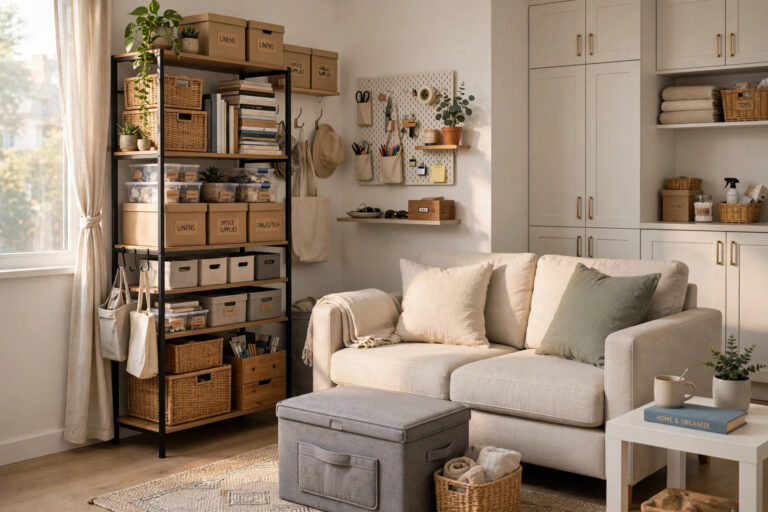
20 Attic Storage Ideas for 2026
An attic is the room where things go to be forgotten — the Christmas lights in a tangled bag, the ornaments in a box with no lid, the suitcase on top of the wreath on top of the tree. The fix is not a bigger attic, it is attic storage with a system: sort first, use bins that fit the roof, give the fragile things a safe spot, and keep one clear walkway so you can actually reach what you stored.
These 20 attic storage ideas are safe labelled attic storage for seasonal stuff: start by sorting into keep, donate and toss, choose clear bins that stack and lock, protect the wreaths, ornaments and lights, and finish with a walkway, a shelf wall and one annual check — so the attic stops being the room where things disappear and becomes the room where things wait, labelled and ready.
Every idea below works in a real attic, from a low-eaved loft with one roof window to a tall attic with a proper floor. The holiday bins that live up there are covered in 25 Holiday Decor Storage Ideas for 2026, where the bins get labelled before they climb the ladder — and the garage, the attic's partner for the bulky things that do not belong upstairs, is in 25 Garage Storage Ideas for 2026. Pick three ideas that fit your attic, start with the sort, and build from there.
Sort first: decide what the attic is for
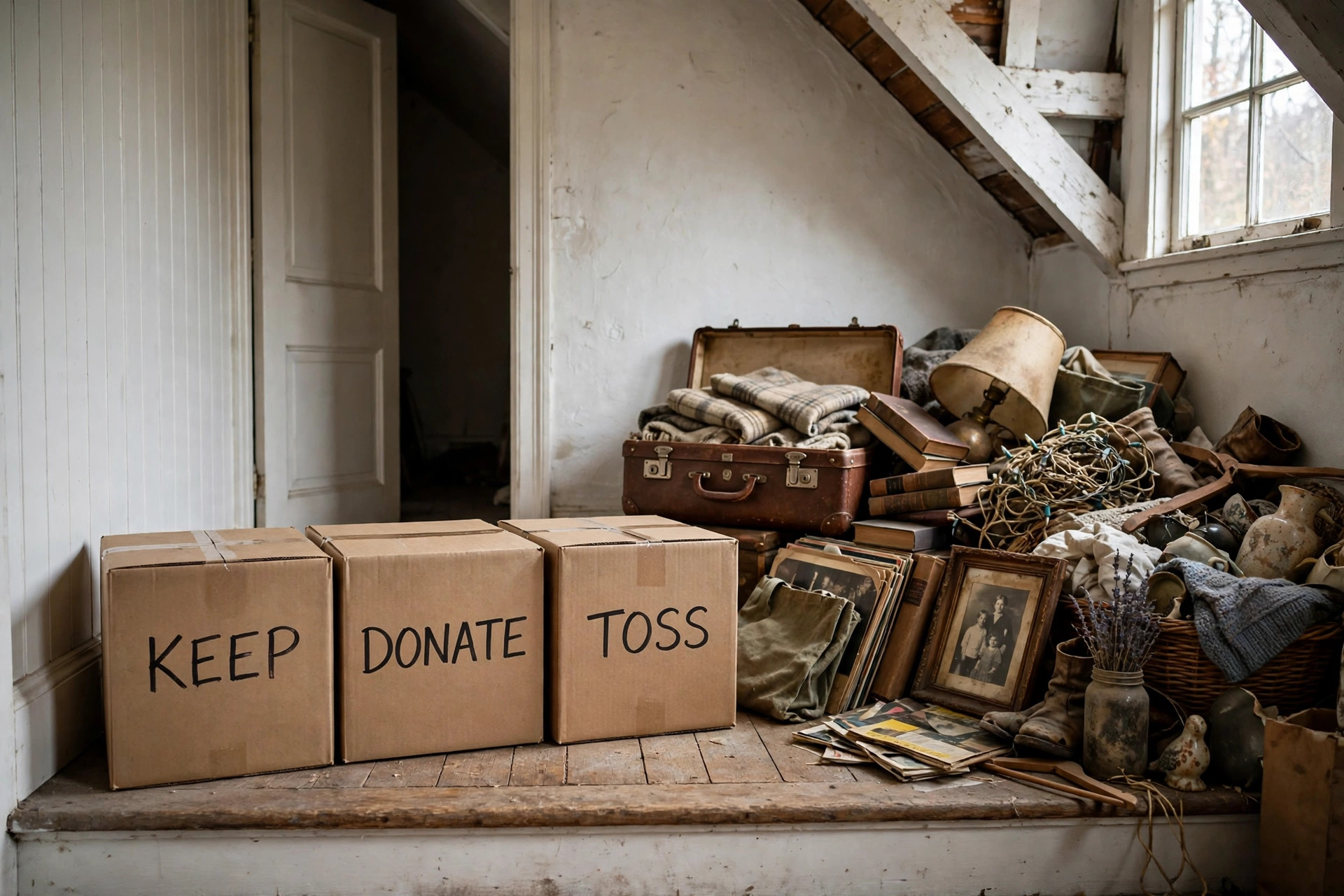
1. Sort the attic into keep, donate and toss before a single bin goes up — the sort comes before the storage
A bin full of things you do not want is a bin that wastes the attic, because the attic is the smallest storage room in the house and every bin in it has to earn its place. Sort before you store — keep, donate and toss before a single bin goes up — so only the things worth keeping climb the ladder. Take everything out of the attic in batches, put three boxes on the landing, and decide on each thing where you can see it in daylight, because the thing you decide on in the attic is the thing you decide on in the dark. The toss box goes straight out of the house, the donate box goes straight to the car, and only the keep box goes back up, because the box that stays on the landing is the box that comes back. One sort, and the attic loses a third of its load before a single bin is bought.
2. Take one holiday at a time — sort Christmas first, then Halloween, then the rest
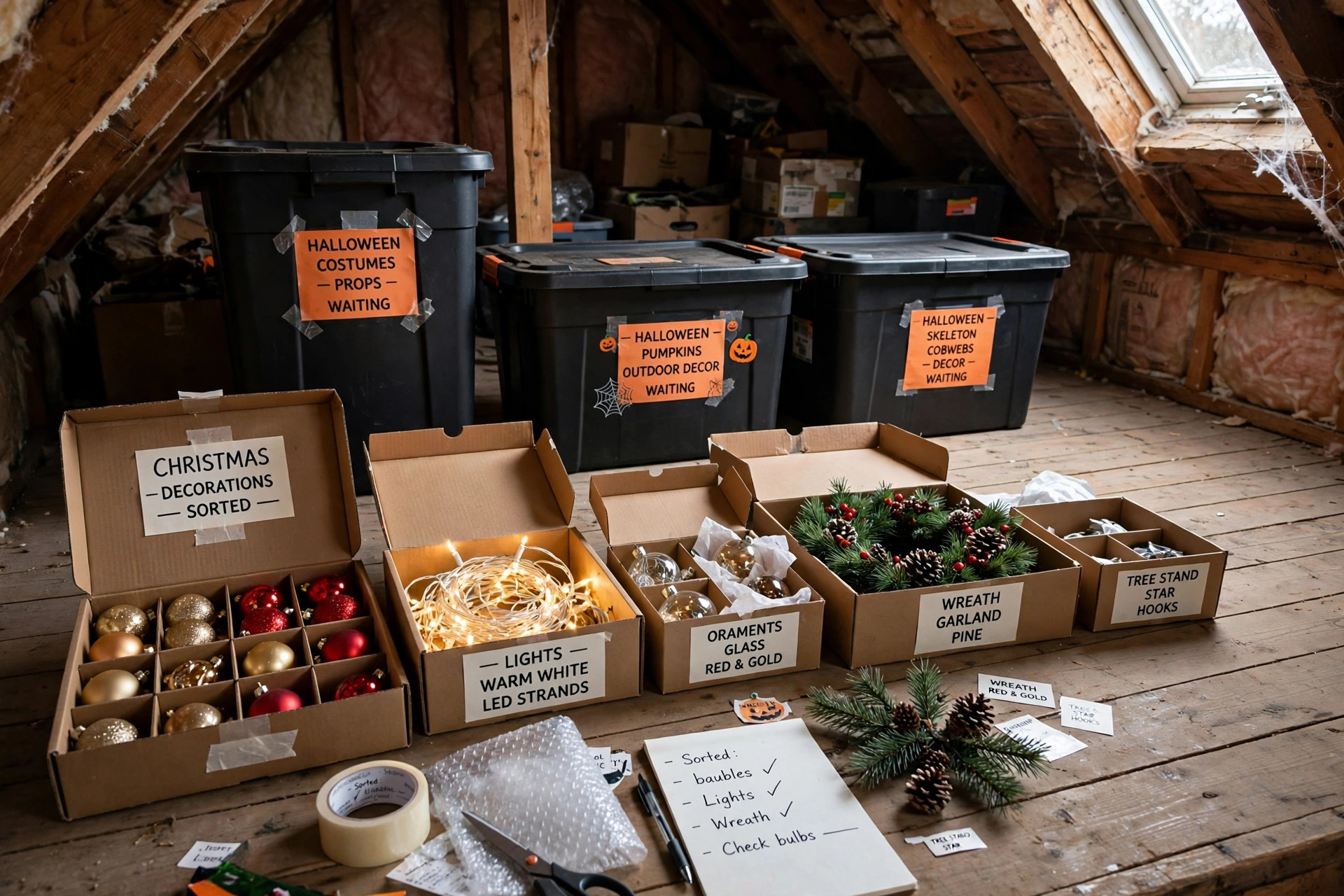
An attic sorted all at once is an attic that never gets sorted, because the whole attic is too big a job and the job that is too big is the job that gets put off. Take one holiday at a time — sort Christmas first, then Halloween, then the rest — so each sort is one afternoon and the attic is done in a month. Start with Christmas, because Christmas is the biggest pile and the pile that causes the most trouble, and finish it properly before you touch Halloween. Put each holiday's things in its own pile on the landing, label the pile, and carry only that pile back up, because the pile that is labelled is the pile that stays together. One holiday per weekend, and the attic is sorted without a single ruined Saturday.
3. Label every bin before it goes up the ladder — the label is written on the ground, not in the attic
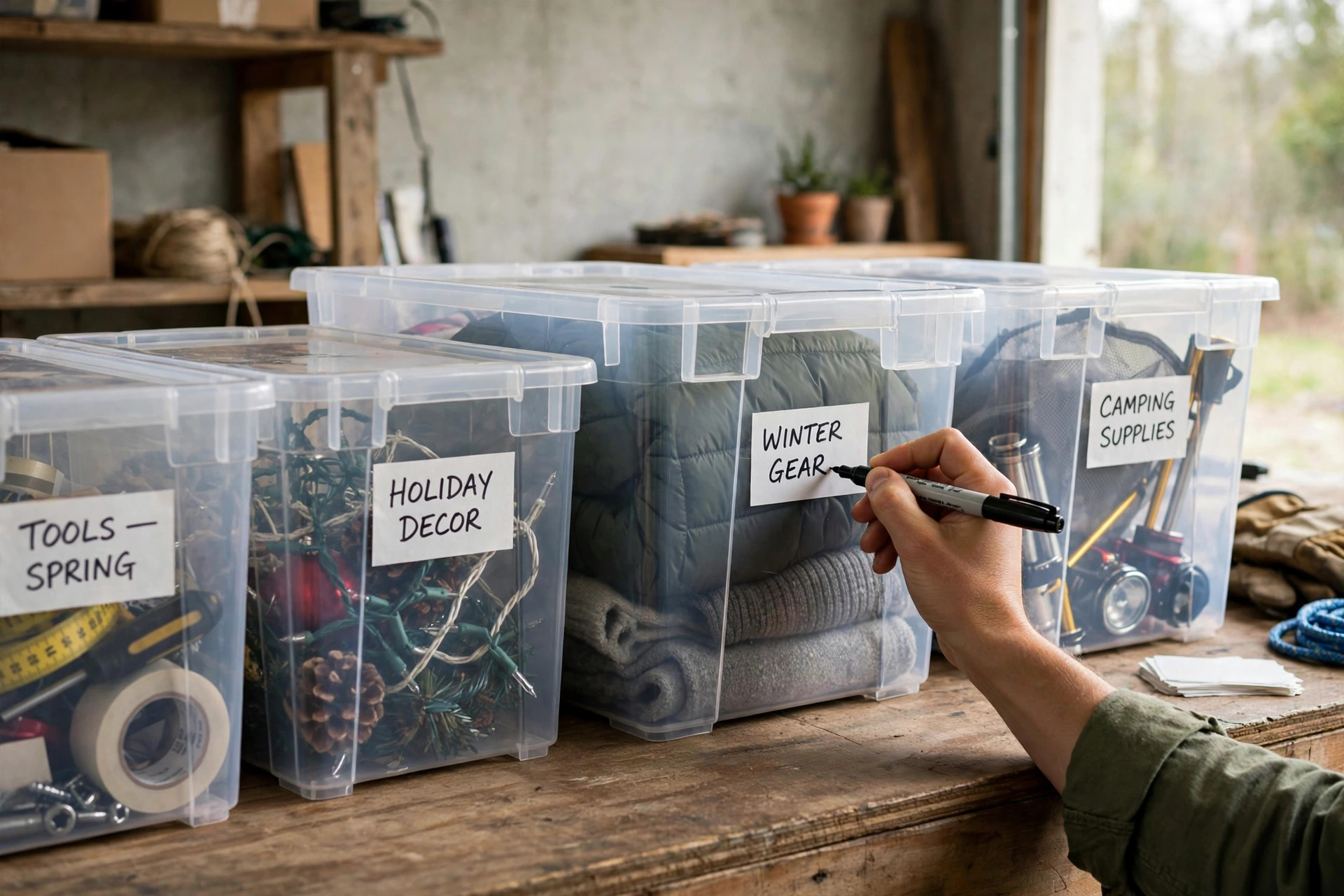
A bin with no label is a bin you have to open, because the bin you cannot read is the bin you have to lift down, open, and put back, and that is three trips for one thing. Label every bin before it goes up the ladder — the label is written on the ground, not in the attic — so the bin is readable from the ladder the moment you need it. Write the label big, on the end of the bin that faces the walkway, and write what is inside it, not just the holiday, because "Christmas — lights and hooks" is a label that finds the lights and "Christmas" is a label that finds a guess. Use a marker on a white label, not a pencil on tape, because the marker survives the attic heat and the pencil fades by spring. Label on the ground, and the attic reads like a shelf.
4. Photograph the contents of each bin and tape the photo to the lid — the photo is the inventory
A label tells you the category, but it does not tell you the contents, because "Christmas ornaments" is a label that could mean the red baubles or the ones your grandmother gave you. Photograph the contents of each bin and tape the photo to the lid — the photo is the inventory — so you can see what is inside without opening the bin. Lay the contents out on the floor, take one photo from above, print it small, and tape it to the lid where the label is, because the photo on the lid is the photo you see from the walkway. Keep the photos on your phone too, in one album called "attic", because the album on your phone is the inventory you carry downstairs. One photo per bin, and the attic answers its own questions.

5. Keep one inventory list by the attic door — one list, and nothing goes up unlisted
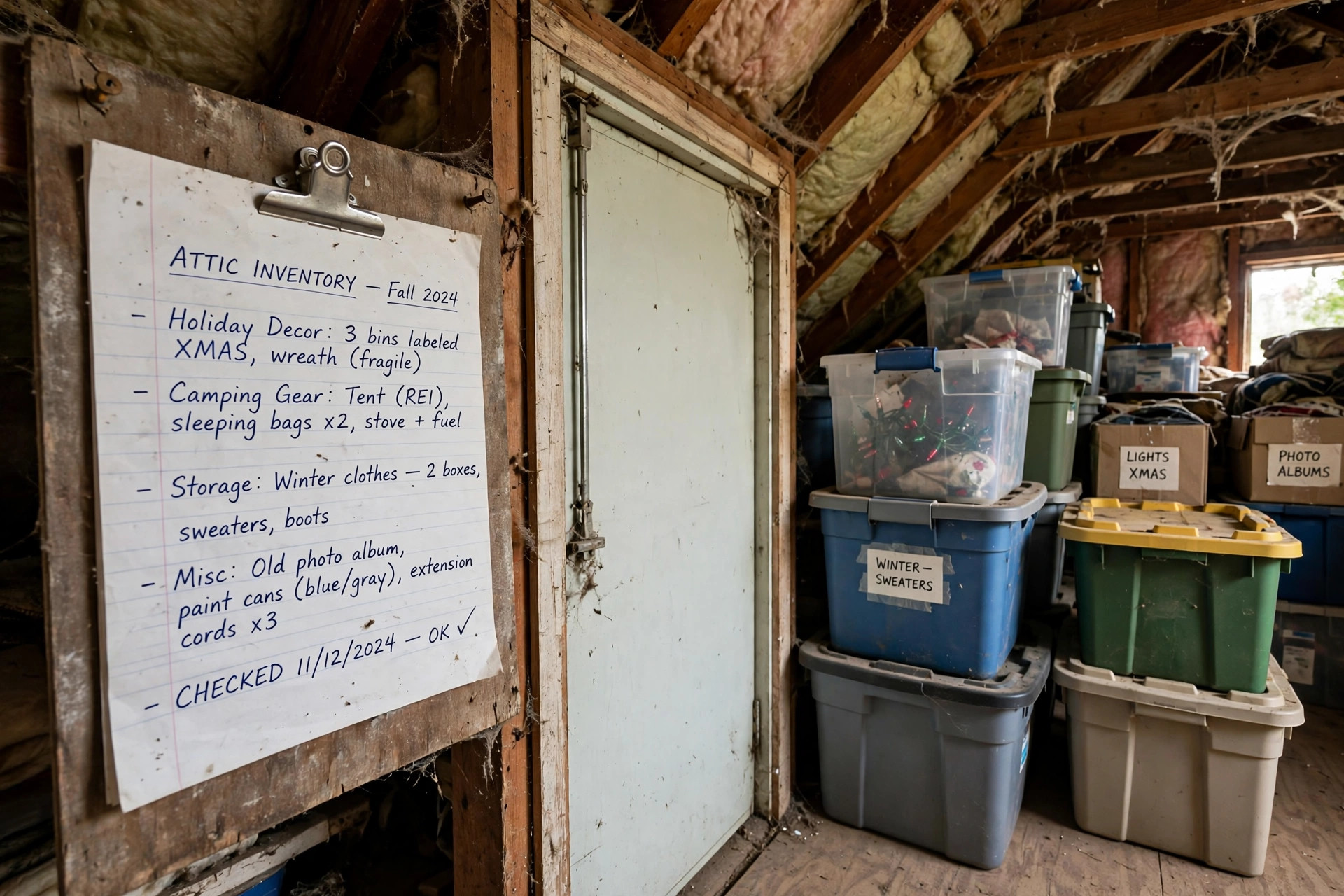
An attic with no list is an attic where things go in and never come out, because the thing that is not written down is the thing nobody remembers. Keep one inventory list by the attic door — one list, and nothing goes up unlisted — so the attic has a record and the record is where the attic starts. Write each bin on the list with its label and its zone, cross it off when it comes down, and add it back when it goes up, because the list that is kept is the list that works. Clip the list to a board by the door, not on a loose sheet that blows away, and use a pencil so it can be changed, because the list that changes is the list that stays true. One list by the door, and nothing climbs the ladder unlisted.
Bins that work in an attic
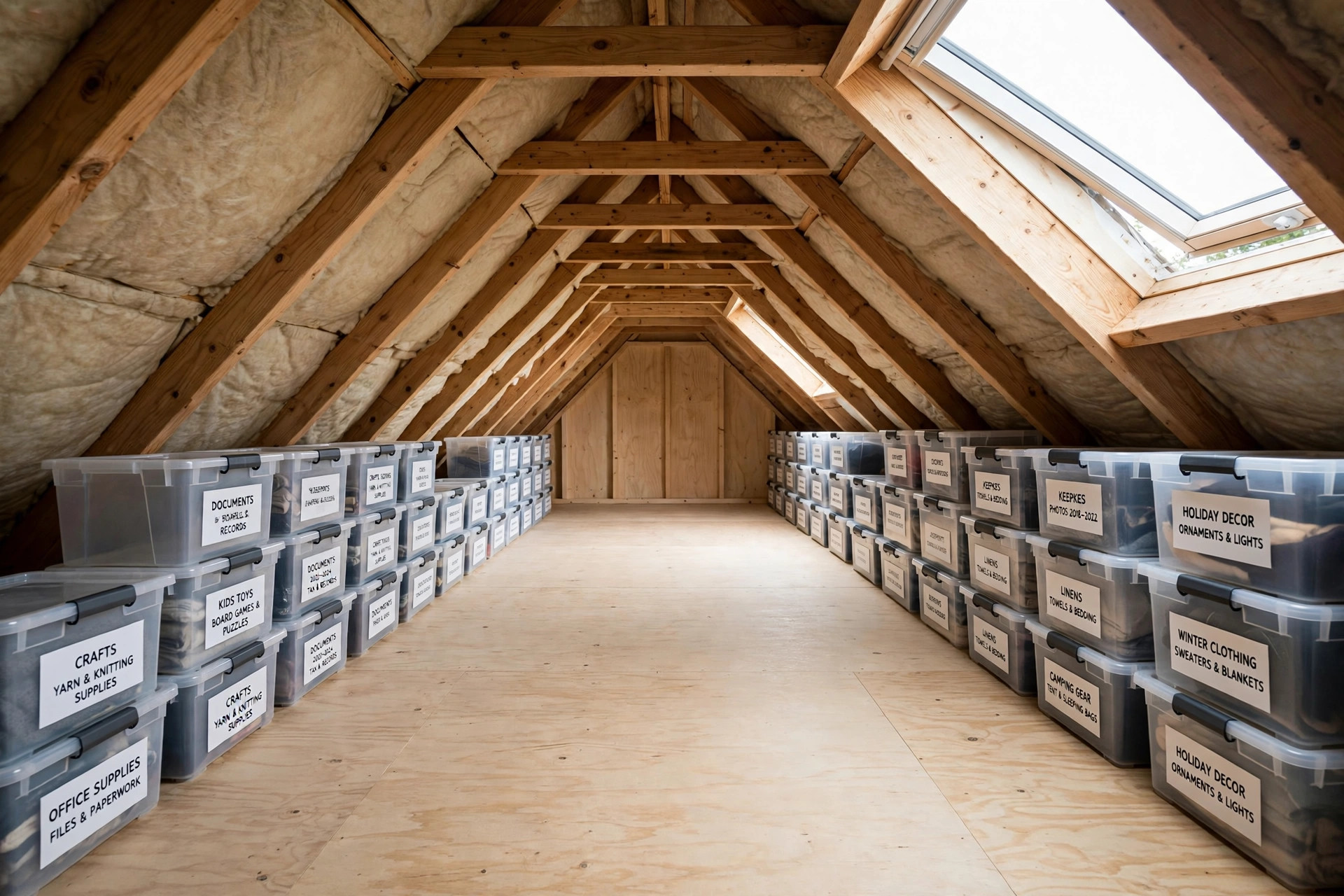
6. Clear bins with lids, all the same size — one bin size stacks, two bin sizes topple
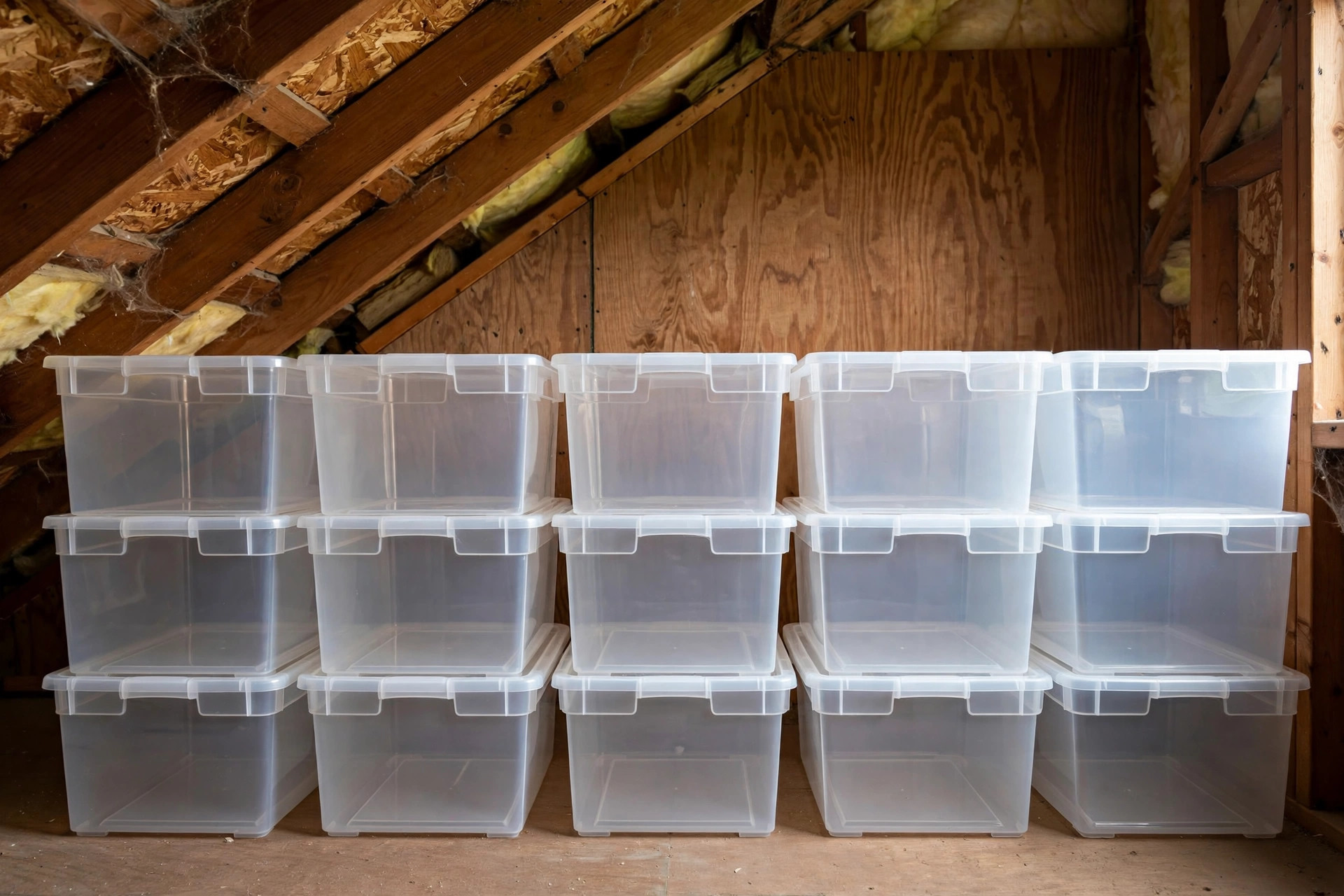
An attic full of different bins is an attic full of wobble, because the bin that is a different size is the bin that does not stack, and the stack that does not stack is the stack that falls. Use clear bins with lids, all the same size — one bin size stacks, two bin sizes topple — so every bin sits squarely on the one below and the whole wall of bins stands steady. Clear bins matter in an attic, because the bin you can see into is the bin you do not have to open, and the attic is the room where opening a bin means lifting it down. Choose bins with lids that clip on, not lids that rest, because the lid that clips is the lid that stays on when the bin is carried up a ladder. One size, clear, with a clipping lid, and the attic stacks like a shelf. (Check on Amazon for clear stackable bins with clipping lids in one size, which stack squarely and show what is inside.)
7. Colour-coded lids, one colour per season — red for Christmas, orange for Halloween, green for the garden
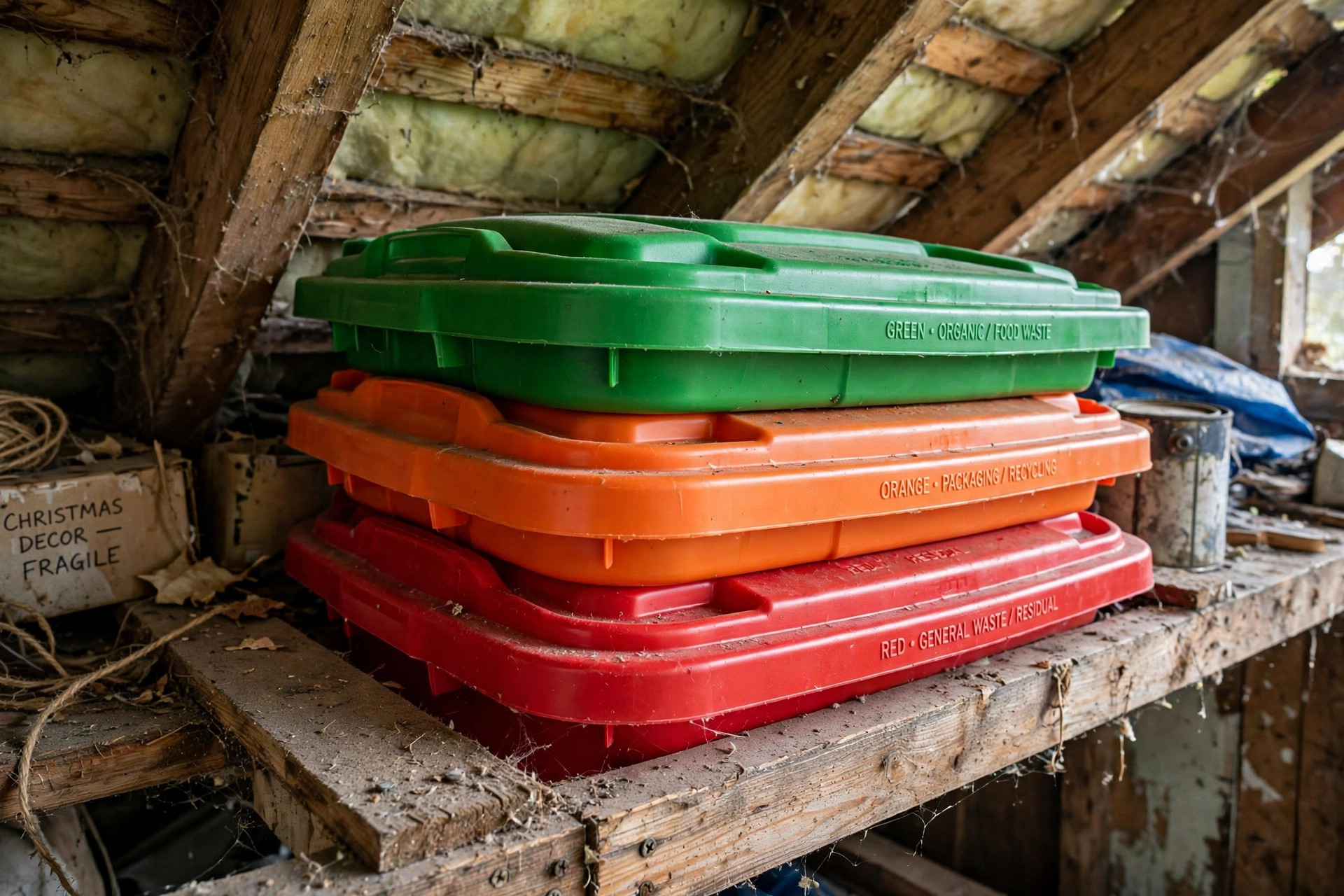
A wall of identical bins is a wall you have to read, because the bin that looks like every other bin is the bin you have to stop and check. Colour-code the lids — one colour per season, red for Christmas, orange for Halloween, green for the garden — so the season is visible from the ladder before a single label is read. Buy the lids in the season's colour, or stick a coloured dot on each lid, because the colour is the first thing your eye finds and the label is the second. Keep the code on the inventory list too, so the next person in the attic reads the same code, because the code that is written down is the code that survives. Red, orange, green, and the attic sorts itself by colour.
8. Low bins that slide under the eaves — the low space under the roof finally earns its keep
The space under the eaves is the space nobody uses, because the roof is too low to stand under and the floor there is the floor that gets ignored. Slide low bins under the eaves — the low space under the roof finally earns its keep — so the shallowest part of the attic holds the flattest things. Measure the height at the eaves before you buy, because the bin that is one inch too tall is the bin that does not slide in, and put the things you need least in the deepest spot, because the deepest spot is the one you reach last. Label the end that faces out, because the end that faces out is the end you read, and slide the bins in on a piece of cardboard if the floor is rough, because the cardboard is the runner that stops the bin from catching. Low bins under the eaves, and the attic gains a whole wall of storage it never had.
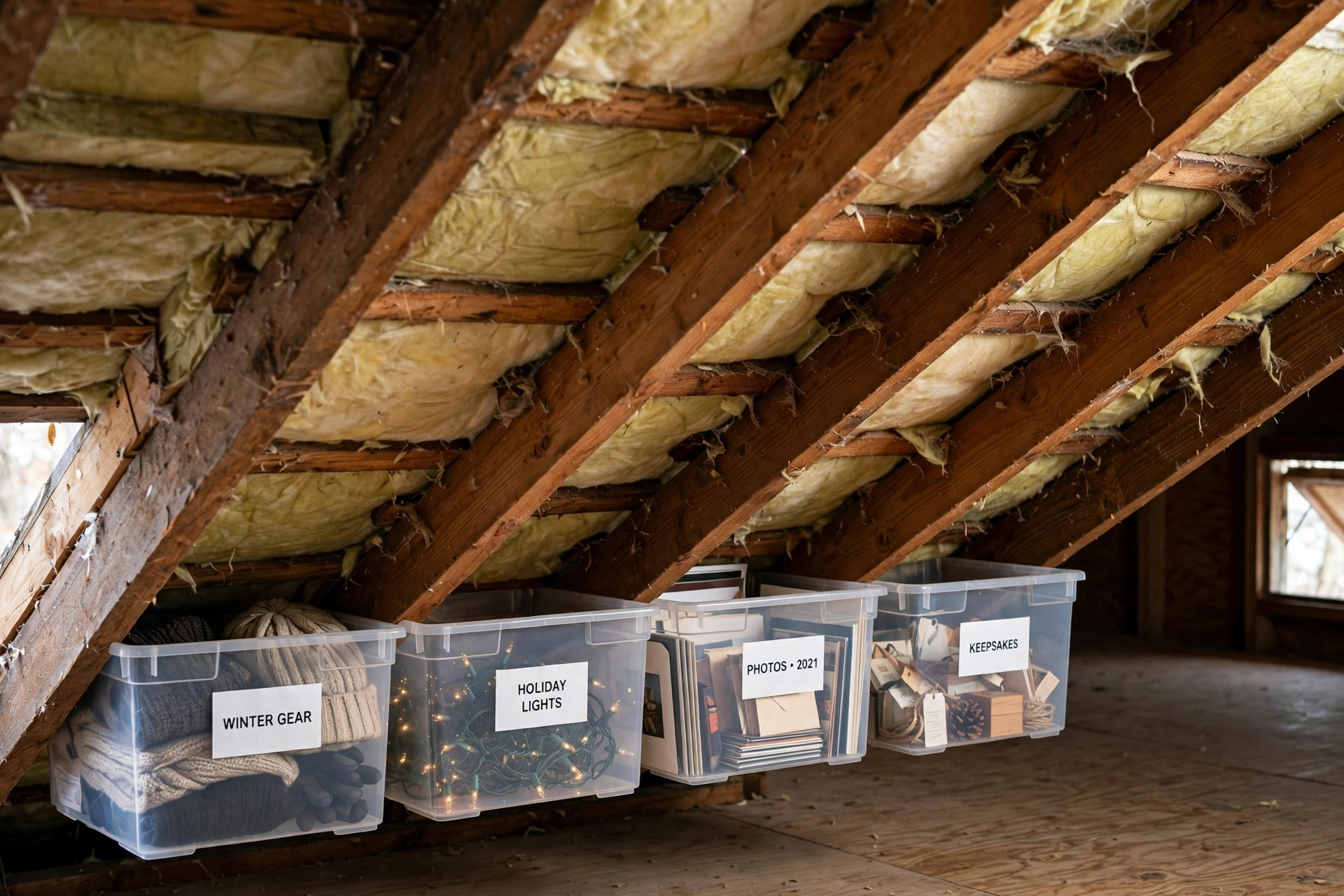
9. Bins that fit between the joists — measure the joist gap once, buy the bins once
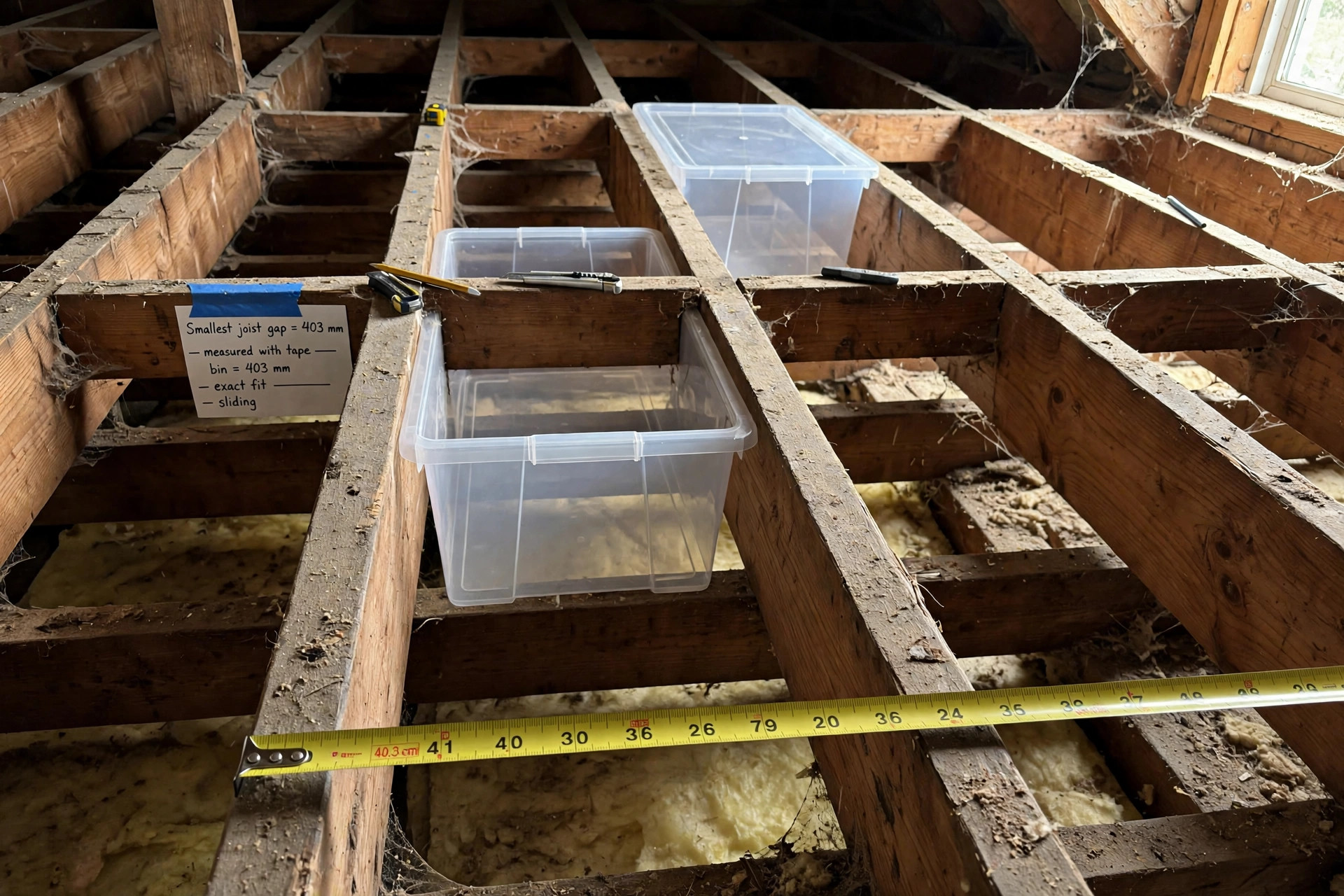
Joists are the hidden ruler of the attic, because the gap between them is the width that decides which bin fits and which bin does not. Measure the joist gap once and buy the bins once — bins that fit between the joists — so the bins slide between the timbers instead of sitting on top of them. Take the tape measure up, measure three gaps, and use the smallest one, because the smallest gap is the one every bin has to fit. Write the measurement on the inventory list, because the measurement on the list is the measurement you still have when you buy the next bin. Measure once, buy once, and the bins fit the attic instead of fighting it.
10. Stackable bins with lids that lock — the stack that locks is the stack that stays standing
An attic stack that leans is a stack that falls, because the attic floor is not always level and the bin on top is the bin that slides. Use stackable bins with lids that lock — the stack that locks is the stack that stays standing — so each bin clicks onto the one below and the whole stack moves as one. Stack no more than three high in an attic, because the stack that is three high is the stack you can lift from safely and the stack that is five high is the stack that sways. Put the heaviest bin at the bottom, because the heavy bin at the bottom is the anchor and the light bin at the top is the thing that lifts easily. Lock, stack three high, heavy at the bottom, and the attic wall of bins stands through the summer heat.

Awkward and fragile things
11. Wreaths in clear bags hung on wall hooks — the wreath hangs, it never gets crushed
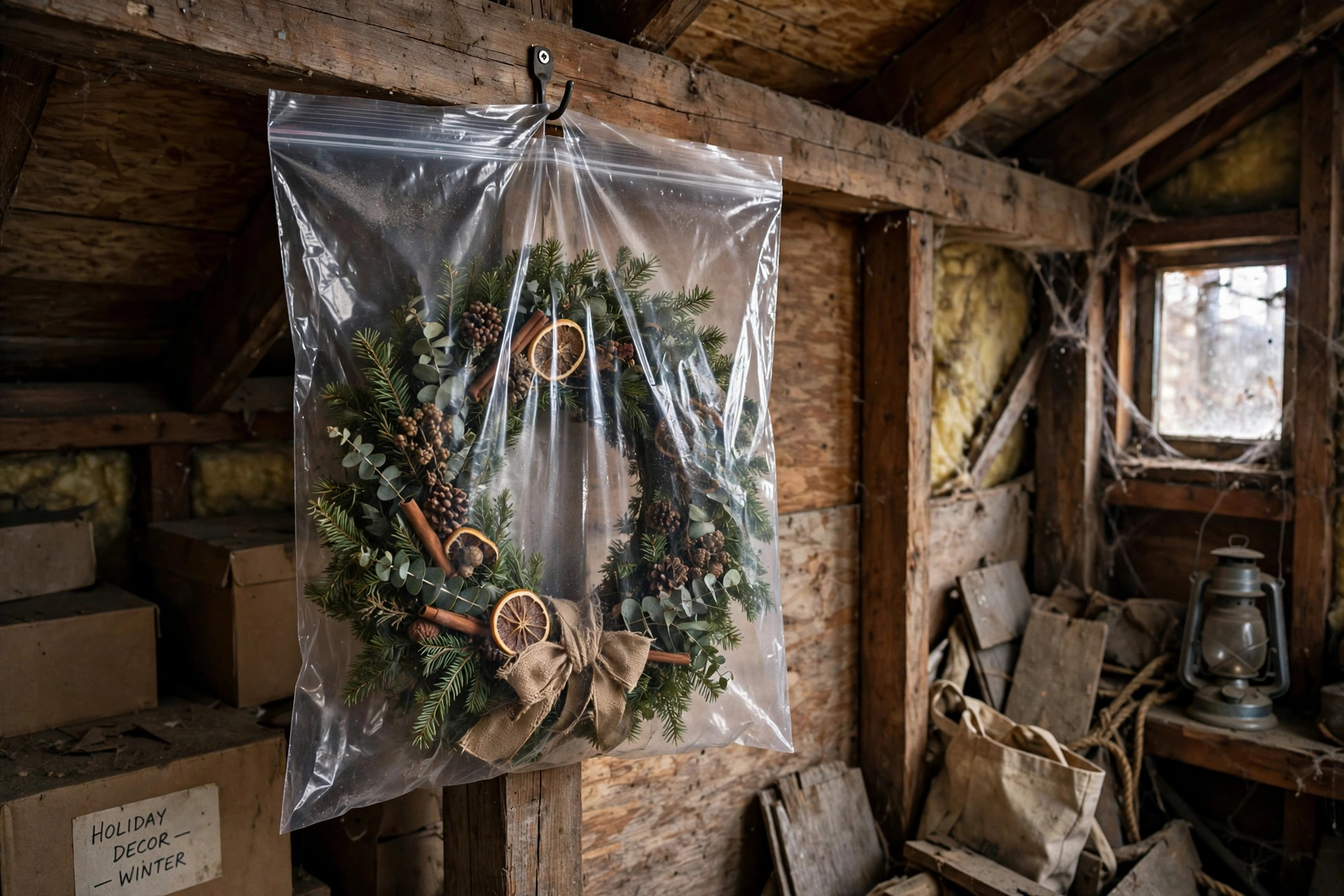
A wreath in a bin is a wreath that gets crushed, because the bin on top of it is the thing that flattens it and the flattened wreath is the wreath that never looks right again. Hang the wreaths in clear bags on wall hooks — the wreath hangs, it never gets crushed — so each wreath keeps its shape all year. Slip the wreath into a clear bag, seal the bag, and hang it from a hook on the gable wall, because the bag is the dust cover and the hook is the thing that keeps it off the floor. Hang the wreaths in a row, one hook per wreath, and label the bag, because the bag that is labelled is the bag you find in November. A hook and a bag, and the wreath comes down looking the way it went up.
12. Ornaments in a divider box, one bauble per slot — the box that divides is the box that saves the baubles
Ornaments loose in a box break, because the bauble that touches another bauble is the bauble that chips, and the chipped bauble is the one that never goes on the tree again. Use a divider box — one bauble per slot, the box that divides is the box that saves the baubles — so each ornament has its own pocket and nothing touches anything else. Put the heavy ornaments at the bottom and the light ones at the top, because the heavy bauble at the bottom is the anchor and the light one at the top is the thing that lifts out easily. Wrap the oldest ornaments in tissue first, because the tissue is the extra layer and the ornament your grandmother gave you is the one worth the extra layer. One slot per bauble, and the ornaments survive the attic. (Check on Amazon for an ornament storage box with dividers, which holds one bauble per slot and stacks neatly.)

13. Christmas lights wrapped on reels — the reel is the thing that stops the tangle
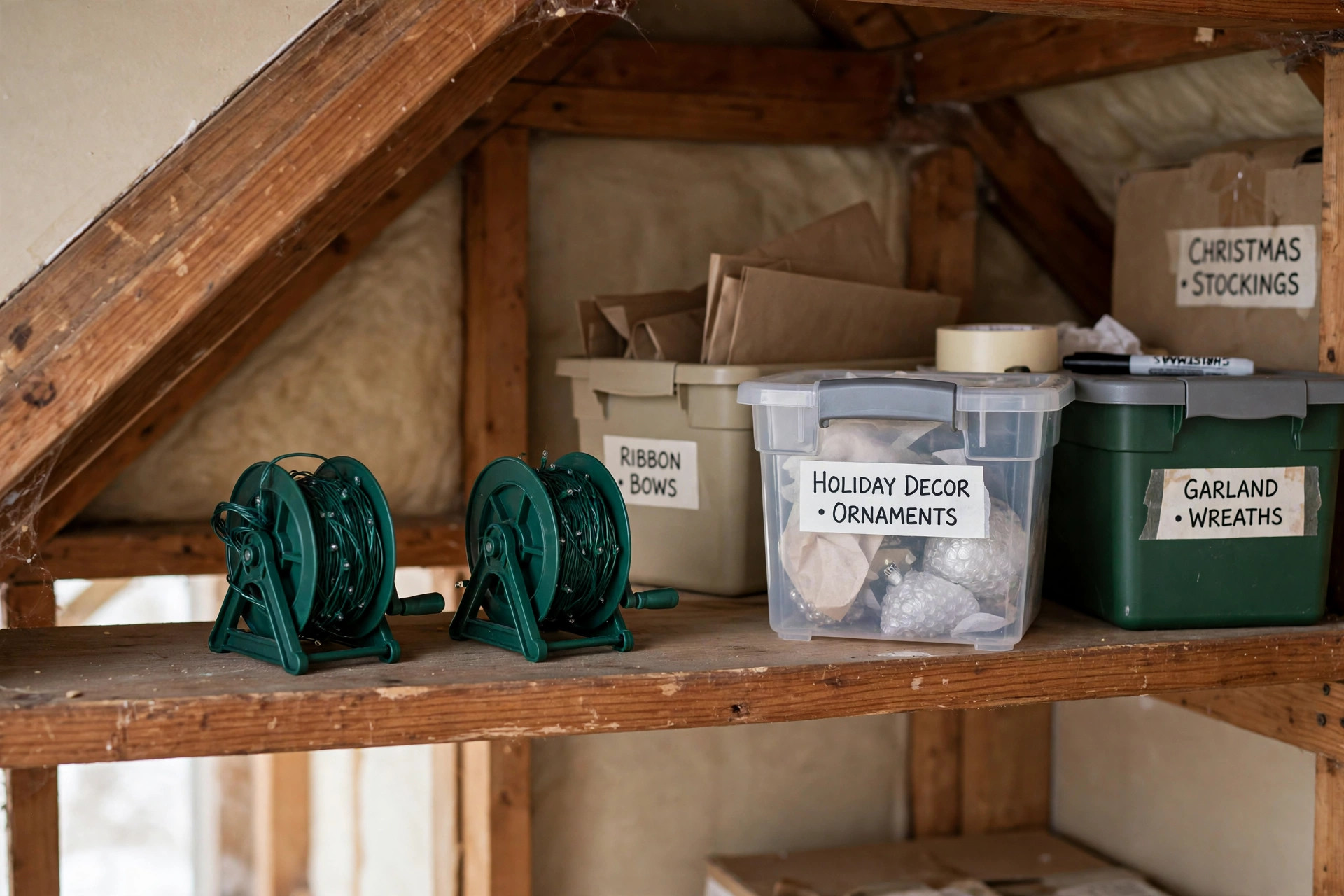
Christmas lights in a bag come out as a knot, because the lights that are loose are the lights that tangle, and the tangled lights are the lights that take an hour to undo. Wrap the lights on reels — the reel is the thing that stops the tangle — so the lights come down ready to hang. Wind each string onto its own reel, tape the plug end to the reel, and label the reel with the room it belongs to, because the reel that is labelled is the reel that goes to the right room. Keep the reels in one bin, standing upright, because the reel that stands is the reel that does not unwind. One reel per string, and the lights come out of the attic the way they went in. (Check on Amazon for Christmas light storage reels, which wind each string flat and keep the plug end taped in place.)
14. The Christmas tree in a storage bag with handles — the bag carries the tree, the tree never sheds in the attic
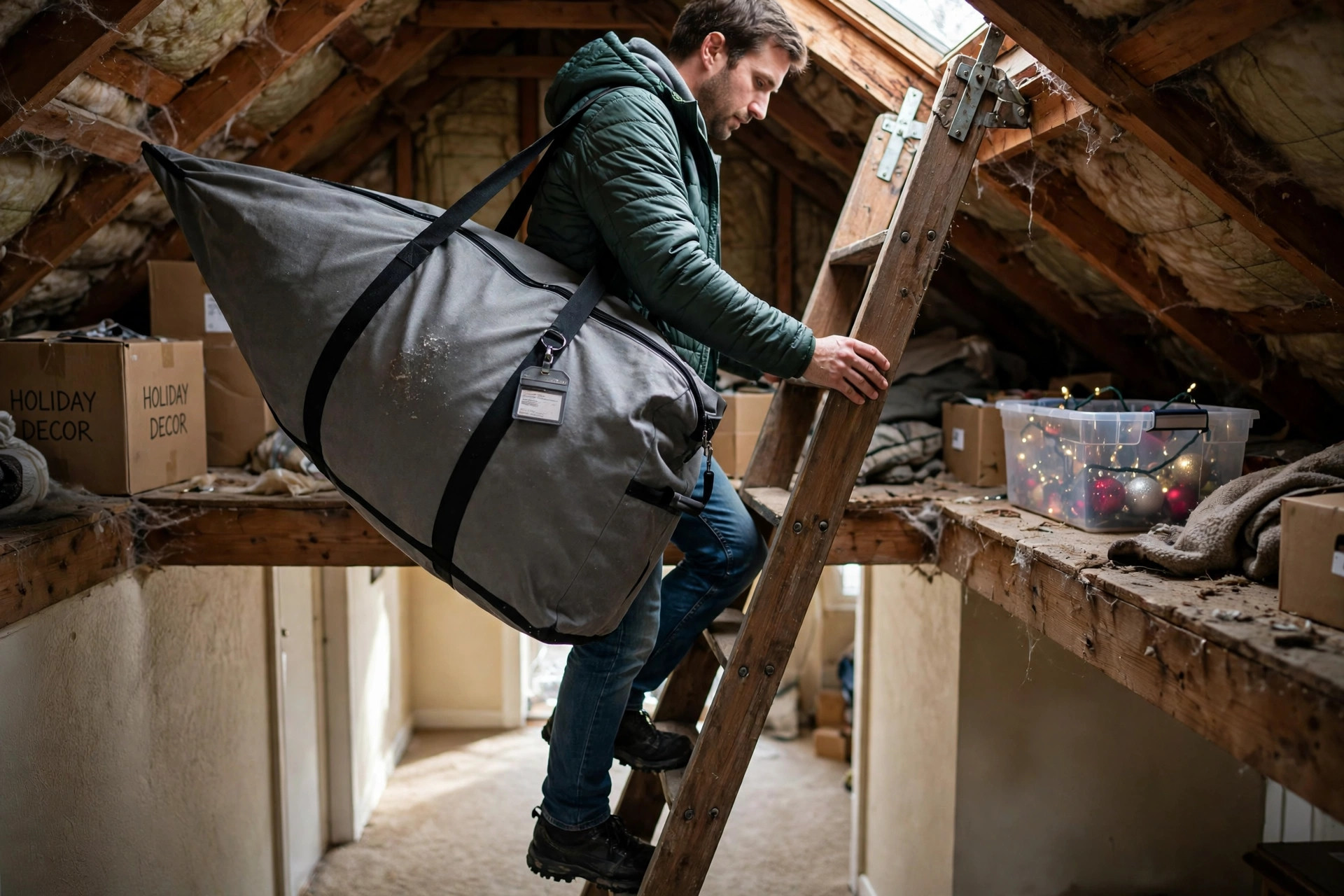
An artificial tree loose in the attic sheds, because the branches that catch on everything are the branches that drop needles on the floor, and the floor that is covered in needles is the floor you have to clean. Put the tree in a storage bag with handles — the bag carries the tree, the tree never sheds in the attic — so the tree travels up and down the ladder in one piece. Slide the tree into the bag, zip it shut, and carry it by the handles, because the handles are the thing that makes the ladder safe and the bag is the thing that keeps the needles inside. Store the bag upright against the gable wall, not flat under a bin, because the bag that stands is the bag that does not get crushed. A bag with handles, and the tree arrives downstairs the way it went up.
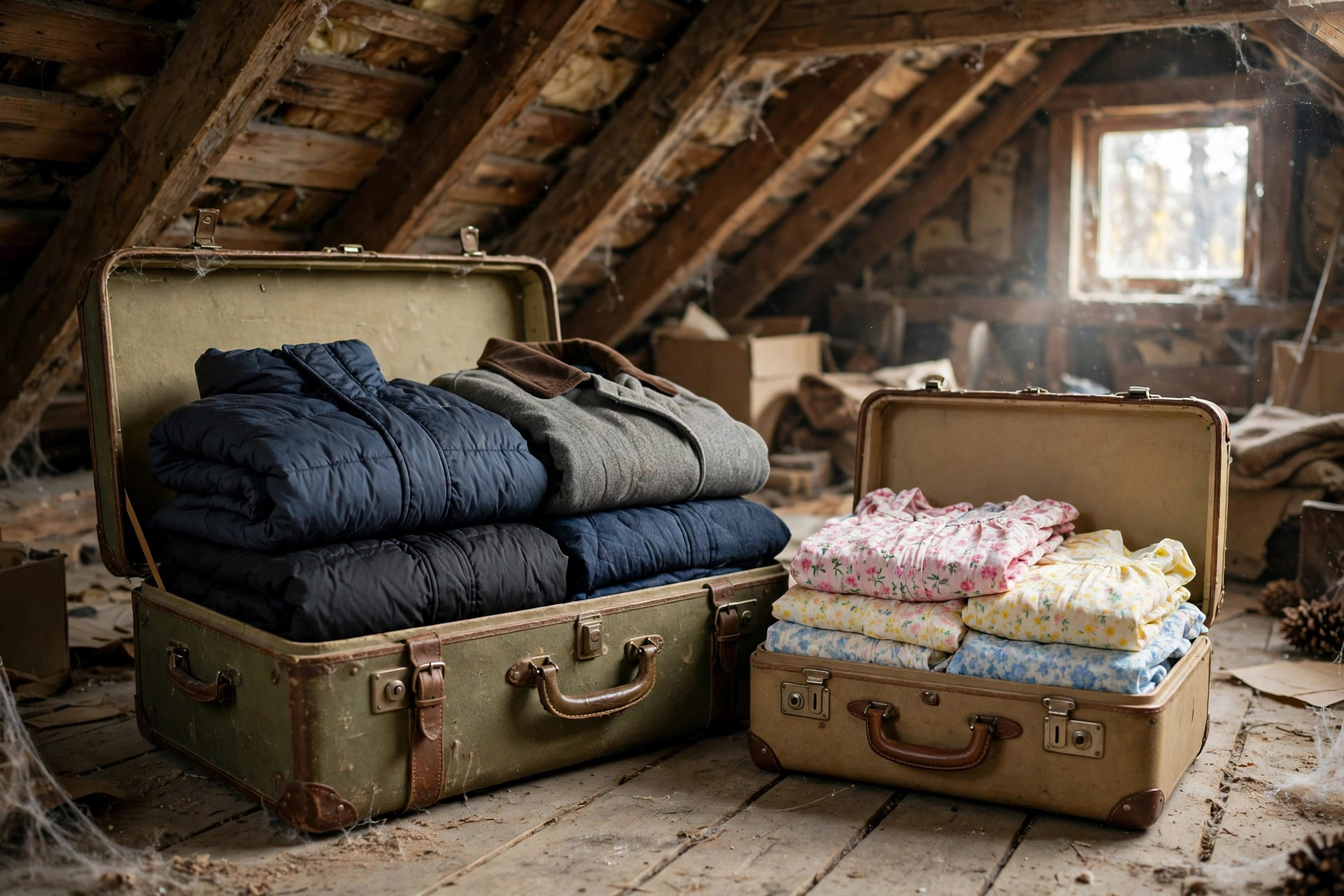
15. Suitcases as storage for out-of-season clothes — the empty suitcase holds the clothes it travelled with
An empty suitcase in the attic is a suitcase doing nothing, because the suitcase you only use twice a year is the suitcase that sits empty for ten months. Fill it with out-of-season clothes — the empty suitcase holds the clothes it travelled with — so the suitcase earns its place and the clothes have a home that is already dust-proof. Fold the winter coats into the big suitcase and the summer dresses into the small one, because the suitcase that holds the season is the suitcase that comes down when the season changes. Put a lavender sachet inside, because the sachet is the thing that keeps the clothes smelling fresh through the summer heat. A suitcase full of clothes, and the attic loses one empty box.
Systems that keep the attic tidy
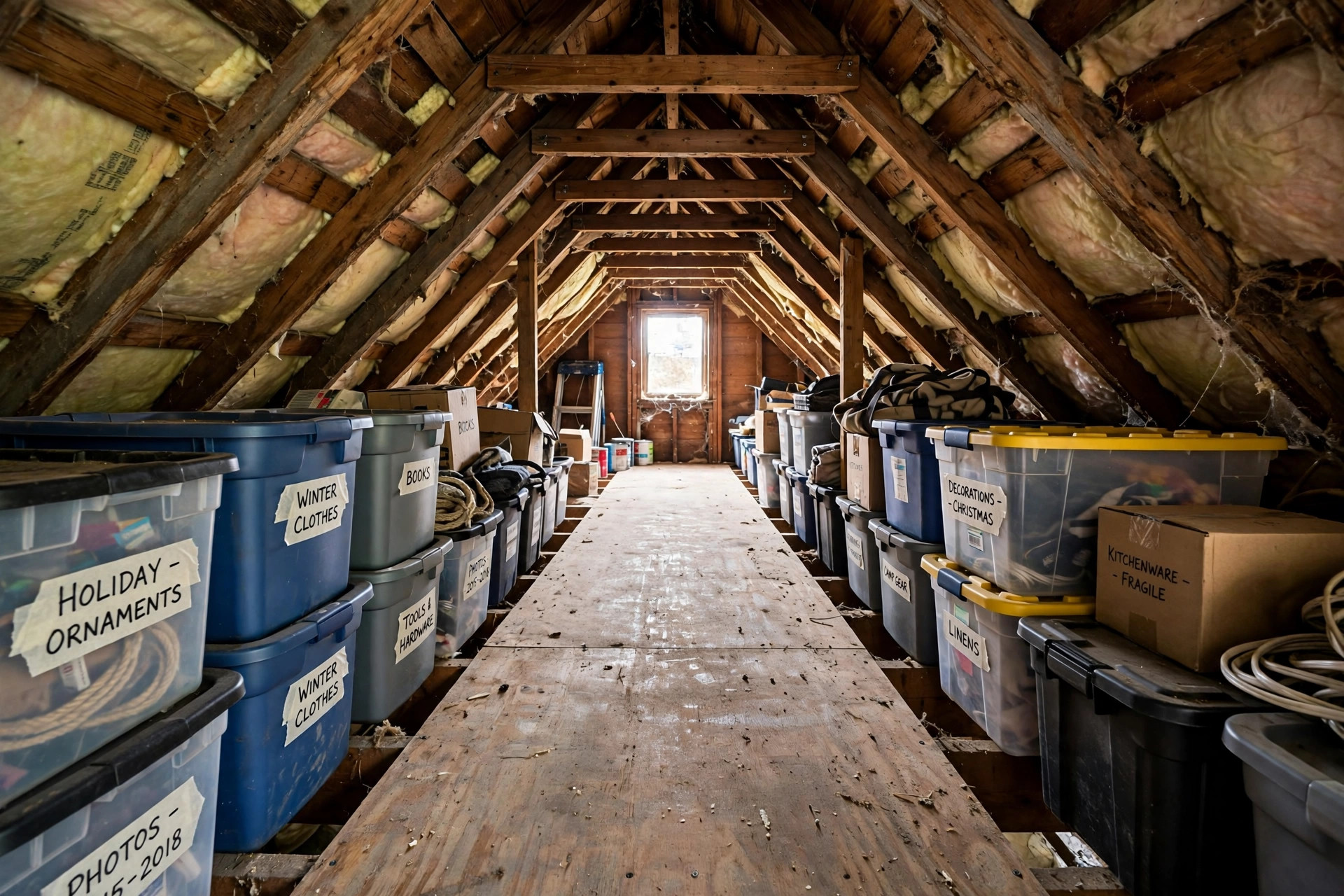
16. A clear walkway down the middle — one path, and the bins live on either side of it
An attic with no walkway is an attic you have to climb over, because the bin in the way is the bin you have to move, and the bin you have to move is the bin that falls. Keep a clear walkway down the middle — one path, and the bins live on either side of it — so you can walk to the back of the attic without moving a single thing. Mark the walkway with a strip of plywood on the floor, because the plywood is the path and the path is the thing that stays clear. Never store anything on the walkway, not even for a day, because the thing that sits on the path for a day is the thing that lives there for a year. One clear path, and the attic is a room you can walk through instead of a room you climb over.
17. Shelving along the gable wall — the only full-height wall in the attic becomes the shelf wall
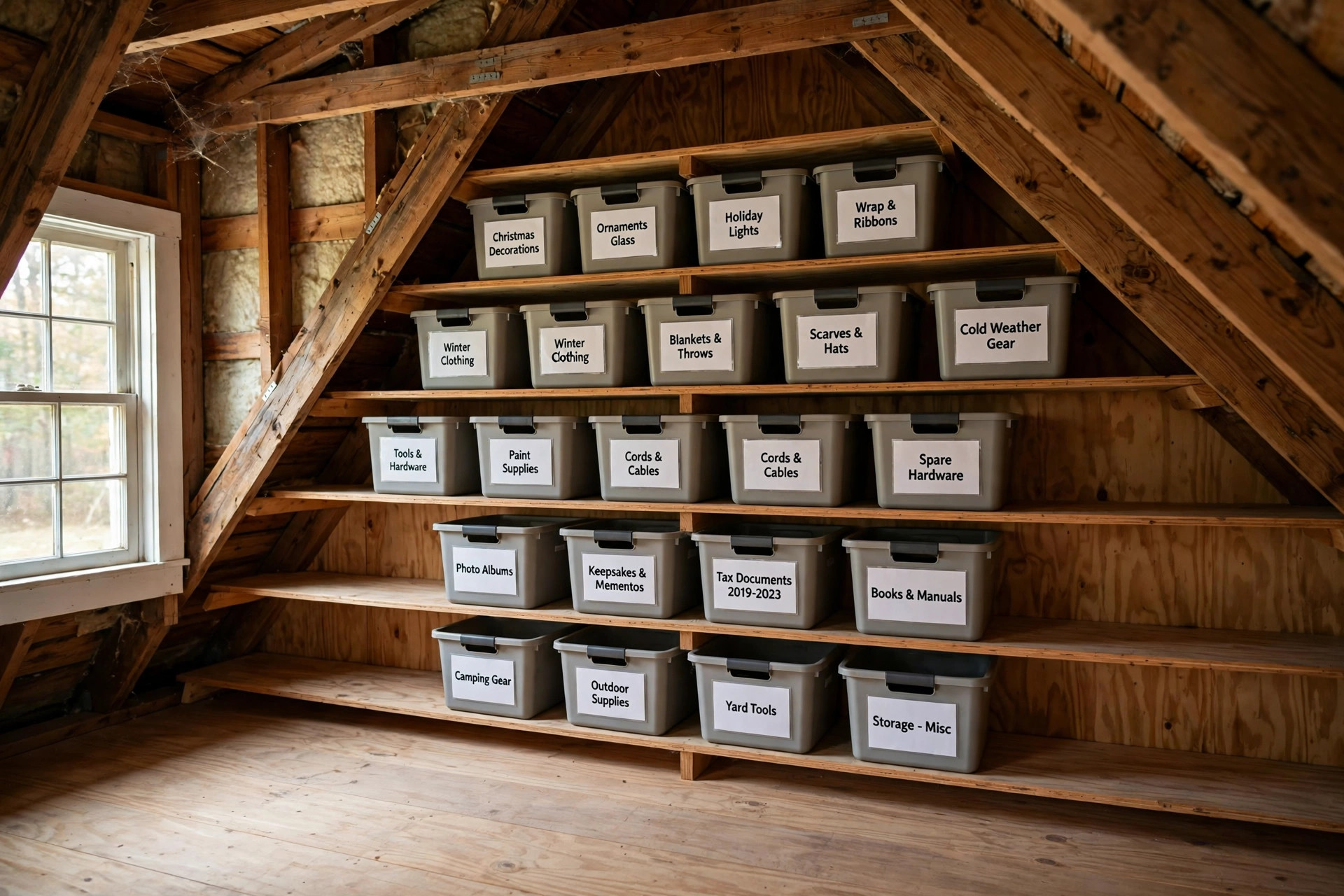
The gable wall is the only wall in the attic you can stand against, because the roof slopes everywhere else and the gable is the one flat, full-height wall the attic has. Build shelving along it — the only full-height wall becomes the shelf wall — so the bins live on shelves instead of on the floor. Fix two or three shelves, one above the other, and put the things you reach for most on the middle shelf, because the middle shelf is the one your hand finds without a ladder. Anchor the shelves into the studs, because the shelf that is anchored is the shelf that holds the weight, and never load a shelf with more than it can carry, because the attic floor is not a warehouse floor. Shelves on the gable wall, and the attic gains a whole room of storage without losing its walkway.
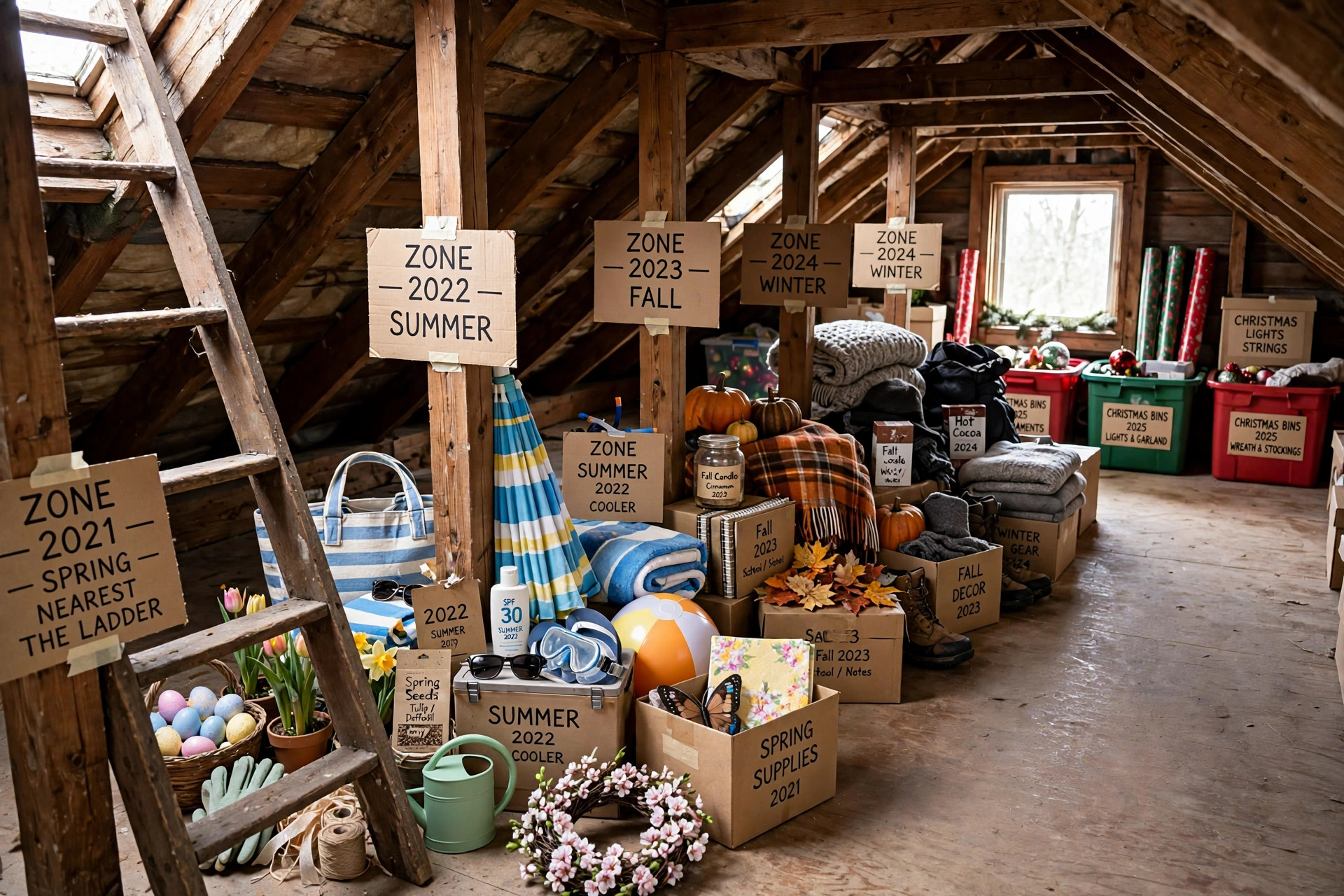
18. One zone per season, in order of the year — January's zone is at the front, December's at the back
An attic where the seasons are mixed is an attic where you dig, because the Christmas bin behind the Halloween bin is the bin you have to move three others to reach. Give each season a zone, in order of the year — January's zone at the front, December's at the back — so the season you need next is the season you reach first. Put the spring things nearest the ladder and the Christmas things at the very back, because the back of the attic is the place for the thing you need once a year. Label each zone on the inventory list, because the zone on the list is the zone that stays put. One zone per season, in order, and the attic works like a calendar.
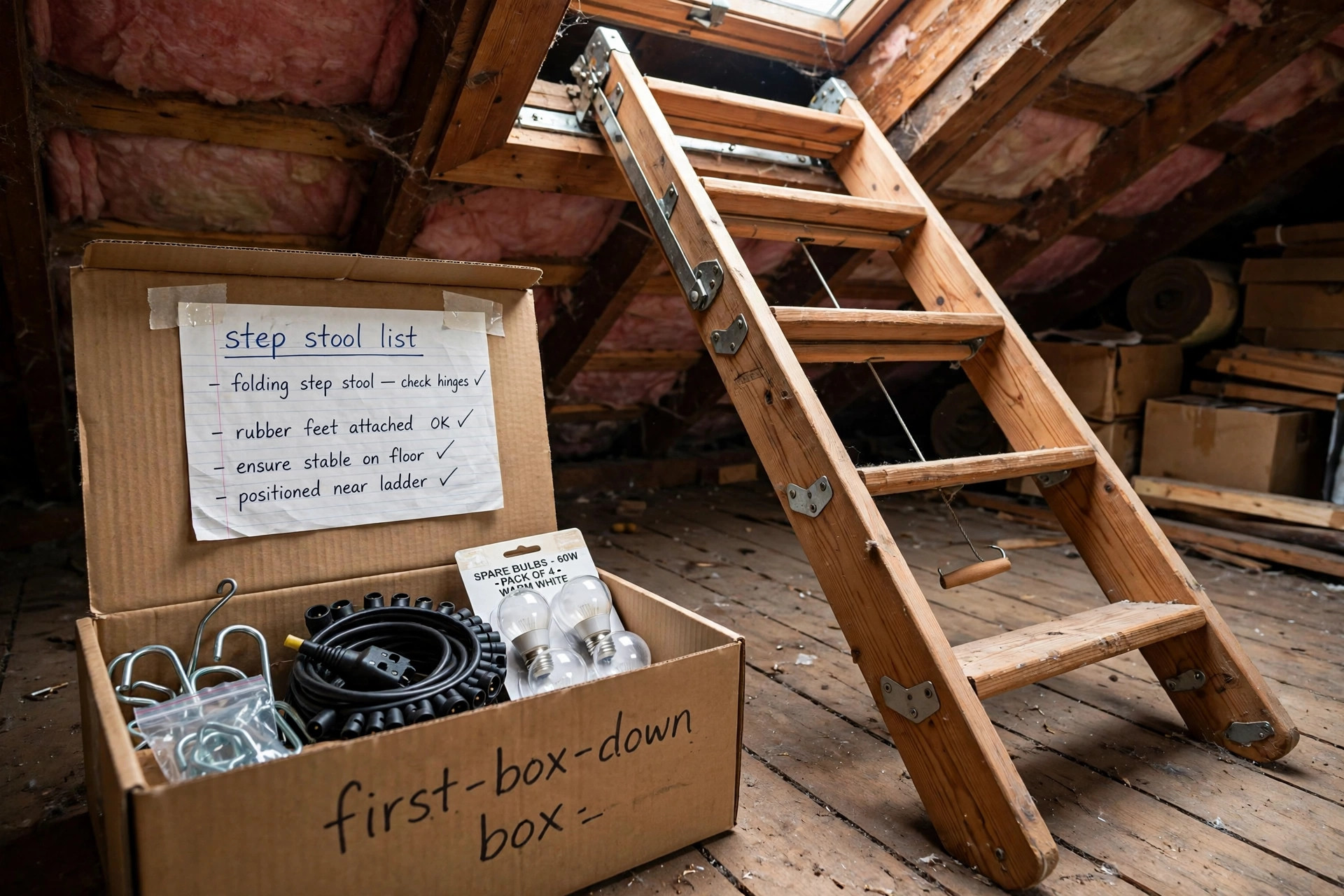
19. A "first box down" box by the ladder — the box with the ladder, the lights and the hooks comes down first
Every decorating day starts with a search, because the ladder is in the garage, the hooks are in a bin at the back, and the lights are somewhere else entirely. Keep a "first box down" box by the ladder — the box with the ladder, the lights and the hooks comes down first — so the first box off the ladder holds everything the decorating day needs. Put the hooks, the extension lead, the spare bulbs and the step stool list in the box, because the box that holds the tools is the box that starts the job. Label it in big letters, "FIRST BOX DOWN", because the box that is labelled is the box that comes down first. One box by the ladder, and the decorating day starts in minutes instead of hours.
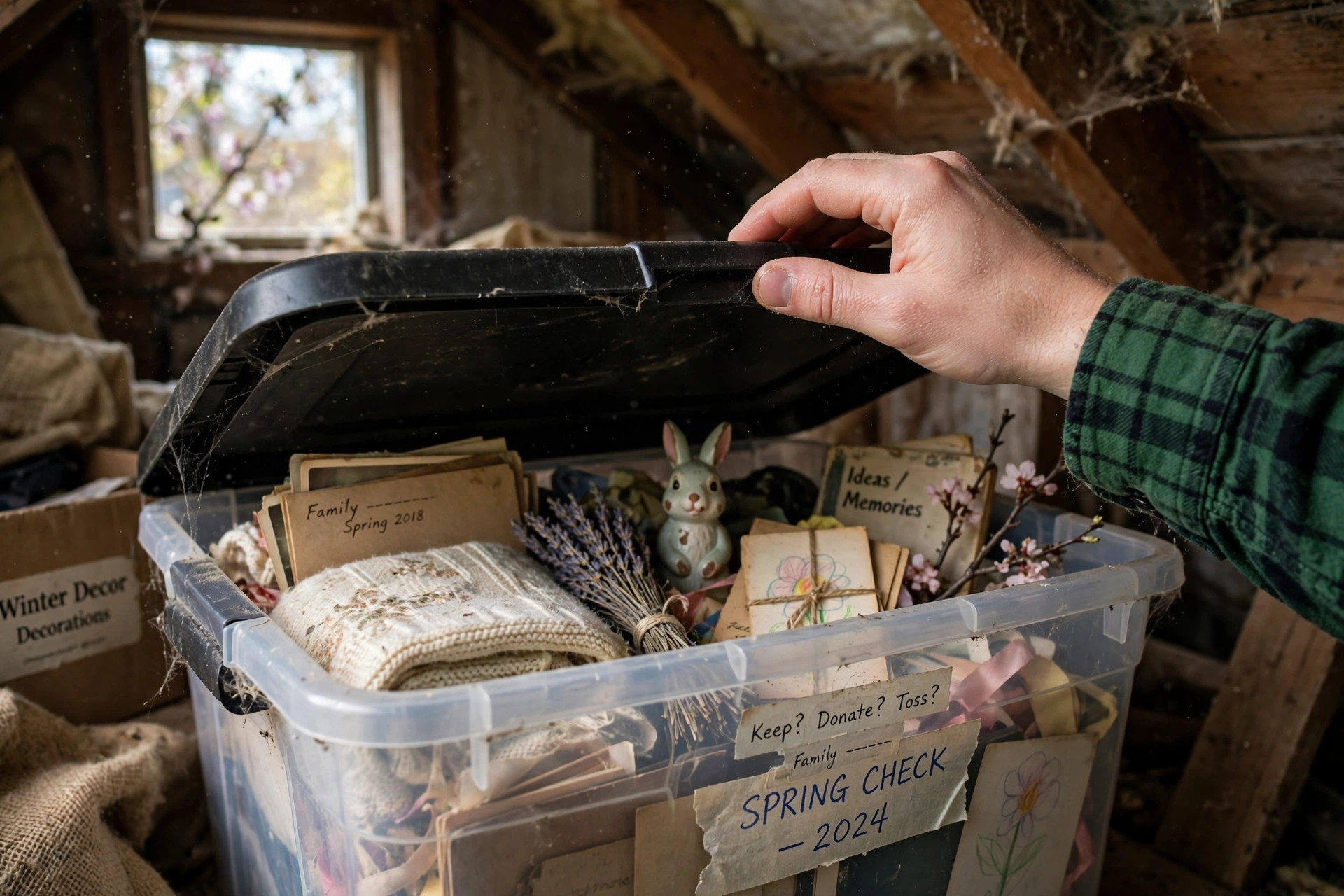
20. An annual attic check every spring — one hour a year, and the attic never fills up again
An attic that is never checked is an attic that fills up, because the thing that goes up in December is the thing that stays up for five years, and the attic that fills is the attic that stops working. Do an annual attic check every spring — one hour a year, and the attic never fills up again — so the attic gets one hour of attention and twelve months of order. Walk the walkway, open each bin, and ask whether the thing inside is still worth its place, because the thing that is not worth its place is the thing that goes to the donate box. Check the bins for damp and the lids for cracks, because the bin that is cracked is the bin that lets the dust in. One hour every spring, and the attic stays the room you meant it to be.
Which attic storage idea fits which situation?
| Situation | Best first move | Budget | Tools needed |
|---|---|---|---|
| Attic full of things you do not want | Sort into keep, donate and toss (idea 1) | Free | Three boxes |
| Too big a job to start | One holiday at a time (idea 2) | Free | None |
| Bins you have to open to identify | Label before the ladder (idea 3) | Low | Marker, labels |
| Labels do not say enough | Photo on the lid (idea 4) | Low | Phone, printer |
| Things go up and never come out | Inventory list by the door (idea 5) | Free | Board, pencil |
| Bins that wobble and topple | One size, clear, clipping lids (idea 6) | Low | Clear bins |
| Every bin looks the same | Colour-coded lids (idea 7) | Low | Coloured dots |
| Wasted space under the eaves | Low bins under the roof (idea 8) | Low | Low bins |
| Bins that do not fit the timbers | Measure the joist gap (idea 9) | Free | Tape measure |
| Stacks that lean and fall | Locking lids, three high (idea 10) | Low | Locking bins |
| Wreaths getting crushed | Clear bag on a hook (idea 11) | Low | Bags, hooks |
| Baubles chipping in a box | Divider box, one per slot (idea 12) | Low | Divider box |
| Lights that come out as a knot | Wrap on reels (idea 13) | Low | Light reels |
| Tree shedding in the attic | Storage bag with handles (idea 14) | Low | Tree bag |
| Empty suitcases doing nothing | Fill with out-of-season clothes (idea 15) | Free | Lavender sachet |
| No way to reach the back | Clear walkway down the middle (idea 16) | Low | Plywood strip |
| Only one full-height wall | Shelving on the gable wall (idea 17) | Low | Shelves, screws |
| Seasons mixed and buried | One zone per season (idea 18) | Free | None |
| Decorating day starts with a search | "First box down" by the ladder (idea 19) | Low | One box |
| Attic filling up year by year | Annual check every spring (idea 20) | Free | One hour |
You do not need all 20 ideas. You need the three that solve your attic — usually the sort that takes a third of the load out, the clear bins that stack and lock, and the walkway that lets you reach the back without moving anything. Start with the sort, do it one holiday at a time, and put the labels on before the bins climb the ladder. Do that and the next time you go up for the Christmas lights, they will be the first bin you reach, labelled and ready, instead of the last thing you find after an hour of digging.
Save this post for your next attic sort, and if the holiday bins need sorting first, read 25 Holiday Decor Storage Ideas for 2026 next — it is Post 49, the labelled holiday bins that live in the attic — and 25 Garage Storage Ideas for 2026, Post 33, for the bulky things that belong in the garage instead of the attic. This is the twenty-first post of the second Storage by room/object run — Posts 31 to 55, one room at a time — and the next posts carry the same storage system into the rooms that follow.
Publish date assigned at publishing time. Updated as new attic storage finds are tested.
Frequently asked questions
What should I not store in an attic?
Do not store anything that heat, cold or damp will ruin — photographs, candles, vinyl records, electronics, leather and important papers all suffer in an attic, because the attic swings from freezing in winter to baking in summer. Keep those things in a closet or under the bed instead, and use the attic for sturdy seasonal things like ornaments, lights, wreaths and out-of-season clothes in sealed bins. If it melts, fades or warps, it does not belong in the attic.
How do I keep my attic from getting too hot for storage?
Use clear bins with lids that clip on, because the lid that clips is the lid that keeps out dust and damp even when the attic bakes in summer. Leave a gap between the bins and the roof so the air can move, never stack bins against the roof itself, and store the most heat-sensitive things nearest the floor, where it is coolest. Check the bins once a year in spring, and move anything that looks warped or faded downstairs.
How much weight can my attic floor hold?
Most attic floors are built to hold light storage, not a warehouse — keep the load spread out, put the heaviest bins near the walls where the floor is strongest, and never stack bins more than three high. If the floor is bare joists with no boards, lay plywood down first so the weight spreads, and never walk on the plasterboard ceiling below. If you are unsure, keep the load light and ask a builder before you fill the attic.