28 Bedroom Storage Ideas for 2026
The bedroom is the room that collects everything — the clothes that never made it to the closet, the spare bedding with no shelf, the books, the chargers, the bag that lives on the chair. The fix is not a bigger bedroom, it is storage that hides in the room itself, under the bed, behind the closet door and inside the bench at the foot of the bed, so the room looks calm even when it is holding a lot.
These 28 bedroom storage ideas are hidden storage for calm, clutter-free bedrooms: start with rolling bins under the bed, add a storage bench at the foot of it, give the closet double rails and a labelled top shelf, and finish with a one-in-one-out rule — so every thing has a home and the bedroom feels like a place to rest, not a place to store things.
Every idea below works in a real bedroom, from a small box room with one wall of wardrobe to a big bedroom that somehow still has nowhere to put anything. The closet the bedroom connects to is covered in 26 Small Walk-In Closet Organization Ideas for 2026, where the hanging and folding system lives — and the spare bedding has its own home in 22 Linen Closet Organization Ideas for 2026, so the bedroom never has to hold the linen as well. Pick three ideas that fit your room, start under the bed, and build from there.
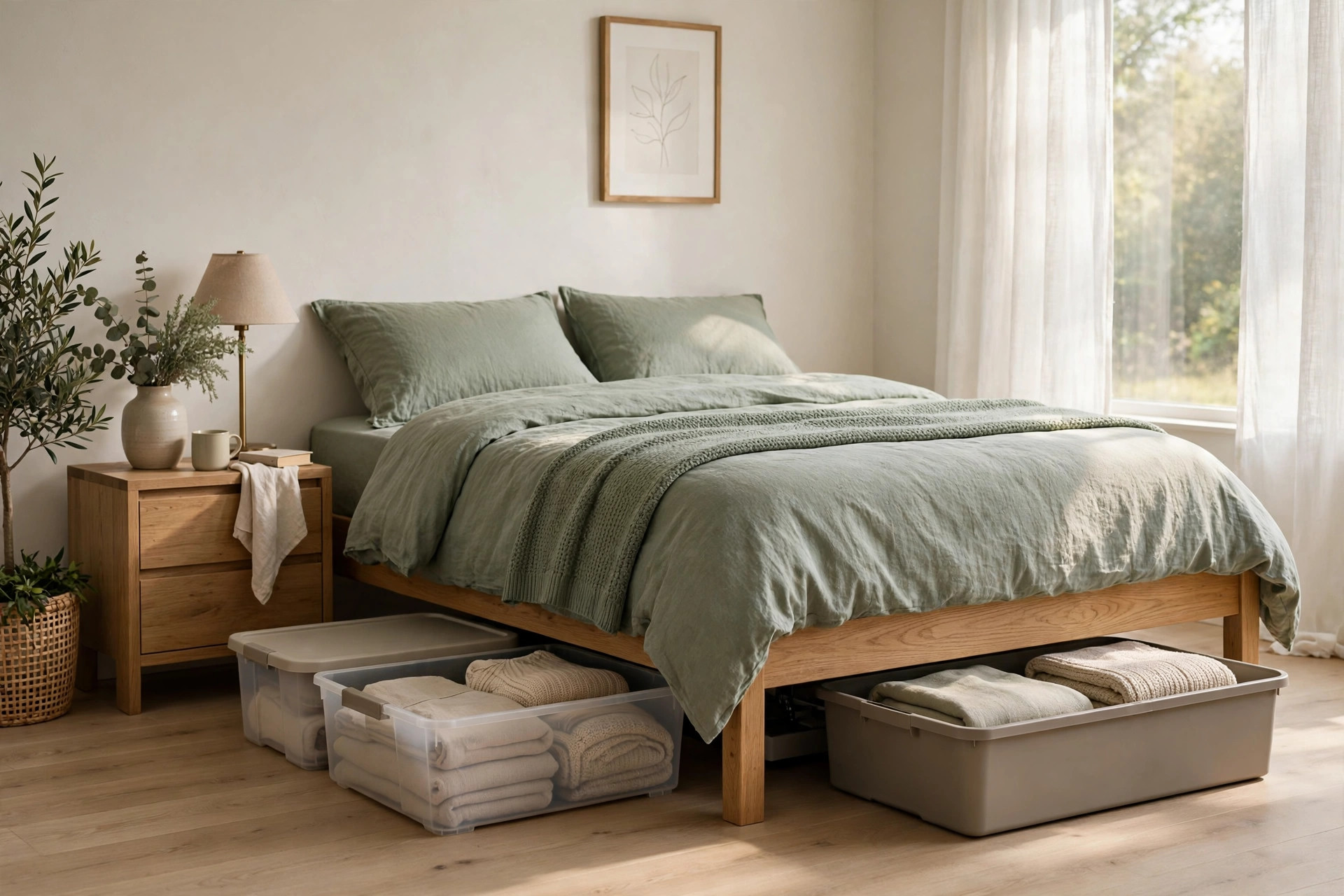
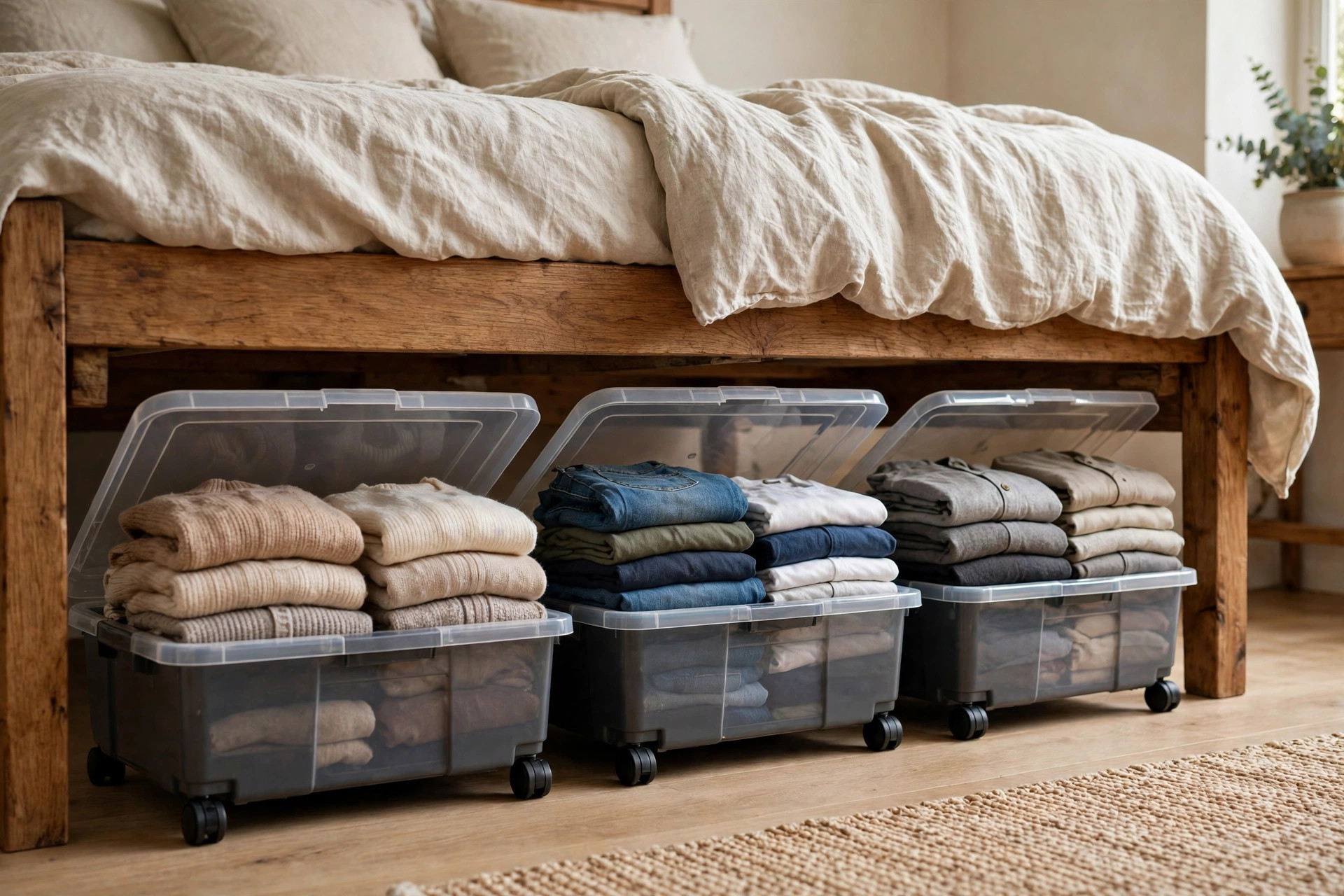
1. Under-bed rolling bins on wheels — the floor space under the bed becomes storage
The space under the bed is the biggest empty space in the bedroom, because the bed is the thing that sits on it and the floor underneath is the floor nobody uses. Turn it into storage — the floor space under the bed becomes storage — so the out-of-season clothes, the spare shoes and the gift wrap live under the bed instead of on the chair. Use low bins on wheels, because the bins that roll are the bins that come out easily and the bins that slide are the bins that get stuck. Keep one bin per thing, label the ends, and pull them out like drawers, because the bin you can roll out is the bin you actually use. One set of rolling bins, and the biggest empty space in the room is working.
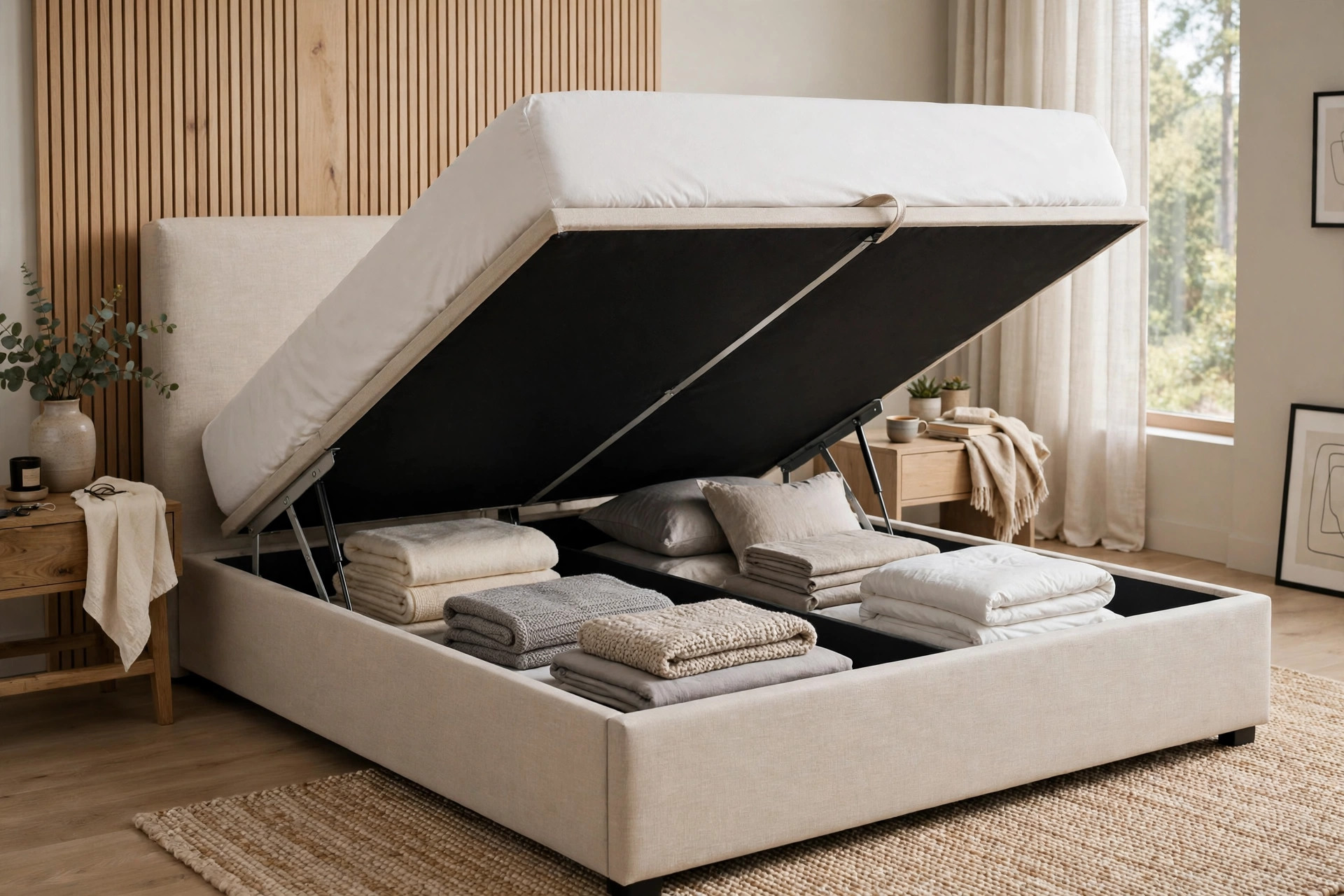
2. A storage bed with a lift-up ottoman base — the whole mattress lifts, the bedding lives underneath
A bed with nothing underneath it is a bed wasting its own footprint, because the footprint is the same whether the space under the mattress holds bedding or holds dust. Buy or build a storage bed with a lift-up ottoman base — the whole mattress lifts, the bedding lives underneath — so the spare duvet, the winter blankets and the out-of-season clothes live inside the bed itself. Lift the mattress on its gas struts, put the bulky things in first and the things you reach for on top, because the things on top are the things you grab without digging. Keep the base tidy with one box per kind of thing, because the base that is organised is the base that does not become a junk drawer. (Check on Amazon for under-bed storage bags with clear windows, which keep the bedding dust-free and let you see what is inside without opening them.) A lift-up base, and the bed stores as much as it sleeps.
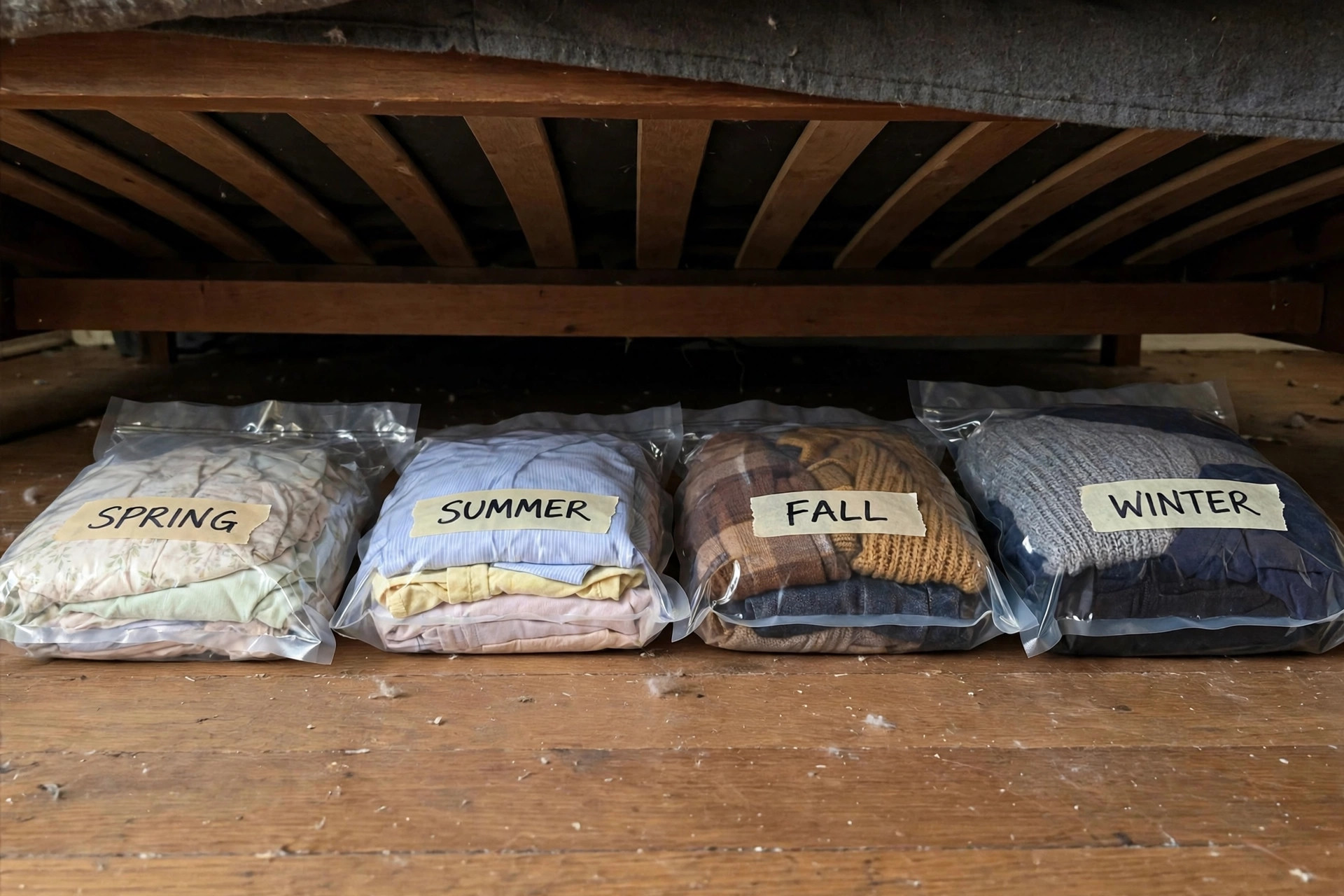
3. Vacuum bags under the bed for out-of-season clothes — flat bags, flat storage
Out-of-season clothes take up a whole shelf, because a winter jumper is the thing that fills a drawer even when it is June. Pack them in vacuum bags — flat bags, flat storage — so the jumpers shrink to a third of their size and slide under the bed in a neat row. Roll the air out or use the hoover, seal the bag, and lay it flat, because the bag that is flat is the bag that stacks. Label each bag with what is inside and the season it comes back, because the bag you labelled is the bag you find in October without opening five others. Flat bags under the bed, and the closet keeps its space for the clothes you are wearing now.
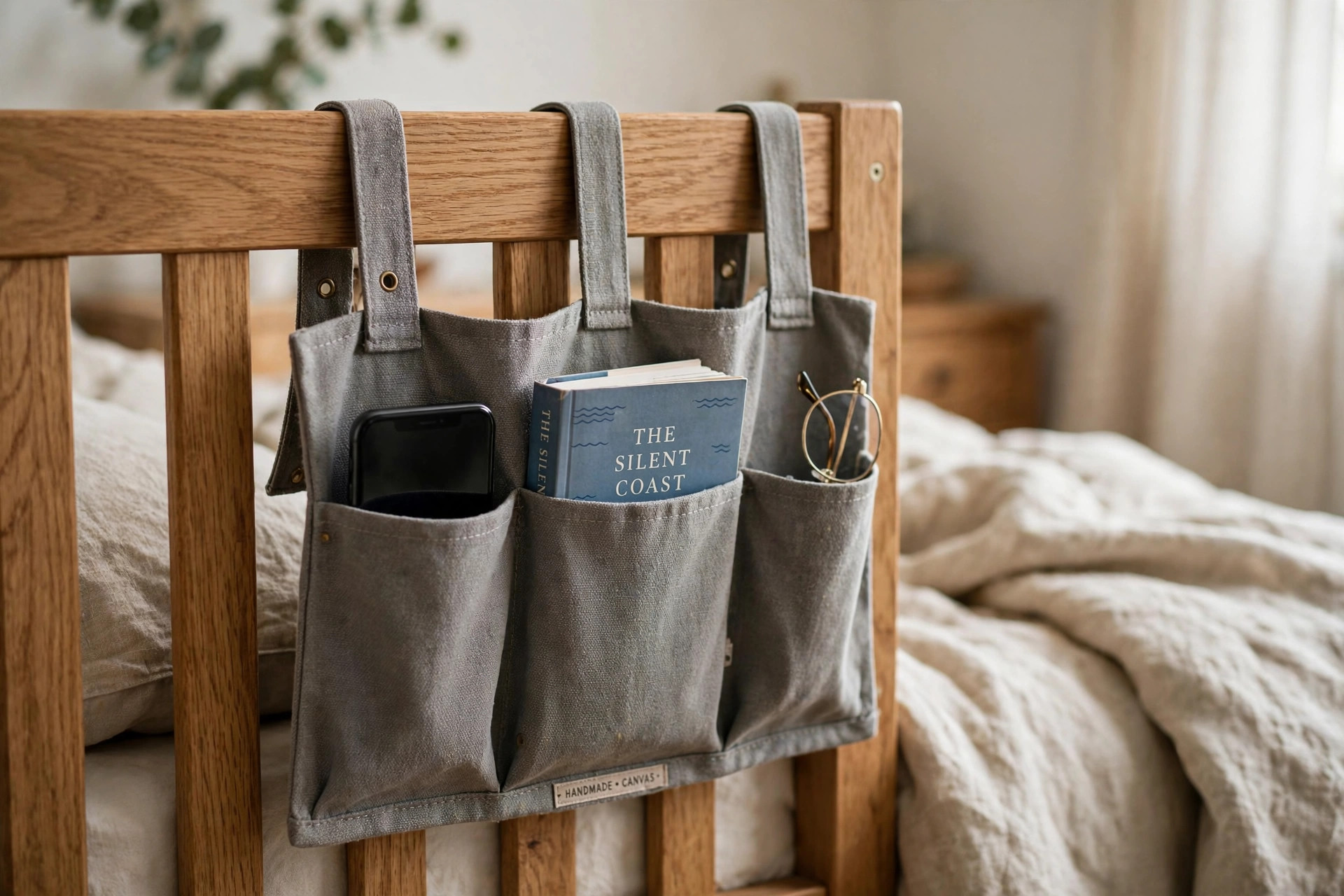
4. A bedside caddy that hangs on the bed frame — phone, book and glasses, off the table
The bedside table fills up because the phone, the book and the glasses all live on it, and the table is the thing that is only as big as a book. Hang a bedside caddy on the bed frame — phone, book and glasses, off the table — so the small things live in pockets at the side of the bed and the table holds only the lamp. Slip the caddy over the frame or hook it to the headboard, and put the phone in the deep pocket and the book in the wide one, because the pocket that fits is the pocket that gets used. Keep the caddy on the side you sleep on, because the caddy that is within reach is the caddy that holds the glasses at night. A caddy on the frame, and the table is clear for the first time in months.
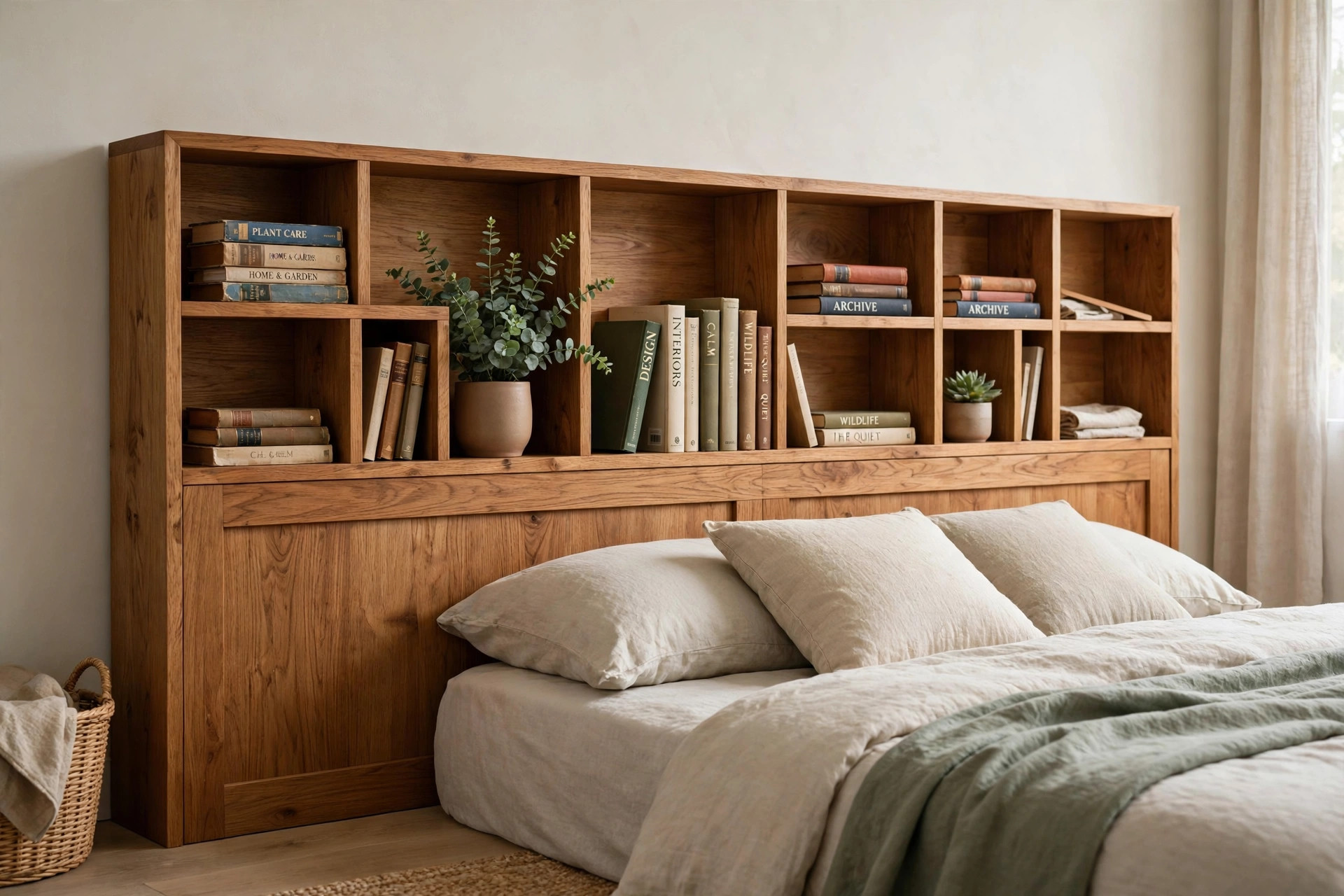
The wall behind the bed does nothing, because the headboard is the thing that covers it and the wall is the wall that is wasted. Use a headboard with shelves and hidden cubbies — the wall behind the bed works for its living — so the books, the alarm clock and the charger live in the headboard instead of on the table. Put the things you reach for at night on the open shelf and the things you do not want to see in the cubby with the door, because the open shelf is the display and the cubby is the hiding place. Keep the shelf to three things, no more, because the shelf that holds three things is a display and the shelf that holds ten is a pile. A headboard with cubbies, and the wall earns its keep.
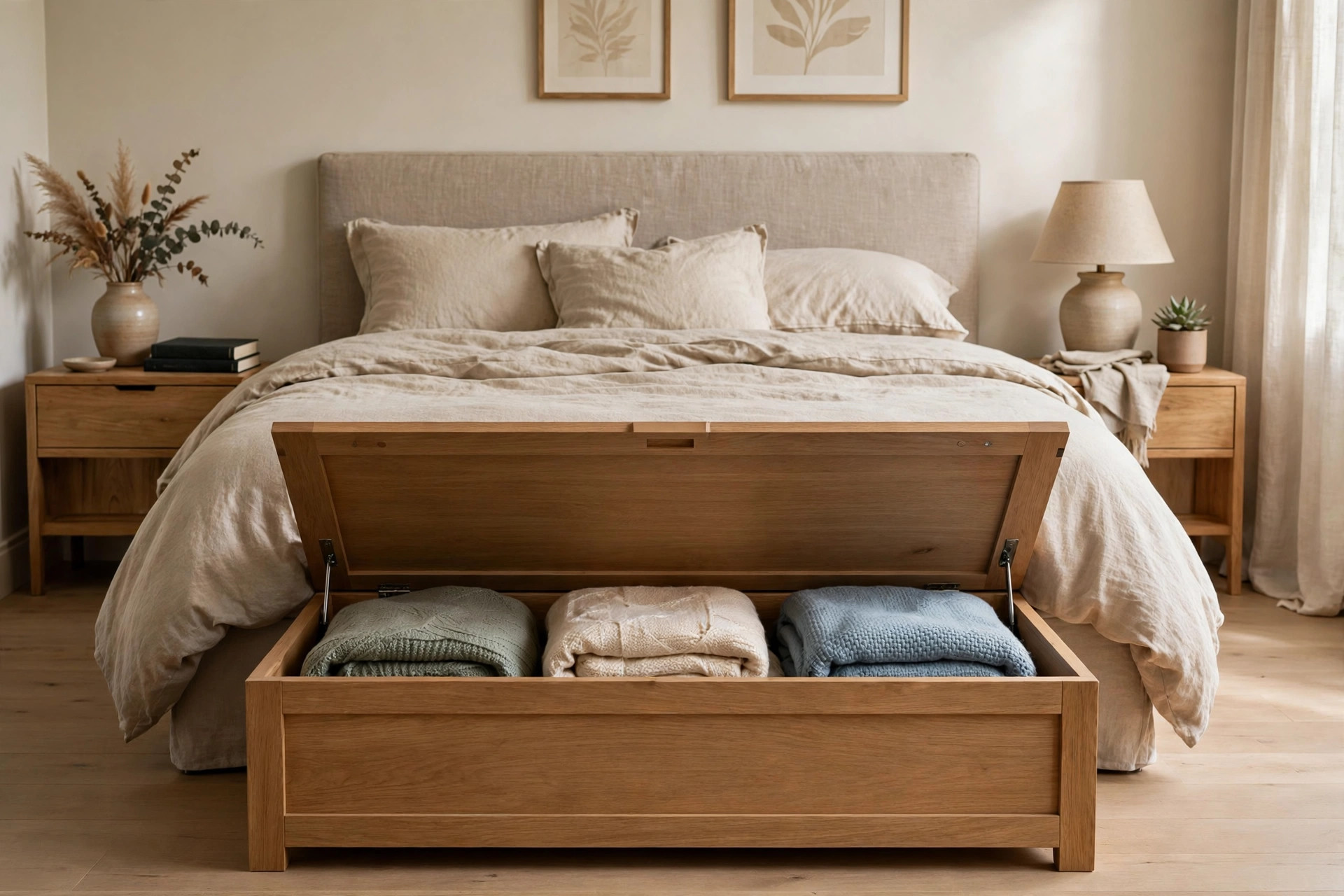
6. A storage bench at the foot of the bed — blankets and books, and a place to sit
The foot of the bed is empty floor, because the bed ends and the room begins, and the empty floor is the floor that holds the clothes that fell off the bed. Put a storage bench there — blankets and books, and a place to sit — so the spare blankets live inside the bench and the bench gives you somewhere to sit while you put your shoes on. Lift the lid, fold the blankets flat, and close it, because the bench that closes is the bench that hides the blankets. Keep the top clear, because the bench that is clear is the bench you sit on, and the bench that is a shelf is a bench you never sit on. A bench at the foot of the bed, and the empty floor stores the blankets and seats the shoes.
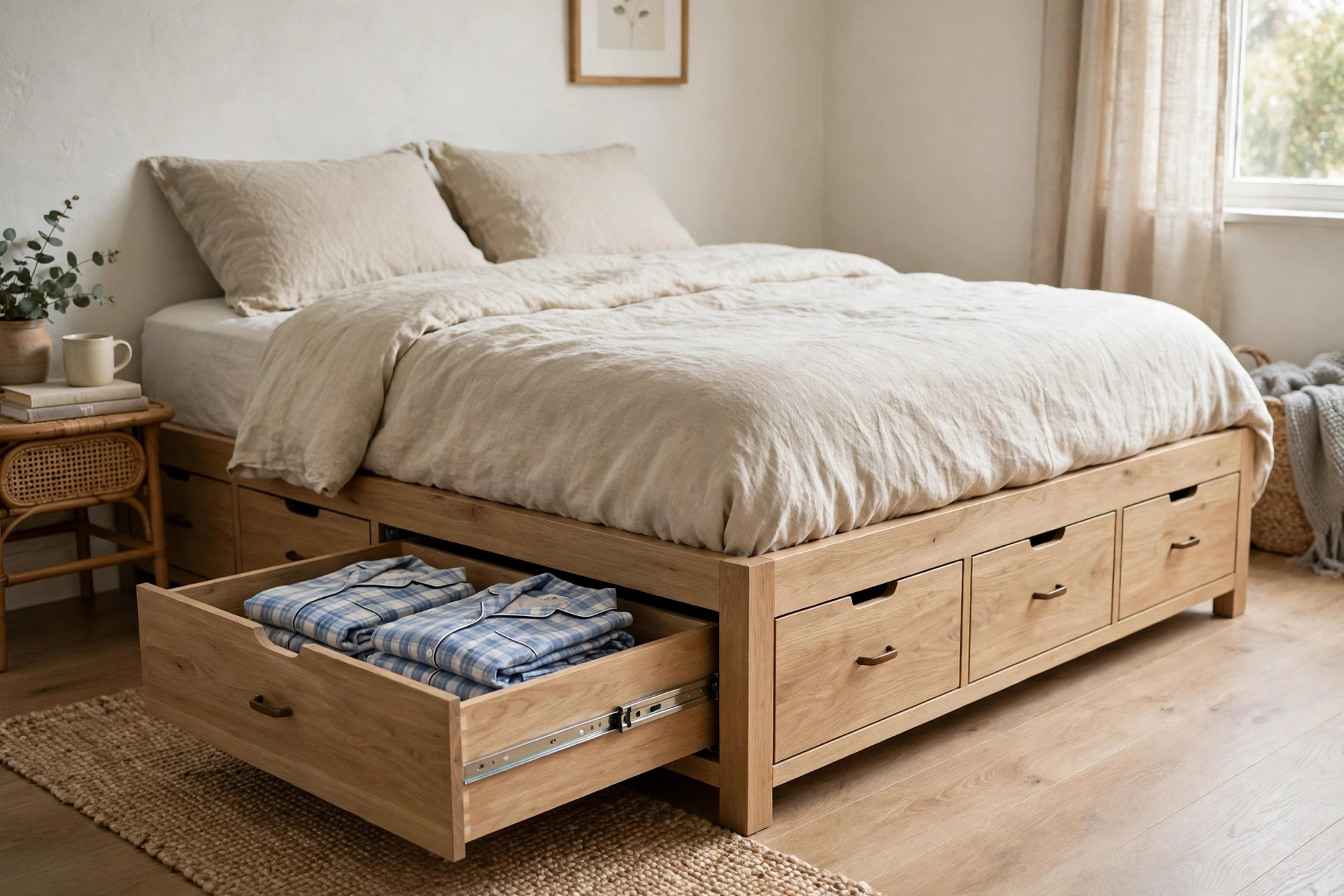
7. Under-bed drawers built into the bed frame — drawers where the dust used to live
Under-bed bins roll away and get lost, because the bin that rolls is the bin that slides too far under and the bin that slides too far is the bin you forget. Build drawers into the bed frame — drawers where the dust used to live — so the storage pulls out like a drawer and pushes back like a drawer, and nothing slides away. Use the drawers for the things you reach for most, pyjamas, spare sheets and the book you are reading, because the drawer that holds the everyday things is the drawer that gets opened. Keep one drawer per person if the bed is shared, because the drawer that is yours is the drawer that stays tidy. The bin racks the drawers pair with are in 18 Storage Bin Rack DIY Ideas for 2026, where the bins get their own frames — and the drawers are the built-in version of the same idea.
The closet and the clothes
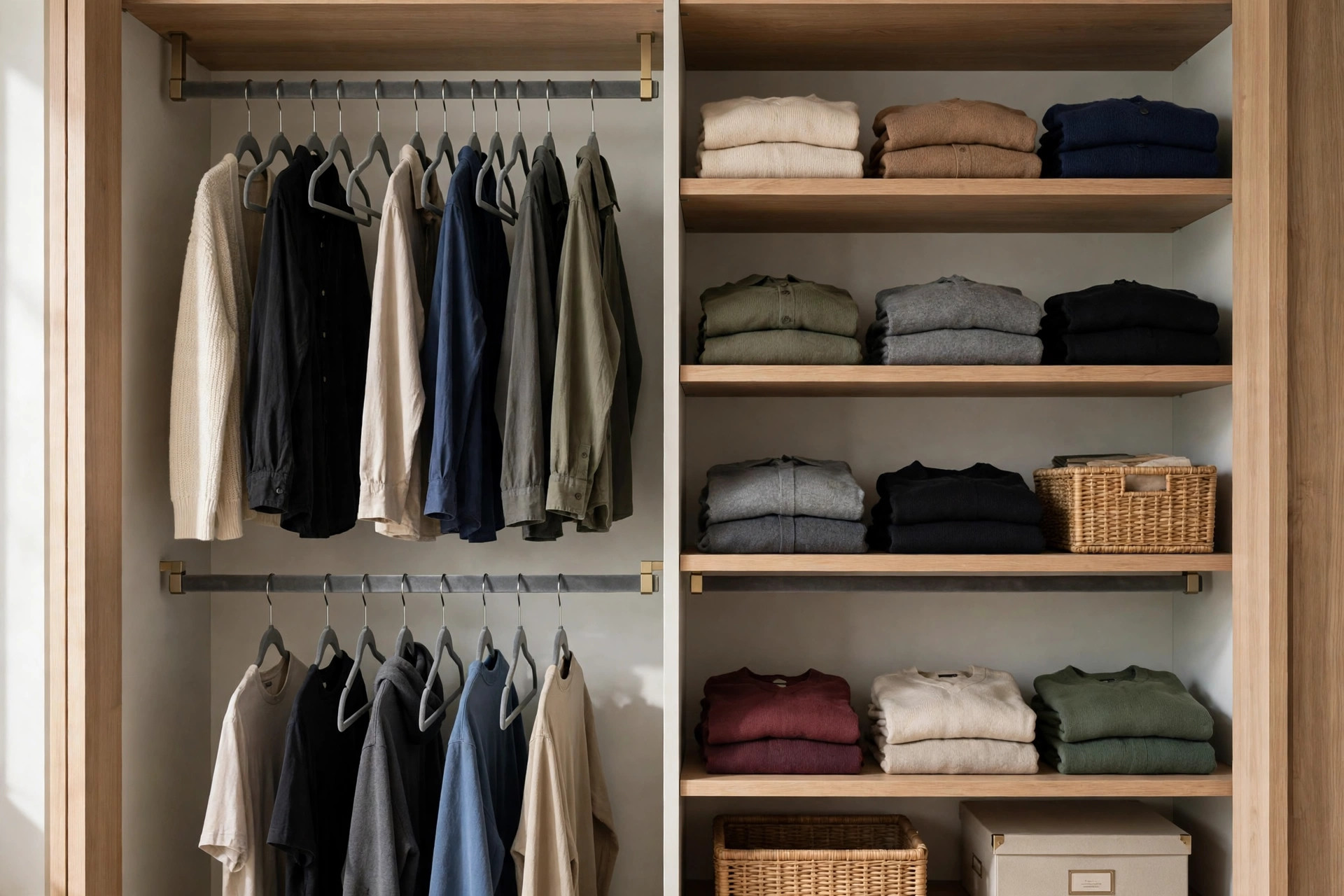
8. Double hanging rails in the closet — two rails, twice the hanging space
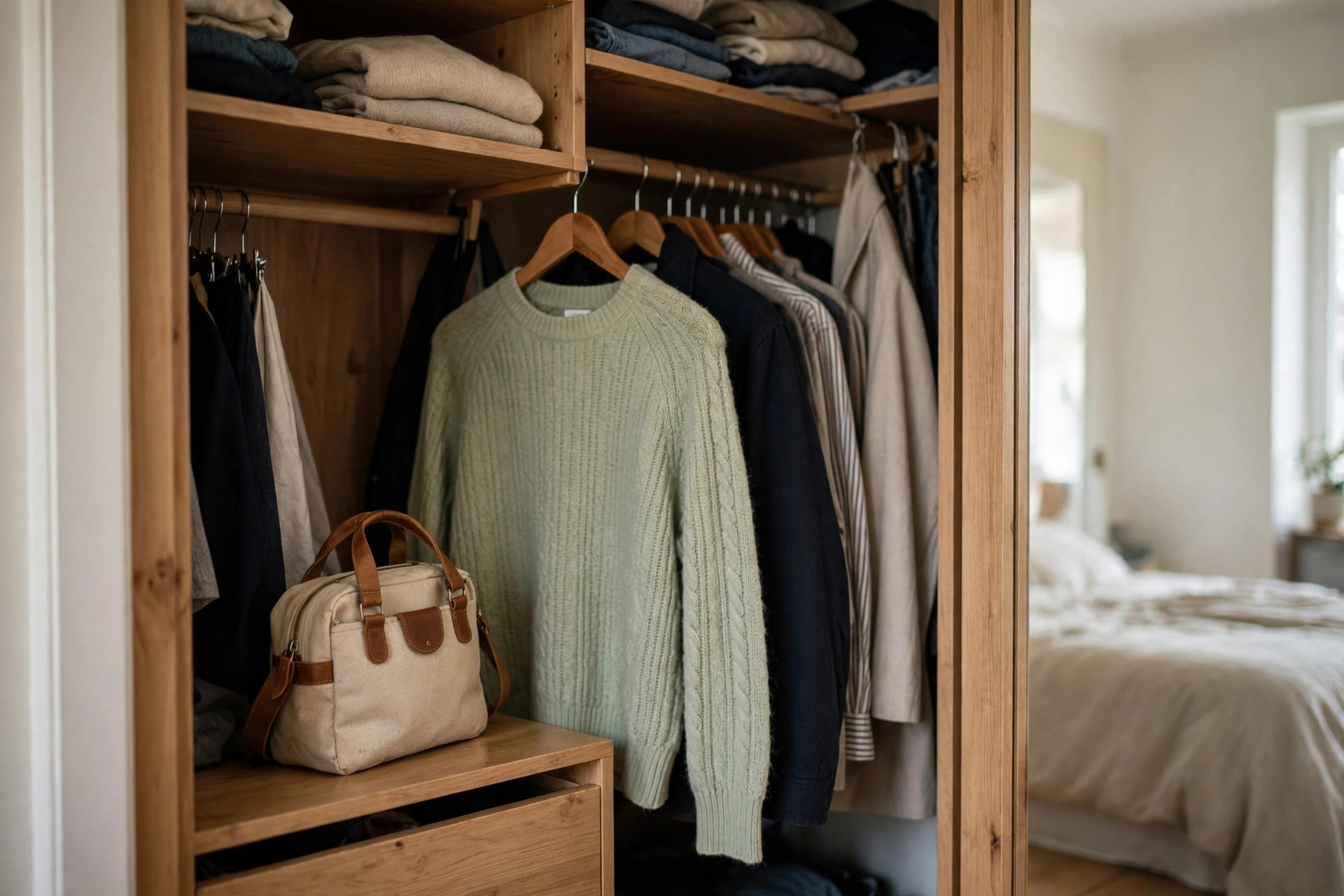
A closet with one rail wastes the bottom half, because the rail is the thing at the top and the space below it is the space where the clothes stop. Add a second rail — two rails, twice the hanging space — so the shirts hang on the top rail and the trousers and skirts hang on the bottom one, and the closet holds twice as much without getting bigger. Hang the long things on one side and the short things on the other, because the rail that is split by length is the rail that wastes nothing. Keep the bottom rail high enough that the trousers do not touch the floor, because the trousers that touch the floor are the trousers that get dirty. Two rails, and the closet doubles without moving a wall.
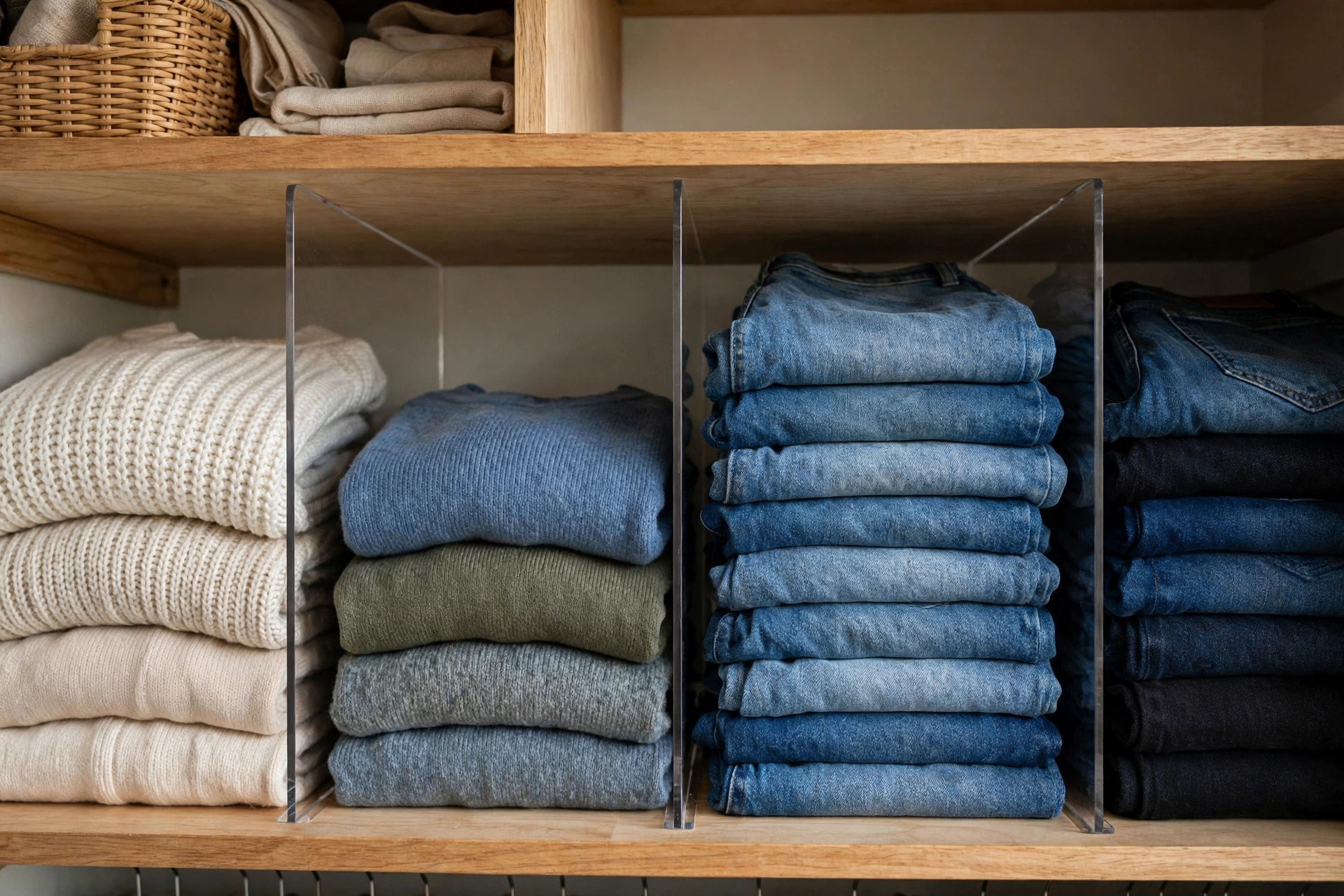
9. Shelf dividers for folded jumpers and jeans — the stack that stays a stack
A folded stack falls over, because the jumper you pull out is the jumper that takes the whole stack with it. Stand shelf dividers between the stacks — the stack that stays a stack — so each pile of jumpers or jeans has its own bay and the pile next to it never moves. Put one divider per stack, upright and snug, and fold everything the same size, because the stack that is the same size is the stack that stands straight. Keep the stacks low, four or five items, because the stack that is short is the stack that does not topple. Dividers on the shelf, and the jumpers stay in their pile.
10. Slim matching hangers, one kind only — the closet that looks twice as big
A closet full of different hangers looks messy, because the thick wooden hanger, the wire hanger and the plastic hanger all take up different amounts of space and none of them match. Switch to slim matching hangers, one kind only — the closet that looks twice as big — so every hanger takes the same thin slice of rail and the clothes hang in a straight line. Use slim velvet hangers, because the velvet is the grip that stops the clothes sliding off and the slim shape is the space that comes back. Replace the hangers a few at a time if the cost stings, because the closet that is half slim is already calmer than the closet that is all mixed. (Check on Amazon for slim velvet hangers in a pack of fifty, which is usually enough for one whole closet in a single buy.) One kind of hanger, and the closet looks like it doubled in size.
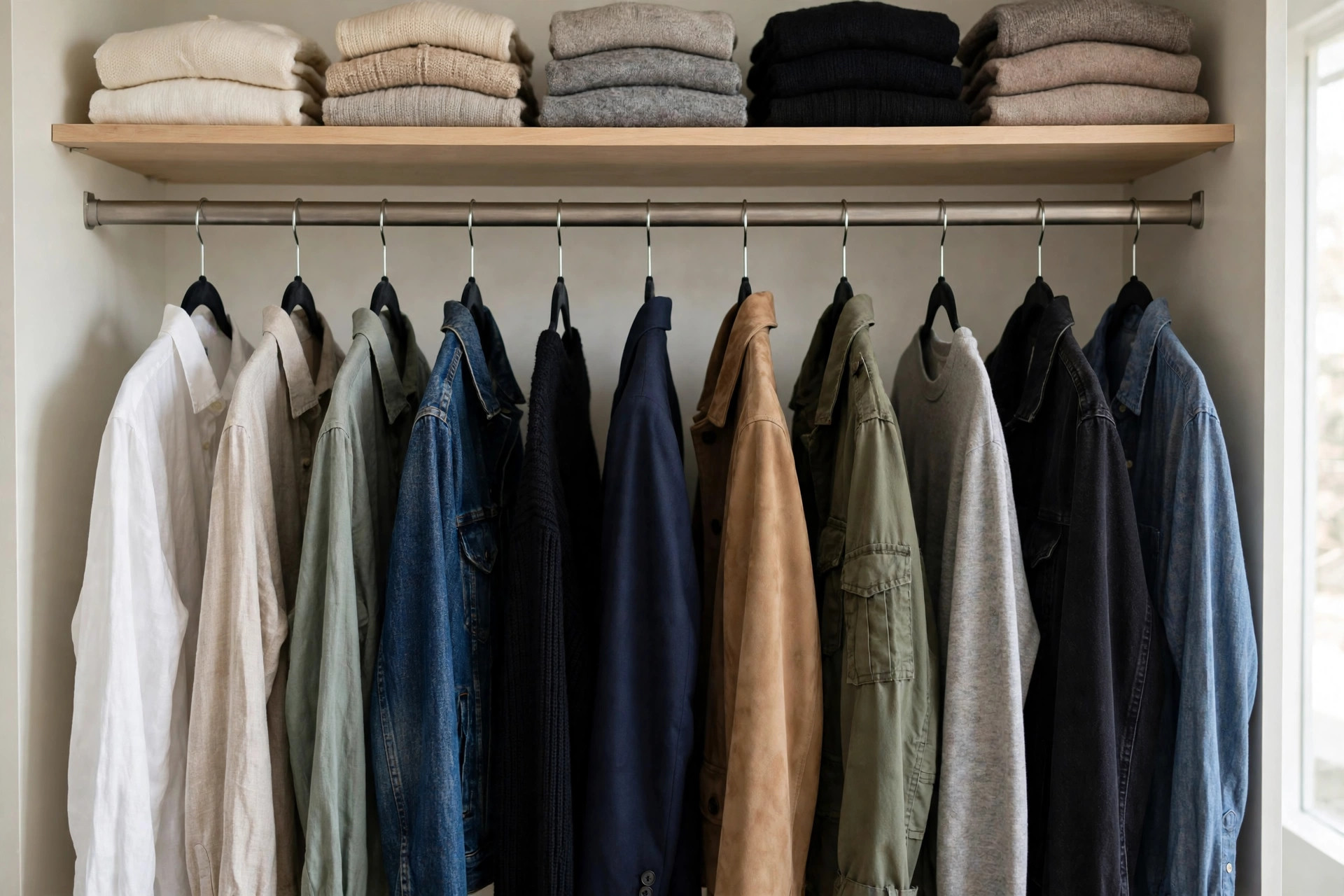
11. A hanging shoe organiser on the closet door — the shoes leave the floor
Shoes on the bedroom floor are the first thing you trip over, because the floor is the place the shoes land and the floor is the place you walk. Hang a shoe organiser on the closet door — the shoes leave the floor — so every pair lives in a clear pocket on the door and the floor is clear for walking. Put the shoes you wear most at eye height and the shoes you wear least at the bottom, because the pocket at eye height is the pocket you reach for. Keep one pair per pocket, because the pocket that holds one pair is the pocket that shows the shoe. Shoes on the door, and the floor is a floor again.
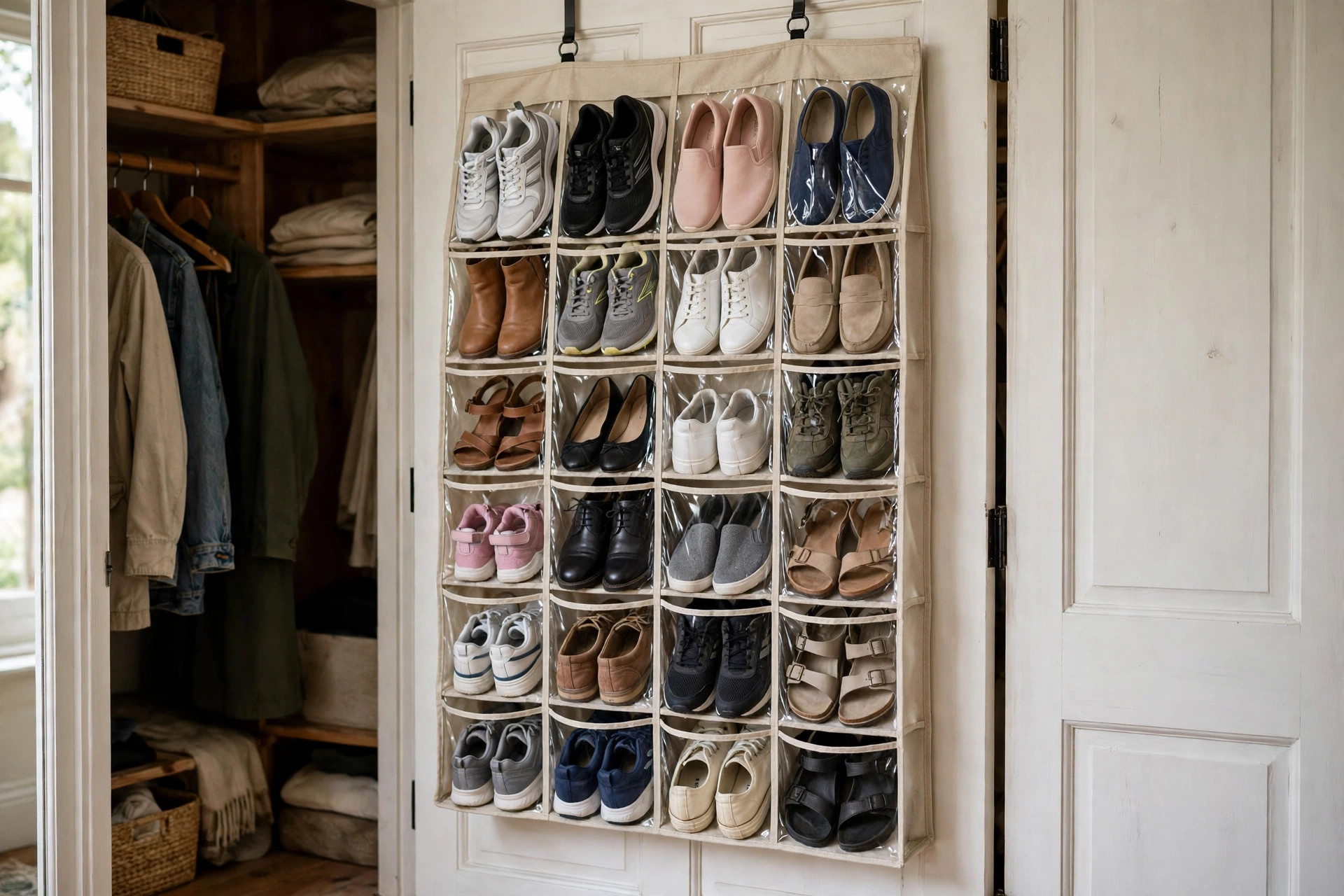
12. Clear bins on the top shelf, labelled — the shelf you can see into
The top shelf is where things go to be forgotten, because the shelf is too high to see into and the things on it are the things you cannot find. Put clear bins on it, labelled — the shelf you can see into — so the hats, the bags and the out-of-season things live in bins you can see through, with a label that says what is inside. Use one bin per kind of thing, because the bin that holds one thing is the bin you find without emptying. Keep the label on the front, facing out, because the label you can read from the floor is the label that works. Clear bins with labels, and the top shelf stops being a mystery.
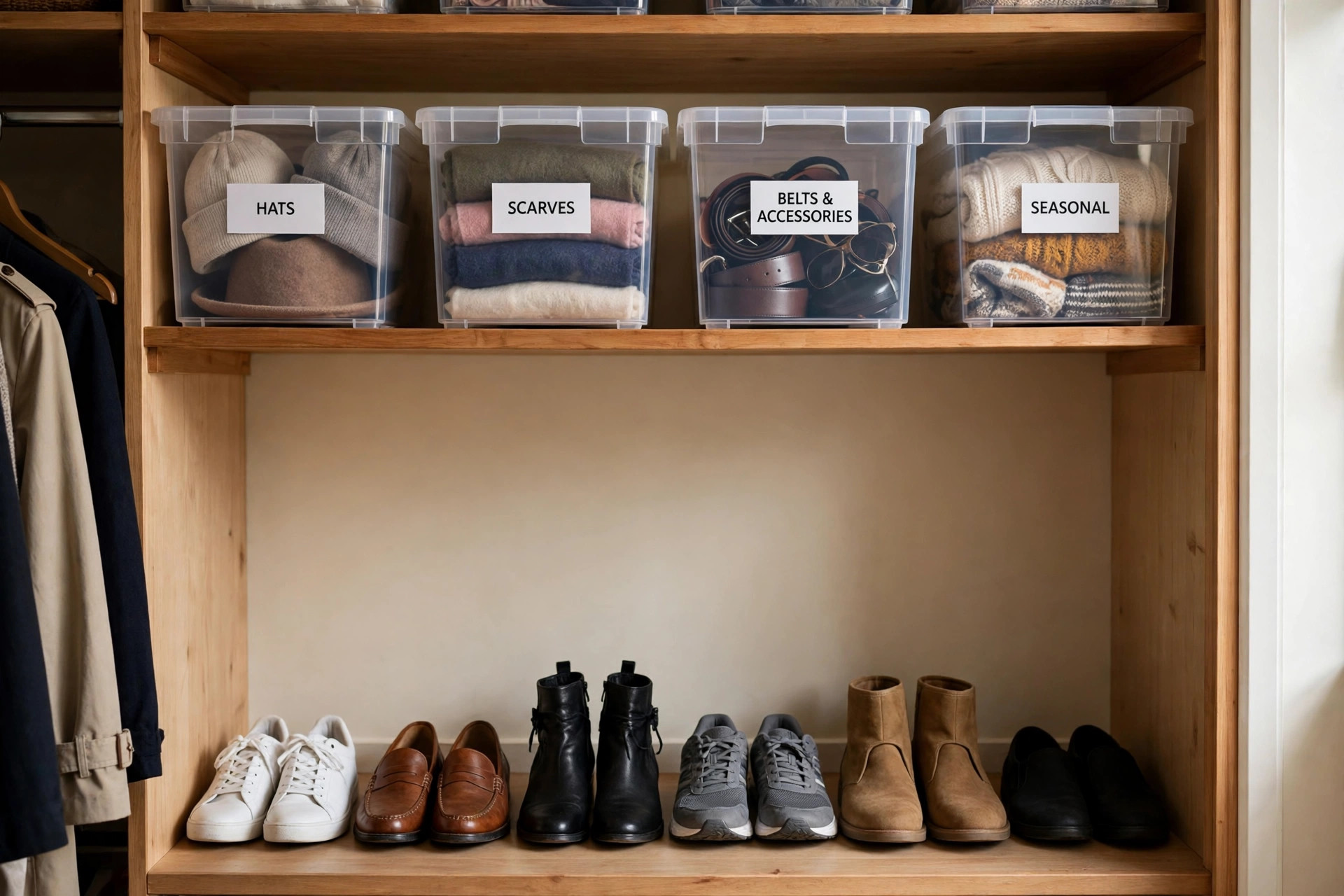
13. A capsule rail for the week's outfits — five outfits, picked on Sunday
Mornings are slow because the outfit is the thing you choose while you are half asleep, and the closet is the thing that offers you everything at once. Set up a capsule rail for the week's outfits — five outfits, picked on Sunday — so Monday to Friday is already decided and the morning is just getting dressed. Hang the five outfits on a small rail or on the end of the closet rail, in order, and add the shoes underneath, because the outfit that is hung together is the outfit that goes on without thinking. Pick the outfits on Sunday evening, because the Sunday pick is the pick that saves five mornings. Five outfits on a rail, and the mornings get ten minutes back.
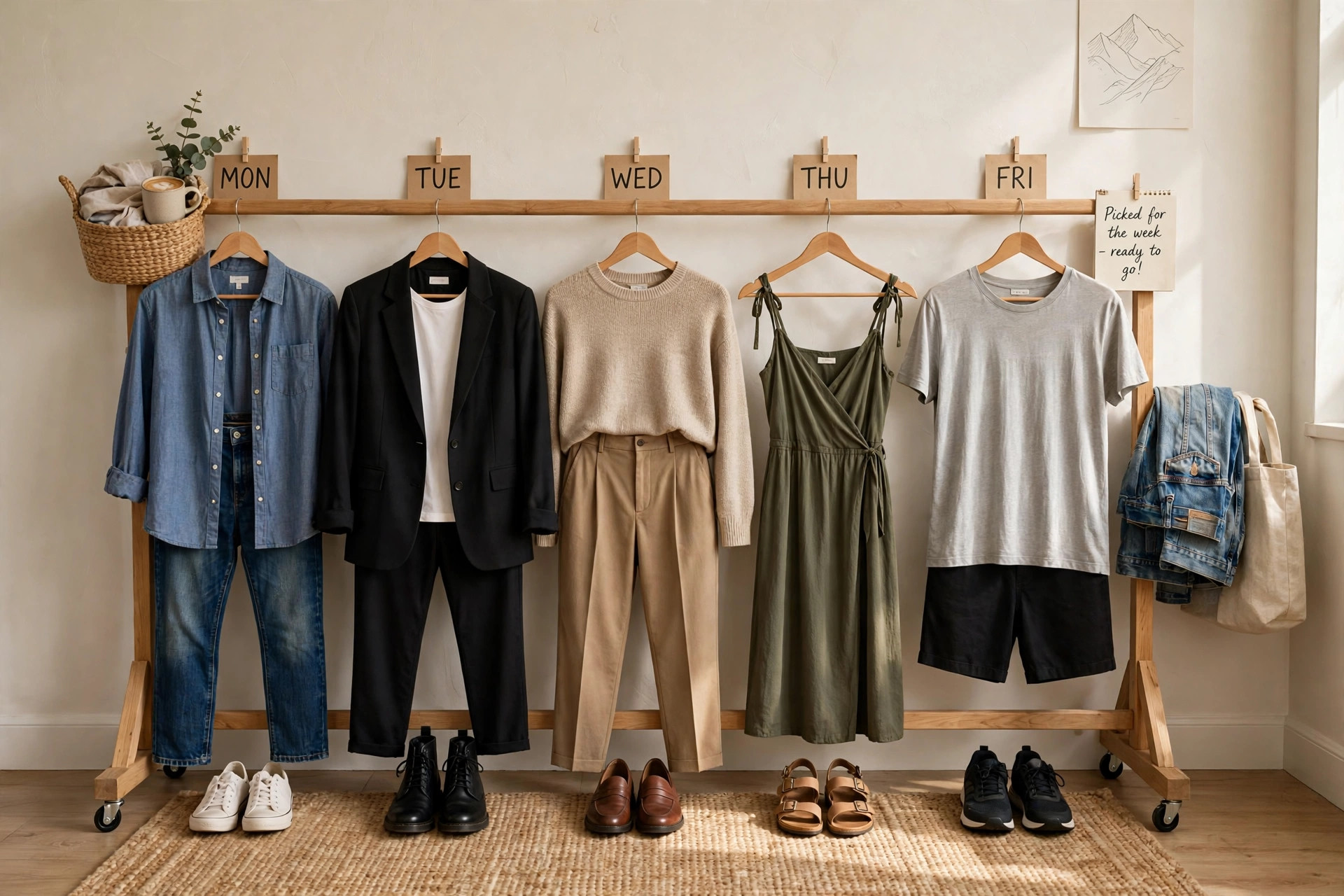
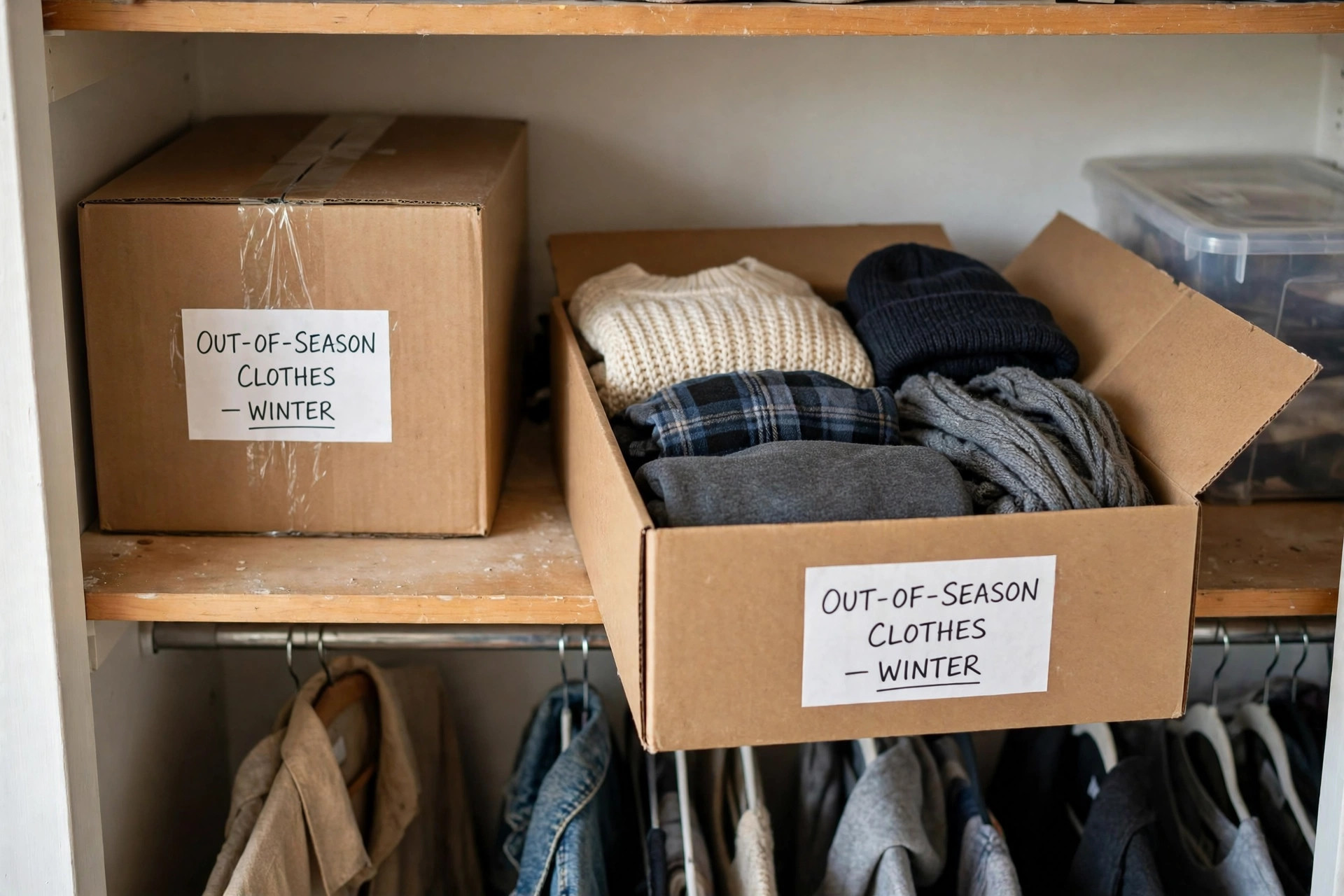
14. Seasonal swap boxes — one box in, one box out, twice a year
The closet fills up because the clothes come in and nothing goes out, and the closet that only fills is the closet that bursts. Run a seasonal swap — one box in, one box out, twice a year — so every time the season changes, one box of clothes leaves and one box of the new season comes in. Put the out-of-season box under the bed or on the top shelf, labelled with the season, and bring it back when the weather turns, because the box that is labelled is the box that comes back at the right time. Do the swap in spring and autumn, because the swap that happens twice a year is the swap that keeps the closet at the same size. One box in, one box out, and the closet never grows.
Small things, surfaces and the dressing area
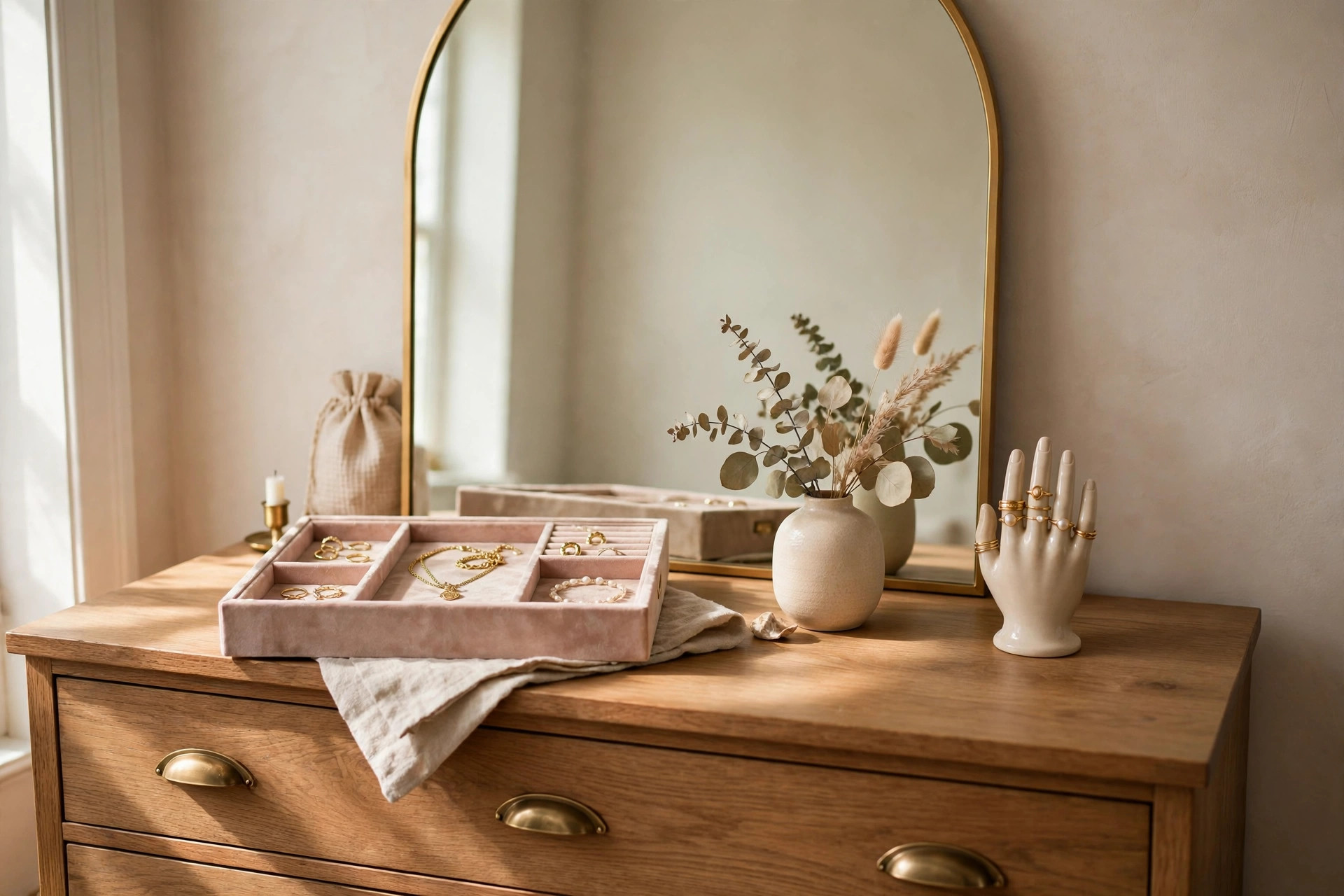
15. A jewellery tray on the dresser — the small things stop vanishing
Earrings and necklaces vanish, because the small things are the things that have no home and the dresser is the place they land. Put a jewellery tray on the dresser — the small things stop vanishing — so every earring, necklace and watch has a compartment and the tray is the first thing you see when you reach for them. Choose a tray with small sections, because the section that fits the thing is the section that keeps it. Keep the tray in the same place every day, because the tray that never moves is the tray that gets used. A tray on the dresser, and the small things stop disappearing.
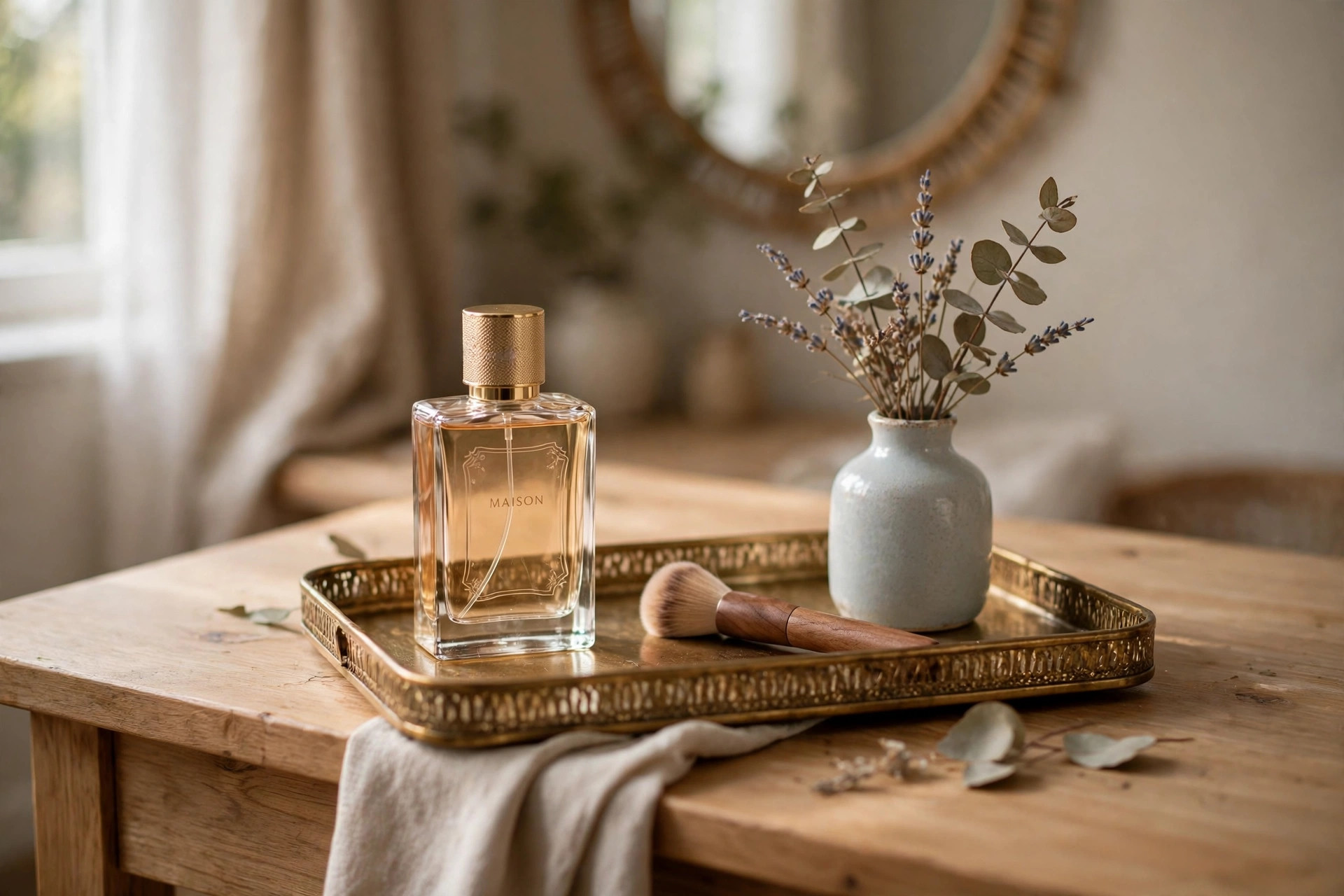
16. A vanity tray that holds three things only — the dressing table that stays a display
A dressing table fills up because the perfume, the brush, the jewellery and the makeup all live on it, and the table is the thing that is only as big as a tray. Use a vanity tray that holds three things only — the dressing table that stays a display — so the perfume, the brush and one small vase live in the tray and everything else lives in a drawer. Pick the three things you reach for every day, because the three things you use are the three things that earn the tray. Keep the tray to the middle of the table, because the tray in the middle is the display and the tray that spreads is the mess. Three things on a tray, and the dressing table looks styled instead of crowded.
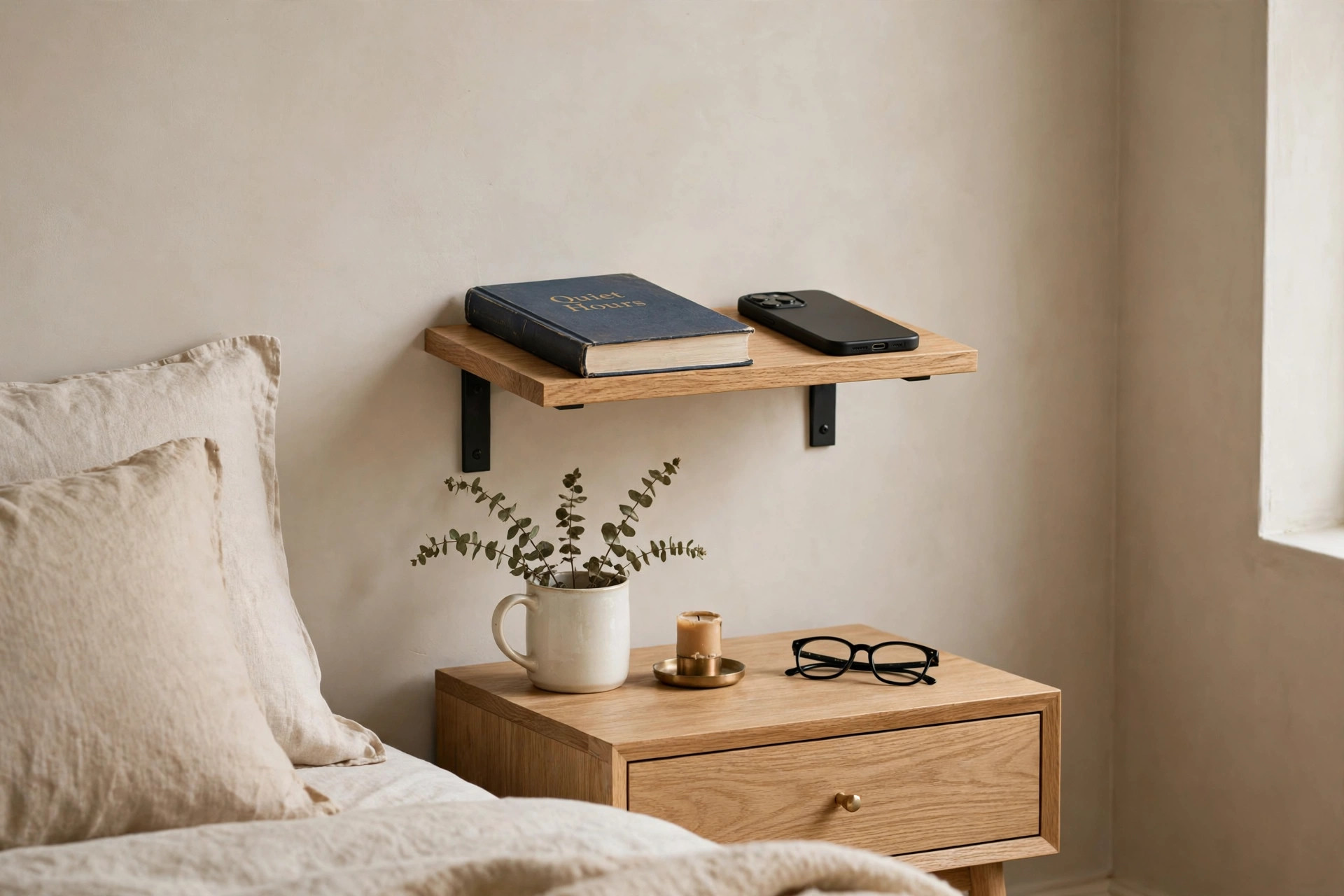
17. A small wall shelf above the bedside table — the table stays clear
The bedside table is small, because the table is the thing that holds a lamp and a book and there is no room for anything else. Add a small wall shelf above it — the table stays clear — so the book, the glasses and the phone charger live on the shelf and the table holds only the lamp. Screw the shelf at the height your hand reaches without sitting up, because the shelf that is within reach is the shelf that gets used. Keep the shelf to two things, because the shelf that holds two things is a shelf and the shelf that holds six is a second table. A shelf above the table, and the table has room to breathe.
18. A nightstand with a drawer, not an open shelf — the clutter goes behind the drawer front
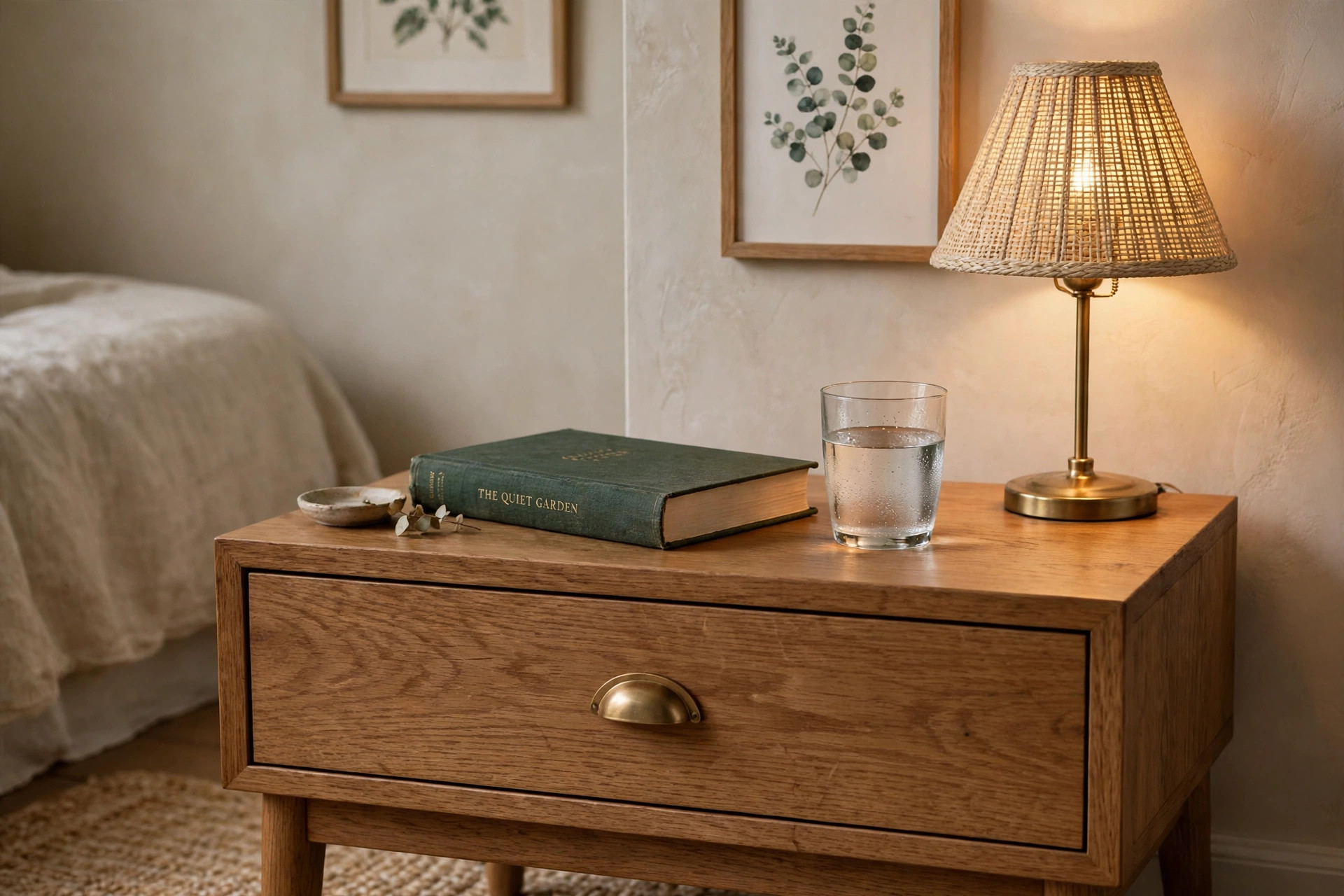
An open nightstand shelf shows everything, because the shelf is the thing with no door and the clutter is the thing that sits on it. Choose a nightstand with a drawer, not an open shelf — the clutter goes behind the drawer front — so the chargers, the lip balm and the notebook live in the drawer and the top of the nightstand stays clear. Put the things you reach for at night in the drawer, because the drawer that holds the night things is the drawer that gets opened. Keep the top to the lamp and one book, because the top that holds two things is a calm top. A drawer in the nightstand, and the clutter has a door.
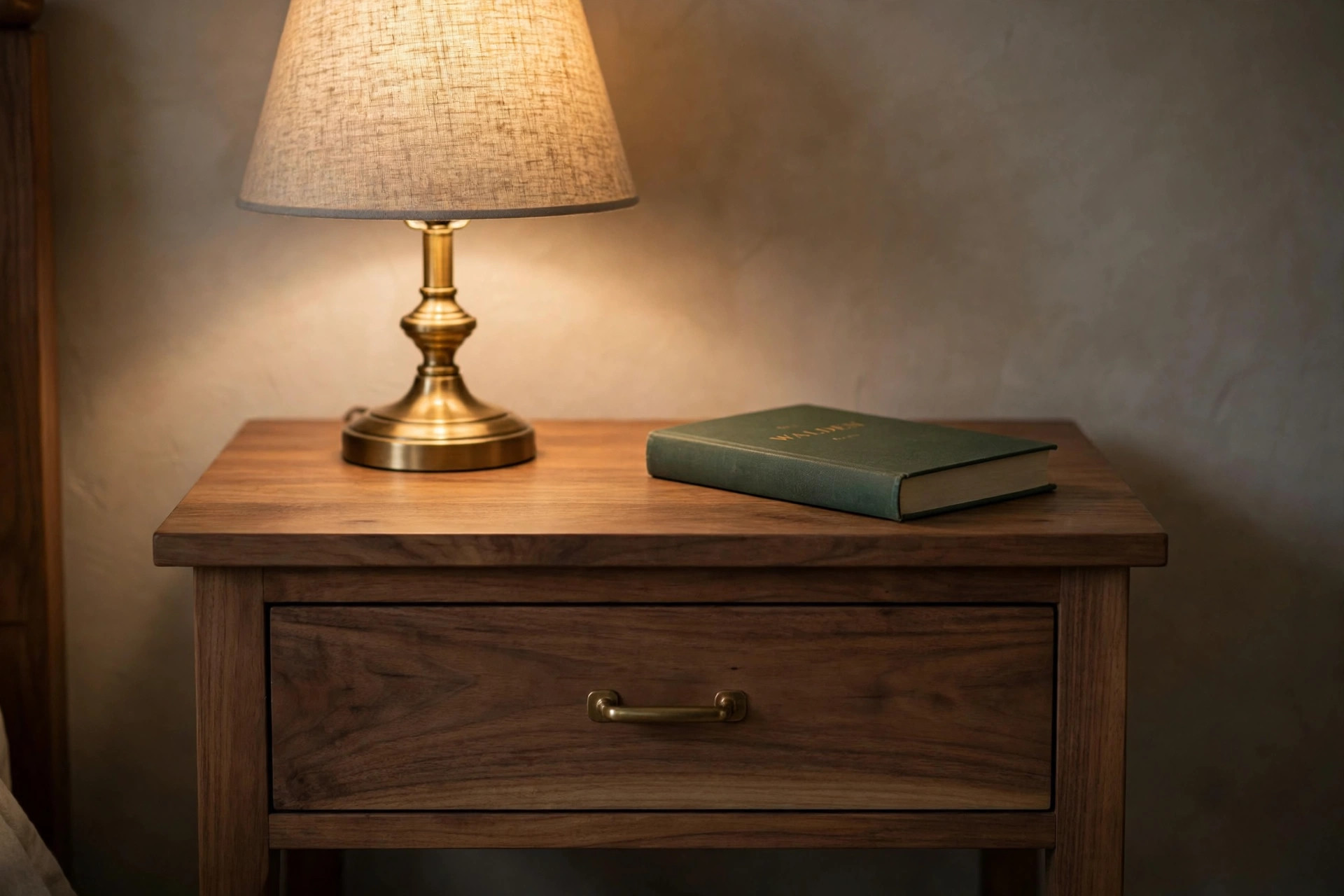
19. A charging station inside the nightstand drawer — phones charge out of sight
Phones charge on the floor, because the socket is the thing by the bed and the cable is the thing that trails across the floor. Move the charging inside the nightstand drawer — phones charge out of sight — so the phone sits in the drawer on its charger and the cable never crosses the floor. Drill a small hole in the back of the drawer for the cable, put a short power strip inside, and lay the phone flat, because the drawer that charges is the drawer that hides the cables. Keep the drawer half empty, because the drawer that is half empty is the drawer the phone fits in. (Check on Amazon for a short power strip with USB ports, which fits in a drawer and charges a phone and a watch at once.) Charging in the drawer, and the floor has no cables to trip over.
20. A cork board and a small shelf for the dressing corner — the corner that holds the day's plan
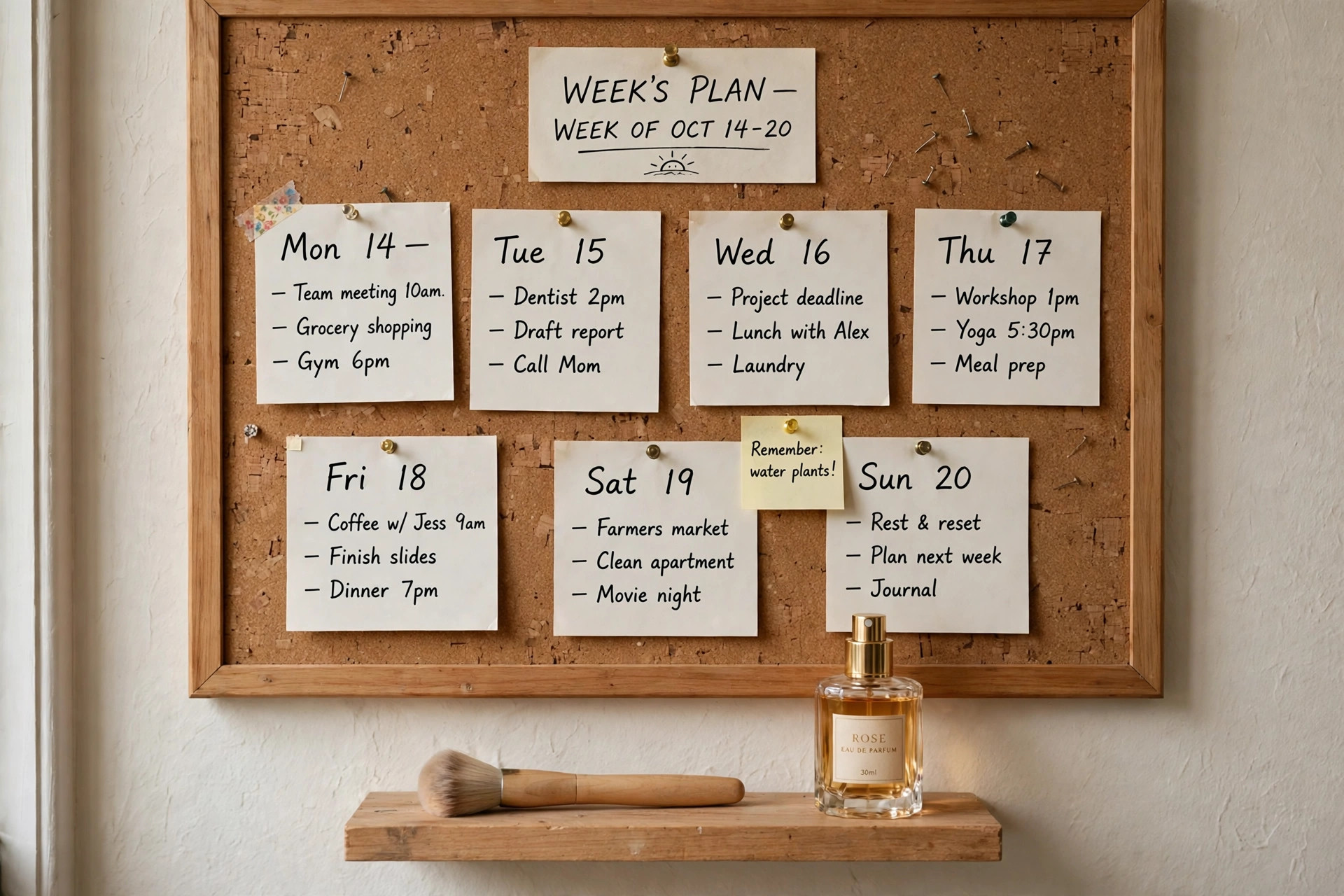
The dressing corner gathers clutter, because the corner is the place where the day's plan, the earrings and the hairbrush all land. Give it a cork board and a small shelf — the corner that holds the day's plan — so the board holds the notes and the earrings, and the shelf holds the brush and the perfume. Pin the week's plan to the board, because the plan you can see is the plan you follow, and keep the shelf to three things, because the shelf that holds three is a display. The board itself is in 18 DIY Cork Board Ideas for 2026, where a plain cork board becomes a dressing-corner board — and this corner is where it earns its keep. A board and a shelf, and the corner has a job.
21. A ring holder on the vanity — the rings live where they come off
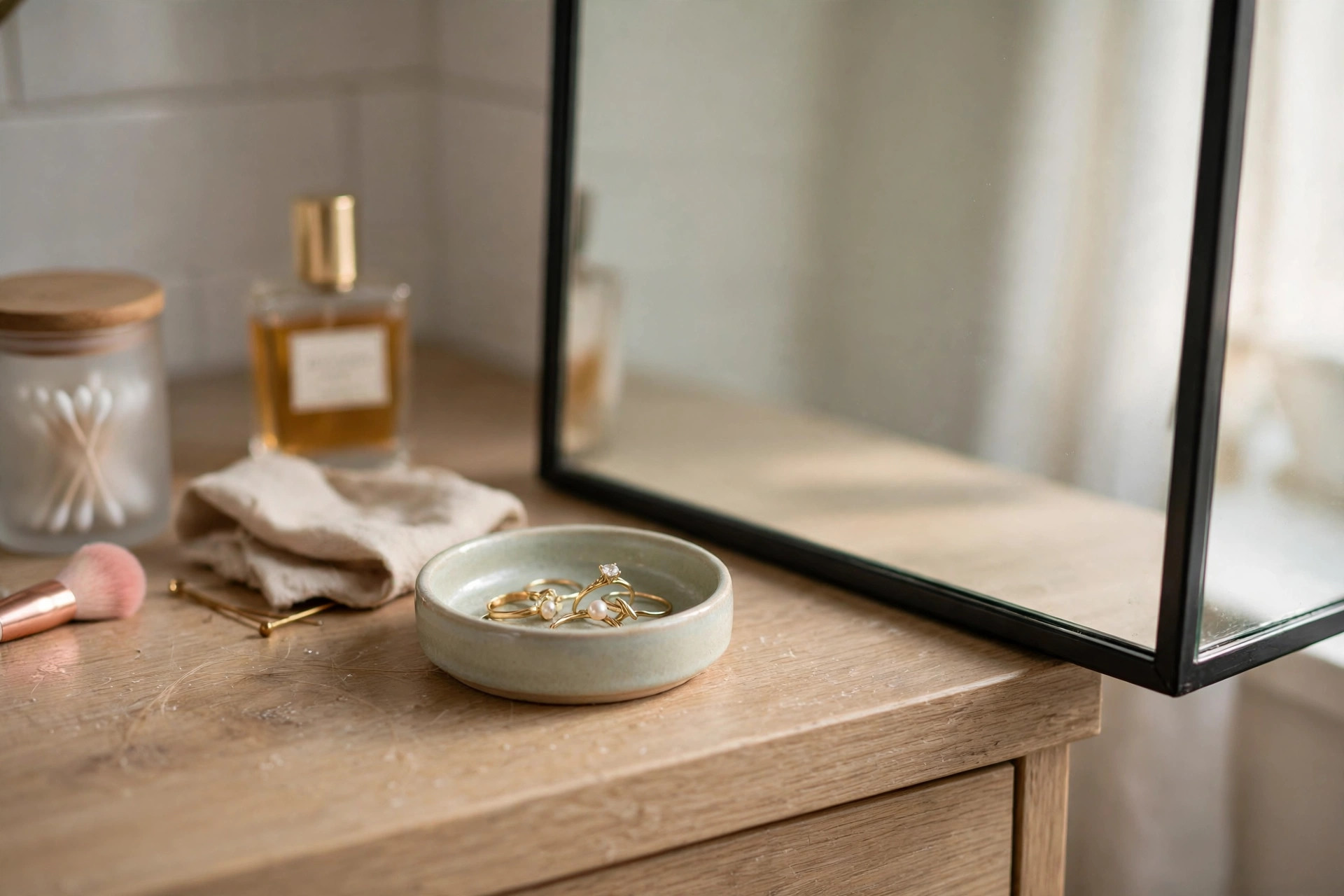
Rings live on the vanity edge, because the vanity is the place you take them off and the edge is the place they land. Put a ring holder on the vanity — the rings live where they come off — so the rings have a dish or a cone in the exact spot your hand reaches, and the vanity edge stays clear. Choose a holder that matches the vanity, because the holder that matches is the holder that looks like it belongs, and keep it beside the mirror, because the mirror is where you see the rings go on. The holders themselves are in 16 DIY Ring Holder Ideas for 2026, where a clay dish, a teacup and a wire tree all become ring holders — and the vanity is where they live. A holder on the vanity, and the rings stop wandering.
The whole room, kept calm
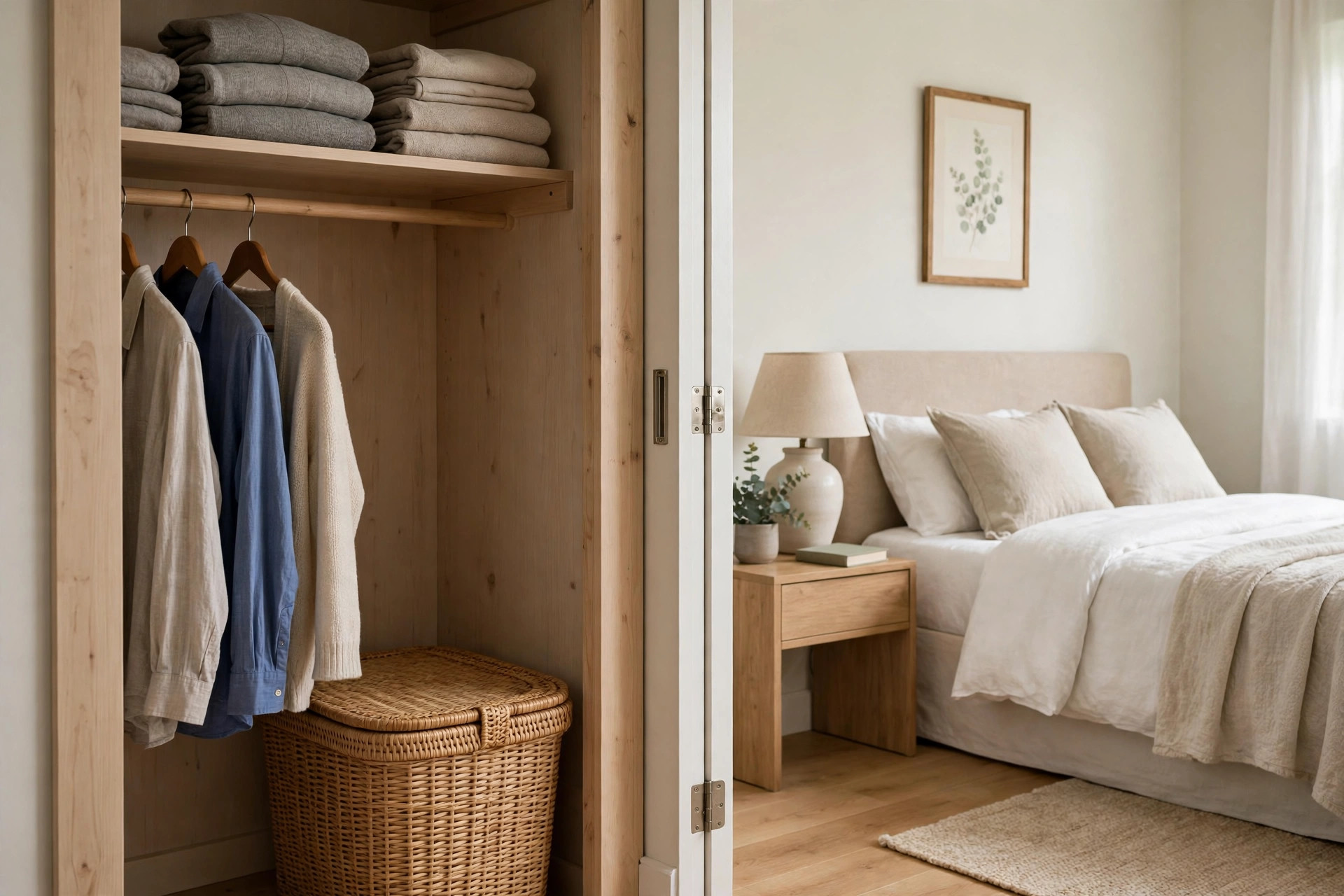
22. A lidded laundry basket that hides in the closet — the laundry leaves the room
Laundry lives on the bedroom floor, because the floor is the place the clothes land and the basket is the thing that is too big to hide. Use a lidded basket that hides in the closet — the laundry leaves the room — so the dirty clothes go straight into the basket in the closet and the bedroom floor stays clear. Put the basket at the bottom of the closet, where the shoes used to pile, and close the lid, because the lid is the thing that hides the laundry and the closet is the thing that hides the basket. Carry the whole basket to the machine, because the basket that carries is the basket that gets emptied. Laundry in the closet, and the bedroom stops looking like a laundry room.
23. A lidded basket for the chair pile — the chair becomes a chair again
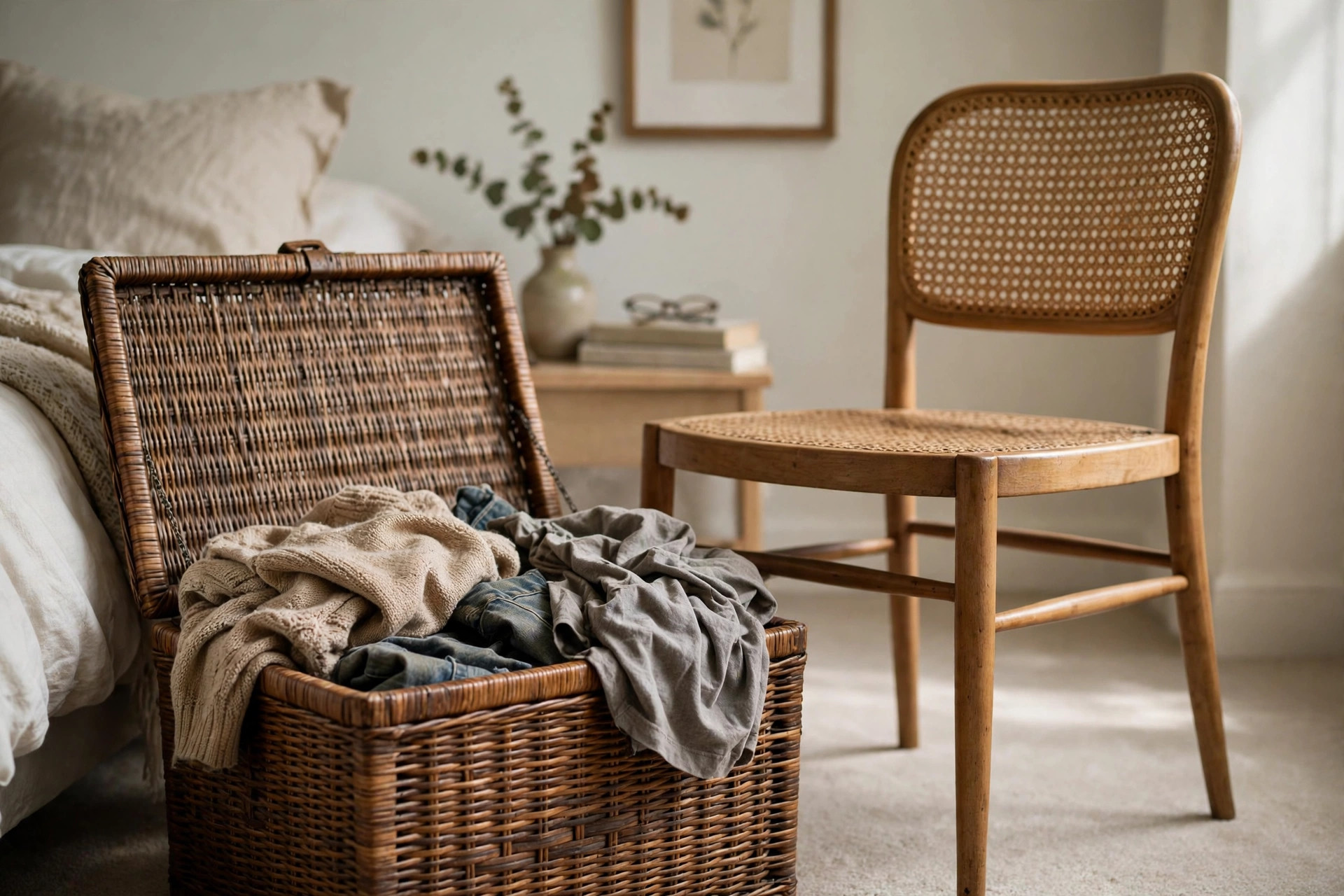
Every bedroom has a chair that is not a chair, because the chair is the place the clothes land and the clothes are the things that never get put away. Give the pile a lidded basket — the chair becomes a chair again — so the clothes that are not dirty and not quite clean live in the basket, and the chair is free to sit on. Put the basket beside the chair, not on it, and drop the worn-once clothes in it, because the basket that is beside the chair is the basket that gets used. Empty the basket once a week, back into the closet or into the wash, because the basket that is emptied is the basket that works. A basket for the pile, and the chair is a chair again.
24. A storage ottoman by the bed — a seat for shoes, blankets inside
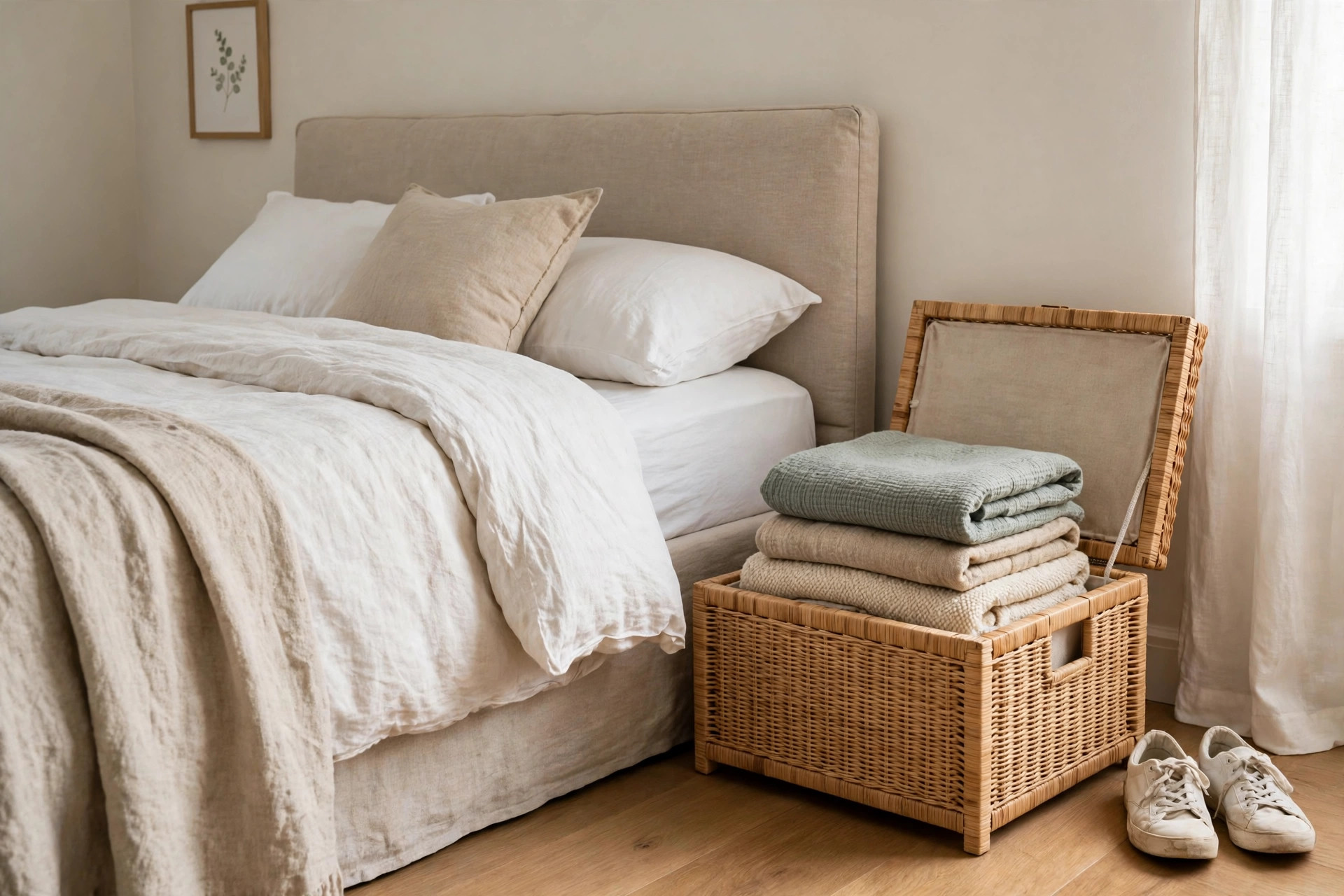
Putting shoes on while standing is a wobble, because the shoe is the thing that needs a seat and the bedroom is the room with nowhere to sit. Put a storage ottoman by the bed — a seat for shoes, blankets inside — so you sit on the ottoman to put your shoes on, and the spare blankets live inside it. Keep the ottoman small, because the ottoman that is small is the ottoman that fits beside the bed, and keep the blankets folded flat, because the blankets that are flat are the blankets that fit. Sit on it every morning, because the ottoman you sit on is the ottoman that earns its place. An ottoman by the bed, and the shoes go on sitting down.
25. A rolling cart for bedtime and beauty things — the cart that parks beside the bed
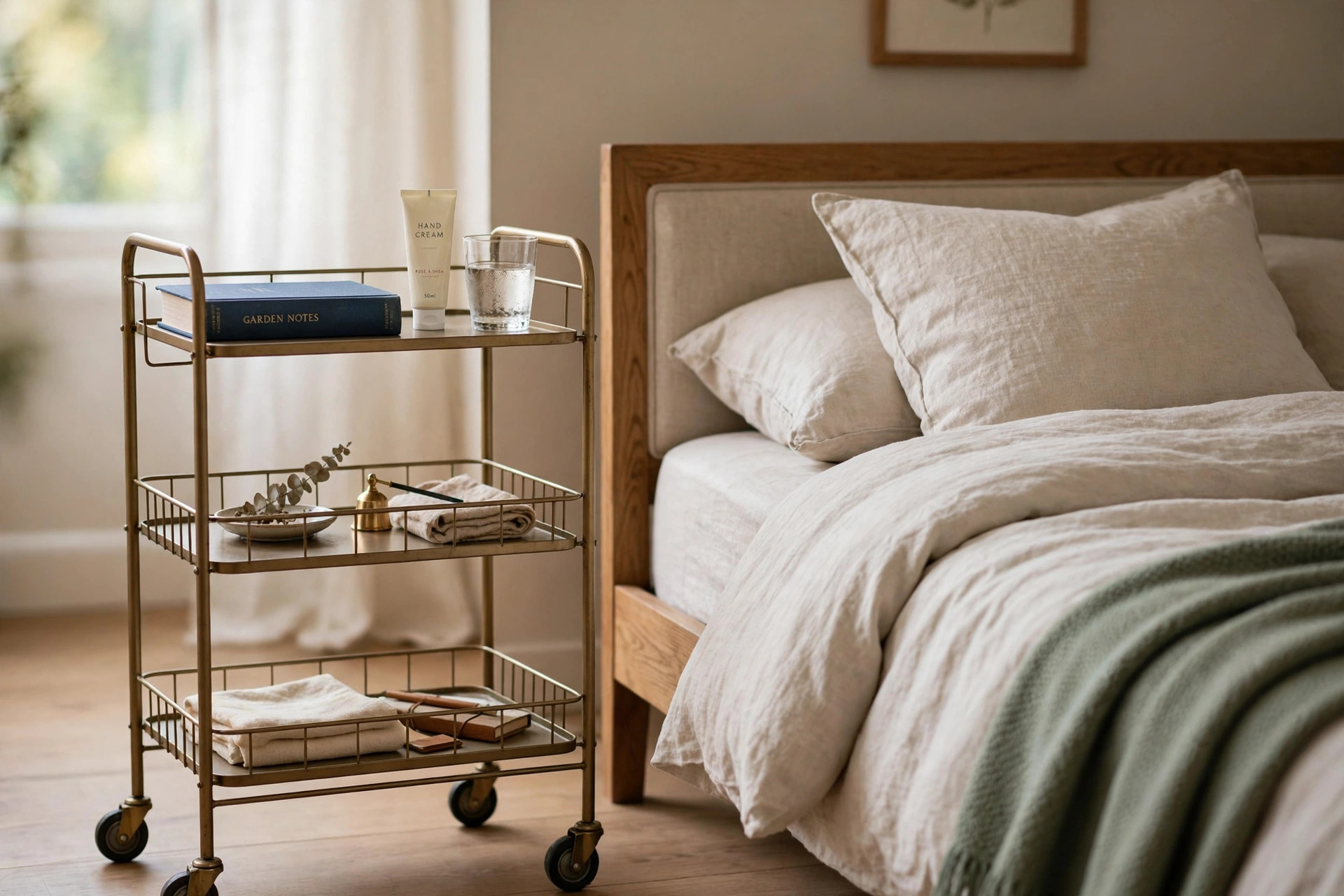
Bedtime things live on the floor, because the book, the hand cream and the water glass all need a home and the nightstand is already full. Use a rolling cart — the cart that parks beside the bed — so the three tiers hold the book, the cream and the glass, and the cart rolls away in the morning. Park it beside the bed at night and roll it to the dressing corner in the day, because the cart that moves is the cart that never gets in the way. Keep the top tier for the things you reach for in the dark, because the top tier is the tier your hand finds first. The carts themselves are in 22 Rolling Cart Organization Ideas for 2026, where one cart serves every room — and the bedroom is the room it parks in at night. A cart beside the bed, and the floor stops holding the bedtime things.
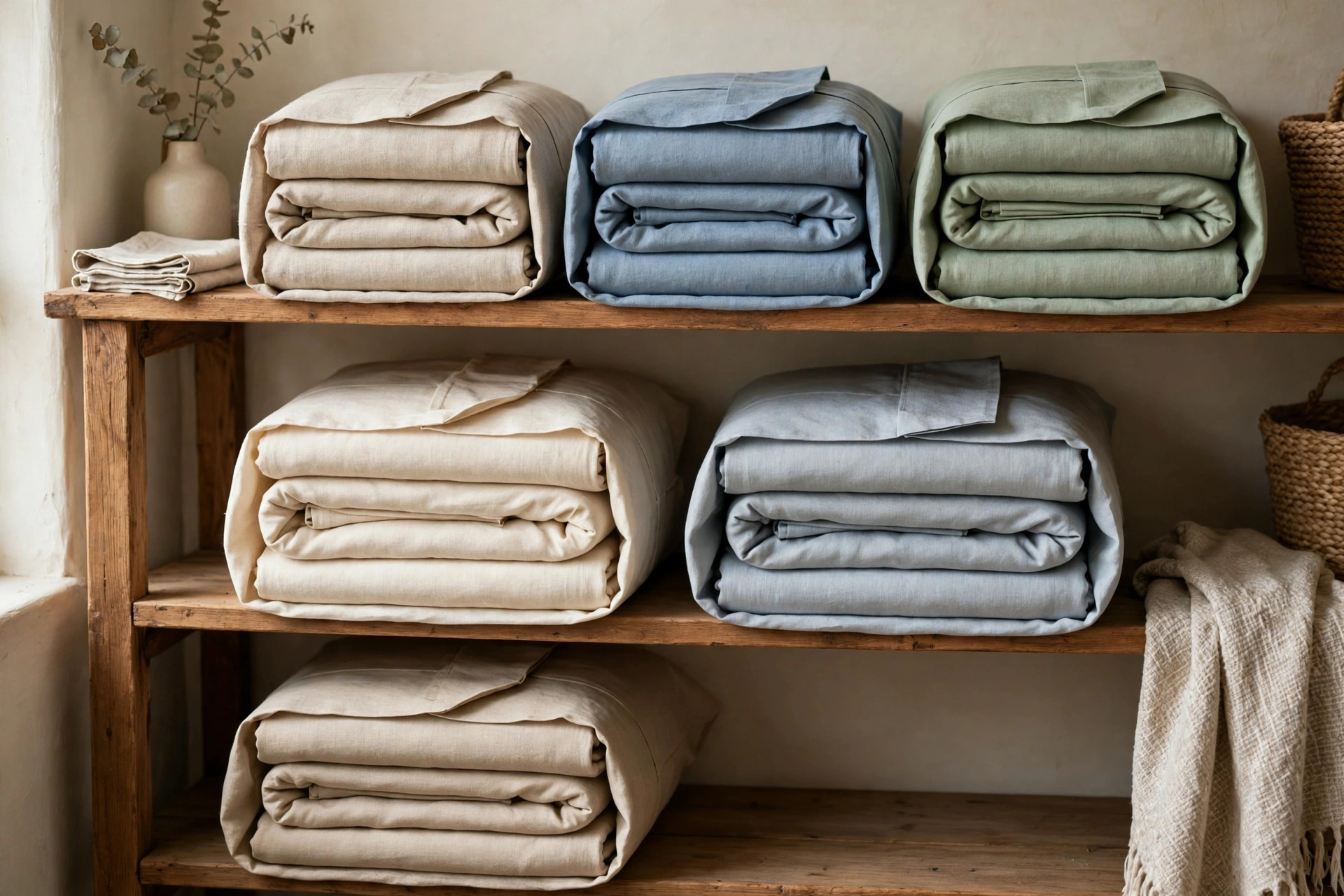
26. A linen shelf for spare bedding, folded the same way — the shelf that stays neat
Spare bedding takes over a shelf, because the duvet cover is the thing that unfolds itself and the shelf is the thing that cannot hold it. Give the bedding one shelf and fold it all the same way — the shelf that stays neat — so every set is folded to the same size, stacked in the same direction, and the shelf looks like a shop display. Fold the sheet set inside its own pillowcase, because the set that lives in its pillowcase is the set that never comes apart. Keep one shelf per kind of bedding, because the shelf that holds one thing is the shelf that stays neat. The linen system behind this shelf is in 22 Linen Closet Organization Ideas for 2026, where the folding and the labelling are worked out properly. One shelf, one fold, and the bedding stays put.
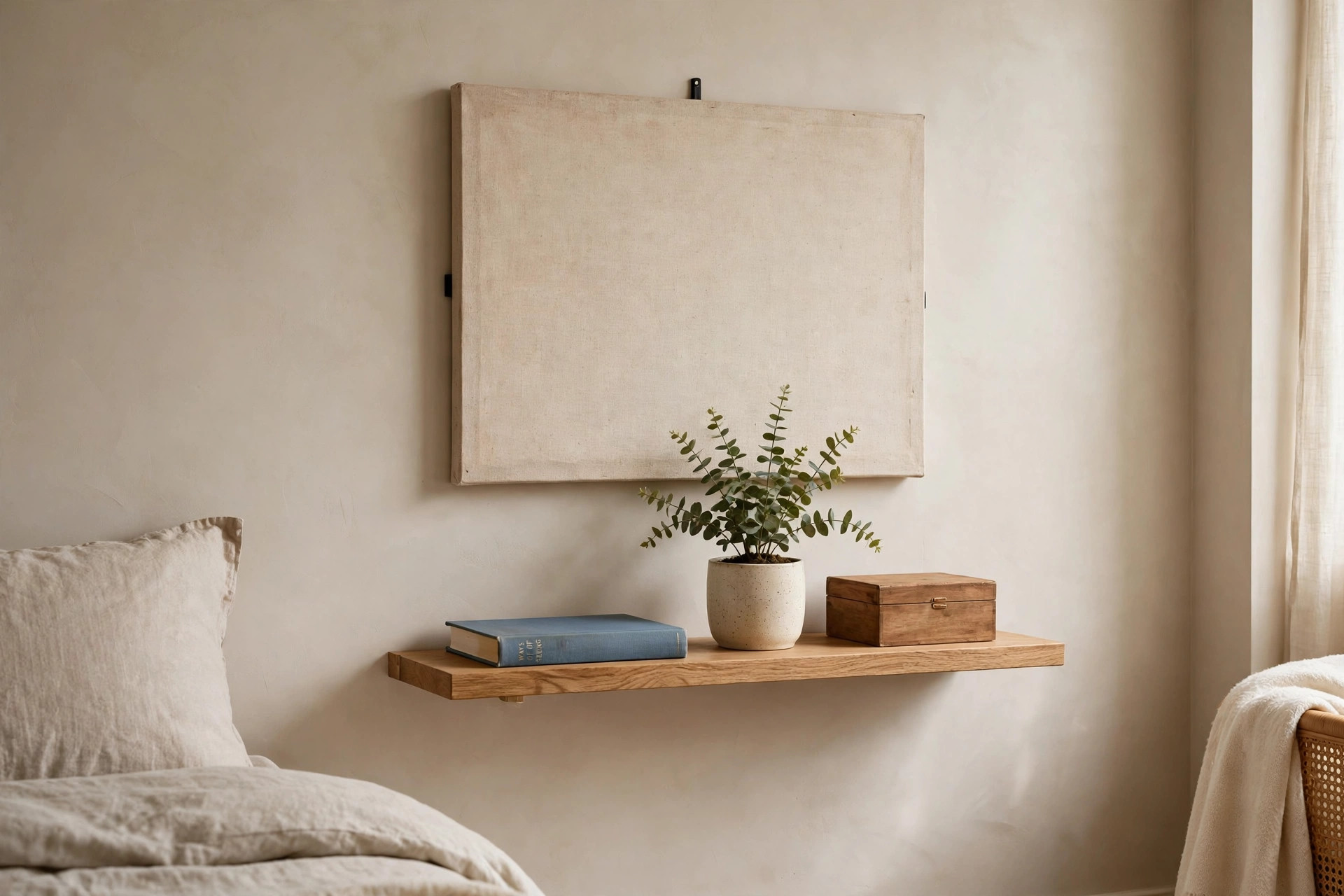
27. Canvas art above a floating shelf — the wall that decorates and stores at once
A bare wall above a shelf looks unfinished, because the wall is the thing that is empty and the shelf is the thing that is doing all the work. Hang canvas art above the floating shelf — the wall that decorates and stores at once — so the art fills the wall and the shelf below it holds the book, the plant and the small box. Match the art to the room, because the art that matches is the art that looks like it belongs, and keep the shelf to three things, because the shelf that holds three is a display. The art itself is in 22 DIY Canvas Wall Art Ideas for 2026, where a painted canvas costs less than a bought print — and this wall is where it hangs. Art above a shelf, and the wall works twice as hard.
28. The one-in-one-out rule for the bedroom — the rule that keeps the room calm
The bedroom fills up because things come in and nothing goes out, and the room that only fills is the room that bursts. Keep one rule — the rule that keeps the room calm — so every time something new comes into the bedroom, something old leaves it: a new jumper in, an old jumper out; a new book in, a finished book out. Keep a small bag in the closet for the things that are leaving, because the bag that is there is the bag that gets filled. Empty the bag once a month, because the bag that is emptied is the bag that works. One in, one out, and the bedroom stays the size it is.
Which bedroom storage idea fits which situation?
| Situation | Best first move | Budget | Tools needed |
|---|---|---|---|
| Clothes on the chair | Lidded basket for the chair pile (idea 23) | Low | Basket |
| No floor space left | Under-bed rolling bins (idea 1) | Low | Bins on wheels |
| Spare bedding with no home | Lift-up ottoman bed (idea 2) | Medium | Storage bed |
| Closet bursting | Double hanging rails (idea 8) | Low | Rails, hangers |
| Shoes everywhere | Shoe organiser on the closet door (idea 11) | Low | Door organiser |
| Small things vanish | Jewellery tray on the dresser (idea 15) | Low | Tray |
| Nightstand cluttered | Nightstand with a drawer (idea 18) | Low | Nightstand |
| Phones charge on the floor | Charging station in the drawer (idea 19) | Low | Power strip |
| Dressing corner has no storage | Cork board and small shelf (idea 20) | Low | Cork board |
| Laundry piles up | Lidded basket hidden in the closet (idea 22) | Low | Hamper |
| Bedtime things everywhere | Rolling cart beside the bed (idea 25) | Low | Rolling cart |
| Room never stays tidy | One-in-one-out rule (idea 28) | Free | None |
You do not need all 28 ideas. You need the three that solve your bedroom — usually the rolling bins under the bed, the storage bench at the foot of it, and the double rails in the closet — and the one rule that keeps it that way. Start under the bed, do it this weekend, and put the first bin where your hand reaches when you tidy up at night. Do that and the next time you walk into the bedroom it will feel like a place to rest, for the price of a few bins and an afternoon.
Save this post for your next bedroom sort, and if the accessories need sorting first, read 22 Purse Storage Ideas for 2026 next — it is Post 07, the bags and accessories that live with the bedroom storage — and 22 DIY Bookends Ideas for 2026, Post 22, for the books on the bedside shelf. This is the first post of the second Storage by room/object run — Posts 31 to 55, one room at a time — and the next posts carry the same storage system into the rooms that follow.
Publish date assigned at publishing time. Updated as new bedroom storage finds are tested.
Frequently asked questions
How do I add storage to a small bedroom without it looking cluttered?
Use storage that hides — under-bed bins, a storage bench and a closet with a door — because the storage you cannot see is the storage that does not clutter the room. Start under the bed, because it is the biggest empty space in the room, then give the closet double rails so the clothes stop spilling out. Keep the surfaces to three things, because the room that shows three things looks calm and the room that shows thirty looks crowded. Hidden storage first, and the small bedroom stays calm.
What is the best way to store clothes under the bed?
Use low bins on wheels with lids, because the bins that roll come out easily and the lids keep the dust off the clothes. Put one kind of thing in each bin — out-of-season clothes in one, spare shoes in another — and label the ends so you can find the right bin without pulling them all out. Keep the bins shallow, no more than 15 cm tall, because the bin that is shallow is the bin that slides under a low bed. Rolling bins with lids, and the under-bed space works like a drawer.
How do I stop the bedroom chair from becoming a clothes pile?
Give the pile a home that is not the chair — a lidded basket beside it for the worn-once clothes that are not dirty and not quite clean. Put the basket where the chair is, because the basket that is beside the chair is the basket the clothes land in, and empty it once a week back into the closet or into the wash. The pile exists because the clothes have nowhere else to go, so the basket is the fix, not willpower. A basket beside the chair, and the chair is a chair again.