28 Living Room Storage Ideas for 2026
A living room has to do too many jobs at once. It is where you relax, host, work, play, and store everything that does not have a home anywhere else — and most living rooms were never given enough storage to match.
These 28 living room storage ideas fix that without a remodel: hidden storage, furniture that does double duty, and small-space tricks that make the same room feel twice as big.
Every idea below works in a real, lived-in room. Pick three that fit your space, start with the one that hides the biggest mess, and build from there.
Storage furniture that earns its floor space
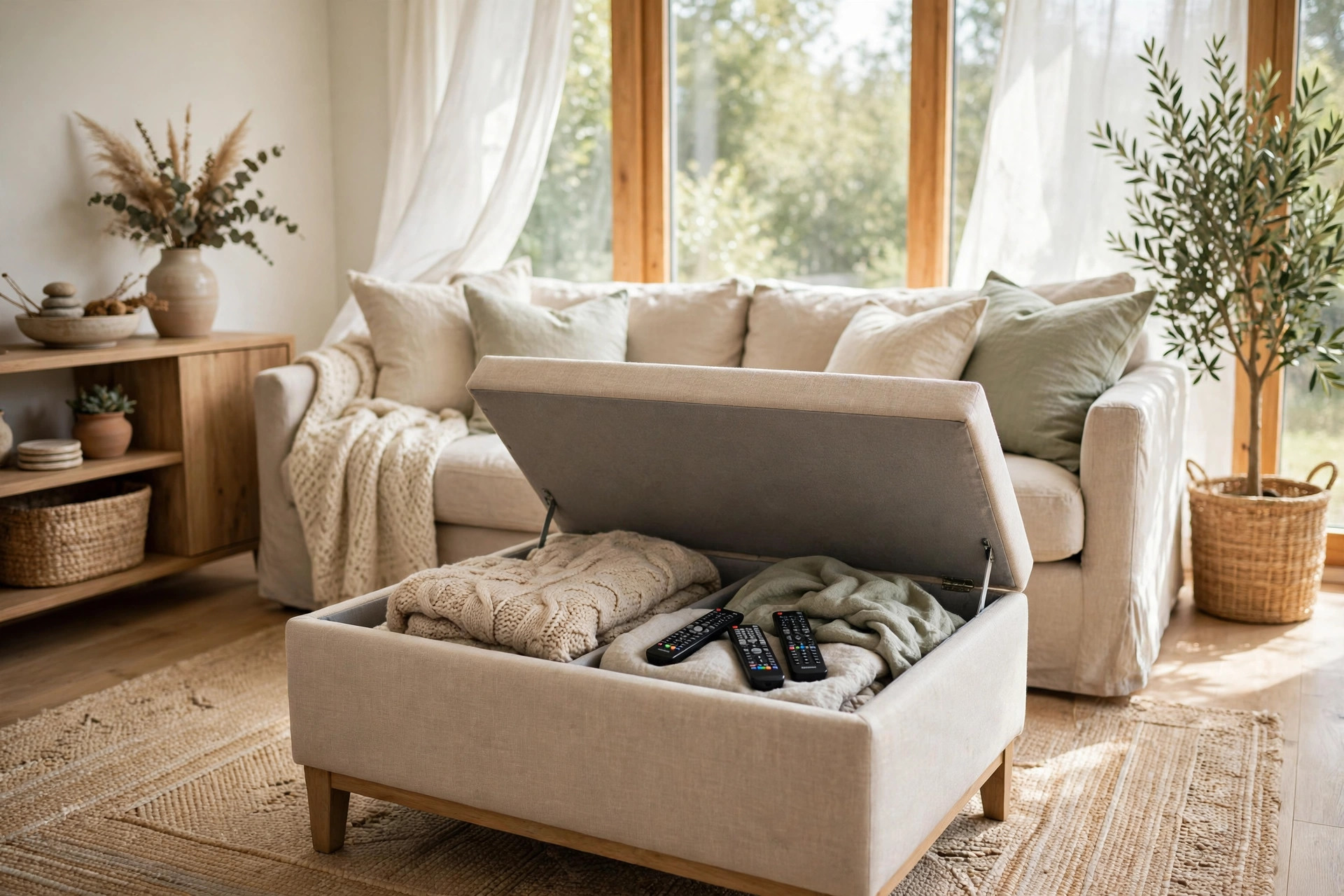
1. A storage ottoman that hides the everyday clutter
A storage ottoman is the fastest win in this whole list. It holds throws, remotes, chargers, kids' toys and board games, and when the lid is closed the room looks finished. Choose one with a firm, flat lid so it can double as a coffee table or an extra seat when guests come over. In a small room, pick a rectangular ottoman in the same colour family as your sofa so it reads as part of the furniture, not another box in the room. Measure first — it should be about two-thirds the length of your sofa, never wider than it.
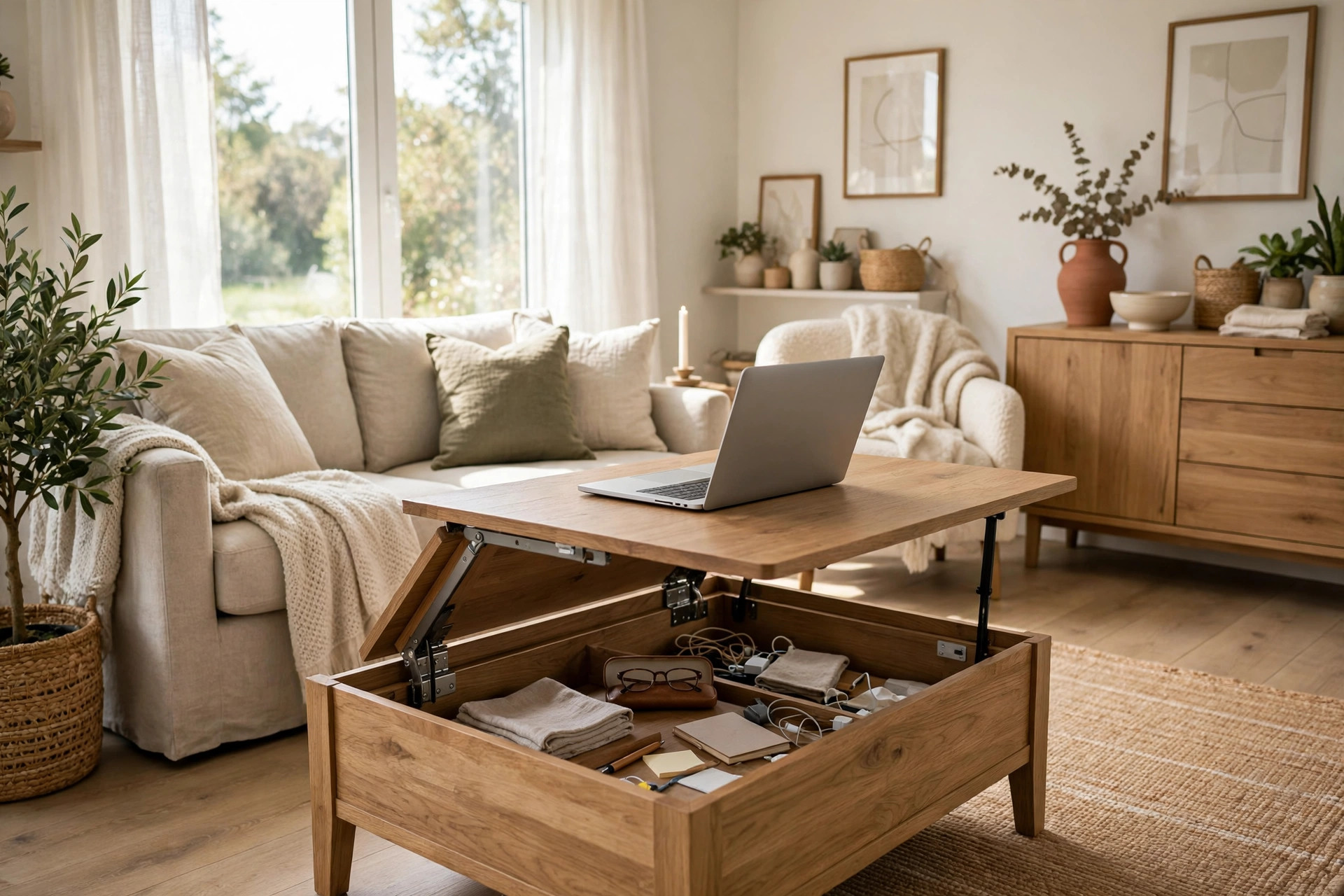
2. A coffee table with drawers or a lift-top
A coffee table with drawers turns the most-used surface in the room into storage. Magazines, coasters, notebooks and the remote graveyard all get a home, and the top stays clear for actual use. A lift-top version goes further: raise it to laptop height for working from the sofa, and use the hidden compartment underneath for chargers, notebooks and craft supplies. Look for soft-close drawers if you have kids, and a table with a lower shelf for books you actually reach for.
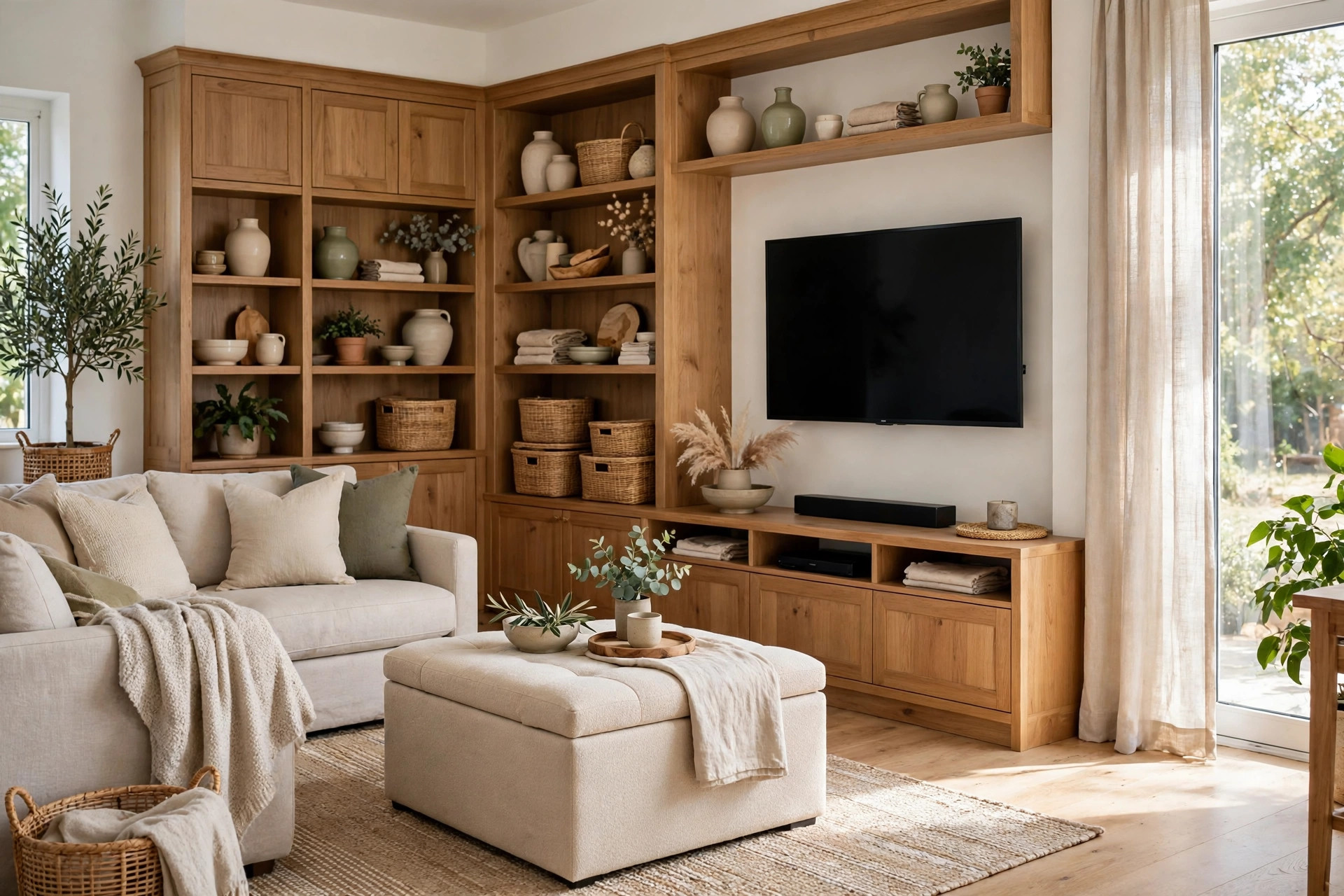
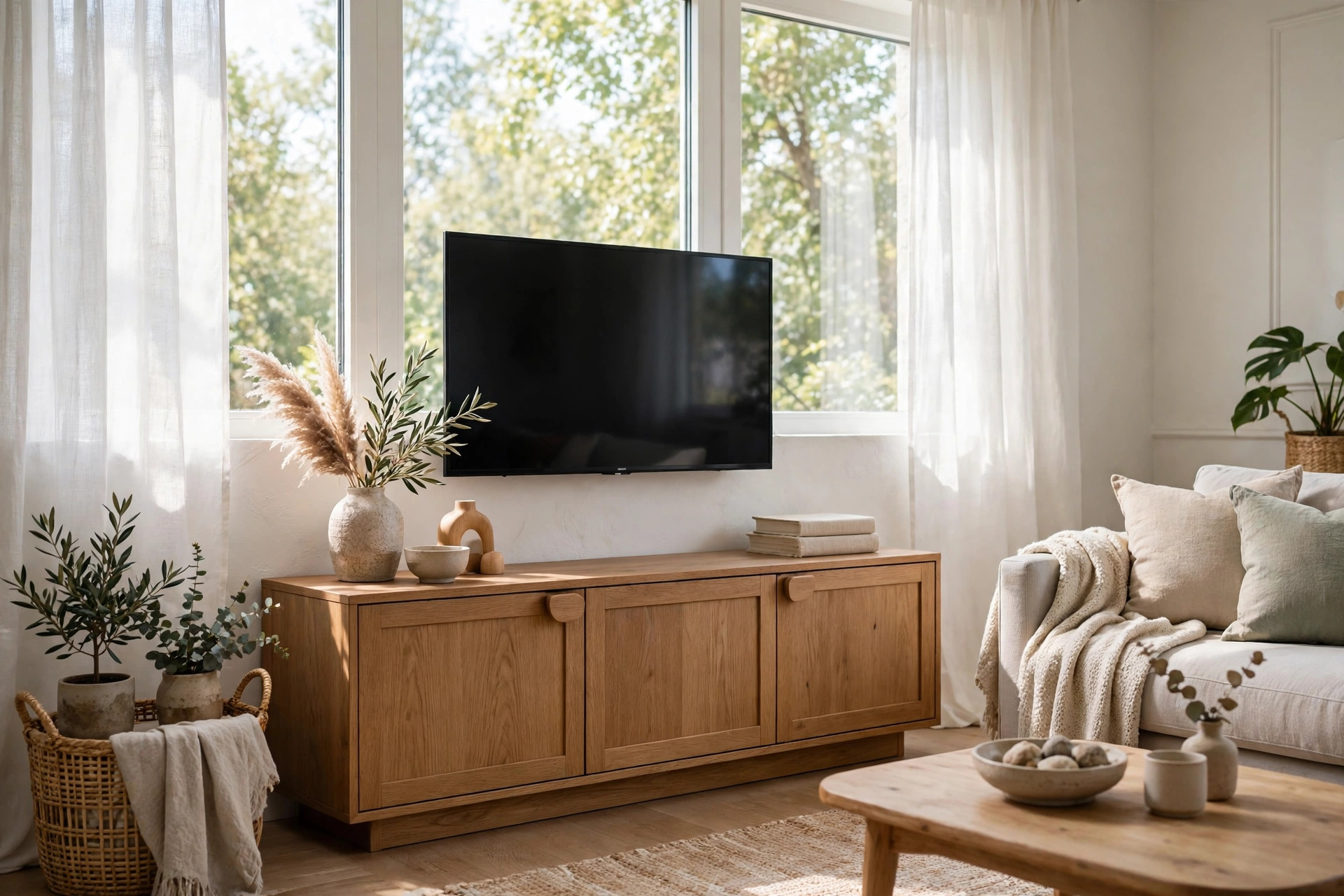
3. A media console with closed cabinets, not open shelves
Open shelving looks good in photos and collects dust and visual noise in real life. A low media console with closed doors hides the router, game consoles, cables and DVDs, while the top holds the TV and one or two styled objects. Choose a console slightly wider than your TV so the proportions feel settled, and drill a cable hole in the back panel if it does not have one — visible cables undo the whole effect. If you rent, a freestanding console beats a wall-mounted unit every time.
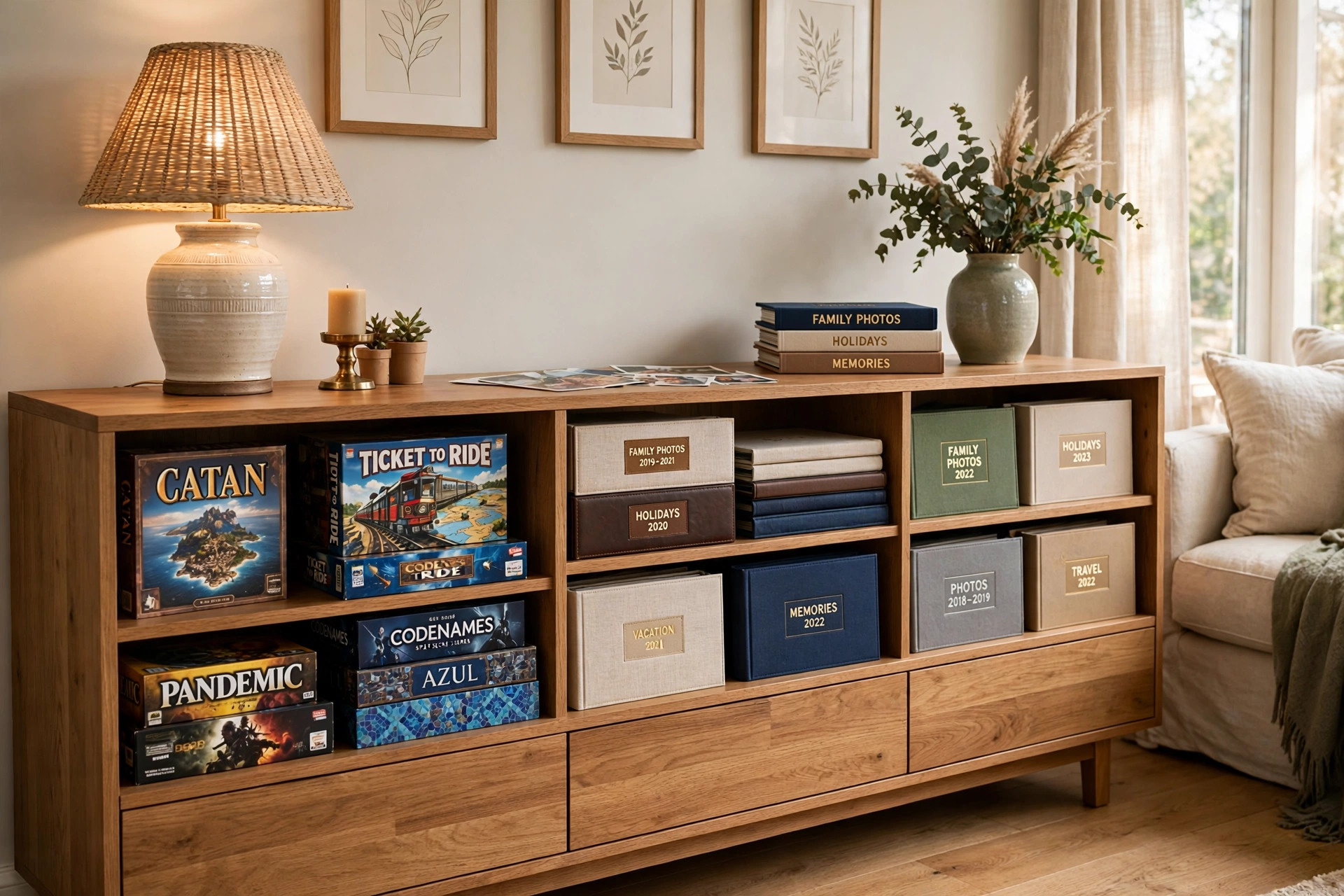
4. A sideboard or credenza along the longest wall
A sideboard is the living room's junk drawer, done properly. It stores board games, photo albums, extra candles, table linens and anything you want close but not visible, and its top is a styling surface for a lamp, a vase and a framed print. In a dining-living combo it can hold placemats and serving pieces too. Keep the top to three objects in different heights and the whole piece looks intentional instead of like overflow storage.
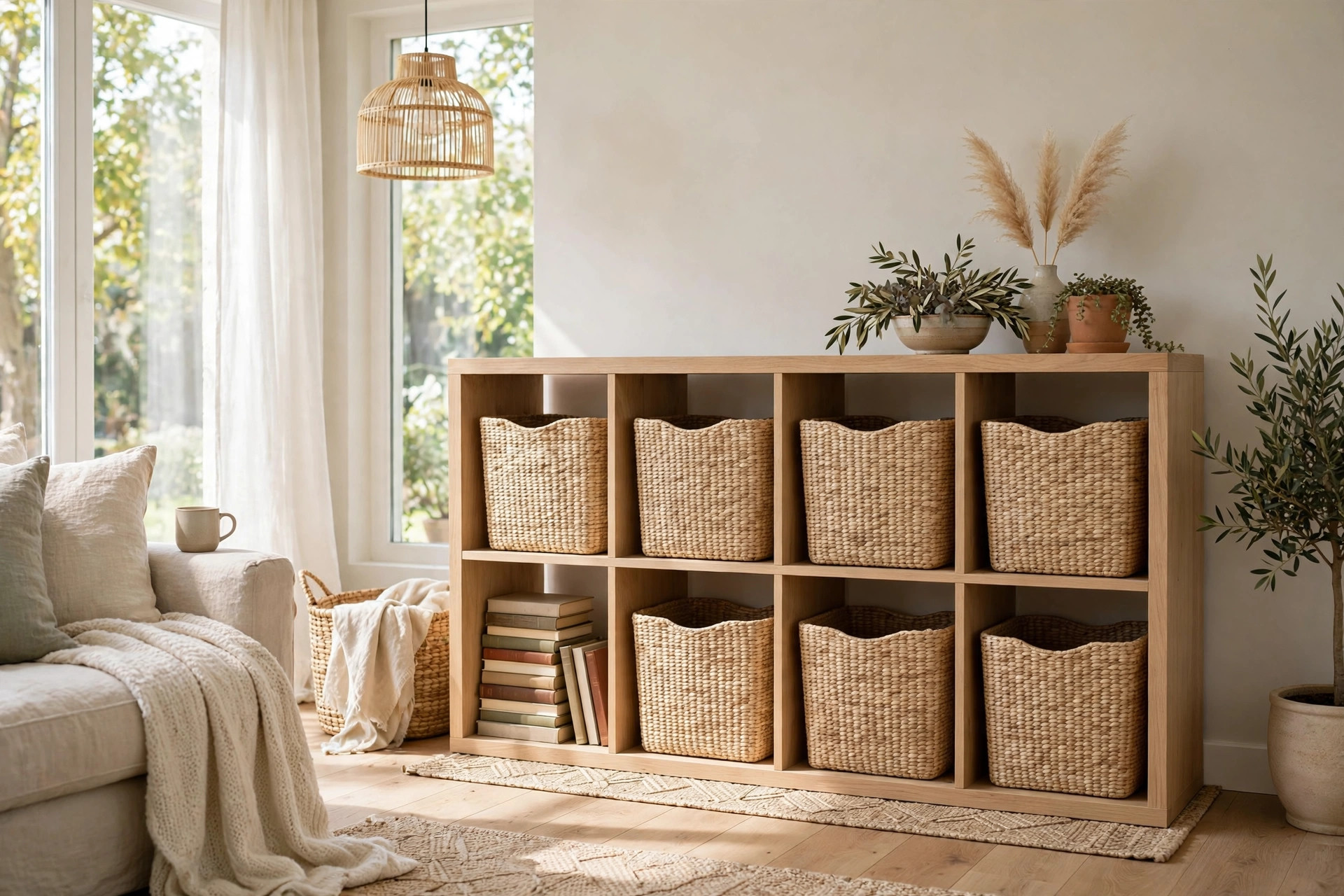
5. Storage cubes inside a cube shelf
A cube shelf with fabric or seagrass bins is the most forgiving storage in a living room. Each cube gets one category — toys, cables, throws, magazines — and the bins hide the mess while the shelf itself looks like furniture. Label the bins on the inside edge if you share the room with kids, and leave one or two cubes open with a book stack or a plant so the unit does not read as a wall of boxes. This is the easiest idea on this list to start today.
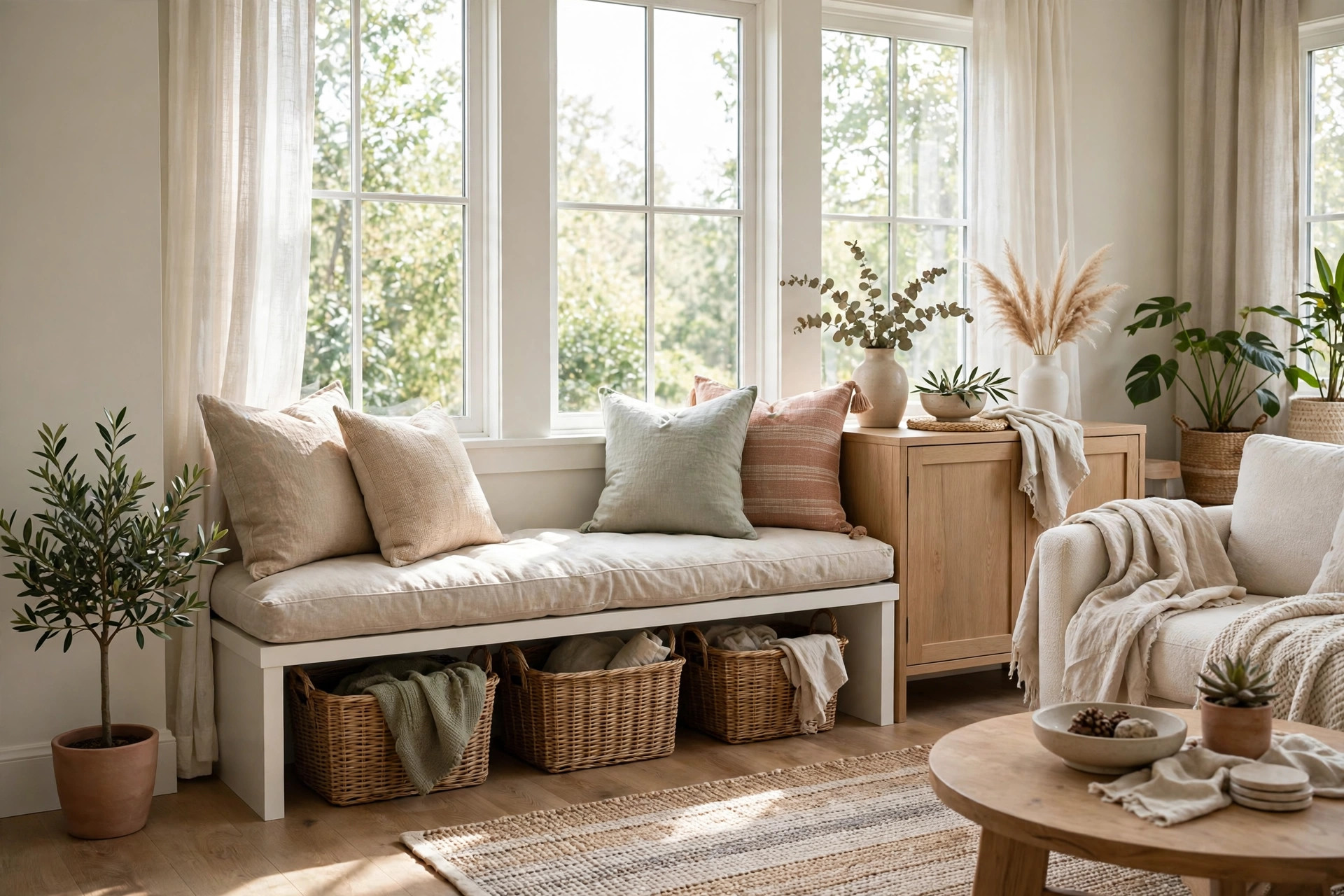
6. A bench with storage under the window
A low storage bench under a window turns dead space into seating and storage in one move. It holds shoes, dog leads, winter throws and kids' outdoor toys, and with a cushion on top it becomes the best seat in the room. In a small living room, a bench is better than a second armchair: it seats two people, stores a full category of clutter, and does not block light. Add baskets inside if the bench is open underneath, so nothing slides around.
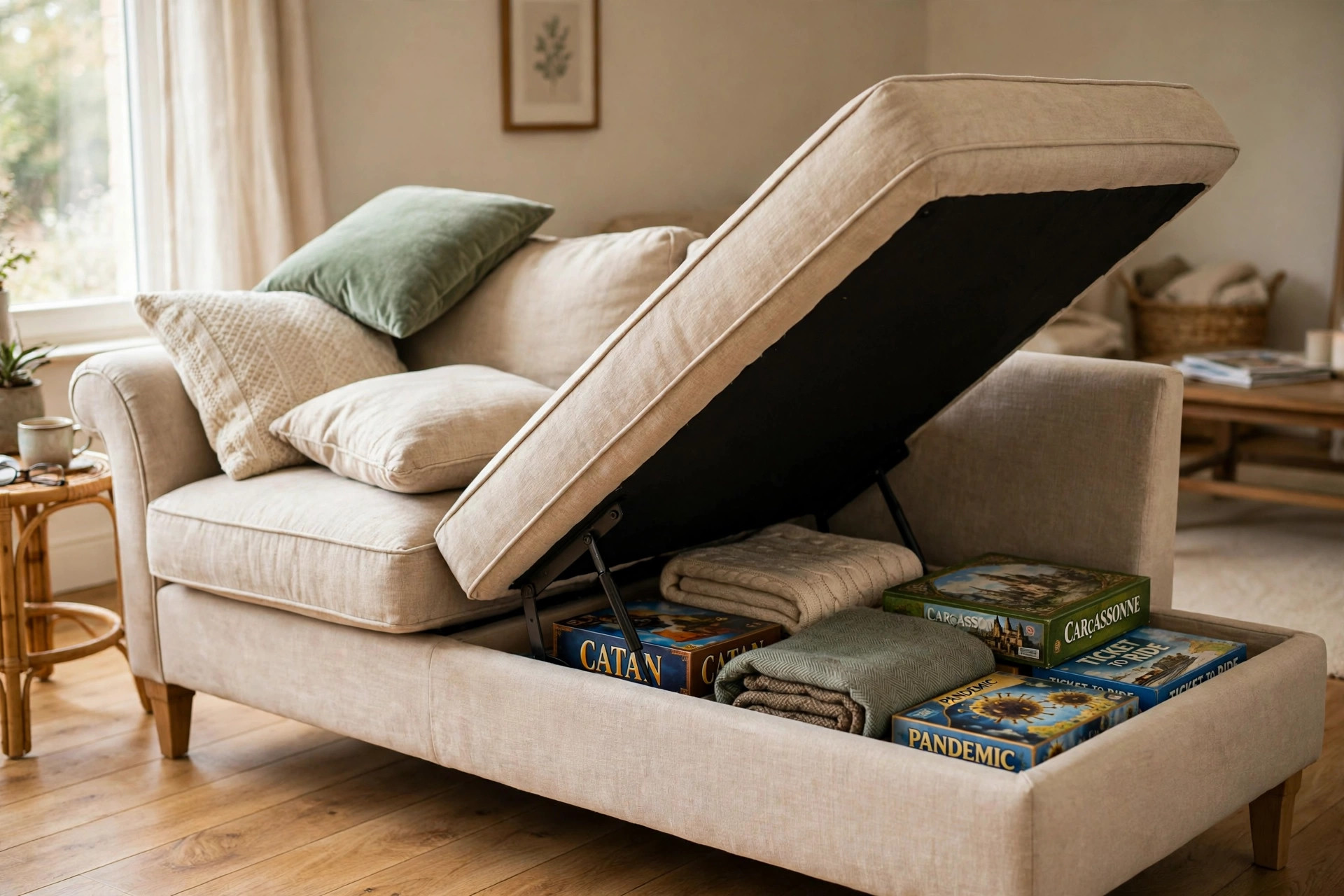
7. A sofa with built-in storage
If you are buying a sofa anyway, buy one with storage. Chaise sofas with a lift-up seat hide bedding, off-season throws and board games, and some designs have a hidden compartment in the armrest for remotes and chargers. It costs more than a standard sofa, so only choose this when a replacement is already planned — but when it is, it is the highest-capacity storage in the room, because it uses space you were already giving to the sofa.
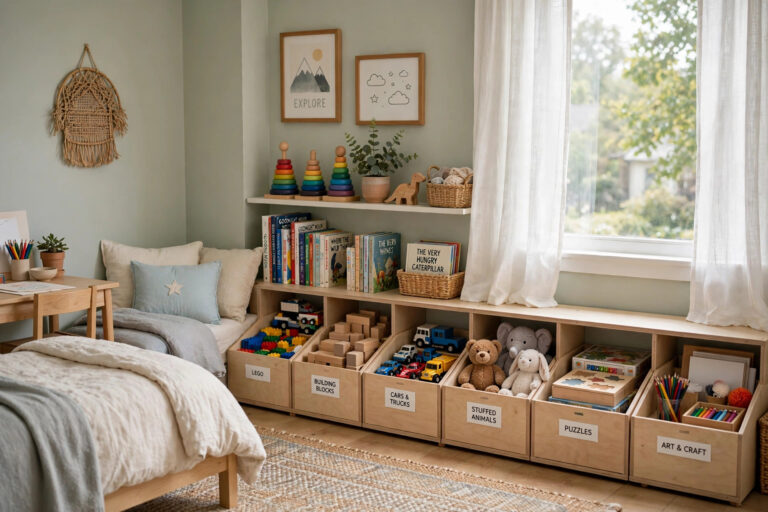
Built-ins and walls that work harder
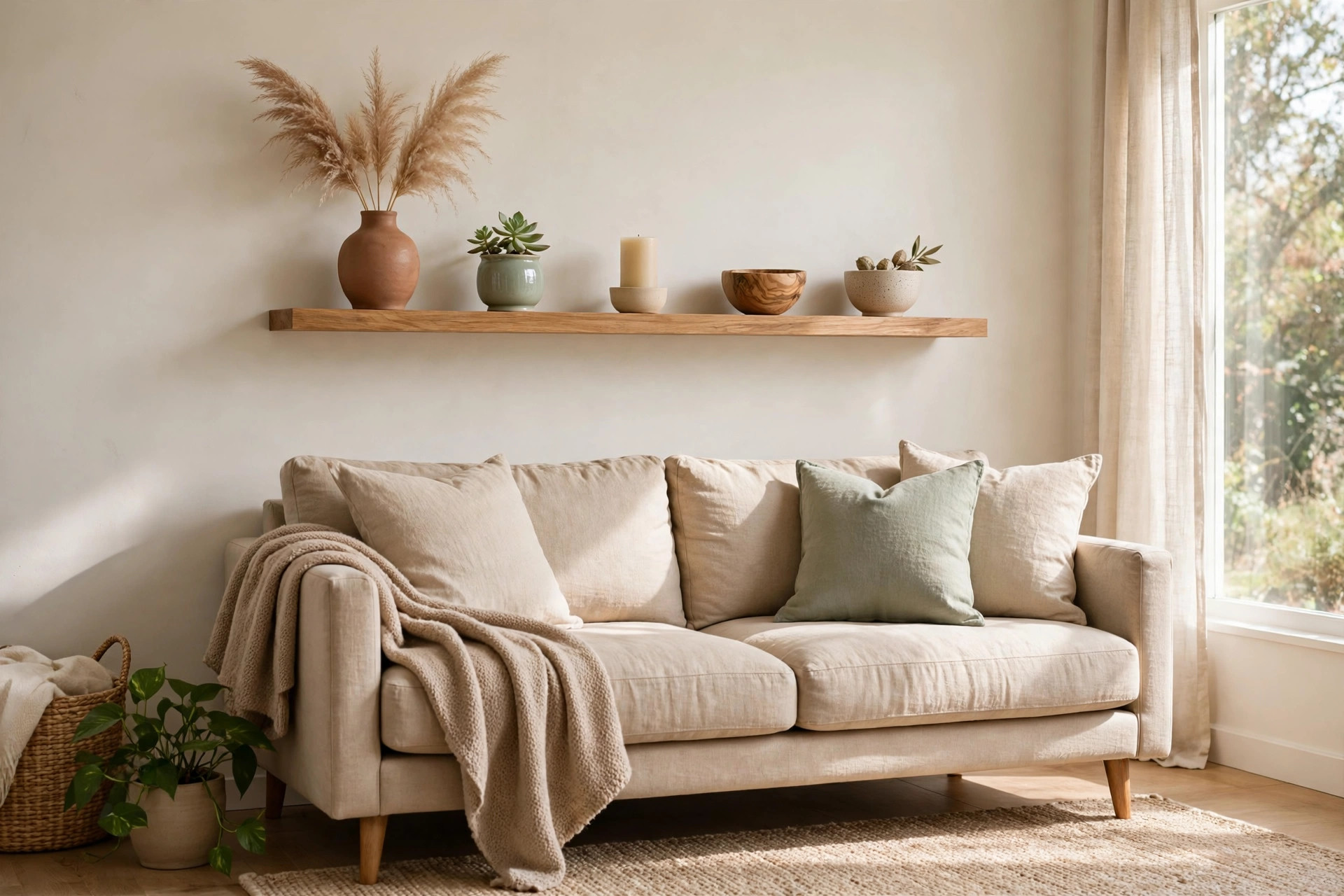
8. Floating shelves above the sofa — styled, not stuffed
Floating shelves work when they hold five things, not fifteen. Use two or three shelves above the sofa for books you love, one plant and one framed photo, and keep the rest of your storage closed. The shelves add display space without taking a centimetre of floor, which is exactly what a small living room needs. Hang them at eye level when seated, not standing, so they feel part of the seating area instead of looming over it.
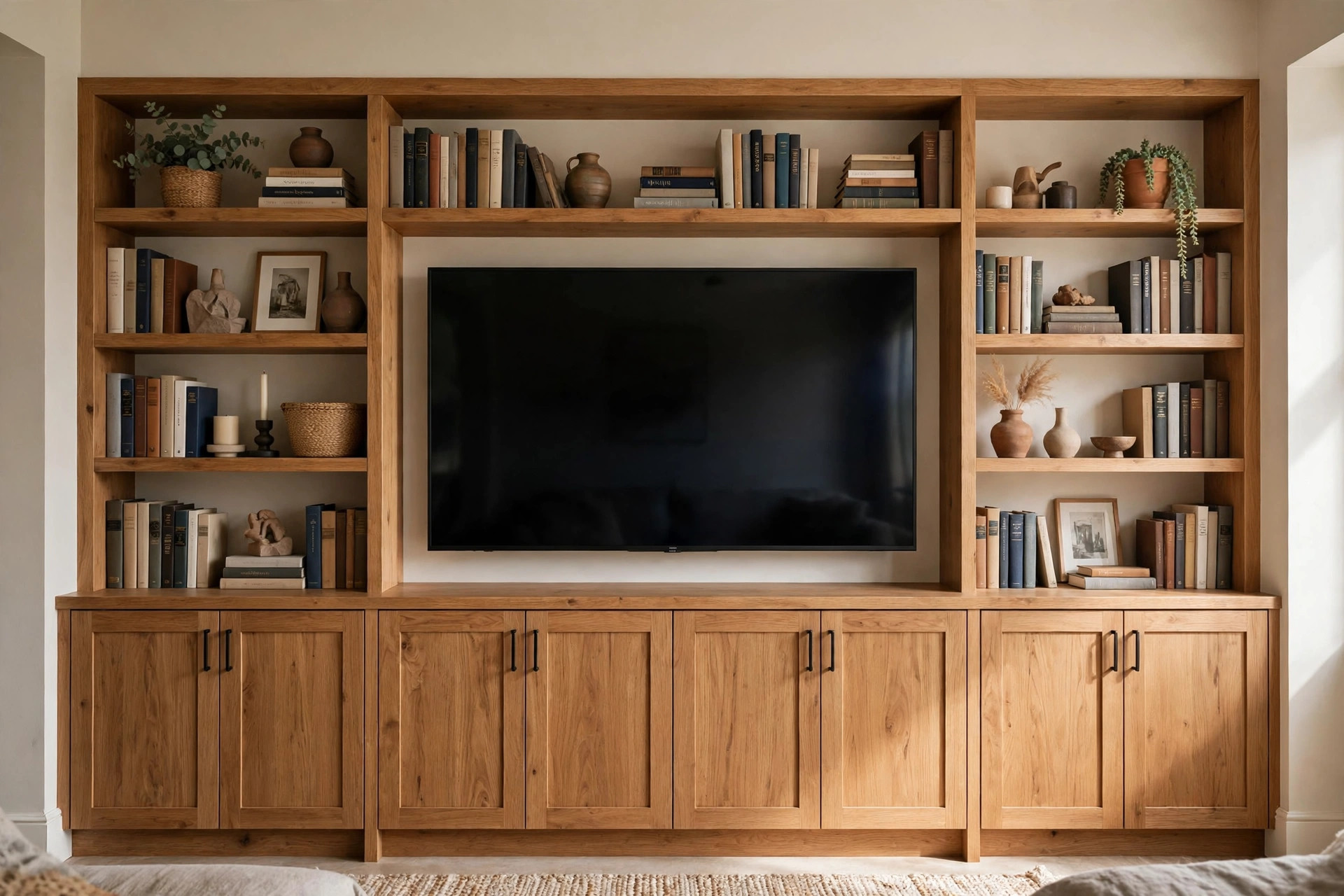
9. Built-in shelves around the TV
Framing the TV with built-in or lookalike shelving turns the biggest object in the room into part of the wall. Closed cabinets at the bottom hide consoles and cables, open shelves at the top hold books and decor, and the TV stops looking like a black rectangle floating on a wall. If true built-ins are out of budget, two tall bookcases flanking the TV with a bridging shelf above give you 80 percent of the look for a fraction of the cost.
10. A full wall of bookcases with closed bottoms
One wall of bookcases with doors on the lower half and open shelves on the upper half is the closest thing to adding a closet to your living room. The closed bottom hides games, paperwork and kids' supplies; the open top keeps books and display pieces where you can see them. Paint the bookcases the same colour as the wall and they read as architecture, not furniture — the room feels bigger, not more crowded.
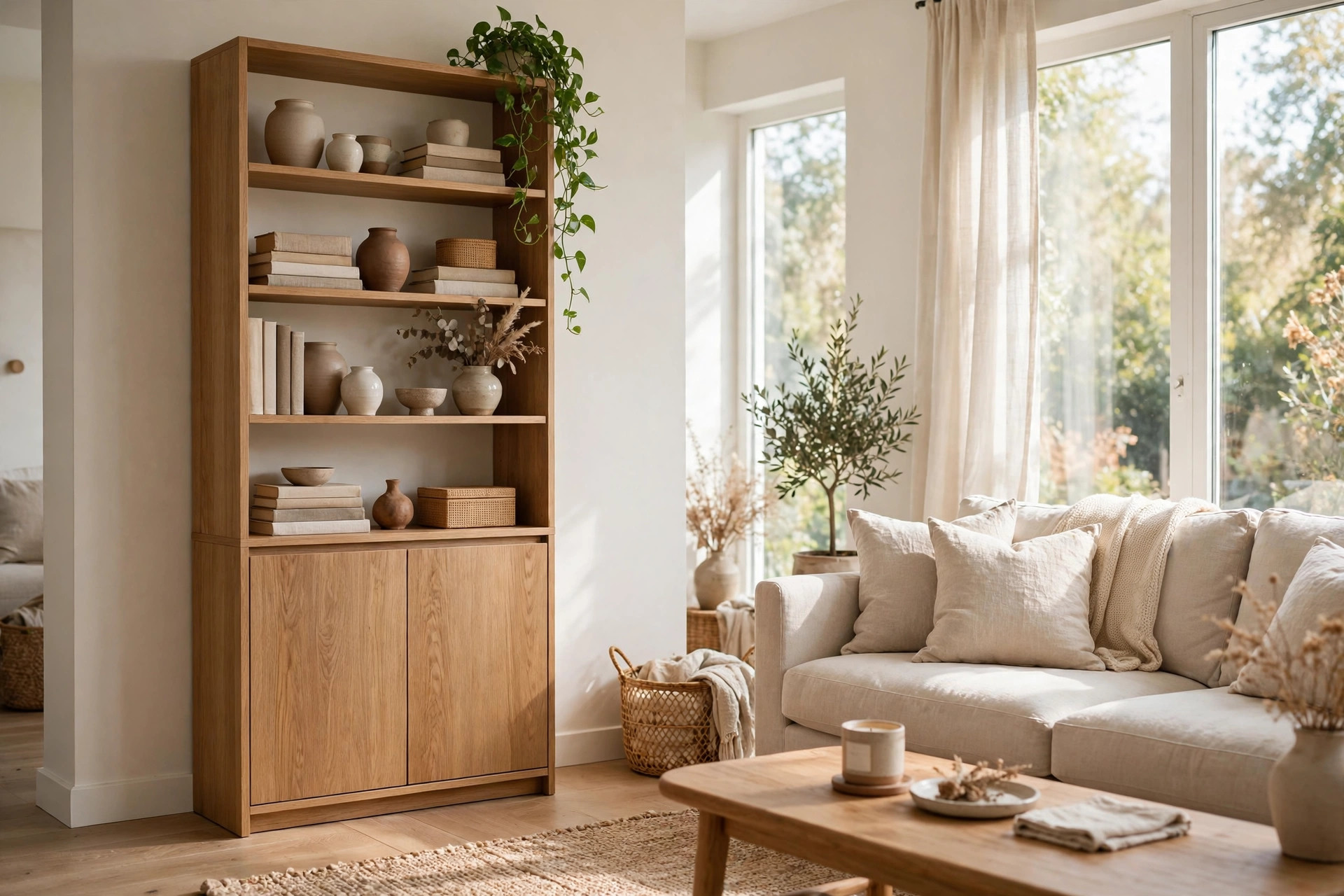
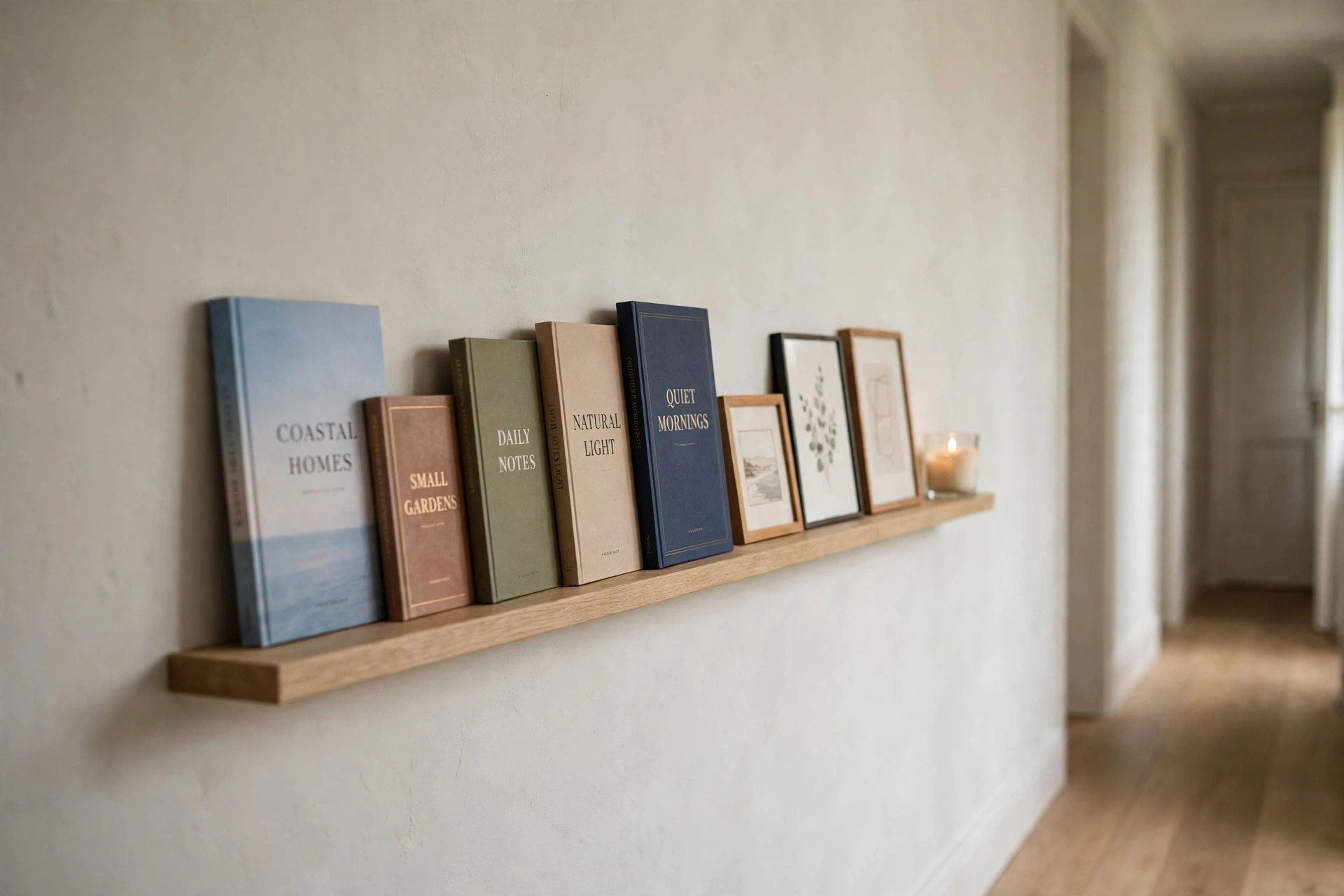
11. Narrow ledges for books and art
Picture ledges are the slim answer when a deep shelf would crowd the room. A 10-centimetre ledge holds books facing out, small framed prints and a candle, and it takes up no floor space at all. Run one along a hallway wall or behind the sofa, and swap the display with the seasons — it is the cheapest way to refresh the room without buying anything new.
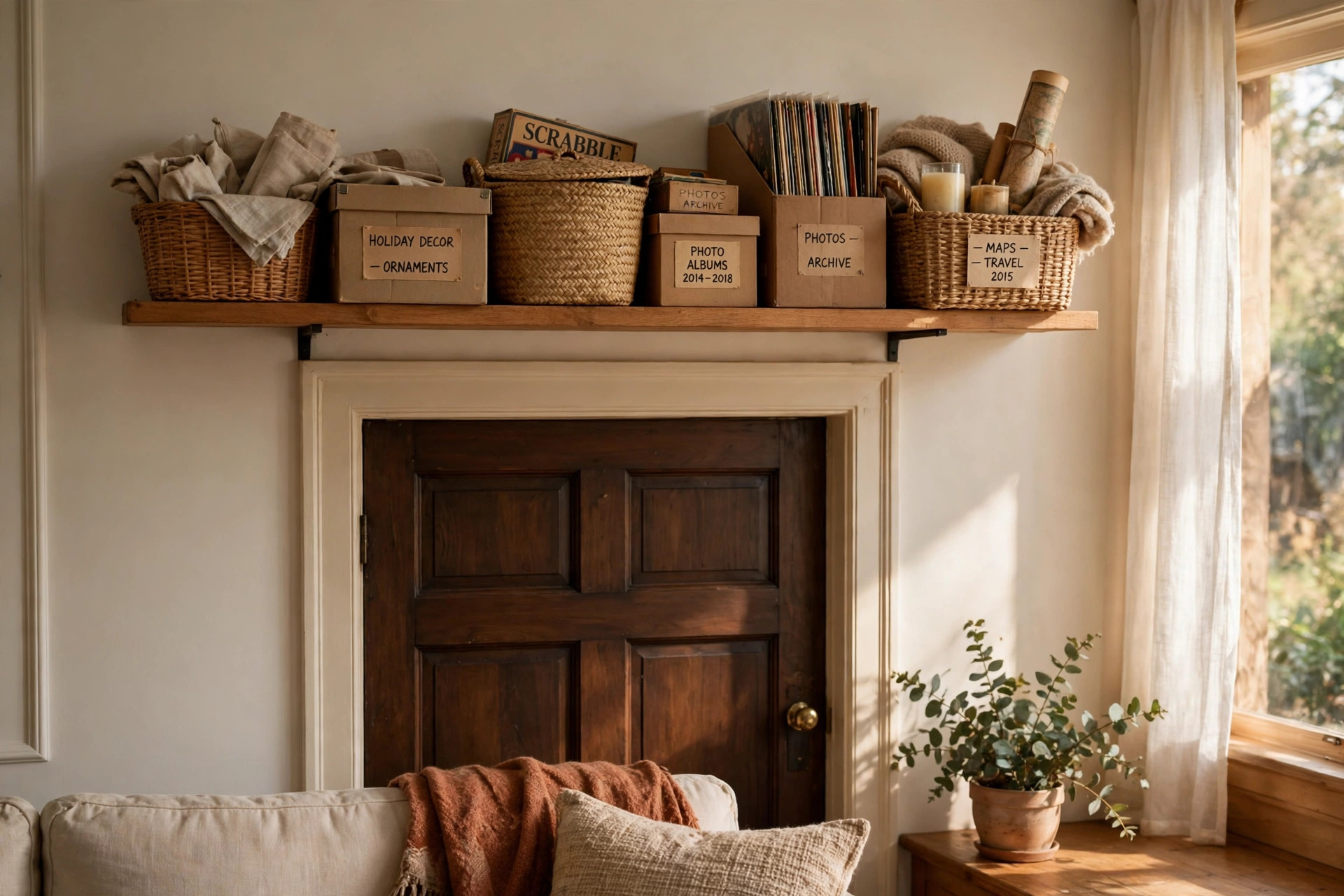
12. Use the space above the door
The wall above a door is wasted in almost every living room. A single shelf there holds books, baskets or storage boxes you reach for rarely — photo albums, holiday decor, spare throws. It works best in rooms with high ceilings, and it keeps rarely used things visible enough to remember but out of the daily sightline. Keep it to one tidy row; a cluttered high shelf draws the eye upward for the wrong reason.
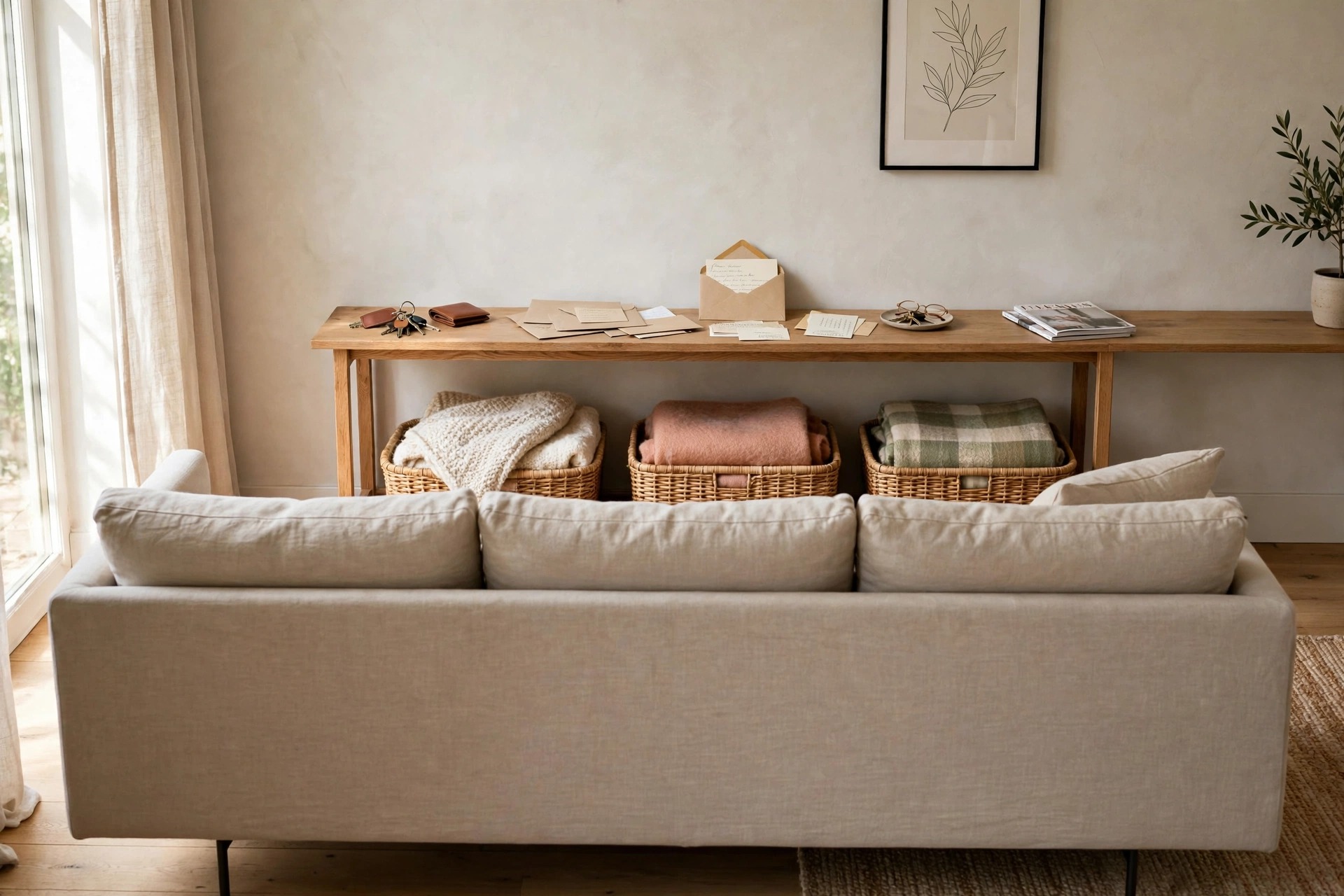
13. A slim console behind the sofa
A sofa table — a narrow console pushed against the back of a floating sofa — creates a landing strip for keys, mail, a lamp and a charging station, and the shelf underneath holds baskets for throws and magazines. It also defines the seating area in an open-plan room, which makes the whole space feel more intentional. Choose one no deeper than 30 centimetres so it does not eat into your walkway.
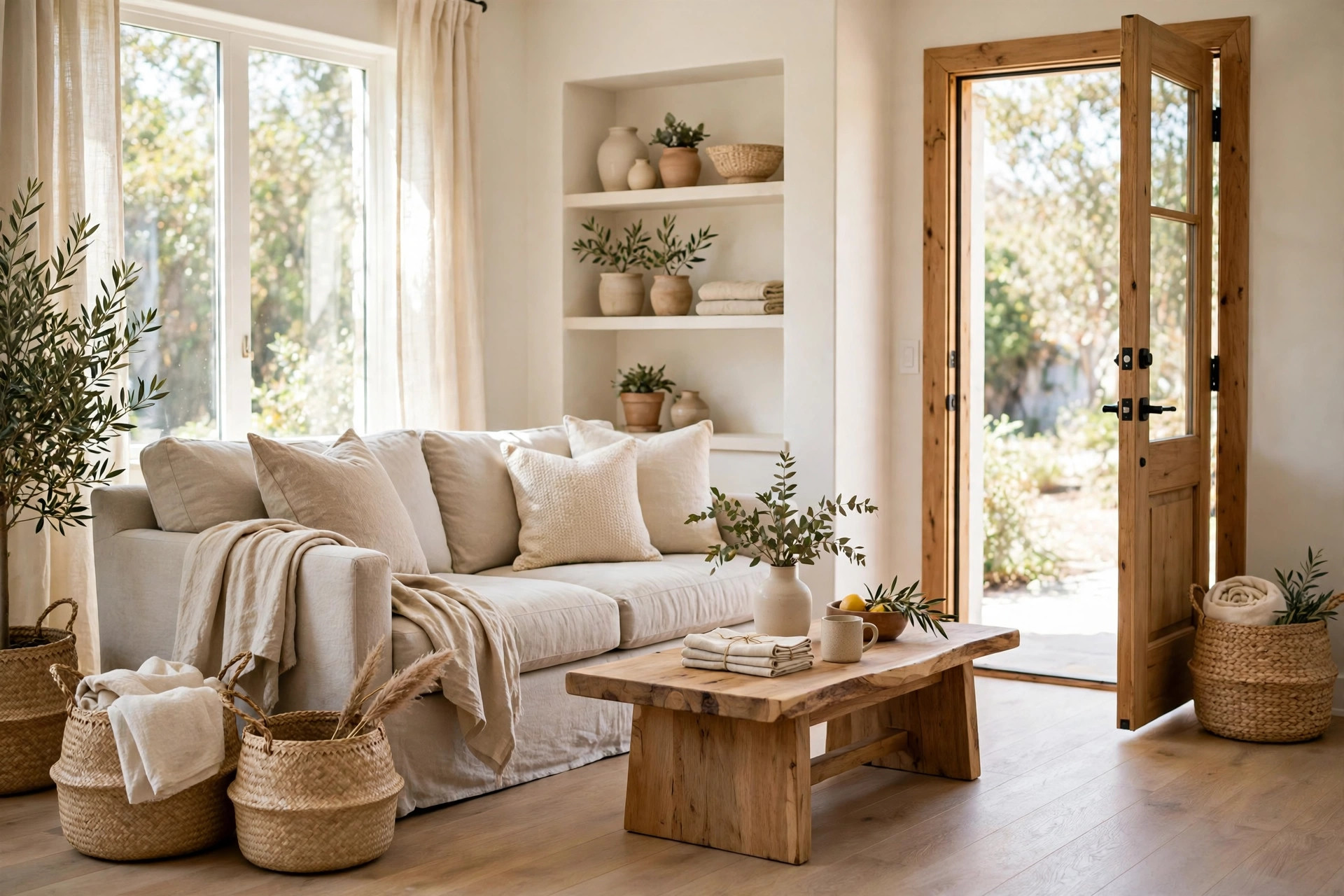
14. Baskets that match the room, not the clutter
Baskets are the fastest way to make visible storage look deliberate. Use the same material in two sizes — seagrass for throws, a smaller matching basket for remotes and chargers — and the clutter disappears into the decor. Keep one basket by the sofa for the things you use every evening, and one by the door for the things that leave the house with you. The rule is simple: if it does not fit in the basket, it does not live in the living room.
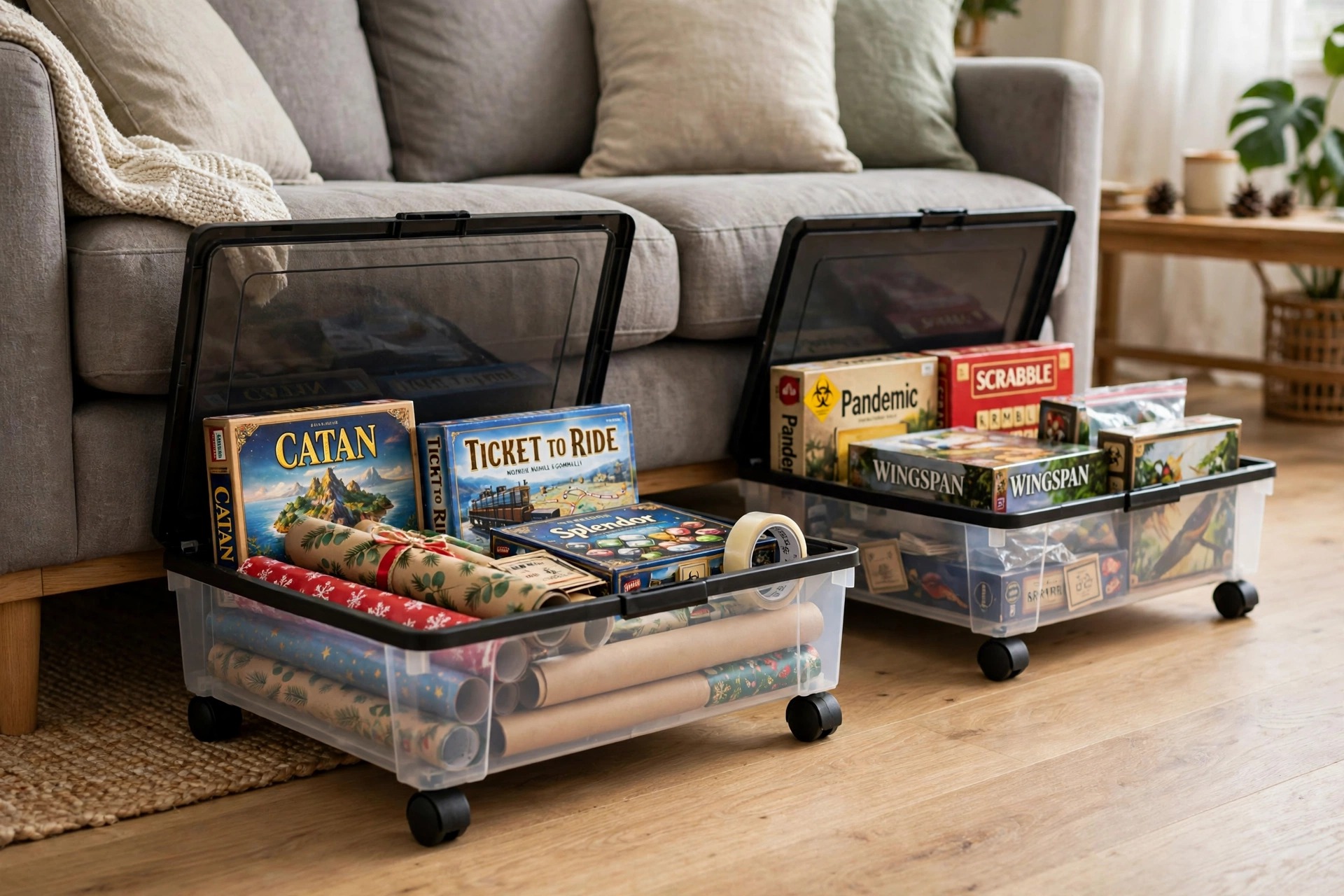
15. Under-sofa storage for flat things
The gap under most sofas fits flat storage boxes for wrapping paper, board games, photo albums and off-season textiles. Low, lidded boxes on castors slide out easily and stay dust-free, and nobody sees them. Measure the clearance first — most sofas give you 10 to 15 centimetres — and choose boxes with a handle on the short end so you can pull them out without moving the sofa.
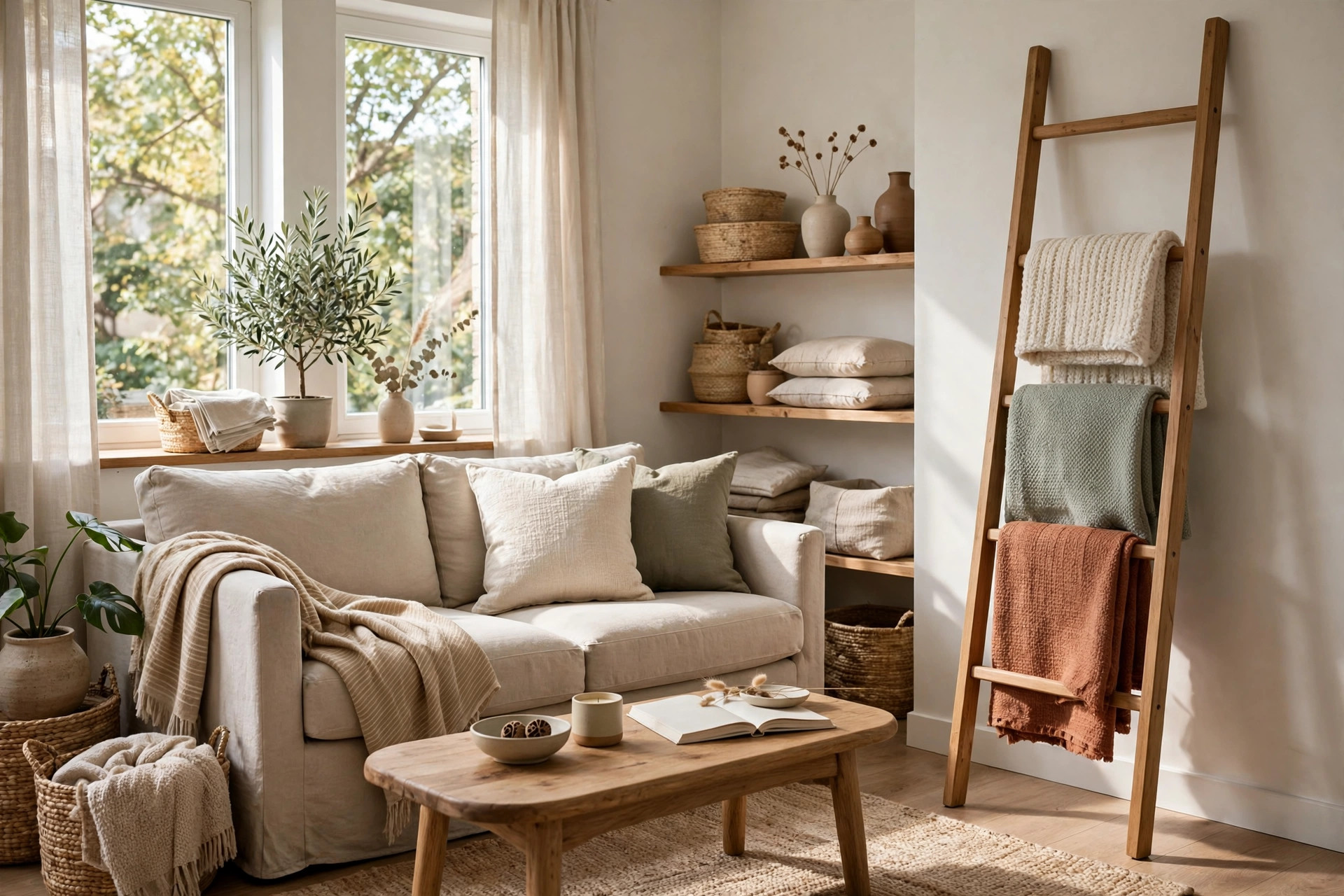
16. A blanket ladder that is also a display
A leaning blanket ladder holds three or four throws without a single drawer, and it doubles as a display for a woven wall hanging or a string of photos. It takes up less than half a metre of wall, it costs very little, and it solves the throw-on-the-sofa-arm problem that makes a tidy room look messy. Hang throws folded over alternating rungs so the colours show, and keep the heaviest blanket at the bottom.
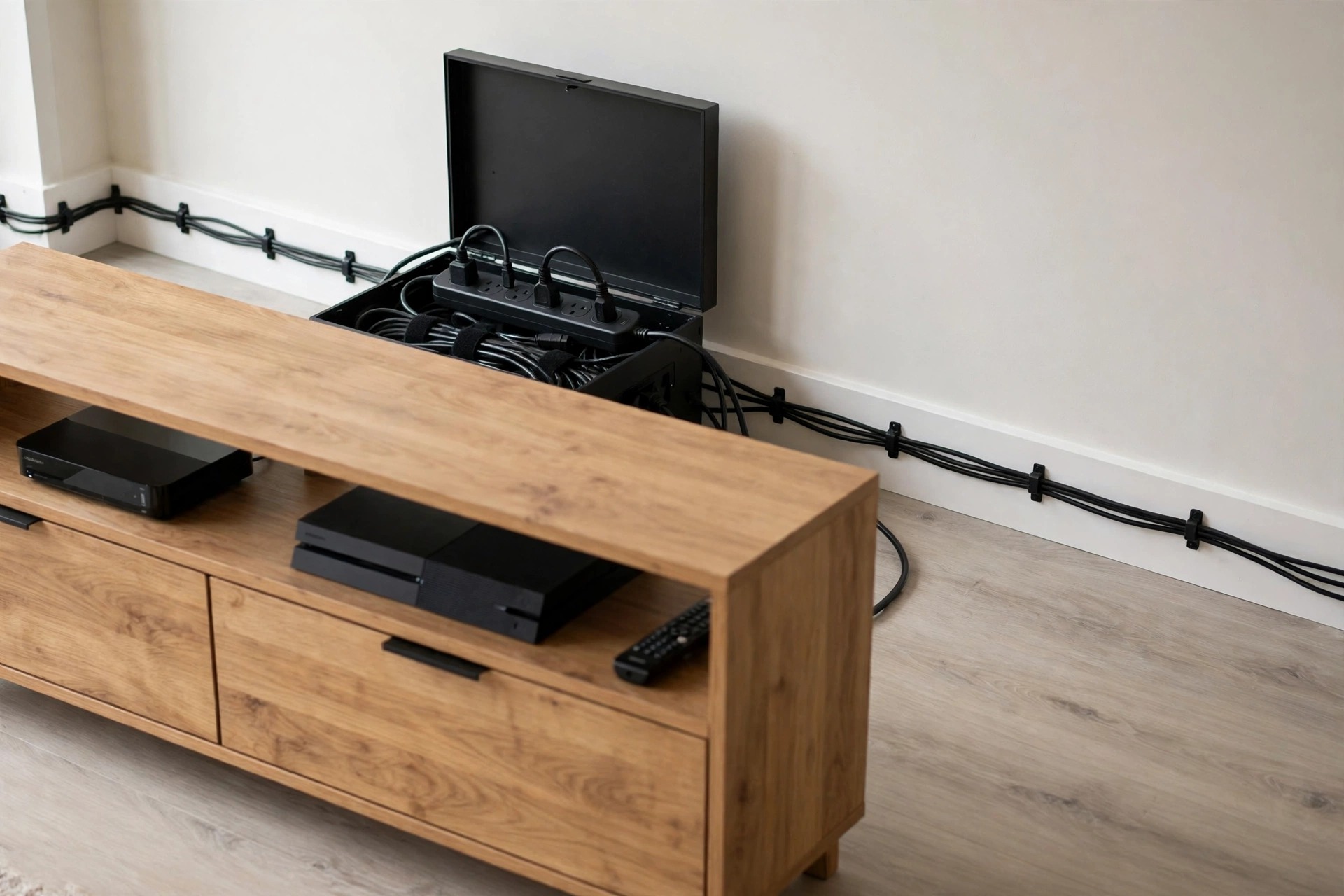
17. Hide the cables, keep the calm
Cables are the clutter nobody counts until they are gone. A cable management box behind the media console, adhesive clips along the skirting board, and one power strip with a short cord turn a tangle into nothing. If your TV is wall mounted, a paintable cable cover down to the console finishes the job. This idea costs almost nothing and changes the room more than most furniture purchases — a room with no visible cables reads as a room with no clutter.
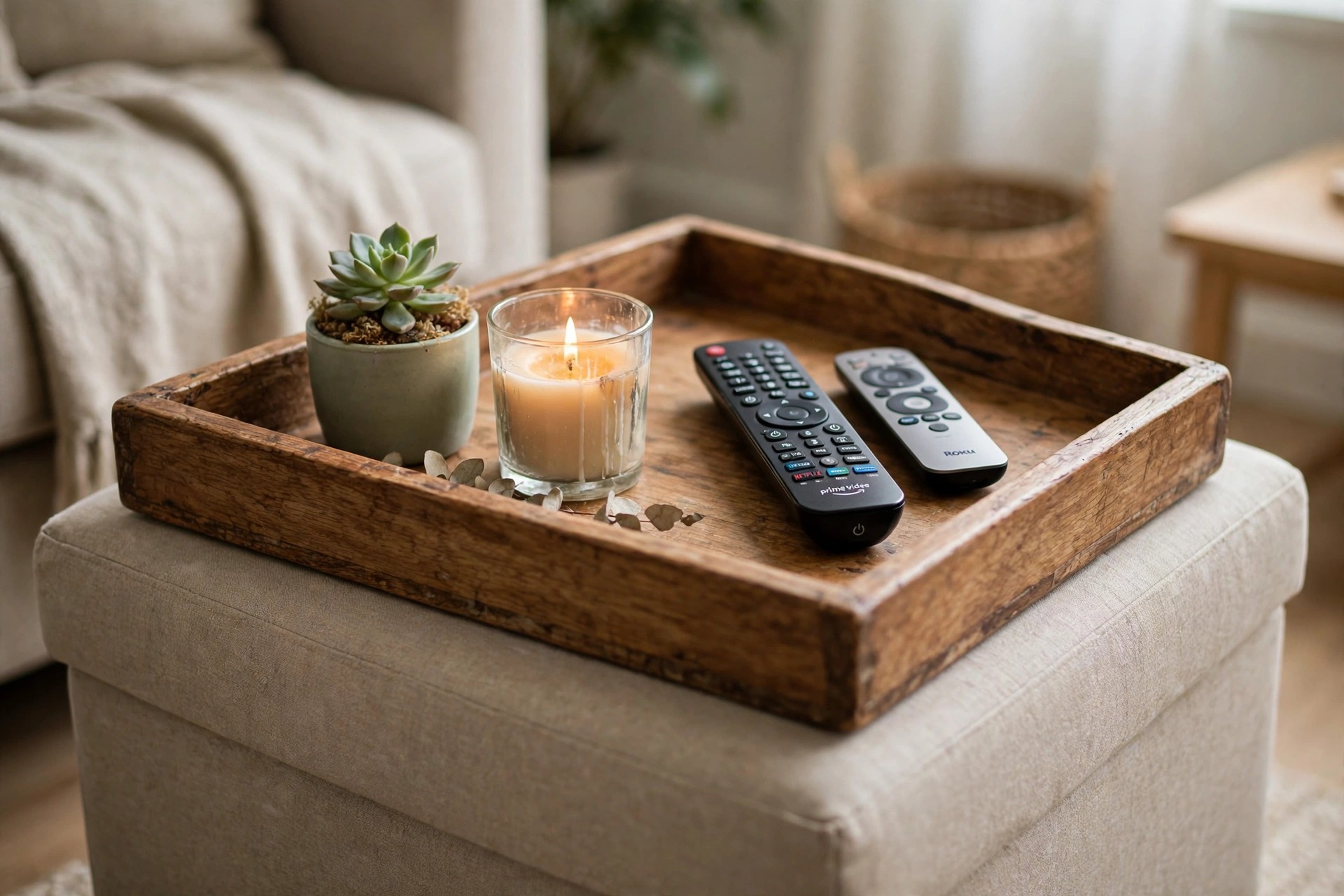
18. A tray on the ottoman or coffee table
A tray is a boundary: everything inside it belongs, everything outside it gets put away. Use a large tray on the ottoman for remotes, a candle and a small plant, and a second one on the coffee table for coasters and the book you are reading. When guests arrive, you lift one tray and the room is tidy. Wood trays warm up a grey room; mirrored trays bounce light in a dark one.
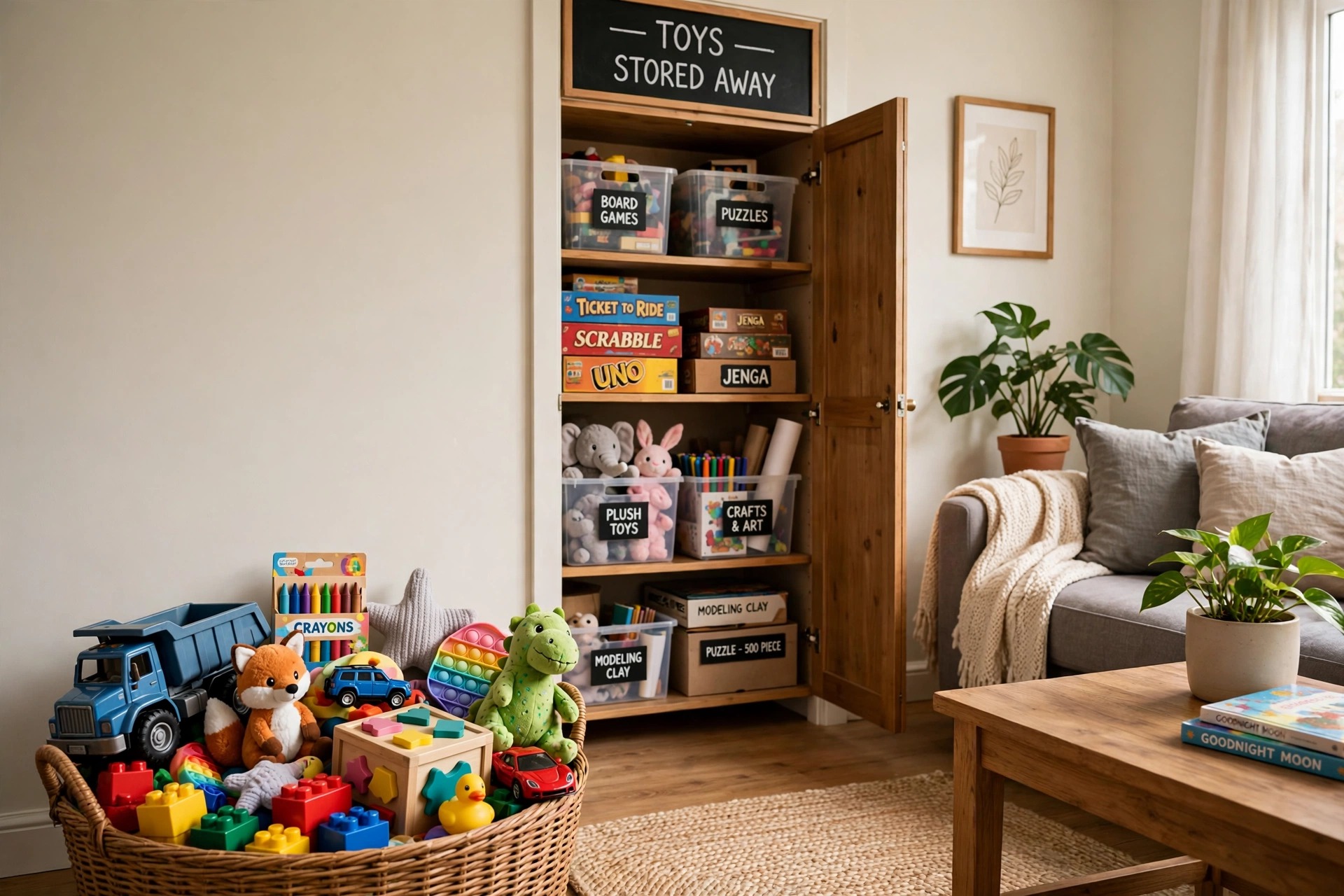
19. Rotate toys instead of storing them all out
If kids use the living room, the problem is rarely storage — it is volume. Keep one basket of current toys in the room and rotate the rest from a closet or bedroom every week. The room stays playable, the toys feel new again, and you need one basket instead of three shelves. This is a habit, not a purchase, and it is the only idea on this list that makes the room tidier while buying nothing at all.
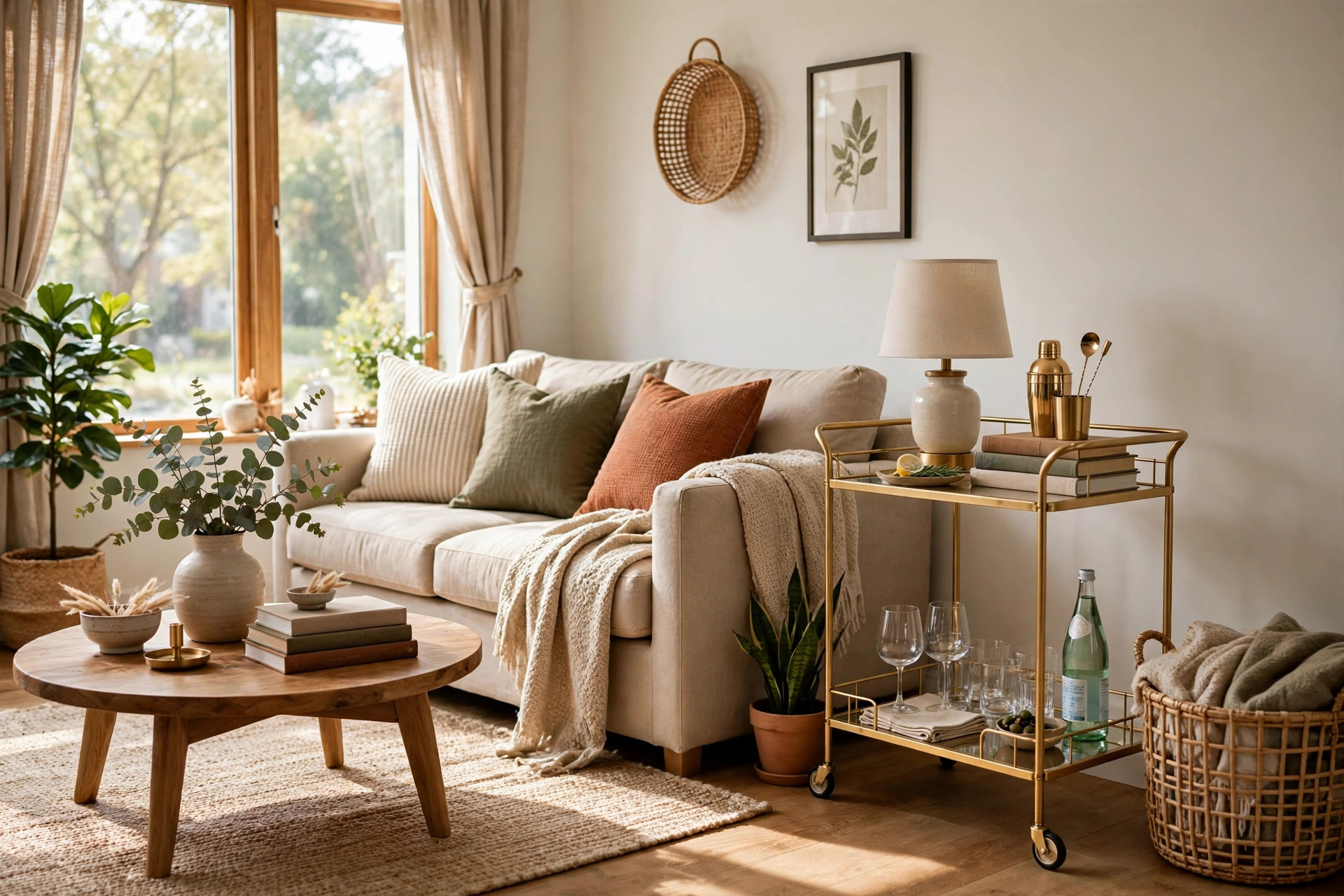
20. A bar cart that doubles as a side table
A bar cart is a side table with wheels and a second shelf. It holds drinks and glasses when you host, and books, a lamp and a plant the rest of the week. Because it moves, it can live beside the sofa, roll to the dining table, and tuck into a corner when the room needs floor space. Choose one with a tray top so nothing slides off when it moves, and keep the lower shelf to one category so it never becomes a dumping ground.
Small living rooms: storage that does not shrink the room
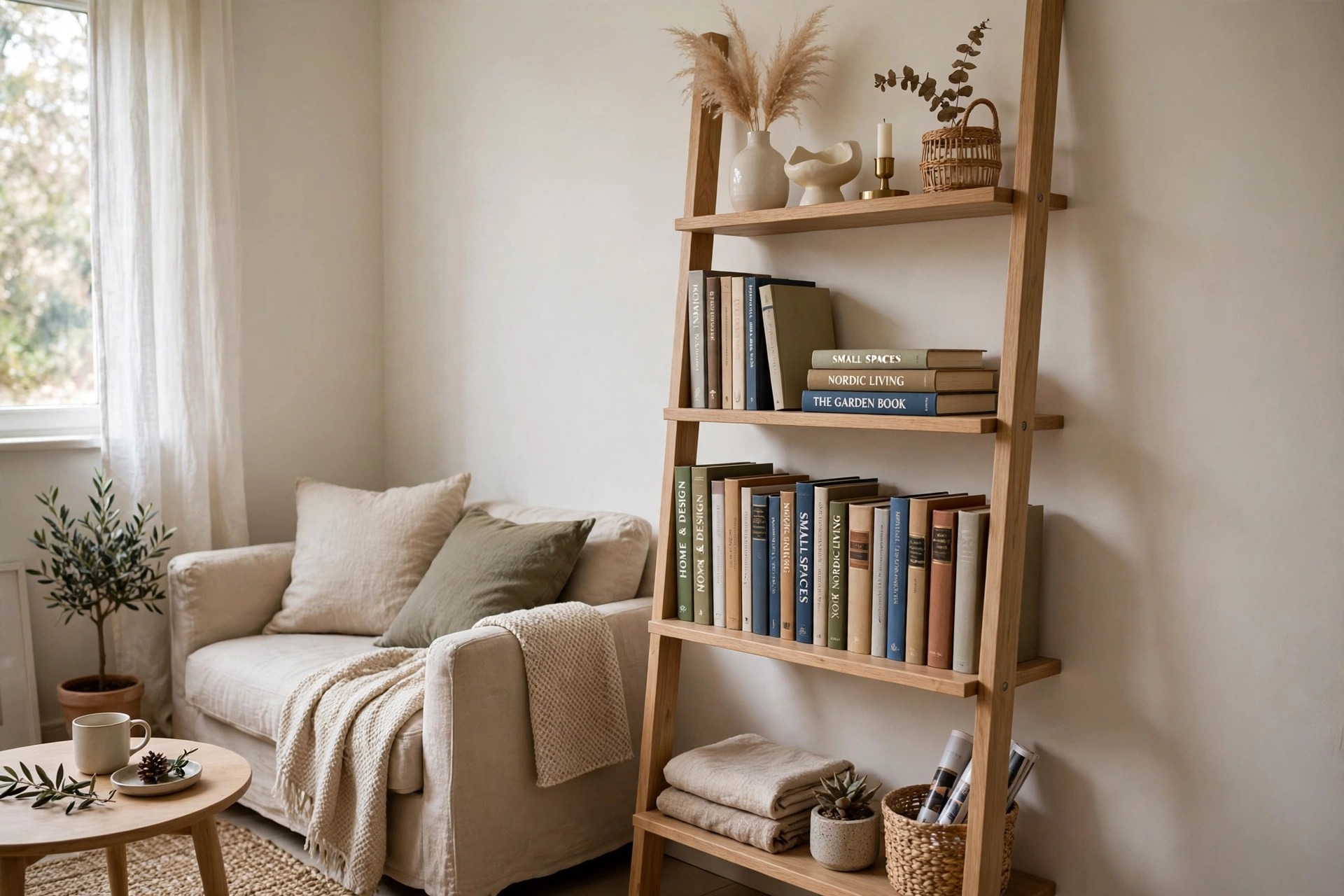
21. Go vertical, not wider
In a small living room, the only direction with free space is up. Tall, narrow storage — a tower shelf, a ladder shelf, a floor-to-ceiling bookcase — stores as much as a wide sideboard while taking a fraction of the floor. Keep the top third light and decorative, the middle third at eye level for books, and the bottom third closed for the things you do not want to see. A tall unit also draws the eye upward, which makes a low ceiling feel higher.
22. Furniture on legs, so the floor shows
A console, media unit or sofa on visible legs shows a strip of floor underneath, and that strip is what makes a small room feel bigger. Storage that sits flat on the floor reads as a solid block; storage on legs reads as furniture with air around it. When you are choosing between two similar pieces, pick the one with legs — it stores the same amount and the room feels larger for it.
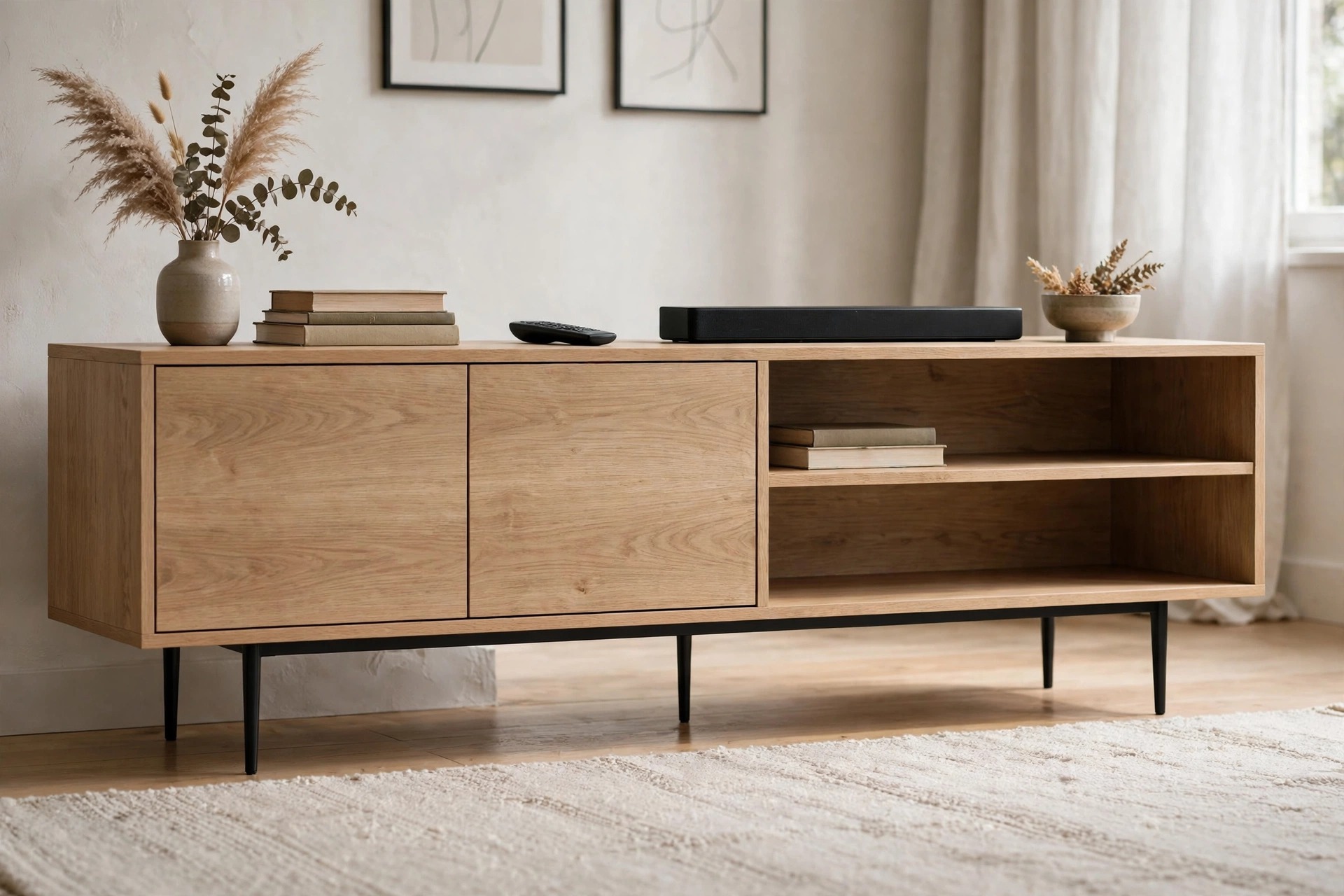
23. One colour for all your storage
When every basket, bin and box is a different colour, the room looks like a storage unit. Pick one material and one neutral colour — natural seagrass, warm wood, or matte white — and use it for every visible container. The storage is still there, but the eye reads it as one calm system instead of ten separate objects. This is the cheapest styling trick in the whole list, and it works in a rented room with nothing fixed to a wall.
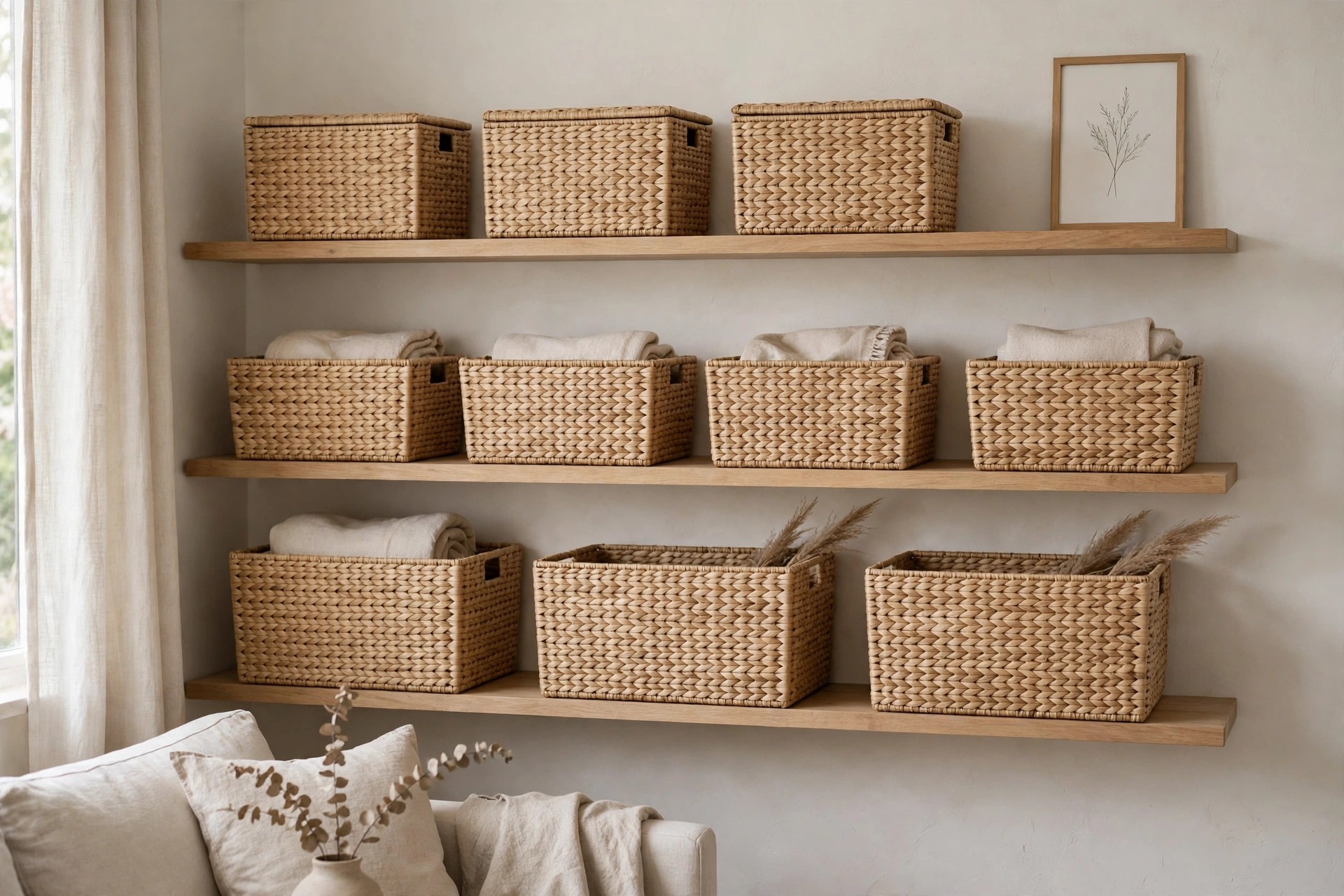
24. A mirror opposite the window, storage below it
A large mirror opposite the window doubles the light in the room, and a slim console or a pair of baskets underneath it turns that wall into storage. The mirror makes the room feel bigger, the console holds the things you need by the door, and the whole arrangement looks designed rather than improvised. Hang the mirror so it reflects the window, not the TV — you want daylight, not glare.
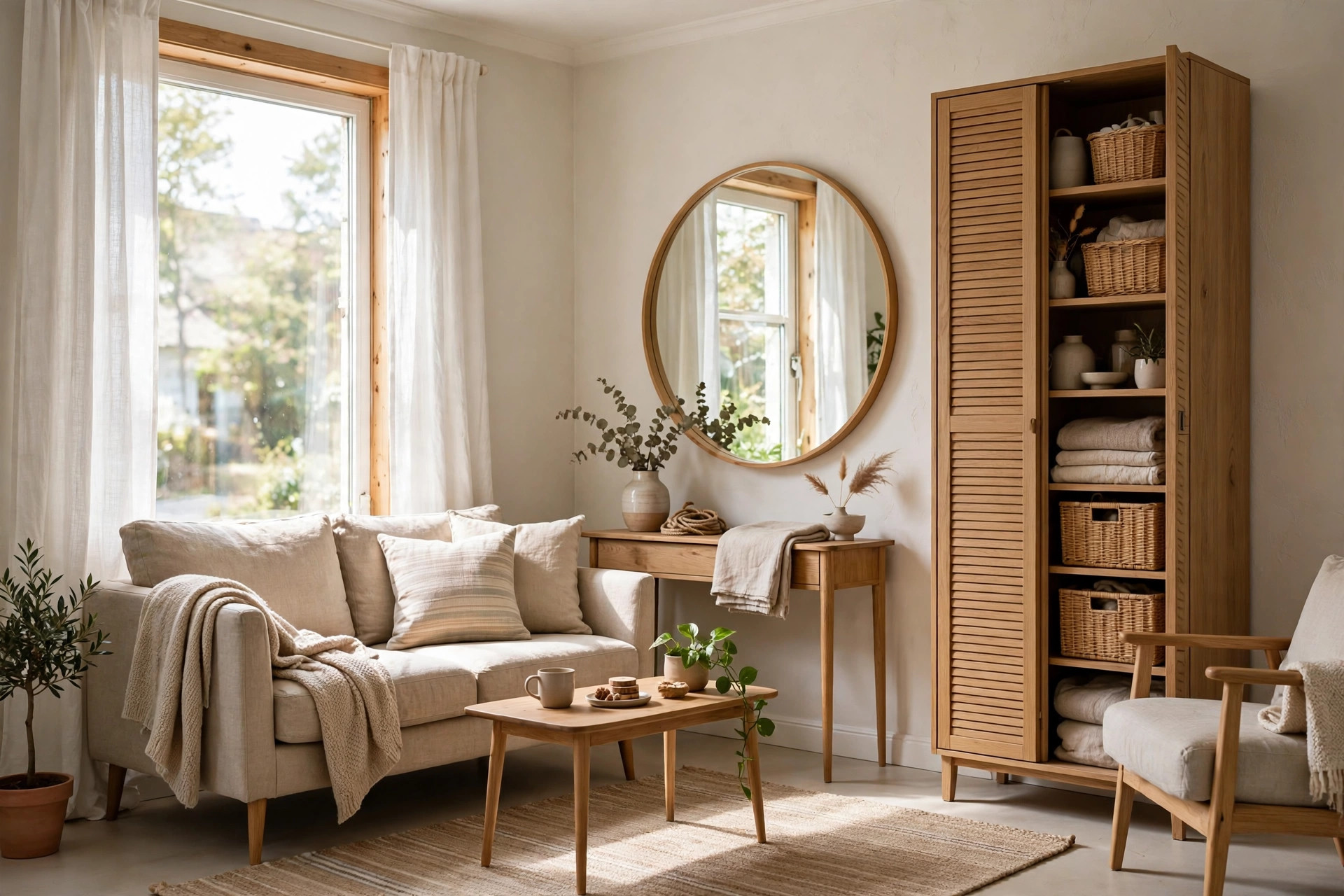
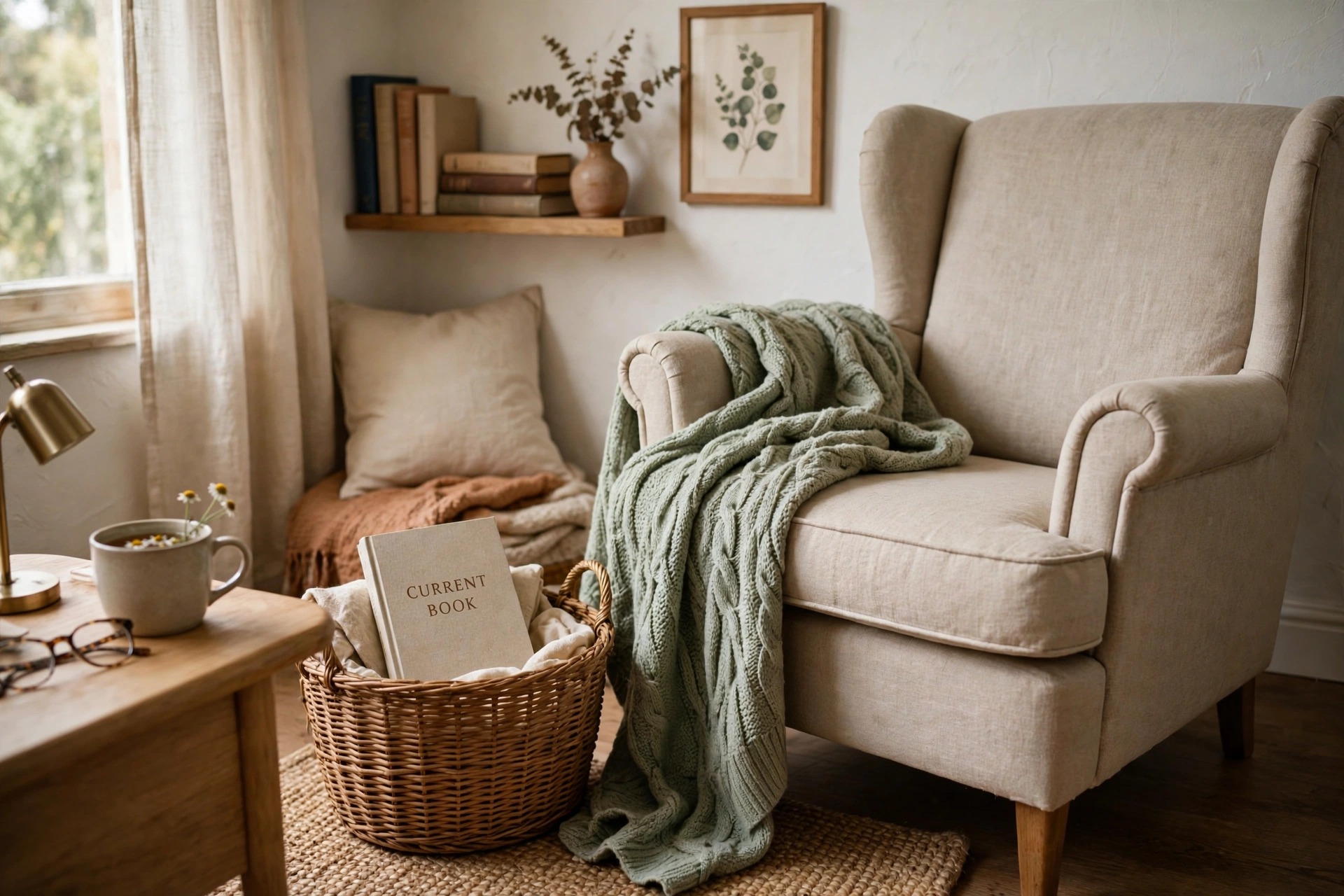
25. Store by zone, not by room
Divide the living room into zones — reading corner, TV wall, window seat — and give each zone its own storage. The reading chair gets a basket for the current book and a throw; the TV wall gets the console for consoles and remotes; the window gets the bench for outdoor things. When everything has a zone, putting things away takes five seconds instead of a decision, and the room stays tidy between deep cleans because nothing has to travel across the room to be stored.
26. The 10-minute reset basket
Keep one empty basket in a closet near the living room. Every evening, walk the room once and put everything out of place into the basket, then put the basket's contents where they belong. It takes ten minutes, it needs no new furniture, and it is the system that makes all the other storage on this list actually work — because storage only helps if things go back into it. If the basket is full every night, you have too much stuff in the room, not too little storage.
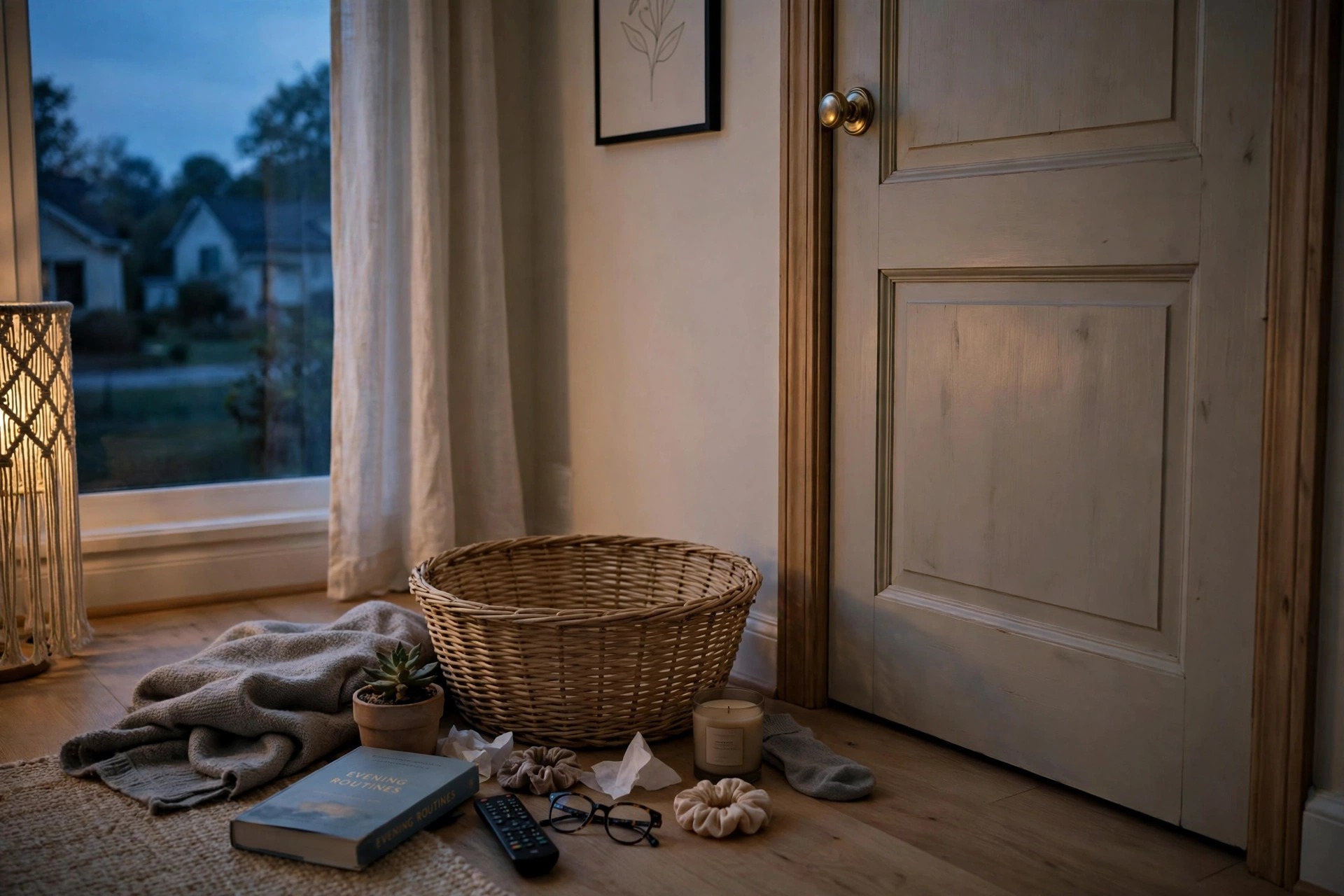
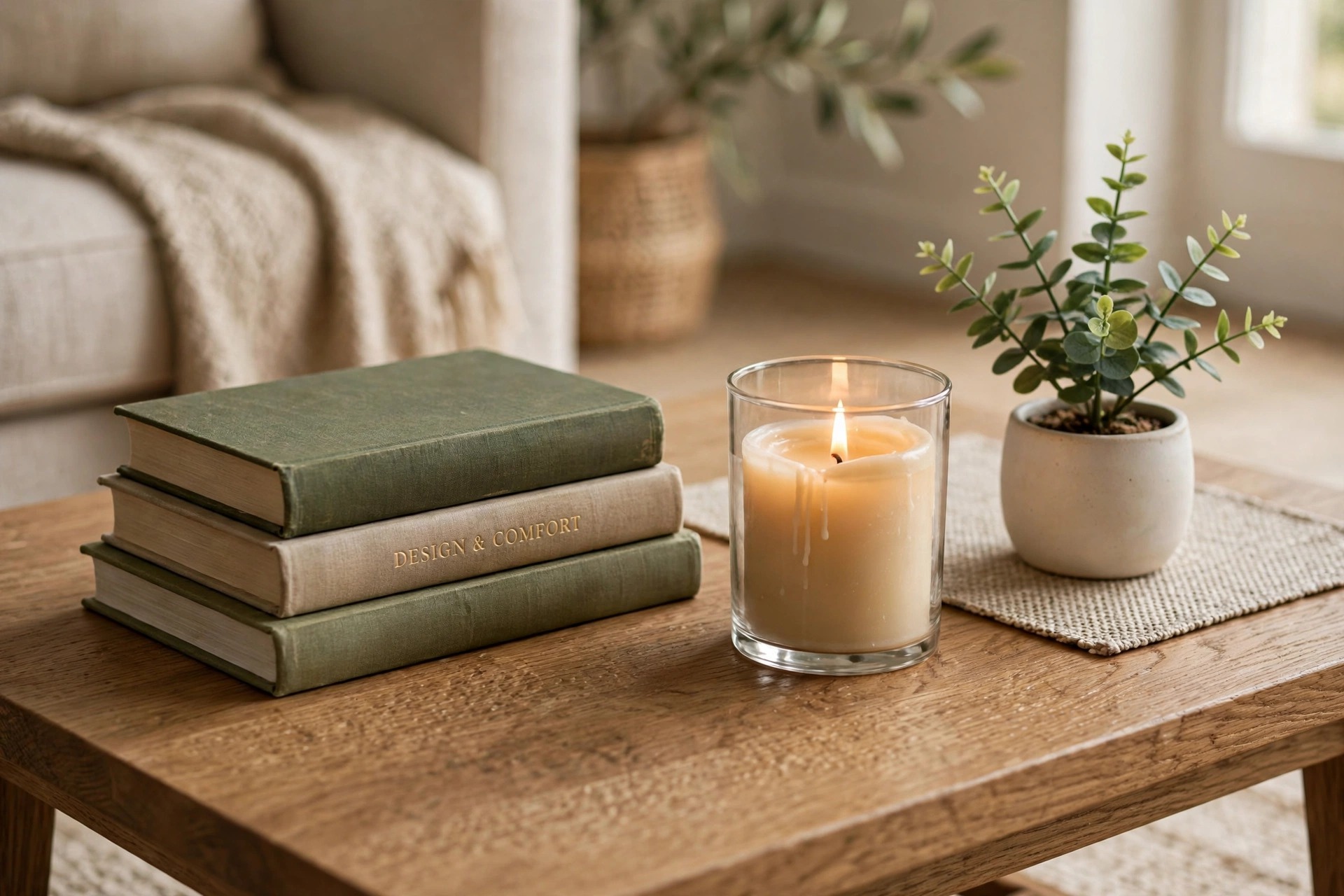
27. Keep surfaces to three objects
A coffee table with three objects looks styled; the same table with nine looks cluttered, even if every object is beautiful. Pick three per surface — a book stack, a candle, a small plant — and store the rest. Apply the same rule to the media console, the sideboard and the mantel. This is not minimalism for its own sake; it is the rule that lets the storage furniture you already own do its job, because the things on top stop competing with the things inside.
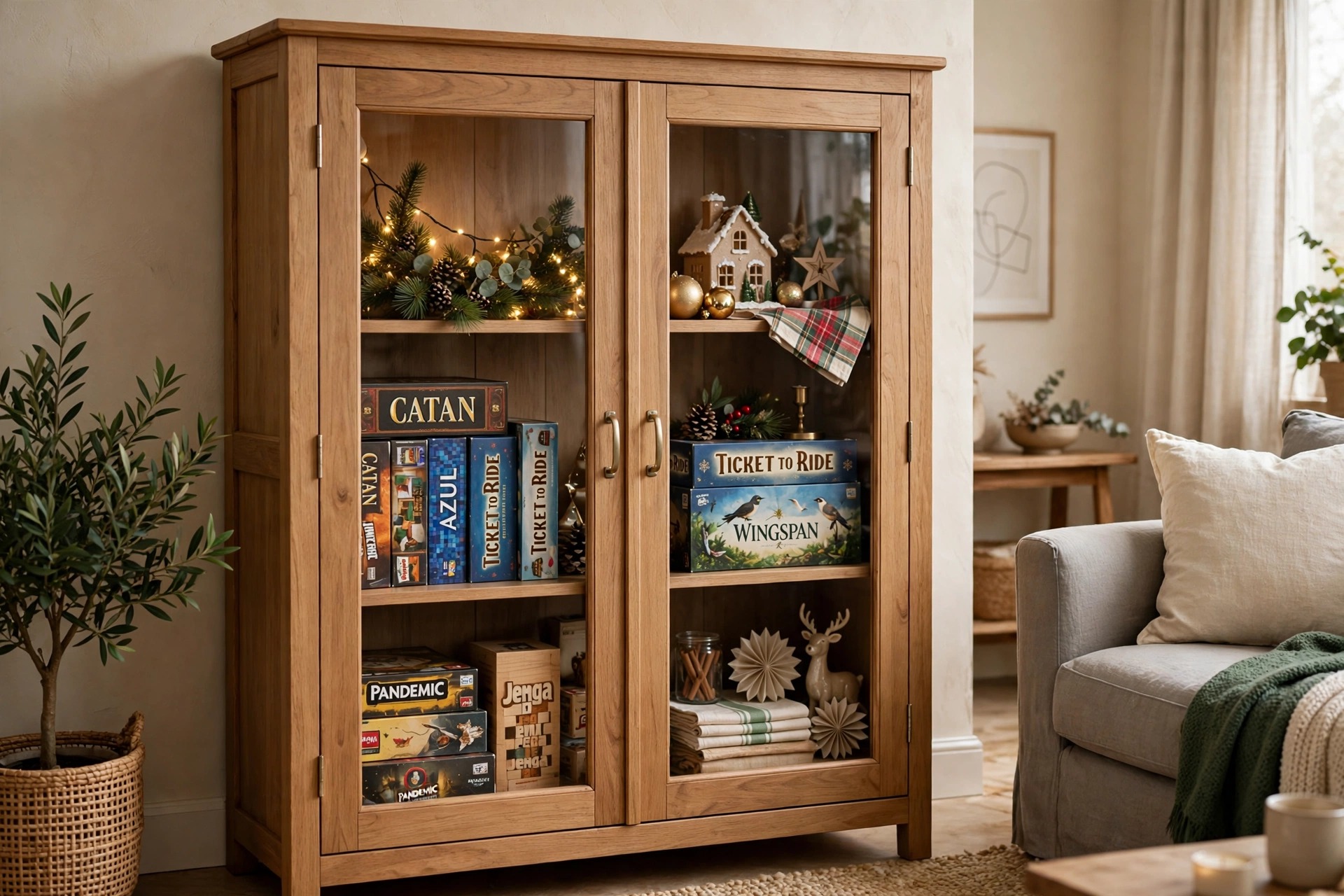
28. A closed cabinet for the things you use once a month
Every living room has a category that is used rarely but has nowhere else to go — board games, holiday decor, the good tablecloth, the airbed for guests. Give that whole category one closed cabinet, one shelf in the sideboard, or one lidded box on top of the wardrobe, and stop letting it live on open shelves. When rarely used things are closed away, the things you use daily finally have room to breathe, and the room stops looking like it is storing someone else's life.
Which storage fits which living room?
| Living room | Best first move | Budget | Floor space needed |
|---|---|---|---|
| Small apartment | Storage ottoman + baskets (ideas 1, 14) | Low | Almost none |
| Rented, no drilling | Cube shelf + bench (ideas 5, 6) | Low–medium | 1 wall |
| Family with kids | Toy rotation + closed console (ideas 19, 3) | Low | None extra |
| Open-plan | Sofa table + sideboard (ideas 13, 4) | Medium | 1 narrow strip |
| Buying new furniture | Storage sofa + lift-top table (ideas 7, 2) | Higher | Same as old pieces |
| High ceilings | Built-ins / tall bookcase (ideas 9, 10) | Medium–high | 1 wall |
You do not need all 28 ideas. You need the three that solve your biggest mess — usually the everyday clutter, the cables, and the things with no home. Start with the storage ottoman, hide the cables, and give every zone its own basket. Do that this weekend and the room will feel different by Sunday night.
Save this post for your next tidy-up, and if you are planning a whole-room refresh, read 27 Refresh My Living Room Ideas for Winter 2026 next — it is the evergreen bridge out of the Christmas batch and pairs with this storage plan room by room.
Published 10 November 2026. Updated as new storage finds are tested.
Frequently asked questions
What is the best storage for a small living room?
Multi-purpose furniture works best in a small living room. A storage ottoman hides blankets and remotes, a lift-top coffee table gives you a hidden compartment and a work surface, and a window bench with baskets adds seating plus storage without taking extra floor space.
How can I hide clutter in my living room without built-ins?
Use closed storage that looks like furniture. A media console with doors hides cables and consoles, a cube shelf with fabric bins keeps games and toys out of sight, and matching baskets on open shelves make everyday clutter look intentional.
What is the easiest living room storage idea to start with?
Start with baskets and a blanket ladder. Baskets corral throws, toys and magazines in minutes, and a leaning blanket ladder keeps throws tidy while doubling as decor. Both are cheap, need no tools, and work in rented homes too.