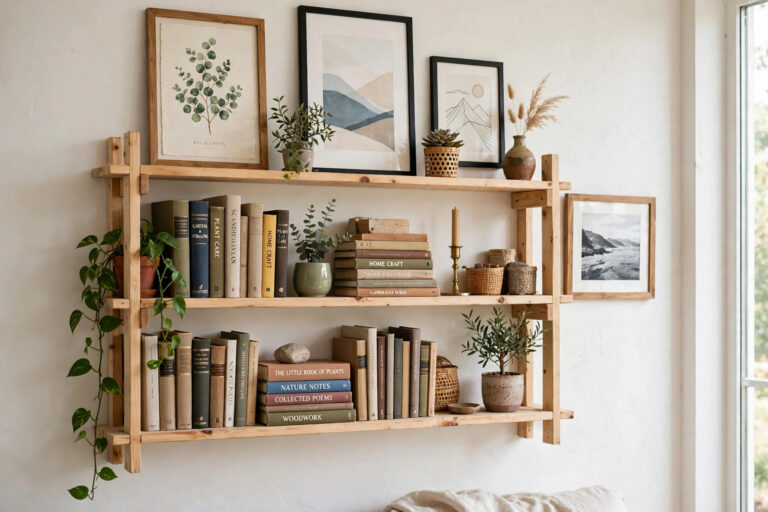
22 DIY Floating Shelves Ideas for 2026
A floating shelf is the cleanest storage a wall can hold. No brackets showing, no legs on the floor, nothing but a board that looks as if the wall grew it — and a shelf that holds the books, the plants and the framed print without taking a single inch of floor space. It is also the shelf most people get wrong, because the bracket misses the stud, the shelf sags under the books, and the level that was never checked leaves a shelf that tilts a little more every month.
These 22 DIY floating shelves ideas give you a shelf you can hang in a weekend and trust to hold: pick the style, find the studs, level it before you drill, and style it for the room it lives in — so the wall works harder and the floor stays clear.
Every idea below works in a real home, from a flat where one shelf above the sofa is all the storage the living room needs to a house where the kitchen shelves hold the everyday plates. The wall shelf family gets its full treatment in 24 DIY Wall Shelves Ideas for 2026, where the bracket shelves hold the heavy things the floating shelf should not — and the display itself gets its ideas in 25 DIY Room Decor Ideas for 2026. Pick three ideas that fit your wall, start with the one shelf, and build from there.
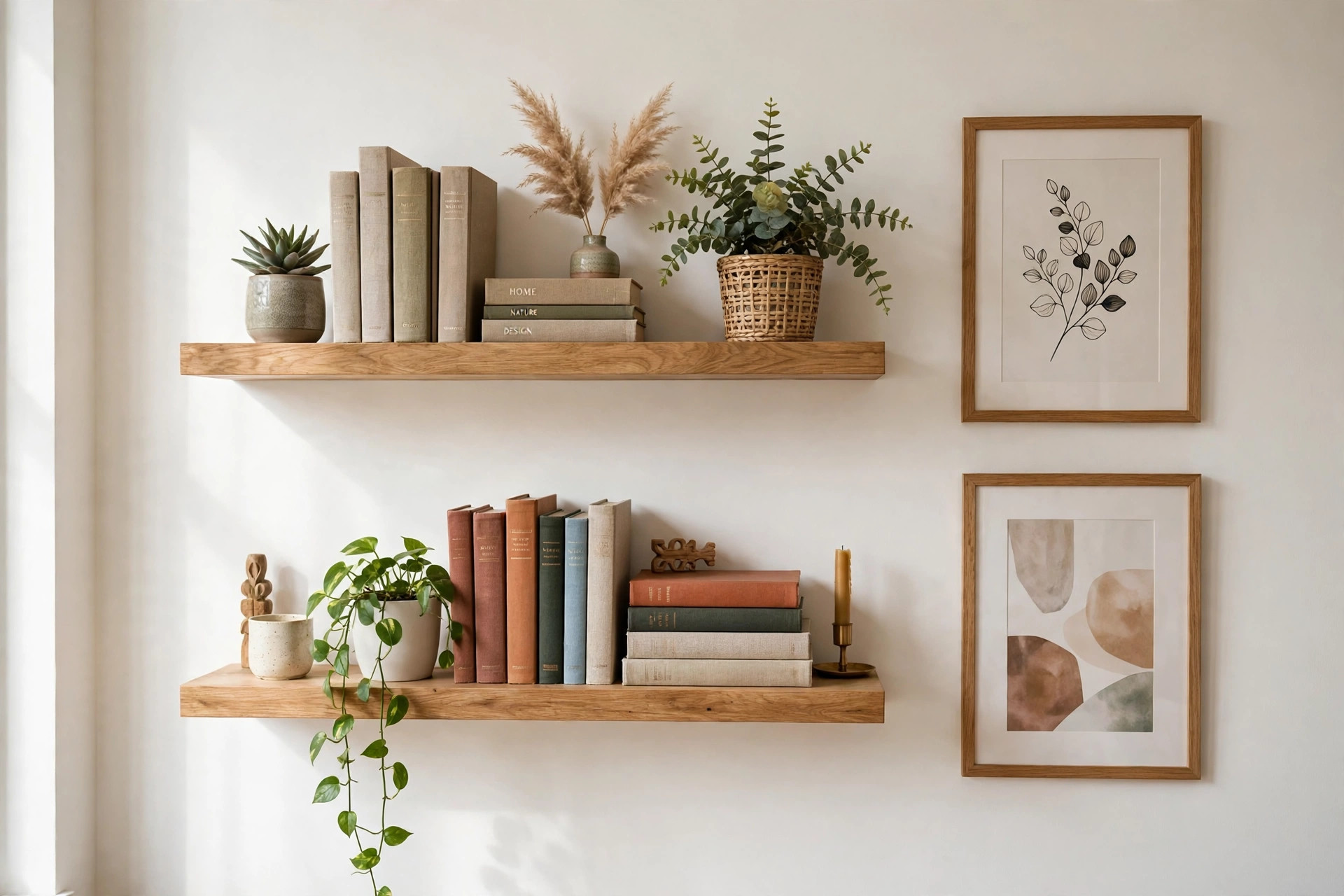
Pick your shelf style
1. The classic wood plank — the shelf that suits every room
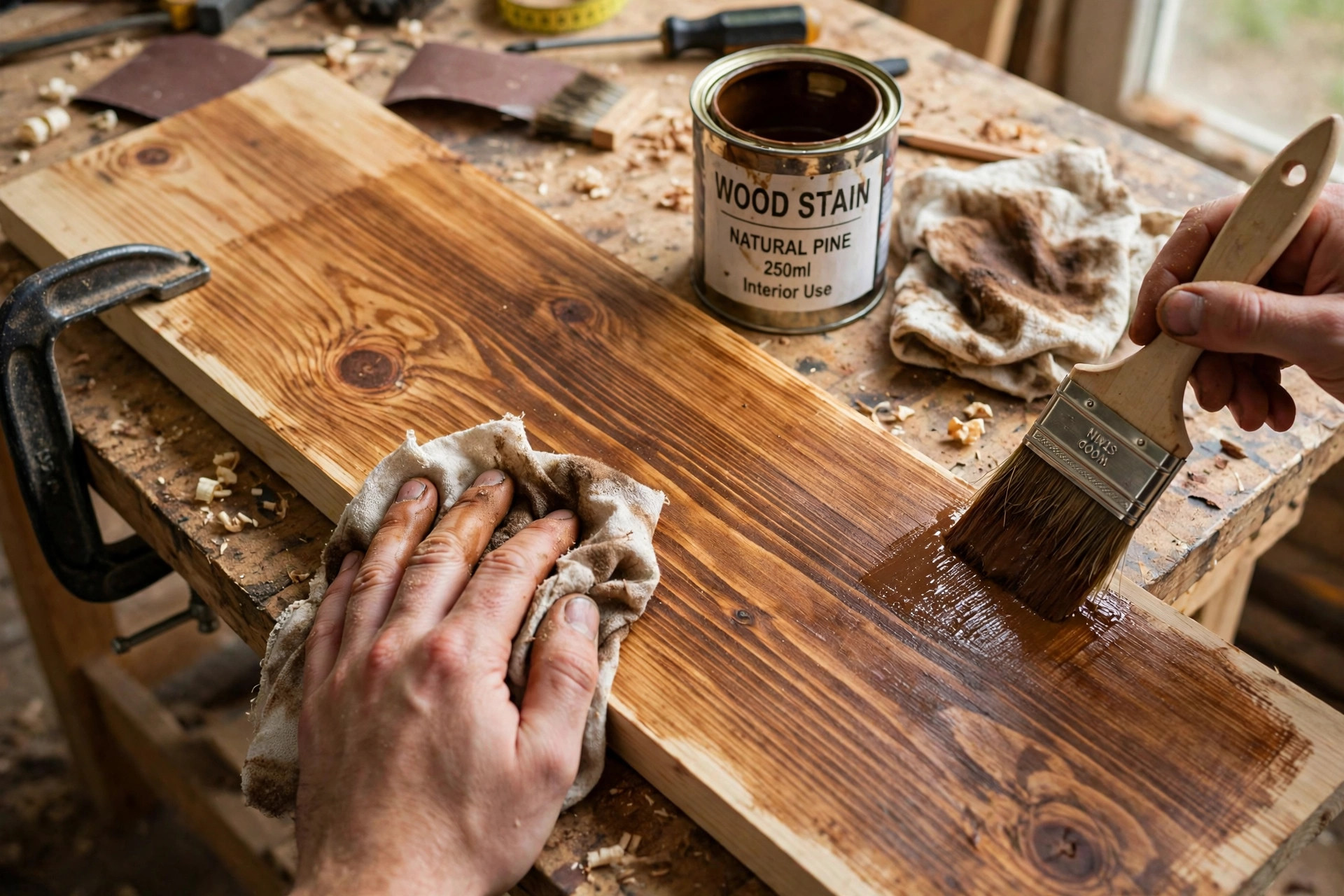
A plain wood plank is the floating shelf that never goes wrong, because it is a board, a bracket and a wall — nothing more — and the board that is stained or painted to match the room is the board that looks as if it was always there. Pick pine for a light shelf that paints well, oak for a warm shelf that stains well, and a board thick enough to hide the bracket rod inside it, because the plank that is too thin is the plank that shows its fixings. Cut it to the length the wall needs, sand the edges until they are smooth to the touch, and finish it before you hang it, because the shelf that is finished on the bench is the shelf that is finished properly. Hang it at eye level where you will actually see what sits on it, and keep the first shelf simple — books, one plant, one framed print — because the plank that is styled simply is the plank that looks expensive. One plain plank, and the wall starts working.
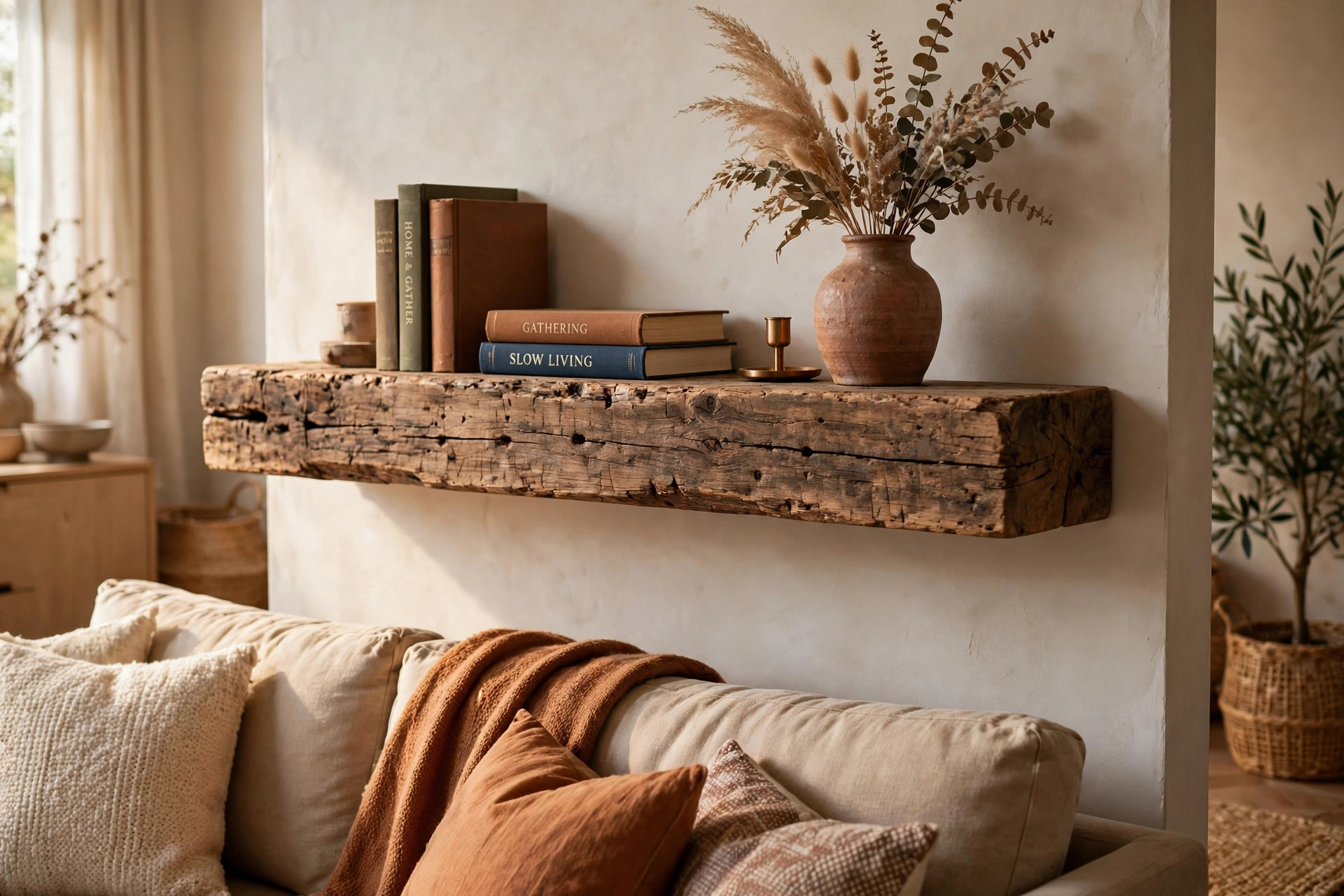
2. The chunky beam shelf — the shelf that anchors a sofa wall
A thin shelf above a sofa disappears, because the sofa is big, the wall is big, and the shelf that is too slim is the shelf nobody notices. Use a chunky beam shelf — the shelf that anchors a sofa wall — so a thick reclaimed beam, four or five inches deep, sits above the sofa and holds the wall the way a mantel holds a fireplace. Pick a beam with character, the saw marks and the knots left in, and seal it so it does not shed dust on the cushions below, because the beam that is sealed is the beam that stays clean. Fix it with a heavy-duty hidden bracket rated for the weight, and hang it high enough that nobody knocks a book off it when they stand up, because the beam that is hung right is the beam that is never in the way. Put three things on it — books at one end, a vase at the other, one framed print in the middle — because the beam that holds three things is the beam that looks styled, and the beam that holds ten is the beam that looks like storage. One chunky beam, and the sofa wall is finished.
3. The slim picture ledge — the ledge that holds prints facing out
Framed prints leaning on the floor are prints nobody sees, because the floor is not a gallery and the print that leans against the skirting board is the print that gets kicked. Use a slim picture ledge — the ledge that holds prints facing out — so a narrow shelf with a small lip at the front holds the frames upright, facing the room, and the prints can be swapped in seconds without a single new hole. Hang two ledges, one above the other, and overlap the frames so the big one sits behind the small one, because the ledge that layers is the ledge that looks like a gallery. Keep the lip shallow, just enough to stop a frame sliding off, and keep the ledge in a hallway or above a desk, because the ledge that lives where you walk past it is the ledge that gets looked at every day. Swap the prints with the seasons, because the ledge that changes is the ledge that never goes stale. One slim ledge, and the prints are finally on the wall.
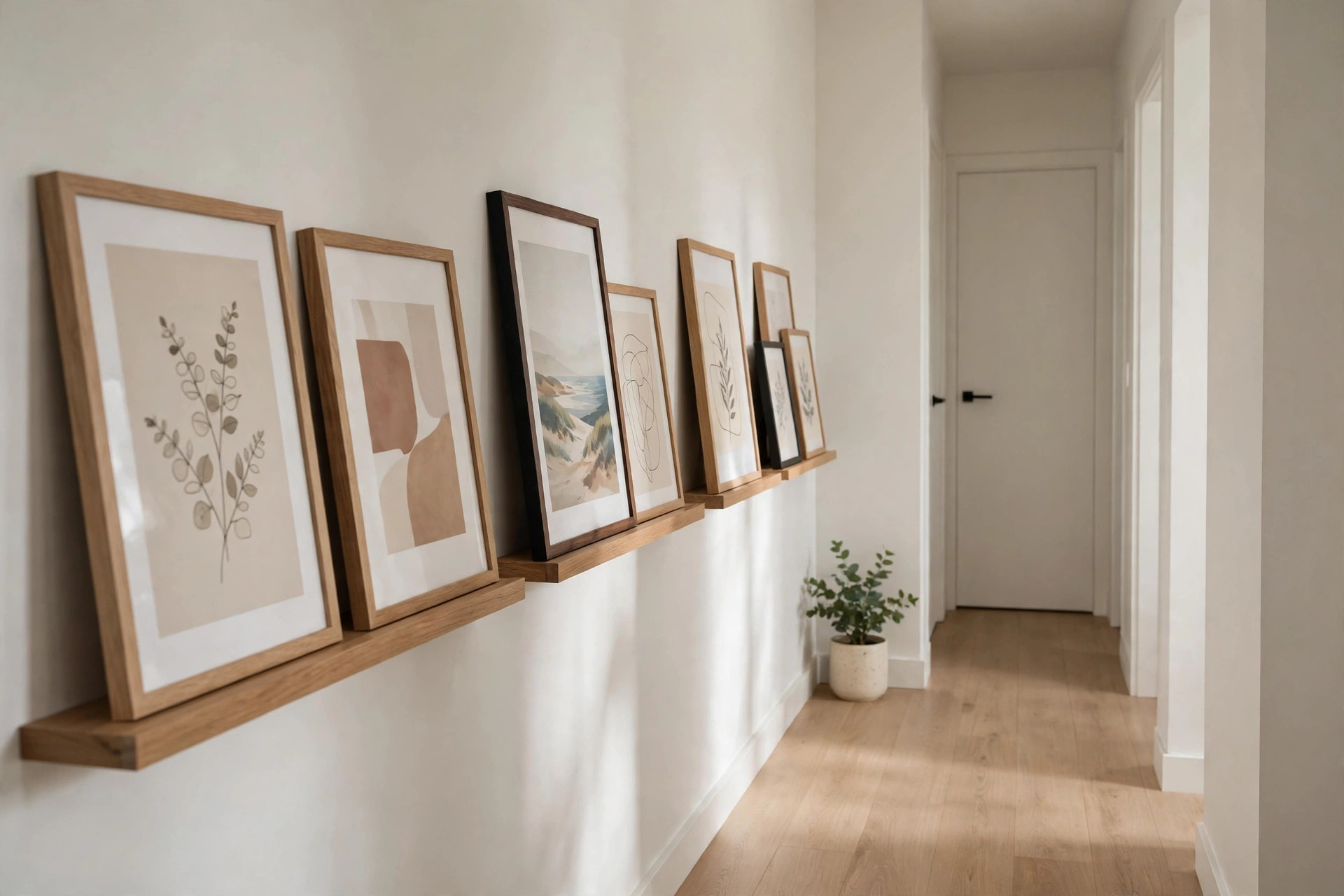
4. The glass shelf — the shelf that keeps a small room light
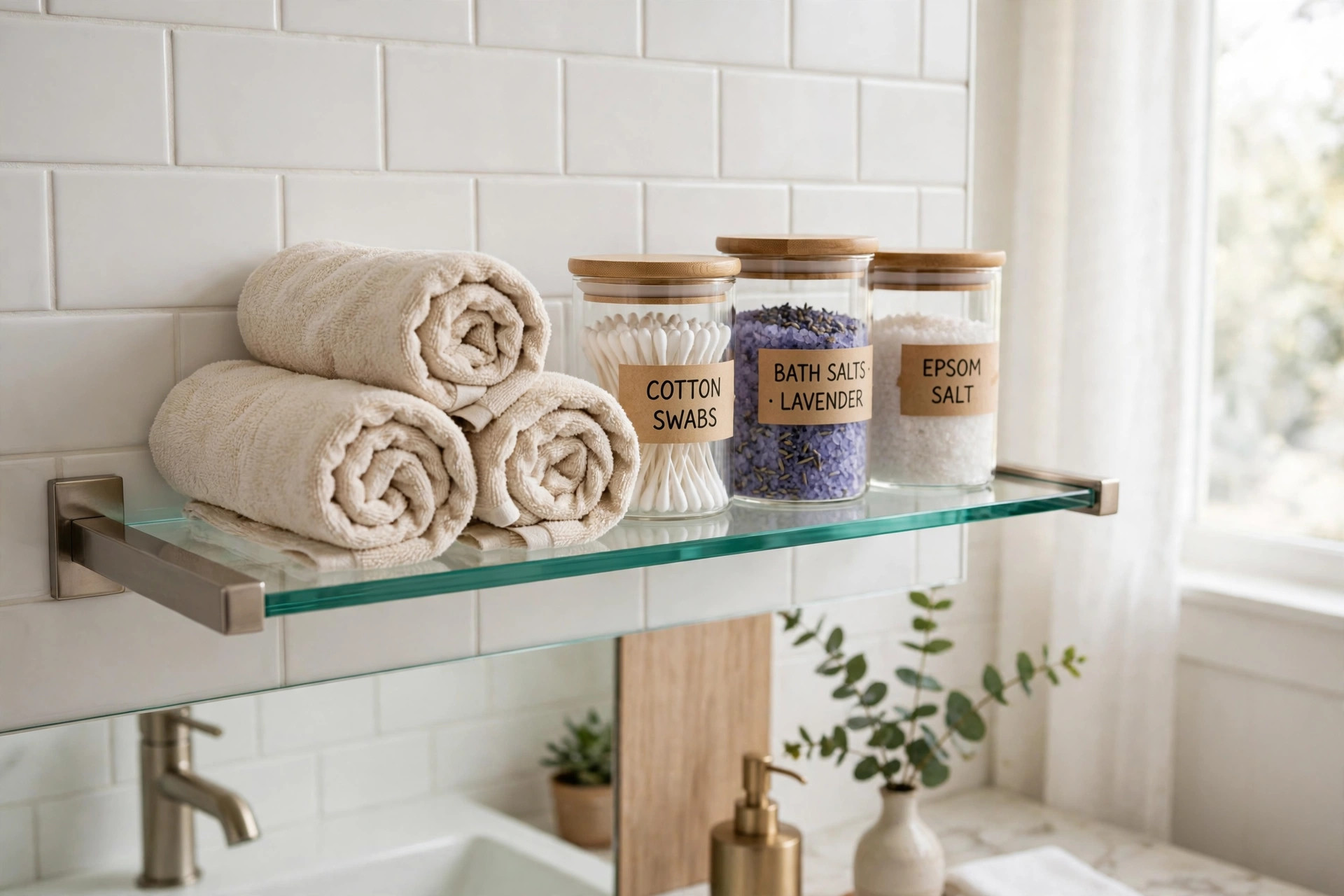
A wooden shelf in a small bathroom makes the room smaller, because the wood is dark, the shelf is solid, and the room that is already tight is the room that feels tighter with a board across it. Use a glass shelf — the shelf that keeps a small room light — so a clear glass board holds the rolled towels and the jars while the light passes straight through it, and the bathroom feels the same size it was. Pick tempered glass, thick enough to hold the weight without flexing, and fix it with chrome brackets made for glass, because the glass that is tempered is the glass that is safe, and the bracket that is made for glass is the bracket that grips it without cracking it. Keep it high, above the splash line, and keep only the pretty things on it, because the shelf that is glass is the shelf that shows everything, and the bathroom that shows the pretty things is the bathroom that looks like a hotel. The counter below the shelf gets its own system in 25 Bathroom Counter Organization Ideas for 2026, where the three things that stay out live. One glass shelf, and the small room stays light.
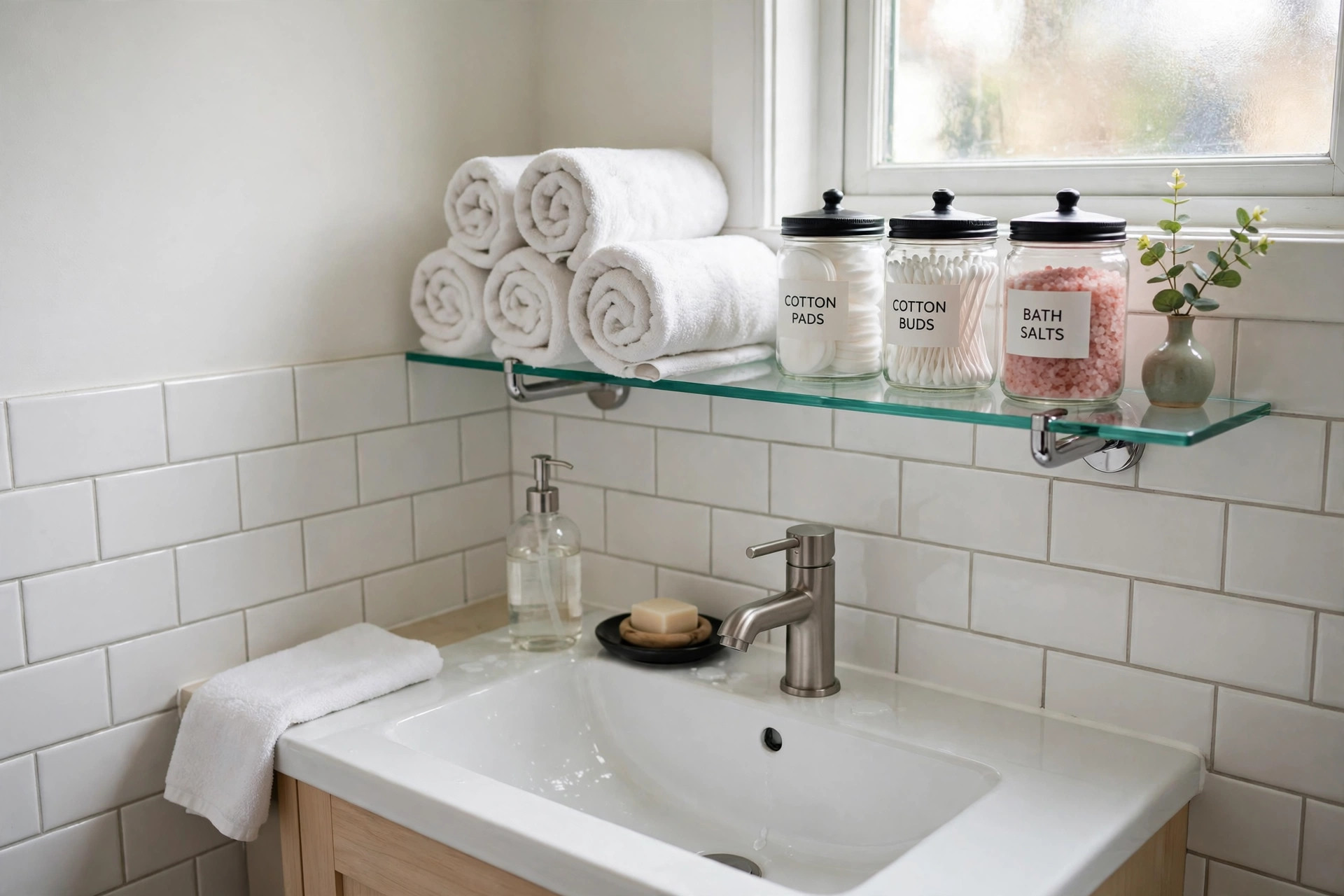
5. The corner shelf — the shelf that rescues dead space
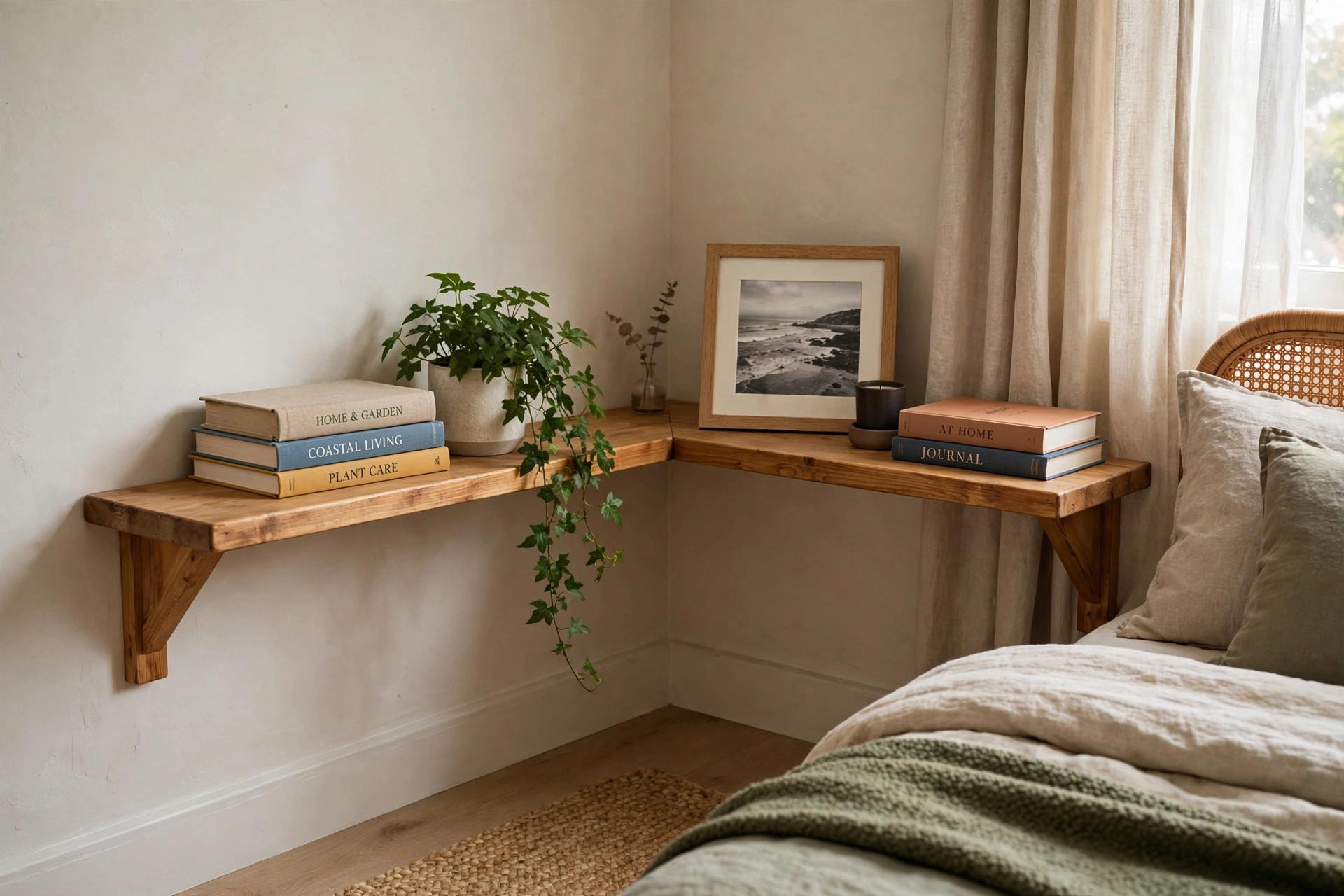
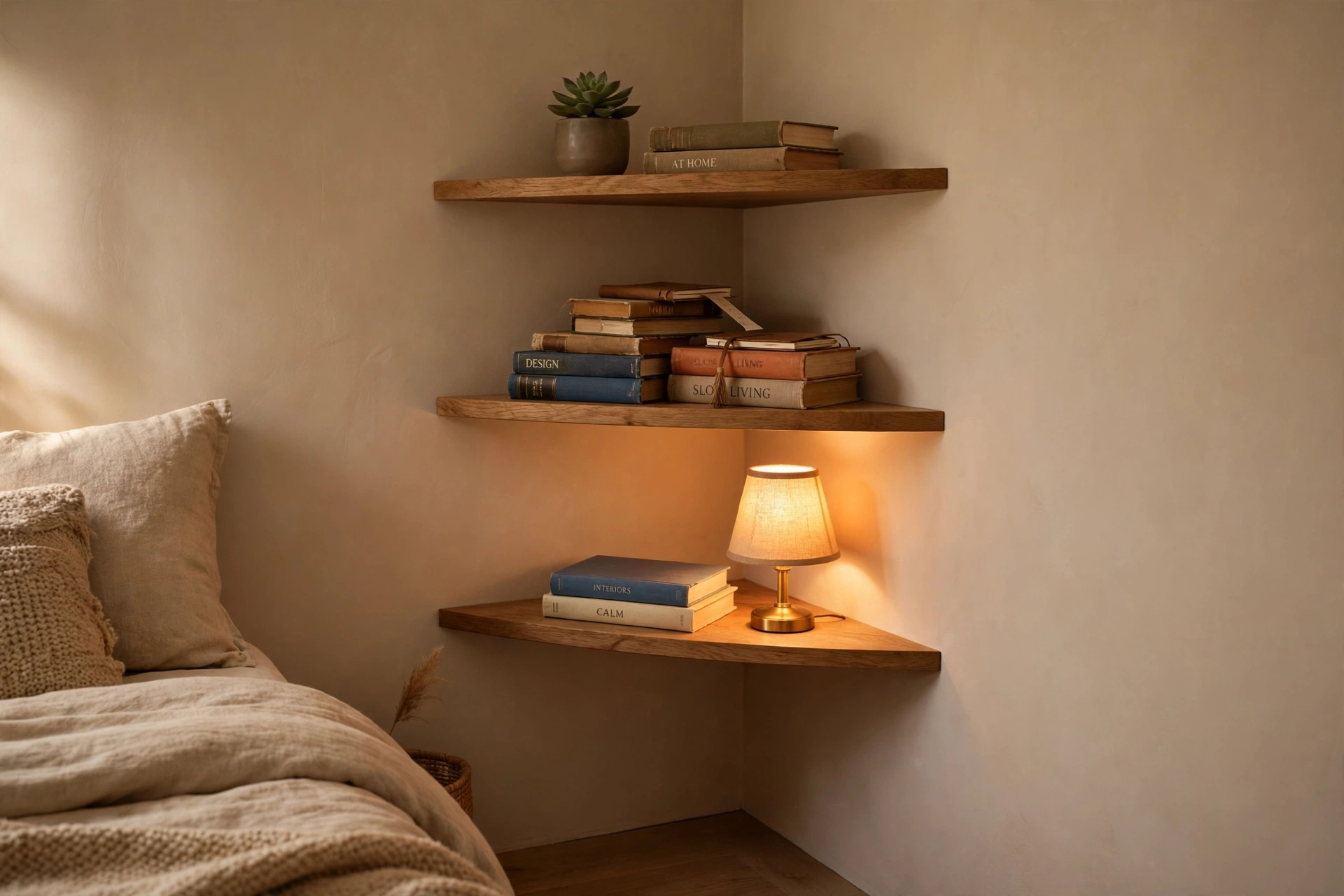
The corner of a room is the space nobody uses, because the corner is awkward, the furniture does not fit into it, and the wall that meets the wall is the wall that holds nothing. Use a corner shelf — the shelf that rescues dead space — so two short shelves meet in the corner, one on each wall, and the corner that held nothing now holds the books, the plant and the photo. Cut the shelves to the same length so the corner reads as one shelf, not two, and fix each side into its own stud, because the corner that is fixed on both sides is the corner that holds twice the weight. Put the tallest thing in the corner itself, where the two walls meet, and step the heights down towards the ends, because the corner that steps down is the corner that looks designed. Keep it in a bedroom or a hallway, where the corner is the only free wall, because the corner that is used is the corner that stops being dead space. One corner shelf, and the awkward corner earns its keep.
Hang it right
6. Measure the wall first — the tape measure that saves the returns
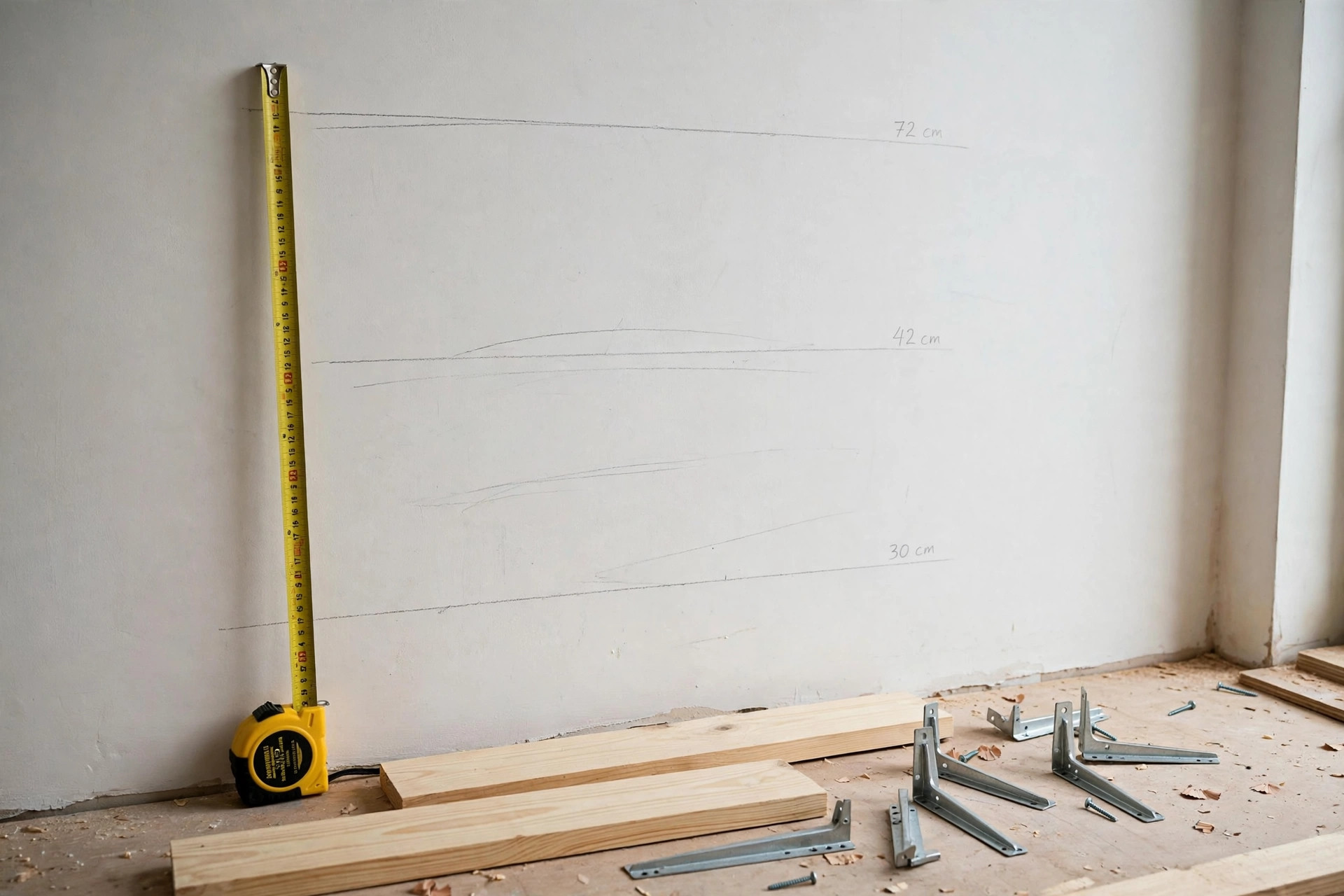
A shelf hung by guessing is a shelf hung wrong, because the shelf is too long for the wall, too short for the space, or hung at a height where nobody can reach what sits on it. Measure the wall first — the tape measure that saves the returns — so the length, the height and the stud positions are all marked before a single hole is drilled. Measure the wall end to end, measure the height from the floor to where the shelf will sit, and measure the distance to the furniture below it, because the numbers that are written down are the numbers that stop the shelf going up twice. Mark the stud positions with a pencil, mark the shelf length with tape on the wall, and stand back and look at the tape before you drill, because the tape that is looked at is the tape that shows you the shelf is too long before the holes are in the wall. One afternoon with a tape measure, and the shelf goes up once.
7. Find the studs — the fixings matter more than the shelf
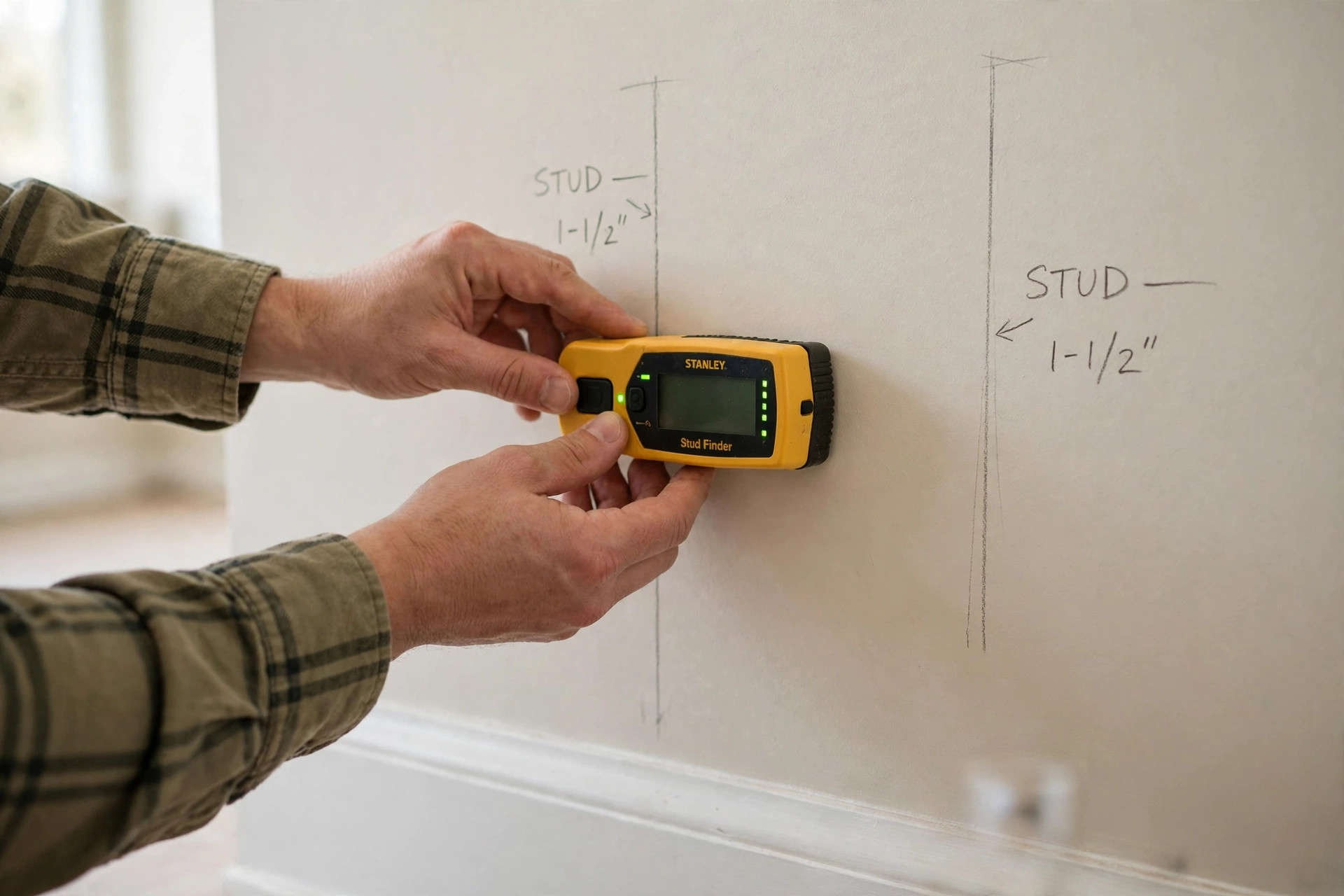
A floating shelf that misses the stud is a floating shelf that falls down, because the plasterboard alone cannot hold the weight, the plugs pull out slowly, and the shelf that looked fine on Sunday is the shelf on the floor by Friday. Find the studs — the fixings matter more than the shelf — so every bracket screw goes into solid timber, and the shelf holds what it is rated to hold. Use a stud finder and sweep it slowly, mark each stud edge with a pencil, and tap the wall to confirm, because the stud that is found twice is the stud that is really there. If the shelf cannot reach a stud, use proper plasterboard fixings rated for the weight, and never hang a loaded shelf on a single rawlplug, because the fixing that is rated is the fixing that holds, and the shelf that is fixed into timber is the shelf that stays up. One stud finder, and the shelf never falls.
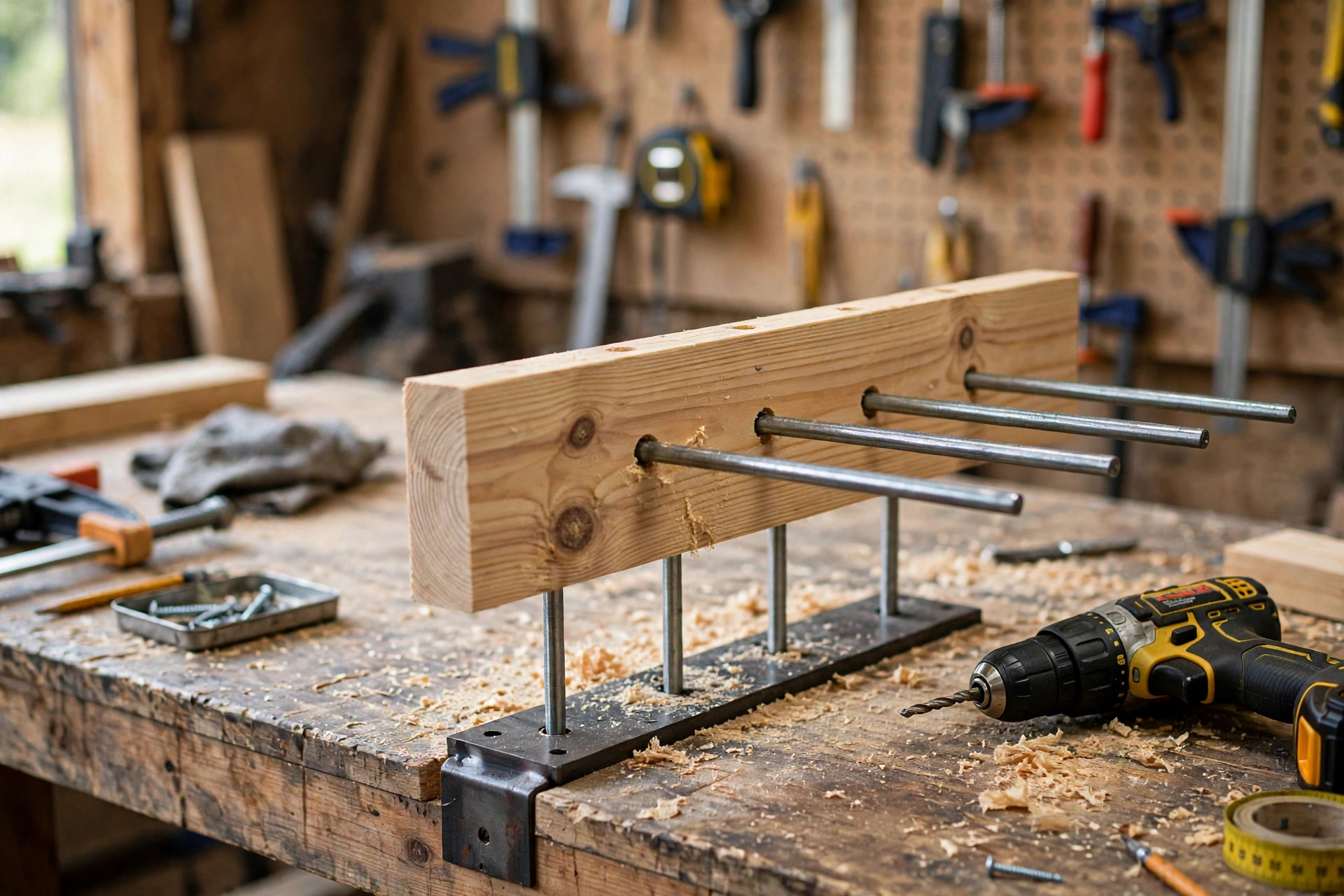
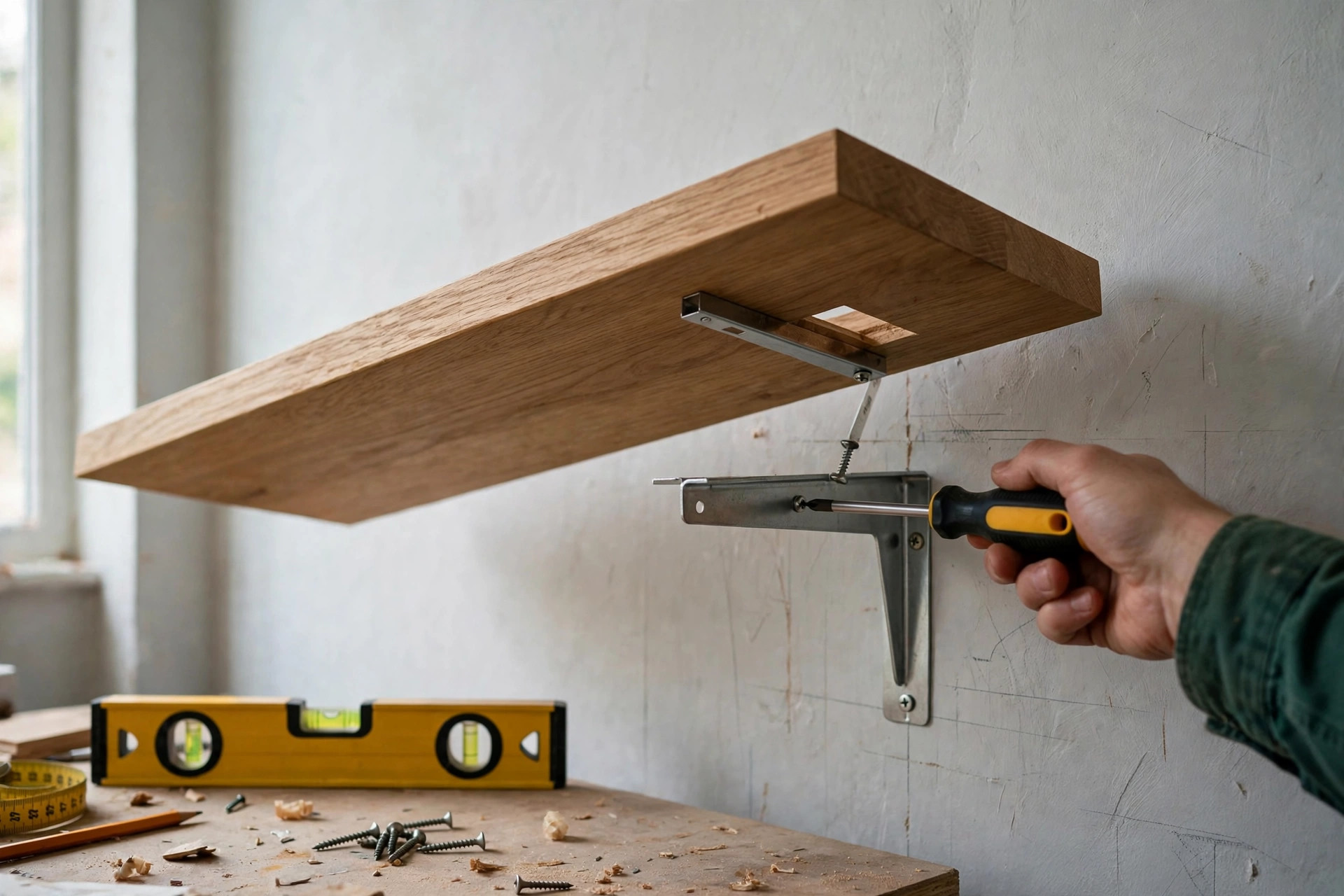
A floating shelf with a visible bracket is not a floating shelf, because the bracket shows, the illusion breaks, and the shelf that was meant to look built-in is the shelf that looks bolted on. Use hidden brackets that hold — the metal rod that disappears — so a steel bracket with rods slides into holes drilled in the back of the shelf, the shelf slides onto the rods, and nothing shows except the board. Drill the holes straight and level, use a drill guide if you have one, and test the fit on the bench before the bracket goes on the wall, because the hole that is drilled straight is the hole the rod slides into, and the bracket that is tested is the bracket that fits the first time. Pick a bracket rated for more weight than the shelf will ever hold, because the bracket that is over-rated is the bracket that never sags. (Check on Amazon for a heavy-duty hidden floating shelf bracket kit with steel rods and a level.)
9. Level it before you drill — the shelf that never tilts
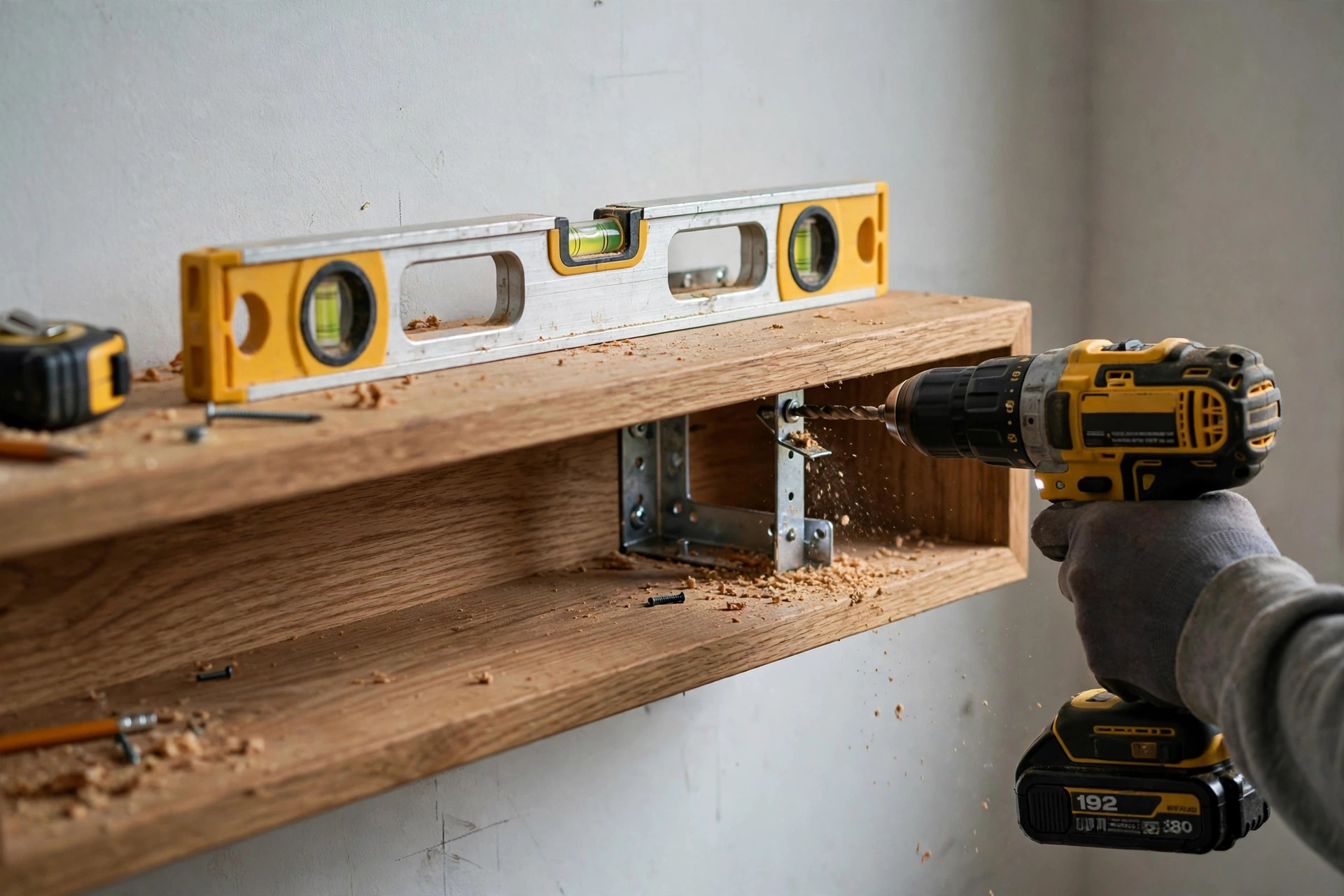
A shelf that tilts is a shelf that announces itself, because the books slide to one end, the plant leans, and the shelf that is a degree out is the shelf that looks a mile out. Level it before you drill — the shelf that never tilts — so the spirit level sits on the bracket, the pencil line is drawn level, and the holes are drilled on the line, not above it or below it. Check the level twice, once before you mark and once after you mark, and check it again after the first screw goes in, because the level that is checked three times is the level that is right. If the wall itself is not level, level the shelf to the room, not to the wall, because the shelf that is level to the room is the shelf that looks right, and the wall that is wonky is the wall nobody measures. One spirit level, and the shelf never tilts.
10. Know the weight limit — what belongs on a bracket shelf instead
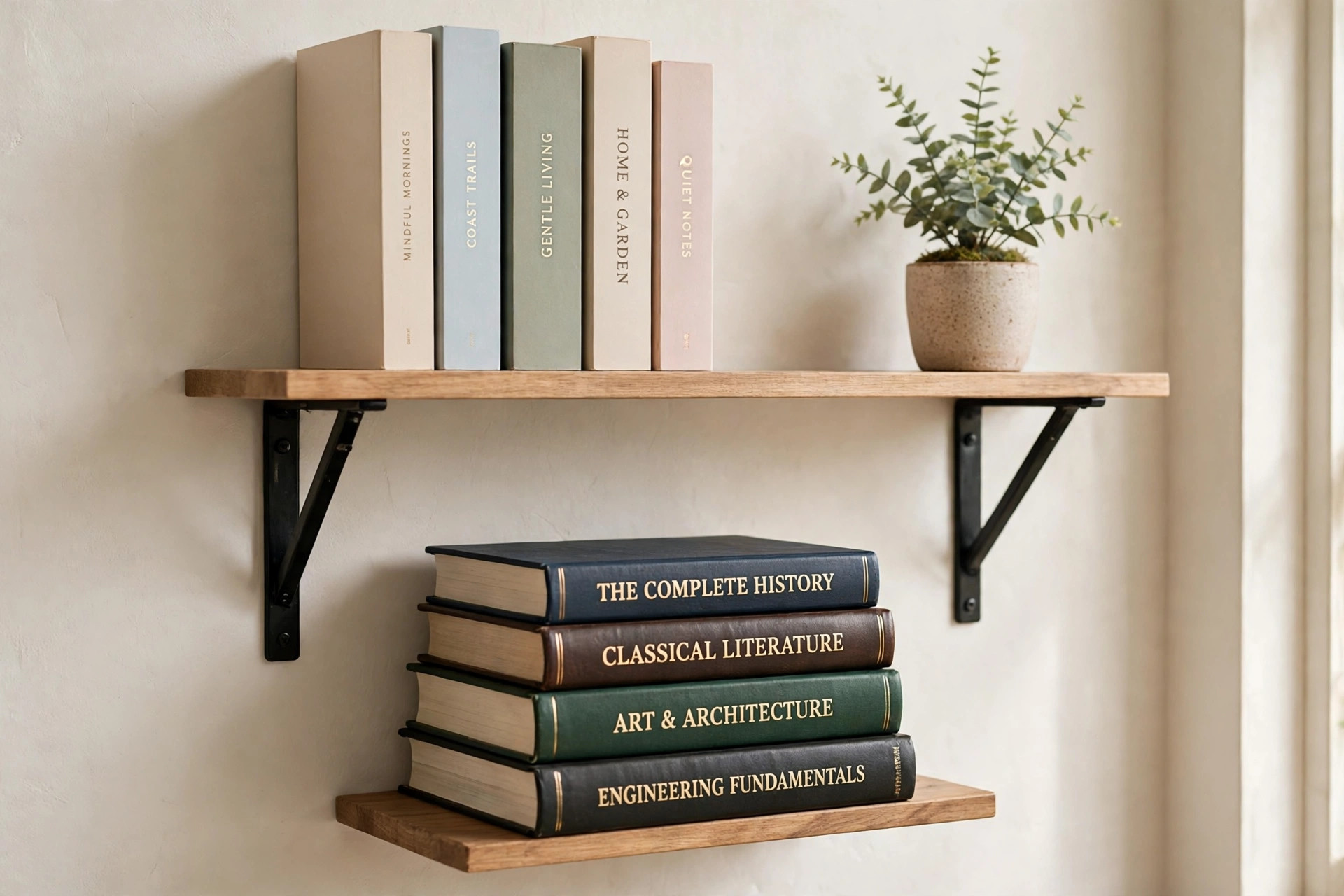
A floating shelf is not a bookshelf, because the bracket is hidden, the leverage is real, and the shelf that holds twenty hardbacks is the shelf that sags in the middle by Christmas. Know the weight limit — what belongs on a bracket shelf instead — so the floating shelf holds the light things, the books in a single row, the plant, the framed print, and the heavy things go on a bracket shelf that shows its fixings and earns them. Read the bracket rating before you buy, add up the weight of what will sit on the shelf, and leave a margin, because the shelf that is loaded under its limit is the shelf that stays level. Put the heavy books on the bracket shelf from 24 DIY Wall Shelves Ideas for 2026, where the fixings show and the weight is honest, and keep the floating shelf for the things that look light. (Check on Amazon for a digital stud finder with a built-in level, so the stud and the level are found in one pass.) One honest weight limit, and the shelf never sags.
Style it for every room
11. The living room wall — books, plants and one framed print
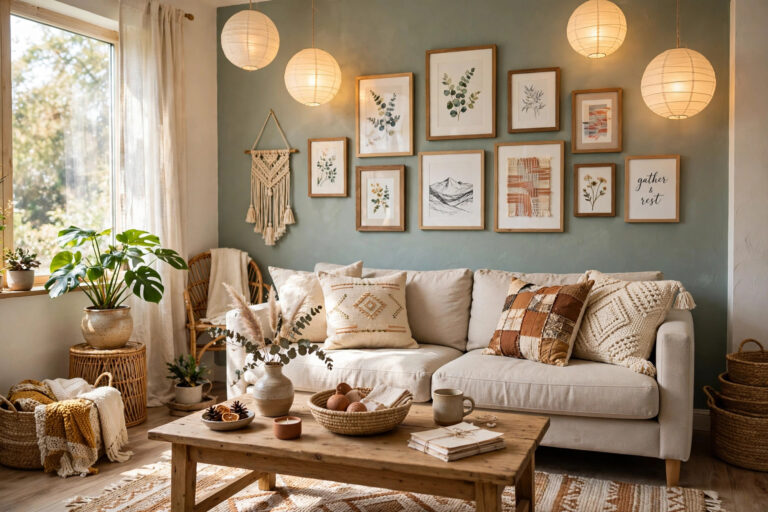
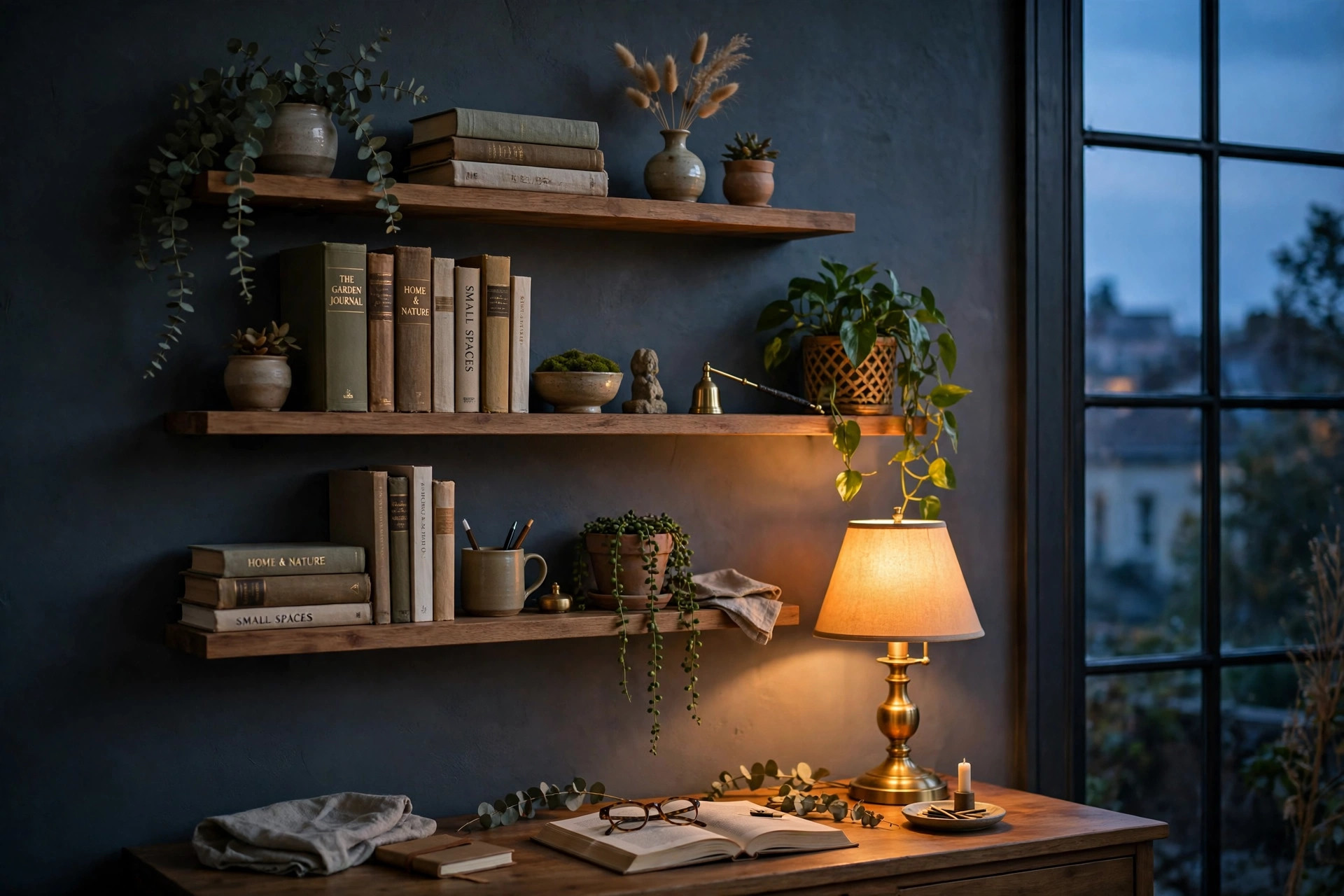
The living room wall above the sofa is the wall everyone looks at, because the sofa faces it, the television sits under it, and the wall that is bare is the wall that makes the whole room feel unfinished. Style the living room wall — books, plants and one framed print — so two floating shelves sit above the sofa, the lower one holding the books and the plant, the upper one holding the framed print and the vase, and the wall that was bare now holds the room together. Keep the shelves the same length and hang them the same distance apart, because the pair that matches is the pair that looks designed, and the shelves that are level with each other are the shelves that look calm. Leave a gap between the objects, because the shelf that breathes is the shelf that looks styled, and the shelf that is crammed is the shelf that looks like storage. The living room itself gets its full system in 28 Living Room Storage Ideas for 2026, where the shelves sit alongside the rest of the room's storage. Two shelves, and the living room wall is finished.
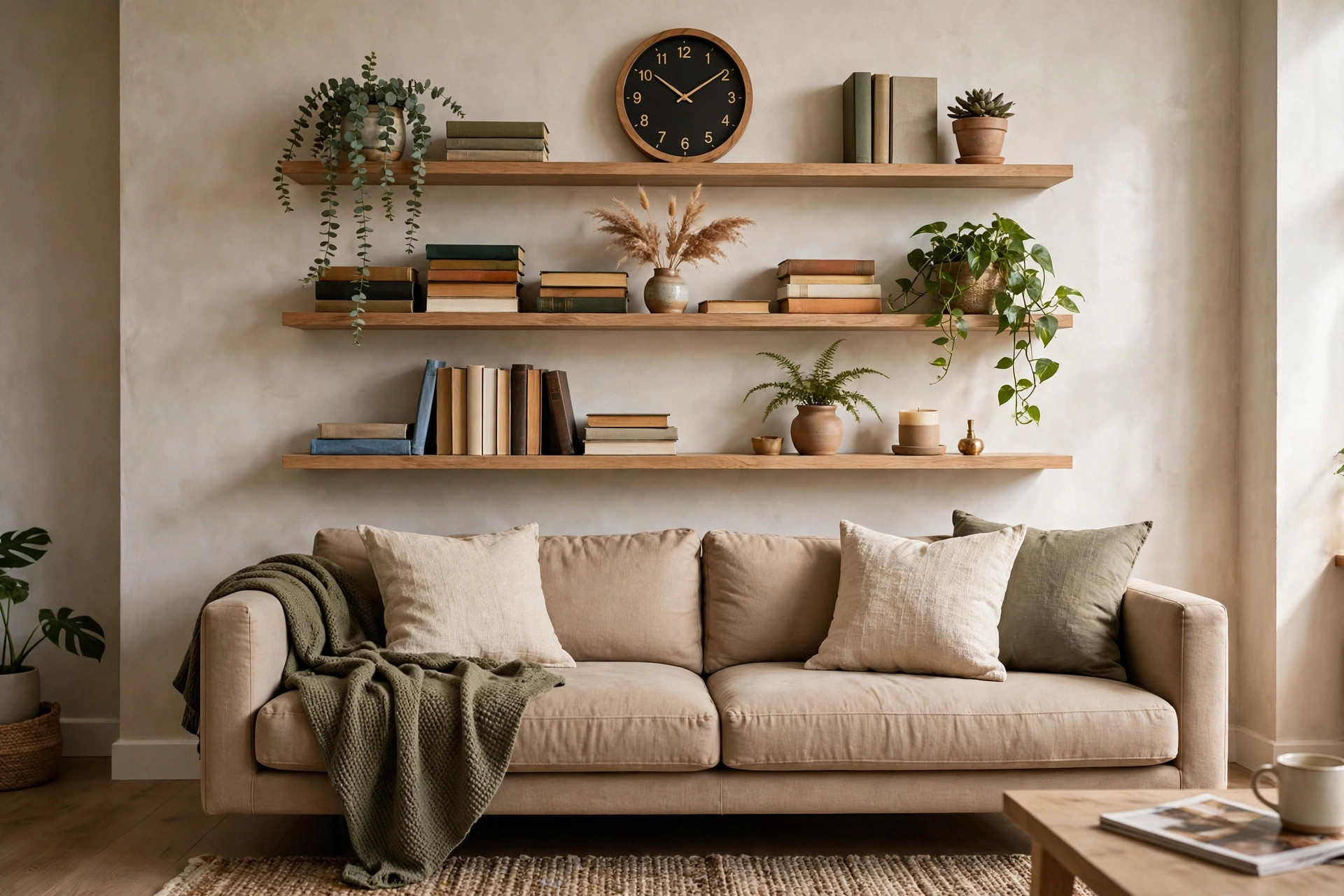
12. The kitchen shelf — plates, mugs and jars in reach
Kitchen cupboards hide the everyday things, because the plates live behind a door, the mugs live on a high shelf, and the breakfast that should take two minutes takes five because everything is behind something. Hang a kitchen shelf — plates, mugs and jars in reach — so the everyday plates stand in a row on the shelf, the mugs hang from hooks underneath it, and the jars of oats and pasta sit where you can see them. Keep the shelf away from the cooker, because the shelf that sits over the hob is the shelf that collects grease, and the plates that live near the table are the plates that get used. Keep only the everyday things on it, because the shelf that holds the daily plates is the shelf that earns its place, and the special plates stay in the cupboard. The kitchen cupboards themselves get their full system in 20 Kitchen Cabinet Organization Ideas for 2026, where the shelf and the cupboard work as a pair. One kitchen shelf, and breakfast takes two minutes.
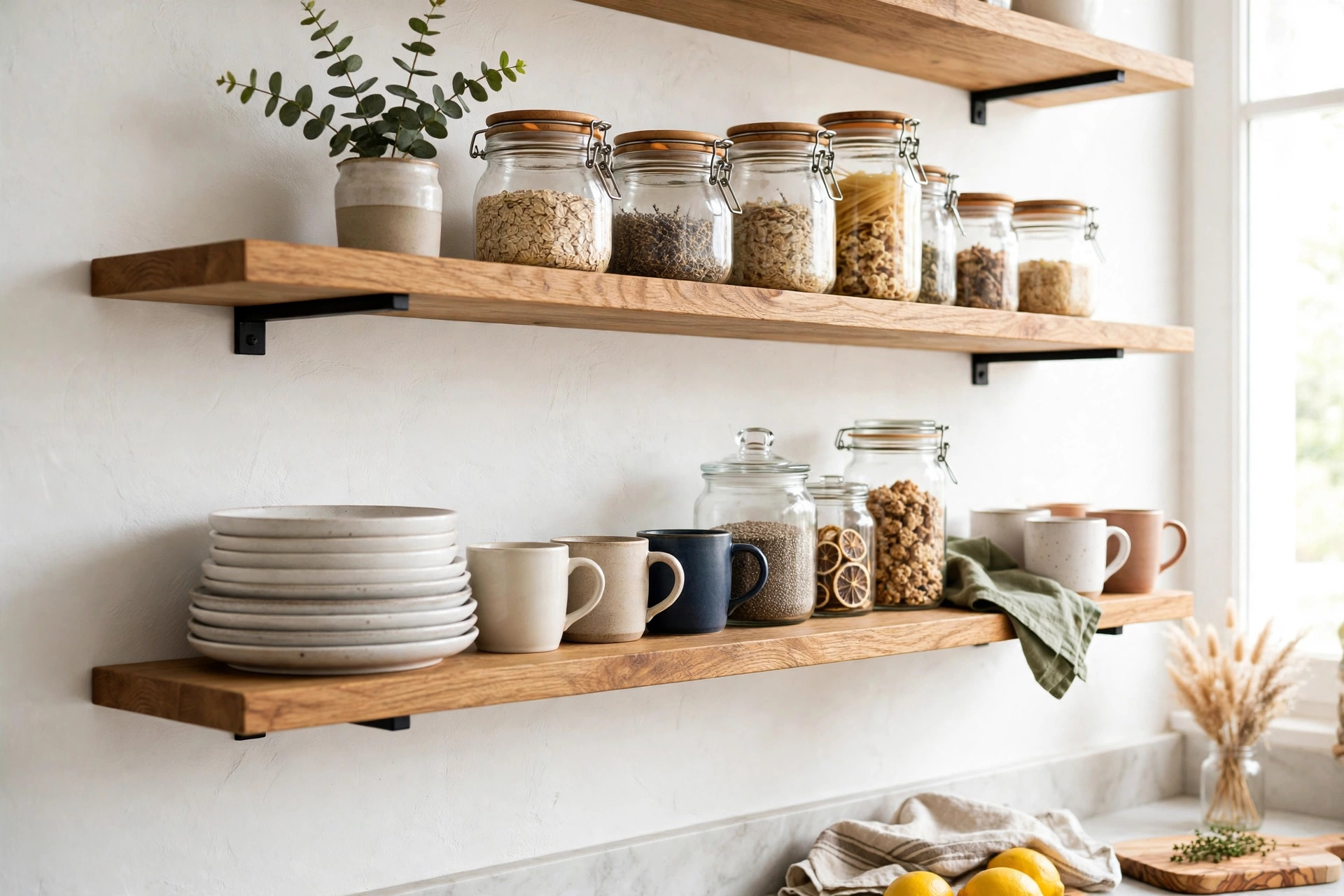
13. The bedroom shelf — books and a lamp above the bed
A bedside table is the only storage most bedrooms have, because the table holds the book, the lamp and the phone, and the table that holds three things is the table that holds nothing else. Hang a bedroom shelf — books and a lamp above the bed — so a floating shelf sits above the bedhead, holding the books and the small lamp, and the bedside table is free for the glass of water and the phone. Hang it high enough that nobody bumps their head sitting up, and keep nothing heavy on it, because the shelf that sits above a pillow is the shelf that must never fall, and the books that live there are the books that are light. Put the reading lamp on the shelf and the phone on the table, because the shelf that holds the lamp is the shelf that lights the book, and the bedroom that reads in bed is the bedroom that needs the shelf. The bedroom itself gets its full system in 28 Bedroom Storage Ideas for 2026, where the shelf sits alongside the closet and the drawers. One bedroom shelf, and the bedside table breathes.
14. The bathroom shelf — rolled towels and jars on a shelf that survives the steam
A bathroom counter holds three things and nothing more, because the counter is small, the steam is constant, and the shelf that cannot survive the steam is the shelf that warps by winter. Hang a bathroom shelf — rolled towels and jars on a shelf that survives the steam — so a sealed wood or glass shelf sits above the toilet or beside the mirror, holding the rolled towels and the jars, and the counter below is clear for the soap and the toothbrush. Seal the wood twice, because the shelf that is sealed is the shelf that survives the steam, and the shelf that is not sealed is the shelf that swells. Keep the towels rolled, not folded, because the roll that is tight is the roll that fits, and the jar that is labelled is the jar that is found. The counter below the shelf gets its own system in 25 Bathroom Counter Organization Ideas for 2026, where the three things that stay out live. One bathroom shelf, and the counter is clear.
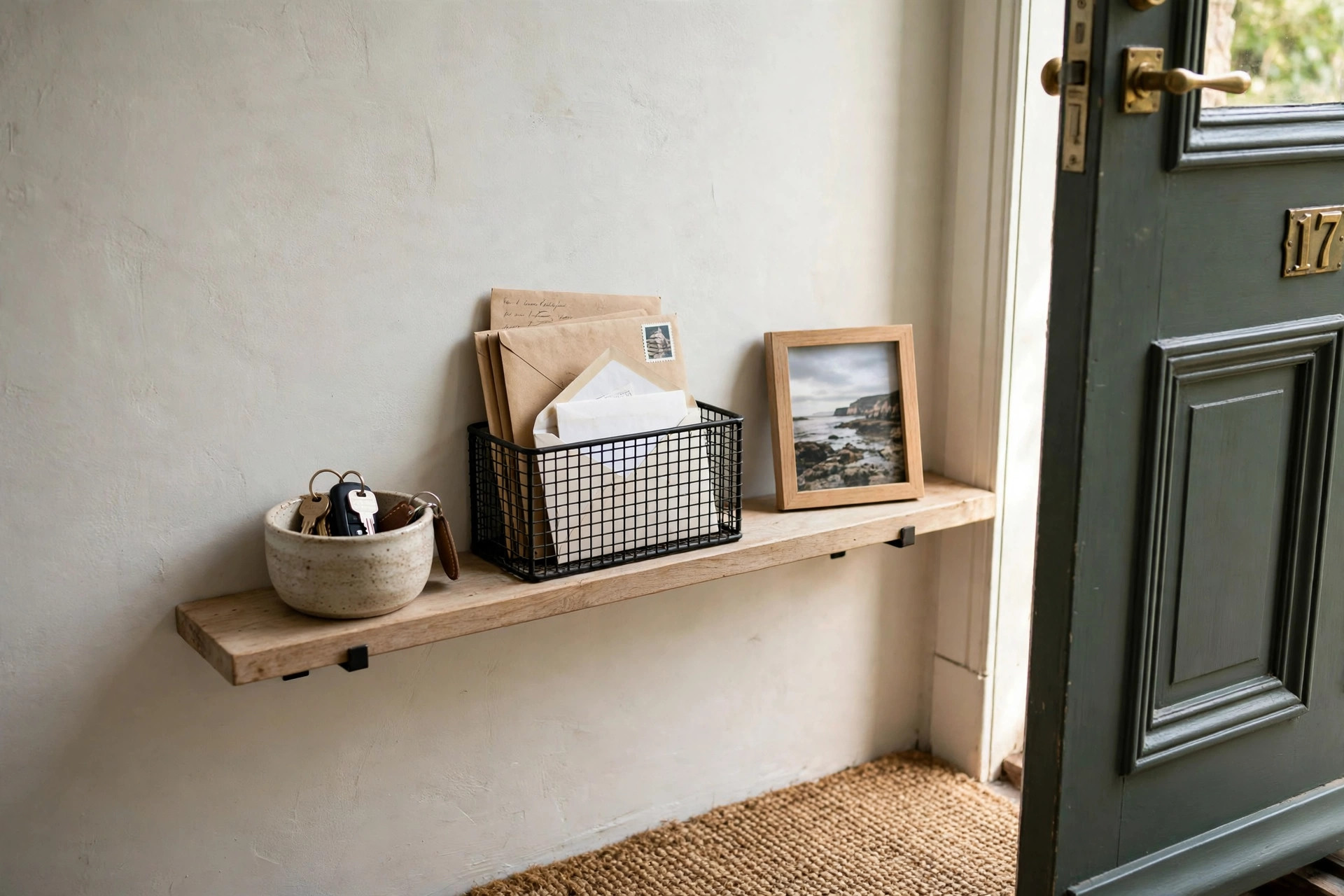
15. The hallway ledge — keys, post and one photo by the door
The hallway is where things are lost, because the keys land on the nearest surface, the post lands on the stairs, and the hallway that has nowhere to put things is the hallway where everything is on the floor. Hang a hallway ledge — keys, post and one photo by the door — so a slim floating shelf sits at shoulder height beside the front door, holding the key bowl, the post tray and one framed photo, and the hallway that was a dumping ground now has a landing spot. Keep it slim, because the ledge that sticks out is the ledge that catches a shoulder, and keep it at the height you reach without thinking, because the ledge that is reached without thinking is the ledge that gets used every single day. Put the keys in the bowl the moment you walk in, because the bowl that is used is the bowl that holds the keys, and the hallway that holds the keys is the hallway where nobody hunts for them in the morning. One hallway ledge, and the morning hunt ends.
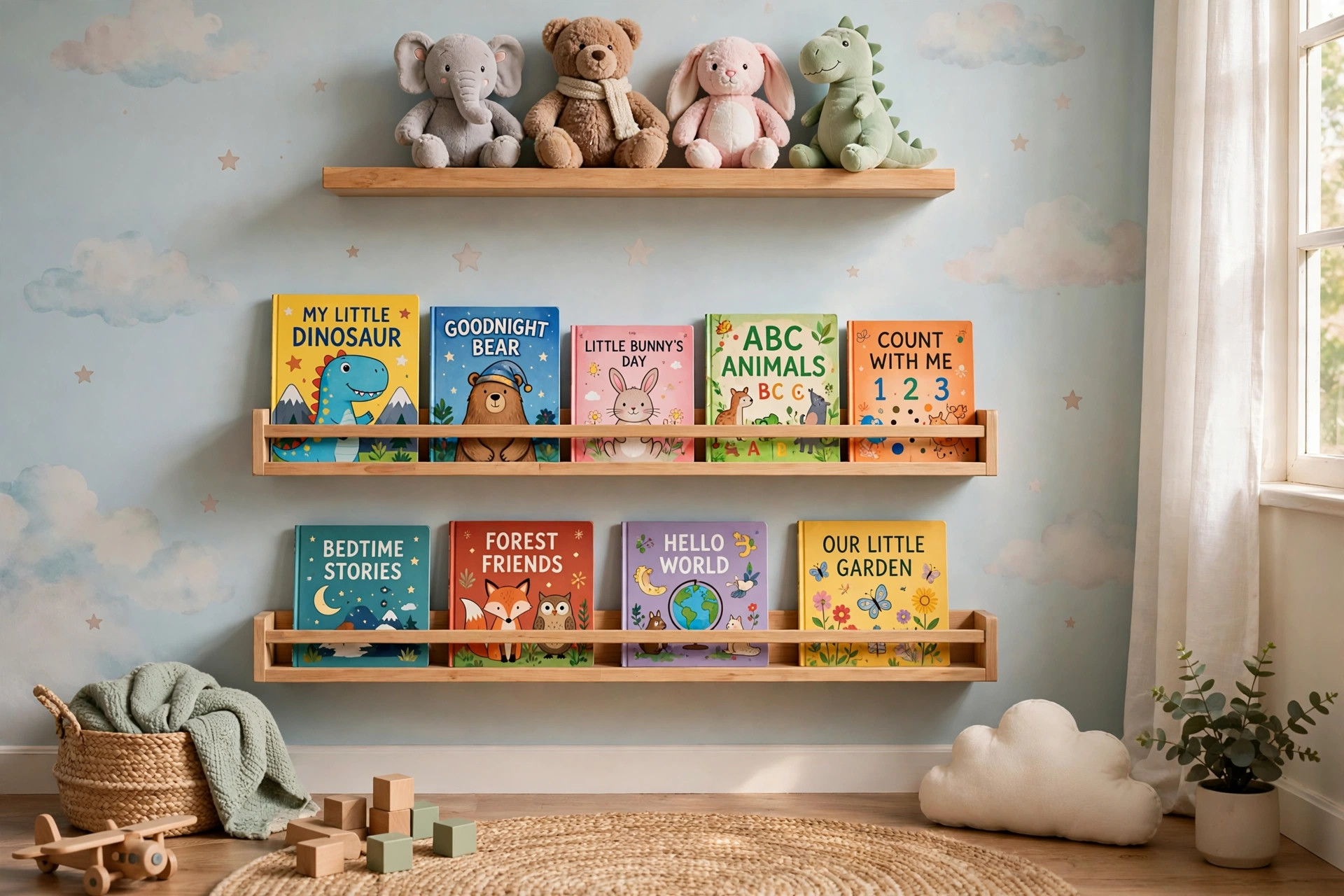
16. The kids' room shelf — books facing out at child height
Kids' books in a pile are books nobody reads, because the pile is on the floor, the covers are hidden, and the book that cannot be seen is the book that is never picked up. Hang a kids' room shelf — books facing out at child height — so a slim ledge sits low on the wall, the books face out with their covers showing, and the child who walks past it picks a book the way they pick a toy off a shelf. Hang it at the child's eye level, not yours, because the shelf that is hung for the child is the shelf the child uses, and the books that face out are the books that get read. Keep the shelf above it for the toys, because the shelf that holds the toys is the shelf that keeps the floor clear, and the room that reads is the room where the books are at eye level. Fix it into a stud and check it yearly, because the shelf that a child pulls on is the shelf that must hold. One low ledge, and the books get read.
Keep it strong and tidy
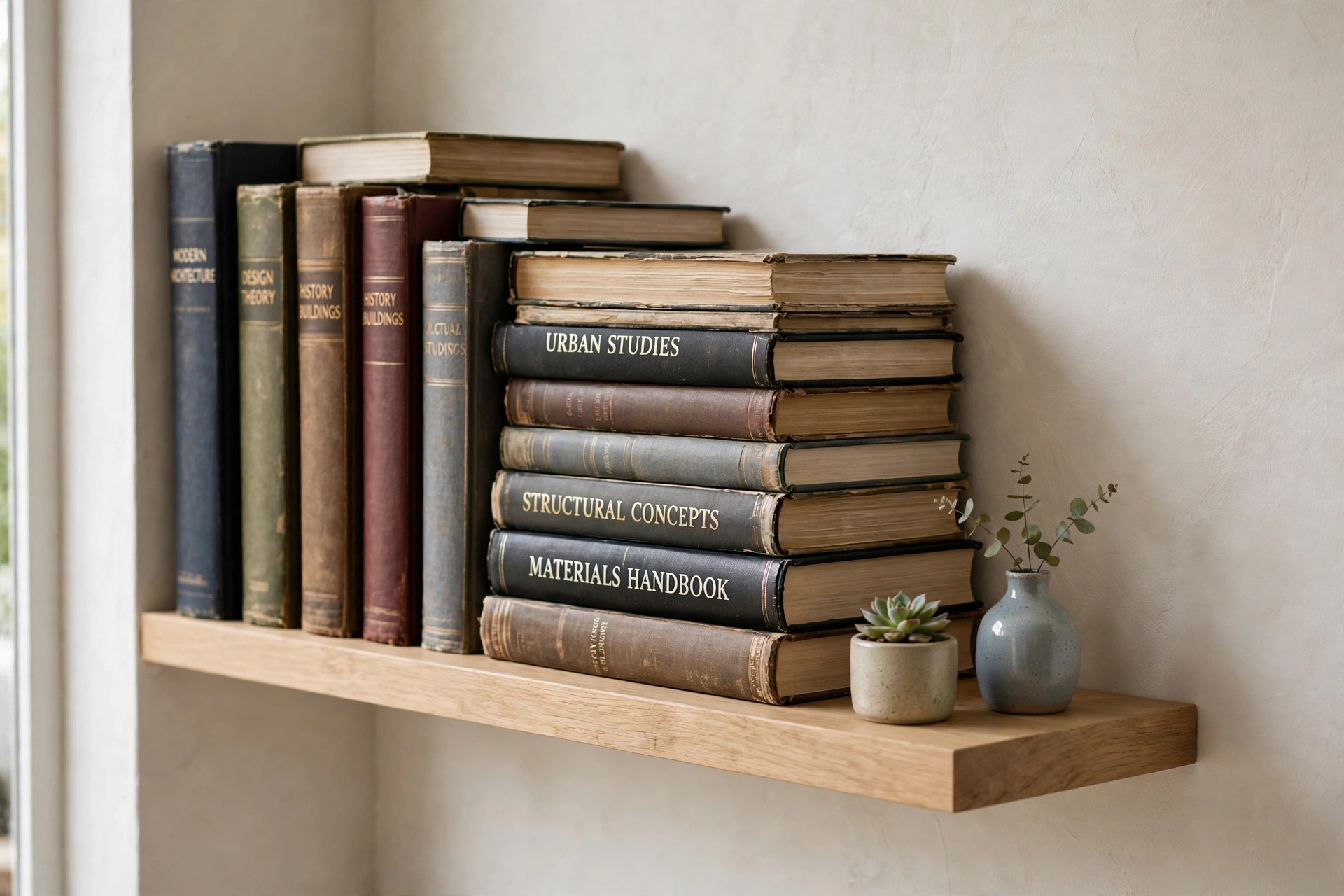
17. Load it right — heavy books at the wall end, light things at the front
A floating shelf loaded wrong sags, because the heavy books sit at the front edge, the leverage pulls the shelf down, and the shelf that is loaded at the edge is the shelf that dips. Load it right — heavy books at the wall end, light things at the front — so the weight sits close to the wall where the bracket is strongest, and the front edge holds only the light things, the plant, the framed print, the vase. Put the heaviest book at the back, against the wall, and the lightest thing at the front, because the shelf that is loaded at the wall is the shelf that stays level, and the shelf that is loaded at the edge is the shelf that sags. Check the shelf after a week, because the shelf that is checked is the shelf that is caught early, and the books that are moved back are the books that save the shelf. One loading rule, and the shelf stays level.
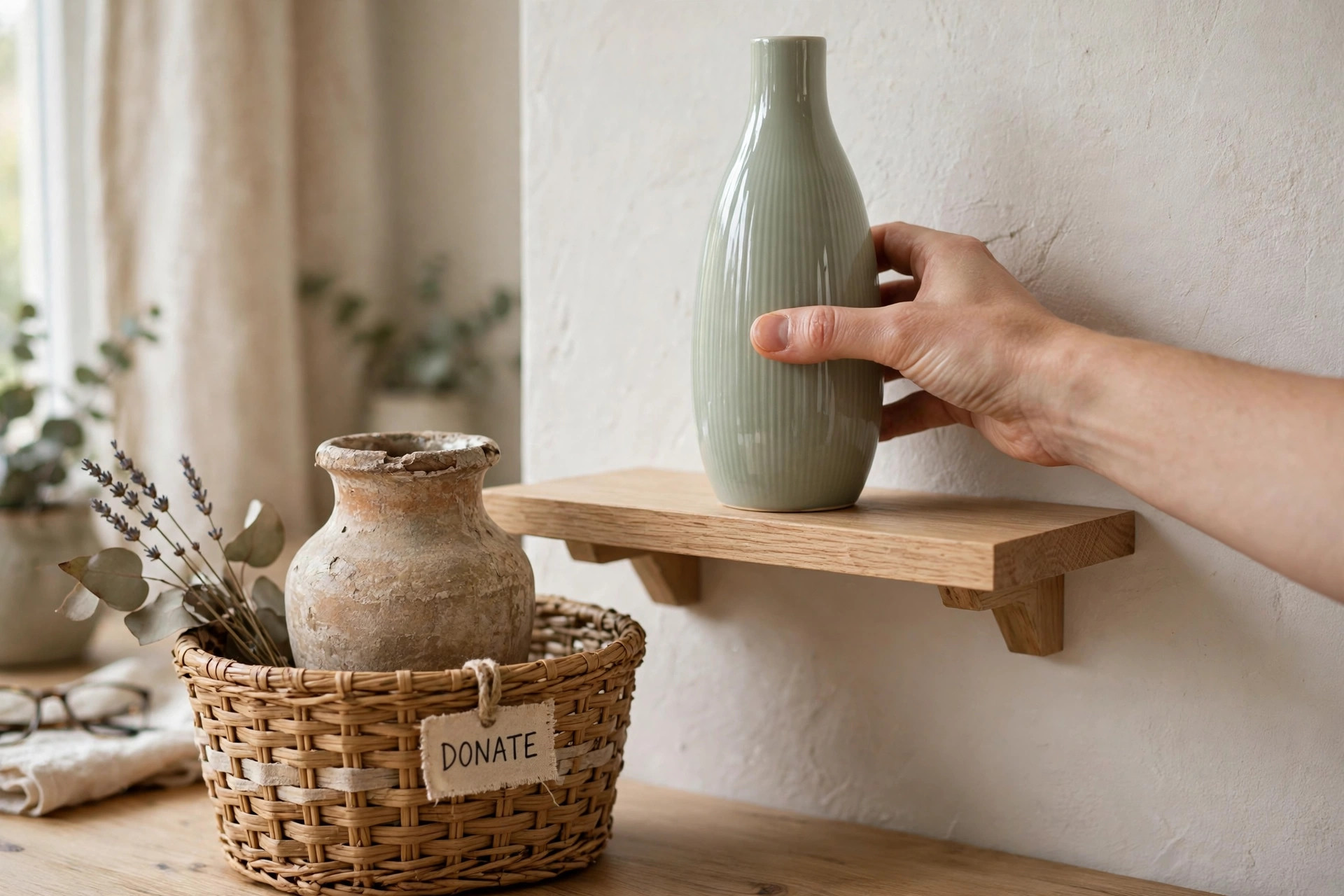
18. One in, one out — every new object means one old object leaves
A floating shelf fills up on its own, because every holiday adds a souvenir, every sale adds a vase, and the shelf that held three things in January holds ten by December. Use one in, one out — every new object means one old object leaves — so the shelf stays styled instead of becoming storage, and the new vase that arrives means the old vase goes into the donate box. Keep the donate box near the shelf, because the box that is near is the box that gets used, and the shelf that is edited is the shelf that looks styled. Count the objects when you do the swap, because the count that is written down is the count that shows you how many the shelf really holds, and the shelf that is counted is the shelf that stops growing. (Check on Amazon for a small woven storage basket to keep beside the shelf as the donate box.) One rule, and the shelf never overflows.
19. A seasonal swap — change the display twice a year
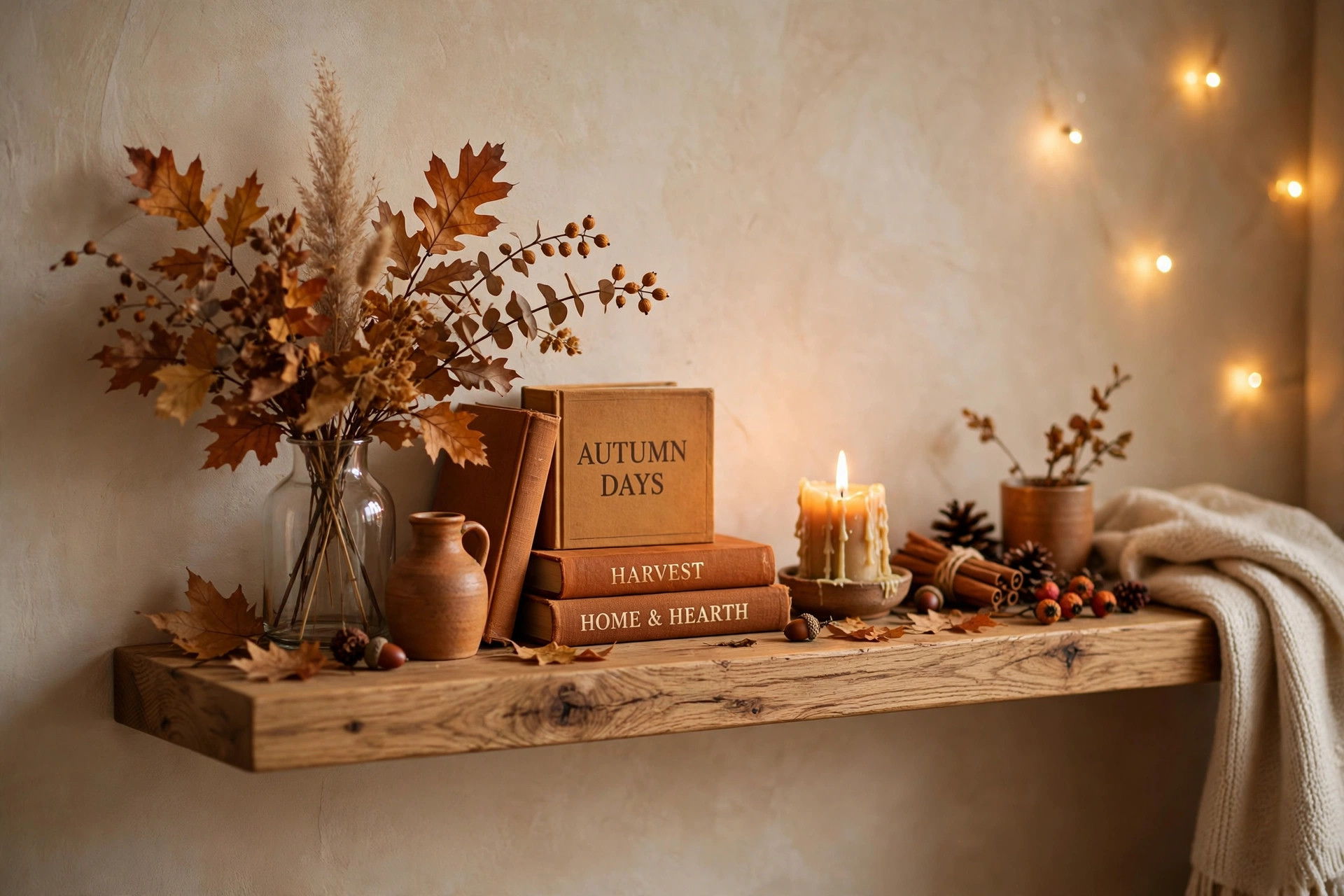
A shelf that never changes goes stale, because the same books sit there all year, the same vase sits there all year, and the shelf that never changes is the shelf nobody looks at. Do a seasonal swap — change the display twice a year — so the shelf holds the bright things in summer and the warm things in winter, and the wall that changes is the wall that gets noticed. Swap in spring and in autumn, check each object as it comes off the shelf, and wipe the shelf down while it is empty, because the swap that cleans is the swap that finds the dust and the loose fixing, and the shelf that is cleaned twice a year is the shelf that is always ready. Keep the off-season objects in a labelled box, because the box that is labelled is the box that is found, and the display that is swapped is the display that stays fresh. The books that leave the shelf get their full home in 24 Book Storage Ideas for 2026, where the shelf books live between swaps. One swap a season, and the shelf never goes stale.
20. The weekly dust — the shelf that is dusted weekly stays clean
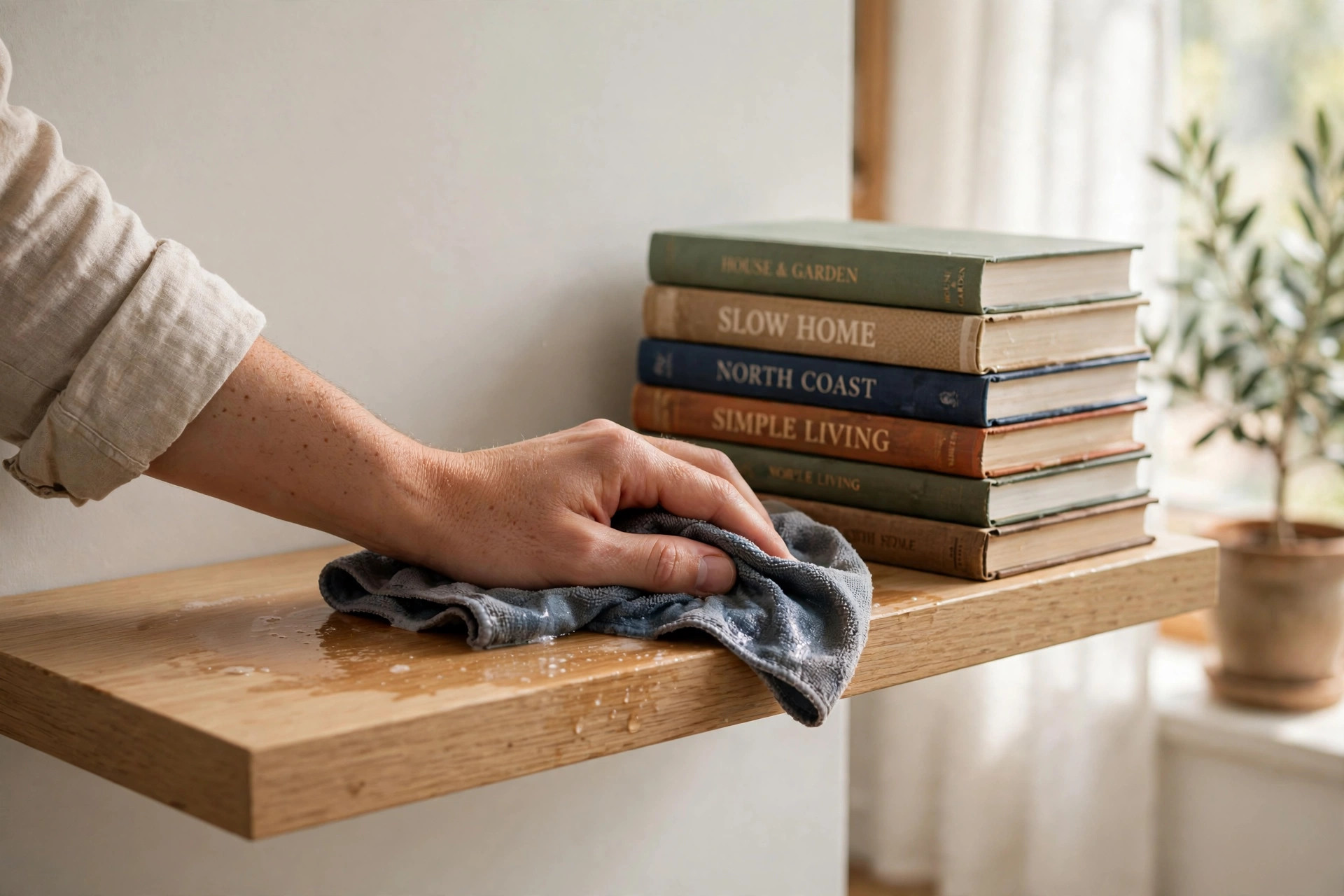
A floating shelf collects dust faster than a closed cupboard, because the shelf is open, the dust settles on the top, and the shelf that is never dusted is the shelf that looks grey by the end of the month. Dust it weekly — the shelf that is dusted weekly stays clean — so a quick wipe with a damp cloth takes thirty seconds, the books come off, the shelf is wiped, and the books go back. Keep the cloth near the shelf, because the cloth that is near is the cloth that gets used, and the shelf that is wiped weekly is the shelf that never needs a deep clean. Dust the objects too, because the vase that is dusty is the vase that looks old, and the shelf that is dusted is the shelf that looks new. One wipe a week, and the shelf stays clean.
21. Check the fixings yearly — the screw that is tightened once a year never fails
A floating shelf fails slowly, because the screw loosens a fraction every month, the bracket shifts a millimetre, and the shelf that was level in January is the shelf that tilts by December. Check the fixings yearly — the screw that is tightened once a year never fails — so once a year the shelf comes off, the bracket is checked, the screws are tightened, and the shelf goes back on level. Put it in the calendar, the same week every year, because the check that is in the calendar is the check that happens, and the bracket that is checked is the bracket that never lets go. Look for the signs while you check — the screw that turns too easily, the plug that moves, the wall that has cracked around the fixing — because the sign that is caught is the sign that is fixed before the shelf falls. One check a year, and the shelf never fails.
22. Fix a sagging shelf — the shelf that dips gets a bracket, a shim, or a shorter span
A sagging shelf is a shelf asking for help, because the middle dips, the books slide to the centre, and the shelf that sags is the shelf that will fall if it is ignored. Fix a sagging shelf — the shelf that dips gets a bracket, a shim, or a shorter span — so the shelf comes off, the bracket is checked, and the fix is chosen: a visible bracket under the middle for the heavy shelf, a shim behind the bracket for the shelf that tilts, or a shorter shelf for the span that was too long. Take everything off the shelf before you fix it, because the shelf that is empty is the shelf that can be levelled properly, and the fix that is done empty is the fix that holds. If the shelf has sagged more than a finger's width, replace the board, because the board that has bent is the board that will bend again, and the shelf that is replaced is the shelf that starts level. The bookends that keep the books upright on the fixed shelf get their full treatment in 22 DIY Bookends Ideas for 2026, where the shelf books stand straight. One fix, and the shelf is level again.
Which floating shelf idea fits which situation?
| Situation | Best first move | Budget | Tools needed |
|---|---|---|---|
| Bare wall, nothing on it | The classic wood plank (idea 1) | Low | Saw, sandpaper |
| Sofa wall looks empty | The chunky beam shelf (idea 2) | Medium | Drill, brackets |
| Prints leaning on the floor | The slim picture ledge (idea 3) | Low | Level, screws |
| Small bathroom, no storage | The glass shelf (idea 4) | Medium | Drill, plugs |
| Dead corner, wasted space | The corner shelf (idea 5) | Low | Saw, brackets |
| Afraid it will fall down | Find the studs (idea 7) | Free | Stud finder |
| Shelf tilts after hanging | Level it before you drill (idea 9) | Free | Spirit level |
| Kitchen with no cupboard space | The kitchen shelf (idea 12) | Low | Brackets |
| Hallway with nowhere for keys | The hallway ledge (idea 15) | Low | Screws |
| Kids' books all over the floor | The kids' room shelf (idea 16) | Low | Brackets |
| Shelf full of clutter | One in, one out (idea 18) | Free | None |
| Shelf sagging in the middle | Fix a sagging shelf (idea 22) | Low | Bracket, shim |
You do not need all 22 ideas. You need the three that solve your wall — usually the classic plank that suits every room, the studs that hold it up, and the level that keeps it straight. Start with the one shelf, do it this weekend before the next room refresh, and hang it on a stud. Do that and the wall will work harder, the floor will stay clear, and the shelf will still be level next year.
Save this post for the next weekend project, and if the wall shelves around it need the same treatment, read 24 DIY Wall Shelves Ideas for 2026 next — it is Post 90, the bracket shelves that hold the heavy things — and 25 DIY Room Decor Ideas for 2026, Post 84, for the display that sits on the shelf. This is the eleventh post of the DIY by project return run — Posts 81 to 100, one project at a time — and the run keeps going with the mirrors next. The plain mirror that needs a frame gets its own deep dive in DIY Mirror Frame, where the glass you already own gets a handmade frame.
Publish date assigned at publishing time. Updated as new floating shelf finds are tested.
Frequently asked questions
How do I hang a floating shelf without it falling down?
Hang it into the studs, because the plasterboard alone cannot hold the weight and the plugs pull out slowly. Find the studs with a stud finder, mark each one with a pencil, and put every bracket screw into solid timber. If the shelf cannot reach a stud, use proper plasterboard fixings rated for the weight — never hang a loaded shelf on a single rawlplug. Pick a hidden bracket rated for more weight than the shelf will ever hold, level it before you drill, and check the fixings once a year.
What is the best wood for DIY floating shelves?
Pine is the best wood for a first floating shelf, because it is light, cheap, easy to cut and paints well. Oak is the better choice if you want the wood grain to show, because it stains warm and holds a screw well. Pick a board thick enough to hide the bracket rod inside it — at least an inch and a half for a standard shelf, thicker for a chunky beam look — and seal the wood before you hang it, so it survives the dust and the steam.
How much weight can a floating shelf hold?
A floating shelf on a good hidden bracket fixed into studs can hold around 20 to 30 pounds, depending on the bracket and the length of the shelf — check the bracket rating before you buy, because that number is the limit. Load the heavy things close to the wall, where the bracket is strongest, and keep the front edge for light things. For anything heavier — a row of hardbacks, a stack of plates — use a bracket shelf that shows its fixings, because the bracket that shows is the bracket that holds the weight honestly.