20 Paperwork Organization Ideas for 2026
Paperwork does not pile up because you are lazy. It piles up because every piece of paper arrives without a home, and the counter is the only place that never says no. The school letter goes on the kitchen worktop, the bill goes on the desk, the receipt goes in a drawer, and by Friday the pile is a job in itself — a job nobody has time to do, because the pile is the reason there is no time. The paper is not the problem. The missing system is.
These 20 paperwork organization ideas give every paper one home: sort the pile in four moves, file by category, scan what you can, and reset for ten minutes a week — so the pile stops growing back and the paper you need is the paper you can find.
Every idea below works in a real home, from a flat where the paperwork lives in one drawer to a family house where the school letters alone could fill a box. The desk the paperwork lands on gets its own treatment in 24 Desk Organization Ideas for 2026, and the school papers get their system in 22 School Organization Ideas for 2026. Pick three ideas that fit your pile, start with the sort, and build from there.
Sort first, then file
1. Empty the pile — every paper out before a single file is bought
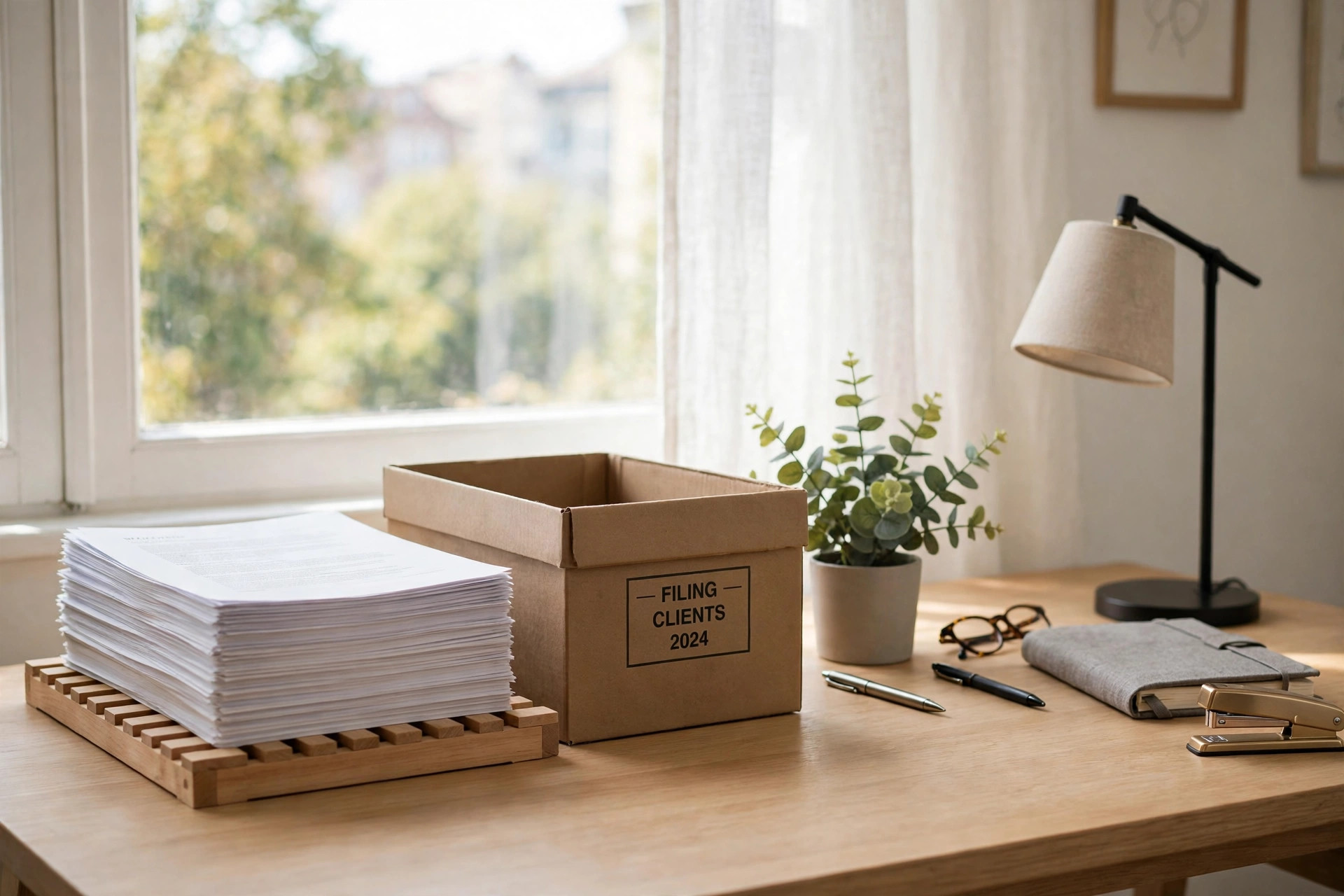
A filing system bought before the pile is sorted is a system that fits the shop, not your home, because you do not know what you are filing yet — the pile is half junk, a quarter action, and a quarter keep, and the folders you buy are bought for a pile you have not measured. Empty the pile first — every paper out before a single file is bought — so the whole mess is visible on the table and the sorting starts from the truth, not from a guess. Spread it out, take the papers off the counter and out of the drawers, and look at what you actually have, because the pile that is spread out is the pile that can be sorted, and the pile that stays in a heap is the pile that stays a mystery. Buy nothing until the sort is done, because the folders that fit your real categories are the folders that get used. One emptying, and the pile becomes a job with an end.
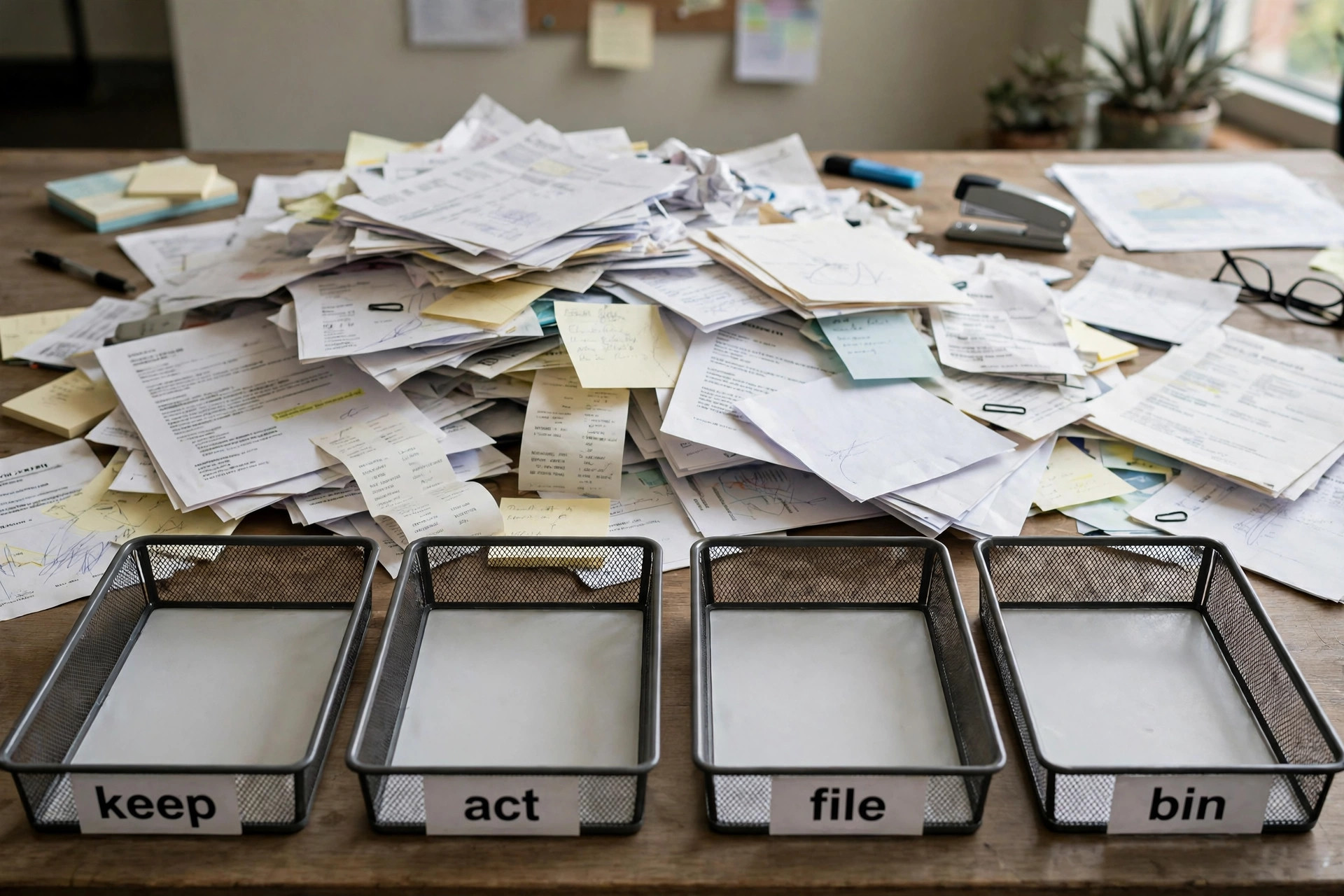
2. The four-pile sort: keep, act, file, bin
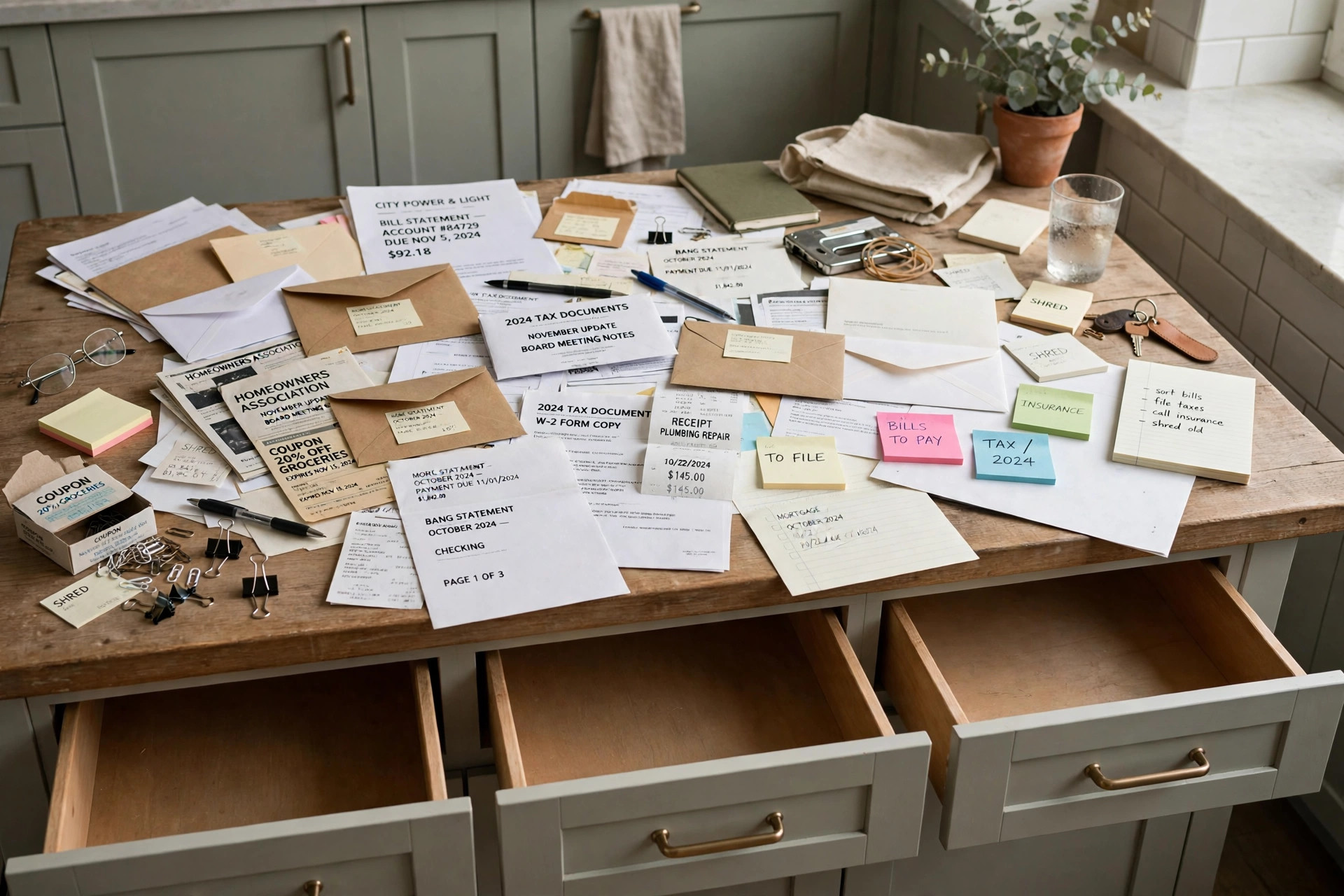
A pile sorted by feeling is a pile that never shrinks, because every paper feels important when you hold it, and the paper you should bin is the paper you keep just in case. Use the four-pile sort — keep, act, file, bin — so every paper gets one decision and only one: the paper that needs an answer goes in Act, the paper that needs a home goes in File, the paper that is done goes in Bin, and the paper that must stay on paper goes in Keep. Work through the pile one sheet at a time, do not put a paper down until it has a pile, and stop when the table is clear, because the sort that makes one decision per paper is the sort that finishes. The bin pile will be the biggest, and that is the point — the pile that loses half its weight in one afternoon is the pile that was never as important as it looked. One sort, and the pile is four small jobs instead of one big one.
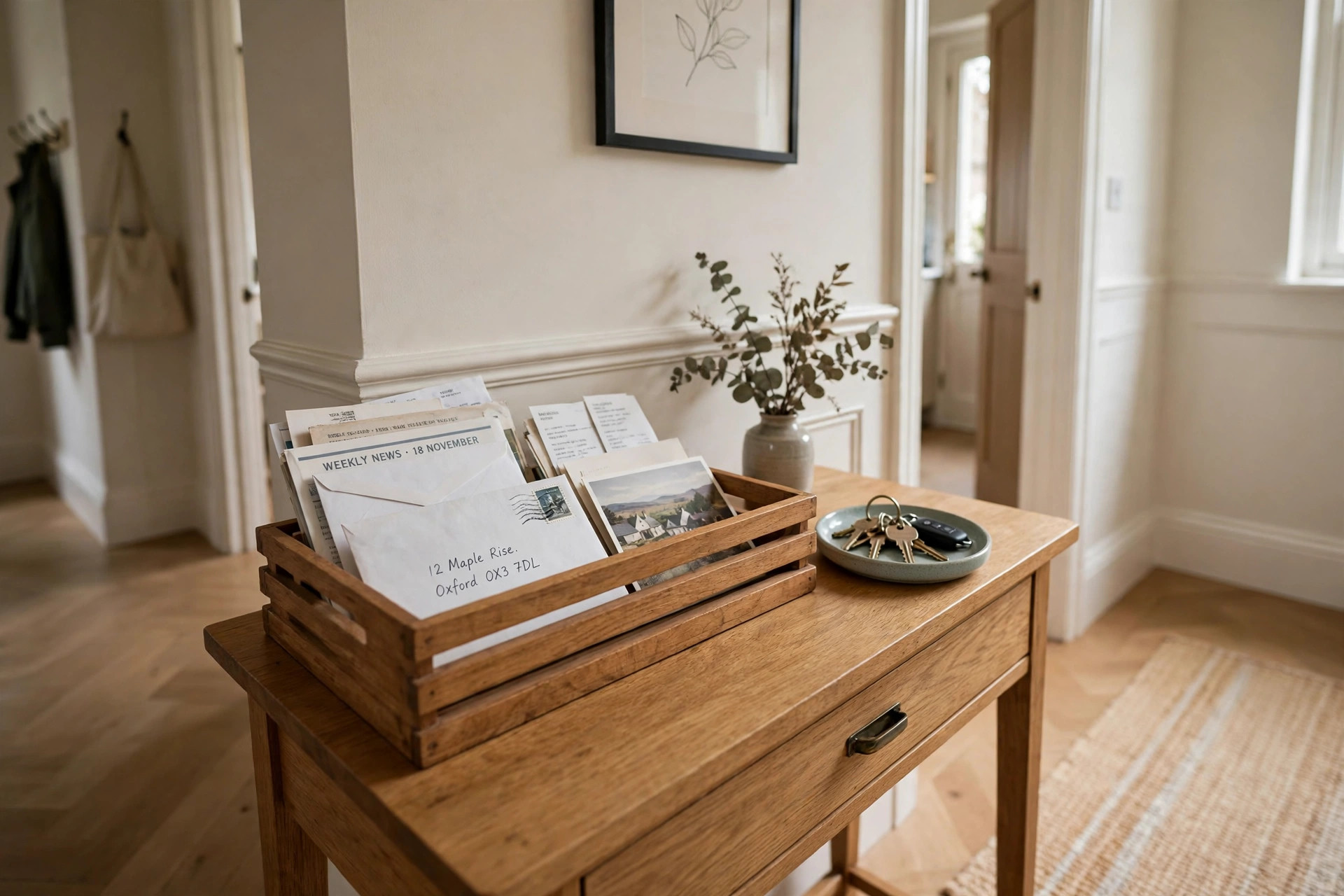
3. One home for incoming mail — the tray that stops the pile
Mail piles up because it has no landing place, because the post comes through the door, the hand puts it down, and the down is wherever the hand happens to be — the counter, the stairs, the top of the shoe rack. Give incoming mail one home — the tray that stops the pile — so every letter lands in the same tray, in the same place, every day. Put the tray by the front door or on the kitchen counter, wherever the post actually arrives, and make it the only place mail is allowed to land, because the tray that is the only landing place is the tray that catches everything. Empty the tray into the four-pile sort once a week, and never let it hold more than a week's post, because the tray that is emptied weekly is the tray that never becomes a pile. The mail itself first lands in the drop zone covered in 22 Drop Zone Organization Ideas for 2026, where the tray sits beside the hooks and the baskets. One tray, and the pile never starts.
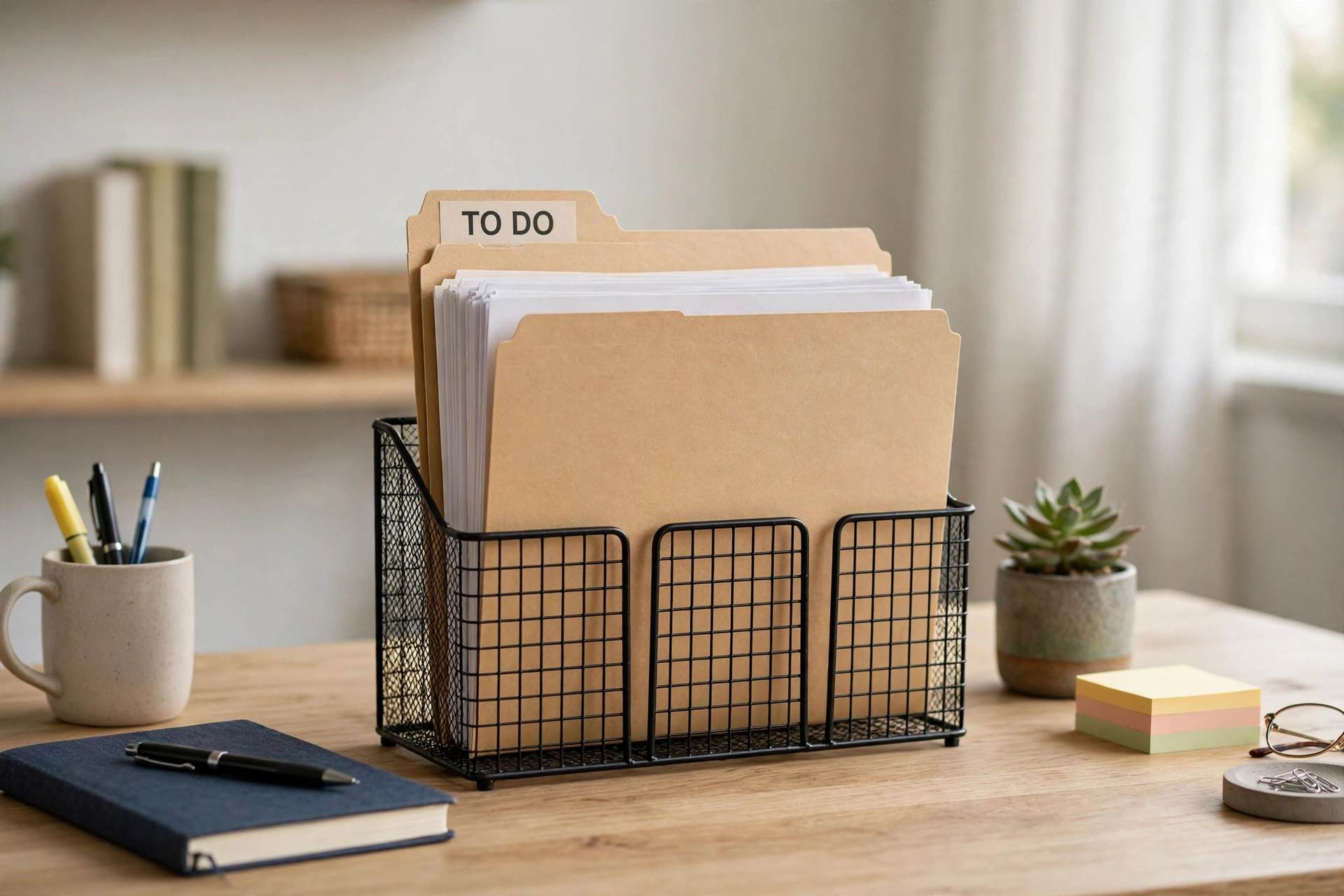
4. A "to do" folder, not a "to do" pile
Action papers in a pile are action papers that get forgotten, because the form that needs signing is under the bill that needs paying, and the pile that holds the actions is the pile that hides them. Keep a "to do" folder — not a "to do" pile — so every paper that needs an answer lives in one folder, upright in a file holder, where it can be seen and reached. Put the most urgent paper at the front, check the folder every morning, and take a paper out only when it is done, because the folder that holds only the actions is the folder that gets emptied. Keep the folder thin on purpose — if it holds more than ten papers, the actions are not being done — and move the finished papers to File or Bin the same day, because the folder that stays thin is the folder that works. One folder, and the actions stop hiding.
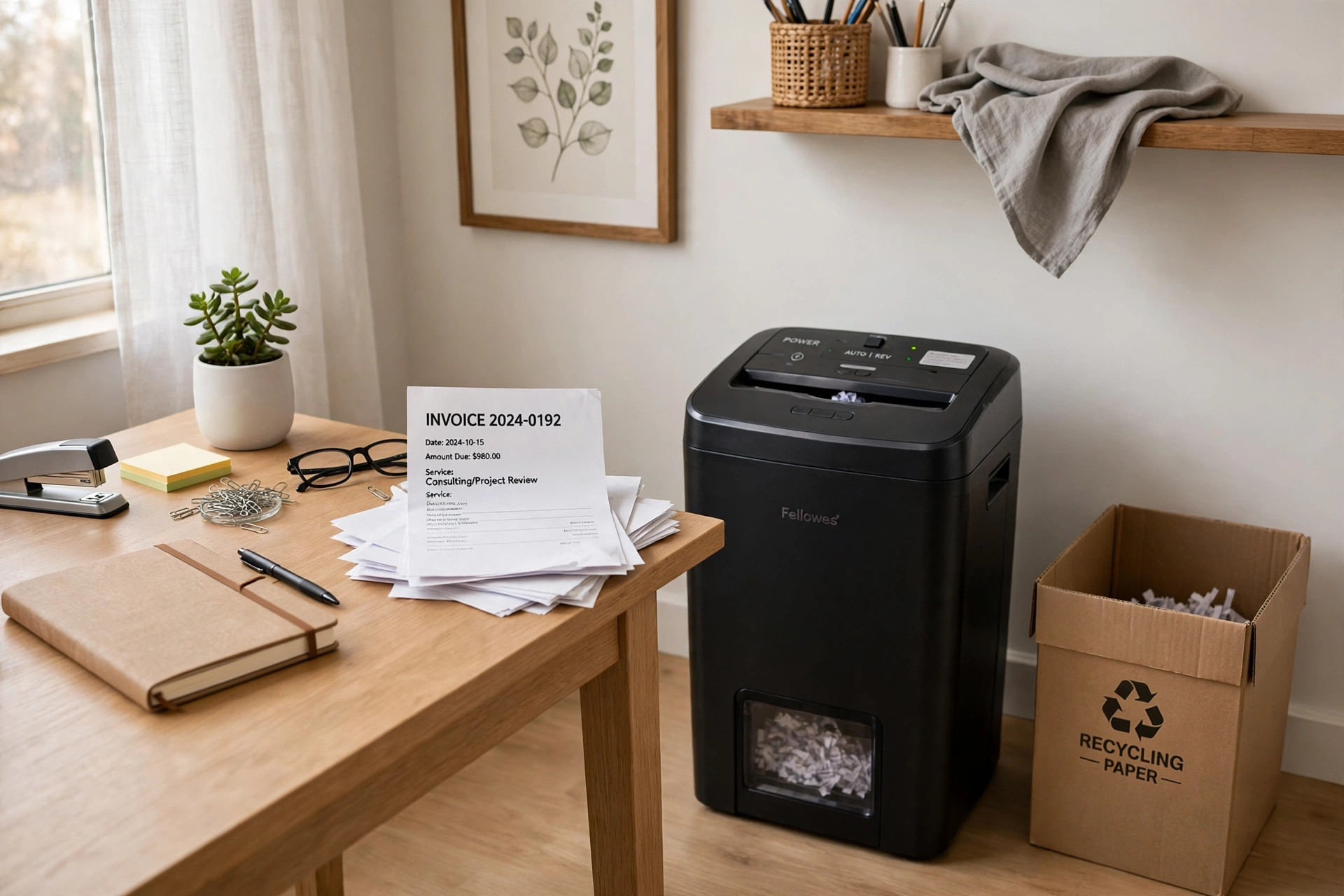
5. Shred, recycle, keep — the bin decision that clears half the pile
Half of every paper pile is paper that should never have been kept, because the envelope is kept with the letter, the old bill is kept with the new one, and the pile that grows is a pile of duplicates and dead paper. Make the bin decision — shred, recycle, keep — so every paper is judged once and judged fast: the paper with your name, address or account number goes in the shred pile, the plain paper goes in the recycling, and only the paper that must exist on paper goes in Keep. Keep a shredder or a shred bag by the desk, and shred little and often, because the shred pile that is dealt with weekly is the shred pile that never becomes a second pile. The rule for keeping is simple — if you can get it again online, you do not need the paper — and the paper that passes that test is the paper that earns its file. One decision, and half the pile is gone.
Filing systems that actually work
6. One file per category — bills, medical, school, home
A single folder labelled "papers" is a folder that holds everything and finds nothing, because the bill is in with the school letter, the medical form is in with the warranty, and the folder that holds it all is the folder you have to search every time. Give every category its own file — bills, medical, school, home — so the paper you need is in the file named for it and nowhere else. Start with five files and no more, because the system that starts small is the system that survives, and add a file only when a category has earned one by filling its folder. Label each file on the front, in words you would actually use, because the label that matches how you think is the label you can find in a hurry. The school file alone has its own deeper system in 22 Homework Station Organization Ideas for 2026, where the school papers live beside the homework. One file per category, and the search ends.
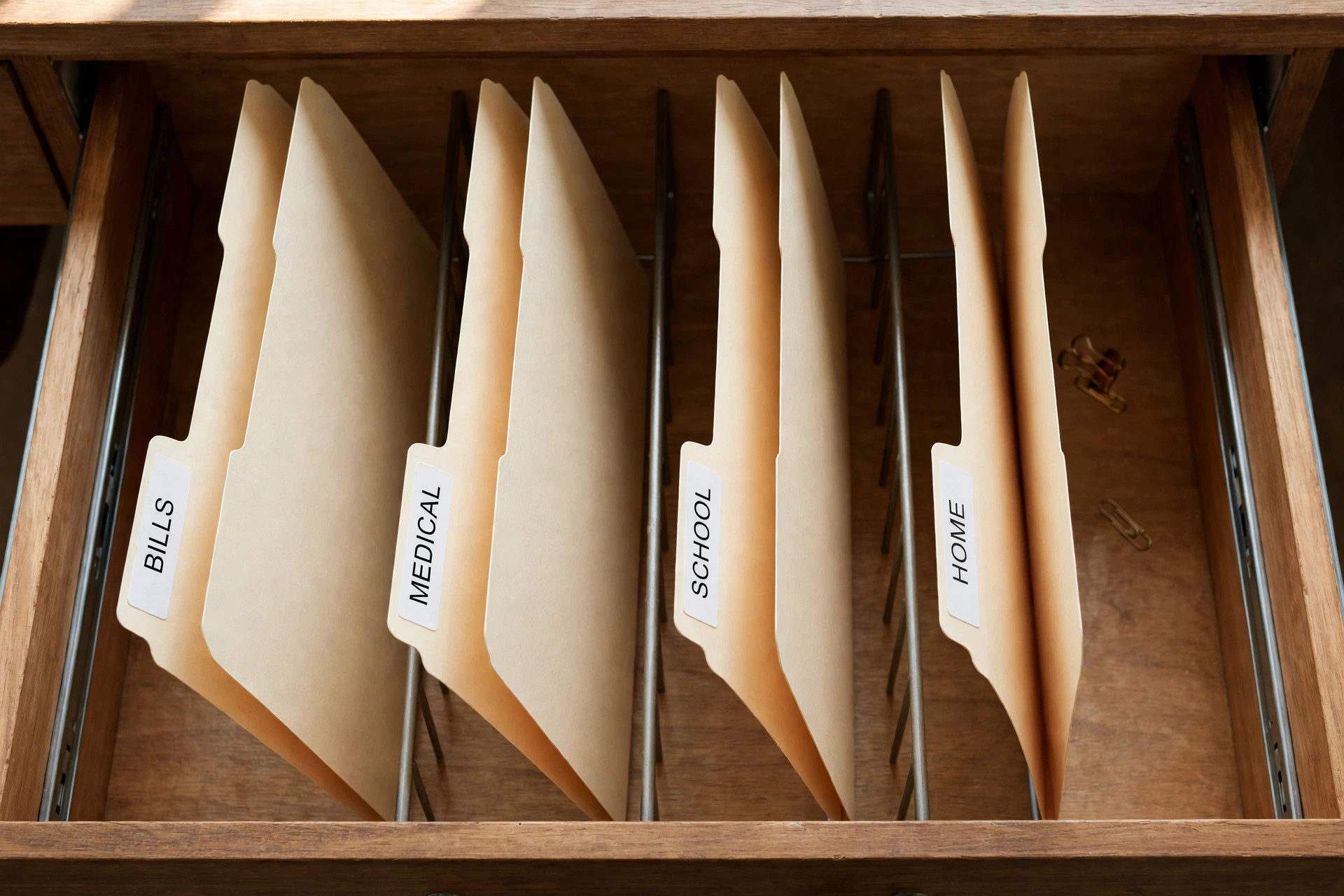
7. Colour-coded folders — one colour per category
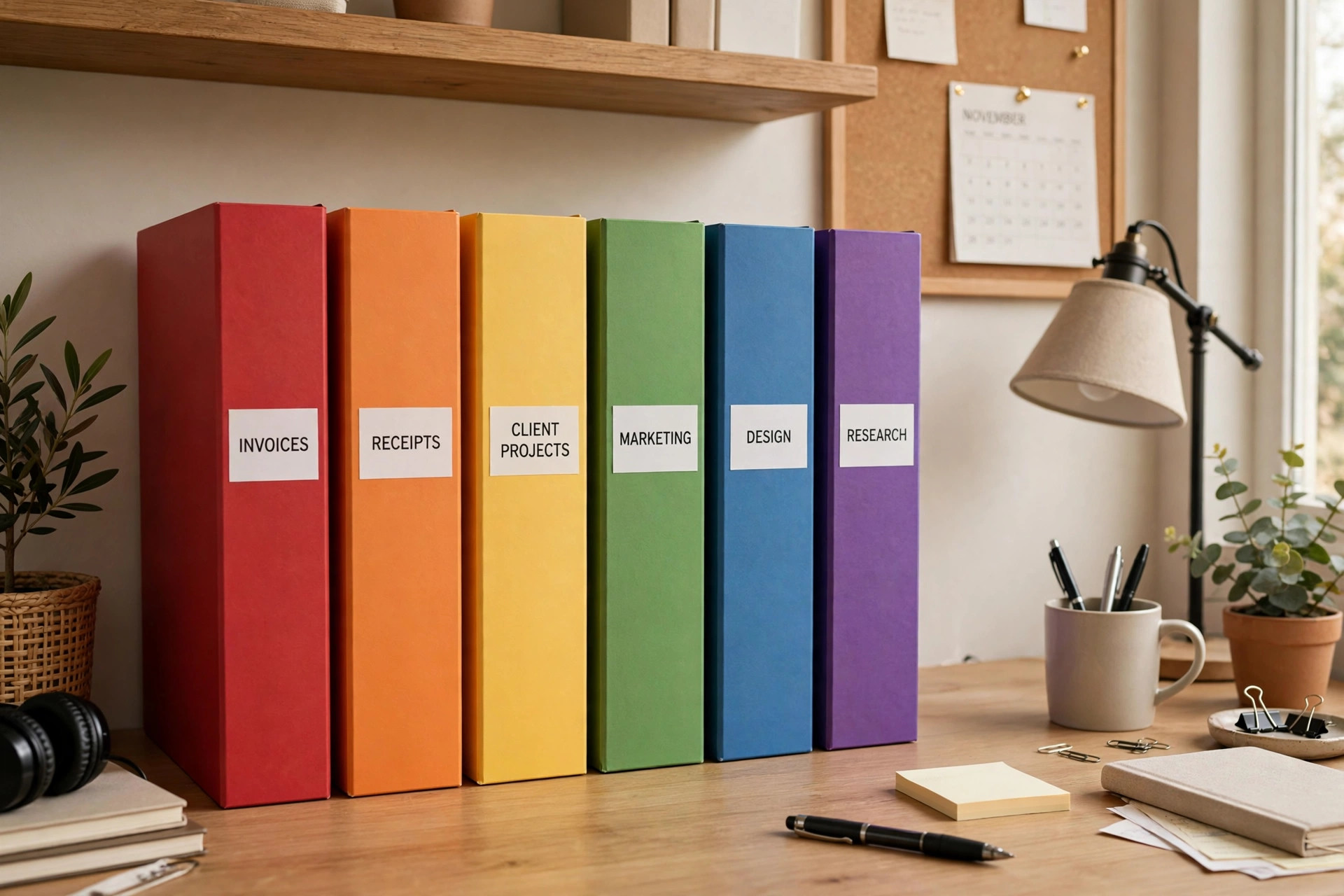
Files that all look the same are files you have to read to find, because the bills folder is the same beige as the medical folder, and the drawer that holds them is a drawer of identical spines. Use colour-coded folders — one colour per category — so the bills are blue, the medical is red, the school papers are green, and the file you need is the file you can spot without reading a label. Pick the colours once and write them down inside the file box lid, because the colour code that is written down is the code the whole household can follow. Keep the colours consistent across the house — the same blue for bills in the desk drawer and in the archive box — because the colour that means the same thing everywhere is the colour that works. One set of colours, and the filing cabinet reads at a glance. (Check on Amazon for a set of colour-coded file folders with tabs, one colour per household category.)
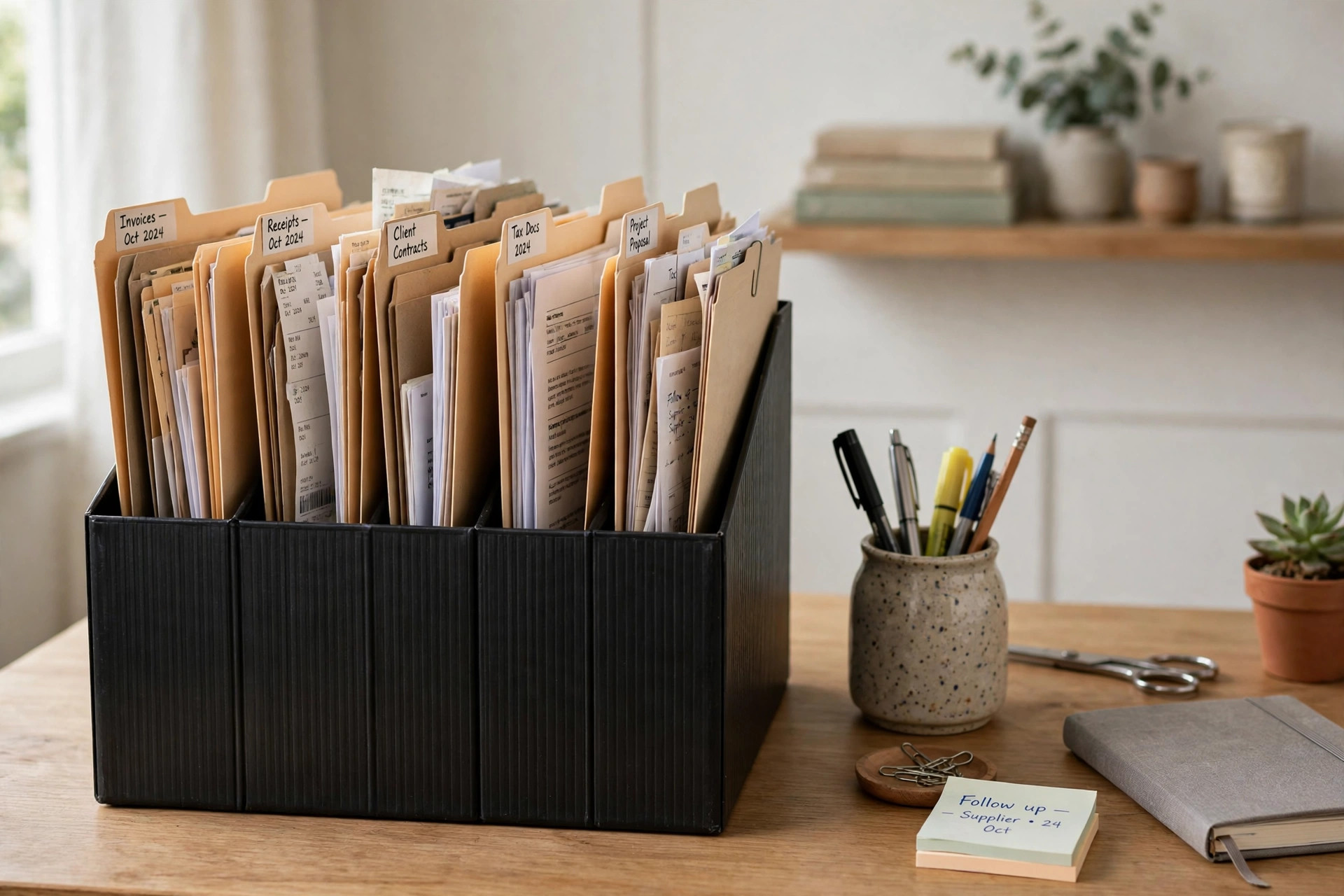
8. A hanging file box for the papers you use every week
Papers that live in a stack are papers that get buried, because the paper you need is always at the bottom of the pile, and the stack that holds the active papers is the stack that falls over. Use a hanging file box — the box for the papers you use every week — so the active files hang upright, each in its own folder, and the paper you need is the paper you can flip to. Keep the box on the desk or beside it, within arm's reach, and keep only the active files in it, because the box that holds only the current papers is the box that stays light. Move a file to the archive box when its job is done, and bring the next one forward, because the hanging box that turns over is the box that never clogs. The box itself can ride on the rolling cart from 22 Rolling Cart Organization Ideas for 2026, so the papers travel with you from desk to kitchen table. One box, and the active papers stand up. (Check on Amazon for a hanging file box with labelled folders that fits a standard desk drawer.)
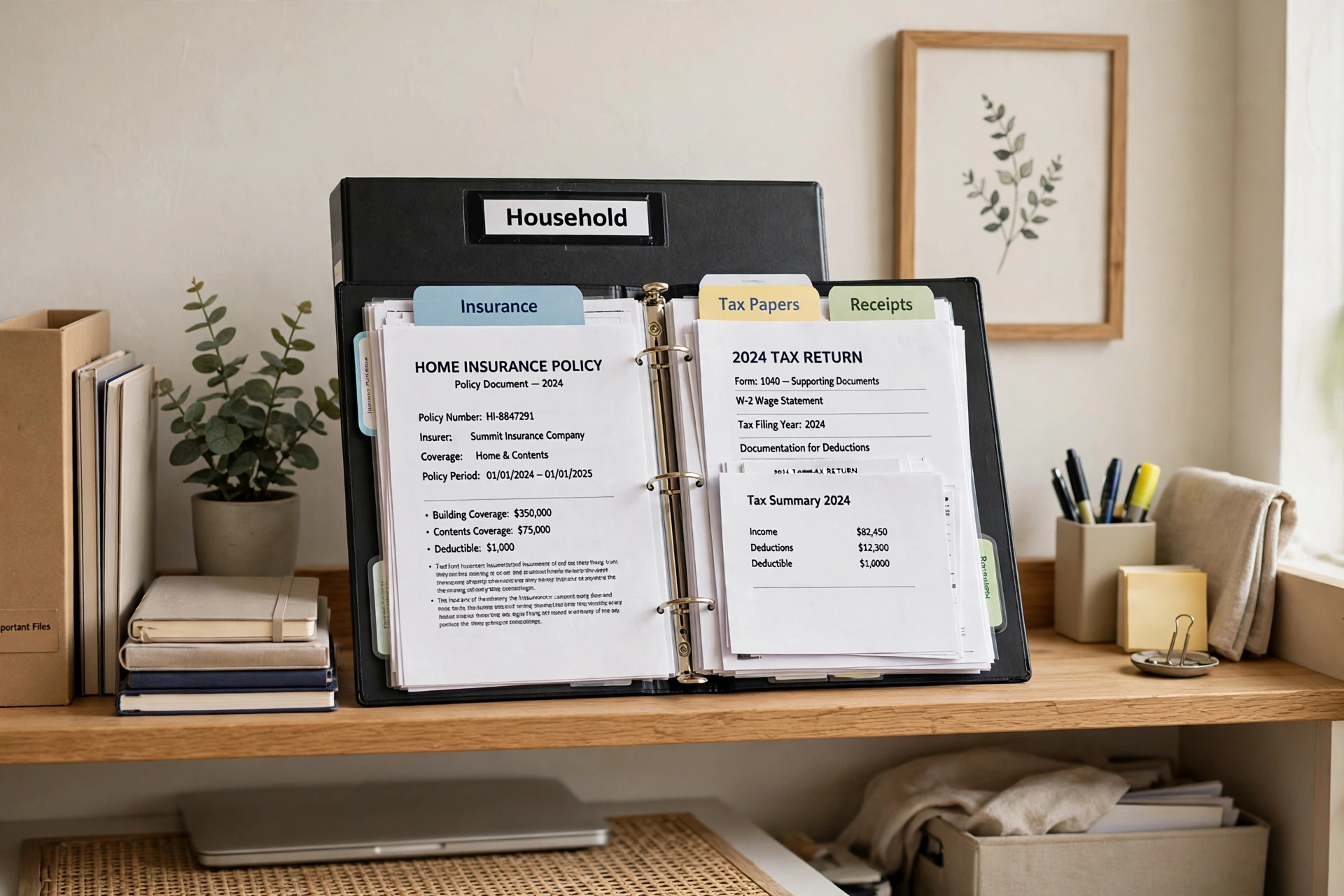
9. A binder for the papers you need every year — tax, insurance, warranties
Yearly papers in a drawer are yearly papers that vanish, because the tax return is in with the birthday cards, the insurance renewal is in with the takeaway menus, and the drawer that holds the yearly papers is the drawer nobody opens until the deadline. Keep a binder for the papers you need every year — tax, insurance, warranties — so the papers that come back every twelve months live in one place, divided by tabs, and the deadline is a matter of opening the binder. Put a tab per year or per type, file each paper the day it arrives, and check the binder once a year when the first renewal lands, because the binder that is checked yearly is the binder that is ready. Keep the binder on a shelf, not in a drawer, because the binder that is visible is the binder that gets filed into. One binder, and the yearly papers stop disappearing.
10. A household manual — the binder that holds the whole house
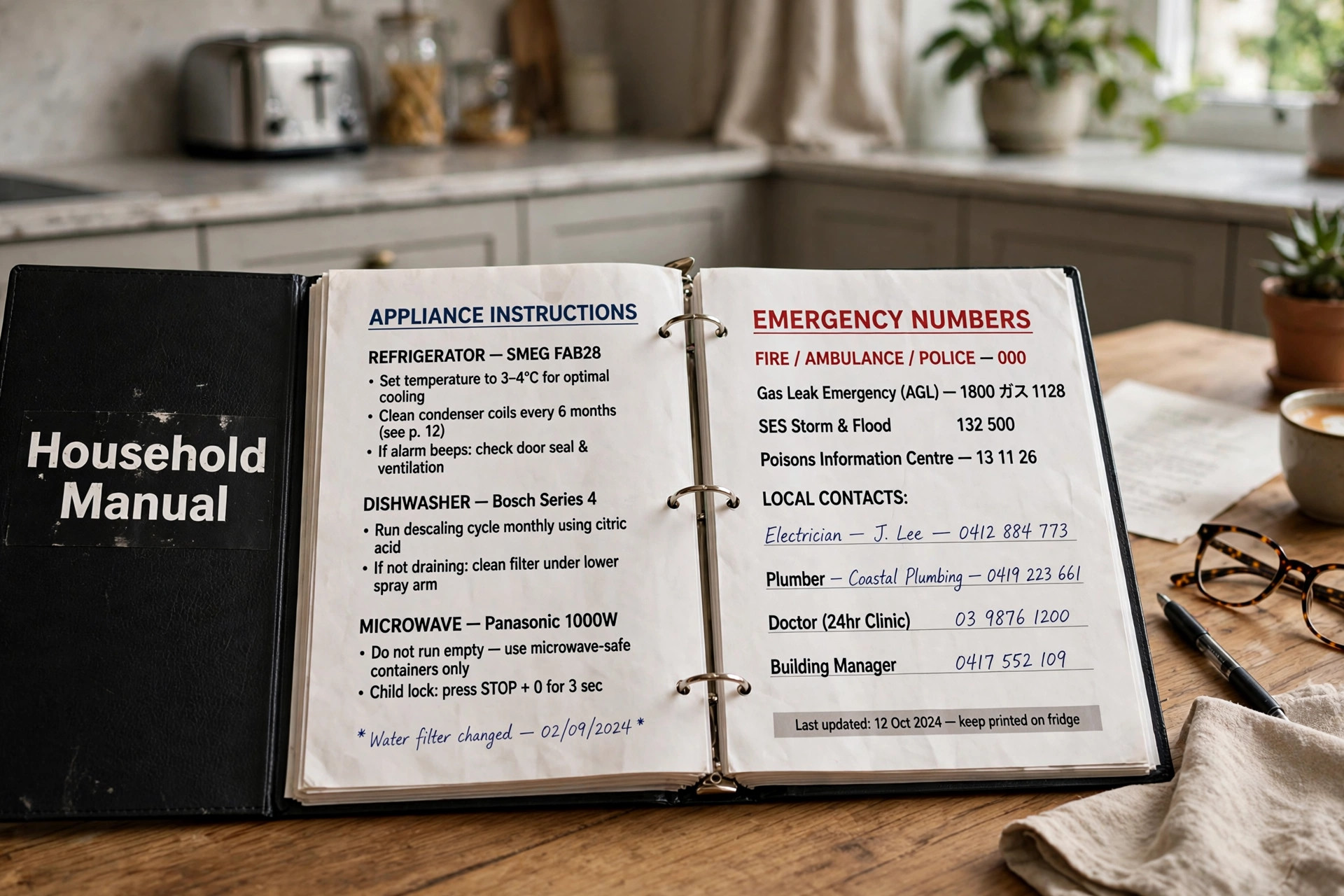
A house without a manual is a house where nobody knows anything, because the boiler instructions are in a drawer, the paint colour is in someone's head, and the plumber's number is on a magnet that fell off the fridge. Build a household manual — the binder that holds the whole house — so the instructions, the guarantees, the paint colours and the emergency numbers live in one binder, divided by room. Put a page per appliance, a pocket per guarantee, and the numbers on the first page, because the manual that answers the question is the manual that gets used. Hand it to the housesitter or the new tenant, and the house runs itself for a week, because the binder that holds the whole house is the binder that speaks for it. One manual, and the house stops depending on one person's memory.
Digital backups and daily paper
11. Scan the keepers — a phone scan that replaces the drawer
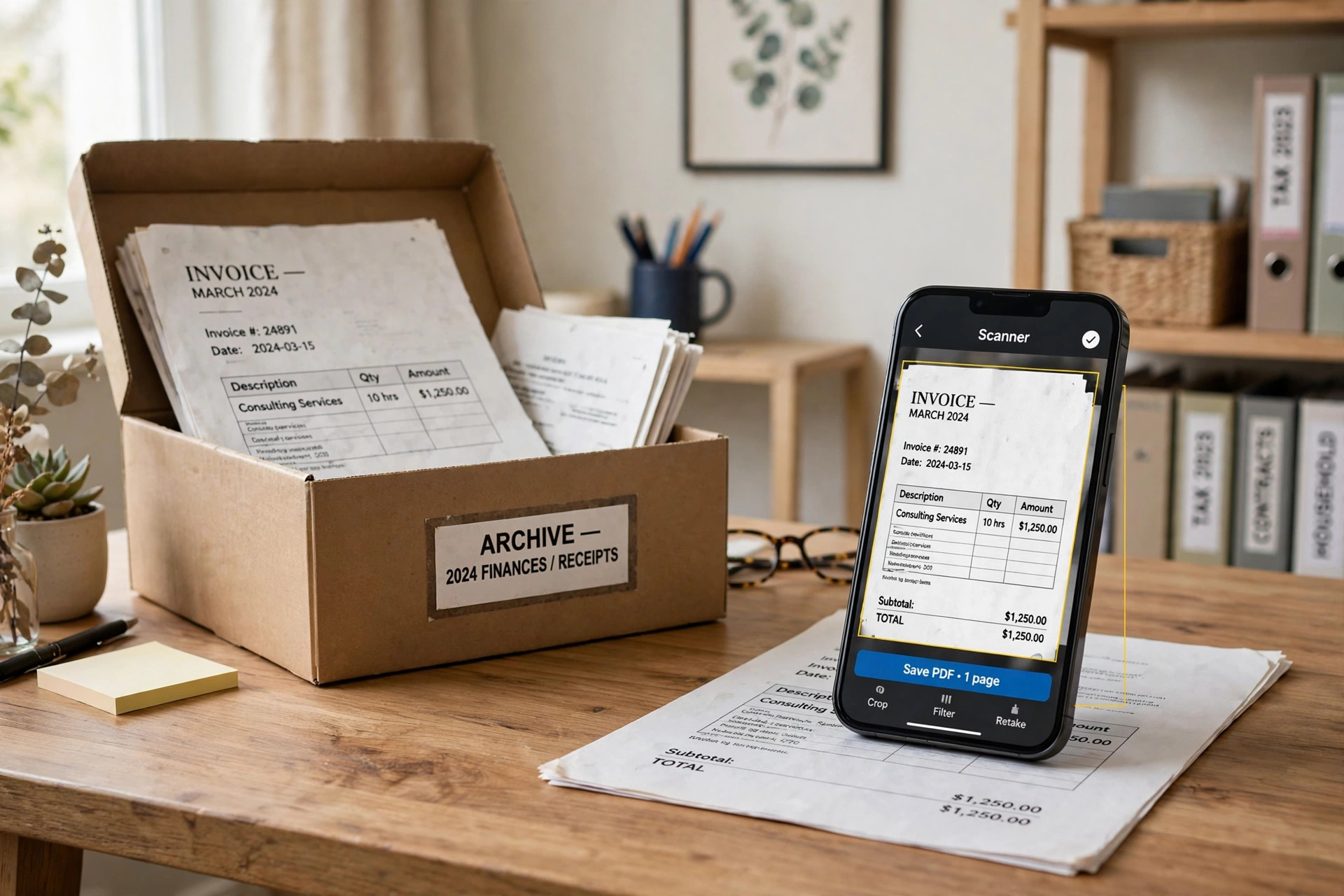
Drawers full of paper are drawers full of weight, because every statement, every receipt and every letter takes space, and the drawer that holds them all is the drawer that cannot close. Scan the keepers — a phone scan that replaces the drawer — so the paper you must keep becomes a file on your phone, named and searchable, and the drawer holds only the papers that must exist on paper. Scan the day a paper arrives, name the file for what it is and when it came, and file it in a folder that mirrors your paper files, because the scan that is named properly is the scan you can find. Keep the phone scan habit small — one paper at a time, as it arrives — because the scanning that happens daily is the scanning that never becomes a backlog. One scan per paper, and the drawer empties by half.
12. A labelled archive box for the papers you must keep on paper
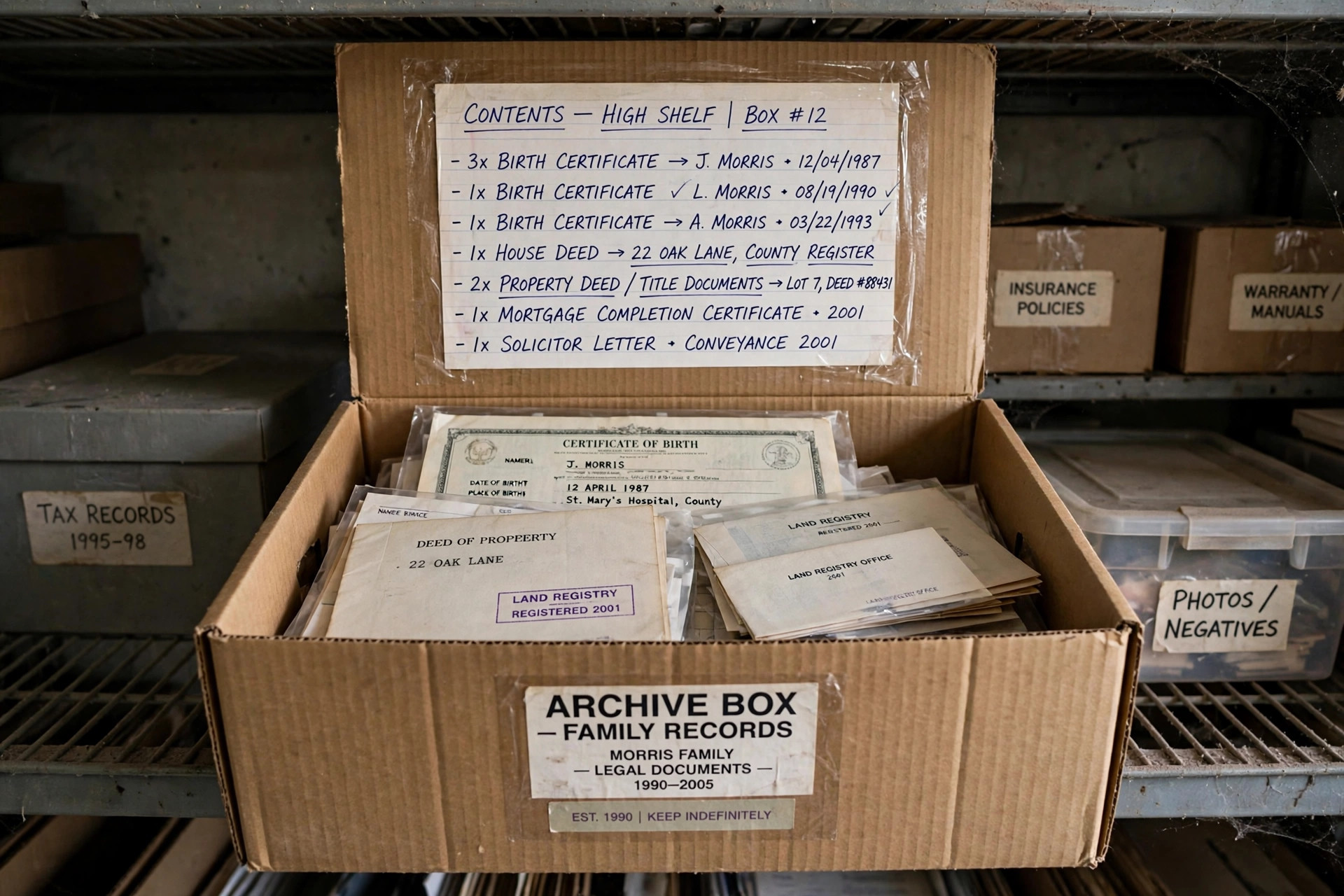
Some papers must stay on paper, because the birth certificate, the house deeds and the passport photos have no digital substitute, and the drawer that holds them is the drawer that must never be thrown away. Keep a labelled archive box — the box for the papers you must keep on paper — so the irreplaceable papers live in one box, on a high shelf, labelled on the front, and everything else is allowed to be scanned. Put the box where it is safe from damp and from little hands, and check it once a year, because the box that is checked yearly is the box that stays complete. Keep a list of what is inside taped to the lid, so you can see the contents without opening it, because the list that is on the lid is the list that stops the search. One box, and the important papers are safe. (Check on Amazon for a labelled archive storage box with a lid, sized for A4 documents.)
13. School papers: one folder per child, one box per year
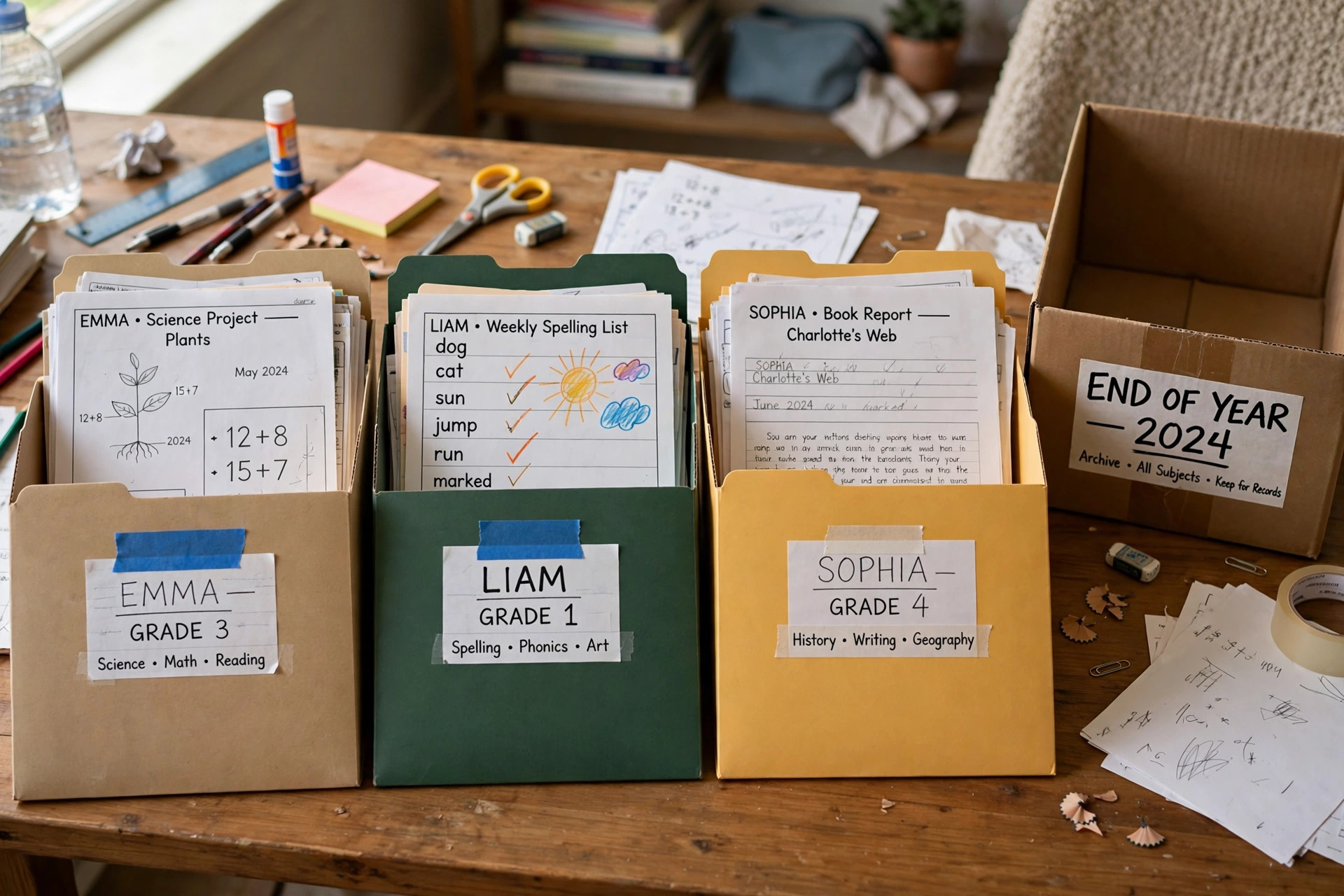
School papers multiply faster than any other paper in the house, because every week brings a letter, a permission slip and a piece of artwork, and the pile that holds them is the pile that grows while you are not looking. Give school papers their own system — one folder per child, one box per year — so each child's papers live in their own folder, and at the end of the school year the folder goes into a box labelled with the year. Keep the current folder in the homework station, where the papers actually arrive, and keep only the best artwork — one piece a month, chosen with the child — because the box that holds the best is the box that fits on the shelf. The homework station itself is covered in 22 Homework Station Organization Ideas for 2026, where the school papers live beside the pencils. One folder per child, and the school pile stops taking over the house.
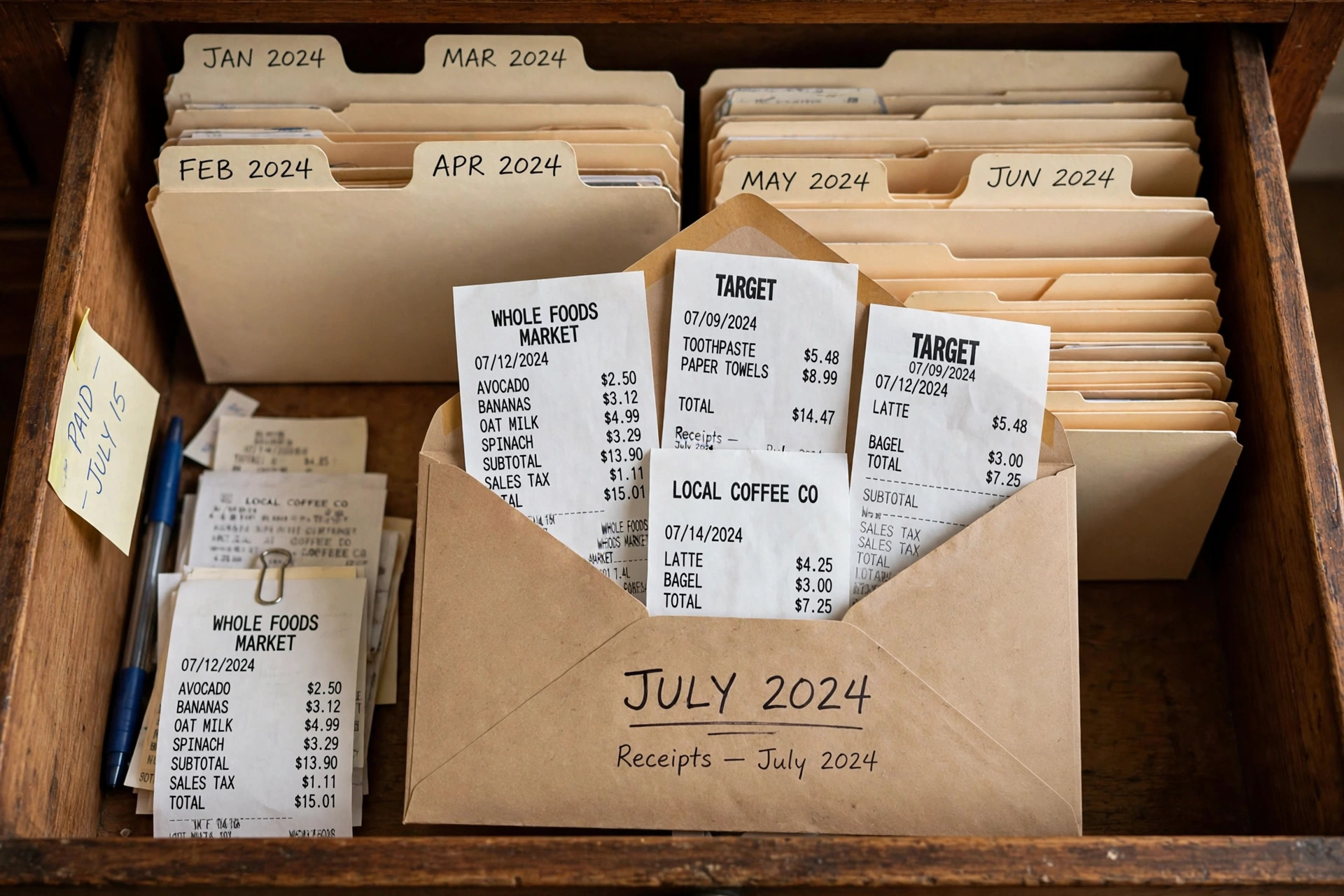
14. Receipts in one place — the envelope that ends the drawer hunt
Receipts in every drawer are receipts you cannot find, because the warranty receipt is in the kitchen drawer, the return receipt is in the coat pocket, and the drawer that holds the receipts is the drawer you search when it is already too late. Keep receipts in one place — the envelope that ends the drawer hunt — so every receipt goes into one envelope, in one drawer, the day it arrives. Write the month on the envelope, start a new one each month, and throw the old ones away after a year, because the envelope that turns over monthly is the envelope that never overflows. For the receipts that matter — the big purchases, the warranties — scan them the day they arrive, because the scan that is taken on day one is the scan that is there on day three hundred. One envelope, and the receipt is where you left it.
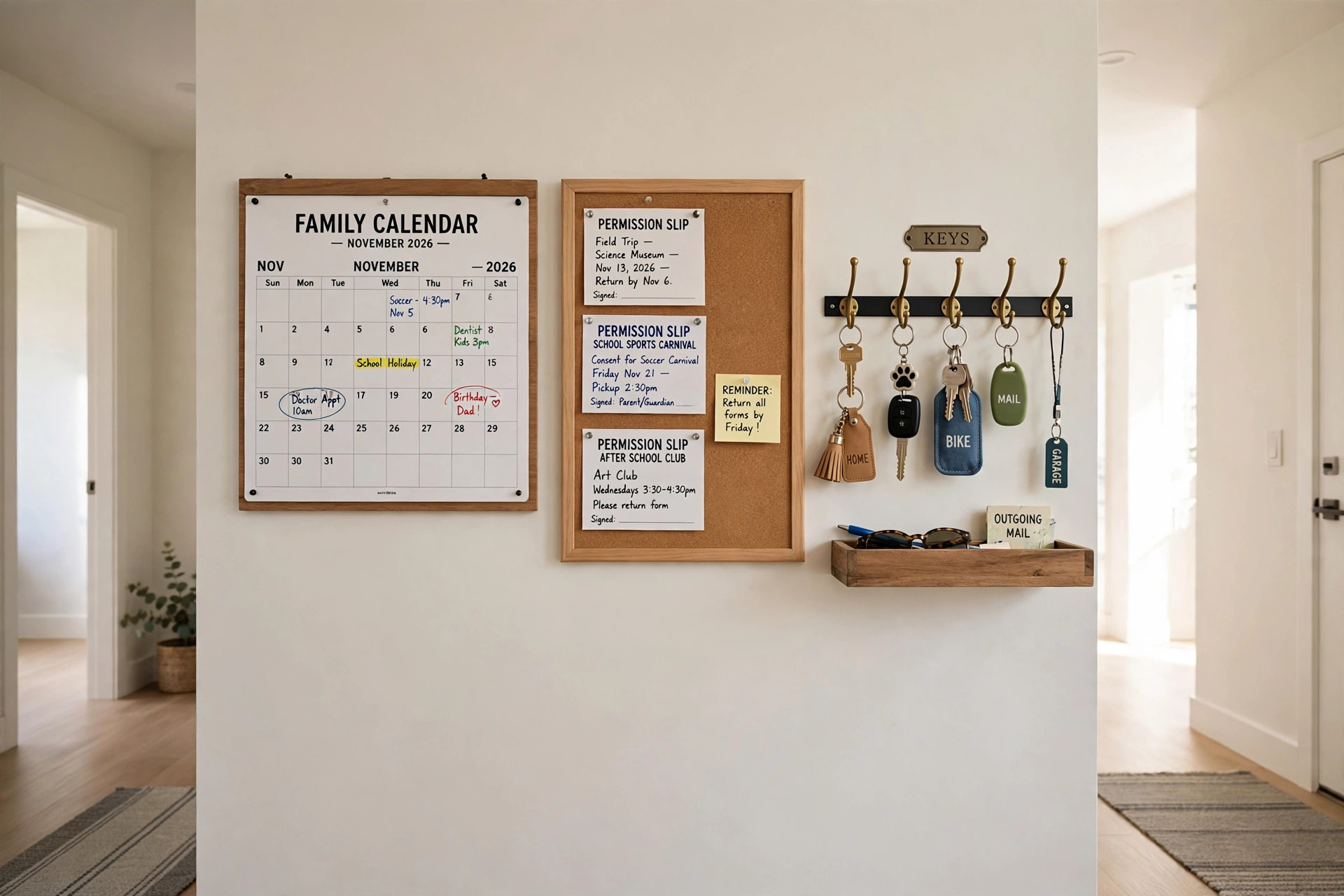
15. A command centre wall — calendar, permission slips and keys in one spot
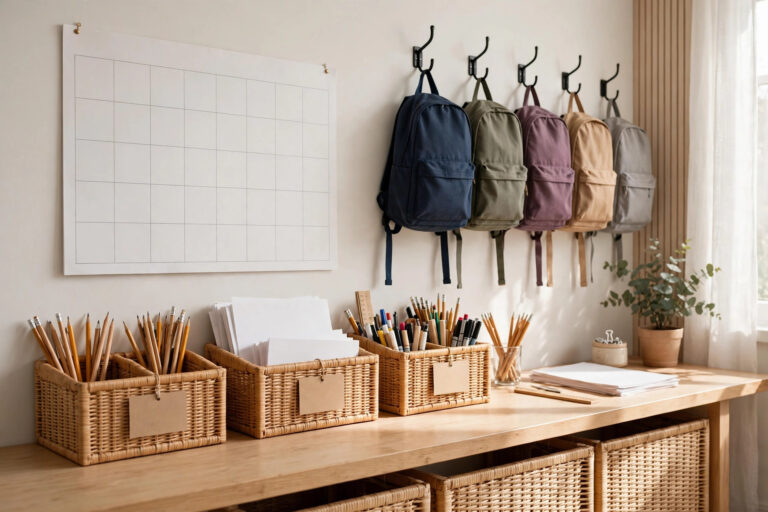
Paper that lives on the fridge is paper that falls off, because the magnet slips, the permission slip slides behind the bin, and the wall that holds the family's paper is a wall that nobody trusts. Build a command centre wall — calendar, permission slips and keys in one spot — so the family's paper lives in one place, on a board or a rail, where everyone can see it. Put the calendar at eye level, a pocket for the permission slips beside it, and hooks for the keys below, because the wall that holds the whole week is the wall the family checks before leaving. Keep the wall small and in the way — by the front door, not in a spare room — because the wall that is passed every day is the wall that gets used. The mudroom version of the same wall is covered in 25 Mudroom Organization Ideas for 2026, where the command centre sits above the bench. One wall, and the family's paper has a headquarters.
Keep the system alive
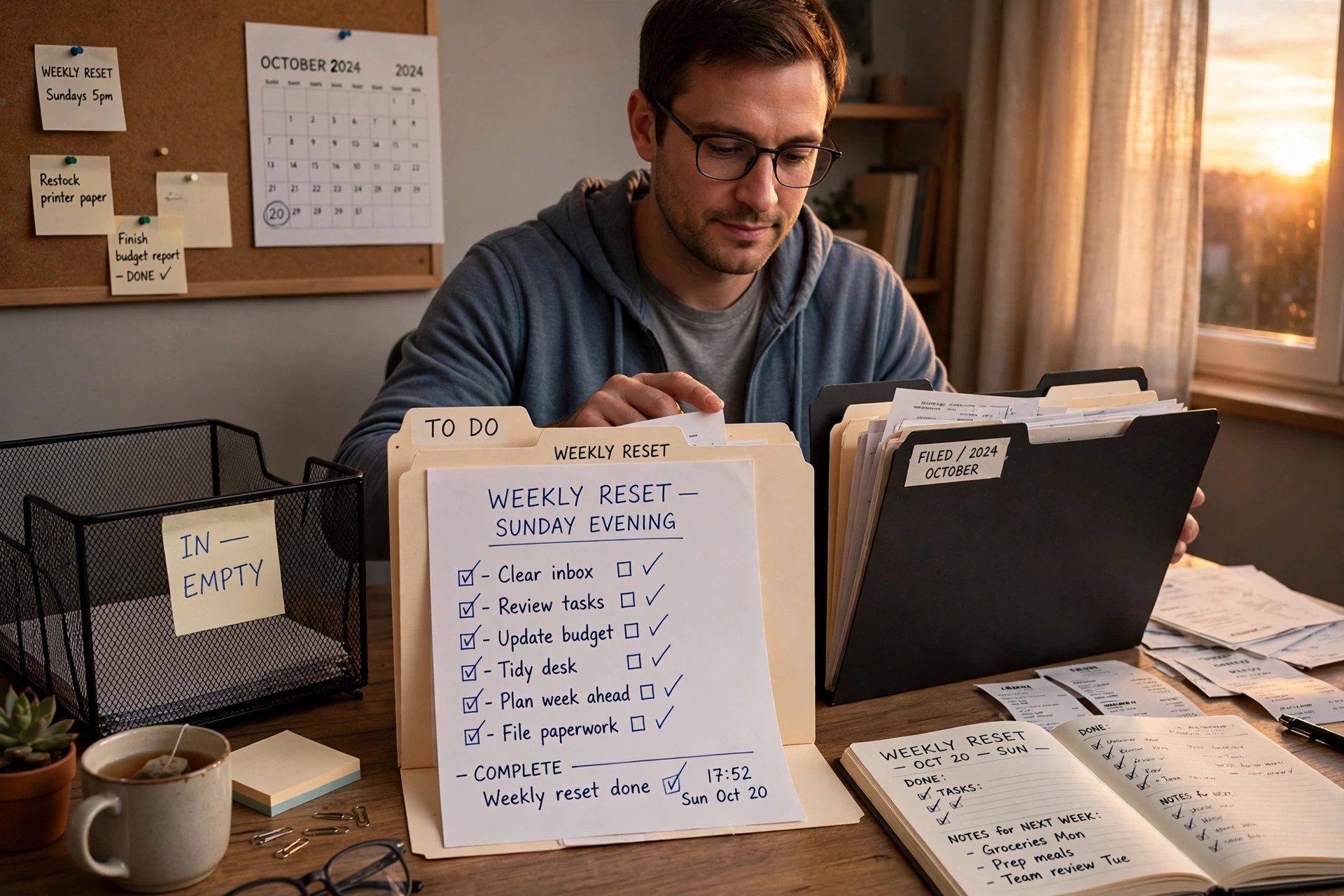
16. A weekly ten-minute paper reset
A filing system with no habit is a system that dies in a month, because the papers keep arriving, the tray fills, and the system that nobody maintains is the system that becomes a pile again. Do a weekly ten-minute paper reset — so the tray is emptied, the "to do" folder is checked, and the new papers are filed or scanned, every week, in ten minutes. Pick a day and a time — Sunday evening, or Friday after the post — and do it standing at the desk, because the reset that has a time is the reset that happens. Ten minutes is enough, because the pile that is dealt with weekly is a pile of a week's papers, not a month's, and the reset that takes ten minutes is the reset that survives. One habit, and the system lives.
17. The end-of-month file tidy
Files drift over a month, because the folder that held the bills now holds a birthday card, the medical file has a school letter in it, and the system that is not checked is the system that slowly stops being a system. Do an end-of-month file tidy — so once a month, open every file, take out what does not belong, and move the finished papers to the archive box or the bin. Check the colour codes while you are there, because the tidy that checks the colours is the tidy that keeps the code working, and throw away the papers that have served their purpose, because the file that is thinned monthly is the file that never overflows. Thirty minutes, once a month, and the system stays honest. One tidy a month, and the drift stops.
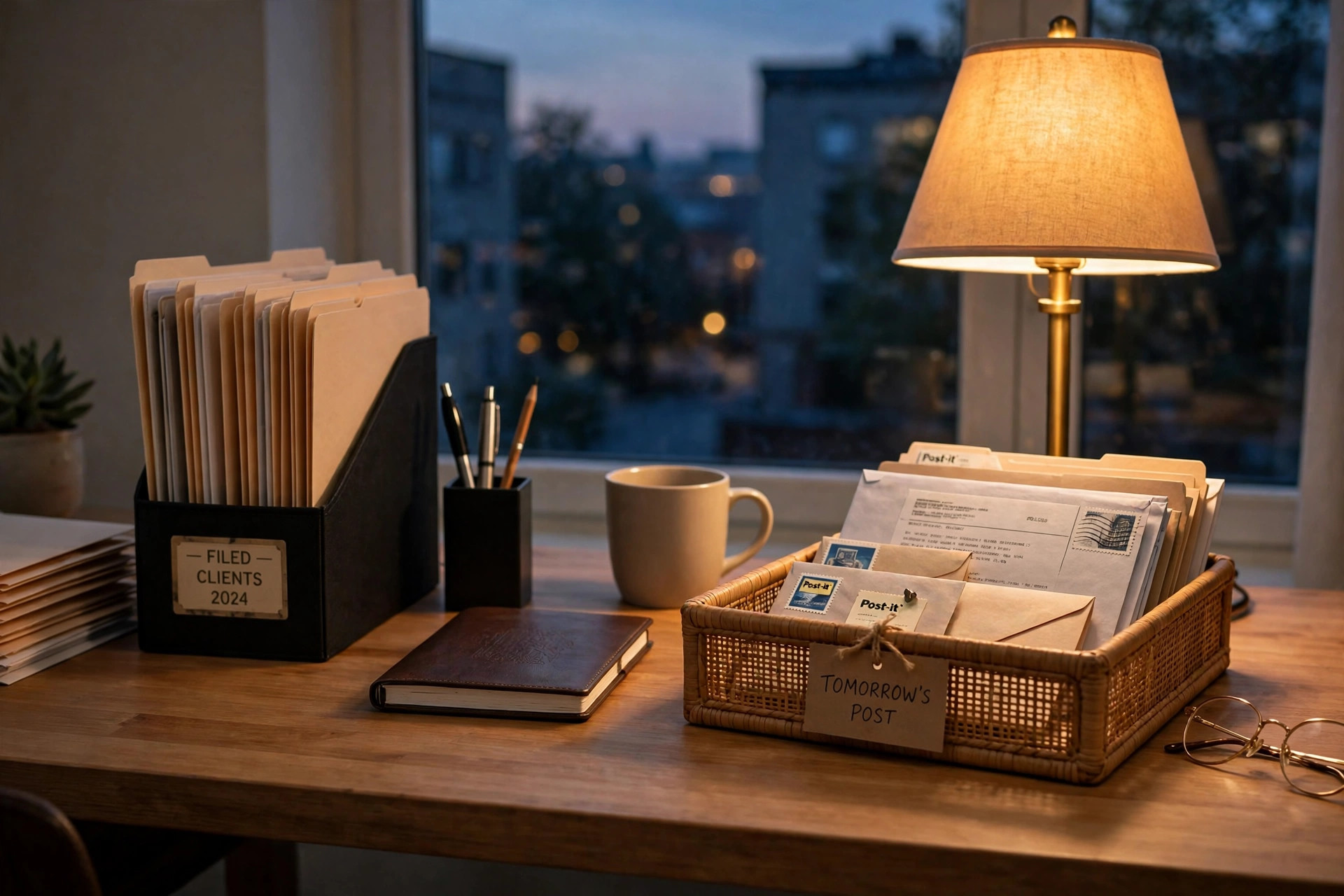
18. One in, one out for paper too
Paper refills the files as fast as you empty them, because every new bill replaces the old one, every new school letter joins the old ones, and the file that never loses a paper is the file that bursts. Use one in, one out for paper too — so every new paper that enters a file means one old paper leaves it, into the archive box or the shredder. When the new insurance renewal arrives, the old one goes, and when the new school term starts, last term's letters leave the folder, because the file that turns over is the file that fits on the shelf. Keep the rule visible — write it inside the file box lid, next to the colour code — because the rule that is seen is the rule that is followed. The same rule keeps the small closet honest in 26 Small Space Closet Organization Ideas for 2026, where one garment in means one out. One rule, and the files never burst.
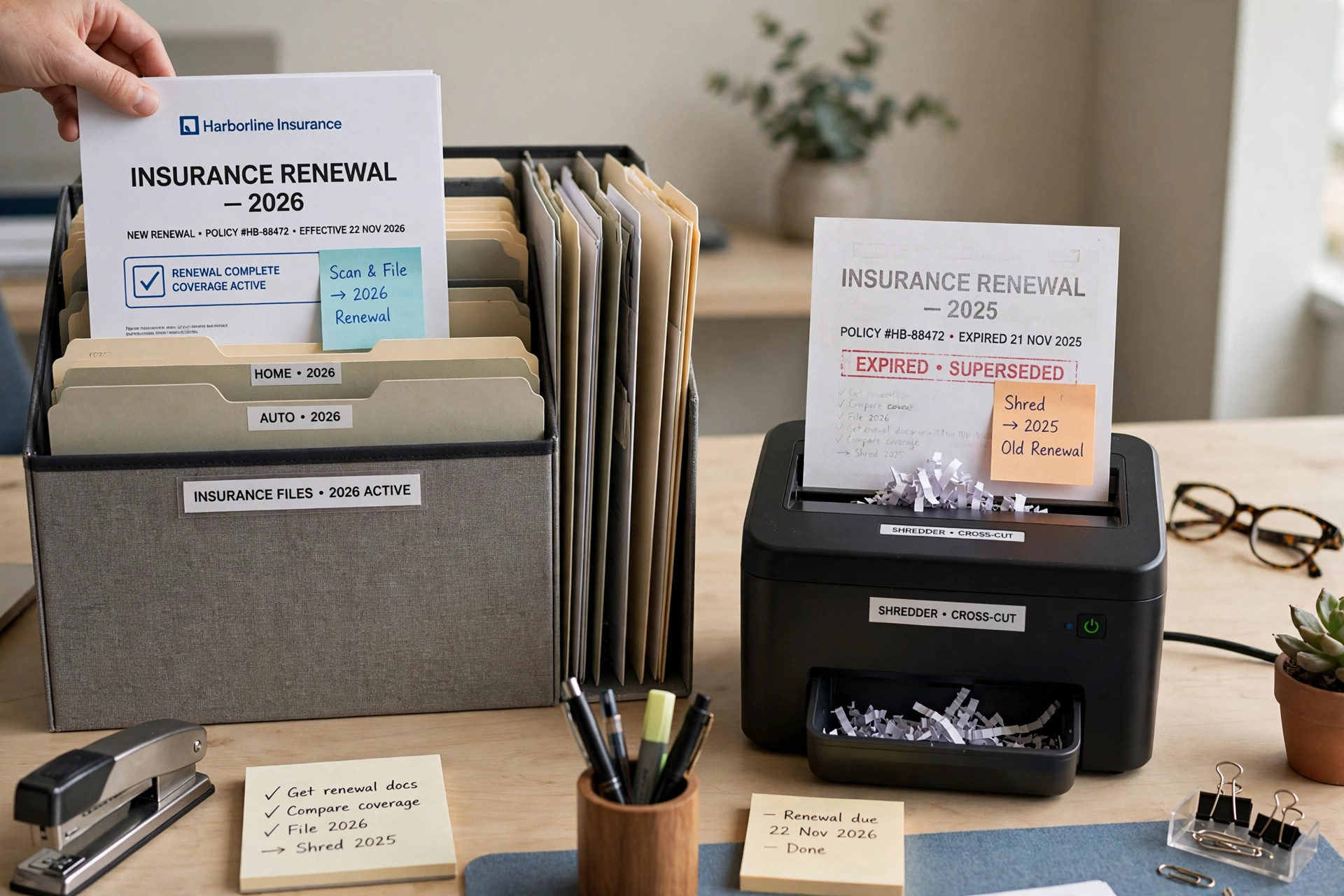
19. A yearly purge — the January drawer clean-out
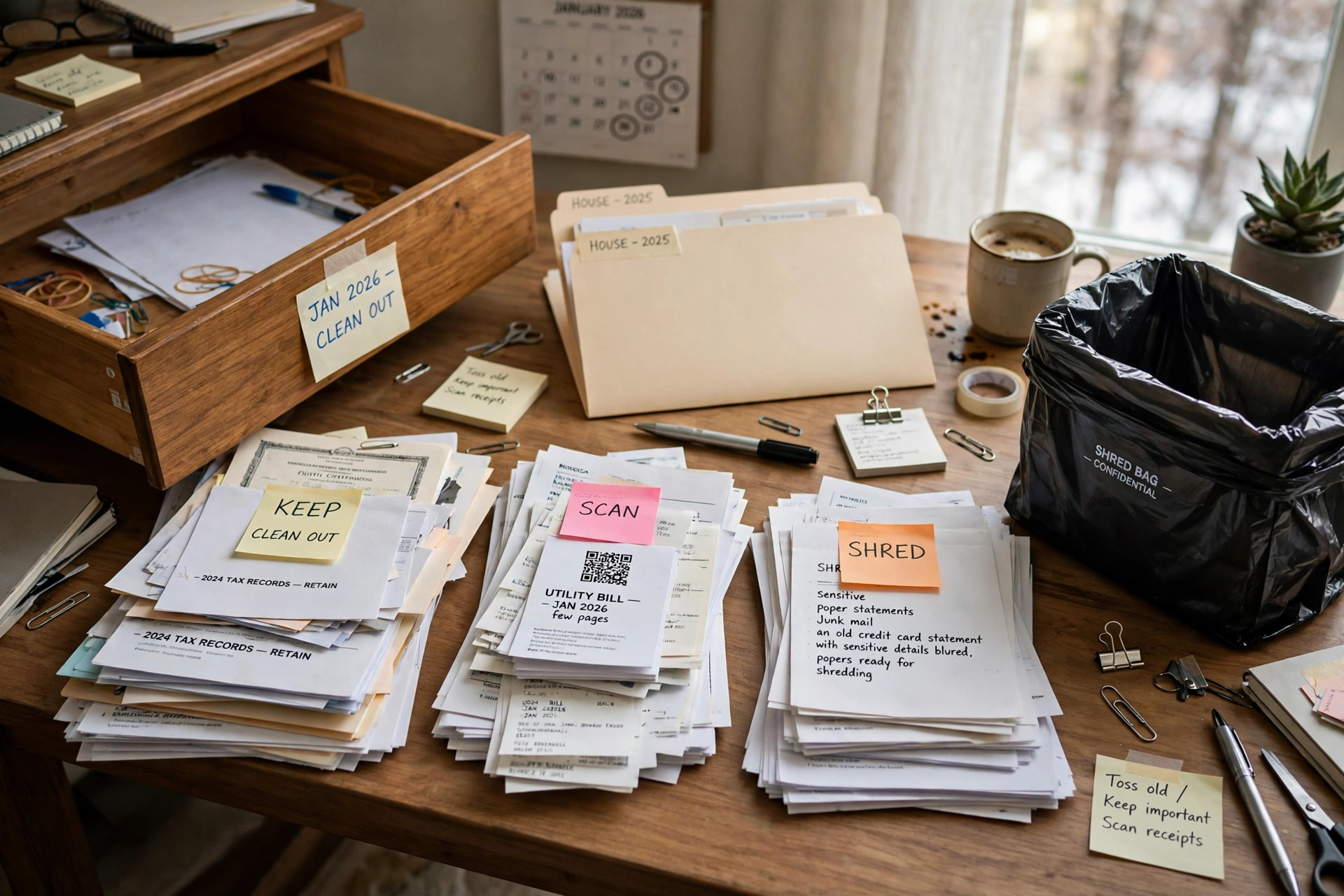
A filing system that is never purged is a system that grows forever, because the papers from three years ago are still in the files, the warranties have expired, and the drawer that holds them is a drawer of history, not of use. Do a yearly purge — the January drawer clean-out — so once a year, in January when the new year starts, every file is opened and every paper is judged: keep, scan, shred. Throw away the papers that have served their purpose, scan the ones that must be kept, and shred the rest, because the purge that is done yearly is the purge that keeps the system small. Put it in the calendar the year before, and do it with a cup of tea and a shred bag, because the purge that has a date is the purge that happens. One purge a year, and the system stays the size it was built to be.
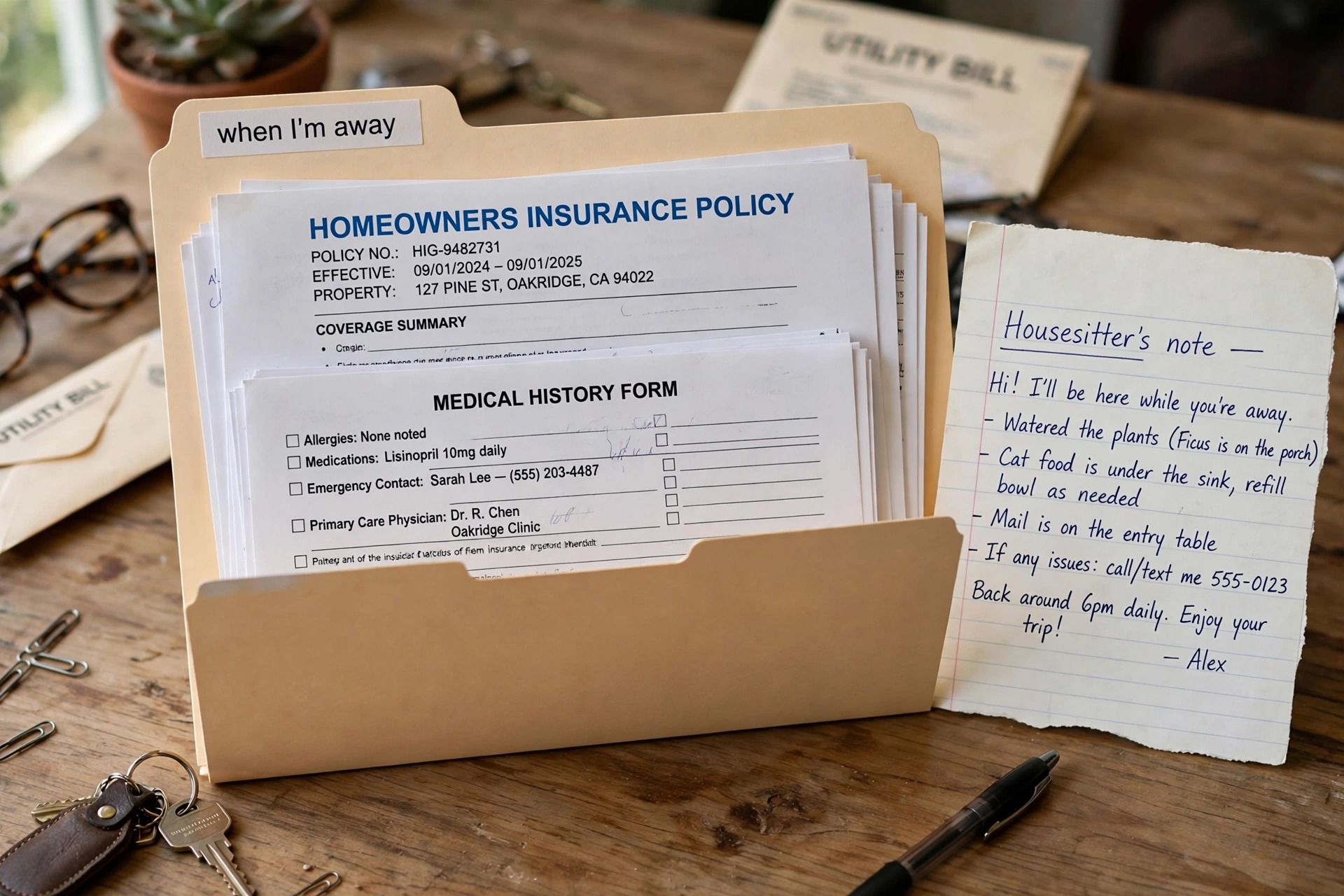
20. A "when I'm away" folder — the papers someone else can find
A household where only one person knows where the papers are is a household that stops when that person is away, because the housesitter cannot find the insurance number, the babysitter cannot find the medical form, and the folder that only one person understands is a folder that fails the moment it is needed. Keep a "when I'm away" folder — the papers someone else can find — so the essential papers live in one folder, on the front of the shelf, with a note on the front that says what is inside and where the rest lives. Put the insurance number, the doctor's number, the school's number and the spare key's location in it, and show the folder to the person who will need it before you leave, because the folder that is shown is the folder that can be found. One folder, and the house keeps running while you are away.
Which paperwork idea fits which situation?
| Situation | Best first move | Budget | Tools needed |
|---|---|---|---|
| A pile with no starting point | Empty the pile (idea 1) | Free | None |
| Can't tell what matters | The four-pile sort (idea 2) | Free | Trays or table space |
| Mail piles up on the counter | One home for incoming mail (idea 3) | Low | In-tray |
| Action papers get lost | A "to do" folder (idea 4) | Low | Folder |
| Half the pile is junk | Shred, recycle, keep (idea 5) | Free | Shredder or bag |
| Files are a mixed mess | One file per category (idea 6) | Low | Folders |
| Can't find the right file | Colour-coded folders (idea 7) | Low | Coloured folders |
| Active papers live in a heap | A hanging file box (idea 8) | Low | File box |
| Drawers full of old paper | Scan the keepers (idea 11) | Free | Phone |
| School papers everywhere | One folder per child (idea 13) | Low | Folders, box |
| Receipts in every drawer | Receipts in one place (idea 14) | Free | Envelope |
| The pile comes back every week | A weekly ten-minute reset (idea 16) | Free | None |
You do not need all 20 ideas. You need the three that solve your pile — usually the four-pile sort that shrinks it in one afternoon, the in-tray that stops the mail landing anywhere, and the weekly ten-minute reset that keeps it from growing back. Start with the sort, do it this weekend before the next post arrives, and put the tray by the door. Do that and the next time the post comes, the letter will land in the tray, the action paper will go in the folder, and the counter will stay clear.
Save this post for the next paper sort-out, and if the desk the paperwork lands on needs the same treatment, read 24 Desk Organization Ideas for 2026 next — it is Post 59, the desk the pile sits on — and 22 Homework Station Organization Ideas for 2026, Post 60, for the school papers that start the pile. This is the fourteenth post of the new Organization by problem run — Posts 56 to 80, one problem at a time — and the run keeps going with the desk's deeper dive. The home office itself gets its own treatment in Home Office Organization, where the whole work-from-home setup gets the same sort-file-scan system.
Publish date assigned at publishing time. Updated as new paperwork finds are tested.
Frequently asked questions
How do I organize a huge pile of paperwork?
Empty the pile onto a table and sort it into four piles — keep, act, file, bin — deciding on one paper at a time and never putting a paper down until it has a pile. The bin pile will be the biggest, and that is the point: half the pile is usually envelopes, duplicates and dead paper. Once the sort is done, give the keep papers one file per category and the action papers one "to do" folder, and buy nothing until the sort tells you what you actually need.
What is the best filing system for home paperwork?
One file per category — bills, medical, school, home — with colour-coded folders so each category is a colour you can spot without reading a label. Keep the active files in a hanging file box on or beside the desk, and the papers you must keep on paper in one labelled archive box on a high shelf. Scan everything else with your phone the day it arrives, so the drawer holds only the irreplaceable papers.
How do I keep paperwork from piling up again?
Give incoming mail one home — a tray by the front door or on the kitchen counter — and empty it into the four-pile sort once a week. Do a weekly ten-minute paper reset: empty the tray, check the "to do" folder, file or scan the new papers. Use one in, one out, so every new paper that enters a file means one old paper leaves it, and do a yearly purge in January so the files stay the size they were built to be.