24 Desk Organization Ideas for 2026
A desk is where the whole day lands — the laptop, the notebook, the post, the charger, the mug, the thing you meant to file last week — and a desk with no system fills up by ten in the morning and stays full until you give up and work from the sofa. The problem is not that you have too much stuff. The problem is that the stuff has nowhere to go, so it stays on the surface, and the surface stops being a place to work.
These 24 desk organization ideas are clear-desk setups that make work feel calmer: start by clearing everything off and sorting it into keep, move and bin, give the desk three zones, tame the drawers and the cables, and finish with a five-minute reset that keeps it clear — so the desk you sit at helps you think instead of getting in the way.
Every idea below works on a real desk, from a full home office to a corner desk in a bedroom. The small-space thinking is the same as in 28 Small Apartment Storage Ideas for 2026, where a tiny flat learns to hold a whole household — and the school and homework systems the desk borrows are in 22 School Organization Ideas for 2026, where the morning routine starts at a tidy surface. Pick three ideas that fit your desk, start with clearing it completely, and build from there.

Clear the surface first: sort, zone, reset
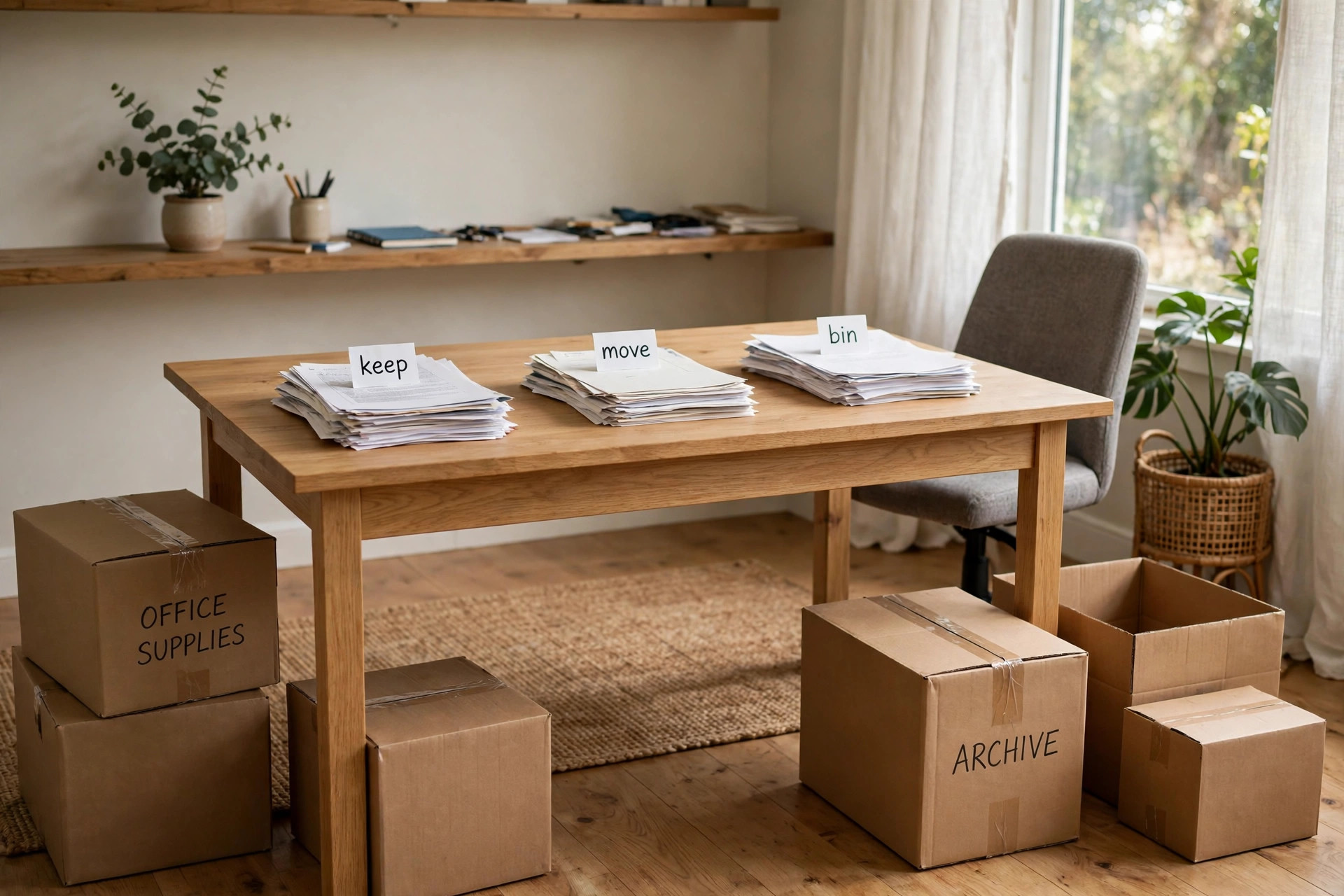
1. Clear everything off the desk and sort into keep, move, bin — the empty desk is the starting line
You cannot organize a desk you cannot see, because the pile on the surface hides the surface and the surface you cannot see is the surface you cannot use. Clear everything off the desk and sort into keep, move, bin — the empty desk is the starting line — so you start from a clean surface instead of shuffling the same pile around. Take everything off, lay it on the bed or the floor, and sort it honestly: keep means it belongs on or near this desk, move means it belongs in another room, bin means it is rubbish or recycling and goes now. The keep pile is usually smaller than you expect. An empty desk, and the rest of the ideas finally have somewhere to go.
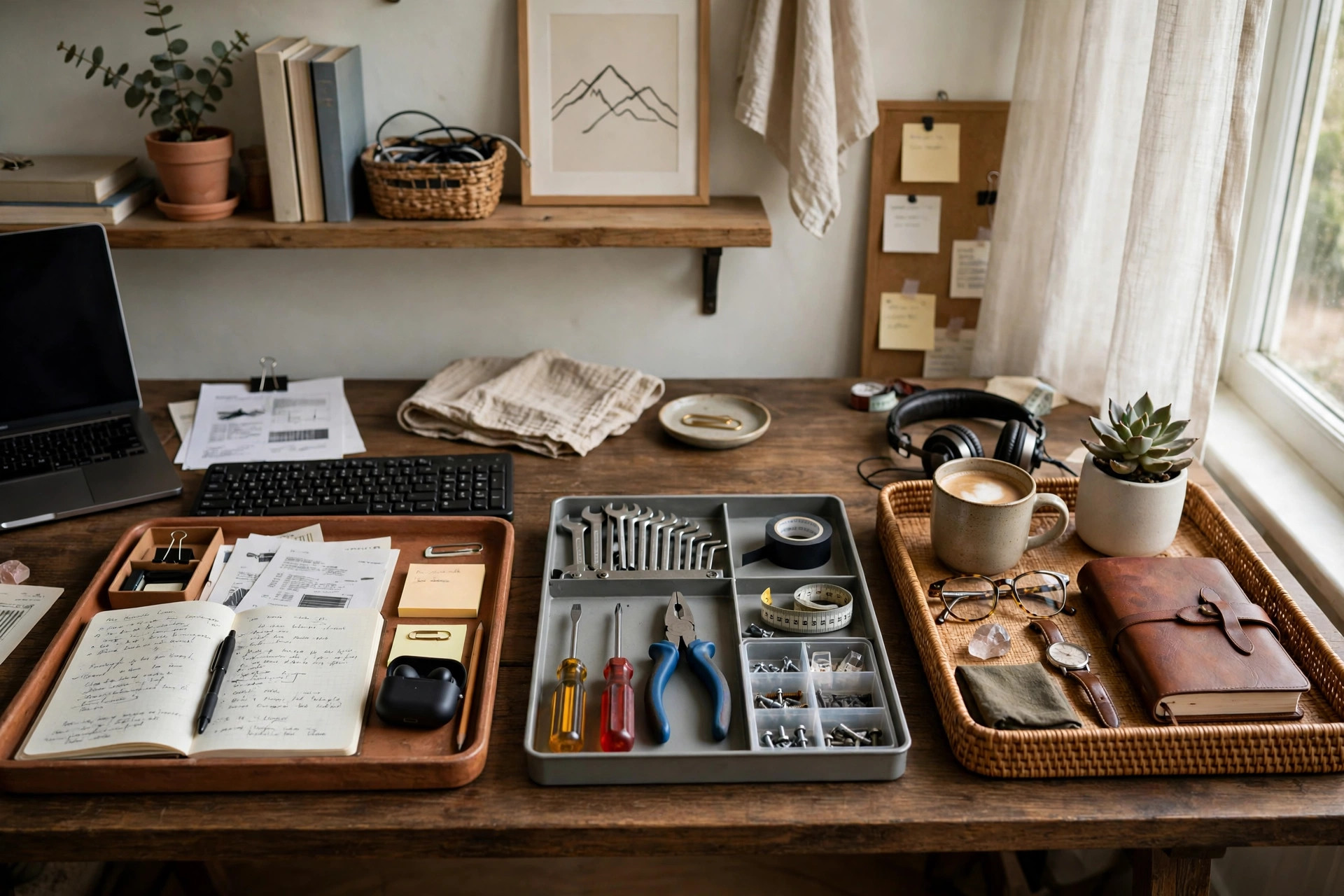
2. Zone the desk: work zone, tools zone, personal zone — one zone, one job
A desk where everything lives everywhere is a desk where nothing is findable, because the scissors are in the work pile, the notebook is under the mug, and the phone charger is tangled in the lamp cable. Zone the desk — work zone, tools zone, personal zone — one zone, one job — so every thing lives where its job happens and your hand finds it without thinking. The work zone is the middle of the desk, where the laptop and the current notebook live; the tools zone is one side, where the pens, scissors and tape sit in a tray; the personal zone is the other side, where the plant, the photo and the mug live, because the desk that has a personal corner is the desk you actually want to sit at. Tell yourself the zones once, because the zones you know are the zones you keep. Three zones, and the desk stops being a search.
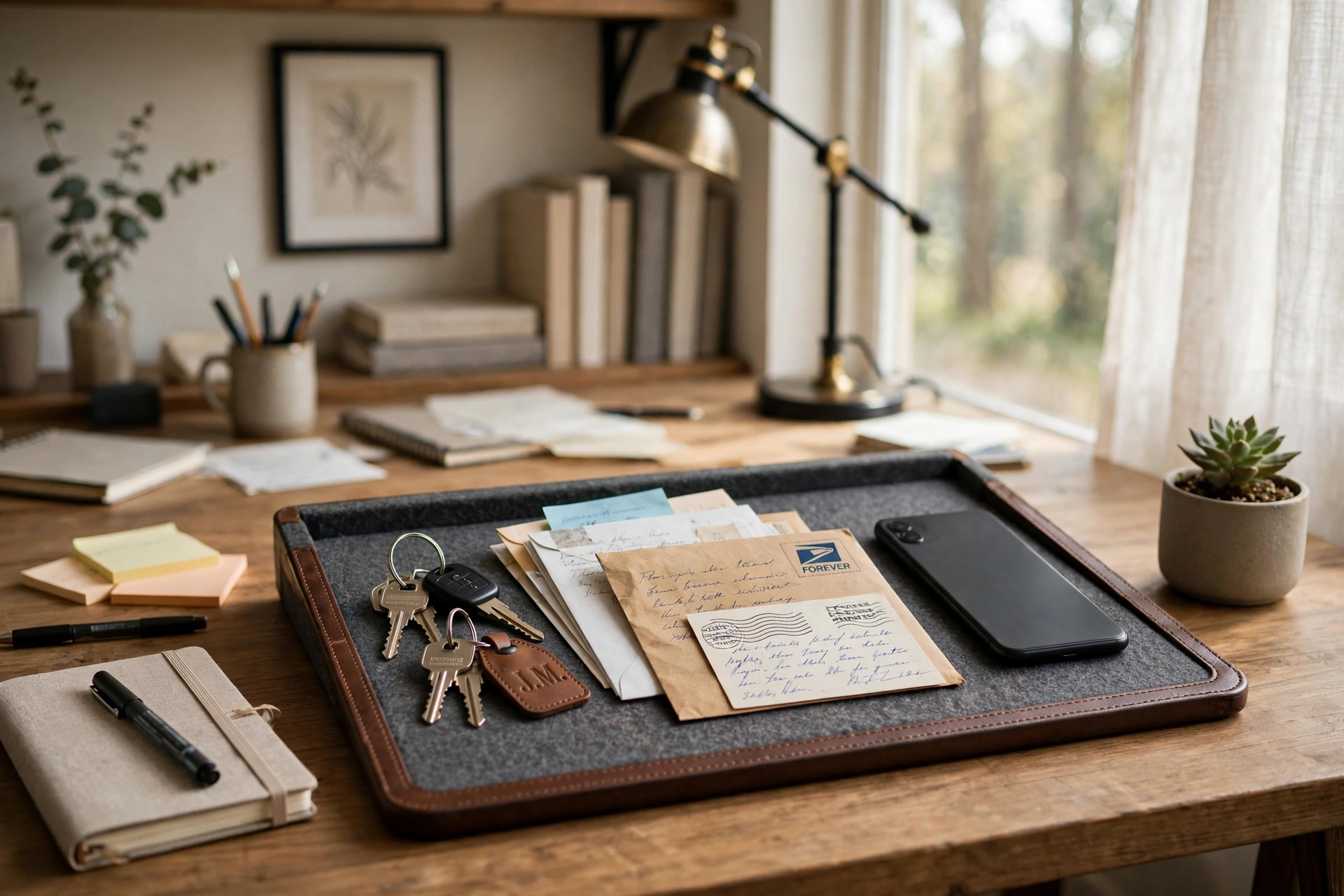
3. A landing tray for the things that arrive daily — keys, post, phone, one tray
The things that arrive daily are the things that spread across the desk, because the post lands on the notebook, the keys land on the charger, and the phone lands wherever there is a gap. Give them a landing tray — keys, post, phone, one tray — so everything that arrives has one place to land and the rest of the desk stays clear. Put a shallow tray by the desk edge nearest the door, and make it the only place the daily arrivals go, because the tray that catches them is the tray that stops them spreading. Empty the tray every evening when you do the reset, because the tray that empties daily is the tray that never overflows. One tray by the door, and the desk stops being a dumping ground.
4. The one-in-one-out rule for desk stuff — nothing new without something leaving
A desk fills up one small thing at a time, because the new pen, the new notebook and the new gadget each seem too small to matter, and the small things are the things that add up to a full desk. Use the one-in-one-out rule — nothing new without something leaving — so the desk holds the same amount of stuff no matter how many new things arrive. Buy a new notebook, and an old one goes to the shelf or the recycling; get a new pen, and a dried-out pen leaves; bring home a new gadget, and the old one goes in a drawer or out of the house, because the desk that stays the same size is the desk that stays usable. The rule takes ten seconds to apply and saves an hour of clearing later. One in, one out, and the desk never creeps full again.

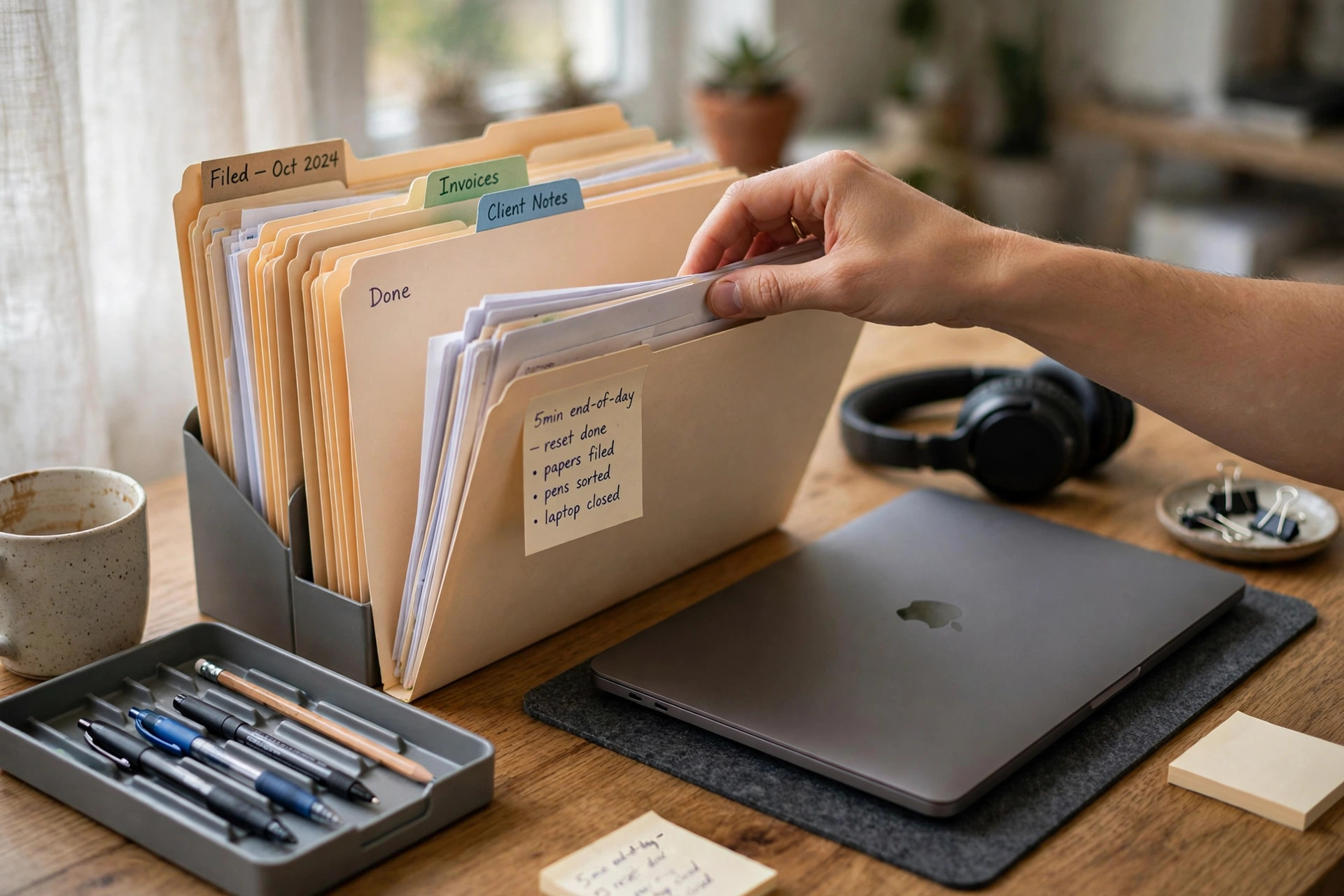
5. A five-minute end-of-day reset — the habit that keeps the desk clear
No system survives a desk without a habit, because the desk is only tidy on the day you clear it and the clutter creeps back one paper at a time. Do a five-minute end-of-day reset — the habit that keeps the desk clear — so the desk is tidy before you leave it and starts clean in the morning. Papers into the file box, pens back in the tray, mug to the kitchen, laptop closed and docked, because the reset that takes five minutes is the reset that actually happens. Do it at the same time every day, right before you stand up, because the fixed-time reset is the reset that becomes automatic. Five minutes at the end of the day, and the desk never needs a big clear again.
6. A "parking lot" list for loose thoughts — write it down, get it off the desk
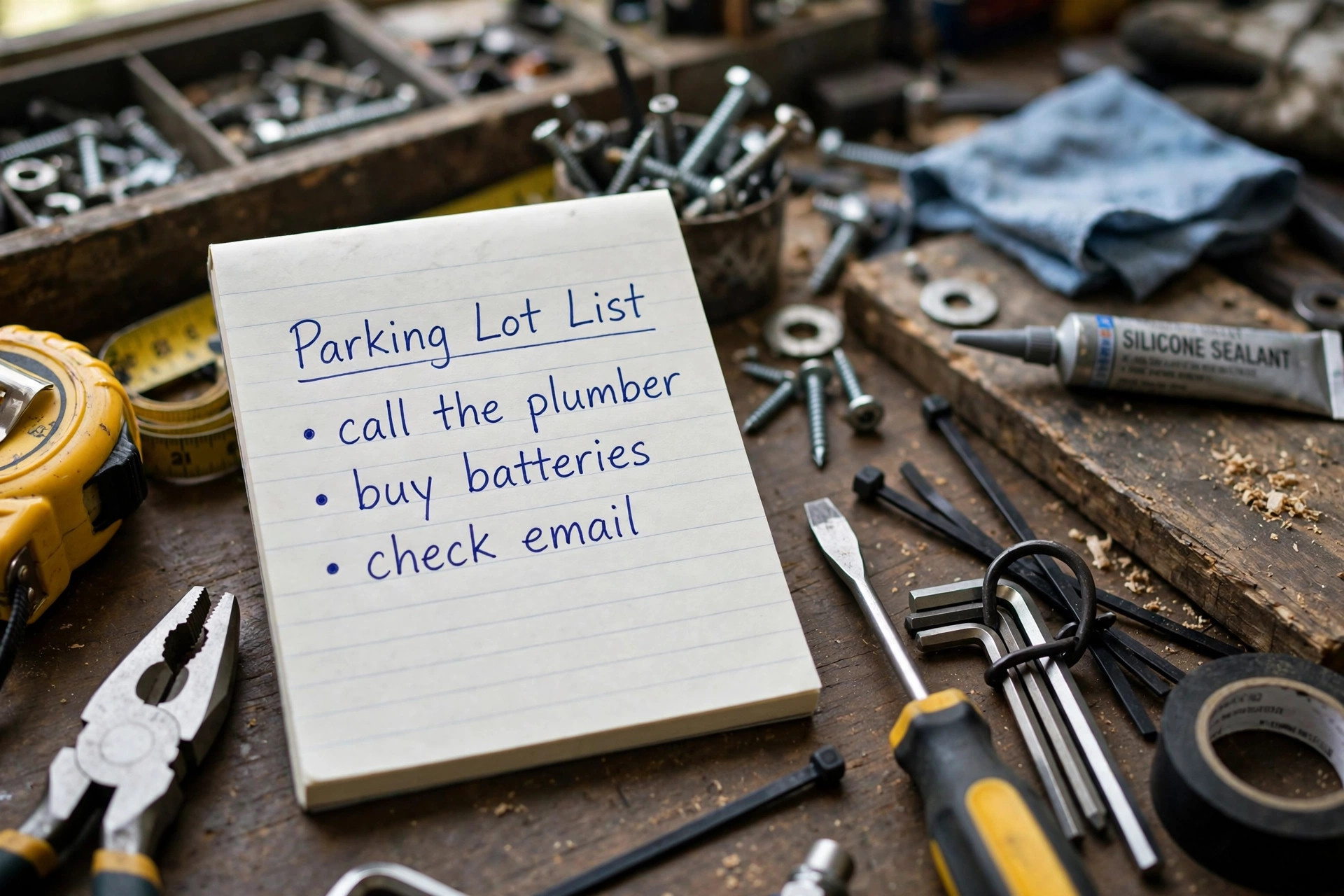
Loose thoughts are the clutter you cannot see, because the thing you must not forget sits in your head all day and the thing in your head is the thing that stops you working. Keep a "parking lot" list — write it down, get it off the desk — so every loose thought has a place to wait and your head is free to work. Put a small notepad in the tools zone, and the moment a thought arrives — call the plumber, buy batteries, check the school email — write it on the list and keep working, because the thought that is written down is the thought that stops nagging. Check the list once a day, deal with what is on it, and cross it off, because the list that gets checked is the list that stays short. One notepad, and the desk stops being a reminder board.
Drawers and storage that actually work
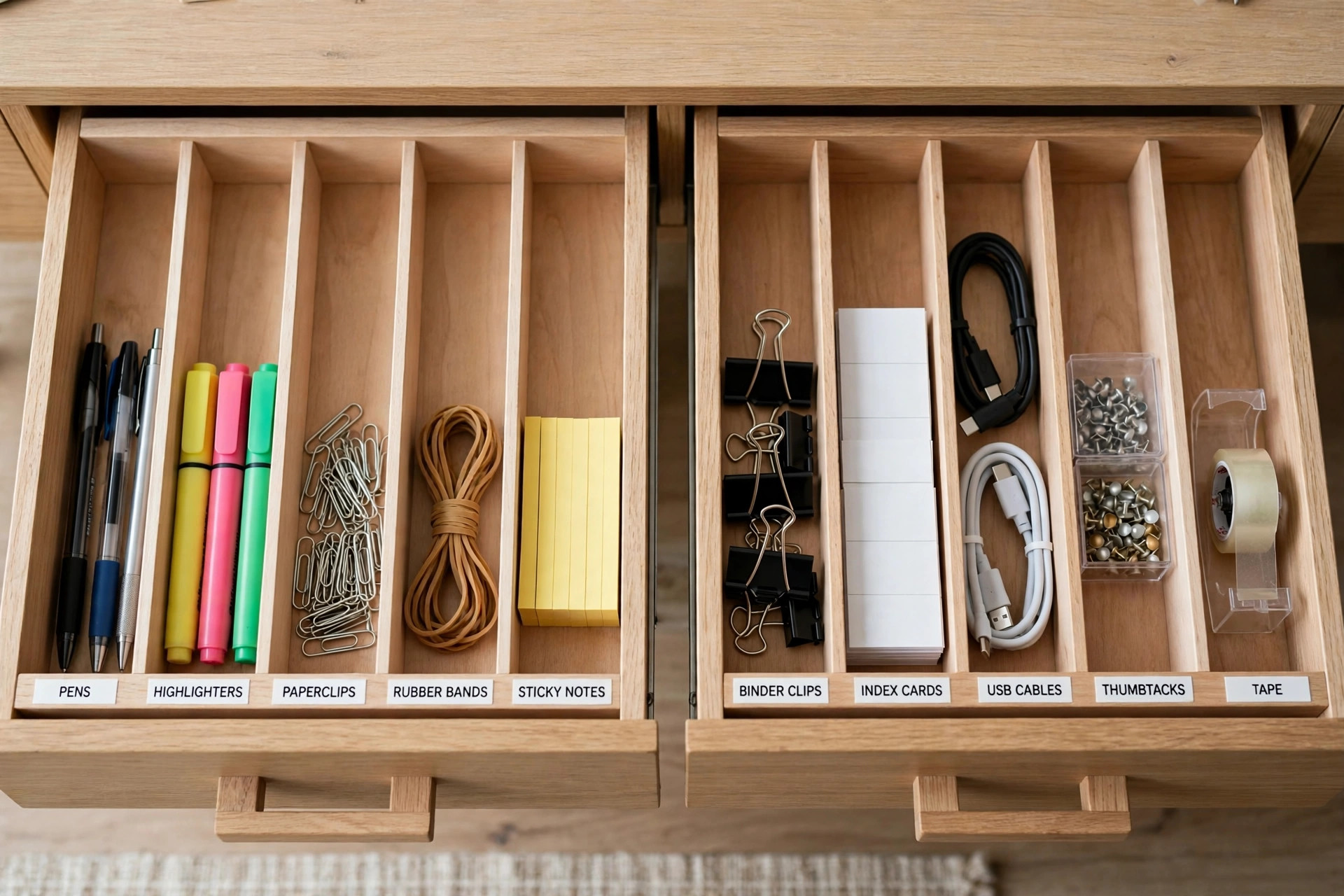
7. Drawer dividers in every drawer — one slot per category
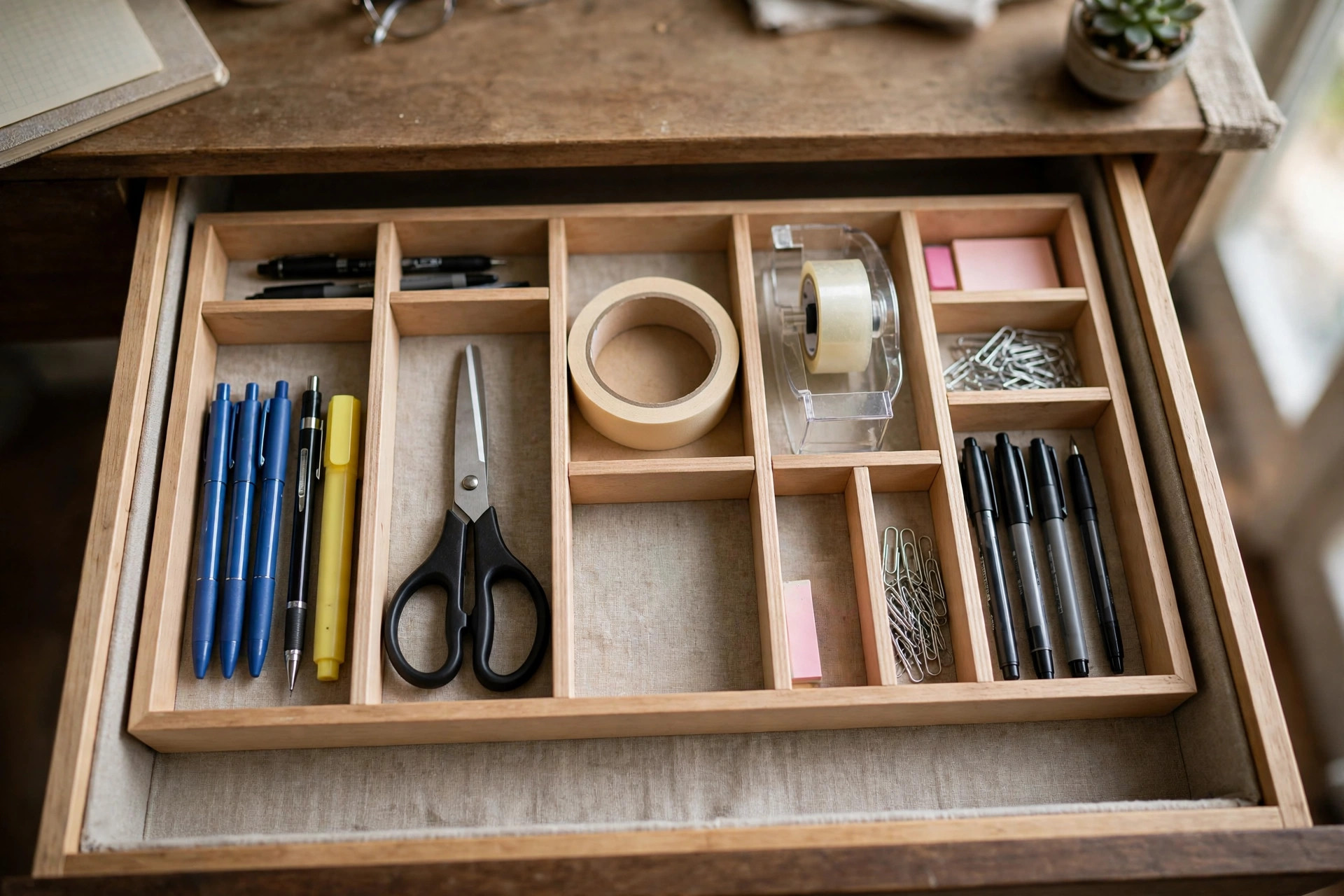
A desk drawer without dividers is a drawer where everything mixes, because the pens roll over the paperclips, the paperclips slide under the tape, and the thing you need is always at the bottom. Put dividers in every drawer — one slot per category — so every item has its own place and the drawer opens on order instead of chaos. Pens in one slot, scissors and tape in another, sticky notes and paperclips in a third, because the slot that holds one thing is the slot that stays tidy. Measure the drawer before you buy, because the divider that fits is the divider that does not slide around. Dividers in every drawer, and the rummaging ends.
8. A shallow top drawer for the daily tools — pens, scissors, tape, in reach
The tools you use every day should be the tools you can reach without standing up, because the pen you need ten times a day is the pen that should live ten centimetres from your hand. Keep a shallow top drawer for the daily tools — pens, scissors, tape, in reach — so the things you grab constantly are always in the same place. Put only the daily tools in it, nothing else, because the drawer that holds only the daily tools is the drawer you can open blindfolded. Everything else — the spare stapler, the hole punch, the box of envelopes — lives in a deeper drawer, because the top drawer that holds everything is the top drawer that holds nothing findable. One shallow drawer, and the daily tools are always in reach.
9. Deep drawers for the bulky stuff — chargers, notebooks, files, out of sight
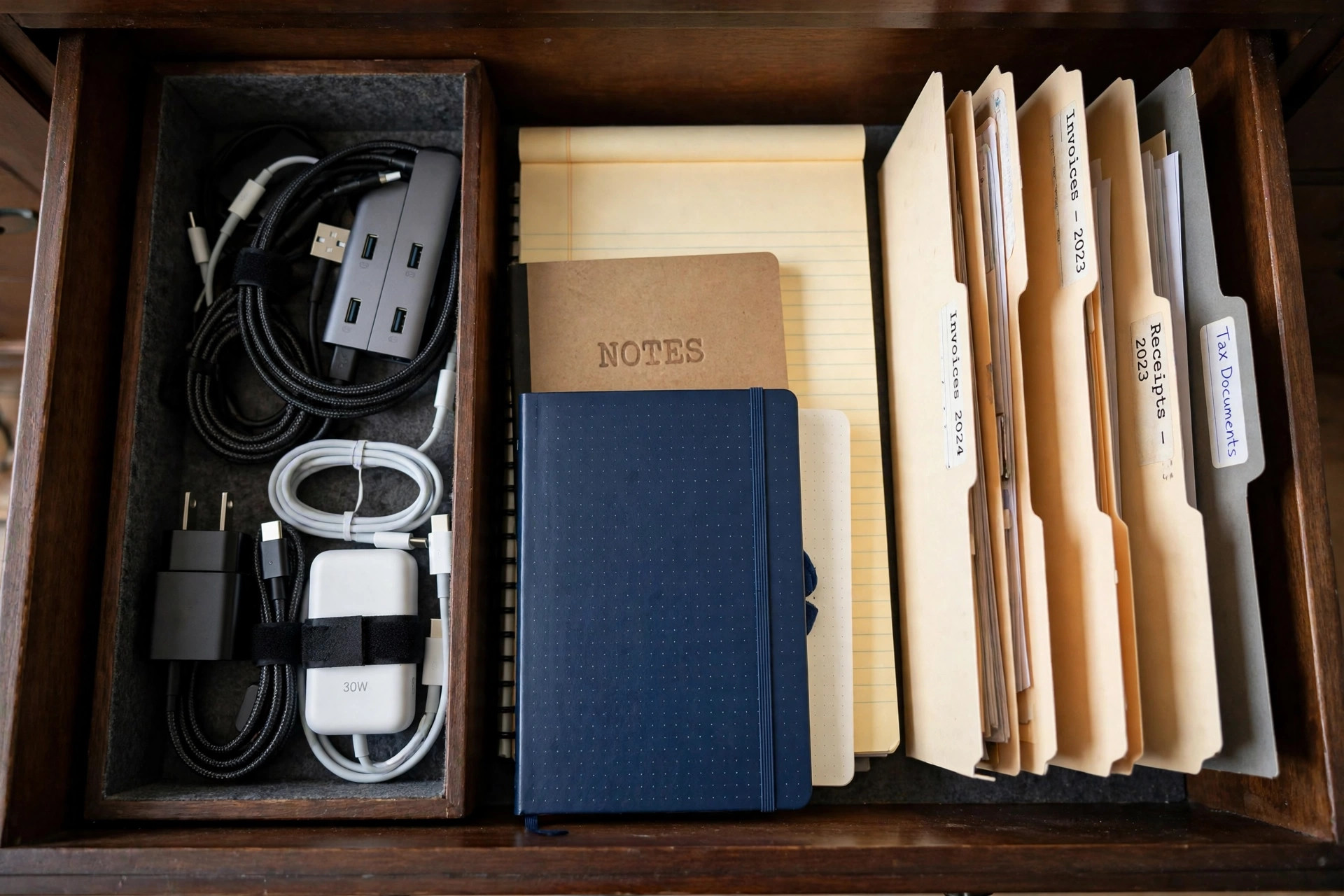
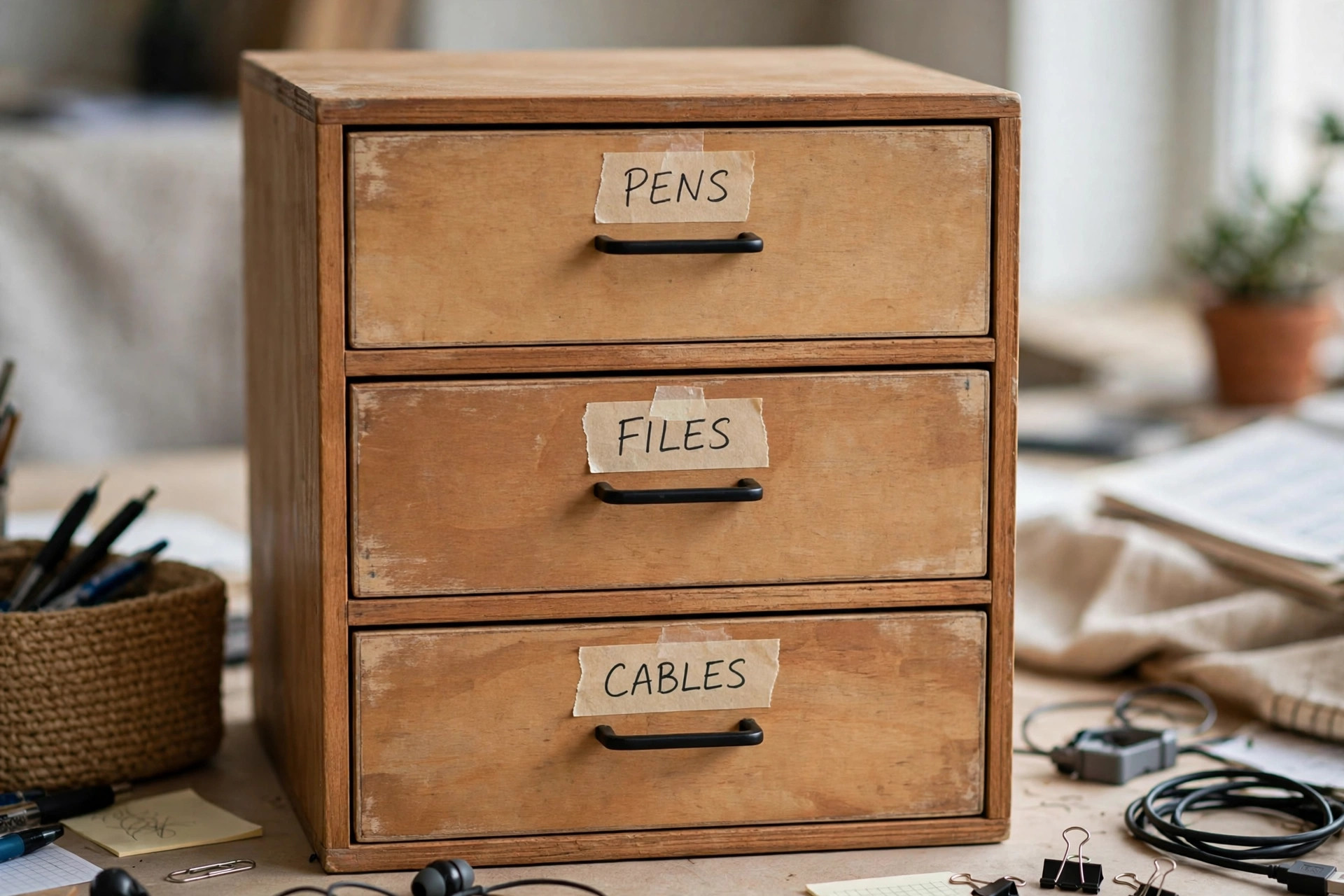
Bulky things on the desk are bulky things in the way, because the spare charger, the stack of notebooks and the file of papers each take up surface that the work needs. Give them a deep drawer — chargers, notebooks, files, out of sight — so the bulky stuff lives below the surface and the surface stays clear. Use one deep drawer for chargers and cables, another for notebooks and files, and keep the heaviest things at the bottom, because the drawer that holds the bulk is the drawer that frees the desk. Label the front of the drawer if it helps, because the label that says what is inside is the label that stops you opening the wrong one. Deep drawers, and the desk top belongs to the work again.
10. A rolling cart beside the desk — the overflow drawer that moves
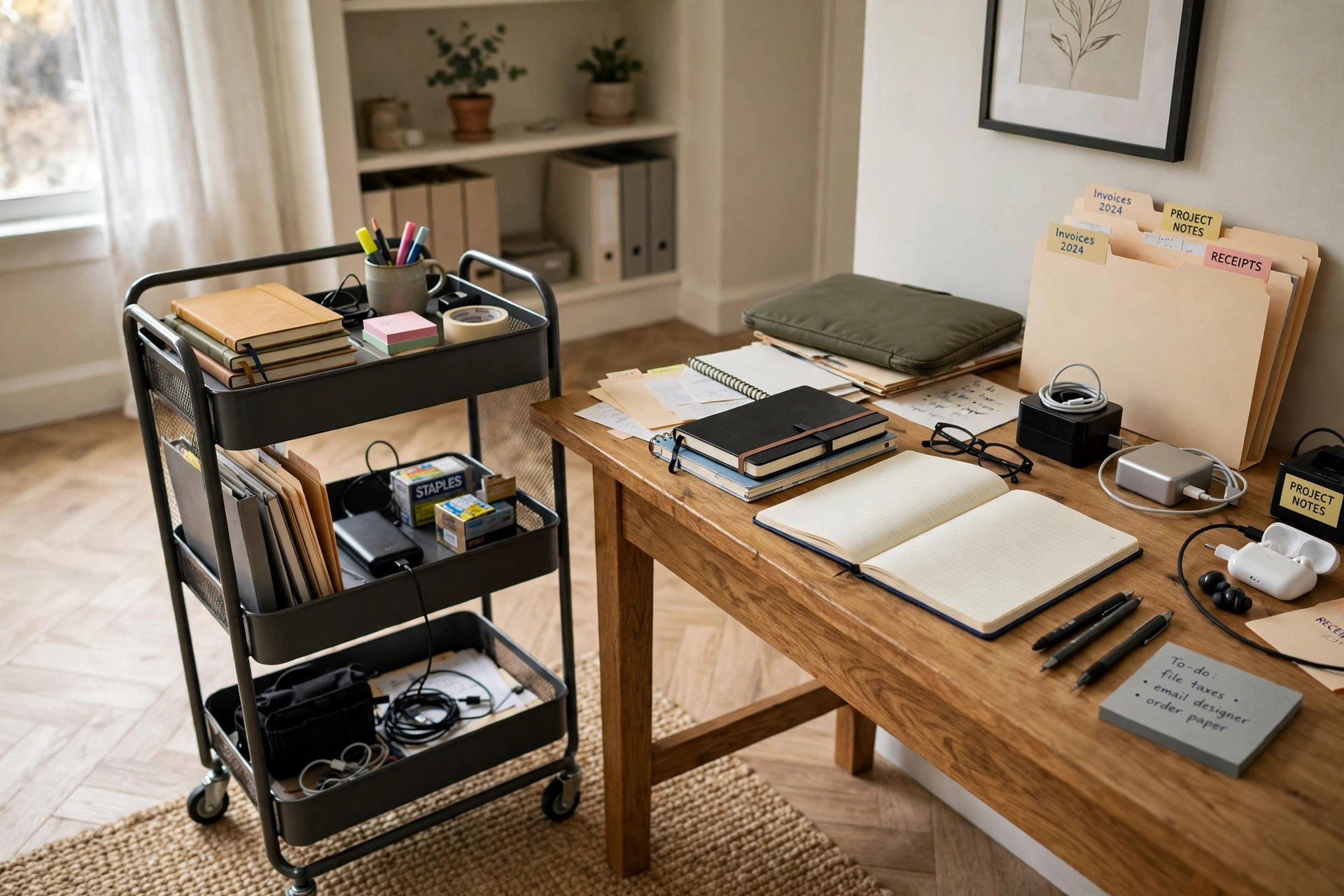
Some desks have no drawers at all, and some desks have drawers that are already full, because the desk that came with the flat is the desk that was never designed for the work you do now. Roll a cart beside the desk — the overflow drawer that moves — so the storage you need is right there and rolls away when you do not. Keep the current project on the top shelf, reference books in the middle, and chargers and spare supplies at the bottom, because the cart that holds the project is the cart that keeps the desk clear. The cart that rolls is covered in 22 Rolling Cart Organization Ideas for 2026, where one cart does the work of a whole extra desk. A cart beside the desk, and the overflow has a home.
11. A desktop shelf riser — two levels where there was one
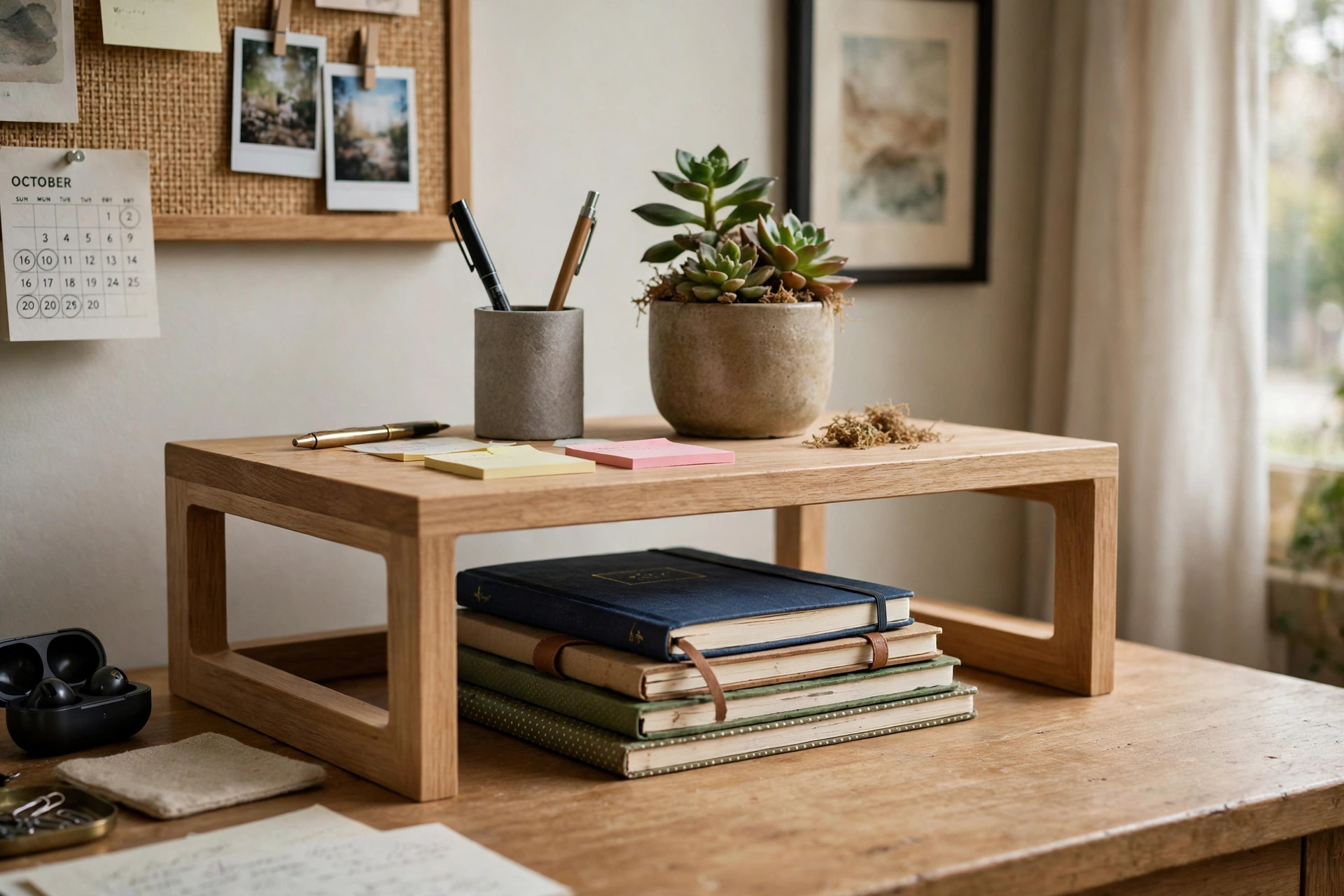
A desk surface is only one level, and one level fills fast, because the notebook, the phone and the plant all want the same flat space and the flat space runs out. Add a desktop shelf riser — two levels where there was one — so the desk gains a second floor without getting any bigger. Put the riser at the back of the desk, keep the notebooks and the reference books underneath it, and put the plant, the clock or the small lamp on top, because the riser that lifts is the riser that doubles the space. Choose one that fits the depth of your desk, because the riser that overhangs is the riser that wobbles. Two levels, and the desk holds twice as much.
12. Label the drawers — the label that stops the rummaging
A drawer you have to open to know what is inside is a drawer you will open three times a day, because the label that is missing is the label that makes you guess. Label the drawers — the label that stops the rummaging — so you open the right drawer first time, every time. Use a label maker or simple handwritten labels on the front of each drawer, one word per drawer — pens, files, cables — because the label you can read from your chair is the label that saves the search. Relabel when the contents change, because the label that lies is worse than no label at all. Labels on every drawer, and the desk stops being a guessing game. (Check on Amazon for a small label maker with tape, sized for drawer fronts.)
Cables, screens and the tech tangle
13. A cable tray under the desk — the tangle that disappears
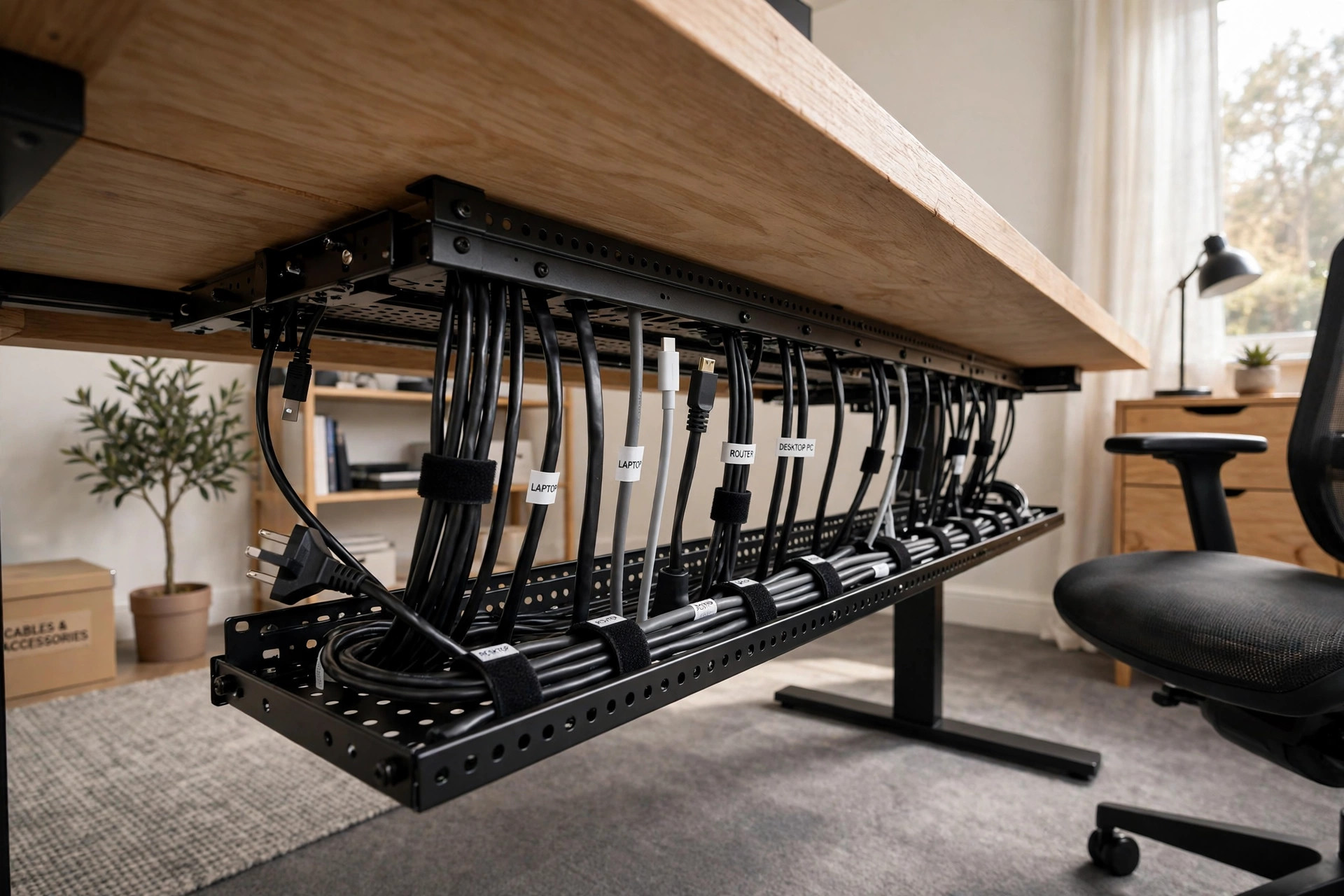
Cables under a desk are cables everywhere, because the charger cable, the monitor cable and the lamp cable all hang down in a knot, and the knot is the thing your feet catch every time you sit down. Fix a cable tray under the desk — the tangle that disappears — so every cable runs through one channel and the floor stays clear. Screw or stick the tray under the desk, feed the cables through it, and leave a little slack at each end, because the tray that holds the slack is the tray that stops the pull. Coil the spare length with a velcro tie, because the cable that is coiled is the cable that does not dangle. A tray under the desk, and the tangle is gone.
14. One charging station — all the chargers in one box
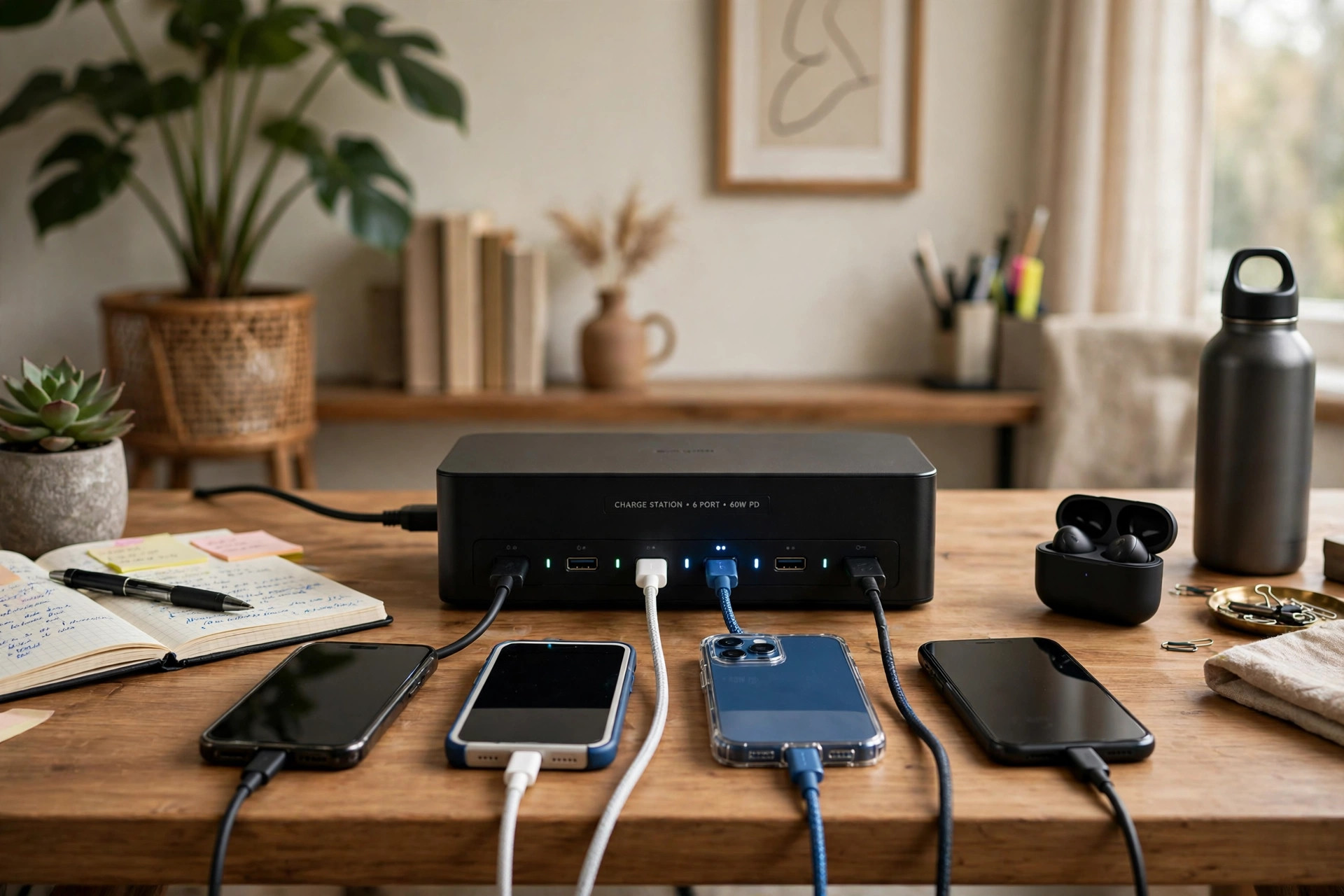
Chargers scattered across a desk are chargers that multiply, because the phone charger, the laptop charger and the headphone charger each have their own cable, and the cables are the things that cover the surface. Build one charging station — all the chargers in one box — so every device charges in the same place and the cables stay inside it. Put a power strip in a ventilated box or a cable-management box, plug all the chargers into it, and cut small slots for the cables to come out, because the box that hides the strip is the box that hides the mess. Keep the box at the back of the desk or on the floor beside it, because the station that is out of the way is the station that does not take desk space. One box, and the chargers stop taking over. (Check on Amazon for a cable-management box with a power strip inside, sized for three or four chargers.)
15. Cable clips on the desk edge — the cable that stays where you left it
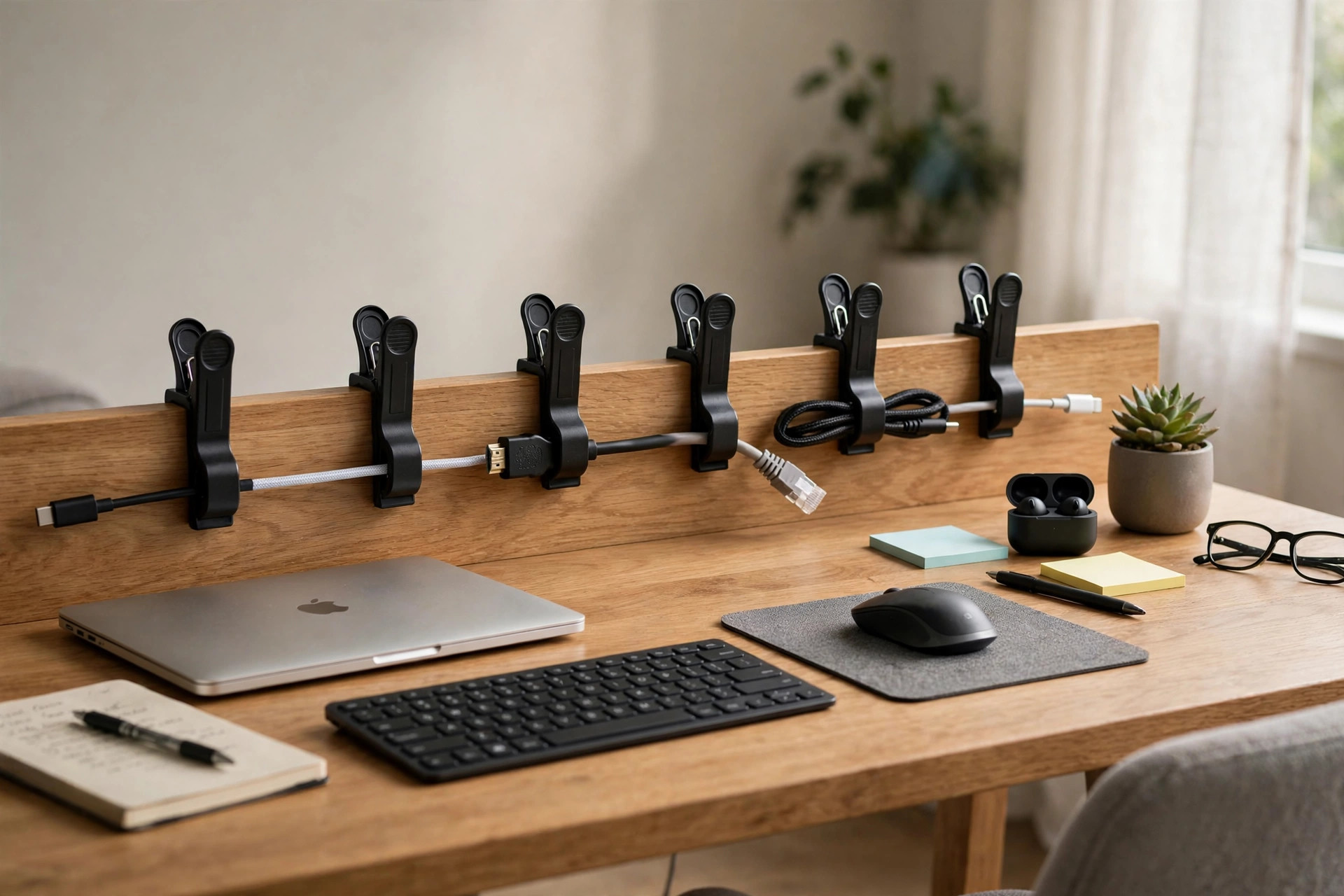
A cable with nowhere to rest is a cable on the floor, because the phone cable slips off the desk the moment you unplug it, and the cable on the floor is the cable you cannot find when you need it. Stick cable clips on the desk edge — the cable that stays where you left it — so every cable has a clip to rest in when it is not in use. Put one clip per cable along the back edge of the desk, thread the cable through when you unplug it, and pull it out when you need it, because the clip that holds is the clip that keeps the cable in reach. Use adhesive clips so there are no holes, because the clip that sticks is the clip that moves when you rearrange. Clips on the edge, and the cables stop falling.
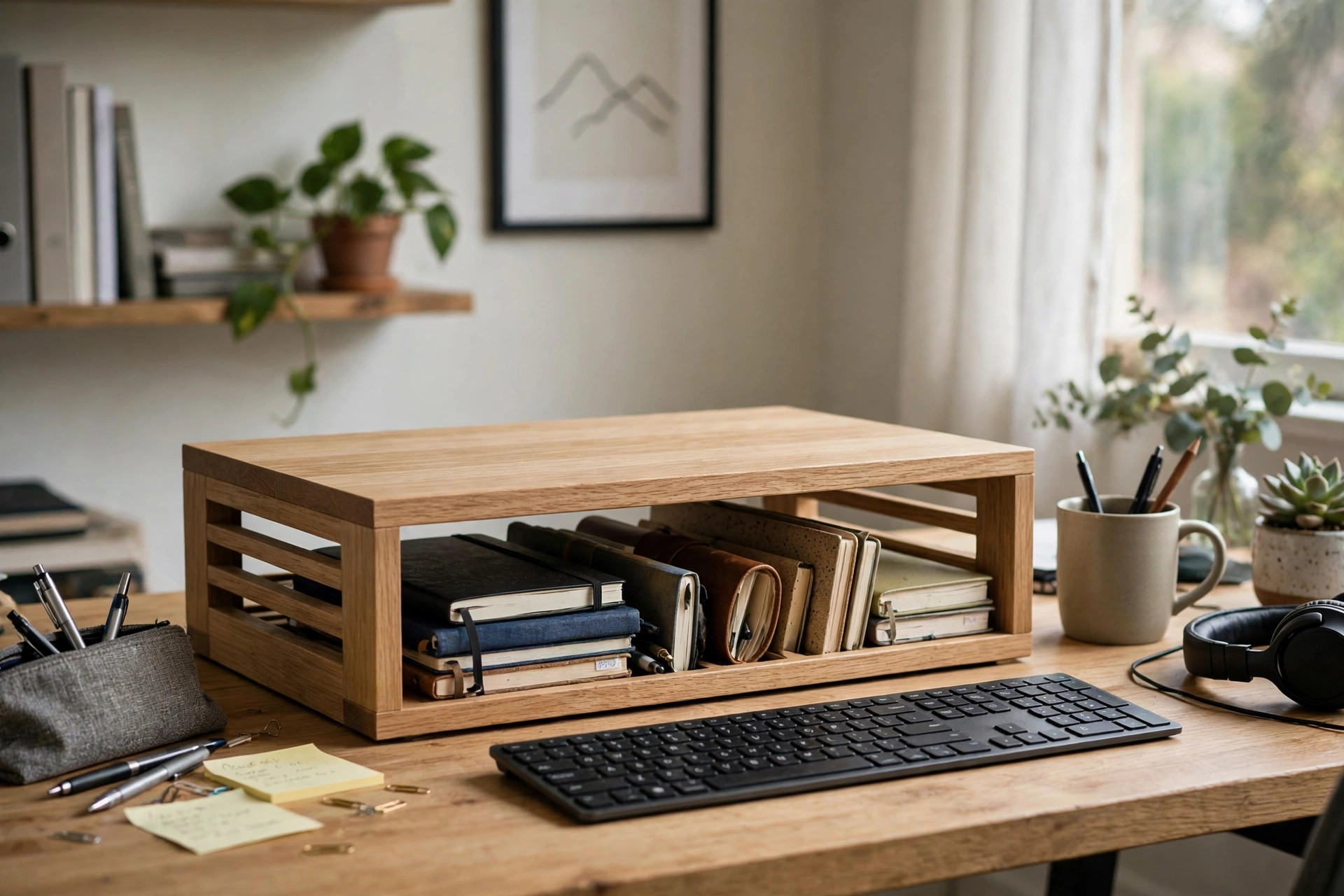
16. A monitor riser that doubles as storage — screen up, notebooks under
A monitor sitting flat on the desk is a monitor at the wrong height and a desk with a dead zone underneath it, because the screen that is too low is the screen that hurts your neck and the space under it is the space that holds nothing. Raise it on a monitor riser that doubles as storage — screen up, notebooks under — so the screen sits at eye level and the space underneath holds the notebooks. Put the current notebook and the phone under the riser, keep the pens on top beside the monitor, and check the riser is stable before you trust it with the screen — the riser that wobbles is the riser that drops the monitor. Screen up, notebooks under, and the desk gains a shelf and a better posture in one move.
17. A pegboard above the desk — tools on the wall, not on the surface
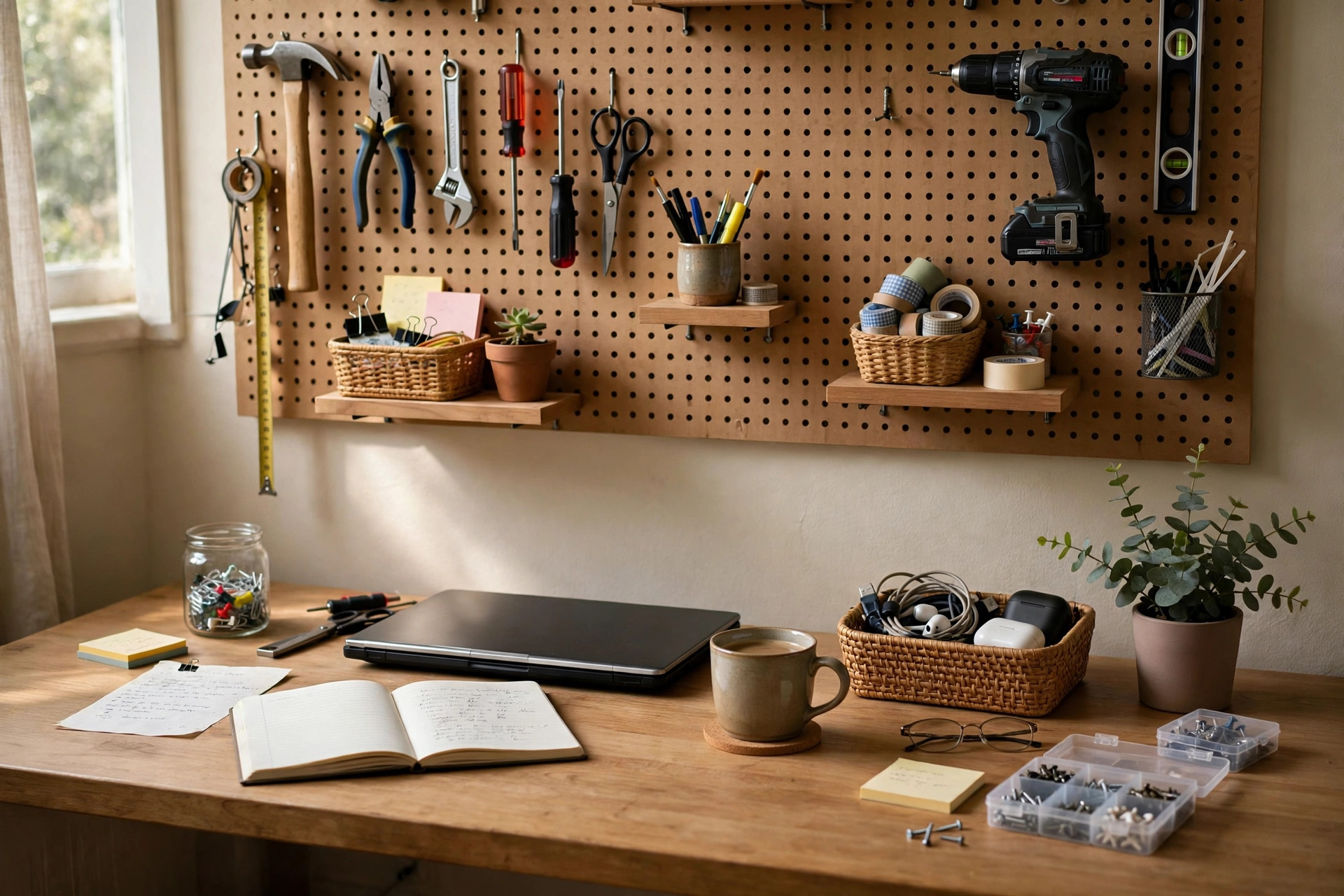
The wall above a desk is the biggest unused space in the room, because the desk holds everything and the wall holds nothing, and the wall that holds nothing is the wall that could hold the tools. Hang a pegboard above the desk — tools on the wall, not on the surface — so the scissors, the tape, the headphones and the small baskets all live on the wall and the desk stays clear. Screw the board to the wall at arm's reach, hang hooks and small baskets from it, and keep the things you grab most often at the centre, because the board that is in reach is the board that gets used. The pegboard that works is covered in 20 Pegboard Organization Ideas for 2026, where the same wall-first rule turns a whole garage tidy. A board on the wall, and the desk loses half its clutter.
18. A docking spot for the laptop — closed, charged, out of the way at 5pm
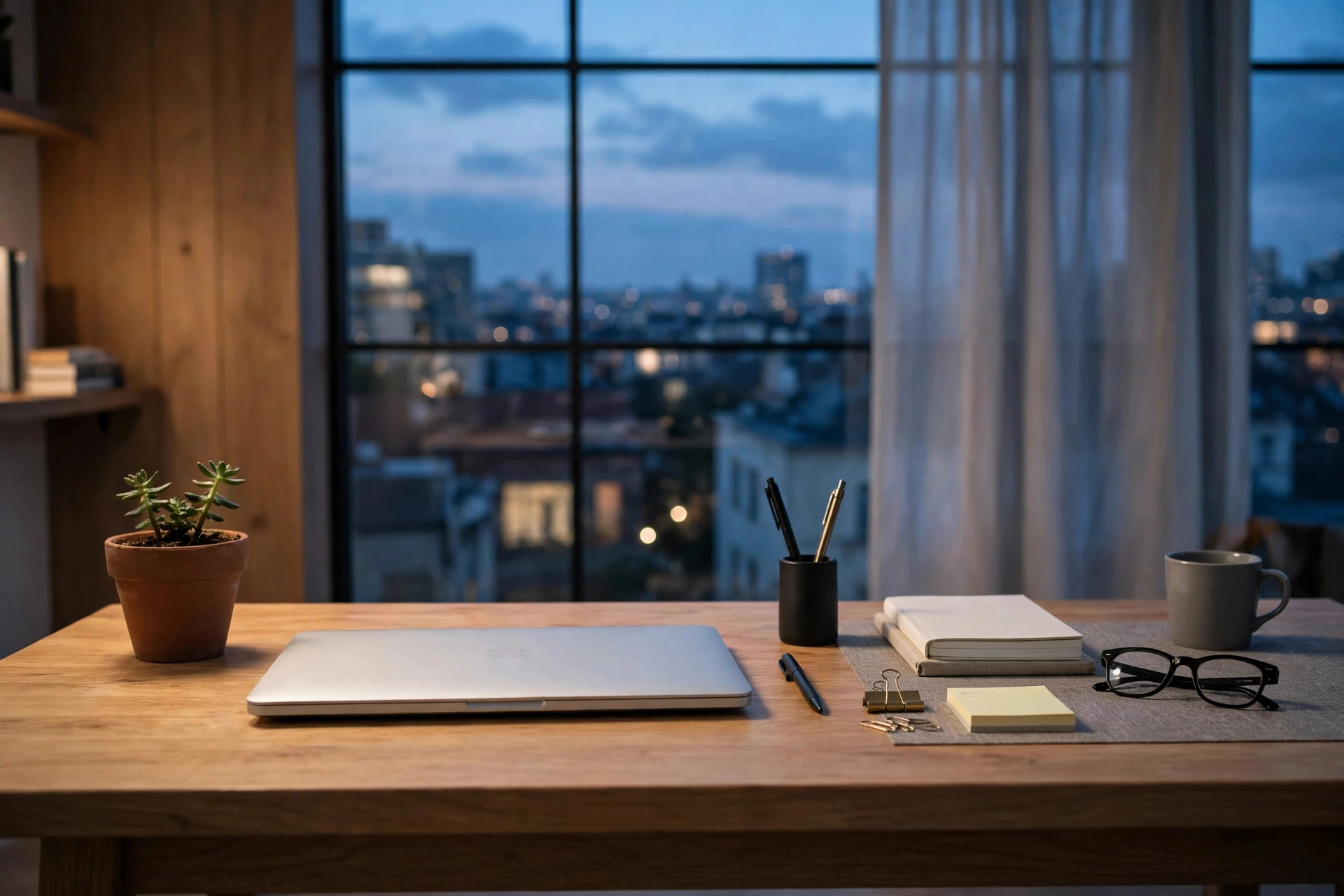
A laptop that lives open on the desk all evening is a laptop that owns the desk, because the open screen is the screen that says work is still happening and the desk that still has work on it is the desk you never leave. Give it a docking spot — closed, charged, out of the way at 5pm — so the workday has a clear end and the desk belongs to the evening. Stand the closed laptop upright in a small vertical stand at the side of the desk, plug the charger in, and leave the surface empty, because the laptop that is docked is the laptop that is done for the day. A vertical stand takes up almost no space, and the desk that is empty at 5pm is the desk that feels calm at 9am. Dock it, close it, and the day is done.
Systems that keep it calm all week
19. A three-tray paper system — in, action, file, and nothing else on the desk
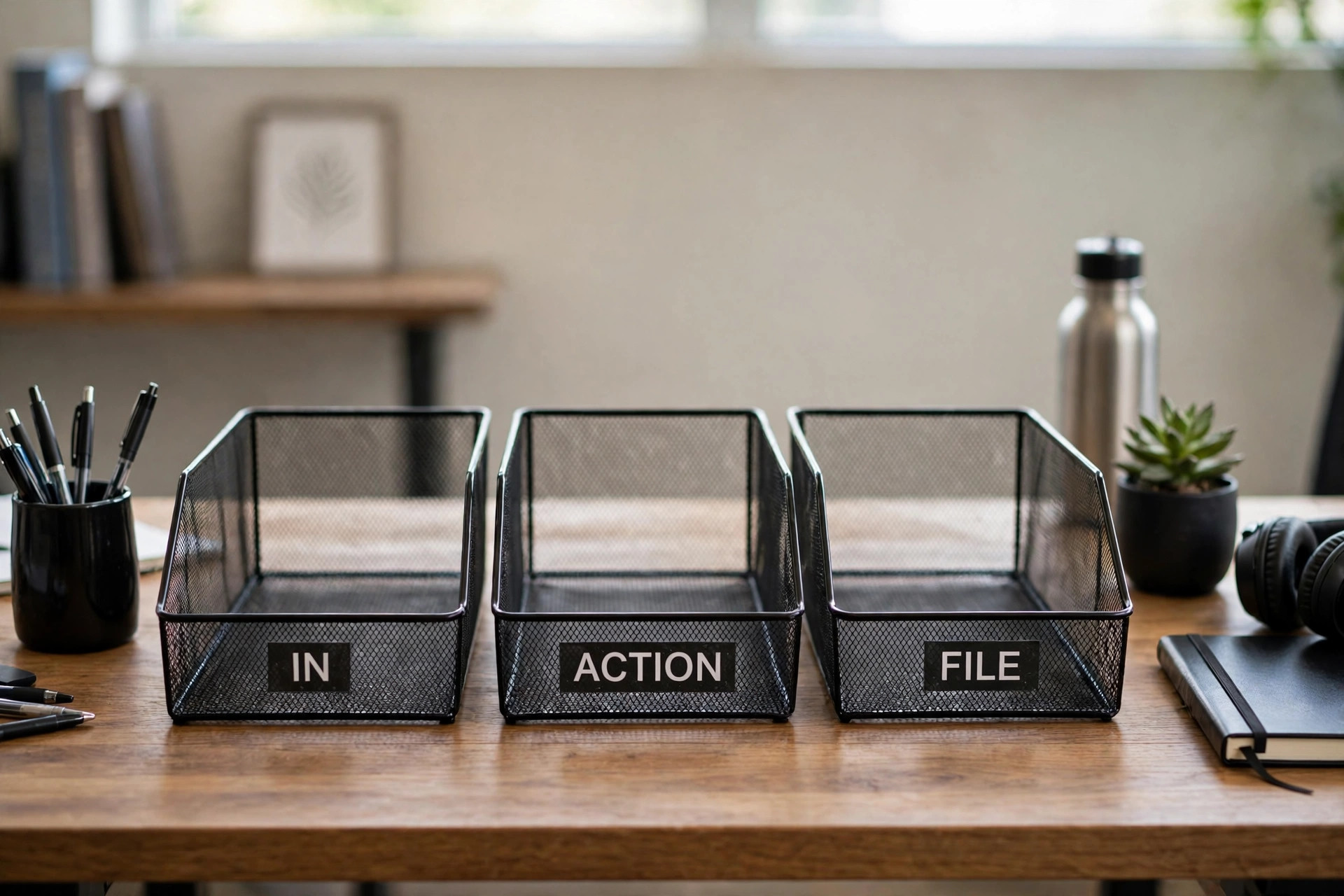
Paper on a desk is paper everywhere, because the bill, the school letter and the form you must sign all land in the same pile, and the pile that holds everything is the pile you never look through. Use three trays — in, action, file, and nothing else on the desk — so every paper has one of three homes and the desk holds no loose paper at all. New paper goes in the in tray, paper that needs doing moves to the action tray, and paper that is done goes in the file tray, because the tray that holds one job is the tray that stays manageable. Empty the action tray once a week, because the tray that empties is the tray that never overflows. Three trays, and the paper stops taking over. (Check on Amazon for a stackable three-tray letter set, sized for A4 paper.)
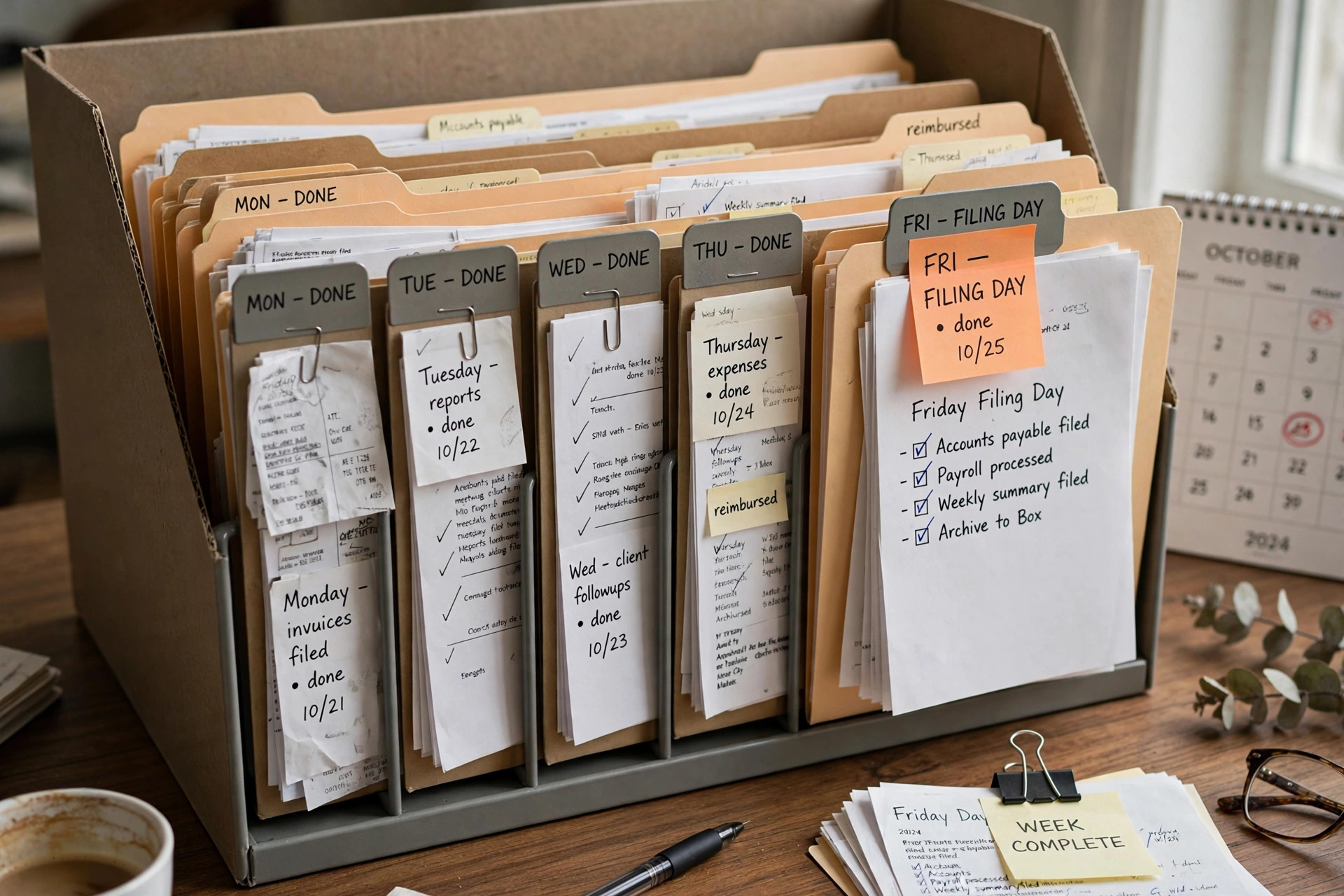
20. A desktop file box for the week's papers — Friday is filing day
Even three trays need a place for the papers that are done, because the file tray fills up and the papers that have nowhere to go are the papers that end up back on the desk. Keep a desktop file box for the week's papers — Friday is filing day — so the done papers have a home and the home gets emptied on a schedule. Put a small file box with hanging folders on the desk or on the shelf beside it, drop the week's done papers into it as you finish them, and on Friday take five minutes to file them properly or throw them away, because the box that empties every Friday is the box that never overflows. One box, one day a week, and the paper has a beginning and an end.
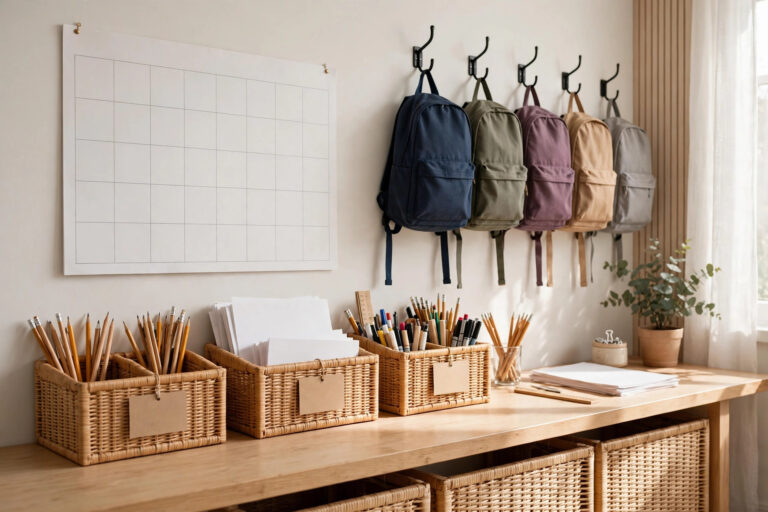
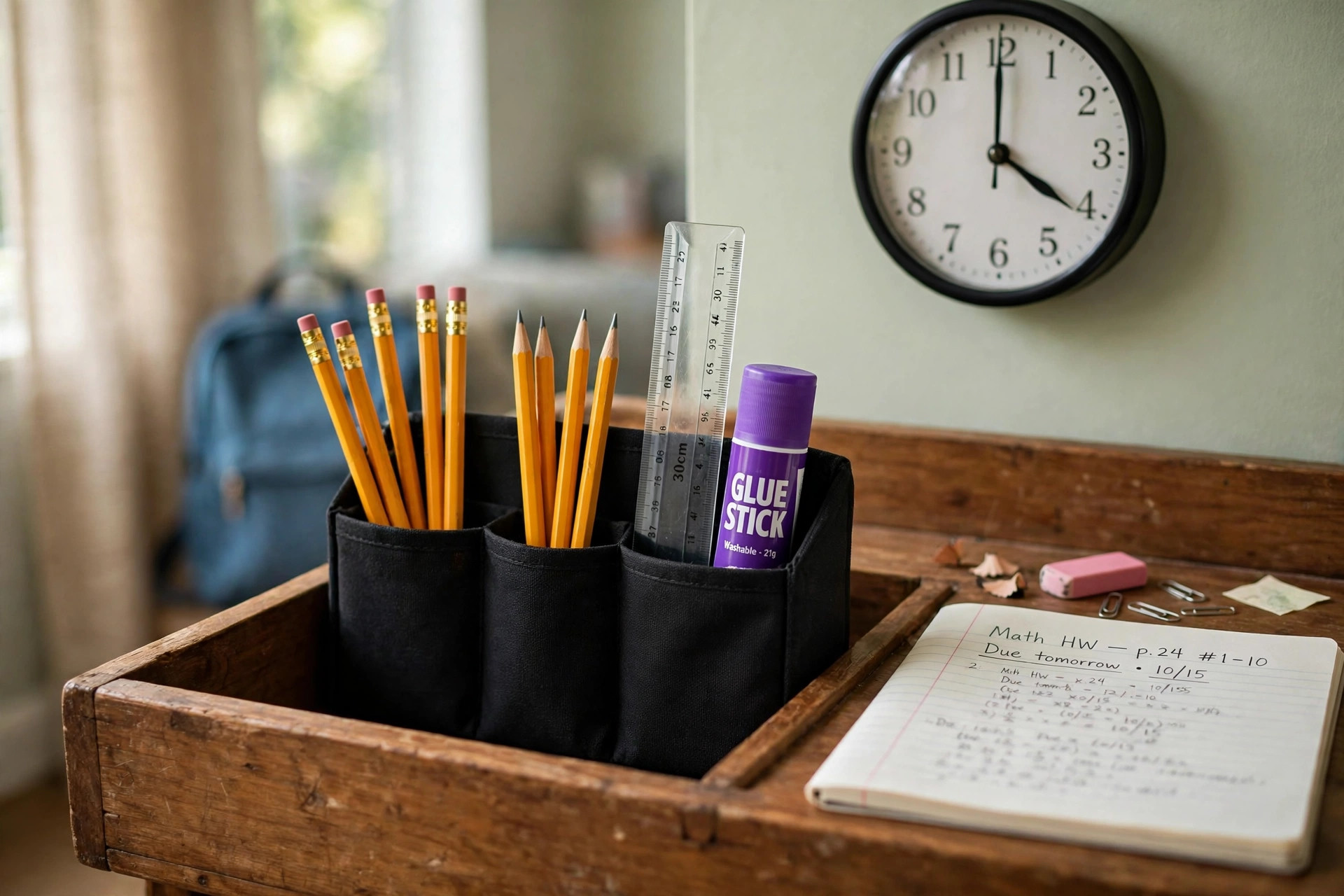
21. A homework caddy within the desk — kids' supplies in one box, ready to grab
A desk shared with homework is a desk with two jobs, because the pencils, the ruler and the glue stick appear at four o'clock and disappear into the drawers by dinner, and the supplies that disappear are the supplies that take ten minutes to find again. Keep a homework caddy within the desk — kids' supplies in one box, ready to grab — so the homework tools live in one carry box that comes out at homework time and goes back when it is done. Fill it with pencils, a ruler, scissors, glue and a sharpener, and keep it on the shelf beside the desk, because the caddy that is in reach is the caddy that gets used. The homework station thinking is the same as in the Homework Station Organization post that follows this one — the kid-ready corner where the supplies are always in reach. One caddy, and homework starts in seconds.
22. A book nook at the end of the desk — the books you reach for, standing upright
Books flat in a pile are books you never open, because the book at the bottom is the book you cannot reach and the pile that grows is the pile that falls over. Stand them up in a book nook at the end of the desk — the books you reach for, standing upright — so the books you use most are always in sight and in reach. Put a bookend or a small shelf at the end of the desk, stand the current reference books upright in it, and keep only the ones you reach for this week, because the nook that holds a few books is the nook that stays tidy. The book storage thinking is in 24 Book Storage Ideas for 2026, where the same upright rule keeps a whole shelf of books findable. A nook at the end of the desk, and the books stop being a pile.

23. A small plant and one personal thing — the desk that feels like yours
A desk with no personal thing on it is a desk nobody wants to sit at, because the desk that is all work and no life is the desk you avoid, and the desk you avoid is the desk that never gets organized. Keep a small plant and one personal thing — the desk that feels like yours — so the desk has a reason to be sat at. A small succulent or a trailing plant in the personal zone, one photo or one object that makes you smile, and nothing more, because the personal corner that holds two things is the corner that stays special. Water the plant once a week when you do the Sunday audit, because the plant that is watered is the plant that stays alive. One plant, one personal thing, and the desk feels like yours.

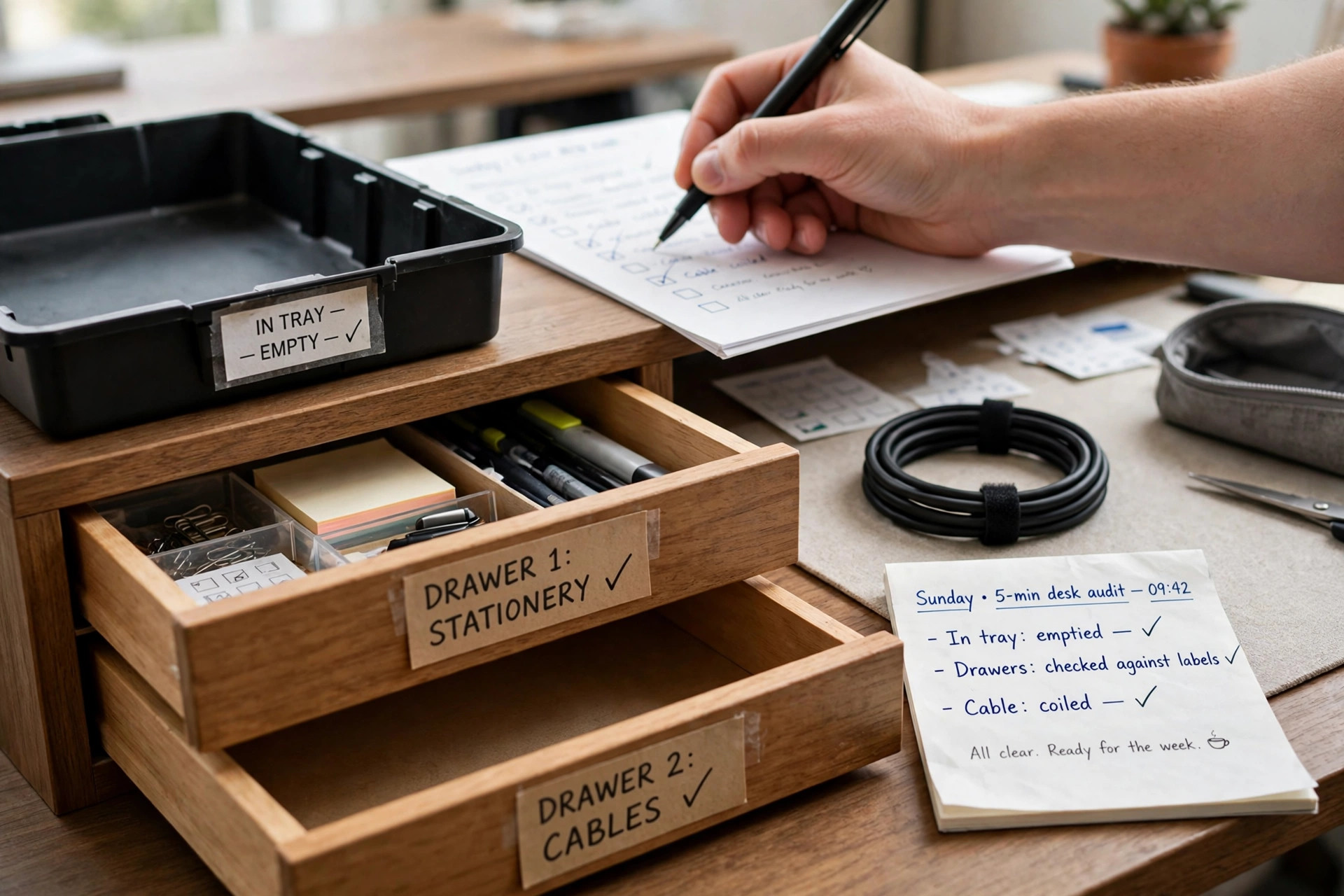
24. A Sunday five-minute desk audit — the weekly reset that keeps the system alive
Every system drifts, because the tray fills, the drawer mixes and the cables creep back, and the drift that nobody checks is the drift that becomes the mess again. Do a Sunday five-minute desk audit — the weekly reset that keeps the system alive — so the desk gets checked before the week starts and the small slips get fixed while they are small. Empty the in tray, check the drawers still match their labels, coil any escaped cable, and wipe the surface, because the audit that takes five minutes is the audit that actually happens. Do it on Sunday evening, when the week is about to start, because the desk that is audited on Sunday is the desk that works all week. Five minutes on Sunday, and the system never falls apart.
Which desk organization idea fits which situation?
| Situation | Best first move | Budget | Tools needed |
|---|---|---|---|
| Desk buried under a pile | Clear everything off and sort keep, move, bin (idea 1) | Free | Three boxes |
| Nothing is findable on the surface | Zone the desk: work, tools, personal (idea 2) | Free | One tray |
| Post, keys and phone spread everywhere | A landing tray by the door (idea 3) | Low | One tray |
| Desk creeps full again every week | The one-in-one-out rule (idea 4) | Free | None |
| Desk is tidy Monday, messy Friday | Five-minute end-of-day reset (idea 5) | Free | None |
| Loose thoughts keep interrupting work | A "parking lot" list (idea 6) | Free | Notepad |
| Drawer is a jumble | Dividers in every drawer (idea 7) | Low | Dividers |
| Daily tools buried in a deep drawer | A shallow top drawer for daily tools (idea 8) | Free | None |
| Bulky stuff covers the surface | Deep drawers for chargers and files (idea 9) | Free | None |
| Desk has no drawers at all | A rolling cart beside the desk (idea 10) | Medium | Rolling cart |
| One flat surface, not enough room | A desktop shelf riser (idea 11) | Low | Shelf riser |
| Always opening the wrong drawer | Label the drawers (idea 12) | Low | Label maker |
You do not need all 24 ideas. You need the three that solve your desk — usually clearing everything off and sorting it, the three-tray paper system, and the five-minute end-of-day reset that keeps it all clear. Start with the clearing this weekend, and put the landing tray by the door. Do that and the next time you sit down to work, the desk will be ready before the laptop opens.
Save this post for your next clear-out, and if the small-space thinking needs to go further, read 28 Small Apartment Storage Ideas for 2026 next — it is Post 50, the tiny-flat systems this desk borrows from — and 22 School Organization Ideas for 2026, Post 12, for the homework and school systems that share the same surface. This is the fourth post of the Organization by problem return run — Posts 56 to 80, one everyday problem at a time — and the run keeps going with the homework station, where the kids' corner gets the same treatment.
Publish date assigned at publishing time. Updated as new desk organization finds are tested.
Frequently asked questions
How do I keep my desk clear when I work from home?
Clear it completely once, then give everything a home: a landing tray for the daily arrivals, a three-tray paper system for the post, and a five-minute reset at the end of every working day. The desk stays clear when the things that arrive have somewhere to go — without a tray and a reset, the desk fills up again by Tuesday no matter how well you cleared it on Sunday.
What is the best way to organize desk drawers?
Dividers in every drawer, one slot per category, with the daily tools in a shallow top drawer and the bulky stuff in deep drawers below. Label each drawer front so you open the right one first time. The divider that fits the drawer is the divider that does not slide around, so measure before you buy — a drawer that is divided stays tidy, a drawer that is not becomes a jumble again within a week.
How do I hide cables under my desk?
Fix a cable tray to the underside of the desk and run every cable through it, coil the spare length with velcro ties, and put all the chargers in one charging station box so the cables stay inside it. Add cable clips along the back edge of the desk so each cable has a place to rest when it is unplugged. The tray hides the tangle, the box hides the chargers, and the clips stop the cables falling to the floor.