22 Rolling Cart Organization Ideas for 2026
A rolling cart promises the easiest storage in the house — storage that comes to you — and most carts fail the same way: the cart that is two centimetres too wide for the gap and ends up in the hallway, the cart that rolls away mid-chop, the cart that holds a bit of kitchen, a bit of craft and a bit of cleaning and none of it properly, and the cart that was tidy for a week and is now a pile on wheels.
These 22 rolling cart organization ideas fix that without a bigger room: measure the gap before you buy, give every tier one job, lock the casters, and finish every week with a five-minute reset — so the cart earns its wheels instead of gathering clutter.
Every idea below works in a real home, from a single cart in a kitchen corner to one cart per floor. If the cabinets themselves need a rethink first, 20 Kitchen Cabinet Organization Ideas for 2026 covers the cabinet side of the same problem — the carts below are the rolling layer that lives beside them. Pick three ideas that fit your worst corner, start by measuring the gap, and build from there.
Pick the right cart first
1. Measure the gap before you buy — a cart that fits between counter and wall beats a bigger one that blocks the door
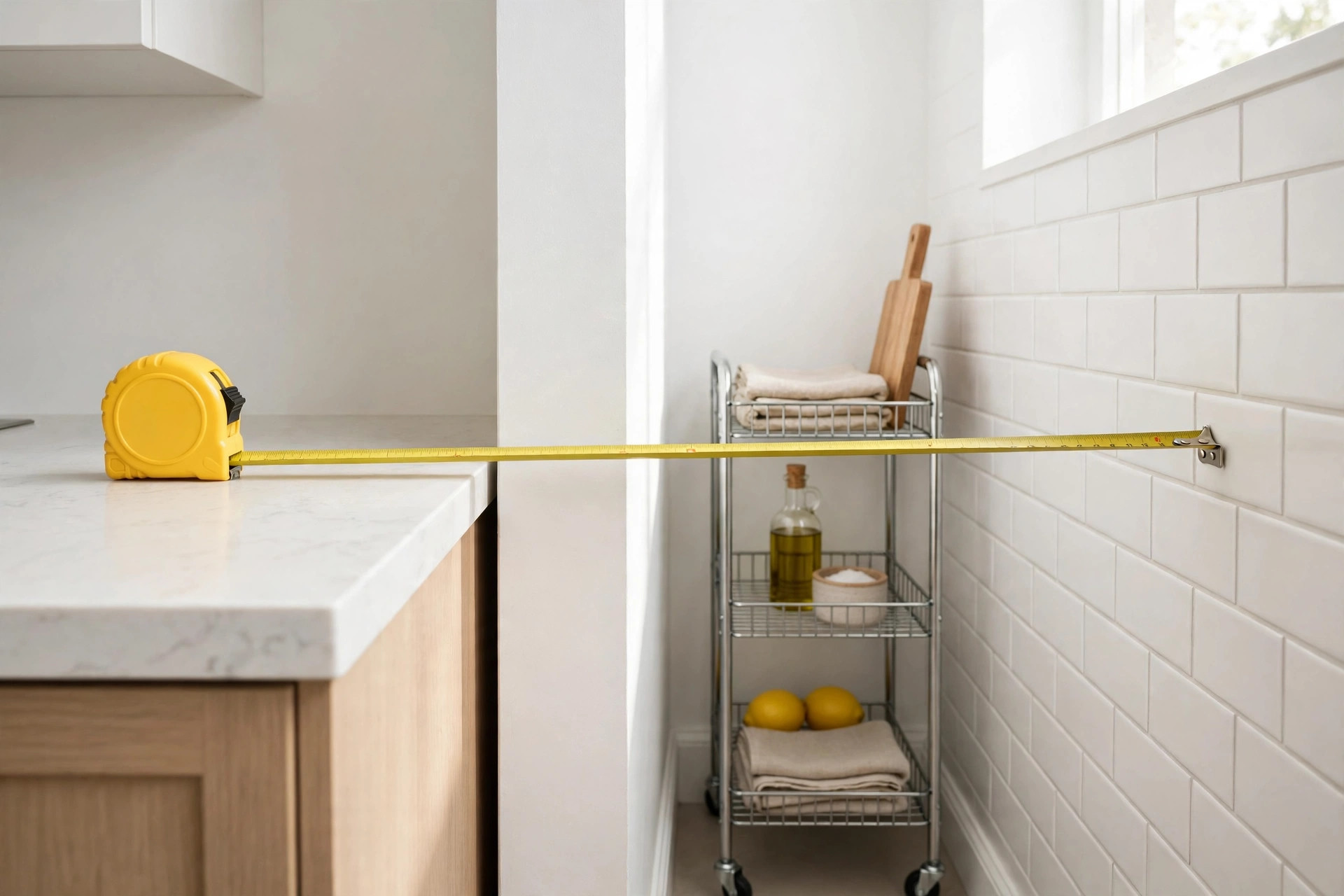
A cart that does not fit the gap is a cart that lives in the hallway, because the six inches beside the washer and the narrow strip between counter and wall are the gaps a cart is made for, and a cart that is two centimetres too wide is a cart that never gets used. Measure the gap before you buy — width, depth and height, with the tape flat against the wall — and buy a cart at least a centimetre narrower than the gap, so it rolls in and out without scraping. Measuring first also stops you buying the big cart that looks right in the shop and blocks the door at home, because the door is the one measurement people forget. Keep the tape measure in the gap while you shop, check the cart's height against the counter overhang, and never guess a measurement, because that is how the cart ends up in the hallway. Measure first, and the cart fits the gap it was bought for.
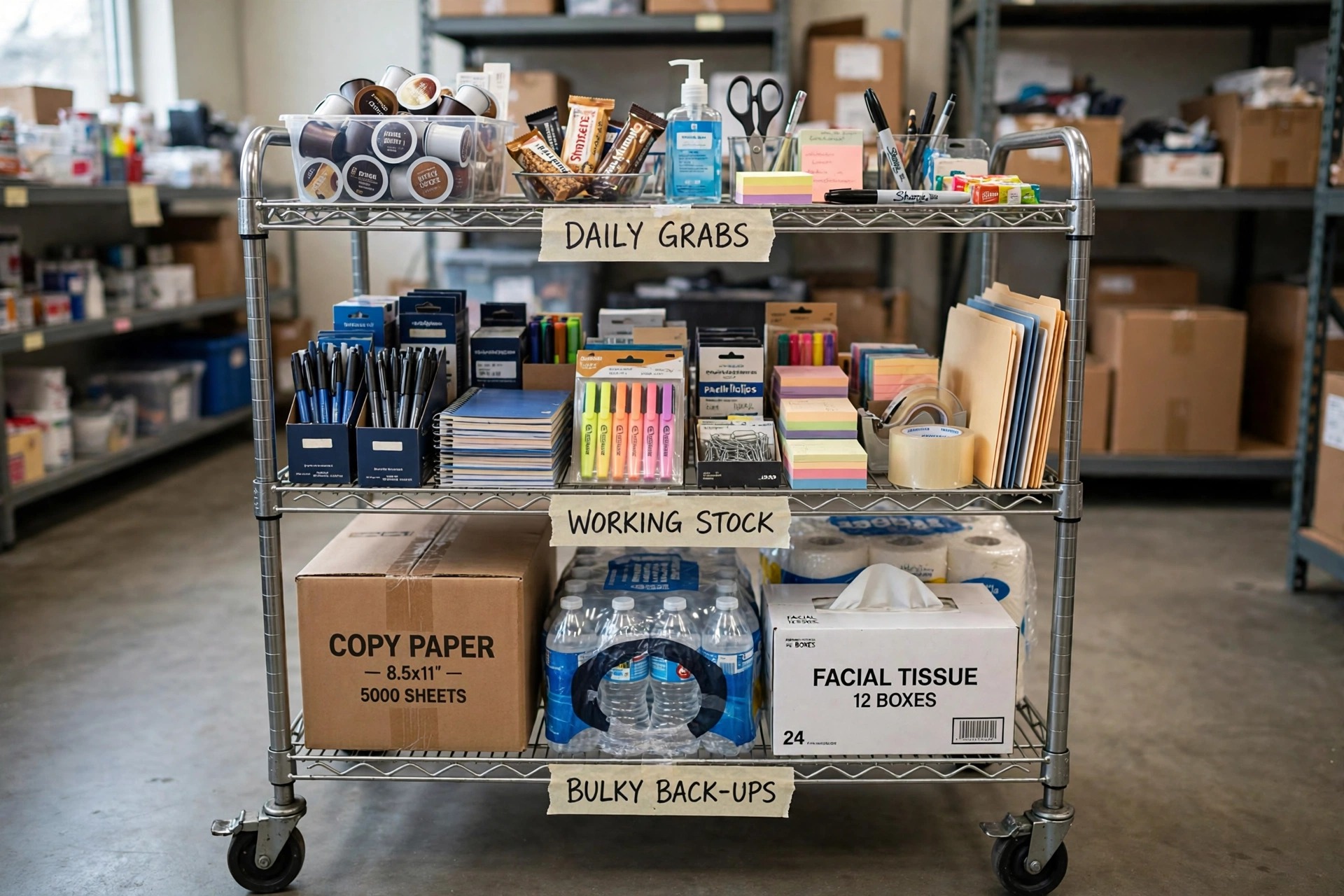
2. Three tiers for most rooms — top for daily grabs, middle for the working stock, bottom for the bulky back-ups
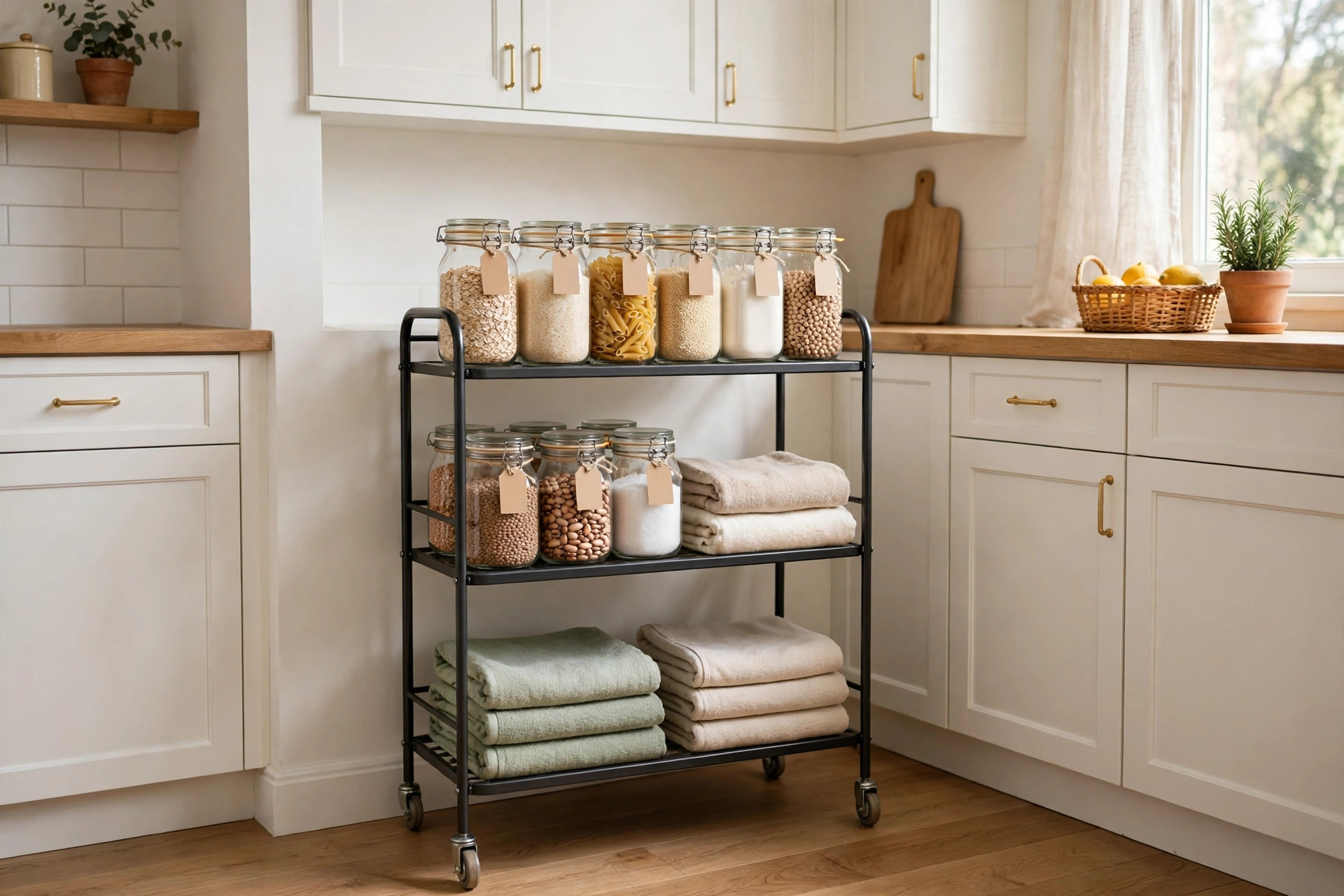
Three tiers is the setup that works in most rooms, because one tier is a tray and four tiers is a tower that tips. Put the daily grabs on top — the things you reach for every day — the working stock in the middle, and the bulky back-ups on the bottom, where their weight keeps the cart steady. Three tiers also stops the cart becoming a single pile, because each tier has one job and the job says what lives there. Keep the top tier for the daily five, the middle for the working stock, and the bottom for the bulky back-ups, and never let the bottom hold the daily things, because that is how you end up crouching for the thing you use most. Three tiers, top-middle-bottom, and the cart stops being a pile.
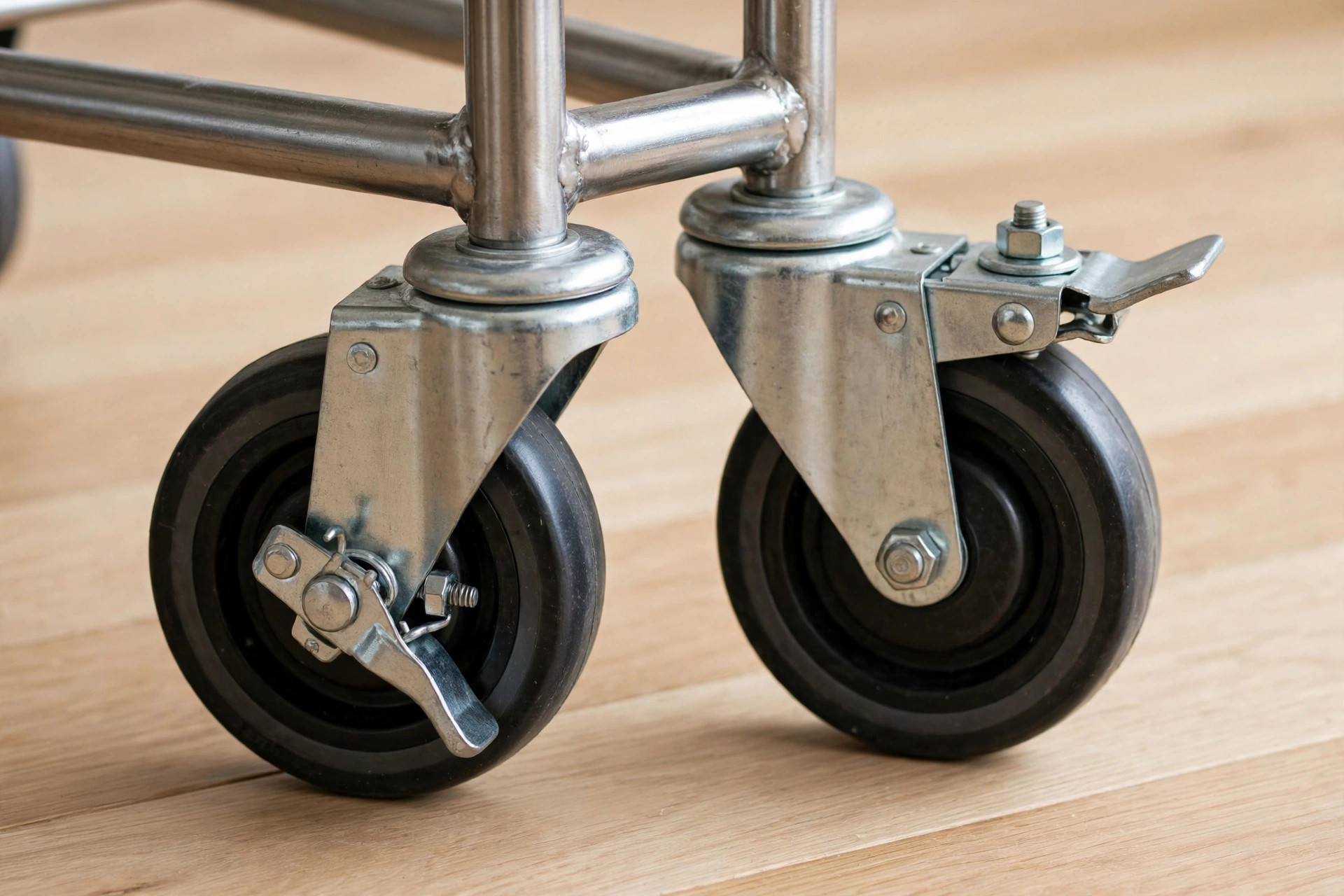
3. Locking casters are non-negotiable — a cart that rolls away mid-chop is a cart you will stop using
A cart that rolls away mid-chop is a cart you will stop using, because the cart that drifts across the kitchen while you are holding a knife is the cart you park in a corner and never touch again. Locking casters are non-negotiable — at least two wheels that lock, so the cart stays where you put it while you work and rolls when you want it to move. Locking casters also stop the cart drifting on a sloping floor, because the lock holds the wheel, not the floor. Keep the locks on while you work, unlock them to move the cart, and never buy a cart without locks to save a few pounds, because that is how the cart ends up parked for good. Locking casters, two wheels at least, and the cart stays where you put it. (Check on Amazon for a rolling cart with locking casters that fits your gap.)
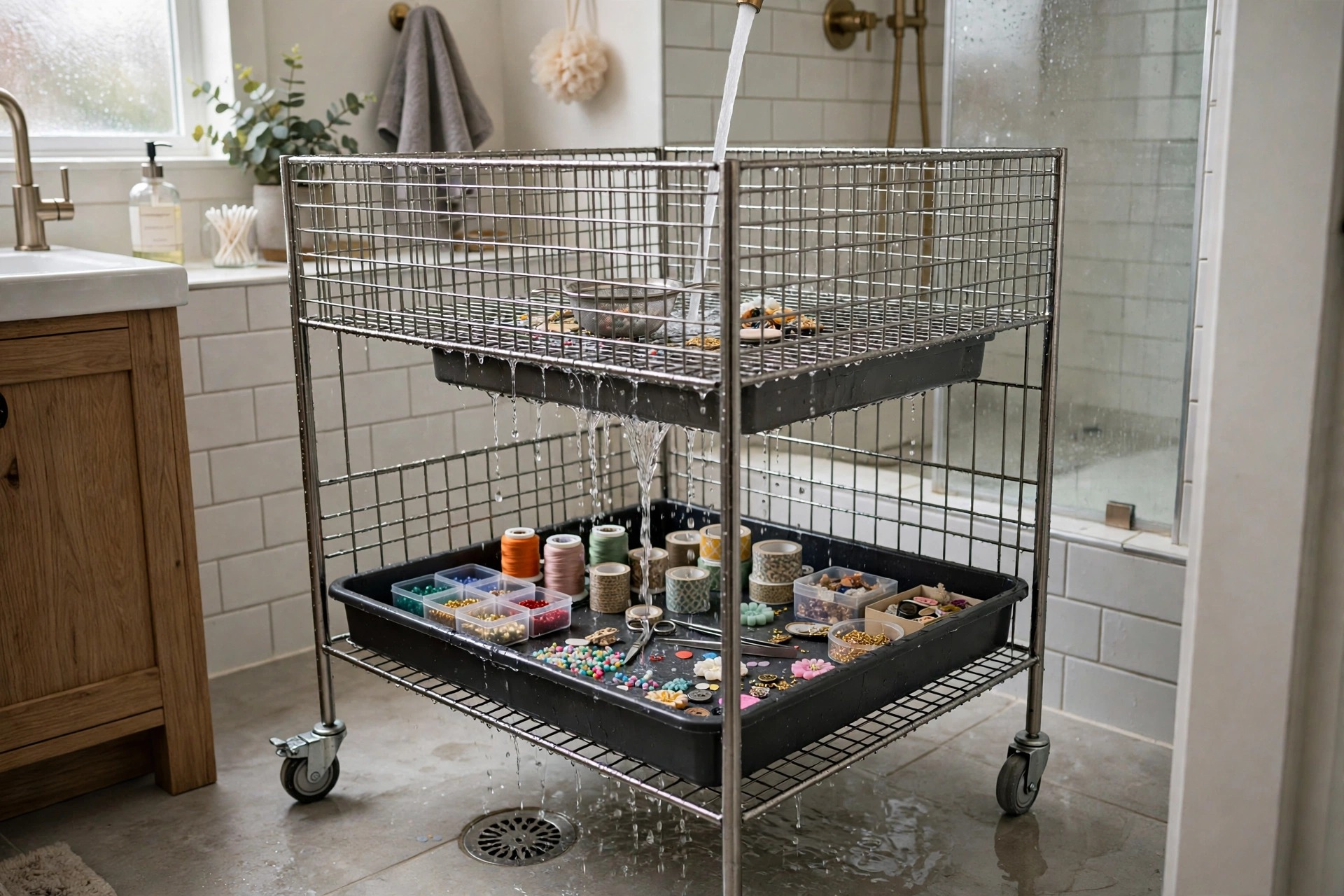
4. Metal mesh for wet rooms, solid trays for small bits — match the cart to what it will actually hold
The cart that holds the right things is the cart whose trays match what they hold, because a solid tray in a wet bathroom holds a puddle and a mesh tray in a craft corner lets the buttons fall through. Use metal mesh for wet rooms — the bathroom, the laundry, the cleaning caddy — so water drains and air moves, and solid trays for small bits — screws, beads, hair grips — so nothing falls through. Matching the tray to the contents also stops the rust that comes from standing water, because the mesh lets the tray dry. Keep mesh where water lives, solid trays where small things live, and never let a solid tray sit under a wet bottle, because that is how the puddle forms. Match the tray, and the cart holds what it is meant to hold.
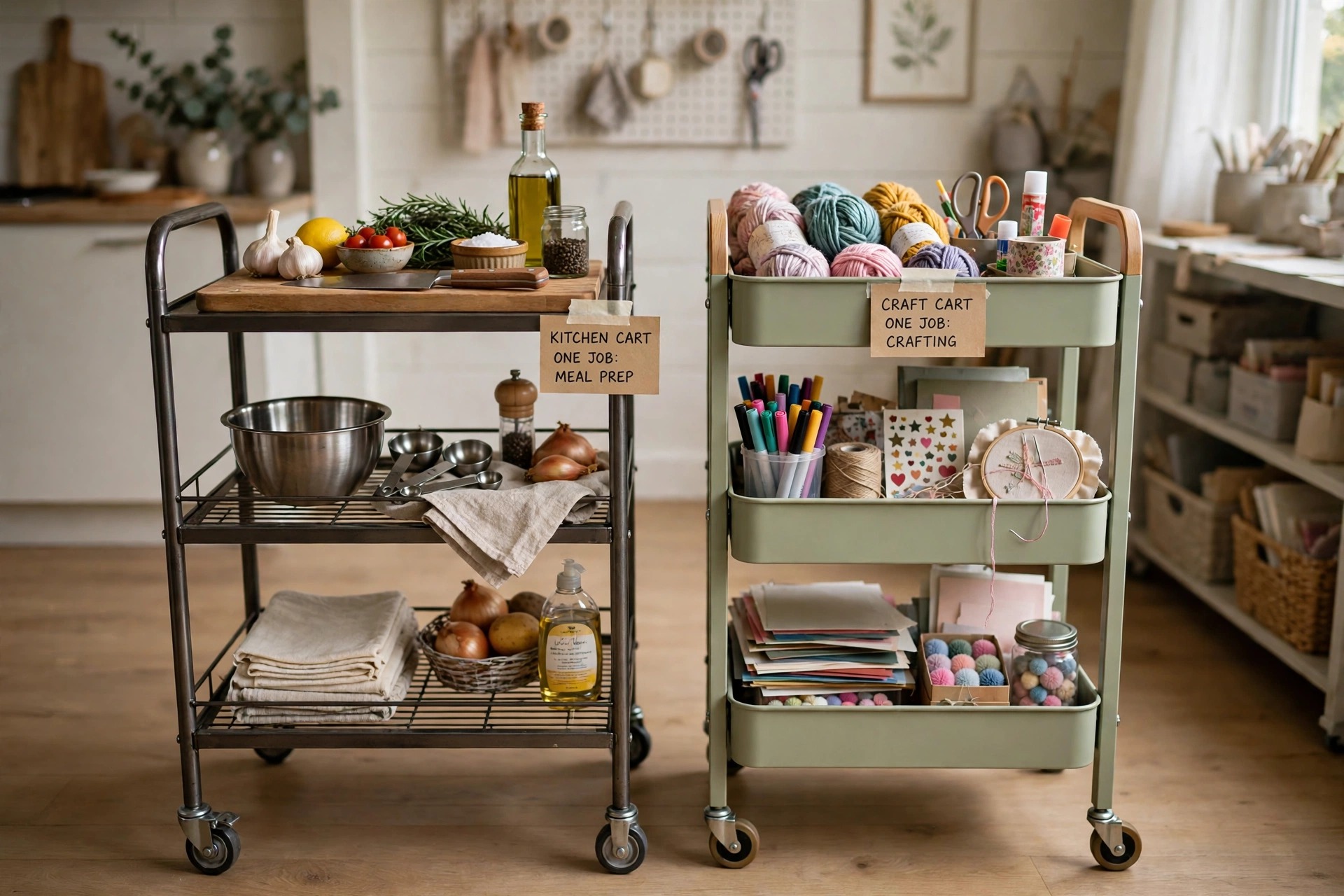
5. One cart, one job — a cart that tries to be kitchen, craft and cleaning storage ends up as none of them
A cart that tries to be kitchen, craft and cleaning storage ends up as none of them, because the craft paint ends up on the cleaning bottles and the kitchen jars end up behind the yarn. Give every cart one job — the kitchen cart holds kitchen things, the craft cart holds craft things, the cleaning cart holds cleaning things — so the cart you reach for is the cart that holds what you need. One job per cart also stops the cart becoming a dumping ground, because the job says what belongs in it and what does not. Keep one job per cart, put the job on the label, and never let a cart hold two jobs, because that is how the cart becomes a pile on wheels. One cart, one job, and the cart stops being a junk drawer.
Kitchen and pantry carts
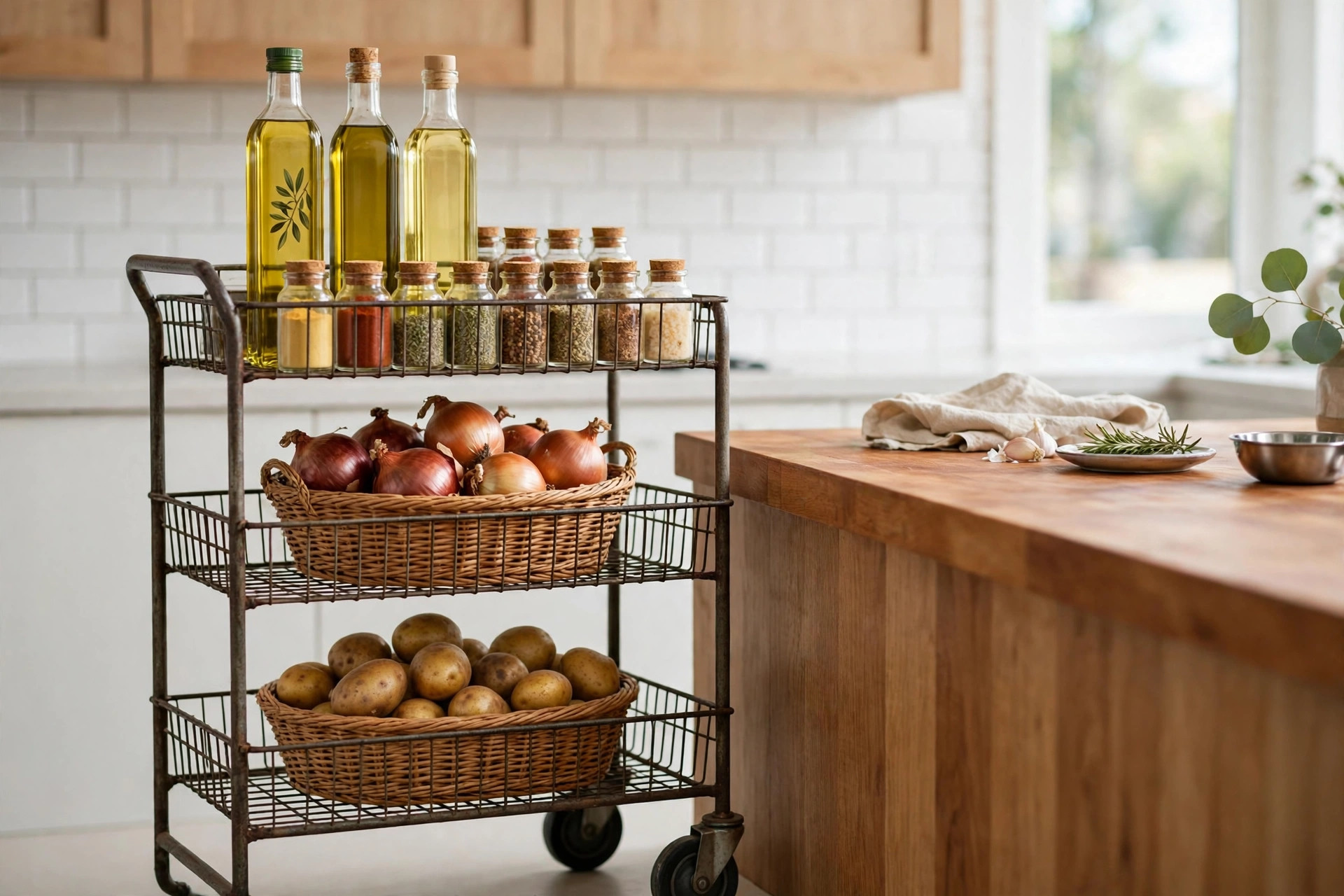
6. A produce cart by the prep counter — onions and potatoes below, oils and spices on top, in arm's reach
Onions and potatoes on the counter are a counter you cannot use, and the oils and spices in a cupboard are the ones you forget while you cook. Put a produce cart by the prep counter — onions and potatoes below, where the dark and the air keep them fresh, oils and spices on top, in arm's reach while you chop. A produce cart also stops the counter filling up with the things you cook with, because the cart holds them beside the counter, not on it. Keep the potatoes in the dark bottom tier, the oils on the top, and never let the cart hold more than the week's produce, because that is how the onions sprout. Produce below, oils on top, and the prep counter stays a prep counter.
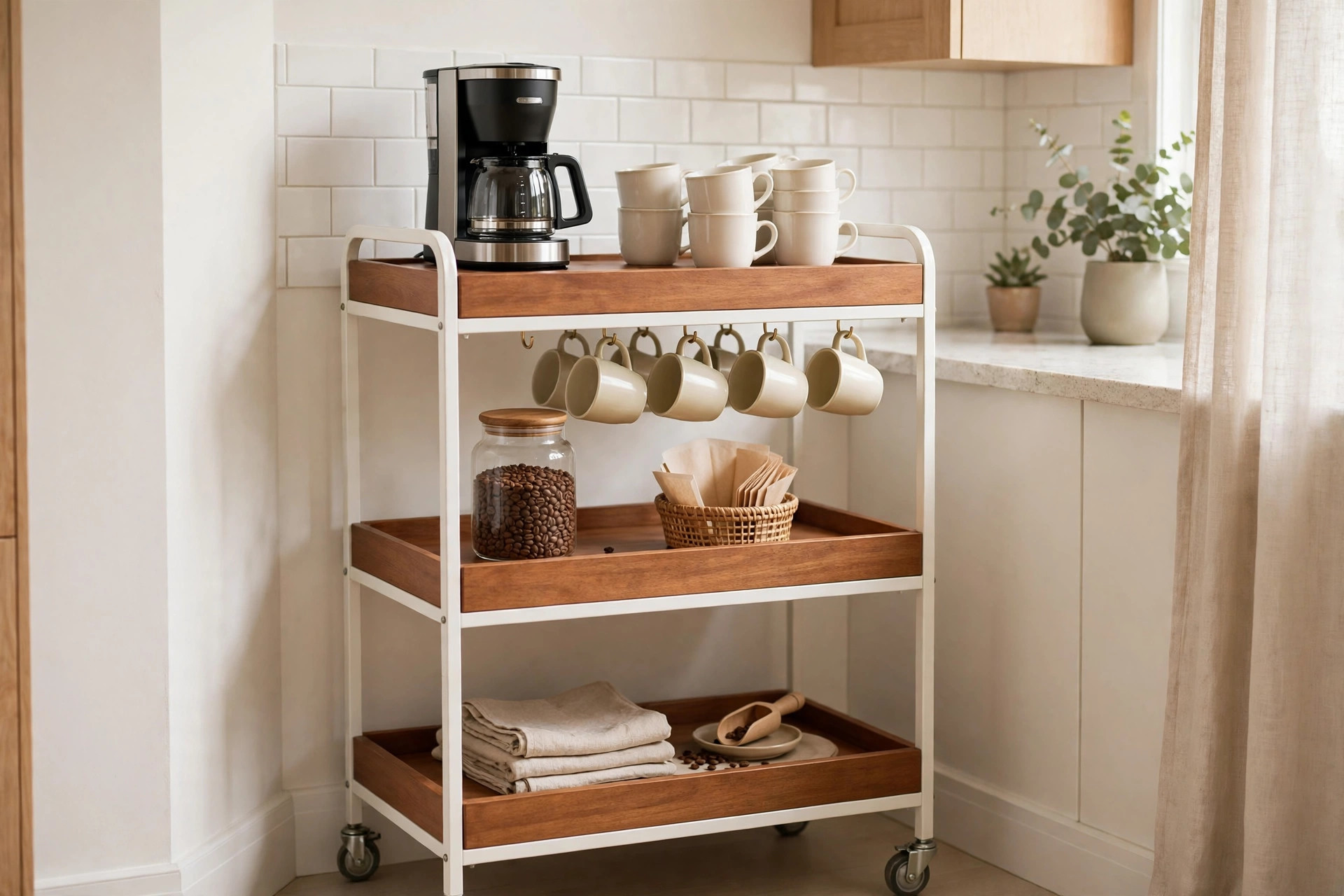
7. Turn a cart into a coffee station — mugs on top, beans and filters in the middle, spare cups below
A coffee station spread across the kitchen is a morning that starts with hunting, because the mugs are in one cupboard, the beans in another and the filters somewhere else entirely. Turn a cart into a coffee station — mugs on top, beans and filters in the middle, spare cups below — so the morning coffee is the cart you roll to the kettle. A coffee cart also stops the mugs living in three different cupboards, because the cart is the one place for everything coffee. Keep the mugs on top, the beans and filters in the middle, and never let the cart hold the tea as well, because that is how the coffee station becomes a drinks cupboard. One cart, coffee only, and the morning starts at the cart.
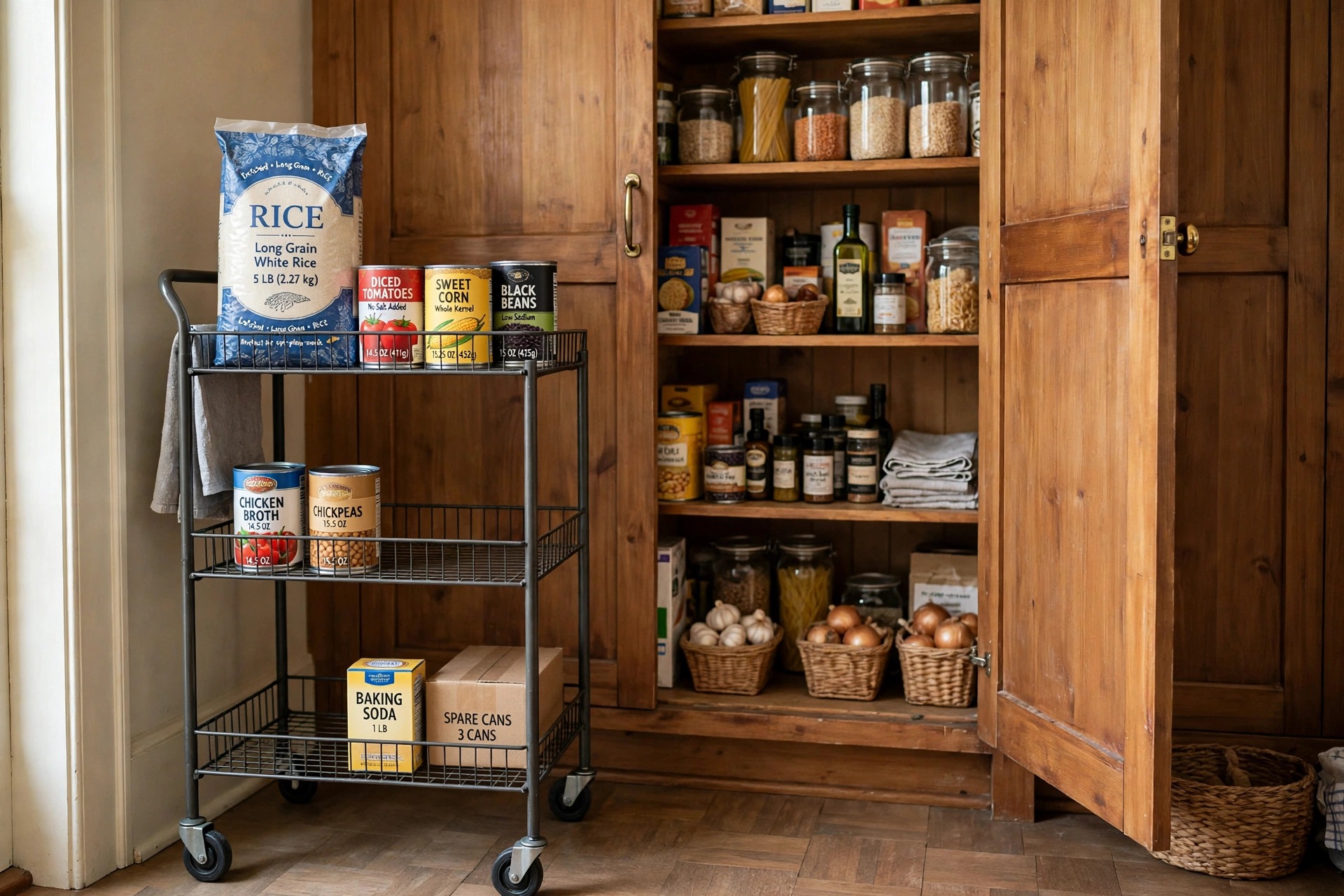
8. A pantry overflow cart for the extras — the second bag of rice and spare cans live here, not on the counter
The second bag of rice and the spare cans have to live somewhere, and the counter is the somewhere they always end up, because the pantry shelf is full and the counter is empty. Give the extras a pantry overflow cart — the second bag of rice, the spare cans, the backup oil — so the extras live beside the pantry, not on the counter. An overflow cart also stops you buying a third bag of rice because you forgot the second, because the cart shows what you already own. Keep the cart by the pantry door, restock it from the shop, and never let it hold the everyday things, because that is how the overflow becomes the pantry. Extras on the cart, everyday in the pantry, and the counter stays clear.
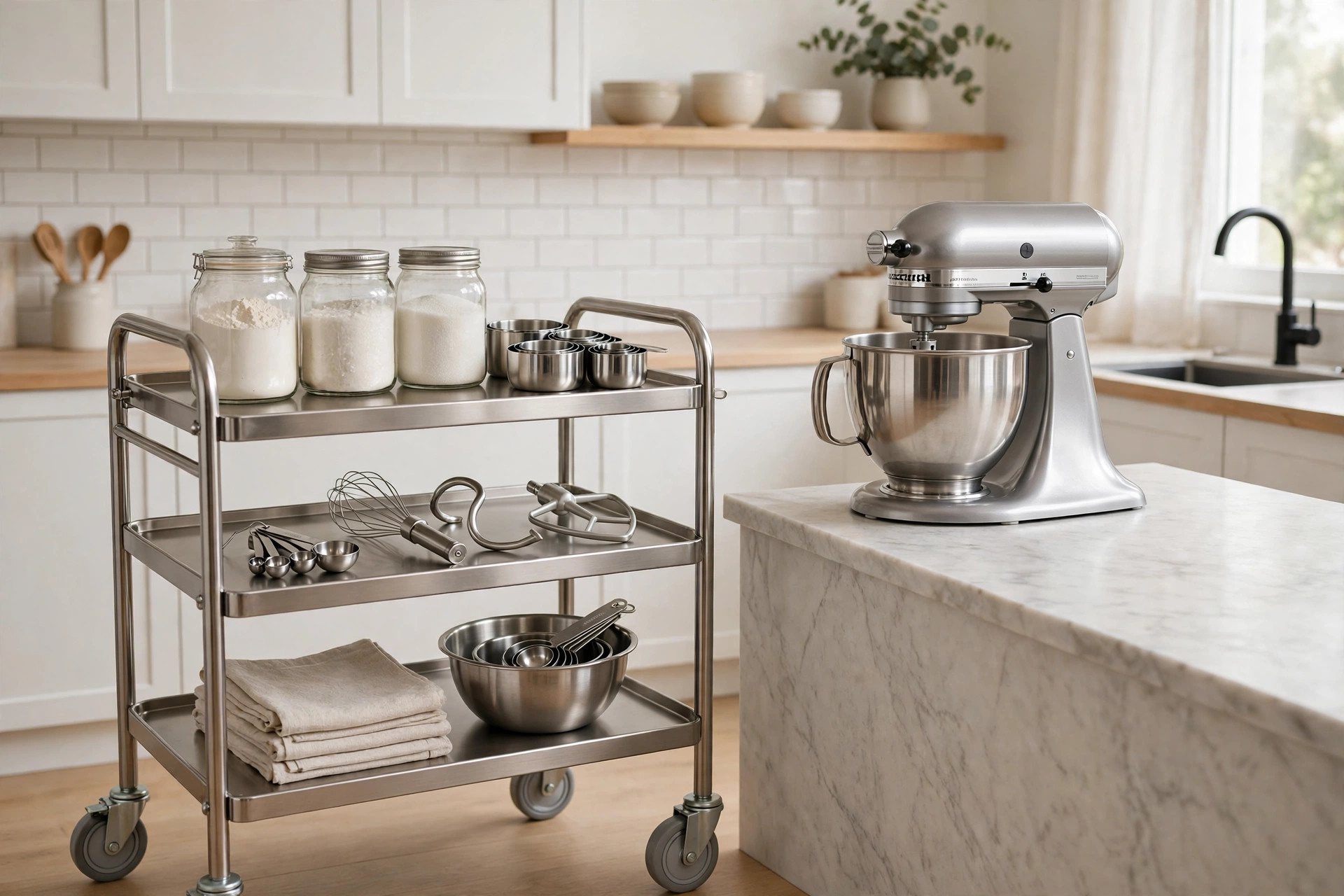
9. Baking cart with everything in one roll — flour, sugar, measuring cups and the mixer attachments together
Baking means gathering — flour from one shelf, sugar from another, measuring cups from a drawer and the mixer attachments from a box — and the gathering takes longer than the mixing. Put it all on a baking cart — flour, sugar, measuring cups and the mixer attachments together — so baking is the cart you roll to the counter. A baking cart also stops the mixer attachments living in a box you never open, because the cart holds them beside the flour. Keep the flour and sugar on the middle tier, the measuring cups on top, and never let the cart hold the everyday cooking things, because that is how the baking cart becomes a kitchen cart. Everything in one roll, and baking starts at the cart. (Check on Amazon for a rolling cart with deep trays for mixer attachments and baking tins.)
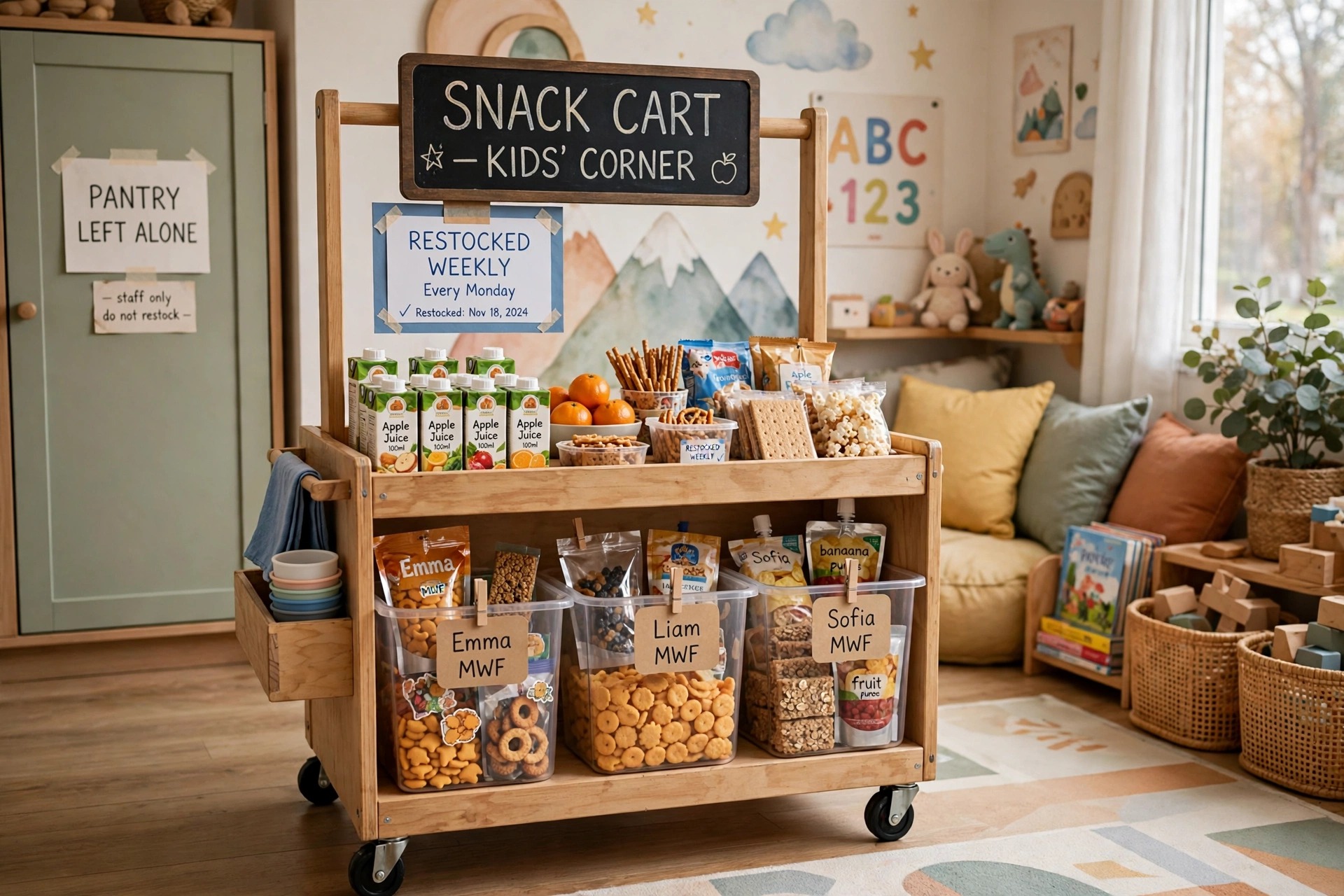
10. A snack cart for the kids' corner — labelled bins per child, restocked weekly, no more raiding the pantry
Kids raiding the pantry is how the pantry ends up empty and the snacks end up everywhere, because the snacks they can reach are the snacks they take. Give them a snack cart in their corner — labelled bins per child, restocked weekly — so the snacks they may take are the snacks on the cart, and the pantry stays for cooking. A snack cart also stops the daily negotiation about what they may eat, because the cart says what is allowed and the bins say whose is whose. Keep one bin per child, restock it on the same day every week, and never let the cart hold the cooking ingredients, because that is how the snack cart becomes a second pantry. Labelled bins, restocked weekly, and the pantry stops being raided.
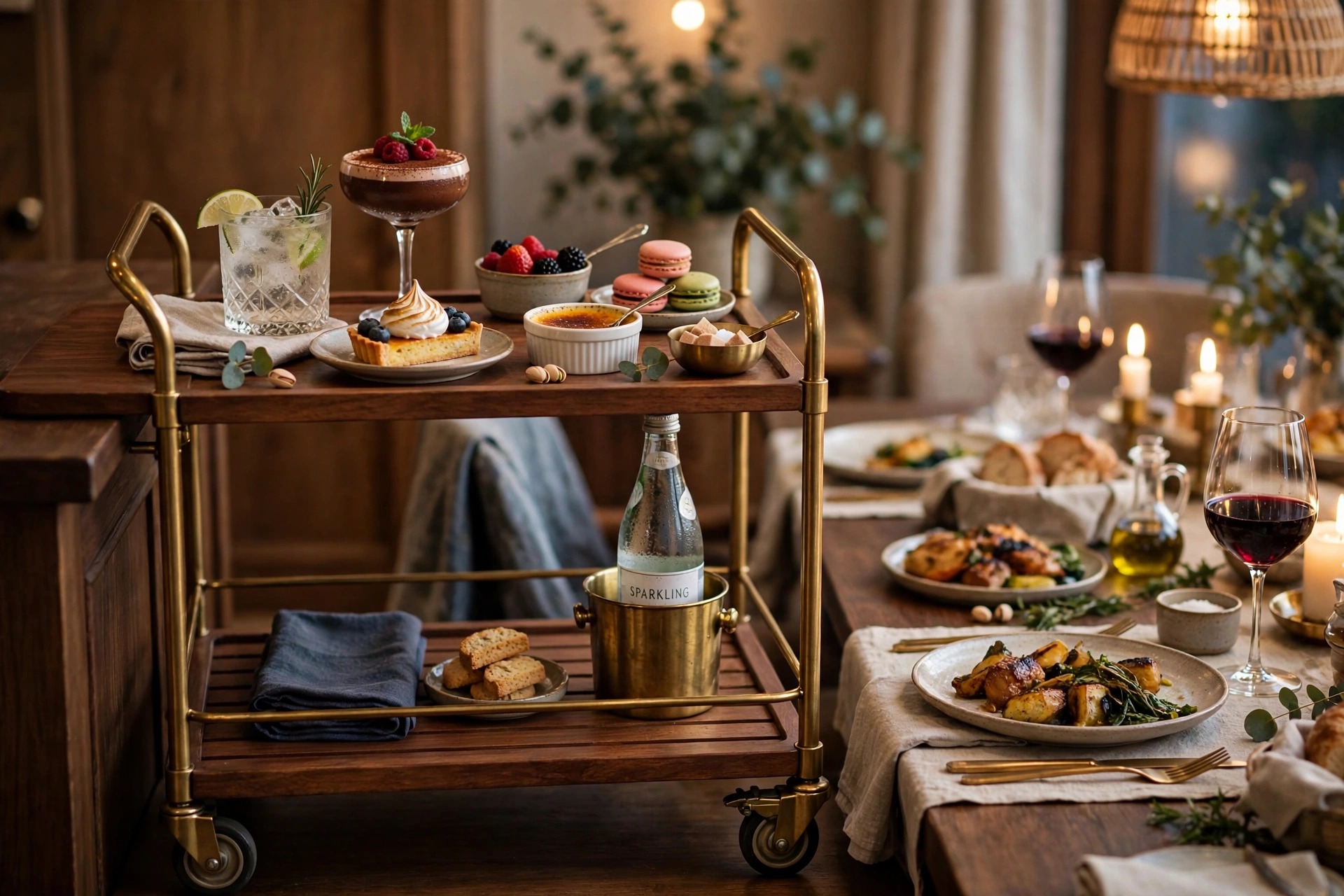
11. Park the cart as a side table at dinner — drinks and desserts roll to the table, then roll back to the kitchen
Drinks and desserts at dinner mean trips to the kitchen, and the trips mean the cook eats last, because the table holds the plates and the kitchen holds everything else. Park the cart as a side table at dinner — drinks and desserts on the cart, rolled to the table — so the table stays for plates and the cart holds the rest. A cart at the table also stops the kitchen trips, because the drinks are beside the table, not in the fridge. Keep the cart loaded before dinner, roll it back to the kitchen after, and never let it stay at the table overnight, because that is how the side table becomes a second counter. Roll to the table, roll back after, and dinner stays at the table.
Bathroom, laundry and cleaning carts
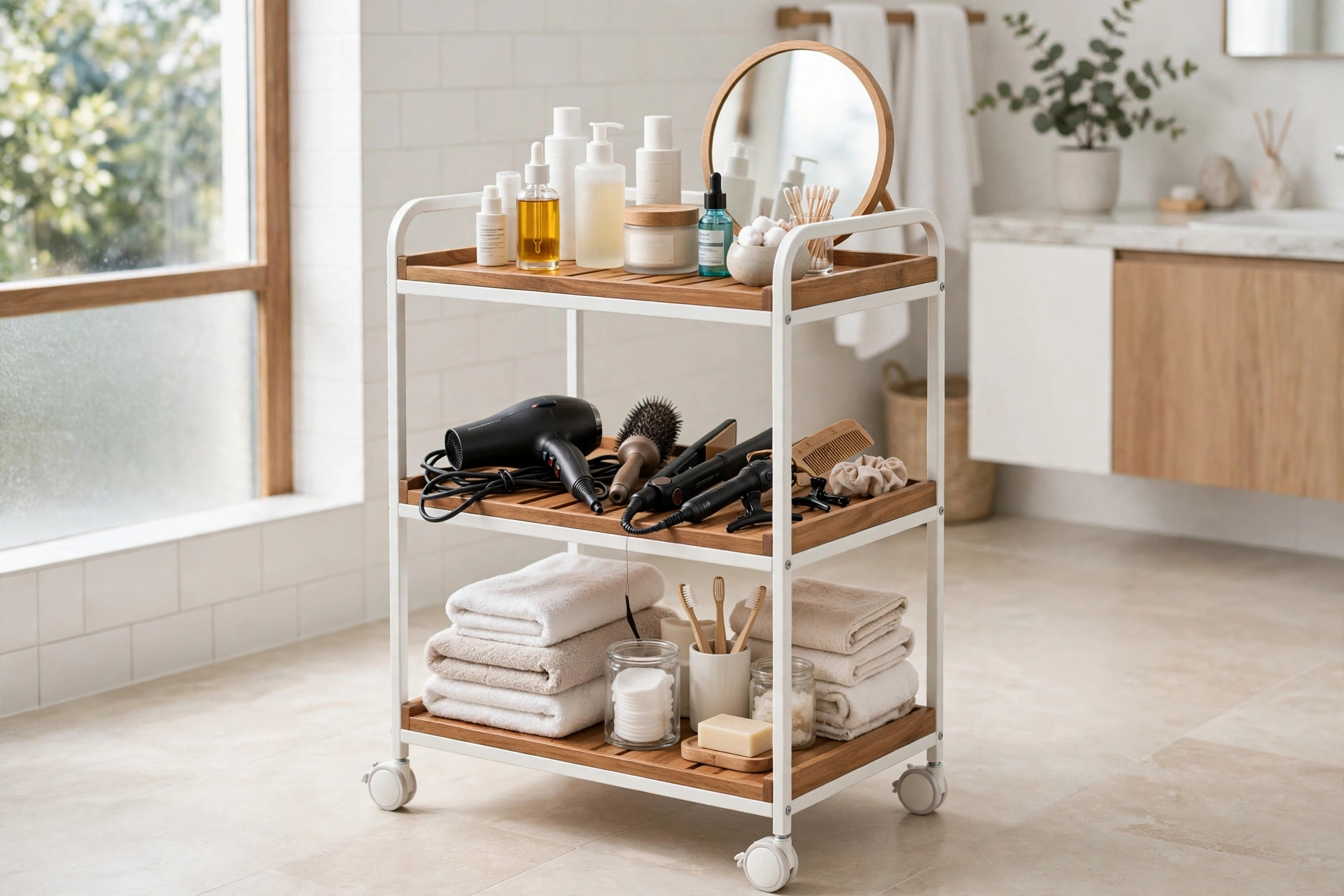
12. A bathroom cart for the morning routine — skincare on top, hair tools in the middle, spares below
A bathroom counter covered in bottles is a counter you cannot use, and the skincare in a cupboard is the skincare you forget. Give the morning routine a bathroom cart — skincare on top, hair tools in the middle, spares below — so the routine is the cart you roll to the mirror. A bathroom cart also stops the counter filling up, because the cart holds the routine beside the sink, not on it. Keep the skincare on top, the hair tools in the middle, and never let the cart hold the cleaning things, because that is how the bathroom cart becomes a cleaning cart. Skincare on top, tools in the middle, and the counter stays clear.
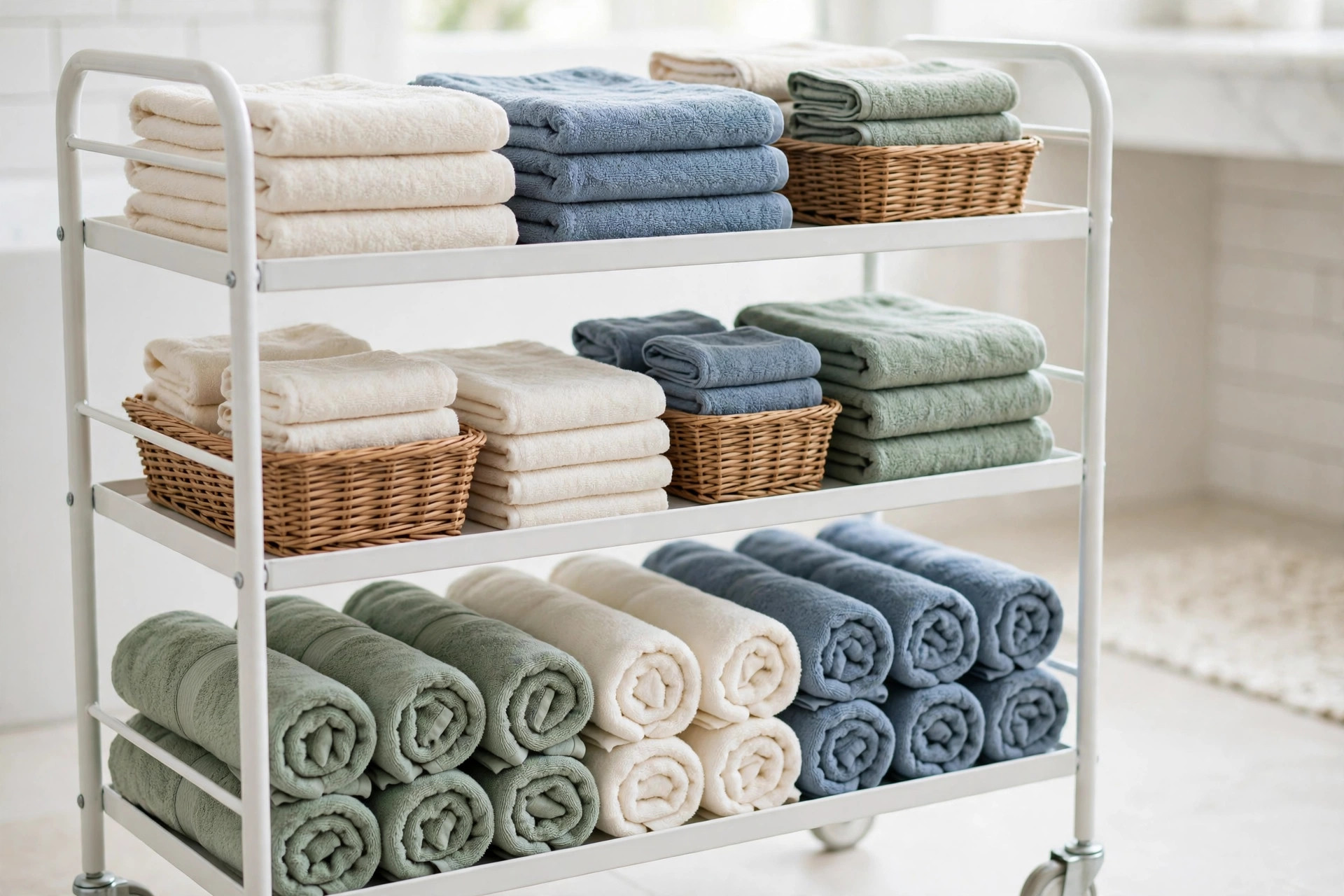
13. Towels rolled, not folded, on the bottom tier — you can see every colour and grab one-handed
Towels folded in a stack are towels you cannot see, and the towel you want is always the one at the bottom. Roll them instead, in neat rows on the bottom tier of the cart — you can see every colour at a glance and grab one-handed, without the stack toppling. Rolled towels also stop the stack leaning, because a roll stands on its own and the rows hold each other upright. Keep one colour per row, roll them tight, and never let the bottom tier hold the folded things, because that is how the stack comes back. Rolled, not folded, on the bottom tier, and the towels stop hiding.
14. A laundry cart that follows the load — detergent and stain spray on top, clean folded clothes below
Laundry means carrying — detergent from the shelf, stain spray from the cupboard, clean clothes from the machine — and the carrying is how the load gets left in the machine. Give the load a laundry cart that follows it — detergent and stain spray on top, clean folded clothes below — so the cart rolls from washer to dryer to folding pile. A laundry cart also stops the detergent living on top of the machine, because the cart holds it beside the washer. Keep the detergent on top, the folded clothes below, and never let the cart hold the dirty laundry, because that is how the clean and the dirty get mixed. One cart, following the load, and the laundry stops being carried.
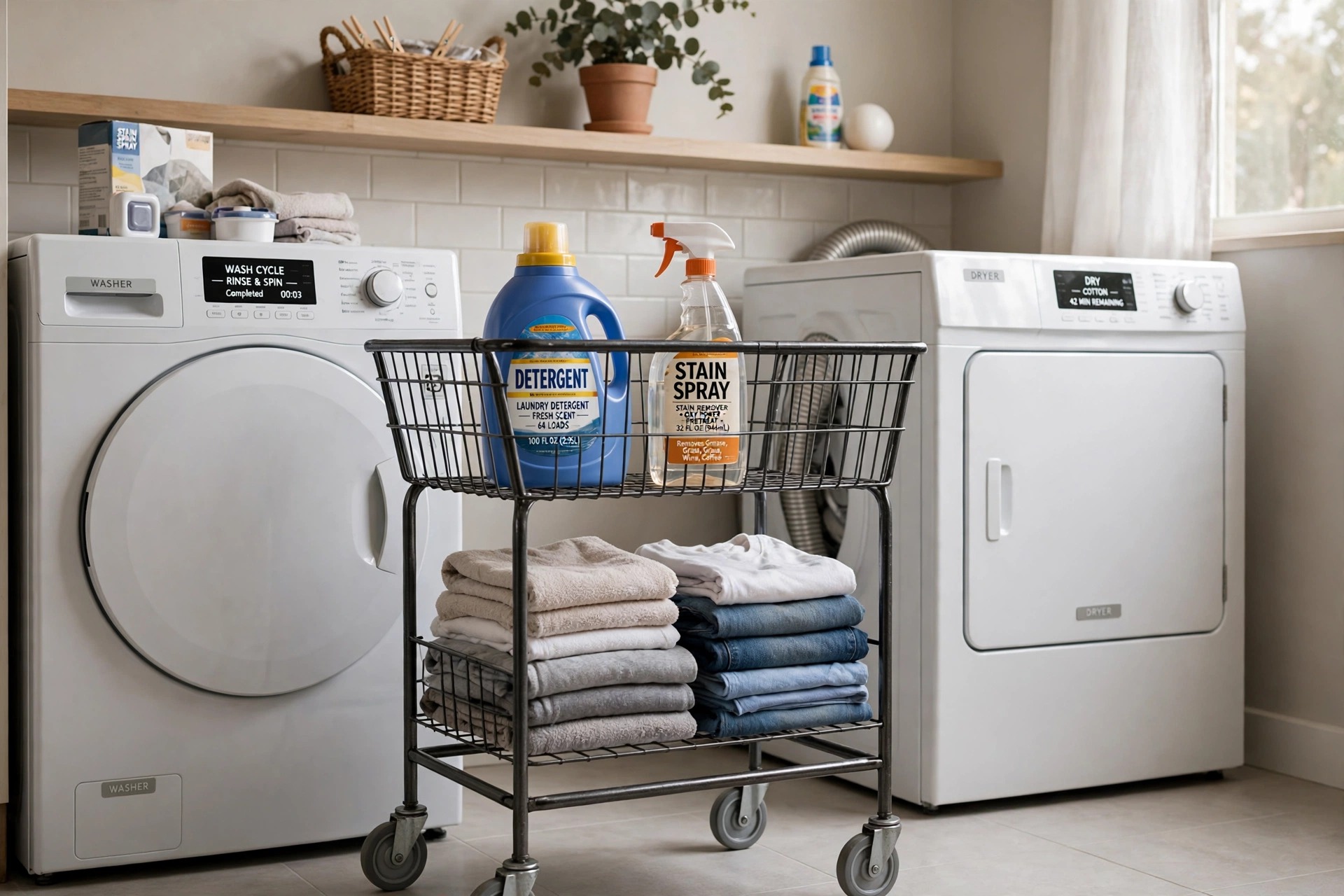
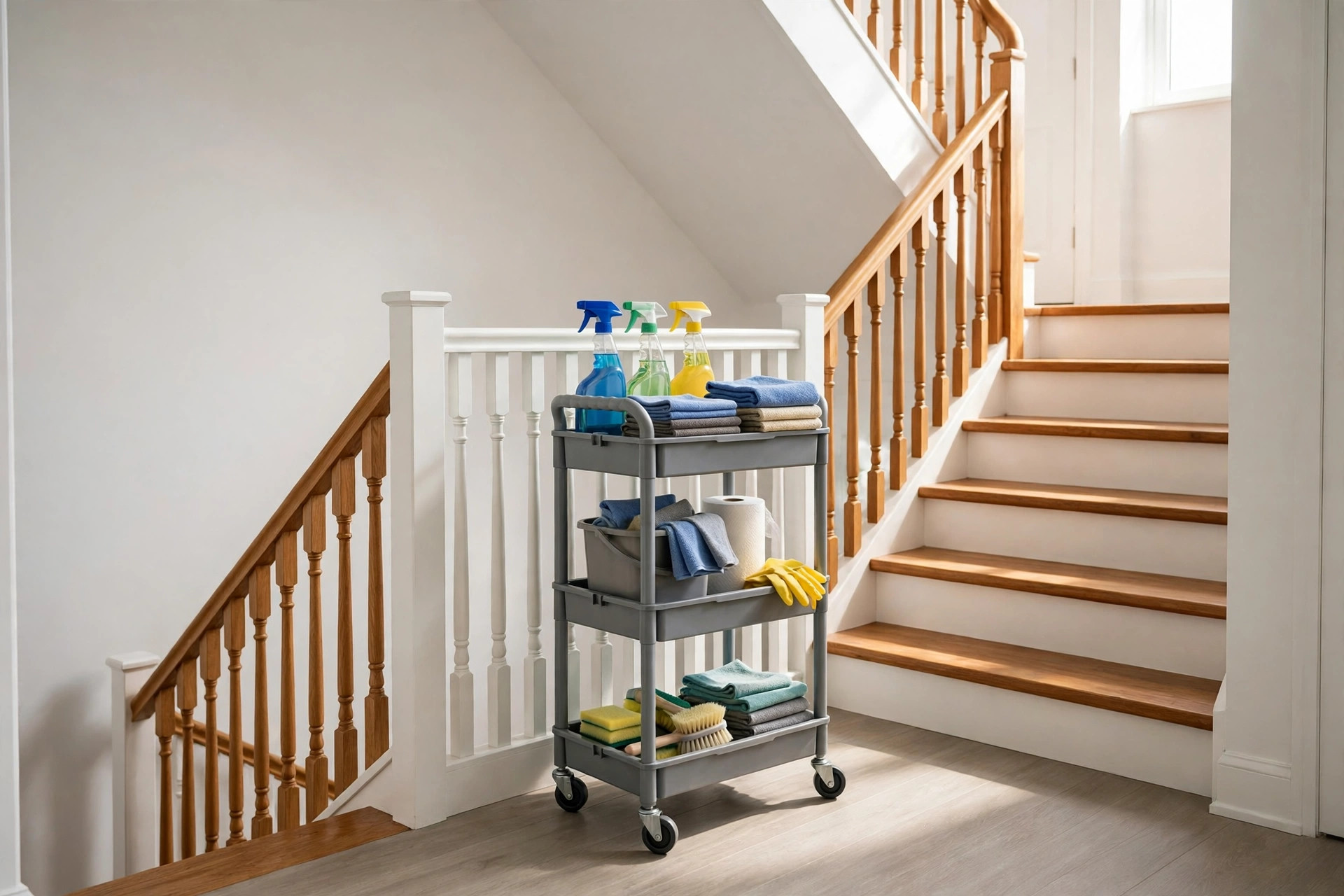
15. Cleaning caddy on wheels — one cart per floor, stocked once, so you stop carrying bottles up the stairs
Carrying cleaning bottles up the stairs is how the upstairs never gets cleaned, because the bottles are downstairs and the stairs are the trip you skip. Put the cleaning on wheels — one cart per floor, stocked once — so the cart lives on the floor it cleans and you stop carrying bottles up the stairs. A caddy per floor also stops the bottles living in one cupboard downstairs, because each floor has its own stocked cart. Keep one cart per floor, stock it once a week, and never let a cart hold the other floor's things, because that is how the carrying starts again. One cart per floor, stocked once, and the stairs stop being a trip.
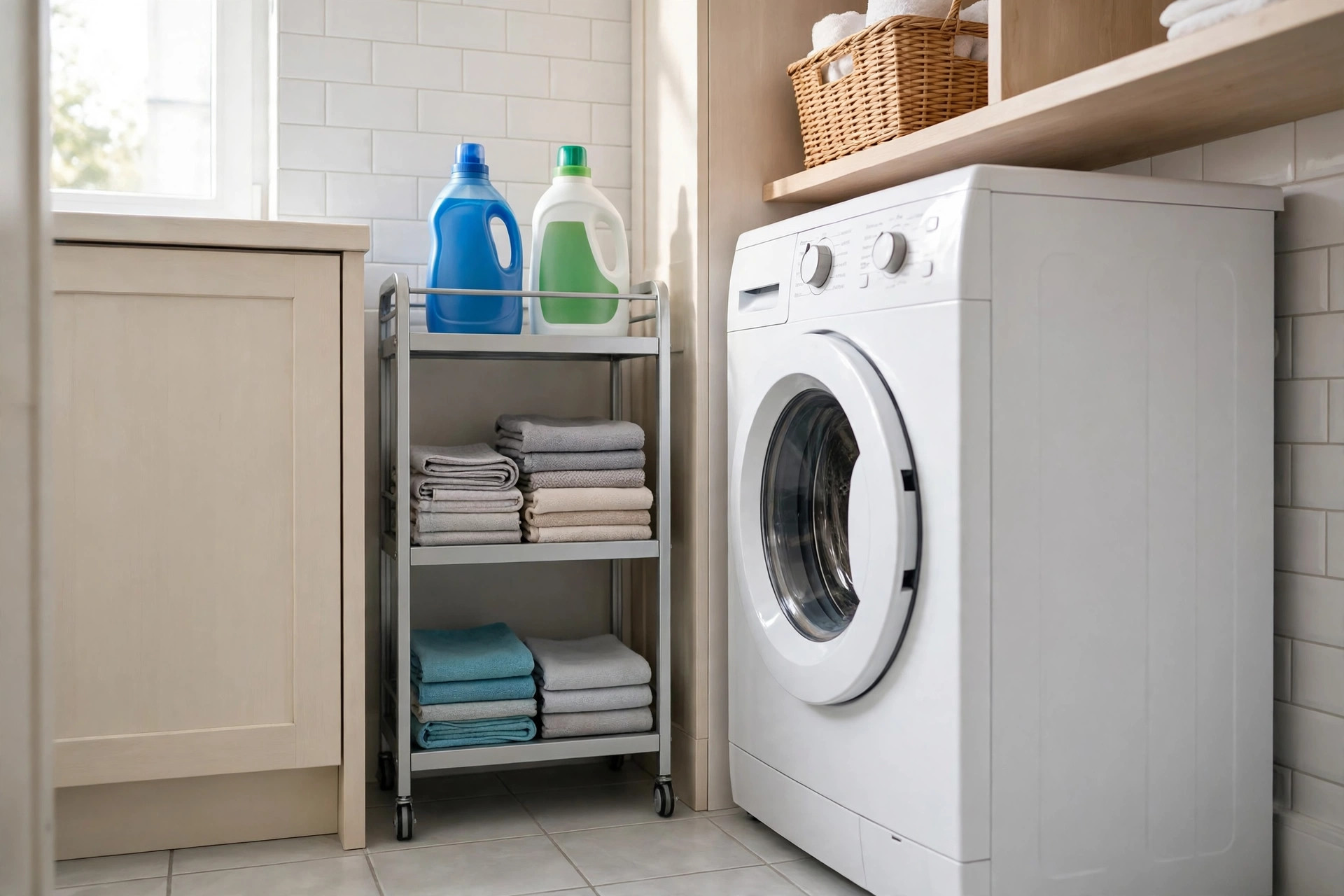
16. A narrow cart in the gap beside the washer — the dead six inches becomes detergent and cloth storage
The six inches beside the washer is dead space, and dead space is how the detergent ends up on top of the machine, because there is nowhere else for it to go. Put a narrow cart in the gap — the dead six inches becomes detergent and cloth storage — so the detergent lives beside the washer, not on top of it. A narrow cart also stops the gap collecting dust, because the cart fills it and rolls out when you need it. Keep the detergent on the top tier, the cloths below, and never let the cart hold more than the gap allows, because that is how it stops rolling. Six inches, one slim cart, and the dead space starts working. (Check on Amazon for a slim rolling cart that fits a six-inch gap beside a washer.)
17. Keep medicines and first aid on the top tier only — high, visible, and never buried under towels
Medicines buried under towels are medicines you cannot find when you need them, and the first aid kit at the bottom of a pile is the kit you never reach in time. Keep medicines and first aid on the top tier only — high, visible, and never buried under towels — so the thing you need in a hurry is the thing you can see. The top tier also stops the medicines getting damp, because the top is the driest tier and the towels below stay below. Keep the first aid kit on top, check the dates every month, and never let a towel sit on top of the medicines, because that is how they get buried. Top tier only, high and visible, and the medicines stop hiding.

Craft, office and a cart that stays tidy
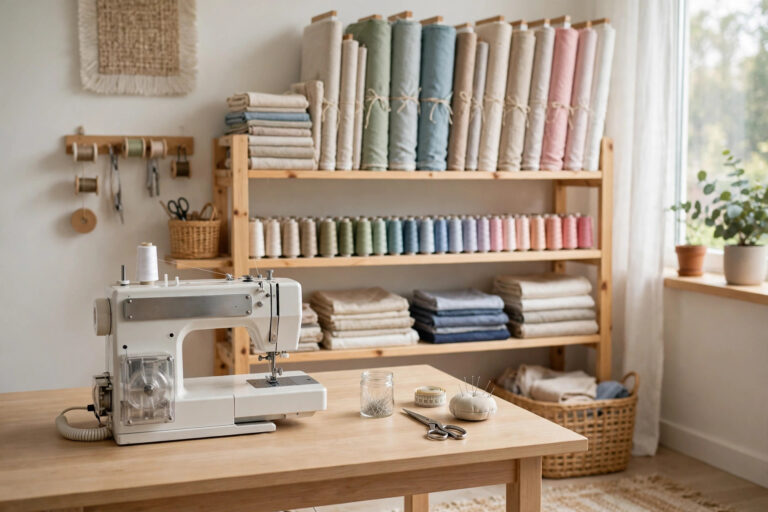
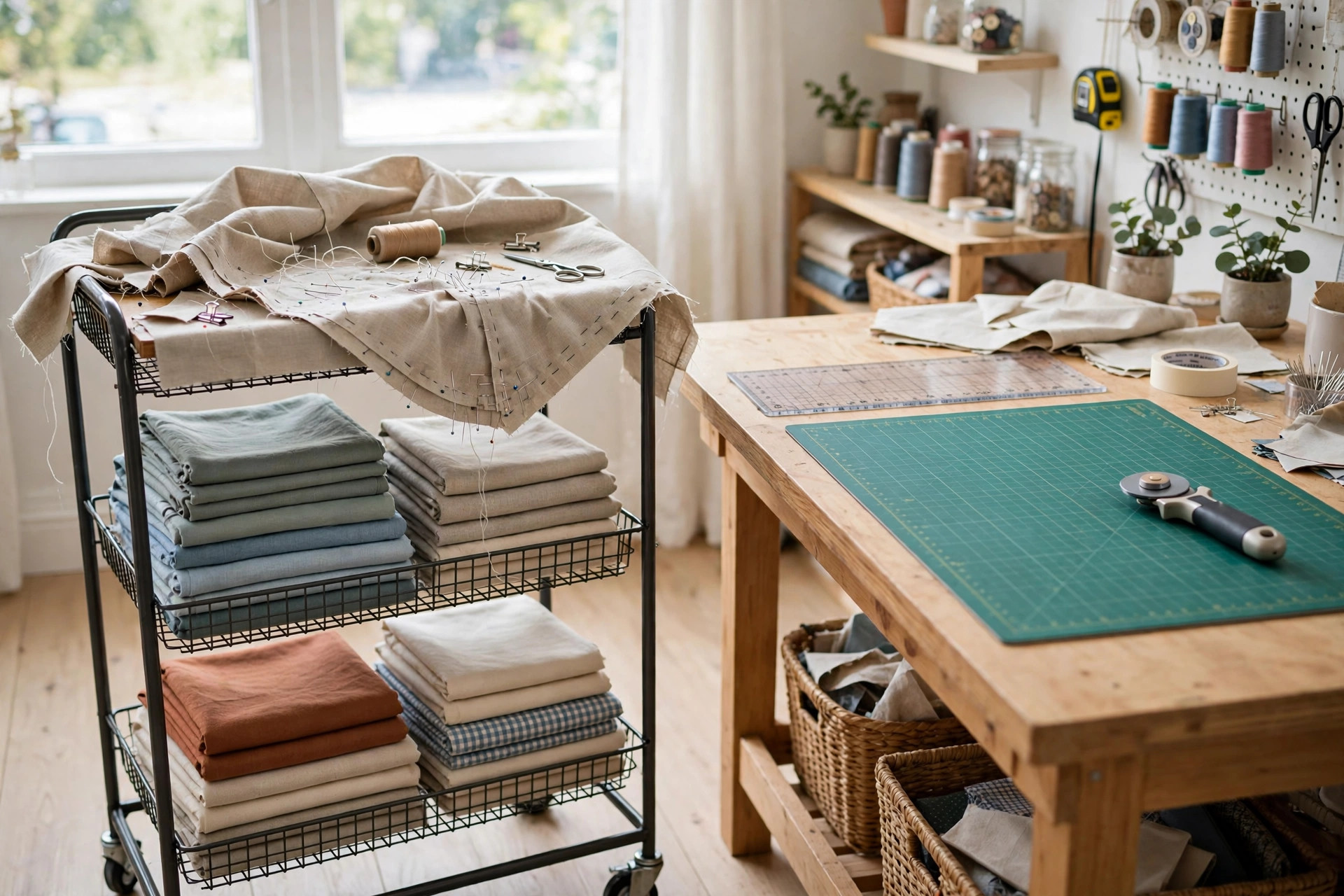
18. A sewing project cart — current make on top, fabric below, wheels for the cutting table (see Post 17)
A current make spread across the table is a make that takes the whole room, because the fabric, the pattern and the half-sewn pieces spread until there is no room left to sew. Give the project a rolling cart — current make on top, fabric below, wheels so it rolls to the cutting table when you need it and away when you do not — so the project lives in one station, not across the whole room. The sewing project cart is the same idea in detail in Post 17, where the cart holds the current make beside the machine. Keep the cart to the current project only, park it by the cutting table when you sew, and never let the cart hold the everyday kit, because that is how the table disappears again. One cart, make on top, fabric below, and the project stops taking over.
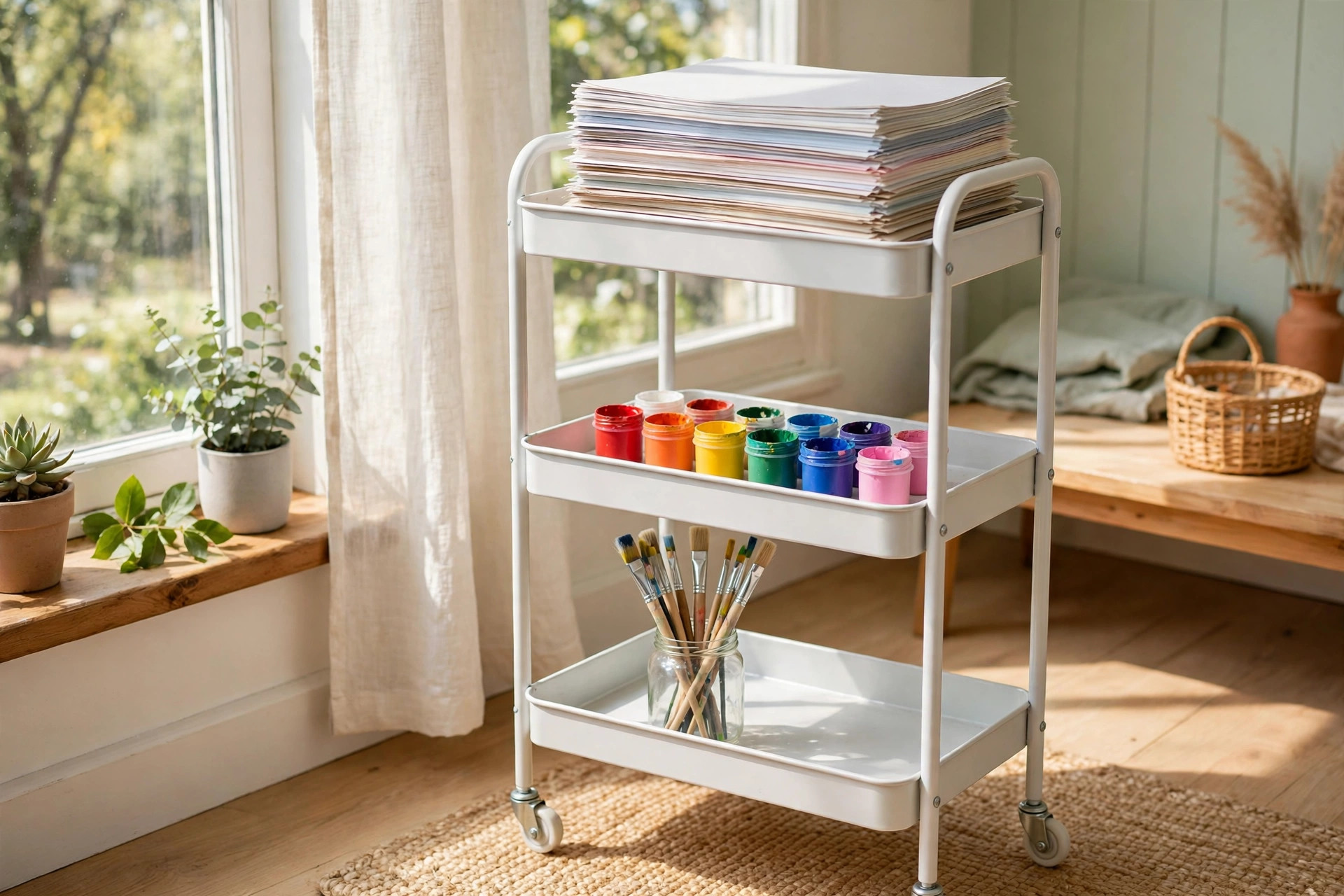
19. An art supply cart for the kids — paper on top, paints in the middle, brushes in a jar that never tips
Art supplies on the table are a table you cannot eat on, and the paints in a box are the paints nobody opens. Give the kids an art supply cart — paper on top, paints in the middle, brushes in a jar that never tips — so the art lives on the cart and the table stays a table. An art cart also stops the paints living in three different boxes, because the cart is the one place for them. Keep the paper on top, the paints in the middle, and never let the cart hold the homework things, because that is how the art cart becomes a homework cart. Paper on top, paints in the middle, and the art stops taking over the table.
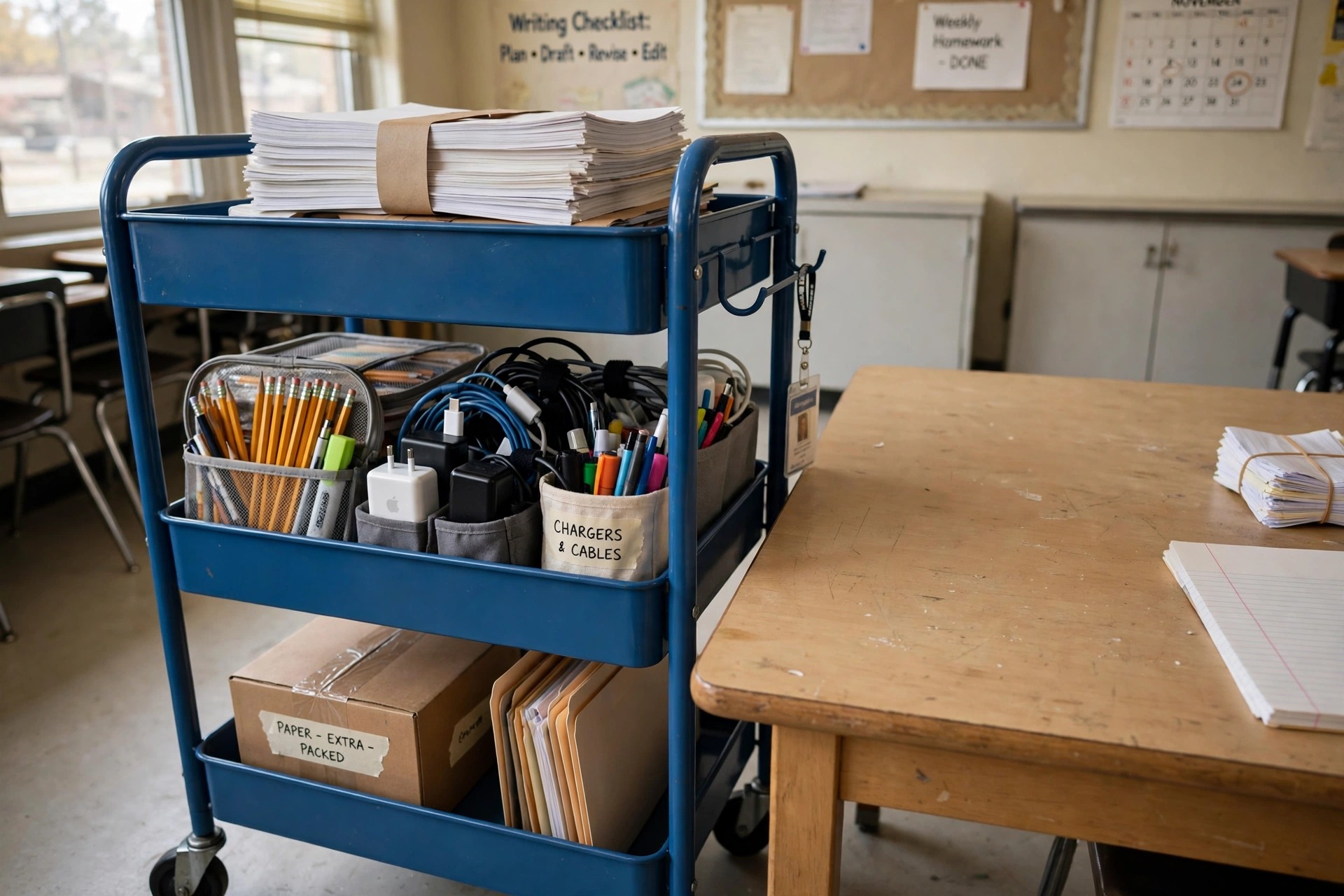
20. A homework cart that rolls to the table — pencils, paper and chargers in one place, packed away after
Homework spread across the house is homework that never gets finished, because the pencils are in one room, the paper in another and the charger somewhere else entirely. Give it a homework cart that rolls to the table — pencils, paper and chargers in one place — so homework is the cart you roll out and pack away after. A homework cart also stops the pencils living in every room, because the cart is the one place for them. Keep the pencils and paper on top, the chargers in the middle, and never let the cart stay out after homework, because that is how the homework cart becomes a permanent fixture. Roll out, pack away, and the homework stops spreading.
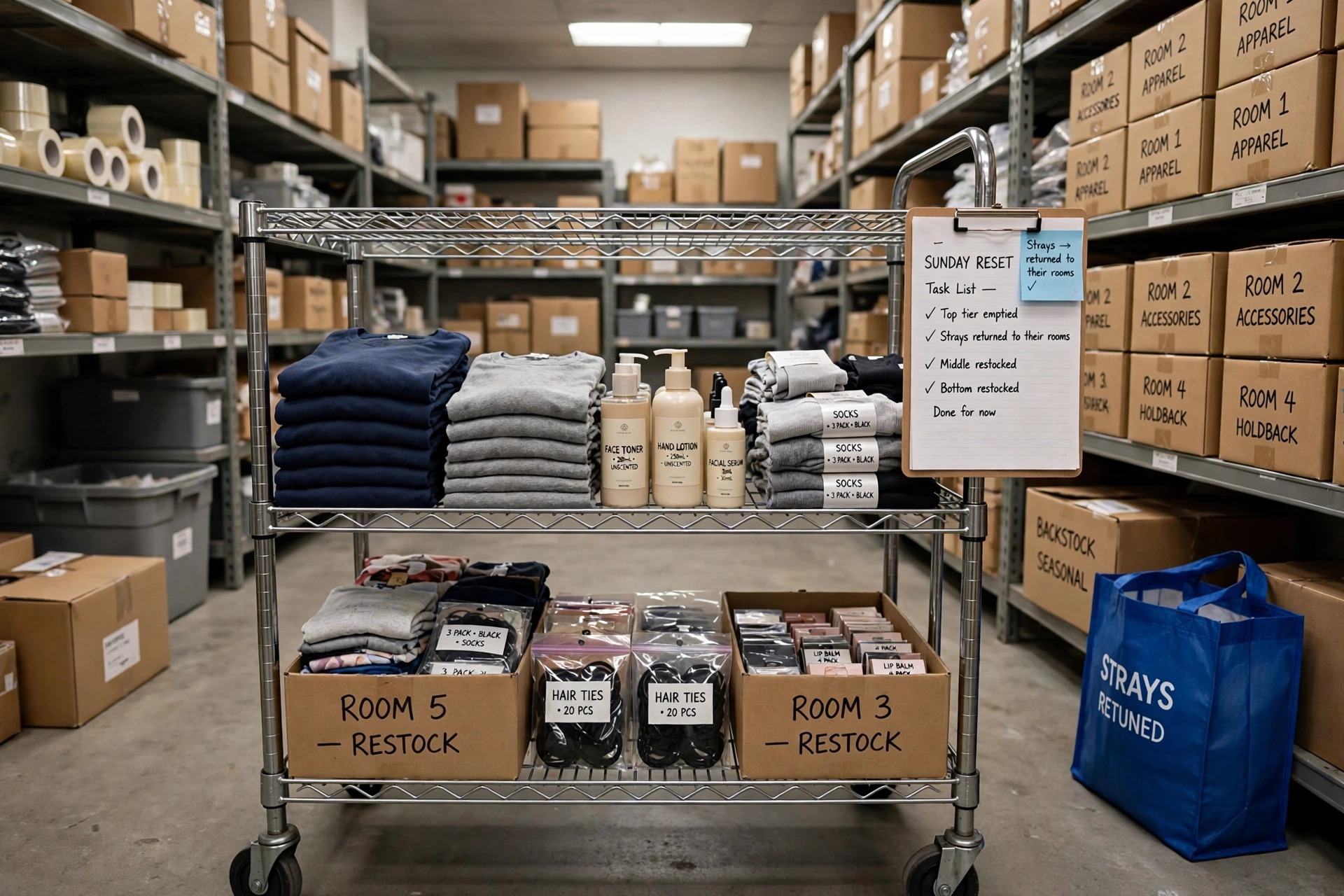
21. A five-minute reset every Sunday — empty the top tier, return strays to their rooms, restock the middle
A cart stays tidy with a small habit every week, not a heroic clear-out once a month. Every Sunday, for five minutes, empty the top tier, return the strays to their rooms, and restock the middle, so the cart never drifts back into a pile. The five-minute reset is small enough to do before the next thing, and it stops the slow drift that turns a tidy cart into a junk cart in a week. Keep the reset on the same day every week, and make it part of the week, not an extra chore. Five minutes every Sunday, and the cart never needs a big clear-out again.
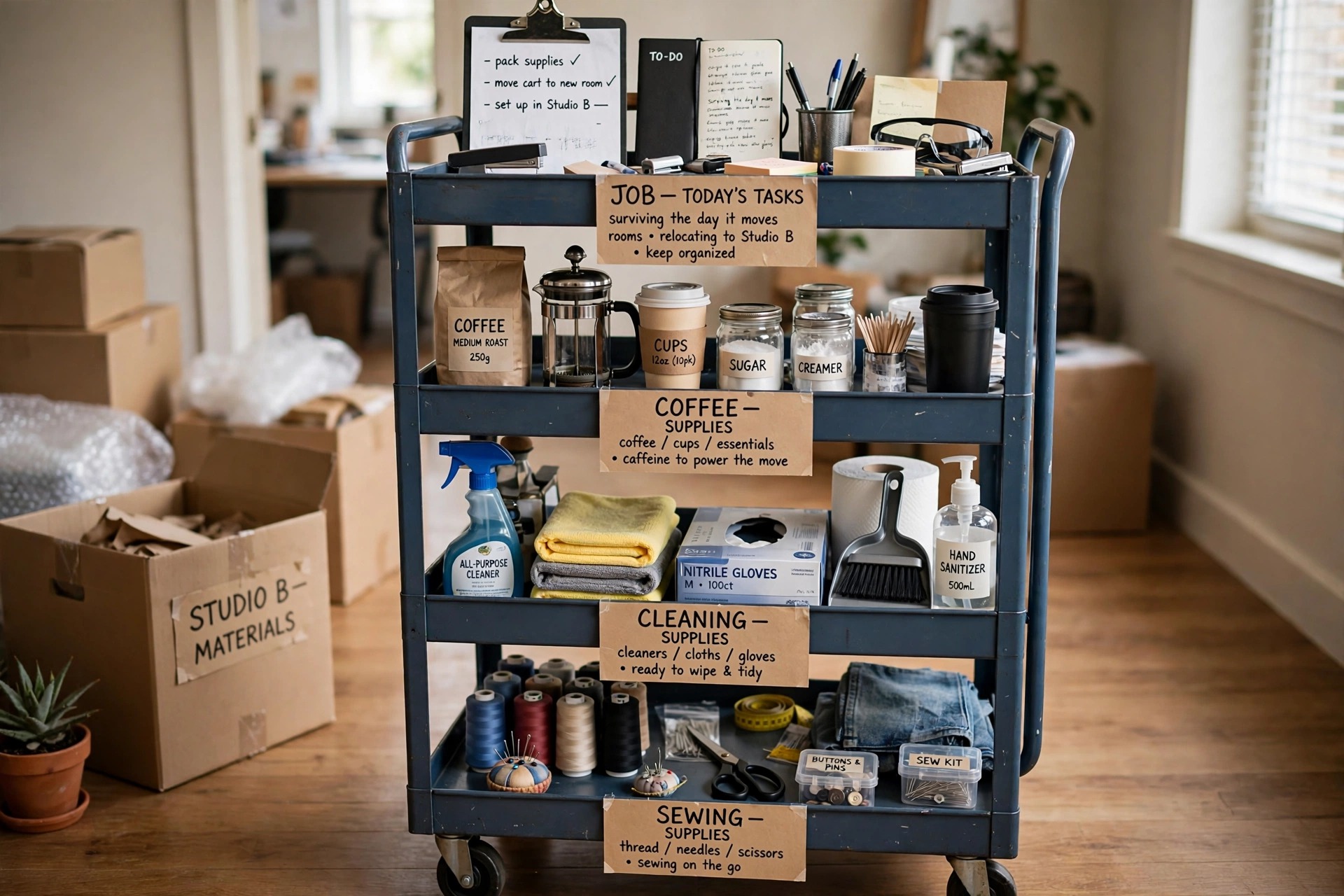
22. Label every tier by its job, not by the room it sits in — the label survives the day the cart moves rooms
A label that says which room the cart sits in is a label that lies the day the cart moves rooms, because the kitchen cart becomes the bathroom cart and the label says kitchen. Label every tier by its job, not by the room it sits in — "coffee", "cleaning", "sewing" — so the label survives the day the cart moves rooms. Labels by job also stop a tier drifting into a second category, because the label says what belongs there. Keep the labels short — one or two words — and replace them when the job changes, not a year later. One label per tier, by job, and the cart keeps working wherever it rolls.
Which rolling cart fix fits which situation?
| Situation | Best first move | Budget | Tools needed |
|---|---|---|---|
| Cart won't fit the gap / blocks the door | Measure the gap first, slim cart (idea 1) | Low | Tape measure |
| Cart rolls away mid-task | Locking casters, two wheels at least (idea 3) | Low | Cart with locks |
| Kitchen counter crowded | Produce cart / coffee station / pantry overflow (ideas 6, 7, 8) | Medium | Rolling cart |
| Bathroom counter covered | Morning-routine cart, towels rolled (ideas 12, 13) | Low | Rolling cart / bins |
| Carrying cleaning bottles up the stairs | One caddy per floor, stocked once (idea 15) | Medium | Rolling cart |
| Dead gap beside the washer | Narrow cart in the six-inch gap (idea 16) | Low | Slim cart |
| Craft supplies spread across the table | Sewing / art / homework carts (ideas 18, 19, 20) | Medium | Rolling cart / jars |
| Cart becomes a junk pile again | Five-minute Sunday reset + label by job (ideas 21, 22) | Low | Labels |
You do not need all 22 ideas. You need the three that solve your biggest mess — usually the gap you never measured, the cart that rolls away, and the tiers that hold a bit of everything. Start by measuring the gap, lock the casters, and give every tier one job. Do that tonight and the next time you reach for the cart it will be where you left it, holding what you need.
Save this post for your next cart clear-out, and if the bathroom counter needs clearing too, read 25 Bathroom Counter Organization Ideas for 2026 next — it is Post 04, the counter the bathroom cart clears — and 20 Kitchen Cabinet Organization Ideas for 2026, Post 02, for the cabinets the kitchen cart supports. Later in this cluster, 22 Sewing Room Organization Ideas for 2026 (Post 17) and 20 Pegboard Organization Ideas for 2026 (Post 19) and 25 Utility Closet Organization Ideas for 2026 (Post 20) carry the same rolling system into the sewing room, the wall storage and the overflow cupboard.
Publish date assigned at publishing time. Updated as new rolling cart finds are tested.
Frequently asked questions
What size rolling cart fits a narrow gap?
Measure the gap first — width, depth and height, with the tape flat against the wall — and buy a cart at least a centimetre narrower than the gap, so it rolls in and out without scraping. Check the height against the counter overhang too, and measure the door it has to pass through, because the door is the measurement people forget. A slim cart made for a six-inch gap is the right buy for the space beside a washer, while a wider three-tier cart suits an open kitchen corner. Measure first, and the cart fits the gap it was bought for.
How do I stop a rolling cart from rolling away?
Buy a cart with locking casters and lock at least two wheels while you work, so the cart stays where you put it and rolls only when you want it to move. Locking casters also stop the cart drifting on a sloping floor, because the lock holds the wheel, not the floor. Park the cart against a wall when it is not in use, and keep the heavy things on the bottom tier, so the weight holds the cart steady. Never buy a cart without locks to save a few pounds, because that is how the cart ends up parked in a corner for good.
How do I keep a rolling cart from turning into a junk cart?
Give every cart one job and label every tier by its job, not by the room it sits in, so the label says what belongs there and what does not. Finish every week with a five-minute Sunday reset — empty the top tier, return the strays to their rooms, and restock the middle — so the cart never drifts back into a pile. Keep the top tier for the daily five only, and never let a tier hold two jobs, because that is how the cart becomes a pile on wheels. One job, labels by job, and a five-minute reset, and the cart stays tidy.