20 Charging Station Organization Ideas for 2026
Charging cables do not stay where you put them. The phone cable lives in a drawer, the tablet cable lives on the kitchen counter, the laptop cable lives behind the sofa, the earbuds cable lives in a bag by the door, and every evening starts with a hunt for the one charger that fits the phone that is at 4%. The devices are not the problem — the problem is that charging has no home, so every cable drifts to wherever there was a socket, and the socket is never where the device is when it needs power.
These 20 charging station organization ideas give every cable and every device one home: a station where the cables are hidden, the chargers are labelled, the devices sit in their own slots, and the whole family knows where to plug in and where to find a full battery — so the next morning starts with charged phones instead of a hunt for a cable.
Every idea below works in a real home, from a flat where the whole station fits in one charging box on a shelf to a house where the family station lives in the hallway and the desk station lives in the office. The desk itself gets its full system in 24 Desk Organization Ideas for 2026, where the cable clips and the laptop shelf below belong — and the hallway the station lives in gets its own treatment in 22 Drop Zone Organization Ideas for 2026. Pick three ideas that fit your home, start with the one home, and build from there.
Set up the station
1. Give charging one home — the station that stops the cable scatter
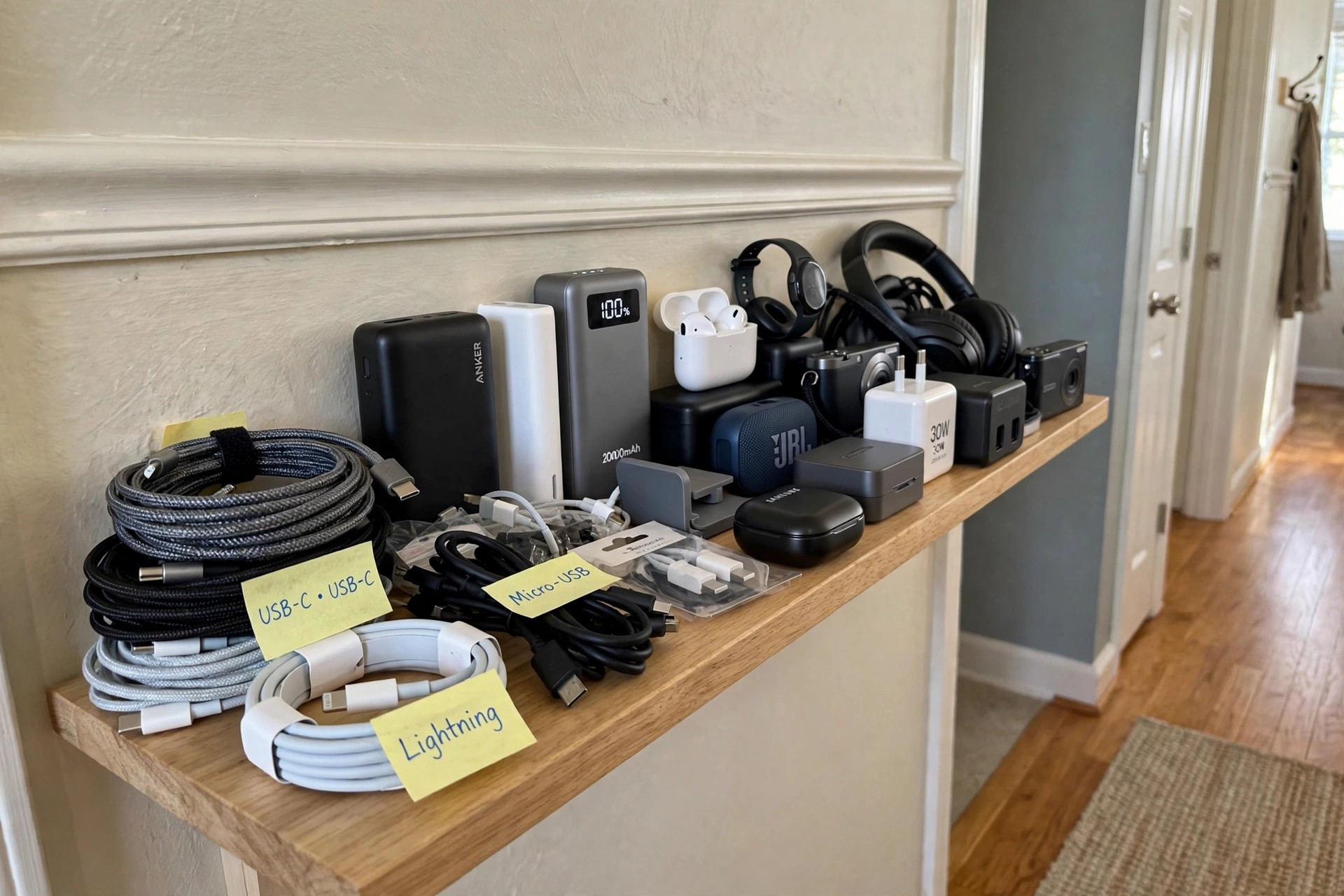
Cables scattered across the house are cables you cannot use, because the phone cable is in the drawer, the tablet cable is on the kitchen counter, and the laptop cable is behind the sofa — and the phone that needs charging tonight is waiting while you hunt through three rooms. Give charging one home — the station that stops the cable scatter — so every cable, plug and device lives in one place and the hunt ends. Pick the spot first: a shelf in the hallway, one end of the kitchen counter, or a corner of the desk, because the station that has a fixed spot is the station that gets used. Move everything there in one go, and the next charge starts at the station instead of starting with a search. Start by emptying every hiding place onto the table — the drawer, the counter, the bag by the door — because the station cannot hold what is still hidden, and seeing the whole pile at once is what shows you how many cables you actually own. One home, and the scatter stops.
2. Measure the devices before you buy storage
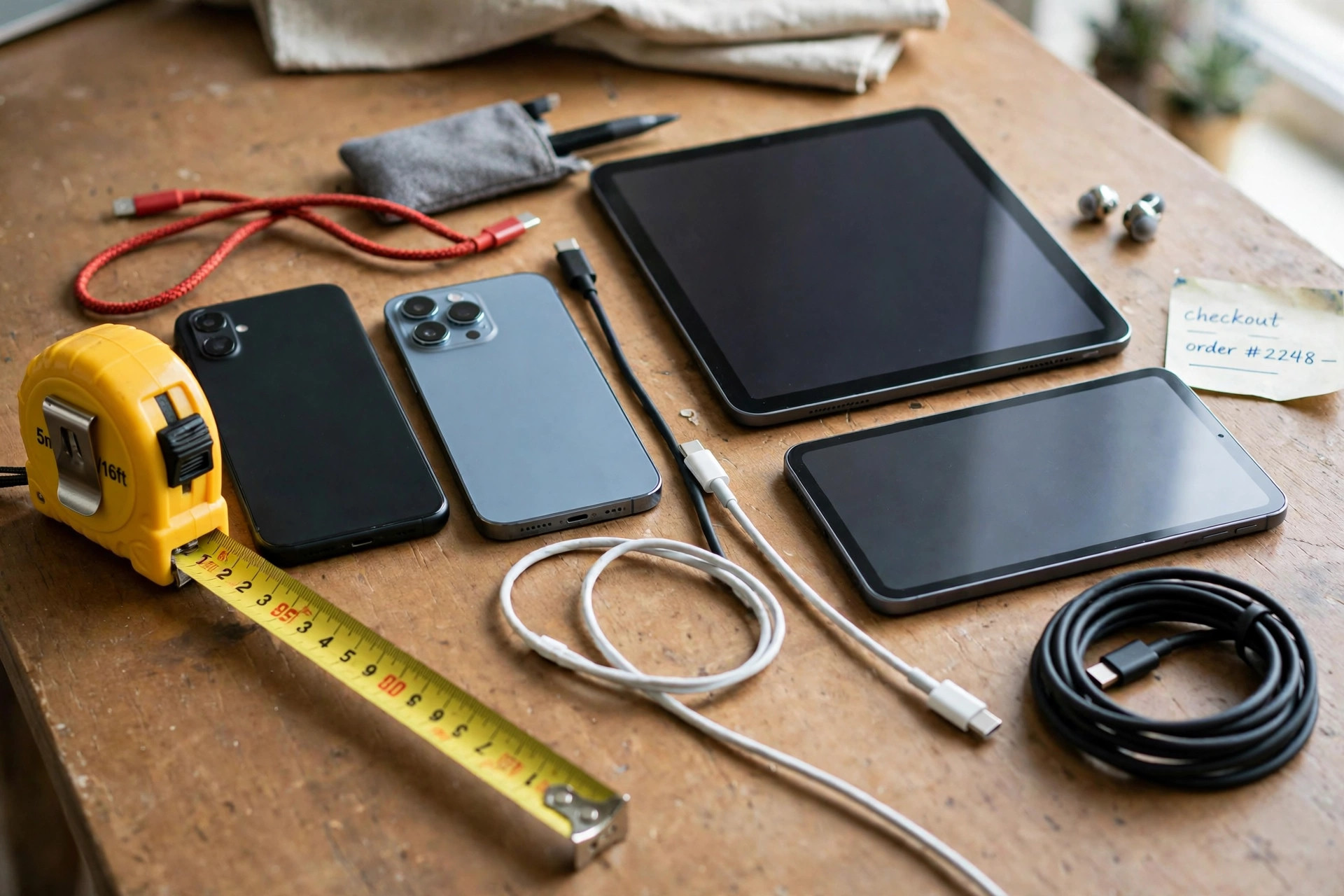
Charging storage bought by guessing is charging storage that does not fit, because the tablet is half an inch wider than the slot, the laptop will not stand upright in the dock, and the organizer that looked right in the shop is the organizer that comes home and goes straight back. Measure the devices before you buy storage — the tape measure that saves the returns — so every dock, box and shelf you buy is bought for your devices, not for devices in a photo. Measure the widest device, measure the thickest case, and measure the space the station will live in, because the numbers that travel with you are the numbers that stop the returns. Write them in a notebook and take the notebook to the shop, because the device that is measured once is the device that fits the first time. Measure the space too — the width of the shelf, the height under it, the depth of the console — because the dock that fits the phones but not the shelf is the dock that lives on the floor, and the shelf that is measured is the shelf that holds the station. One afternoon with a tape measure, and everything you buy fits.
3. Sort by person — one row per family member
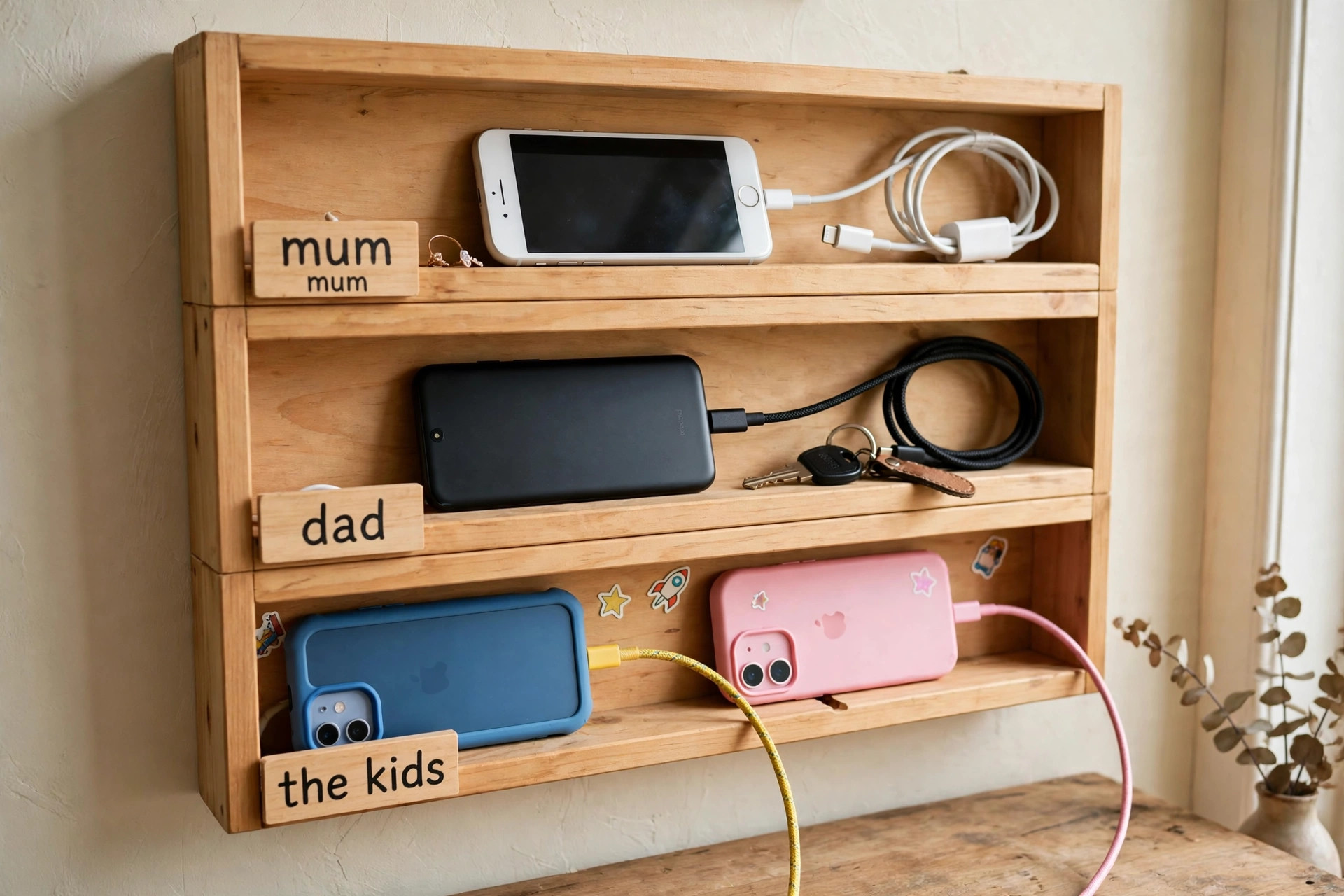
A pile of mixed cables is a pile you have to dig through, because mum's cable is under dad's cable, the kids' cables are tangled together, and the cable you want is always the cable at the bottom. Sort by person — one row per family member — so each person has their own slot, their own cable and their own label, and the cable you want is the cable you can reach. Give each row a name label and a colour, because the row that is labelled is the row that stays sorted, and the colour that belongs to one person is the colour that ends the argument about whose cable is whose. Keep the kids' rows low enough for them to reach, because the row that a child can reach is the row a child actually uses, and the station that the children can use is the station that keeps their tablets off the floor. One sort by person, and the dig ends.
4. Keep the charging kit together — cables, plugs and adapters in one caddy
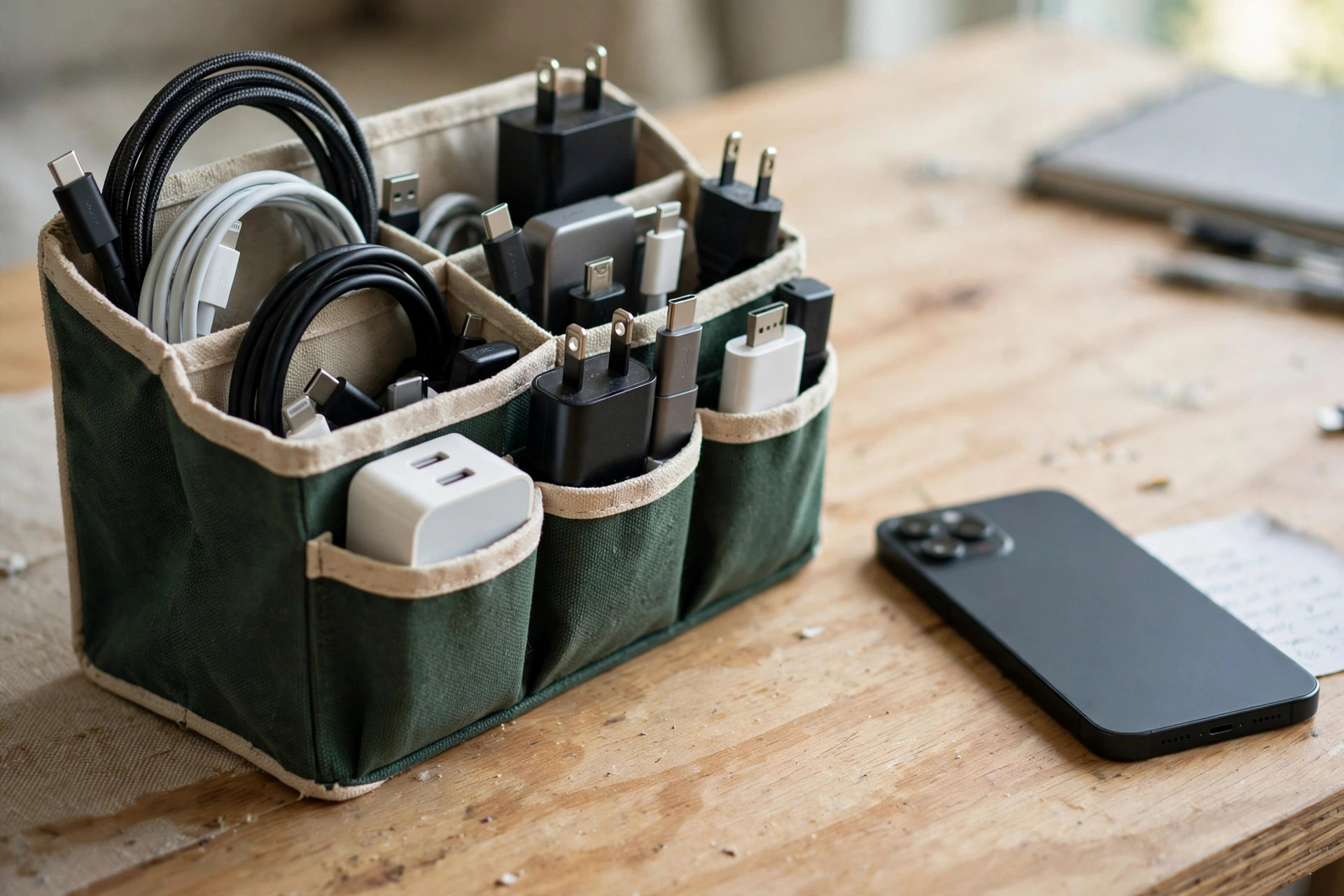
The charging kit is the part of the station that wanders most, because the spare plug goes back to the drawer, the adapter goes back to the laptop bag, and the cable you need is the cable that was last seen somewhere else — and the charging starts with a hunt for a plug every single time. Keep the charging kit together — cables, plugs and adapters in one caddy — so the caddy lives at the station and the kit never leaves it. Put the spare cables, the spare plugs and the adapters you actually use in the caddy, and keep the caddy on the shelf under the station, because the caddy that stays at the station is the caddy that is there when you need it. Label the caddy too, so the next person who charges knows where the spare plug lives, because the caddy that is labelled is the caddy that comes back to the station instead of wandering off to the drawer. The same caddy logic keeps the desk tools findable in 24 Desk Organization Ideas for 2026, where the pens and the cables share one box. One caddy, and the hunt for a plug ends.
5. Charge where you sit — the station that lives where the family actually is
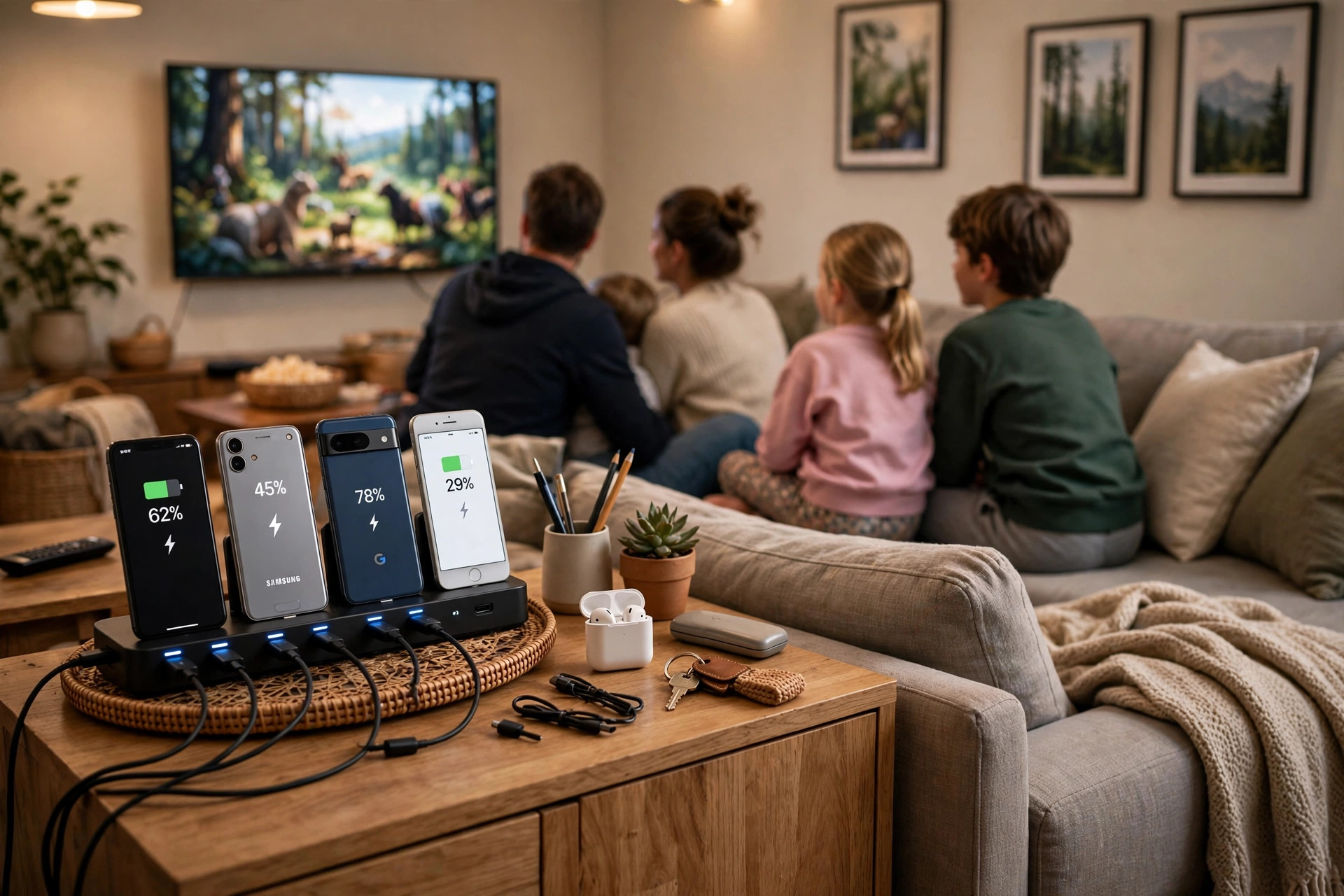
A charging station in a room nobody sits in is a charging station nobody uses, because the phones live on the sofa, the tablets live at the kitchen table, and the station in the spare room is the station that stays empty. Charge where you sit — the station that lives where the family actually is — so the station sits where the devices already gather, and the charging happens without anyone having to remember it. Put the main station in the hallway or the living room where the family passes every evening, and put a small second station where the work happens, because the station that is in the way is the station that gets used. If the family watches television in the evening, the station belongs on the sideboard beside the sofa, because the phone that charges beside the sofa is the phone that is full by bedtime. One station where you sit, and the charging happens on its own.
Hide the cables
6. A charging box — the box that hides the power strip
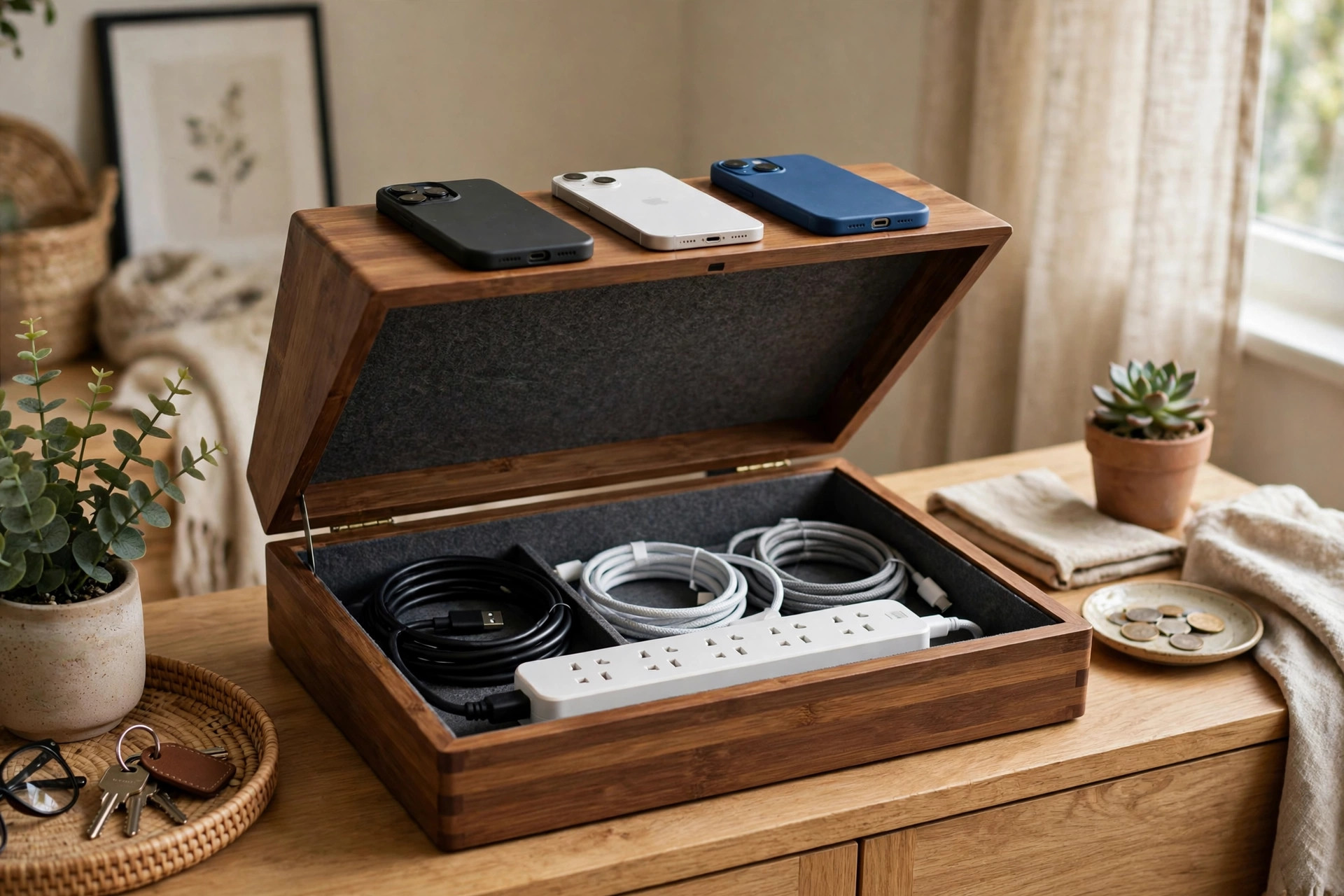
A power strip on the sideboard ruins the room, because the strip is ugly, the cables spill out of it in every direction, and the tidy console is the console with a tangle of black wires across it. Use a charging box — the box that hides the power strip — so the strip and the coiled cables live inside a lidded box, the devices rest on top of it, and the only thing you see is a tidy wooden or bamboo box. Put the power strip inside the box, feed the cables through the slots in the sides, and rest the phones on the lid, because the box that hides the strip is the box that keeps the room looking like a room. Pick a box with a lid that lifts off easily, because the box that opens is the box you can reach into when a cable needs swapping, and the box that stays shut is the box that keeps the dust off the plugs. One charging box, and the tangle disappears. (Check on Amazon for a bamboo charging box with cable slots, sized for a four-way power strip.)
7. Cable clips on the desk edge — the clips that stop cables falling behind the desk
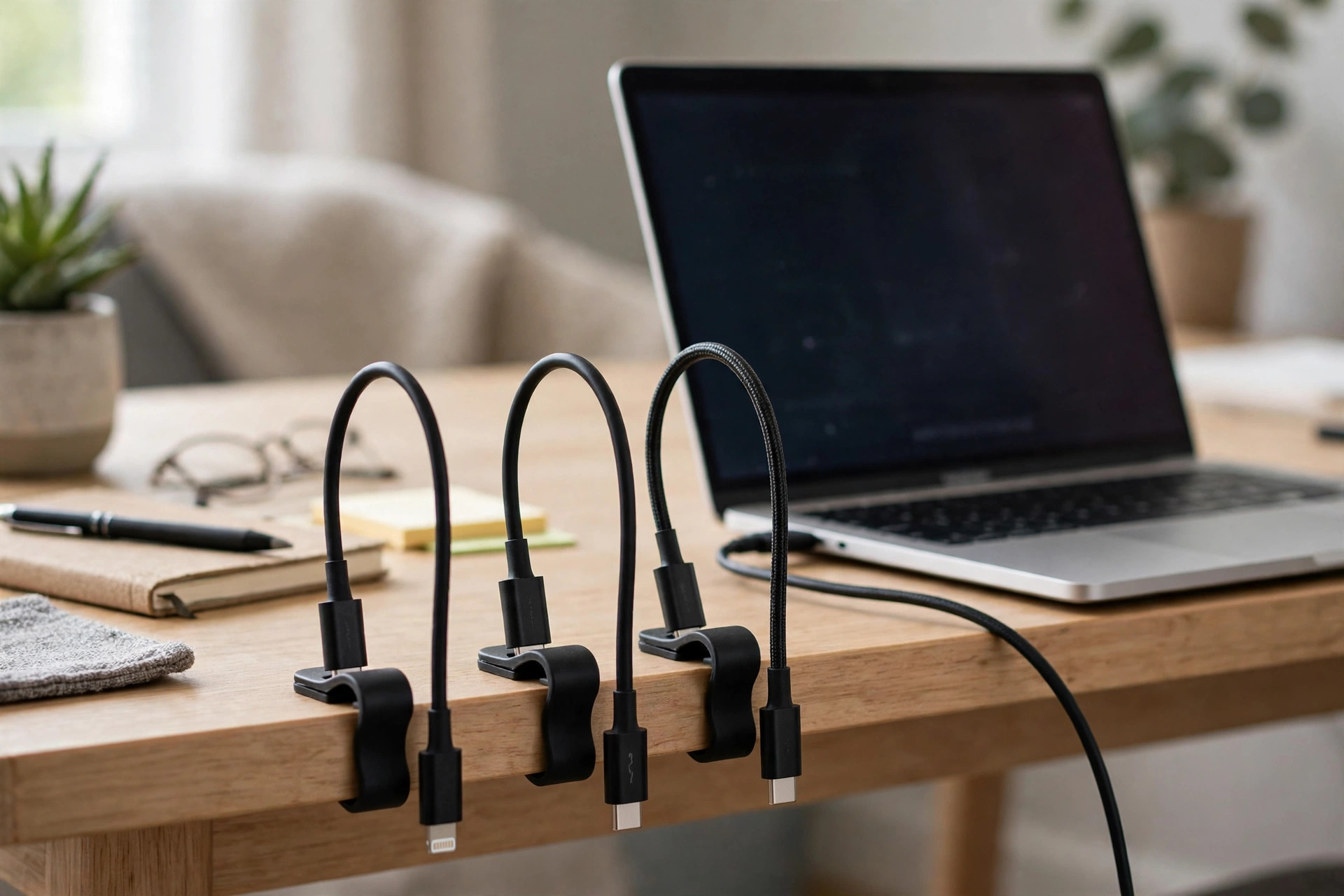
Cables on a desk fall behind it, because the cable slips off the edge, drops to the floor, and the next time you need it you are on your knees behind the desk fishing for the end. Stick cable clips on the desk edge — the clips that stop cables falling behind the desk — so each cable sits in its own clip, the end stays on the desk where you can reach it, and nothing ever falls. Clip one cable per clip, leave the clip near the device that uses it, and keep the spare cables clipped too, because the clip that holds the cable is the clip that keeps the desk clear. The clips work on a desk, a bedside table or a kitchen counter, because the edge that holds a clip is the edge that holds a cable, and the cable that is clipped is the cable that is always in reach. The desk the clips live on gets its full system in 24 Desk Organization Ideas for 2026, where the clips sit beside the laptop shelf. One row of clips, and the fishing behind the desk ends.
8. Short cables and cable winders — the short cable that cannot tangle
A long cable in a small space tangles, because the extra length coils on itself, the coils knot, and the drawer that holds the long cables is the drawer where every cable is wrapped around every other cable. Use short cables and cable winders — the short cable that cannot tangle — so each cable is only as long as it needs to be, the spare length winds onto a small winder, and the drawer holds neat coils instead of a knot. Buy cables in the shortest length that reaches from the plug to the device, and wind the rest onto winders or velcro ties, because the cable that is short is the cable that stays tidy. Keep one long cable in the caddy for the sofa or the car, because the long cable that is kept for travel is the long cable that never tangles the station. One short cable, and the knots stop.
9. A power strip inside a drawer — the drawer that charges in secret
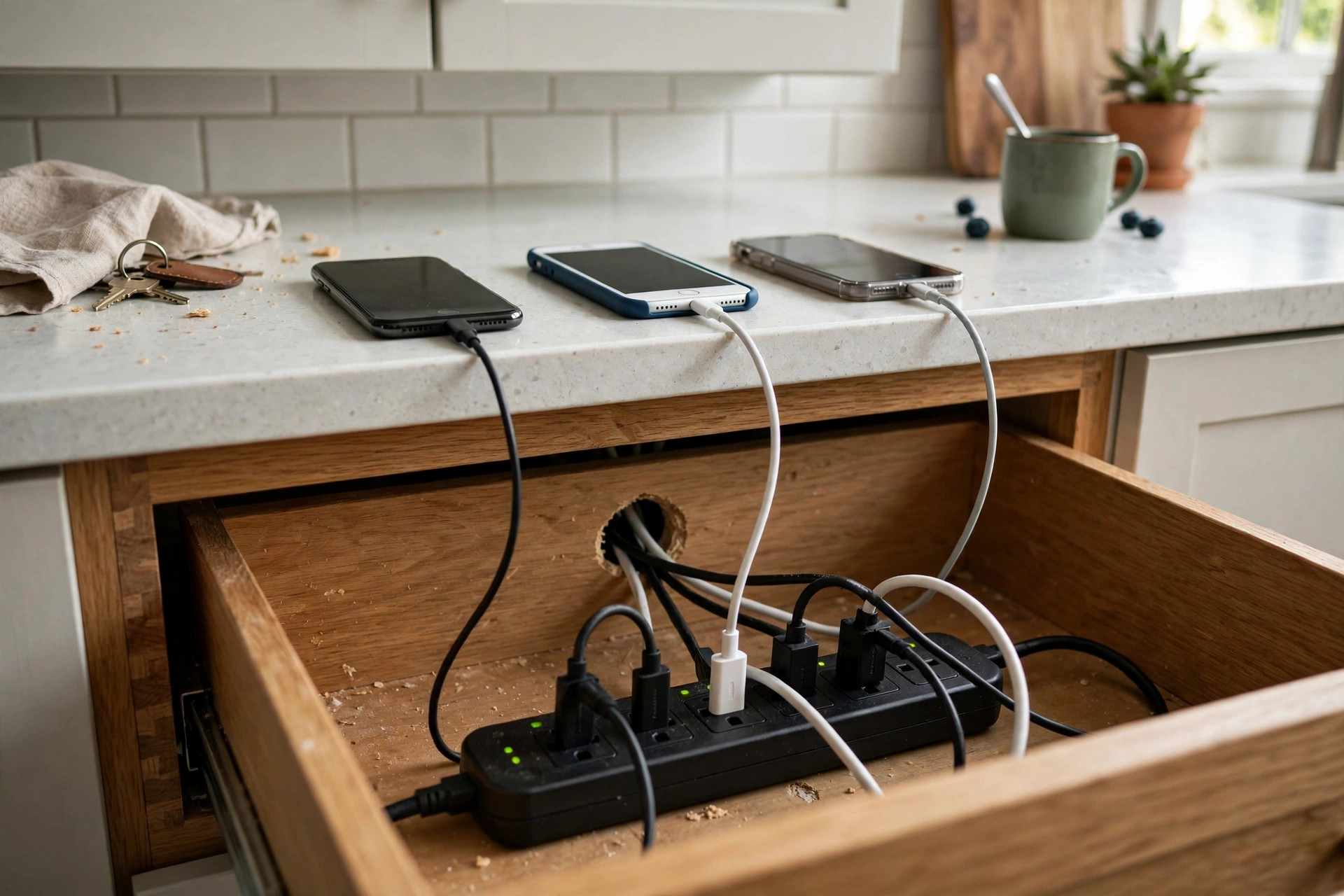
Some rooms cannot show a charging station at all, because the kitchen counter must stay clear, the bedroom must stay calm, and the station that sits out in the open is the station that ruins the look. Put a power strip inside a drawer — the drawer that charges in secret — so the strip lives in the drawer, the cables feed through a hole in the back, and the devices charge out of sight while the counter stays clear. Drill a small hole in the back of the drawer for the cables, line the drawer with a heat-safe mat, and keep the drawer slightly open while charging if it gets warm, because the drawer that breathes is the drawer that stays safe. Check the strip is not overloaded, because the strip that holds too many plugs is the strip that trips, and the drawer that charges in secret is the drawer that keeps the room looking untouched. The drawer itself gets its full system in 22 Kitchen Drawer Organization Ideas for 2026, where the charging drawer sits beside the everyday drawer. One hidden drawer, and the station vanishes.
10. Colour-code by person — the colour that ends the argument
Identical black cables cause identical black arguments, because every cable looks the same, nobody knows which cable is theirs, and the morning starts with someone unplugging the wrong phone. Colour-code by person — the colour that ends the argument — so each family member has their own cable colour, their own label and their own velcro tie, and the cable you pick up is always your own. Give mum blue, dad green, and the kids a colour each, and mark the plugs with the same colour, because the colour that matches the plug is the colour that ends the mix-up. Use coloured tape or coloured cable ties, because the tie that is coloured is the tie that is read at a glance, and the cable that is coloured is the cable that never gets taken by mistake. One colour per person, and the argument ends.
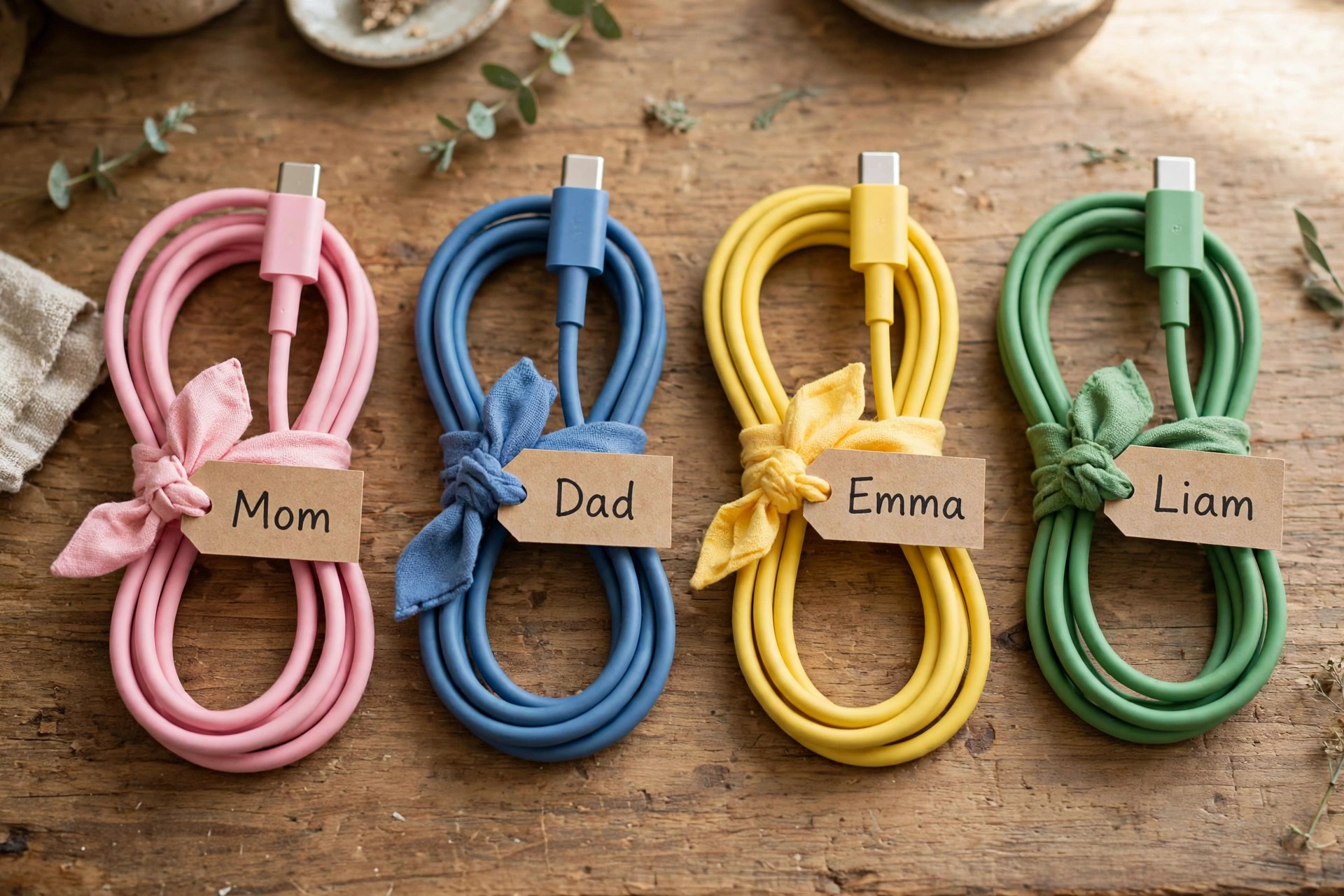
A home for every device
11. A phone dock by the door — the grab-and-go dock
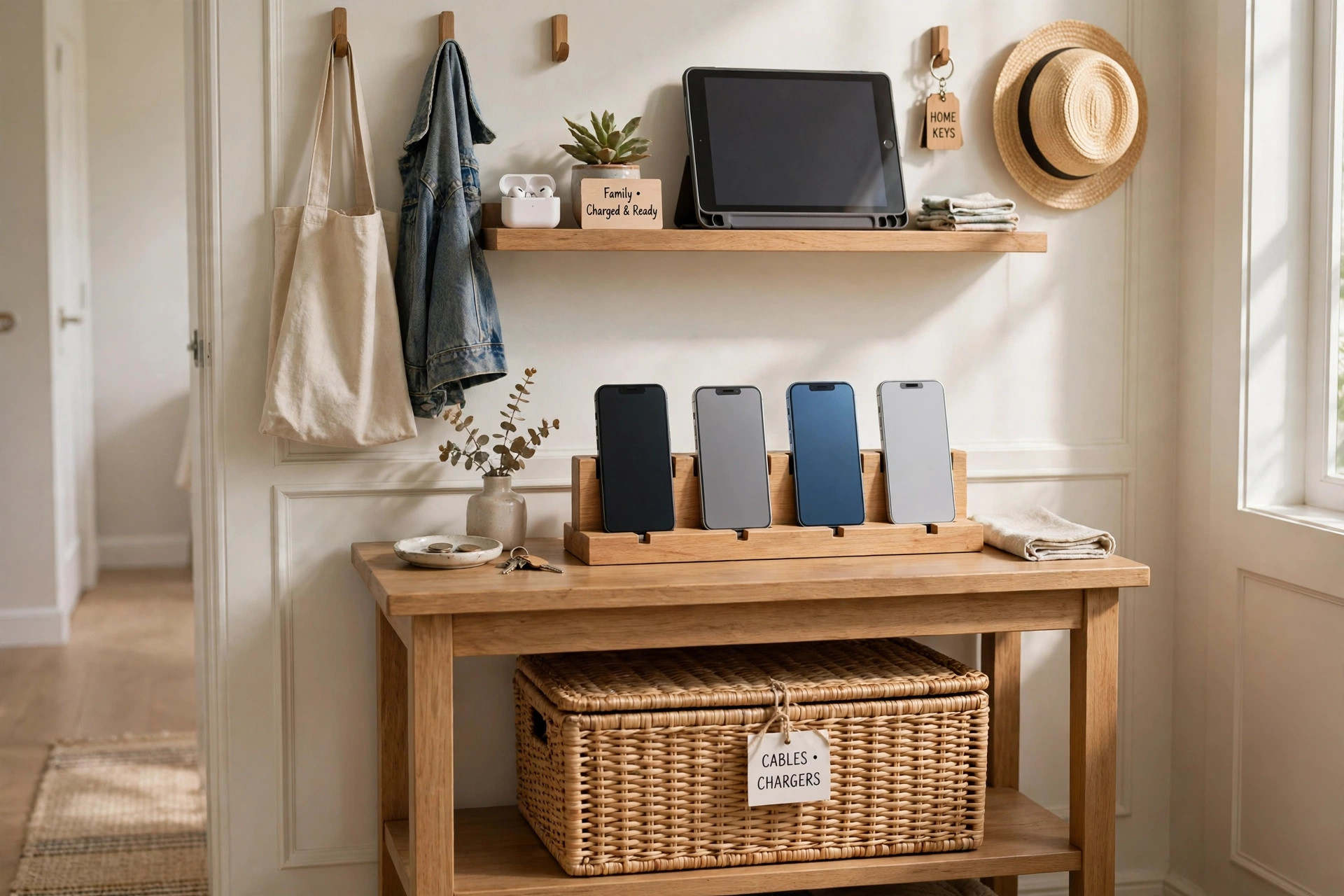
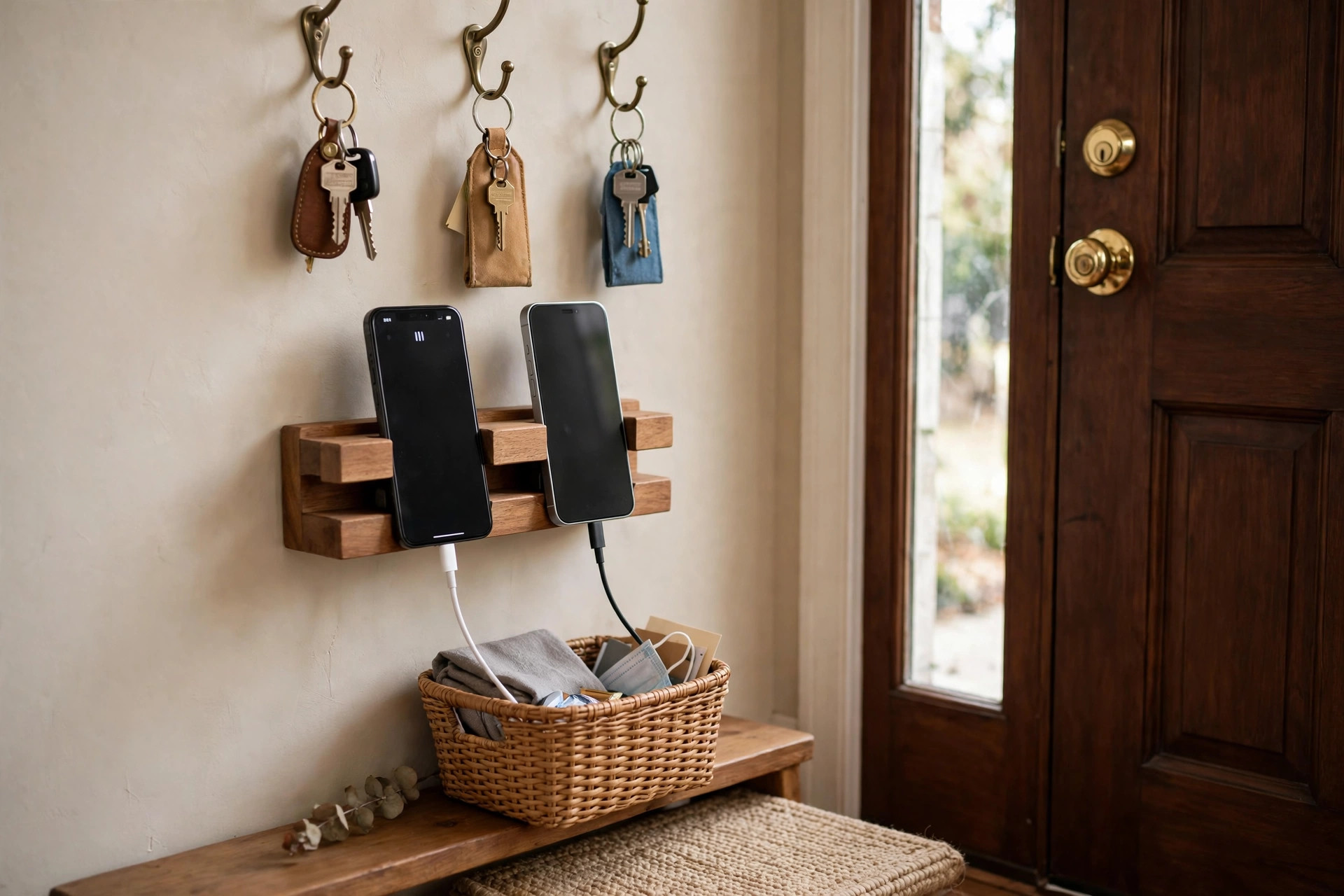
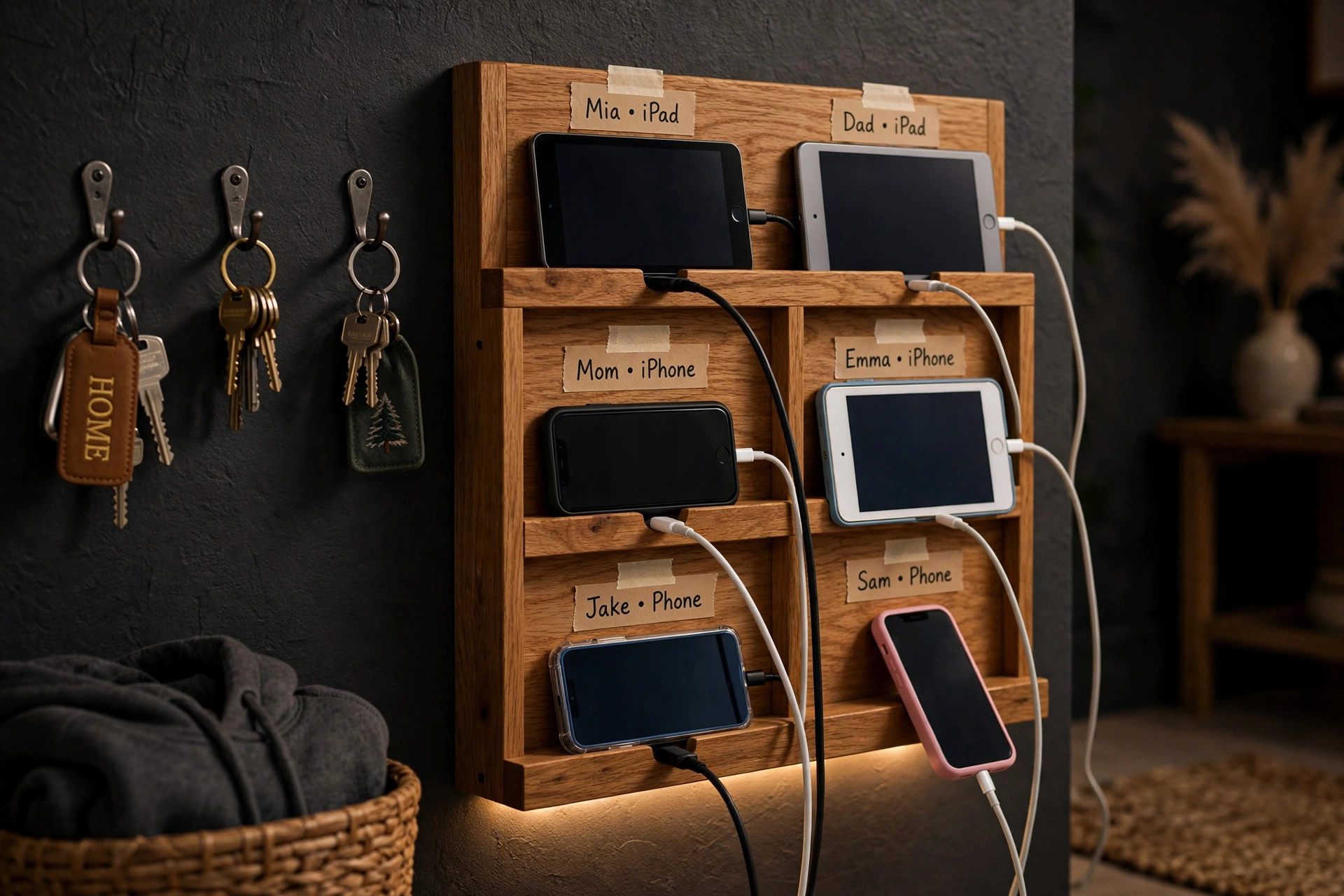
The phone that charges in the bedroom is the phone you forget when you leave, because the phone is upstairs, the keys are by the door, and the morning starts with a run back upstairs for the phone that is still plugged in. Put a phone dock by the door — the grab-and-go dock — so the phones charge on the hallway console, the keys hang above them, and the phone, the keys and the bag all leave together. Keep the dock on the console where the family passes every evening, plug the phones in when you come home, and pick them up when you leave, because the dock that sits by the door is the dock that is used twice a day. Keep the dock's cables short and hidden in the box below, because the dock that is tidy is the dock that stays by the door, and the phone that charges by the door is the phone that is never forgotten. The hallway the dock lives in gets its full system in 22 Entryway Storage Ideas for 2026, where the dock sits beside the hooks and the baskets. One dock by the door, and the forgotten phone stops. (Check on Amazon for a wooden multi-phone charging dock with short cables included.)
12. A tablet and laptop shelf — the shelf that keeps screens upright and charging
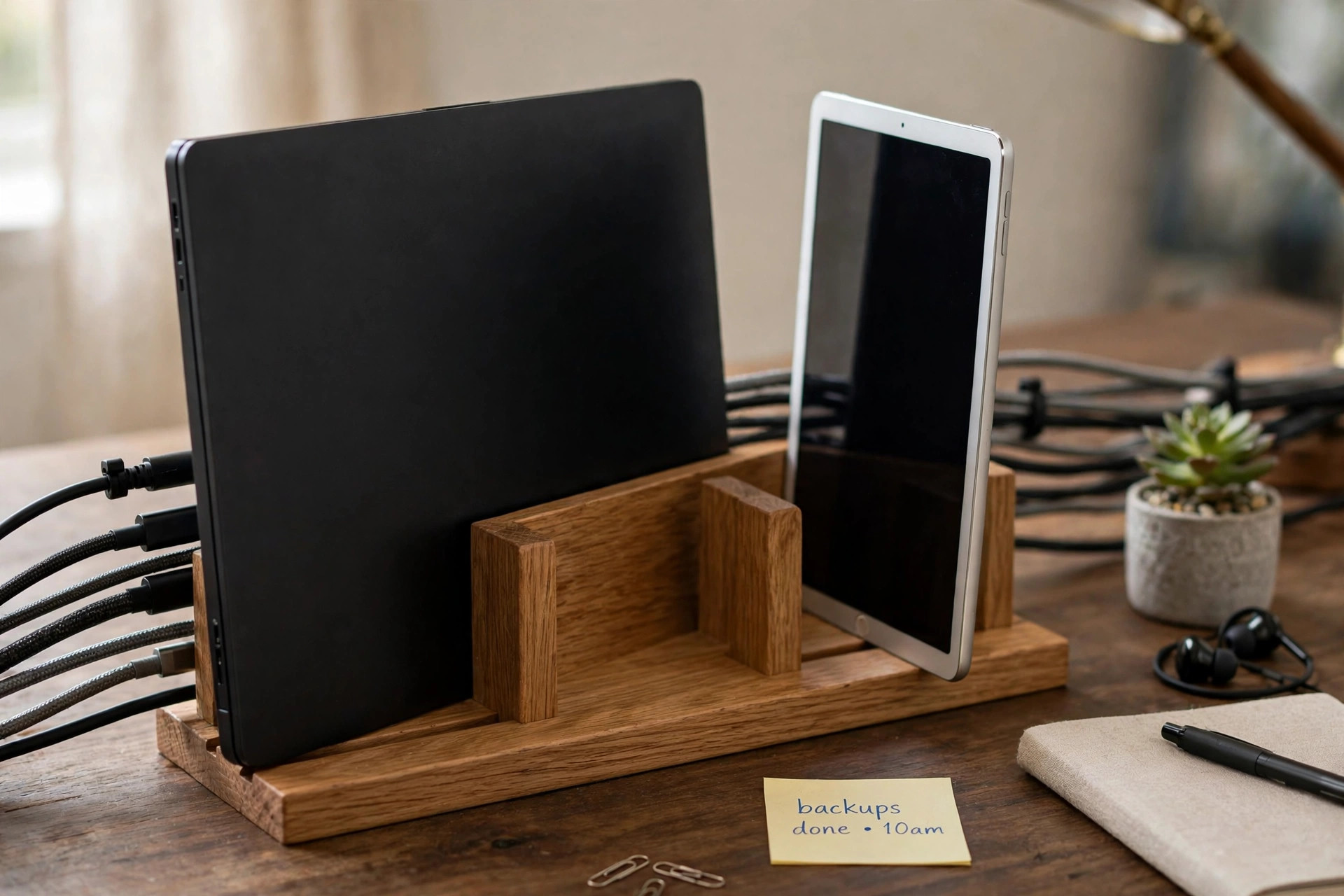
Tablets and laptops left flat on a desk take the whole desk, because each one lies flat, the screens face up, and the desk that holds two flat devices holds nothing else — while the wall above the desk stands empty. Use a tablet and laptop shelf — the shelf that keeps screens upright and charging — so the devices stand upright in slots on a shelf or a stand, the cables run behind them, and the desk below stays free for work. Stand the devices in the slots with the charging port at the bottom, run the cables behind the shelf, and leave a finger's width between the devices, because the shelf that is spaced is the shelf that lets you pull one device without pulling them all. Keep the shelf at the back of the desk, because the shelf that sits at the back is the shelf that never blocks the work, and the device that stands upright is the device that charges without taking a desk. The office the shelf belongs to gets its full system in 25 Home Office Organization Ideas for 2026, where the laptop shelf sits beside the filing. One shelf, and the desk is free again.
13. Earbuds and smartwatch docks — the small docks for the small devices
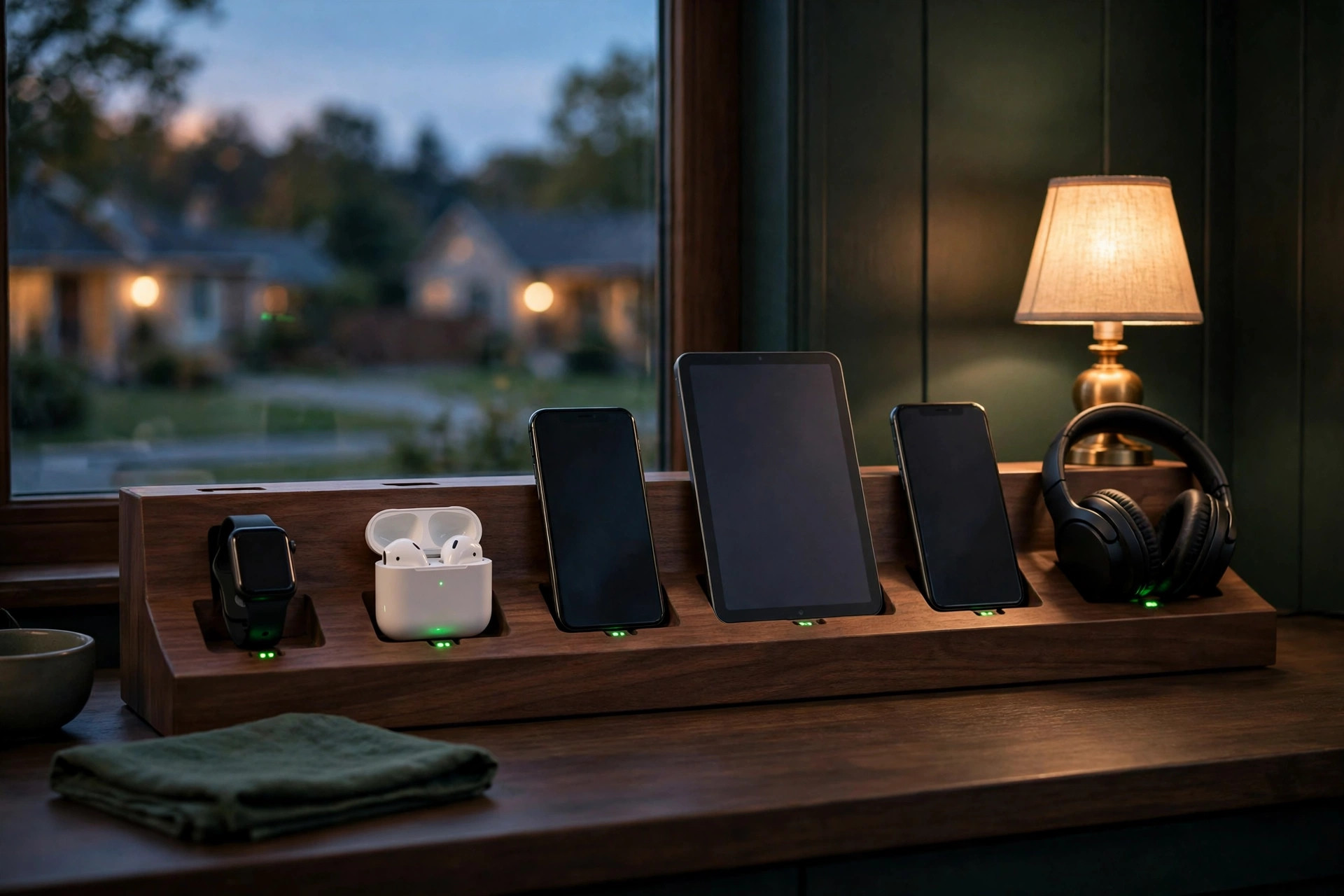
Small devices vanish, because the earbuds case is the size of a matchbox, the watch charger is a disc the size of a coin, and the drawer that holds the small things is the drawer where they slide under everything else. Give the small devices their own docks — the small docks for the small devices — so the earbuds case sits in a small tray, the watch hangs on its own stand, and nothing small ever goes into a drawer again. Keep the tray on the bedside table or the desk, plug the watch charger into the tray, and put the earbuds case back in the tray the moment you take them out, because the tray that holds the small things is the tray that keeps them found. Buy a dock that holds the phone, the watch and the earbuds together, because the dock that holds all three is the dock that charges the whole bedside in one place. One small dock, and the small things stop vanishing.
14. A kids' devices station — the station that keeps children's tablets in one place
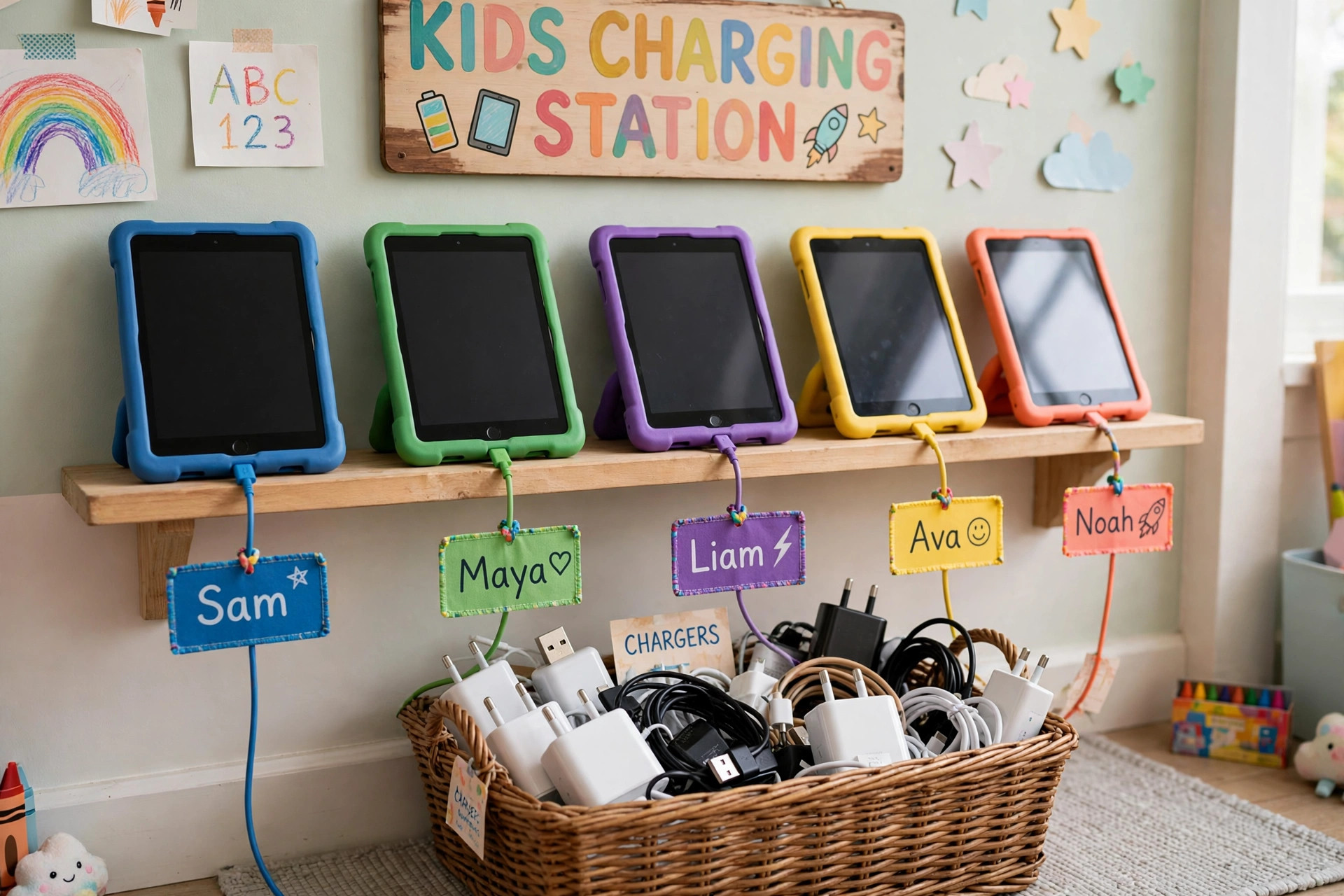
Children's tablets end up everywhere, because the tablet goes to the sofa, the tablet goes to the car, the tablet goes under the bed, and the tablet that needs charging is always the tablet that cannot be found. Give the children their own devices station — the station that keeps children's tablets in one place — so the tablets live on a low shelf, each in its own slot with its own coloured cable, and the rule is simple: the tablet lives on the station or it does not charge. Keep the station low enough for the children to reach, label each slot with a name, and set a charging time for the evening, because the station that a child can reach is the station a child actually uses. Keep the spare chargers in the caddy below the station, because the caddy that holds the spares is the caddy that stops the station being raided for a cable. The school bags the tablets travel in get their full system in 22 School Organization Ideas for 2026, where the tablet goes back in the bag in the morning. One kids' station, and the lost tablet stops. (Check on Amazon for a multi-slot tablet charging station with colour-coded cables.)
15. A guest charging spot — the spot that saves visitors from asking for a cable
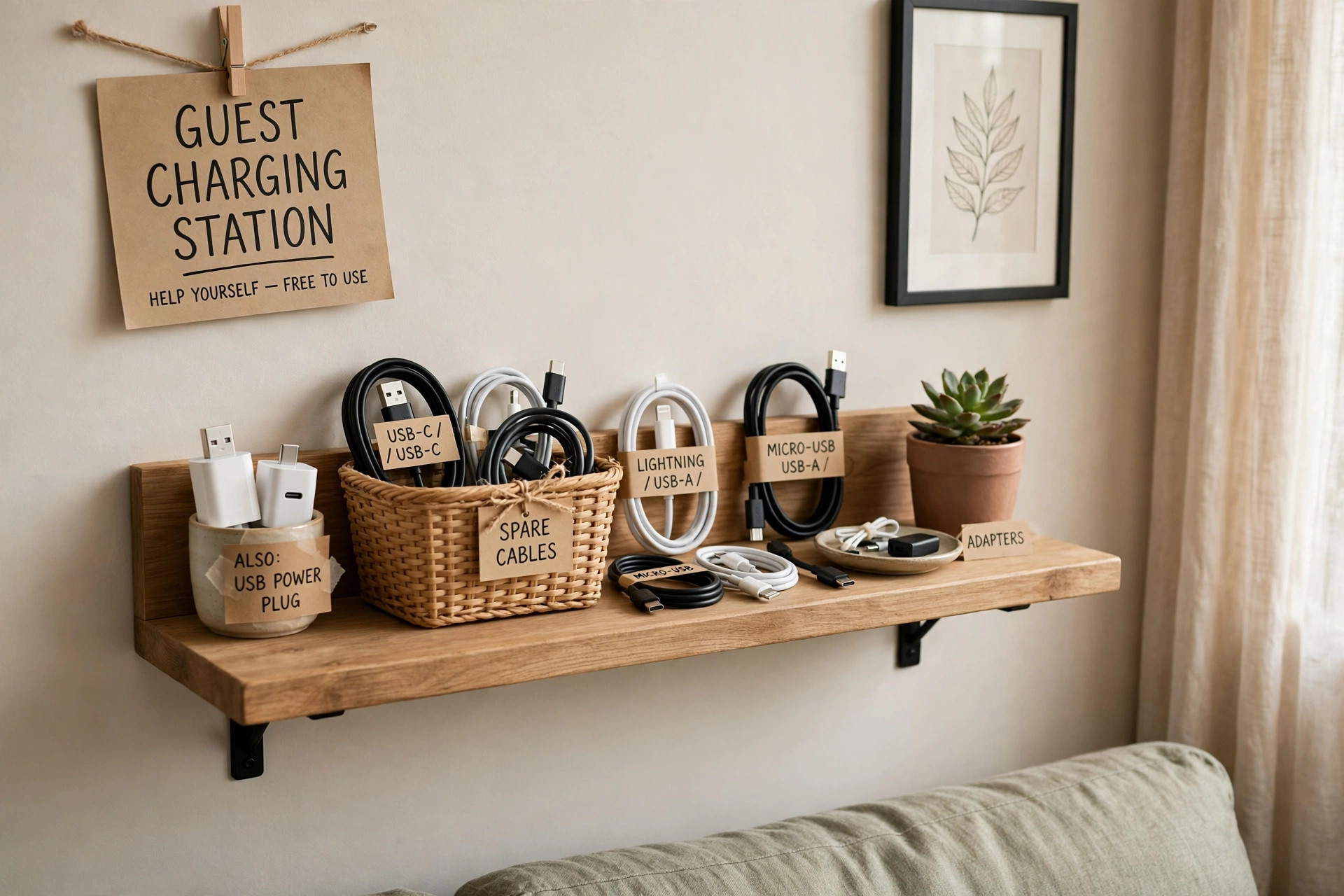
Every guest asks the same question, because their phone is dying, they do not know where your cables are, and the visit starts with an awkward ask for a charger that fits a phone you do not own. Keep a guest charging spot — the spot that saves visitors from asking for a cable — so one shelf or one drawer holds a spare cable for each common phone type, a spare plug, and a small sign that says help yourself. Keep the spot in the living room or the hallway where guests actually sit, and keep the spare cables short and labelled, because the spot that is visible is the spot that gets used without asking. Check the spare cables every month, because the cable that is borrowed is the cable that never comes back, and the spot that is stocked is the spot that saves the next visit. One guest spot, and the awkward ask ends.
Keep it tidy for good
16. Label every cable — the label that stops the dig
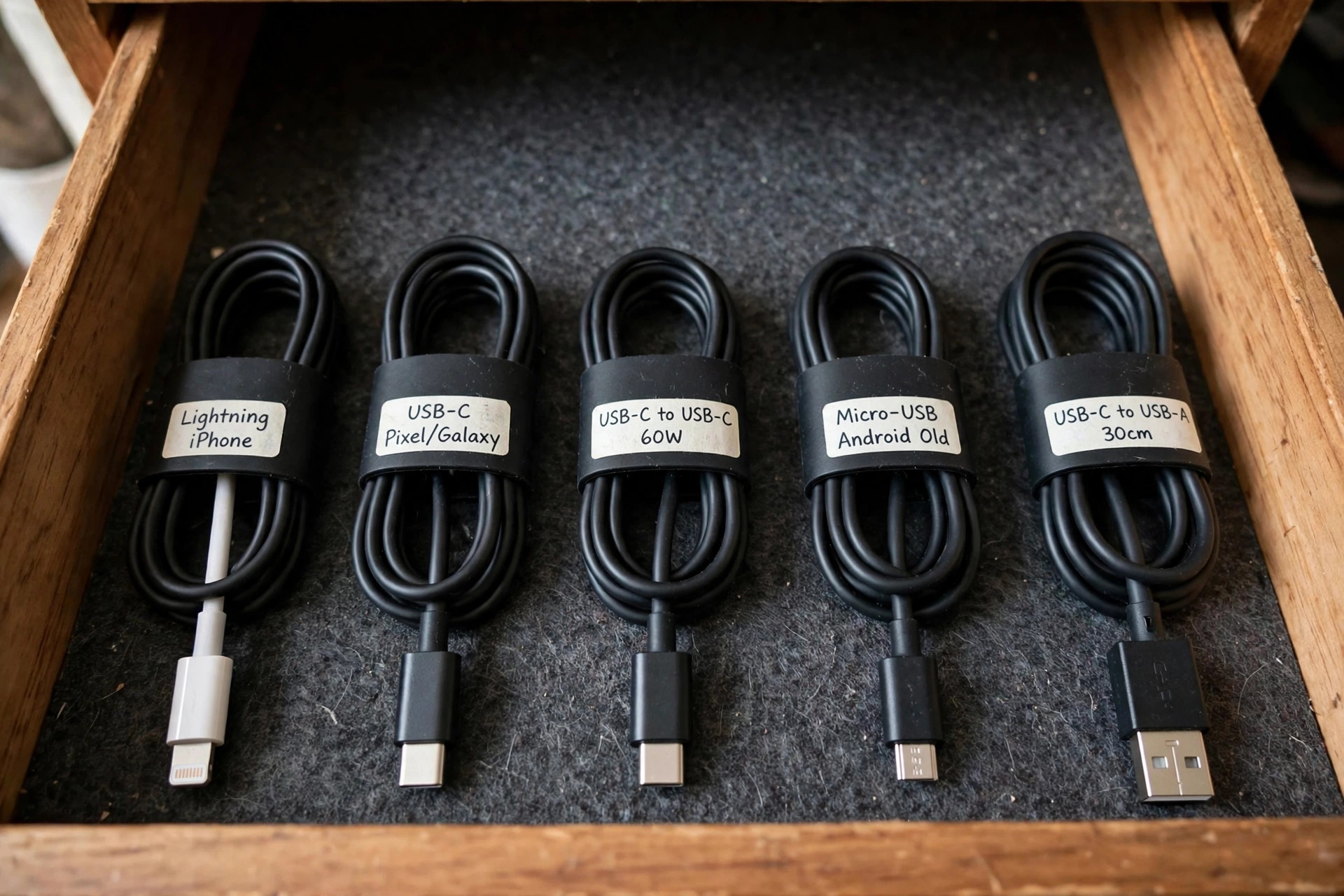
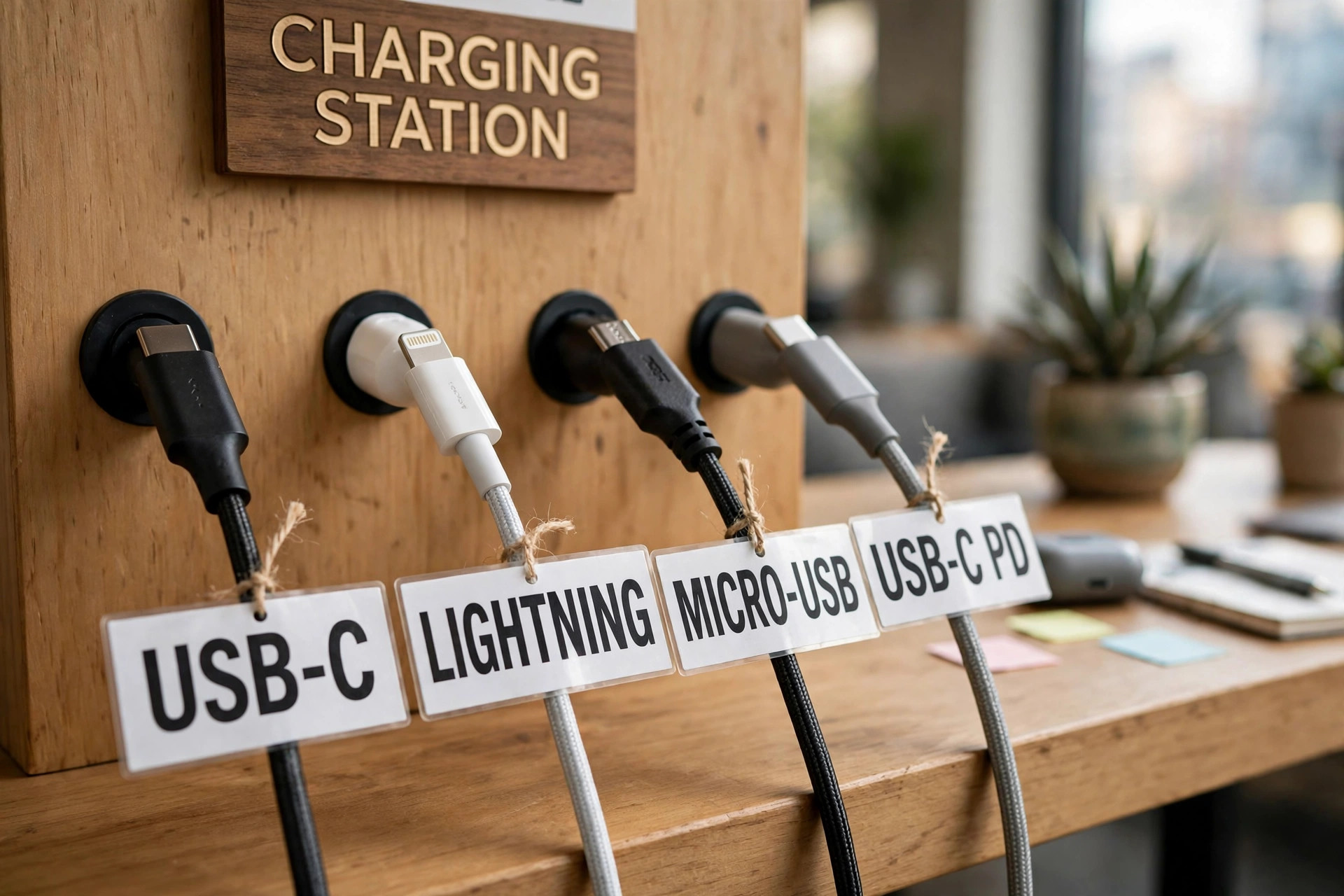
Cables without labels are cables you have to trace, because the cable that charges the tablet looks exactly like the cable that charges the phone, and the station that holds unlabelled cables is a station you never use. Label every cable — the label that stops the dig — so each cable says what it charges and the station becomes usable instead of a mystery. Put the label near the plug end, not the middle, because the label that sits at the plug is the label you can read when you reach for it, and use one label per cable, because the cable that holds one label is the cable that stays sorted. Write the label in big clear letters and use a colour per person, because the label that is big is the label that is read, and the cable that is labelled is the cable that gets used first. One label per cable, and the dig stops.
17. One in, one out for chargers — the rule that stops the drawer overflowing
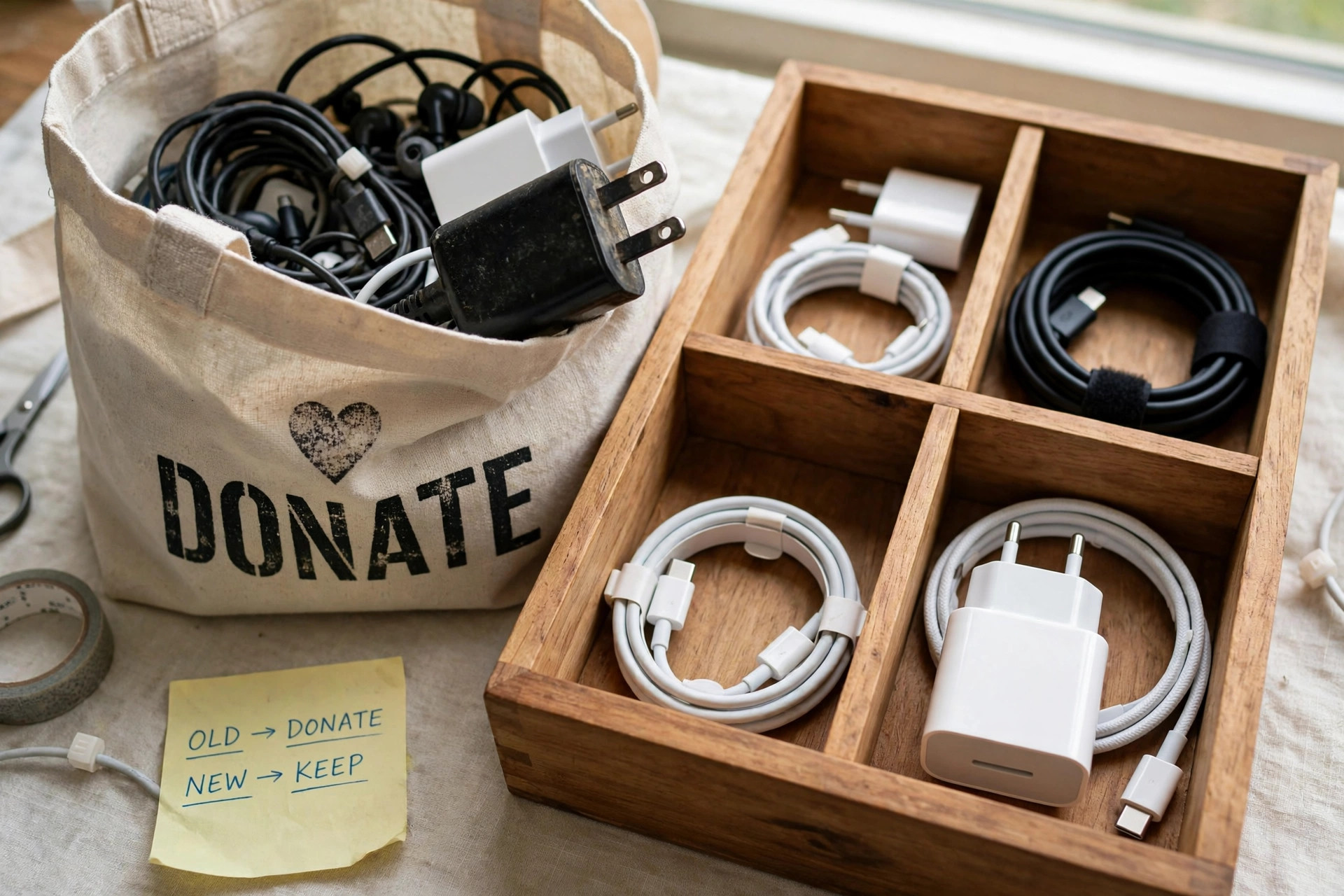
A charger drawer grows on its own, because every new device adds a plug, every upgrade adds a spare, and the drawer that held four chargers in January holds twenty by December. Use one in, one out for chargers — the rule that stops the drawer overflowing — so every new charger that enters the station means one old charger leaves it, into the donate bag or the recycling. Keep the donate bag at the station, so the charger that leaves has somewhere to go the moment you decide, because the bag that is at the station is the bag that gets used. Count the chargers when you do the swap, because the count that is written down is the count that shows you how many you really own, and the drawer that is counted is the drawer that stops growing. One rule, and the station never overflows.
18. A weekly cable check — the five-minute untangle that keeps the station working
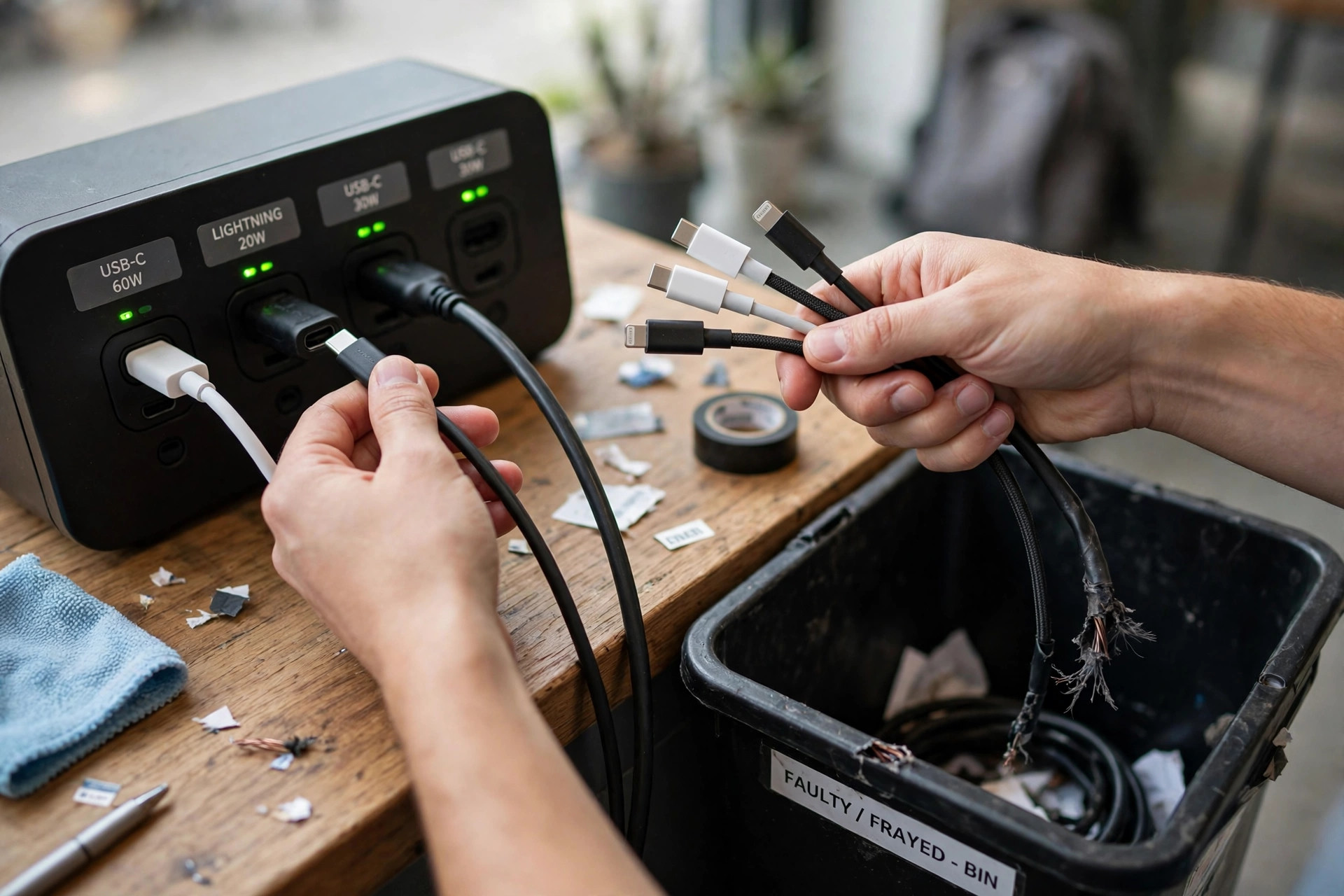
No charging station stays tidy without a habit, because the station is only tidy on the day you organize it and the mess creeps back one cable at a time. Do a weekly cable check — the five-minute untangle that keeps the station working — so once a week you unplug everything, straighten the cables, check for frayed ends, and plug it all back in properly. Throw away the frayed cables at once, because the cable that is frayed is the cable that stops working when you need it most, and the check that catches it is the check that saves the morning. Keep a small bag for the dead cables beside the station, because the cable that is binned at once is the cable that never becomes clutter, and the station that is checked every week is the station that works every day. Five minutes a week, and the station never needs a big clean.
19. A travel charging kit — the kit that stops the home station being raided
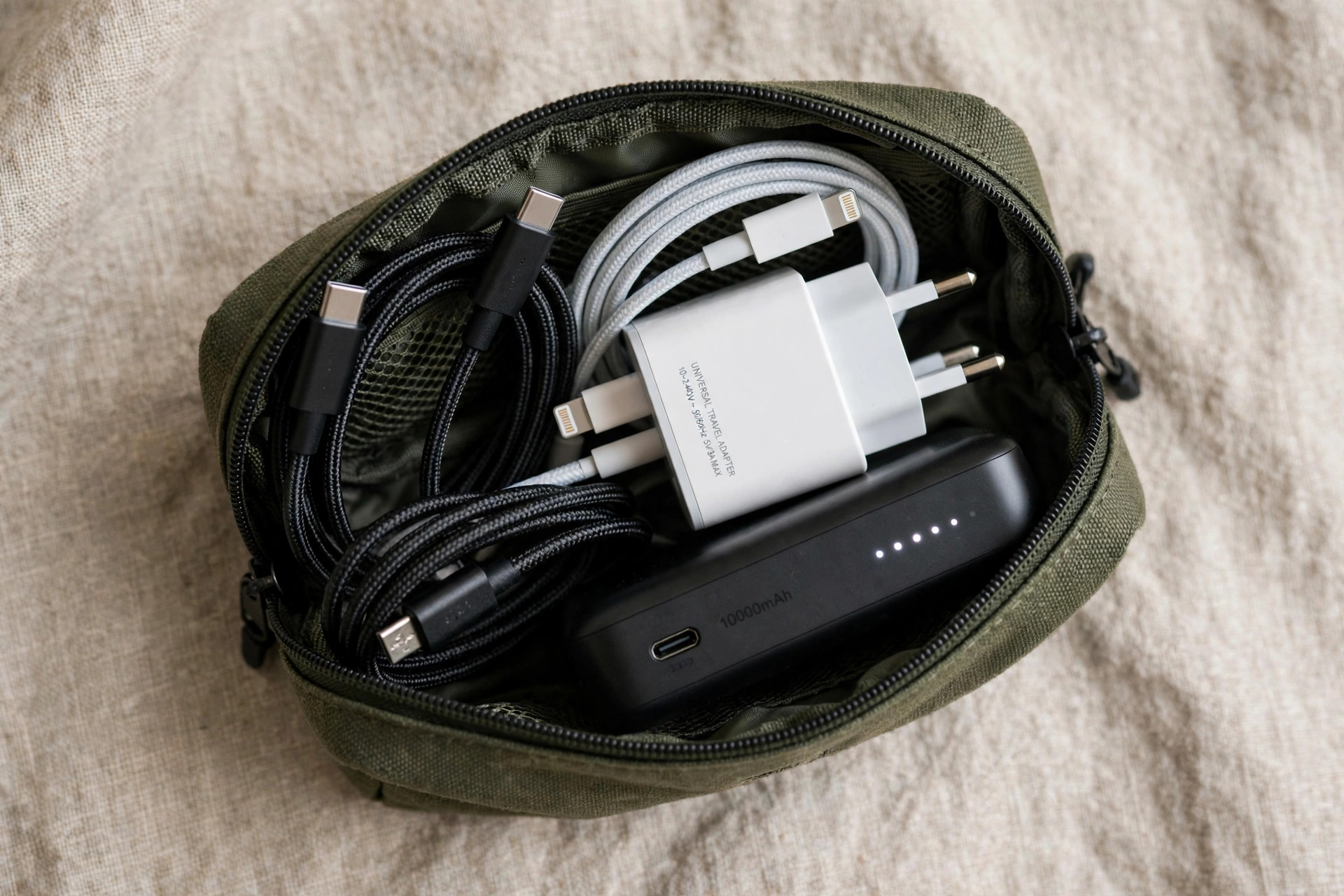
Every trip raids the home station, because the holiday needs a cable, the car needs a plug, and the station that held four cables on Friday holds one on Saturday — while the trip comes home with a cable that never goes back. Keep a travel charging kit — the kit that stops the home station being raided — so one small pouch holds a cable for each device, a multi-plug adapter and a power bank, and the pouch lives in the bag that travels. Pack the pouch the night before, keep it by the door with the travel bag, and unpack it the moment you come home, because the kit that is packed is the kit that never borrows from the station. Check the power bank is charged before you pack it, because the bank that is flat is the bank that is useless on the train, and the kit that is ready is the kit that travels without a raid. One travel kit, and the home station stays whole.
20. A nightly plug-in routine — the routine that means full batteries every morning
A station with no routine is a station nobody plugs into, because the phones stay in pockets, the tablets stay on the sofa, and the morning starts with four devices at 20% and one charger between them. Build a nightly plug-in routine — the routine that means full batteries every morning — so every device goes onto the station at the same time every evening, the same way the keys go on the hook and the shoes go by the door. Pick a time, after dinner or before bed, and make it the family's habit, because the routine that has a time is the routine that happens. Keep the station where the family passes on the way to bed, because the station that is on the way is the station that gets used, and the phone that is plugged in at night is the phone that is full in the morning. One routine a night, and the dead battery stops.
Which charging station idea fits which situation?
| Situation | Best first move | Budget | Tools needed |
|---|---|---|---|
| Cables scattered in every room | Give charging one home (idea 1) | Free | None |
| Bought a dock that does not fit | Measure the devices first (idea 2) | Free | Tape measure |
| Nobody knows whose cable is whose | Sort by person (idea 3) | Free | Labels |
| Plugs and adapters always missing | Keep the kit together (idea 4) | Low | Caddy |
| Cables fall behind the desk | Cable clips on the desk edge (idea 7) | Low | Clips |
| A power strip ruins the look | A charging box (idea 6) | Low | Charging box |
| Cables tangle in a drawer | Short cables and winders (idea 8) | Low | Winders |
| No visible charging allowed | A power strip inside a drawer (idea 9) | Low | Power strip |
| Phones die by the front door | A phone dock by the door (idea 11) | Low | Dock |
| Kids' tablets everywhere | A kids' devices station (idea 14) | Low | Shelf / dock |
| Visitors always ask for a cable | A guest charging spot (idea 15) | Low | Spare cable |
| Station messy again by Monday | A nightly plug-in routine (idea 20) | Free | None |
You do not need all 20 ideas. You need the three that solve your cable mess — usually the one home that stops the scatter, the charging box that hides the power strip, and the nightly routine that means full batteries every morning. Start with the one home, do it this weekend before the next school run, and plug everything in tonight. Do that and the next morning will start with charged phones, the cables will be in the box where you left them, and nobody will be hunting for a charger at 7 a.m.
Save this post for the next time a cable goes missing, and if the hallway around the station needs the same treatment, read 22 Drop Zone Organization Ideas for 2026 next — it is Post 56, the hallway the dock lives in — and 25 Home Office Organization Ideas for 2026, Post 68, for the office that charges the laptops. This is the twenty-third post of the new Organization by problem run — Posts 56 to 80, one problem at a time — and the run keeps going with the entryway bench next door. The bench itself gets its own deep dive in Entryway Bench Organization, where the shoes and the charging dock share the same hallway.
Publish date assigned at publishing time. Updated as new charging finds are tested.
Frequently asked questions
How do I hide charging cables in my home?
Put the power strip and the coiled cables inside a charging box, so the strip lives in a lidded box and only the devices resting on top are visible. For a fully hidden setup, put the power strip inside a drawer and feed the cables through a small hole in the back, so the devices charge out of sight while the counter stays clear. Use short cables, cable clips on the desk edge, and cable winders in the drawer, so the spare length never spills out where you can see it.
What is the best way to organize chargers for the whole family?
Give charging one home — a single station where every cable, plug and device lives — and sort it by person, so each family member has their own row, their own cable and their own colour. Label every cable near the plug end, keep the spare cables, plugs and adapters in one caddy at the station, and put the station where the family actually is, by the front door or in the living room, so the devices get plugged in without anyone having to remember.
How do I stop cables from tangling?
Use the shortest cable that reaches from the plug to the device, and wind the spare length onto a cable winder or a velcro tie, so there is no loose length to knot. Clip each cable to the desk edge in its own cable clip, so the ends stay where you can reach them and never fall behind the desk, and never drop a loose cable into a drawer — the drawer is where cables go to tangle. Check the station once a week, straighten the cables, and throw away any frayed ones at once.