25 Home Office Organization Ideas for 2026
A home office that is messy is not a decorating problem. It is a focus problem, because the desk that is covered in paper is a desk that cannot hold the work, the cables that tangle under it are the cables you trip over, and the morning that starts with clearing a space is a morning that starts behind. The work is not too much for the office — the office is too full in the wrong places and too empty in the wrong ones, and the focus you lose is really lost to a room that was never given a system.
These 25 home office organization ideas give a work-from-home setup that boosts focus: clear the desk, give every drawer one job, move paper through three trays, use the wall, and finish with a five-minute reset — so the desk holds the work and nothing else, and the day starts with a clear surface instead of a clear-up.
Every idea below works in a real home, from a spare bedroom turned office to a desk in the corner of a living room where the office has to share the room. The desk itself gets its own deep dive in 24 Desk Organization Ideas for 2026, where the drawer and cable rules are the same and the focus is the desk alone — and the homework version of the same setup is covered in 22 Homework Station Organization Ideas for 2026. Pick three ideas that fit your office, start with the empty-desk reset, and build from there.
The desk zone
1. Clear the desk completely before you organize anything — the empty-desk reset
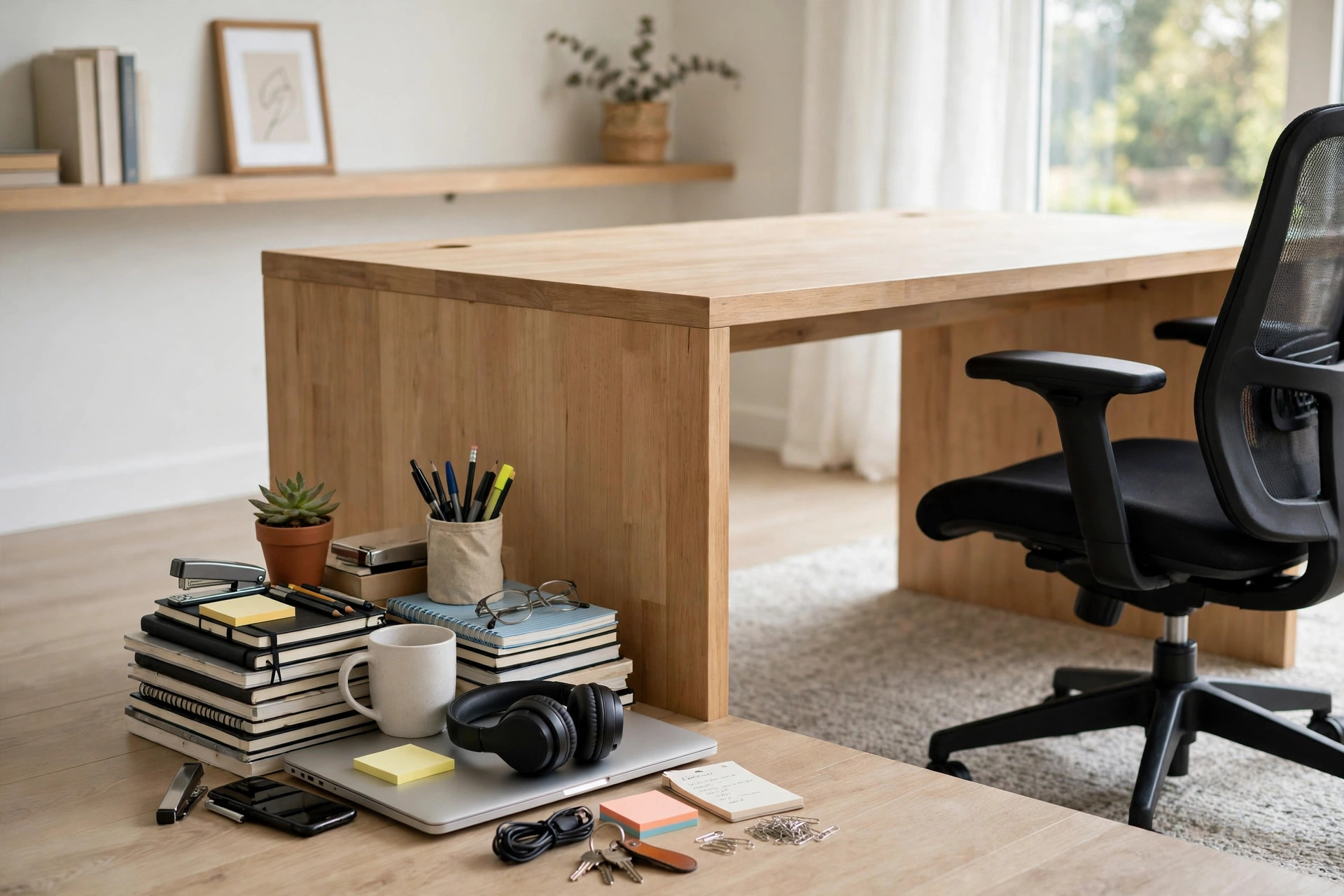
A desk organized without being cleared is a desk that keeps its mess, because the papers are shuffled, the pens are moved an inch, and the clutter that was there yesterday is still there today, only tidier-looking. Clear the desk completely before you organize anything — the empty-desk reset — so every single thing comes off the desk and the surface is bare for the first time in months. Put everything in one pile on the floor beside the desk, wipe the surface clean, and only then decide what earns its way back, because the desk that starts empty is the desk where every object has to justify its place. One clear desk, and the office starts from zero instead of from the mess.
2. One job per drawer — the desk drawer that knows its purpose
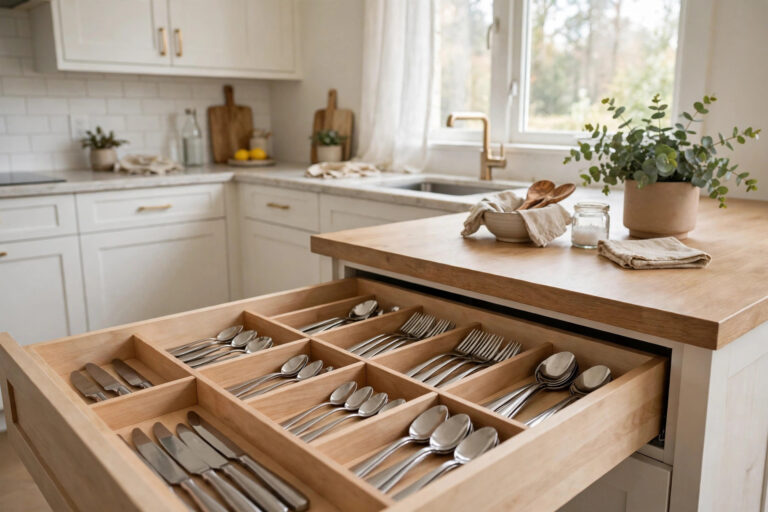
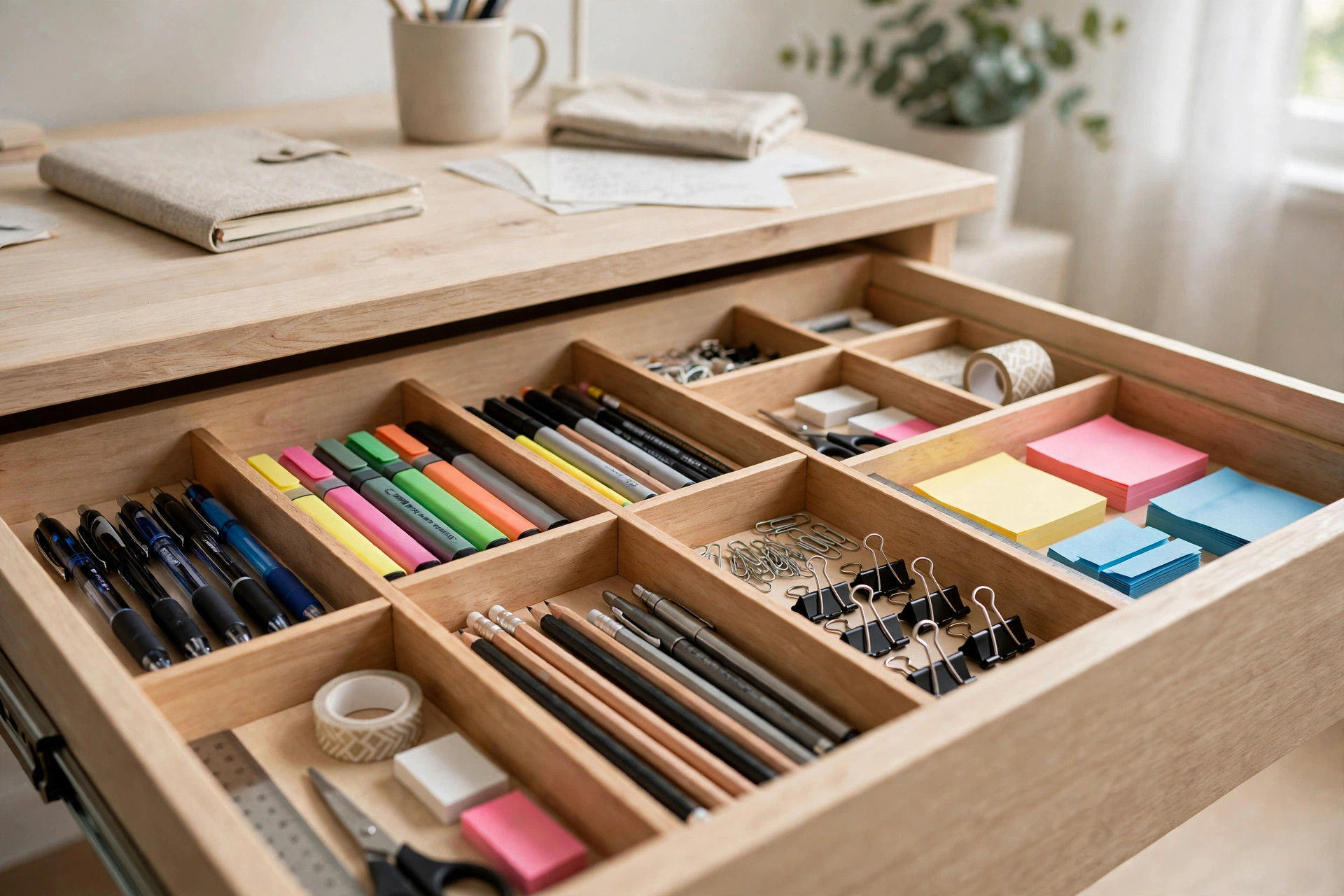
A desk drawer that holds a bit of everything is a drawer that holds nothing you can find, because the pens are under the cables, the cables are under the receipts, and the drawer you open looking for a pen is the drawer you close having found nothing. Give every drawer one job — the desk drawer that knows its purpose — so the top drawer holds the stationery, the next holds the paper, and the deep drawer holds the tech, and each drawer is opened for one thing only. The one-job rule is the same rule that keeps the kitchen drawers working in 22 Kitchen Drawer Organization Ideas for 2026, where every drawer has a single job and the rummage stops. One job per drawer, and the drawer opens to the thing you want.
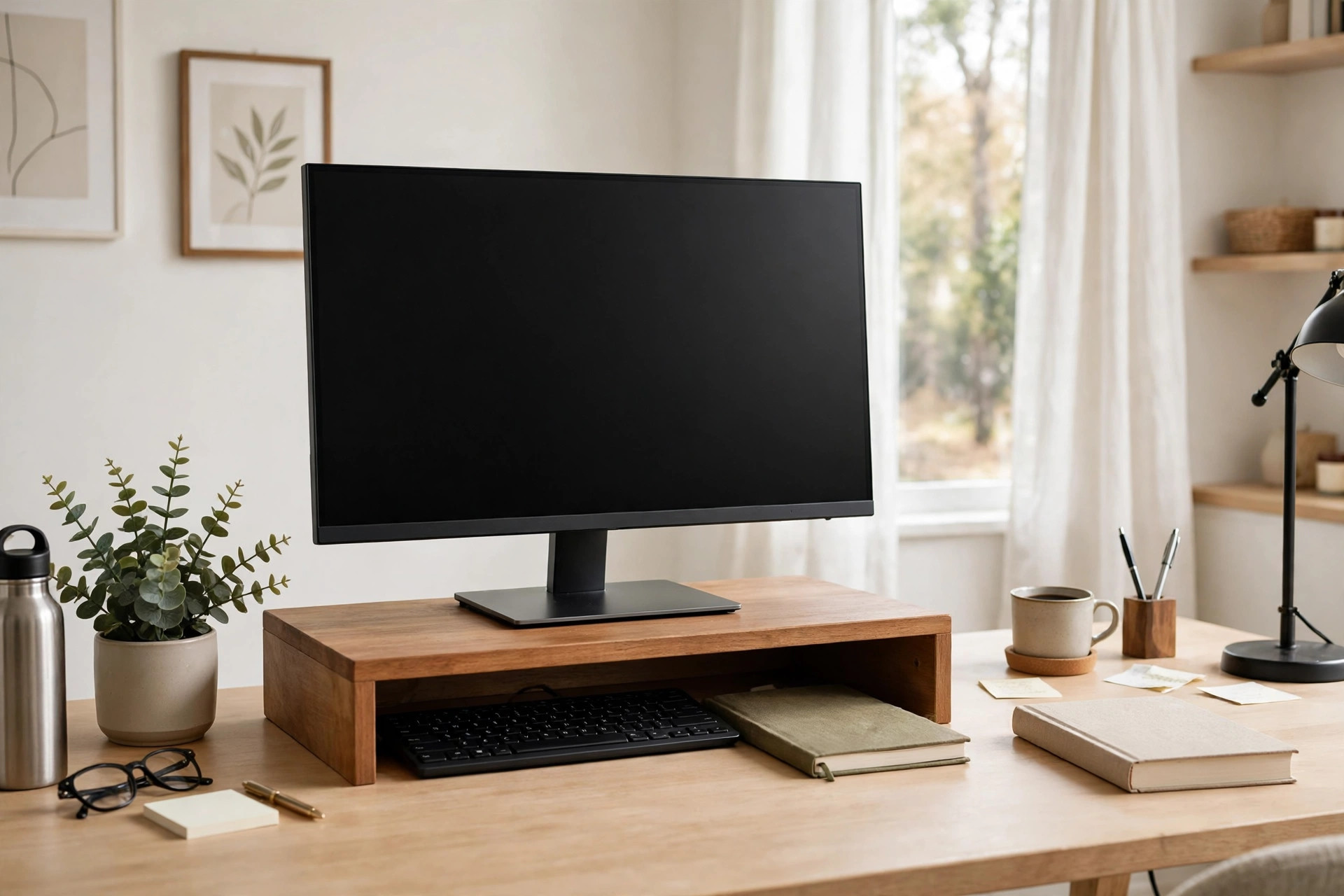
3. A monitor riser — the lift that frees a whole shelf of desk
A monitor sitting flat on the desk is a monitor wasting the space under it, because the screen takes the desk, the keyboard slides in front of it, and the notebook and the phone have nowhere to go but on top of each other. Use a monitor riser — the lift that frees a whole shelf of desk — so the screen sits at eye level, the keyboard and the notebook slide underneath when you are done, and the desk gains a whole shelf of space without getting any bigger. Pick a wooden riser with a drawer or a slot for the notebook, because the riser that stores is the riser that does two jobs, and set the screen so the top of it is at your eye line, because the screen at the right height is the screen that saves your neck as well as your desk. One riser, and the desk gains a shelf. (Check on Amazon for a wooden monitor riser with storage, sized for your screen.)
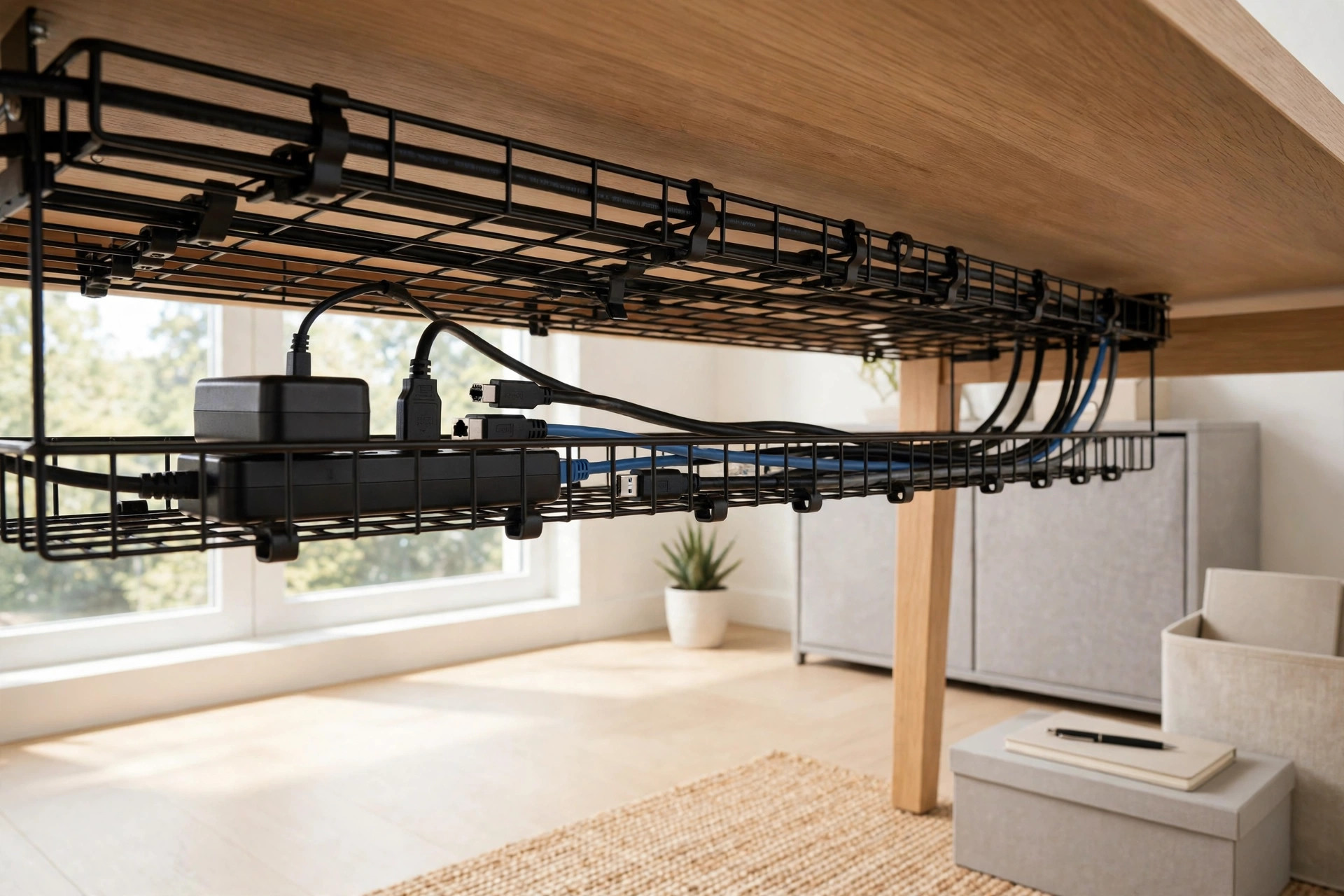
4. A cable tray under the desk — the tangle that disappears
Cables hanging loose under a desk are cables that tangle, because the charger drops, the extension lead slides, and the floor under the desk becomes a nest of wires that nobody wants to touch. Fit a cable tray under the desk — the tangle that disappears — so the power strip and the spare cables live in the tray, clipped in place, and the floor under the desk is empty. Run each cable through a clip on the way to the tray, label the plugs if there are more than three, and keep the cables you unplug daily — the laptop charger — on top of the desk in reach, because the tray that holds the permanent cables is the tray that never needs touching. One tray, and the tangle is gone.
5. A desk mat that marks the work zone — the boundary that keeps the desk tidy
A desk with no boundary is a desk that spreads, because the papers drift to the edges, the coffee cup migrates, and the work zone that was the middle of the desk is the whole desk by lunchtime. Lay a desk mat — the boundary that keeps the desk tidy — so the mat marks the work zone and everything outside it is not the desk but the rest of the room. Put the laptop, the notebook and the pen on the mat, and keep the rest — the papers, the phone, the mug — off it, because the mat that holds only the work is the mat that shows when the desk is drifting. A leather or felt mat in a calm colour keeps the desk looking like an office and not a dumping ground, and the mat that is wiped each evening is the mat that starts clean each morning. One mat, and the desk has an edge.

6. A keyboard tray that slides away — the keyboard that leaves the desk clear
A keyboard that lives on the desk all day is a keyboard taking up the desk, because the typing space is the writing space, the writing space is the reading space, and the desk that holds the keyboard permanently holds nothing else properly. Fit a keyboard tray that slides away — the keyboard that leaves the desk clear — so the keyboard slides out when you type and slides back under the desk when you write, and the desk surface is free for the notebook. Set the tray at elbow height so your shoulders stay relaxed, because the tray at the right height is the tray that saves your wrists as well as your desk, and keep the mouse on the tray beside the keyboard, because the mouse that travels with the keyboard is the mouse that is always where your hand expects it. One tray, and the desk is clear when you need it clear.
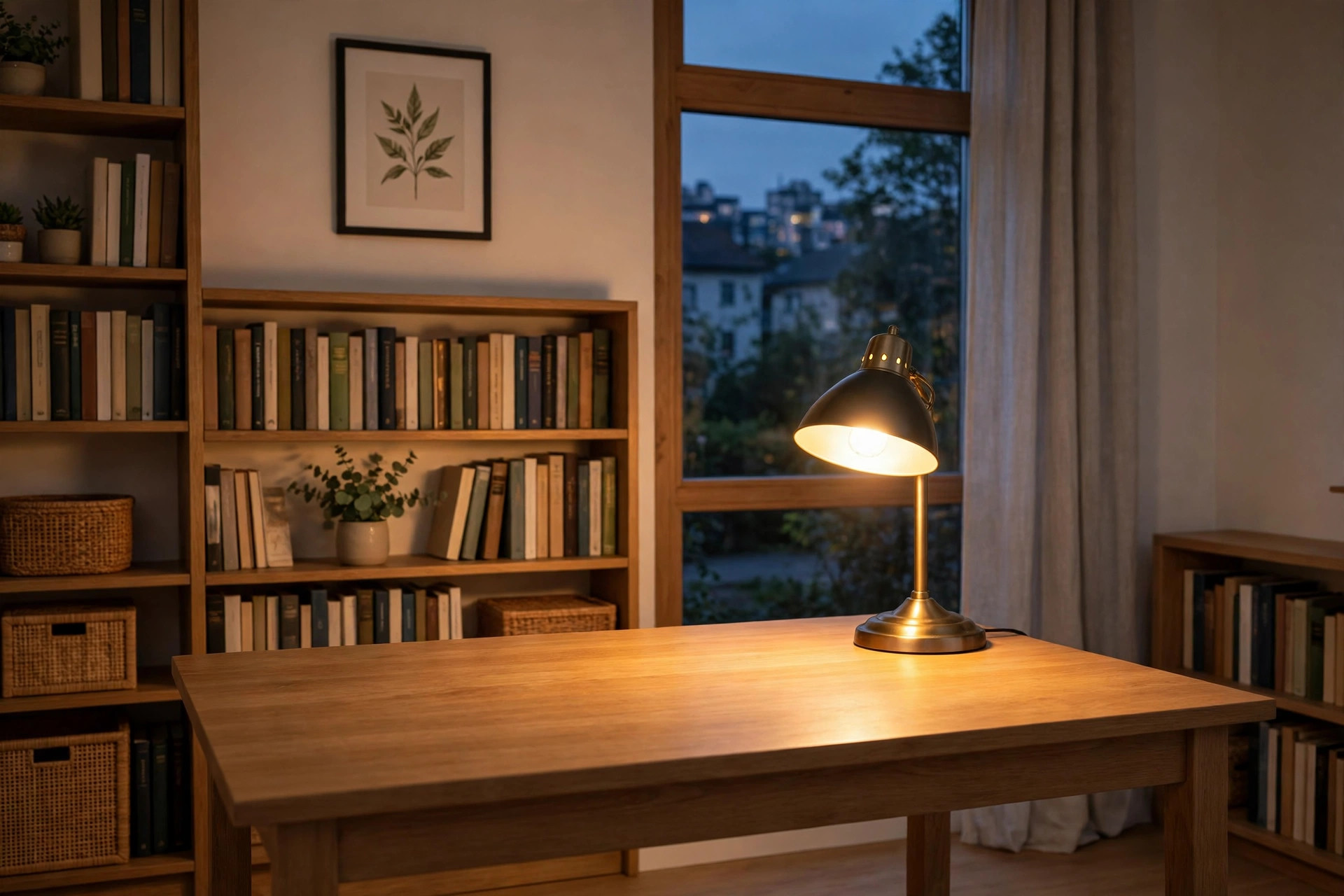
7. A lamp on the left, a plant on the right — the desk layout that stops the spread
A desk with no fixed layout is a desk where everything moves, because the lamp ends up in the middle, the plant ends up behind the screen, and the things you reach for are never where your hand expects them to be. Fix the layout — a lamp on the left, a plant on the right — so the lamp lights the work from the side that does not cast a shadow over your writing hand, and the plant sits where it softens the room without blocking the screen. Keep the layout the same every day, because the layout that never changes is the layout your hands learn, and the things that live in fixed places are the things that get put back. One fixed layout, and the desk stops spreading.

Paper, files and supplies
8. A paper flow with three trays — in, doing, done
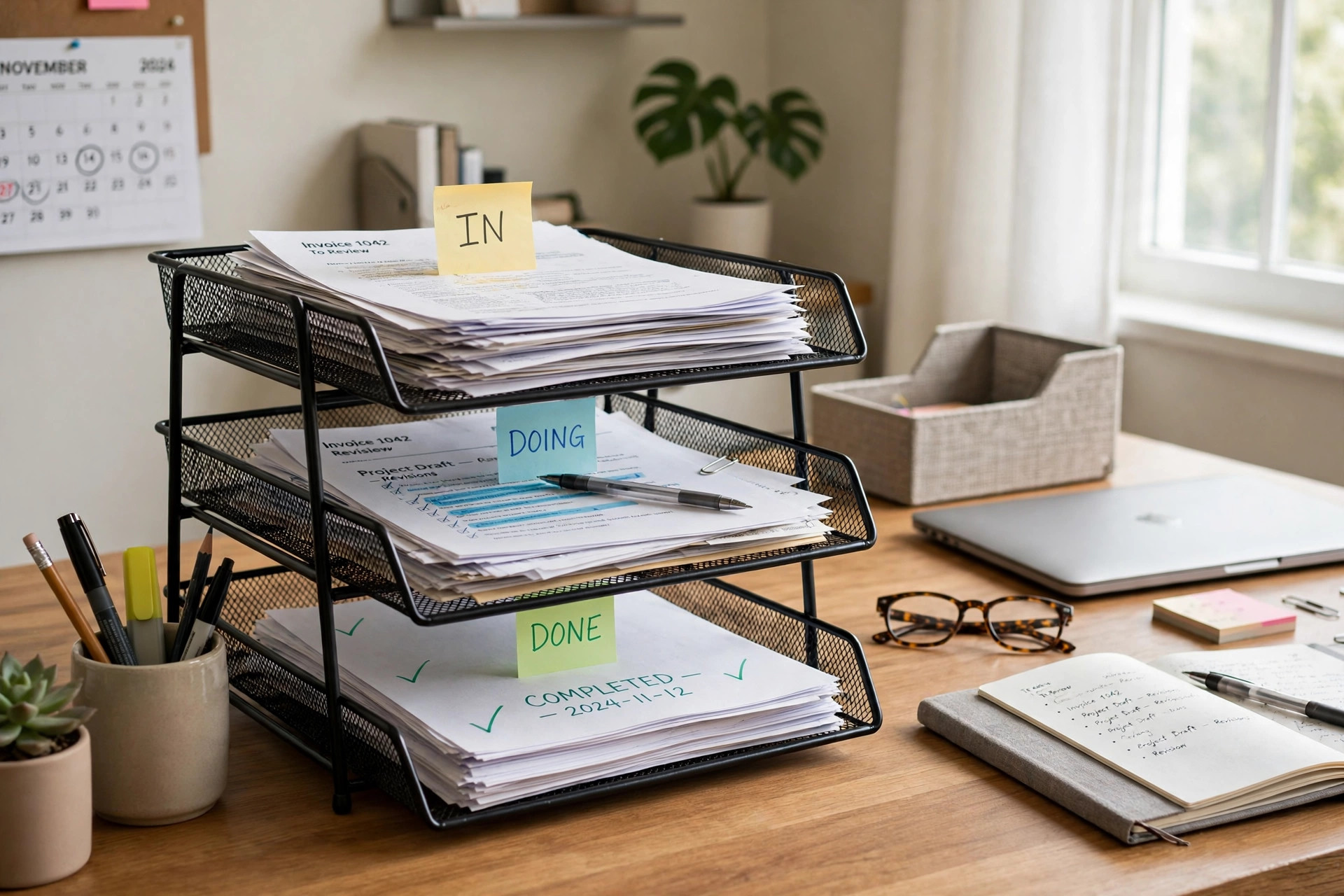
Paper with no flow is paper that piles, because the post lands on the desk, the bill lands on the post, and the desk that holds the paper is the desk where nothing is ever finished. Set up a paper flow with three trays — in, doing, done — so every piece of paper enters the top tray, moves to the middle tray while you work on it, and leaves through the bottom tray when it is finished. Empty the "in" tray every day and the "doing" tray every week, because the tray that is emptied is the tray that keeps flowing, and file the "done" papers the same day, because the paper that is filed is the paper that stops piling. The same command-centre thinking runs the mudroom in 25 Mudroom Organization Ideas for 2026, where the paper station by the door works the same way. Three trays, and the paper flows instead of piling.
9. A filing system with one folder per topic — the cabinet that answers back
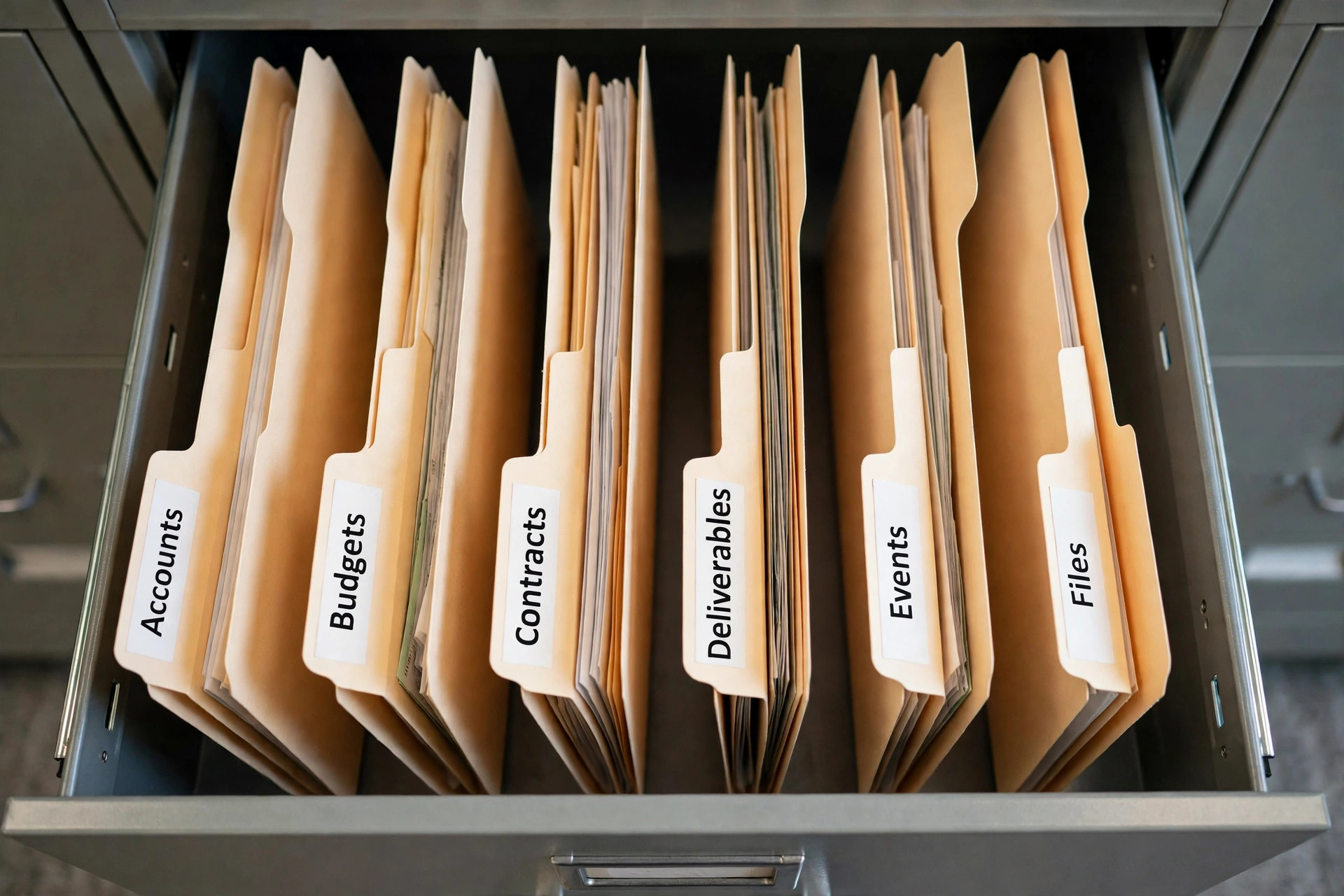
A filing drawer full of mixed papers is a drawer you cannot use, because the tax papers are with the school forms, the school forms are with the warranties, and the folder you open looking for one paper is the folder that holds everything but that paper. Build a filing system with one folder per topic — the cabinet that answers back — so every folder holds one subject, the folders sit in alphabetical order, and the paper you need is the paper you can find in under a minute. Label every folder on the tab, not the front, because the tab that faces up is the tab you can read without pulling the folder out, and keep one empty folder at the front for the papers that have no home yet, because the folder that catches the strays is the folder that keeps the system honest. The school version of the same flow is covered in 22 School Organization Ideas for 2026, where the family papers run through the same one-folder rule. One folder per topic, and the cabinet answers back.
10. A stationery caddy that holds only the daily tools — the pen pot that earns its place
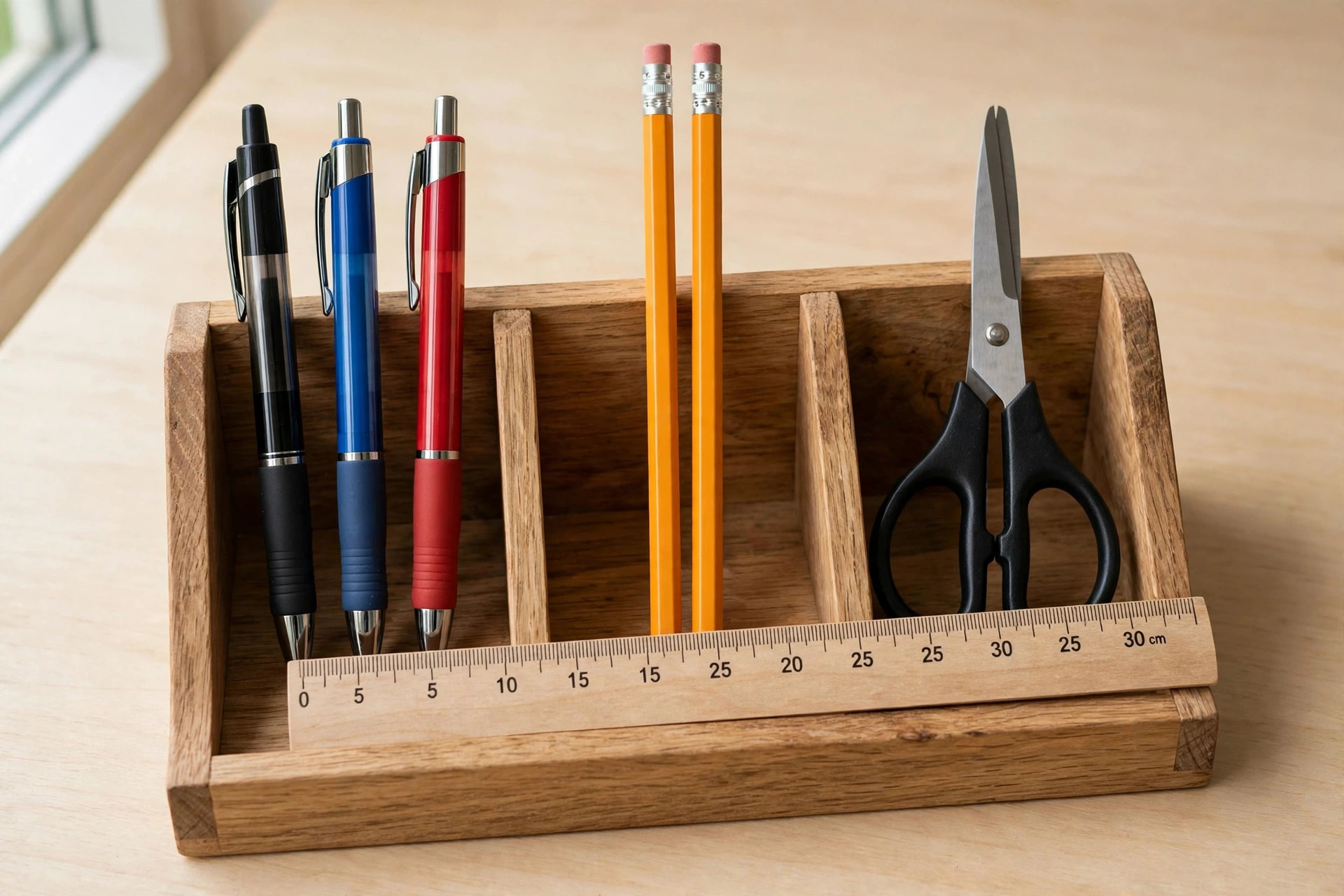
A pen pot full of every pen you own is a pen pot that holds nothing you can use, because the dried-out pens are with the good ones, the pencils are with the highlighters, and the pen you reach for is the pen that does not write. Keep a stationery caddy that holds only the daily tools — the pen pot that earns its place — so the caddy holds three pens that work, two pencils, one pair of scissors and a ruler, and nothing else. Test every pen before it goes in the caddy, throw the dead ones away, and keep the spares in the supply drawer from idea 12, because the caddy that holds only the working tools is the caddy you can reach into without looking. The pencils themselves get their full system in 18 Pencil Storage Ideas for 2026, where the daily pencils are kept the same way. One caddy, and the pen you grab is the pen that works. (Check on Amazon for a small wooden desk caddy with sections for pens, pencils and scissors.)
11. Labelled boxes on the shelf — the shelf you can find blindfold
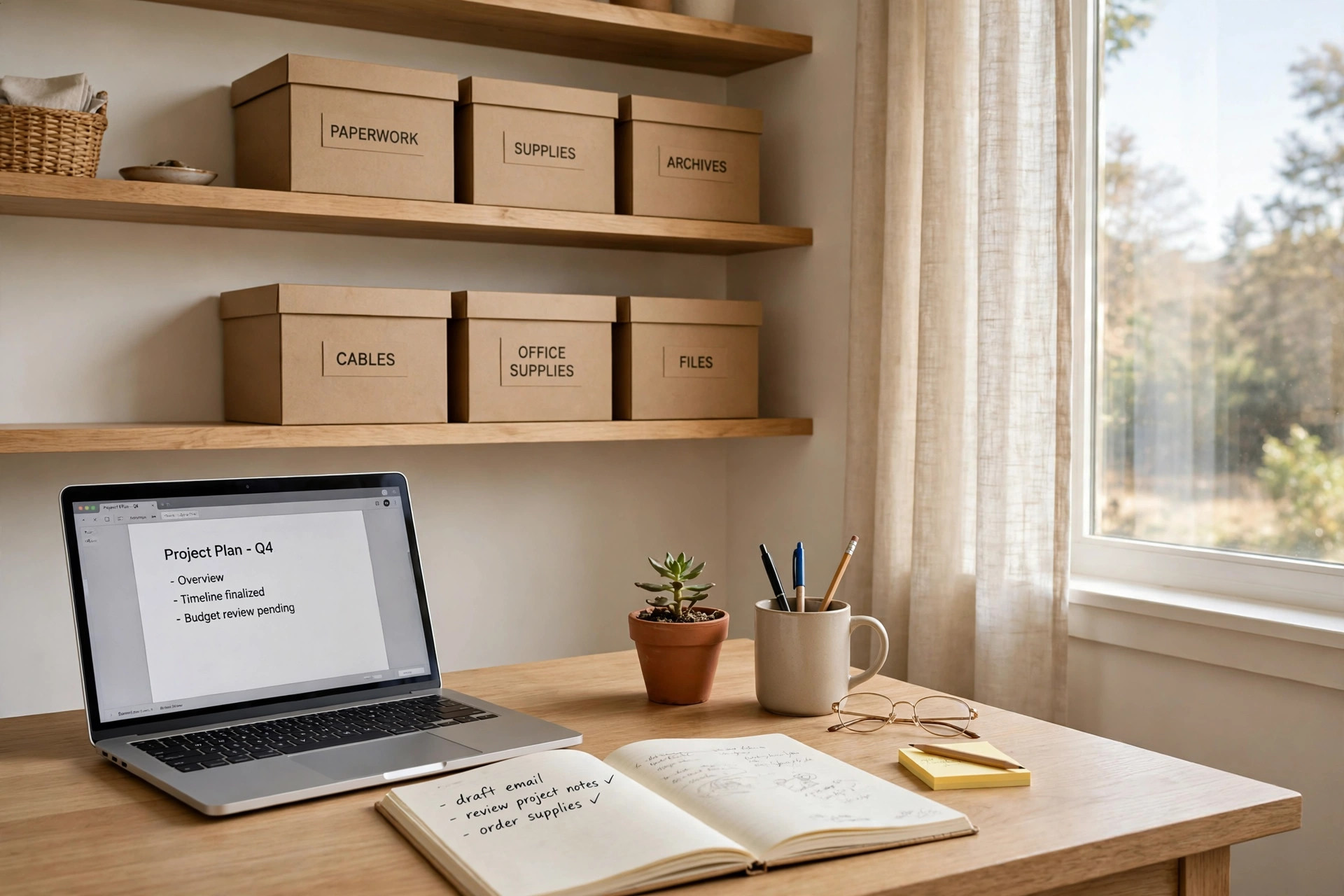
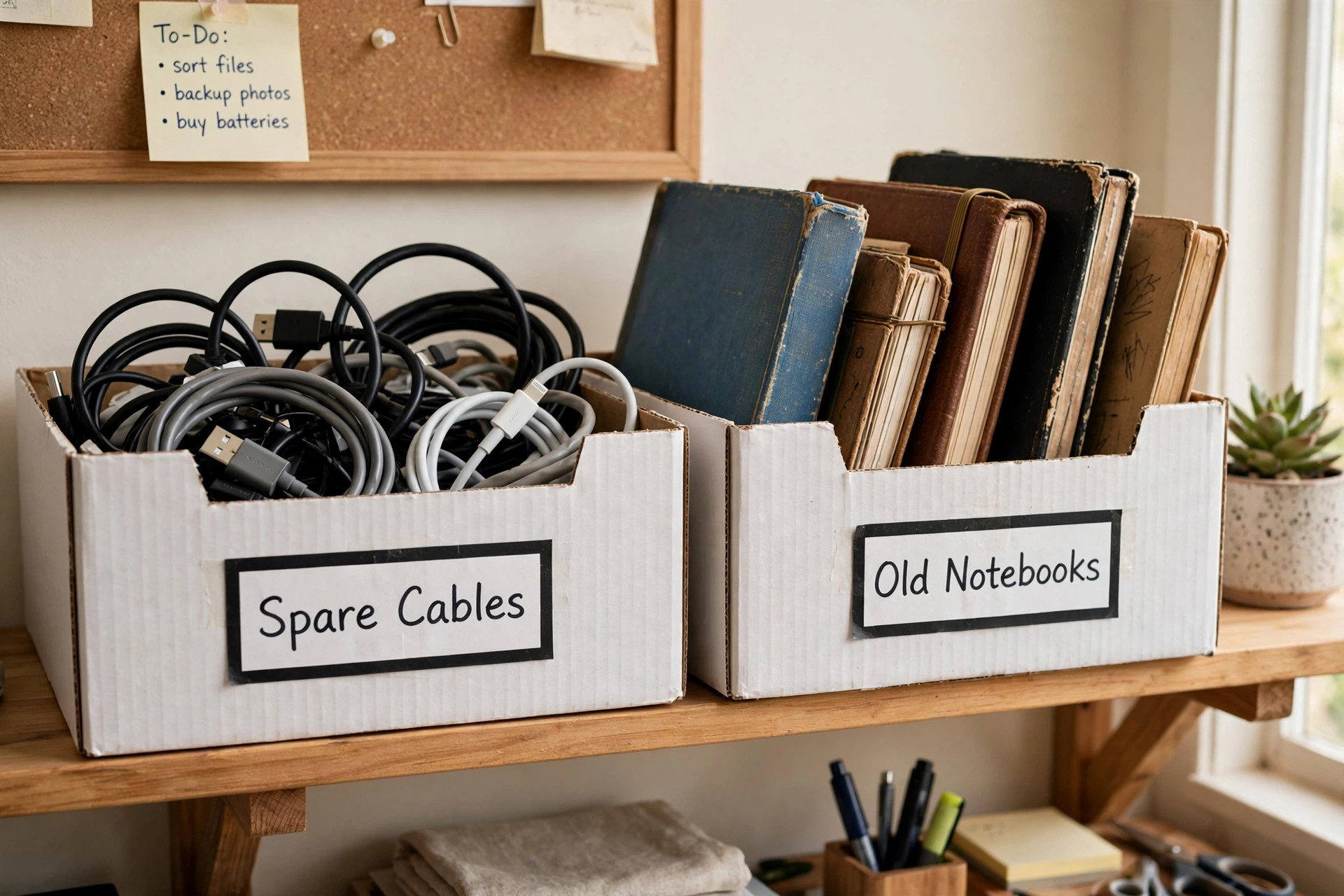
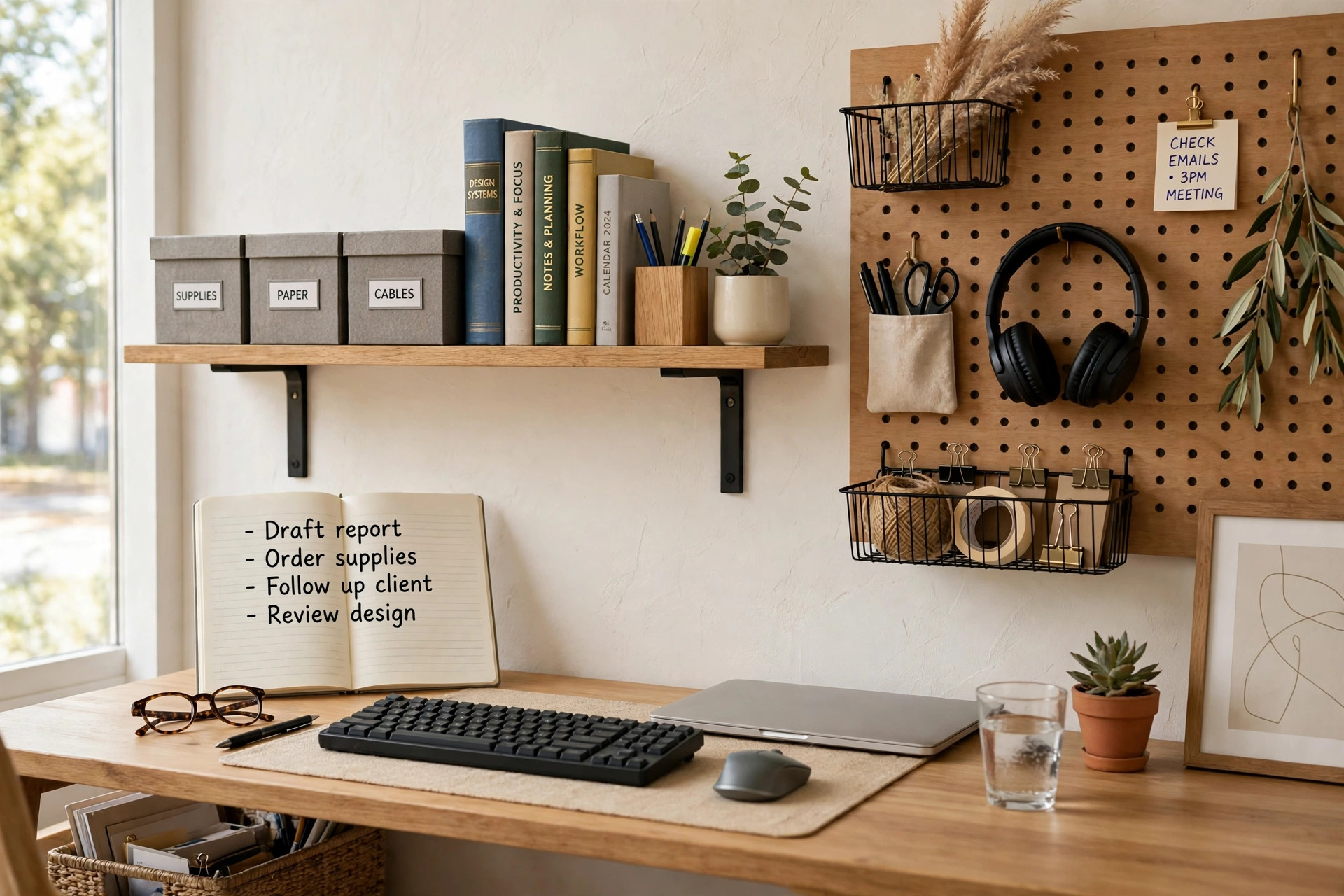
Boxes without labels are boxes you have to open, because the box that holds the spare cables looks exactly like the box that holds the old notebooks, and the shelf that holds unlabelled boxes is a shelf you never use. Use labelled boxes on the shelf — the shelf you can find blindfold — so every box says what it holds and the shelf becomes usable storage instead of a mystery. Put the label on the front of the box, not the lid, because the label that faces you is the label you can read from the desk, and use one box per category, because the box that holds one thing is the box that stays sorted. The same front-label rule keeps the bedroom bins findable in 28 Bedroom Storage Ideas for 2026, where the bins live on open shelves. One label per box, and the shelf stops being a mystery.
12. A supply drawer with dividers — the drawer that stops the rummage
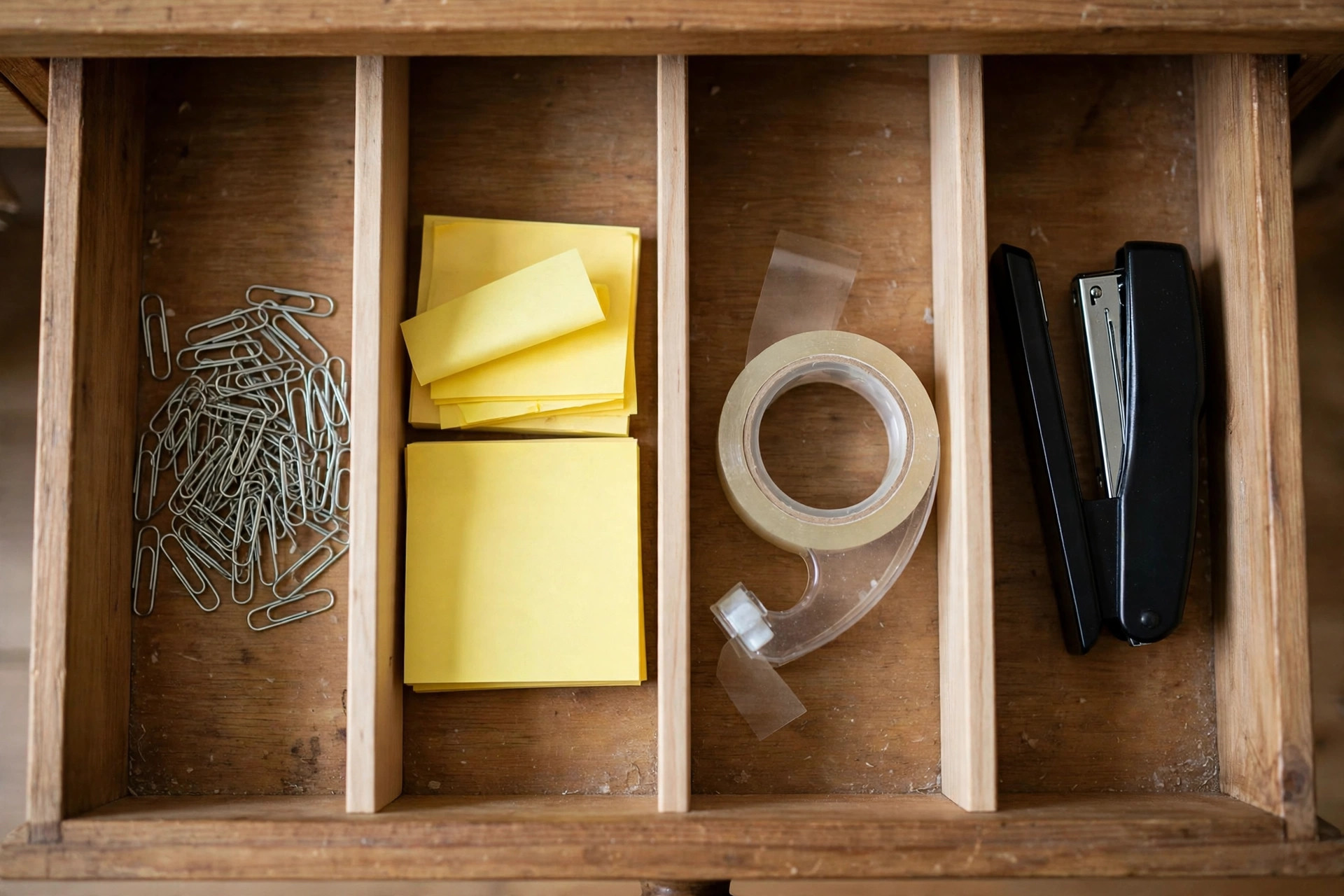
A supply drawer without dividers is a drawer where everything mixes, because the paper clips slide under the sticky notes, the sticky notes slide under the batteries, and the drawer you open for a paper clip is the drawer you empty onto the desk. Fit dividers in the supply drawer — the drawer that stops the rummage — so every small thing has its own section and the drawer opens to order. Use shallow dividers for the clips and pins and deeper ones for the tape and the stapler, because the divider that fits the object is the divider that keeps it in place, and keep the dividers adjustable, because the drawer that can change is the drawer that grows with the office. The same divider logic keeps the bathroom drawers working in 20 Bathroom Drawer Organization Ideas for 2026, where the small things stay sorted the same way. One set of dividers, and the rummage stops.
13. A wall shelf above the desk — the shelf for the things you reach for least
The wall above the desk is the most wasted surface in the office, because it holds nothing, it faces the chair, and the space it offers is space nobody thinks to use. Fit a wall shelf above the desk — the shelf for the things you reach for least — so the reference books, the spare notebooks and the box of envelopes live up high and the desk below stays free for the work. Keep the shelf shallow and put the things you use once a week there, not the things you use every hour, because the shelf that holds the rarely-used is the shelf that never gets in the way. The books themselves get their full system in 24 Book Storage Ideas for 2026, where the shelf above the desk is only the start. One shelf above the desk, and the top of the office starts working.
Walls, shelves and small spaces
14. A pegboard on the wall — the wall that works as hard as the desk
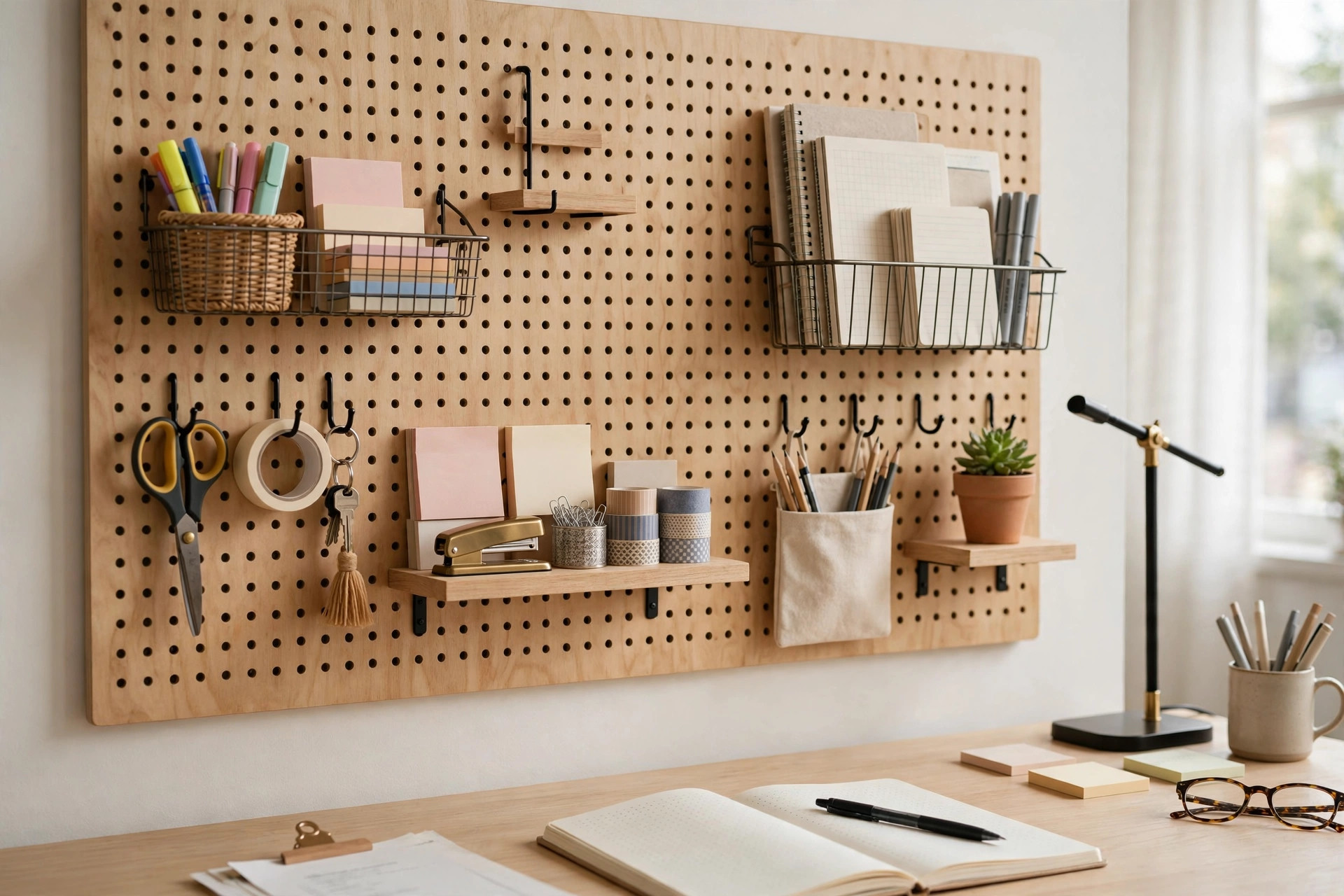
A bare wall beside the desk is a wall doing nothing, because the desk holds everything, the shelves hold the rest, and the wall that could hold the daily tools holds only paint. Hang a pegboard on the wall — the wall that works as hard as the desk — so the scissors, the tape, the headphones and the small baskets hang on hooks and the desk stays clear. Move the pegboard hooks when the work changes, because the board that can be rearranged is the board that grows with the office, and keep the things you use every day at arm's reach and the rest higher up, because the pegboard that puts the daily tools in reach is the pegboard that gets used. One pegboard, and the wall starts working.
15. A rolling cart beside the desk — the overflow that stays tidy
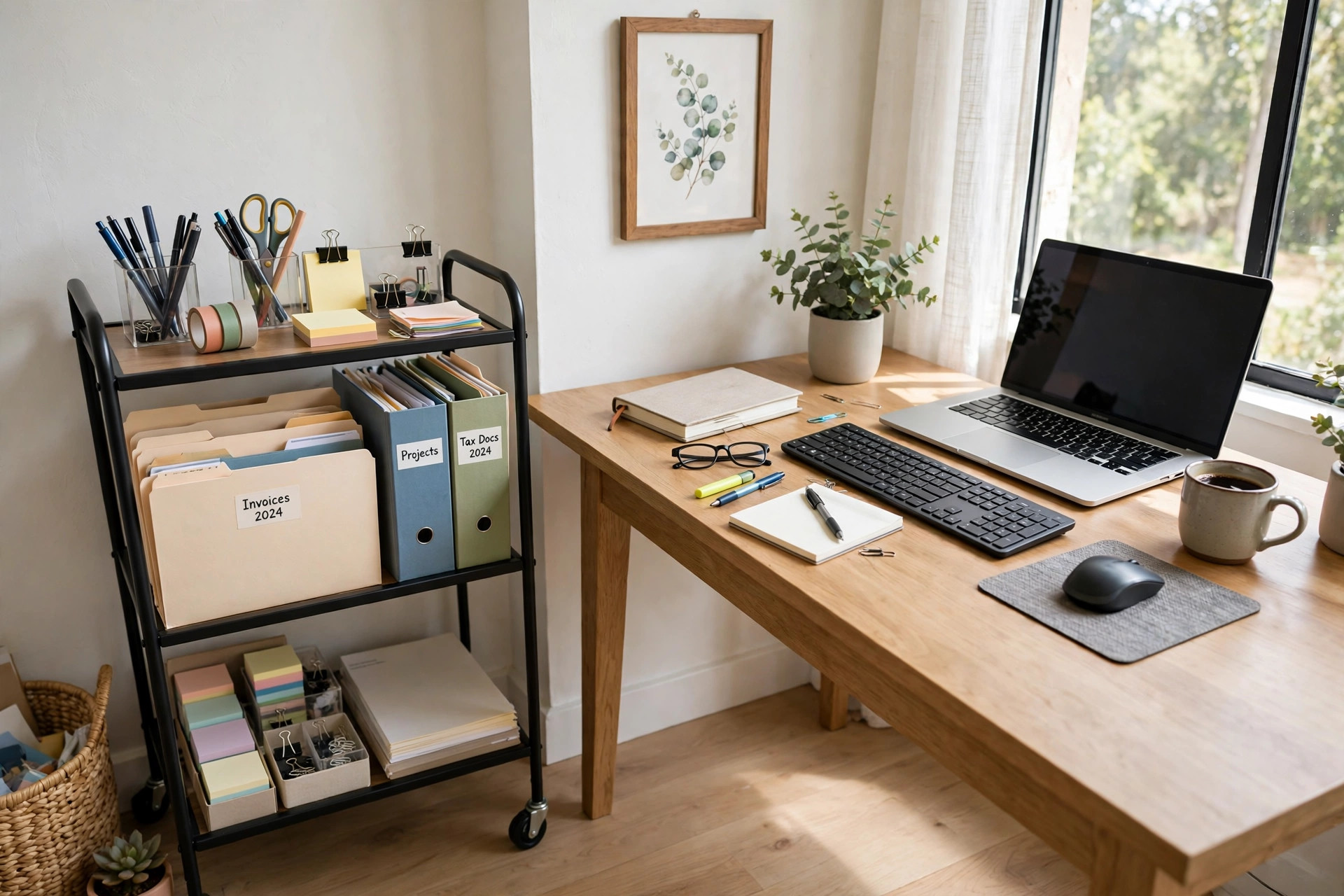
Some offices are too small even when they are organized, because the desk fits and the extras do not, and the extras — the printer paper, the spare files, the craft supplies for the kids' homework — end up on the floor. Keep a rolling cart beside the desk — the overflow that stays tidy — so the extras live on the cart, in reach of the desk, and the cart rolls away when the room needs the space. Load the cart with the things the desk cannot hold, park it beside the desk leg, and roll it into the corner when guests come, because the cart that moves is the overflow that never becomes clutter. The rolling cart itself is covered in 22 Rolling Cart Organization Ideas for 2026, where the same cart works as a craft station and an office helper in turn. One cart, and the overflow has a home. (Check on Amazon for a slim three-tier rolling cart that fits beside a desk.)
16. Vertical file holders for the papers you use every week
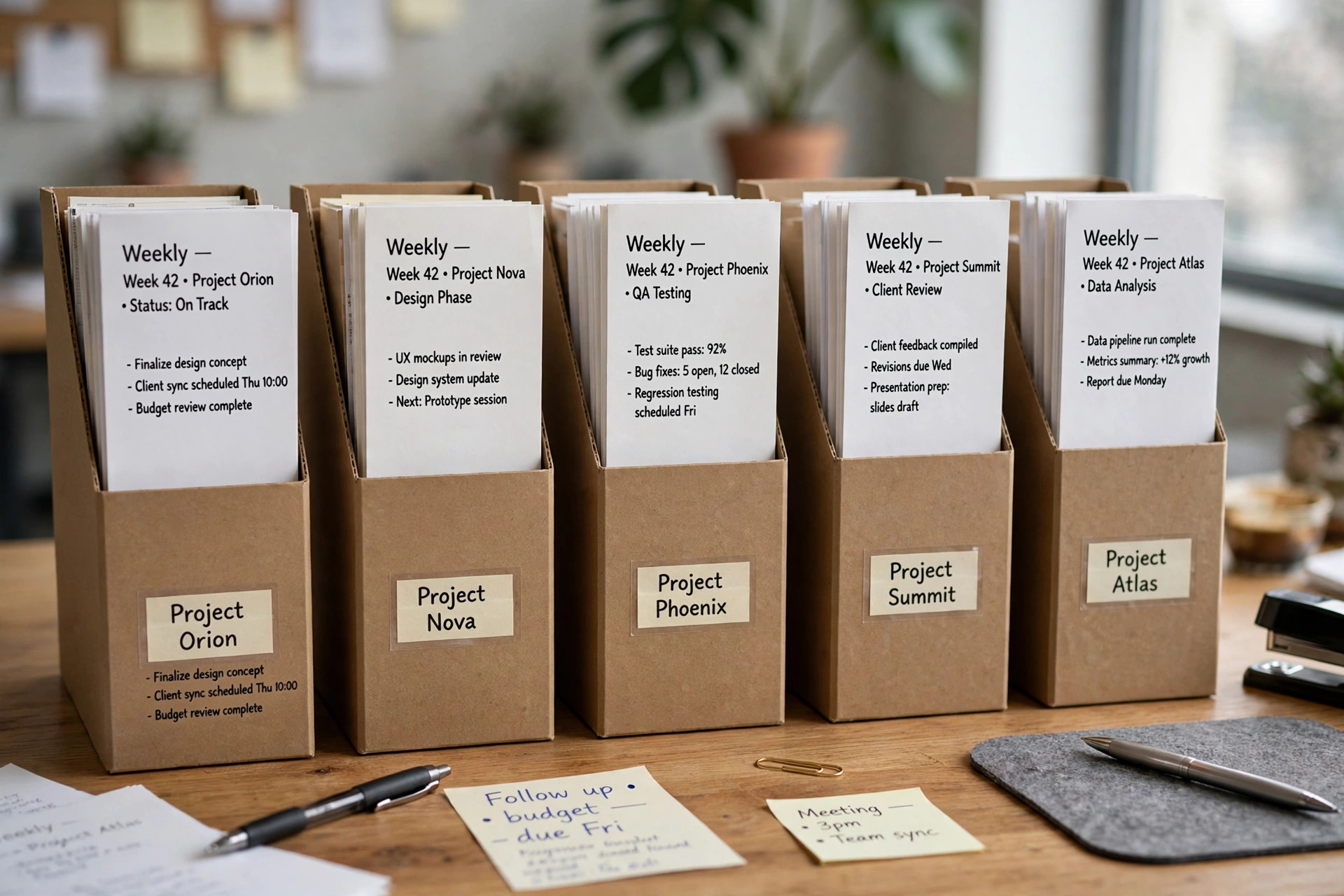
Papers stacked flat are papers that get buried, because the bottom of the pile is never seen, the pile leans, and the paper you need is the paper at the bottom of a stack you are afraid to disturb. Stand the weekly papers up in vertical file holders — the papers you use every week, on edge — so each project has its own upright slot and the paper you need is the paper you can pull out without disturbing the rest. Label each holder with the project name, keep the holders on the desk or on the shelf beside it, and empty them every Friday, because the holder that is emptied weekly is the holder that never overflows. One set of holders, and the pile stops burying the work.
17. A printer station that lives off the desk — the printer that stops eating the desk
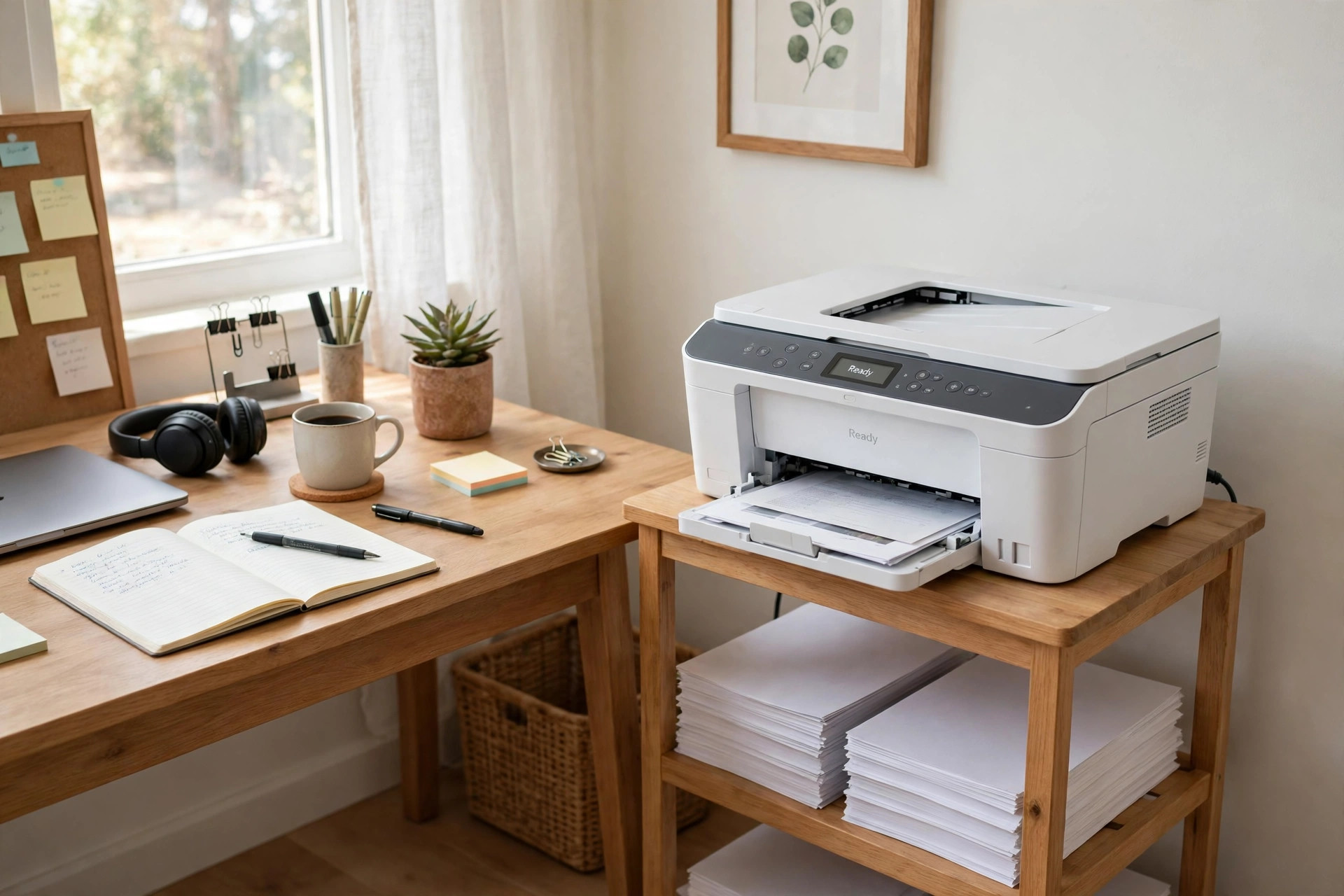
A printer on the desk is a printer eating the desk, because the machine takes a third of the surface, the paper tray takes another third, and the desk that holds the printer holds almost nothing else. Move the printer to its own station off the desk — the printer that stops eating the desk — so the machine lives on a small stand beside the desk, the paper lives underneath it, and the desk is free for the work. Keep the stand at the same height as the desk so the paper slides across easily, and put the spare ink and the envelopes on the shelf below, because the station that holds everything printer-shaped is the station that keeps the printer off the desk. One stand, and the desk gets its space back.
18. A charging station in one spot — the cables that stop wandering
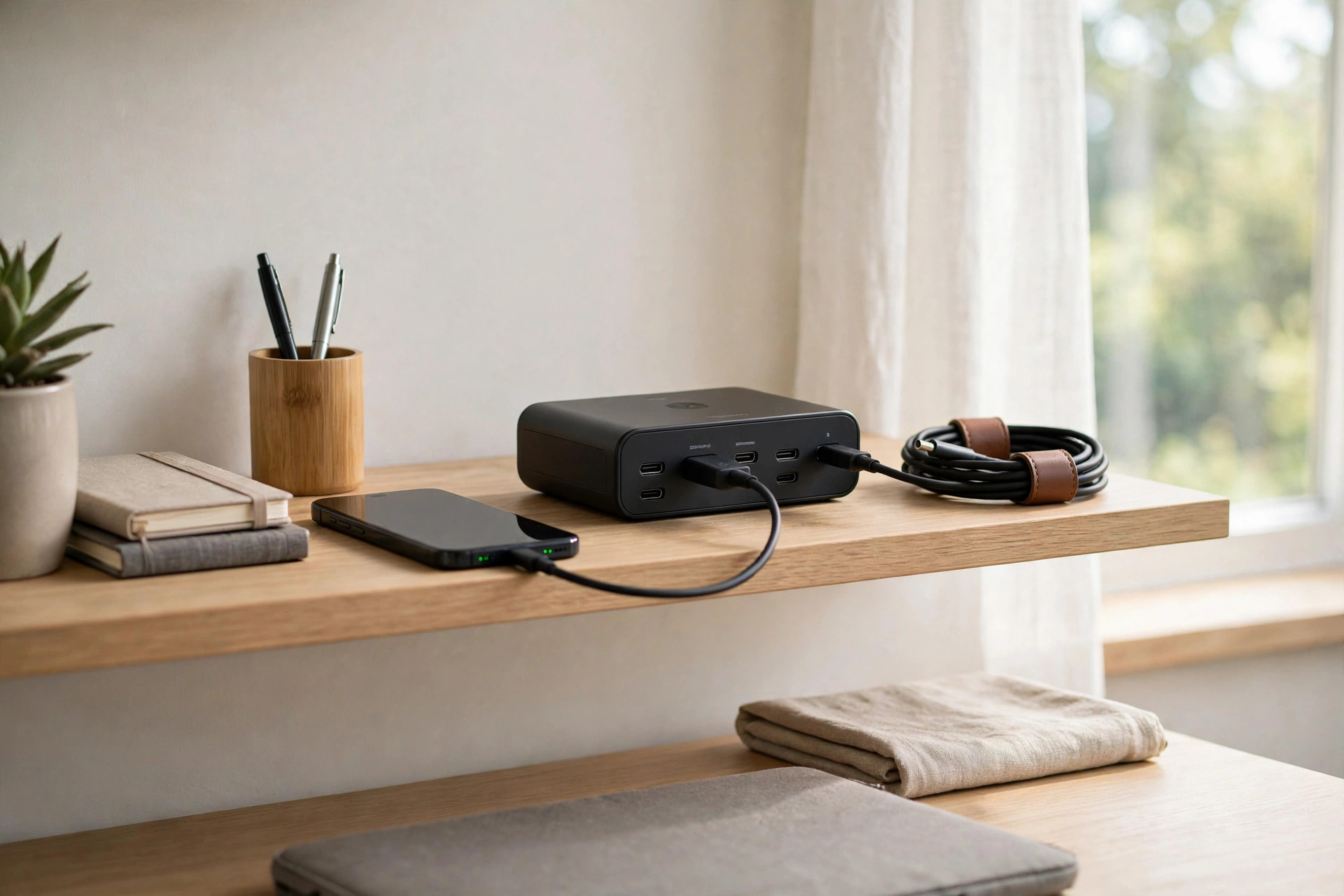
Chargers scattered around the office are chargers that wander, because the phone charger is on the desk, the laptop charger is on the floor, and the cable you need is the cable that is always in the other room. Set up a charging station in one spot — the cables that stop wandering — so every charger lives on one shelf or in one small box, the phone and the laptop charge in the same place, and the cables never leave it. Use a small tray or a charging box with holes for the cables, label which charger belongs to which device, and keep the station near the desk but off it, because the station that is close but not on the desk is the station that charges without cluttering. One station, and the cables stop wandering.
19. Hooks on the door for the bag and the headphones
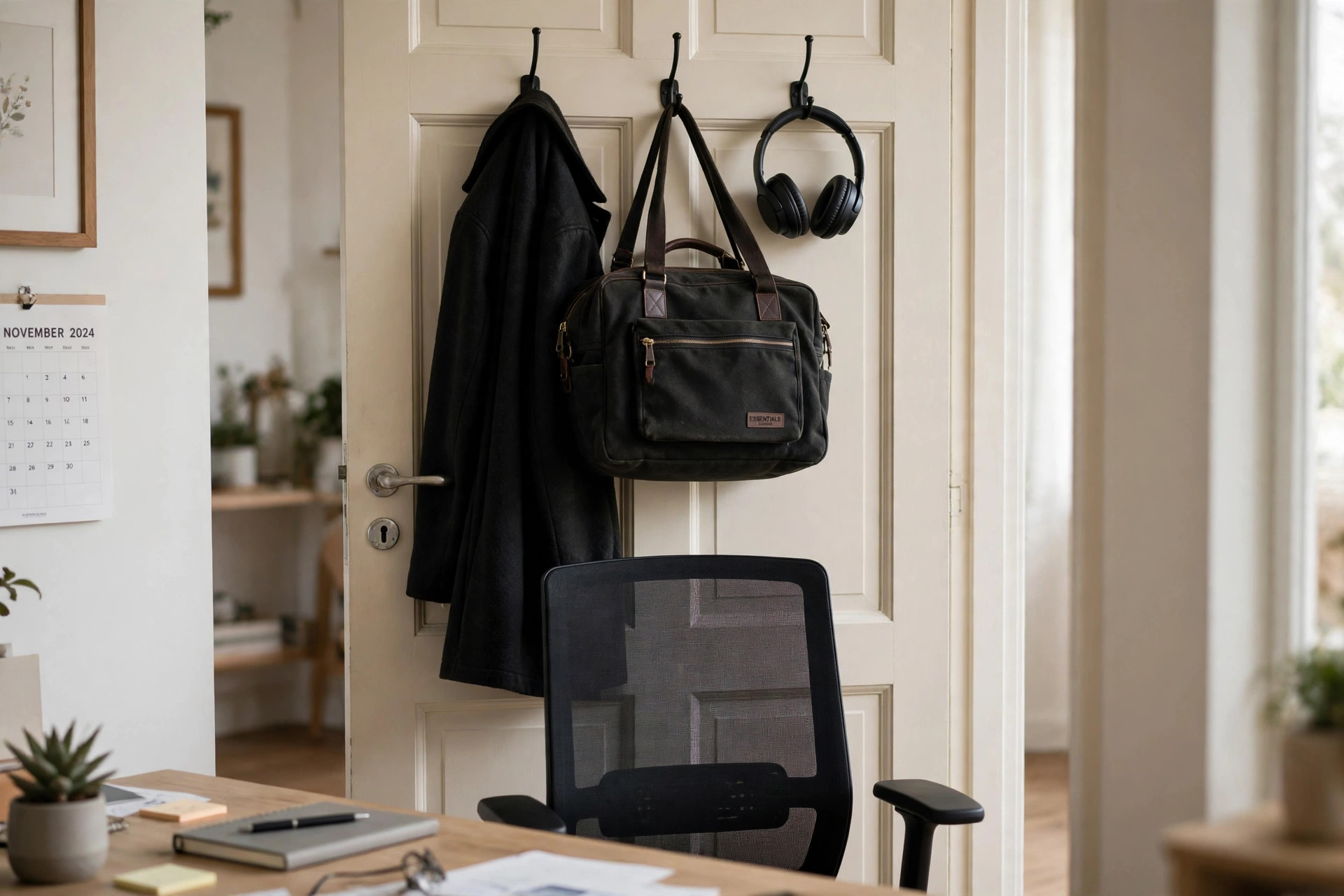
The office door is the most wasted surface in the room, because it holds nothing, it faces the desk, and the space it offers is space nobody thinks to use. Hang hooks on the door — the bag and the headphones, off the desk — so the work bag, the headphones and the coat you wear to the school run live on the door instead of on the chair. Hang a row of hooks at eye level for the things you grab daily, keep the heavy bag on the lowest hook, and leave the desk chair free, because the door that holds the daily things is the door that keeps the chair empty. The same door-first rule clears the entryway in 22 Drop Zone Organization Ideas for 2026, where the hooks hold the bags before anyone sits down. One row of hooks, and the desk chair is a chair again.
Habits that keep it tidy for good
20. An end-of-day reset — five minutes that save the morning
No office stays tidy without a habit, because the office is only tidy on the day you organize it and the mess creeps back one paper at a time. Do an end-of-day reset — five minutes that save the morning — so the desk is clear before you leave it and the next day starts with a clean surface. File the papers, put the pens back in the caddy, plug the laptop in at the charging station, and wipe the desk mat, because the reset that takes five minutes is the reset that actually happens. Five minutes at the end of the day, and the morning starts with work instead of a clear-up.
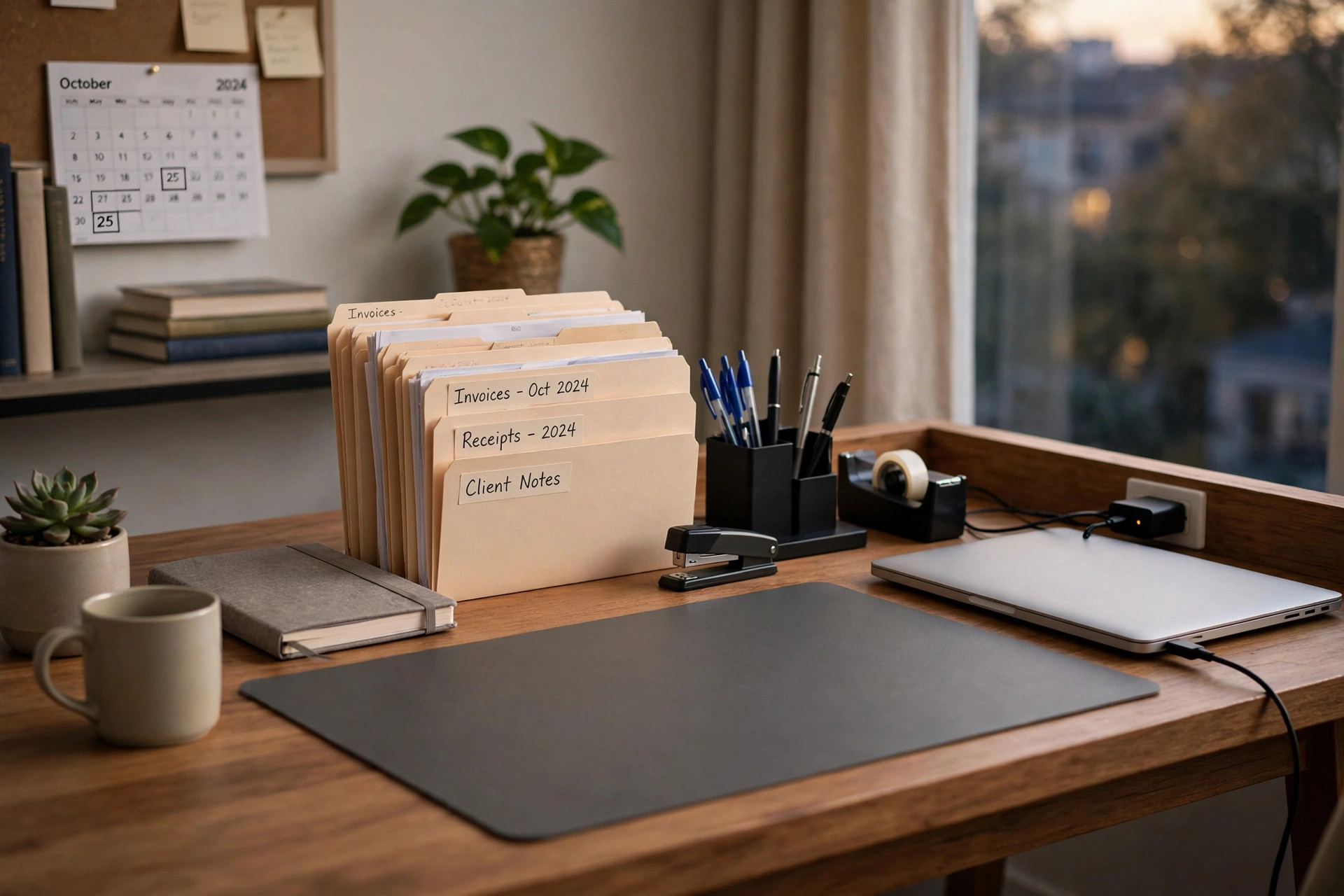
21. One in, one out — the rule that stops the office refilling
An office organized once is an office that refills, because every new notebook goes in, nothing comes out, and the desk that held ten things in January holds thirty by June. Use one in, one out — the rule that stops the office refilling — so every new notebook, pen or gadget that enters the office means one old one leaves it, into the donate bag or the bin. Keep the donate bag on the shelf, so the thing that leaves has somewhere to go the moment you decide, because the bag that is in the office is the bag that gets used. One rule, and the office never refills.

22. A focus zone — the one clear corner that means work
An office with no clear corner is an office where work has nowhere to start, because every surface holds something, the desk holds the paper, and the place where the work happens is the place you have to make before you can begin. Keep a focus zone — the one clear corner that means work — so one corner of the desk is always empty, always ready, and the moment you sit down the work can start. Guard that corner: nothing lives there, nothing is stored there, and the papers that arrive go to the trays, not to the corner, because the corner that stays clear is the corner that means work. The same one-zone thinking doubles the small closet in 26 Small Space Closet Organization Ideas for 2026, where one clear zone makes the whole room work. One clear corner, and the work has a place to begin.
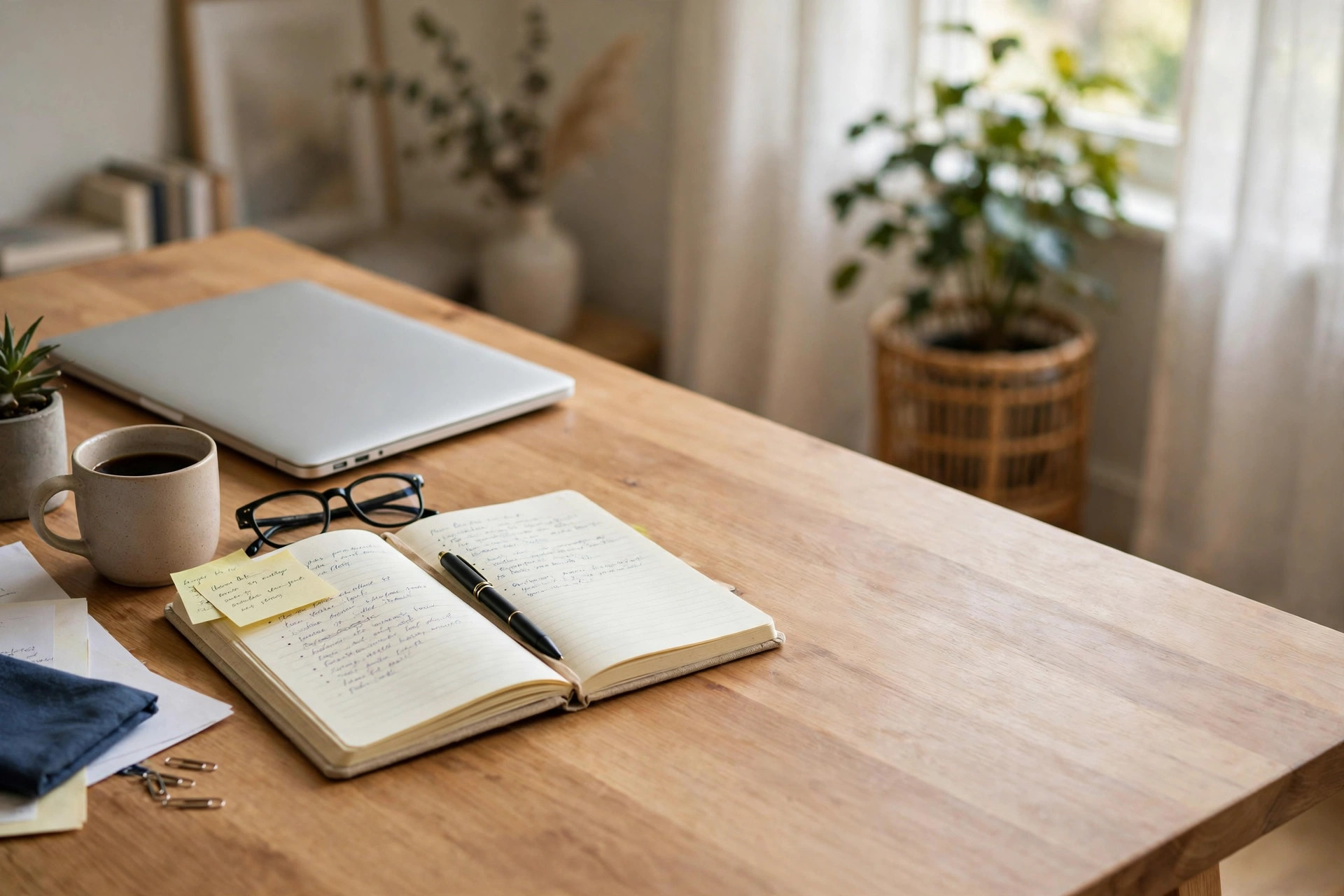
23. A weekly reset — the Friday tidy that starts Monday clean
No office stays tidy on daily habits alone, because the week adds up, the trays fill, the holders overflow, and the office that was tidy on Monday is tired by Friday. Do a weekly reset — the Friday tidy that starts Monday clean — so the trays are emptied, the file holders are cleared, the supply drawer is checked, and the desk is wiped before the weekend. File the "done" papers, throw away the dead pens, and put the rolling cart back beside the desk, because the reset that takes twenty minutes is the reset that keeps the office working all week. The same weekly rhythm keeps the whole flat tidy in 28 Small Apartment Storage Ideas for 2026, where the Friday reset is the habit that holds the home together. Twenty minutes on Friday, and Monday starts clean.
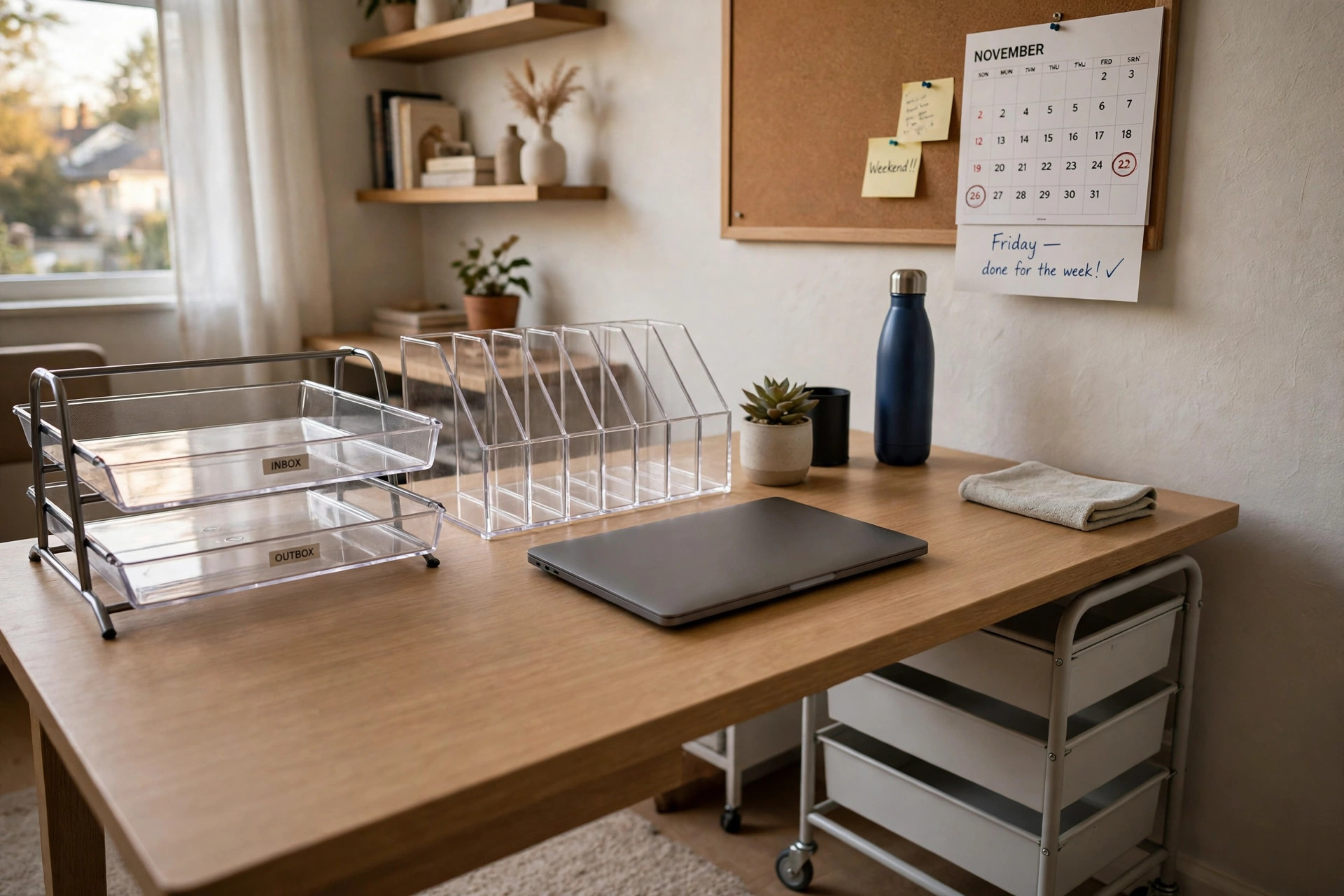
24. A to-read tray that empties every week — the pile that never grows
A to-read pile with no limit is a pile that never stops growing, because the articles land on the pile, the reports land on the articles, and the pile that was five papers in January is fifty by March. Keep a to-read tray that empties every week — the pile that never grows — so the reading goes into one tray, the tray is read or cleared every Friday, and nothing stays in it for more than a week. Read what matters, file what must be kept, and recycle the rest, because the tray that empties weekly is the tray that never becomes a pile. One tray, one week, and the reading stops piling.
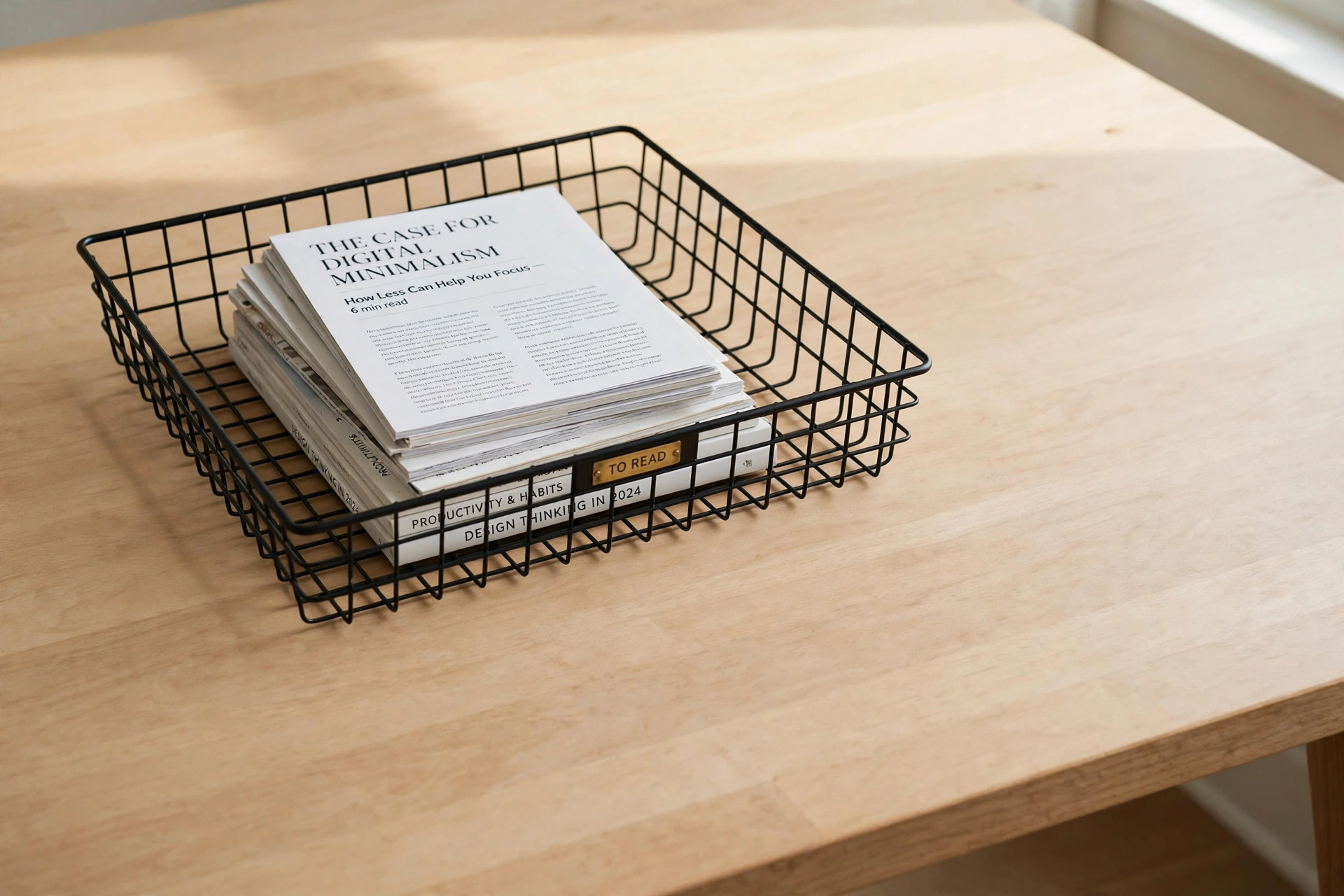
25. A seasonal declutter — the office that grows with the year
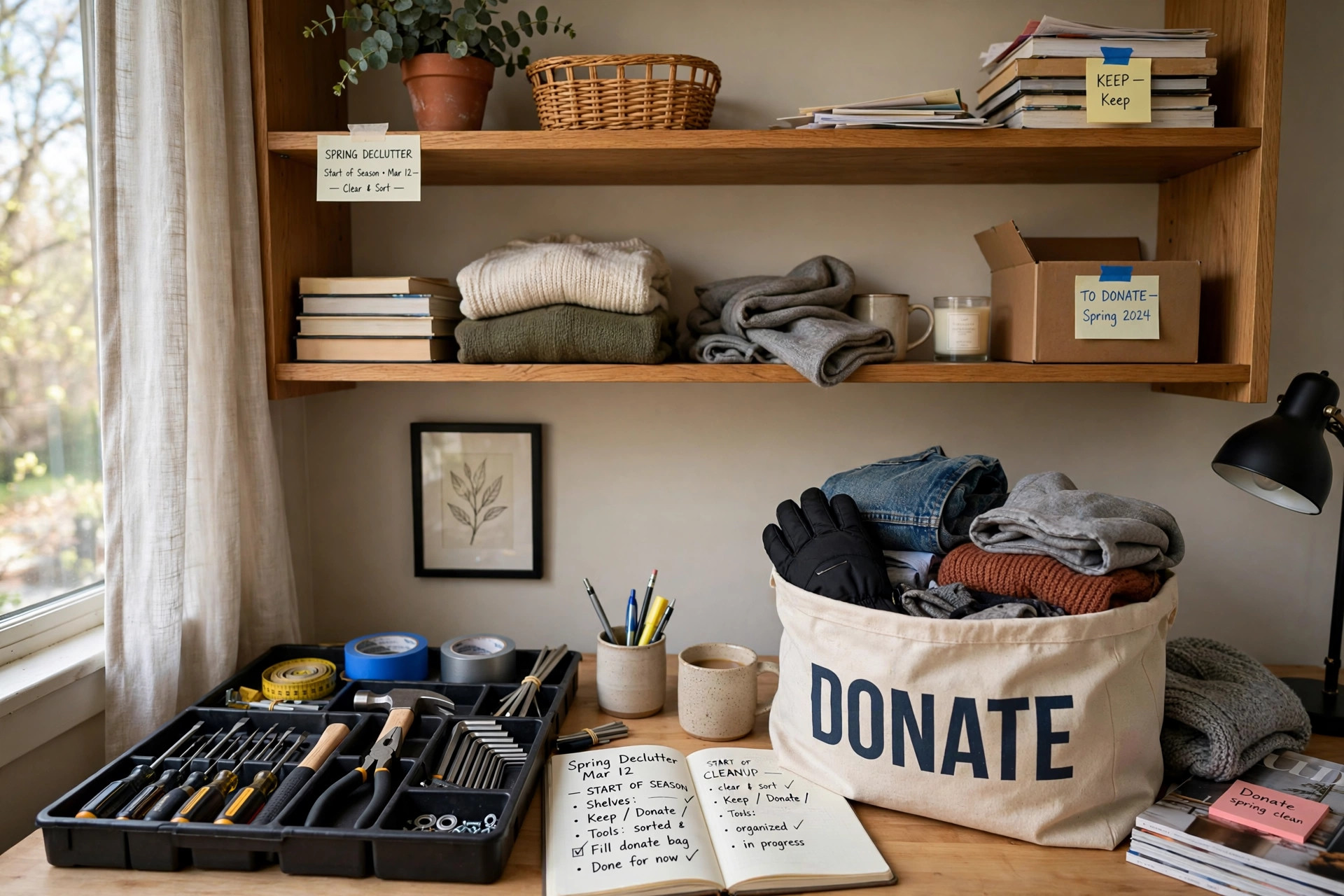
An office set up in January is an office that does not fit by July, because the work has changed, the projects have changed, and the office that held last season's files is the office holding this season's clutter. Do a seasonal declutter — the office that grows with the year — so the office changes as the year does. At the start of each season, clear the desk, the drawers and the shelves, try out the tools that came back from the cupboard, and move the ones that no longer earn their place to the donate bag, because the declutter that checks the tools is the declutter that keeps the office honest. The papers that leave go to the filing system from idea 9, and the office holds only the season you are working in. One declutter a season, and the office fits the year.
Which home office idea fits which situation?
| Situation | Best first move | Budget | Tools needed |
|---|---|---|---|
| Desk buried under everything | Clear the desk completely (idea 1) | Free | None |
| Drawers hold a bit of everything | One job per drawer (idea 2) | Free | None |
| No room on the desk for work | A monitor riser (idea 3) | Low | Riser |
| Cables tangled under the desk | A cable tray (idea 4) | Low | Tray, clips |
| Paper piles on every surface | A paper flow with three trays (idea 8) | Low | Trays |
| Can't find a file when you need it | One folder per topic (idea 9) | Free | Folders |
| Pens and tools scattered | A stationery caddy (idea 10) | Low | Caddy |
| Supplies vanish in a drawer | A supply drawer with dividers (idea 12) | Low | Dividers |
| Wall space doing nothing | A pegboard (idea 14) | Low | Pegboard |
| Printer eats the desk | A printer station off the desk (idea 17) | Low | Stand |
| Desk messy again by morning | An end-of-day reset (idea 20) | Free | None |
| Office refills within a month | One in, one out (idea 21) | Free | None |
You do not need all 25 ideas. You need the three that solve your office — usually the empty-desk reset that starts from zero, the paper flow that stops the piles, and the end-of-day reset that keeps the desk clear overnight. Start with the reset, do it this evening before you switch the laptop off, and set up the three trays tomorrow. Do that and the next time you sit down, the desk will be clear, the paper will be in its tray, and the work will be waiting instead of the mess.
Save this post for the next office sort-out, and if the desk itself needs the deeper treatment, read 24 Desk Organization Ideas for 2026 next — it is Post 59, the desk the office is built around — and 22 Homework Station Organization Ideas for 2026, Post 60, for the homework desk that shares the house. This is the thirteenth post of the new Organization by problem run — Posts 56 to 80, one problem at a time — and the run keeps going with the paperwork next. The paper itself gets its own deep dive in Paperwork Organization, where the filing system from idea 9 becomes a whole post.
Publish date assigned at publishing time. Updated as new home office finds are tested.
Frequently asked questions
How do I organize a small home office?
Start with the empty-desk reset: clear everything off the desk, then only put back what earns its place. Give every drawer one job, set up three paper trays — in, doing, done — and use the wall above the desk for a shelf or a pegboard, so the small space works vertically. Keep one corner of the desk always clear as a focus zone, and finish each day with a five-minute reset so the office starts clean.
How do I keep my desk clear when I work from home?
Use the end-of-day reset: five minutes before you switch the laptop off, file the papers, put the pens back in the caddy, and wipe the desk mat. Keep the keyboard on a sliding tray so it leaves the desk when you write, move the printer to its own stand off the desk, and use the one-in-one-out rule so every new notebook means one old one leaves. The desk that is reset daily is the desk that stays clear.
What is the best way to organize paperwork at home?
Give paper a flow, not a pile: three trays — in, doing, done — so every paper enters the top tray, moves to the middle while you work on it, and is filed the day it is finished. File by topic, one folder per subject in alphabetical order, and empty the trays every Friday so nothing sits for more than a week. The papers you use every week stand upright in vertical file holders, where you can pull one out without disturbing the rest.