18 Pencil Storage Ideas for 2026
Pencils are the smallest things on the desk and the first things to disappear — a pencil under the notebook, a pencil in the drawer, a pencil on the floor that rolls under the desk and is never seen again. The fix is not a bigger desk tidy, it is a pencil home the pencils actually live in, one that sits where the hand reaches and looks pretty enough to stay there.
These 18 pencil storage ideas are upright pencil jars sorted by colour: start with one glass jar you can see into, add a row of small jars one colour per jar, put a rotating shelf on the shared desk, and finish with a sharpener station and a pencil audit — so every pencil has a home and the desk looks like it was styled on purpose.
Every idea below works on a real desk, from a small homework corner in a bedroom to a shared family desk with two children and one sharpener. The art supplies the pencils belong with are covered in 20 Art Supply Organization Ideas for 2026, where the paints and brushes get their own homes before the pencils arrive — and the school bag the pencils travel in is in 22 School Organization Ideas for 2026, so the desk and the bag match. Pick three ideas that fit your desk, start with the jar, and build from there.
Start simple: a jar, a cup, a first pencil home
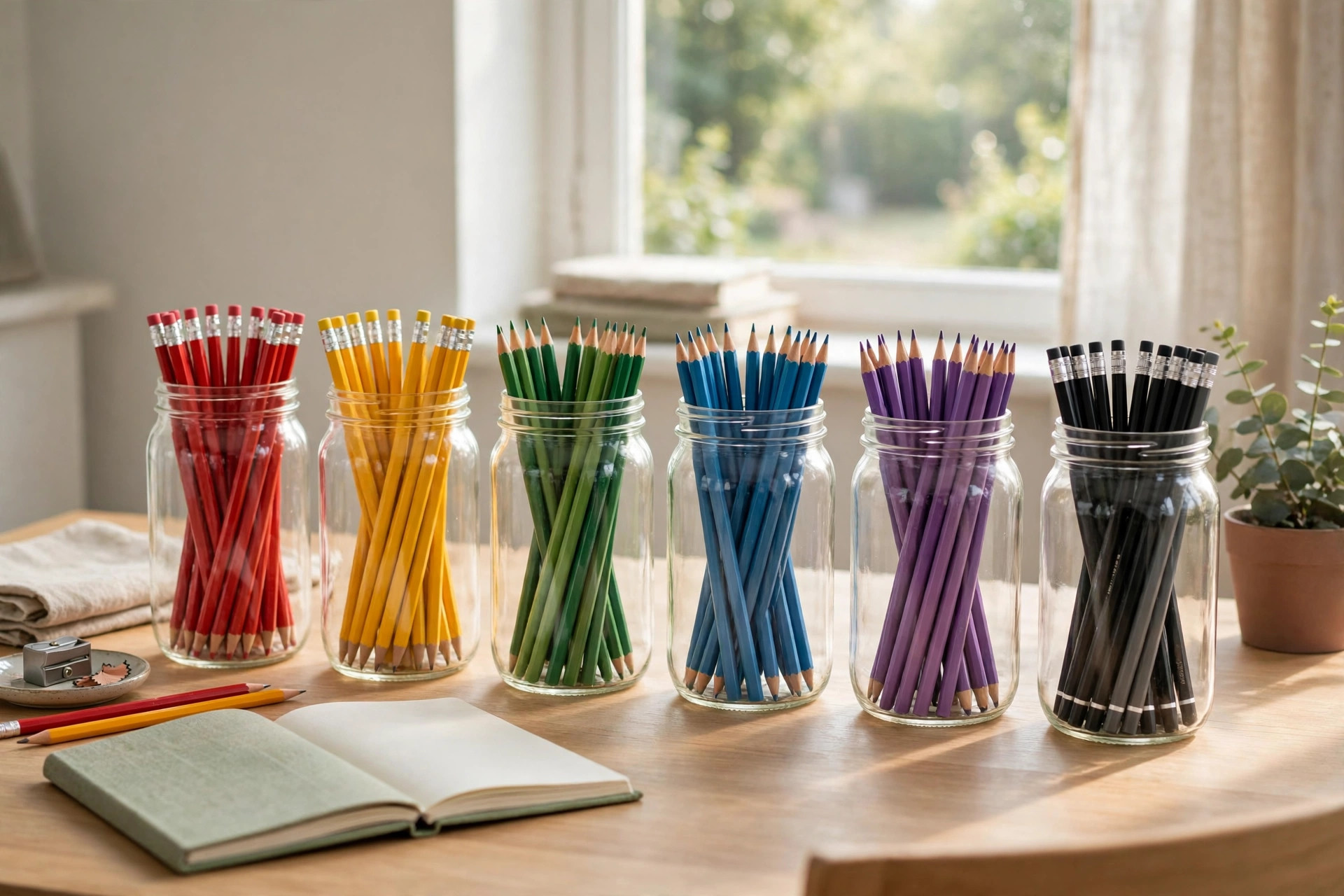
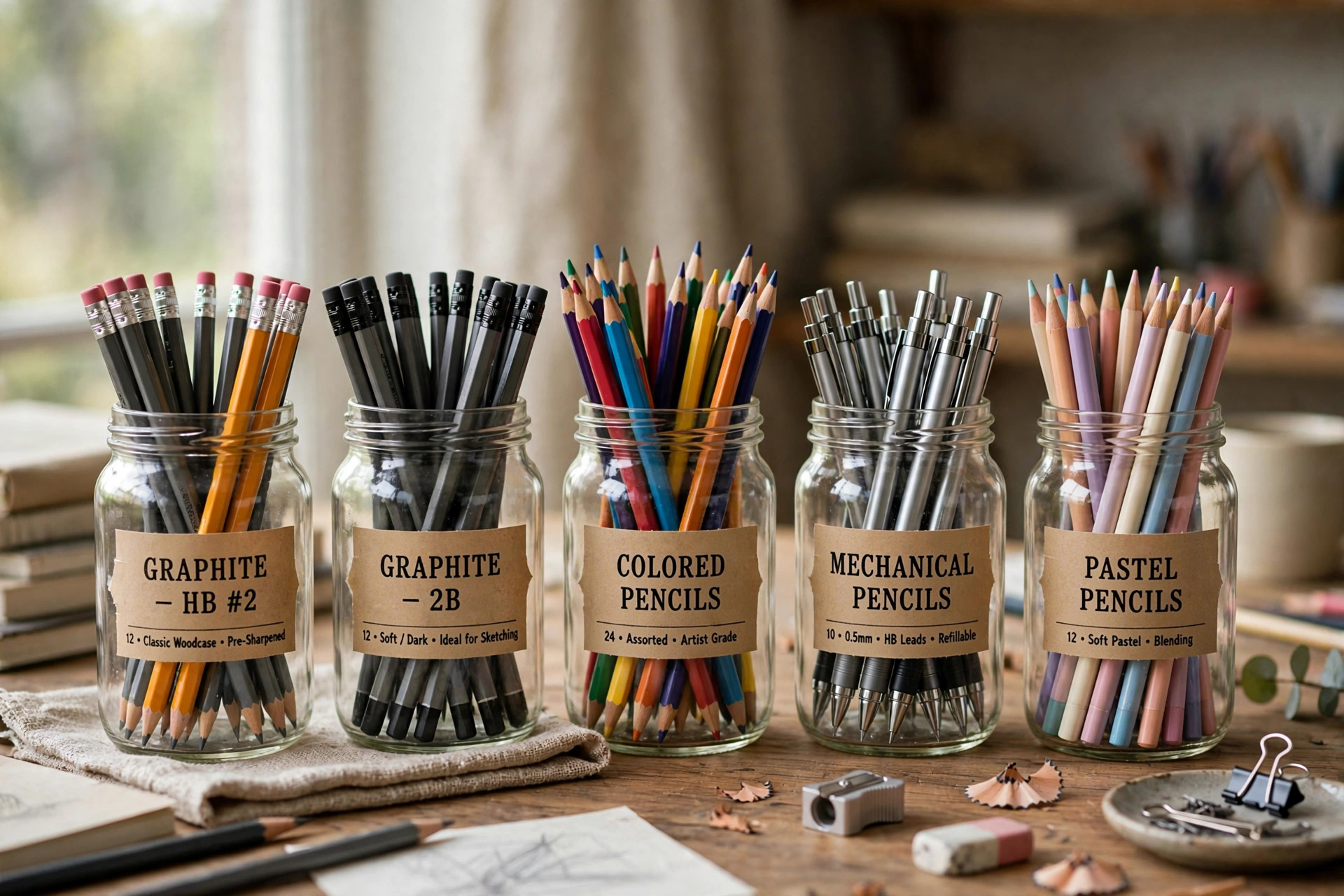
1. A glass jar of pencils sorted by colour — the jar you can see into
A pencil in a drawer is a pencil you cannot see, because the drawer is the place pencils go to hide and the hiding is the reason you buy more. Put them in a glass jar — the jar you can see into — so every pencil is visible and the colour you want is the colour you reach for. Sort the pencils by colour as they go in, reds with reds and blues with blues, because the sorted jar is the jar that looks like a display and the display is the jar that stays on the desk. Stand the pencils upright, points up, because the upright pencil is the pencil you can grab without digging, and keep the jar at the back of the desk where it cannot be knocked over. One glass jar, and the pencils stop wandering.
2. A row of small jars, one colour per jar
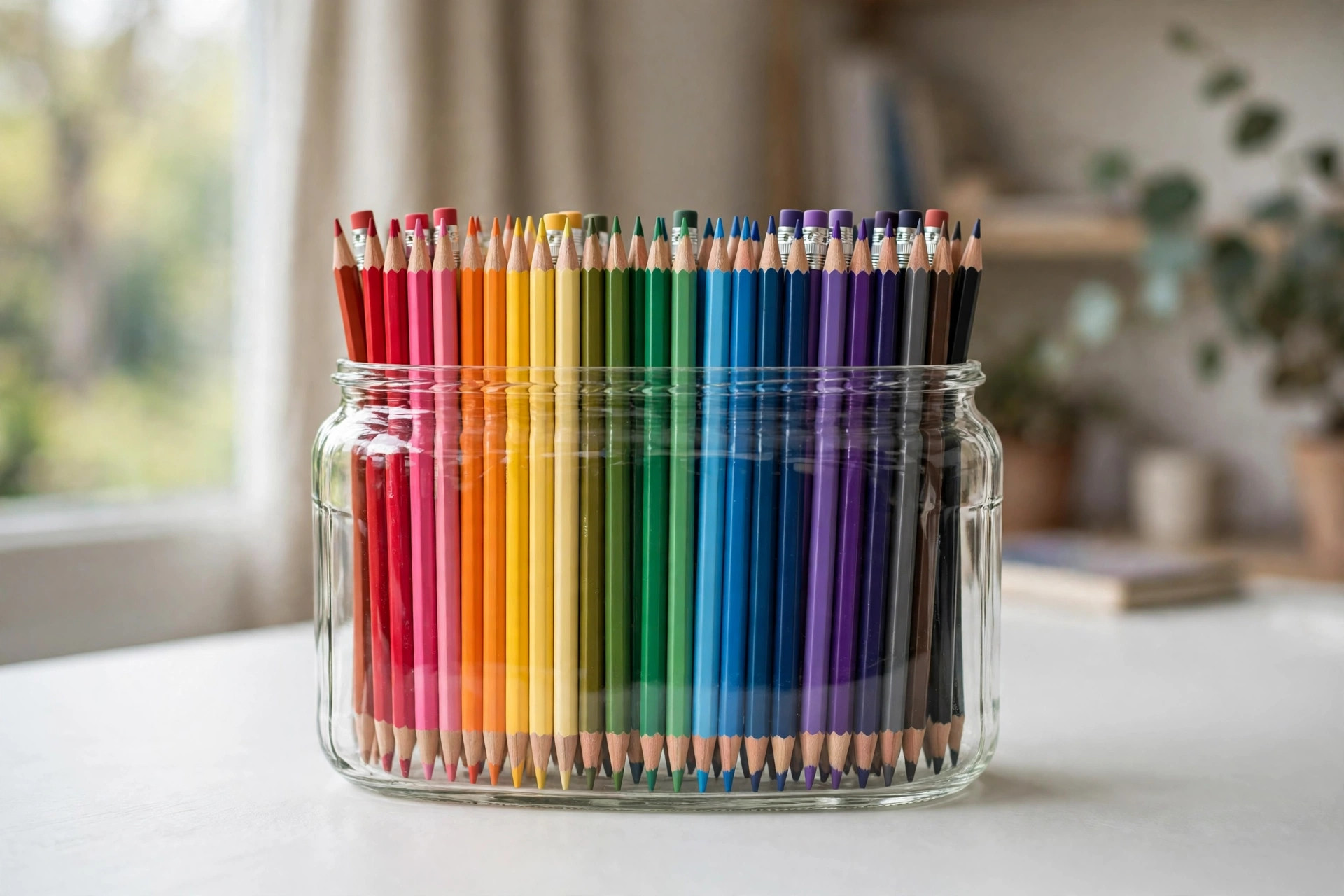
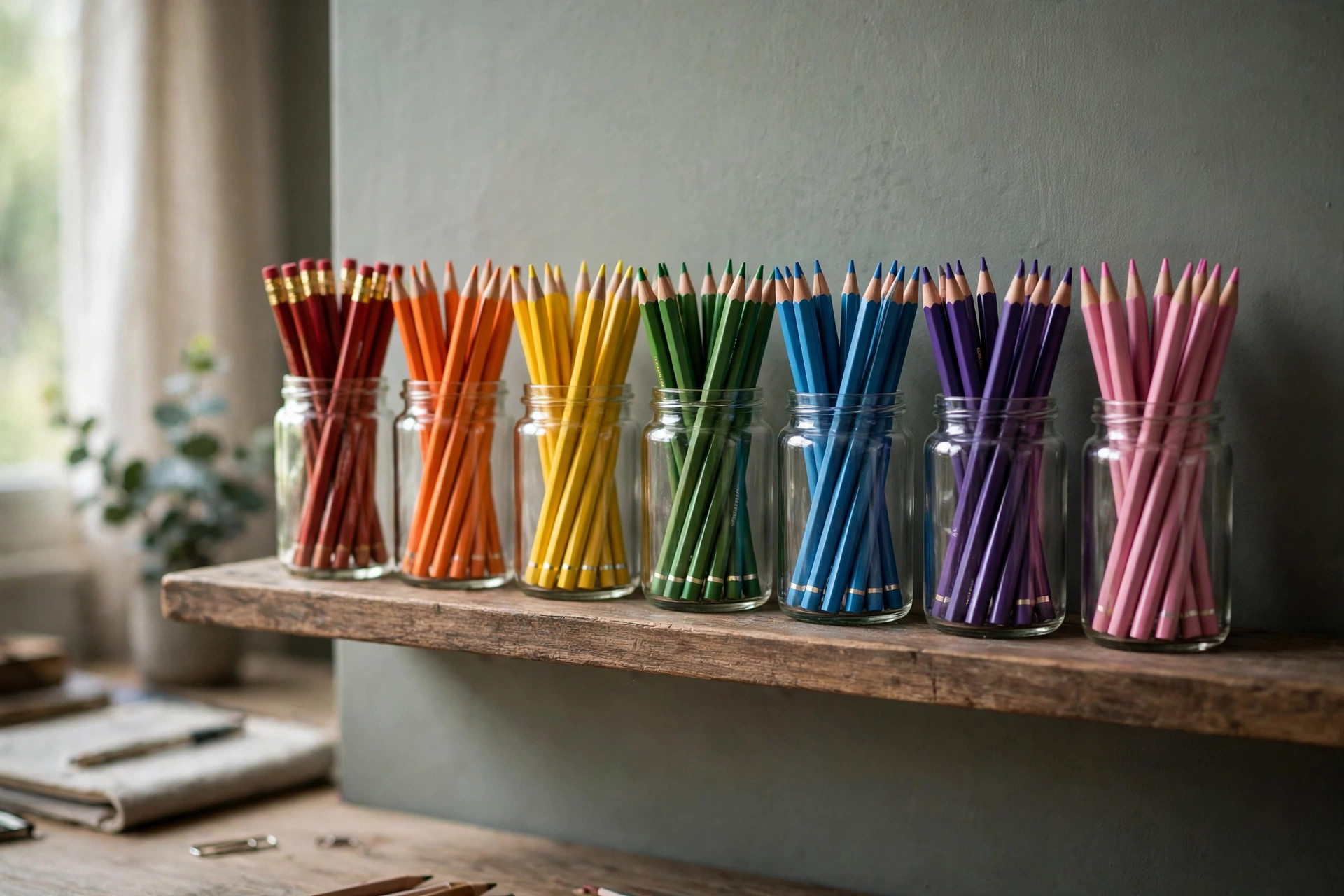
One big jar mixes the colours back together, because the jar that holds everything is the jar where the reds end up under the greens. Use a row of small jars instead — one colour per jar — so each colour has its own home and the row reads like a rainbow across the desk. Line the jars up on a shelf or along the back of the desk, tallest pencils at the back, because the row is the order and the order is what keeps the system alive. Use jars the same size, because the matching row looks tidy even when the pencils inside are a mess, and label the bottom of each jar if the colours are close, because the label is the thing that stops the sorting from sliding. A row of small jars, and the colours stay sorted.
3. A tin can wrapped in kraft paper — a free pencil pot
A pencil pot from a shop costs more than the pencils inside it, because the pot is the expensive part and the tin can is the free part. Wrap a clean tin can in kraft paper — a free pencil pot — so the can holds the pencils and the desk gains a holder for the price of nothing. Wash the can, dry it well, and wrap the paper tight, because the paper is the pretty part and the can is the strong part. Tie a ribbon around the middle or stamp a label on the front, because the pot you made yourself is the pot you keep on display, and keep it on the desk, not in the cupboard, because the pot that is on display is the pot that holds the pencils. A tin can and a sheet of kraft paper, and the pencils have a home for free.

4. A pencil cup with a weighted base that never tips
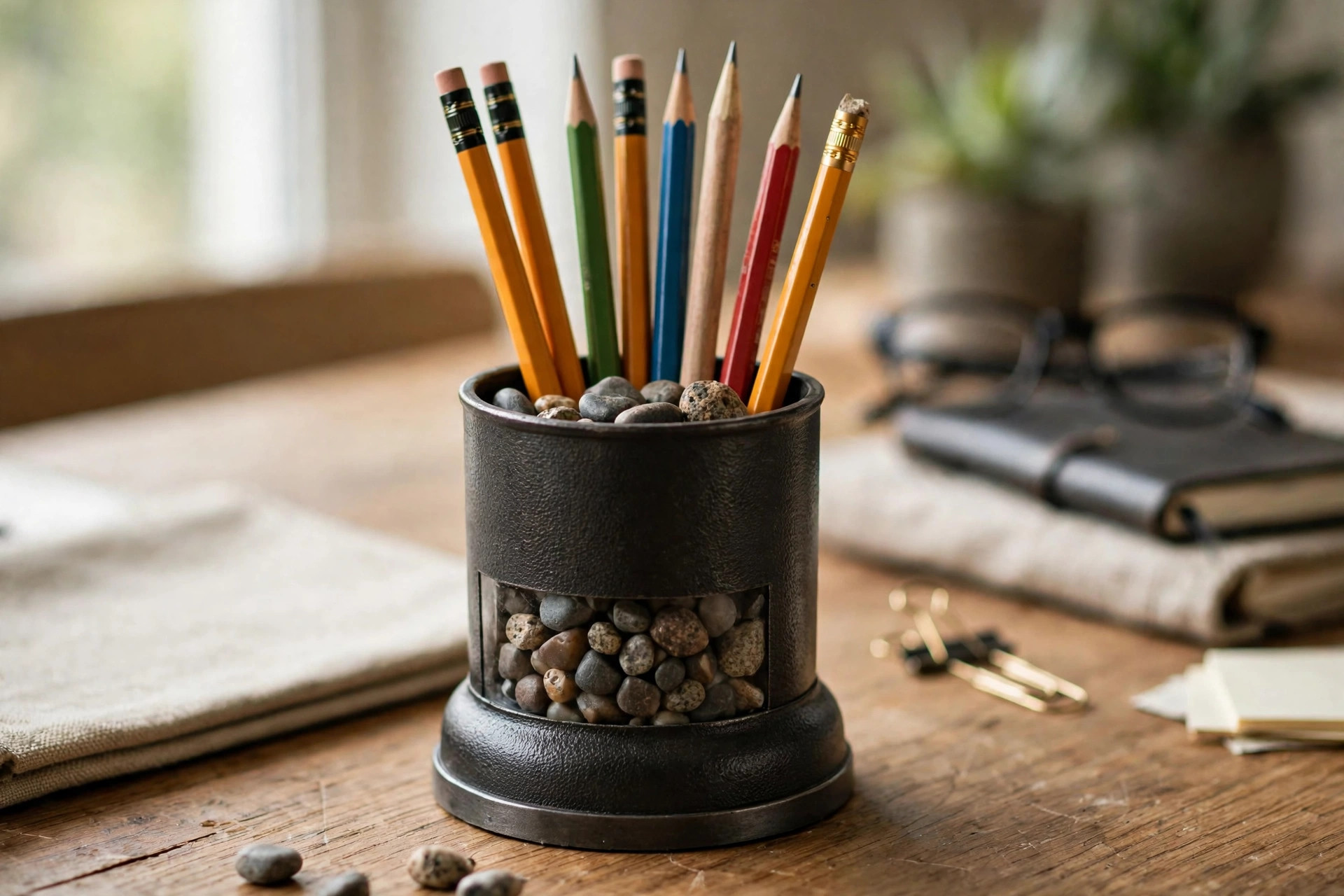
A light pencil cup tips over, because the cup that is top-heavy is the cup that falls when a sleeve catches it, and the fall is the reason pencils end up on the floor. Use a cup with a weighted base — the cup that never tips — so the pencils stay upright even when the desk gets bumped. Fill the bottom of a plain cup with pebbles or a disc of modelling clay if you would rather make one, because the weight is the thing that keeps the cup standing and the standing cup is the cup that gets used. Choose a cup with a wide base and a low centre of gravity, because the wide base is the stability and the stability is what survives a busy desk. A weighted cup, and the pencils stay where they belong. (Check on Amazon for a weighted desk pencil cup with a non-slip base, which stays put on a smooth desk.)
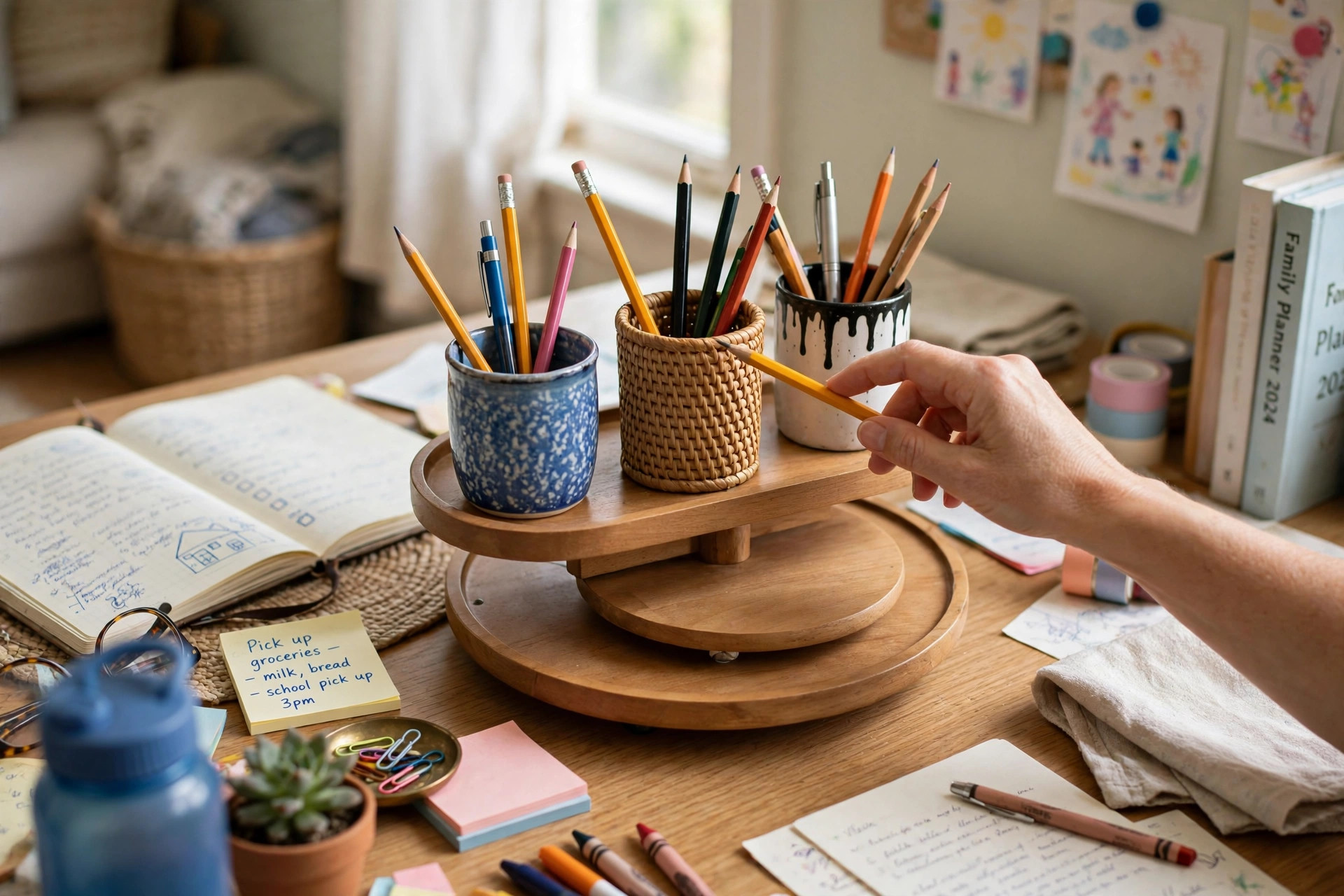
A shared desk has two people reaching for the same pencils, because the pencils that sit in the middle are the pencils nobody can reach comfortably. Put them on a rotating shelf — one spin, every pencil in reach — so the shelf turns to whoever needs a pencil and the pencils never have to travel across the desk. Set small cups or jars on the rotating shelf, one per colour or per person, because the shelf is the spinner of the desk and the cups are the order. Keep the shelf in the middle of the desk, because the middle is the place both people can reach, and spin it gently, because the shelf that spins smoothly is the shelf that does not tip the cups. A rotating shelf, and the shared desk stops arguing over pencils.
Sorted by colour and by type
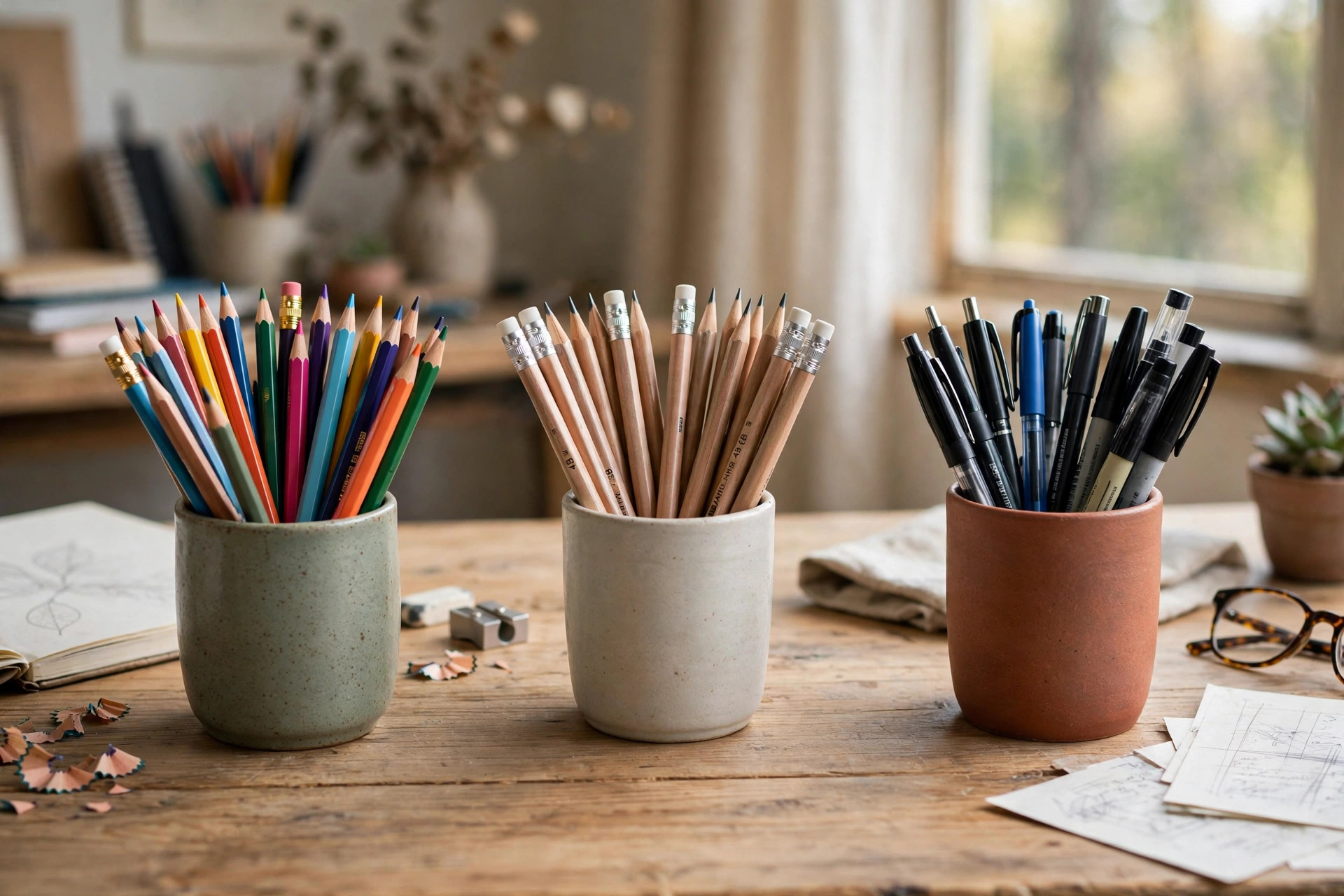
6. Pencils sorted by type — coloured, graphite and pens apart
Coloured pencils and graphite pencils in one jar fight each other, because the coloured pencil is the one you want for drawing and the graphite pencil is the one you want for writing, and the mixed jar makes you dig for both. Sort them by type — coloured, graphite and pens apart — so each kind has its own cup and the hand goes straight to the right one. Keep the coloured pencils in the prettiest jar, because the coloured pencils are the ones you look at most, and the graphite pencils in a plain cup by the notebook, because the graphite pencil is the workhorse and the workhorse belongs by the work. Pens go in a third cup, because the pen that lives with the pencils is the pen that leaks on them. Three cups, three types, and the digging stops.
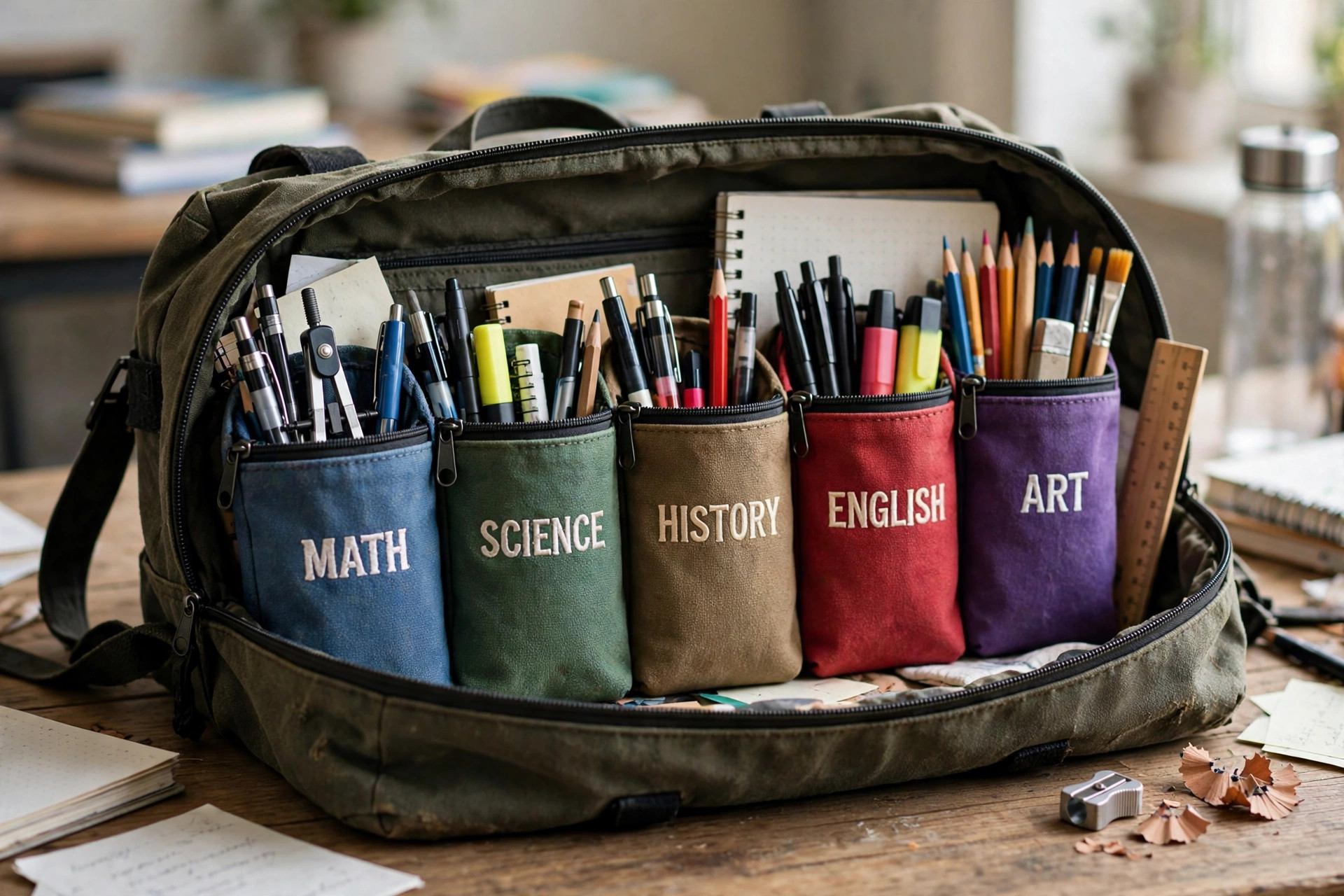
7. A pencil pouch per subject for the school bag
A school bag with one pencil case is a bag where every subject shares the same pencils, because the pencils that live together are the pencils that get lost between lessons. Give each subject its own pouch — a pencil pouch per subject — so the maths pencils stay with the maths book and the art pencils stay with the art book. Label each pouch with the subject name, because the label is the thing that stops the pouches from swapping, and keep the pouches flat in the bag, because the flat pouch is the pouch that does not bulge. Pack the pouch the night before, because the pouch that is packed is the pouch that is ready, and check it once a week, because the weekly check is the thing that catches the broken pencil before the lesson does. One pouch per subject, and the bag stops losing pencils.
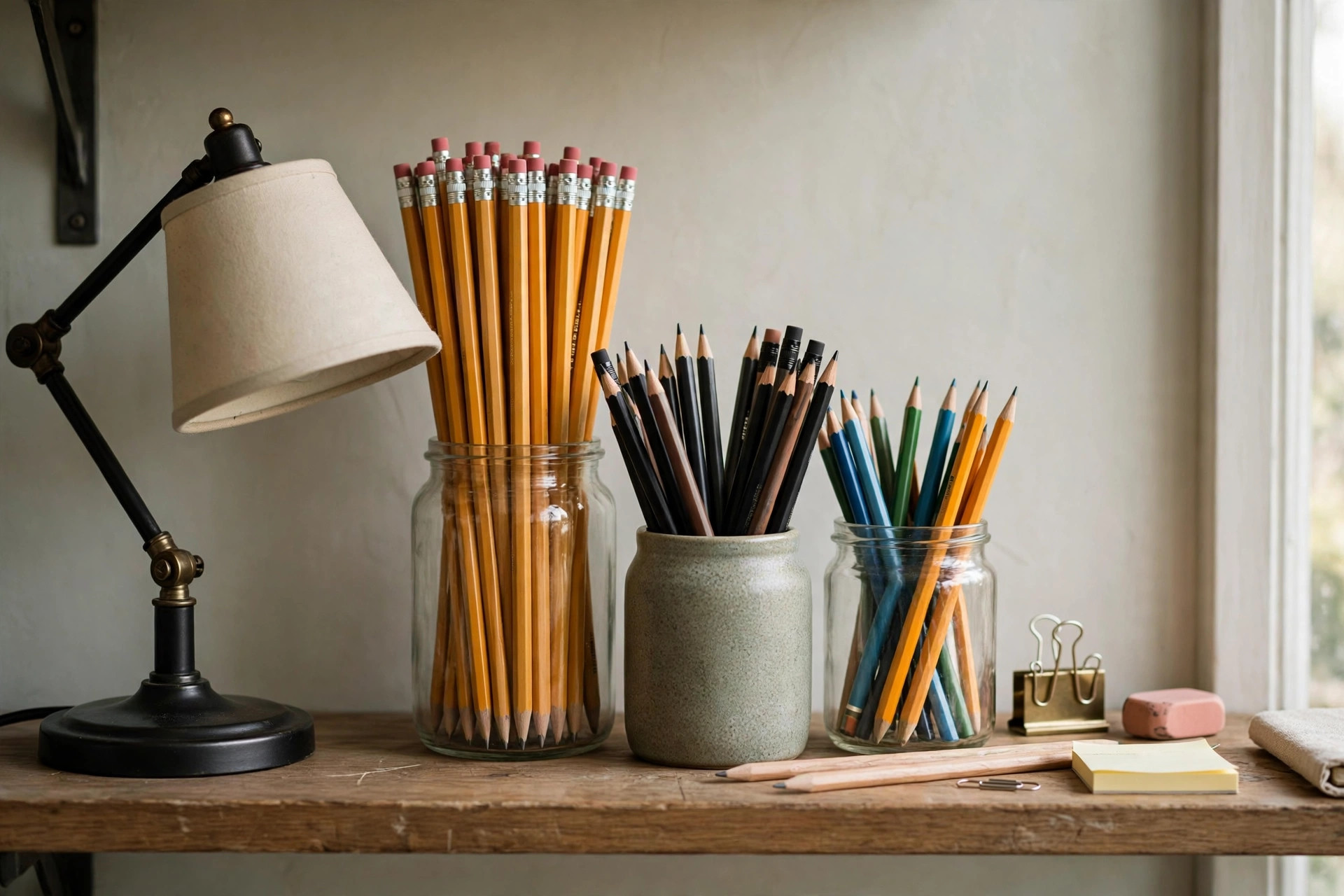
8. Upright pencil jars on a desk shelf, tallest at the back
Pencil jars on a flat desk hide the short pencils, because the jar at the front is the jar that blocks the jar behind it. Put the jars on a desk shelf instead — tallest at the back — so every jar is visible and every pencil can be reached without moving another jar. Raise the back row on a small shelf or a stack of books, because the raised row is the row you can see and the visible row is the row you use. Keep the most-used colours at the front, because the front jars are the ones your hand reaches first, and the rarely used colours at the back, because the back jars are the ones you reach for once a week. A shelf and a row of jars, and the short pencils stop hiding.
9. A labelled jar system so every pencil goes home
A pencil with no label is a pencil that belongs to nobody, because the pencil that has no home is the pencil that stays on someone else's desk. Label the jars — a labelled jar system so every pencil goes home — so each pencil has a place to return to and the return is the habit that keeps the desk tidy. Write the colour or the type on a small tag and tie it to the jar, because the tag is the instruction and the instruction is what children follow. Put the labels where the hand can read them, facing out, because the label you can read is the label that works, and check the labels once a month, because the monthly check is the thing that catches the jar that drifted. Labelled jars, and every pencil goes home.
Off the desk: wall, drawer and portable pencil storage
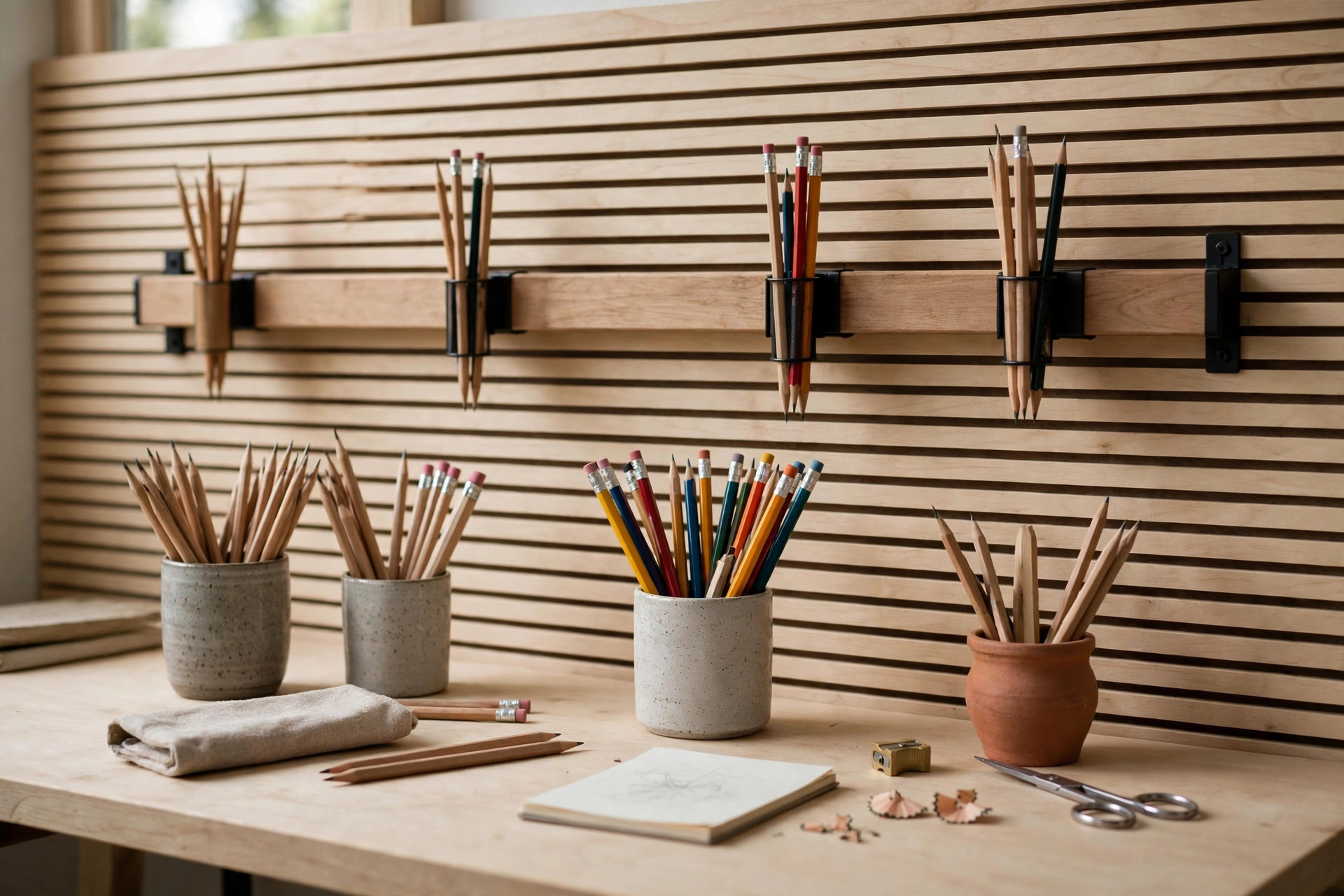
10. A wall-mounted pencil rail above the desk
A desk with no free surface is a desk with no room for a jar, because the surface is the thing that is already full. Move the pencils to the wall — a wall-mounted pencil rail above the desk — so the cups hang where the hand can reach them and the surface stays free. Screw a rail to the wall, hang small cups from it with hooks, and fill each cup with one colour, because the rail is the shelf and the cups are the jars. Keep the rail at eye height, so you can see the pencils and reach them without standing up, and paint it the same colour as the wall, because the rail that matches is the rail that looks built in. Hang the pencils you use most at the front of the rail, because the front cups are the ones you reach first. A rail and hooks, and the pencils live on the wall.
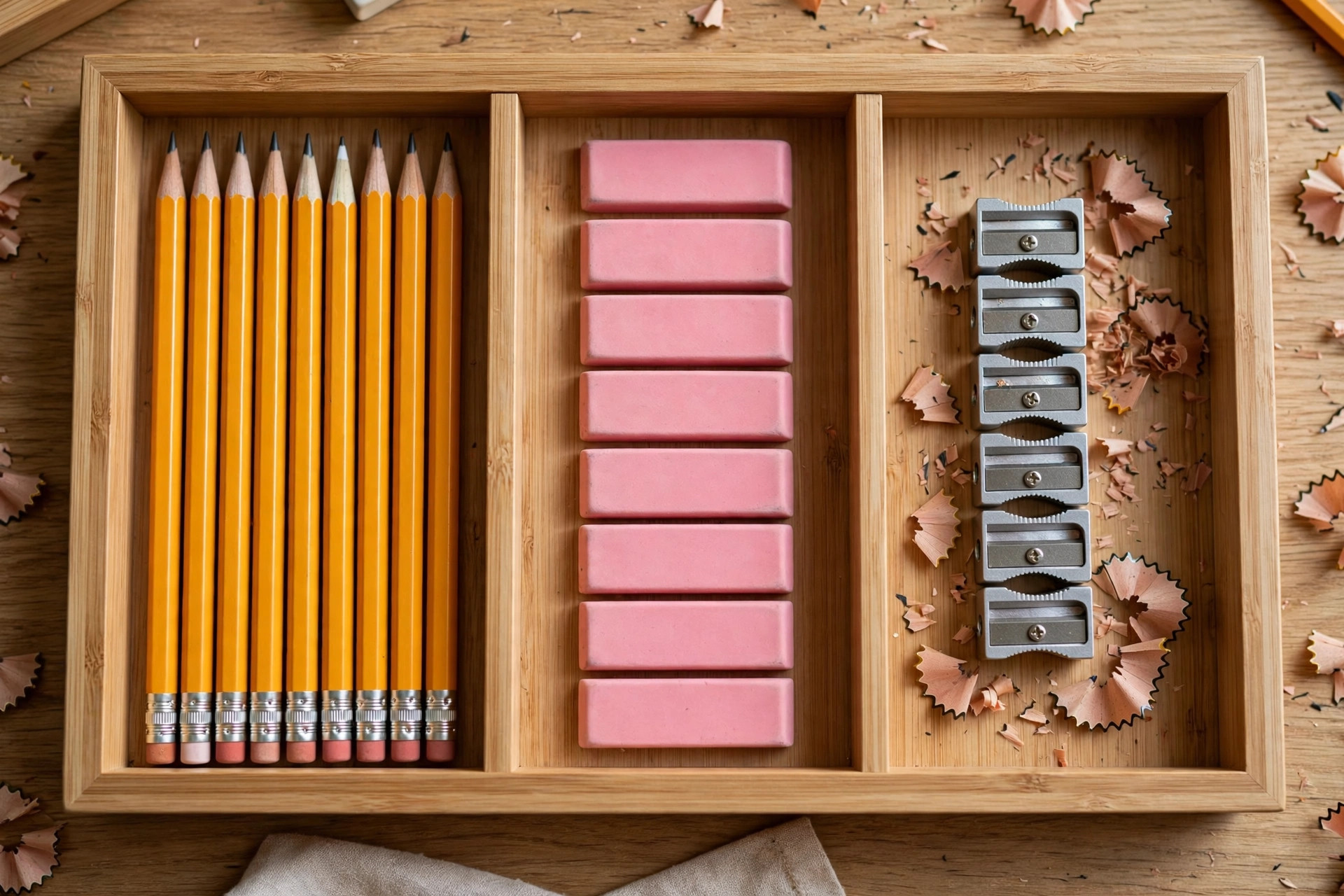
11. A drawer divider tray for pencils, erasers and sharpeners
A drawer full of loose pencils is a drawer you have to dig through, because the pencils that lie flat are the pencils that slide under everything else. Put a divider tray in the drawer — a drawer divider tray for pencils, erasers and sharpeners — so each thing has its own slot and the drawer opens to order. Lay the pencils in rows, points facing the same way, because the row is the order and the order is what makes the drawer work. Give the erasers and the sharpener their own compartments, because the sharpener that lives with the pencils is the sharpener that covers them in shavings, and keep the tray shallow, because the shallow tray is the tray that lets you see everything at a glance. A divider tray, and the drawer stops being a junk drawer. (Check on Amazon for a bamboo drawer divider tray that fits a standard desk drawer, which you can trim to size.)
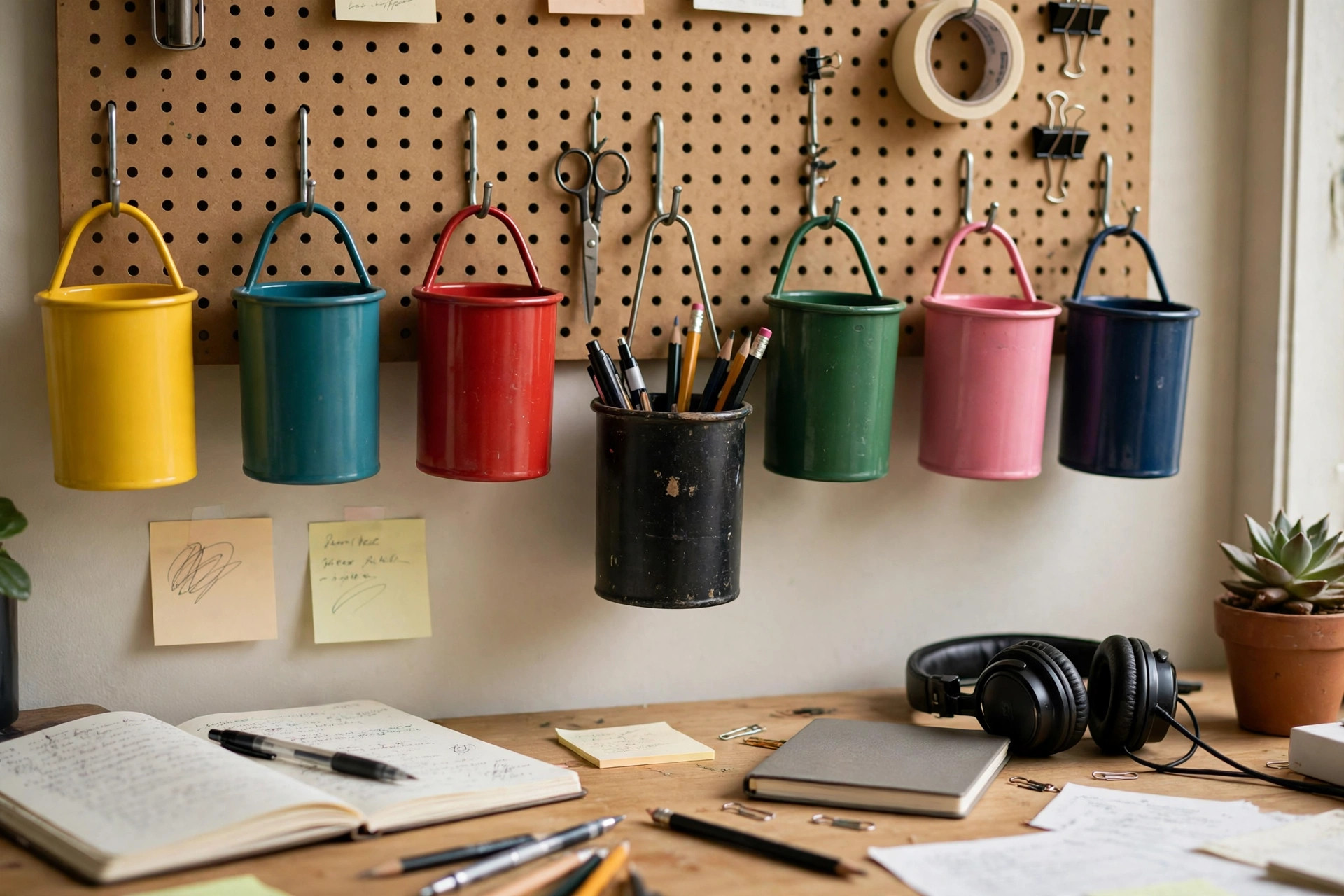
12. A pegboard with pencil cups on hooks
A pegboard on the wall is a wall doing nothing, because the board you do not use is the board that sits empty above the desk. Hang pencil cups from it — a pegboard with pencil cups on hooks — so the board holds the pencils and the desk gains storage without losing a single inch of surface. Hook small cups onto the pegboard, one colour per cup, because the hooks are the holders and the cups are the jars. Keep the most-used colours at arm height, because the cups you can reach are the cups you use, and the rarely used colours higher up, because the high cups are the ones you reach for once a week. The pegboard the cups hang from is in 22 Pegboard Organization Ideas for 2026, where the board gets its own system before the cups arrive. A pegboard and hooks, and the pencils live on the wall.
13. A portable pencil caddy that moves room to room
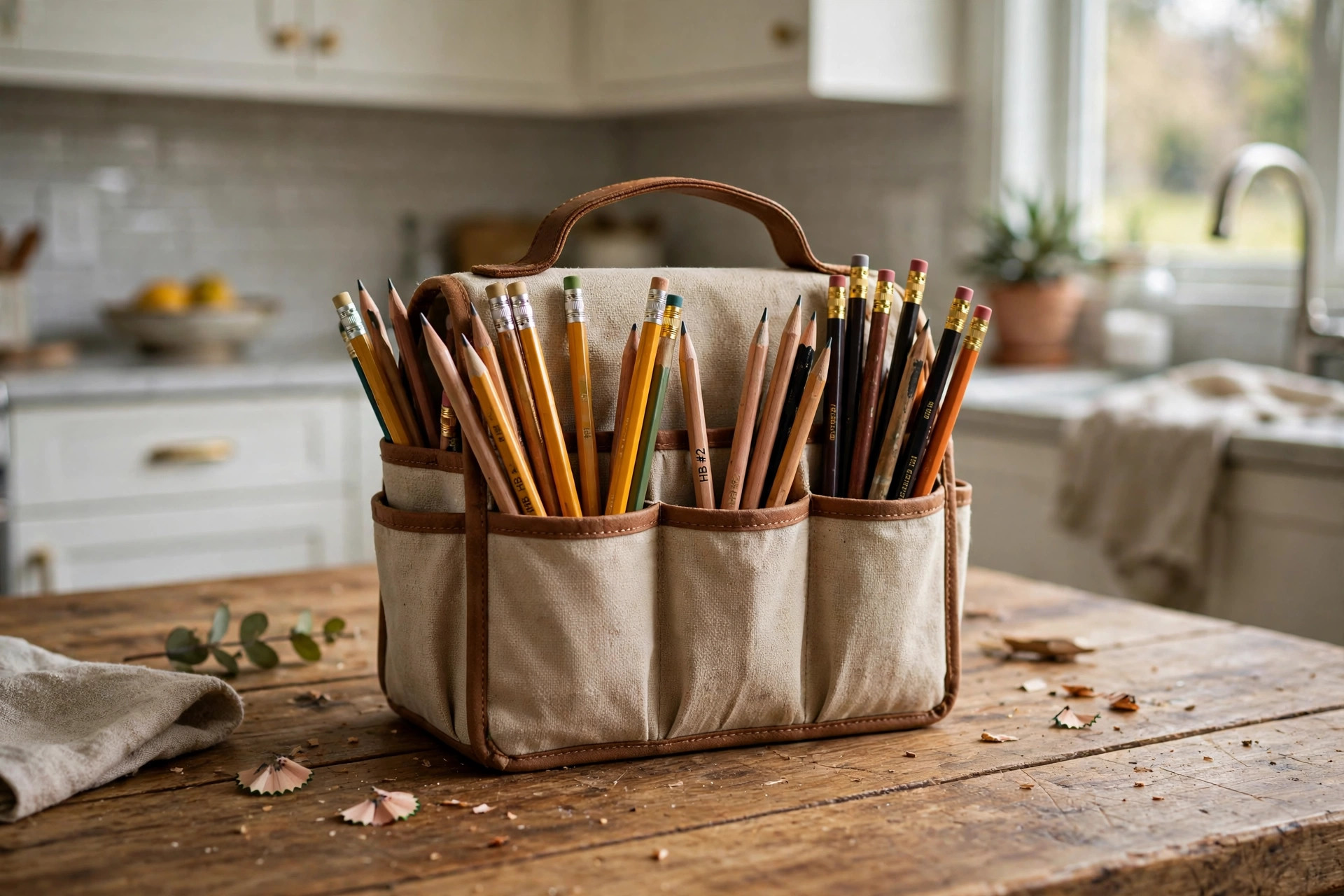
Pencils that live in one room never make it to the other room, because the pencil that stays on the desk is the pencil that is not there when homework happens at the kitchen table. Use a caddy with a handle — a portable pencil caddy that moves room to room — so the pencils travel to where the work happens and come back when it is done. Fill the caddy with one jar per colour and a small pot for erasers, because the caddy is the desk that moves and the jars are the order. Keep the caddy light, because the heavy caddy is the caddy that stays put, and put it back on the desk when the work is finished, because the caddy that goes home is the caddy that is ready tomorrow. The rolling cart the caddy sits on is in 22 Rolling Cart Organization Ideas for 2026, for the supplies that travel further than one room. A caddy with a handle, and the pencils go where the work goes.
Pencil storage that works harder
14. A pencil roll that keeps pencils from rolling off the desk
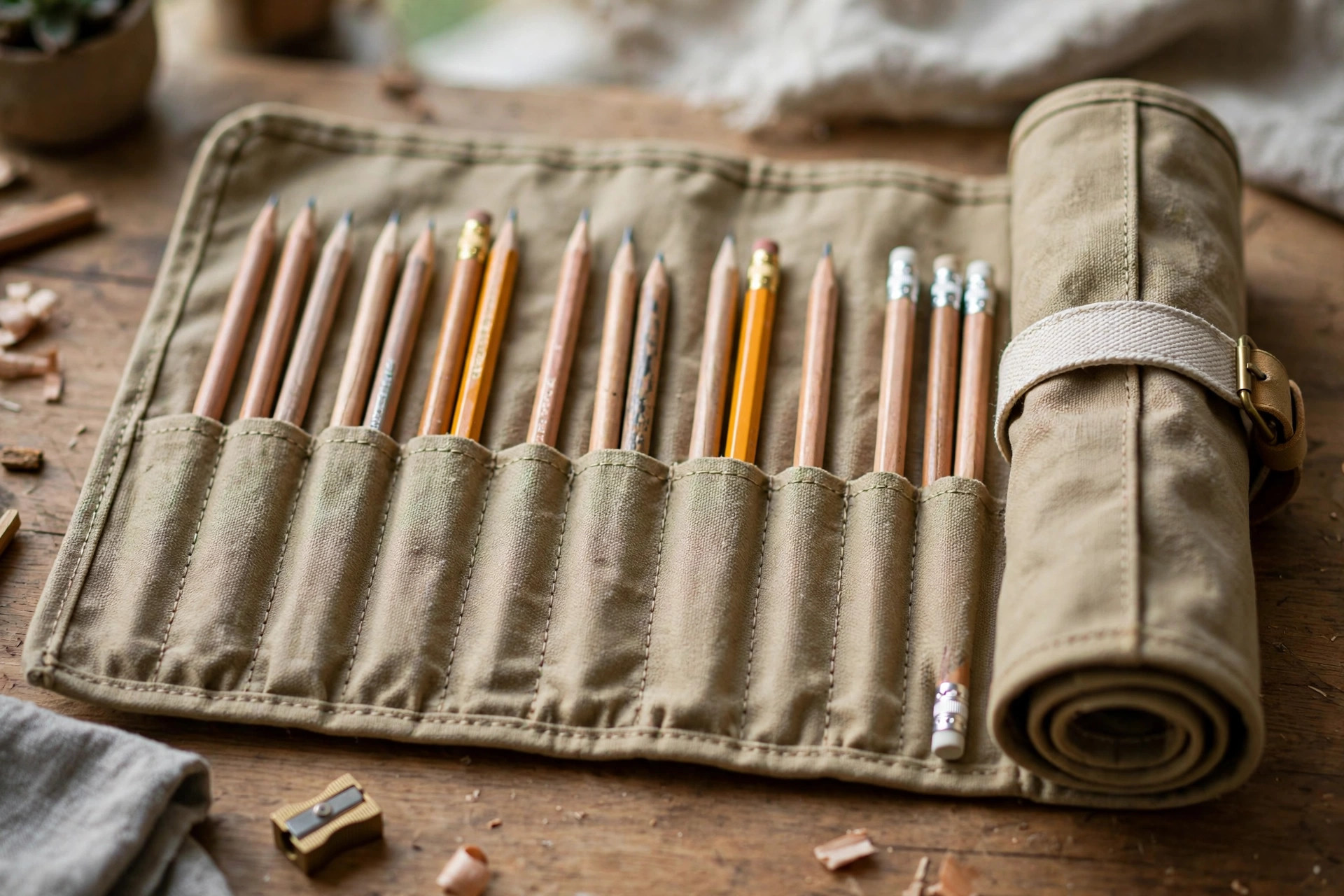
A pencil on a bare desk rolls, because the desk is flat and the pencil is round, and the roll is the reason pencils end up on the floor. Use a pencil roll — a pencil roll that keeps pencils from rolling off the desk — so each pencil has its own slot and the roll is the thing that stops the rolling. Roll a strip of fabric into a tube, stitch the slots, and slide the pencils in, because the fabric is the grip and the roll is the shape that fits in a bag. Keep the roll tied shut when it travels, because the tied roll is the roll that keeps the pencils safe, and unroll it flat on the desk when you work, because the flat roll is the roll that shows every pencil at once. A fabric roll, and the pencils stop rolling away.
15. A sharpener station — shavings in one place
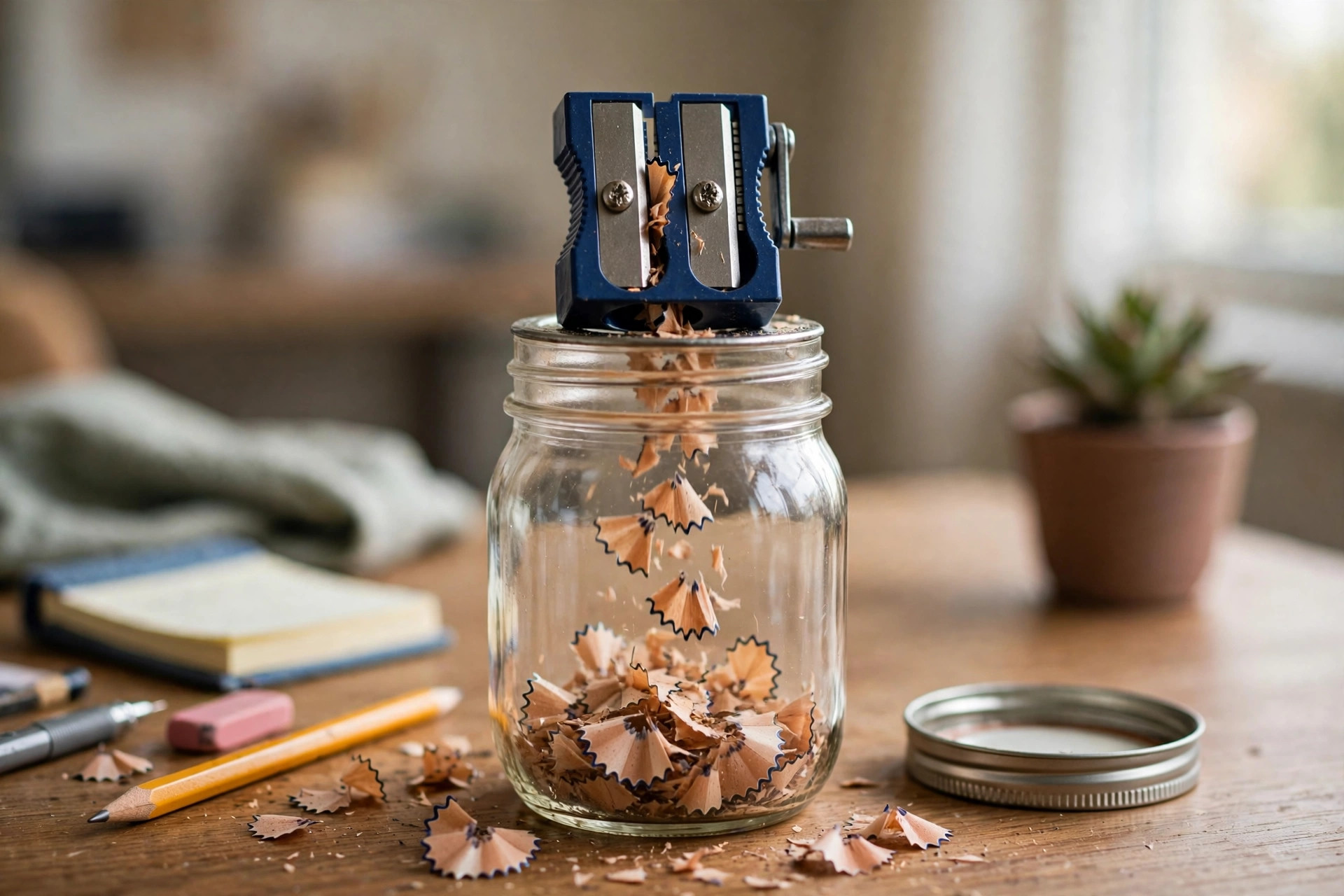
A sharpener loose on the desk makes shavings everywhere, because the sharpener that has no home is the sharpener that gets used over the notebook and the notebook is the thing that gets dirty. Build a sharpener station — shavings in one place — so the sharpener lives over a small pot and the shavings fall where they belong. Put the sharpener on top of a lidded jar or a small tub, because the tub is the catcher and the lid is the thing that stops the shavings from spilling. Empty the tub once a week, because the weekly empty is the habit that keeps the station working, and keep a spare sharpener in the drawer, because the spare is the thing that saves the homework when the first one jams. A sharpener station, and the shavings stay in one place. (Check on Amazon for a sharpener with a built-in shavings catcher, which keeps the desk clean between empties.)
16. A pencil holder painted to match the desk — one colour, one finish
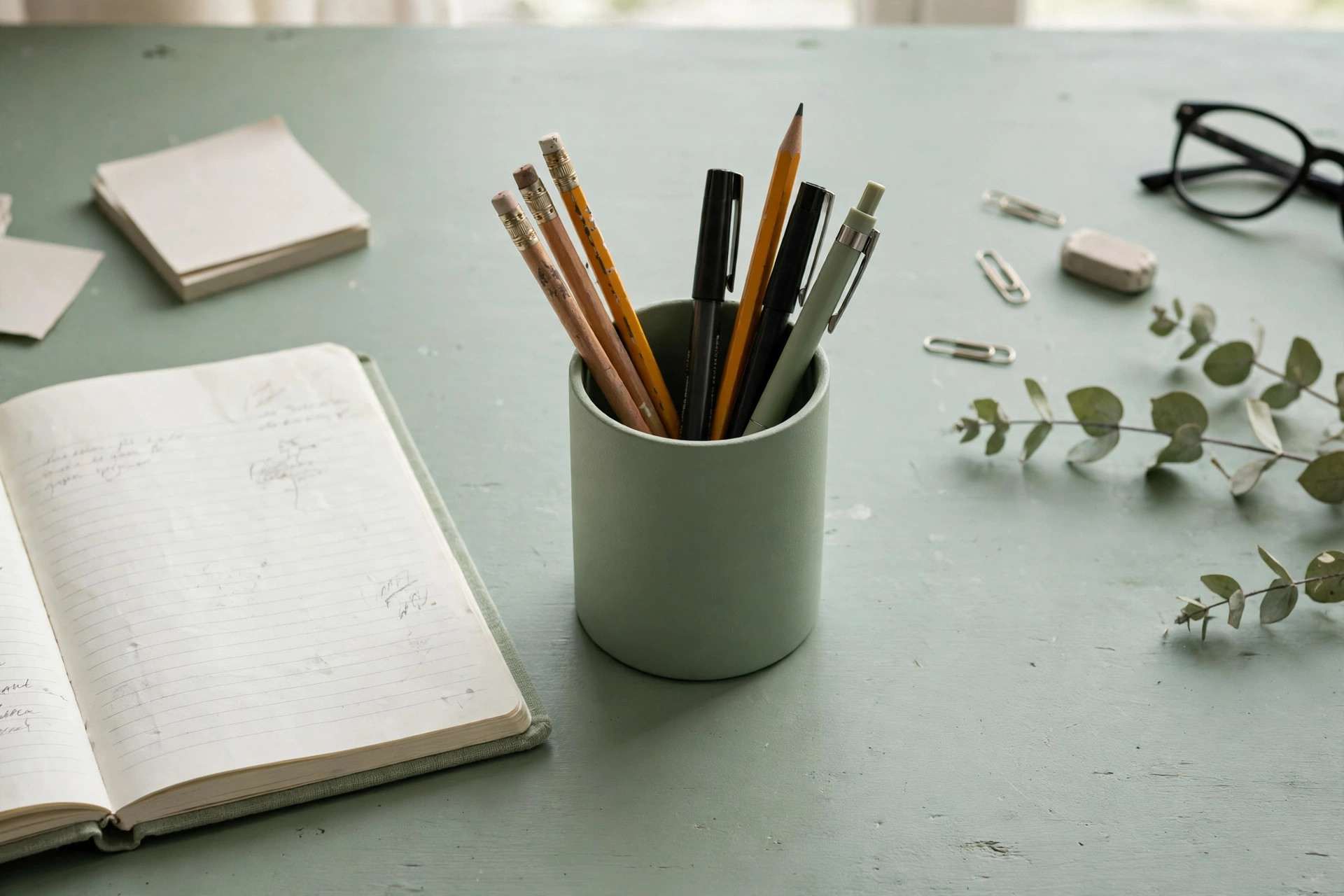
A pencil holder in the wrong colour stands out, because the colour that does not match is the colour that shouts. Paint the holder to match the desk — one colour, one finish — so the holder looks like it was always there and the desk reads as one piece. Paint the jar, the cup or the tin the same sage, white or wood tone as the desk, and use the same finish, matt or gloss, because the finish that matches is the finish that blends. Test the paint on the back of the holder first, because the paint that matches on the back is the paint that matches on the front. Keep the pencils the only colour on the holder, because the pencils are the display and the holder is the frame. One colour, one finish, and the holder belongs to the room.
17. A pencil jar for the kids' table that survives being knocked over
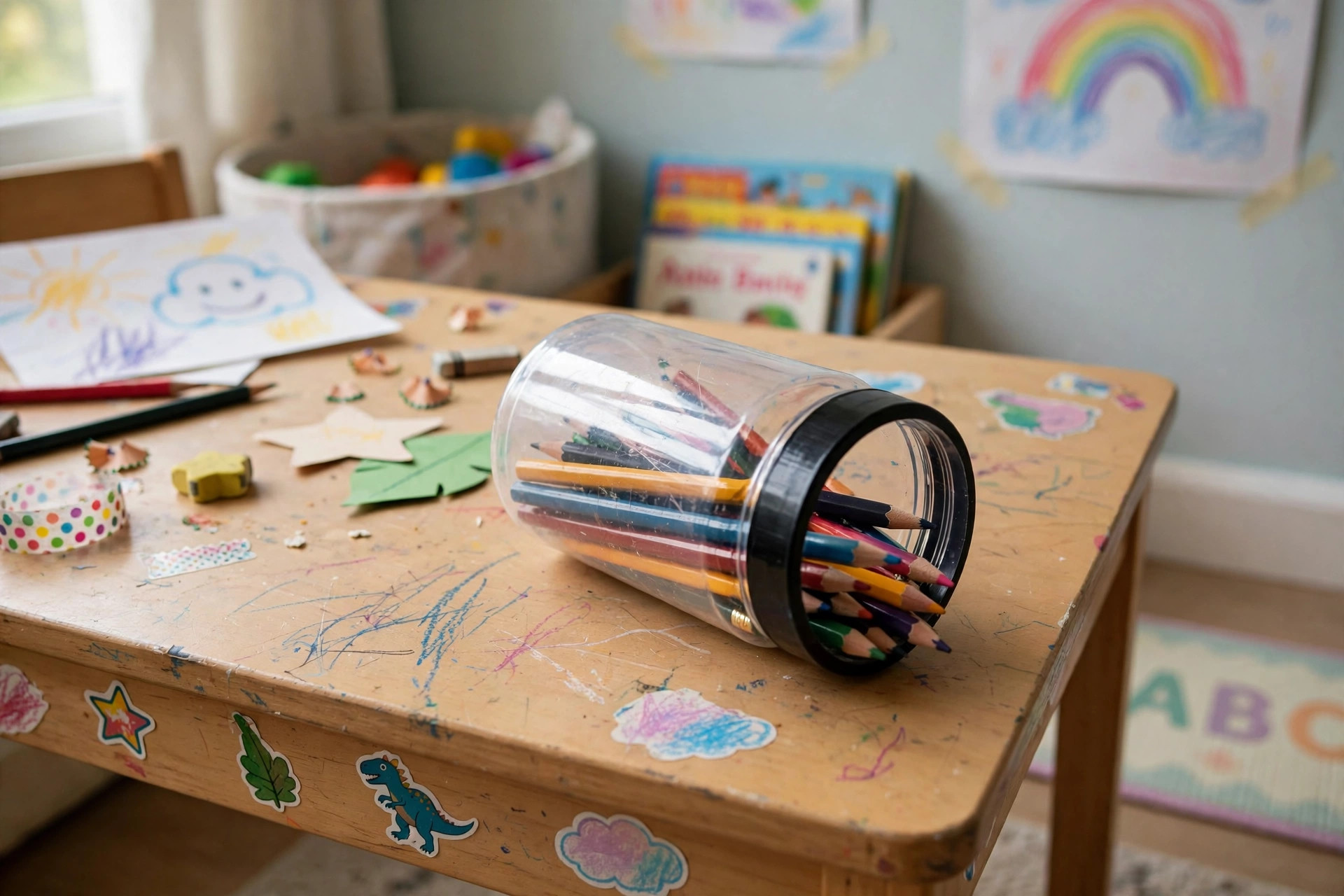
A glass jar on a kids' table breaks, because the table is the place where elbows land and the glass is the thing that cannot survive them. Use a jar that can take a knock — a pencil jar for the kids' table that survives being knocked over — so the pencils stay put and the table stays safe. Choose a short, wide jar in thick plastic or silicone, because the short jar is the jar that does not tip and the soft jar is the jar that bounces. Keep the pencils short too, because the short pencil is the pencil that fits in a short jar, and put the jar in the middle of the table, because the middle is the place every child can reach. The kids' room the table sits in is in 26 Kids Room Storage Ideas for 2026, where the room gets its own system before the jar arrives. A short, soft jar, and the pencils survive the kids' table.
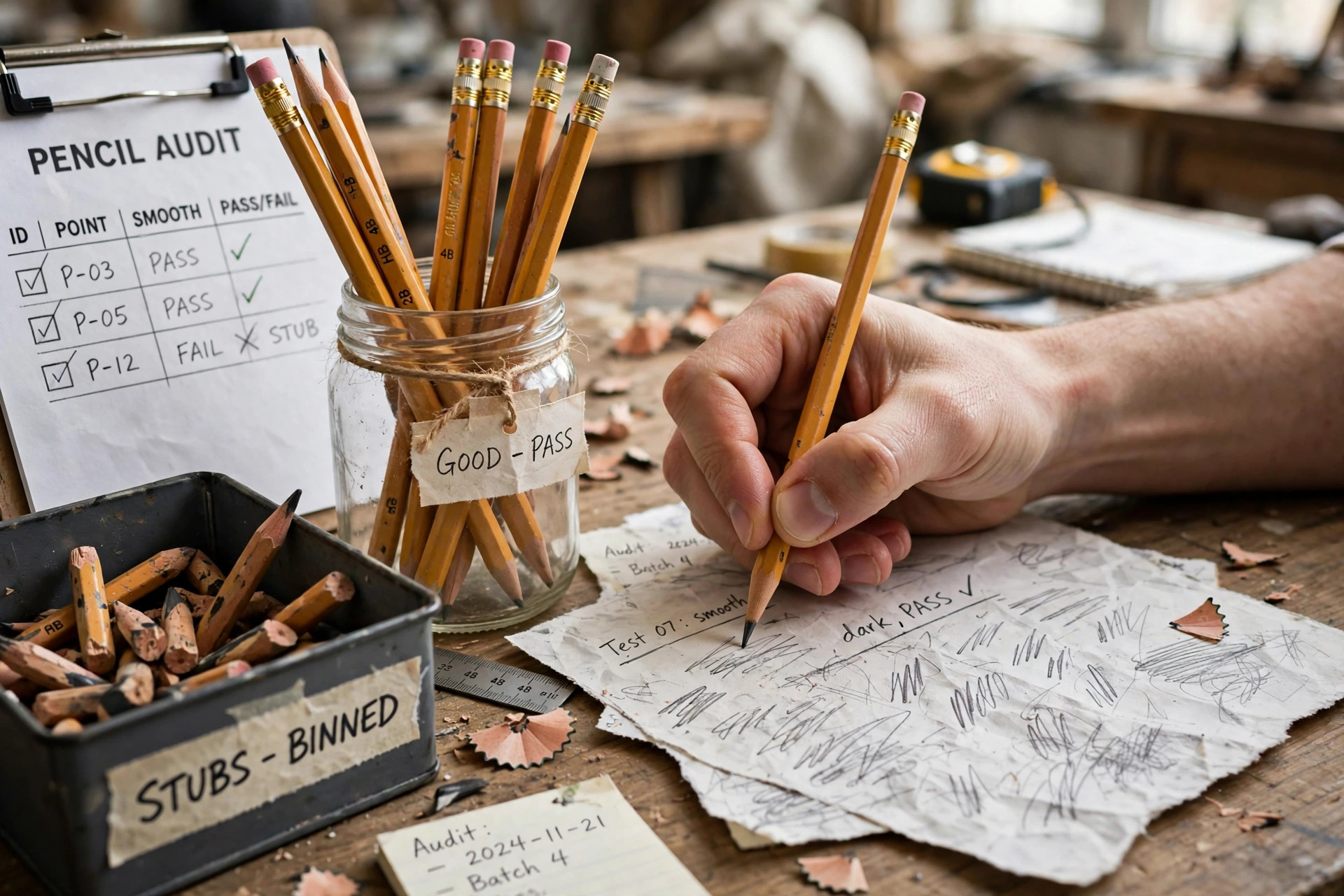
18. A pencil storage audit — keep the good ones, bin the stubs
A pencil jar that never gets emptied fills up with stubs, because the stub is the pencil you cannot hold and the jar is the place it hides. Do a pencil audit — keep the good ones, bin the stubs — so the jar holds only pencils worth using and the desk stops pretending it has more than it does. Tip the jar out once a month, test every pencil on a scrap of paper, and bin the ones shorter than your thumb, because the stub is the pencil that wastes your time. Keep the good ones, sharpen the blunt ones, and put back only what fits in the jar, because the jar that fits is the jar that stays tidy. One audit a month, and the pencils stop multiplying.
Which pencil storage idea fits which situation?
| Situation | Best first move | Budget | Tools needed |
|---|---|---|---|
| Pencils loose on the desk | Glass jar sorted by colour (idea 1) | Low | Glass jar |
| Colours keep mixing | Row of small jars, one per colour (idea 2) | Low | Small jars |
| No money for a pot | Tin can wrapped in kraft paper (idea 3) | Free | Tin can, paper |
| Cup keeps tipping over | Weighted-base pencil cup (idea 4) | Low | Weighted cup |
| Two people share one desk | Rotating shelf with cups (idea 5) | Low | Rotating shelf |
| Coloured and graphite mixed | Sort by type, three cups (idea 6) | Low | Three cups |
| Pencils lost between lessons | One pouch per subject (idea 7) | Low | Pouches, labels |
| Short pencils hide behind tall | Jars on a shelf, tallest back (idea 8) | Low | Shelf |
| Pencils never go back | Labelled jar system (idea 9) | Low | Labels |
| Desk surface is full | Wall-mounted pencil rail (idea 10) | Low | Rail, hooks |
| Drawer is a mess | Divider tray (idea 11) | Low | Divider tray |
| Wall space is free | Pegboard with cups on hooks (idea 12) | Low | Pegboard, hooks |
| Homework moves rooms | Portable pencil caddy (idea 13) | Low | Caddy |
| Pencils roll off the desk | Fabric pencil roll (idea 14) | Low | Fabric, needle |
| Shavings everywhere | Sharpener station (idea 15) | Low | Sharpener, tub |
| Holder clashes with the room | Paint it to match the desk (idea 16) | Low | Paint, brush |
| Kids keep knocking it over | Short, soft jar (idea 17) | Low | Plastic jar |
| Jar full of stubs | Monthly pencil audit (idea 18) | Free | Bin |
You do not need all 18 ideas. You need the three that solve your desk — usually the glass jar sorted by colour where the pencils live, the rotating shelf that serves the shared desk, and the sharpener station that keeps the shavings in one place. Start with the jar, sort the pencils by colour tonight, and put it where your hand reaches when you sit down. Do that and the next time you reach for a pencil it will be there, for the price of a jar and an evening.
Save this post for your next desk sort, and if the craft supplies need sorting first, read 26 Craft Storage Ideas for 2026 next — it is Post 43, the craft room the pencils share a desk with — and 20 Art Supply Organization Ideas for 2026, Post 16, for the paints and brushes that live beside the pencils. This is the sixteenth post of the Storage by room/object return run — Posts 31 to 55, one room and one object at a time — and the next posts carry the same storage system into the rooms that follow.
Publish date assigned at publishing time. Updated as new pencil storage finds are tested.
Frequently asked questions
How do I store pencils so they don't roll off the desk?
Stand them upright in a jar or a cup — a pencil that stands up cannot roll, and the jar is the thing that holds it there. A fabric pencil roll works too, because each pencil has its own slot and the slot is what stops the rolling. Never leave pencils lying loose on a bare desk, because the flat desk and the round pencil are the combination that sends them to the floor.
What is the best way to organize coloured pencils?
Sort them by colour in a glass jar you can see into, or a row of small jars with one colour per jar, so the colour you want is the colour you reach for. Keep the most-used colours at the front and the rarely used ones at the back, and label the jars if the colours are close. The sorted jar looks like a display, and the display is the jar that stays on the desk.
How many pencils should I keep on my desk?
Keep the ones you actually use — usually one jar of coloured pencils, one cup of graphite pencils and a couple of pens, and no more. Do a pencil audit once a month: tip the jar out, test every pencil, bin the stubs shorter than your thumb, and put back only what fits. A jar that fits is a jar that stays tidy, and a tidy jar is a desk you can work at.