22 Cleaning Supply Organization Ideas for 2026
Cleaning supplies do not stay where you put them. The kitchen spray lives under the sink, the bleach lives on the laundry shelf, the bathroom cleaner lives on the bathroom floor, the cloths live in three different drawers, and every cleaning session starts with a hunt through two rooms for the bottle you need. The cleaners are not the problem — the problem is that cleaning supply organization never happened, so every bottle, cloth and brush drifts to wherever there was a gap, and the gap is never where you are standing when you need to clean the bathroom.
These 22 cleaning supply organization ideas give every cleaner, cloth and tool one home: an under-sink zone with the everyday bottles in one caddy, the supplies sorted by room, the sprays in a row with their labels facing out, and a lock on the cupboard — so the next clean starts at the cupboard instead of starting with a search.
Every idea below works in a real home, from a flat where the whole cleaning kit fits in one caddy under the sink to a house where the bulk buys live in the garage. The detergents and laundry cleaners get their full treatment in 22 Laundry Room Storage Ideas for 2026, where the wash-day supplies live — and the cupboard the cleaners borrow from gets its own system in 25 Utility Closet Organization Ideas for 2026. Pick three ideas that fit your space, start with the one home, and build from there.
Give the cleaners one home
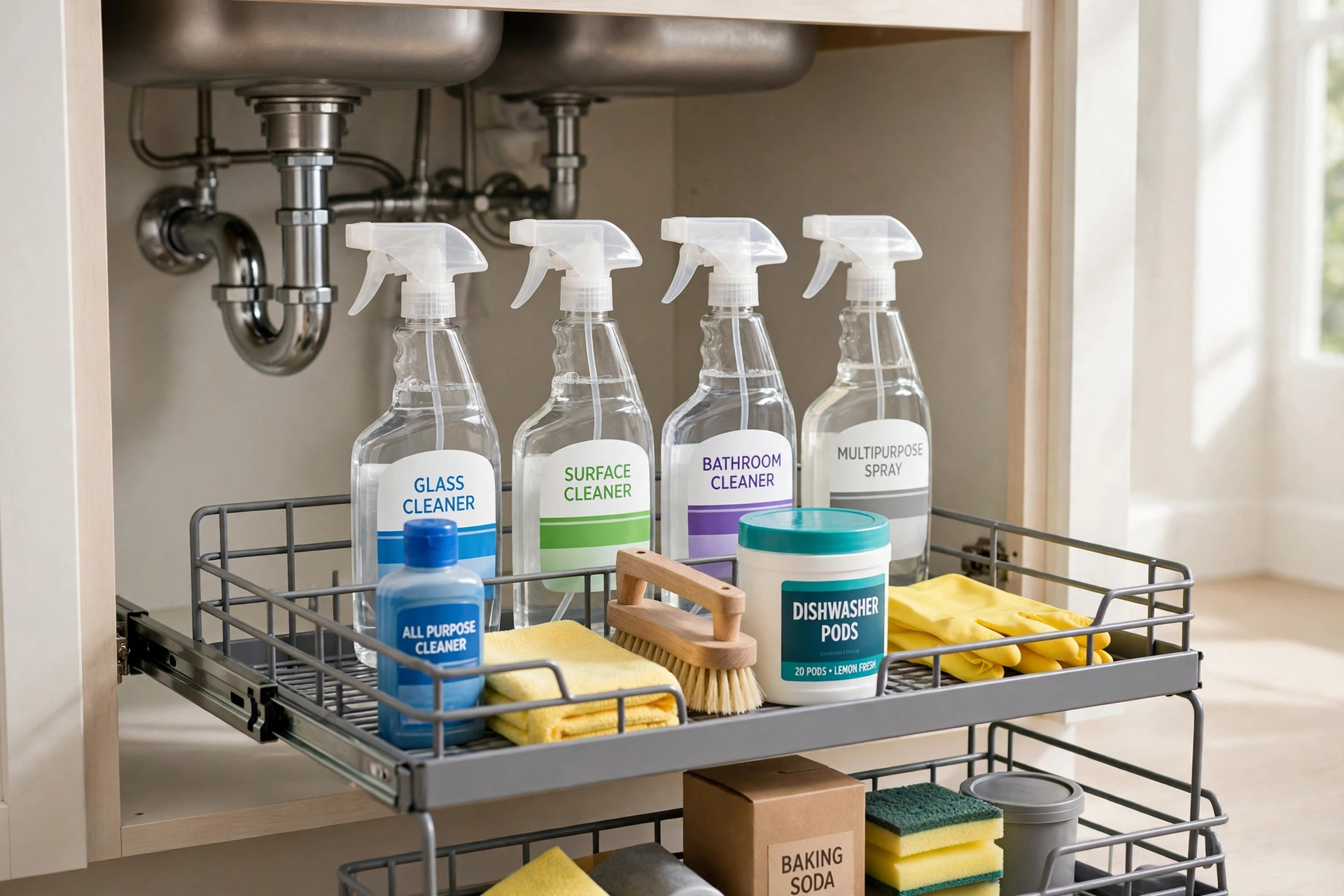
1. Give cleaning supplies one home — the home that stops the scatter
Cleaning supplies scattered across the house are cleaning supplies you cannot use, because the spray is under the sink, the bleach is on the laundry shelf, and the cloths are in a drawer in the other room — and the bathroom that needs cleaning tonight is waiting while you hunt through two rooms. Give cleaning supplies one home — the home that stops the scatter — so every bottle, cloth and brush lives in one cupboard and the hunt ends. Pick the cupboard first: under the kitchen sink, one shelf in the utility closet, or a tall cabinet in the laundry room, because the home that has a fixed spot is the home that gets used. Move everything there in one go, and the next clean starts at the cupboard instead of starting with a search. Start by emptying every hiding place onto the table — the sink cupboard, the laundry shelf, the bathroom floor — because the home cannot hold what is still hidden, and seeing the whole pile at once is what shows you how many half-empty bottles you actually own. One home, and the scatter stops.
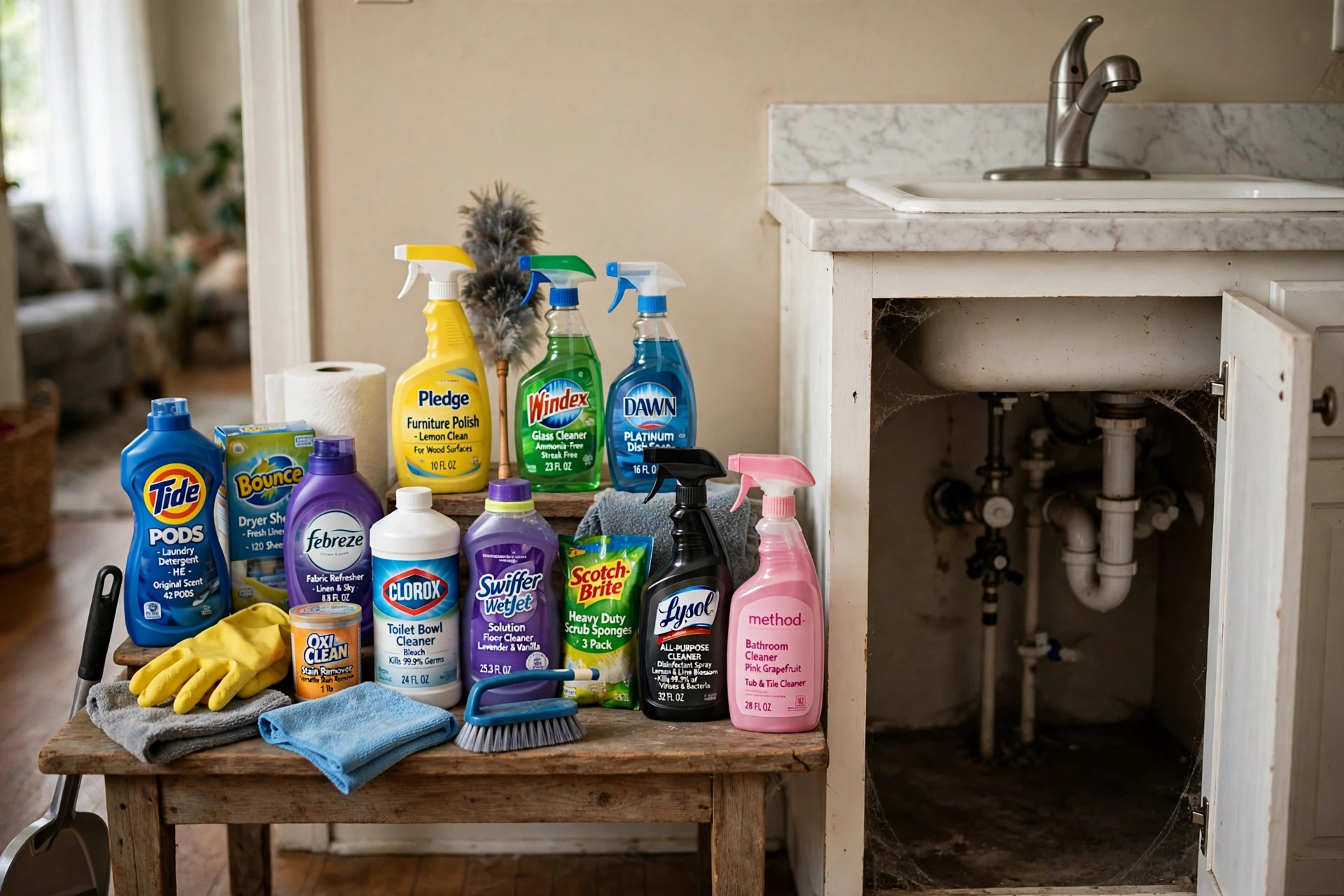
2. Sort by room — kitchen, bathroom, laundry
A pile of mixed cleaners is a pile you have to dig through, because the kitchen degreaser is under the bathroom spray, the laundry stain remover is behind the floor cleaner, and the bottle you want is always the bottle at the back. Sort by room — kitchen, bathroom, laundry — so each kind of cleaner has its own bin, its own section of the shelf, or its own slot in the caddy, and the bottle you want is the bottle you can reach. Keep the kitchen cleaners together because they come out every day, keep the bathroom cleaners together because they come out once a week, and keep the laundry cleaners together because they live by the machine, because the sort that follows the room is the sort that matches how you actually clean. Keep a small section for the all-purpose cleaners as well, because the all-purpose spray is the bottle that covers the quick wipe-down, the spill and the surface that needs no specialist, and the cupboard that holds an all-purpose bottle is the cupboard that is never stuck. One sort by room, and the dig ends. The detergents themselves get their full system in 22 Laundry Room Storage Ideas for 2026, where the wash-day supplies live by the machine.
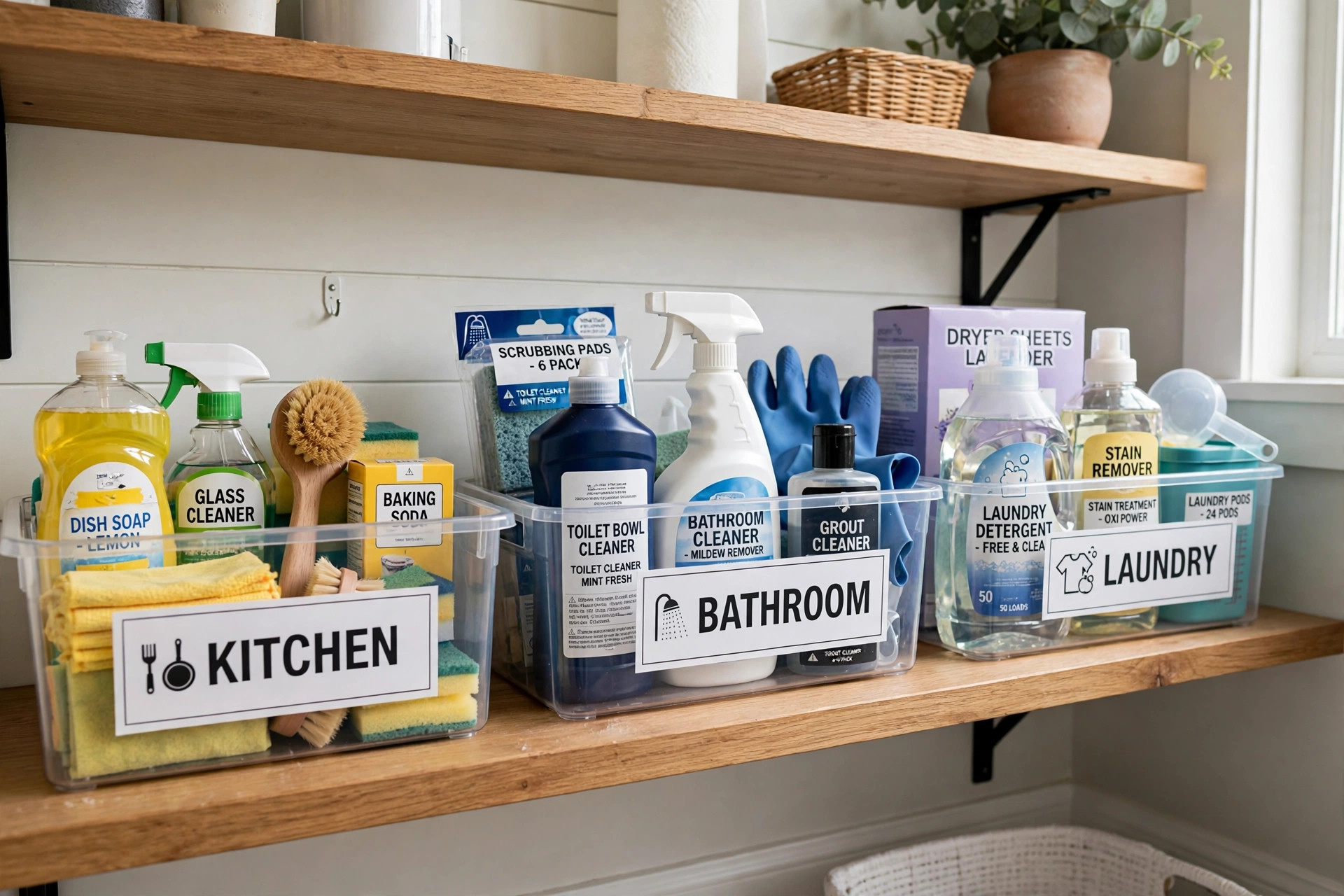
3. Keep the everyday cleaners in one caddy
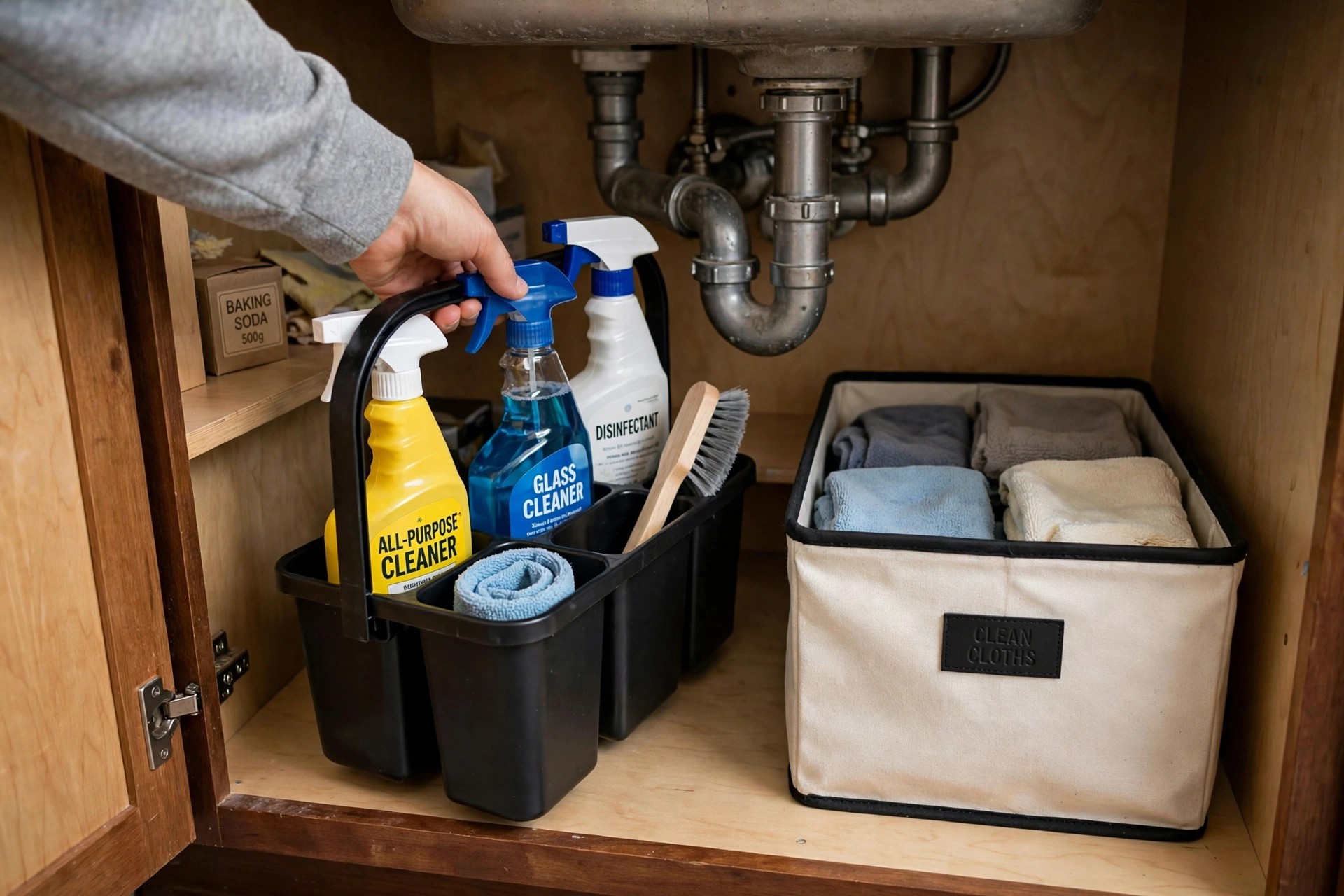
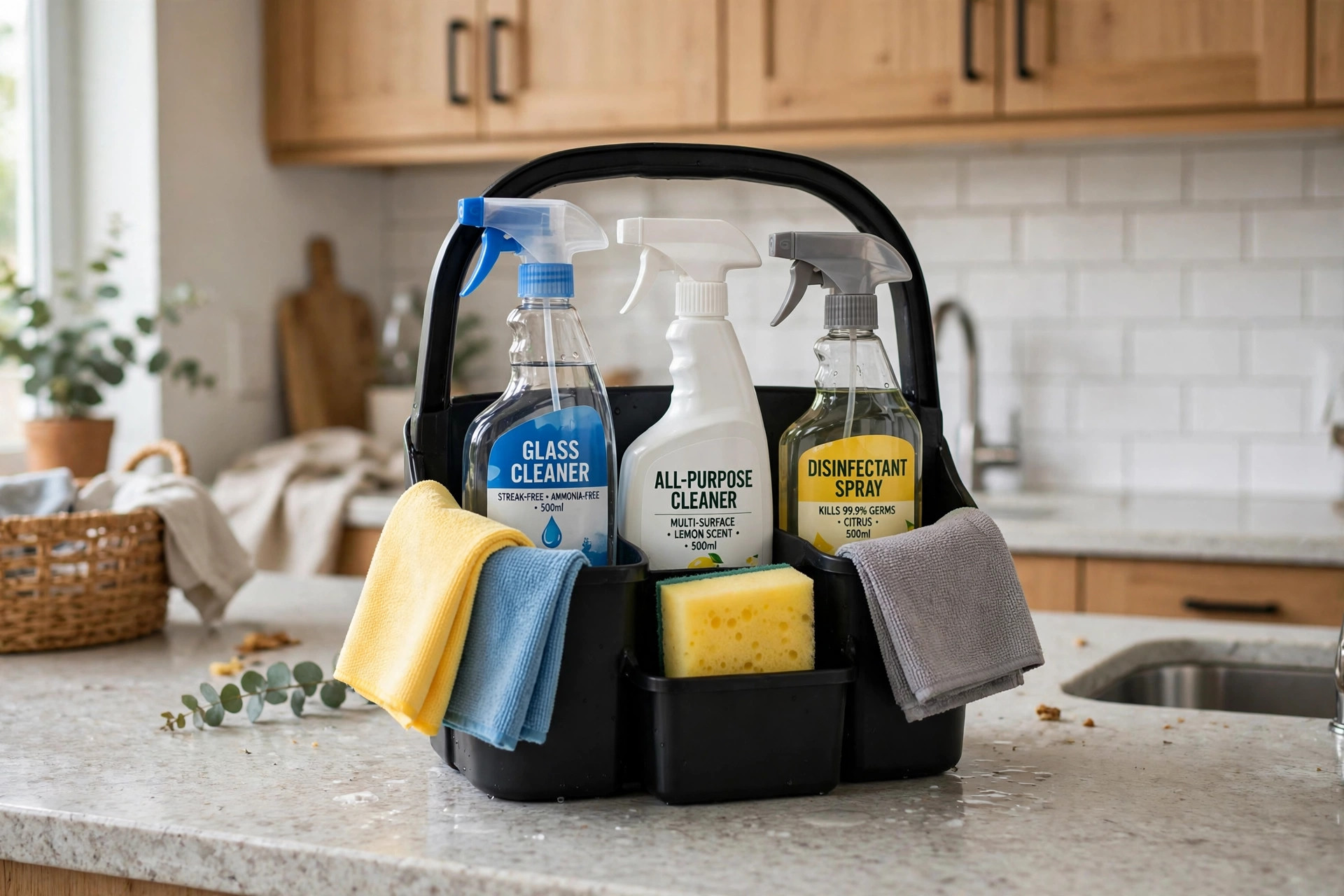
The everyday cleaners are the bottles that wander most, because the all-purpose spray goes back to the kitchen, the glass cleaner goes back to the bathroom, and the cloth goes back to wherever it was last seen — and the cleaning starts with a hunt for the spray every single time. Keep the everyday cleaners in one caddy — the caddy that travels from room to room — so the caddy holds one all-purpose spray, one glass cleaner, one bathroom spray and two cloths, and it lives at the home cupboard between cleans. Put the caddy on the top shelf of the cupboard or on the work surface beside it, and carry the whole caddy to the room you are cleaning, because the caddy that travels is the caddy that saves the trips. Label the caddy too, so the next person who cleans knows where the sprays live, because the caddy that is labelled is the caddy that comes back to the cupboard instead of wandering off to the bathroom floor. One caddy, and the hunt for the spray ends.
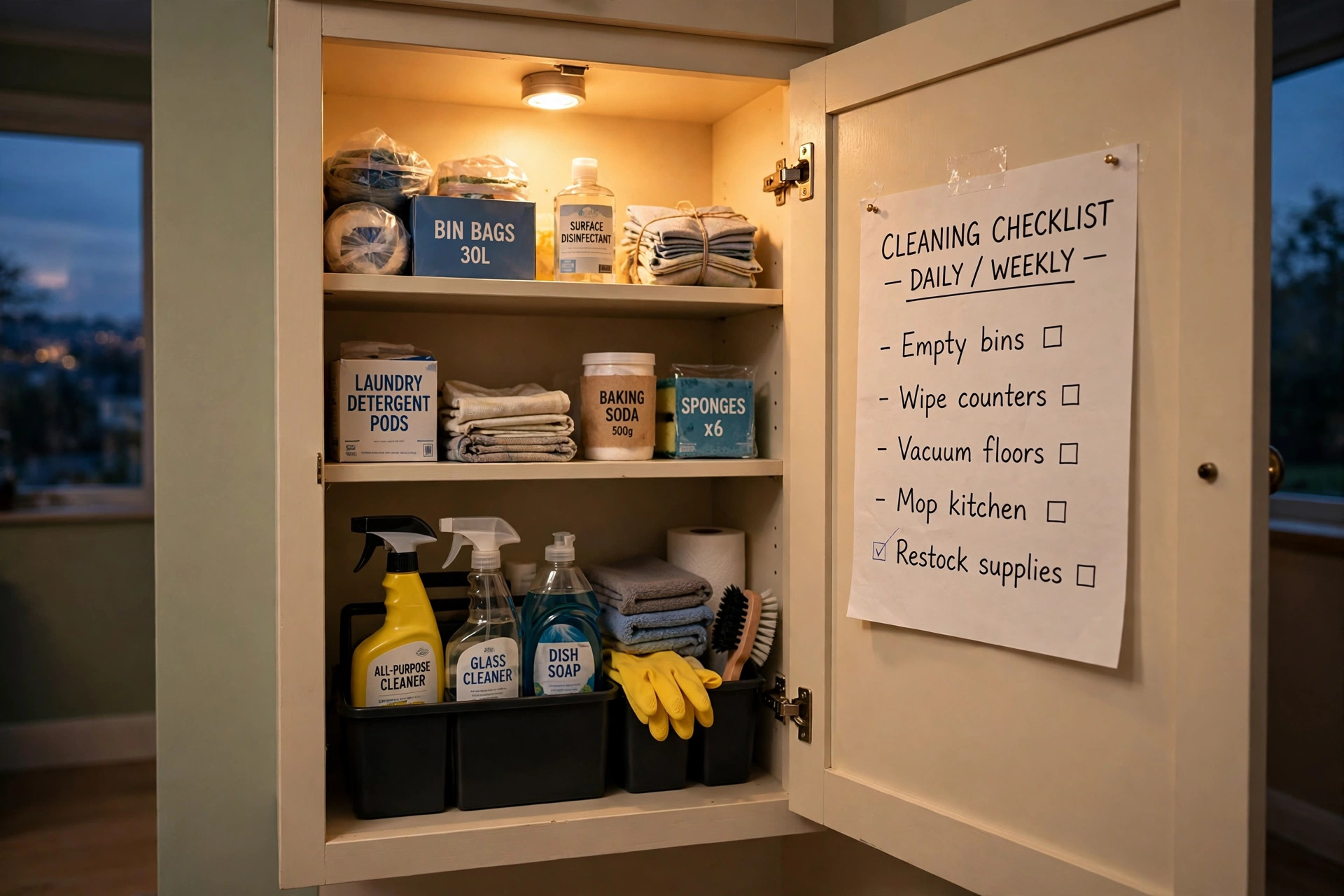
4. The under-sink zone — the cupboard that holds the cleaners
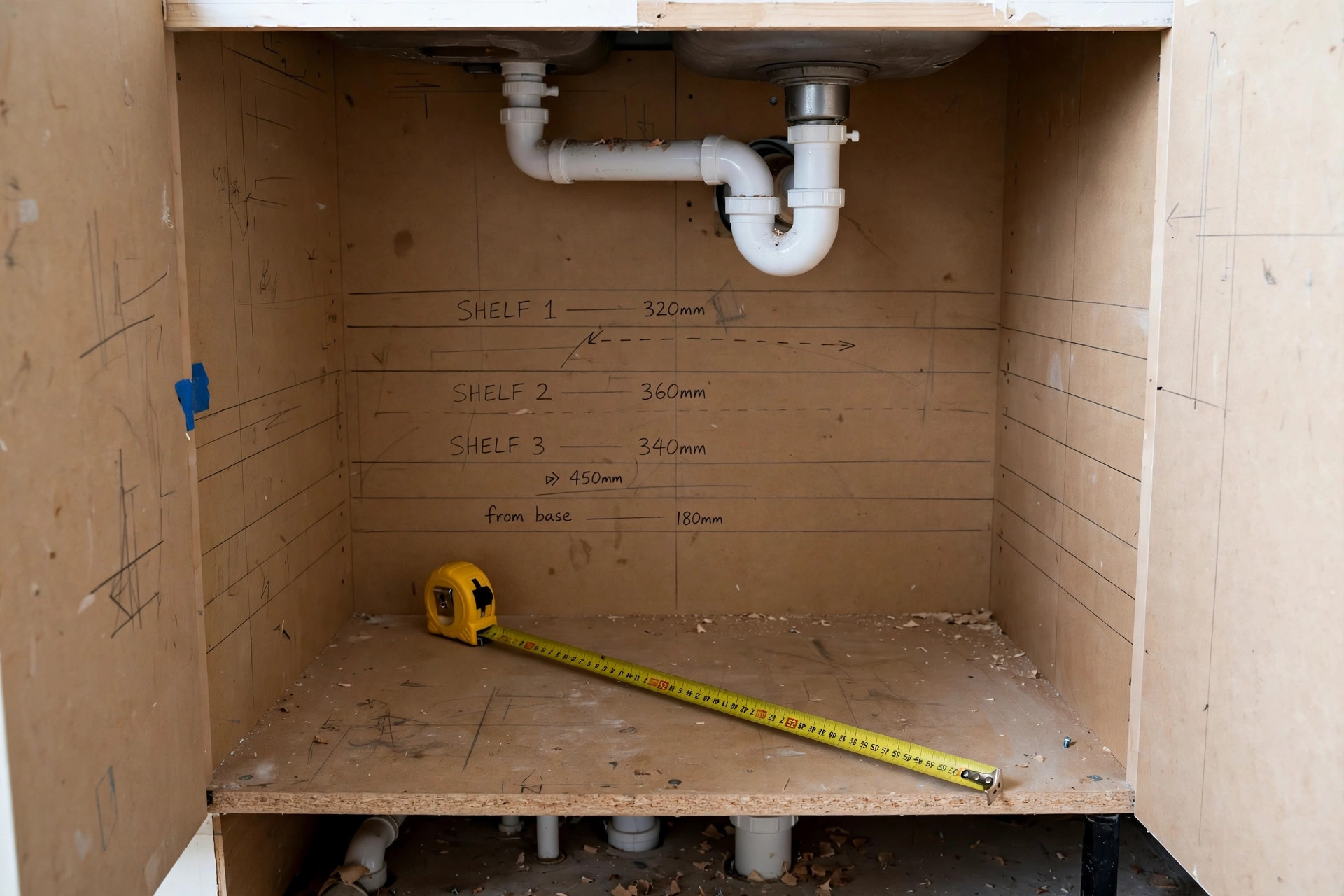
The cupboard under the kitchen sink is the natural home for the cleaners, because it is central, it is close to the water, and it is the cupboard that nobody opens for anything else — but left alone it becomes a graveyard of bottles that leak and fall over. Make it the under-sink zone — the cupboard that holds the cleaners — so the zone has a pull-out caddy, a rotating shelf or a set of bins, and every bottle has a place instead of a pile. Line the bottom of the cupboard with a waterproof tray first, because the tray that catches the leak is the tray that saves the wood, and keep the bottles upright in the caddy, because the bottle that stands is the bottle that does not leak. Keep the heavy bottles at the bottom and the light sprays at the top, because the zone that is stacked by weight is the zone that never topples. The cupboard the zone borrows its logic from gets its full treatment in 25 Utility Closet Organization Ideas for 2026, where the same zone thinking runs a whole closet. One zone, and the graveyard becomes a system.
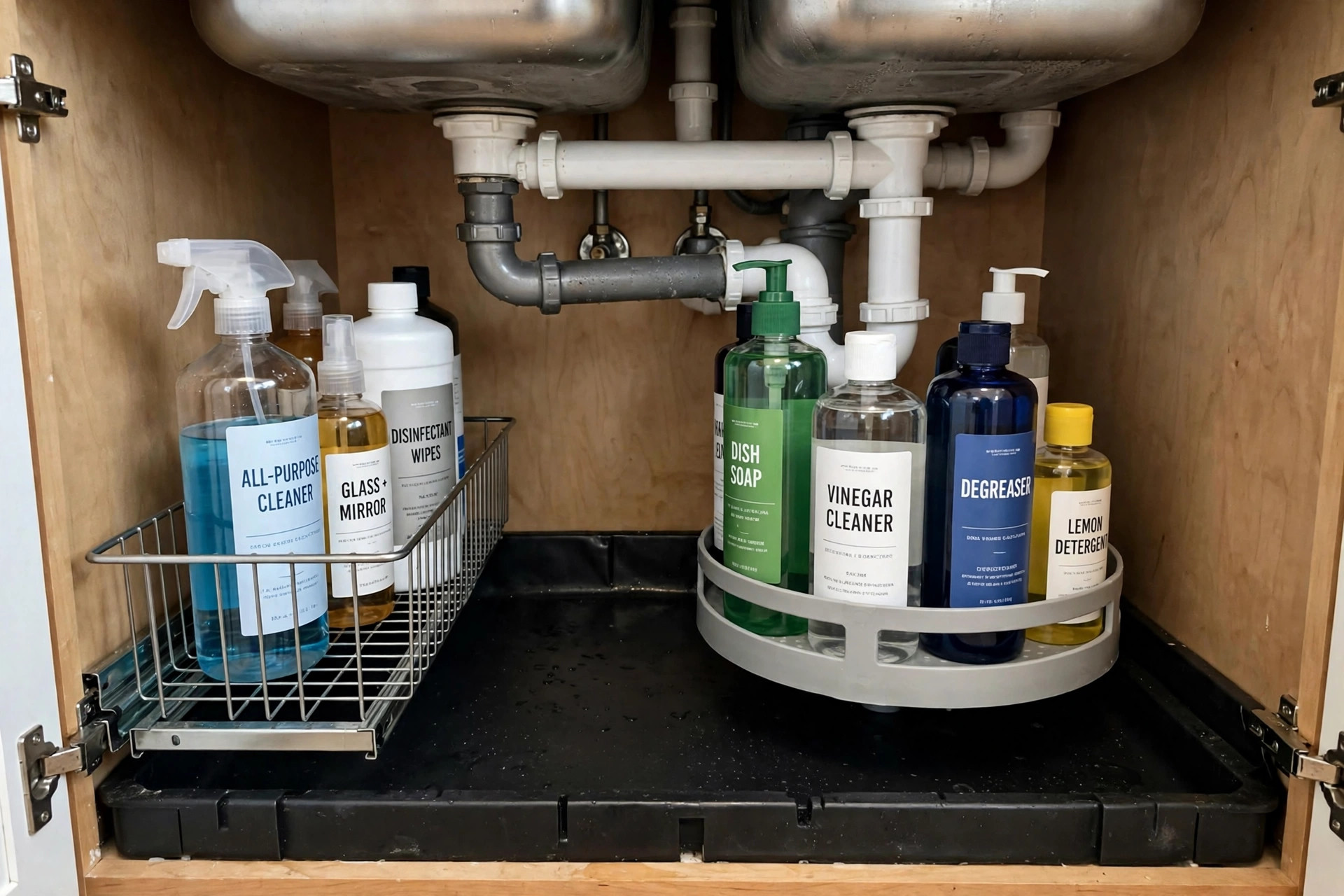
5. Measure under the sink before you buy storage
Under-sink storage bought by guessing is under-sink storage that does not fit, because the pipes take half the space, the bin is two inches too wide, and the organizer that looked right in the shop is the organizer that comes home and goes straight back. Measure under the sink before you buy storage — the tape measure that saves the returns — so every caddy, shelf and bin you buy is bought for your cupboard, not for a cupboard in a photo. Measure the width between the pipes, measure the height under the sink, and measure the depth from the door to the back wall, because the numbers that travel with you are the numbers that stop the returns. Write them in a notebook and take the notebook to the shop, because the cupboard that is measured once is the cupboard that fits the first time. Measure the pipes too — where they run, how far they stick out — because the bin that clears the pipes is the bin that slides in, and the cupboard that is measured is the cupboard that holds the system. One afternoon with a tape measure, and everything you buy fits.
Store them right
6. An under-sink pull-out caddy — the caddy that slides to you
Bottles at the back of the cupboard are bottles you cannot reach, because the front bottles block them, the cupboard is dark, and the spray you want is always the spray behind three other sprays. Use an under-sink pull-out caddy — the caddy that slides to you — so the whole shelf slides out on rails, the bottles come to you, and the back of the cupboard is as reachable as the front. Pick a caddy sized for your cupboard with an inch to spare on each side, and keep the tallest bottles in the middle where they cannot catch the door frame, because the caddy that slides freely is the caddy that gets used. Load the everyday sprays at the front of the caddy and the rarely used bottles at the back, because the caddy that is loaded by frequency is the caddy where the daily spray is always the first bottle you see. One pull-out caddy, and the reach-in ends. (Check on Amazon for an under-sink pull-out caddy with rails, sized for a standard kitchen sink cupboard.)
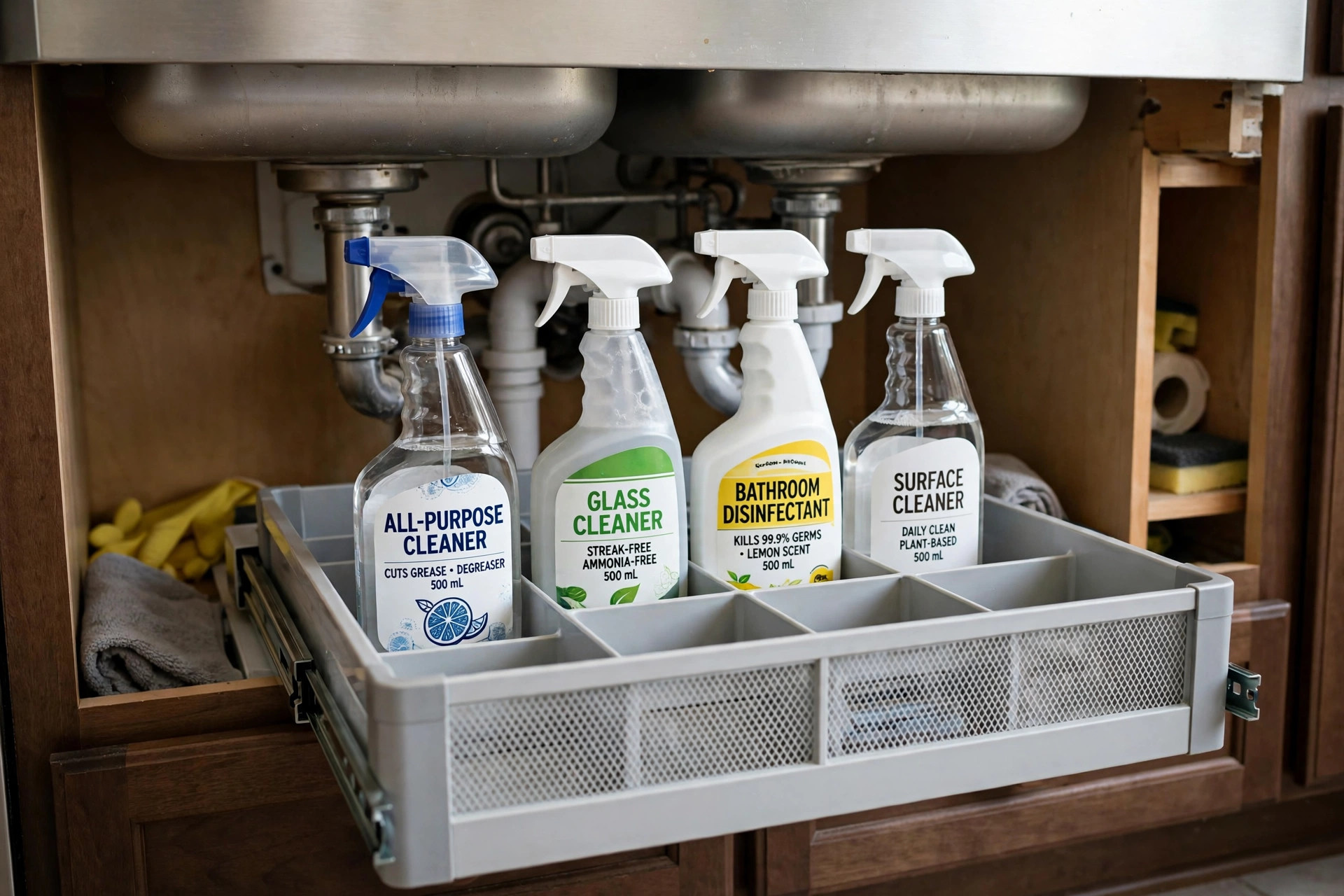
7. A rotating shelf under the sink — the lazy Susan that ends the reach-in
A deep cupboard is a cupboard where things hide, because the bottles at the back sit behind the bottles at the front, and the only way to reach them is to take everything out first. Put a rotating shelf under the sink — the lazy Susan rotating shelf that ends the reach-in — so the bottles sit on a round shelf that spins, and the bottle at the back spins to the front with one turn. Pick a shelf that clears the pipes and spins freely, and keep the bottles in a circle with the labels facing out, because the shelf that spins is the shelf where every bottle is one turn away. Keep the heavy bottles low and the light sprays on top, because the shelf that is balanced is the shelf that spins smoothly, and the shelf that spins is the shelf that never hides a bottle. The rotating shelf itself gets its full system in 21 Lazy Susan Organization Ideas for 2026, where the same spin works in every cupboard. One spin, and the hidden bottles are gone.
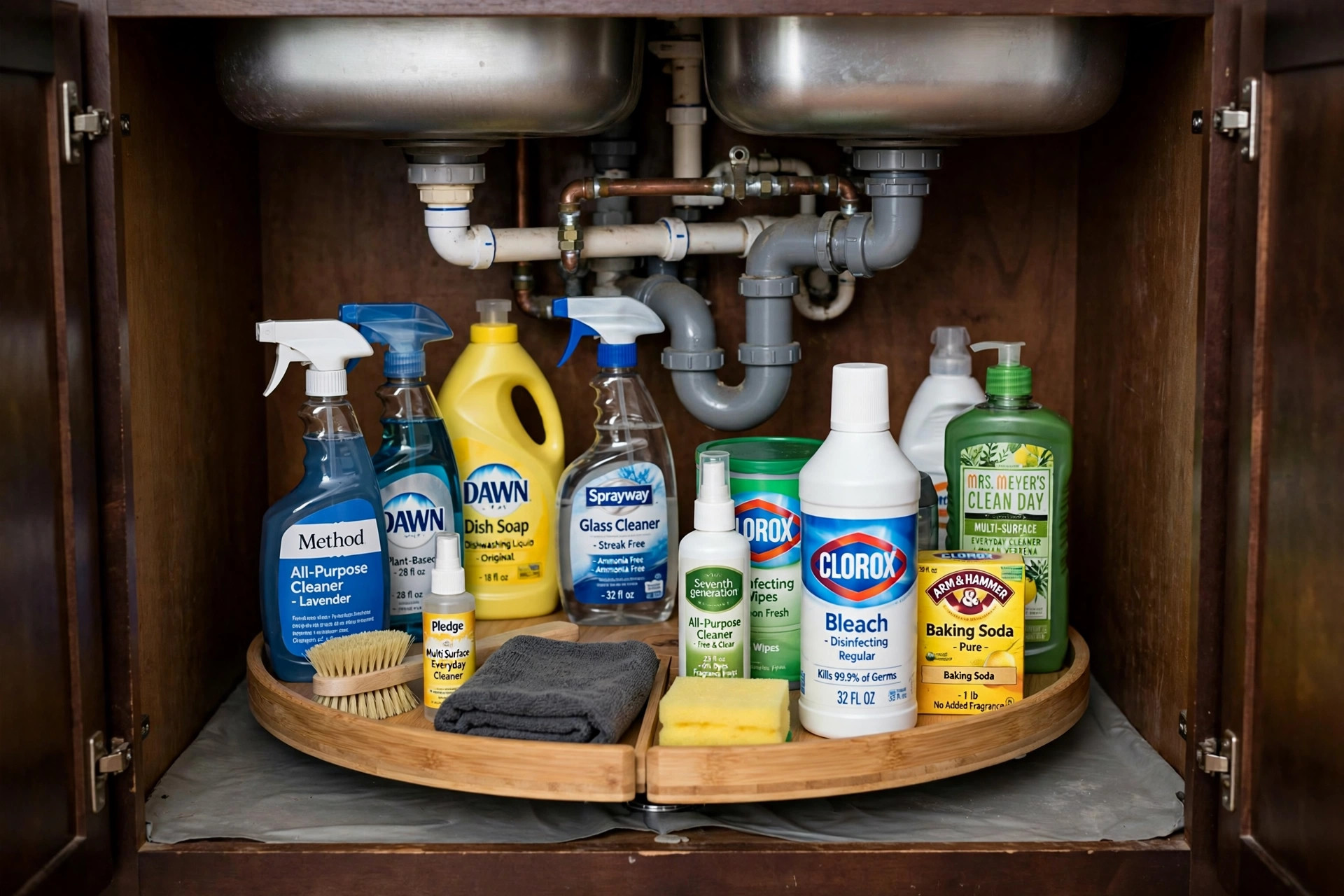
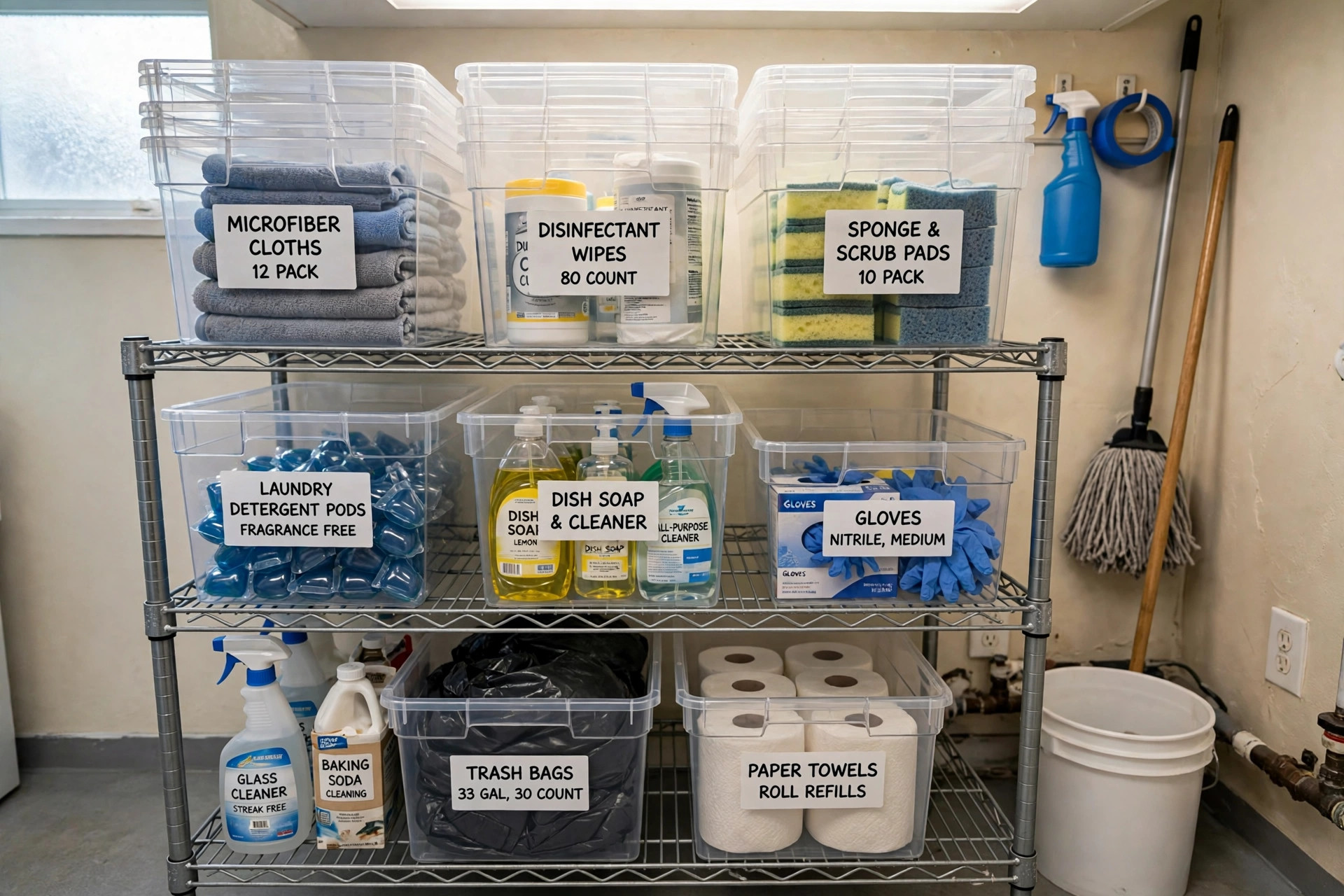
8. Stackable bins on the shelf — the bins that use the height
A shelf with bottles standing on it wastes the height above them, because the bottles are eight inches tall, the shelf is eighteen inches tall, and the ten inches above the bottles hold nothing at all. Use stackable bins on the shelf — the bins that use the height — so the cleaners sit in clear bins that stack two high, and the shelf holds twice as much without a single new cupboard. Pick bins you can see through, because the bin that is clear is the bin you can read without opening, and label the front of each bin by room, because the bin that is labelled is the bin you can reach for without a dig. Keep the heavy bins at the bottom and the light bins on top, because the stack that is loaded by weight is the stack that never topples. The bathroom cleaners get their own drawer system in 20 Bathroom Drawer Organization Ideas for 2026, where the same bin logic runs a shallow drawer. One stack, and the wasted height is gone.
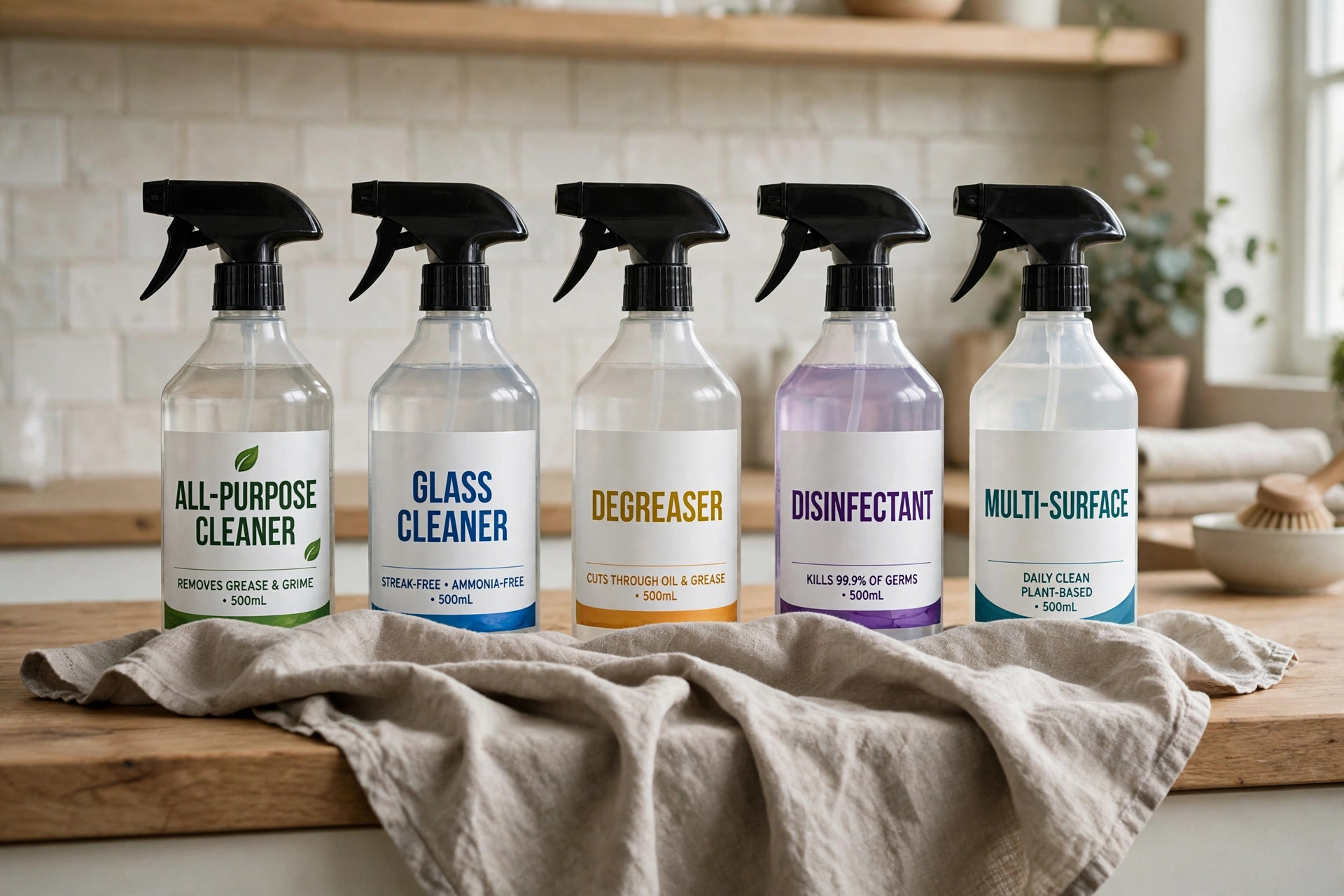
9. Spray bottles in a row, labels facing out
Spray bottles with their labels facing in are spray bottles you have to pick up to read, because the bleach looks exactly like the glass cleaner from the back, and the cupboard that holds faceless bottles is a cupboard where you grab the wrong one. Line the spray bottles in a row, labels facing out — the row that reads itself — so each bottle shows its name, the row runs from most-used to least-used, and the bottle you want is the bottle you can see. Keep the row on the front edge of the shelf or the front of the caddy, because the row that faces you is the row you can read from the door, and use one row per room where the shelf allows, because the row that is sorted by room is the row that never mixes the kitchen spray with the bathroom spray. The daily bathroom sprays get their own counter system in 25 Bathroom Counter Organization Ideas for 2026, where the same row logic keeps the counter clear. One row, labels out, and the wrong bottle is gone.
10. A door-mounted rack for cloths and sprays
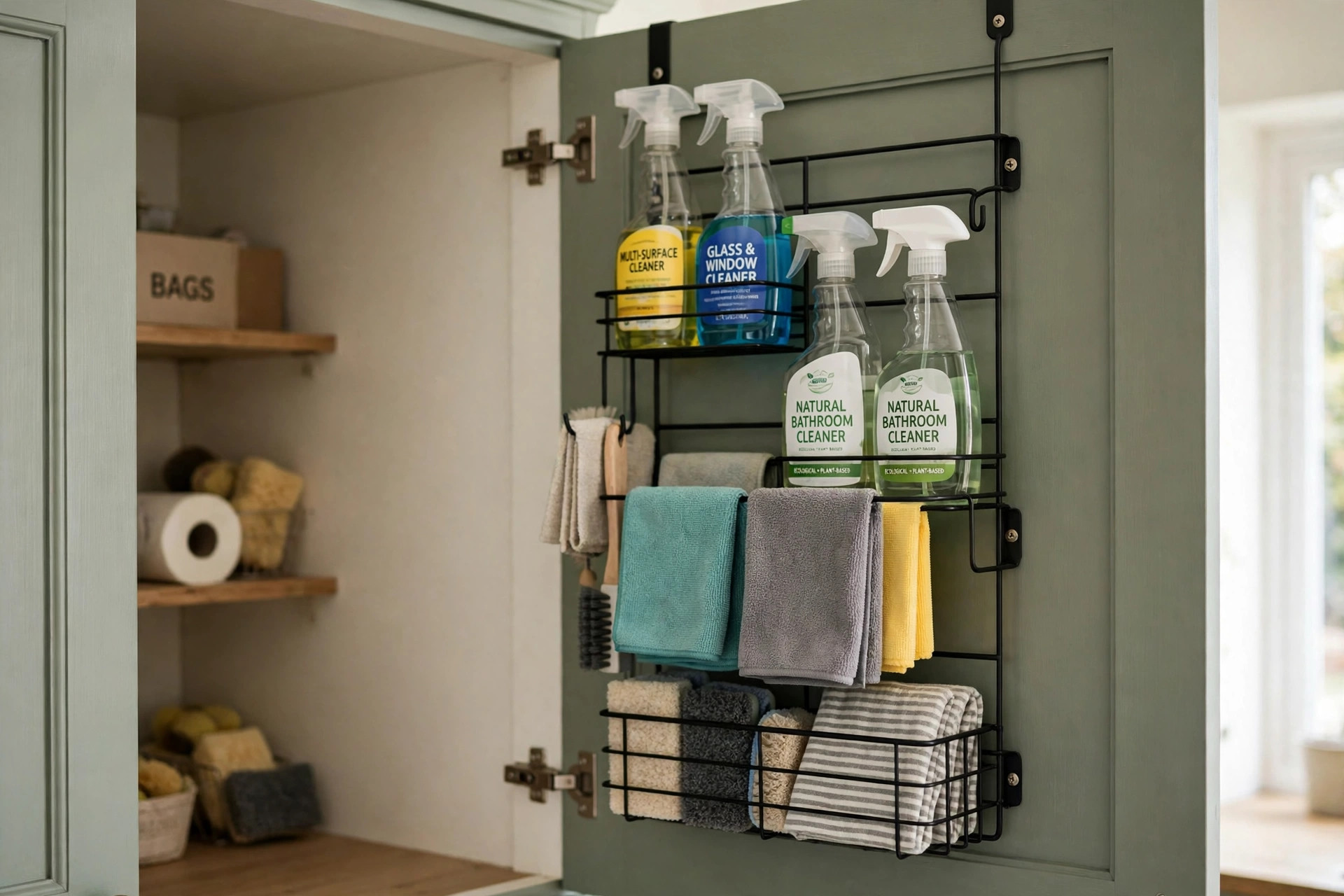
The inside of the cupboard door is space that stands empty, because the door opens and closes and nobody thinks to use it — while the shelf below is crowded with cloths and small sprays that have nowhere to go. Hang a door-mounted rack for cloths and sprays — the rack on the inside of the cupboard door — so the small sprays and the cloths hang on the door, in reach the moment you open it, and the shelf stays free for the big bottles. Keep the light things on the door and the heavy bottles on the shelf, because the door that holds the light things is the door that still closes properly. Check the door still closes before you load the rack, because the rack that is too deep is the rack that stops the door, and the door that closes is the door that keeps the cleaners hidden and tidy. The kitchen drawer that holds the cloths and sprays gets its own system in 22 Kitchen Drawer Organization Ideas for 2026, where the same door logic keeps a drawer tidy. One door rack, and the empty door earns its keep.
11. A refill station — decant into labelled bottles
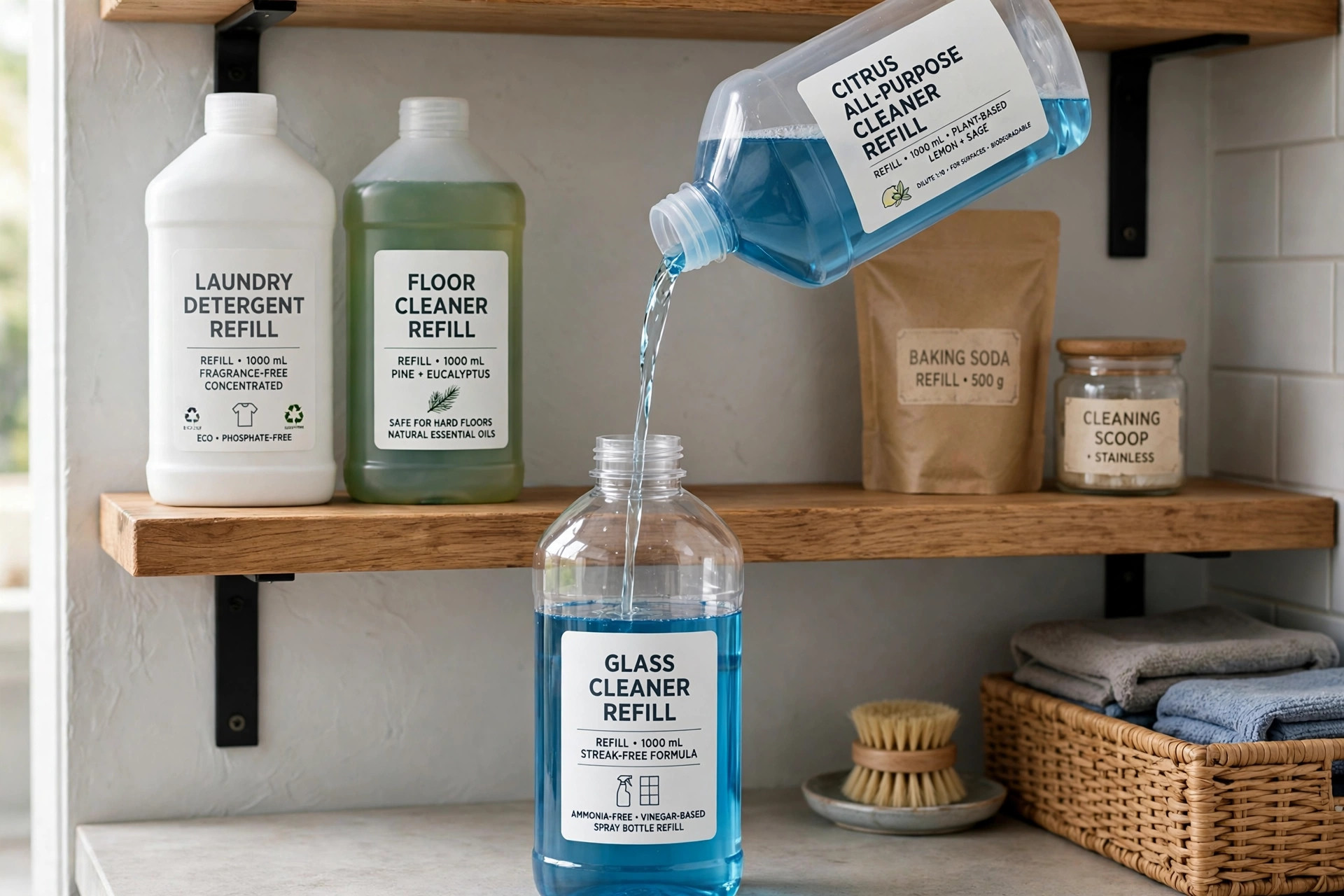
Big refill bottles are awkward to use, because the five-litre bottle is heavy, it sloshes, and the bottle that should save money is the bottle you dread lifting. Set up a refill station — decant into labelled bottles — so the big bottle lives on the bottom shelf and the small labelled bottle lives in the caddy, and you refill the small bottle when it runs low instead of wrestling the big one every time. Decant over the sink, label the small bottle with the product name and the date you filled it, and keep a funnel in the caddy, because the station that labels is the station where nobody pours the wrong cleaner. Keep one small bottle per product, because the bottle that is labelled is the bottle that is safe to grab, and the station that refills is the station that saves money without the lifting. One refill station, and the heavy bottle stays put. (Check on Amazon for a set of labelled refill spray bottles with a funnel, sized for everyday cleaners.)
Tools, cloths and the bulky stuff
12. Wall hooks for mops and brooms — the hooks that free the floor
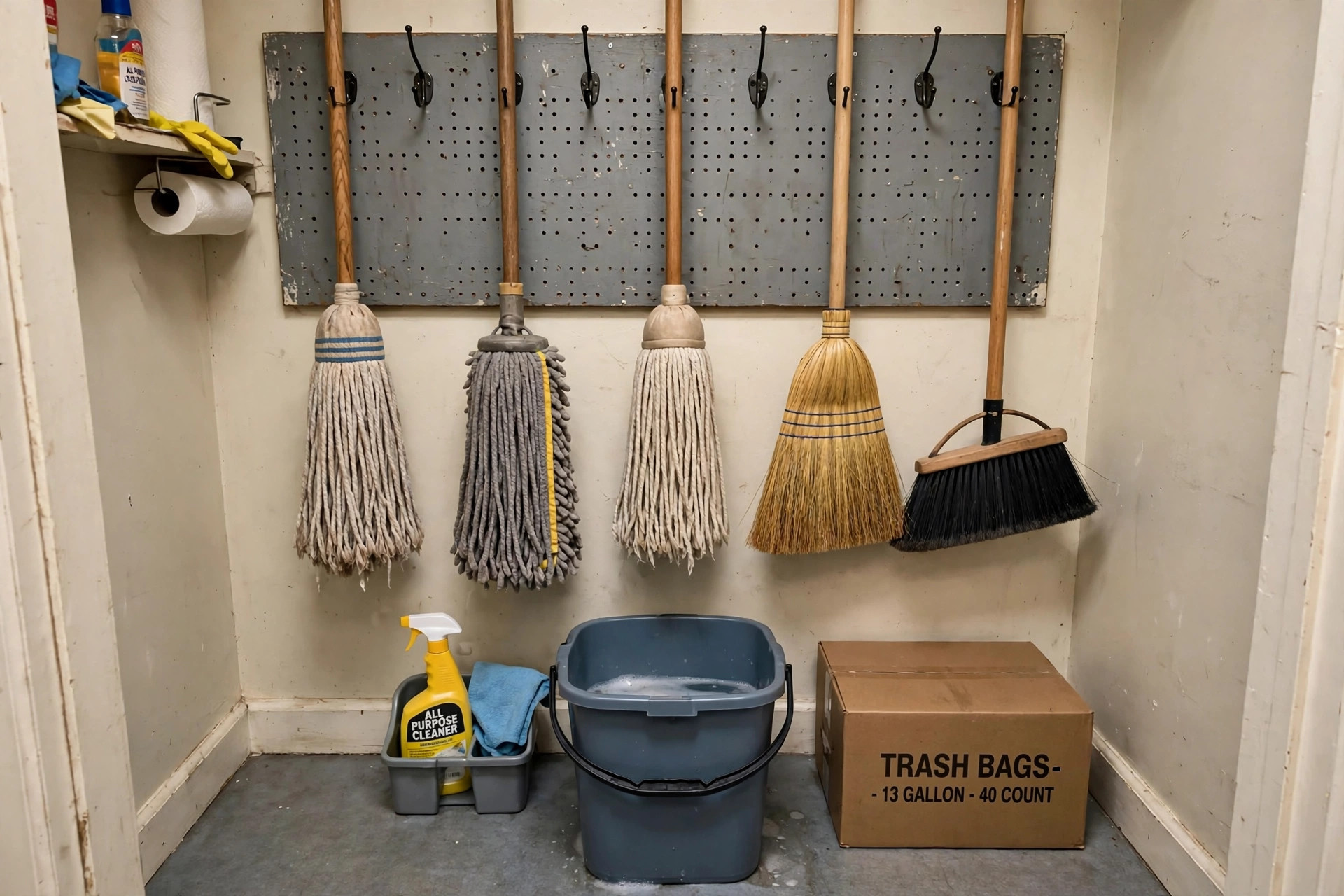
Mops and brooms leaning in a corner fall over, because the handles slide, the heads catch, and the corner that holds them is the corner where they clatter to the floor every time someone opens the door. Hang wall hooks for mops and brooms — the hooks that free the floor — so each handle hangs on its own hook on the wall of the utility closet or the garage, the heads hang down, and the floor stays clear. Mount the hooks at shoulder height so the handles lift off without a stretch, and leave a hand's width between the hooks, because the wall that is spaced is the wall where you can take one mop without taking them all. Fix the hooks into a stud or use proper wall plugs, because the wall that holds four mops is heavier than it looks, and the hooks that are fixed properly are the hooks that never come down mid-clean. The bulk buys that share the wall get their own home in 25 Garage Storage Ideas for 2026, where the same hooks hold the big tools. One row of hooks, and the floor is free again.
13. Microfibre cloths rolled, not folded
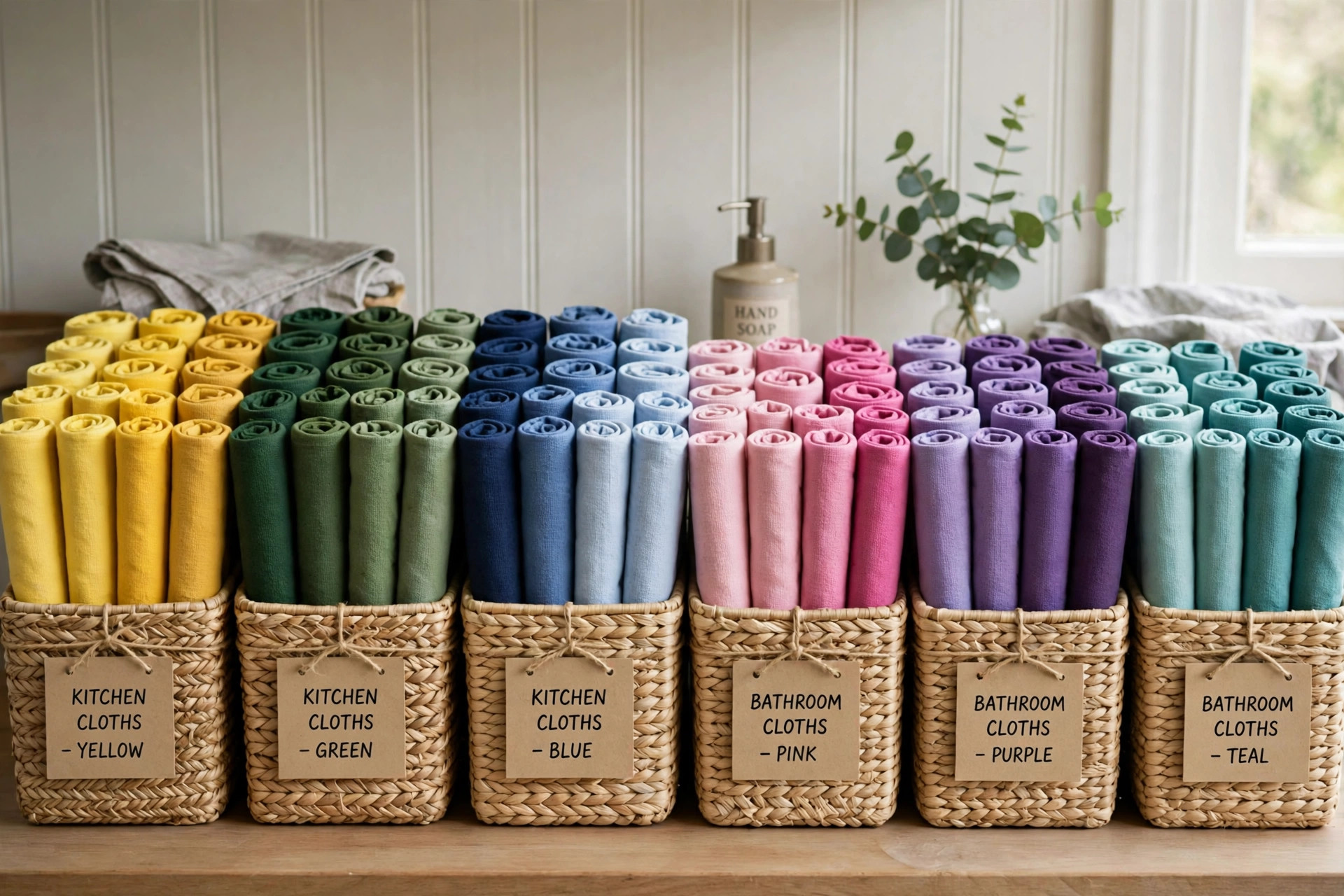
Microfibre cloths folded in a pile slide apart, because the pile leans, the cloths slip, and the drawer that holds the cloths is the drawer where every cloth is a crumpled ball by the next clean. Roll the microfibre cloths, not folded — the roll that stays put — so each cloth rolls into a tight tube, stands upright in a bin or a basket, and the cloth you want is the cloth you can pull out without disturbing the rest. Sort the rolls by colour or by job, kitchen cloths in one bin and bathroom cloths in another, because the bin that is sorted is the bin where the glass cloth is never the cloth that wiped the toilet. Keep the clean rolls in the cupboard and the dirty ones in a small laundry bag, because the roll that is separated is the roll that stays clean, and the bin that holds the rolls is the bin that never becomes a pile. One roll, and the crumpled cloths stop.
14. Sponges and brushes in a draining caddy
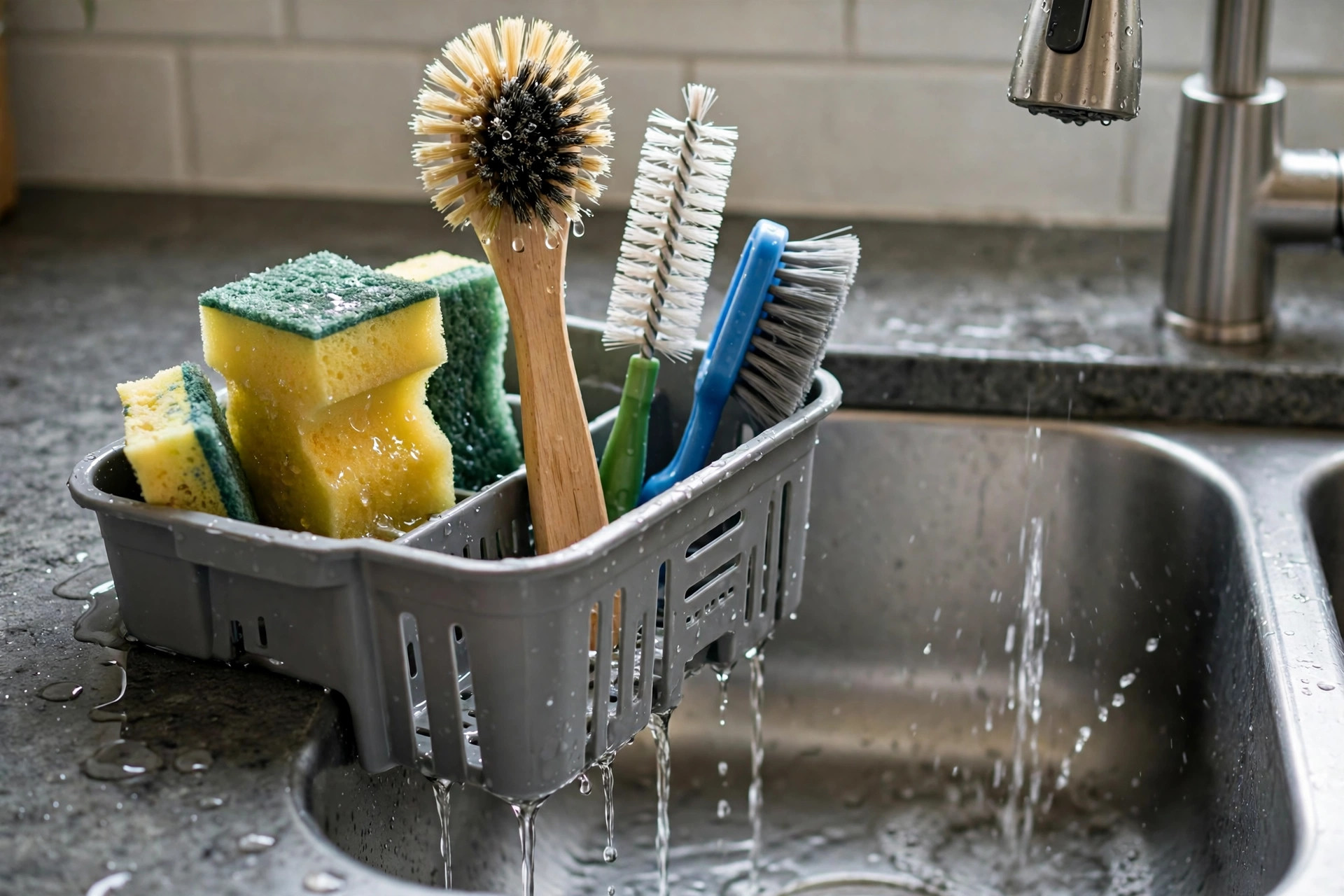
Sponges and brushes left in a drawer go damp, because the drawer holds the moisture, the sponge never dries, and the drawer that holds the damp things is the drawer that smells by the end of the week. Keep the sponges and brushes in a draining caddy — the caddy that lets them dry — so the caddy sits on the sink or on the shelf with holes in the bottom, the water drains away, and the sponge dries between cleans. Stand the brushes handle-down and the sponges on their edge, because the caddy that stands them up is the caddy where the air reaches every side, and rinse the caddy once a week, because the caddy that is rinsed is the caddy that never smells. Replace the sponge when it starts to smell even after a rinse, because the sponge that smells is the sponge that spreads the smell, and the caddy that drains is the caddy that keeps the fresh sponge fresh. One draining caddy, and the damp drawer is gone.
15. Vacuum and mop in one tall corner
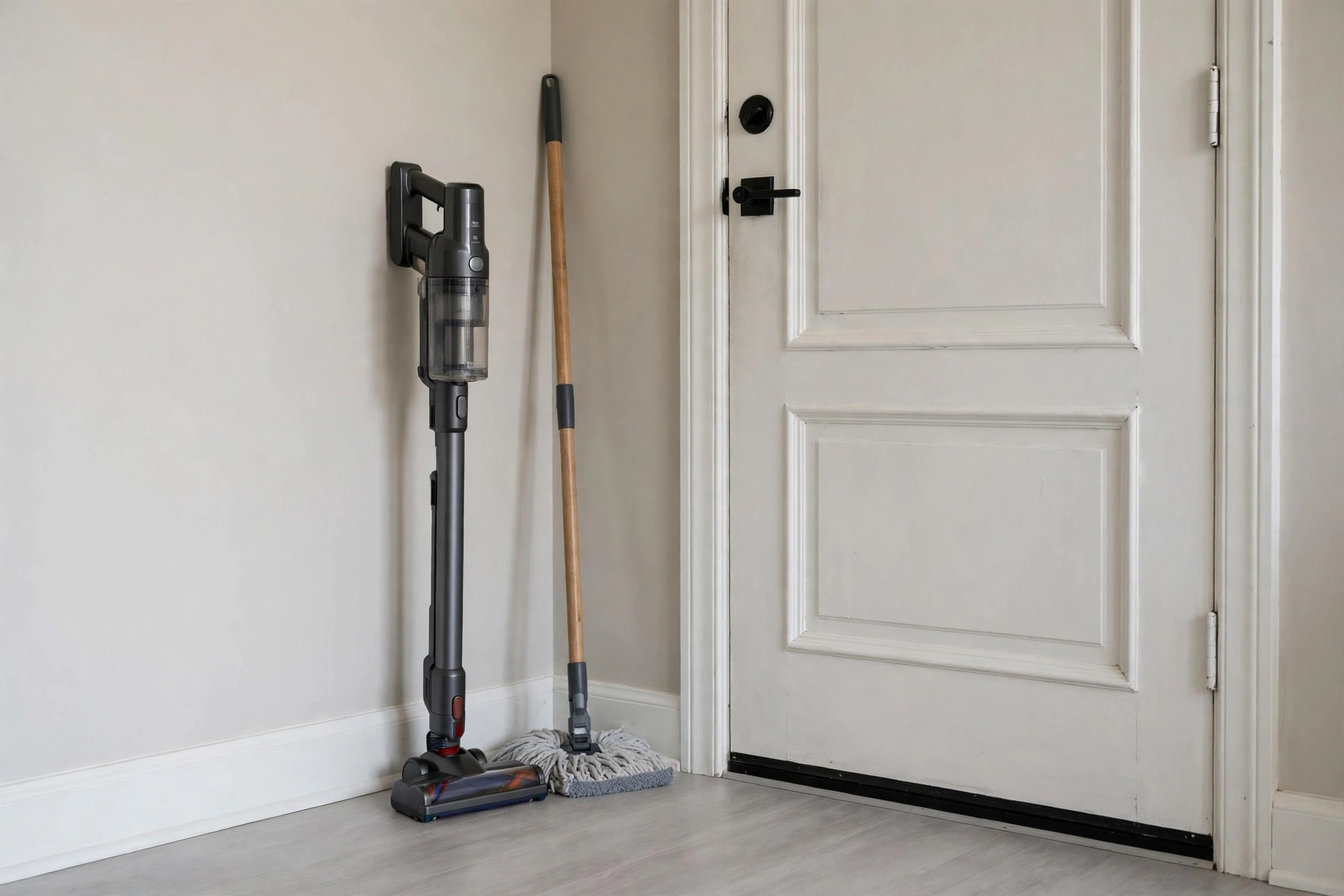
A vacuum and a mop with no home live in the middle of the room, because the vacuum leans against the wall, the mop leans against the vacuum, and the corner that should hold them is the corner that holds the coats instead. Give the vacuum and mop one tall corner — the corner that holds the big tools — so the corner has a hook for the mop, a space for the vacuum, and nothing else, and the big tools have a home that is not the middle of the room. Pick the corner nearest the door you clean from most, because the corner that is close is the corner that gets used, and keep the vacuum plugged in nearby, because the vacuum that is plugged in is the vacuum that gets used instead of the broom. The small-space thinking for that corner gets its full system in 26 Small Space Closet Organization Ideas for 2026, where one tall corner holds twice as much. One tall corner, and the middle of the room is free.
16. Bulk buys in the garage or utility room
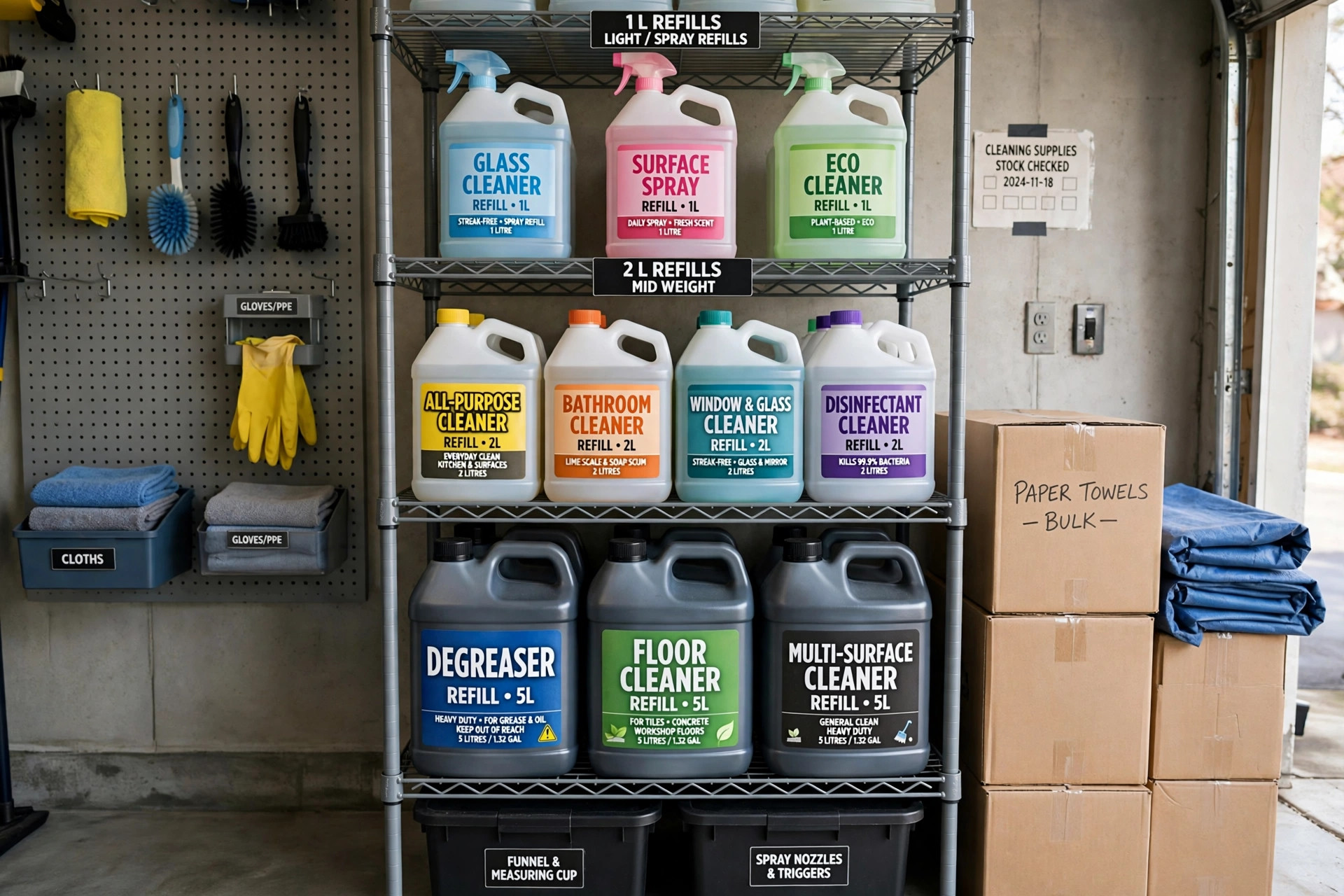
Bulk buys of cleaners are too big for the kitchen cupboard, because the five-litre bottles are tall, the multipacks are wide, and the cupboard that holds the everyday bottles is the cupboard that cannot hold the bulk too. Keep the bulk buys in the garage or utility room — the bulk that lives out of the way — so the big bottles sit on a shelf in the garage or the utility room, and the kitchen cupboard holds only what you use this month. Label the bulk shelf by product, keep the heaviest bottles at the bottom, and carry one bottle at a time to the kitchen when the small bottle runs low, because the shelf that is labelled is the shelf you can find in the dark. The kitchen cabinet that holds the everyday bottles gets its own system in 20 Kitchen Cabinet Organization Ideas for 2026, where the small bottles live within reach. One bulk shelf, and the kitchen cupboard breathes again.
17. A child-safe lock on the cleaner cupboard
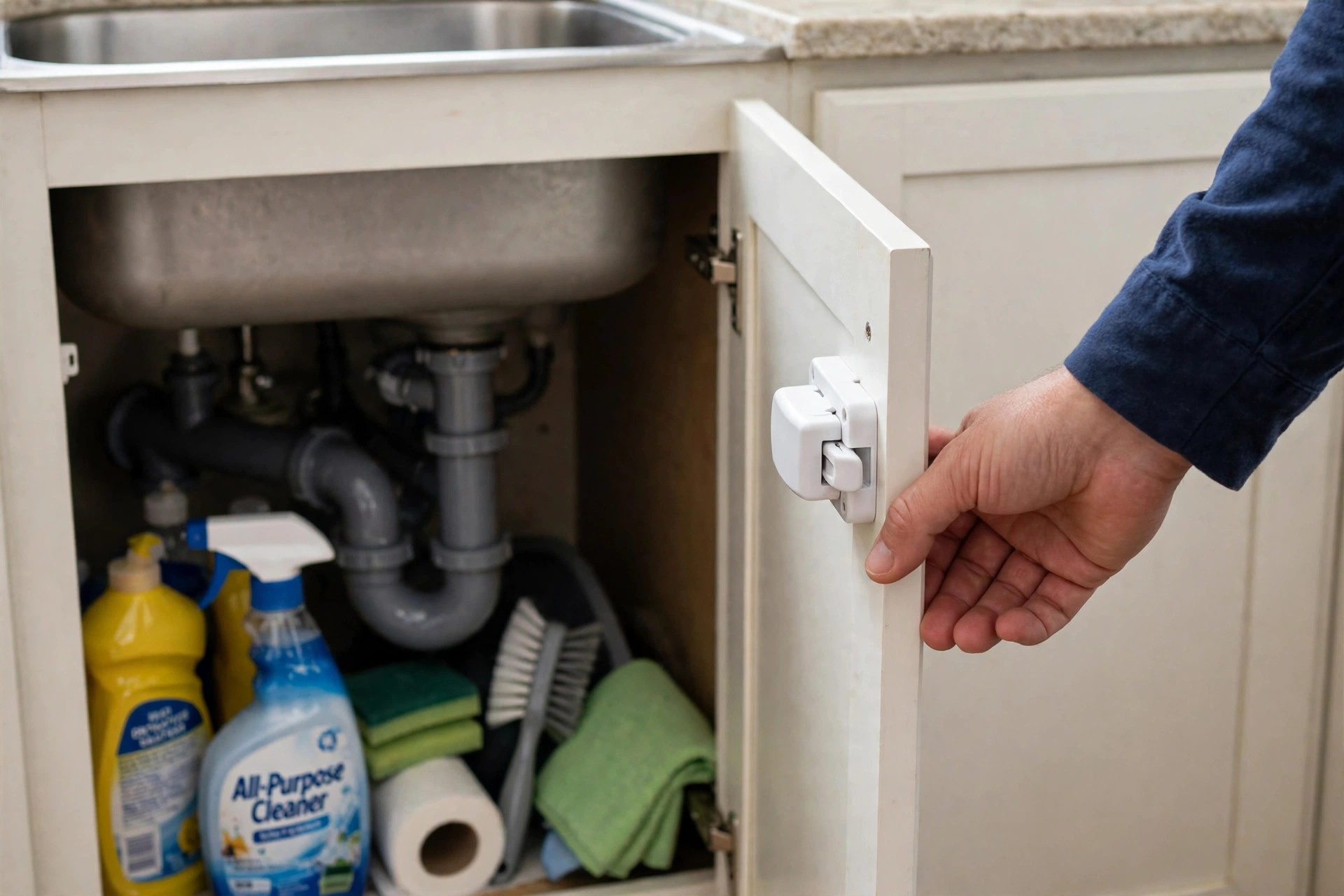
Cleaners in an unlocked cupboard are cleaners a child can reach, because the cupboard is at knee height, the bottles are bright, and the child who opens it is the child who finds the bleach before you do. Fit a child-safe lock on the cleaner cupboard — the lock that keeps the cleaners safe — so the cupboard opens only for an adult, and the bottles stay behind a door a small hand cannot open. Pick a lock that an adult can open with one hand while holding a cloth, because the lock that is easy for you is the lock that actually gets used, and test it with the cupboard full, because the lock that works empty is the lock that must work full too. Tell every adult in the house where the lock is and how it opens, because the lock that everyone knows is the lock that never gets left open, and the cupboard that is locked is the cupboard that is safe. One lock, and the worry ends. (Check on Amazon for a child-safe cabinet lock that fits a standard under-sink cupboard door and opens one-handed.)
Keep it tidy for good
18. Label every bin and bottle — the label that stops the dig
Bins without labels are bins you have to open, because the bin that holds the kitchen cleaners looks exactly like the bin that holds the bathroom cleaners, and the cupboard that holds unlabelled bins is a cupboard you never use. Label every bin and bottle — the label that stops the dig — so each bin says what it holds and the cupboard becomes usable instead of a mystery. Put the label on the front of the bin, not the lid, because the label that faces you is the label you can read from the door, and use one label per bin, because the bin that holds one room is the bin that stays sorted. Write the label in big clear letters and put it where you look when you open the cupboard, because the label that is big is the label that is read, and the bin that is labelled is the bin that gets used first. The rolling cart that carries the labelled bins from room to room gets its full system in 22 Rolling Cart Organization Ideas for 2026, where the same labels run a moving station. One label per bin, and the dig stops.
19. One in, one out for the cleaner stash
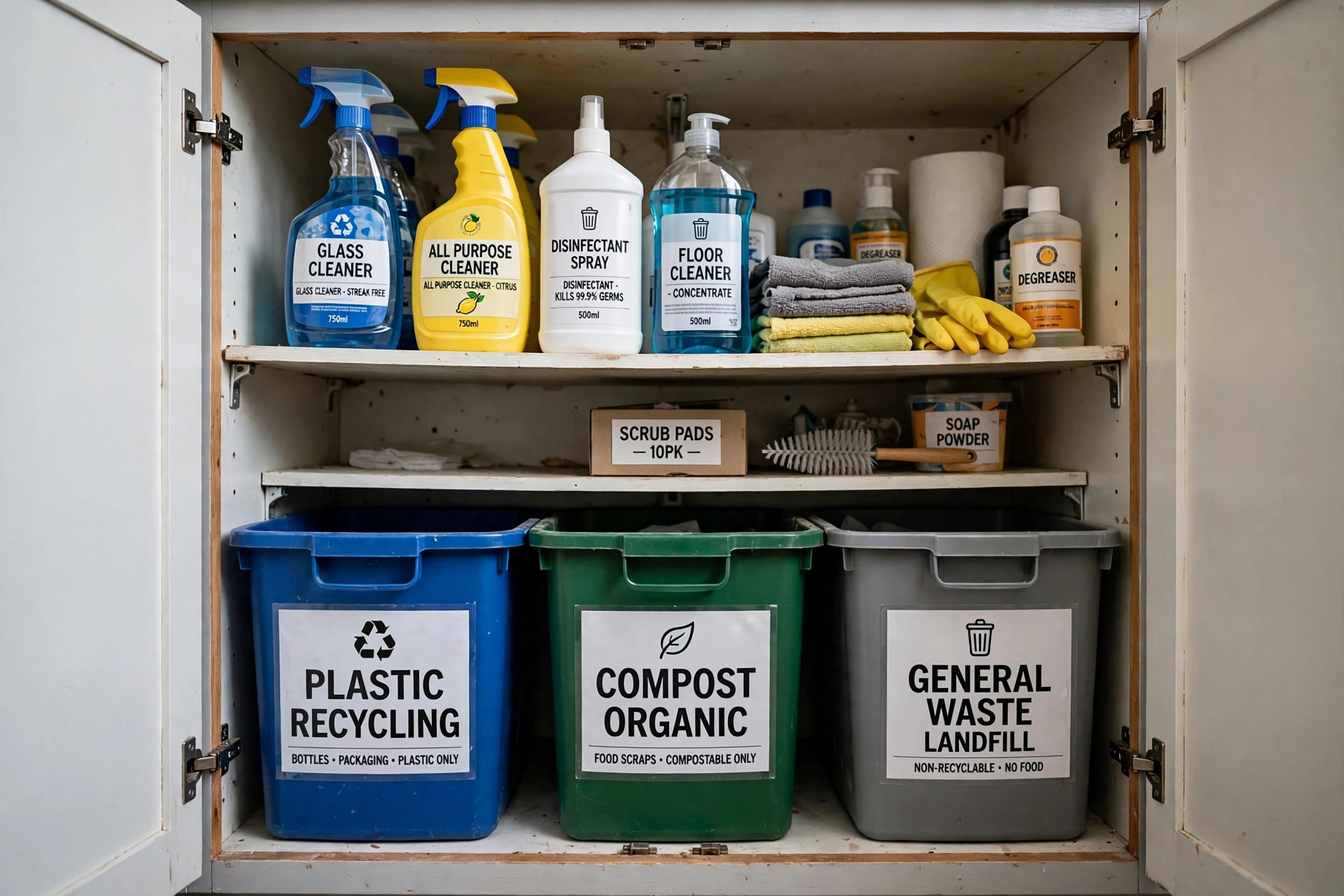
A cleaner stash grows on its own, because every sale adds a bottle, every bulk buy adds three more, and the cupboard that held ten bottles in January holds thirty by June. Use one in, one out for the cleaner stash — the rule that stops the cupboard overflowing — so every new bottle that enters the cupboard means one old bottle leaves it, into the bin or the donate bag. Keep a small bag at the cupboard for the bottles that leave, so the bottle that leaves has somewhere to go the moment you decide, because the bag that is at the cupboard is the bag that gets used. Count the bottles when you do the swap, because the count that is written down is the count that shows you how many you really own, and the stash that is counted is the stash that stops growing. One rule, and the cupboard never overflows.
20. A monthly expiry check — the check that catches the dead bottles
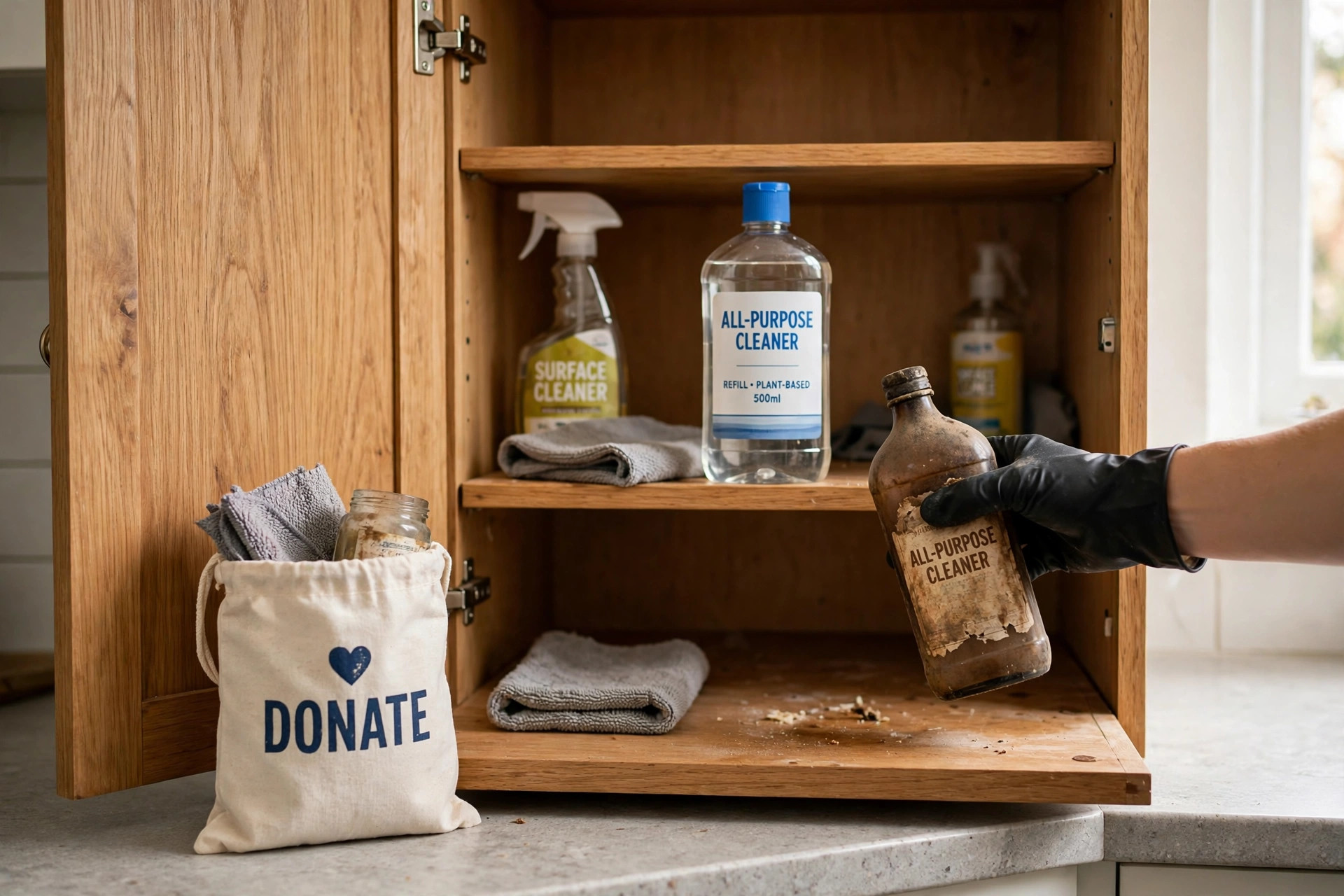
Cleaners go dead quietly, because the bottle that worked last year is the bottle that barely works now, and the cupboard that never gets checked is the cupboard full of bottles that clean nothing. Do a monthly expiry check — the check that catches the dead bottles — so once a month you open the cupboard, check the dates on the bottles, and bin the ones that are past their best or nearly empty. Check the spray nozzles too, because the nozzle that is clogged is the nozzle that wastes the cleaner, and rinse the ones that still work, because the check that rinses is the check that saves the bottle. Write the check on the calendar, the first Saturday of the month, because the check that is written down is the check that happens, and the cupboard that is checked monthly is the cupboard where every bottle works. One check a month, and the dead bottles are gone.
21. A five-minute reset after cleaning
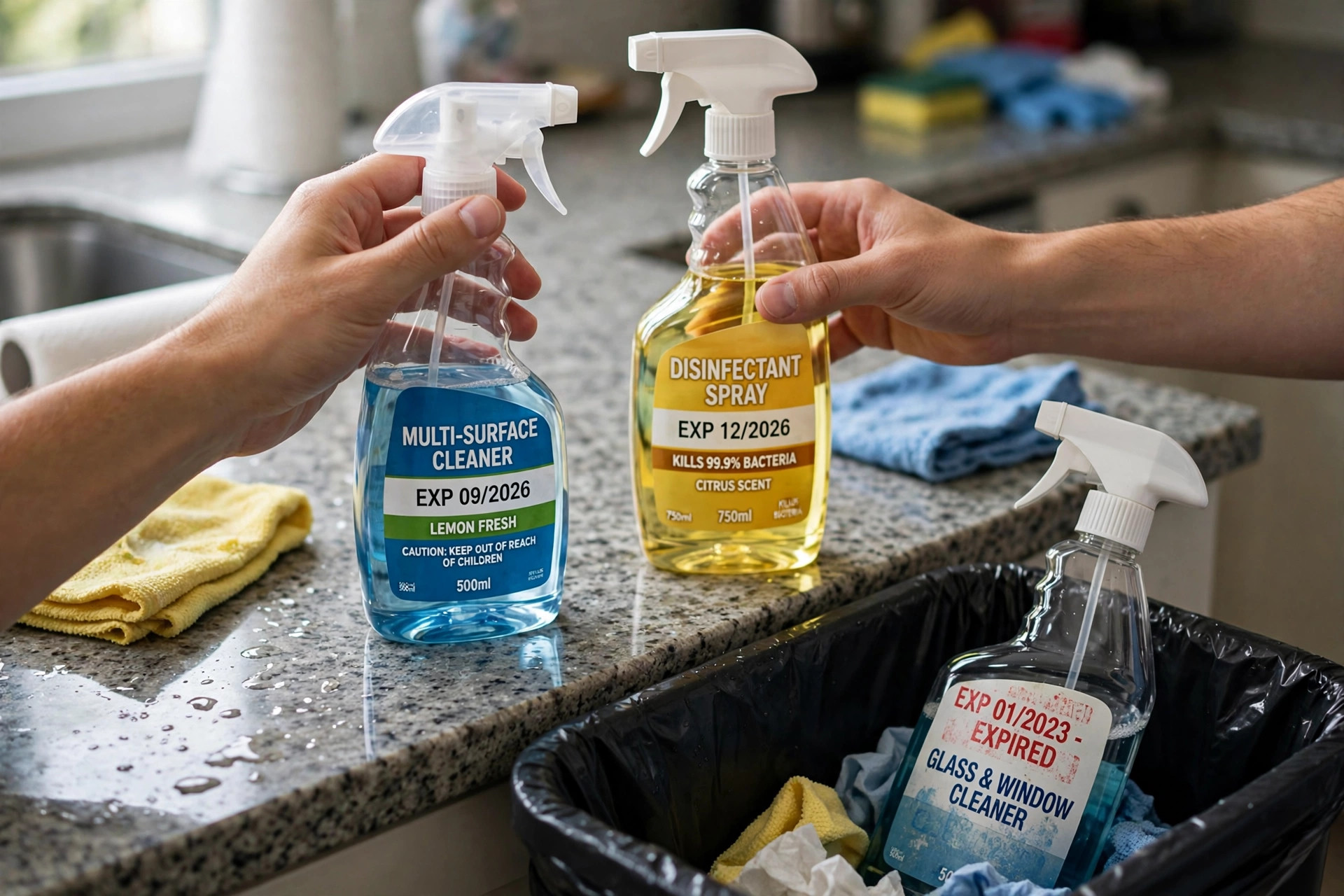
No cleaning cupboard stays tidy without a habit, because the cupboard is only tidy on the day you organize it and the mess creeps back one clean at a time. Do a five-minute reset after cleaning — bottles back in the caddy, cloths back in the bin, caddy back in the cupboard — so the cupboard is tidy before the next clean and starts clean every time. Rinse the cloths, bin the used sponge, and put the tools back, because the reset that takes five minutes is the reset that actually happens. Keep a small bin for the used cloths beside the cupboard, because the cloth that is binned at once is the cloth that never becomes clutter, and the cupboard that is reset after every clean is the cupboard that is tidy on the next clean. The small-space thinking that makes the reset easy gets its full system in 28 Small Apartment Storage Ideas for 2026, where the same five minutes keeps a flat tidy. Five minutes a clean, and the cupboard never needs a big clean.
22. A restock list on the cupboard door
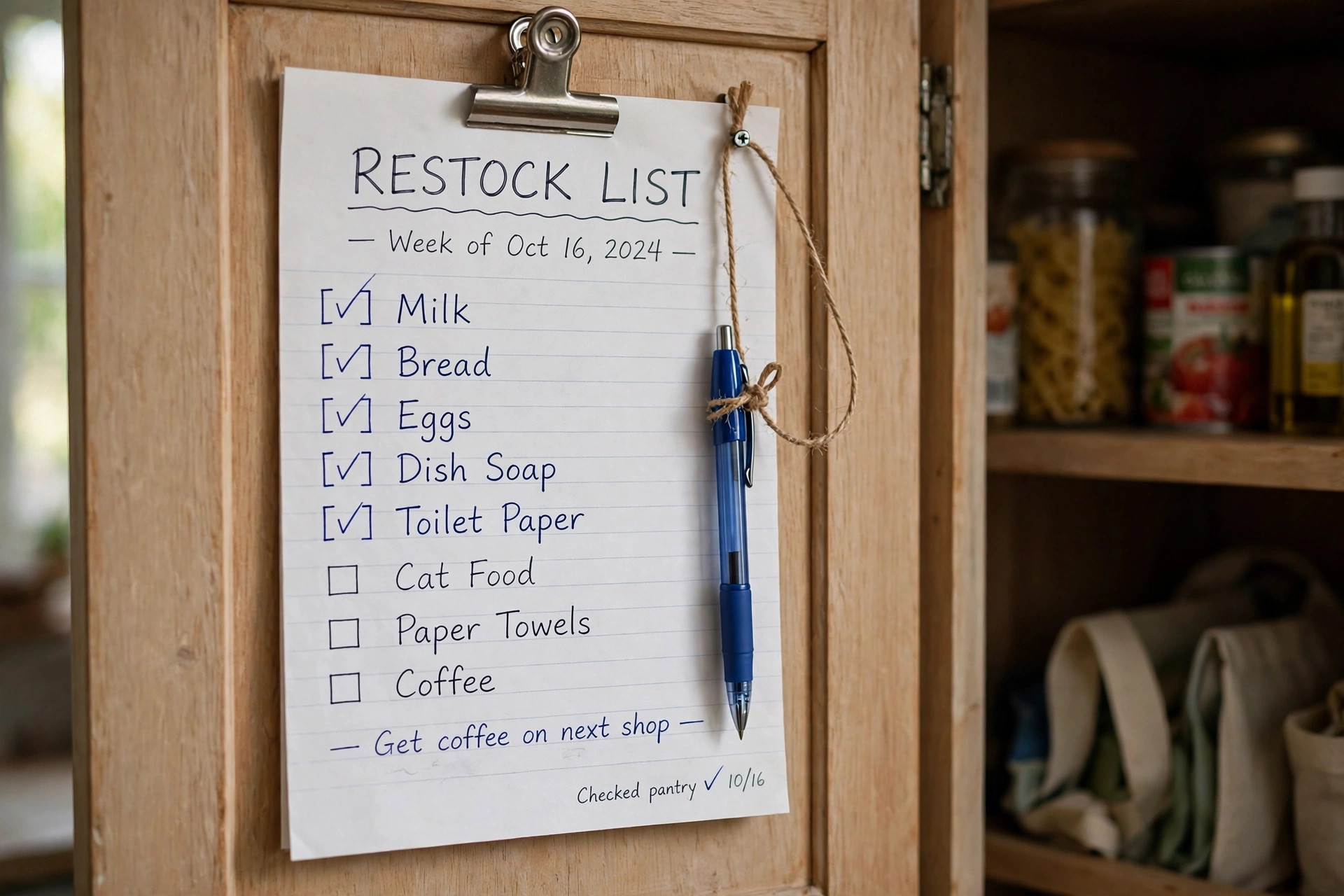
A cleaning cupboard runs out without warning, because the spray runs out mid-clean, the cloths run out mid-week, and the cupboard that holds no list is the cupboard where you discover the empty bottle too late. Keep a restock list on the cupboard door — the list that never lets you run out — so the list hangs inside the door, and every time a bottle runs low you write it on the list instead of trusting your memory. Check the list before every shop, because the list that is checked is the list that gets bought, and cross the items off as they come home, because the list that is crossed off is the list that stays true. Keep a pen on a string beside the list, because the pen that is there is the pen that gets used, and the list that is written is the list that never forgets. One list on the door, and the mid-clean empty bottle is gone.
Which cleaning supply idea fits which situation?
| Situation | Best first move | Budget | Tools needed |
|---|---|---|---|
| Cleaners scattered in three rooms | Give cleaning supplies one home (idea 1) | Free | None |
| Can't find the bathroom cleaner | Sort by room (idea 2) | Free | Labels |
| Carrying bottles one by one | Keep the everyday cleaners in one caddy (idea 3) | Low | Caddy |
| Bought storage that does not fit | Measure under the sink first (idea 5) | Free | Tape measure |
| Bottles buried at the back | An under-sink pull-out caddy (idea 6) | Low | Pull-out caddy |
| Reaching past bottles to find one | A rotating shelf under the sink (idea 7) | Low | Rotating shelf |
| Can't tell the sprays apart | Spray bottles in a row, labels out (idea 9) | Free | None |
| Mops and brooms on the floor | Wall hooks for mops and brooms (idea 12) | Low | Hooks |
| Vacuum in the middle of the room | Vacuum and mop in one tall corner (idea 15) | Free | None |
| Kids can reach the cleaners | A child-safe lock on the cupboard (idea 17) | Low | Cabinet lock |
| Half-empty bottles everywhere | A monthly expiry check (idea 20) | Free | None |
| Cupboard messy again by March | A five-minute reset (idea 21) | Free | None |
You do not need all 22 ideas. You need the three that solve your cleaner mess — usually the one home that stops the scatter, the pull-out caddy that brings the back bottles to you, and the lock that keeps the cupboard safe. Start with the one home, do it this weekend before the next clean, and line the cupboard with a tray. Do that and the next clean will start at the cupboard, the spray will be in the caddy where you left it, and the bottle you want will be the bottle you can reach.
Save this post for the next spring clean, and if the cupboard around the cleaners needs the same treatment, read 25 Utility Closet Organization Ideas for 2026 next — it is Post 20, the closet the cleaning cupboard borrows from — and 22 Laundry Room Storage Ideas for 2026, Post 09, for the detergents that share the shelf. This is the sixteenth post of the new Organization by problem run — Posts 56 to 80, one problem at a time — and the run keeps going with the pet supplies next door. The pet food, toys and leads get their own deep dive in Pet Supply Organization, where the pet station gets the same one-home treatment.
Publish date assigned at publishing time. Updated as new cleaning supply finds are tested.
Frequently asked questions
How do I organize cleaning supplies under the kitchen sink?
Give the cupboard one system: line the bottom with a waterproof tray, then add a pull-out caddy or a lazy Susan rotating shelf so the bottles at the back come to you. Keep the everyday sprays in one caddy at the front, the heavy bottles at the bottom, and the labels facing out so you can read the row from the door. Measure between the pipes before you buy anything, because the caddy that clears the pipes is the caddy that slides in.
How do I store cleaning products safely with kids in the house?
Fit a child-safe lock on the cleaner cupboard, so the cupboard opens only for an adult. Keep the cleaners in one locked cupboard rather than spread across rooms, store the most dangerous products on the highest shelf inside it, and never decant cleaners into food or drink bottles — always use labelled refill bottles made for cleaning products. Tell every adult in the house where the lock is and how it opens, so it never gets left open.
What is the best way to organize cleaning supplies in a small space?
Give them one home — a single under-sink cupboard, even if the whole system is one caddy and a door rack. Stand the everyday sprays in a pull-out caddy, hang the cloths on a door-mounted rack, roll the microfibre cloths into a small bin, and keep the bulk buys somewhere else entirely. Sort by room so the bottle you want is the bottle you can reach, label every bin, and do a five-minute reset after every clean so the small cupboard never overflows.