22 Playroom Organization Ideas for 2026
A playroom only stays usable when a child can find a toy, play with it, and put it back without an adult standing over them. Most playrooms fail the same way, and it is rarely a storage problem — it is a playroom organization problem: the toys are all out at once, the bins are too high or too deep to see into, the small pieces live in three different boxes, the art supplies have spread across the floor, and the room that was tidy at nine in the morning is a carpet of plastic by lunch.
These 22 playroom organization ideas fix that without a bigger room: one corner per kind of play, low shelves a child can actually reach, one bin per toy type with a label a child can read, a tidy-up routine that takes five minutes, and a rule that everything goes back to its own zone, not wherever there is a gap.
Every idea below works in a real home, from a dedicated playroom to a single corner of the living room. If the toy bins themselves are the first mess, start with 35 Clever Toy Storage Ideas for 2026 — it sorts the bins — and this post sorts the room around them. Pick three ideas that fit your worst corner, start by giving every toy one home, and build from there.
Playroom organization starts with zones, not more bins
1. Divide the playroom into zones — building, reading, art, pretend play — one corner each
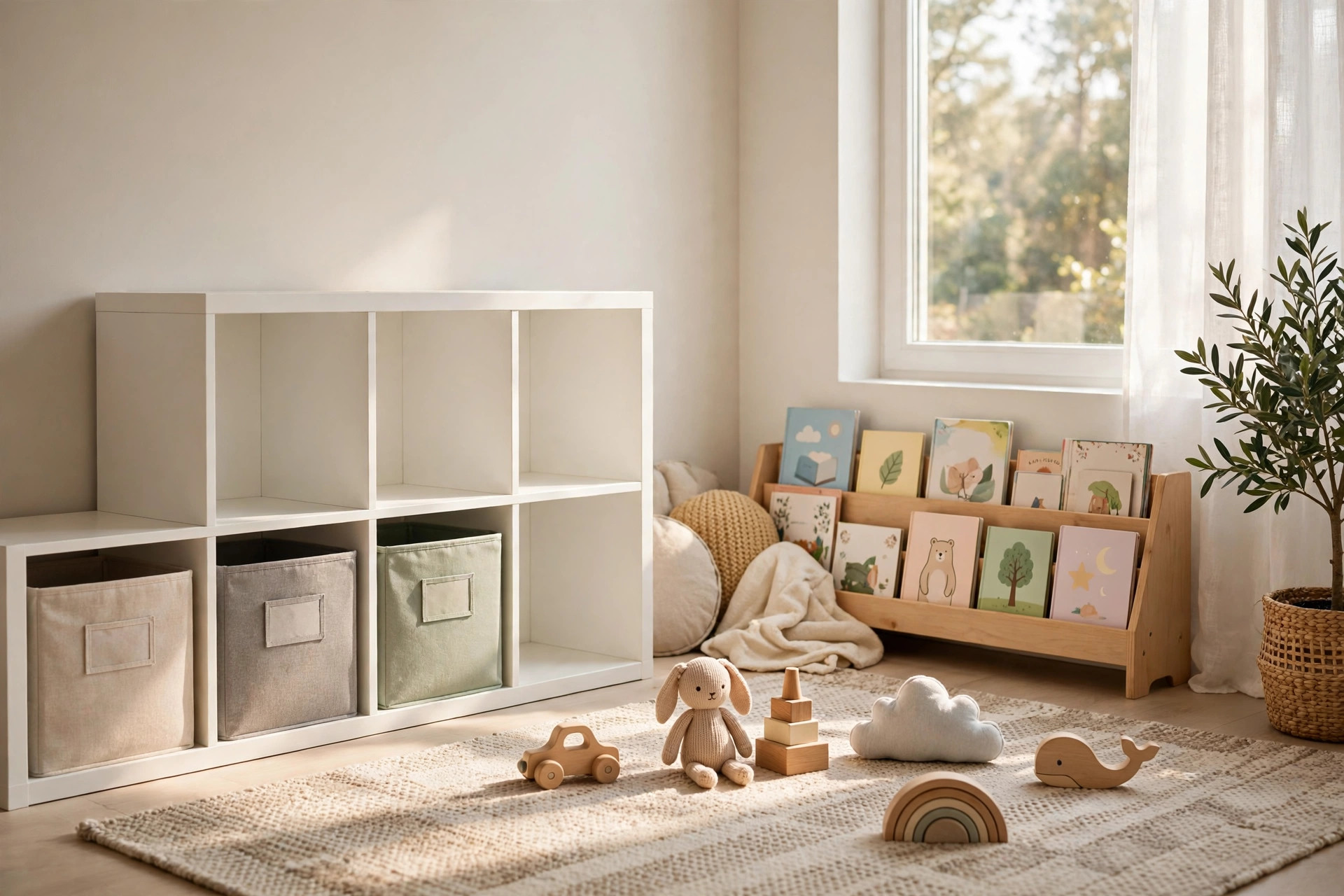
A playroom with no zones is a room where every toy is everywhere, because nothing has a place to belong. Divide it into zones instead: one corner for building, one for reading, one for art, one for pretend play — each corner holding only the toys for that kind of play. Zones also tell you the real shape of the room: if the building corner is always overflowing and the reading corner is always empty, the room is telling you what your children actually play with. Keep one zone per kind of play, give each zone a corner you can point to, and never let a zone hold two kinds of toys at once. One zone per kind of play is enough; if you need a second corner, you need a second kind of play, not a bigger pile.
2. One activity per zone, so tidy-up is carrying a toy back to its corner
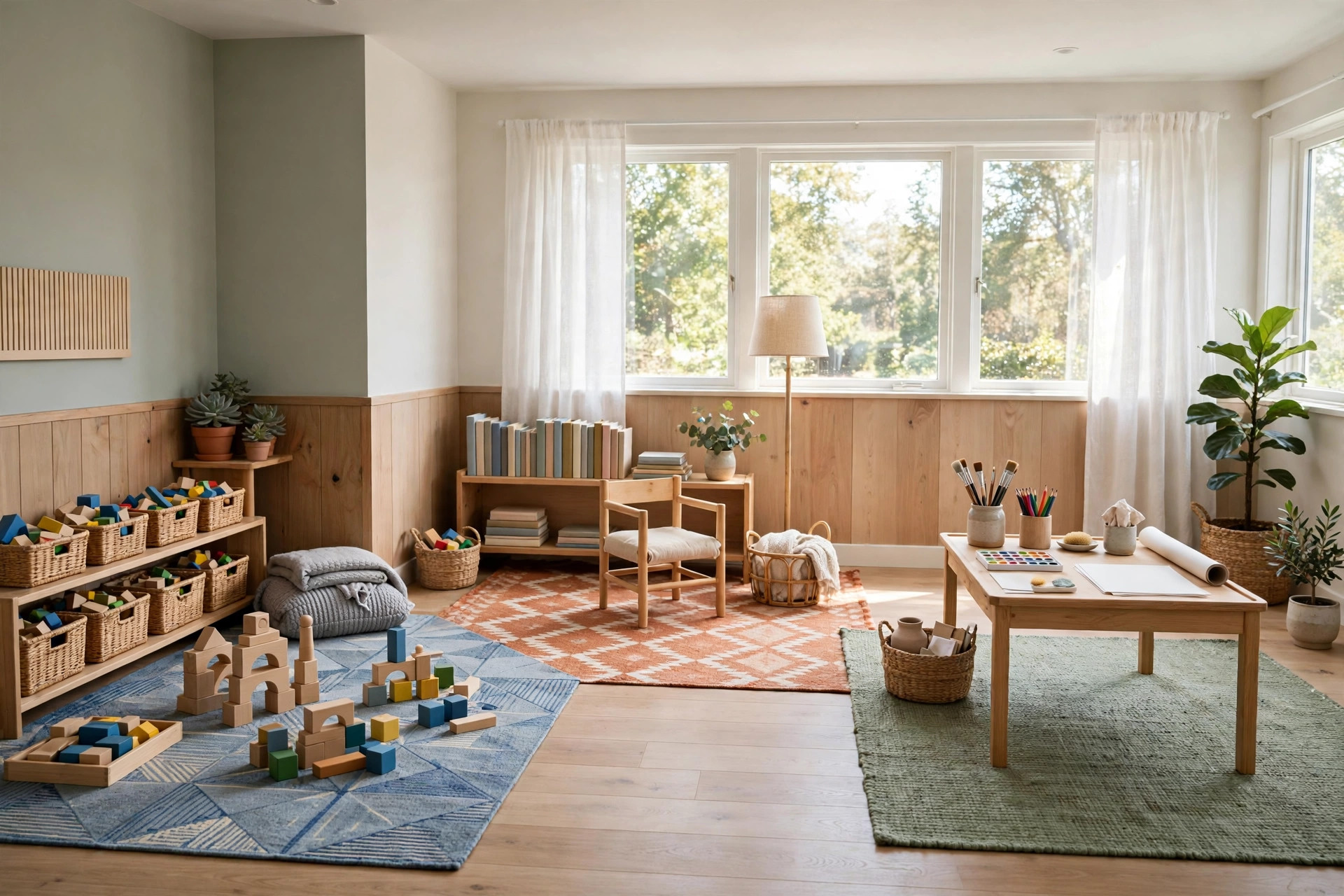
Tidy-up fails when it means sorting a mixed pile, because a child faced with a room of everything does not know where to start. Make it one activity per zone, so tidy-up is never sorting — it is carrying a toy back to its corner. A block goes back to the building corner, a book goes back to the reading corner, a crayon goes back to the art table, and the job is done when every corner holds only its own things. One activity per zone also stops toys migrating, because a toy that lives in two places ends up in neither. Keep one activity per zone, and the tidy-up becomes a walk around the room, not a chore.
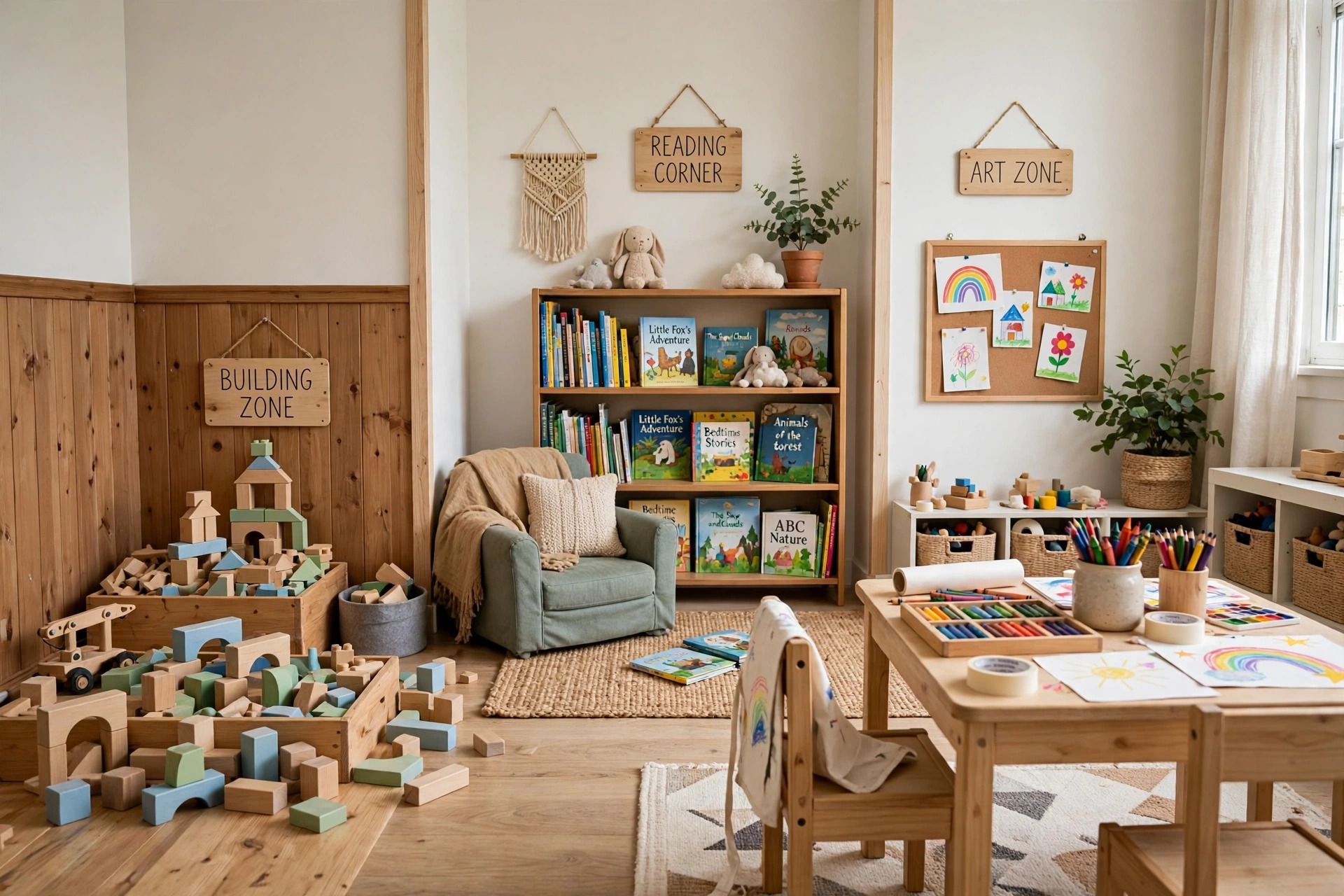
3. A rug per zone, so the boundary is visible even to a three-year-old
A zone that exists only in an adult's head is a zone a child cannot see, and a child who cannot see the boundary cannot keep to it. Give every zone its own rug, so the boundary is visible even to a three-year-old: the blocks stay on the building rug, the books stay on the reading rug, the dressing-up stays on the pretend-play rug. Rugs also stop the play spreading across the whole floor, because the rug says where this kind of play happens and where it stops. Keep one rug per zone, in a colour or pattern the child can name, and never let a rug hold two kinds of play, because that is how zones blur back into one big pile. One rug per zone, and the room explains itself.
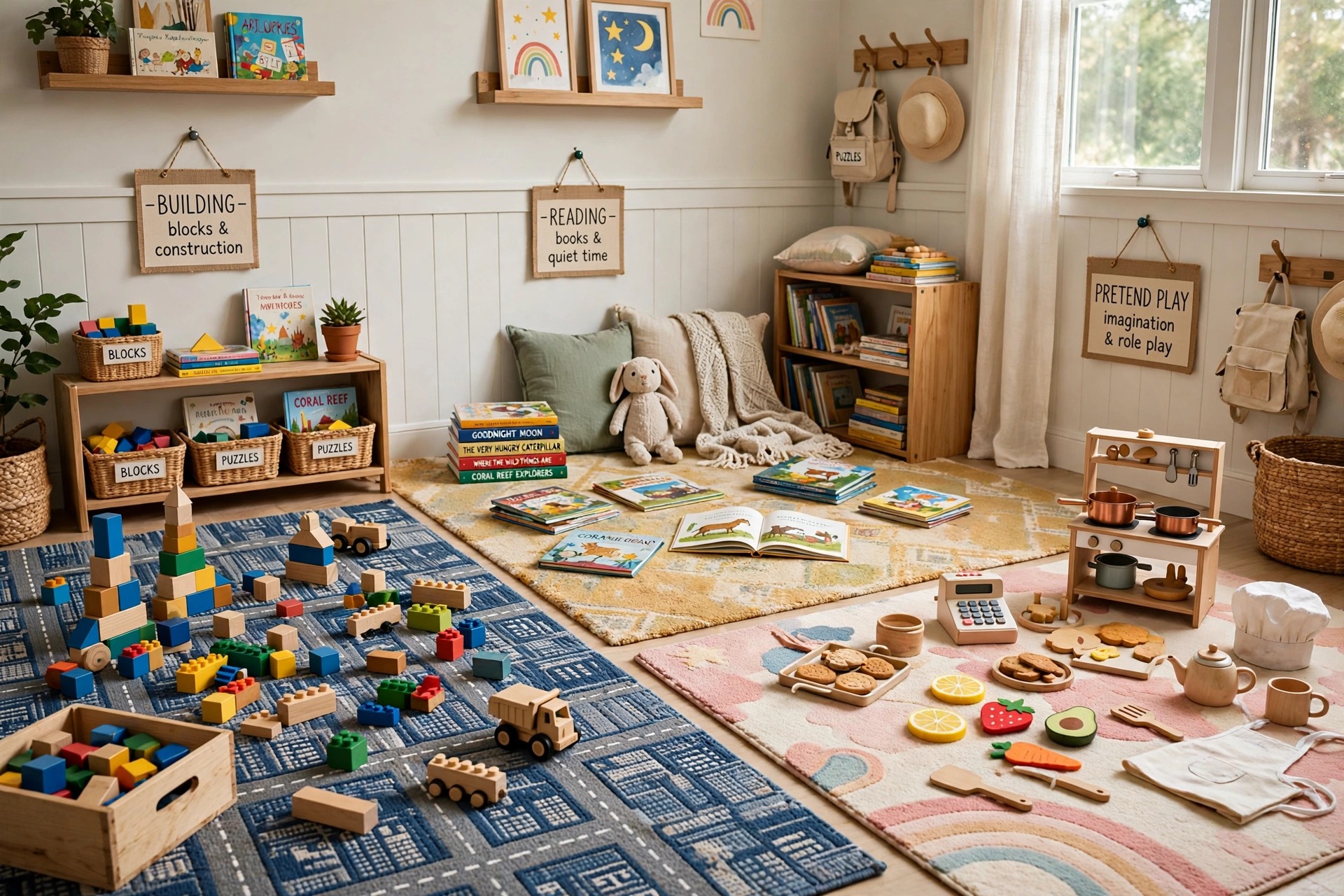
4. Keep the daily toys out and the rest rotated — swap, don't stack
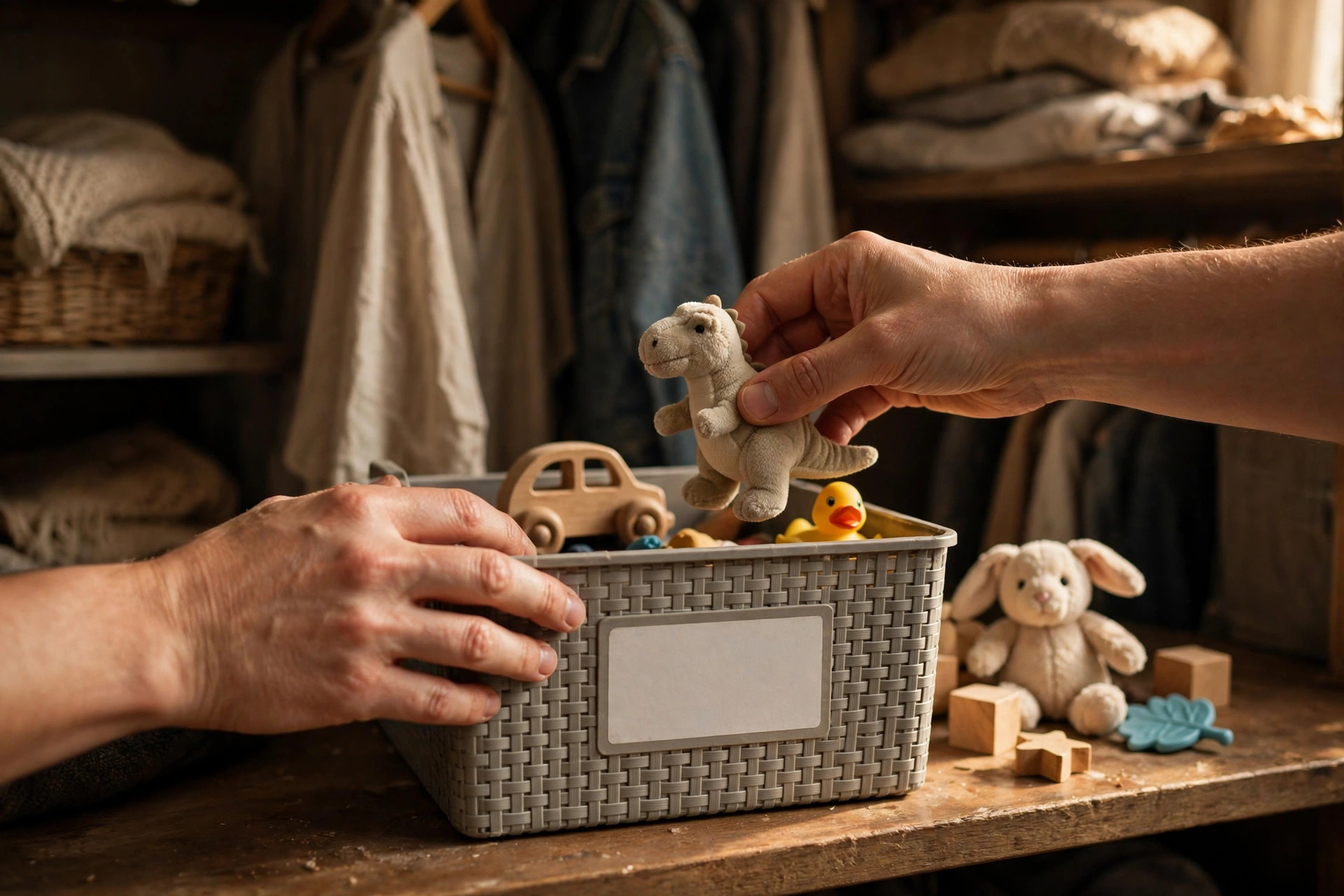
A playroom where every toy is out at once is a room where no toy gets played with, because the choice is too big and the floor is too full. Keep the daily toys out — the favourites, the ones played with every day — and rotate the rest: a few toys out, the rest stored away, swapped every couple of weeks. Rotation also makes old toys feel new again, because a toy that comes back after two weeks away is a toy worth playing with. Keep the daily toys to a small set you can count at a glance, and never stack the rotated toys where a child can see them and ask for all of them at once. Swap, don't stack, and the room stays playable.
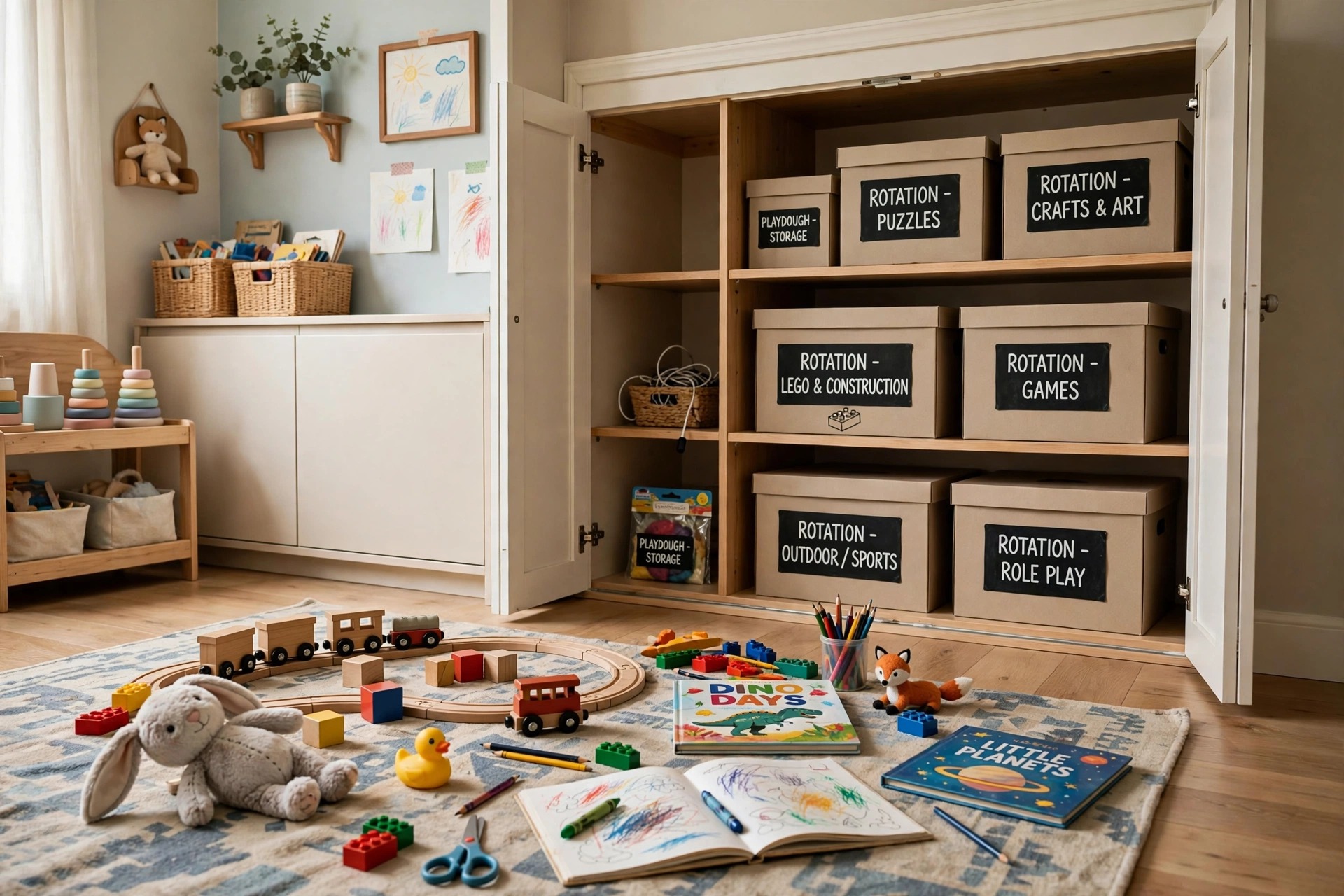
5. A toy rotation box in the closet, swapped every two weeks
Rotation only works if the toys that are away have a home of their own, because a box with no label is a box that gets forgotten. Keep one toy rotation box in the closet — a labelled box, one per zone or one for the whole room — and swap it every two weeks: a few toys out, a few toys in, the box back in the closet. The swap takes ten minutes, once a fortnight, and it stops the slow drift that turns a tidy playroom into a toy shop in a month. Keep the box to toys that are rotated, and put every toy back in it the day it comes out of play, so the swap is always a swap and never a clear-out. One rotation box, swapped every two weeks, and the favourites stay fresh.
Playroom storage children can actually use
6. Low, open cube shelves at child height — every toy visible, nothing to climb for
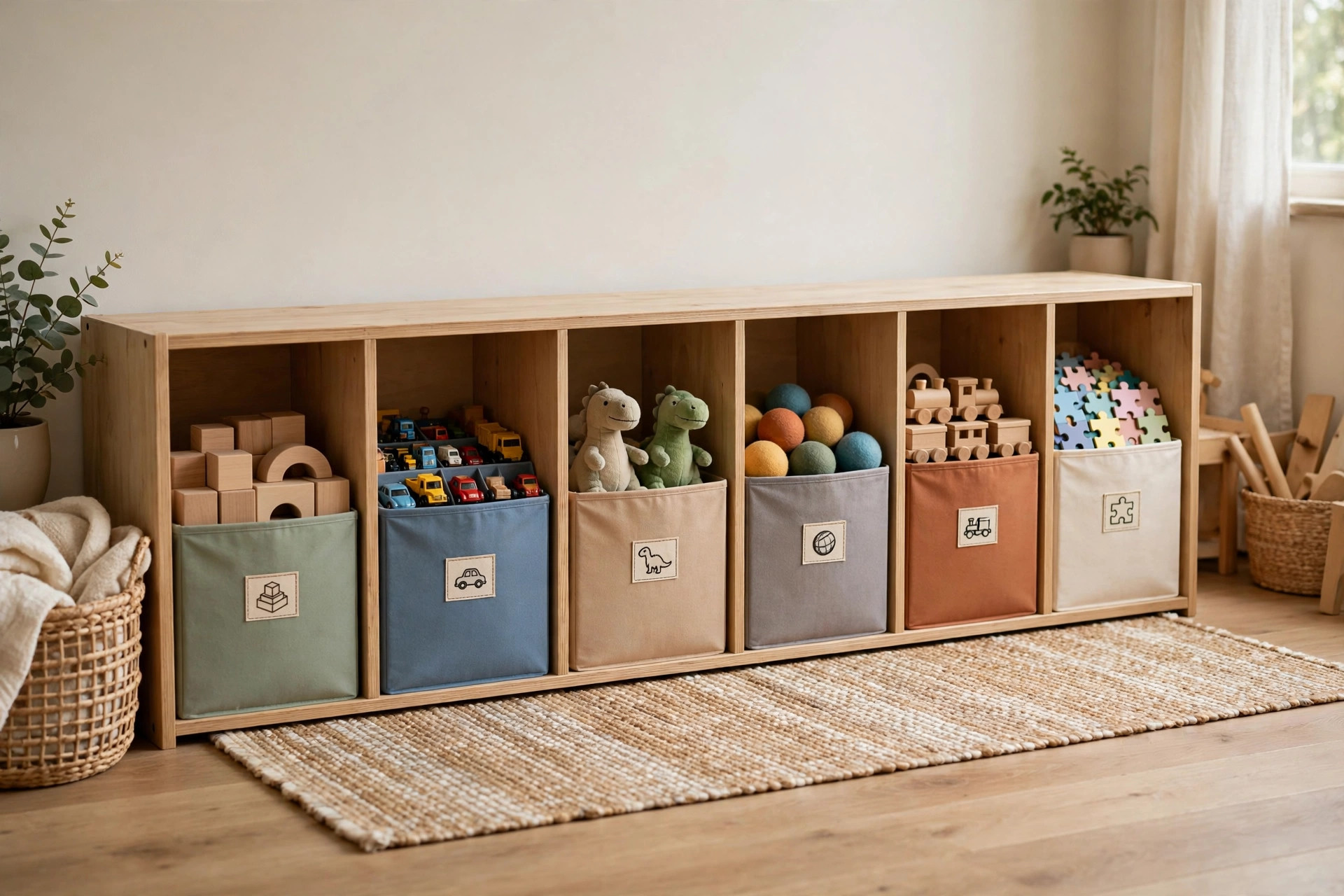
A shelf a child cannot reach is a shelf an adult has to manage, and a shelf an adult manages is a shelf that stays messy. Use low, open cube shelves at child height — every toy visible, nothing to climb for — so a child can see every toy, reach every toy, and put every toy back without help. Open cubes also stop toys hiding at the back of a deep shelf, because the front of the cube is the whole shelf. Keep the shelves low enough that the smallest child can reach the top cube, and never put a toy on a shelf a child cannot reach, because that is how toys get forgotten. One low shelf, every toy visible, and the room works for the child, not just the adult.
7. One bin per toy type, with a photo label a child can read before they can read words
A bin labelled with words is a bin only a reader can use, and a bin only a reader can use is a bin a small child fills with anything. Give every bin a photo label — a picture of the toy type on the front — so a child can read it before they can read words: a photo of blocks on the block bin, a photo of cars on the car bin, a photo of dolls on the doll bin. Photo labels also stop bins drifting into a second toy type, because the picture says what belongs inside. Keep one bin per toy type, label the front with a photo, and never let a bin hold two kinds of toy, because that is how the small pieces get lost. One bin per toy type, photo on the front, and the tidy-up works for the youngest child too.
8. One material, one neutral colour for every visible bin, so the room reads calm
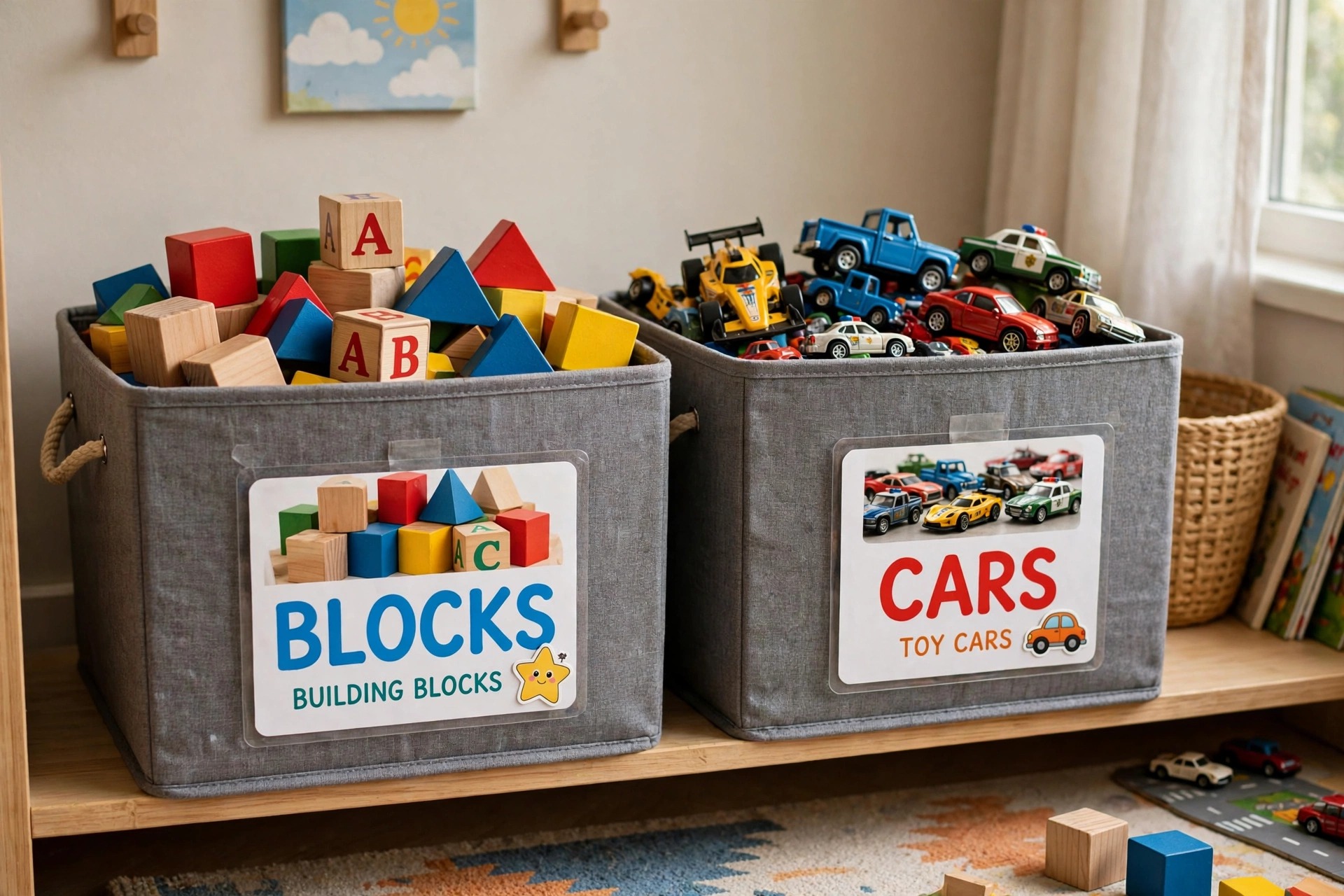
A playroom full of bright, mismatched bins looks busy even when it is tidy, because every colour is shouting at once. Use one material and one neutral colour for every visible bin — the same baskets, the same boxes, the same calm colour — so the room reads calm even when the toys inside are bright. Matching bins also stop the room looking like a toy shop, because the storage disappears and the toys take the stage. Keep the visible bins to one material and one colour, and let the bright colours live inside the bins, not on them. One material, one neutral colour, and a tidy room looks tidy.
9. A tall cabinet with doors for the toys that only come out with an adult
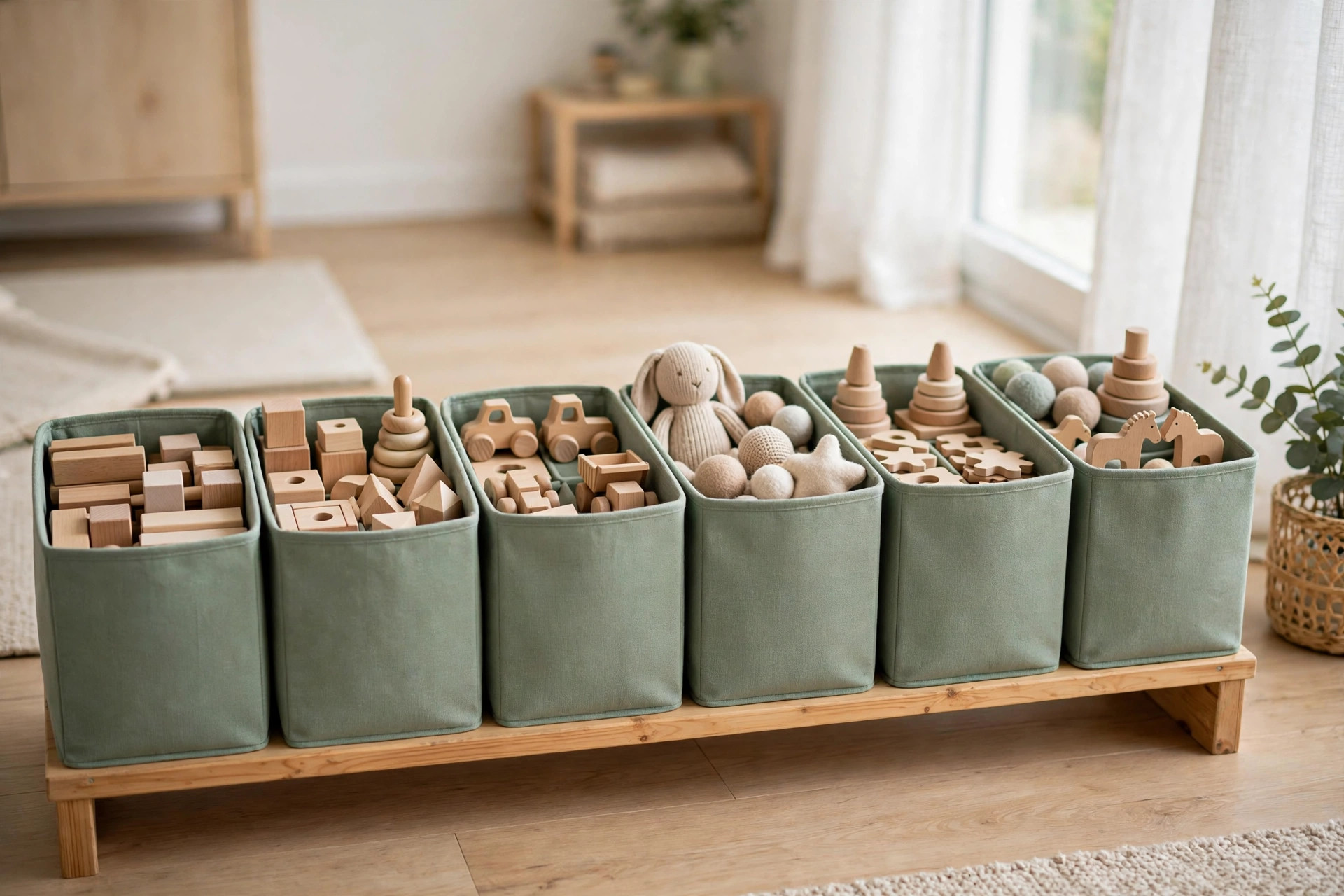
Some toys only come out with an adult — the messy ones, the small-pieced ones, the ones that need supervision — and they need a home that a child cannot open alone. Give them a tall cabinet with doors, in a corner of the playroom, so the adult-only toys live behind closed doors and come out when an adult opens them. A cabinet with doors also stops the small pieces spreading across the floor, because the pieces stay inside until playtime. Keep the cabinet to adult-only toys, and put every piece back inside before the doors close, so the next play session starts complete. One tall cabinet with doors, and the supervised toys stay supervised.
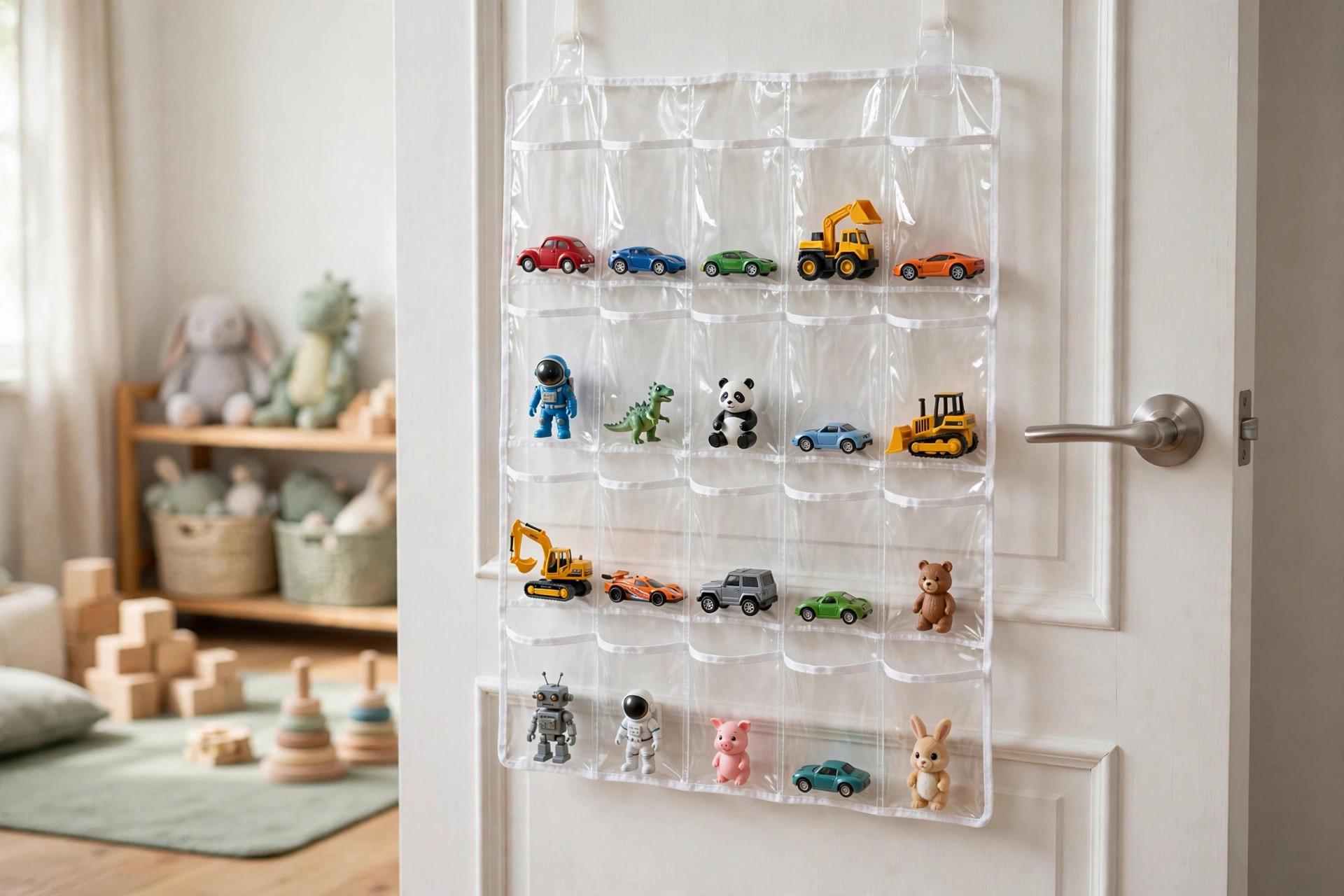
10. Clear shoe-organizer pockets on the door for small toys, cars and figures
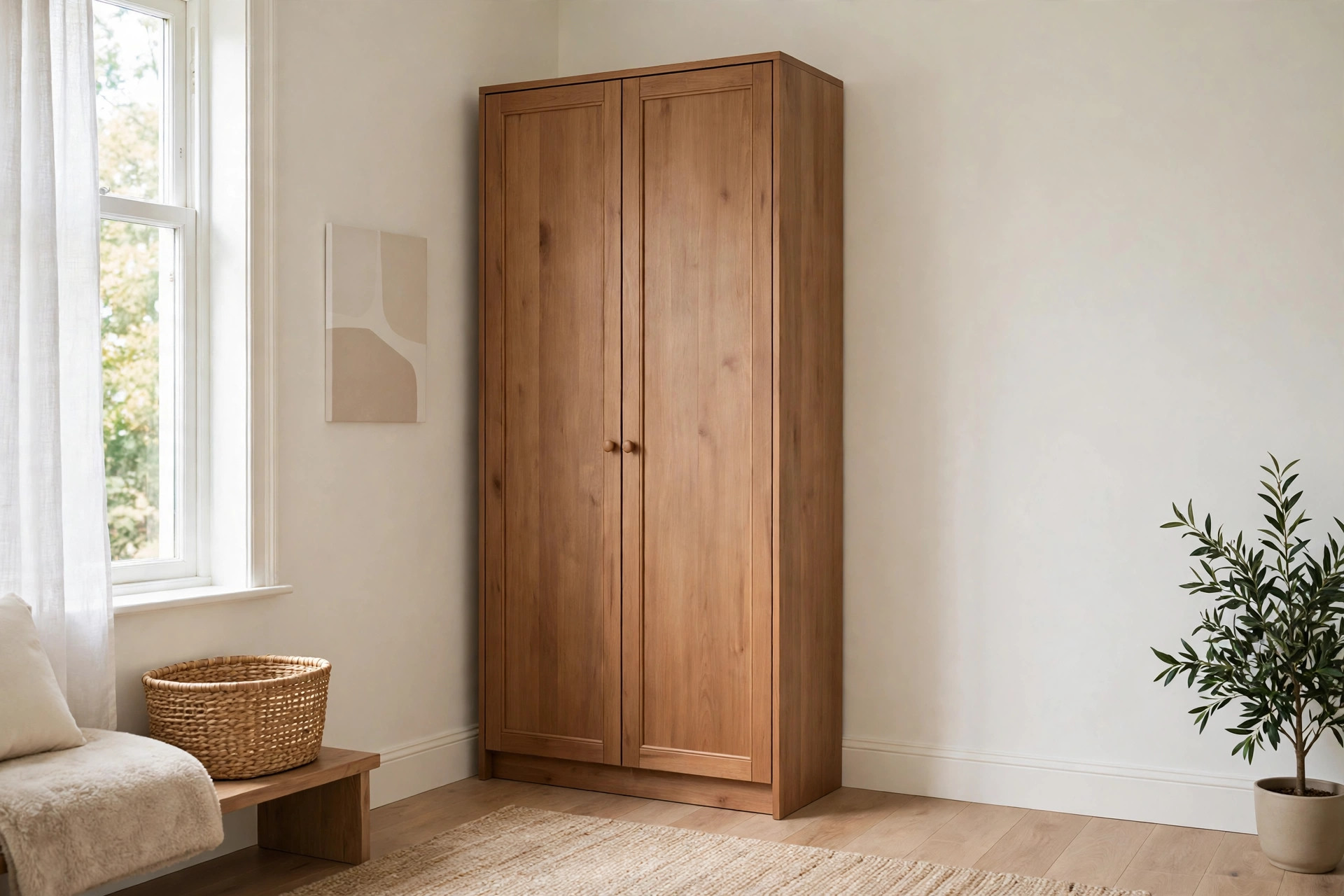
Small toys — cars, figures, tiny animals — are the first things to vanish, because they are too small for a bin and too many for a shelf. Hang a clear shoe organizer on the back of the playroom door, one pocket per kind, so every small toy is visible and none of them falls to the bottom of a box. Clear pockets also stop a small toy hiding behind a big one, because the pocket shows what is inside. Keep one kind of small toy per pocket, and never let a pocket hold two kinds, because that is how cars end up with the dinosaurs and both get lost. One pocket per kind, and the small toys stop disappearing. (Check on Amazon for a clear over-door organizer with sturdy pockets.)
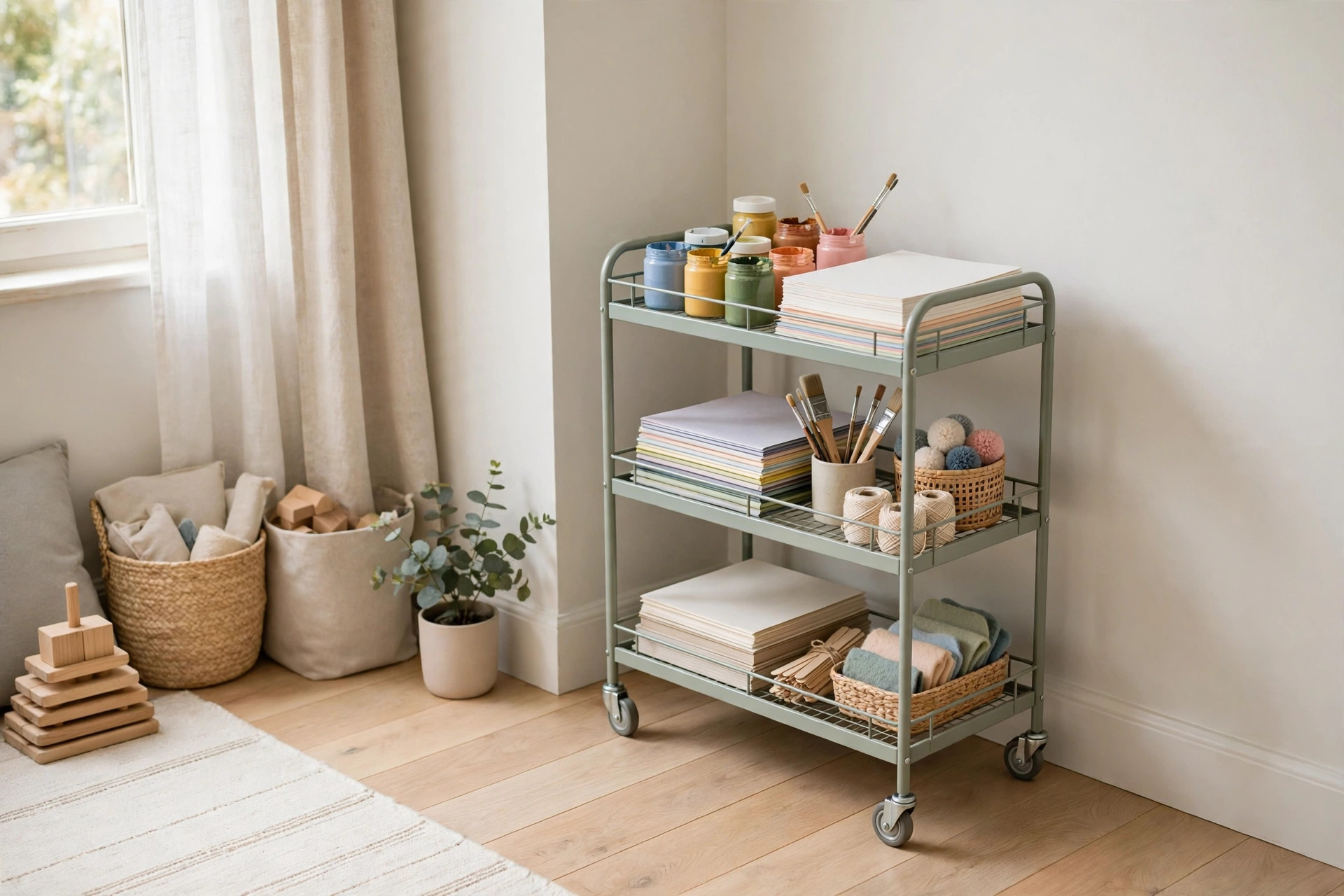
11. A rolling cart that parks away — the playroom's travelling toy box
Some play moves around the house — the art supplies that travel to the kitchen table, the building set that goes to the living room — and it needs storage that moves too. Give it a rolling cart — a small cart with trays or caddies, loaded with the travelling toys — that parks away in a corner of the playroom when it is not in use. The cart also stops travelling toys spreading across the house, because the cart is the toy box on wheels and everything goes back on it. Keep the cart to the travelling toys only, and park it in the same corner every night, so the morning starts with a clear floor. One rolling cart, parked away, and the playroom travels without taking over the house. (Check on Amazon for a small rolling cart with trays that fits your playroom corner.)
Playroom organization for books, art and the messy stuff
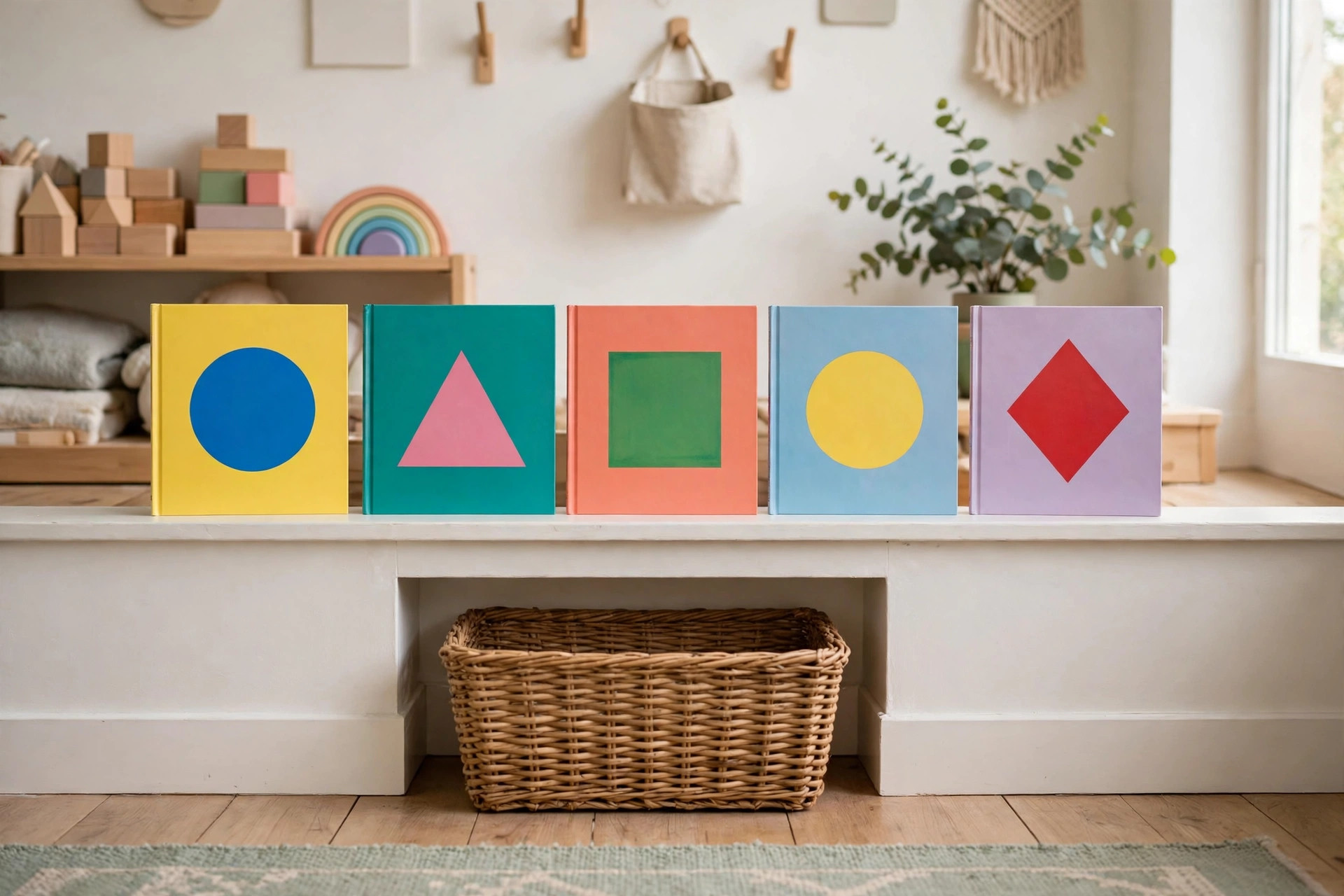
12. Books forward-facing on a low ledge, covers out, one basket per reader
Books spine-out on a high shelf are books nobody chooses, because a child cannot see what the book is. Put books forward-facing on a low ledge — covers out, at child height — with one basket per reader below, so every child can see the covers and pick their own book. Forward-facing books also stop books being pulled off a shelf in a pile, because the child can see the one they want and take only that one. Keep the ledge to current reads only, and swap the books when one is finished, so the ledge never fills with books nobody is reading. One ledge, covers out, one basket per reader, and the books stop living on the floor.
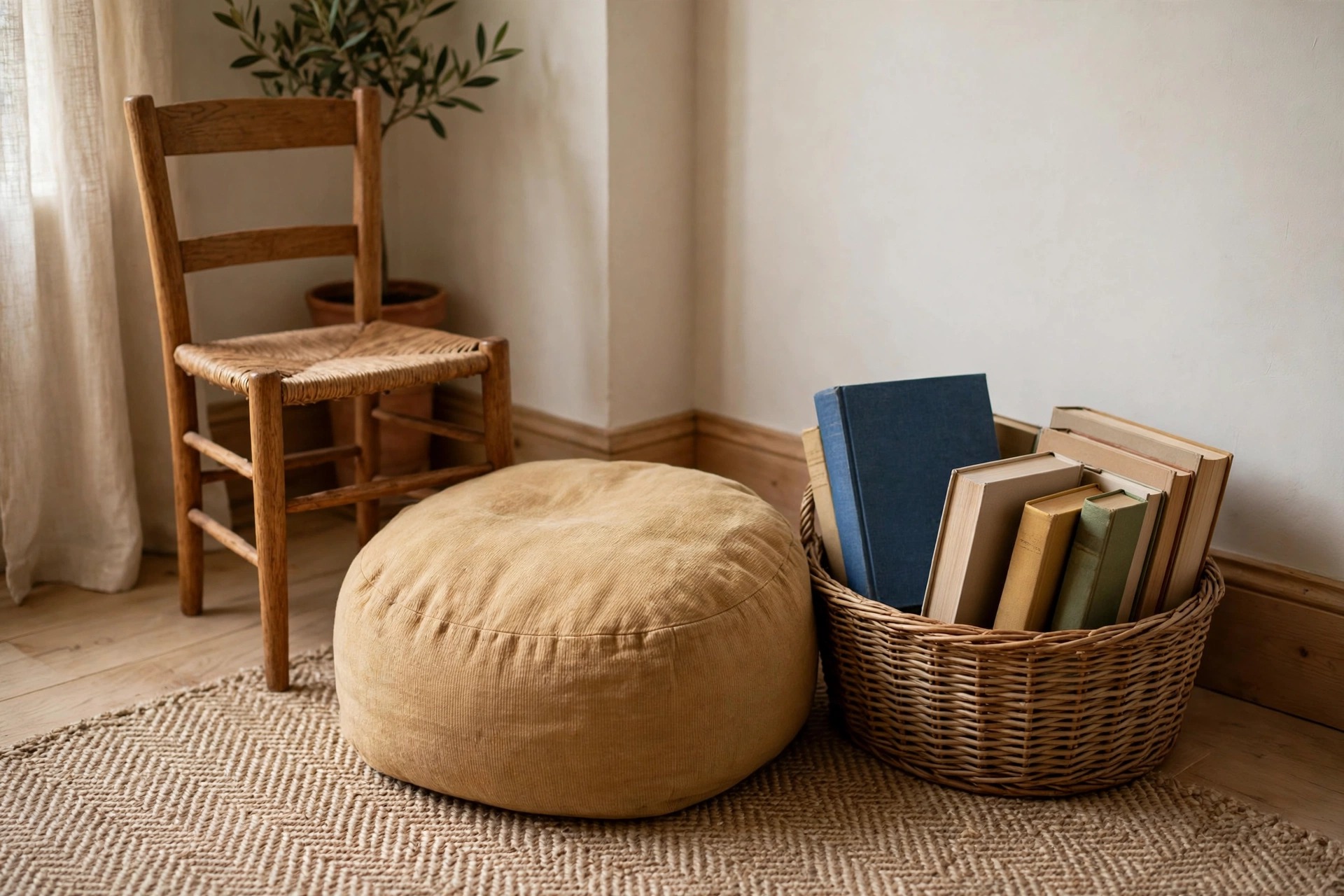
13. A reading corner with a cushion and a basket — books live there, nowhere else
Reading only happens when there is a place to sit and read, and a place to sit only works if the books are there too. Make one reading corner — a cushion, a small chair, a basket of books — and make the rule that books live there, nowhere else: a book read in the building corner goes back to the reading corner when it is finished. The corner also stops books drifting around the house, because the basket says where each book lives. Keep the corner to books and a cushion, and clear it once a week, so it never fills with toys that belong in another zone. One reading corner, books live there, and the reading habit has a home.
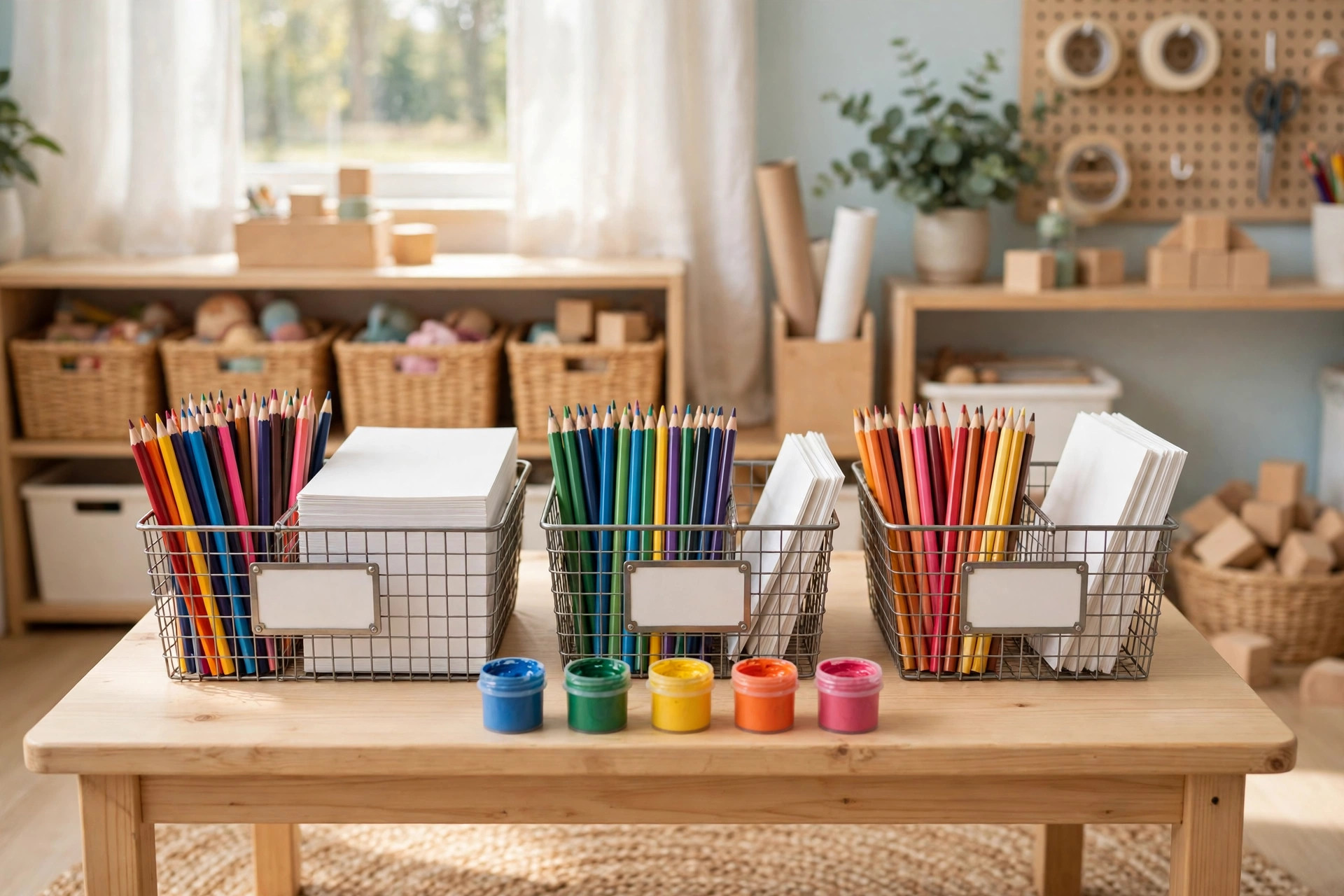
14. An art table with supplies in labelled caddies, paint only at the table
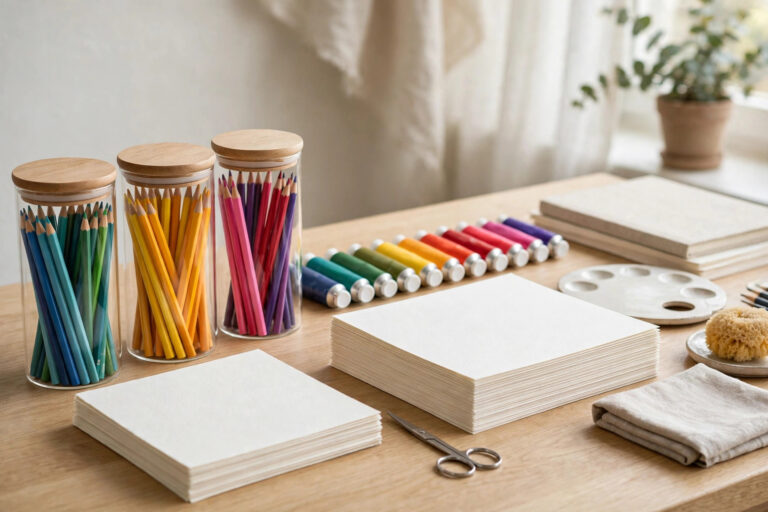
Art supplies that live in three different cupboards are supplies that never get used together, because every art session starts with a hunt. Give art one table — a small table with labelled caddies of pencils, paper, scissors and glue — and make the rule that paint only happens at the table, never on the rug or the bed. Caddies also stop supplies drifting across the room, because the label says where each thing belongs. Keep the table to art only, and put every supply back in its caddy when the session ends, so the next session starts set up instead of starting with a search. One art table, supplies in caddies, paint only at the table, and the mess stays where it belongs.
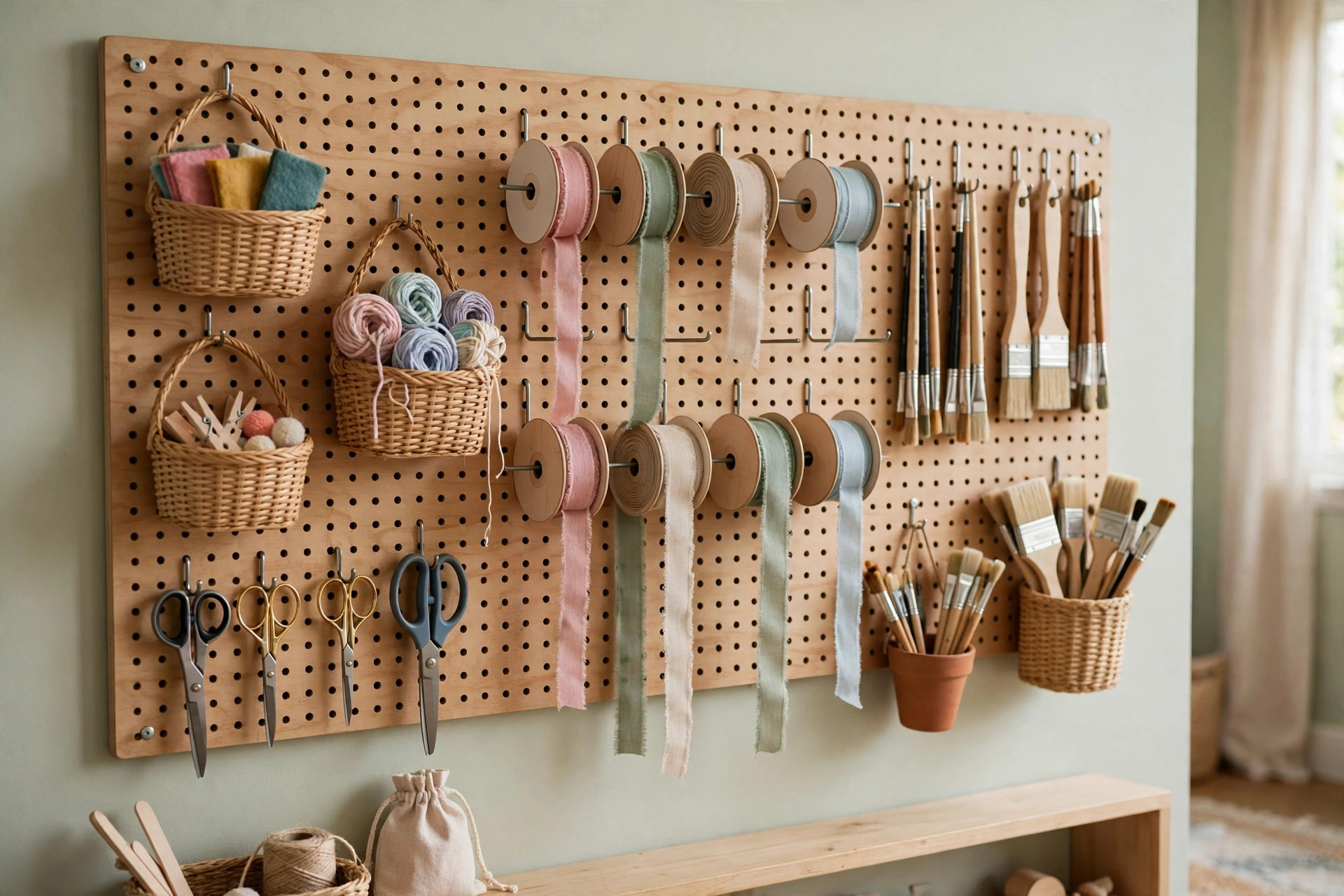
15. A pegboard on the wall for craft supplies, at child height, sharp things on top
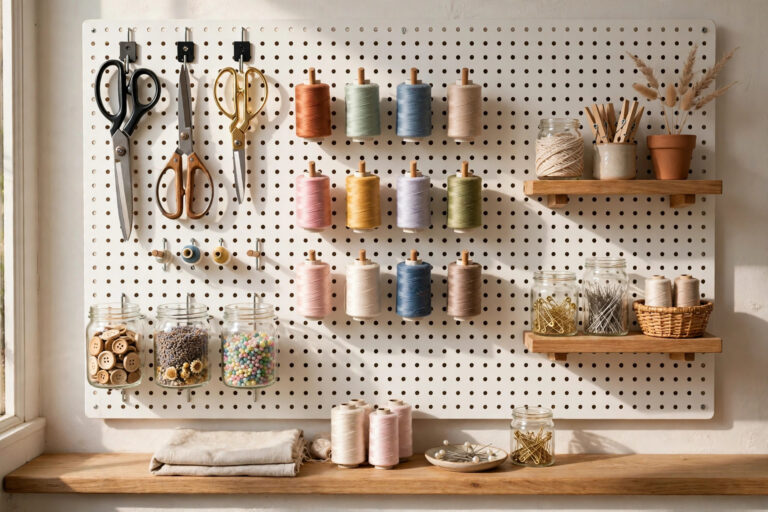
Craft supplies in a drawer are supplies nobody can see, and supplies nobody can see are supplies nobody uses. Hang a pegboard on the playroom wall — hooks and small baskets holding scissors, tape, string, stickers and glue — at child height, so every supply is visible and reachable. Put the sharp things on the top row, out of small hands' reach, and the safe things below, so the board works for every age in the room. A pegboard also stops supplies hiding in a drawer, because the wall shows what is running low at a glance. One pegboard, at child height, sharp things on top, and the craft supplies stop disappearing into drawers. (Check on Amazon for a pegboard with hooks and small baskets sized for a playroom wall.)
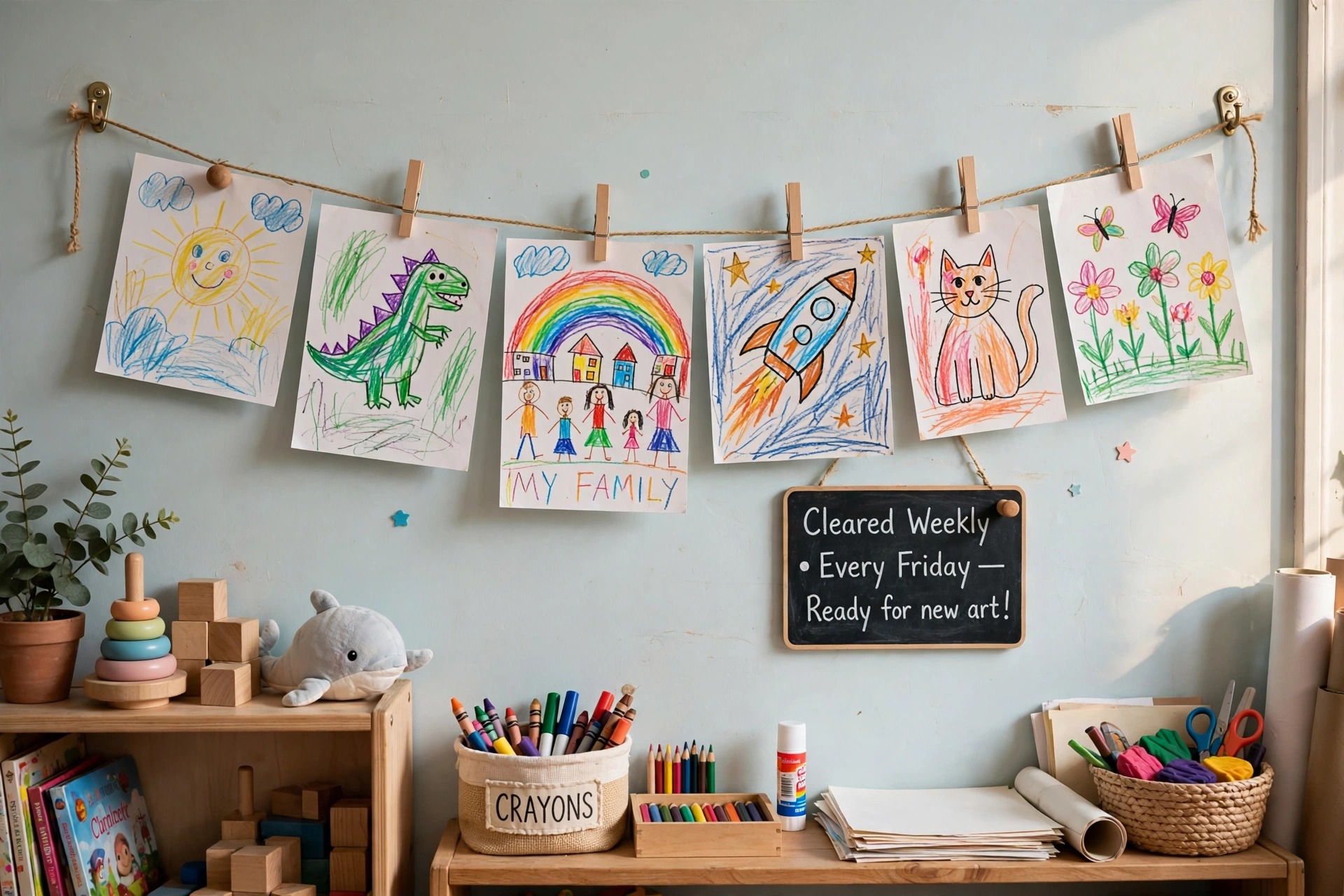
16. A drying line or clip rail for finished art, cleared weekly
Finished art with nowhere to go ends up in a pile on the table, and a pile on the table is a table nobody can use. Hang a drying line or a clip rail on the wall — a line with pegs, or a rail with clips — so every finished piece goes up on display the moment it is done. The rail also stops art being forgotten in a drawer, because the wall shows what the child made this week. Clear it once a week: keep the favourites in a folder, recycle the rest, and the rail is empty for the next week's work. One drying line, cleared weekly, and the art gets seen instead of piled.
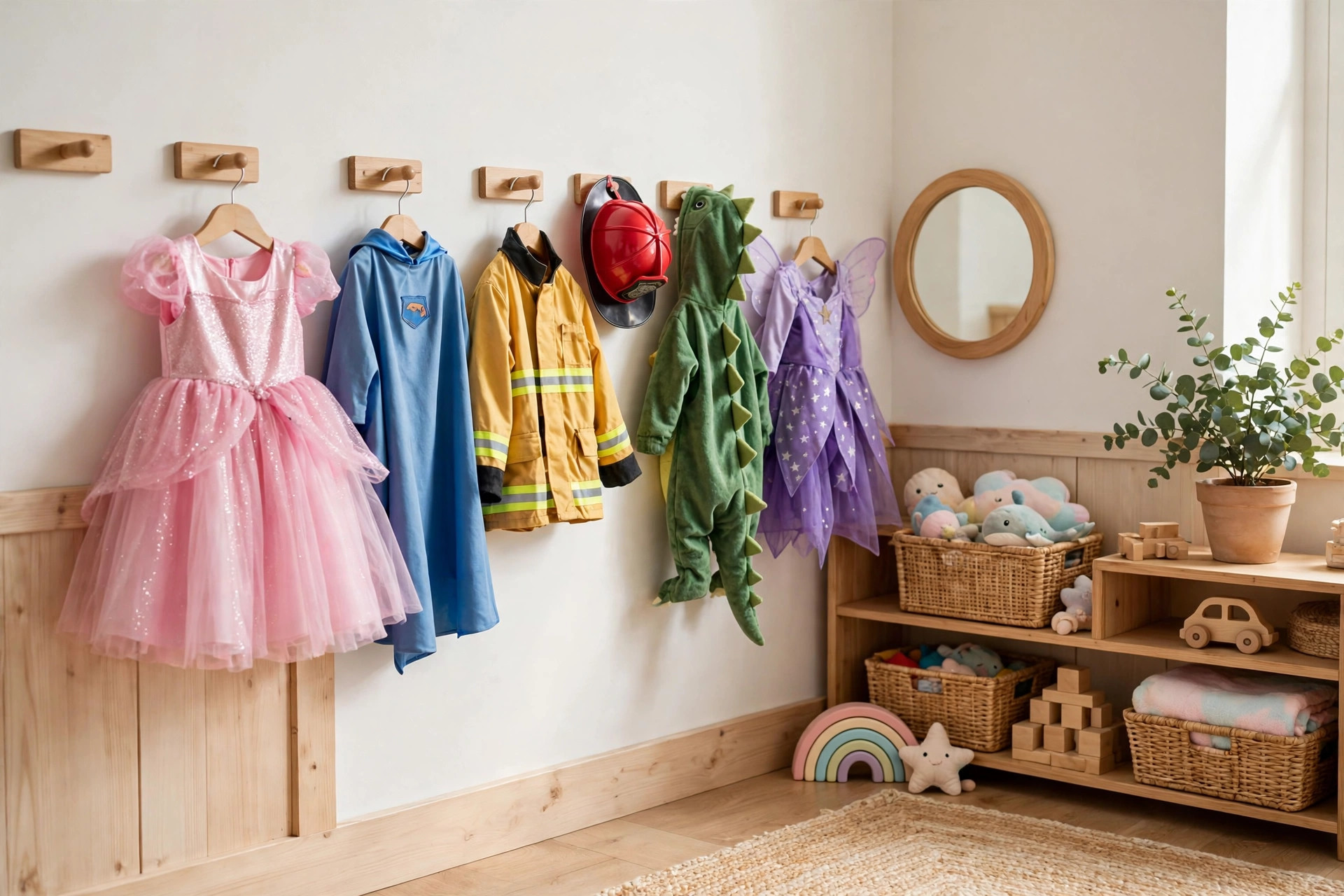
17. Dress-up clothes on low hooks with a mirror beside them, not in a heap
Dress-up clothes in a heap are clothes nobody can find, because the cape you want is always at the bottom. Hang them on low hooks — one hook per outfit, at child height — with a small mirror beside them, so a child can choose an outfit, put it on, and see themselves in it. Hooks also stop dress-up clothes being stepped on, because the clothes hang instead of lying on the floor. Keep the hooks to dress-up only, and put every piece back on its hook when play ends, so the next game starts with a full wardrobe. Low hooks, a mirror beside them, and the dress-up box stops being a heap.
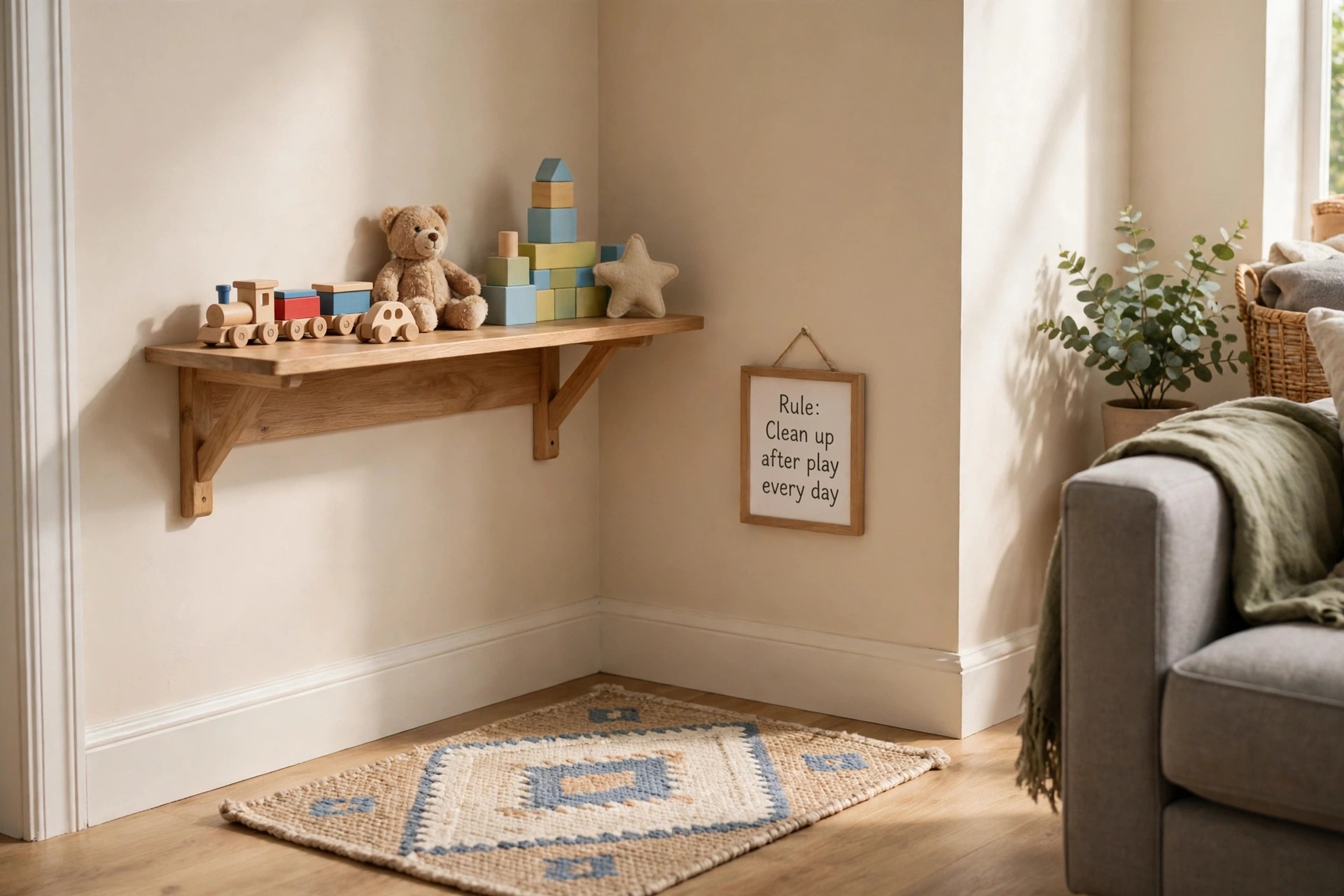
18. A small playroom in a living-room corner — one shelf, one rug, one rule
A playroom does not need a room of its own — it needs one corner with a clear edge. Give it one shelf, one rug and one rule: the shelf holds the daily toys, the rug marks where play happens, and the rule is that every toy goes back on the shelf when play ends. The rug also stops the play spreading across the whole living room, because the rug says where the playroom ends and the living room begins. Keep the shelf to the daily toys only, and rotate the rest from a box in the closet, so one small shelf never has to hold everything. One shelf, one rug, one rule, and a corner of the living room is a playroom.
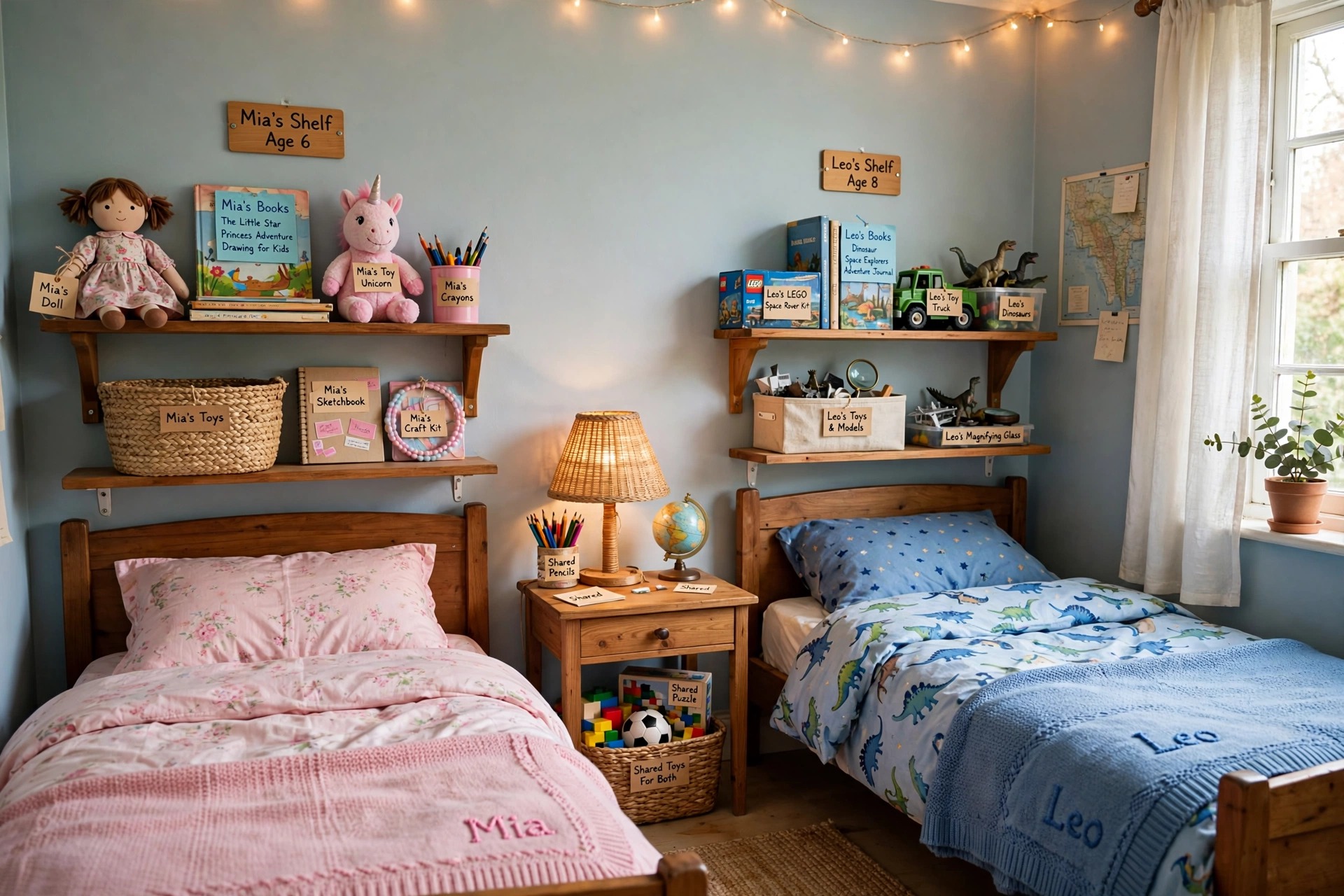
A shared bedroom with shared piles is a bedroom where nobody can find their own toys, because every pile belongs to everyone and therefore to no one. Give every child one labelled shelf of their own — toys, books and games on their shelf, nothing else — so every thing has an owner and every owner knows exactly where to reach. Shelves also stop one child's mess spreading into another's, because the label says where one child's things end and the next child's begin. Keep one shelf per child, label it with their name or a picture, and never let an adult's things take a child's shelf. One labelled shelf per child, and the shared piles stop.
20. Outdoor toys stay by the back door — one weatherproof bin, never past the door
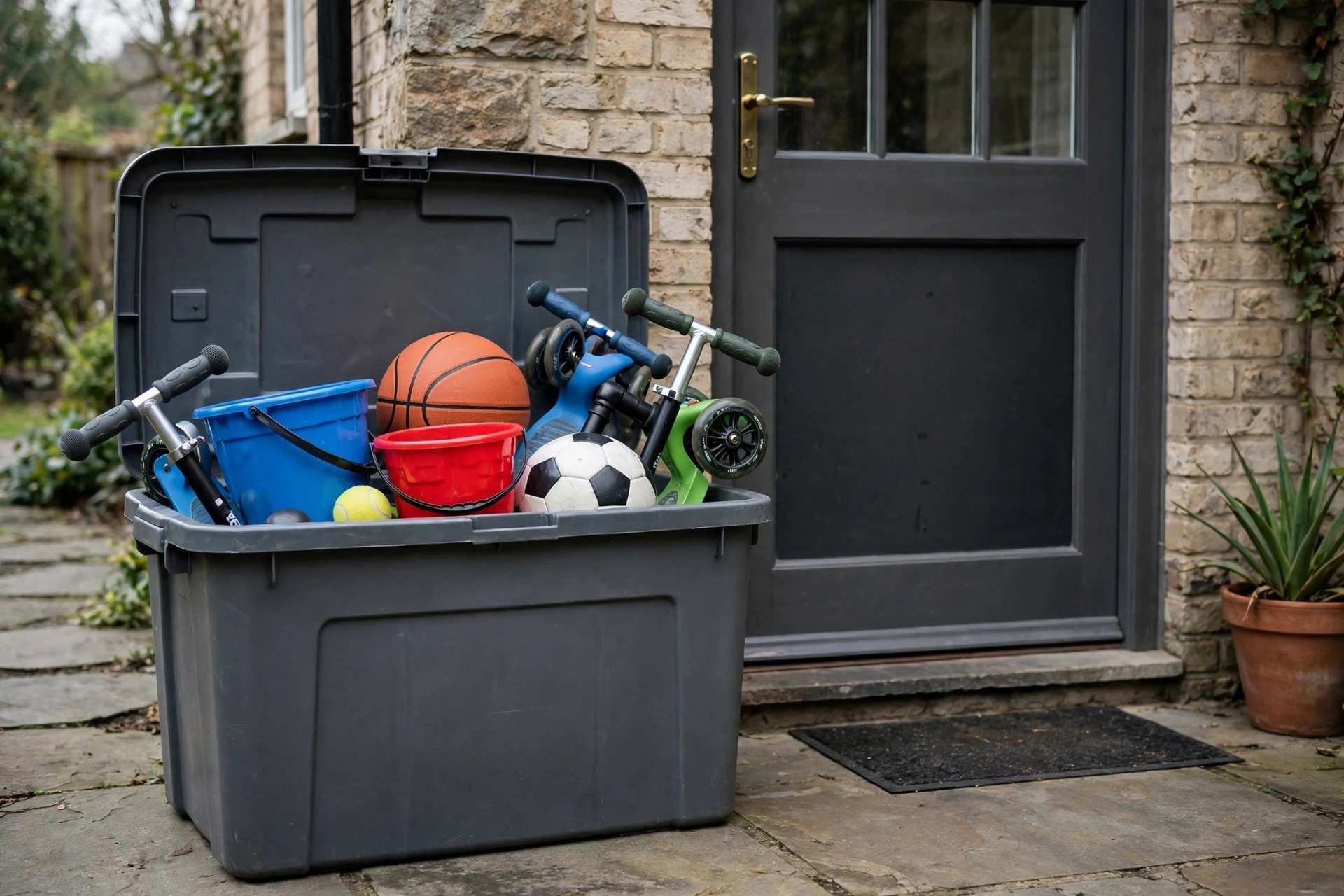
Outdoor toys that come inside are toys that bring mud, sand and water across the floor, and the playroom pays for it. Make the rule: outdoor toys stay by the back door, in one weatherproof bin, and never past the door — the balls, the buckets, the scooters and the water toys live in the bin, and the bin lives by the door. The bin also stops outdoor toys being forgotten outside, because the bin by the door is where they are picked up and put back. Keep the bin to outdoor toys only, and empty it once a week, so it never fills with indoor toys that wandered out. One weatherproof bin, by the back door, and the mud stops coming inside. For the full outdoor setup, 20 Outdoor Toy Storage Ideas for 2026 sorts the bigger outdoor toys — the bikes, the ride-ons and the garden games — in the same system.
21. A five-minute tidy-up song before dinner, every day, not a weekend clear-out
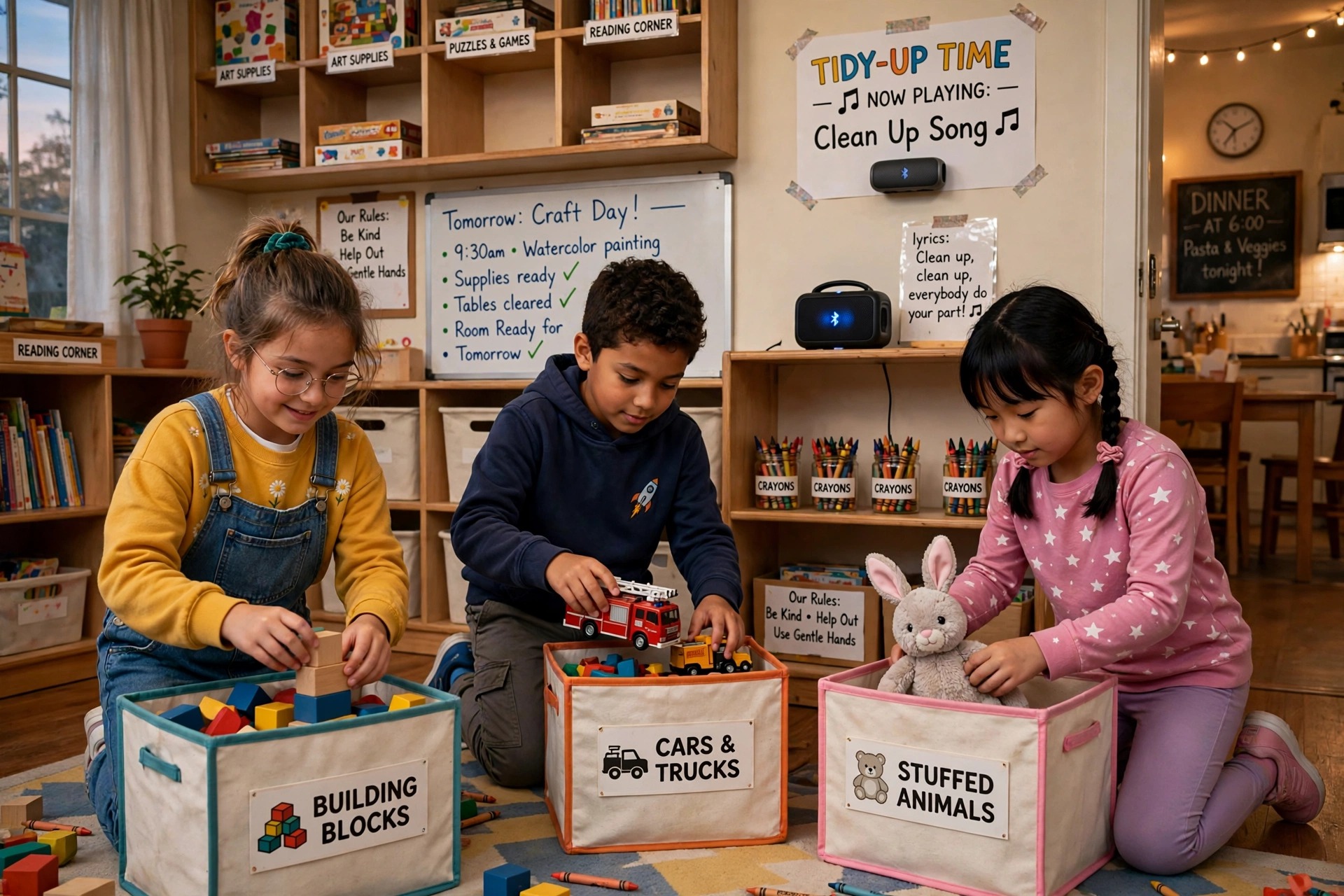
A playroom stays tidy with a small daily habit, not a heroic weekend clear-out. Once a day, before dinner, for five minutes, put on a tidy-up song: every toy goes back to its zone, every book back to the reading corner, every crayon back to its caddy, and the room is ready for tomorrow. The song makes the habit fun, and five minutes is small enough to do every day, so the slow drift that turns a tidy playroom into a messy one in a week never gets started. Keep a small basket by the door for things that belong in another room, and empty it during the song. Five minutes a day, every day, and the playroom never needs a weekend clear-out again.
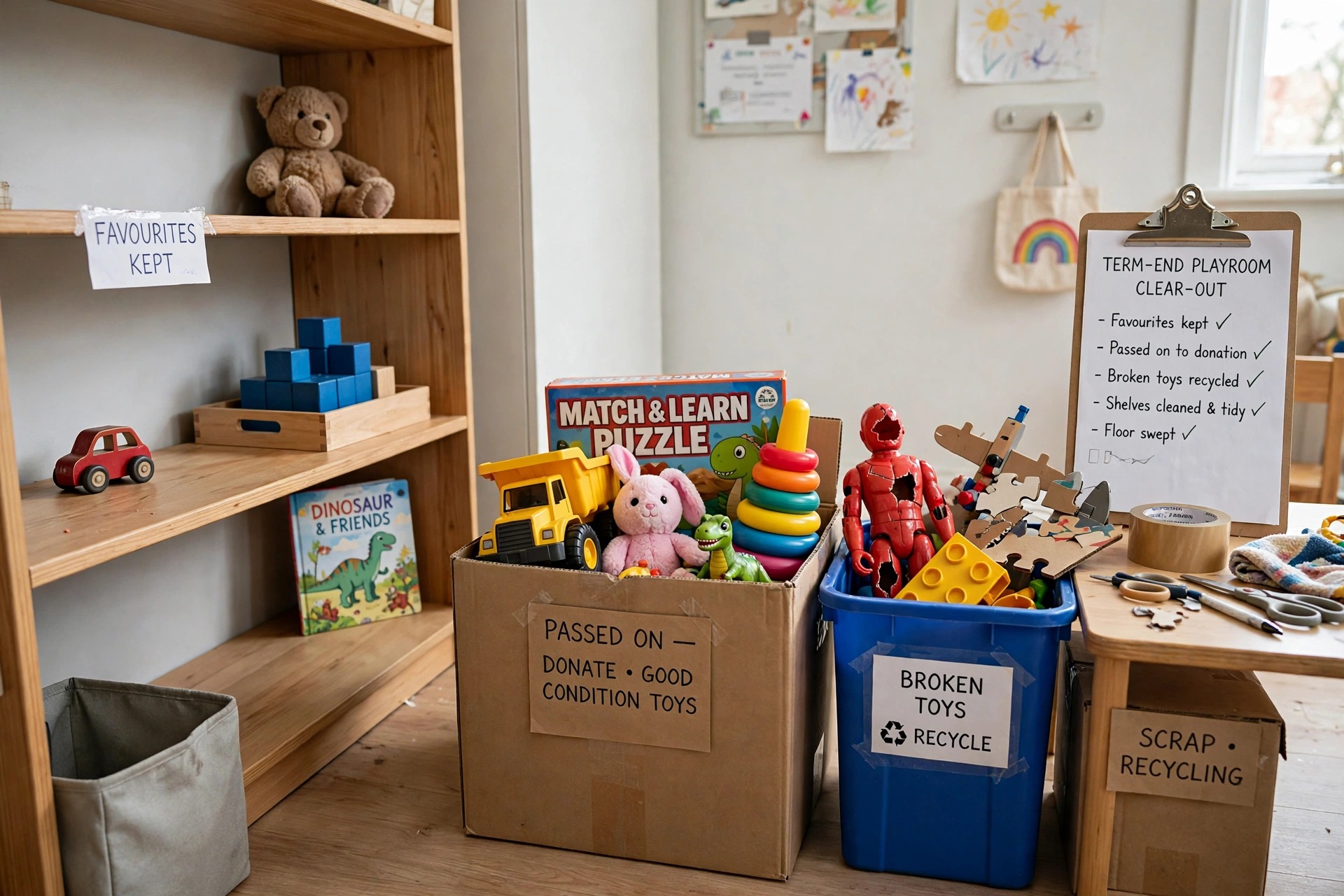
22. A term-end clear-out — keep the favourites, pass on the rest, recycle the broken
A playroom that is never cleared is a playroom nobody can find anything in, because the favourites are buried under a year of outgrown toys. Clear it out at the end of every term: keep the favourites — the toys played with every week — pass on the rest to a younger child or a charity shop, and recycle the broken. The clear-out takes an afternoon, once a term, and it stops the room growing until it bursts. Keeping the favourites also shows the child what they actually love, which is the first step to owning fewer toys. One term-end clear-out, keep the favourites, pass on the rest, recycle the broken, and the playroom stops overflowing.
Which playroom organization fix fits which playroom?
| Playroom / situation | Best first move | Budget | Tools needed |
|---|---|---|---|
| Toys everywhere, no system | Zones + one activity per zone (ideas 1, 2) | Low | Rugs / labels |
| Children can't reach or see their toys | Low cube shelves + photo-labelled bins (ideas 6, 7) | Low | Cube shelves / bins |
| Art and craft supplies spread everywhere | Art table + pegboard (ideas 14, 15) | Low | Caddies / pegboard |
| Books all over the floor | Forward-facing ledge + reading corner (ideas 12, 13) | Low | Ledge / baskets |
| Small playroom or shared room | One shelf, one rug, one rule + labelled shelf per child (ideas 18, 19) | Low | Shelf / rug / labels |
| Tidy-up never sticks | Five-minute tidy-up song + term-end clear-out (ideas 21, 22) | Low | None |
You do not need all 22 ideas. You need the three that solve your biggest mess — usually the toys with no zone, the bins no child can reach, and the tidy-up with no routine. Start with one corner per kind of play, give every toy one home, and make the rule that everything goes back to its zone before dinner, every day. Do that tonight and the playroom will feel different by tomorrow morning.
Save this post for your next toy rotation, and if you are finishing the toy storage too, read 35 Clever Toy Storage Ideas for 2026 next — it is Post 05, the toy bins' home in the Storage by room cluster — and 20 Outdoor Toy Storage Ideas for 2026, Post 06, to carry the same system out to the back door. Later in this cluster, 22 School Organization Ideas for 2026 (Post 12), 20 Art Supply Organization Ideas for 2026 (Post 16) and 25 Utility Closet Organization Ideas for 2026 (Post 20) carry the same system into the school things, the art supplies and the spares cupboard.
Frequently asked questions
How do I organize a playroom so it actually stays tidy?
Start with zones, not more bins. Give every kind of play its own corner — building, reading, art, pretend play — with a rug marking each one, low shelves a child can reach, and one photo-labelled bin per toy type. Then add the habit that holds it together: a five-minute tidy-up song before dinner every day, so toys go back to their own zone daily instead of waiting for a weekend clear-out.
How do I label toy bins for children who can't read yet?
Use photo labels, not words. Put a picture of the toy type on the front of each bin — blocks on the block bin, cars on the car bin — so a child can match the toy to its picture before they can read a single word. One bin per toy type keeps the matching simple, and the same photo label on the shelf tells the child exactly where the bin goes back.
One shelf, one rug and one rule. The shelf holds only the daily toys, the rug marks where play happens, and the rule is that every toy goes back on the shelf when play ends. In a shared bedroom, give every child one labelled shelf of their own and no shared piles, and rotate the rest of the toys from a box in the closet every two weeks so one small shelf never has to hold everything.