22 Photo Organization Ideas for 2026
Photo organization is the project everyone means to do and nobody finishes, because the photos live in four places at once — a shoebox in the closet, an album on the shelf, a drawer of loose prints, and a phone with ten thousand pictures nobody has looked at twice. Every print in those boxes is a memory somebody wanted to keep, and the boxes are the reason nobody can find any of them. The photos are not the problem — the problem is that the photos have no system, so every print drifts to wherever there was a gap, and the gap is never the album.
These 22 photo organization ideas turn the boxes into browsable memories: one pile sorted by decade, prints stored in acid-free boxes that protect them for decades, the keepers scanned and backed up twice, and the best of them out on the wall and in albums people actually open — so the photo you want is the photo you can find in under a minute.
Every idea below works in a real home, from a flat where the whole archive fits in two boxes to a house clearing a parent's lifetime of prints. The paper the photos share a drawer with gets its own system in 20 Paperwork Organization Ideas for 2026, where the same sort-and-label logic files the bills and certificates — and the craft supplies for the scrapbooks get their full treatment in 26 Craft Storage Ideas for 2026. Pick three ideas that fit your pile, start with the one pile, and build from there.
Sort the pile first
1. Gather every photo into one pile before you sort anything
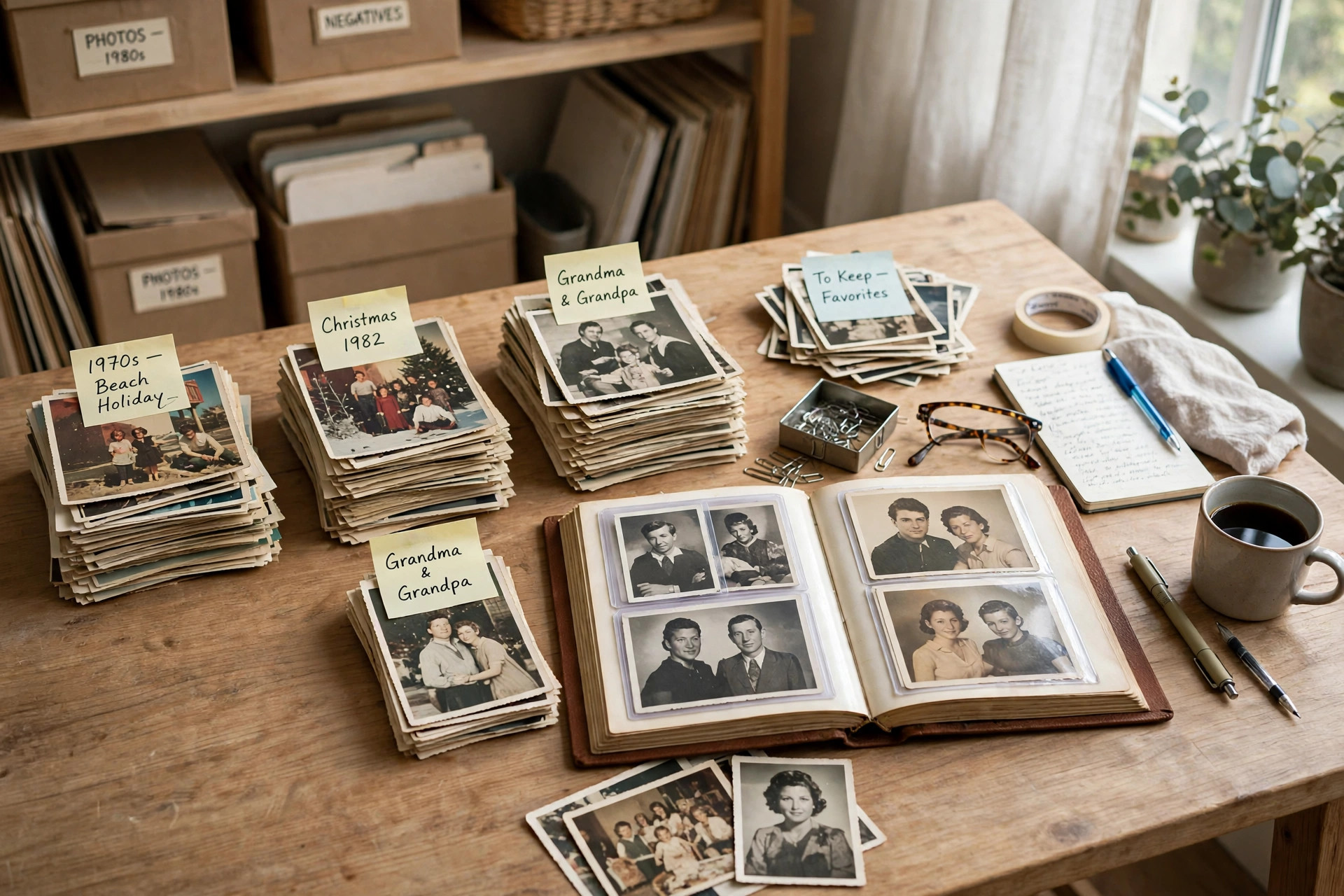
You cannot sort photos you cannot see, because the prints are in the closet, the albums are on the shelf, the loose ones are in the drawer, and the phone holds ten thousand more — and every sort that starts with only one box ends with the same mess in a tidier box. Gather every photo into one pile before you sort anything — the pile that shows you what you actually own — so the whole archive is on one table and the sorting starts from the truth. Empty every hiding place onto the table: the shoebox in the closet, the drawer of loose prints, the albums, the envelope from the chemist that was never opened. Seeing the whole pile at once is what shows you how much there is, and the pile that is gathered is the pile that can be sorted. Clear a big table, put a bin beside it for the ones that leave, and do not buy a single box until the pile is gathered. One pile, and the sorting can start.
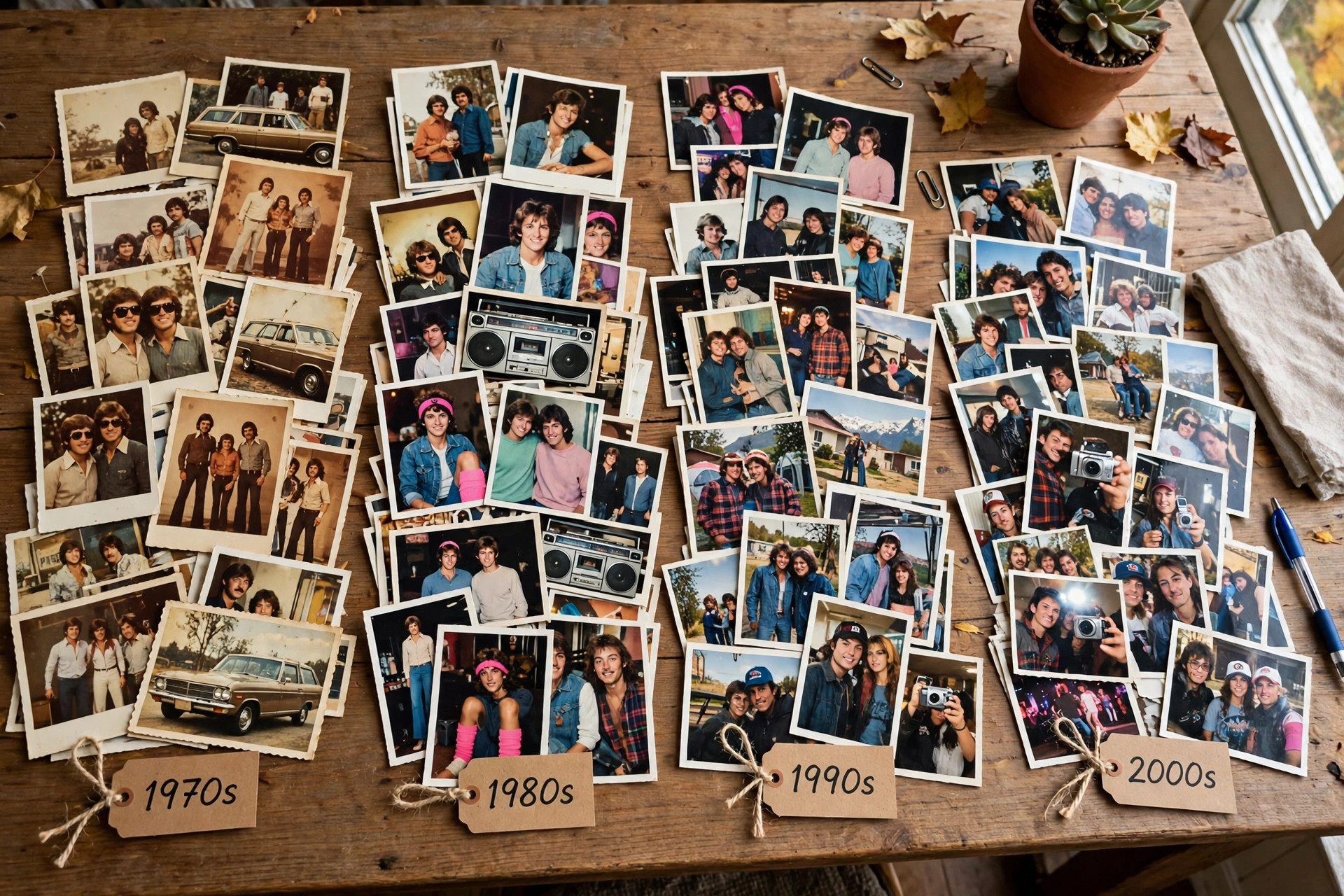
2. Sort by decade first — the decade sort that makes everything else easy
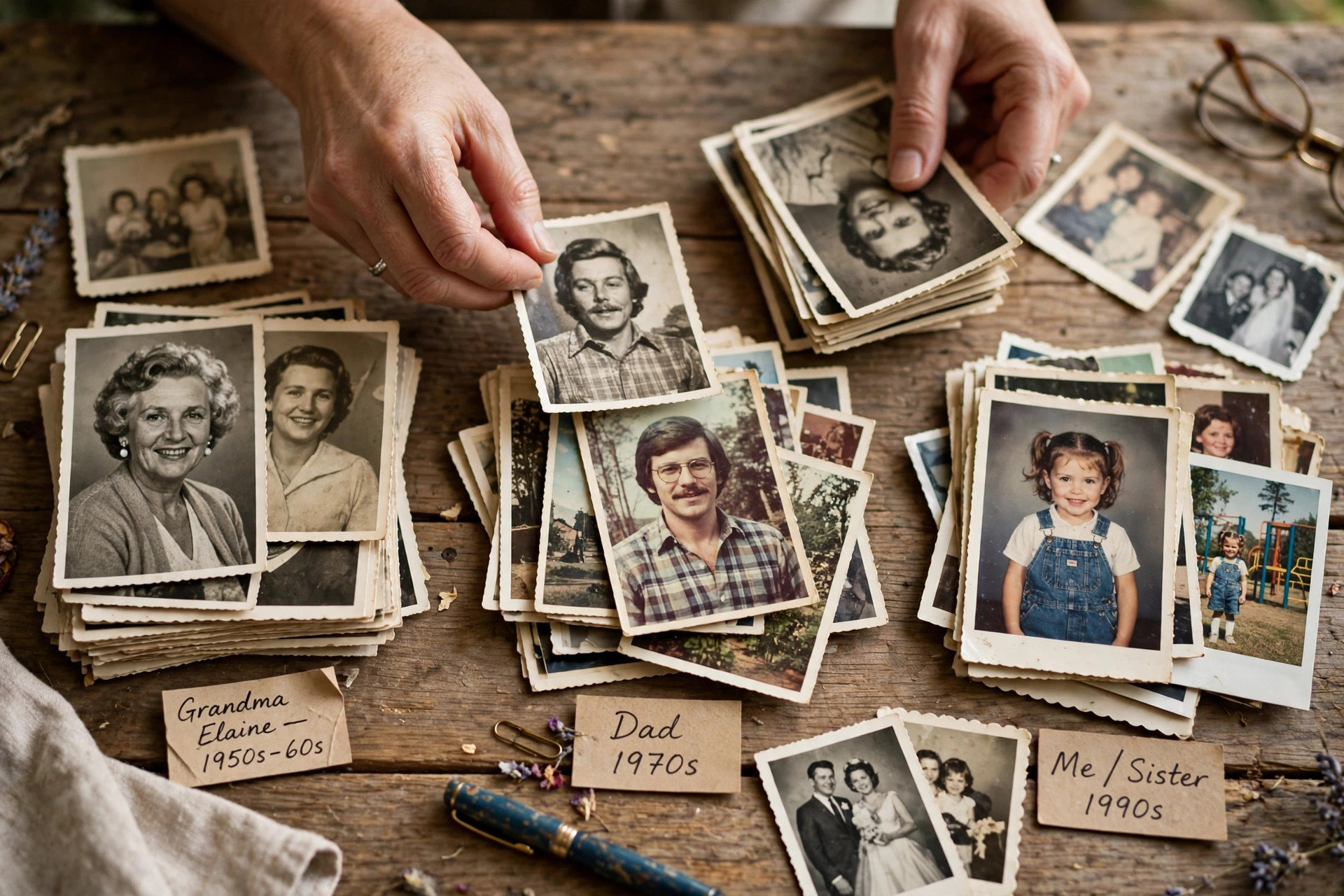
Sorting by person or event first is sorting that stalls, because you cannot remember whether that beach photo was 1994 or 1997, the names blur, and the pile that should take an afternoon takes a month. Sort by decade first — the decade sort that makes everything else easy — so every print lands in one of five or six big piles: the seventies, the eighties, the nineties, the two-thousands, and now. Decades are easy to guess from the clothes, the cars, the hair and the colour of the print, because the photo that looks seventies is seventies, and the pile that is sorted by decade is the pile that can be sorted again inside each decade. Put a labelled pile or a labelled tray for each decade on the table, and move fast — the decade that is guessed wrong can be fixed later, and the sort that moves fast is the sort that finishes. One sort by decade, and the pile becomes six piles you can actually work with.
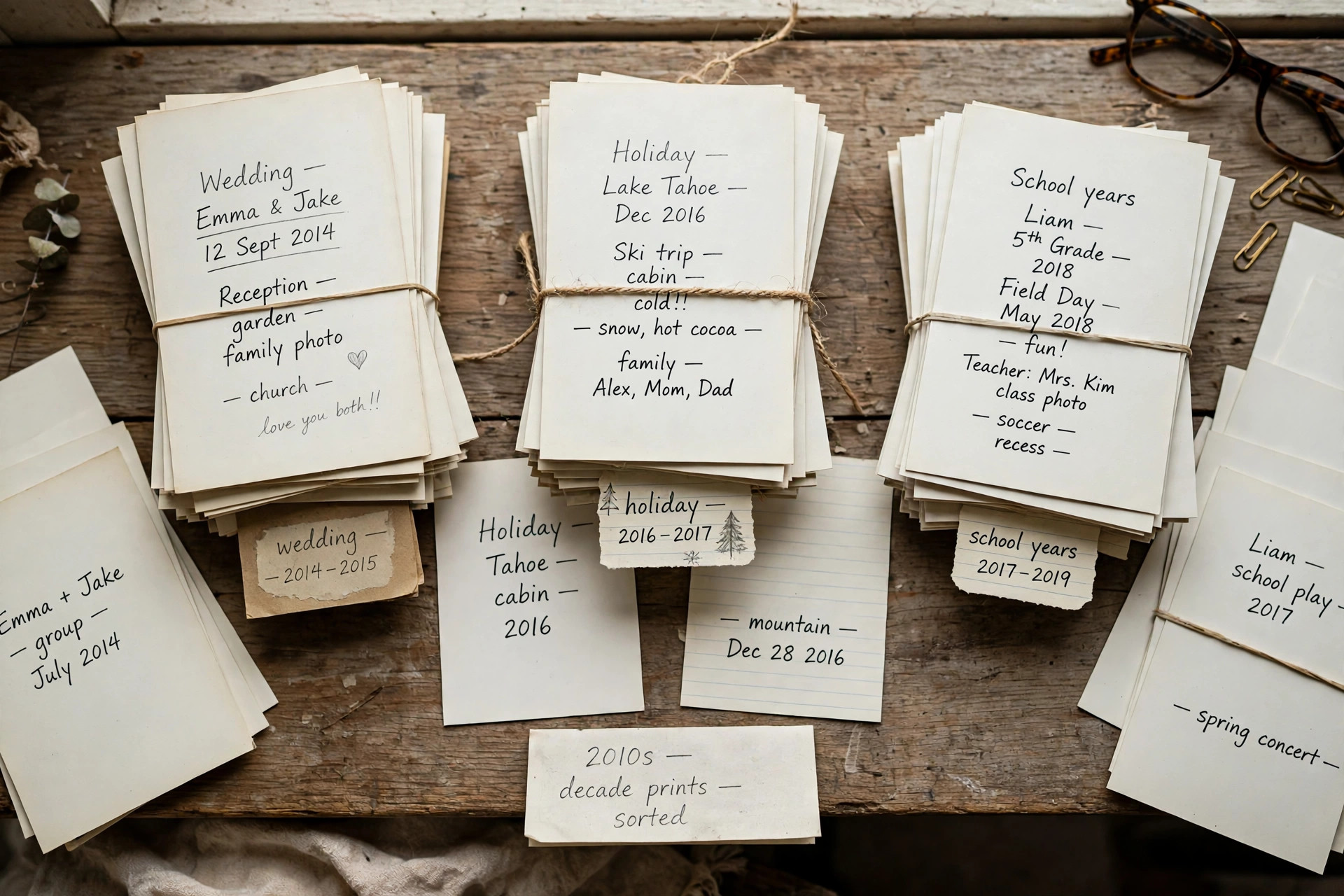
3. Sort by person or event inside each decade
Once the decades are sorted, the pile inside each decade still needs order, because the birthday photos sit with the holiday photos, the school photos sit with the wedding photos, and the decade pile is still a pile you have to dig through. Sort by person or event inside each decade — the sort that turns a pile into a story — so each decade splits into events: the 1998 holiday, the 2001 wedding, the children's school years. Keep the events in rough order inside the decade, because the pile that is ordered by event is the pile you can browse like a book. Write the event on the back of the first photo in each group with a soft pencil, because the back of the photo is where the memory lives when nobody remembers it in ten years, and the group that is labelled is the group that stays together. One sort by event, and the decades become stories.
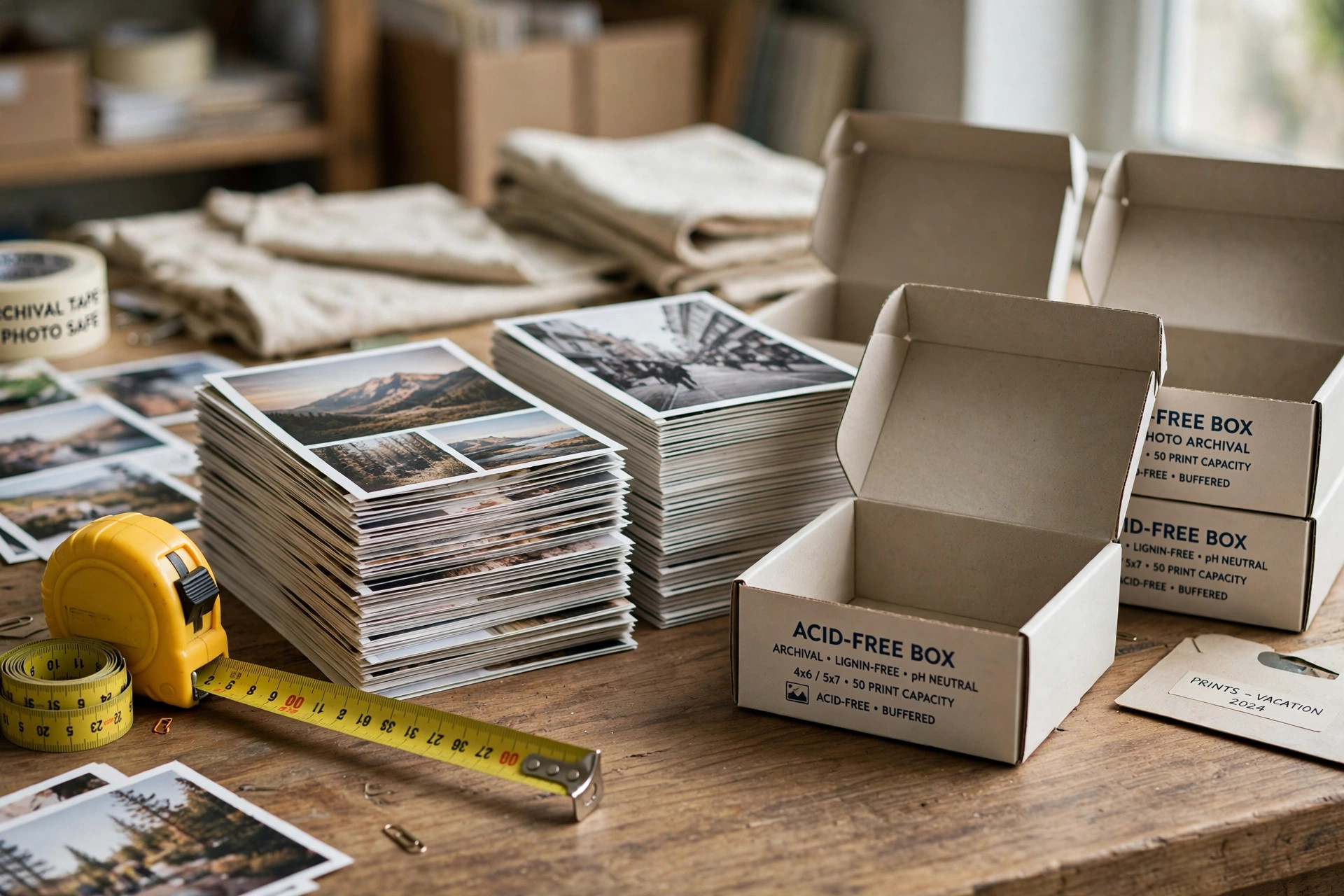
4. Measure the pile — count the prints before you buy a single box
Photo storage bought by guessing is storage that does not fit, because the pile is three times bigger than you thought, the boxes you bought hold half of it, and the organizer that looked right in the shop is the organizer that comes home and goes straight back. Measure the pile — count the prints before you buy a single box — so every box, album and sleeve you buy is bought for your pile, not for a pile in a photo. Count the prints in each decade pile and write the numbers down, because the numbers that travel with you are the numbers that stop the returns. Measure the space the archive will live in too — the width of the shelf, the height under it, the depth of the closet — because the box that fits the prints but not the shelf is the box that lives on the floor, and the shelf that is measured is the shelf that holds the archive. One afternoon with a count, and everything you buy fits.
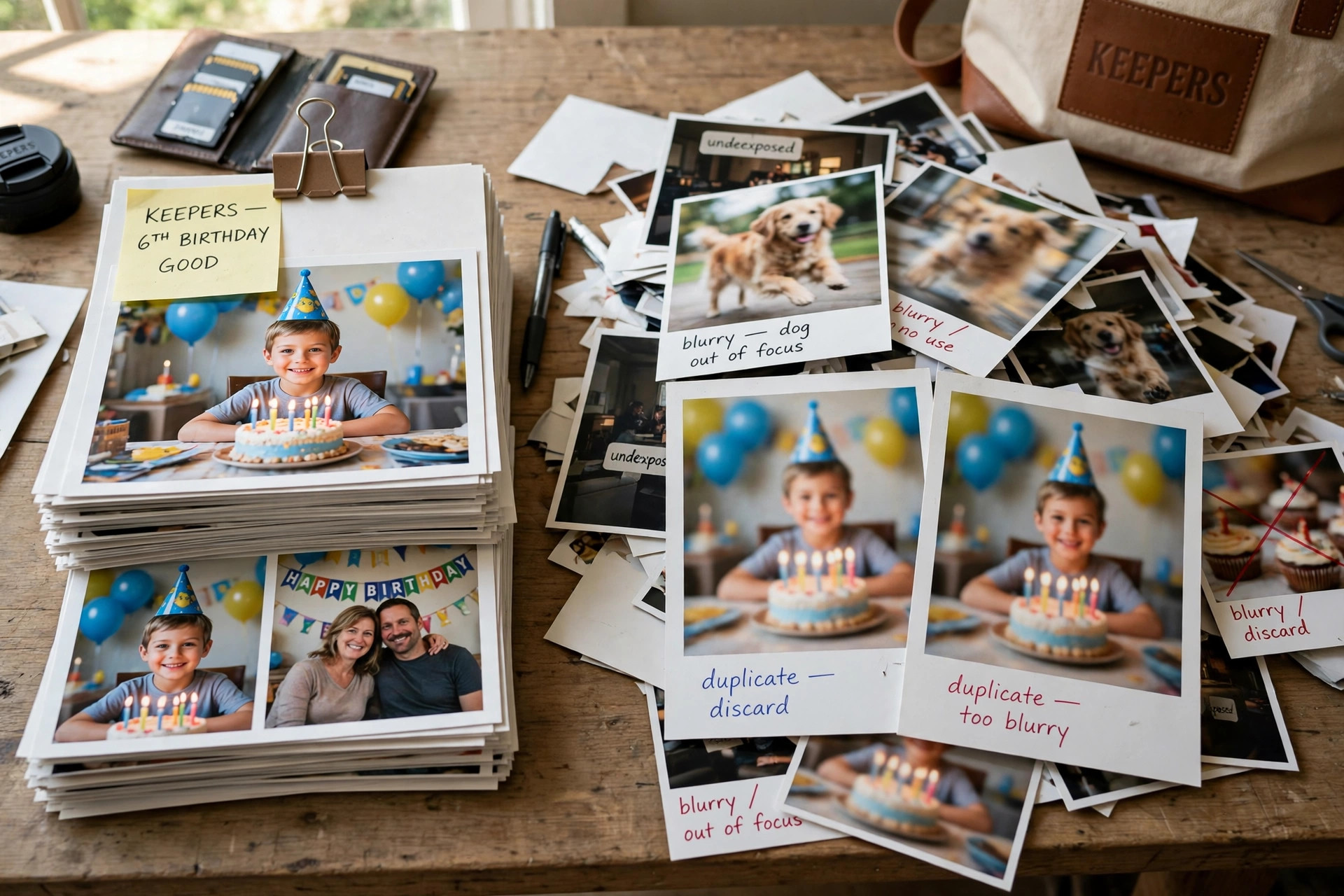
5. Set aside the duplicates, the blurry shots and the ones nobody wants
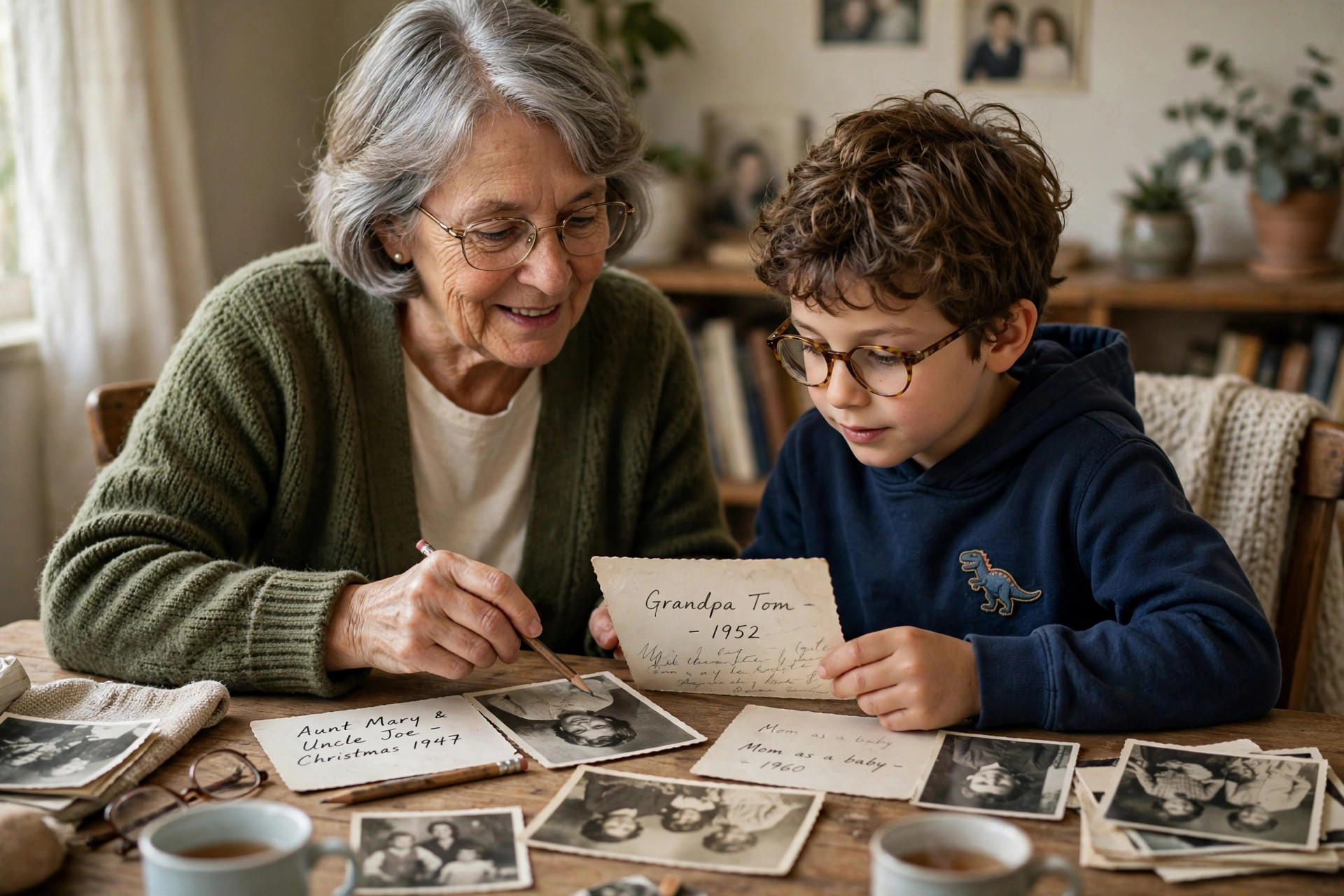
Not every print deserves a box, because the pile holds three copies of the same birthday cake, a dozen blurry shots of a dog running past the camera, and the photos nobody in the family wants to keep. Set aside the duplicates, the blurry shots and the ones nobody wants — the cull that makes the archive worth browsing — so the pile that gets stored is the pile worth keeping. Keep the best copy of each moment and let the rest go, because the album that holds one good photo of the birthday is the album people open, and the album that holds twelve near-identical ones is the album people close. Ask the family before you bin the ones with people in them, because the photo that looks like nothing to you is the photo somebody else has been looking for, and the cull that asks first is the cull nobody regrets. One honest cull, and the pile shrinks to the memories that matter.
Store the prints right
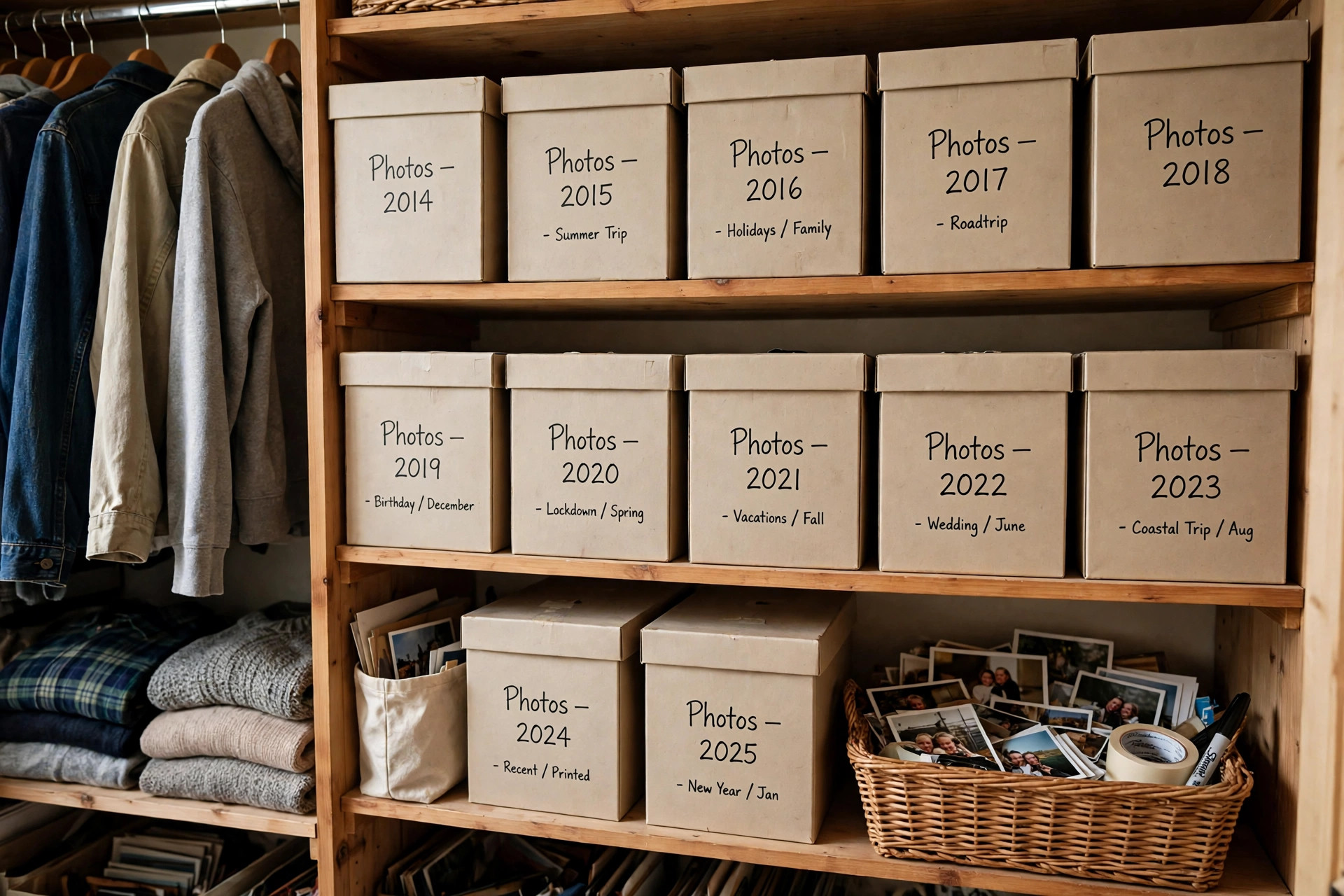
6. Acid-free boxes — the box that protects prints for decades
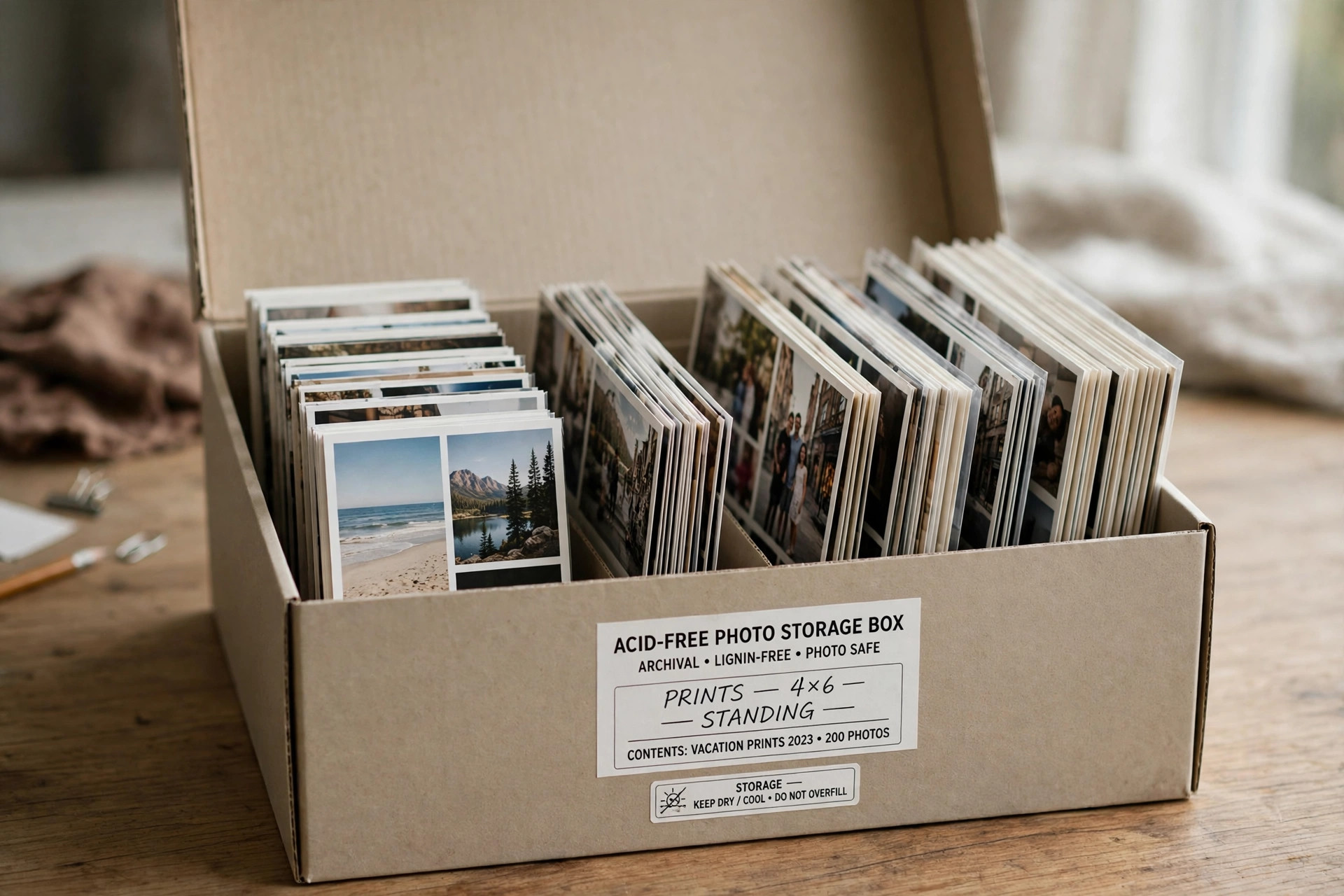
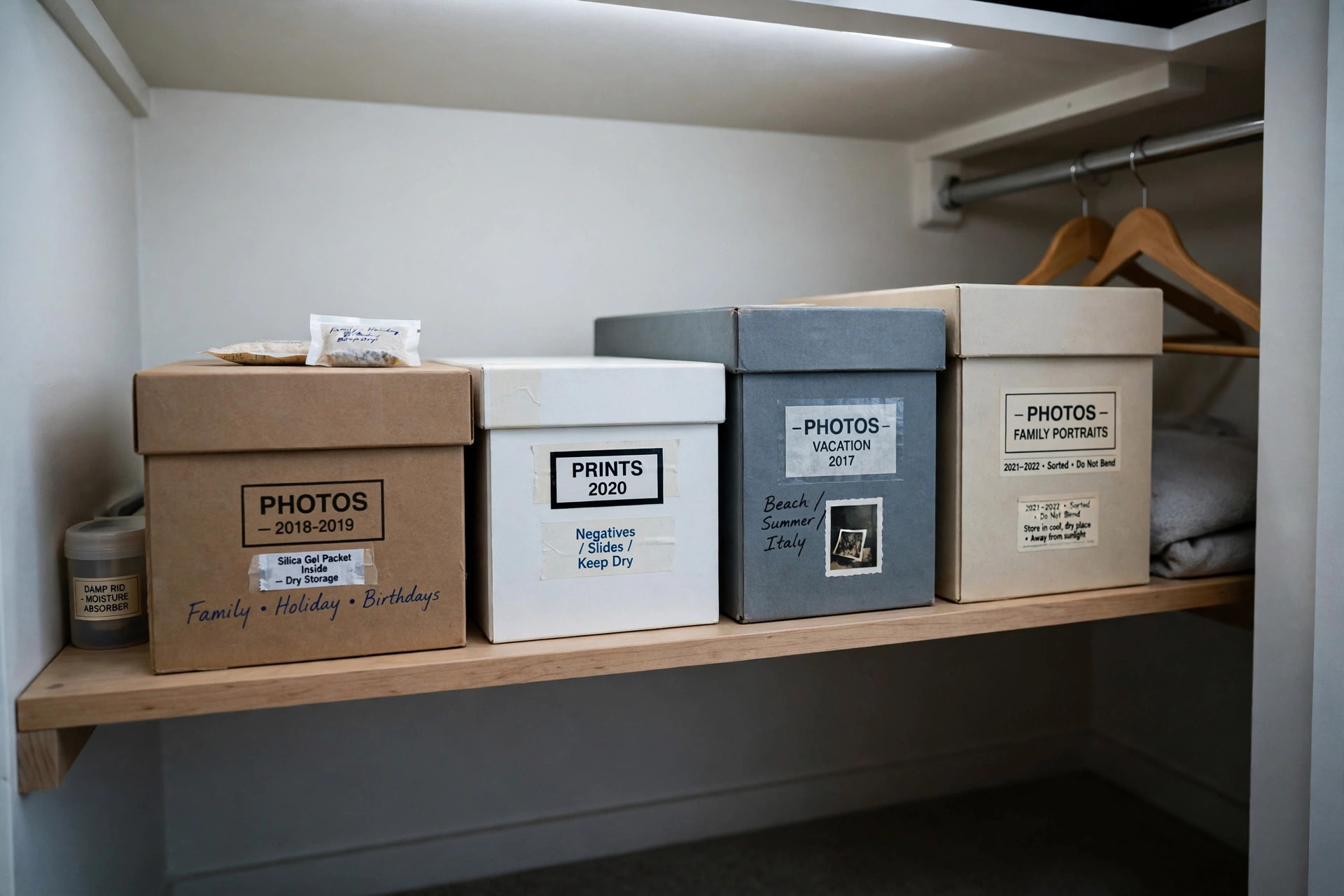
Ordinary cardboard boxes eat photographs, because the acid in the cardboard yellows the prints, the prints stick to each other, and the box that looked fine in the attic is the box whose photos come out faded and stuck together. Use acid-free boxes — the box that protects prints for decades — so each print sits in a box made for photographs, with no acid to yellow it and no glue to stick it. Pick boxes sized for your prints with an inch to spare, and keep the prints standing upright in them like files, because the box that stands the prints up is the box you can flip through without pulling them all out. Label the box on the front with the decade and the events inside, because the box that is labelled is the box you can find, and the box that is acid-free is the box that keeps the photos safe for the next generation. One box per decade, and the prints survive. (Check on Amazon for acid-free photo storage boxes with dividers, sized for standard 4×6 and 5×7 prints.)
7. Photo albums that actually get opened
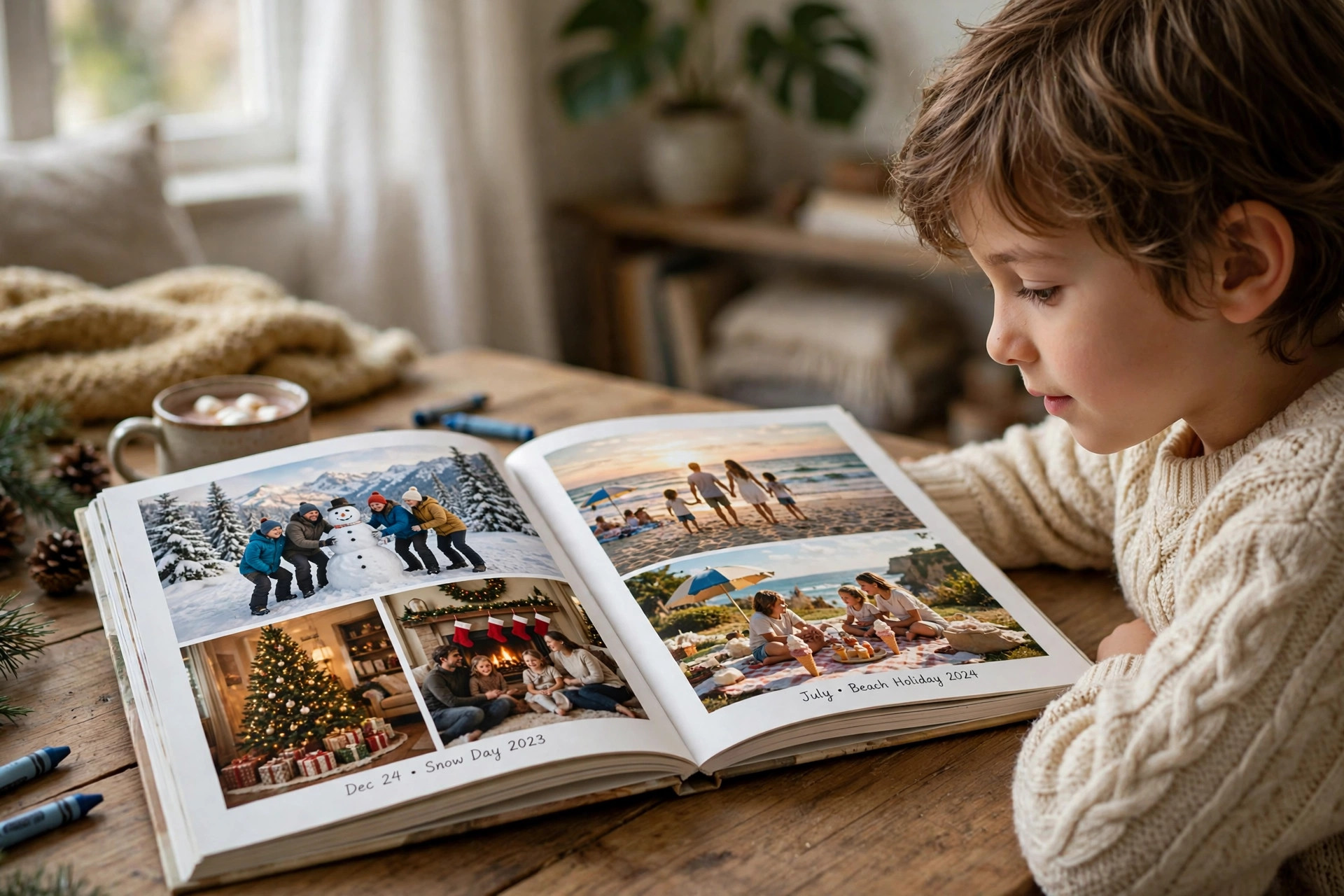
An album nobody opens is an album that does not work, because the album is too heavy, too fragile, or too precious to touch, and the photos inside it are photos nobody sees. Choose photo albums that actually get opened — the album that lives where people sit — so the album is light enough to carry to the sofa, sturdy enough to survive being opened a hundred times, and ordinary enough that nobody is afraid to touch it. Keep the best album on the coffee table or the shelf by the sofa, because the album that is within reach is the album that gets opened on a rainy afternoon, and the album that is buried in the closet is the album that is never seen. Fill the album with the keepers from one decade or one event, because the album that tells one story is the album people finish, and the album that holds everything is the album nobody starts. One album in reach, and the photos get seen.
8. Labelled sleeves by year — the sleeve that stops the dig
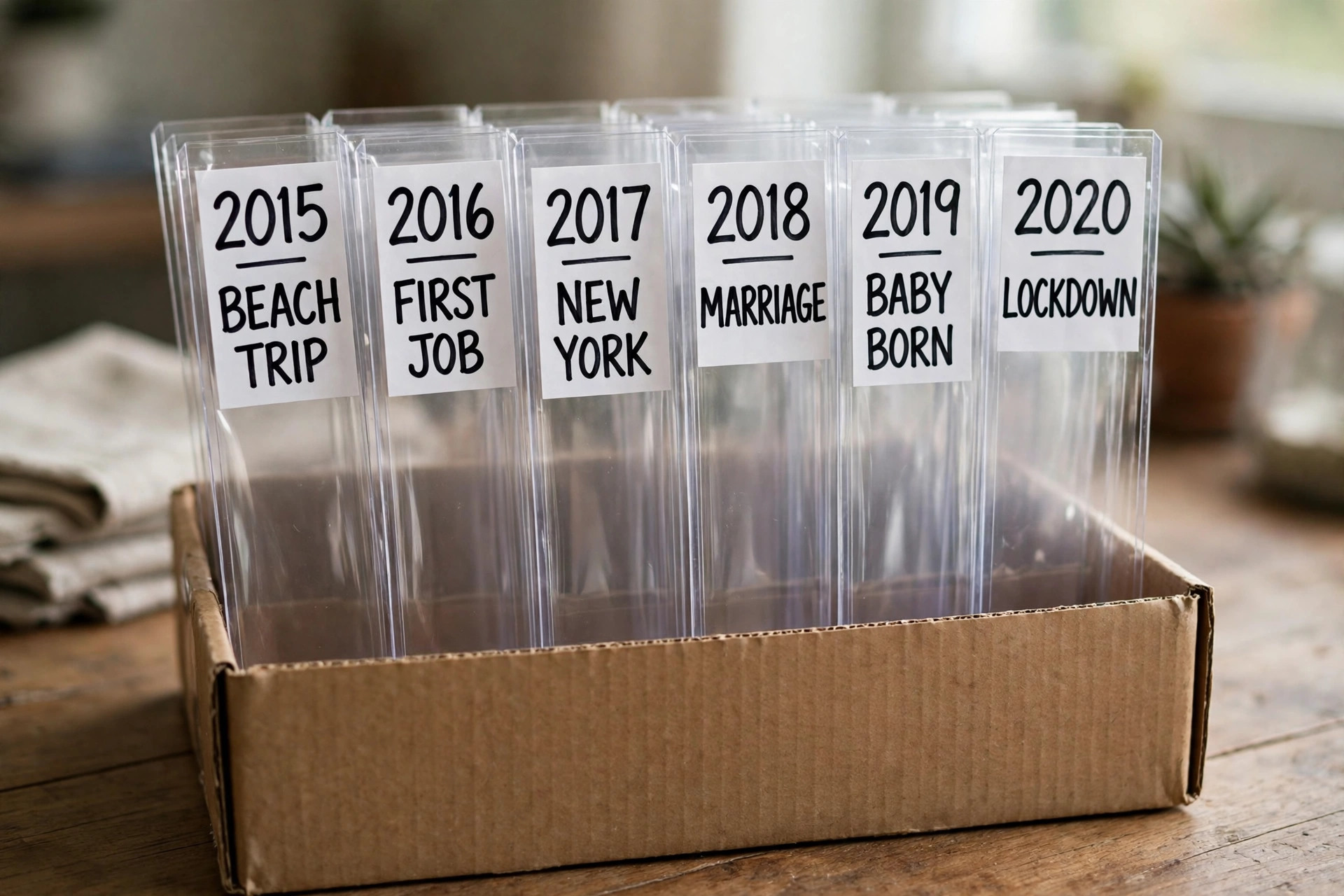
Prints loose in a box are prints you have to dig through, because the 1998 holiday sits under the 2003 wedding, the sleeves are mixed up, and the box that holds a decade is a box you have to empty to find one photo. Use labelled sleeves by year — the sleeve that stops the dig — so each year's prints live in their own clear sleeve, the sleeves stand upright in the box in order, and the photo you want is the photo you can pull out without emptying the box. Write the year and the event on the sleeve in big clear letters, because the sleeve that is labelled is the sleeve you can read from the top of the box, and the box that is sleeved by year is the box you can browse in a minute. Keep one empty sleeve at the front of each box, because the sleeve that is empty is the sleeve for the prints that turn up later, and the box that has room is the box that never overflows. One sleeve per year, and the dig stops. (Check on Amazon for clear archival photo sleeves with label pockets, sized for 4×6 prints.)
9. Keep negatives and slides with the prints they belong to
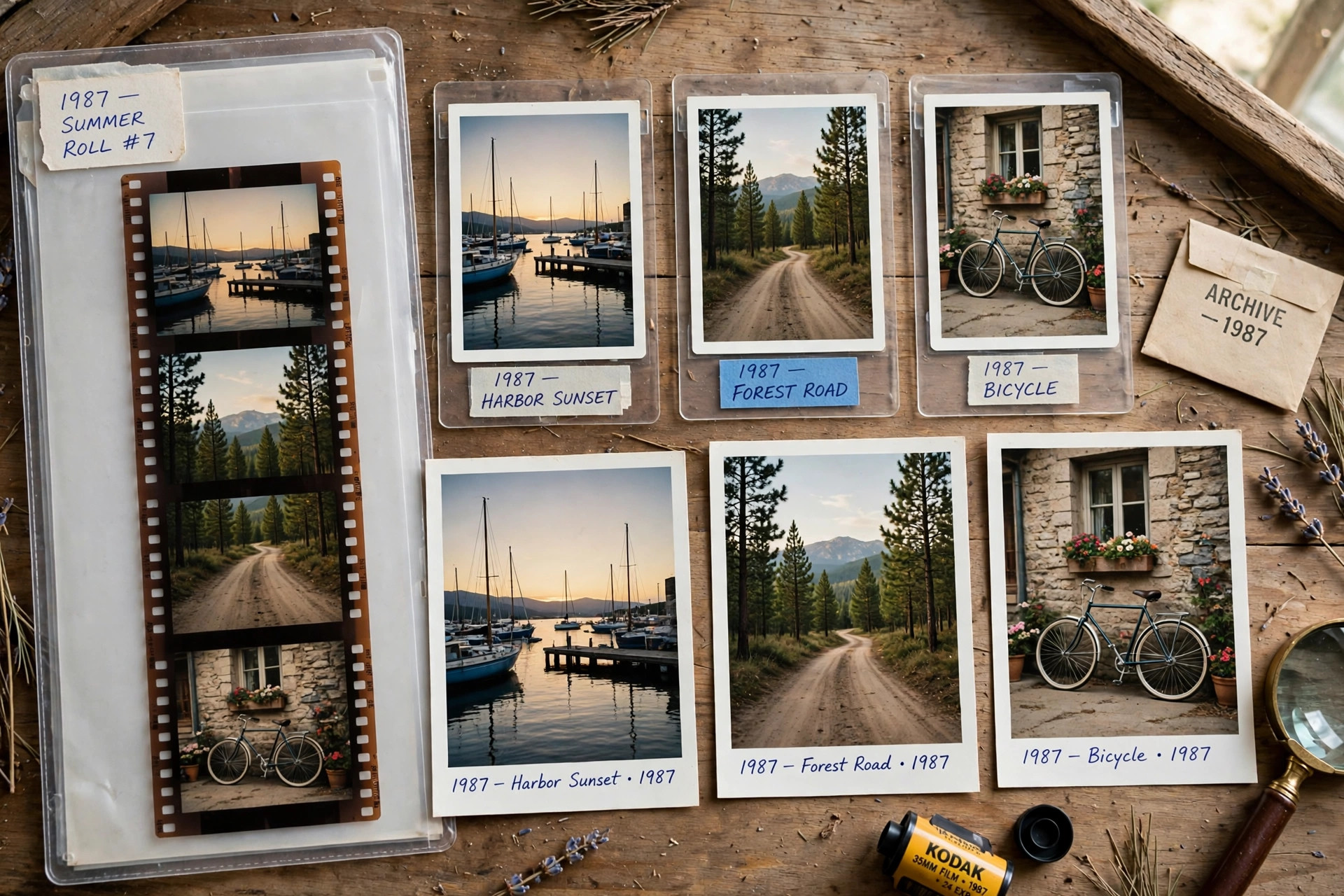
Negatives and slides separated from their prints are negatives nobody can use, because the strip that belongs to the 1998 holiday lives in a different box from the prints, the slide that matches the album photo is in a drawer somewhere, and the archive that is split is an archive that cannot be rescanned. Keep negatives and slides with the prints they belong to — the negative that stays with its photo — so each sleeve holds the prints and the strip or slide that made them, and the photo that needs rescanning is the photo whose negative is right there. Store the strips in archival sleeves, label them with the same year and event as the prints, and keep them in the same box, because the archive that is kept together is the archive that survives a move, a flood or a clear-out. One box, one story, negatives included, and nothing gets lost.
10. Keep the originals away from heat, damp and light
Photographs die quietly in bad storage, because the heat in the attic fades the colours, the damp in the basement sticks the prints together, and the sunlight on the shelf bleaches the faces out of the pictures. Keep the originals away from heat, damp and light — the three enemies of every print — so the boxes live in a cool, dry room, on a shelf that never gets direct sun, and never in the attic or the basement. The attic is the worst place in the house for photographs, because the summer heat cooks the prints and the winter cold cracks them, and the box that lives in the attic is the box whose photos fade first. Keep the boxes in a closet in a lived-in room, off the floor and away from outside walls, because the closet that is cool and dry is the closet that keeps the photos safe. The attic itself gets its full system in 22 Attic Storage Ideas for 2026, where the climate rules explain why the photo boxes should never live up there. One cool dry shelf, and the prints last.
Go digital without losing the originals
11. Scan the keepers first — start with the ones you would miss most
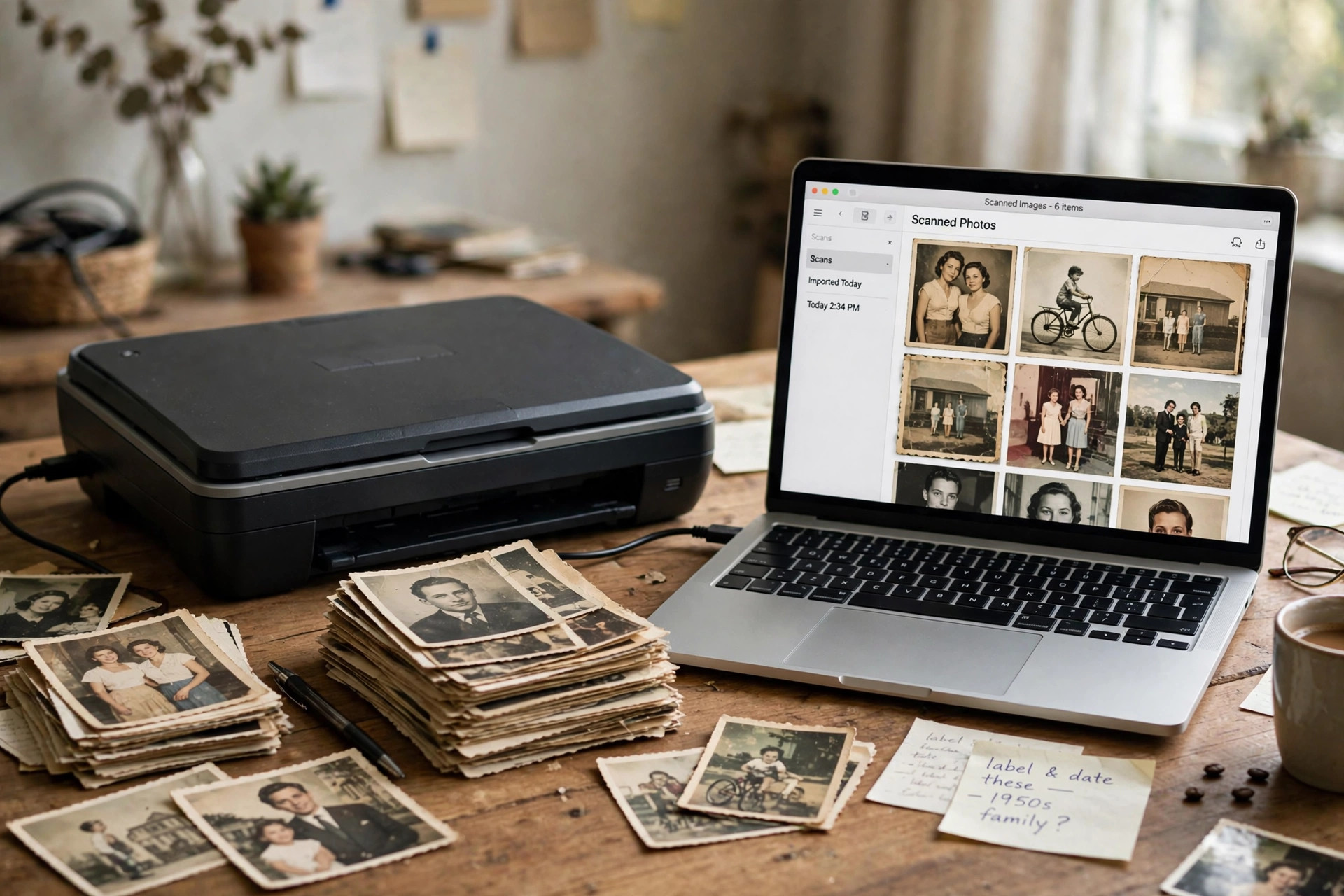
Scanning every print is a project that never starts, because the pile is three thousand prints, the scanner is slow, and the archive that needs scanning is the archive that stays in the box. Scan the keepers first — start with the ones you would miss most — so the first hundred scans are the photos that matter: the wedding, the children's first years, the grandparents, the house you grew up in. Scan in short sessions, a dozen photos at a time, because the session that takes twenty minutes is the session that actually happens, and the pile that is scanned in dozens is the pile that gets scanned. Work through one decade at a time, because the decade that is scanned is the decade that is safe, and the keeper that is scanned first is the keeper that survives even if the print does not. One dozen a session, and the keepers are safe.
12. Name the files so you can find them — year, event, person
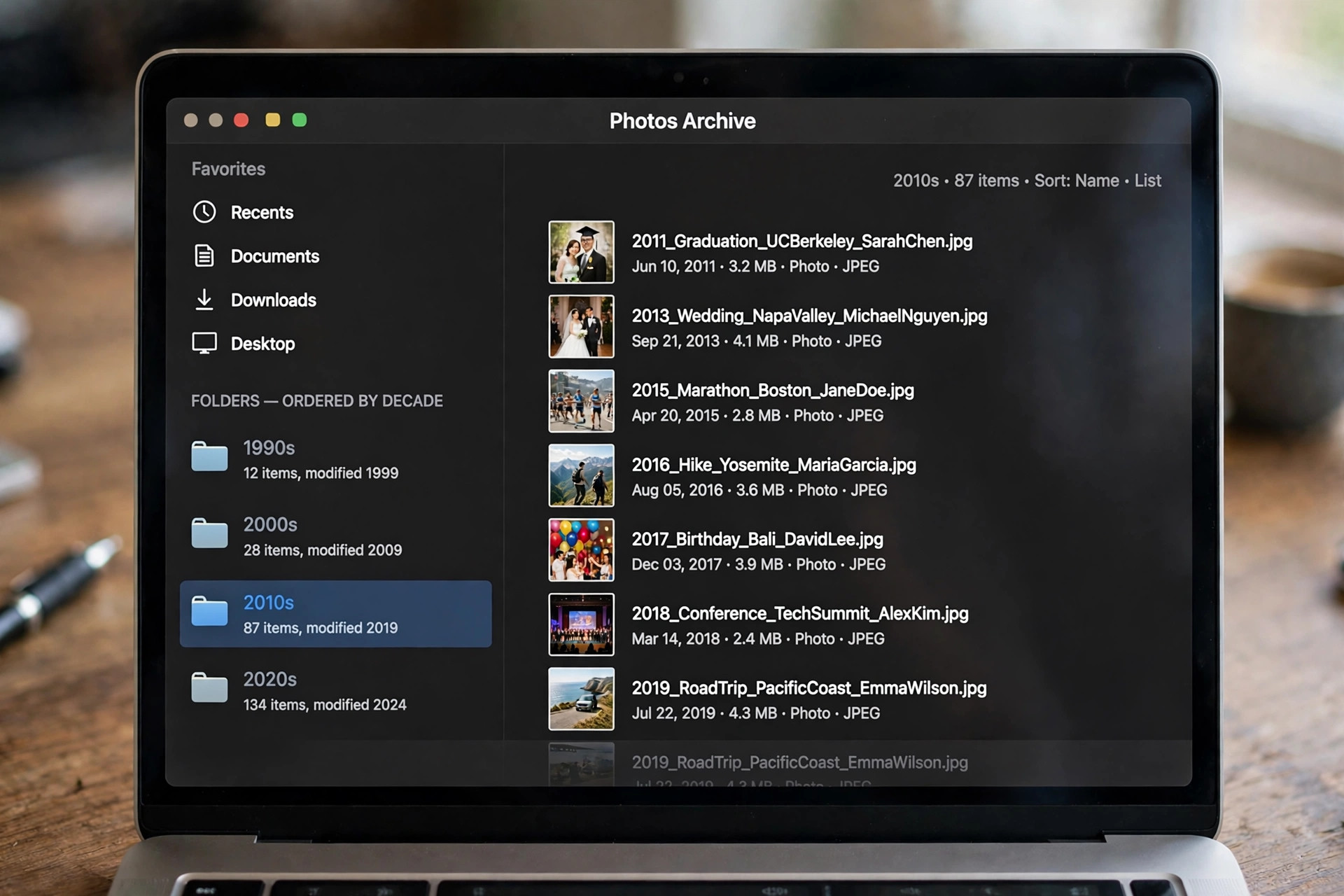
A folder full of files called IMG_0042 is a folder nobody can search, because the photo from the 1998 holiday sits beside the photo from the 2019 wedding, and the scan that has no name is the scan that can never be found. Name the files so you can find them — year, event, person — so every scan is called something like 1998-holiday-cornwall-mum, and the photo you want is the photo a search finds in seconds. Use the same naming for every file, because the system that is consistent is the system that works, and the file that is named by year first is the file that sorts itself in order. Write the names as you scan, not afterwards, because the scan that is named at once is the scan that is never renamed, and the folder that is named by year is the folder you can browse like an album. One naming rule, and every photo is findable.
13. One cloud backup and one hard-drive backup
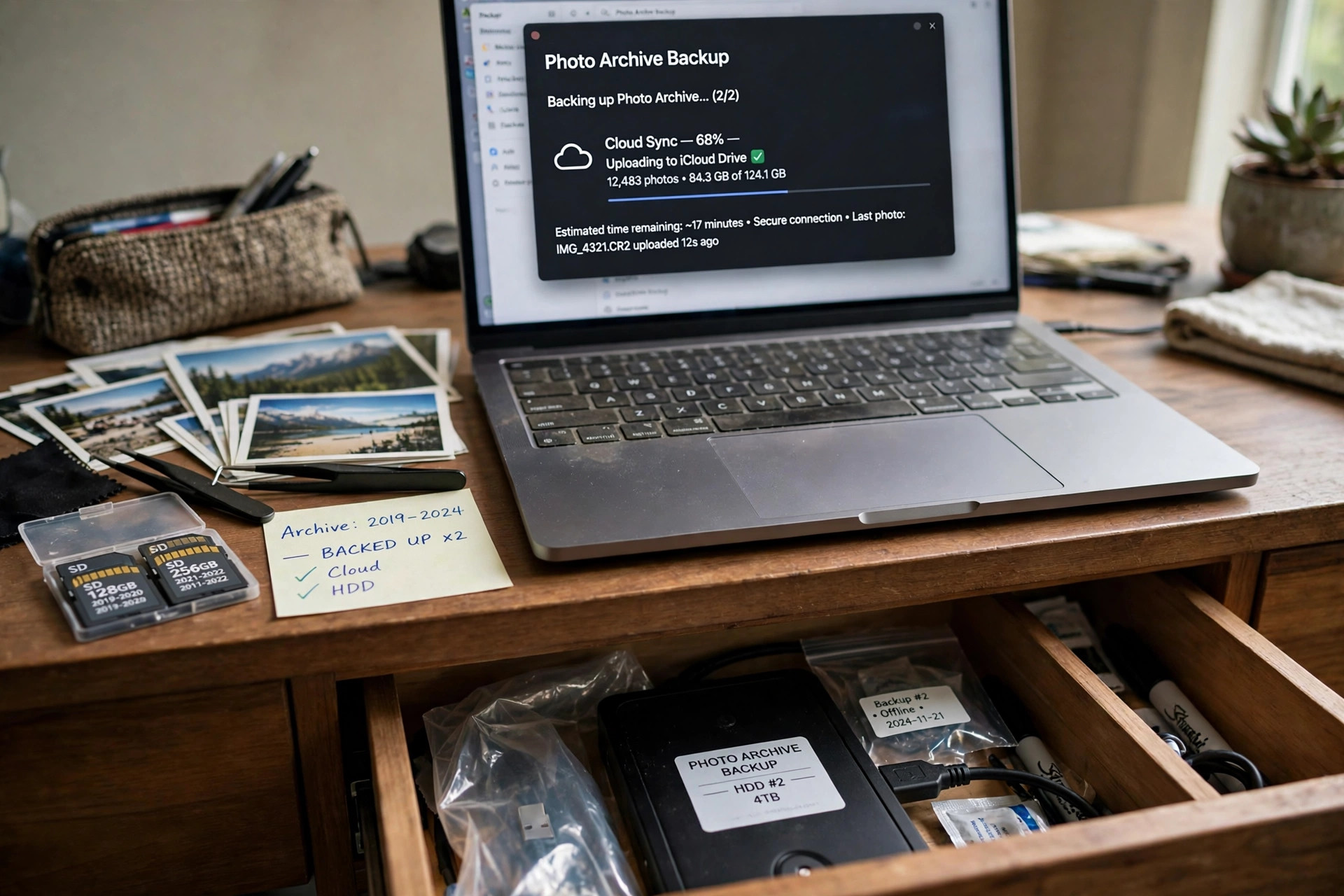
One copy of a photo is no copy at all, because the hard drive fails, the phone gets stolen, and the laptop that held the only scans is the laptop that dies the week after the prints were binned. Keep one cloud backup and one hard-drive backup — the two copies that mean the photos survive — so every scan lives in the cloud and on a hard drive that sits in a different room from the computer. Set the cloud backup to run automatically, because the backup that runs itself is the backup that actually happens, and check the hard drive twice a year, because the drive that is checked is the drive that gets replaced before it fails. Keep the hard drive in a drawer away from the computer, because the drive that sits beside the computer is the drive that dies in the same flood, and the archive that lives in two places is the archive that survives. Two copies, and the photos are safe. (Check on Amazon for a portable external hard drive with at least 1TB, for the photo archive backup.)
14. Tag the faces while you still remember the names
A photo of people nobody can name is a photo that loses its story, because the grandmother in the 1972 print is a stranger to the grandchildren, the friends in the wedding photo have no names attached, and the album that holds unnamed faces is an album nobody can explain. Tag the faces while you still remember the names — the tag that saves the story — so every scan gets the names of the people in it, written in the file name or in the photo app's face tags, before the memory fades. Ask the oldest person in the family to sit with you for one afternoon, because the afternoon that names the faces is the afternoon that saves the stories, and the photo that is tagged is the photo that keeps its people. Write the names on the back of the prints too, in soft pencil, because the print that is named is the print that explains itself in fifty years, and the tag that is written now is the tag that is never lost. One afternoon of tagging, and the faces keep their names.
15. Print the best of the scans for the wall
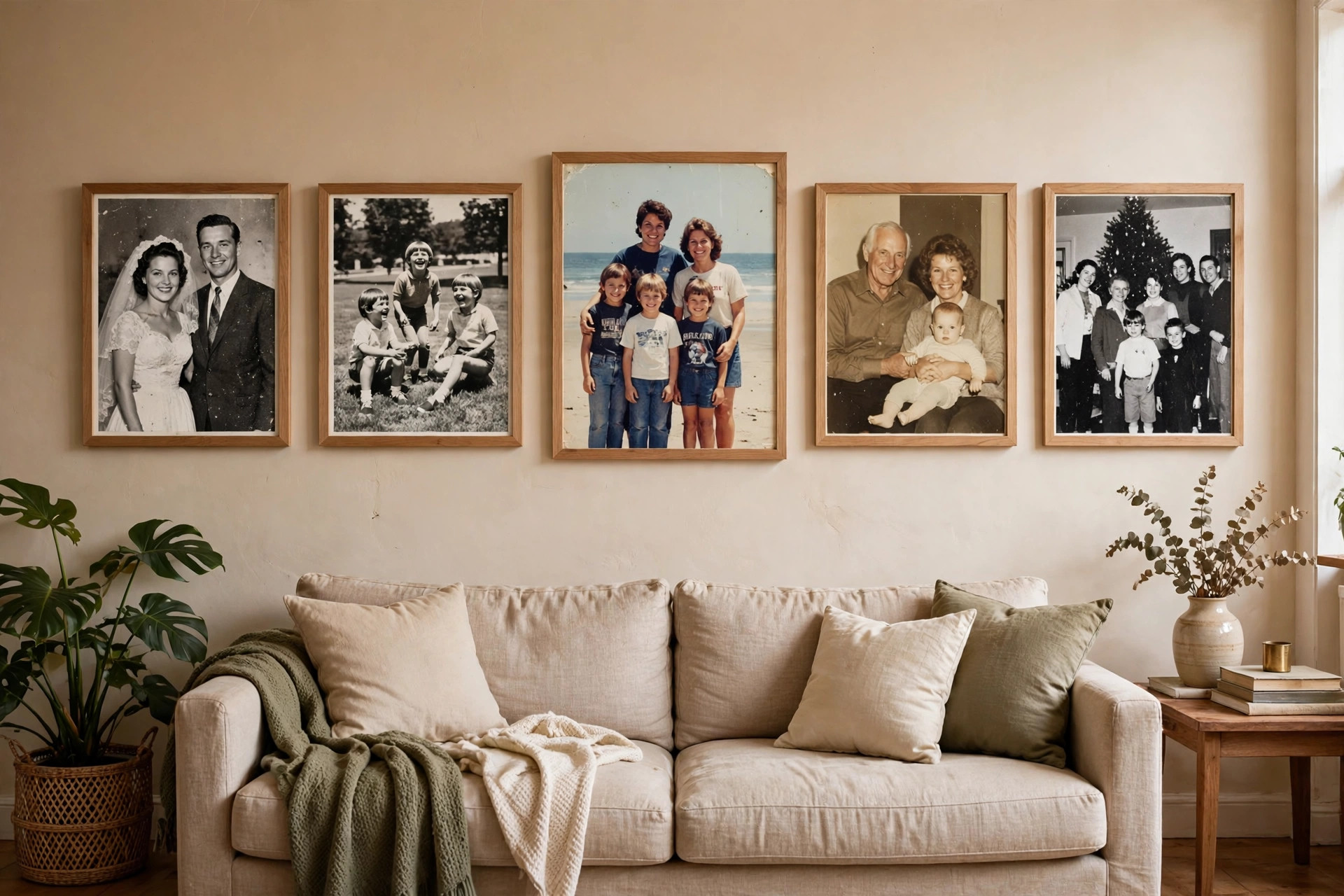
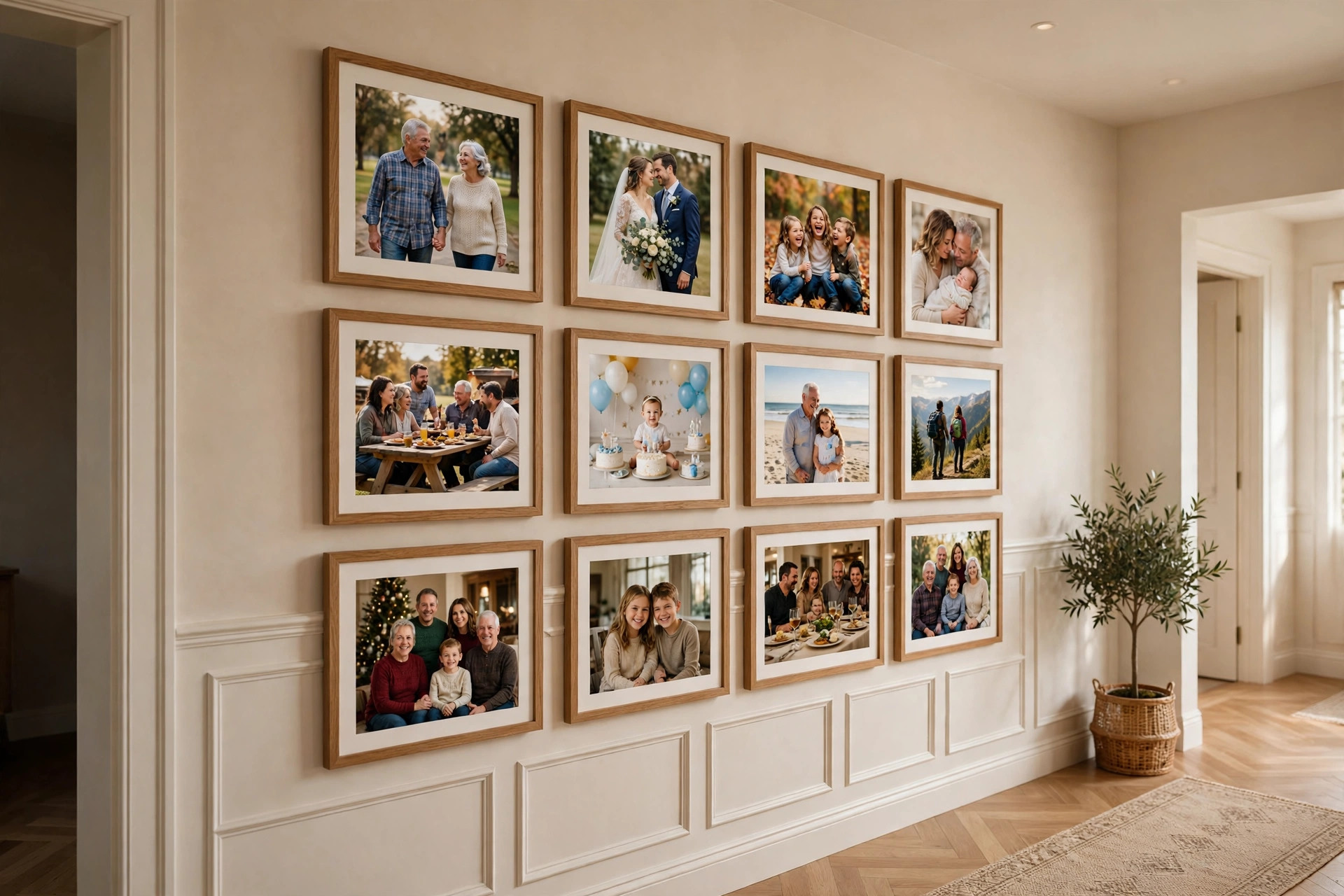
A scan that only lives on a hard drive is a photo nobody sees, because the screen is off, the folder is buried, and the best photo of the family is the photo that never leaves the computer. Print the best of the scans for the wall — the print that puts the memory where you live — so the favourite photos from each decade come back out of the archive and onto the wall, in frames that match, in the hallway or above the sofa. Print them at a proper size, because the print that is big enough to see from the sofa is the print that gets looked at, and the wall that holds the best photos is the wall that tells the family story. Rotate the prints twice a year, because the wall that changes is the wall that gets noticed, and the scan that is printed is the scan that is seen every day. One wall of favourites, and the archive lives in the open.
An archive that lives in one house is an archive that can be lost in one house, because the fire, the flood or the clear-out takes the only copies, and the photos that nobody else holds are the photos that vanish. Share the digital albums with family so the copies survive — the share that makes the archive unlosable — so every decade's scans go into a shared album that the siblings, the children and the cousins can all open, download and keep. Send the link at Christmas or at the family gathering, because the album that is shared is the album that lives on five hard drives instead of one, and the photo that is shared is the photo that survives even if your copy does not. Keep the sharing simple, one album per decade, because the album that is easy to open is the album the family actually opens, and the archive that is shared is the archive that cannot be lost. One share, and the photos survive the house.

Display it and keep it tidy
17. A gallery wall that rotates — the wall that changes with the seasons
A gallery wall that never changes is a gallery wall nobody looks at, because the same faces have hung there for five years, the frames have faded into the background, and the wall that was once the family's favourite is now just wallpaper. Build a gallery wall that rotates — the wall that changes with the seasons — so the frames stay up and the photos inside them change twice a year: the summer holiday in July, the Christmas photos in December, the children's school photos in September. Use frames that open from the front, because the frame that opens easily is the frame that gets changed, and the wall that rotates is the wall that gets noticed every time it changes. Keep the spare prints in a labelled sleeve behind the display album, because the sleeve that holds the next rotation is the sleeve that makes the swap take ten minutes, and the wall that changes is the wall that tells the family what this season is. The holiday photos that rotate onto the wall each December get their full seasonal system in 25 Holiday Decor Storage Ideas for 2026, where the Christmas albums live with the ornaments. One wall, two rotations a year, and the photos stay alive.
18. One display album on the coffee table
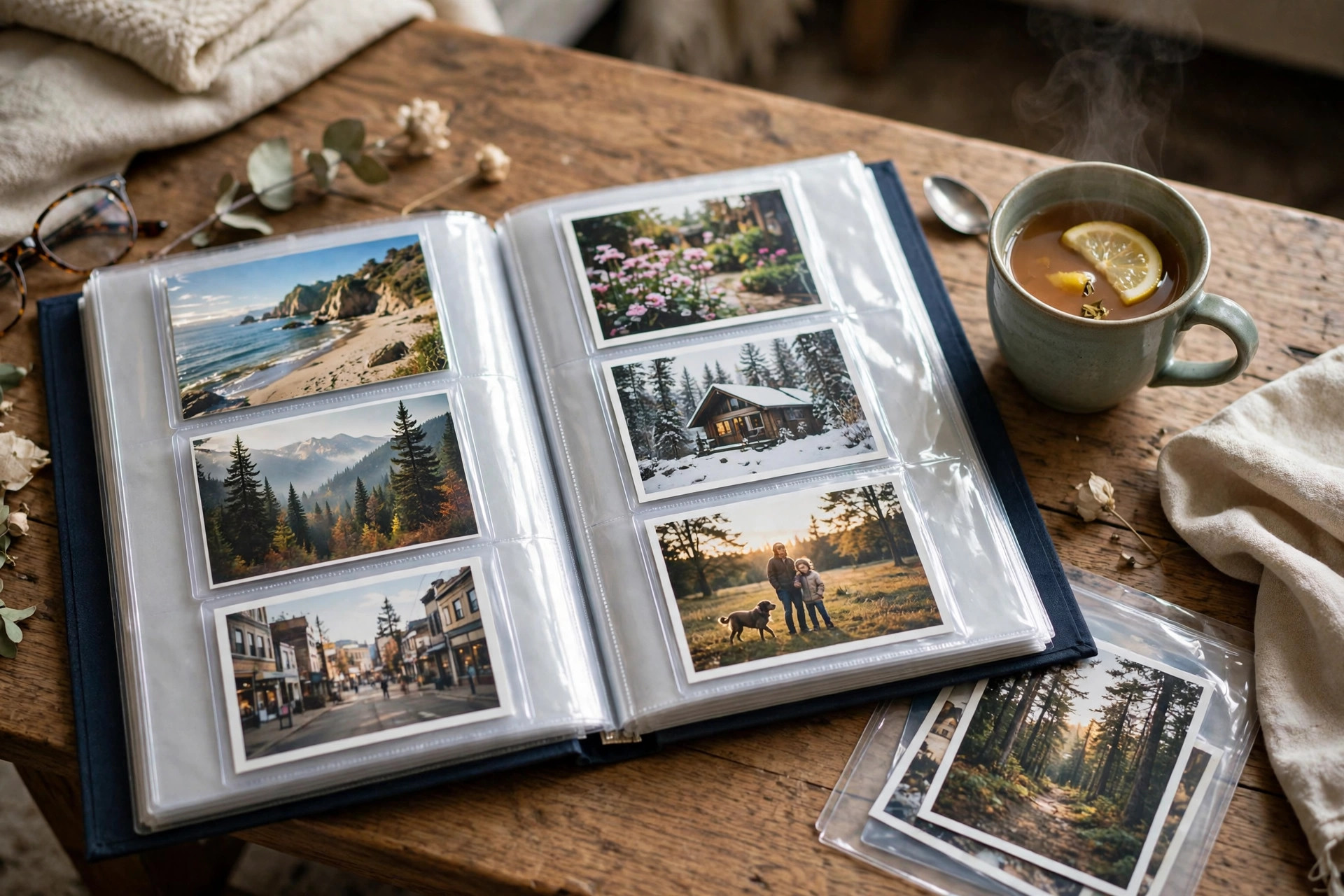
The coffee table is where the family actually sits, because the sofa is where the rainy afternoon happens, the tea is where the conversation happens, and the album that lives on the coffee table is the album that gets opened. Keep one display album on the coffee table — the album that gets opened — so the best photos from the current year live in a single album within reach of the sofa, and the album that is there is the album that gets picked up. Fill it with the year's favourites, not the whole archive, because the album that holds thirty photos is the album people finish, and the album that holds three hundred is the album people close. Swap the album's contents once a year, because the album that changes is the album that stays interesting, and the table that holds the album is the table that tells the family story. The drop zone shelf by the door holds the same logic in 22 Drop Zone Organization Ideas for 2026, where the things that live within reach are the things that get used. One album on the table, and the photos get seen.
19. Photo books by year — the book that replaces the box
A box of prints is a box nobody browses, because the box has to be emptied, the prints have to be sorted, and the afternoon that should be spent looking at photos is spent looking for them. Make photo books by year — the book that replaces the box — so each year's keepers become one printed book with the photos in order, the names underneath, and a cover with the year on it, and the shelf that holds the books is the shelf that holds the whole family history. Order one book a year, starting with the oldest decade, because the book that is ordered is the book that exists, and the shelf that fills one book at a time is the shelf that becomes the archive. Keep the books where the albums live, because the book that sits beside the albums is the book that gets picked up, and the box that is replaced by a book is the box that can finally go. One book a year, and the archive becomes a library.
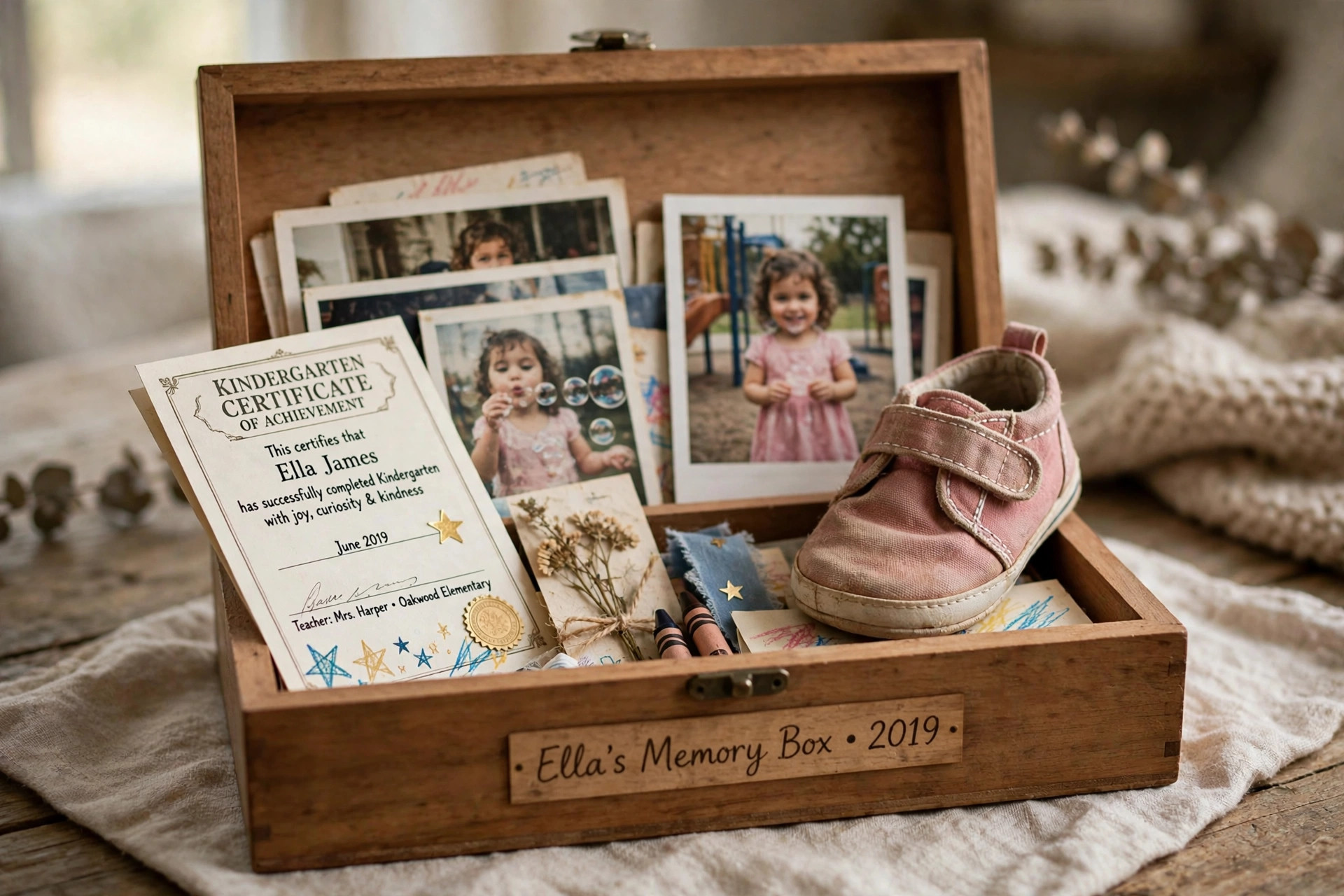
20. A memory box for each child
A child's keepsakes scattered across the house are keepsakes that get lost, because the first shoe is in the closet, the school certificate is in the drawer, the baby photos are in the box with everyone else's, and the child who grows up has nothing of their own to look back on. Give each child a memory box — the box that holds one childhood — so each child gets a labelled box with their name and birth year on it, holding their baby photos, their school certificates, their first drawings and the small things that matter. Add to the box once a year, on the birthday, because the box that grows one item a year is the box that fills slowly and honestly, and the child who opens their box at eighteen is the child who finds their whole childhood in one place. The baby photos that start the box get their full system in 22 Baby Closet Organization Ideas for 2026, where the keepsakes and the clothes share the same small space, and the teen photos that finish it live in 24 Teen Room Organization Ideas for 2026. One box per child, and the childhood stays together.
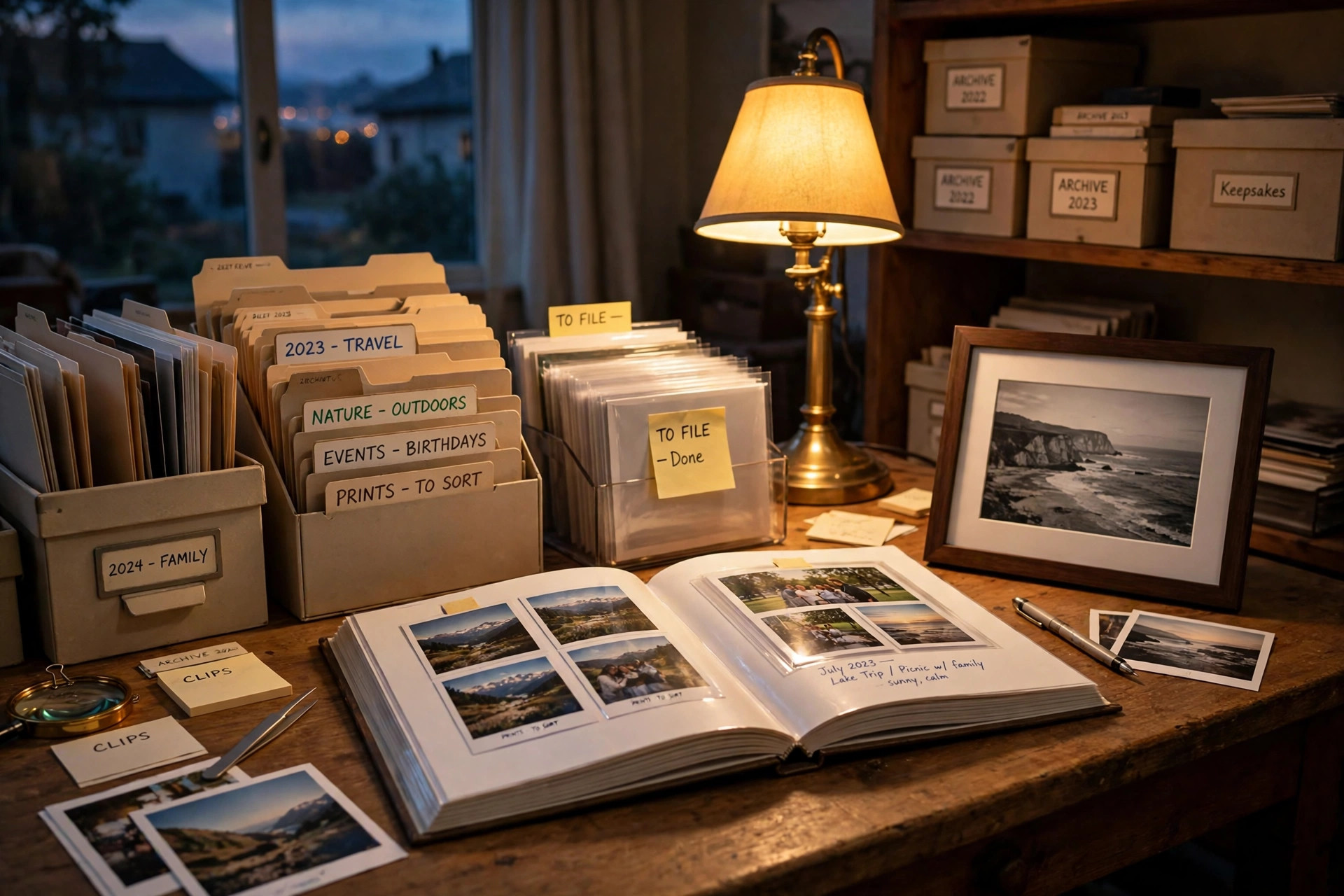
21. A five-minute habit — file new photos the week they arrive
No photo system stays tidy without a habit, because the system is only tidy on the day you organize it and the new photos pile up one phone dump at a time. Build a five-minute habit — file new photos the week they arrive — so every Sunday, or every first of the month, the new photos get named, sorted into the right year's folder, and the best ones printed or added to the display album. Do it while the kettle boils, because the habit that takes five minutes is the habit that actually happens, and the pile that is filed weekly is the pile that never becomes a box again. Keep a small tray by the computer for the prints that arrive in the post, because the tray that catches them is the tray that keeps them from joining the drawer, and the system that is fed weekly is the system that never needs a big clean. Five minutes a week, and the archive stays tidy.
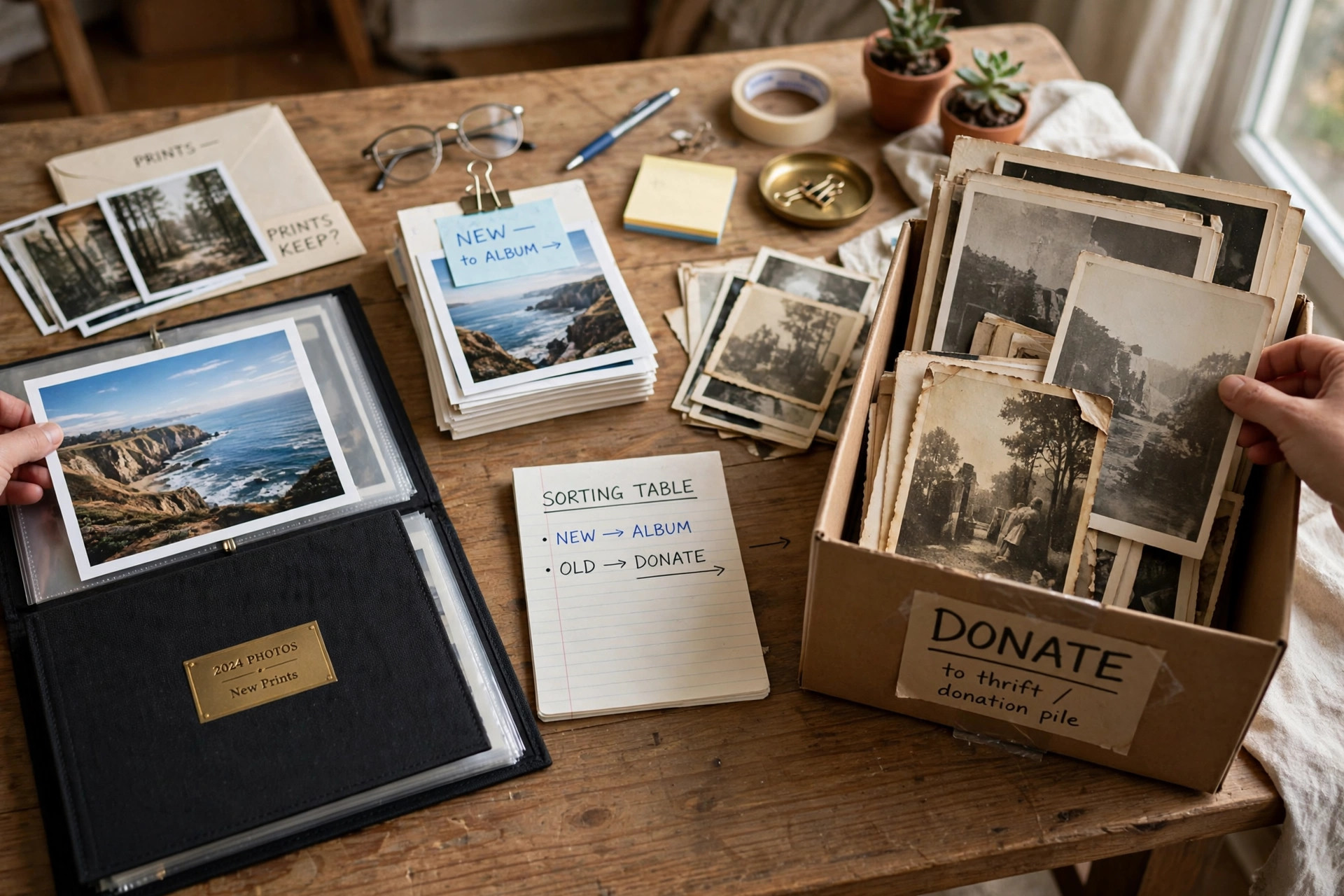
22. One in, one out for the print pile
A print pile grows on its own, because every holiday adds a hundred photos, every birthday adds fifty more, and the archive that held two boxes in January holds five by December. Use one in, one out for the print pile — the rule that stops the archive overflowing — so every new print that enters the archive means one old print leaves it, into the frame, the album, or the bin. Keep the donate-and-share pile at the sorting table, so the print that leaves has somewhere to go the moment you decide, because the pile that is at the table is the pile that gets used. Count the boxes when you do the swap, because the count that is written down is the count that shows you how many you really own, and the archive that is counted is the archive that stops growing. The gift photos that leave the pile make good presents too, wrapped the way 18 Gift Wrap Organization Ideas for 2026 wraps them — the photo gift is the present that costs nothing and means everything. One rule, and the archive never overflows.
Which photo idea fits which situation?
| Situation | Best first move | Budget | Tools needed |
|---|---|---|---|
| Photos in boxes all over the house | Gather every photo into one pile (idea 1) | Free | Table |
| Can't tell which decade a print is from | Sort by decade first (idea 2) | Free | Labels |
| Bought boxes that do not fit the pile | Measure the pile first (idea 4) | Free | None |
| Prints yellowing and sticking together | Acid-free boxes (idea 6) | Low | Boxes |
| Albums nobody ever opens | Photo albums that actually get opened (idea 7) | Low | Album |
| Negatives separated from their prints | Keep negatives with the prints (idea 9) | Free | Sleeves |
| Prints fading in a hot attic | Keep originals away from heat and light (idea 10) | Free | None |
| Afraid of losing the only copies | Scan the keepers first (idea 11) | Low | Scanner |
| Digital photos nobody can find | Name the files year-event-person (idea 12) | Free | None |
| One hard drive holds everything | Cloud plus hard-drive backup (idea 13) | Low | Hard drive |
| Bare walls, photos stuck in boxes | A gallery wall that rotates (idea 17) | Low | Frames |
| New photos piling up again | A five-minute filing habit (idea 21) | Free | None |
You do not need all 22 ideas. You need the three that solve your photo mess — usually the one pile that shows you what you own, the decade sort that turns the pile into stories, and the acid-free boxes that keep the prints safe for the next generation. Start with the one pile, do it this weekend before the next family gathering, and sort by decade. Do that and the photo you want will be the photo you can find in under a minute, the prints will stop fading in the attic, and the albums will be the albums people actually open.
Save this post for the next clear-out, and if the paper around the photos needs the same treatment, read 20 Paperwork Organization Ideas for 2026 next — it is Post 69, the drawer the photos share — and 26 Craft Storage Ideas for 2026, Post 43, for the scrapbook supplies that turn the keepers into albums. This is the twenty-first post of the new Organization by problem run — Posts 56 to 80, one problem at a time — and the run keeps going with the pantry labels next door. The pantry labels themselves get their own deep dive in Pantry Label Ideas, where the same labelling habit meets the kitchen shelves.
Publish date assigned at publishing time. Updated as new photo finds are tested.
Frequently asked questions
What is the best way to organize old printed photos?
Gather every photo into one pile first, so you can see the whole archive at once. Sort by decade — the clothes, cars and print colours make the decade easy to guess — then sort by person or event inside each decade, and cull the duplicates and blurry shots. Store the keepers in acid-free boxes with labelled sleeves by year, and keep the boxes in a cool, dry room away from heat, damp and direct light. Never store prints in the attic or the basement, where heat and damp fade and stick them together.
Should I scan my photos or keep the prints?
Do both. Keep the prints — they are the originals, and they belong in acid-free boxes — but scan the keepers first, starting with the ones you would miss most: the wedding, the children's first years, the grandparents. Name every scan by year, event and person so you can find it in seconds, keep one cloud backup and one hard-drive backup, and share the digital albums with family so the copies survive even if yours do not. The scan protects the memory; the print keeps the original.
How do I store photos so they don't fade or stick together?
Use acid-free boxes and sleeves made for photographs, because ordinary cardboard yellows prints and glues them together. Keep the boxes in a cool, dry, lived-in room, on a shelf that never gets direct sunlight, off the floor and away from outside walls. Never store prints in the attic, where summer heat fades the colours and winter cold cracks them, or in a damp basement, where prints stick together. Write names and dates on the back of prints in soft pencil, never in pen, so the ink cannot bleed through.