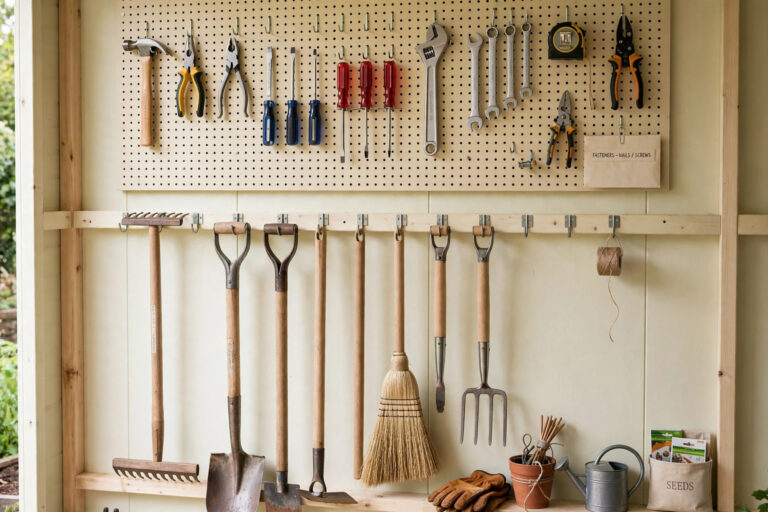
22 Kitchen Drawer Organization Ideas for 2026
Kitchen drawer organization is not about buying a pretty set of dividers. It is about opening a drawer and finding the thing you need in five seconds, in the dark, with wet hands, while the pan is on the stove — and the drawer that gives you the tongs in five seconds is the drawer that was sorted first and divided second, because a divider in a drawer full of things you do not use is just a tidy-looking tangle.
These 22 kitchen drawer organization ideas give every drawer a job and every thing a slot: empty the drawers and sort them into keep, move and bin, measure before you buy a single divider, and finish with a five-minute reset once a month — so the drawers stay tidy through real cooking, not just through the photograph.
Every idea below works in a real kitchen, from a one-drawer flat to a big family kitchen with deep drawers and a gadget habit. The cabinets above the drawers get the same treatment in 20 Kitchen Cabinet Organization Ideas for 2026, where the shelves and the cupboards are sorted with the same rules — and the pantry the drawers feed into is covered in 25 Pantry Organization Ideas for 2026, so the food and the tools stop fighting for the same space. Pick three ideas that fit your kitchen, start with the drawer you open most, and build from there.
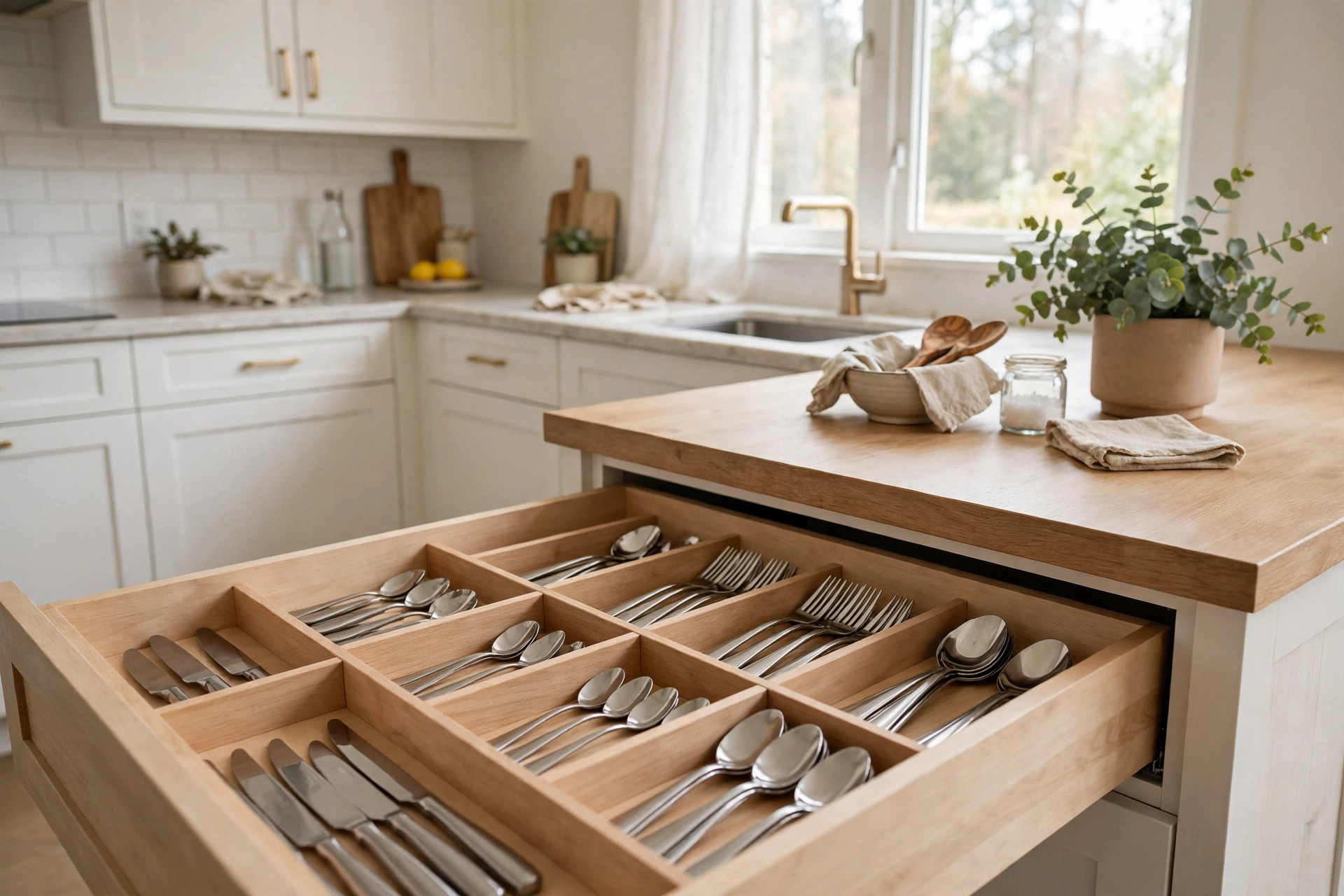
Start with the sort-out: empty, sort, keep
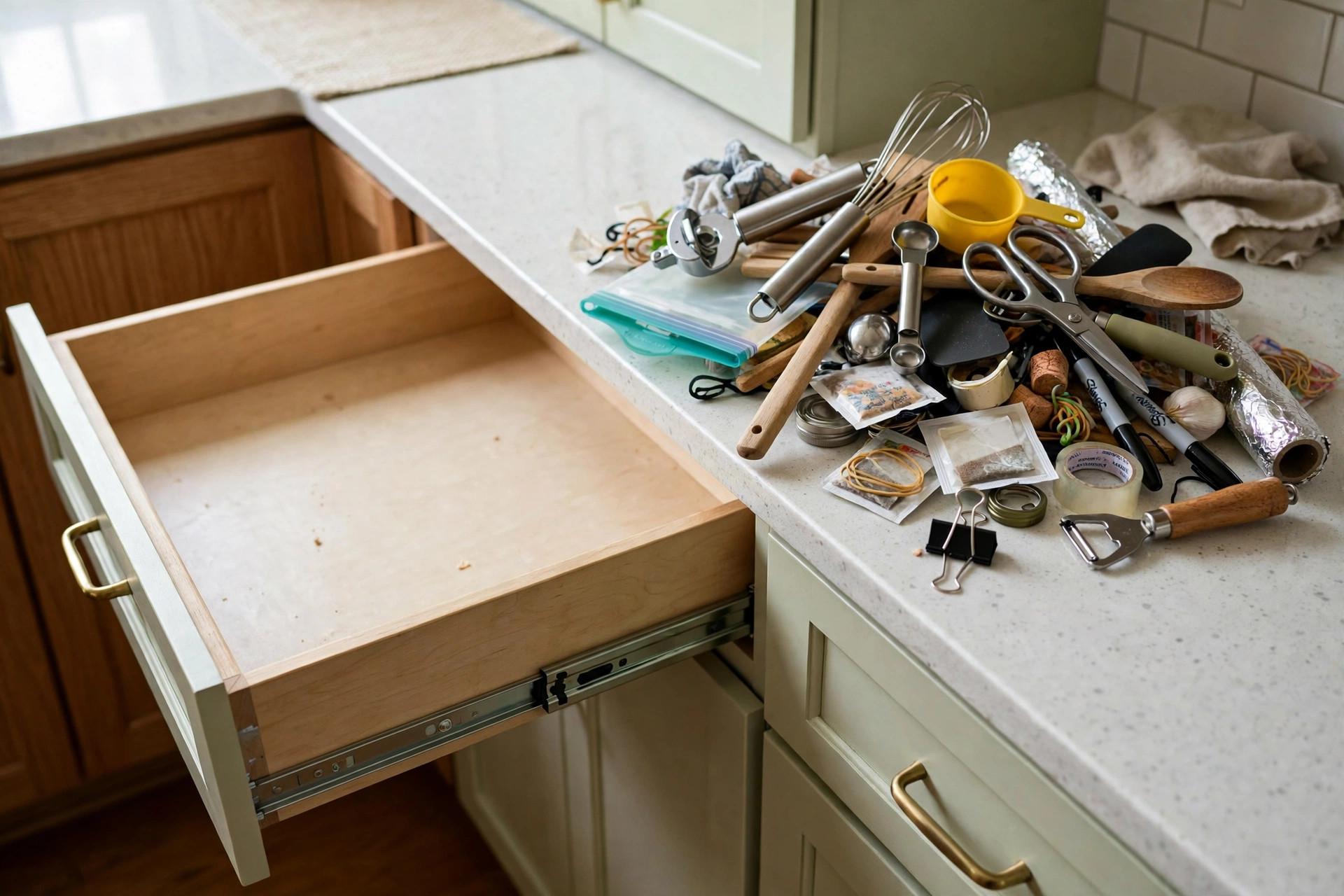
1. Empty every drawer first — the drawer that is empty is the drawer you can see
A drawer you organize without emptying is a drawer you never really see, because the things at the back stay at the back, the broken peeler stays under the good one, and the drawer that was never emptied is the drawer that still holds the gadget from two flats ago. Empty every drawer first — the drawer that is empty is the drawer you can see — so you can wipe the base, check the runners, and look at everything you own in one pile on the counter. Work one drawer at a time, because the kitchen with six empty drawers and dinner in an hour is the kitchen that gets everything shoved back in a panic. One drawer empty, one drawer sorted, and the system starts with a clean base.
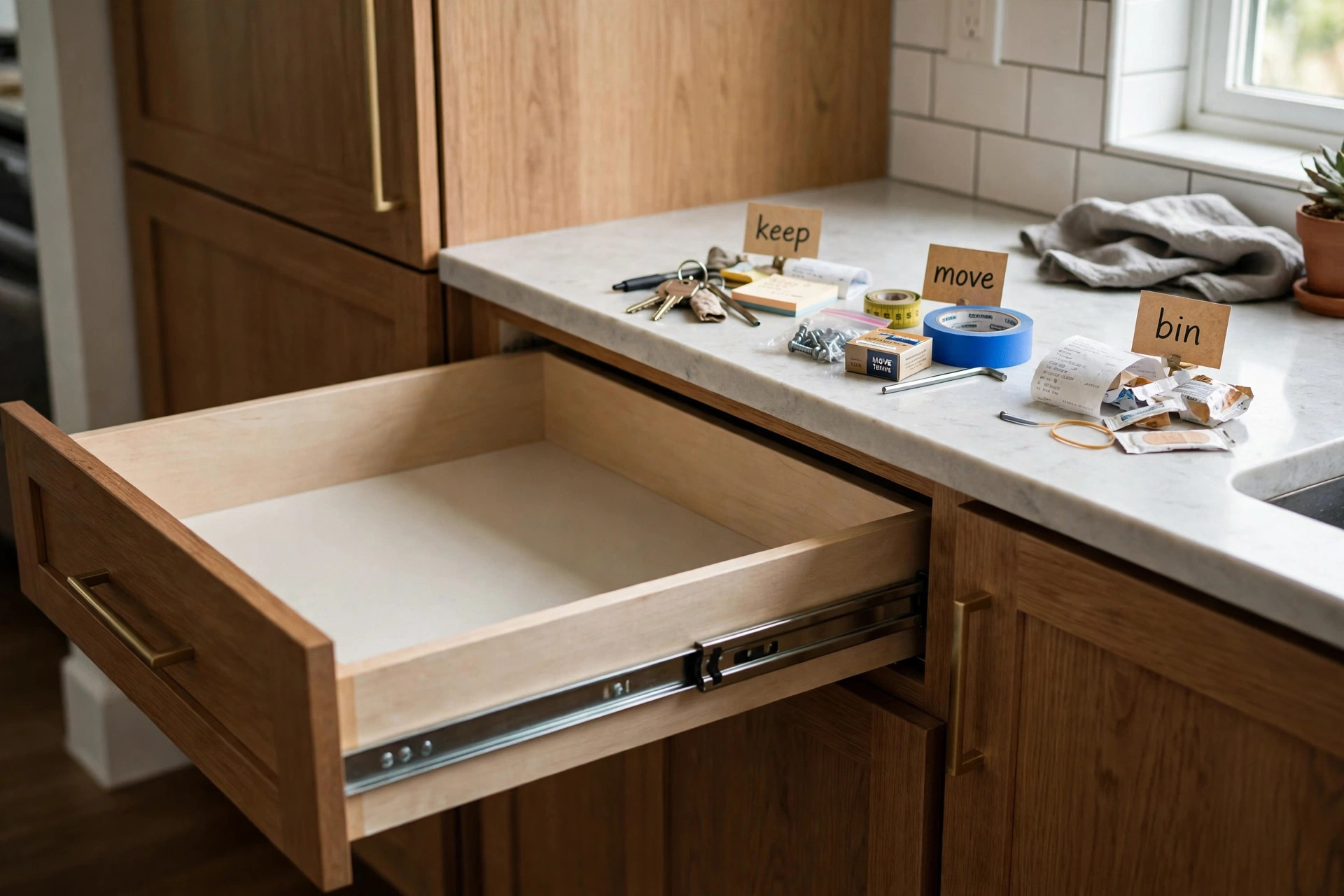
2. Sort into keep, move, bin — three piles on the kitchen counter
Everything that comes out of a drawer belongs in one of three piles, because the pile that is "maybe" is the pile that goes straight back in the drawer, and the drawer that gets its maybe pile back is the drawer that never changes. Sort into keep, move, bin — three piles on the kitchen counter — so the keep pile is the things you use every week, the move pile is the things that belong in another room, and the bin pile is the broken, the duplicate and the dried-out. Be ruthless with duplicates, because the kitchen with four wooden spoons and three whisks is the kitchen where the drawer is full and the cook still cannot find a spoon. Three piles, and the drawer keeps only what earns its place.
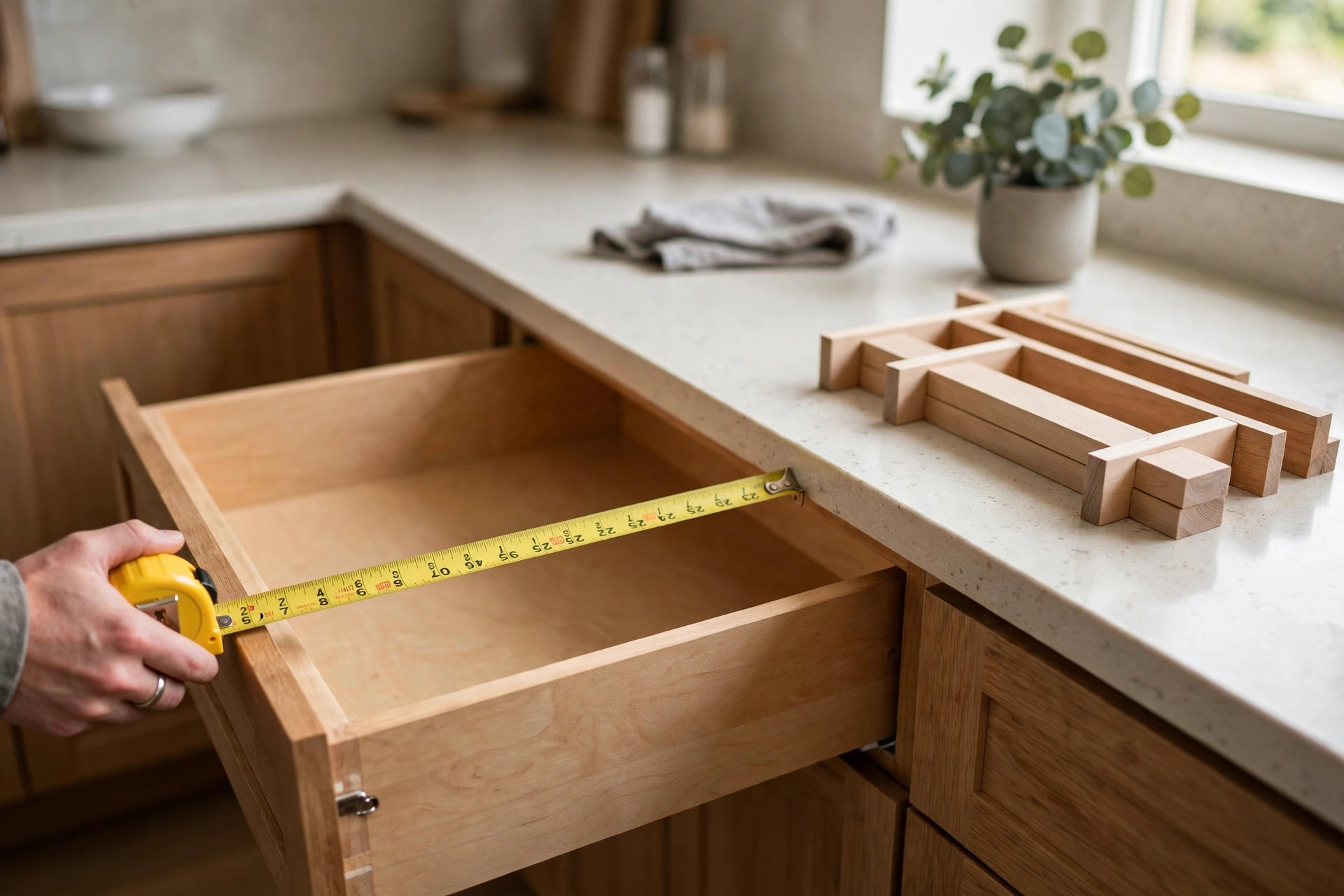
3. Measure before you buy a single divider — the tape measure saves the return trip
A divider bought without measuring is a divider that goes back to the shop, because the drawer that is 43 centimetres wide does not fit the 45-centimetre insert, the insert that is too tall stops the drawer closing, and the drawer that will not close is the drawer that gets its divider taken out by Friday. Measure before you buy a single divider — the tape measure saves the return trip — and write the width, depth and height of every drawer on a card you take to the shop. Measure the inside, not the front, because the front of the drawer is wider than the box it slides into, and the centimetre you forget is the centimetre that makes the divider useless. One tape measure, one card, and every divider you buy fits the first time.
4. One drawer, one job — the drawer that does one thing never tangles
A drawer that holds cutlery, batteries, string and a spare light bulb is a drawer that holds a junk drawer in disguise, because the things in it have nothing in common, they slide into each other, and the drawer that does everything is the drawer that does nothing tidily. Give each drawer one job — the drawer that does one thing never tangles — so the top drawer is cutlery, the next is utensils, and the deep drawer is pans, and nothing else crosses the line. The job should match the spot, because the drawer beside the cooker is the drawer for the cooking tools, and the drawer beside the sink is the drawer for the cloths and the washing-up things. One job per drawer, and the tangle has nowhere to start.
5. Give the junk drawer a job — the drawer that holds the odds and ends, on purpose
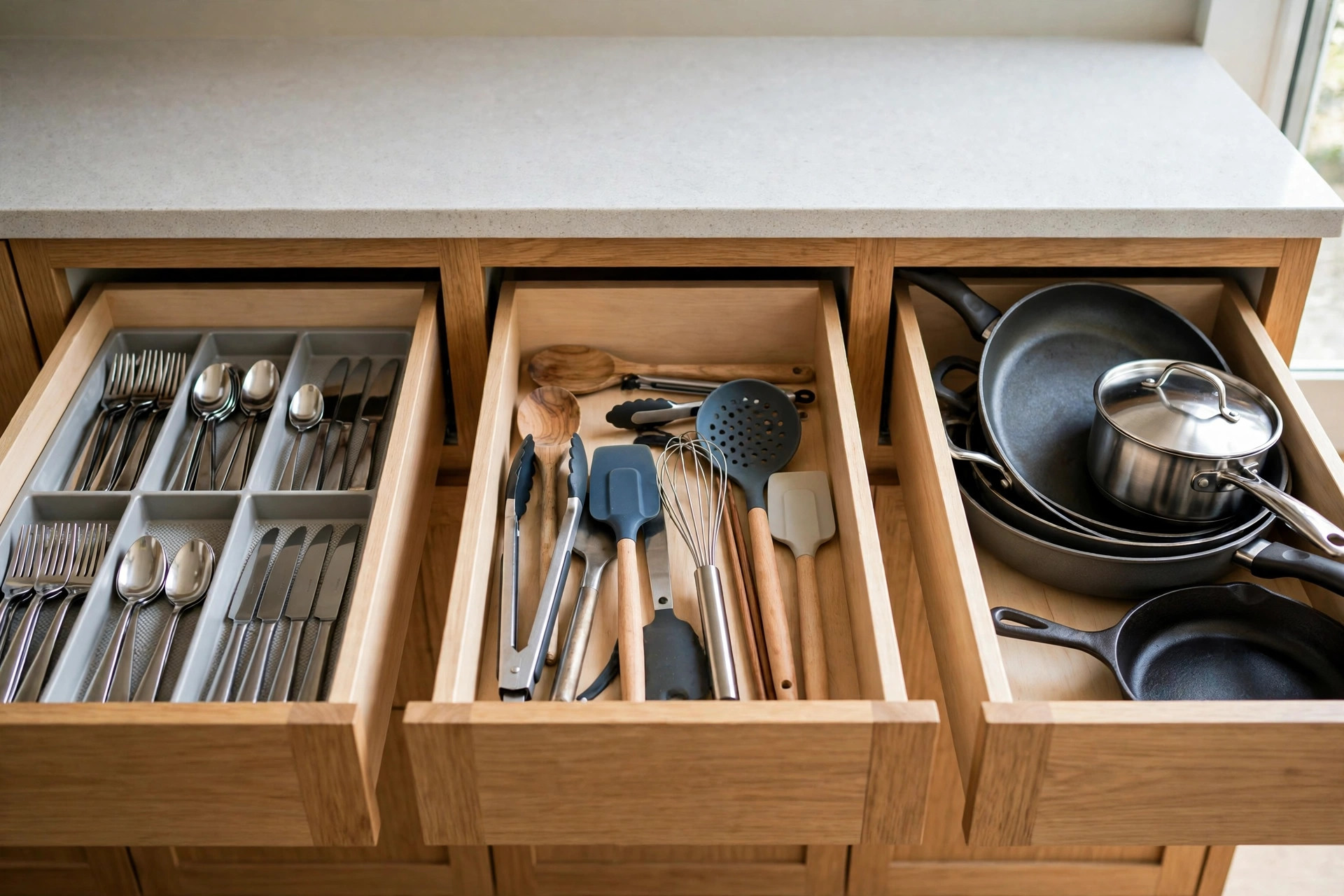
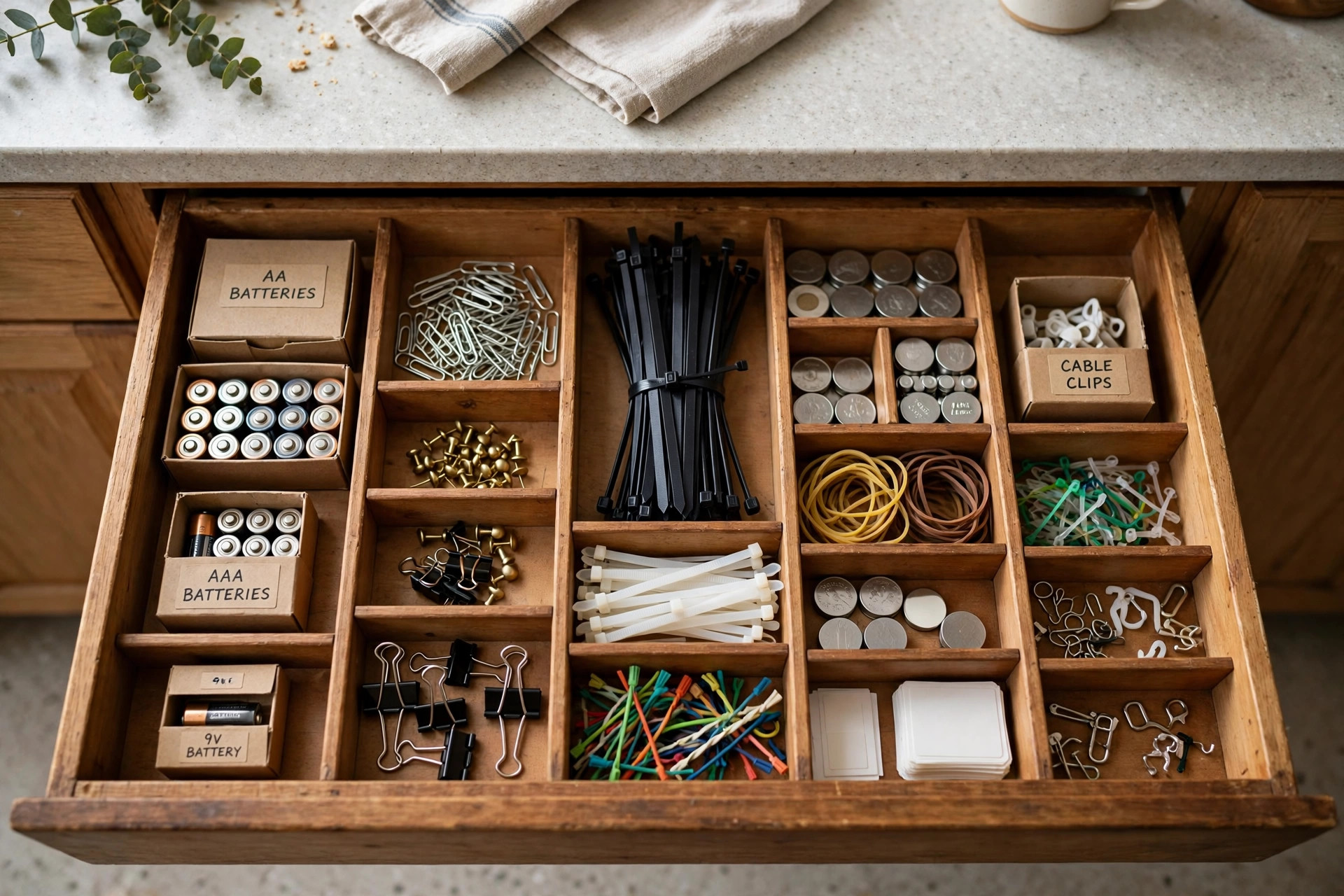
Every kitchen has a junk drawer, and the kitchen that pretends it does not is the kitchen where the junk lives in every drawer instead, because the batteries, the string and the spare keys have to live somewhere, and the drawer with no job is the drawer they all end up in. Give the junk drawer a job — the drawer that holds the odds and ends, on purpose — so one drawer, and only one, is allowed to hold the small things that belong nowhere else. Put small boxes inside it, because the junk drawer with boxes is a drawer with slots, and the junk drawer without them is a drawer with a pile. Cap it at one drawer, because the second junk drawer is the sign the first one is not working. One junk drawer, on purpose, and the rest of the kitchen stays clean.
6. Match every lid to its base — the lid that has no base leaves the drawer
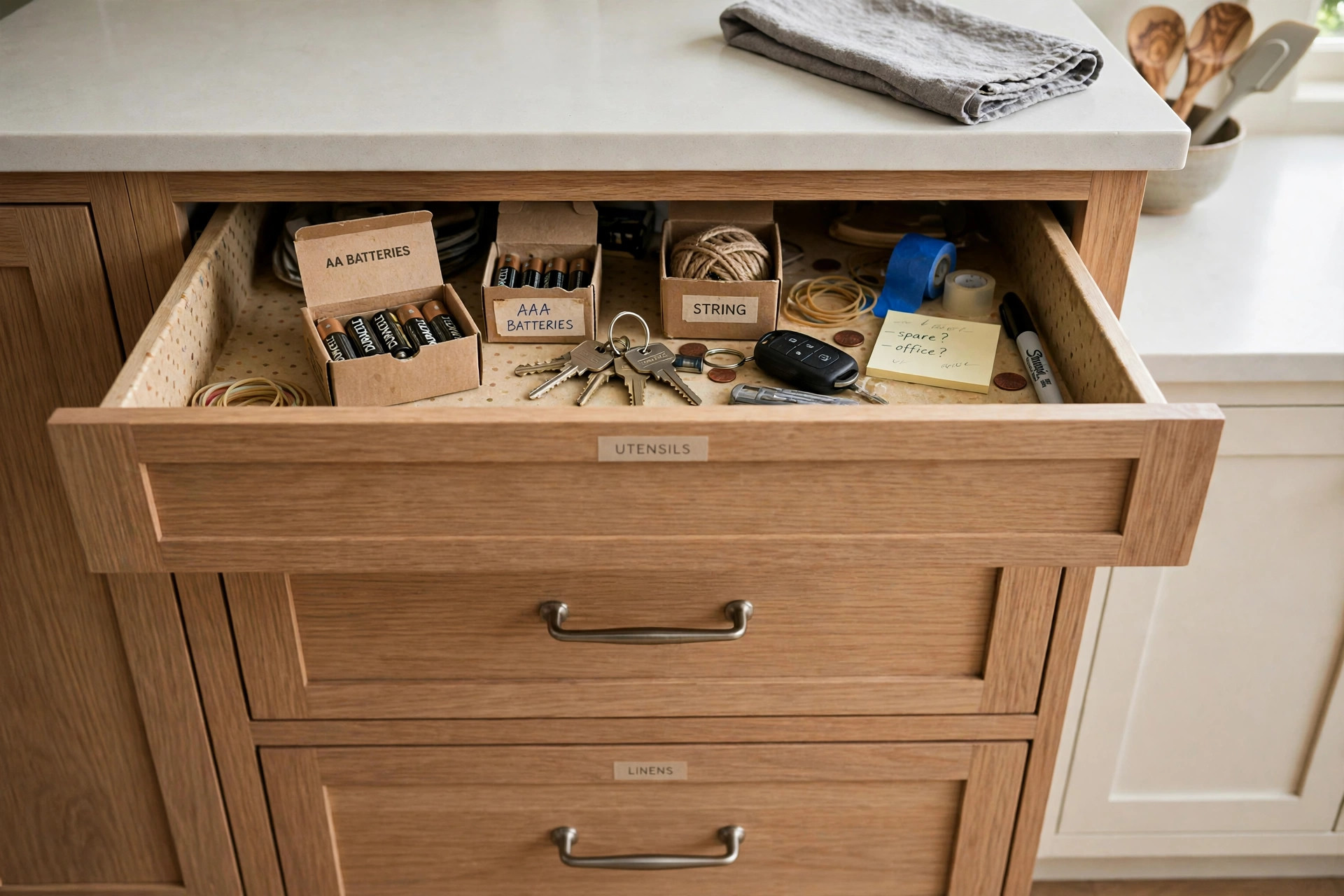
Lids are the drawer clutter that multiplies on its own, because the lid from the container that cracked is still in the drawer, the lid from the takeaway tub is still in the drawer, and the drawer that holds lids without bases is the drawer that holds nothing useful. Match every lid to its base — the lid that has no base leaves the drawer — and do it on the counter, not in the drawer, because the matching game needs space and the drawer does not have it. Keep the pairs together once they are matched, because the lid that is stored with its base is the lid that is found with its base, and the lid that is stored alone is the lid that is lost. Every lid matched, every orphan binned, and the drawer breathes again.
Dividers and inserts: a place for everything
7. Adjustable dividers that move with you — the divider that fits the drawer, not the other way round
A fixed tray is a tray that fits one drawer and one layout, because the drawer changes when the cooking changes, the tray that cannot move is the tray that gets in the way, and the drawer that cannot change is the drawer that stops working by summer. Use adjustable dividers — the divider that fits the drawer, not the other way round — so the sections slide to fit the drawer you have and the things you actually own. Spring-loaded dividers grip the sides without screws, bamboo ones slide and lock, and both let you re-divide the drawer in a minute when a new gadget arrives, because the divider that moves is the divider that lasts. Measure first, then buy the adjustable set, because the adjustable divider in the wrong-sized drawer is still the wrong divider. One set of dividers that moves, and the drawer changes with you. (Check on Amazon for adjustable bamboo drawer dividers, spring-loaded, sized to your drawer measurements from idea 3.)
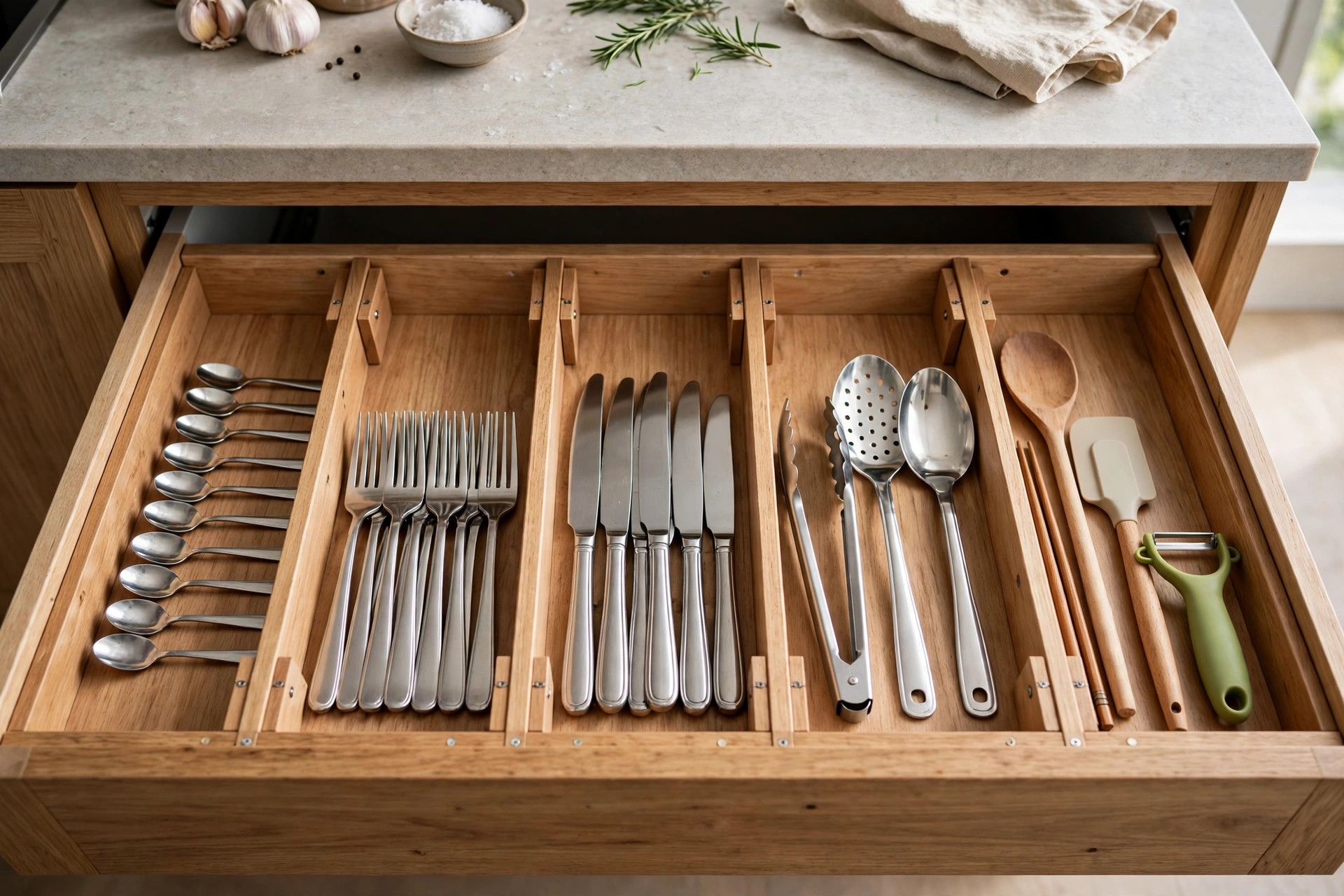
8. A cutlery tray that actually fits — the tray that leaves no gap at the back
A cutlery tray that is too small leaves a gap at the back, and the gap at the back is the gap where the spare teaspoons fall, the chopsticks slide, and the tray that does not fit is the tray that slowly fills the drawer with loose cutlery anyway. Buy a tray that actually fits — the tray that leaves no gap at the back — and fill the leftover centimetres with a small box for the odd pieces, because the drawer with no gaps is the drawer where nothing slides. Expandable trays work well in wide drawers, and a tray with a deep section for the serving spoons stops the big things from sitting on top of the small ones. The tray should sit flat and stay put, because the tray that slides when the drawer opens is the tray that dumps the cutlery. One tray that fits, and the forks stay in their lane.
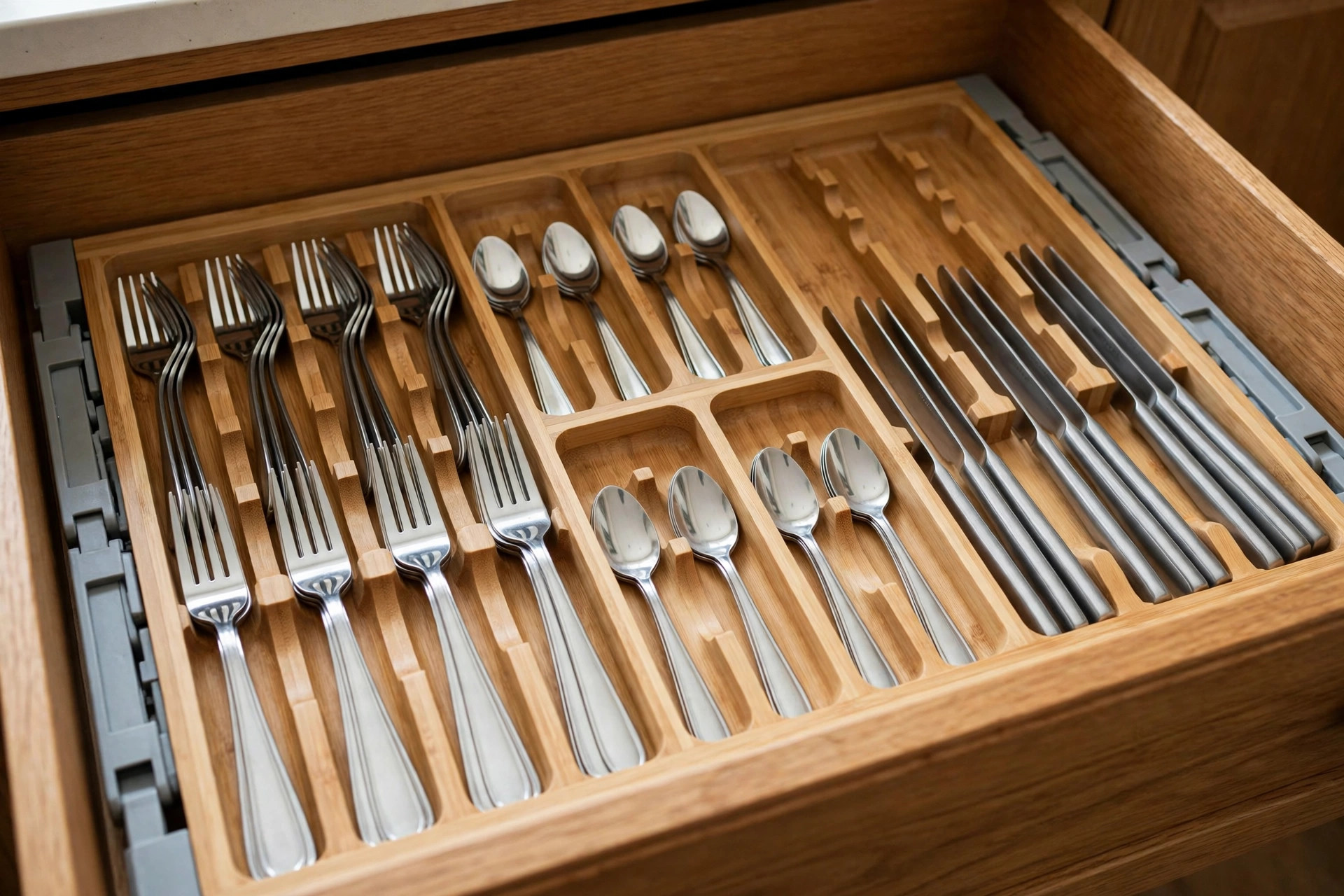
9. Knives in the drawer, safely — an in-drawer knife block, blades down
Knives loose in a drawer are the most dangerous thing in the kitchen, because the hand that reaches for a spoon finds a blade, the blade that is loose dulls itself on the other cutlery, and the drawer that holds loose knives is the drawer nobody opens without looking first. Put the knives in the drawer safely — an in-drawer knife block, blades down — so every knife sits in its own slot with the handle up and the edge protected. The block should fit the drawer snugly so it does not slide, and the knives should go in blade-down so the edge never touches the wood, because the knife that is stored right is the knife that stays sharp and the hand that stays safe. A knife roll works for a small drawer, and a magnetic strip on the wall is the alternative when the drawer is too shallow. One block, blades down, and the drawer is safe to open. (Check on Amazon for an in-drawer knife block sized to your drawer — measure the depth first, per idea 3.)
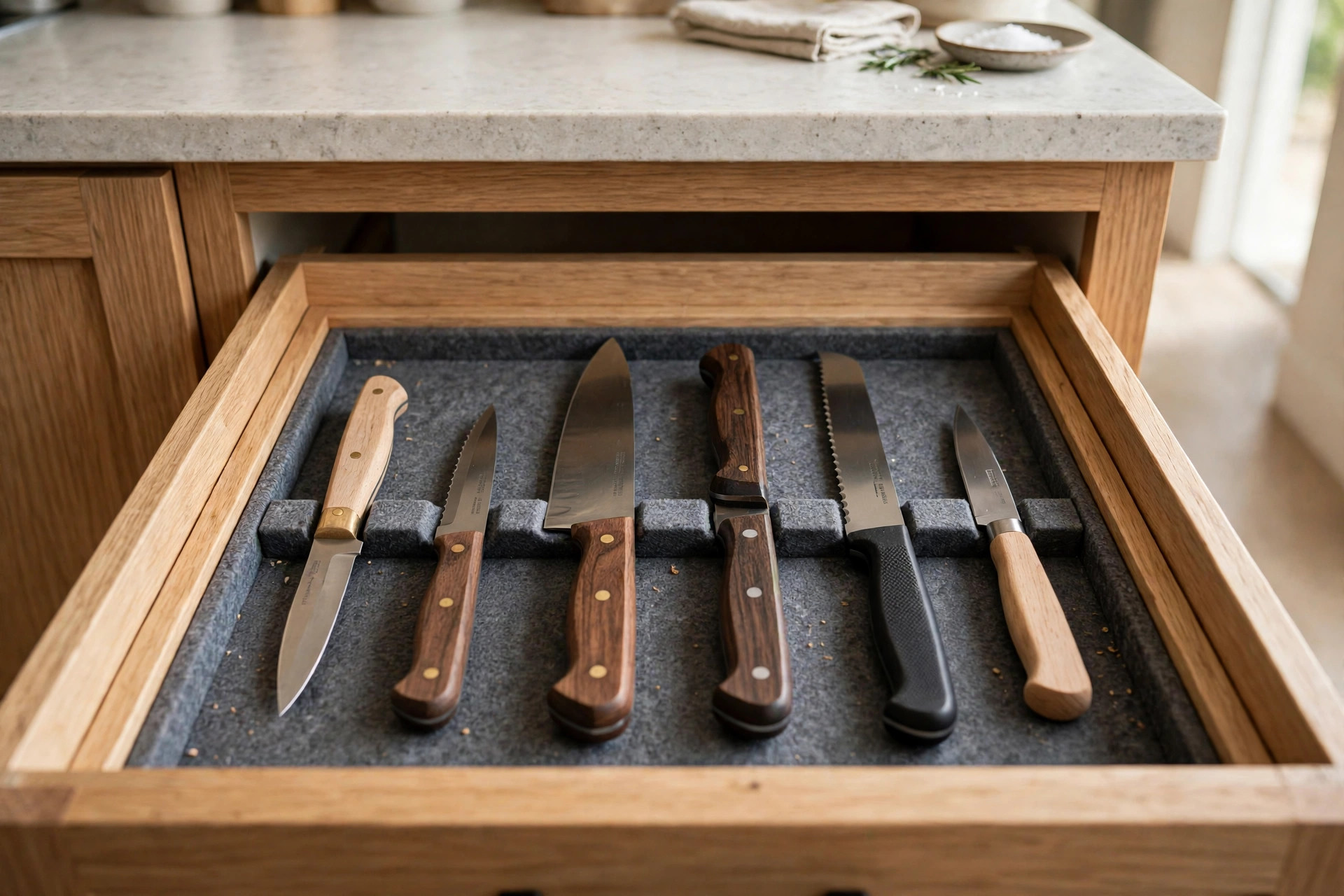
10. Deep-drawer inserts for lids and pans — lids standing up, not stacked flat
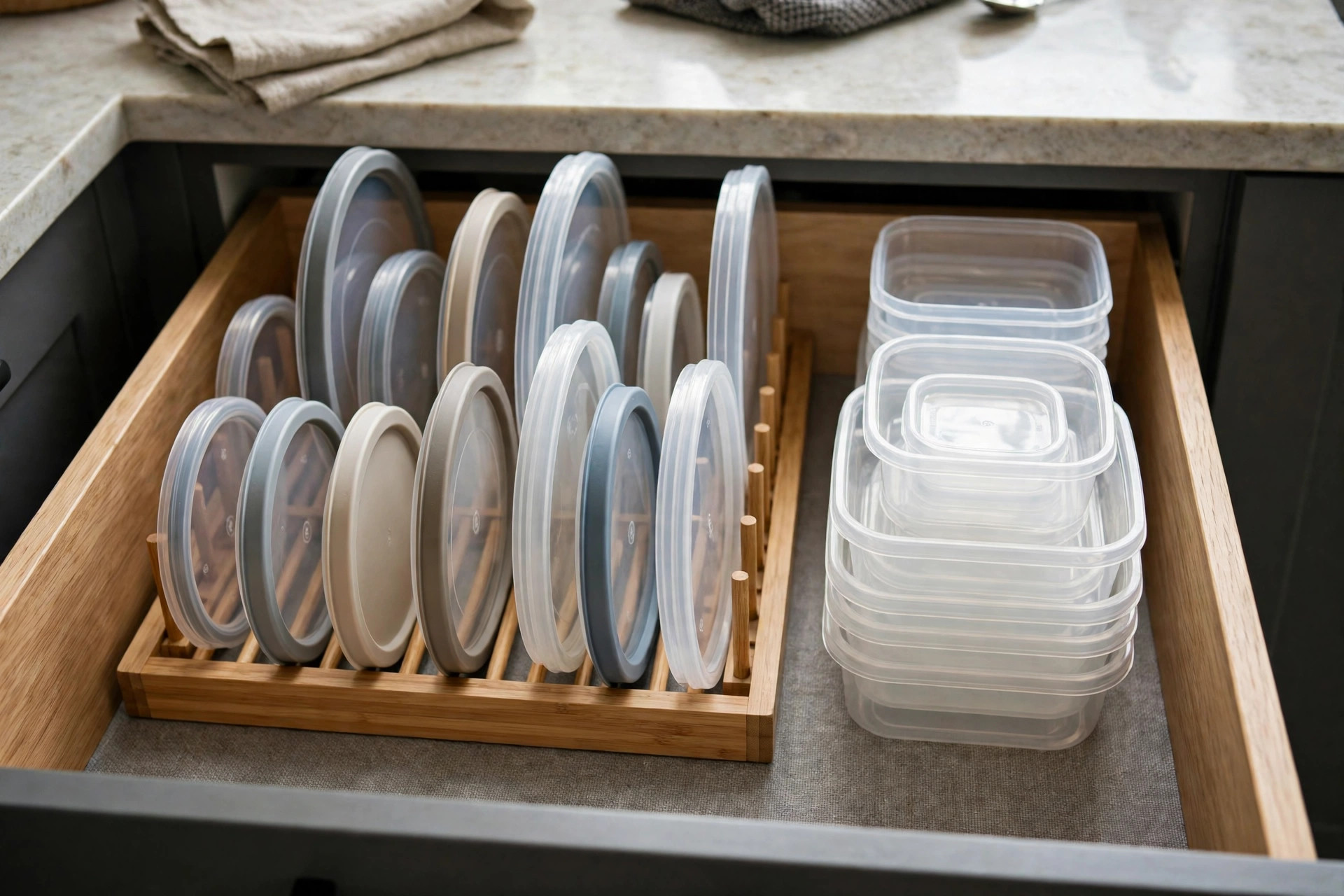
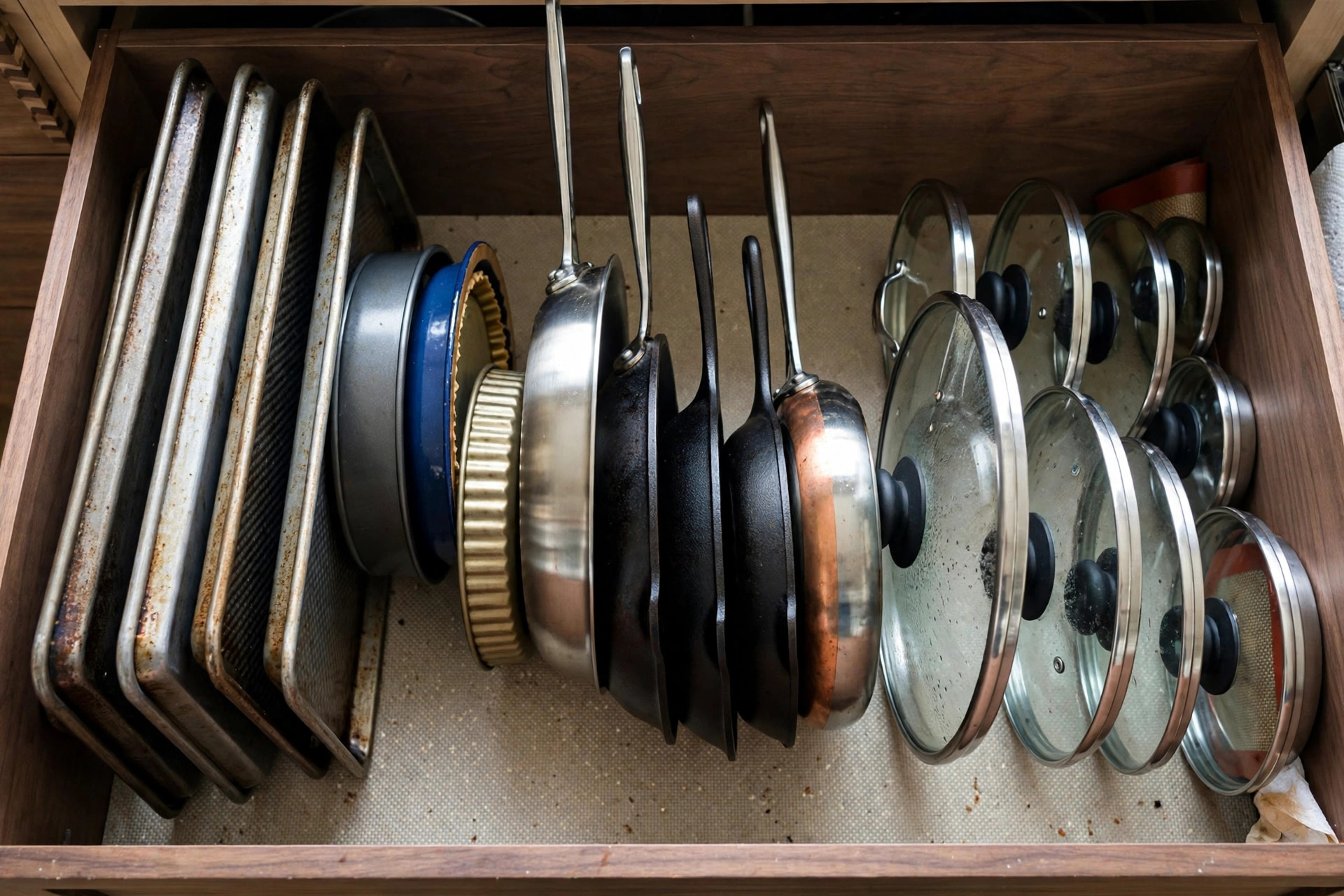
A deep drawer full of pans stacked flat is a drawer where the pan you want is always at the bottom, because the stack has to come out to reach it, the lids slide off the top, and the drawer that holds a stack is the drawer that makes cooking a lifting exercise. Use deep-drawer inserts — lids standing up, not stacked flat — so the lids stand in a row like books on a shelf and the pans sit beside them, each one liftable without moving the others. Vertical dividers or a simple lid rack turn the deep drawer into a shelf you pull out, because the drawer that works vertically is the drawer that holds twice as much without a pile. Keep the heaviest pan at the bottom of its own section, because the heavy pan on top of the light one is the pan that dents it. Lids up, pans beside them, and the deep drawer works like a cupboard.
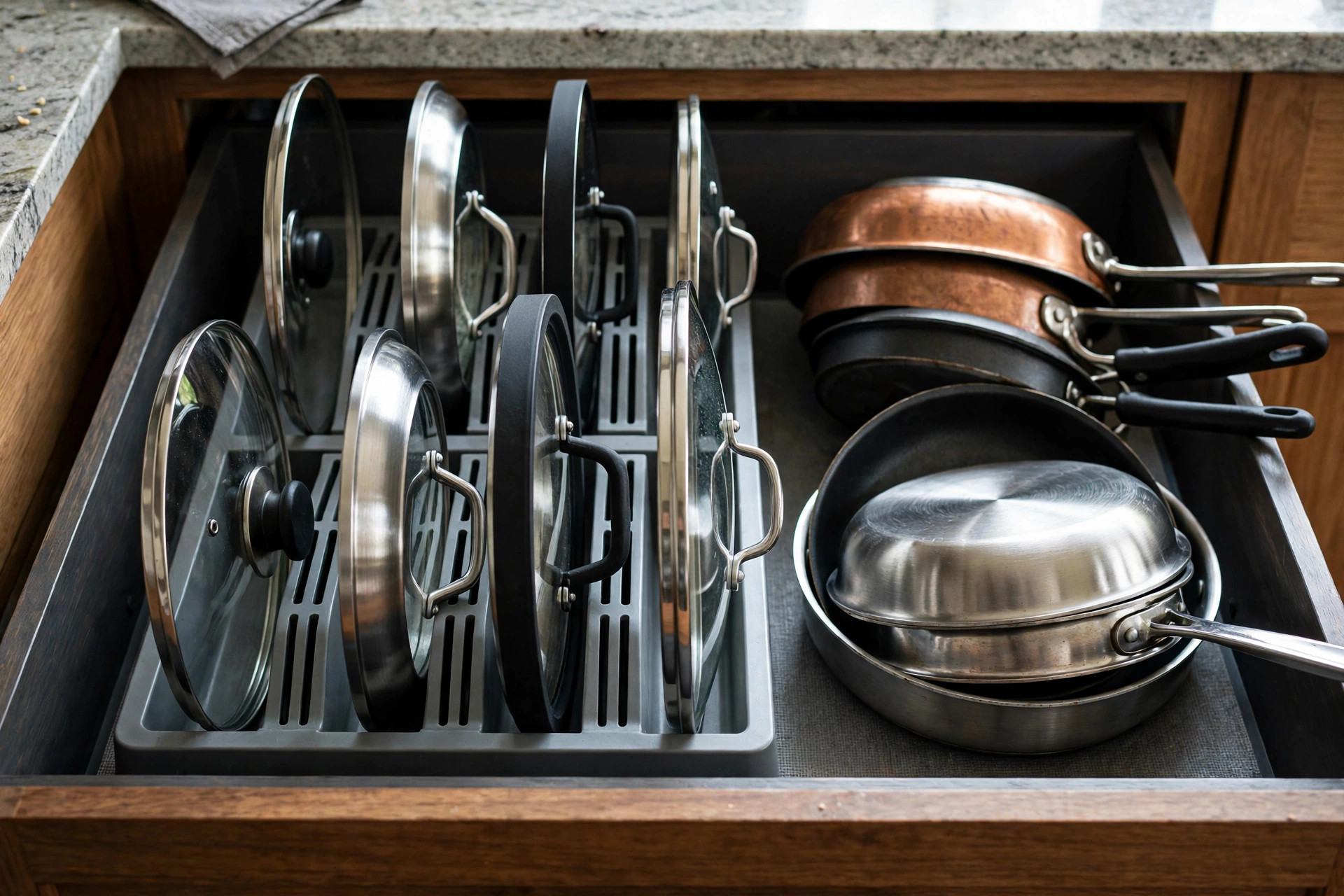
11. Small boxes for the small things — clips, ties, batteries and spare parts in their own slots
The small things in a kitchen drawer are the things that vanish first, because the bag clip is under the tea towel, the battery is under the string, and the drawer that holds small things loose is the drawer where small things go to hide. Put small boxes inside the drawer — clips, ties, batteries and spare parts in their own slots — so every small thing has a box the size of itself and the box stops it sliding. Little trays, jam jars without lids, or the small boxes that came with a phone all work, because the box that fits the thing is the box that keeps it findable. Label the boxes if the drawer is shared, because the box that is labelled is the box the rest of the family puts things back into. Small boxes, small slots, and the small things stop disappearing.
The hard drawers: utensils, gadgets, spices
12. Utensils by use, not by type — the drawer sorted the way you cook
A utensil drawer sorted by type puts the whisk with the whisk and the spatula with the spatula, and the cook who needs the whisk, the spatula and the tongs for one dish is the cook opening three sections and closing none of them. Sort utensils by use, not by type — the drawer sorted the way you cook — so the everyday cooking tools live together in one section, the baking tools live together in another, and the serving tools live in a third. The test is the meal: if one dish needs tools from three sections, the sections are wrong, because the drawer that matches the cooking is the drawer that works in the middle of it. Put the tools you reach for while the pan is hot nearest the front, because the drawer that puts the hot-pan tools at the back is the drawer that burns the cook. Sorted by use, and the drawer works the way dinner works.
13. Tame the gadget drawer — one gadget in, one gadget out
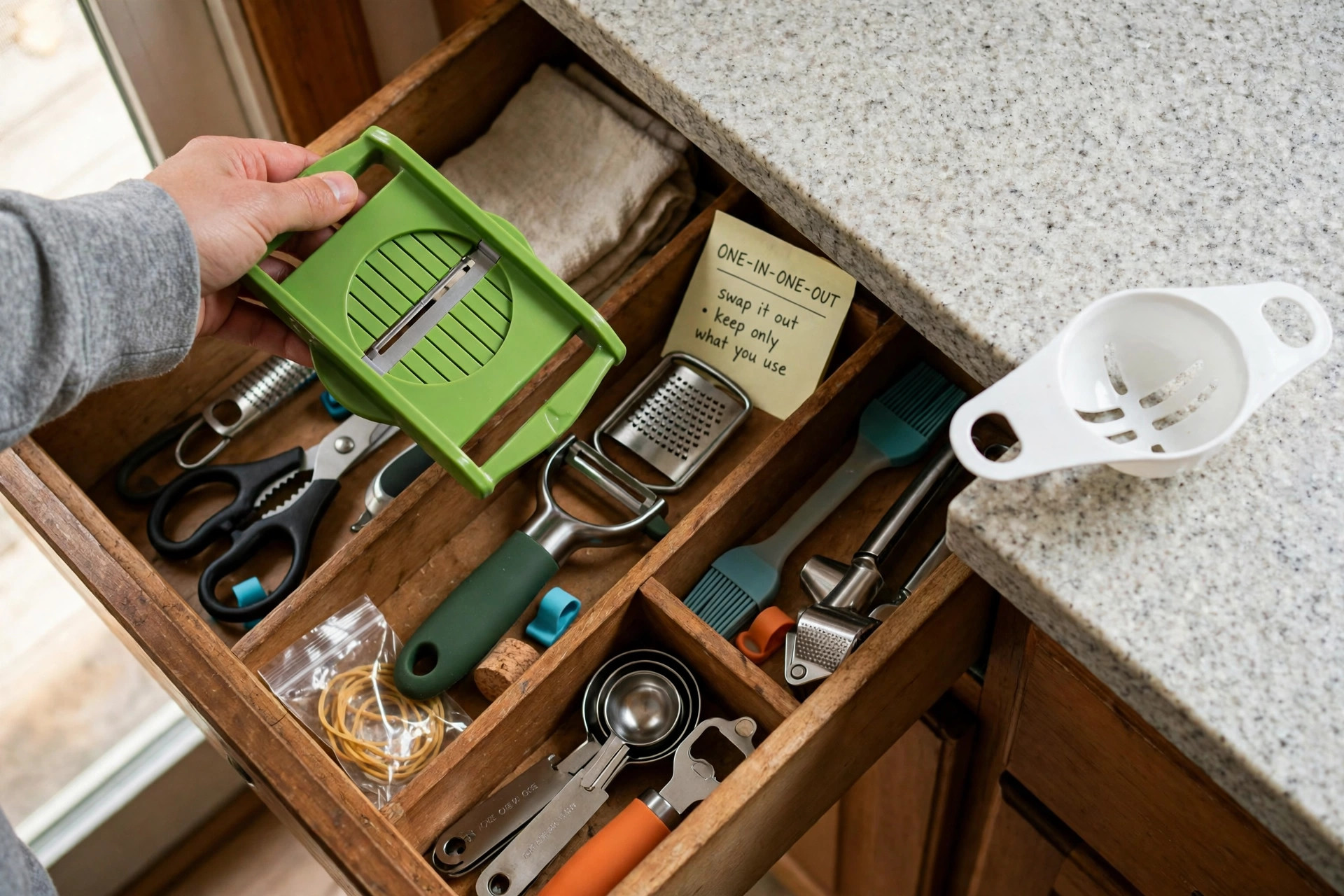
The gadget drawer is the drawer that grows on its own, because the avocado slicer arrives, then the egg separator, then the garlic press that does the same job as the knife, and the drawer that holds every gadget is the drawer that holds none of them findable. Tame the gadget drawer — one gadget in, one gadget out — so every new gadget costs an old one its place, and the drawer only ever holds the gadgets that earn their keep. Ask the question honestly: did you use it in the last month, and would you miss it if it went, because the gadget that is used once a year is the gadget that belongs in a box on a high shelf, not in the drawer you open every day. The cooking drawer beside the cooker is covered in 25 Fridge Organization Ideas for 2026 in the same spirit — the tools that serve the food you actually cook, not the food you imagine cooking. One in, one out, and the gadget drawer stops growing.
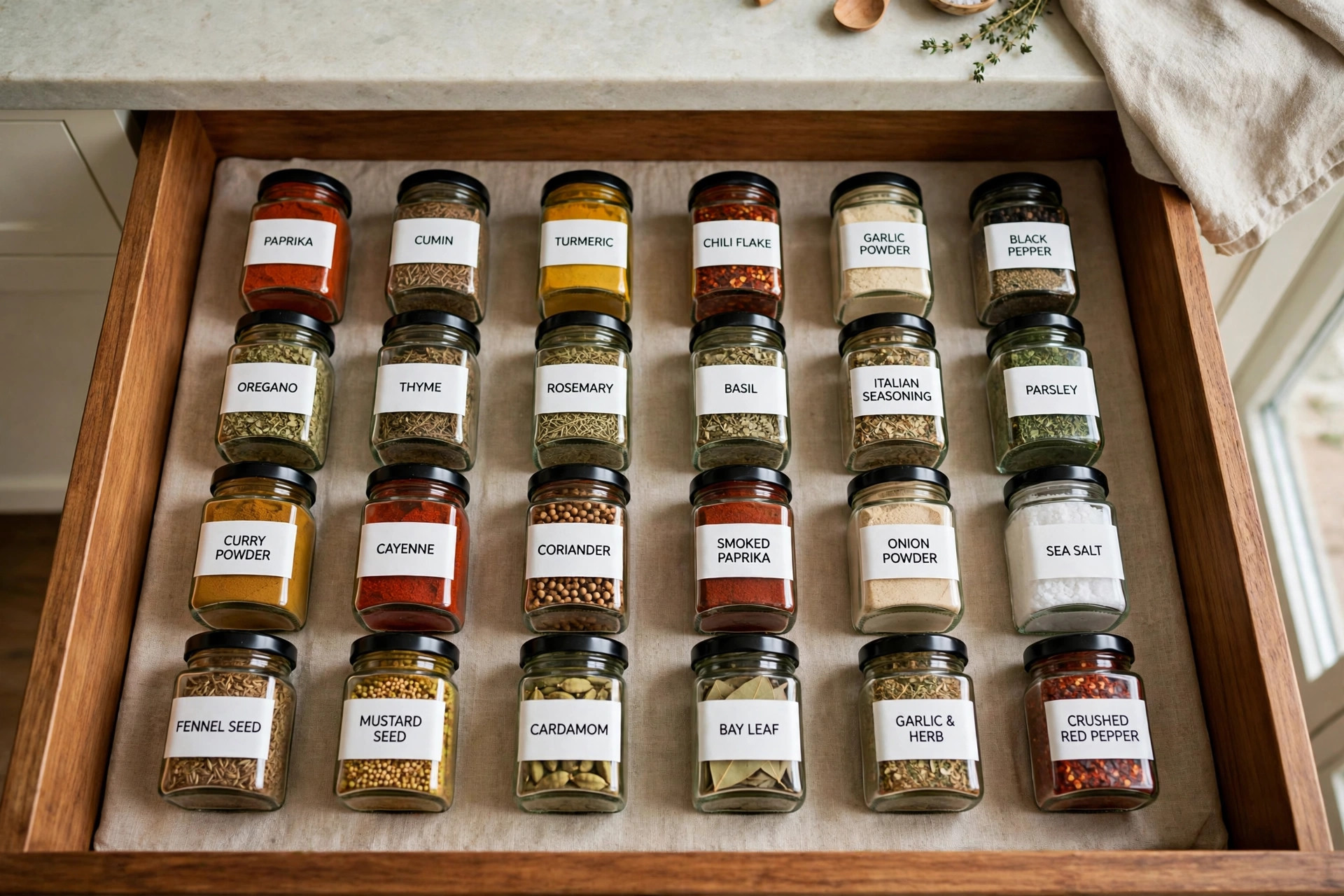
14. Spices flat in a drawer — labels facing up, every jar findable
Spices in a cupboard are spices you cannot see, because the jar you want is behind the jar you never use, the cupboard that holds spices is the cupboard where jars fall out when the door opens, and the cook who cannot see the cumin is the cook who buys a second jar of cumin. Put the spices flat in a drawer — labels facing up, every jar findable — so the whole collection is visible in one pull, like a spice shop laid out in front of you. Use small inserts or a stepped rack inside the drawer so the jars lie at a slight angle and the labels face up, because the jar that lies flat with its label up is the jar you read without picking it up. Keep the everyday spices nearest the front and the rare ones at the back, because the drawer that puts the paprika at the back is the drawer that wastes the cook's time. The wider spice system — the jars, the refills, the pantry shelf — is covered in 22 Spice Storage Ideas for 2026, where the drawer is one part of a bigger plan. Spices flat, labels up, and the cumin is always there. (Check on Amazon for spice drawer inserts with a stepped or angled base, sized to your drawer.)
15. Tea towels and cloths folded in a drawer — the drawer that replaces the towel rail
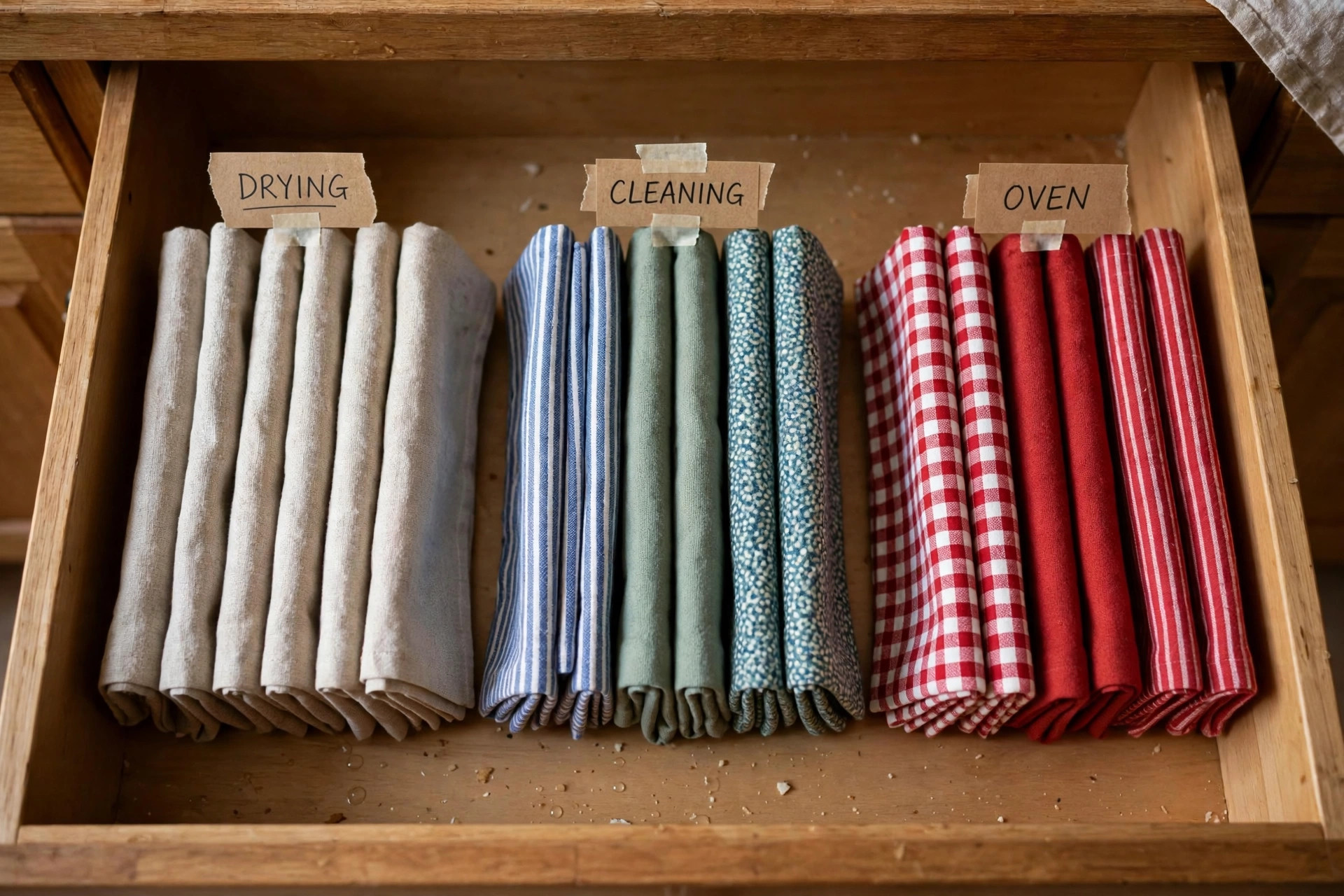
Tea towels on a rail are tea towels in the way, because the rail holds two, the drawer holds twelve, and the towel that is always damp is the towel that never dries on a crowded rail. Fold the tea towels and cloths in a drawer — the drawer that replaces the towel rail — so the clean ones stand in a row, folded in thirds, and the cook pulls the top one without unfolding the rest. Sort them by job, because the drying towel, the cleaning cloth and the oven cloth are three different tools, and the drawer that mixes them is the drawer that hands you a greasy cloth for a clean plate. Keep the dirty ones out of the drawer entirely, because the drawer that holds the dirty cloth is the drawer that smells of it by Friday. Towels folded, cloths sorted, and the rail holds only the towel in use.
16. A baking drawer — measuring cups, spoons and baking tools in one place
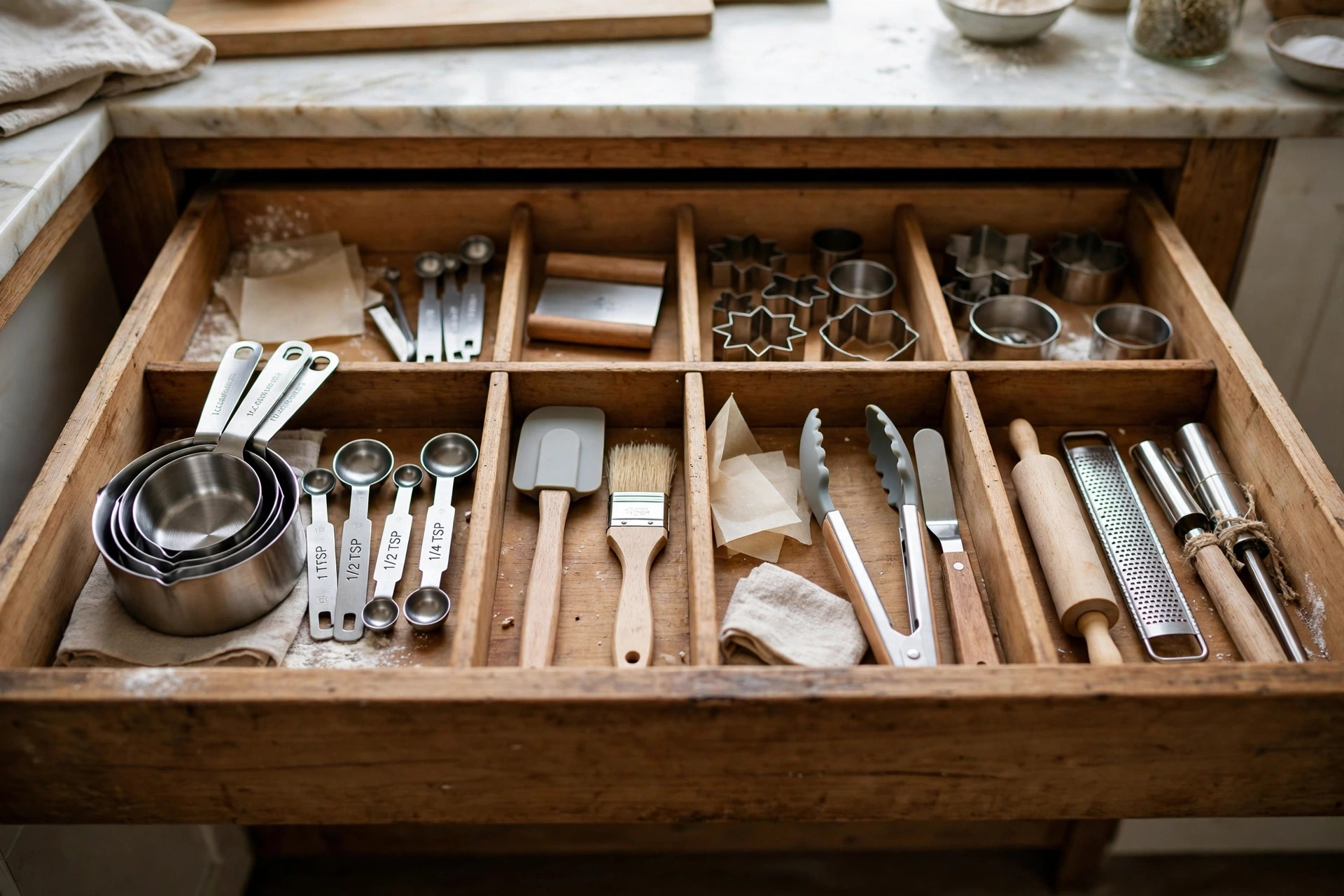
Baking tools scattered through the kitchen are baking tools you cannot find when the oven is hot, because the measuring cups are in the utensil drawer, the baking powder is in the pantry, and the baker who hunts for the teaspoon is the baker whose cake sinks while they look. Make a baking drawer — measuring cups, spoons and baking tools in one place — so the whole baking kit lives in the drawer nearest the worktop where you bake. Put the cups and spoons in one section, the piping tips and the cutters in another, and the small scales on top, because the drawer that holds the whole kit is the drawer that makes baking start in five minutes. The freezer the baking drawer feeds — the frozen berries, the spare butter — is organized the same way in 20 Freezer Organization Ideas for 2026. One baking drawer, and the cake starts on time.
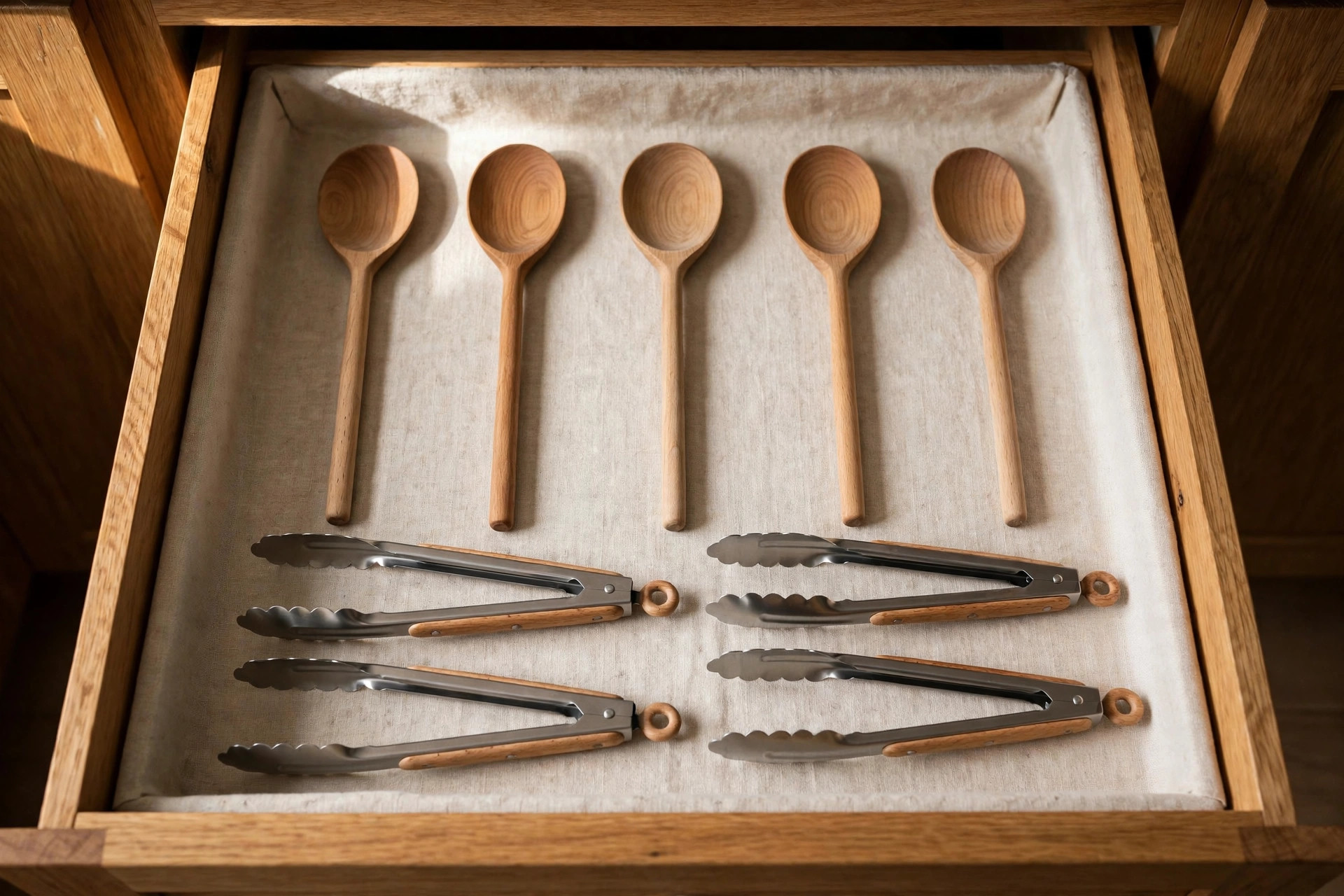
17. The "while cooking" drawer — tongs, timers and thermometers within arm's reach
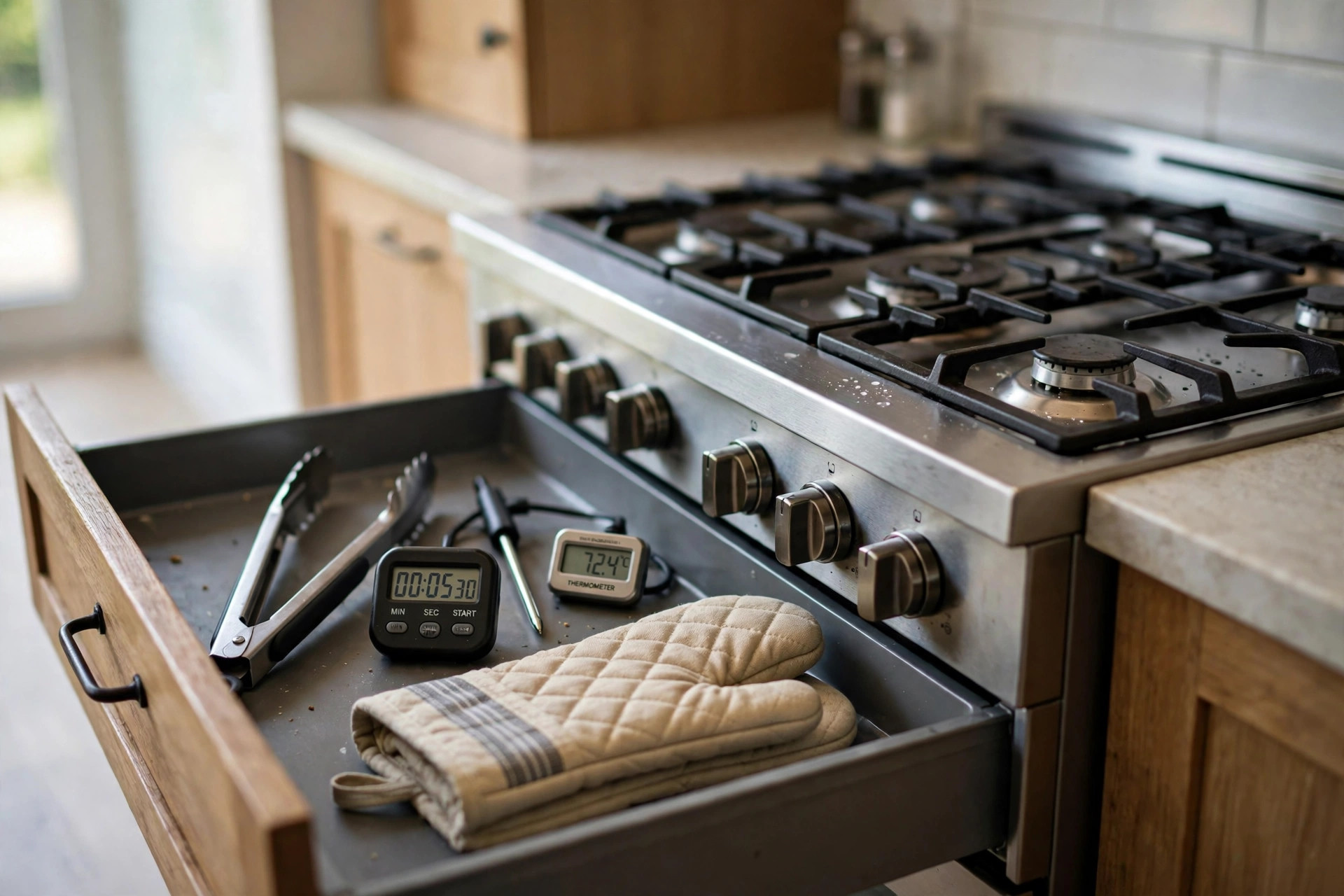
The tools you need while food is cooking are the tools you need fast, because the pan is hot, the timer is beeping, and the cook who has to open three drawers to find the tongs is the cook whose dinner burns while they look. Keep a "while cooking" drawer — tongs, timers and thermometers within arm's reach — in the drawer closest to the cooker, so the tools that save dinner are the tools that are already in your hand. The tongs, the timer, the thermometer and the oven glove live here and nowhere else, because the drawer that holds the cooking tools is the drawer that is opened with one hand while the other holds the pan. The lazy Susan in the corner cabinet beside the cooker works the same way, and 21 Lazy Susan Organization Ideas for 2026 shows how the rotating shelf keeps the cooking oils and sauces just as close. One drawer by the cooker, and dinner never waits for a tool.
Systems that keep drawers tidy
18. Label the dividers — the label that stops the drift
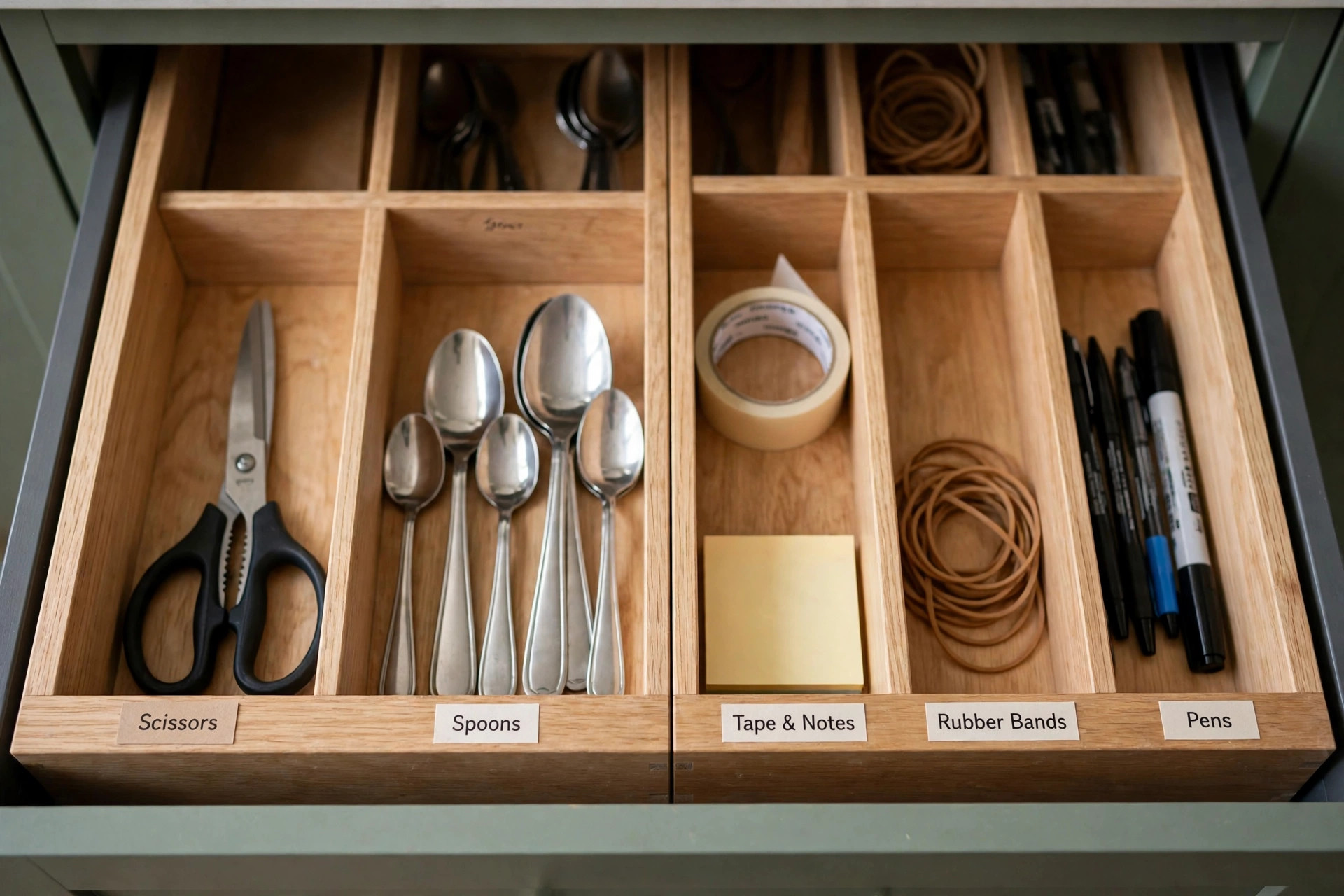
A divided drawer without labels is a divided drawer that drifts, because the family puts the scissors where the spoons go, the spoons where the scissors go, and the drawer that has no labels is the drawer that is back to a tangle by the end of the week. Label the dividers — the label that stops the drift — so every section says what lives in it and the person putting things away does not have to guess. Small labels on the front edge of each divider work best, because the label on the front is the label you see when the drawer opens, and the label on the bottom is the label you never see at all. Use pictures for young children, because the child who cannot read the word can still match the picture of the spoon. Labelled dividers, and the drawer puts itself away.
19. The one-in, one-out rule — the drawer that never overflows again
A drawer stays tidy until the day something new arrives, because the new gadget goes in, nothing comes out, and the drawer that gains one thing a month is the drawer that overflows by Christmas. Keep the one-in, one-out rule — the drawer that never overflows again — so every new thing that enters a drawer costs an old thing its place, and the drawer never holds more than it was divided to hold. The rule works best when it is said out loud, because the family that knows the rule is the family that stops bringing home the third garlic press, and the drawer that has a rule is the drawer that keeps its shape. One in, one out, and the drawers stay the size you divided them to be.
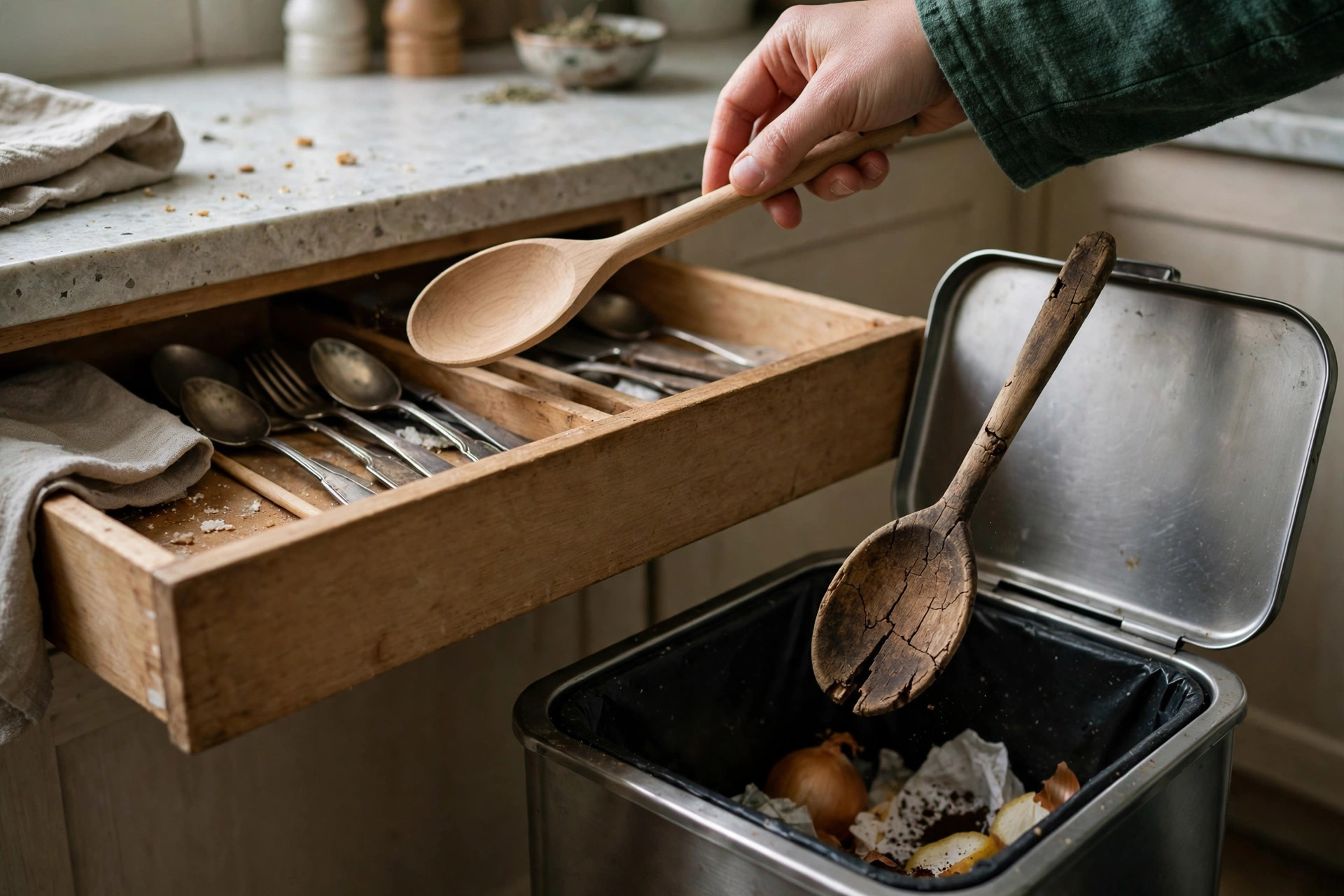
20. A monthly drawer reset — five minutes, one drawer, every month
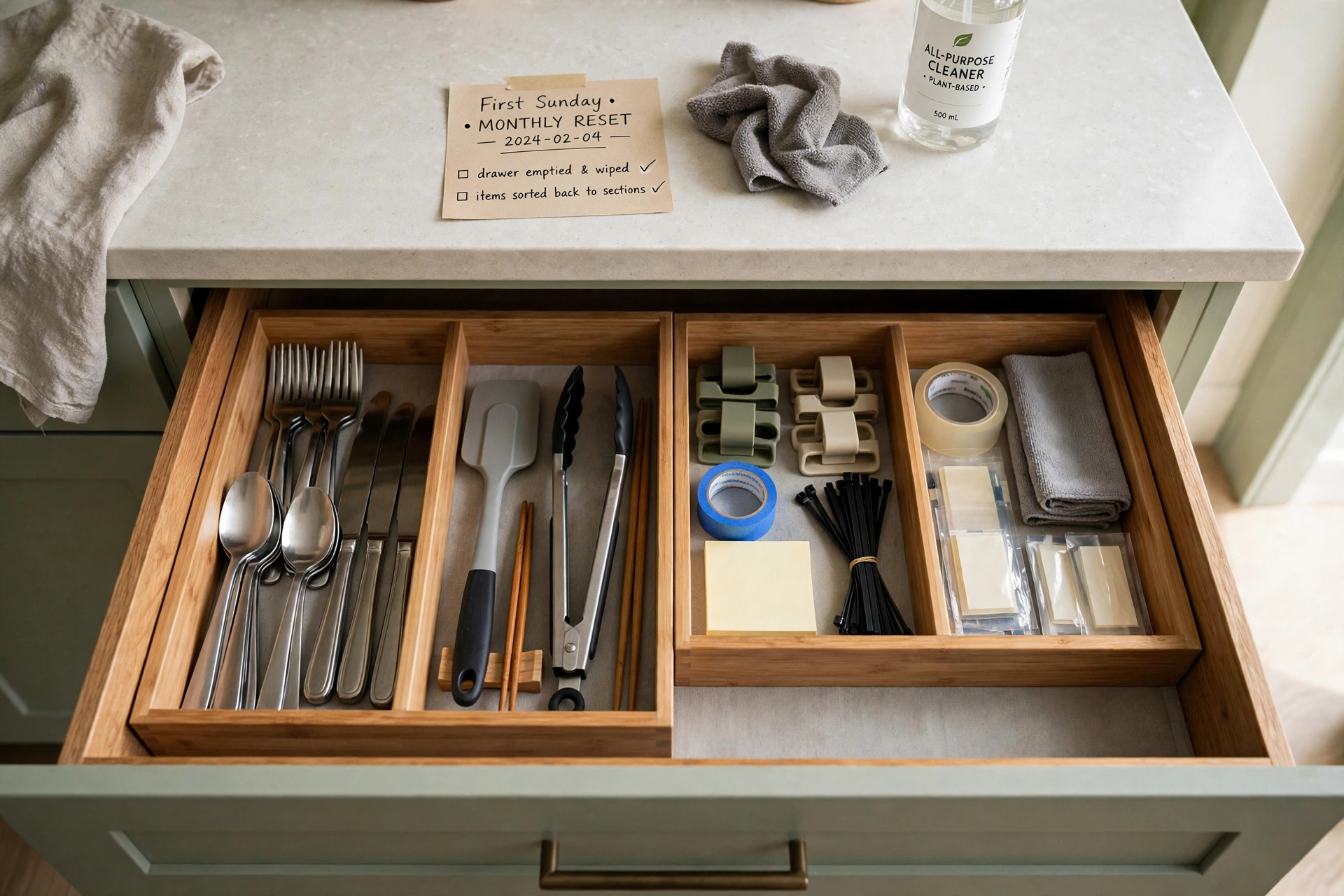
A drawer organized once is a drawer that is tidy once, because the cooking changes, the gadgets arrive, and the drawer that is never reset is the drawer that slowly fills with the things that do not belong. Do a monthly drawer reset — five minutes, one drawer, every month — so one drawer gets emptied, wiped and re-sorted on the first Sunday of the month, and the whole kitchen is done by the end of the year. Five minutes is enough, because the reset is not a re-organization, it is a tidy-up: the things that drifted go back to their sections, the things that do not belong leave, and the drawer that is reset monthly is the drawer that never needs a big sort-out again. One drawer a month, five minutes, and the kitchen stays done.
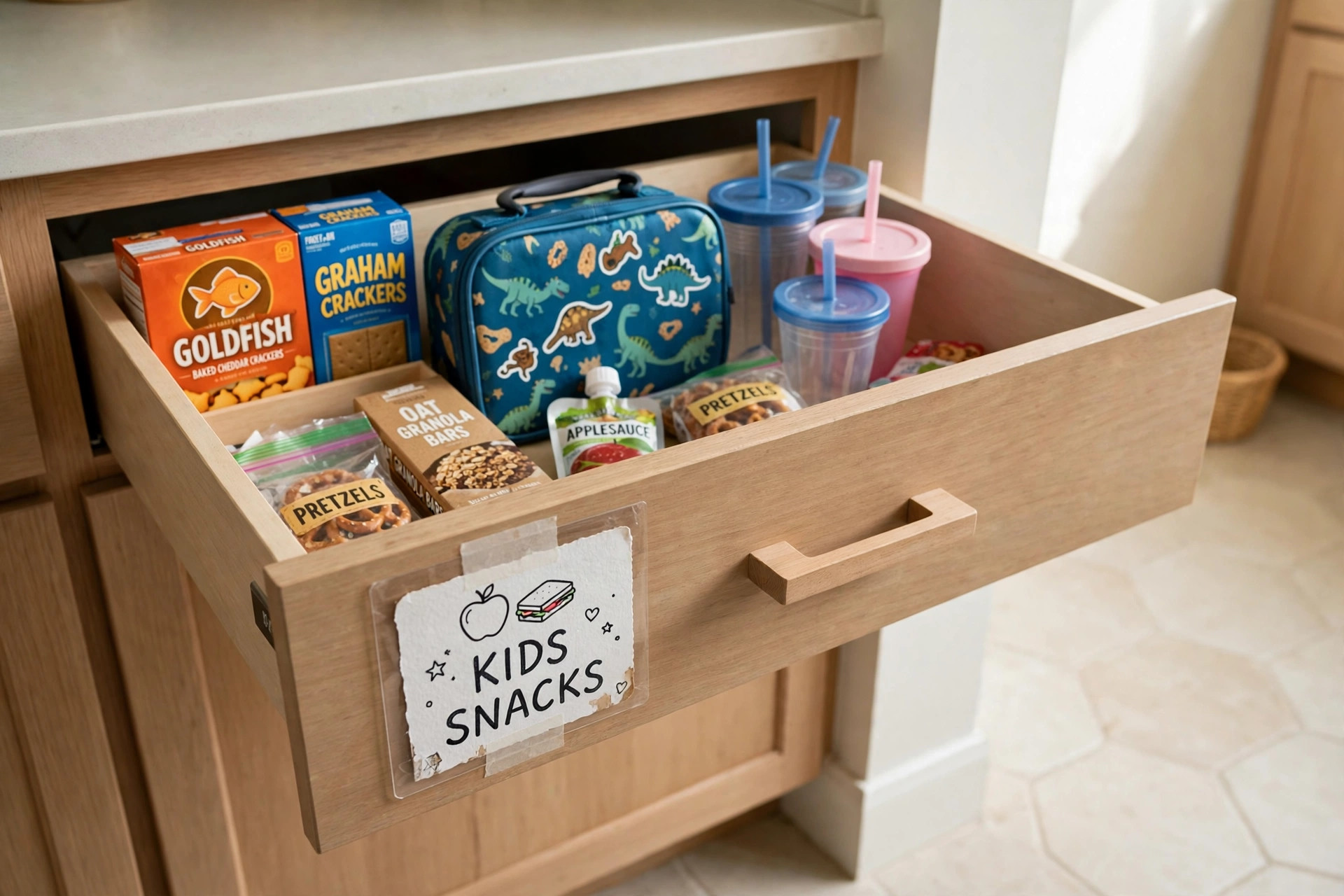
21. A drawer the kids can reach — snacks and lunchbox kit at their height
A kitchen where the children's things live on a high shelf is a kitchen where the children ask for help fifty times a day, because the snack is up high, the lunchbox is up high, and the child who cannot reach is the child who pulls everything down trying. Give the children a drawer they can reach — snacks and lunchbox kit at their height — so the lowest drawer holds their cups, their snack boxes and their lunchbox, and the child who can reach their own snack is the child who stops asking. Keep it simple, because the drawer that holds three snacks and one box is the drawer the child can manage, and the drawer that holds twenty snacks is the drawer the child empties onto the floor. The same divider habit that works at a desk — one slot per thing, labelled so a child can match it — is covered in 24 Desk Organization Ideas for 2026, where the drawer that a child can use is the drawer that stays tidy. One low drawer, and the children help themselves.
22. Stack vertically in deep drawers — the deep drawer that works like a shelf
A deep drawer filled flat is a drawer where the bottom layer is invisible, because the things on top hide the things underneath, the drawer that is filled flat is the drawer where you forget what you own, and the forgotten thing is the thing you buy twice. Stack vertically in deep drawers — the deep drawer that works like a shelf — so the pans stand on their sides, the lids stand in a row, and the baking trays stand upright like books, because the drawer that works vertically is the drawer where everything is visible in one pull. Vertical file holders, plate racks and simple dividers all do the job, because the divider that holds a tray upright is the divider that turns a deep drawer into a pull-out shelf. The same vertical habit keeps a bathroom counter clear, and 25 Bathroom Counter Organization Ideas for 2026 shows the same rule working in a smaller space. Stacked vertically, and the deep drawer holds twice as much without a pile.
Which kitchen drawer idea fits which situation?
| Situation | Best first move | Budget | Tools needed |
|---|---|---|---|
| Every drawer is a tangle | Empty every drawer first (idea 1) | Free | None |
| Too much stuff, nowhere to put it | Sort into keep, move, bin (idea 2) | Free | Three bags |
| Dividers never fit | Measure before you buy (idea 3) | Free | Tape measure |
| One drawer holds everything | One drawer, one job (idea 4) | Free | None |
| The junk drawer overflows | Give the junk drawer a job (idea 5) | Low | Small boxes |
| Lids everywhere, bases nowhere | Match every lid to its base (idea 6) | Free | None |
| Cutlery slides around | Adjustable dividers (idea 7) | Low | Dividers |
| Knives loose in a drawer | An in-drawer knife block (idea 9) | Low–Medium | Knife block |
| Deep drawer is a pile | Deep-drawer inserts, lids standing (idea 10) | Low | Inserts |
| Spices lost in a cupboard | Spices flat in a drawer (idea 14) | Low | Inserts, labels |
| Baking tools scattered | A baking drawer (idea 16) | Low | Dividers |
| Drawers tidy for one week only | A monthly drawer reset (idea 20) | Free | None |
You do not need all 22 ideas. You need the three that solve your kitchen — usually the sort into keep, move and bin, the adjustable dividers that fit the drawer you actually have, and the monthly reset that keeps it all tidy. Start with the drawer you open most, do it this weekend before the next big shop, and put the dividers in while the drawer is still empty. Do that and the next time the pan is on the stove, the tongs will be in their slot, the lid will be standing with its base, and cooking will start without the rummage.
Save this post for the next kitchen sort-out, and if the cupboards above the drawers need the same treatment, read 20 Kitchen Cabinet Organization Ideas for 2026 next — it is Post 02, the cabinets the drawers sit under, sorted with the same rules — and 25 Pantry Organization Ideas for 2026, Post 08, for the food the drawers serve. This is the ninth post of the new Organization by problem run — Posts 56 to 80, one problem at a time — and the run keeps going drawer by drawer. The bathroom version of the same system is covered in Bathroom Drawer Organization, where the same sort, measure and divide habit works in a smaller room.
Publish date assigned at publishing time. Updated as new kitchen drawer finds are tested.
Frequently asked questions
How do I organize kitchen drawers without buying lots of organizers?
Start with the sort-out, not the shopping: empty the drawer, sort into keep, move and bin, and give each drawer one job. Most drawers only need one or two dividers after that, and small boxes you already own — jam jars, phone boxes, little trays — work for the small things. Measure the drawer first, then buy only the dividers that fit the sections you actually need.
What is the best way to organize deep kitchen drawers?
Treat a deep drawer like a pull-out shelf: stack vertically, not flat. Lids stand upright in a rack, pans stand on their sides, and baking trays stand like books, so everything is visible in one pull. Deep-drawer inserts and vertical dividers hold things upright, and the heaviest pan goes at the bottom of its own section so it never dents the lighter ones.
How do I stop kitchen drawers from getting messy again?
Give every section a label, keep the one-in, one-out rule, and do a five-minute reset on one drawer a month. The label stops the drift, the rule stops the overflow, and the monthly reset catches the things that wandered before they become a pile. A drawer that is reset monthly never needs a big sort-out again.