25 Mudroom Organization Ideas for 2026
The mudroom is the room that takes the hit so the rest of the house stays tidy — and in most homes it is not a room at all, it is a wall by the front door where the coats pile up, the shoes scatter, the school bags land in a heap, and the keys vanish into a pocket that nobody can find in the morning. A mudroom is not about square footage. It is about one rule that changes everything: every person in the house gets a hook, a place for their shoes, and a spot for their bag — and the pile on the floor disappears because everything has a home that is easier to use than the floor.
These 25 mudroom organization ideas build a hardworking mudroom with a hook for everyone: give each person a hook and a cubby, put a bench to sit on and a tray to catch the mud, and finish with a five-minute reset after school — so the front door stops being a dumping ground and starts being the room that keeps the house tidy.
Every idea below works in a real home, from a proper mudroom with built-in cubbies to a hallway with one wall and a bench. The entryway systems around the mudroom are covered in 22 Entryway Storage Ideas for 2026, where the front door gets the same treatment — and the coats themselves get their own deep dive in 25 Coat Closet Organization Ideas for 2026. Pick three ideas that fit your space, start with the hooks, and build from there.
Set up the mudroom: one hook for everyone
1. One hook per person — a hook for everyone, coats off the floor
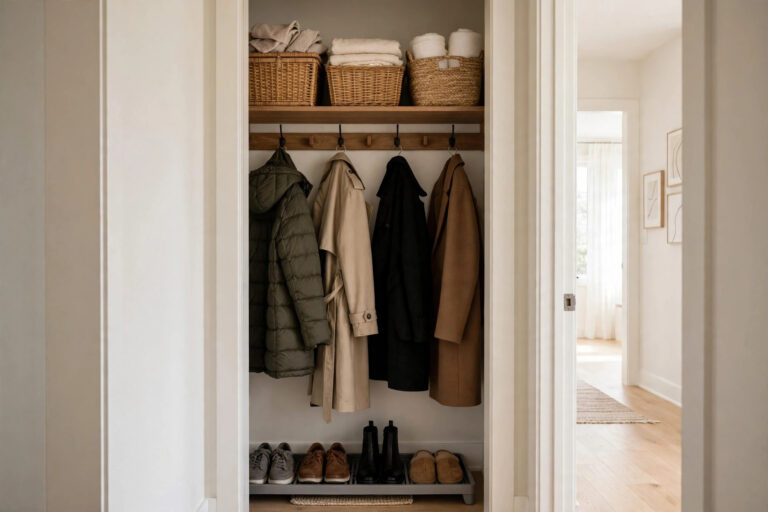
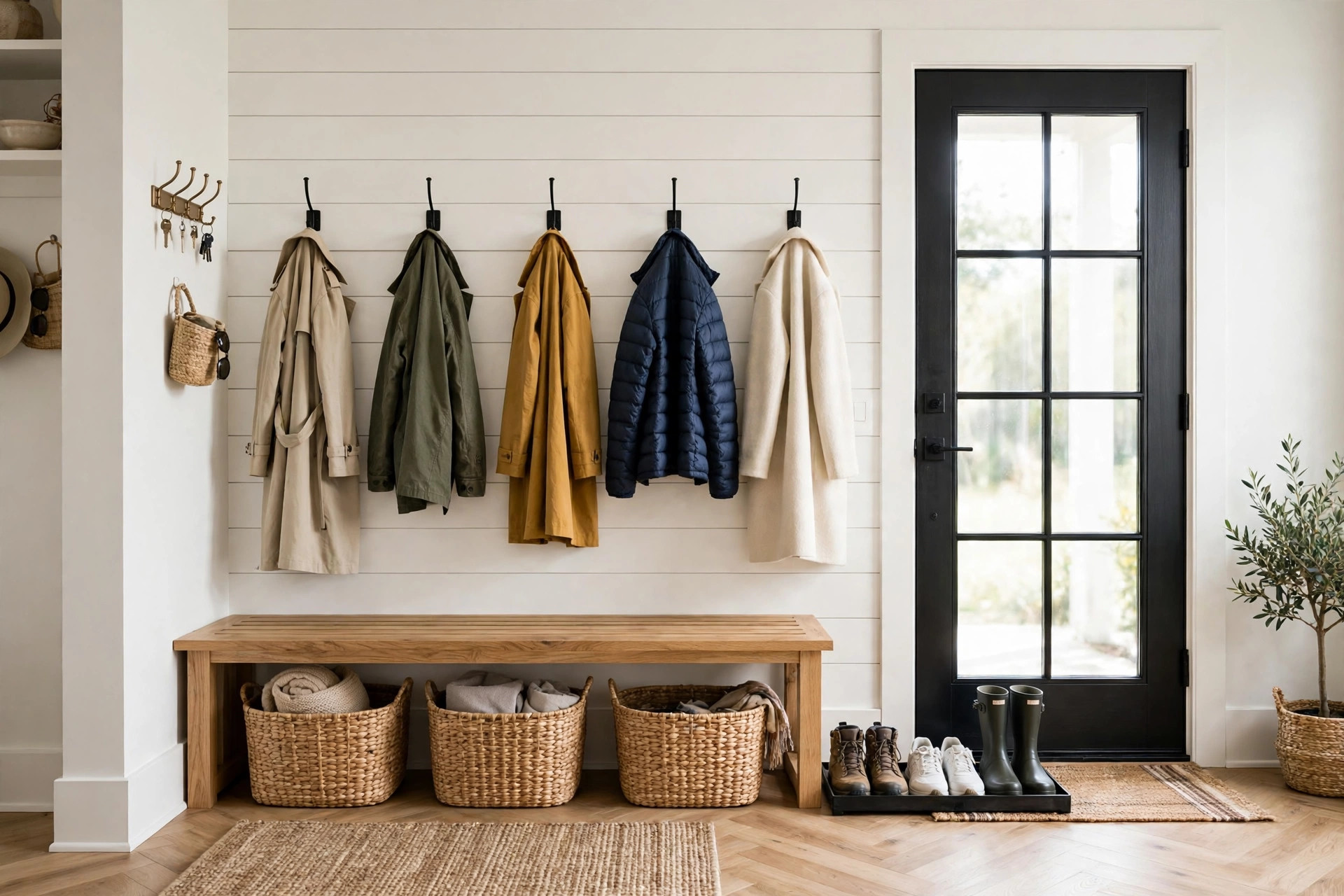
Coats on the floor are coats nobody owns, because the coat that lands in the pile is the coat that gets stepped on, the coat that gets stepped on is the coat that never gets hung up, and the pile by the door is the pile that grows until nobody can find anything. Give every person one hook — one hook per person, a hook for everyone, coats off the floor — so the red coat is one person's coat and the blue coat is another's, and the morning coat hunt takes five seconds. Put the hooks on the wall by the front door, one per person, with a little space between them. One hook per person, and the floor stays clear.
2. Measure the wall before you hang anything — hooks at the right height, in the right place
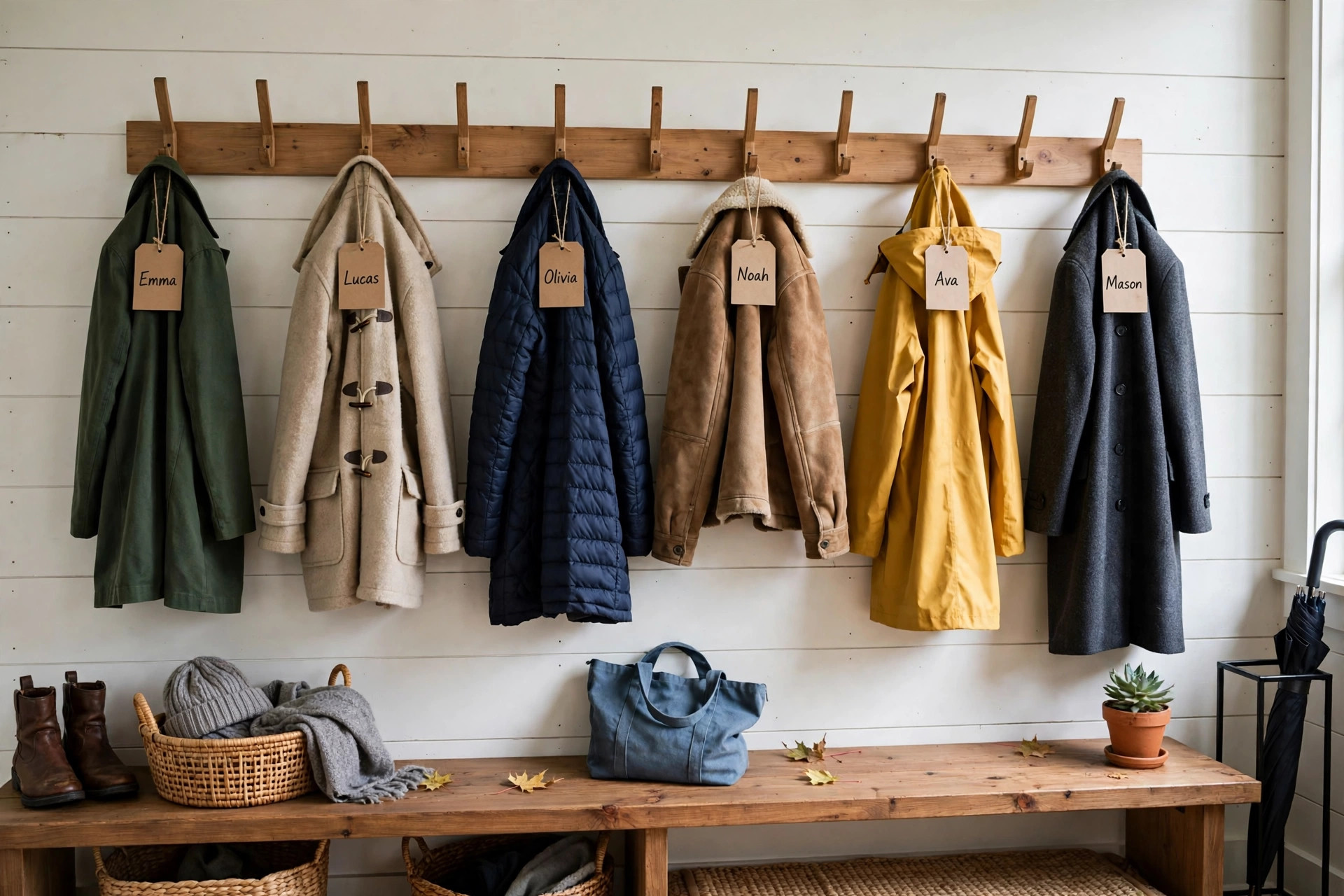
Hooks hung in a hurry are hooks hung wrong, because the hook that is too high is the hook the child never reaches, the hook that is too low is the hook the adult's coat drags on the floor from, and the row of hooks that is too close together is the row where the coats bunch up and slide off. Measure the wall before you hang anything — hooks at the right height, in the right place — so the hooks sit where the people who use them can actually reach them. Mark the spots with tape first, stand everyone against the wall and check the reach, and leave a hand's width between hooks. One afternoon with a tape measure, and the hooks never need moving again.
3. A bench that does double duty — sit, store, stash
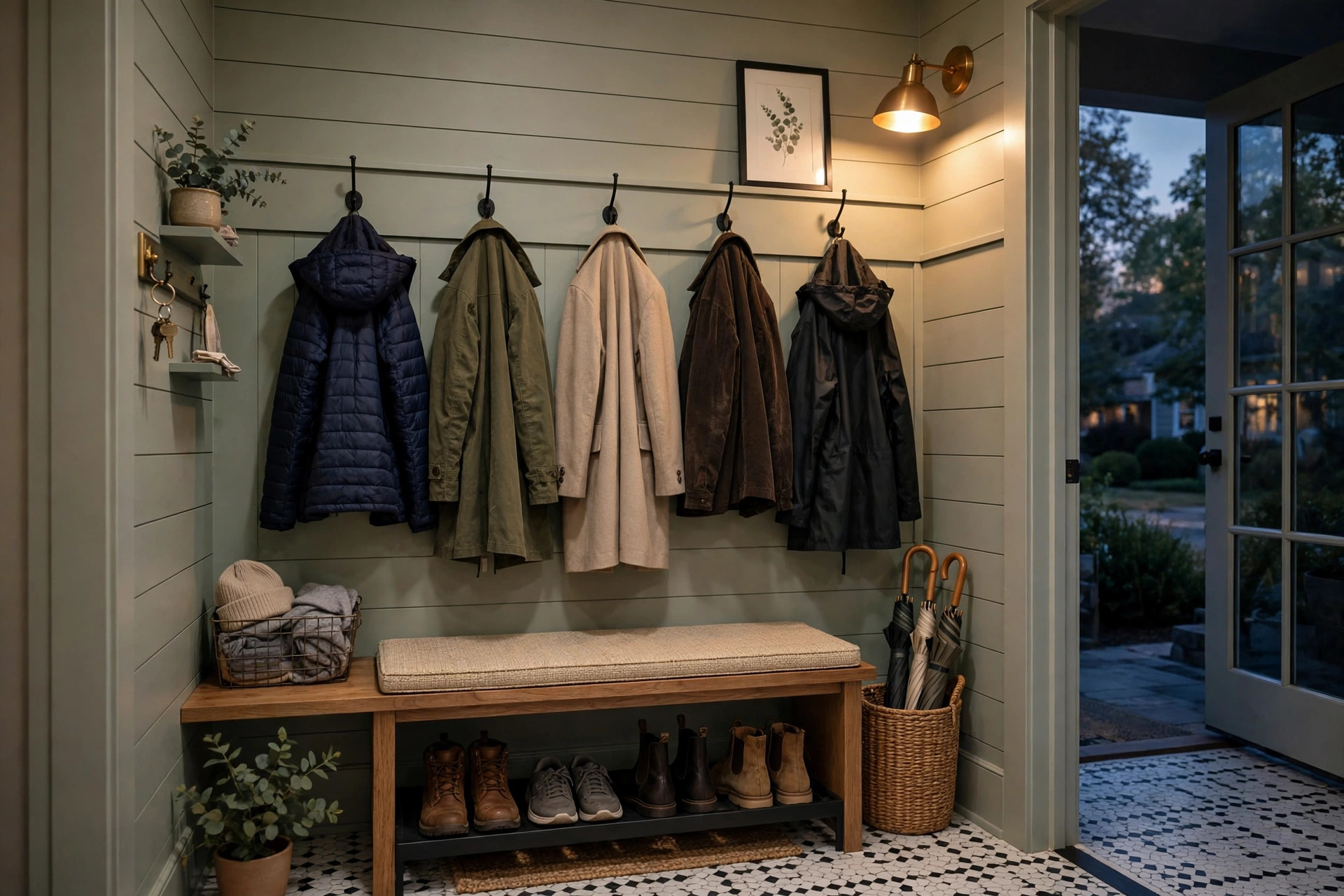
A mudroom without a bench is a mudroom where shoes come off standing up, because the child who has to balance on one foot is the child who kicks the shoe off and leaves it where it lands, and the adult who has nowhere to sit is the adult who leaves the boots by the door. Use a bench that does double duty — sit, store, stash — so the family sits down to put shoes on and the shoes live underneath when they come off. Pick a bench with baskets or cubbies underneath, and put it against the wall under the hooks, so the whole wall works as one system. One bench, and the mudroom has a seat and a store in the same piece of furniture.
4. Labelled cubbies — one cubby per family member
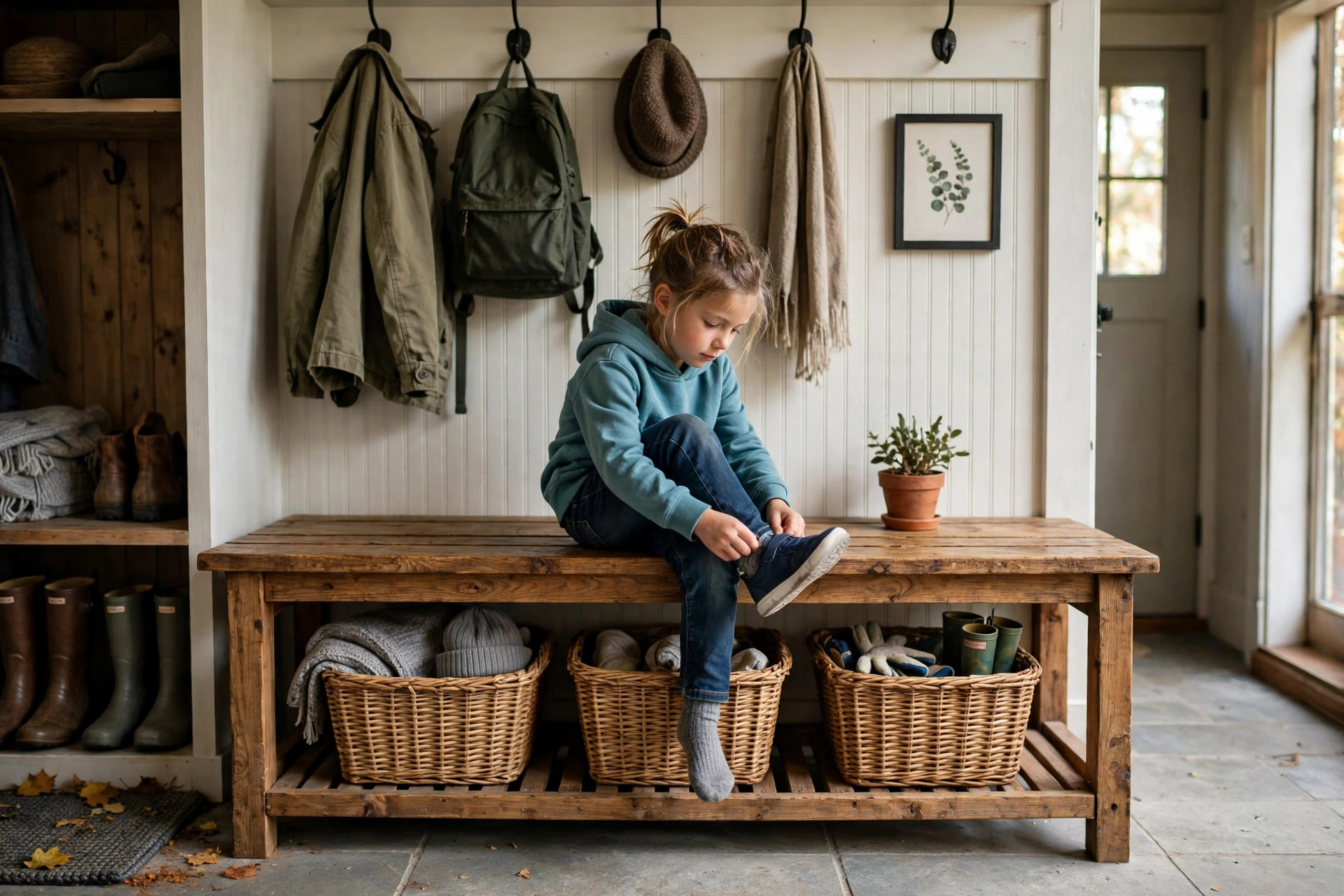
A mudroom where everyone's things live together is a mudroom where nobody can find anything, because the gloves are in the wrong cubby, the hat is under someone else's scarf, and the child who needs their things is the child digging through everyone else's. Build labelled cubbies — one cubby per family member — so each person has a box, a shelf or a basket with their name on it, and the things that belong to them stay in their own spot. Label the cubbies with names or pictures for younger children, and keep one spare cubby for the things that belong to no one — the spare gloves, the umbrella, the dog lead. The drop zone thinking behind the cubbies is covered in 22 Drop Zone Organization Ideas for 2026, where one spot per person keeps the whole entryway tidy. One cubby per person, and the mixing stops.
5. A shoe tray by the door — mud stays in the tray
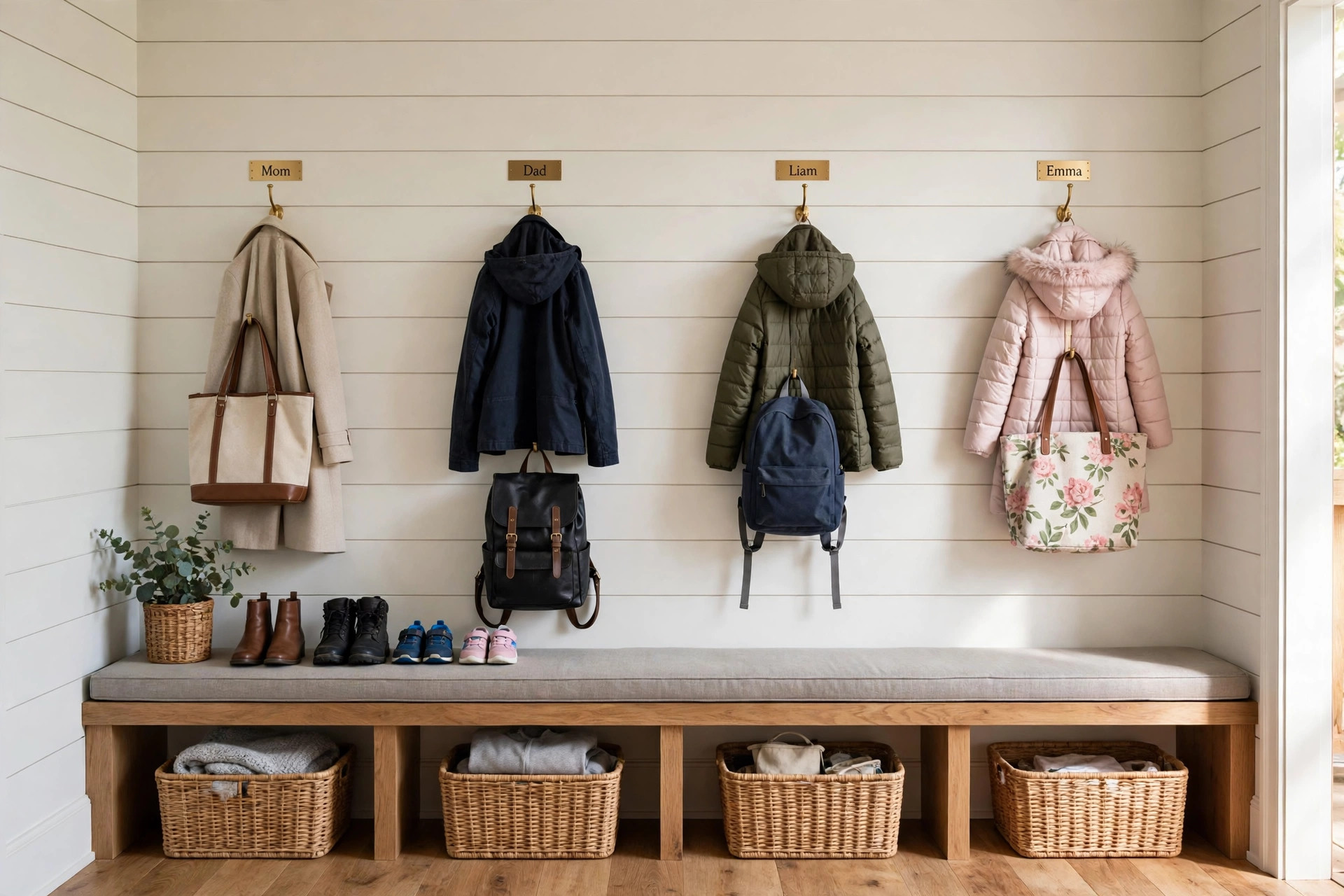
Shoes that come straight onto the floor are shoes that bring the outside in, because the mud on the boots is the mud on the rug, the mud on the rug is the mud on the carpet, and the floor that is cleaned on Saturday is the floor that is dirty again by Monday. Put a shoe tray by the door — mud stays in the tray — so every pair of shoes lands in the tray when it comes off and the floor beyond the tray stays clean. Choose a tray with a raised lip, big enough for the family's daily shoes, and put it right where the shoes come off. One tray by the door, and the mud stops at the threshold.
6. A "grab-and-go" basket by the door — tomorrow's bag packed tonight
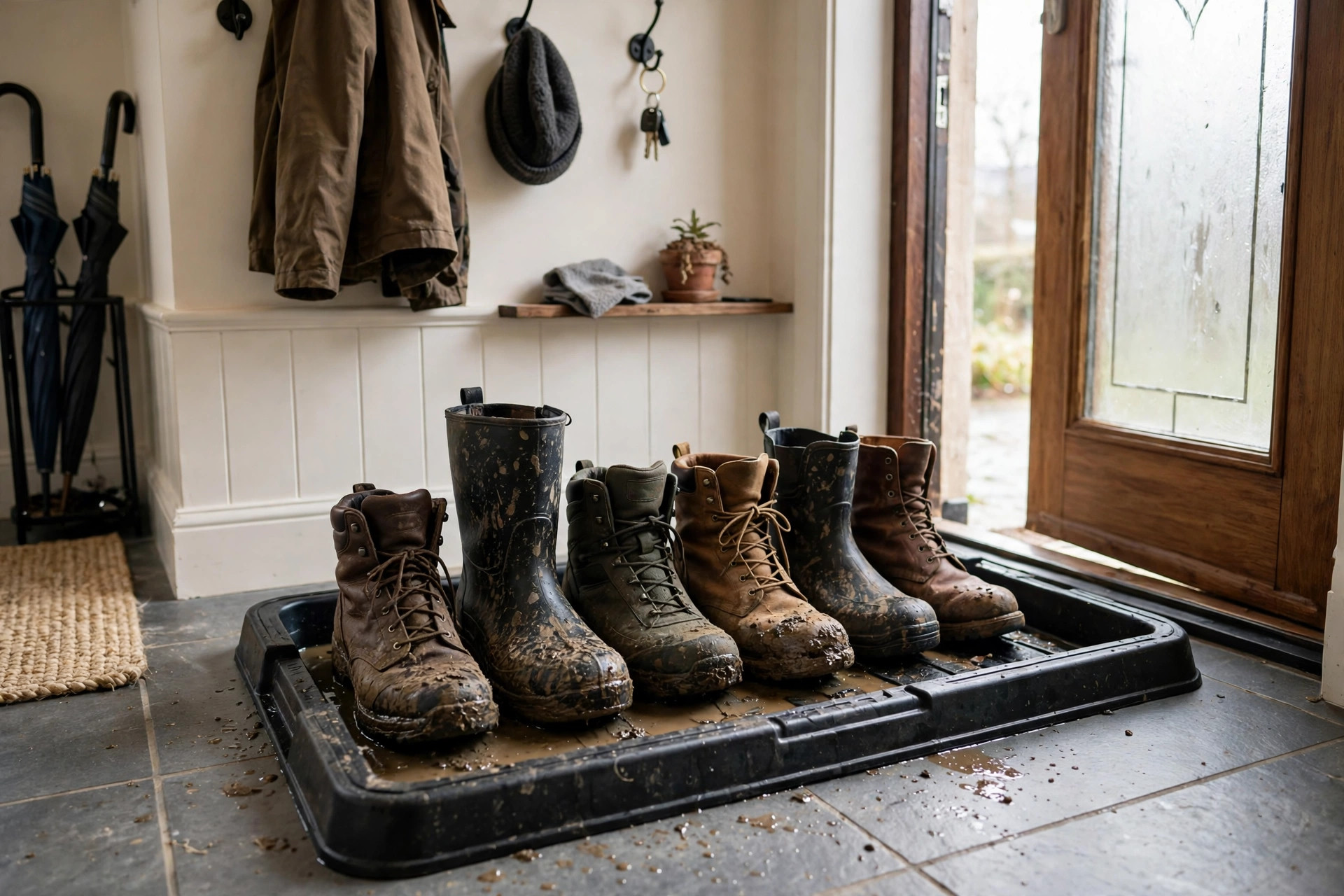
Mornings fall apart at the front door, because the school bag is still in the bedroom, the lunchbox is still in the kitchen, and the child who is hunting for their bag is the child who is late for the bus. Keep a "grab-and-go" basket by the door — tomorrow's bag packed tonight — so the bag, the lunchbox and the keys are packed the night before and waiting in one basket by the door. Put the basket beside the bench, and make the rule that the bag goes in the basket when homework is done. The school mornings this basket serves are covered in 22 School Organization Ideas for 2026, where the morning routine gets the same treatment. One basket by the door, and the mornings start on time.
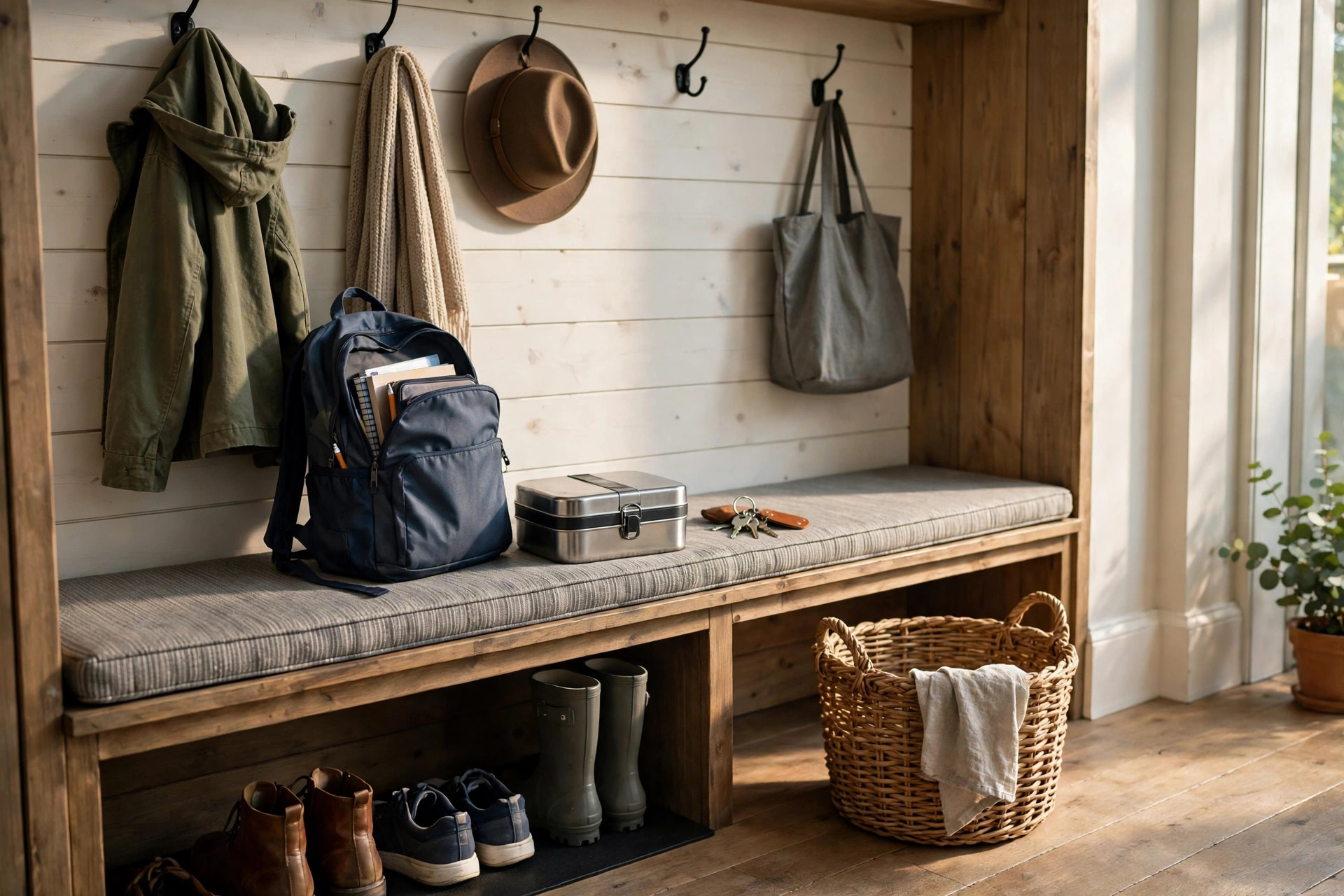
Coats, shoes and bags: the daily pile, sorted
7. Hooks at two heights — kids' coats low, adults' coats high
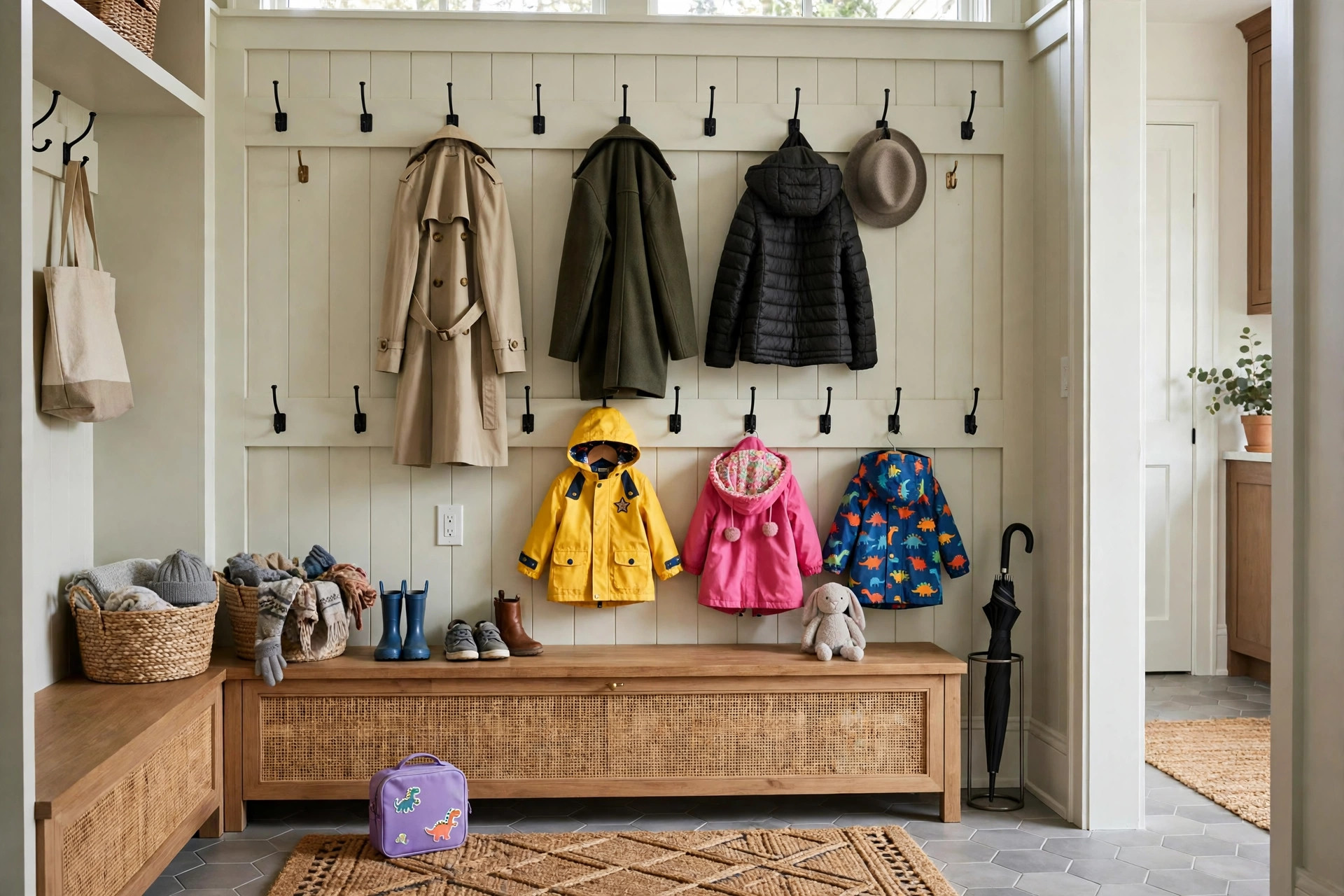
Hooks at one height are hooks for one person, because the hook that is right for the adult is the hook the child cannot reach, the child who cannot reach the hook is the child who drops the coat on the floor, and the floor that holds the children's coats is the floor nobody can walk across. Hang hooks at two heights — kids' coats low, adults' coats high — so every coat hangs at the height of the person who wears it. Put the children's hooks at shoulder height for the youngest child, the adults' hooks above them, and leave a gap between the rows so the coats do not bunch. Two rows of hooks, and every coat has a hook it can reach.
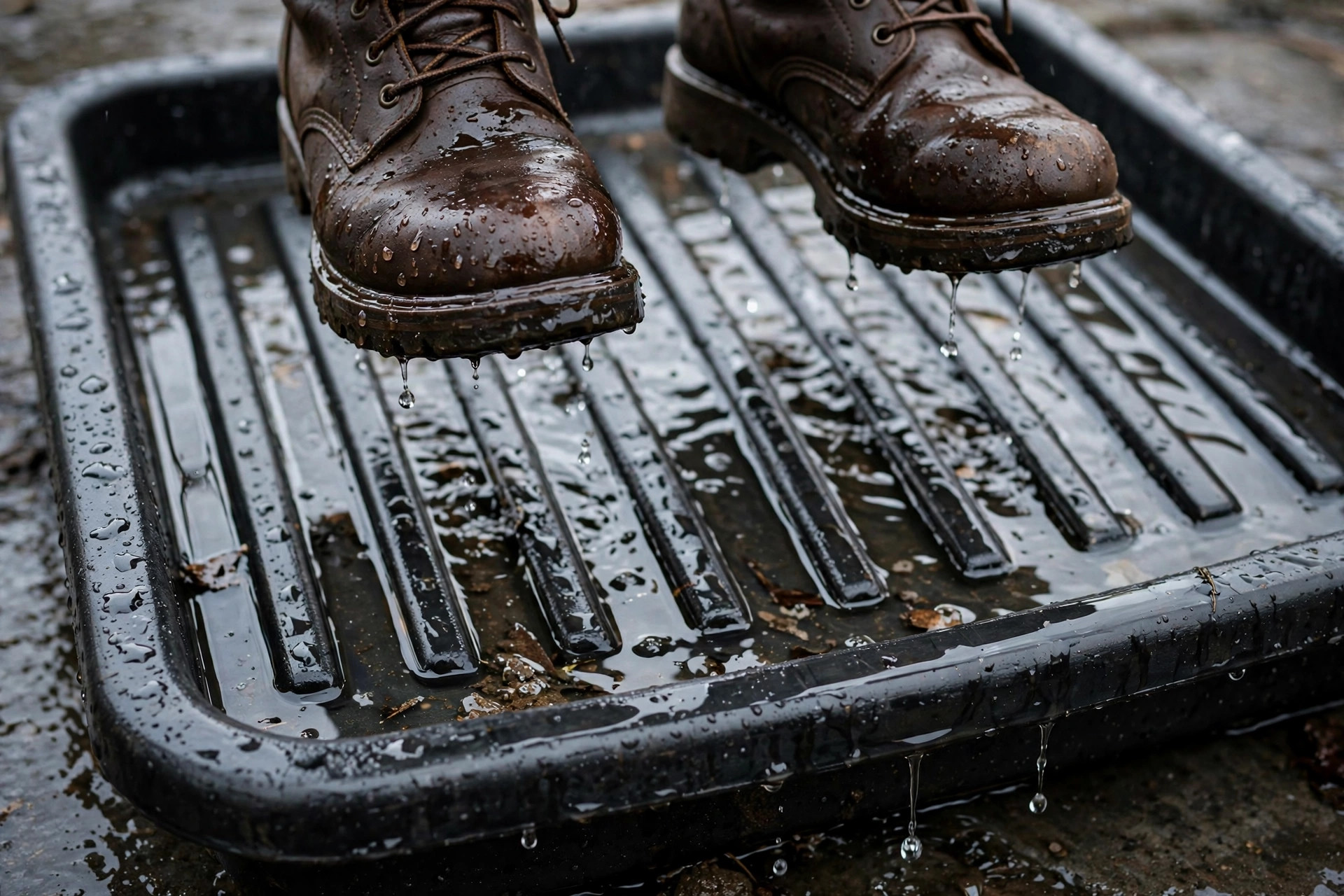
8. A boot tray with a lip — wet boots drain, the floor stays dry
Wet boots on a flat tray are wet boots on a wet floor, because the water that runs off the boots is the water that runs off the tray, the water that runs off the tray is the water on the floorboards, and the floor that is wet every winter is the floor that warps by spring. Use a boot tray with a lip — wet boots drain, the floor stays dry — so the water from the boots pools in the tray and the floor stays dry underneath. Pick a tray with a lip at least an inch high and a ridged base that lifts the boots out of the water. Empty the tray when it fills, and wipe it dry once a week. One tray with a lip, and winter stops coming through the front door. (Check on Amazon for a boot tray with a raised lip and a ridged base, sized for at least four pairs of boots.)
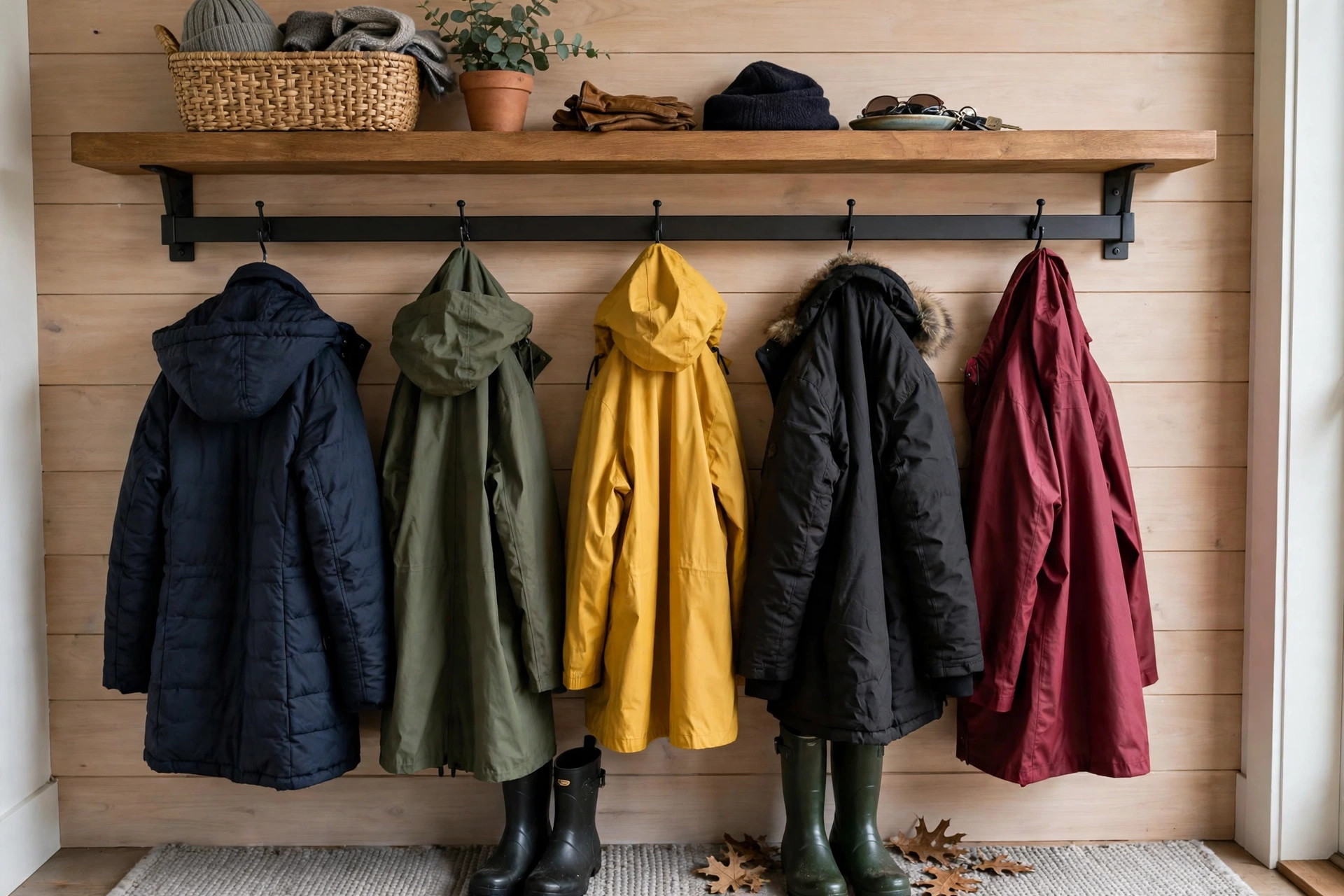
9. A coat rail that holds the whole family's outerwear
A single row of hooks is not enough for a family, because the winter coats are thick, the raincoats are long, and the row that holds three coats is the row that drops the fourth on the floor. Fit a coat rail that holds the whole family's outerwear — a rail with enough hooks, spaced wide enough, fixed firmly enough to hold the weight of every coat the family owns. Use a rail with a shelf above it for hats and gloves, and fix it into the wall studs, not just the plaster. The coats themselves get their own deep dive in 25 Coat Closet Organization Ideas for 2026, where the closet does the same job for the coats that are not in daily use. One rail, fixed right, and every coat has a home.
10. A bag rail — school bags and handbags off the floor
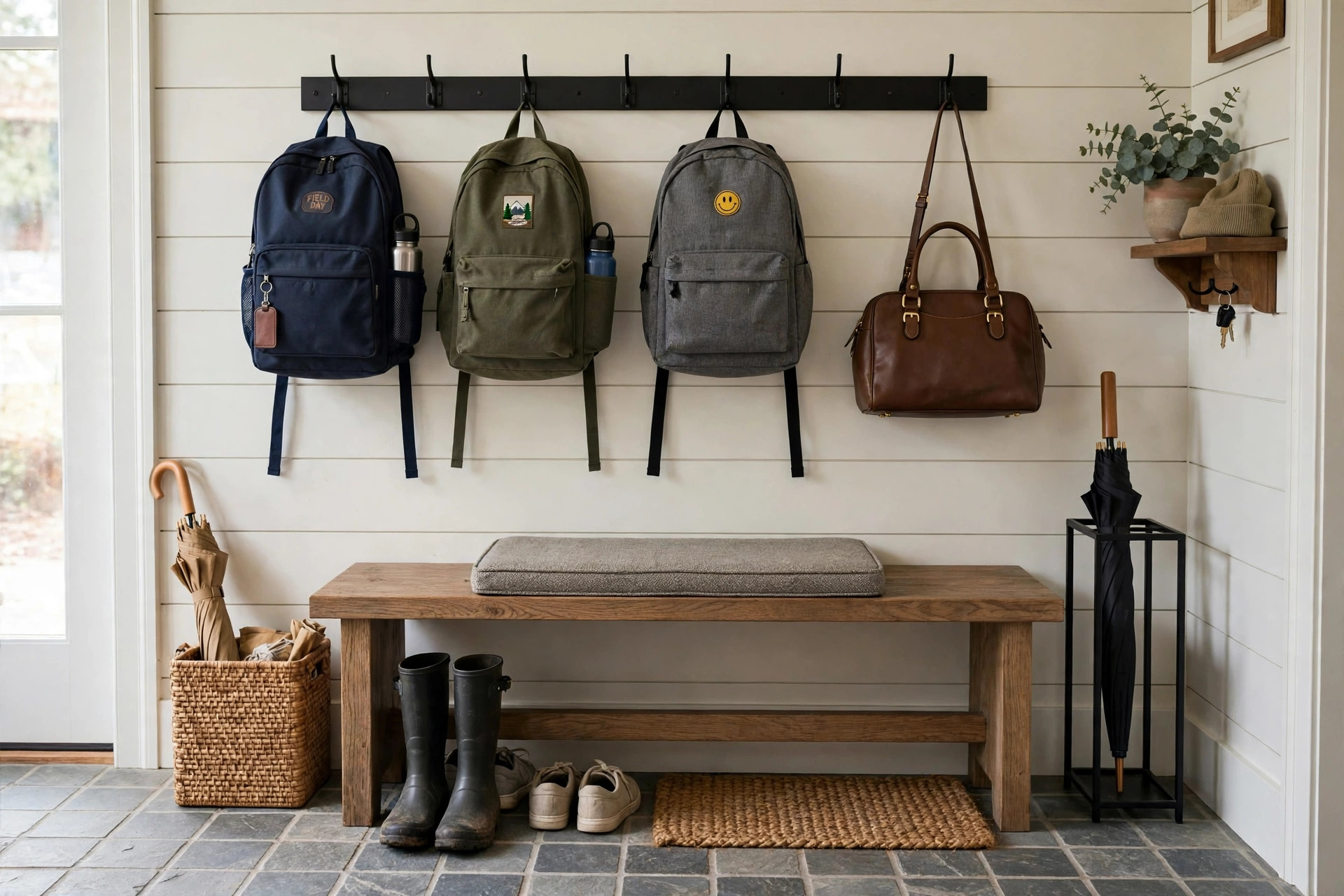
Bags on the floor are bags that get kicked, tripped over and forgotten, because the school bag that lands by the door is the school bag that gets stepped on, the handbag that lands beside it is the handbag that gets buried, and the floor that holds the bags is the floor nobody can walk across. Hang a bag rail — school bags and handbags off the floor — so every bag hangs on its own hook and the floor stays clear. Put the rail at a height the children can reach, with hooks spaced wide enough for a full school bag. Hang the bags by their straps, not by their handles, so they do not slide off, and keep one hook free for the bag that comes home tomorrow. One rail for the bags, and the floor is free to walk on.
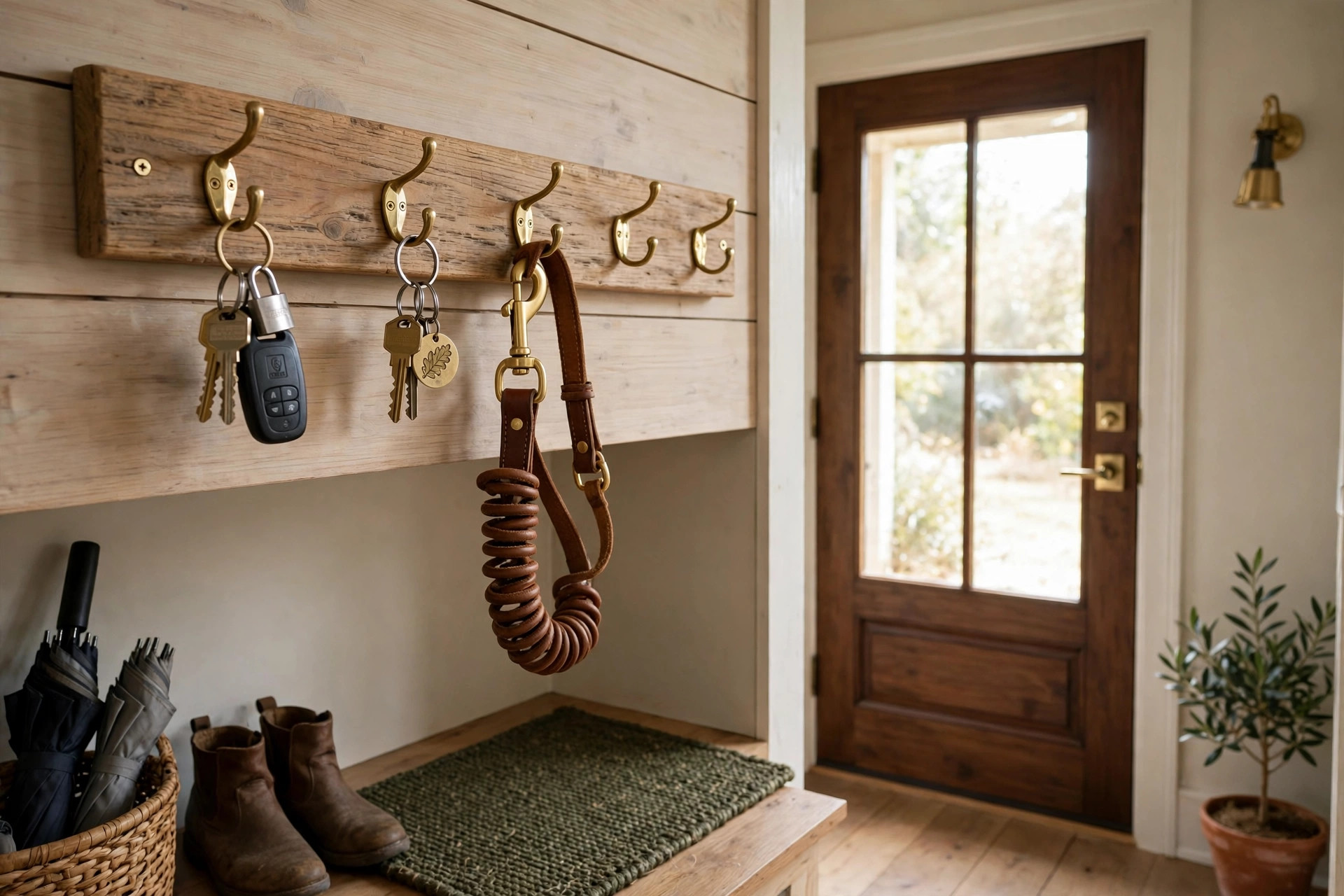
11. A key rail by the door — keys and the dog lead in one place
Keys without a home are keys that vanish, because the keys that land on the bench are the keys that slide behind the cushion, the keys that land in a coat pocket are the keys that go out with the wrong coat, and the morning that starts with a key hunt is the morning that starts late. Fit a key rail by the door — keys and the dog lead in one place — so every set of keys hangs on its own hook the moment the door closes behind you. Put the rail at eye level beside the door, with a small dish underneath for the loose change and the dog lead on the end hook. One rail by the door, and the keys are always where you left them.
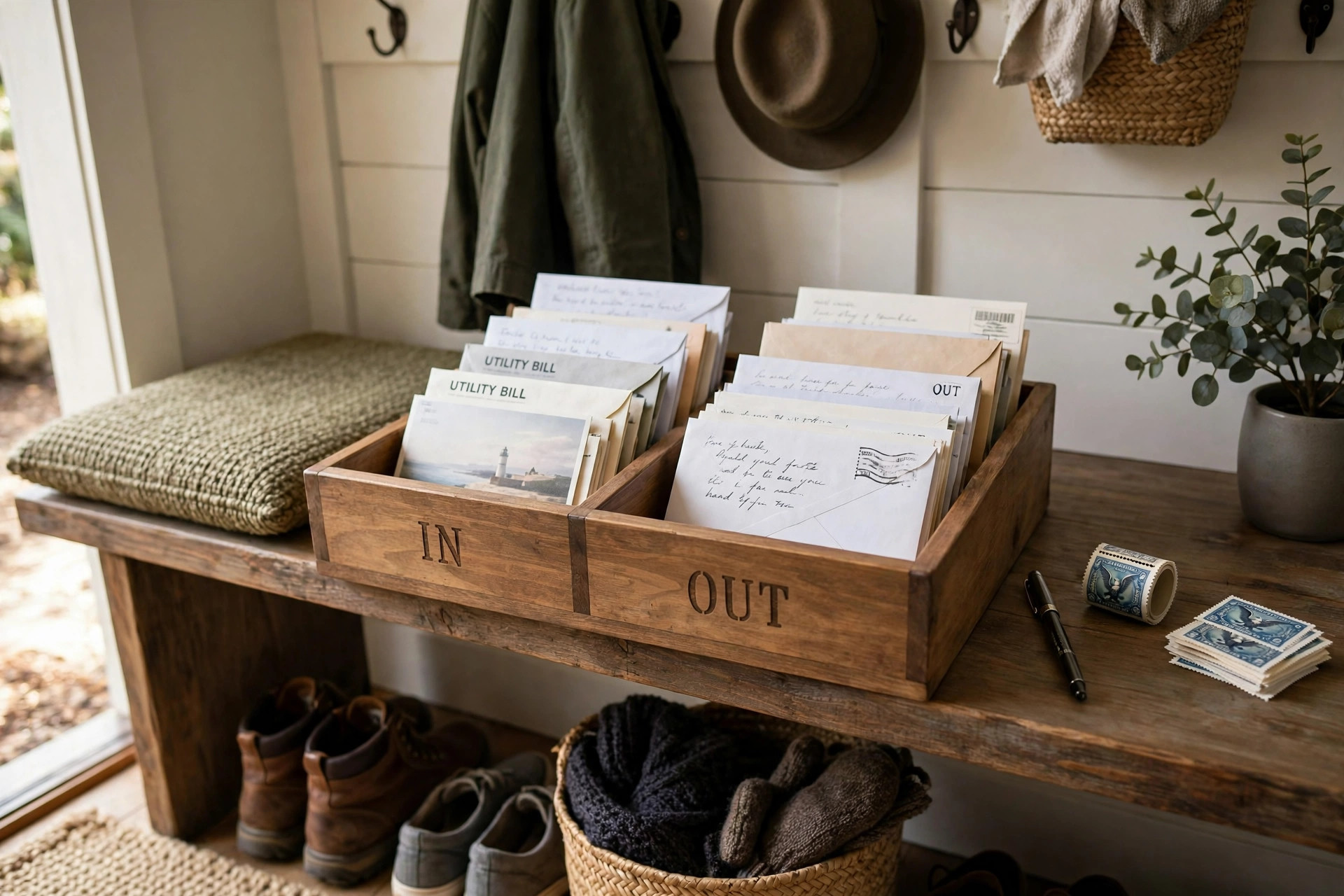
12. A post tray — in and out sections for letters and parcels
Post without a tray is post that piles up, because the letters land on the bench, the bench fills up, the parcels land on the floor, and the letter that matters is the letter buried under the catalogues. Use a post tray — in and out sections for letters and parcels — so the post that comes in goes in one section and the post that needs to go out goes in the other. Put the tray on the bench or the narrow console by the door, and empty the "in" section when the letters are opened, because the tray that empties is the tray that never overflows. Keep a pen in the tray for the envelope that needs an address, and a small stack of stamps beside it. One tray, two sections, and the post stops piling up.
Storage that works: cubbies, bins and benches
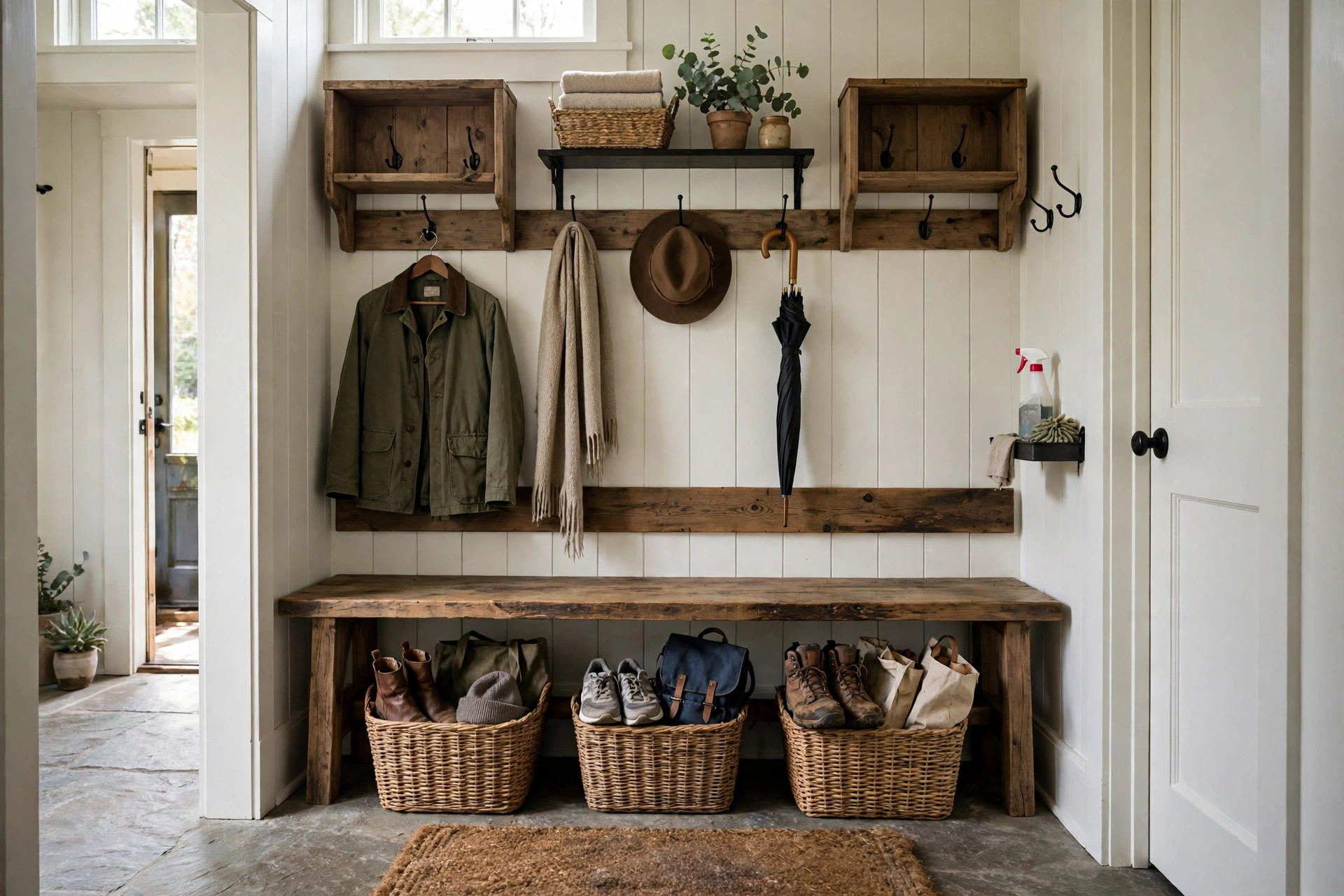
13. Baskets under the bench — shoes and bags tucked away
The space under the bench is the space that gets wasted, because the shoes that live under the bench without a basket are the shoes that scatter, the bags that live under the bench without a basket are the bags that slide out, and the bench that has nothing underneath is the bench that hides a mess. Slide baskets under the bench — shoes and bags tucked away — so every pair of shoes and every bag has a basket to live in, and the baskets slide out when they are needed and slide back when they are not. Use one basket per person, or one basket for shoes and one for bags, and label them. Woven baskets breathe, so the shoes inside them do not smell. Baskets under the bench, and the space under the bench stops being a mess. (Check on Amazon for woven storage baskets with handles, sized to fit under a standard bench.)
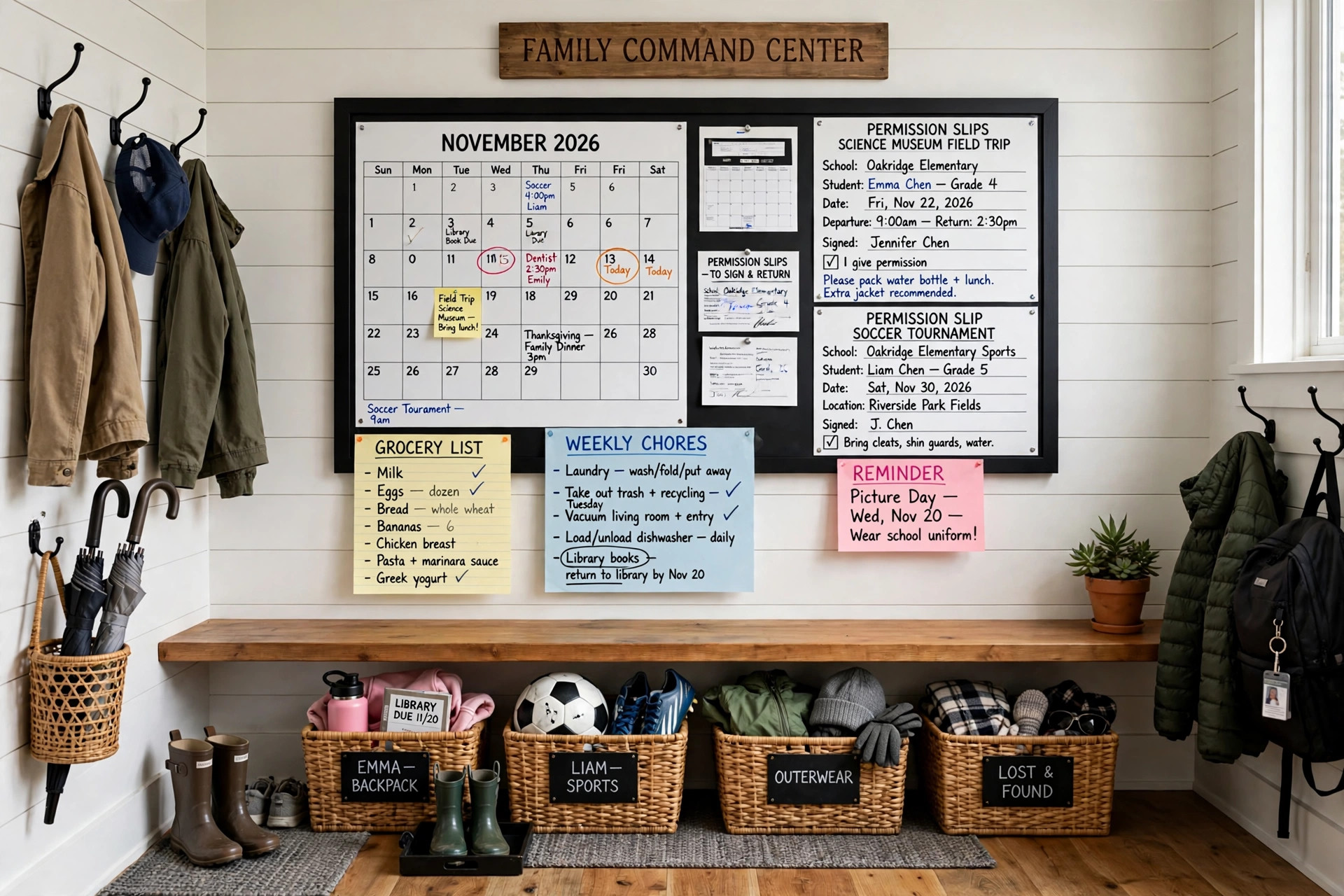
14. A family command centre — calendar, permission slips, lists
A family without a command centre is a family that forgets, because the permission slip is in the school bag, the school bag is by the door, and the parent who never sees the slip is the parent who signs it the morning it is due. Build a family command centre on the mudroom wall — calendar, permission slips, lists — so the week is on the wall where everyone sees it every time they walk past. Hang a calendar, pin the permission slips beside it, and keep a notepad for the shopping list and the things that need doing, because the board that is on the wall is the board that gets checked. Check it together every Sunday. One board on the wall, and the family stops forgetting.
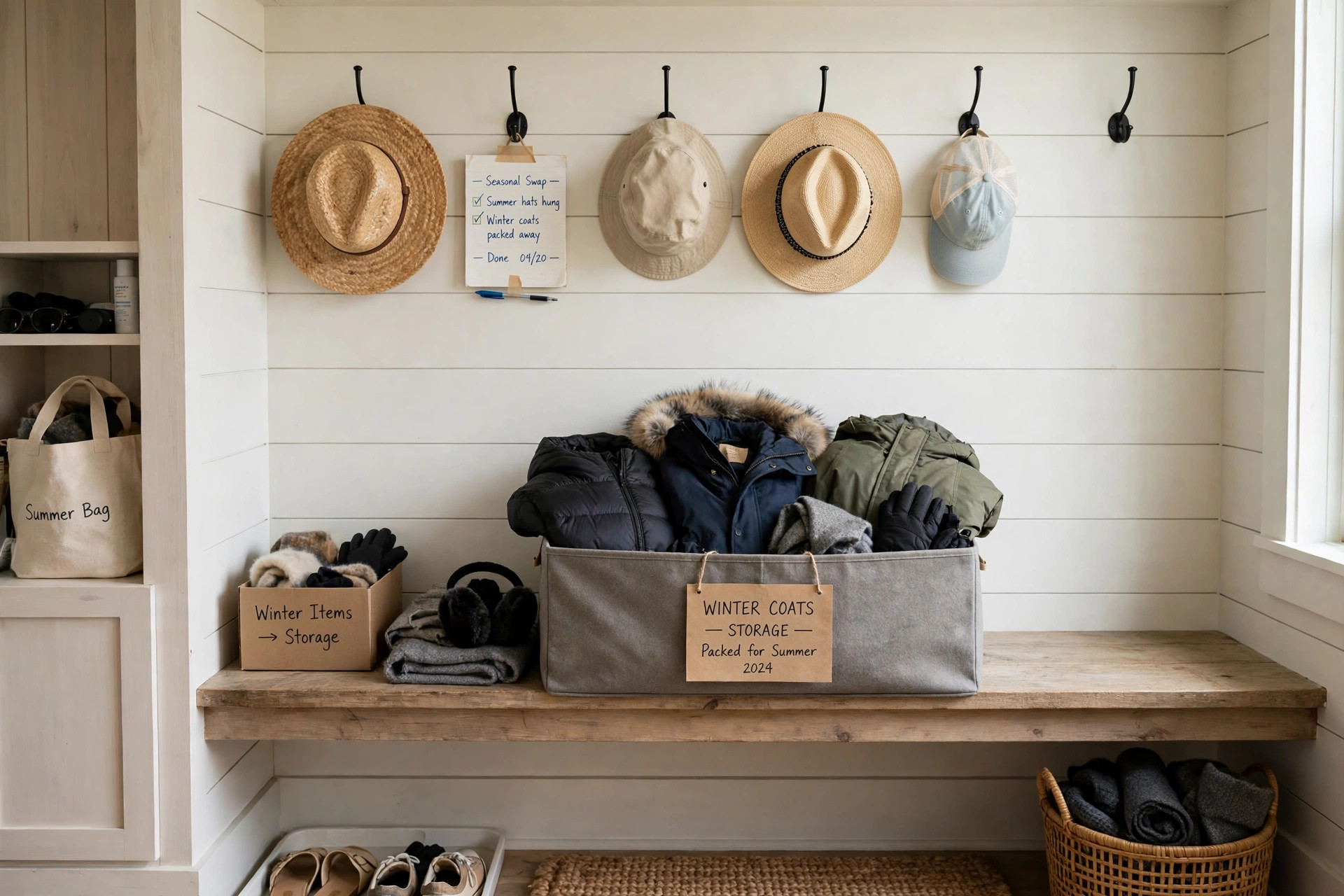
15. A seasonal swap — winter coats out, summer hats in
A mudroom that holds every season at once is a mudroom that holds nothing well, because the winter coats crowd out the raincoats, the raincoats crowd out the sun hats, and the hooks that hold four seasons are the hooks that hold nothing findable. Do a seasonal swap — winter coats out, summer hats in — so the mudroom holds only the season you are in and the rest lives in storage. When the season changes, move the out-of-season coats to the utility closet or the garage, bring the new season's coats to the hooks, and check the sizes while you are at it. The storage the swap feeds into is covered in 22 Utility Closet Organization Ideas for 2026, where the out-of-season things get a home of their own. One swap a season, and the mudroom always fits the weather.
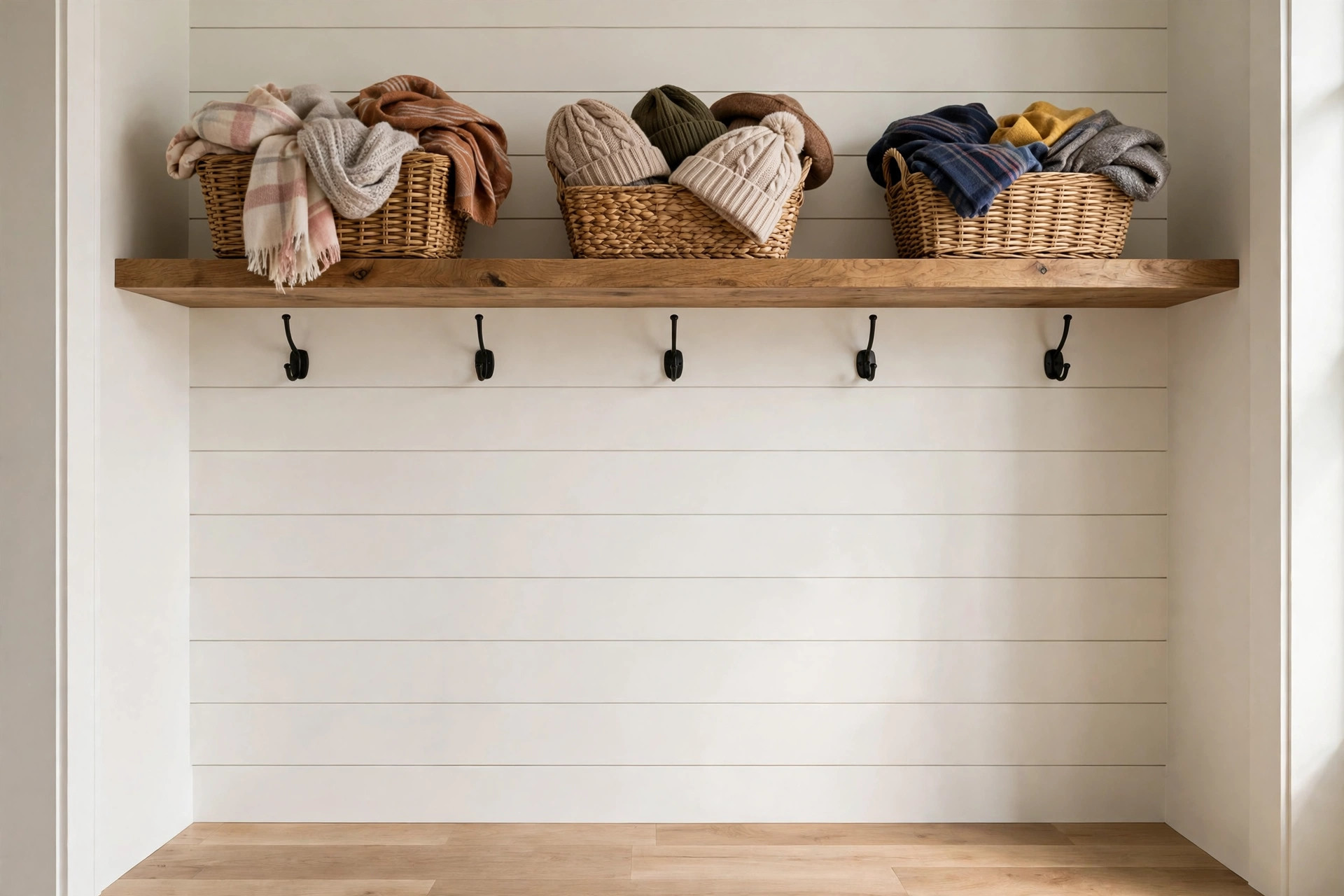
16. Use the wall, not the floor — vertical storage up high
A mudroom that only uses the floor is a mudroom that runs out of room, because the floor fills up with shoes and bags, the bench fills up with post and parcels, and the mudroom that has no wall storage is the mudroom that has nowhere left to put anything. Use the wall, not the floor — vertical storage up high — so the things that are used less often live above eye level and the floor stays clear for the things that are used every day. Hang a shelf above the hooks for hats and gloves, fit a rail above the bench for the bags that are not in daily use, and keep a basket on the top shelf for the spare scarves. One shelf up high, and the mudroom gains a whole extra layer of storage.
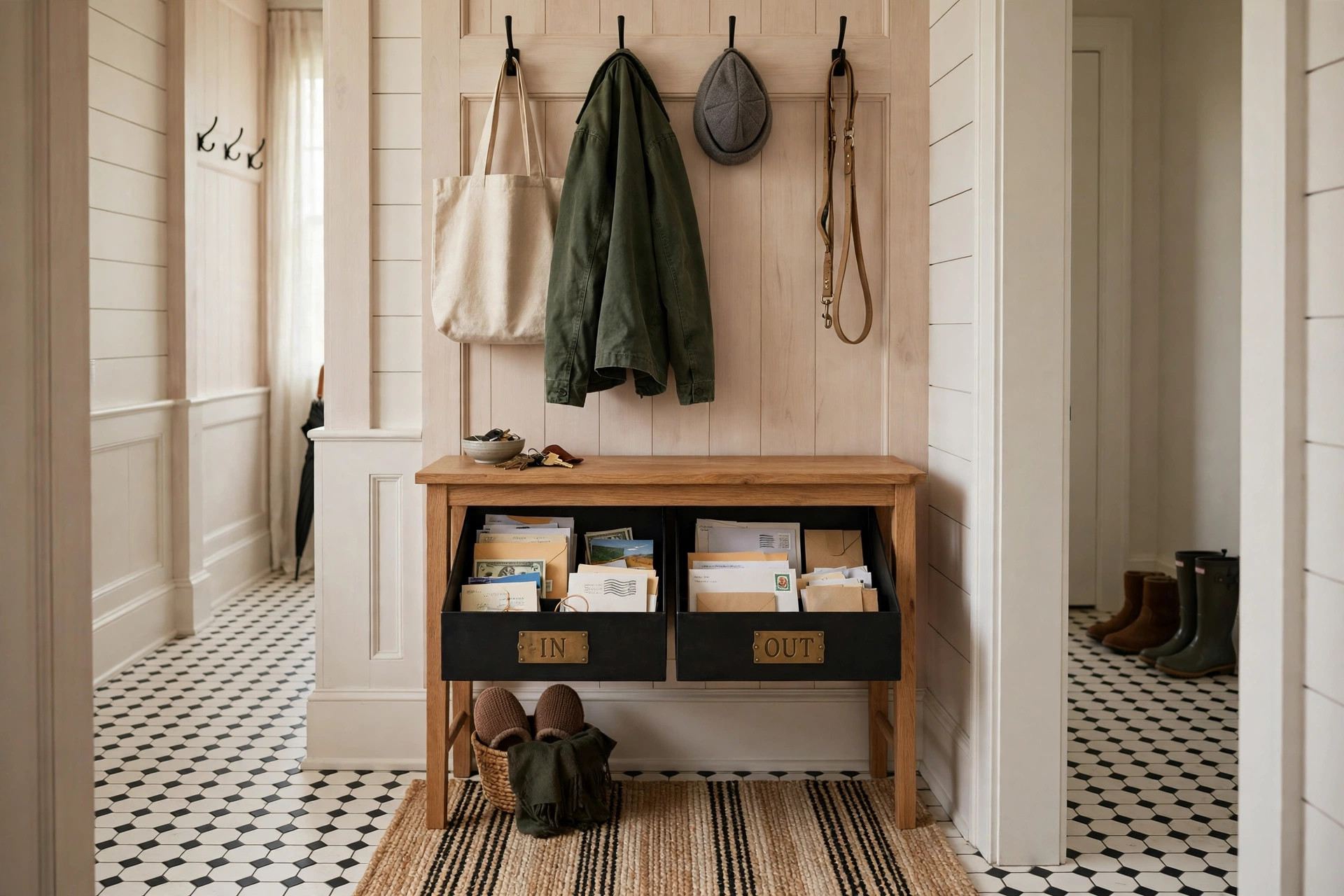
17. A narrow console — the mudroom that fits a hallway
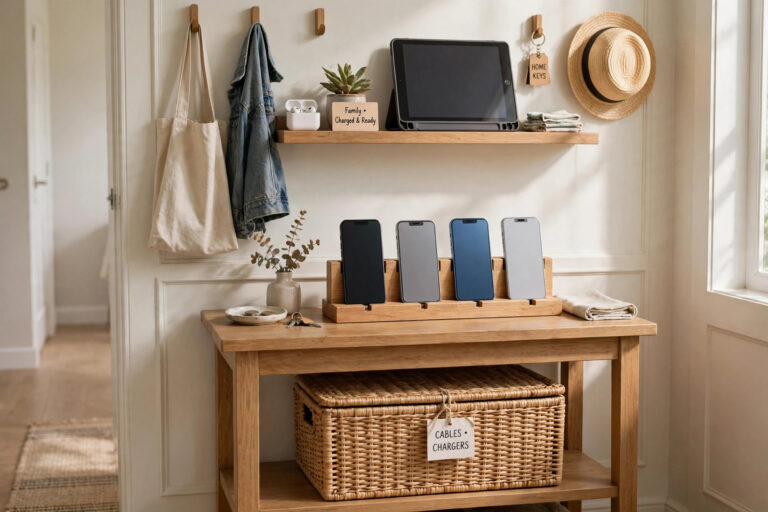
A hallway with no mudroom is a hallway where the coats and shoes have nowhere to go, because the wall is narrow, the floor is narrow, and the hallway that has no furniture is the hallway where everything lands on the floor. Use a narrow console — the mudroom that fits a hallway — so a slim table against the wall holds the post tray, the keys and the dog lead, with baskets underneath for the shoes. Pick a console no deeper than a hand's width, because the console that is slim is the console that leaves room to walk past, and put the hooks above it, because the console under the hooks is the console that turns a hallway into a mudroom. The small-space thinking behind the console is covered in 28 Small Apartment Storage Ideas for 2026, where a hallway mudroom works in a flat with no entry at all. One narrow console, and the hallway becomes a mudroom.
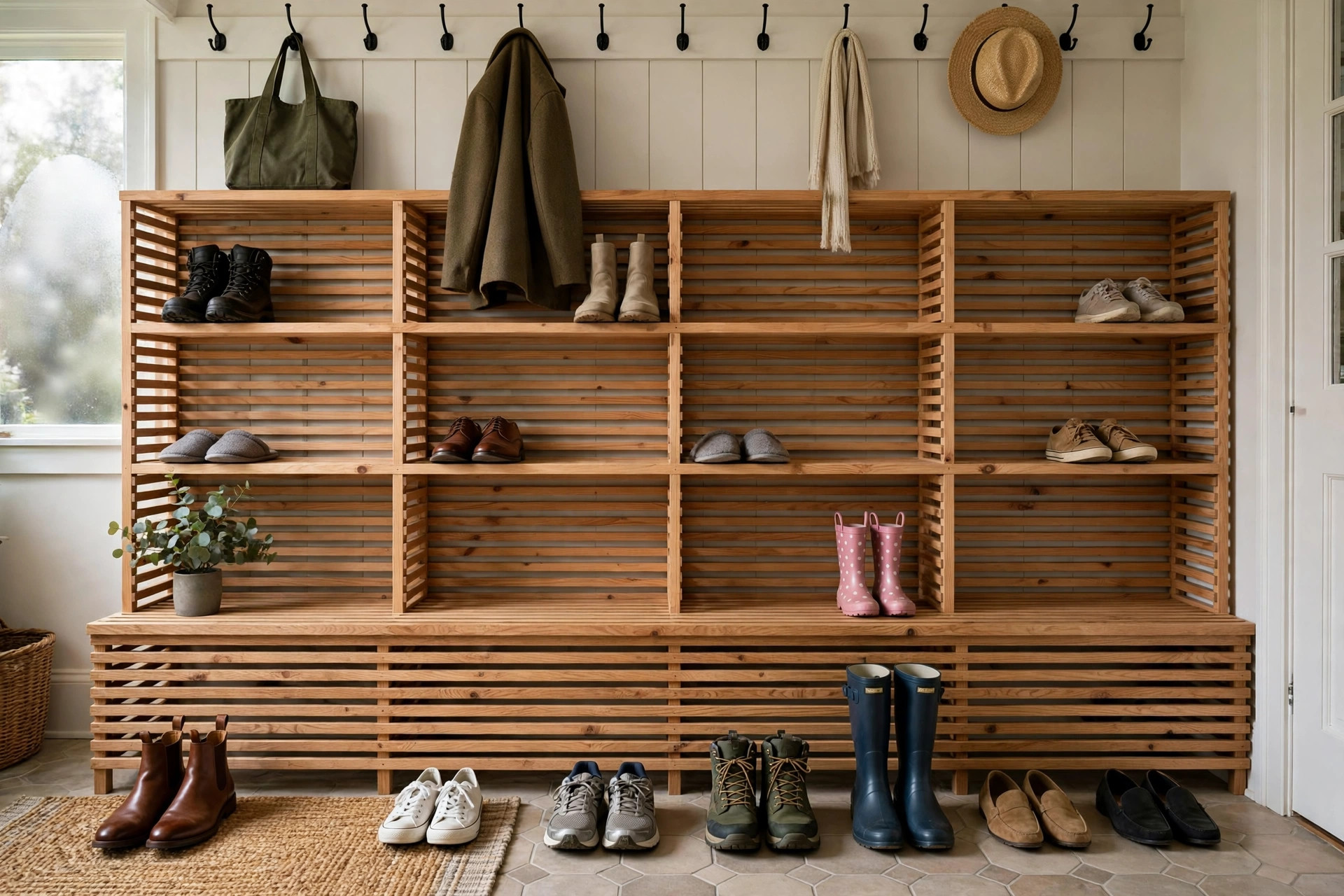
18. Shoe storage that breathes — slatted shelves, no smells
Shoes stored in a closed box are shoes that smell, because the damp from the day is the damp that stays in the box, the damp that stays in the box is the smell that grows in the box, and the box that is opened on Monday is the box that smells of Saturday. Use shoe storage that breathes — slatted shelves, no smells — so the air moves around every pair and the shoes dry out between wears. Build or buy a slatted shelf where the shoes sit on open slats with space between them, and leave a finger's width between pairs, because the shelf that breathes is the shelf that keeps the shoes dry. Put the slatted shelf under the bench or on the wall, and keep the muddy boots on the tray from idea 5. The shoe storage itself is covered in 24 Shoe Storage Ideas for 2026, where the slatted shelf gets the full treatment. Slatted shelves, and the mudroom stops smelling of shoes.
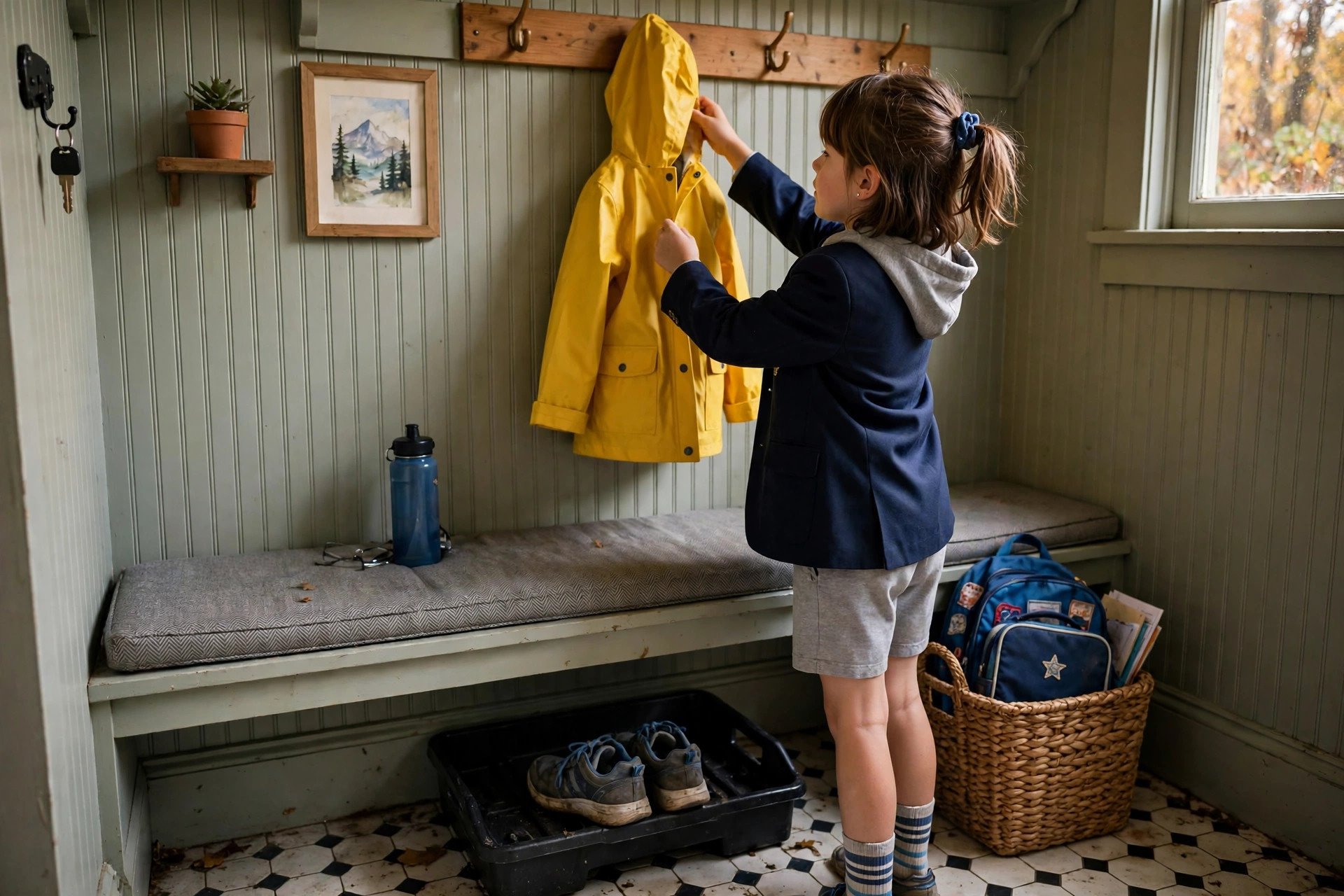
19. A five-minute reset after school — the habit that keeps the mudroom clear
No mudroom survives without a habit, because the mudroom is only tidy on the day you set it up and the mess creeps back one coat at a time. Do a five-minute reset after school — the habit that keeps the mudroom clear — so the coats are on the hooks, the shoes are in the tray, and the bags are in the basket before dinner. Coats on the hooks, shoes in the tray, bags in the basket, and the bench wiped. Do it together for the first week, because the reset the parent does with the child is the reset the child learns to do alone. Five minutes after school, and the mudroom never needs a big clean.
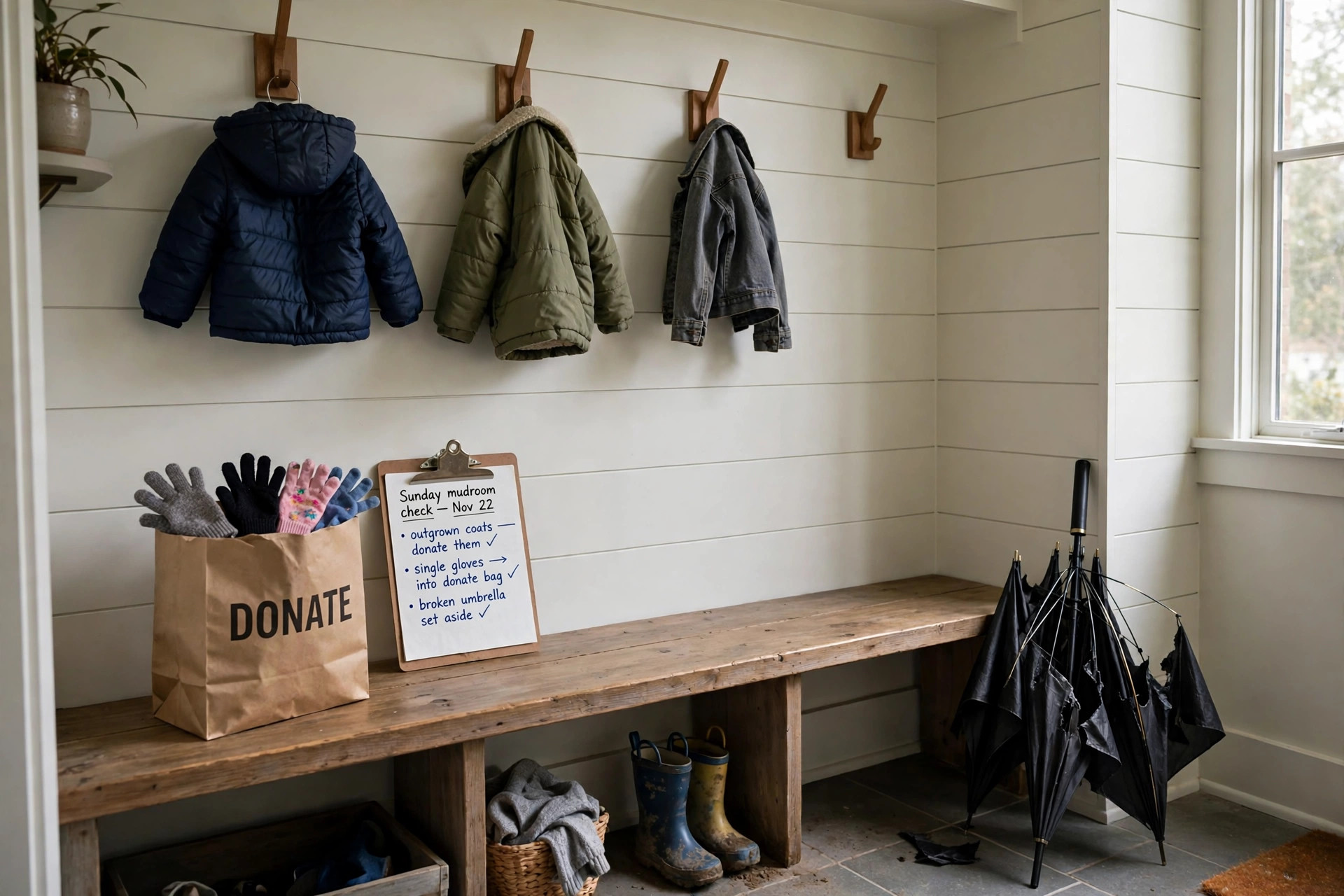
20. A weekly mudroom check — outgrown coats, single gloves, broken umbrellas
A mudroom without a weekly check is a mudroom that fills up with things nobody uses, because the coat the child outgrew is still on the hook, the single glove is still in the cubby, and the broken umbrella is still in the stand. Do a weekly mudroom check — outgrown coats, single gloves, broken umbrellas — so the mudroom holds only what the family actually uses. Every Sunday, check the hooks for coats that no longer fit, the cubbies for gloves with no partner, and the stand for umbrellas that no longer open, and put the outgrown things in a bag for the charity shop, because the check that happens weekly is the check that stops the mudroom filling up. One check a week, and the mudroom never overflows.
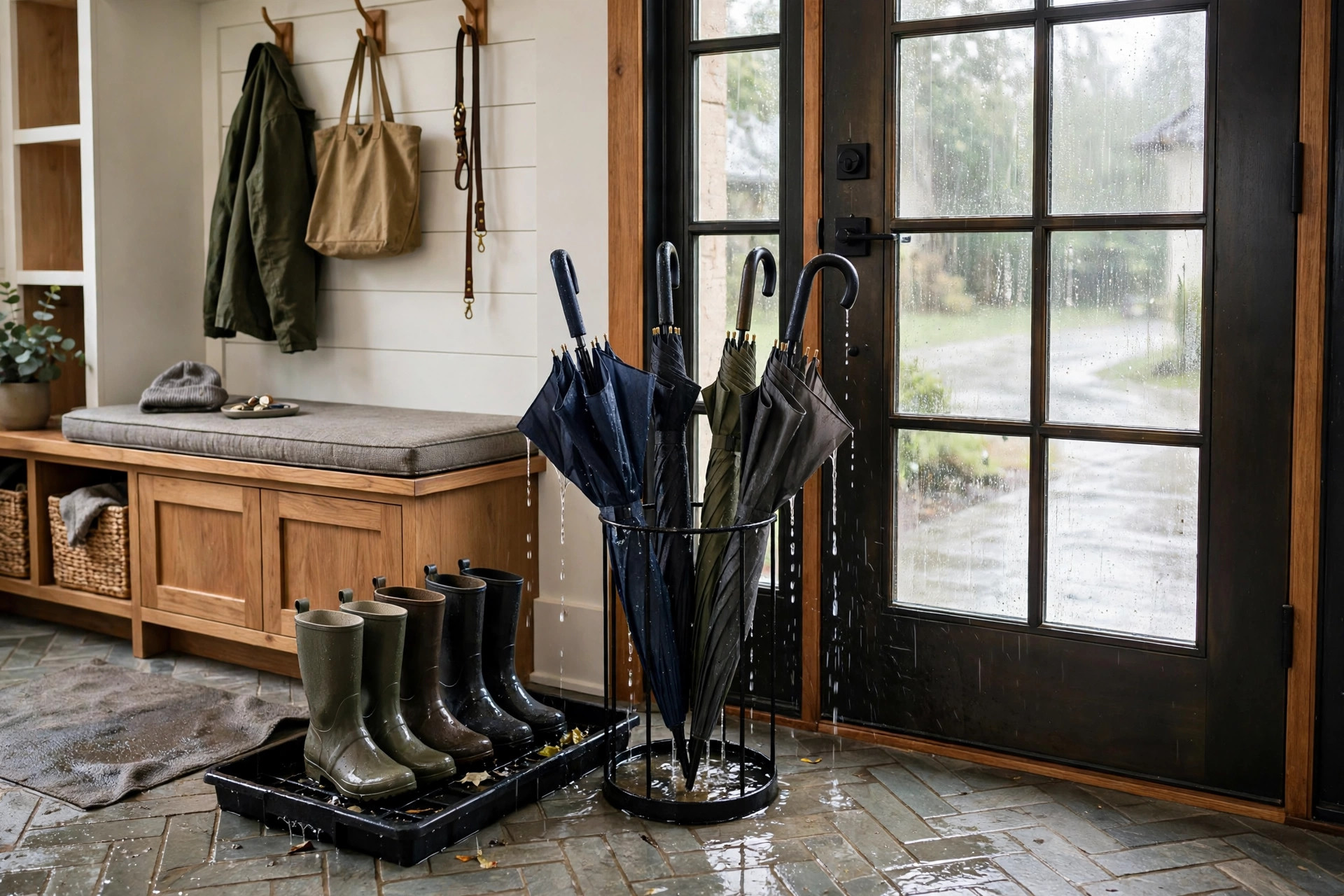
21. An umbrella stand by the door — wet umbrellas drip in one place
Wet umbrellas without a stand are wet umbrellas on the floor, because the umbrella that leans against the wall is the umbrella that slides down, the umbrella that slides down is the umbrella that drips across the floor, and the floor that is wet every time it rains is the floor that nobody wants to walk on. Keep an umbrella stand by the door — wet umbrellas drip in one place — so every umbrella goes into the stand when it comes in and the water drips into the stand, not onto the floor. Pick a stand with a drip tray at the bottom and enough room for the family's umbrellas. Empty the tray when it fills, and keep the stand beside the boot tray from idea 8. One stand by the door, and the rain stops coming through the front door. (Check on Amazon for an umbrella stand with a removable drip tray, tall enough for full-size umbrellas.)
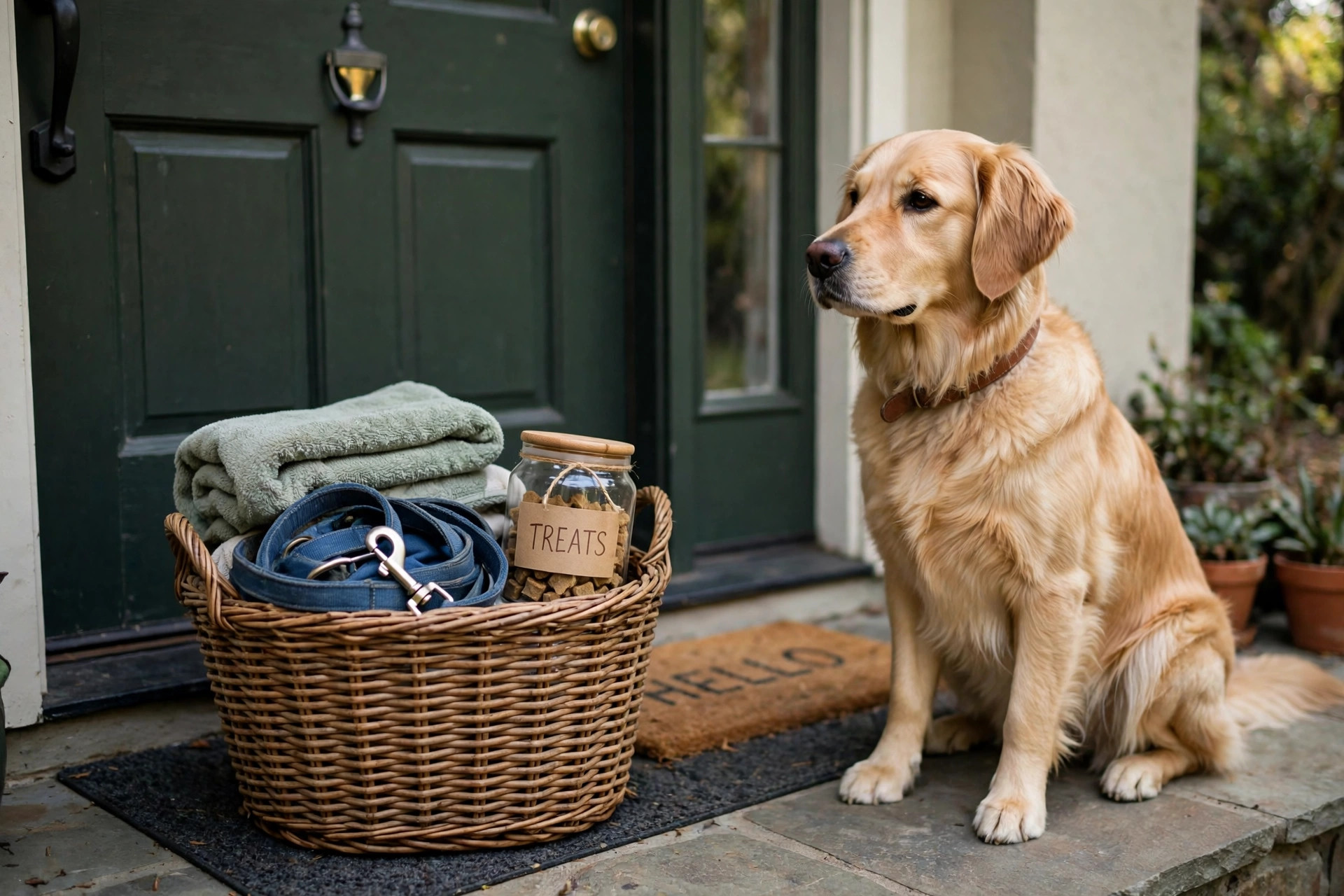
22. A pet zone — leads, towels and treats in one basket
A dog without a zone is a dog whose things are everywhere, because the lead is on the bench, the towel is on the floor, and the treats are in a kitchen drawer that nobody can find when the dog comes in wet. Give the dog a pet zone — leads, towels and treats in one basket — so everything the dog needs lives by the front door in one basket. Hang the lead on the end hook of the key rail from idea 11, keep a towel in the basket for muddy paws, and put the treats in a small jar beside it. One basket by the door, and the dog's things stop being everywhere.
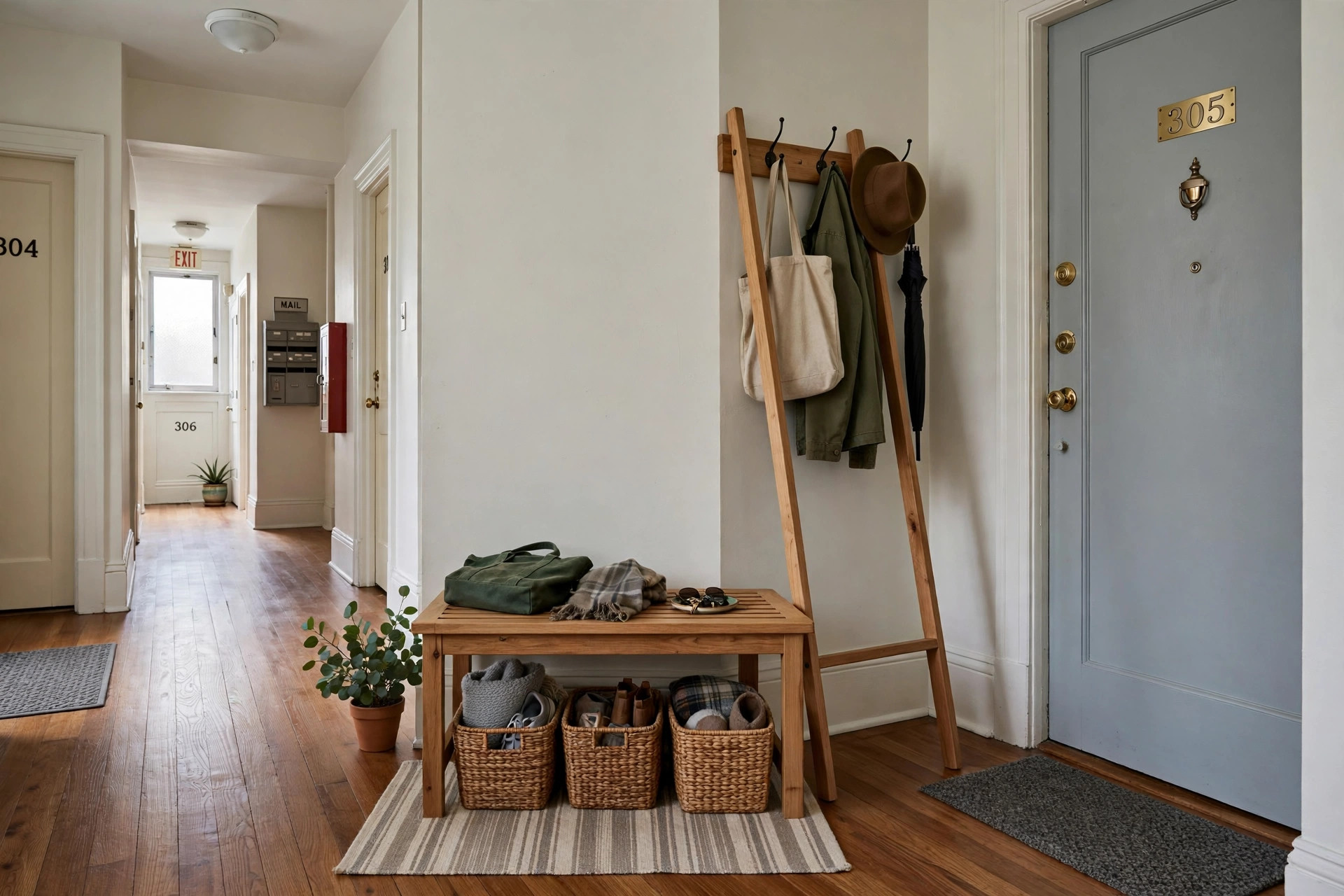
A shared entryway is an entryway where nobody's things have a home, because the neighbour's shoes are beside yours, the landlord will not let you drill holes, and the hallway that belongs to everyone is the hallway that belongs to no one. Build a mudroom for two homes — shared entryways and rented flats — so your family's things live in one freestanding unit that needs no drilling and no permission. Use a freestanding bench with hooks on a rail that leans against the wall, or a tall narrow shelf that stands on the floor. Keep it slim, keep it to one wall, and keep the baskets under the bench, because the mudroom that is freestanding is the mudroom that works in a rented flat. One freestanding unit, and the shared hallway has a mudroom.
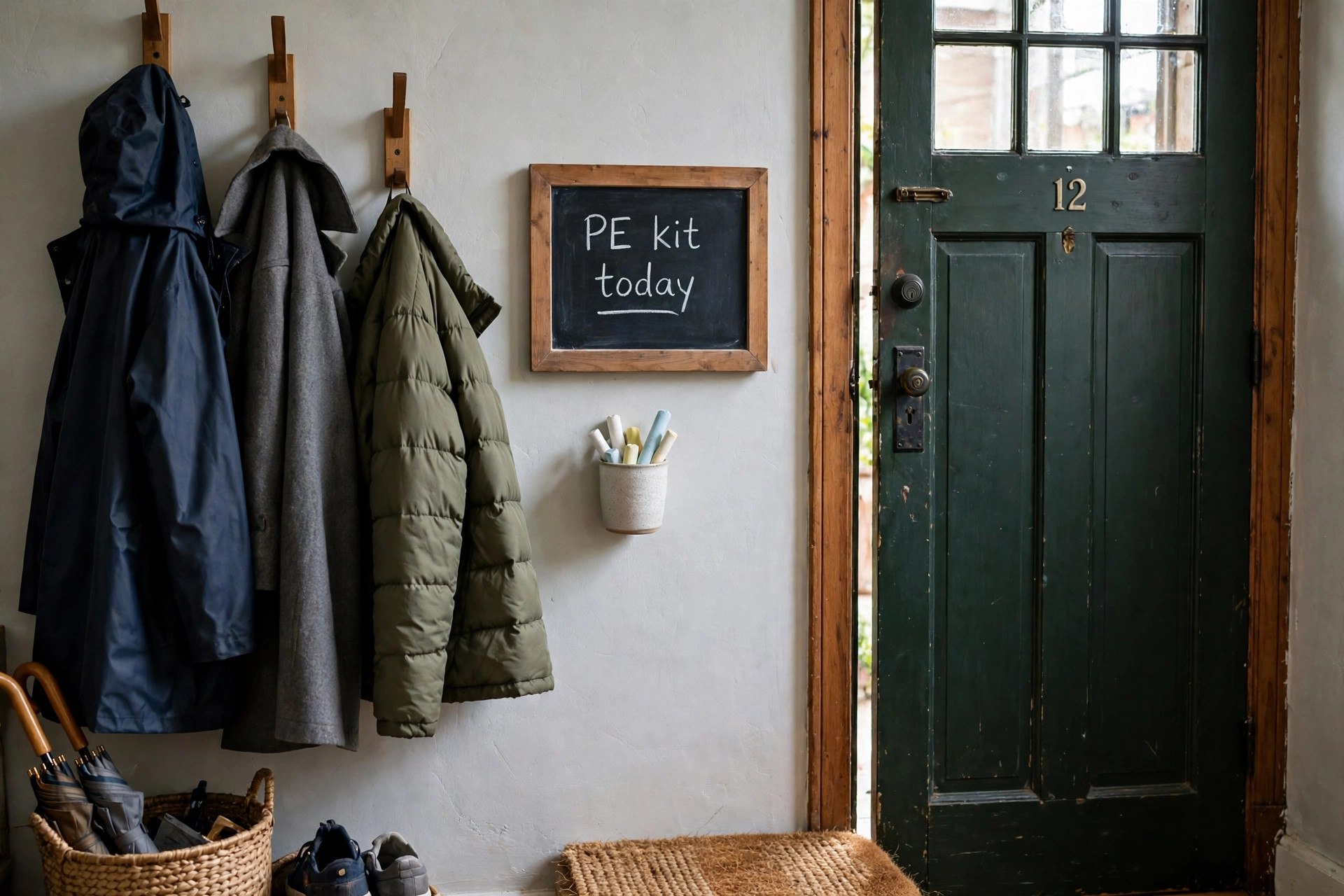
24. A chalkboard by the door — the morning message board
Mornings go wrong when the message does not get through, because the parent who writes a note on the kitchen table is the parent whose note is never seen, and the child who leaves without the message is the child who forgets the thing that mattered. Hang a chalkboard by the door — the morning message board — so the message is on the wall where everyone looks before they leave. Write the one thing that matters today — "PE kit", "permission slip", "early pick-up" — and wipe it clean when the day is done, because the board that holds one message is the board that gets read. Put the chalk in a small cup beside the board, and let the children write their own messages too. One chalkboard by the door, and the morning message always gets through.
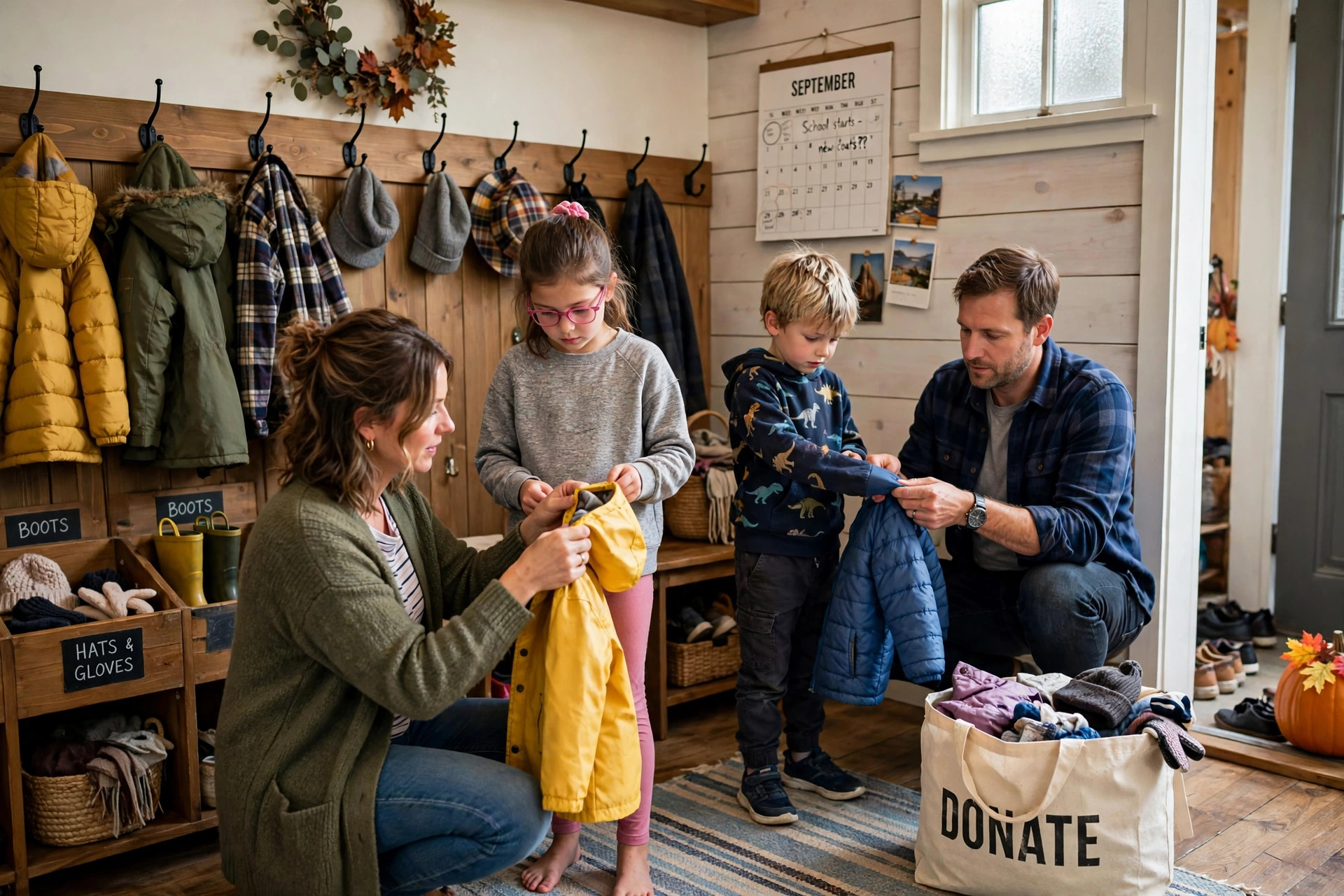
25. A seasonal sort-out — the mudroom that grows with the year
A mudroom set up in September is a mudroom that does not fit by February, because the children have grown, the seasons have changed, and the hooks that held the autumn coats are the hooks holding last season's things. Do a seasonal sort-out — the mudroom that grows with the year — so the mudroom changes as the family does. At the start of each season, clear the hooks, throw away the broken umbrellas and the single gloves, move the out-of-season coats to storage, and check the children's coat sizes. The garage mudroom that shares the load is covered in 25 Garage Storage Ideas for 2026, where the entry meets the car and the seasonal things get a second home. One sort-out a season, and the mudroom grows with the family.
Which mudroom idea fits which situation?
| Situation | Best first move | Budget | Tools needed |
|---|---|---|---|
| Coats on the floor every day | One hook per person (idea 1) | Low | Hooks |
| Hooks at the wrong height | Measure the wall first (idea 2) | Free | Tape measure |
| Nowhere to sit and put shoes on | A bench that does double duty (idea 3) | Low–Medium | Bench |
| Everyone's things mixed together | Labelled cubbies (idea 4) | Low | Cubbies, labels |
| Mud tracked through the house | A shoe tray by the door (idea 5) | Low | Shoe tray |
| Mornings are a hunt for the bag | A "grab-and-go" basket (idea 6) | Low | Basket |
| Kids can't reach the hooks | Hooks at two heights (idea 7) | Low | Hooks |
| Wet boots soaking the floor | A boot tray with a lip (idea 8) | Low | Boot tray |
| Bags dumped on the floor | A bag rail (idea 10) | Low | Rail, hooks |
| Keys lost every morning | A key rail by the door (idea 11) | Low | Key rail |
| Letters piling on the bench | A post tray (idea 12) | Low | Tray |
| Mudroom tidy for one day only | Five-minute reset after school (idea 19) | Free | None |
You do not need all 25 ideas. You need the three that solve your front door — usually the one hook per person that stops the coats landing on the floor, the shoe tray that catches the mud, and the five-minute reset after school that keeps it all tidy. Start with the hooks, do it this weekend before the school week starts, and put the tray by the door. Do that and the next time the school bag hits the floor, the coat will be on its hook, the shoes will be in the tray, and the front door will be the room that keeps the house tidy.
Save this post for the next school term, and if the hallway beyond the mudroom needs the same treatment, read 22 Entryway Storage Ideas for 2026 next — it is Post 10, the entryway systems this mudroom plugs into — and 25 Coat Closet Organization Ideas for 2026, Post 11, for the coats that are not in daily use. This is the first post of the next Organization by problem run — Posts 61 to 65, one problem at a time — and the run opens with the room that takes the hit so the rest of the house stays tidy. The hallway closet itself gets its own deep dive in Hallway Closet Organization, where narrow closets that hold coats and more are covered in full.
Publish date assigned at publishing time. Updated as new mudroom finds are tested.
Frequently asked questions
How do I organize a small mudroom with no built-ins?
You do not need built-ins — a freestanding bench with hooks on a rail above it does the same job. Put a shoe tray by the door for the mud, slide baskets under the bench for shoes and bags, and hang one hook per person on the wall. A narrow console with a post tray turns a hallway into a mudroom, and a rolling cart or a single basket per person works in a rented flat where you cannot drill holes.
How do I keep shoes from piling up by the front door?
Give every pair of shoes a place that is easier to use than the floor: a shoe tray with a raised lip right where the shoes come off, and baskets or slatted shelves under the bench for the pairs that are not in daily use. Keep only the daily shoes by the door and move the rest to the closet, and do a five-minute reset after school so the shoes go back in the tray instead of piling up beside it.
How do I keep a mudroom tidy when the whole family uses it?
Give every person one hook, one cubby and one basket, so nobody's things mix with anyone else's — the mixing is what makes a mudroom look messy. Then add the habit: a five-minute reset after school where coats go on hooks, shoes go in the tray and bags go in the basket, plus a weekly check for outgrown coats and single gloves. A mudroom that is labelled and reset daily stays tidy because the system does the work, not the family.