25 Pantry Organization Ideas for 2026
A pantry is only useful when you can see what is in it. Most pantries fail the same way: the good stuff hides at the back, the same jar gets bought twice, the thing you need is always behind three things you do not need, and the food at the back quietly goes out of date.
These 25 pantry organization ideas fix that without a bigger kitchen: one zone per kind of food, a shelf you can actually see, clear bins and labels for the daily rotation, and a rule that everything goes back in its zone, not wherever there is a gap.
Every idea below works in a real kitchen, from a single cupboard to a walk-in pantry. Pick three that fit your worst shelf, start with taking everything out and sorting it by zone, and build from there.
Start with a system, not another shelf
1. Take everything out before you buy a single bin
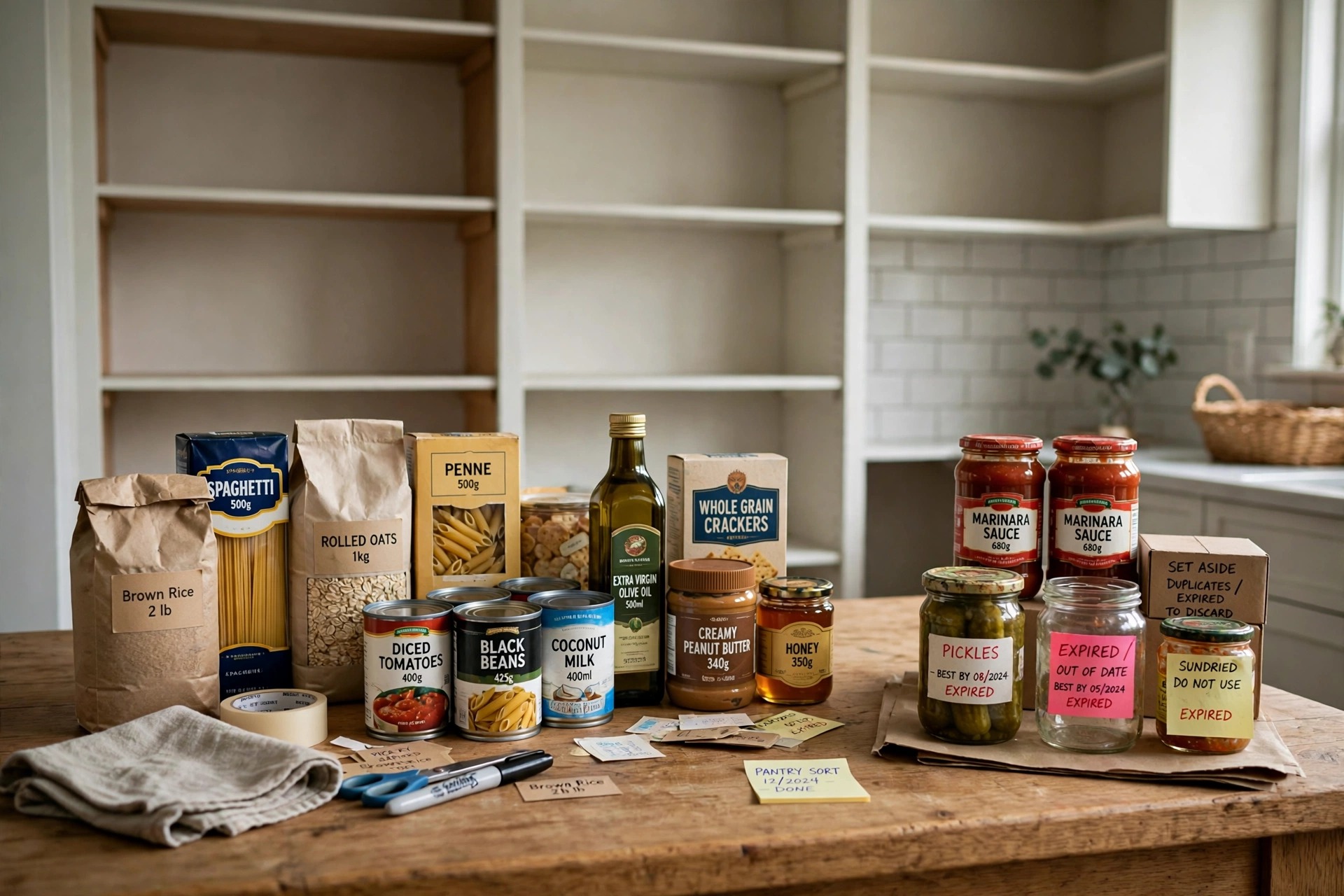
A pantry cannot be organized while it is still full, because you cannot see what you actually own. Take everything out, shelf by shelf, and put it on the kitchen table in groups — and only then decide what stays, what goes, and what you need to store. Most people find three or four duplicates, a few things years out of date, and a whole shelf of food nobody in the house eats. Throw the expired food, donate the unopened food you will not use, and put the keepers back in groups. Buy bins after the sort, not before it, so the bins fit the food you actually have.
2. Sort by zone, not by size or colour
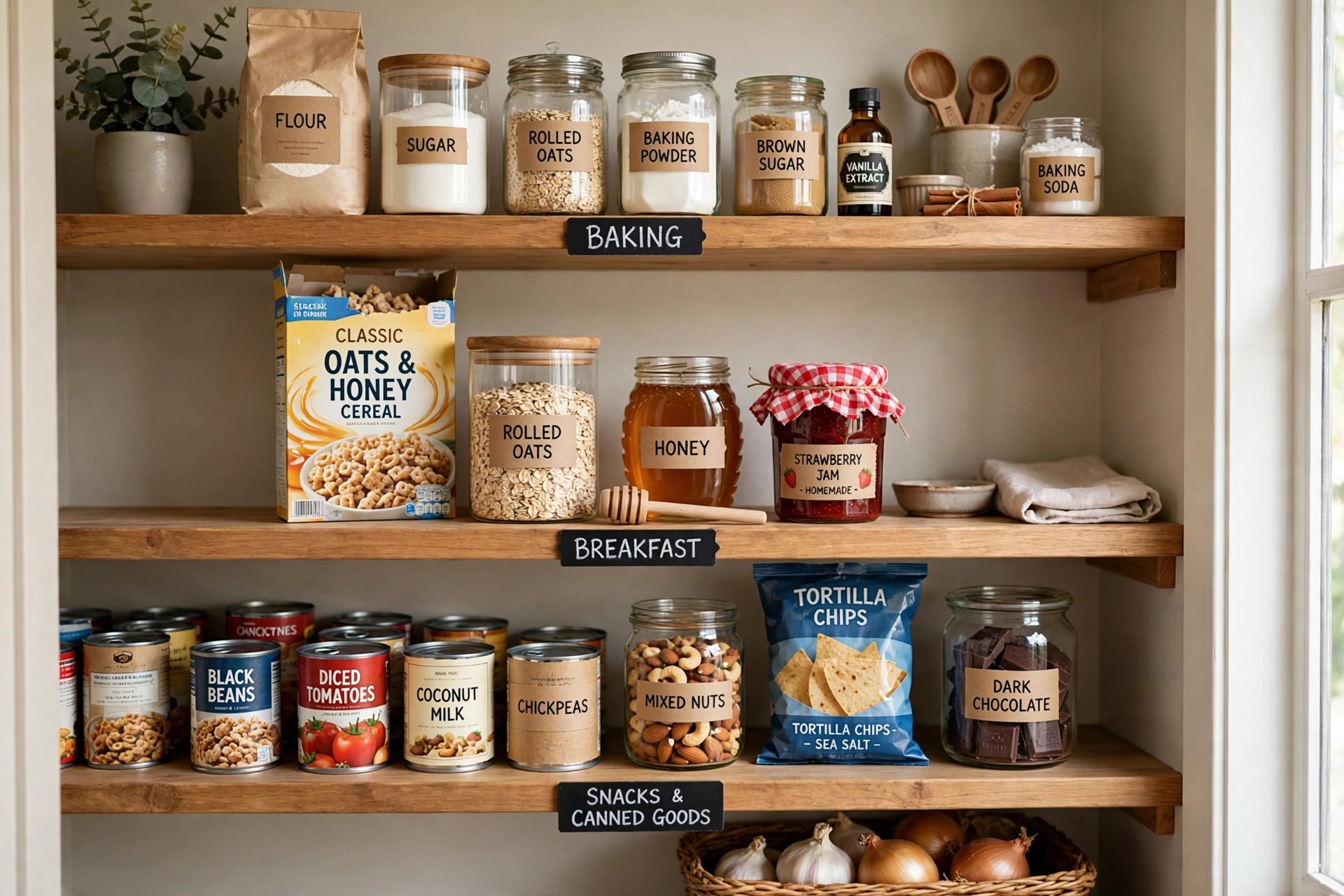
Sorting by size looks tidy and helps no one cook dinner. Sort by how you use the food instead: breakfast, cooking, baking, snacks, drinks and backstock, and only then by type inside each zone. Breakfast lives together — cereal, oats, honey and jam on one shelf — so the morning is one reach instead of a hunt across three shelves. Cooking lives together too: oils, sauces and tins in one place, spices in another. Zones also tell you the real shape of the pantry: if the snack zone is three shelves and the cooking zone is one, the pantry is telling you what this household actually eats.
3. One home for every food, and only one home
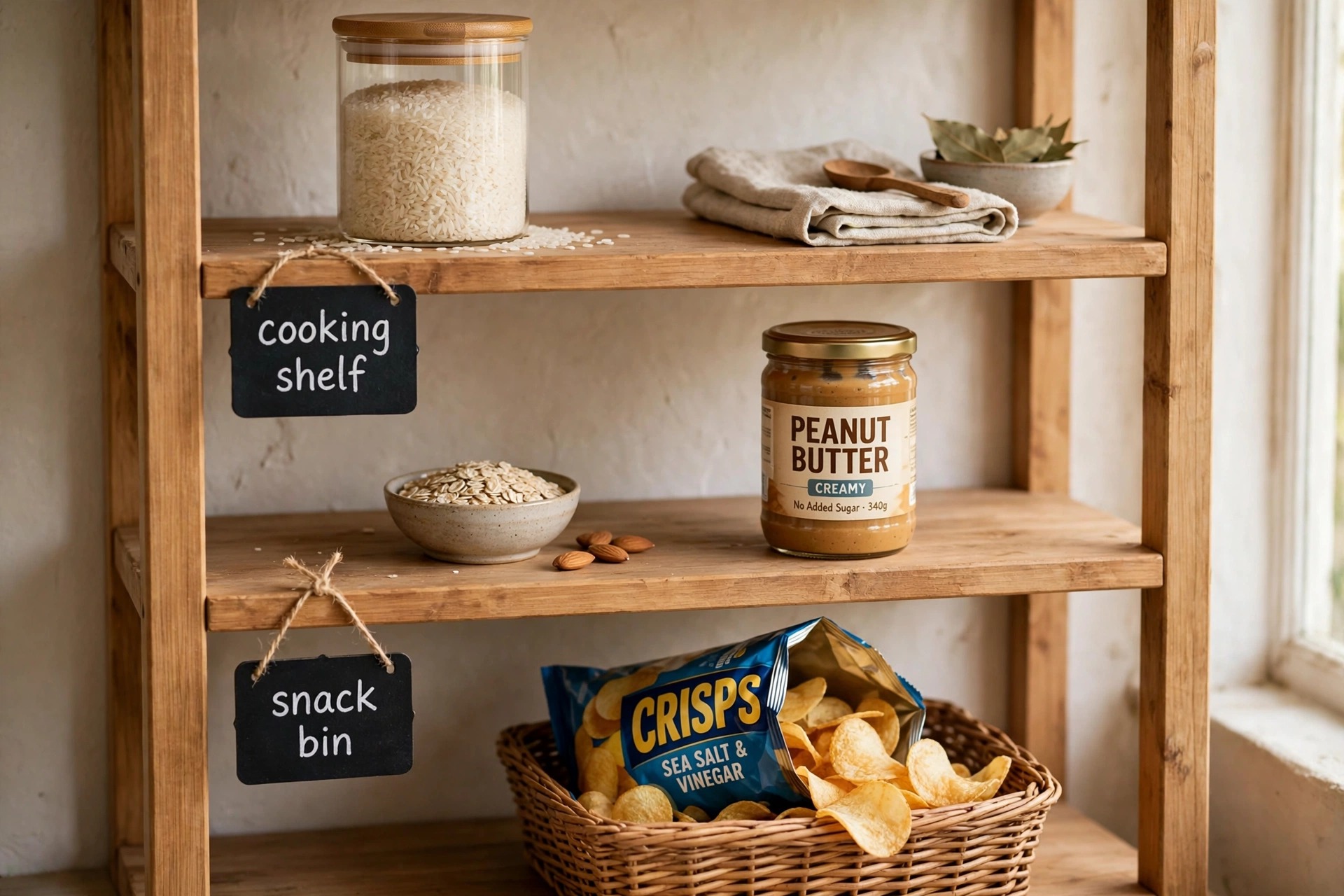
A jar with two homes ends up in neither — it lives on the counter, the shelf and the back of the cupboard between them. Give every food exactly one place: the rice in its jar on the cooking shelf, the peanut butter in the breakfast zone, the crisps in the snack bin. When the shopping comes home, everything goes straight to its home before anything else happens, and cooking is just walking to the shelf. If a food has no home, it does not get a new bin — it gets a zone, or it gets used up first. One home per food is the whole system in one rule.
4. Eye level is for the everyday, high and low are for the rest
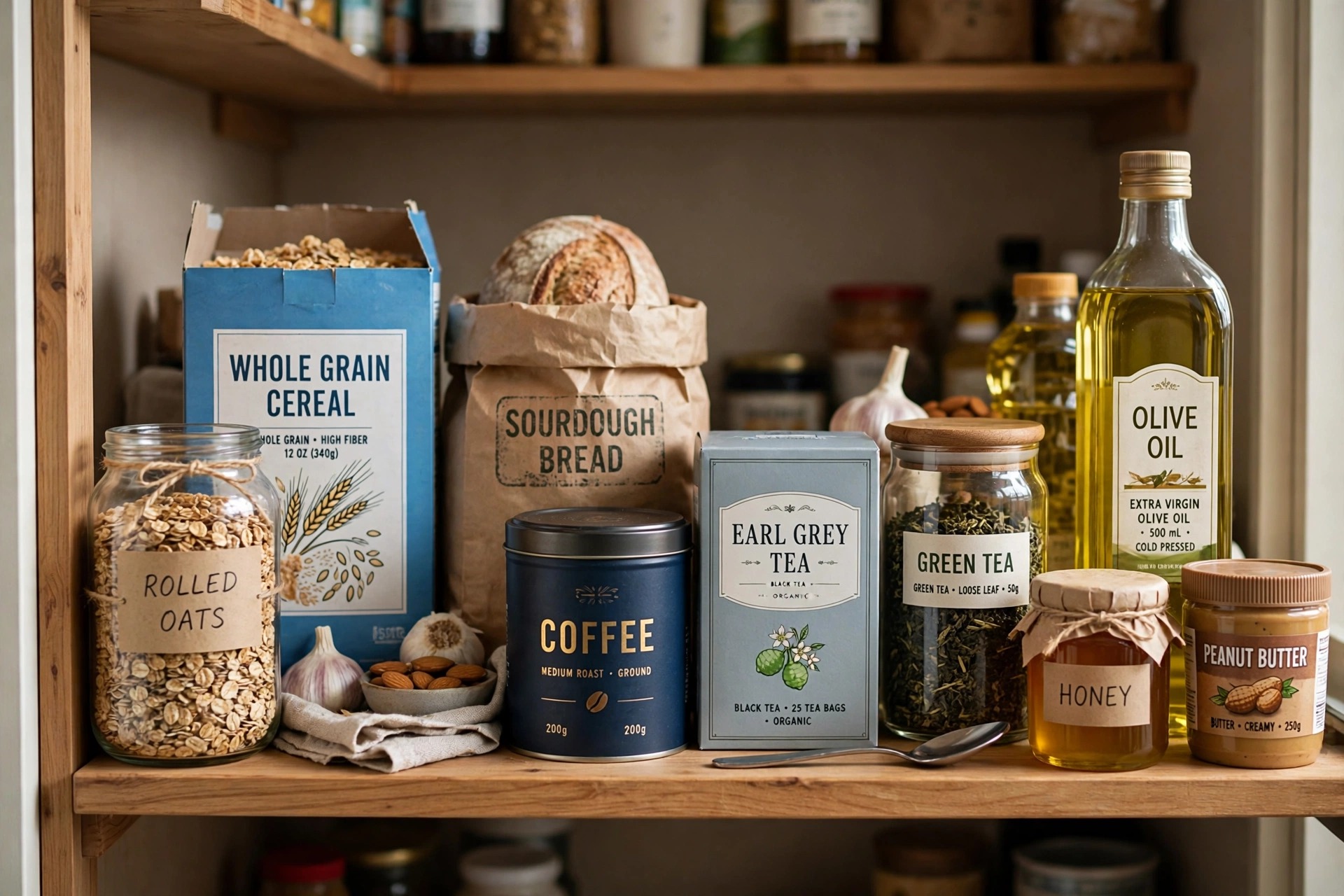
The most-used food should live where you can see it without stretching or bending, and everything else should live out of its way. Put the daily food — tea, coffee, cereal, the oil you cook with — at eye level, the weekly food just above or below it, and the backstock and the things you use monthly on the highest and lowest shelves. A pantry that puts the Christmas baking tray at eye level and the daily cereal on the top shelf is working backwards. Move one thing a day until the eye-level shelf holds only the food you touch every day, and the pantry will feel twice as big.
5. The first-in, first-out rule for every shelf
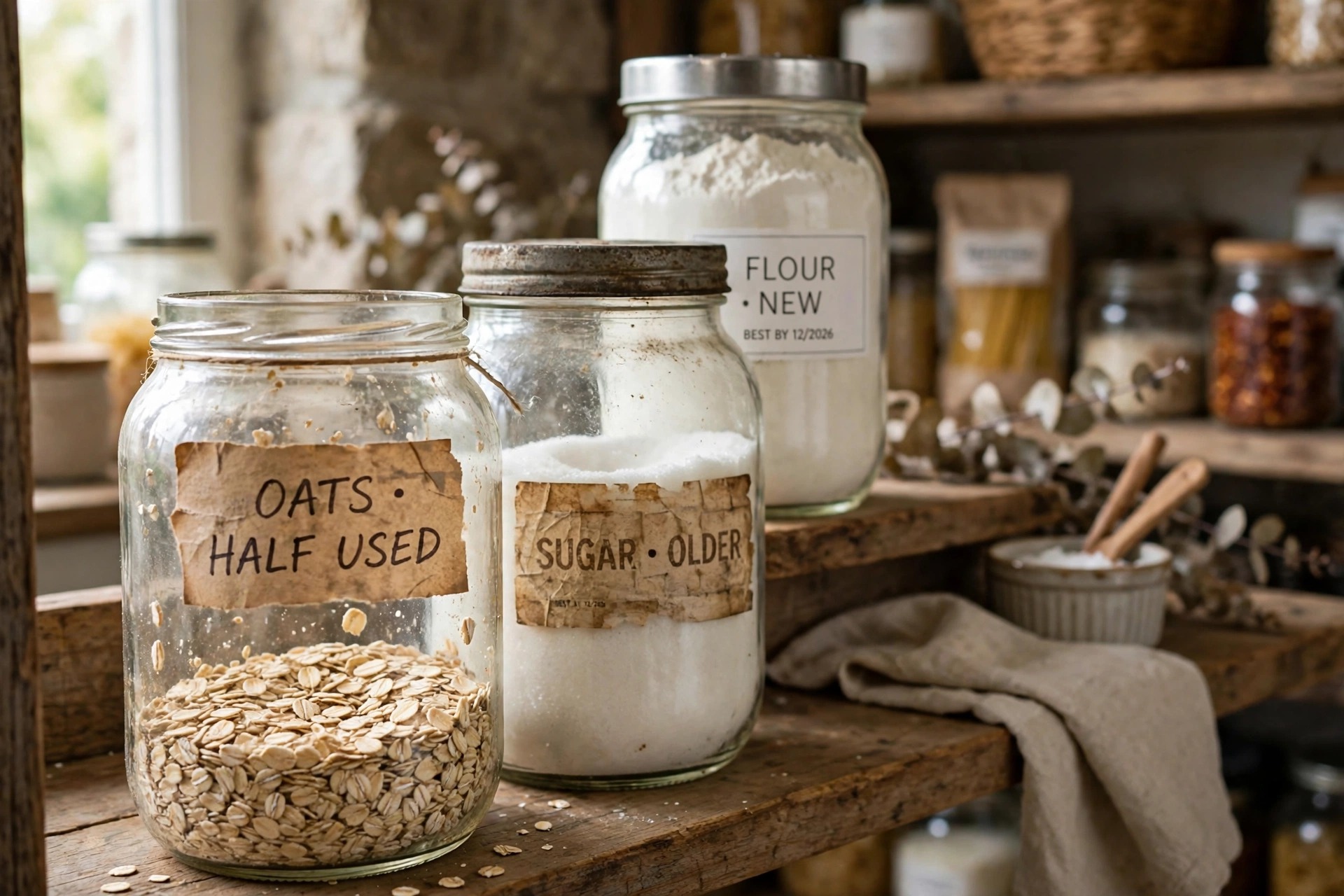
Food goes out of date at the back of the shelf because the new jar always goes in front of the old one. Make the rule before the next shop arrives: new food goes behind the old food, always, on every shelf. When you open a new jar, the half-used one moves to the front, and when you take something out, you take the one at the front. It takes five seconds and it stops the same jar being bought twice and the old one expiring behind it. Put a small marker on the front of the shelf as a reminder until the habit sticks, and the waste drops within a month.
Shelves, bins and containers that work
6. Clear bins, so you can see what is inside without opening them
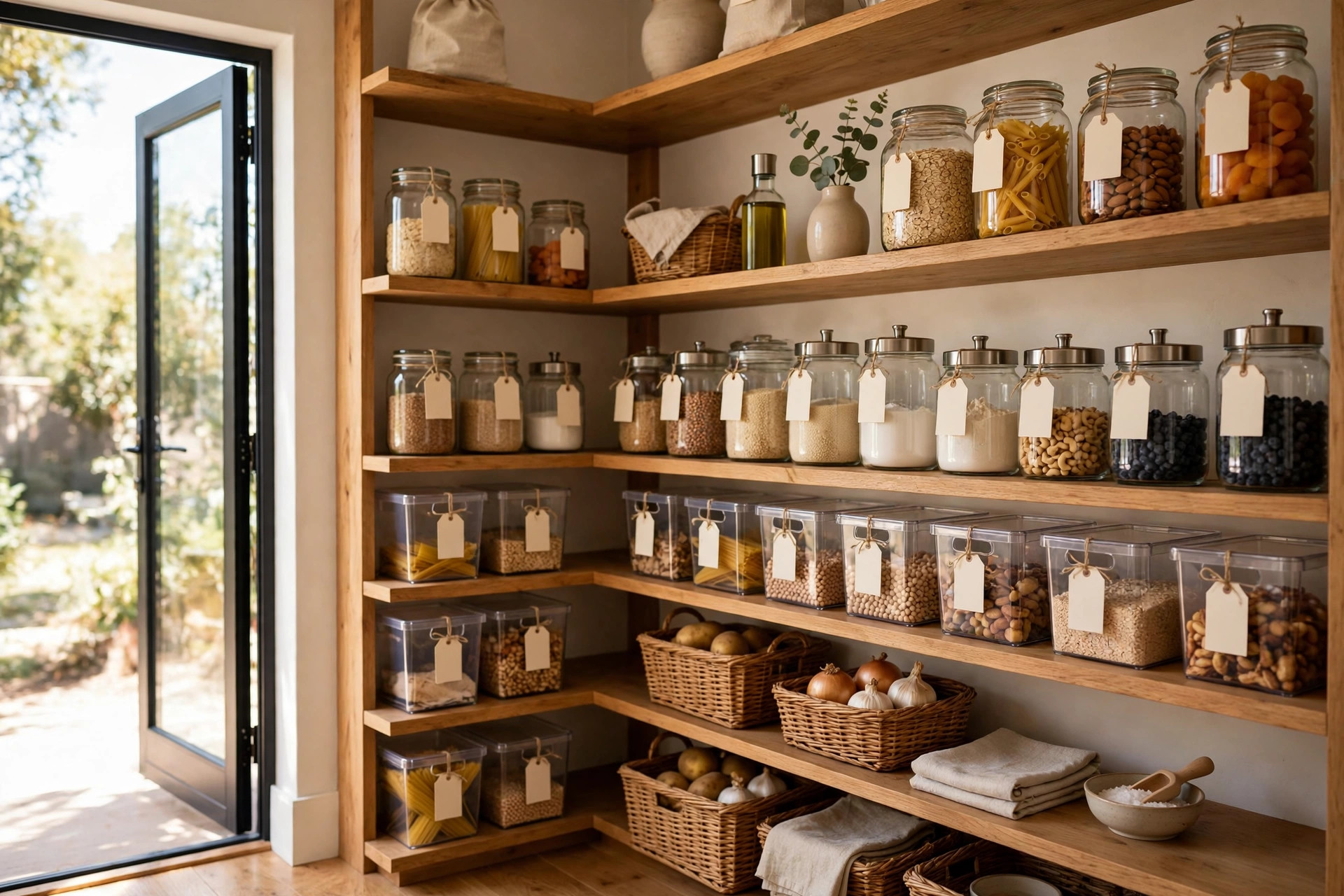
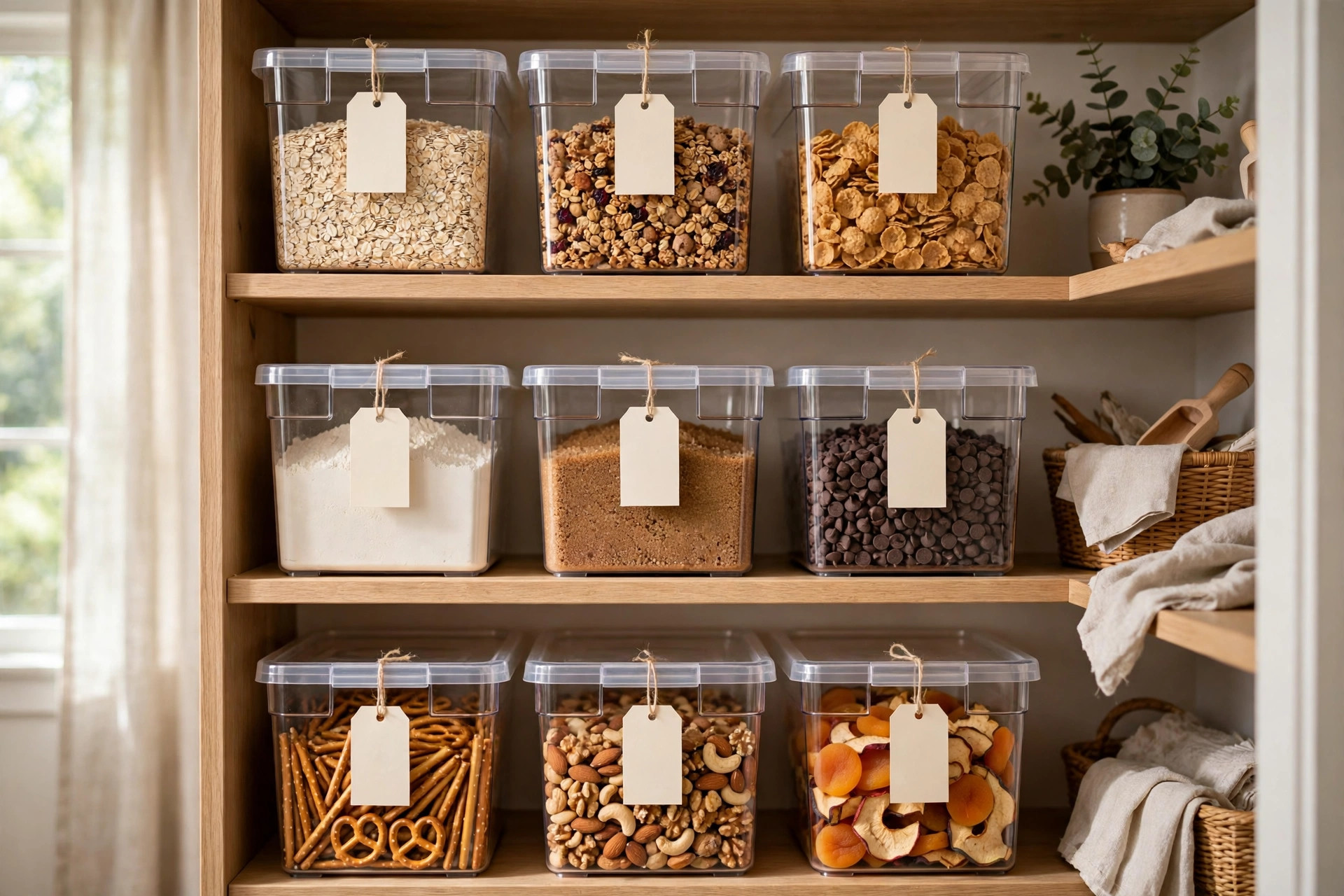
A pantry full of opaque boxes is a pantry you have to open to understand, and nobody opens every box before cooking. Use clear bins for the groups that matter — snacks in one, baking in another, lunchbox food in a third — so you can see at a glance what is inside and what is running low. Clear bins also stop a half-empty packet sliding to the back and being forgotten, because the bin keeps the group together. Keep one bin per zone, label the front, and never let a bin hold two zones at once. One clear bin per group is enough; if you need a second, you need a second zone, not a bigger bin.
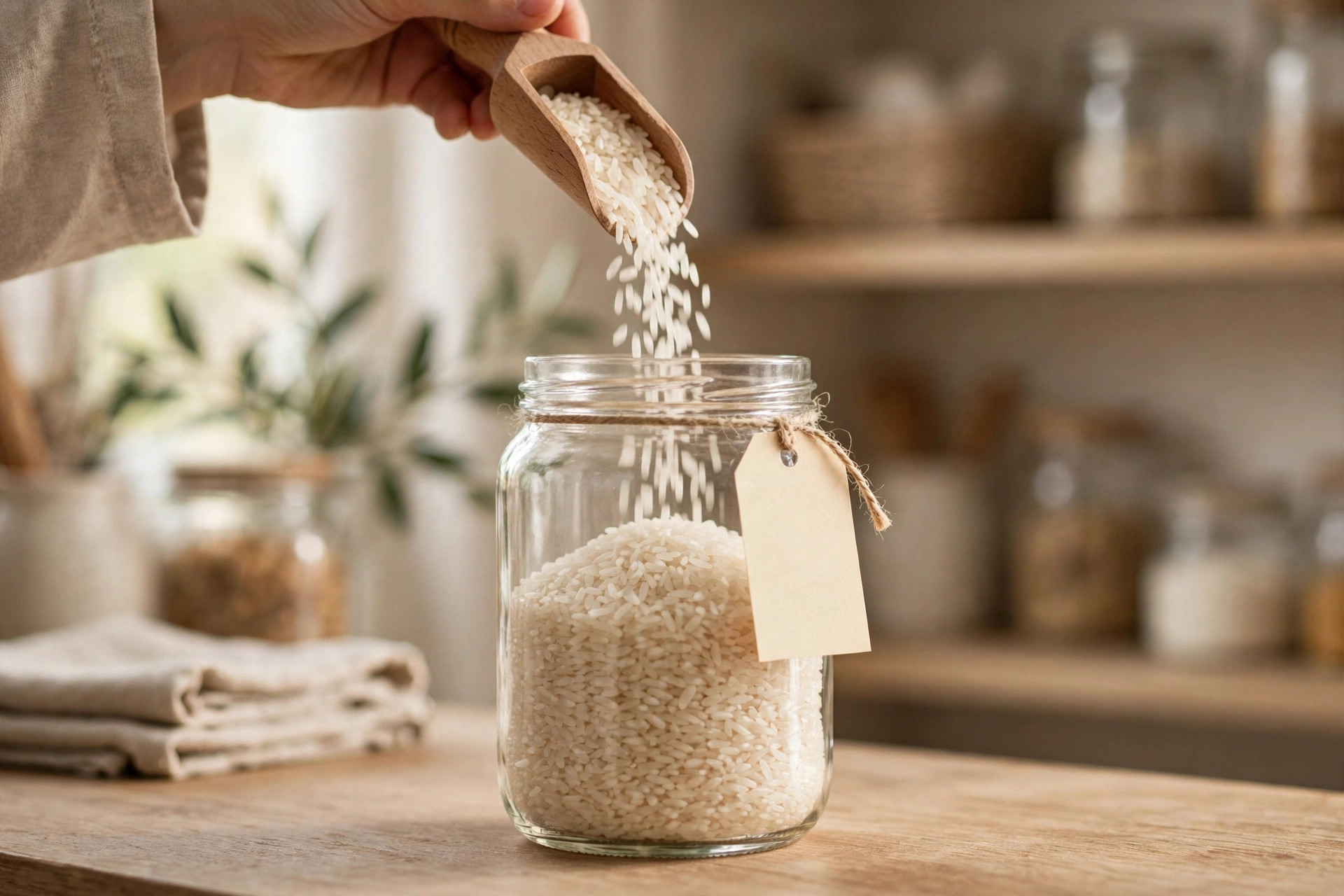
7. Decant the dry goods into matching jars
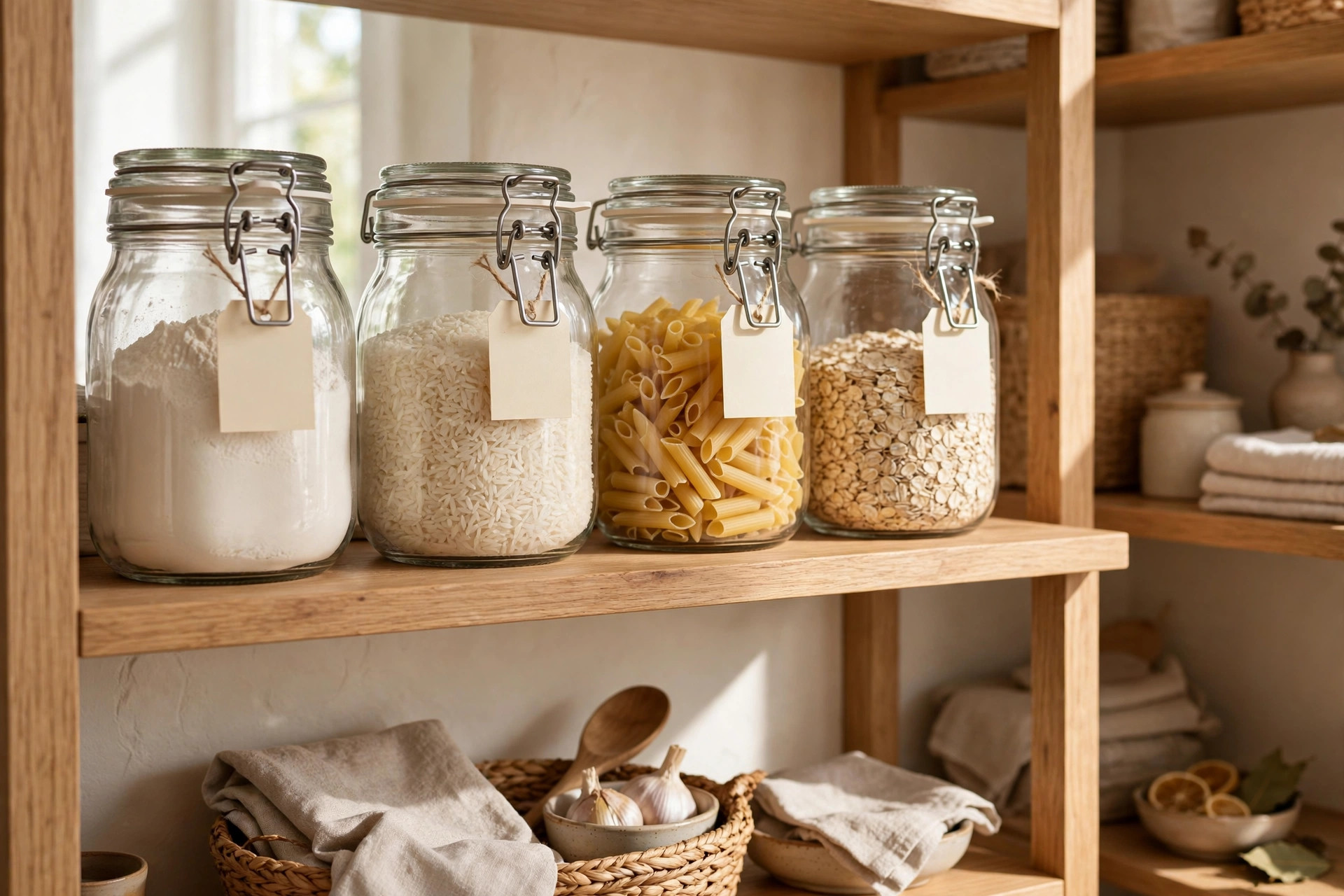
Dry goods in half-open bags spill, go stale and hide how much is left. Decant flour, rice, pasta, oats and sugar into clear, matching jars with airtight lids, one jar per food, and the shelf turns into a row you can read at a glance. Matching jars also stack neatly, use the shelf height properly, and make the pantry look like a shop shelf instead of a bag pile. Label each jar on the front with the food and the date you filled it, so the older jar is always the one you use first. One jar per food, one shelf for the jars, and the dry goods stop spilling.
8. Shelf risers to double the usable shelf
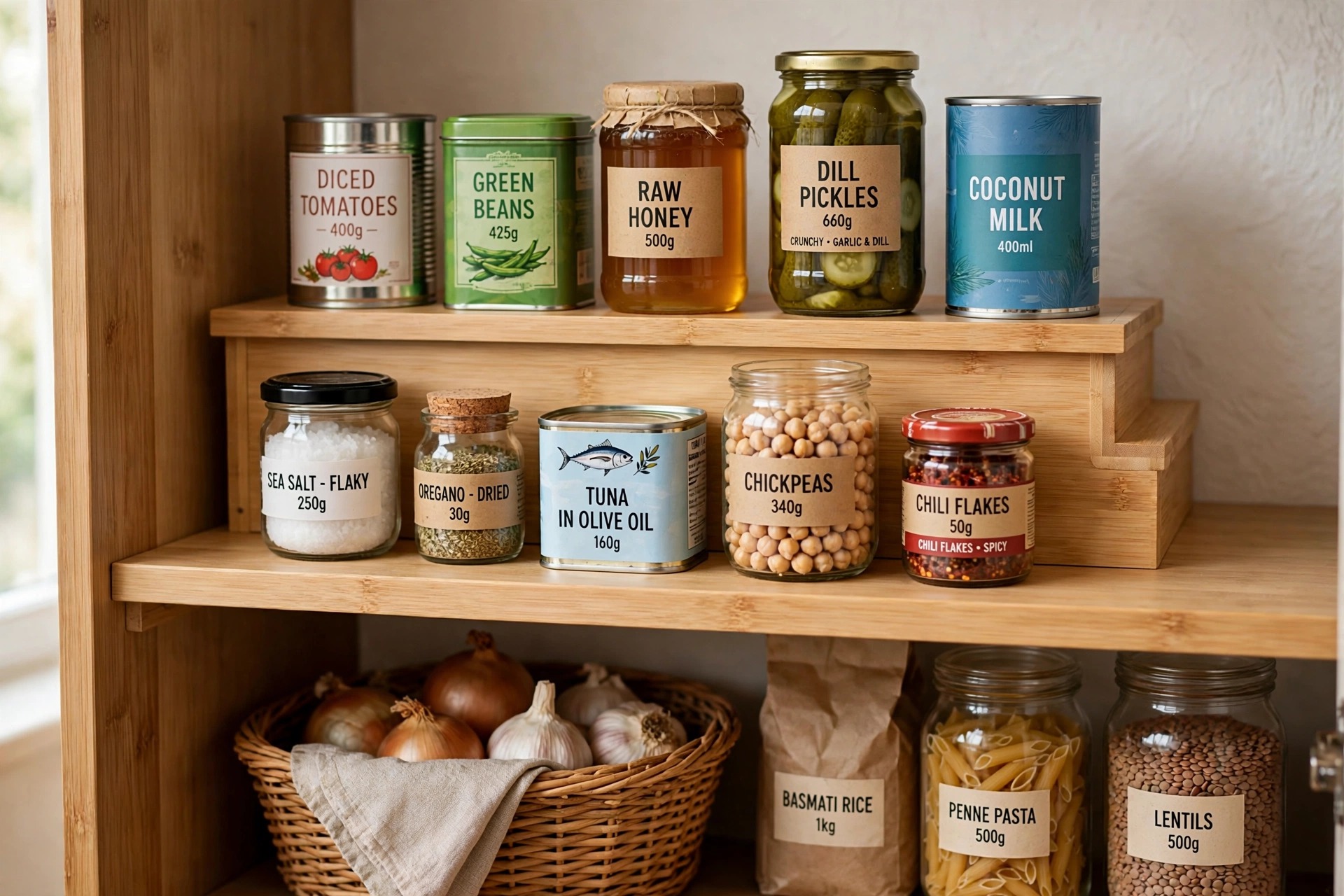
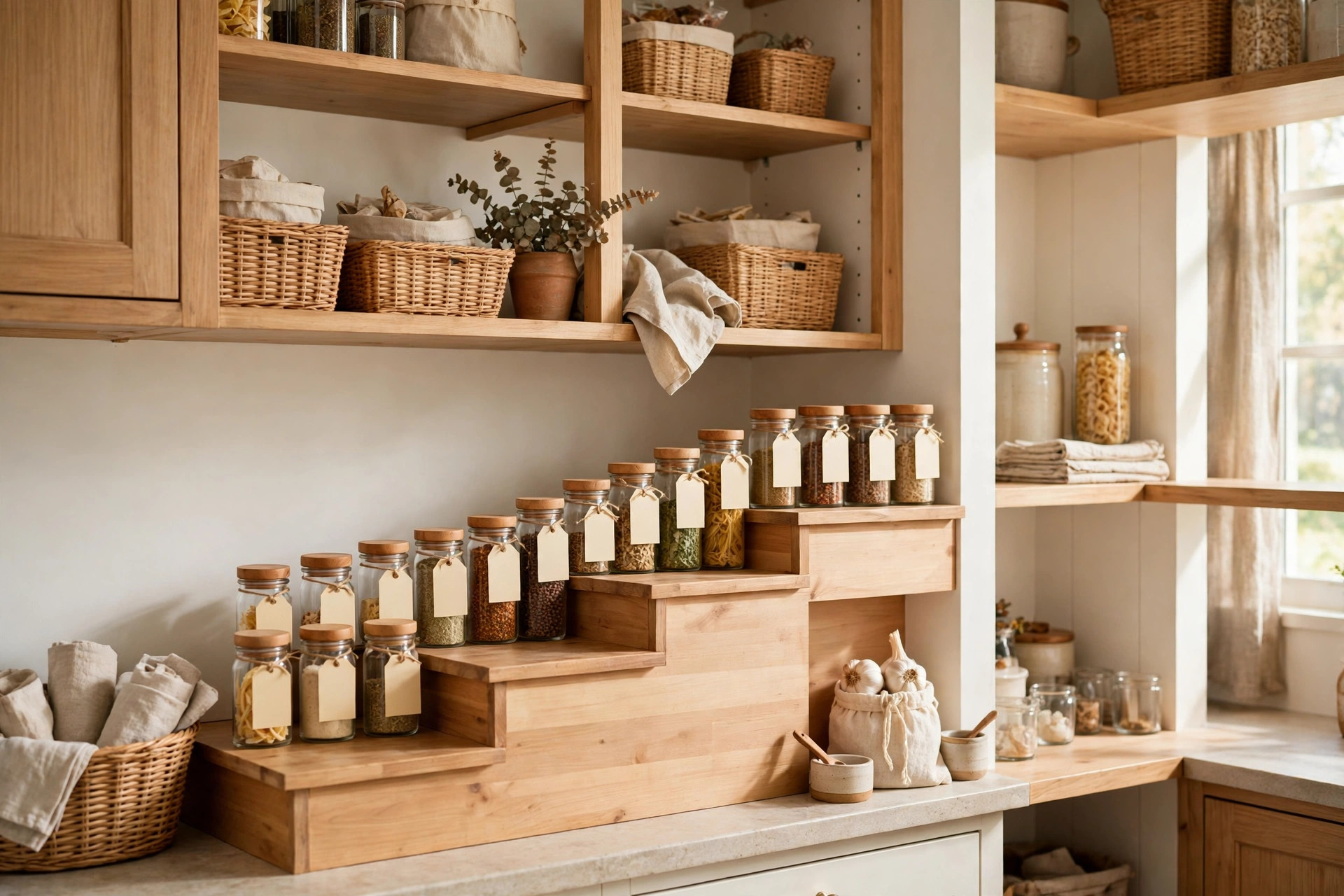
A pantry shelf is usually tall enough for two rows and only ever holds one, because the back row hides behind the front. Put a shelf riser — a small stepped stand — on the shelf, and the back row sits one step higher, visible above the front row instead of hidden behind it. Risers work best for tins, jars and small packets, and they cost almost nothing for the space they recover. Keep the tallest things at the back, the shortest at the front, and never stack a riser on a riser, because that is how jars fall. One riser per shelf, and a shelf that held one row now holds two.
9. A turntable for oils, sauces and the things that hide
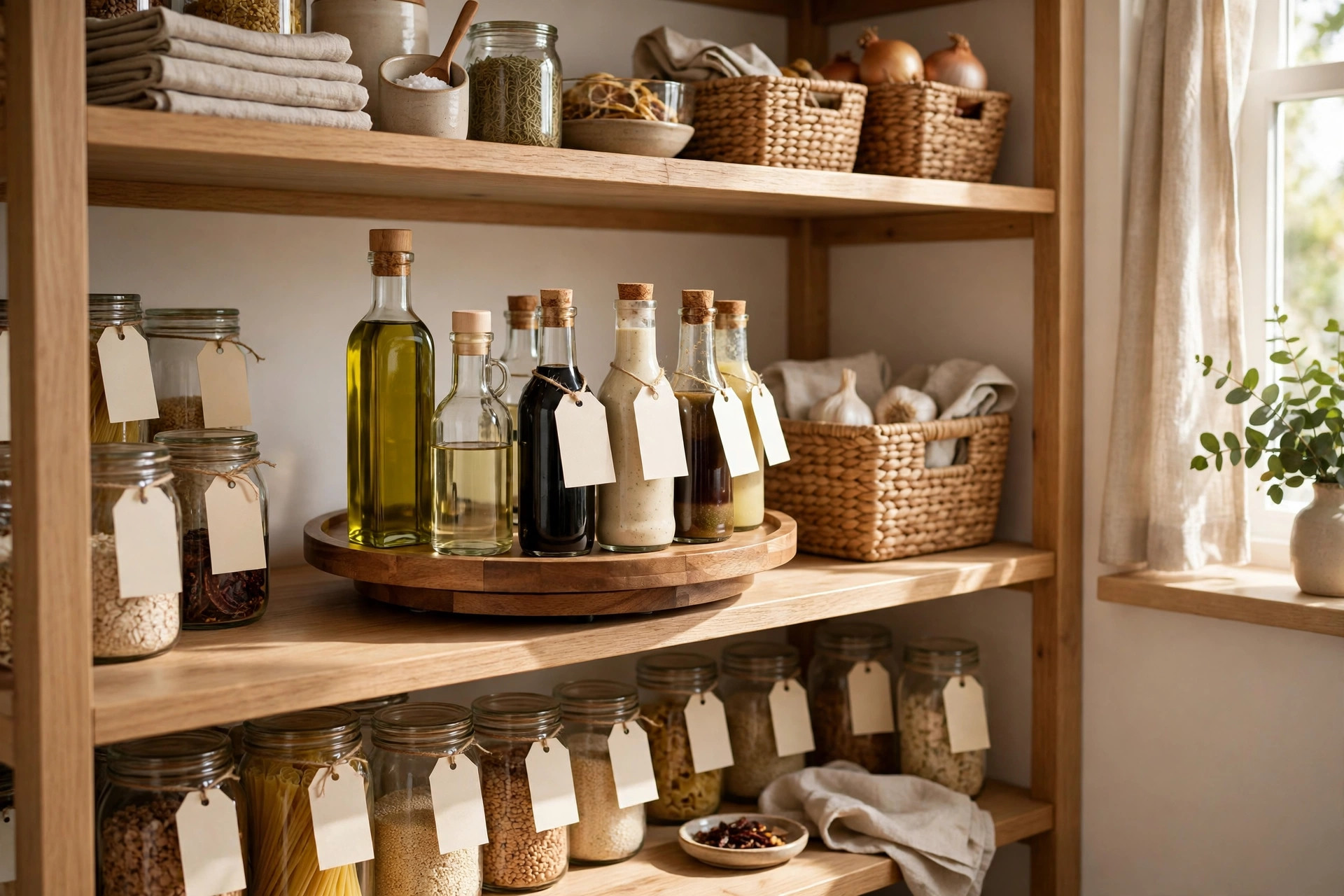
Oils, sauces and condiments are the worst thing to store in a straight row, because the one you want is always at the back. Put a turntable — a lazy Susan — on the shelf, load it with the cooking oils, sauces and dressings, and spin it to find the one you need. The turntable uses no extra shelf at all, keeps every bottle reachable, and stops a bottle falling over when you pull the one behind it. Keep the heavy bottles in the middle and the light ones at the edge, and keep one turntable per zone, not one for the whole pantry. One spin, and the back of the shelf stops hiding.
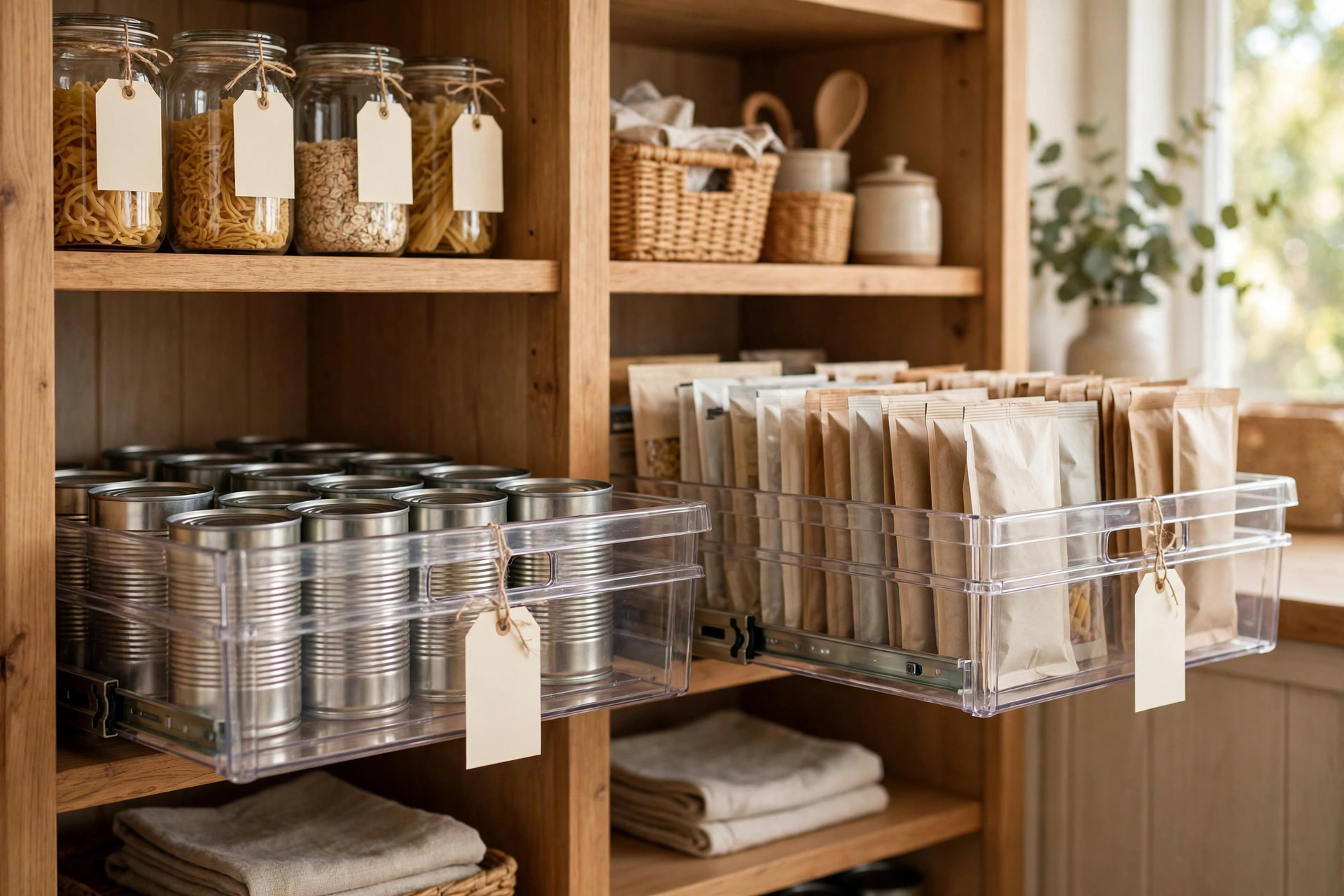
10. Stackable bins for the deep shelves
A deep pantry shelf wastes its back half, because food pushed to the back is food forgotten. Use stackable bins, pulled out like drawers, so the back of the shelf comes to you instead of you reaching into the dark. One bin per group — tins in one, packets in another — and the bin slides out, you take what you need, and it slides back. Label the front of each bin, so you can grab the right one without opening three, and keep the bins shallow enough that nothing gets buried at the bottom. One bin per group, stacked two high at most, and the deep shelf stops eating food.
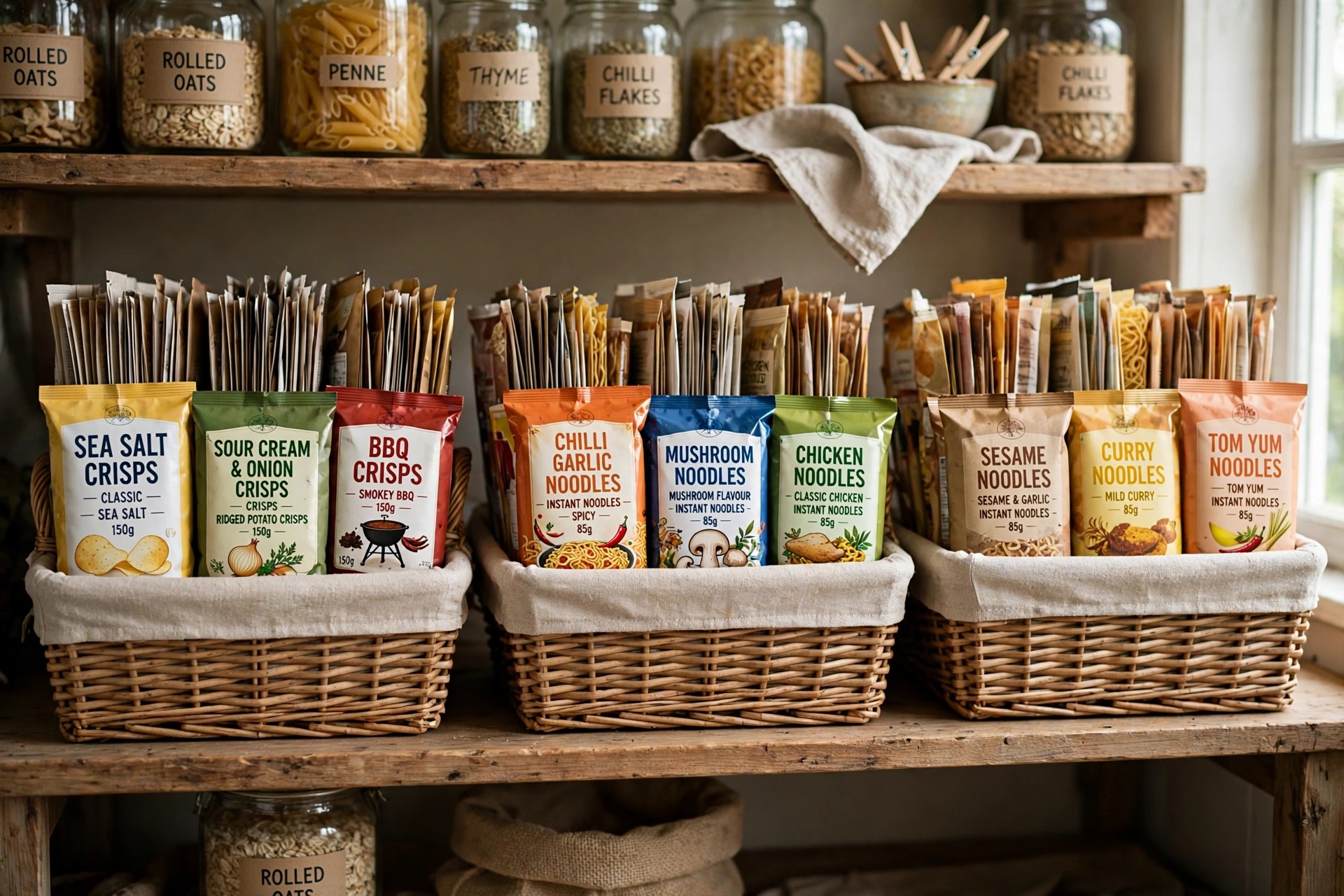
11. Baskets for the loose packets and the odd shapes
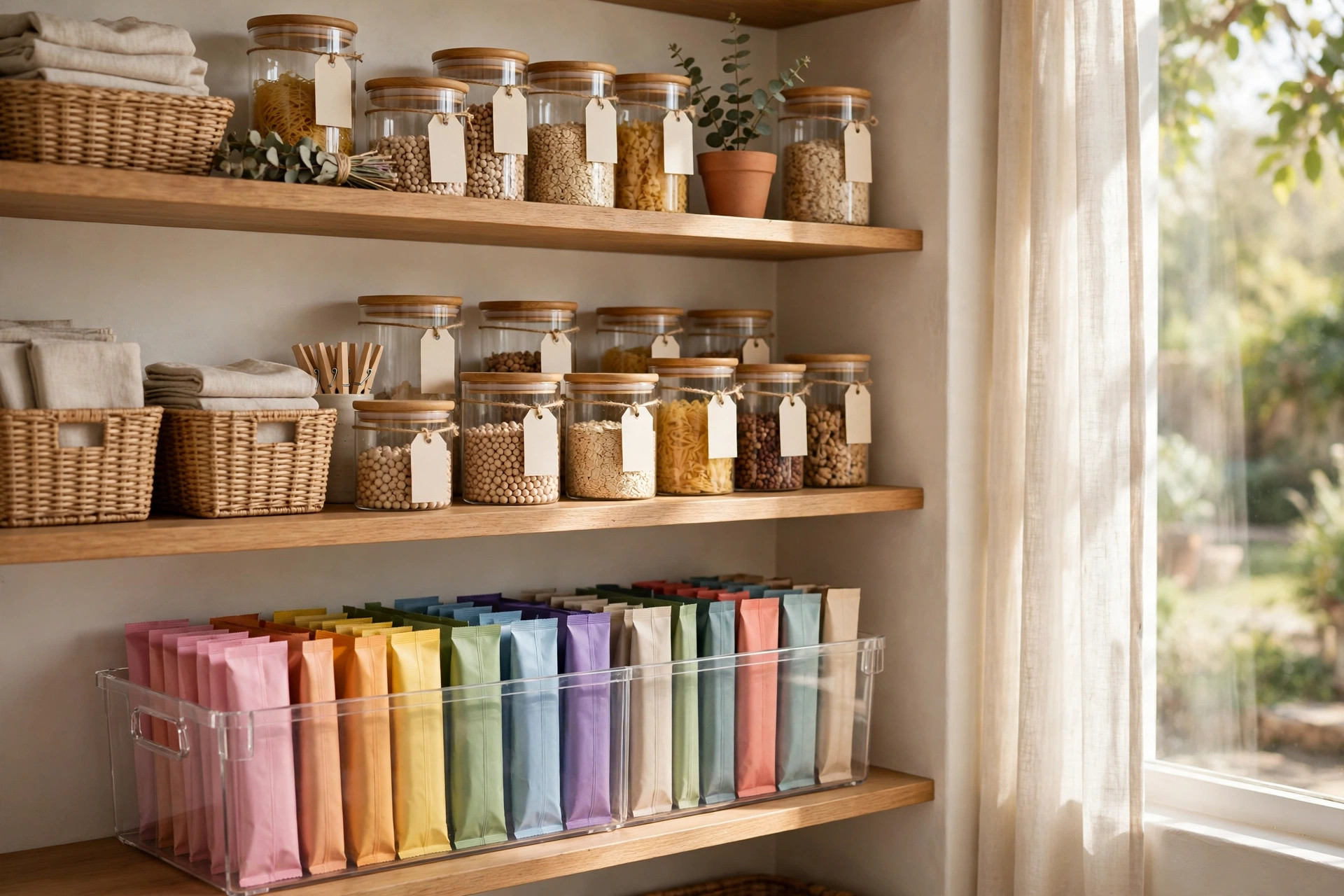
Loose packets — crisps, noodles, sauce sachets, snack bars — slide, fall over and fill every gap, and they are the first thing to make a pantry look messy. Put them in a basket, one basket per kind, standing upright like files in a drawer, so every packet is visible and none of them falls. Baskets also stop a torn packet spilling across the shelf, because the mess stays inside the basket. Keep the baskets on the shelf you reach most, and never let a basket hold two kinds of food, because that is how the packets get lost again. One basket per kind, and the loose packets stop taking over.
Organization by food type: dry goods, cans, spices, snacks and baking
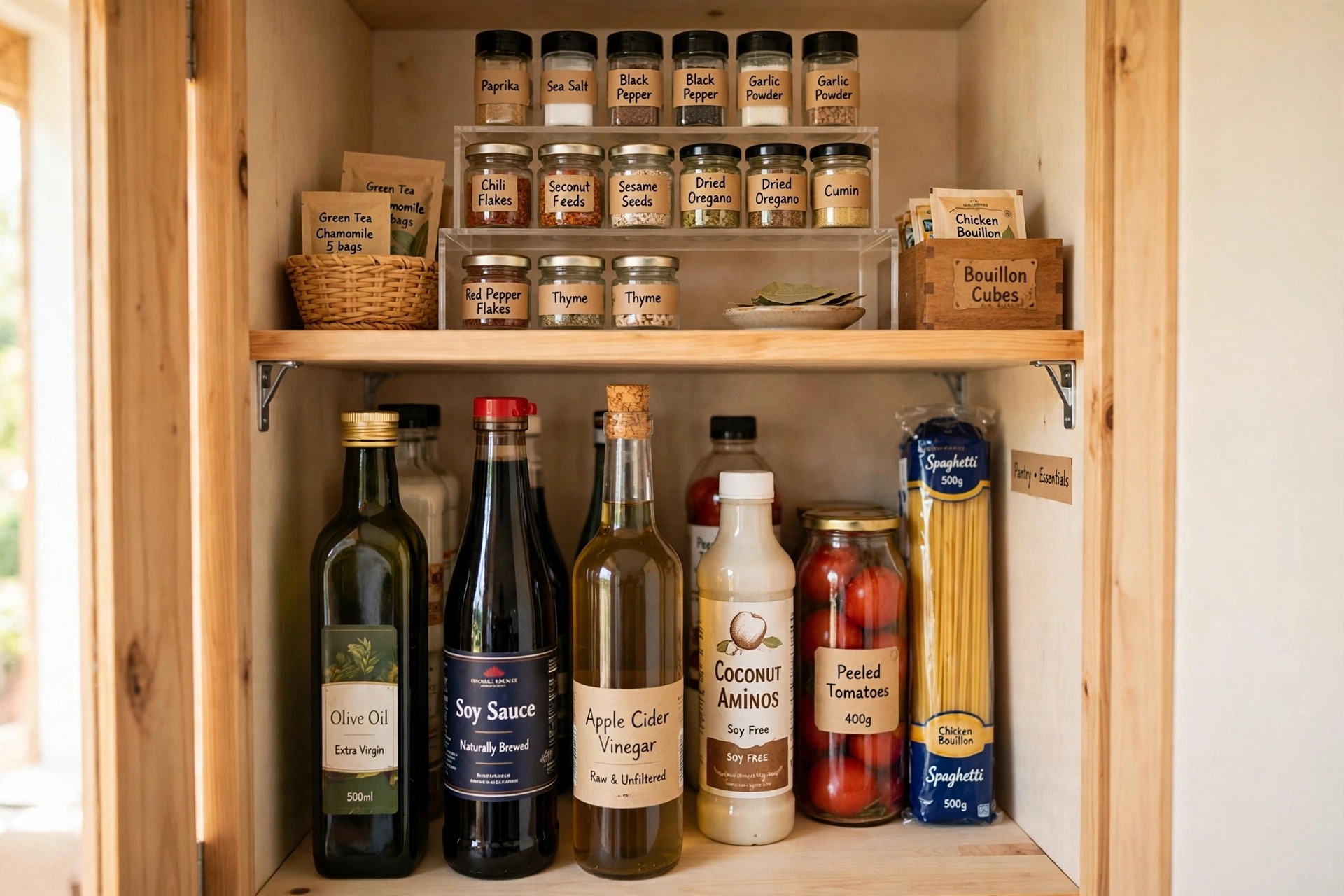
12. A spice system you can actually read
Spices are small, look alike, and live in a drawer or a shelf where you can never find the one you need. Put them in one place — a single shelf, a drawer insert, or a stepped riser — with every jar labelled on the top or the front, in alphabetical order or in cooking groups. Alphabetical works for a big collection; cooking groups — Indian, Italian, baking — work for a small one. Keep the spices you use weekly at the front and the rare ones at the back, and check the dates once a year, because ground spices lose their flavour long before they look old. One spice home, labelled, and the cooking stops pausing for a hunt.
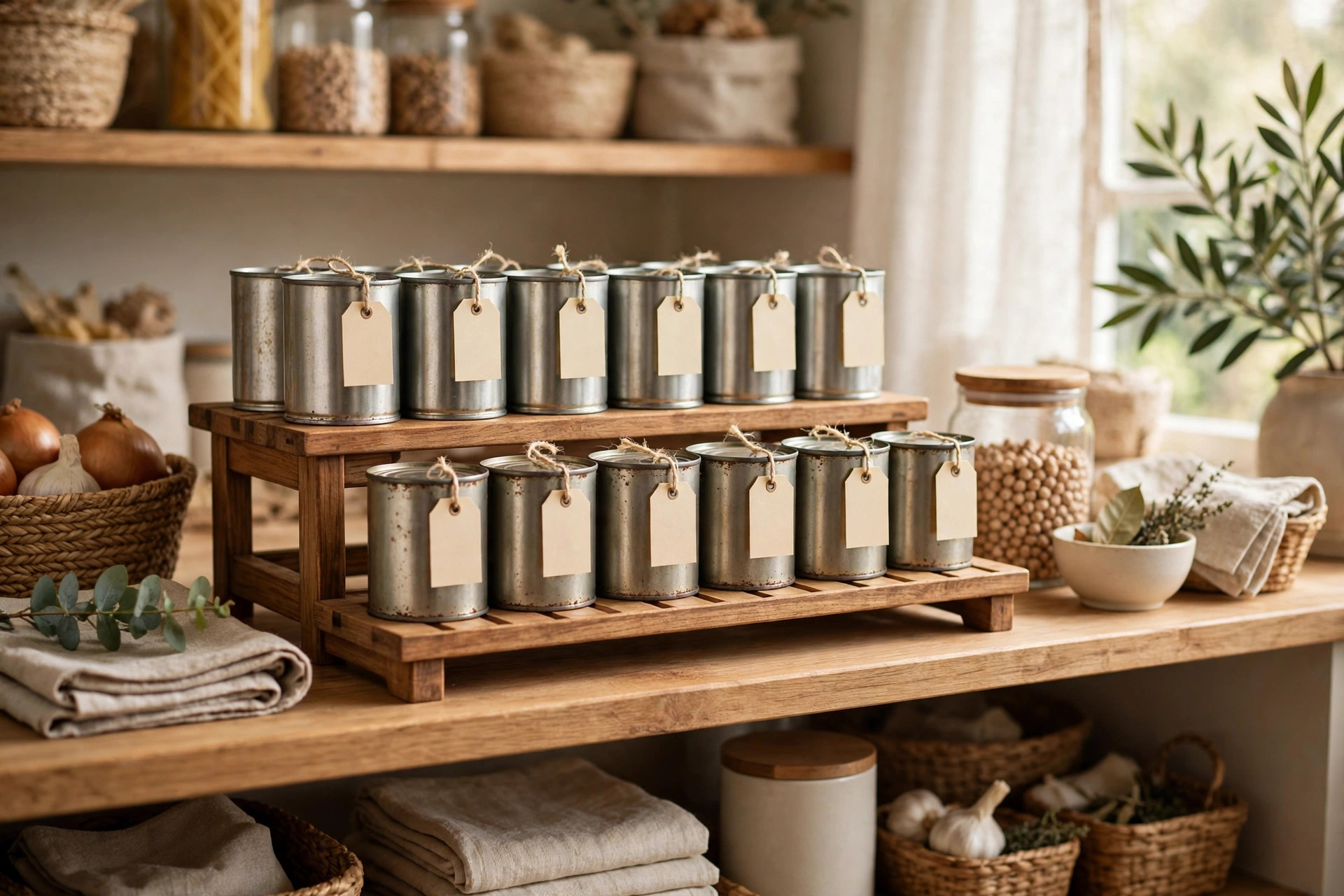
13. Tins in a row, labels out, oldest at the front
Tins stack, roll and hide, and a tin shelf is where duplicates breed fastest. Stand the tins in a single row, labels facing out, oldest at the front, newest at the back, one row deep if the shelf allows it. A tin organizer or a simple shelf riser keeps the back row visible, and a quick count once a month tells you what to use up before the next shop. Keep soups together, beans together and tomatoes together, so the shelf reads like a shop aisle and dinner is one glance, not a search. One row, labels out, and the tins stop multiplying.
14. A baking zone, all in one place
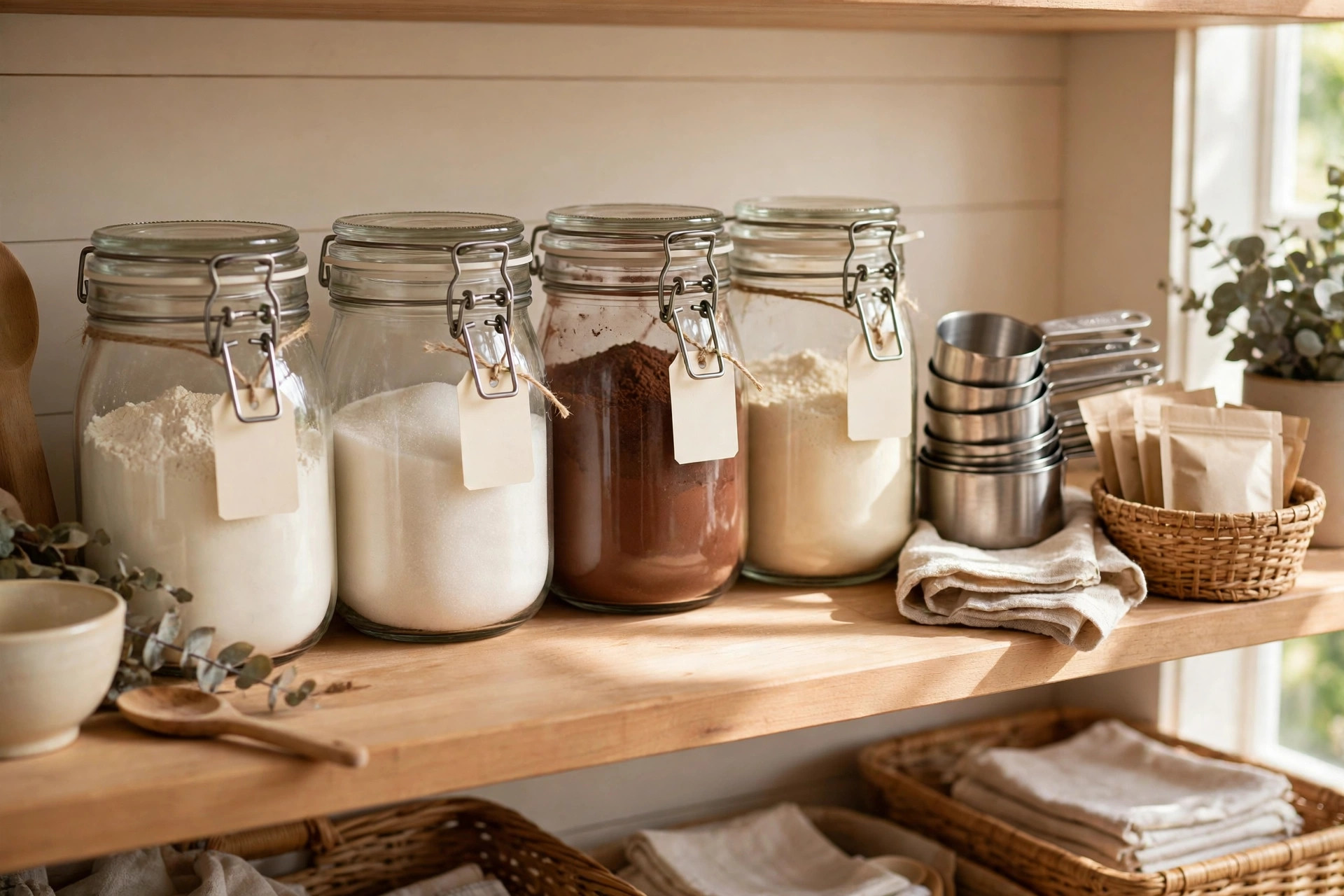
Baking fails when the flour is on one shelf, the sugar on another and the baking powder is nowhere. Give baking one zone — flour, sugar, baking powder, cocoa, vanilla and the measuring cups together, in clear jars and one basket for the small packets. The zone lives on a single shelf, ideally near the worktop, so baking is one reach instead of three trips across the kitchen. Keep the baking zone separate from the everyday cooking zone, so a baking session does not disturb the dinner shelf. One zone, one shelf, and baking starts on time.
15. Snacks in one bin, at a height children can reach
Snacks scattered across three shelves get eaten at random and restocked at random, and nobody knows what is left. Put all the snacks — crisps, crackers, dried fruit, snack bars — in one bin, or one bin per person if the household needs it, at a height the people who eat them can reach. The bin makes the snack count visible, so the weekly shop buys what is actually gone, and it stops snacks living on the counter, which is where they get eaten mindlessly. Keep the bin to snacks only, and refill it once a week from the backstock, not every day. One snack bin, and the snacks stop spreading.
16. A drinks shelf, so bottles stop falling over
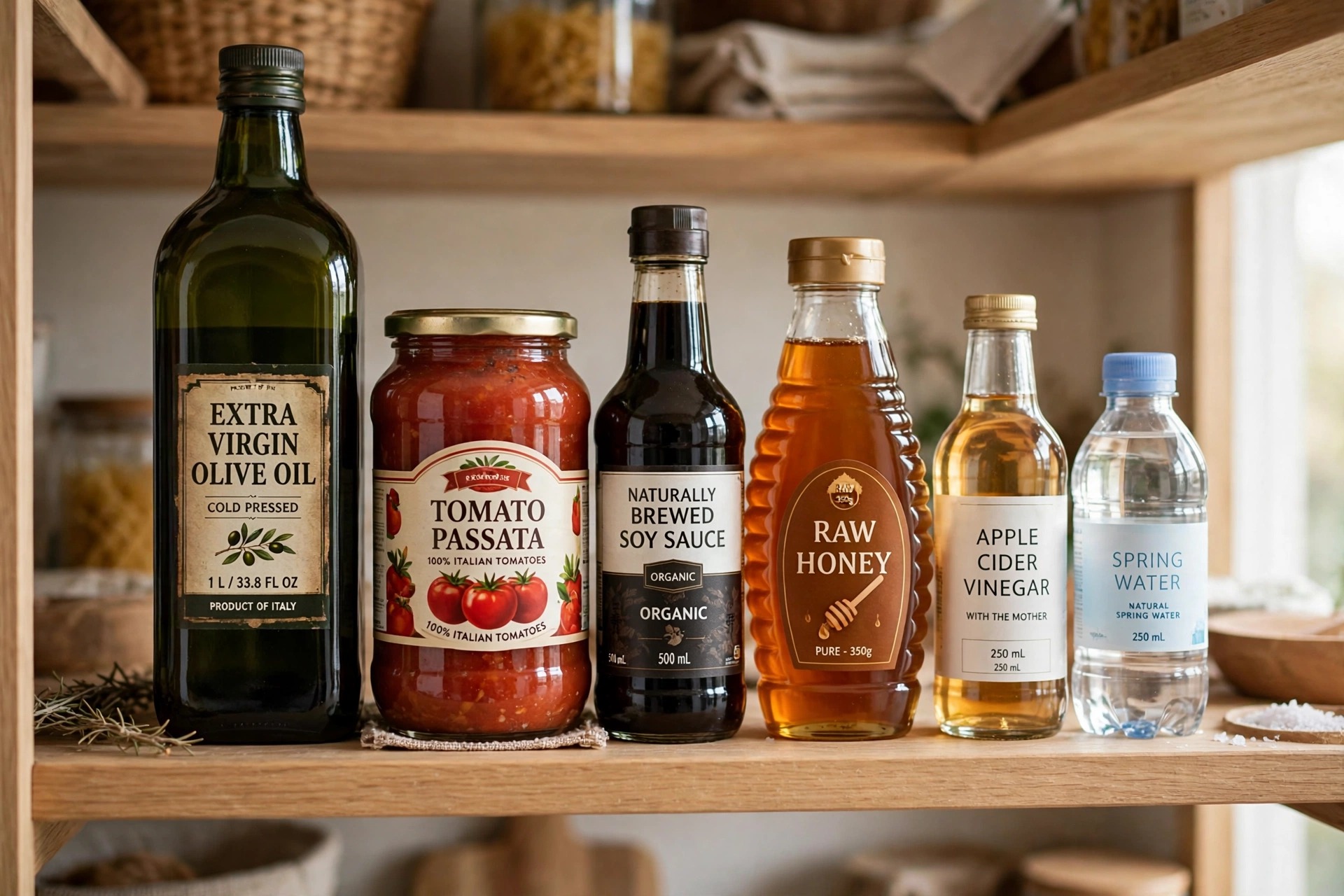
Bottles — water, juice, cordial, wine for cooking — are tall, heavy and always falling over when you pull the one behind them. Give drinks their own shelf, standing upright in a row, heaviest at the back and lightest at the front, with a small riser if the shelf is deep. A bottle rack or a simple bin keeps them from rolling, and keeping them together stops a bottle ending up on every shelf in the pantry. Keep the everyday drinks at eye level and the backstock on the lowest shelf, where weight does not matter. One drinks shelf, and the bottles stop falling.
17. Breakfast together, on one shelf, ready in the morning
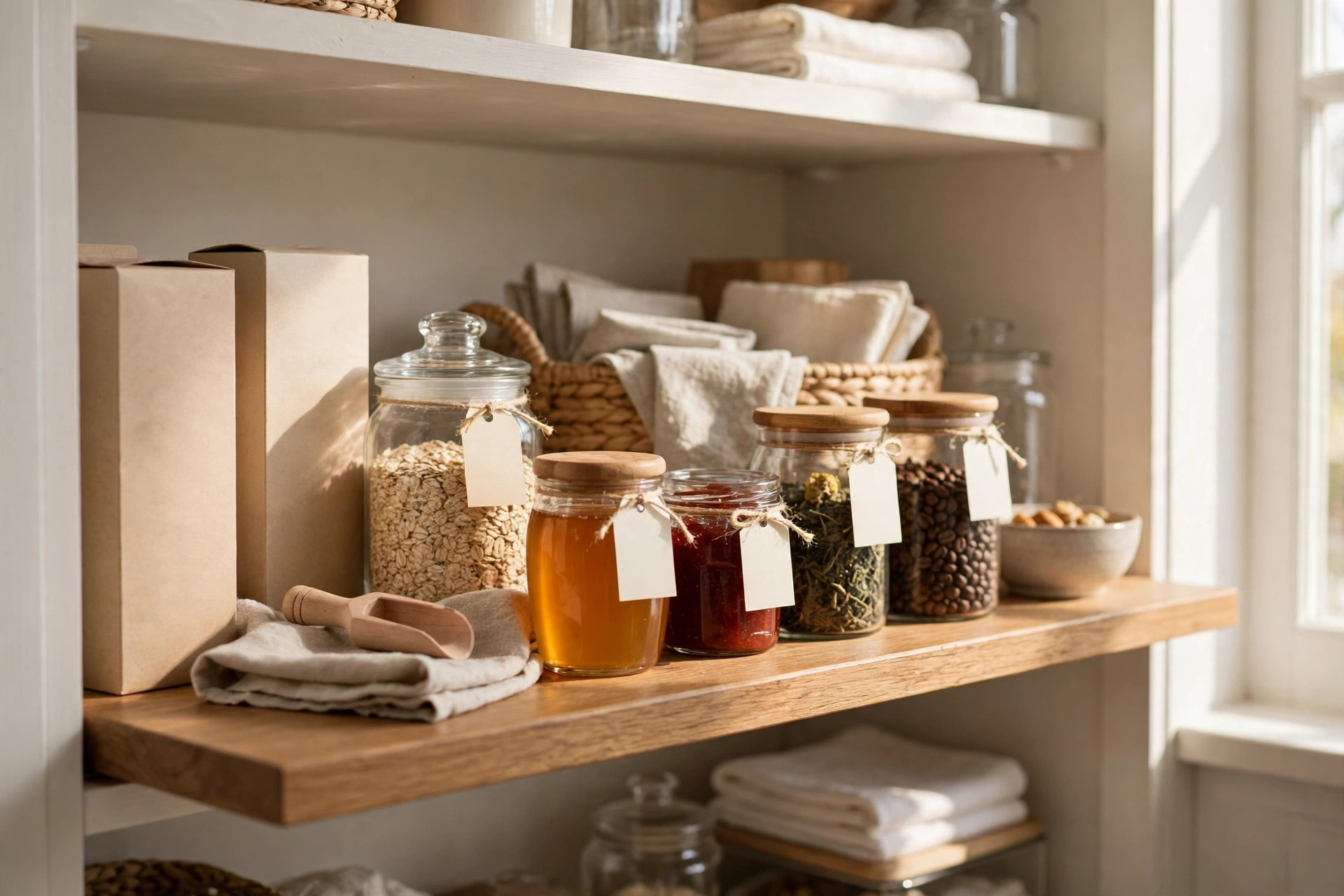
Breakfast is the most rushed meal of the day, and a pantry that spreads it across three shelves makes it slower. Put breakfast together on one shelf: cereal, oats, honey, jam, peanut butter, tea and coffee, everything the household eats before school or work. The shelf lives at eye level, near the front of the pantry, so the morning is one reach instead of a hunt. Keep the breakfast shelf to breakfast only, and restock it once a week, so the morning never starts with an empty jar. One shelf, one meal, and the morning is faster.
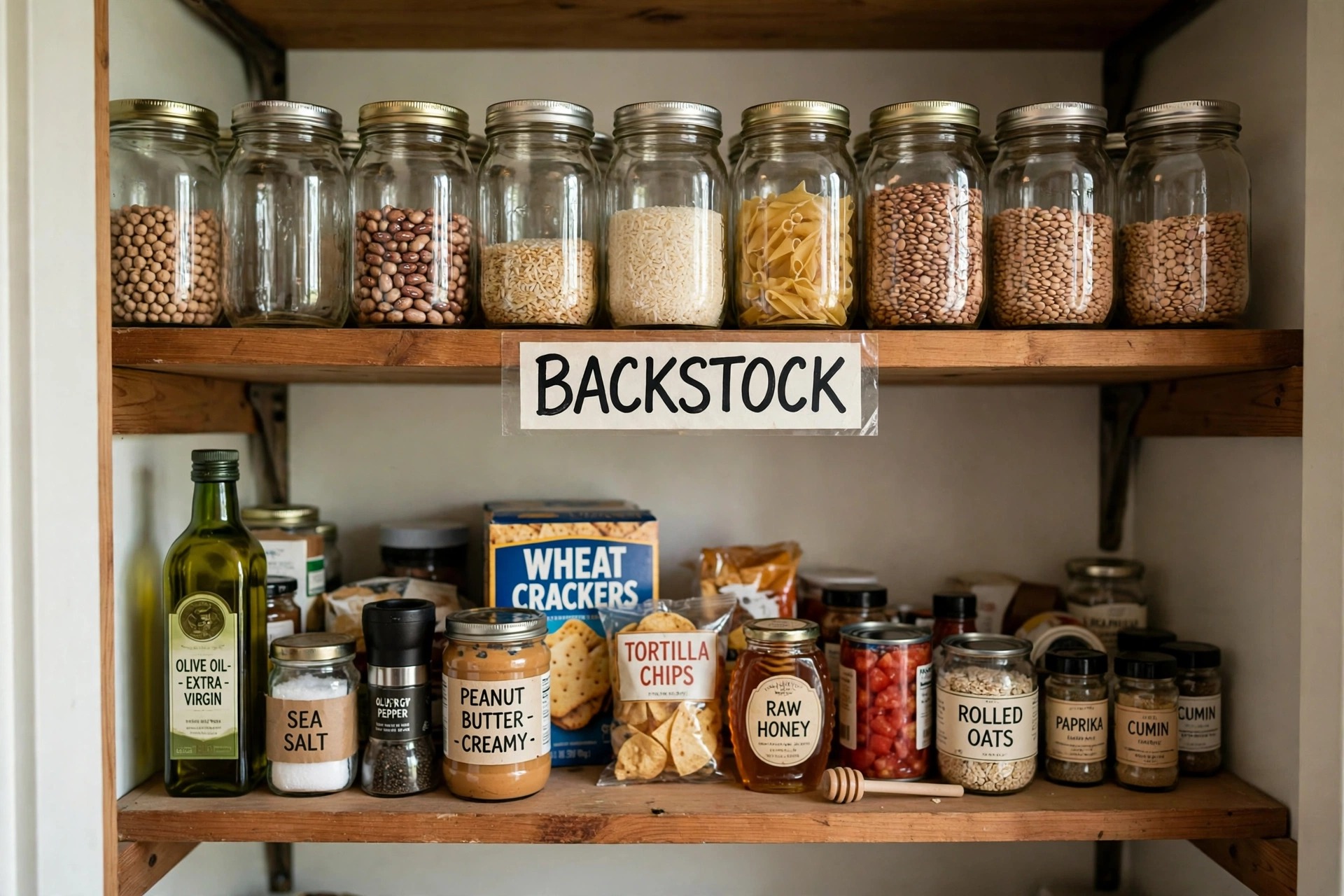
18. A backstock shelf, clearly separate from the everyday food
Backstock mixed with everyday food is how you buy a third jar of something you already own two of. Give backstock its own shelf — the highest or the lowest one, clearly labelled — and keep only one of each food on the everyday shelf. When the everyday jar runs out, you go to the backstock shelf, take one, and add it to the shopping list. The backstock shelf also shows you the real count at a glance, which is the first step to buying less. One backstock shelf, and the duplicates stop.
Small pantries, deep shelves and keeping it tidy
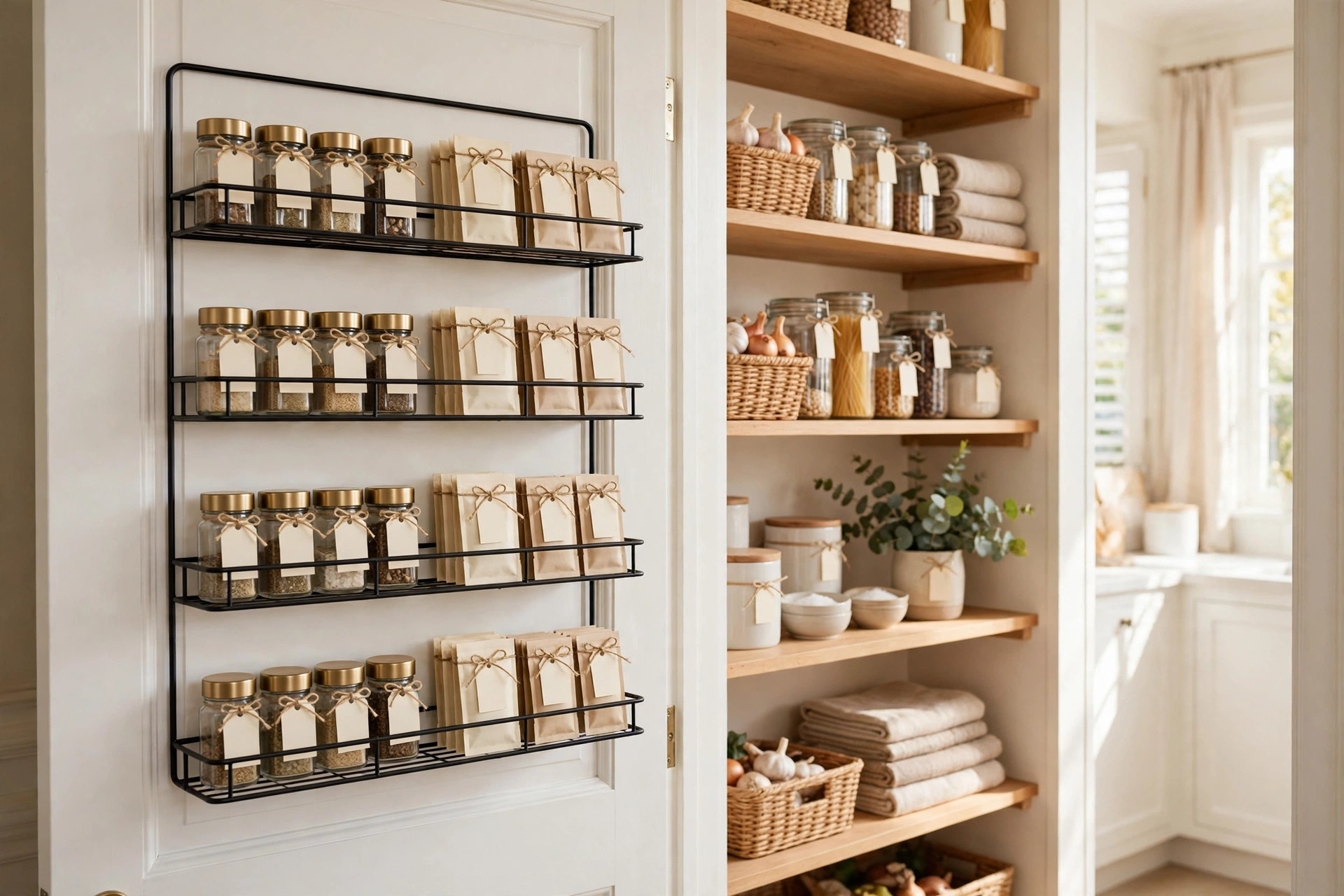
19. Use the door: racks, hooks and narrow shelves inside it
A small pantry has no floor space to spare, so storage has to go on the door. Fit a narrow rack or a set of small shelves inside the pantry door, and keep the small things there — spices, small jars, sauce packets, tea bags — standing upright where you can see them. The door uses space that is otherwise wasted, keeps the small food visible, and costs almost nothing to fit. Keep the heavy jars off the door, because that is how racks bend and jars fall, and keep the daily spices there, not the monthly ones. One door rack, and a tiny pantry gains a whole row of storage.
20. Label everything, in the same place, in the same way
A pantry with no labels is a pantry only one person in the house can use, and that person is always the one doing the cooking. Label every bin, jar and basket in the same place — the front, at the same height — in the same handwriting or the same printed style, so anyone can put the shopping away and find the food. Labels also stop a bin drifting into a second zone, because the label says what belongs inside. Keep the labels short — one or two words — and replace them when the zone changes, not a year later. One label per container, and the pantry works for the whole household.
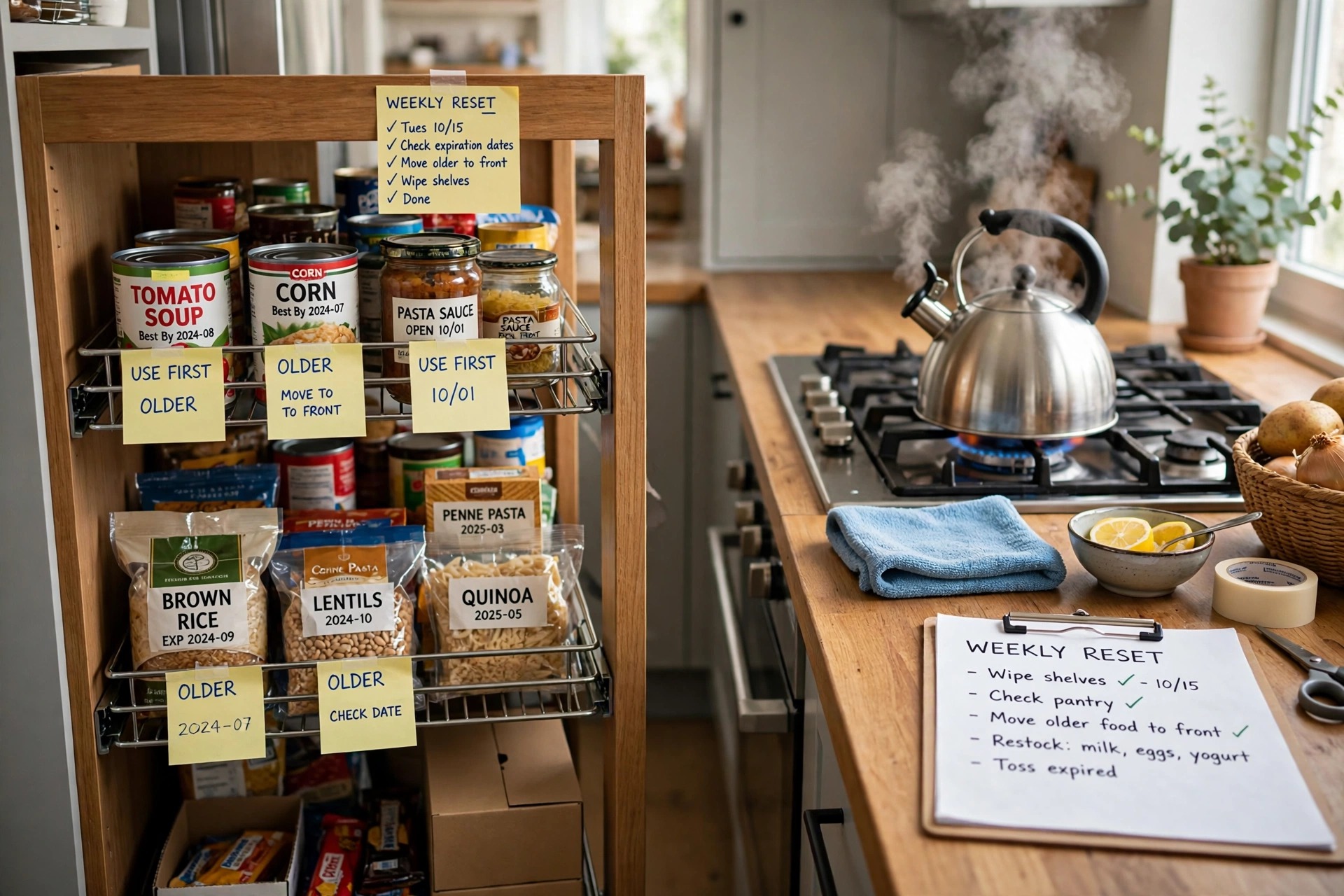
21. A weekly five-minute reset, not a yearly big clear-out
A pantry stays tidy with a small weekly habit, not a heroic yearly clear-out. Once a week, for five minutes, pull the front row forward, check what is running low, move the older food to the front, and put anything that has drifted back in its zone. The reset is small enough to do while the kettle boils, and it stops the slow drift that turns a tidy pantry into a messy one in a month. Keep a small notepad or a phone note by the pantry for the shopping list, and add to it during the reset. Five minutes a week, and the pantry never needs a big clear-out again.
22. Small pantries: go vertical, and use every inch of height
A small pantry feels full because its shelves are too far apart, not because it holds too much food. Add a shelf, a riser or a stackable bin to use the empty air above the jars, and the same shelf holds a second row. Store the tall things on the bottom shelf, the short things on a riser above them, and the flat things — packets, wraps, baking paper — standing upright in a file holder at the side. Measure the shelf height before buying anything, and buy to fit the food, not the other way round. One extra layer per shelf, and a small pantry gains a whole shelf of space.
23. Keep the counter clear: nothing lives outside its zone
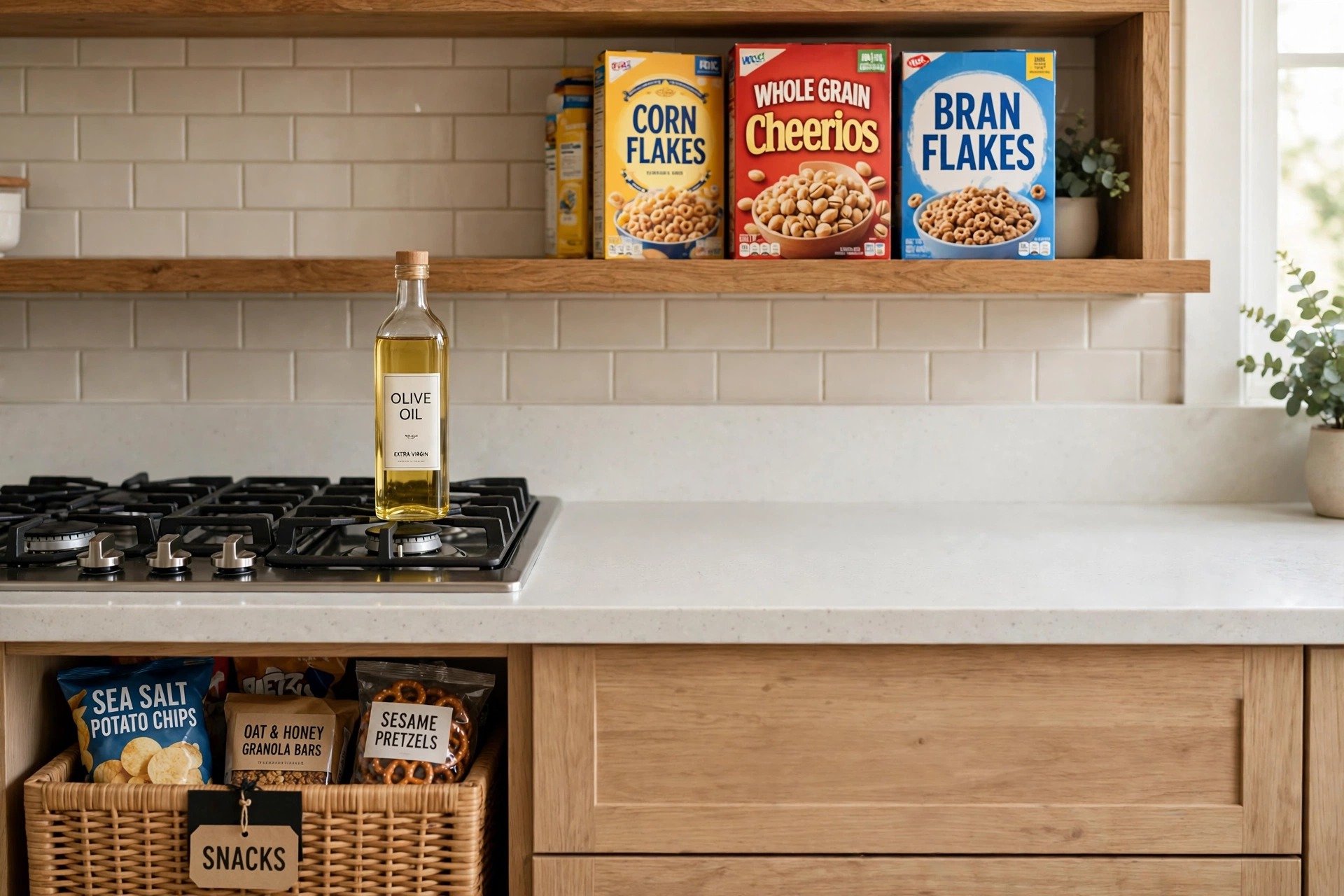
The mess is rarely the pantry itself — it is the food that lives on the counter because it has no home inside. Make the rule that nothing lives outside its zone: the cereal goes back on its shelf, the oil goes back in its cooking zone, the snacks go back in their bin. The counter stays clear, the pantry stays honest, and cooking starts with a clear worktop instead of a move-the-food-first chore. Keep one small tray by the kettle for the daily tea and coffee, if the household needs it, and clear it once a week. One rule, and the counter stops being a second pantry.
24. Photograph the shelves once, and keep the photo on your phone
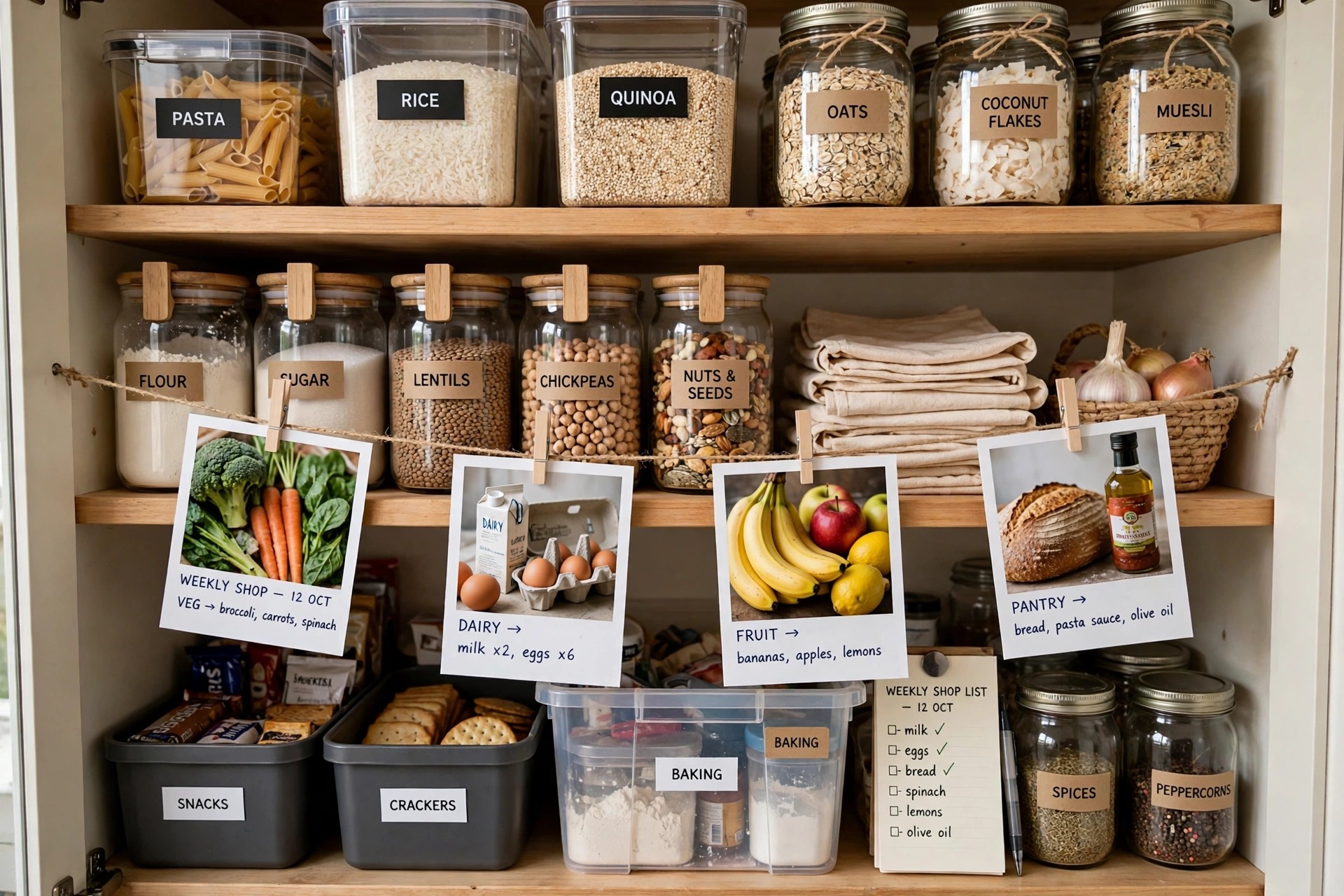
When food lives in bins and jars, you forget what you own — and you buy a jar you already have. Photograph each shelf once, after the sort, and keep the photos on your phone for the weekly shop. Choosing what to buy becomes checking the photos, not opening every bin, and the pantry stays visible even when it is closed. The photos also help when someone else does the shopping, because the list is already half written. One photo per shelf, and the pantry stops hiding its own food.
25. Care for the food, not just the shelf it sits on
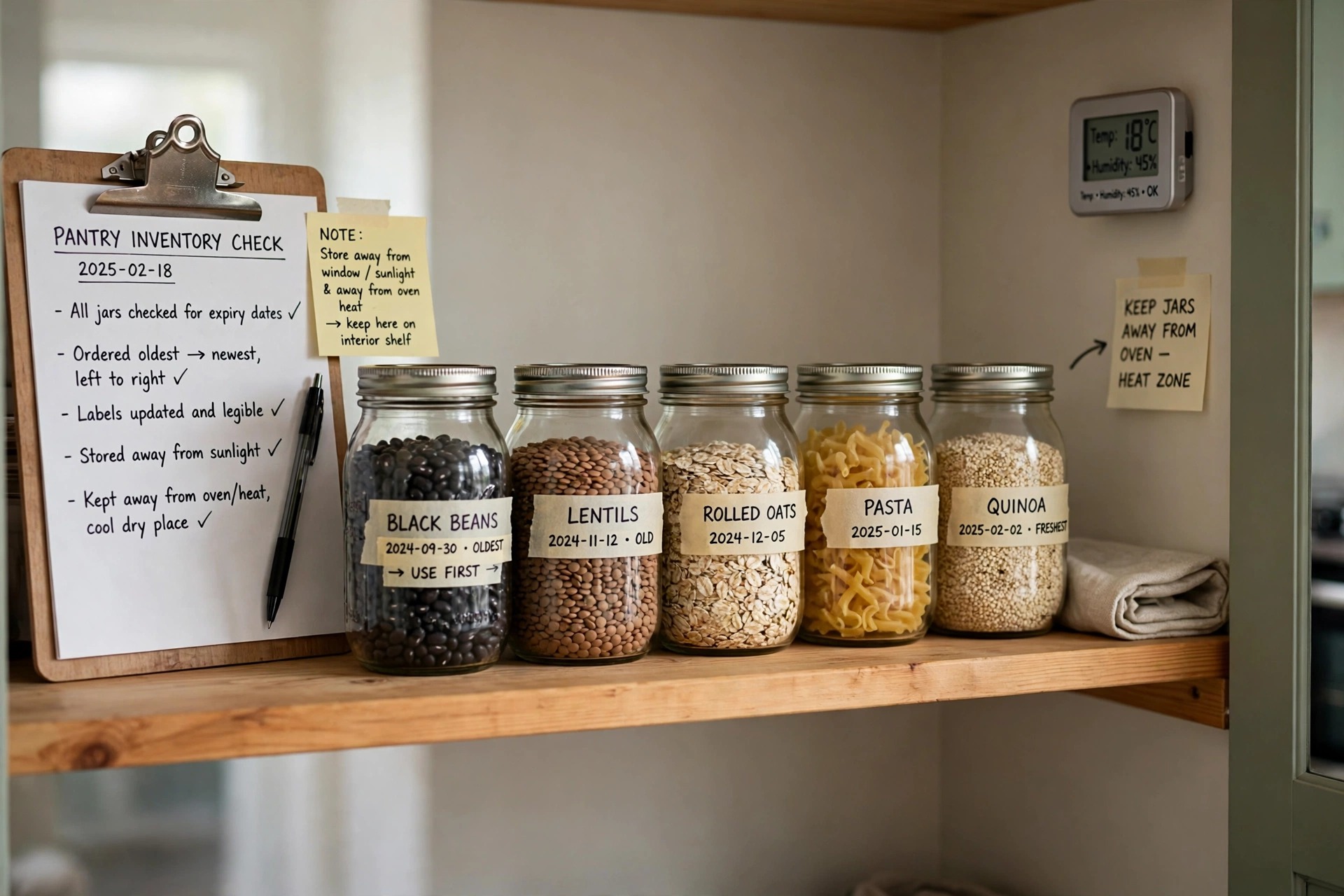
Storage only helps if the food itself is looked after. Check the dates once a month, use the oldest food first, keep food out of direct sunlight and away from the heat of the oven, and never decant food into a jar without a label and a date, because that is how food gets forgotten. Wipe the shelves once a month, check for open packets, and repair a torn bag before it spills. Food stored well and checked lightly lasts longer than food stored perfectly and never looked at. Care for the food, and the shelf takes care of itself.
Which pantry organization fits which kitchen?
| Kitchen / situation | Best first move | Budget | Tools needed |
|---|---|---|---|
| Crowded pantry / lots of food | Zones + clear bins (ideas 2, 6) | Low | Clear bins |
| Small pantry / no shelf space | Door rack + risers (ideas 8, 19) | Low | Door rack / risers |
| Deep shelves / food at the back | Stackable bins + turntable (ideas 9, 10) | Low | Bins / turntable |
| Everyday cooking, always in use | Eye-level everyday shelf (idea 4) | Low | None |
| Baking household | One baking zone (idea 14) | Low | Jars / basket |
| Food going out of date | First-in, first-out + weekly reset (ideas 5, 21) | Low | Labels |
You do not need all 25 ideas. You need the three that solve your biggest mess — usually the food with no home, the shelf you cannot see into, and the duplicates you keep buying. Start with taking everything out, sort it by zone, and make the rule that every food goes back in its zone, oldest at the front. Do that tonight and the kitchen will feel different by tomorrow morning.
Save this post for your next kitchen clear-out, and if you are finishing the Storage by room cluster too, read 20 Kitchen Cabinet Organization Ideas for 2026 next — it is Post 02 in the same cluster — and 22 Laundry Room Storage Ideas for 2026, Post 09, to carry the same system from the pantry to the rest of the house.
Published 16 November 2026. Updated as new pantry organization finds are tested.
Frequently asked questions
How do I organize a small pantry with deep shelves?
Zone the pantry with clear bins and pull them out like drawers. Bins keep deep shelves usable, a lazy Susan handles oils and sauces in the corner, and shelf risers add a second level for tins so nothing hides at the back.
Should I decant pantry food into jars?
Yes for the staples you use most — flour, rice, pasta and oats. Glass jars keep food fresh, let you see at a glance what is running low, and stack neatly. Label each jar and keep a scoop inside for easy serving.
How do I keep a pantry organized with kids?
Put their food where they can reach it. A snack bin at kids' height, a breakfast shelf with cereal, bowls and spoons in one place, and clear bins they can see into means kids help themselves — and put things back — without asking.