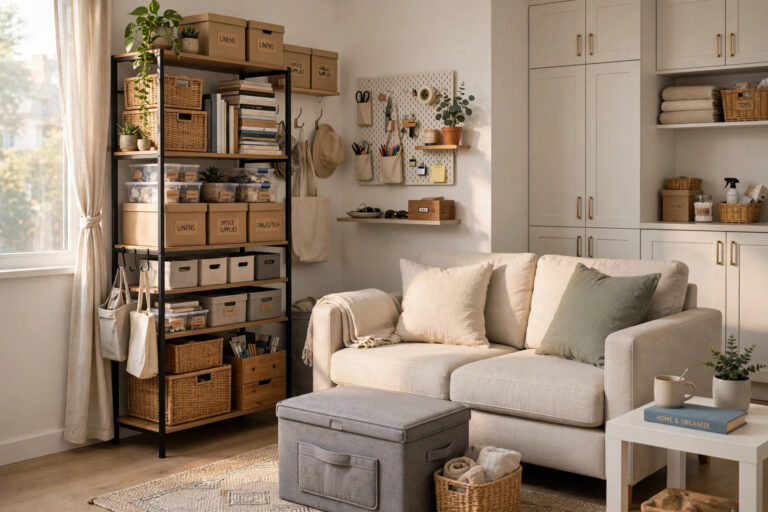
22 Fabric Storage Ideas for 2026
Fabric is the one craft supply that grows while you are not looking — a fat quarter here, a remnant there, a metre bought for a project that never happened, and suddenly the shelf is a pile and the pile is a landslide. The fix is not a bigger cupboard, it is fabric storage that shows every print, because the fabric you can see is the fabric you use and the fabric you cannot see is the fabric you buy twice.
These 22 fabric storage ideas are folded shelves, mini bolts and labelled bins for sewers: start with fabric folded around boards so it stands like books, sort it by colour in clear bins, hang the rolls on a pegboard, and finish with a swatch book and an inventory list — so every print is on show, easy to reach and easy to find.
Every idea below works in a real sewing room, from a corner of a bedroom with one shelf to a whole craft room with a wall to fill. The sewing room the fabric lives in is covered in 22 Sewing Room Organization Ideas for 2026, where the room gets its own system before the fabric arrives — and the closet the fabric hangs in is in 26 Small Walk-In Closet Organization Ideas for 2026, so the stash matches the room. Pick three ideas that fit your stash, start with the boards, and build from there.
Folded fabric on show: shelves that display every print
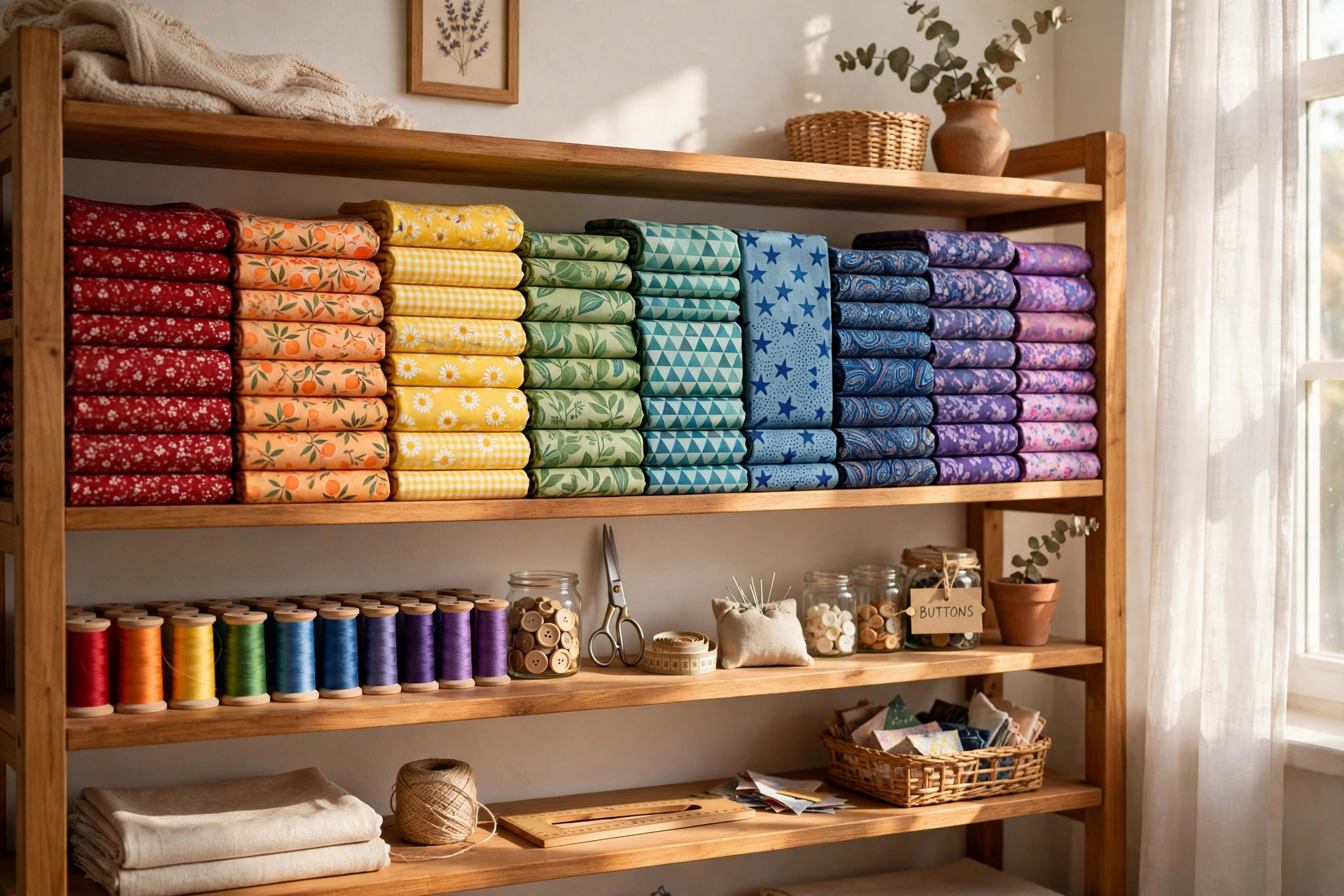
1. Fold fabric around comic book boards — uniform mini bolts on a shelf
Fabric folded any old way makes a wobbly pile, because the pieces are all different sizes and the pile that is uneven is the pile that falls over. Fold each piece around a comic book board — uniform mini bolts on a shelf — so every piece is the same size and the shelf looks like a fabric shop. Wrap the fabric around the board, tuck the end in, and stand the mini bolts upright in a row, because the board is the shape and the row is the order. Keep the folded edge facing out, so you see the print and not the cut edge, and sort the row by colour, because the colour row is the row you can read at a glance. One pack of boards, and the shelf stops being a pile. (Check on Amazon for comic book boards in bulk, which are the right size for fat quarters and half metres.)
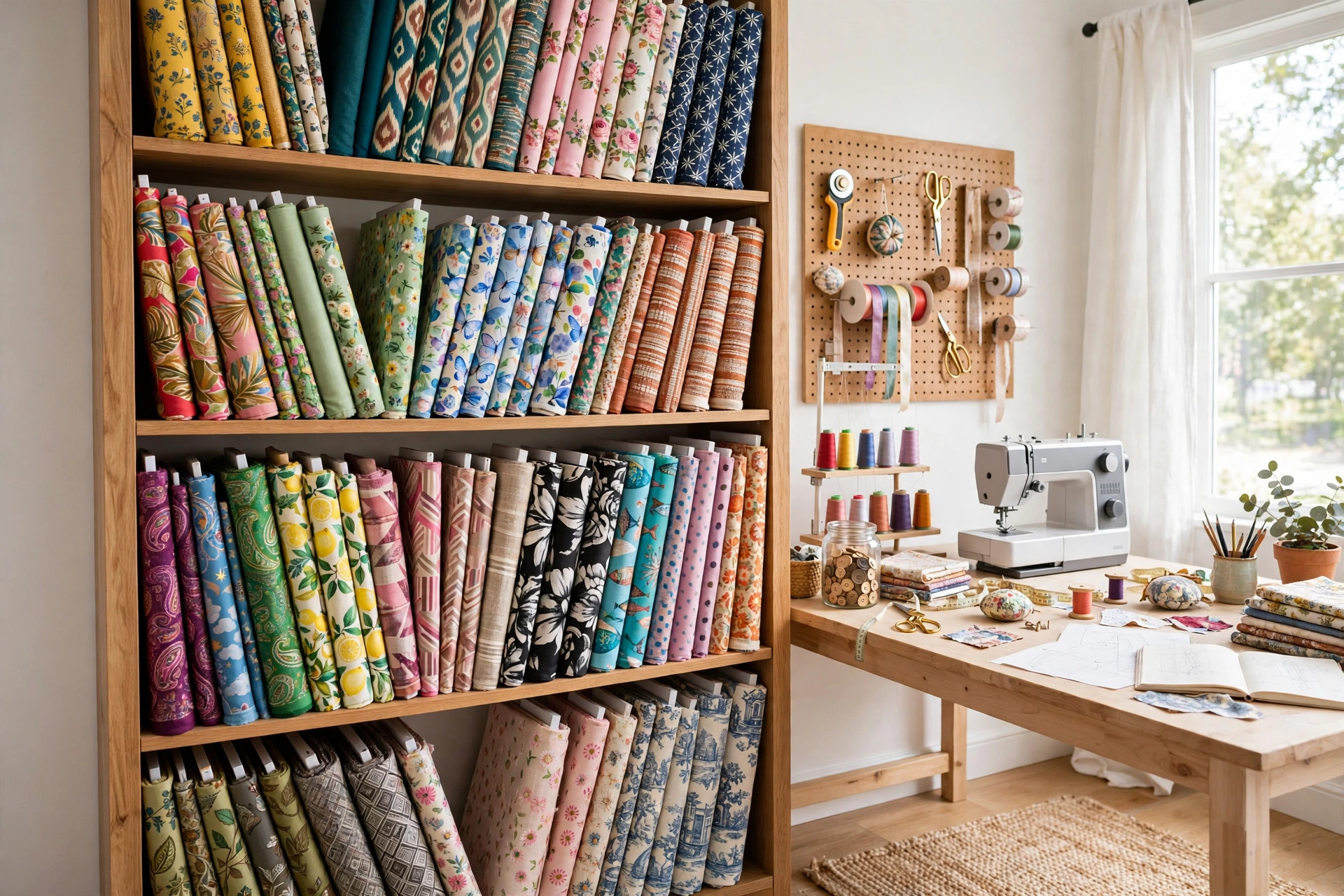
2. A bookshelf of fabric bolts, spines out — prints on show like books
A shelf of fabric stacked flat hides the bottom pieces, because the fabric that is buried is the fabric you forget and the fabric you forget is the fabric you buy again. Stand the bolts upright like books — prints on show like books — so every print faces you and the shelf reads like a library. Use a bookshelf with shelves close together, stand the folded fabric on its edge with the folded side out, and pack the row snug so the pieces support each other, because the snug row is the row that stands up. Sort the shelf by colour or by project, because the shelf that is sorted is the shelf that finds the fabric fast, and leave a gap at the end of each row for the next piece you buy. A bookshelf and a row of bolts, and the fabric is on show like books.
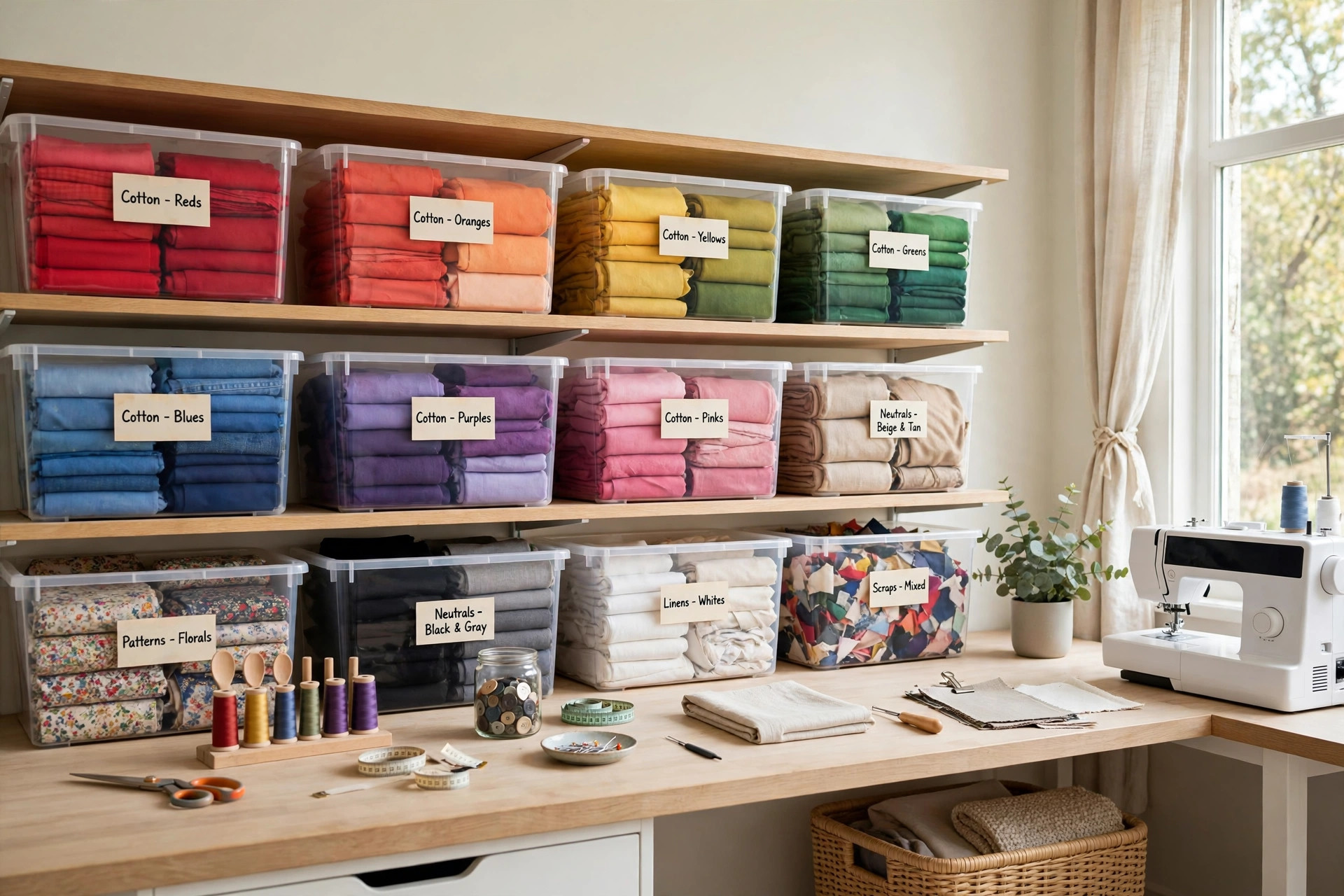
3. Clear bins by colour — see the fabric without opening the bin
A solid bin hides its fabric, because the bin you cannot see into is the bin you have to open and the bin you have to open is the bin you never check. Use clear bins sorted by colour — see the fabric without opening the bin — so the print is visible through the plastic and the right bin is the one you reach for first. Put all the blues in one bin, all the florals in another, and label the front with the colour and the contents, because the label is the shortcut and the clear plastic is the proof. Stack the bins two high, no more, because the stack that is two high is the stack you can still lift, and keep the bin you use most at waist height, because the bin at waist height is the bin that gets used. Clear bins by colour, and the fabric is visible before you touch it.
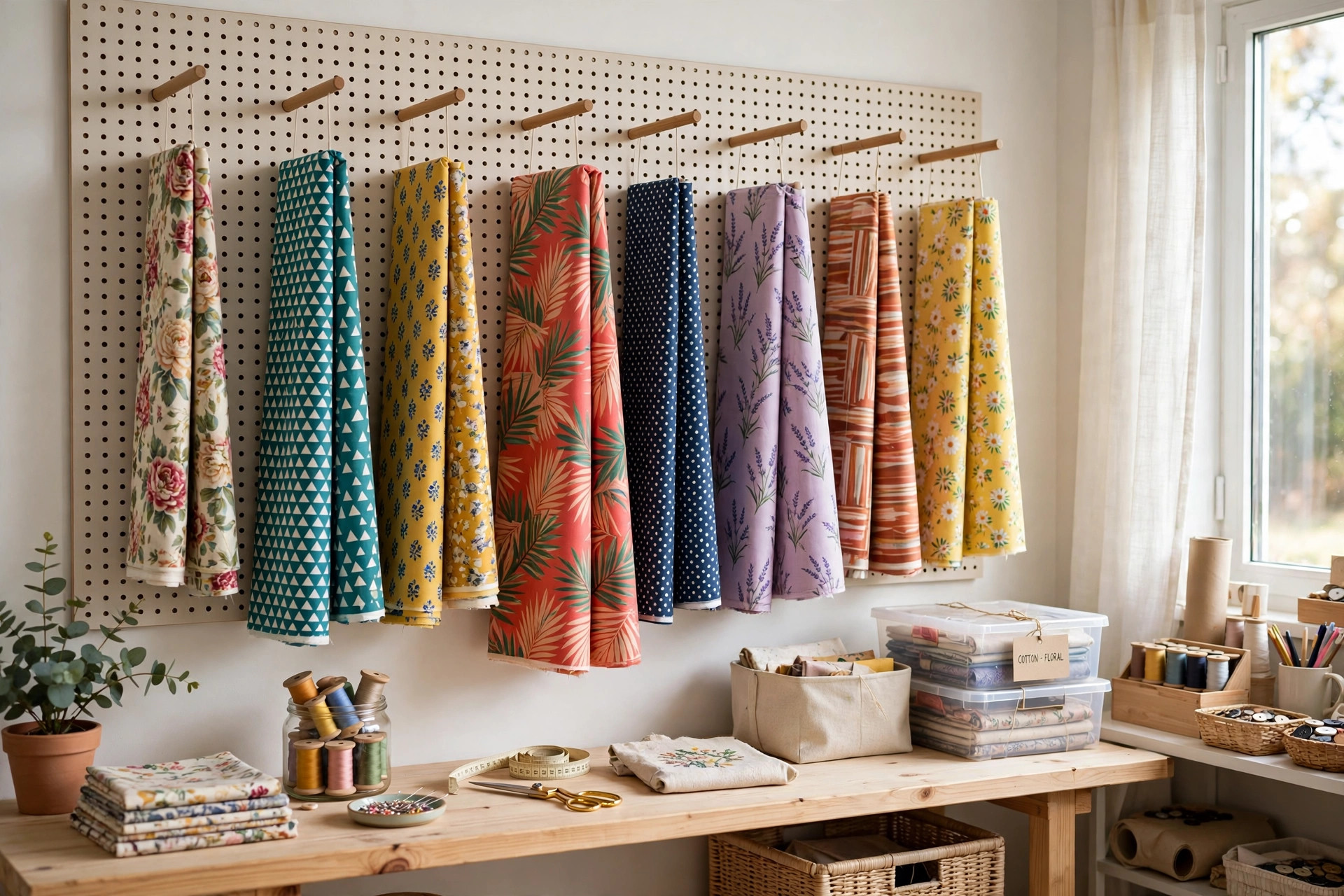
4. A wall of fabric on a pegboard — dowels hold the rolls where you can see them
Fabric in a cupboard is fabric out of sight, because the cupboard door is the thing that closes and the fabric behind it is the fabric you forget. Put the fabric on the wall — dowels hold the rolls where you can see them — so the prints hang in a row and the wall becomes the shop window. Fix a pegboard to the wall, slide wooden dowels through the holes, and hang the fabric rolls over the dowels, because the dowel is the holder and the wall is the display. The pegboard the fabric hangs on is in 20 Pegboard Organization Ideas for 2026, where the board gets its hooks and dowels sorted before the fabric arrives. Keep the rolls you use most at eye level, because the roll at eye level is the roll you reach for, and leave the top of the board for the fabric you use least. A pegboard and a row of dowels, and the fabric is on the wall where you can see it.
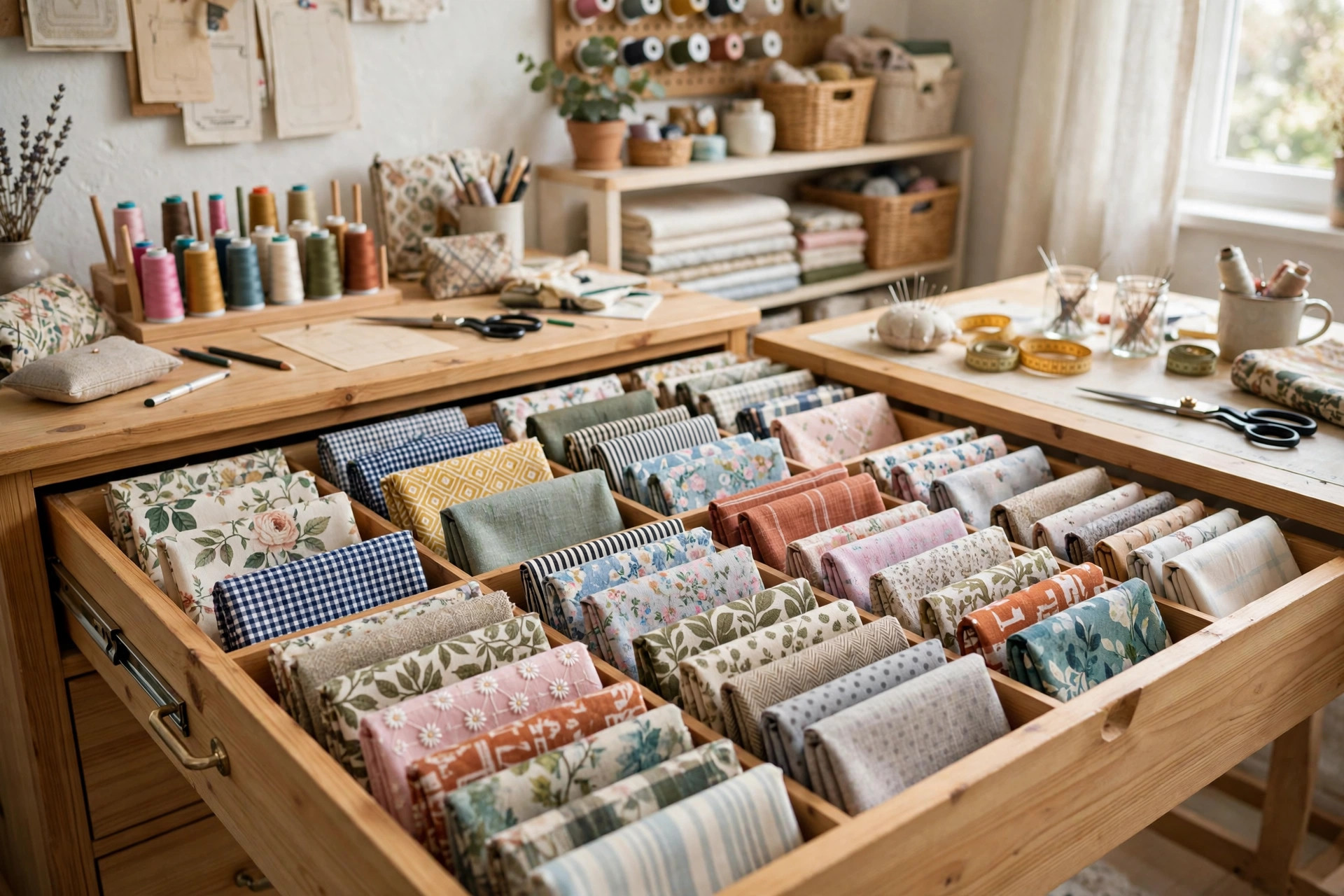
5. Fabric file-folded in a drawer with dividers — every print standing up in a row
A drawer of fabric folded flat is a drawer you have to dig through, because the piece at the bottom is the piece you cannot reach without moving the whole pile. File-fold the fabric instead — every print standing up in a row — so each piece stands on its edge and the drawer reads like a filing cabinet. Fold each piece into a rectangle the height of the drawer, stand the pieces in a row, and add dividers every few inches so the row does not slump, because the divider is the support and the row is the order. Put the brightest prints at the front, because the print at the front is the print you see first, and keep one drawer for cotton and one for the rest, because the drawer that is sorted is the drawer that finds the fabric. A drawer, some dividers and a file fold, and the fabric stands up in a row.
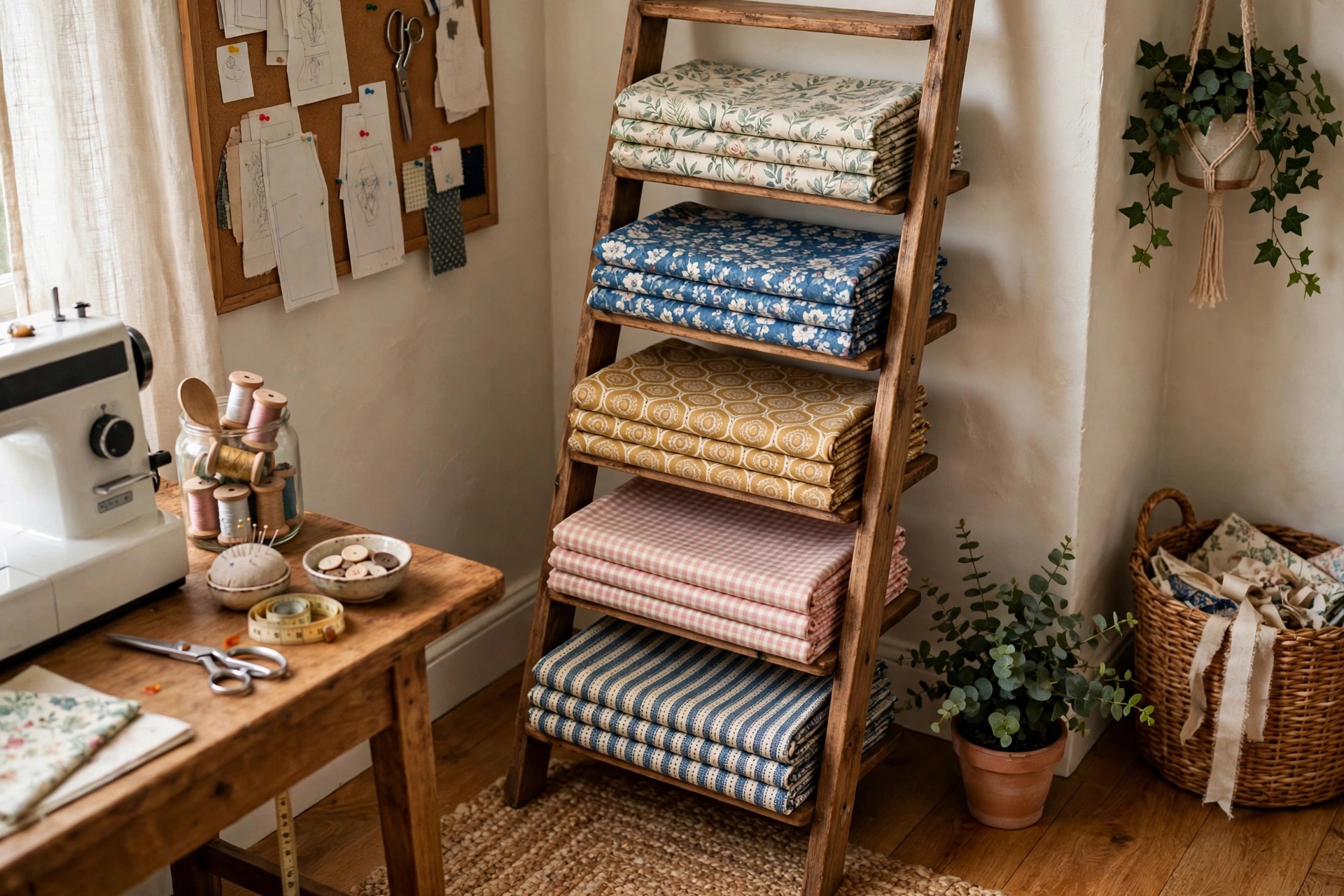
6. A leaning ladder shelf for folded fabric — fabric on the rungs, prints on display
A spare corner in a sewing room is a corner doing nothing, because the corner you do not use is the corner that gathers the things with no home. Lean a ladder shelf into it — fabric on the rungs, prints on display — so the corner holds the fabric and the fabric holds the room together. Choose a ladder shelf with deep rungs, fold the fabric into neat stacks, and lay one stack on each rung with the folded edge out, because the rung is the shelf and the folded edge is the display. Put the heaviest fabric on the bottom rung, because the bottom rung is the one that carries the weight, and keep the top rung for the prettiest prints, because the top rung is the one your eye lands on first. A ladder shelf in a corner, and the fabric is on display instead of in a pile.
Rolled, hung and filed: fabric that stays wrinkle-free
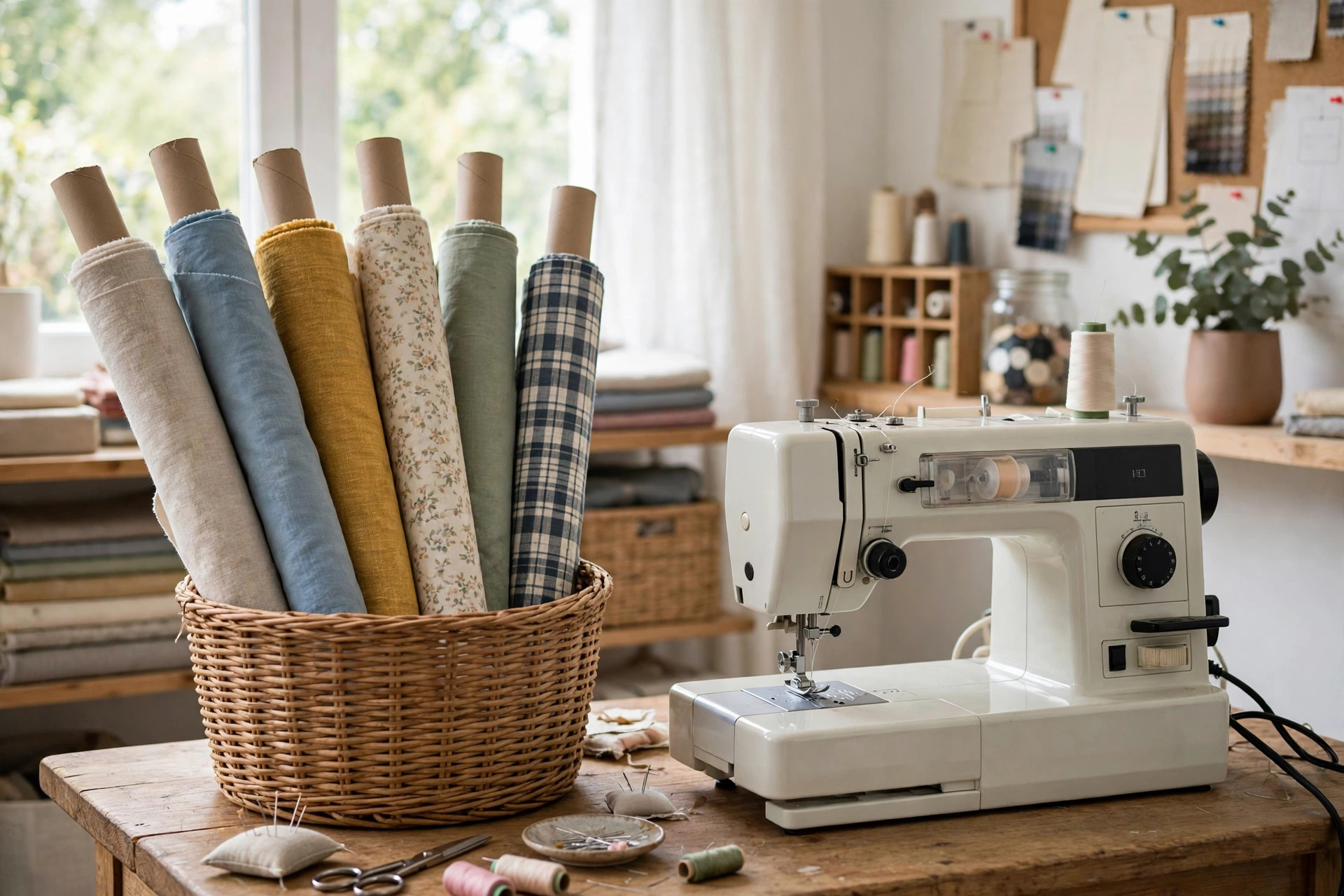
7. Roll fabric on cardboard tubes — no creases, pull from the roll
Fabric folded for months gets creases that will not iron out, because the fold is the line that sets and the line that sets is the line that shows in the finished piece. Roll the fabric on cardboard tubes instead — no creases, pull from the roll — so the fabric stays smooth and unrolls flat when you need it. Wrap each piece around a tube, secure the end with a pin or a rubber band, and stand the tubes upright in a basket or a tall bin, because the tube is the shape and the basket is the home. Label the end of each tube with the fabric name, because the label is the thing that finds the roll without unrolling it, and keep the tubes you use most at the front of the basket. A roll of tubes and a basket, and the fabric stays crease-free.
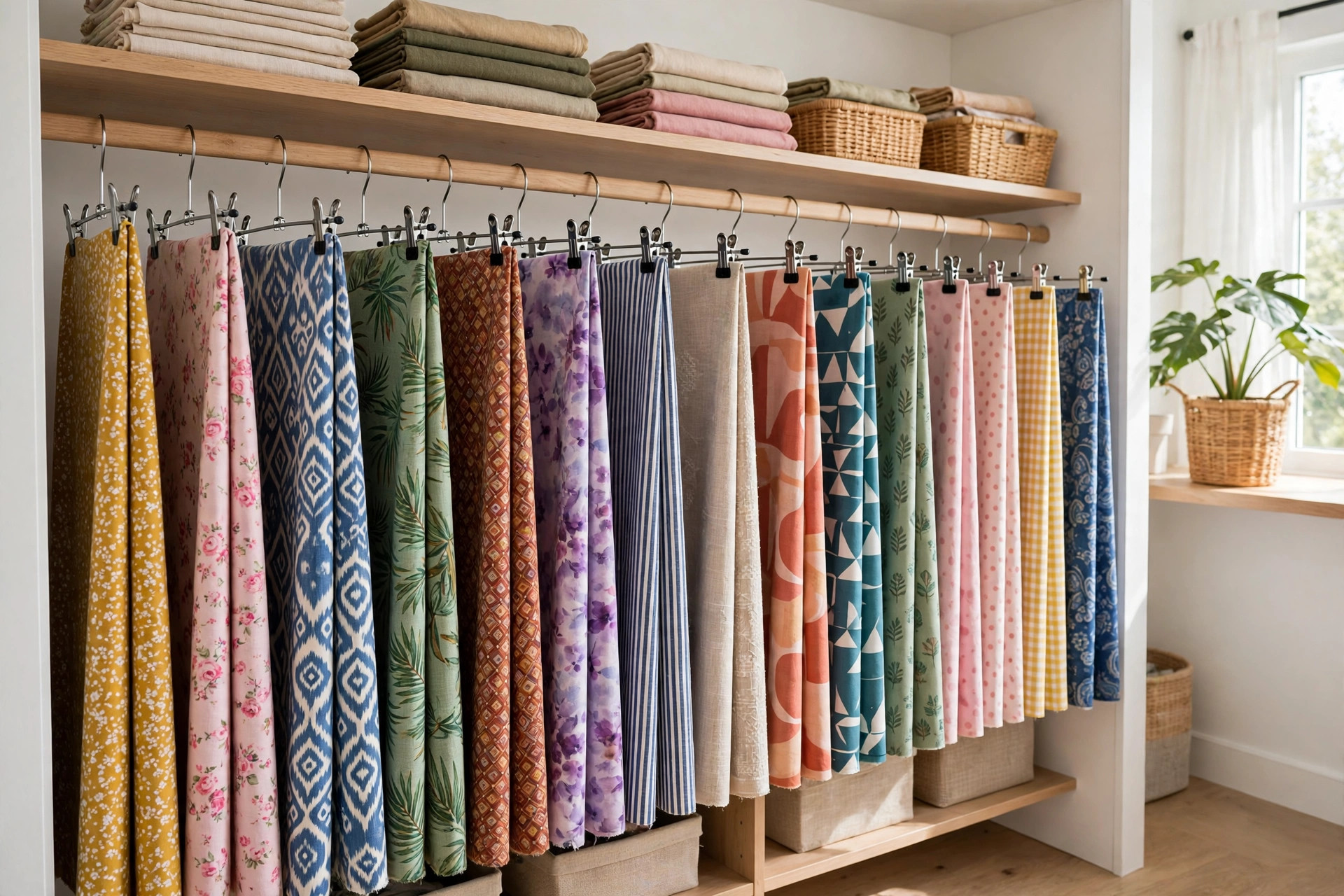
8. Hang fabric on trouser hangers in the closet — one print per hanger, no folding
Some fabric hates being folded, because the fold is the crease and the crease is the flaw in a fabric that should drape. Hang it instead — one print per hanger, no folding — so the fabric hangs straight and the closet becomes the fabric store. Clip each piece to a trouser hanger, hang the hangers in a row on the closet rail, and leave a gap between them so the fabric can breathe, because the gap is the air and the hanger is the shape. The closet the fabric hangs in is in 26 Small Walk-In Closet Organization Ideas for 2026, where the rail and the hangers get sorted before the fabric moves in. Sort the hangers by colour along the rail, because the colour row is the row you can read at a glance, and keep the longest pieces at the back so they do not brush the floor. One print per hanger, and the fabric hangs crease-free.
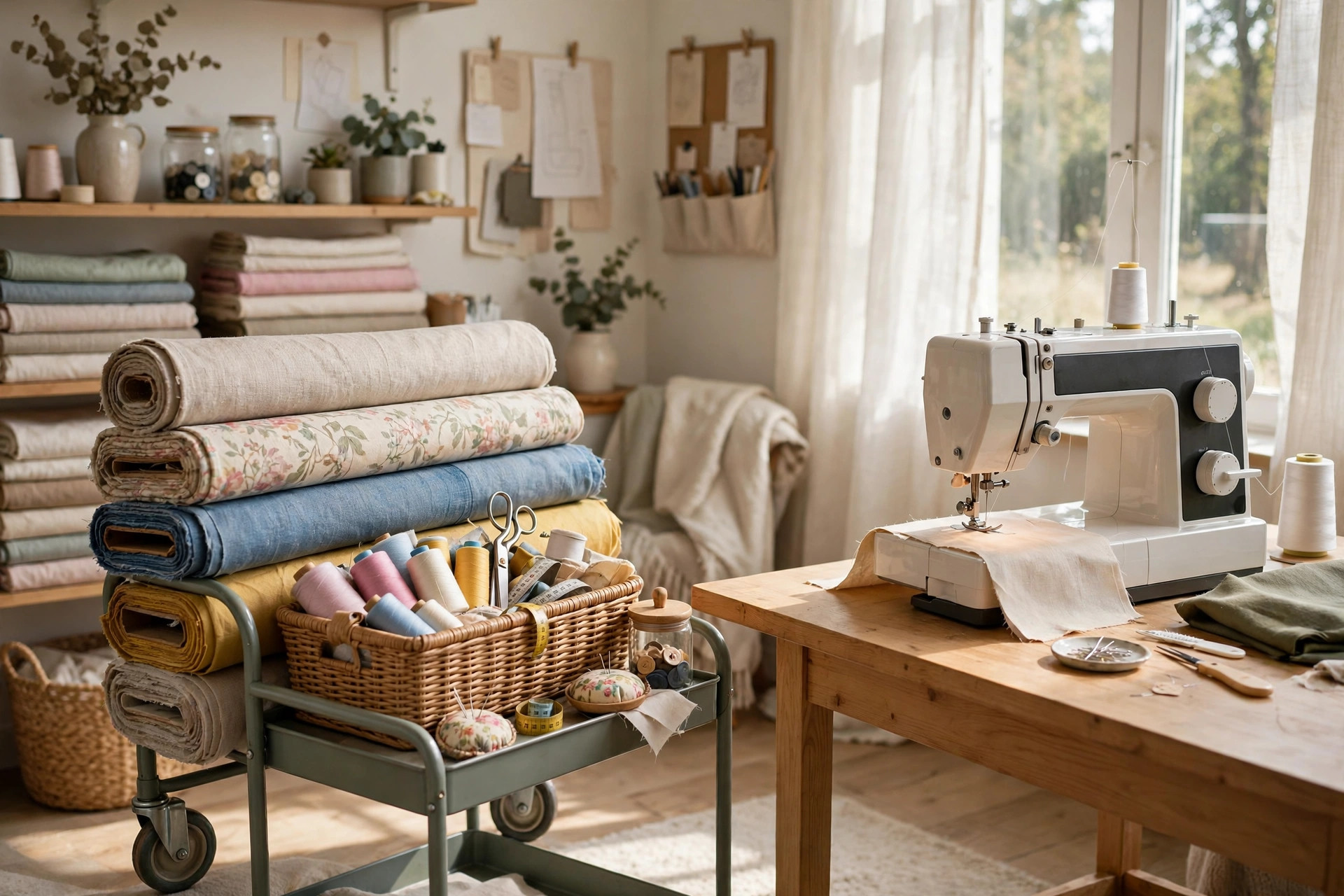
9. A rolling cart with fabric rolls — the cart moves to the machine
Fabric stored across the room from the machine is fabric you have to fetch, because the walk is the interruption and the interruption is the thing that breaks the sewing flow. Put the fabric on a rolling cart — the cart moves to the machine — so the stash rolls to where you work and rolls away when you are done. Use a three-tier cart, stand the fabric rolls in the top tier, keep the tools in the middle and the notions at the bottom, because the top is the fabric and the bottom is the weight. The cart that holds the fabric is in 22 Rolling Cart Organization Ideas for 2026, where the cart gets its tiers sorted before the fabric moves in. Park the cart beside the machine while you sew, because the cart beside the machine is the cart that hands you the next piece, and wheel it back to the wall when the room needs tidying. A cart on wheels, and the fabric comes to the machine. (Check on Amazon for a three-tier rolling cart with deep baskets, which holds fabric rolls without them tipping.)
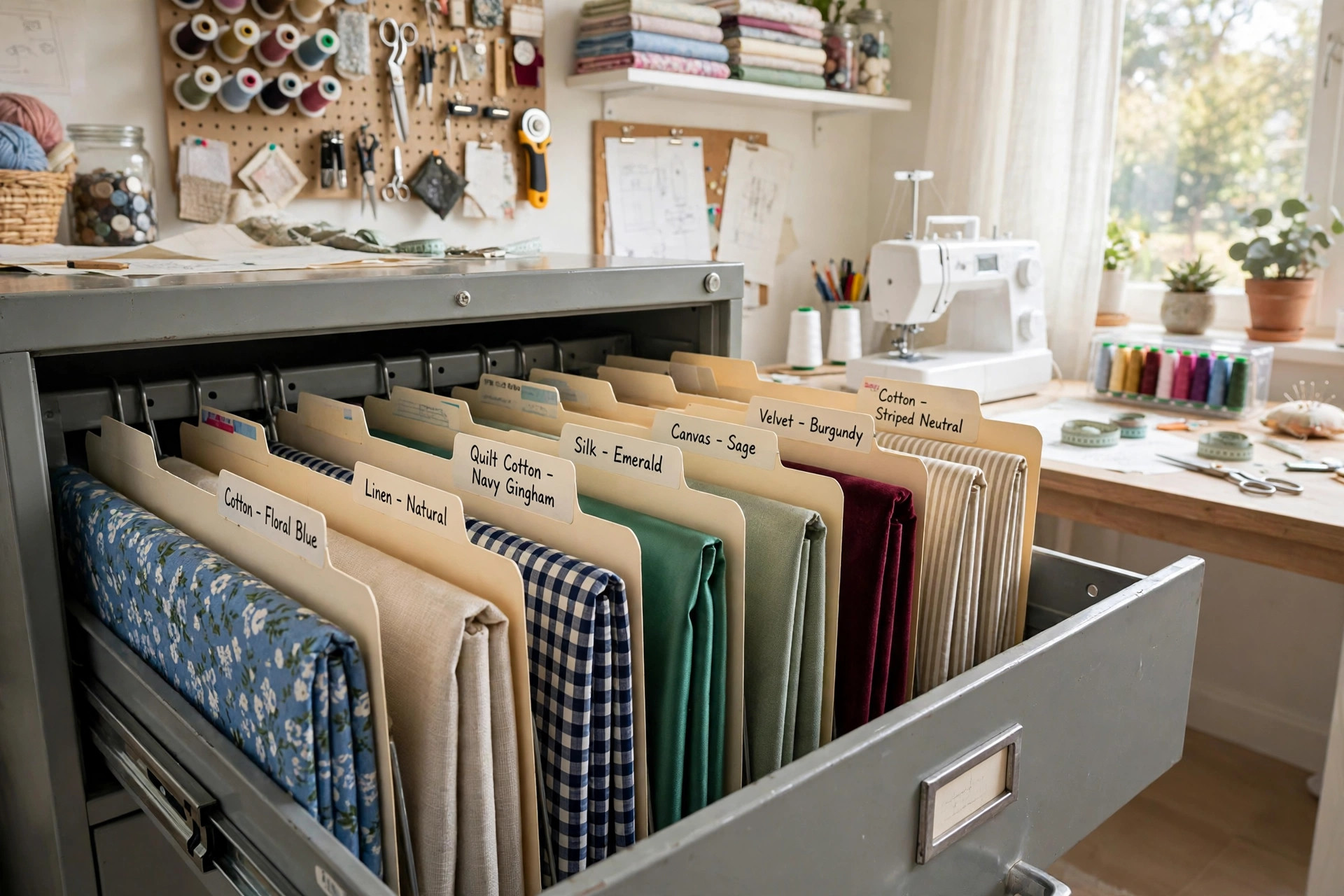
10. Fabric in a filing cabinet — hanging files, one fabric per file
A filing cabinet with no job is a cabinet doing nothing, because the drawers you do not use are the drawers that hold the things you forgot. Give it the fabric — hanging files, one fabric per file — so each piece hangs in its own file and the drawer opens onto the whole stash. Hang the fabric over the file frames, label each tab with the print and the length, and sort the files by colour, because the tab is the index and the drawer is the catalogue. Keep one drawer for cotton, one for linen and knits, and one for the pieces you are saving, because the drawer that is sorted is the drawer that finds the fabric. Pull the drawer open, flick through the files, and the fabric you want is the one you lift out. A filing cabinet and some hanging files, and the fabric is filed like paper.
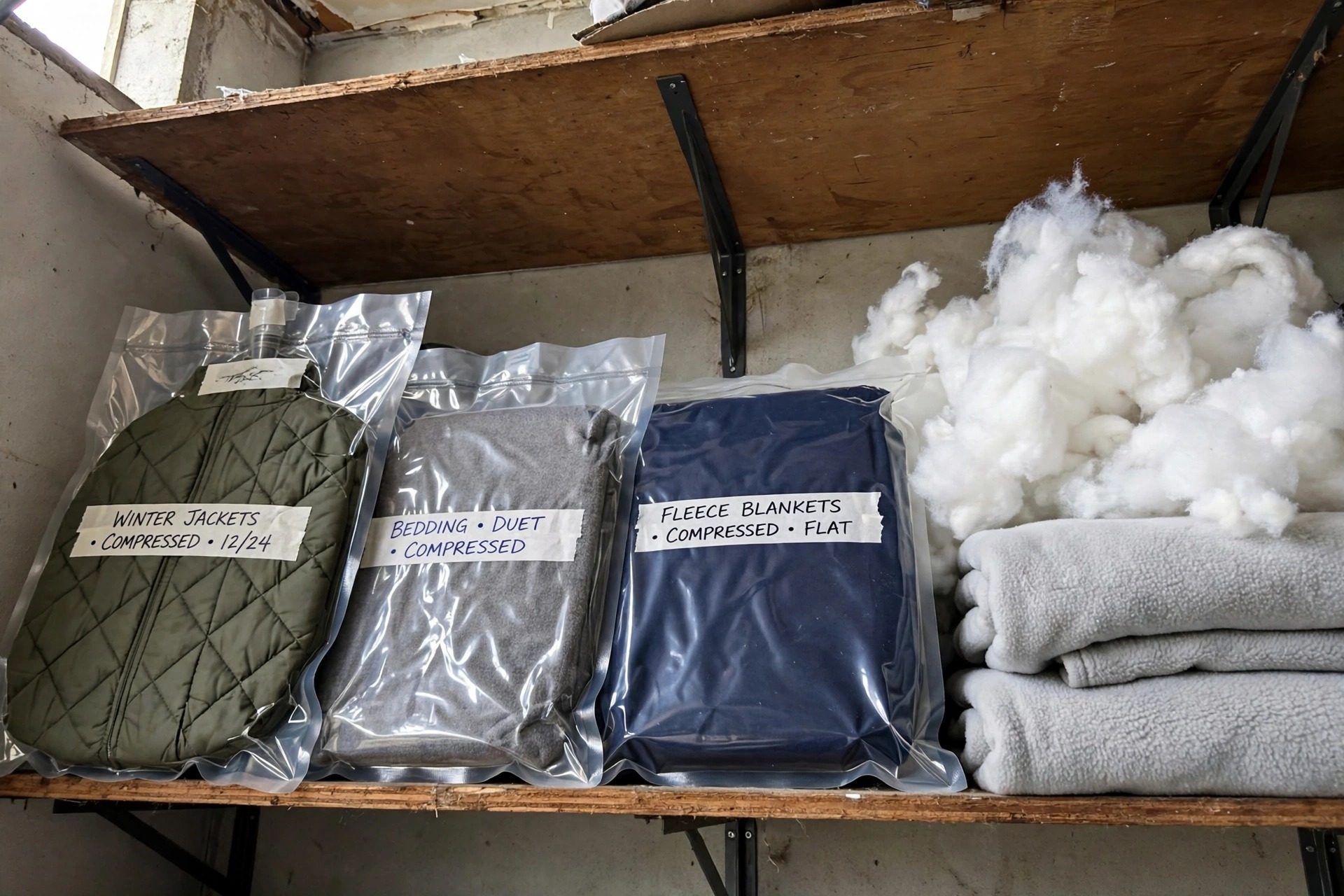
11. Vacuum bags for out-of-season fabric — bulky fabric compressed flat
Bulky fabric eats shelf space, because the wadding and the fleece are the things that puff up and the puffed-up fabric is the fabric that fills a shelf on its own. Compress it — bulky fabric compressed flat — so the shelf holds three times as much and the fabric you use least takes the least room. Fold the fabric into a vacuum bag, seal it, suck the air out, and slide the flat bag onto a high shelf or under the bed, because the flat bag is the space saver and the high shelf is the place for the fabric you reach for least. Label the bag with the contents and the date, because the label is the thing that finds the bag without opening it, and keep the bags you open most at the front of the shelf. A vacuum bag and a flat shelf, and the bulky fabric takes a third of the room.
Small pieces, scraps and notions: nothing lost
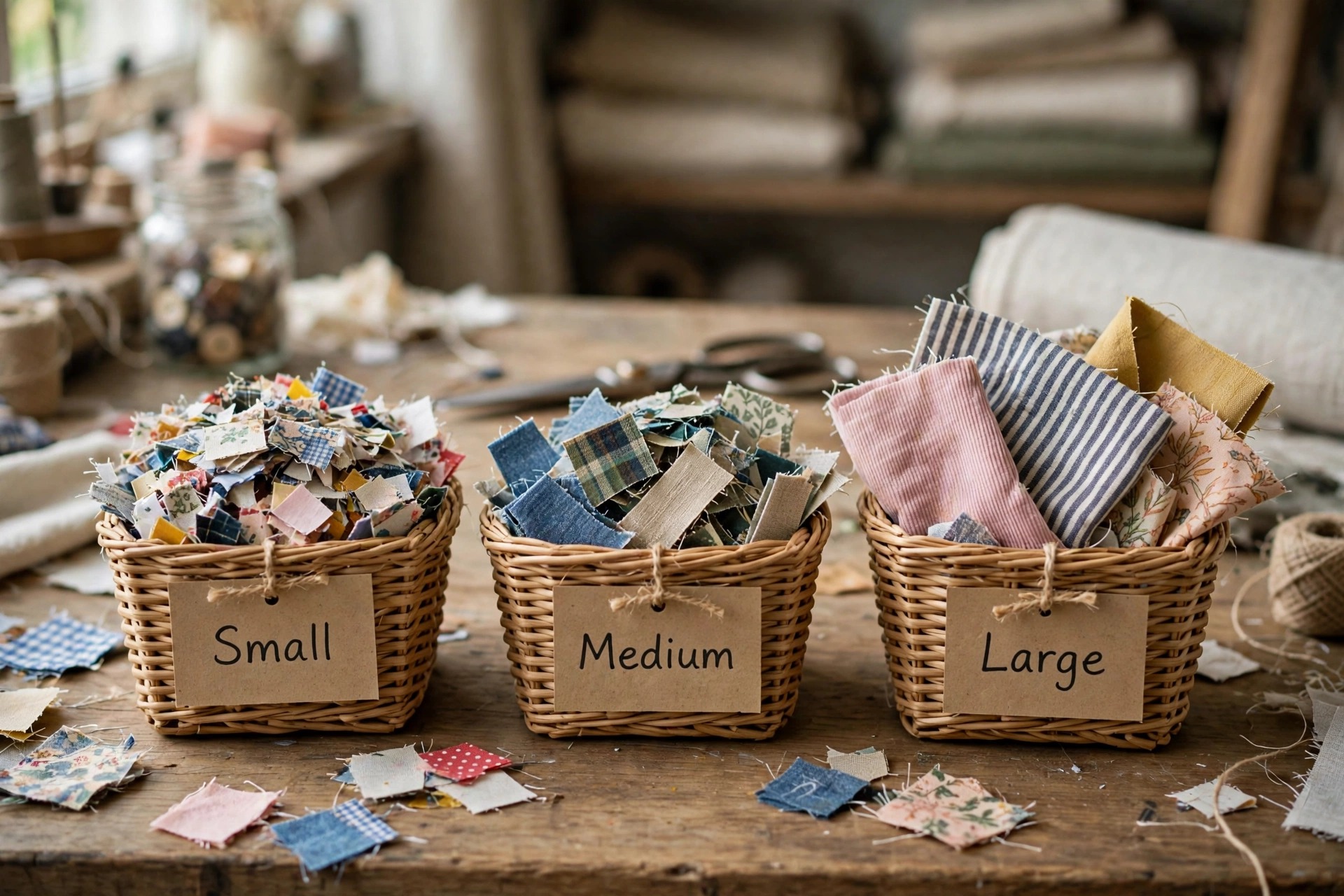
12. A scrap bin sorted by size — small, medium and large scraps in their own bins
Scraps in one bin become a tangle, because the small pieces fall to the bottom and the bottom is the place you never reach. Sort the scraps by size — small, medium and large scraps in their own bins — so each bin holds pieces you can actually use and the bin you open is the bin with the right size. Use three small bins, label them small, medium and large, and drop each scrap in the bin that fits it, because the label is the rule and the bin is the home. Keep the large-scrap bin nearest the machine, because the large scraps are the ones you reach for first, and empty the small-scrap bin into a stuffing bag when it fills, because the scraps that are too small to sew are the scraps that stuff a cushion. Three bins by size, and the scraps stop being a tangle.
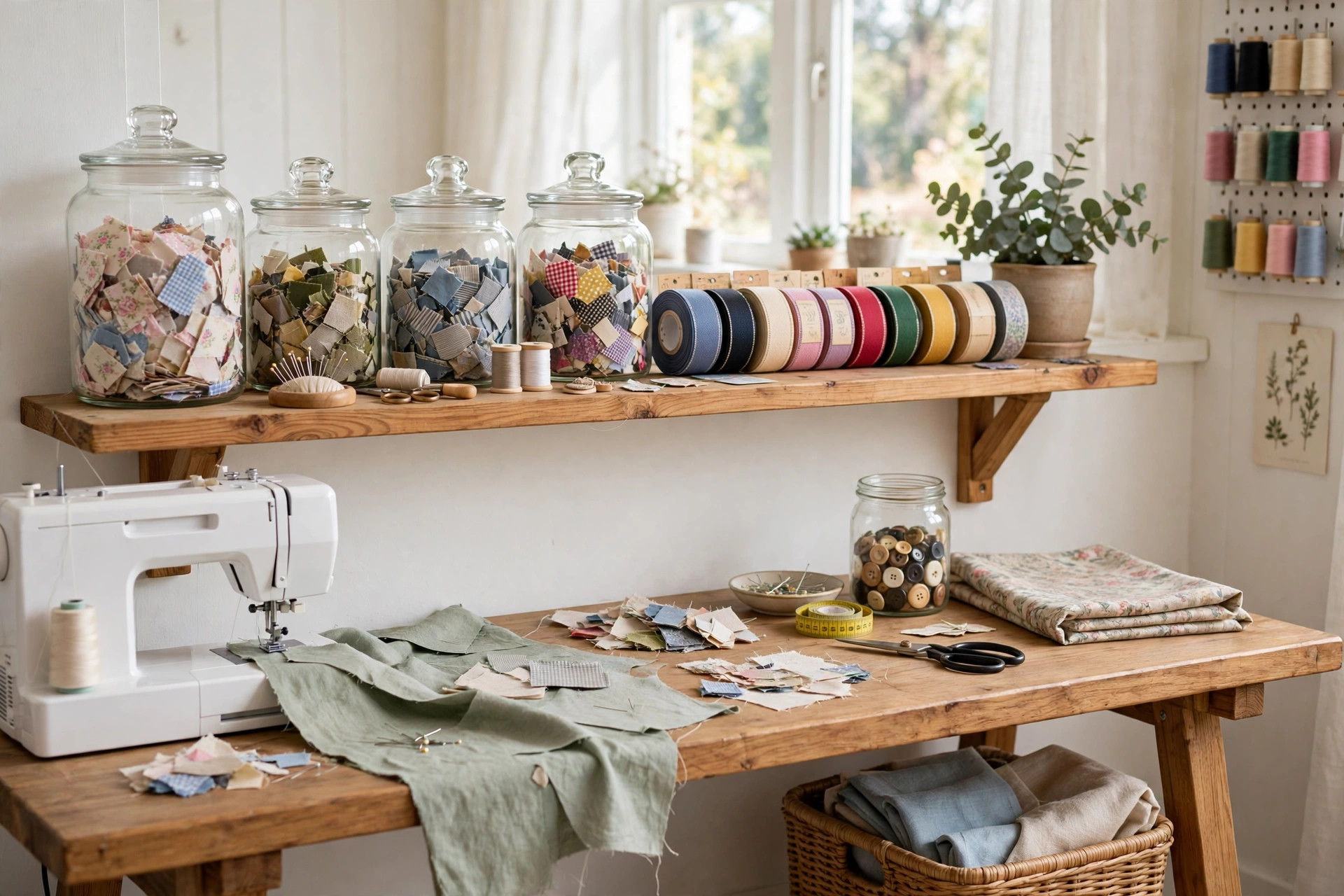
13. Clear jars for tiny scraps and bias tape — jars on a shelf, everything visible
Tiny scraps in a drawer disappear, because the drawer is the dark place and the small pieces are the things that sink to the bottom. Put them in clear jars — jars on a shelf, everything visible — so the scraps and the bias tape sit where you can see them and the jar you need is the jar you pick up. Use glass jars with lids, sort the scraps by colour into the jars, and wind the bias tape into rolls that stand in a jar of their own, because the jar is the display and the lid is the dust cover. Line the jars along a shelf above the sewing table, because the shelf above the table is the shelf your hand reaches without standing up, and keep one jar for the pieces you are saving for a quilt. Clear jars on a shelf, and the tiny pieces stop disappearing. (Check on Amazon for glass jars with wooden lids in a set, which look neat in a row and keep the dust out.)
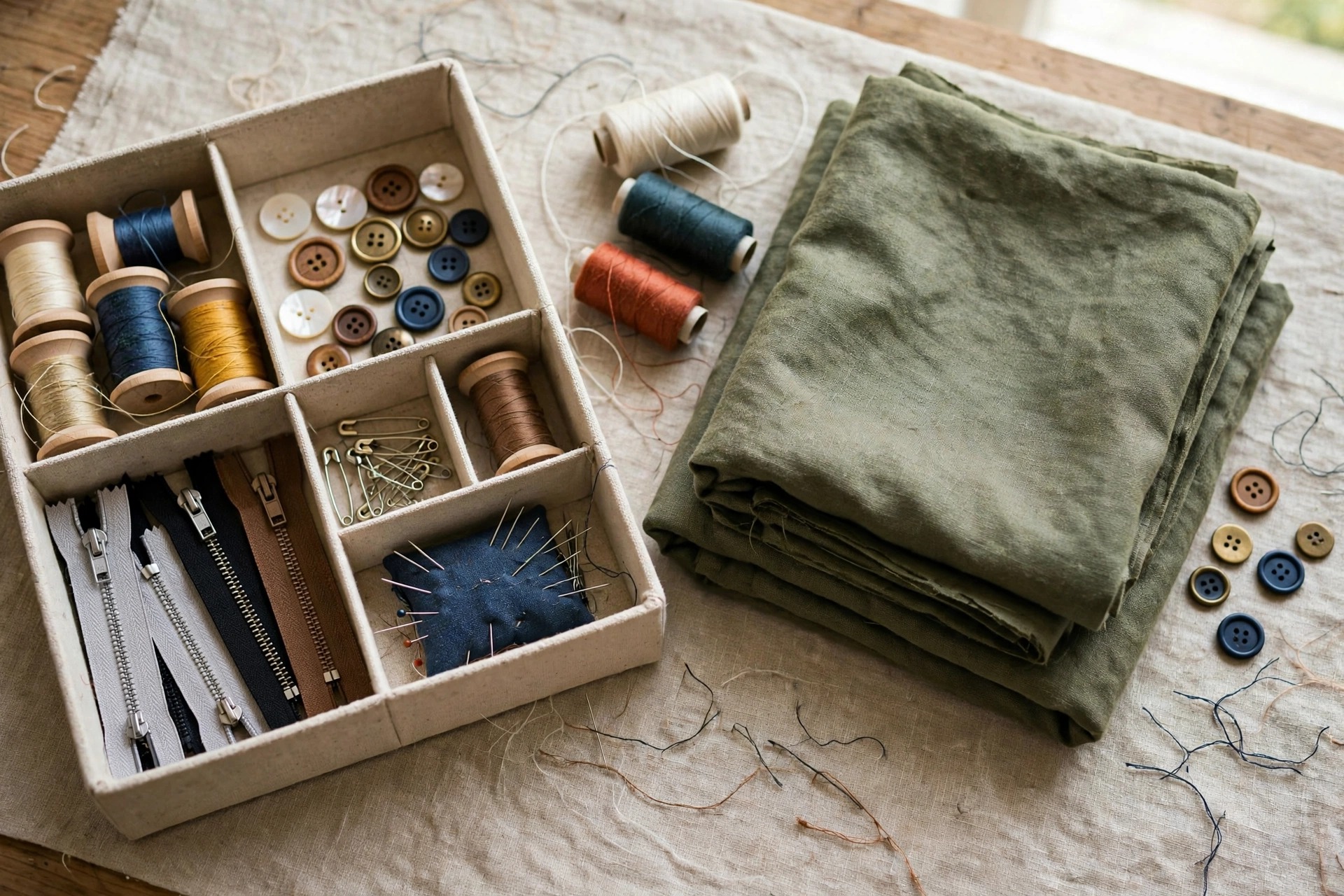
14. A thread and notion caddy beside the fabric — everything for the project in one caddy
Thread in one drawer, buttons in another and zips somewhere else is a project in three places, because the things that live apart are the things you have to hunt for. Put them in one caddy beside the fabric — everything for the project in one caddy — so the thread, the buttons and the zips travel together and the project starts in one place. Use a caddy with compartments, fill one section with the thread that matches the fabric, one with the buttons and one with the zips and elastic, because the compartment is the order and the caddy is the home. Keep the caddy on the shelf beside the fabric it belongs to, because the caddy beside the fabric is the caddy that starts the project, and move it to the machine when the sewing starts. One caddy beside the fabric, and the notions stop being a hunt.
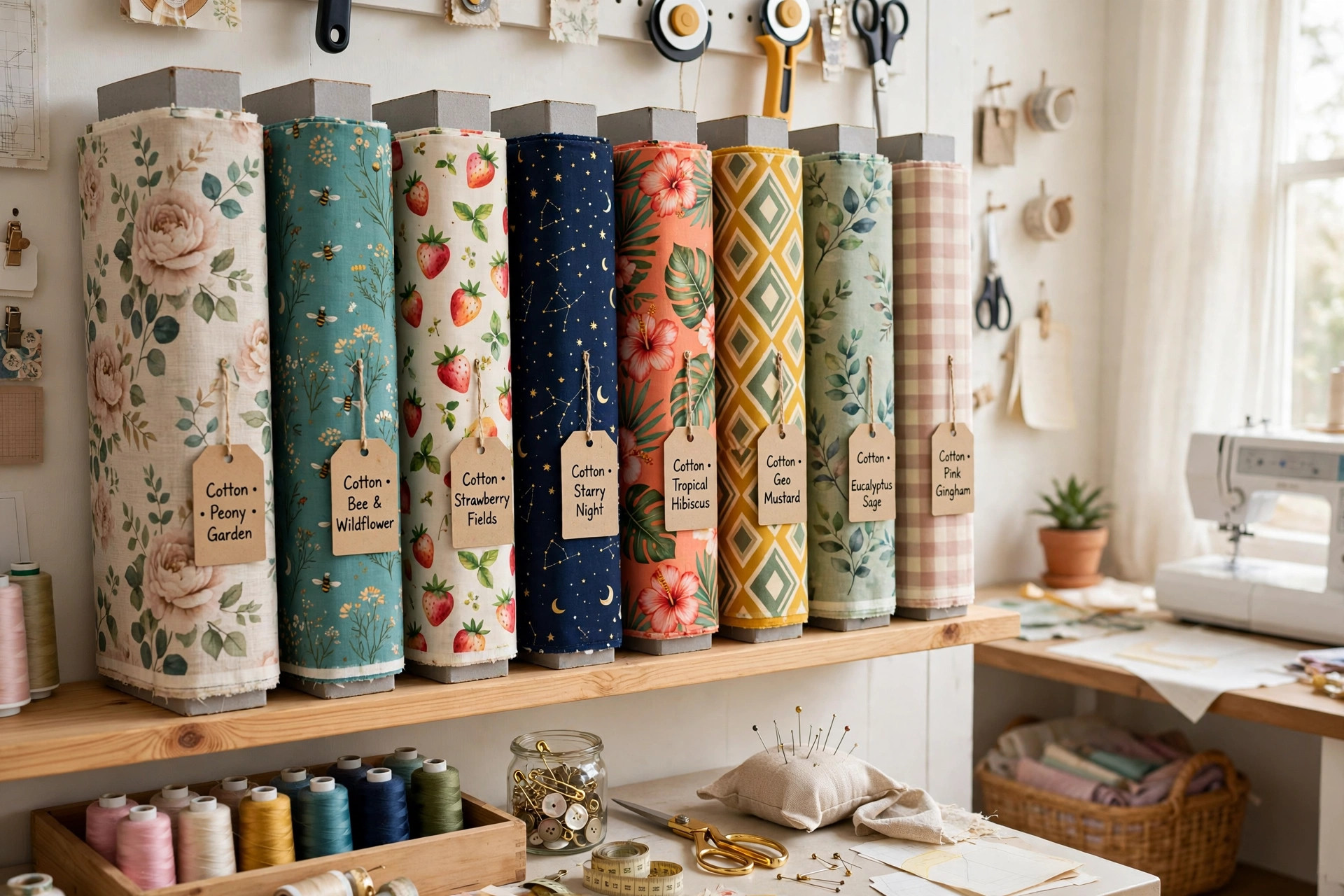
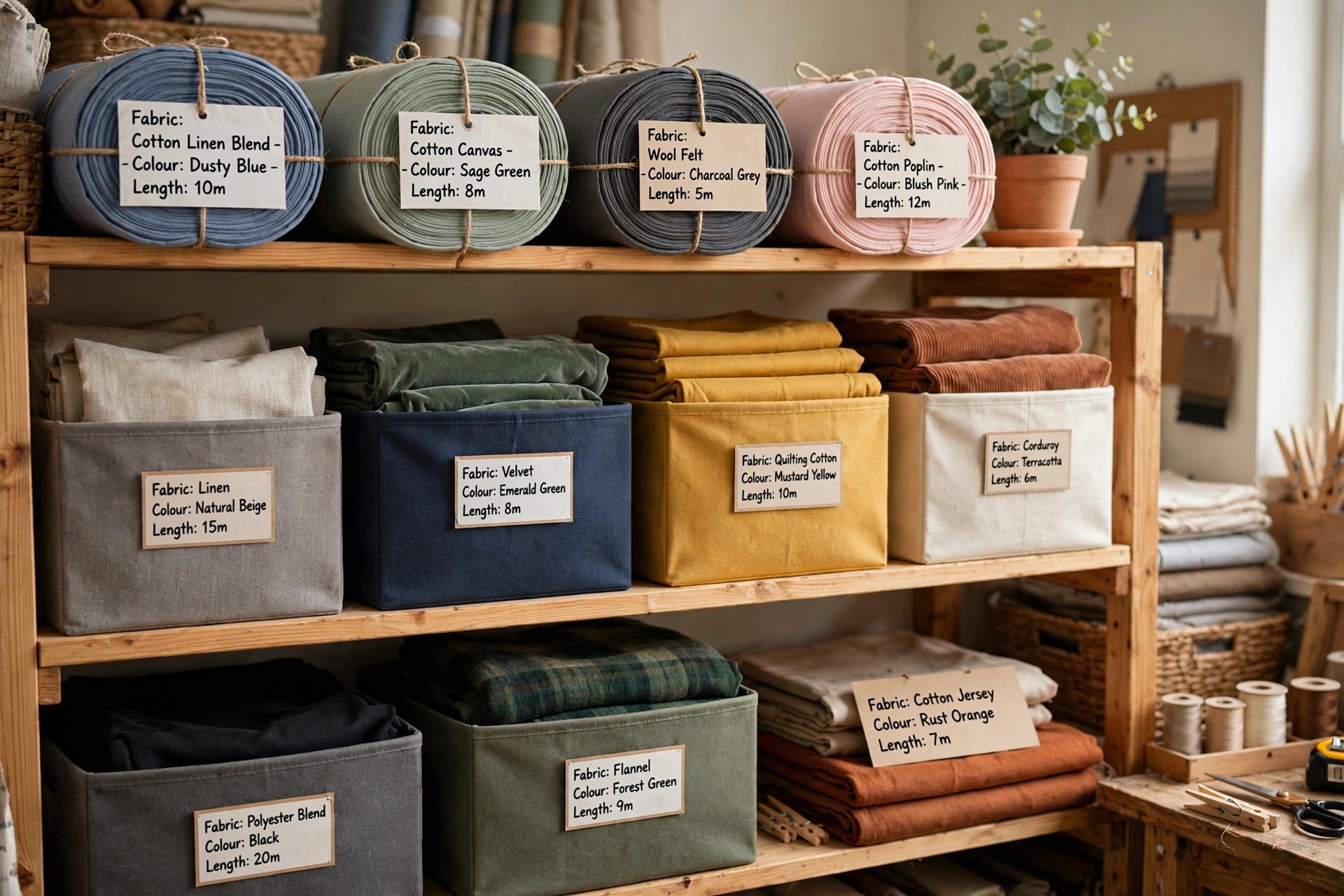
15. Label every bin, shelf and roll — labels so you find the print fast
A shelf of fabric with no labels is a shelf you have to search, because the print you want is the print you cannot name and the print you cannot name is the print you cannot find. Label everything — labels so you find the print fast — so the bin, the shelf and the roll all say what they hold and the fabric you want is the one you reach for first. Write the fabric name, the colour and the length on each label, stick it where you can read it without moving anything, and keep the labels the same size and style, because the label that matches is the label that reads like a system. Use a label maker or neat handwritten tags, because the label you can read is the label that works, and update the label when the fabric changes, because the label that lies is worse than no label. Labels on everything, and the print is found in seconds.
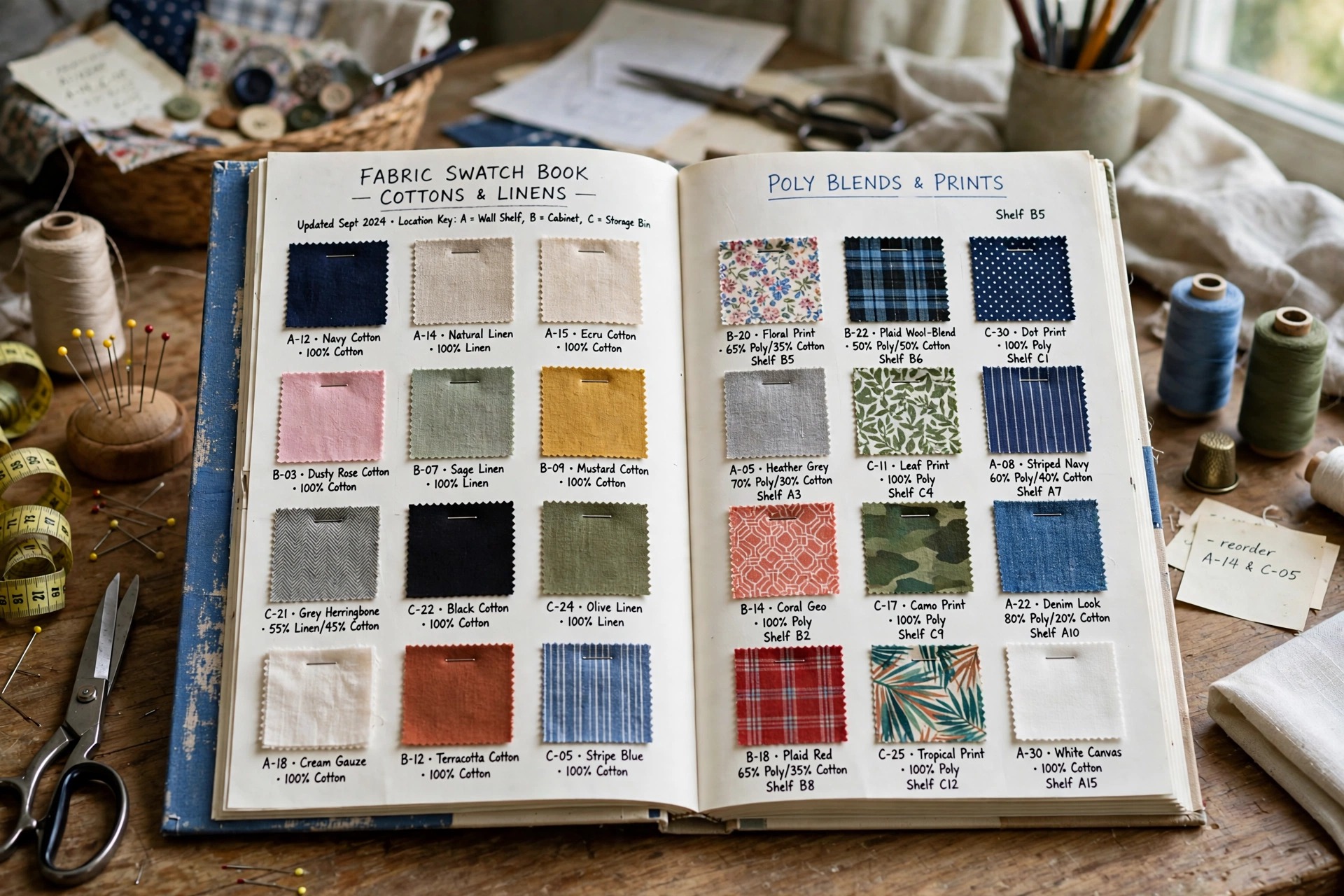
16. A fabric swatch book — swatches with the shelf location written on them
A stash you cannot see without opening every bin is a stash you shop twice, because the fabric you forgot is the fabric you buy again. Make a swatch book — swatches with the shelf location written on them — so the whole stash fits in your hand and the print you want points to its shelf. Cut a small square from each fabric, staple it to a page, and write the shelf, the bin and the length beside it, because the swatch is the proof and the note is the map. Keep the book by the machine, because the book by the machine is the book you check before you cut, and flip through it when you plan a project, because the book that shows the stash is the book that stops the second purchase. A swatch book and a pen, and the stash fits in your hand.
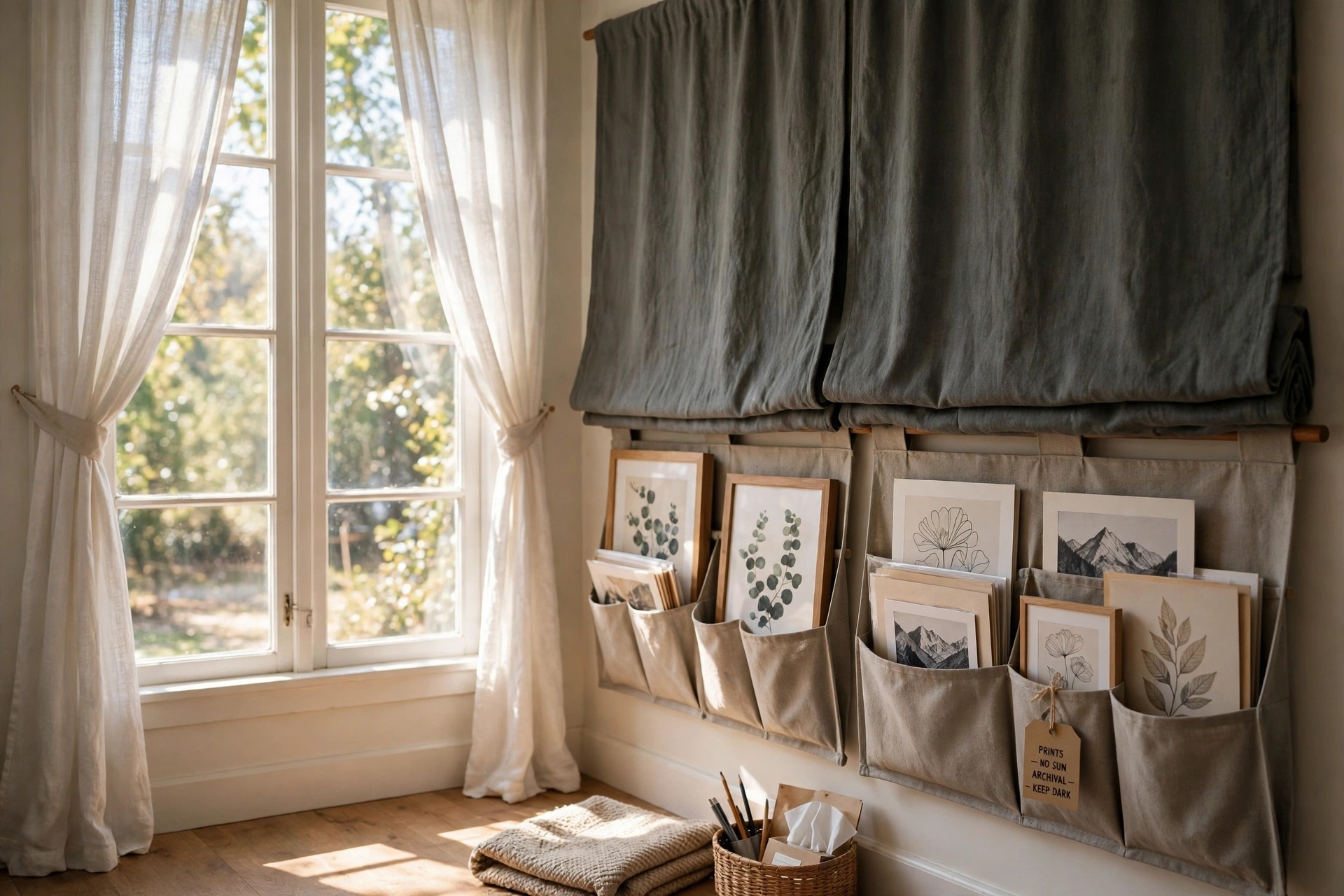
17. Store fabric away from sunlight — keep prints from fading
Fabric in a sunny window fades, because the sun is the thing that bleaches the colour and the bleached print is the print that looks old before it is used. Move the fabric out of the sun — keep prints from fading — so the colours stay bright and the fabric you bought looks new when you cut it. Keep the shelves on the wall opposite the window, close the curtains on the shelf wall, and never store fabric on a windowsill, because the windowsill is the sunniest place in the room. Use solid bins or a cupboard door for the fabrics you care about most, because the door is the shade and the shade is the protection, and rotate the front row of fabric every few months so no one piece sits in the light. Away from the sun, and the prints stay bright.
Fabric storage that works harder
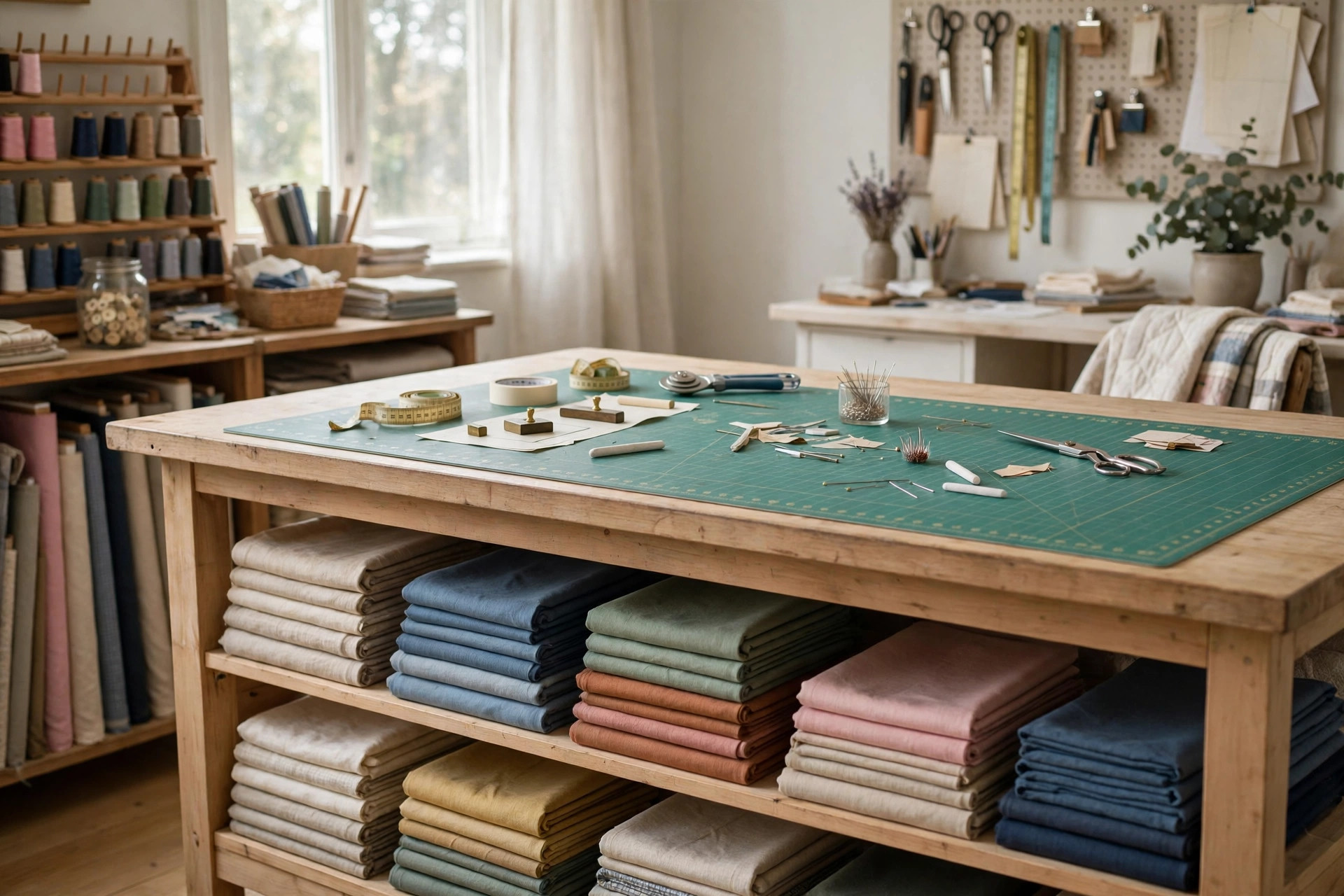
18. A cutting table with fabric storage underneath — shelves under the table
A cutting table with empty space underneath is a table wasting its best storage, because the space under the table is the space your knees do not need and the fabric does. Fill it — shelves under the table — so the fabric lives where you cut it and the cutting starts without a trip to the shelf. Put open shelves or baskets under the table, stack the folded fabric in them with the folded edge out, and keep the fabric for the current project on the top shelf, because the top shelf is the one your hand reaches while you cut. Leave the middle of the table clear, because the table that is clear is the table you can cut on, and keep the heavy bolts on the bottom shelf, because the bottom shelf is the one that carries the weight. Shelves under the cutting table, and the fabric is where the cutting happens.
19. Fabric storage that doubles as a room divider — a shelf unit as a divider
A sewing room that shares a room with something else has no wall for the fabric, because the shared room is the room with no boundary and the fabric with no wall is the fabric with no home. Use the storage as the wall — a shelf unit as a divider — so the fabric shelves split the room and the stash gets a wall of its own. Stand a tall open shelf unit across the room, fill it with folded fabric facing the sewing side, and back it with a plain panel or a curtain, because the shelf is the divider and the fabric is the display. Keep the heaviest fabric on the bottom shelves, because the bottom shelves are the ones that steady the unit, and anchor the top to the ceiling or the wall, because the unit that is anchored is the unit that does not tip. A shelf unit as a divider, and the fabric gets a wall where there was none.
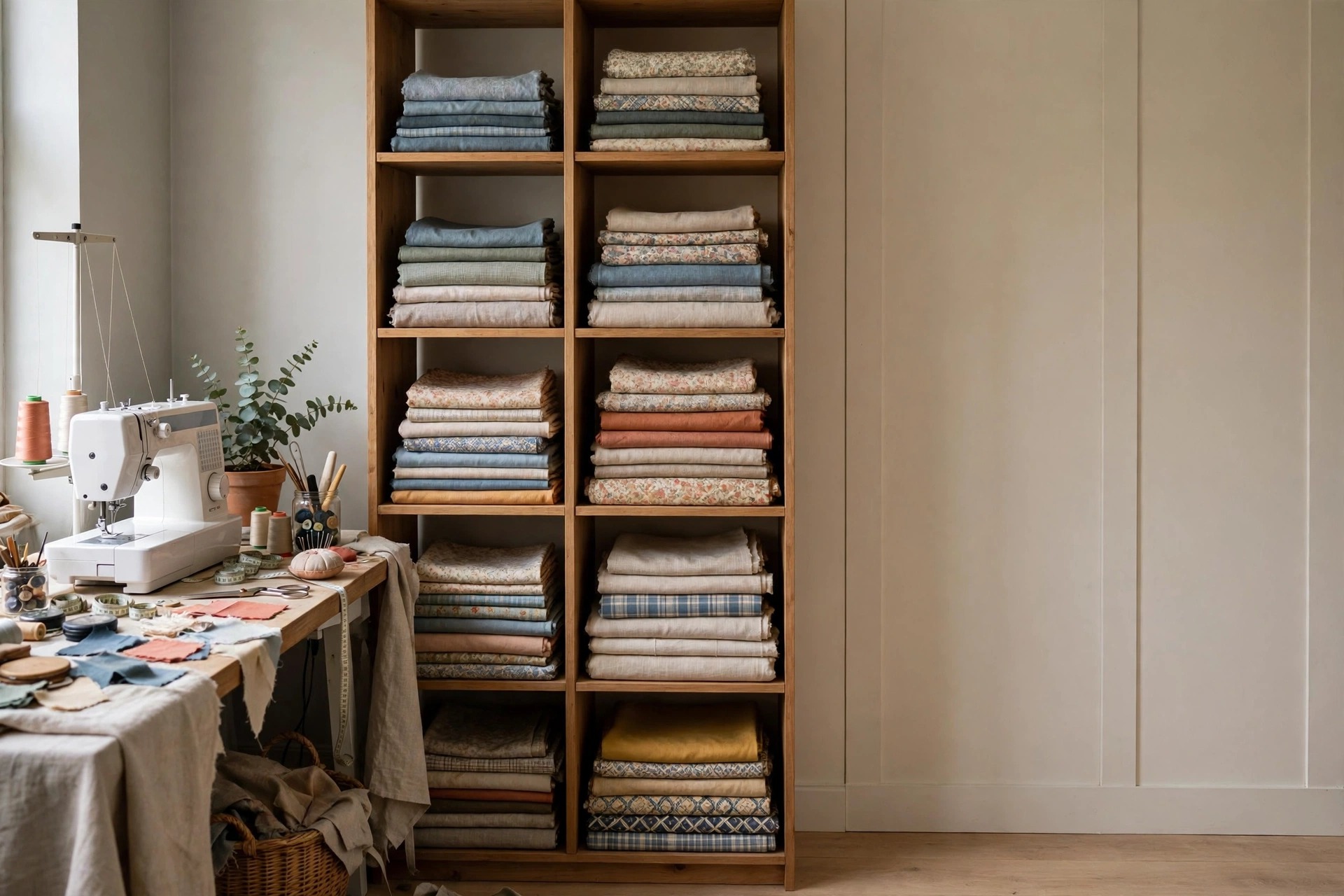
20. A portable fabric tote for sewing days — the day's fabric in one tote
Fabric for a sewing day scattered across the room is fabric you have to gather, because the gathering is the chore and the chore is the thing that eats the sewing time. Pack it in one tote — the day's fabric in one tote — so the fabric, the pattern and the thread travel together and the sewing starts the moment you sit down. Choose a tote with stiff sides and a flat bottom, fold the day's fabric inside with the pattern on top, and add the thread and notions in the side pockets, because the tote is the kit and the pockets are the order. Keep the tote by the door when the sewing day is away from home, because the tote by the door is the tote that leaves with you, and unpack it onto the shelf when you are home, because the tote that is unpacked is the tote that is ready for next time. One tote for the day, and the fabric travels as a kit.
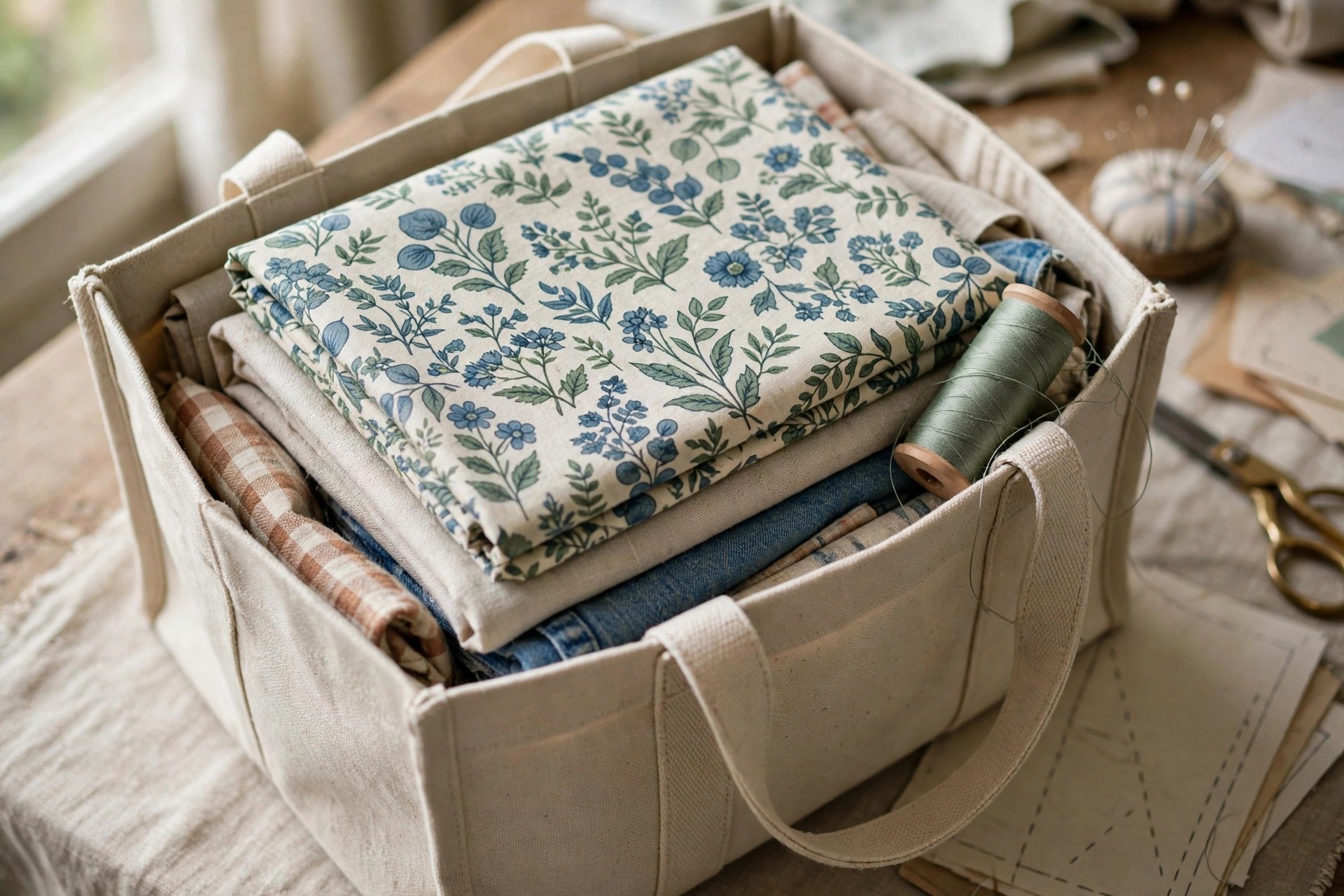
21. Keep the stash to one shelf — a one-in-one-out rule for new fabric
A stash with no limit grows until it owns the room, because the fabric you buy is the fabric that needs a home and the home that is full is the home that overflows. Set the limit — a one-in-one-out rule for new fabric — so the stash stays on one shelf and every new piece earns its place. Choose the shelf, fill it, and when a new fabric arrives, let an old piece go — use it, gift it or cut it into scraps — because the rule is the boundary and the boundary is the thing that keeps the room yours. Keep the rule visible on the shelf, because the rule you can see is the rule you keep, and review the shelf every season, because the shelf you review is the shelf that stays in shape. One shelf and one rule, and the stash stops growing.
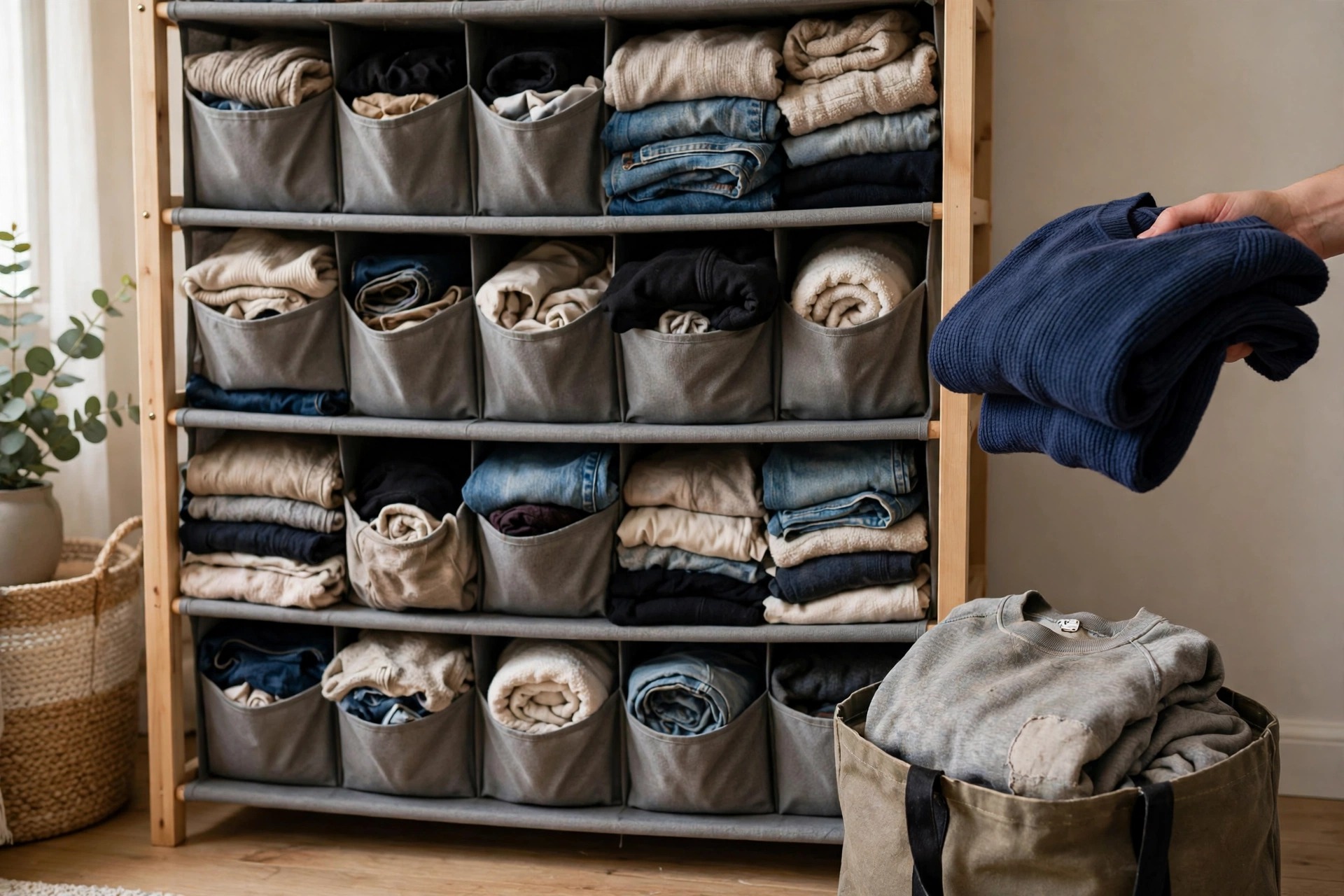
22. A fabric inventory list on the shelf door — a list so you stop buying doubles
A stash with no list is a stash you cannot remember, because the fabric you own is the fabric you forget and the fabric you forget is the fabric you buy again. Write the list — a list so you stop buying doubles — so every fabric has a line and the list you check before you shop is the list that saves the money. Tape the list to the shelf door, write the fabric name, the colour and the length on each line, and cross a line off when the fabric is used up, because the list is the memory and the door is the place you see it. Update the list when new fabric arrives, because the list that is current is the list that works, and check it on your phone before you buy, because the list you check is the list that stops the double. A list on the shelf door, and the doubles stop.
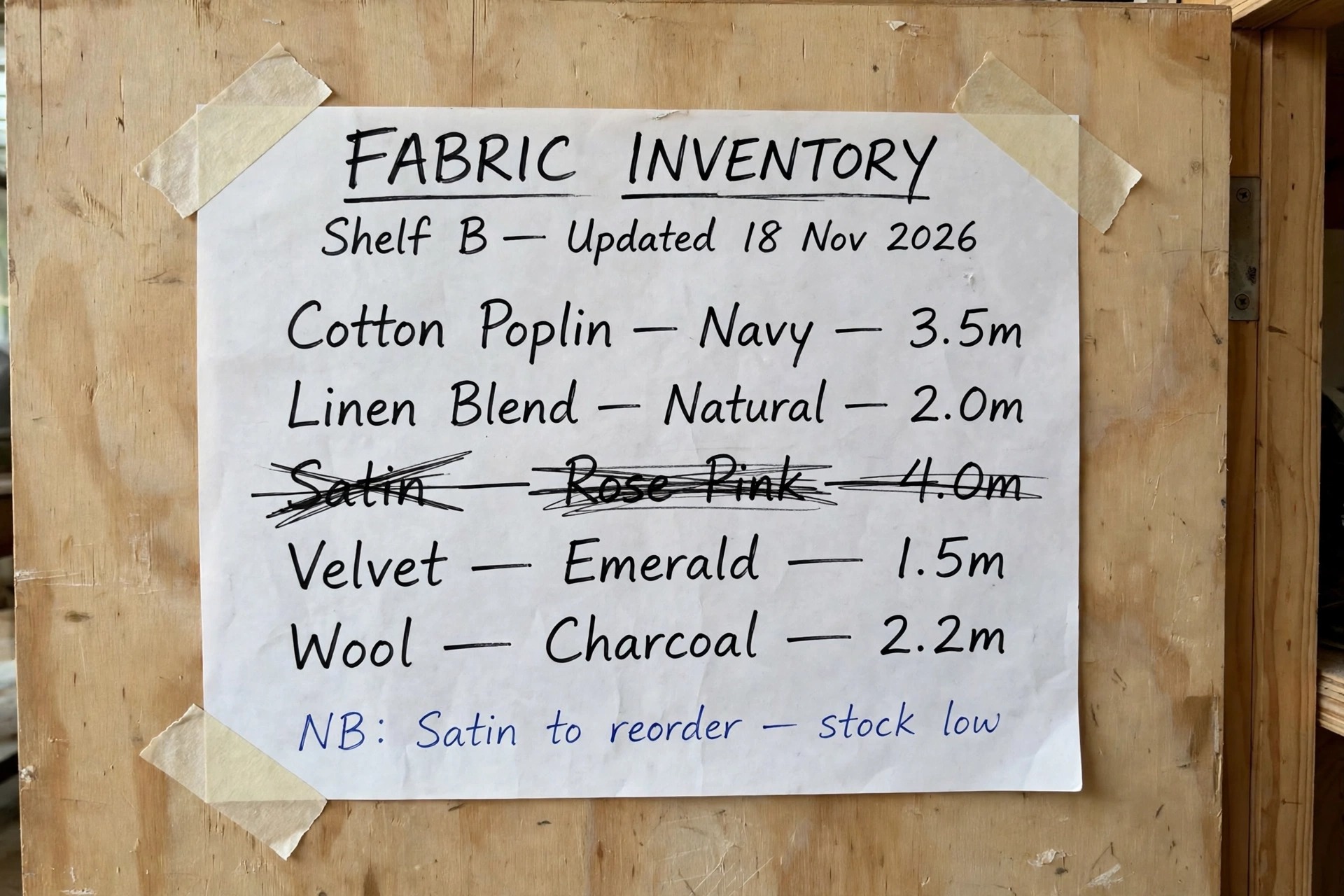
Which fabric storage idea fits which situation?
| Situation | Best first move | Budget | Tools needed |
|---|---|---|---|
| Fabric in a wobbly pile | Mini bolts on comic book boards (idea 1) | Low | Comic book boards |
| Fabric buried at the bottom | Bookshelf of bolts, spines out (idea 2) | Low | Bookshelf |
| Cannot see inside the bins | Clear bins by colour (idea 3) | Low | Clear bins, labels |
| Fabric hidden in a cupboard | Pegboard wall with dowels (idea 4) | Low | Pegboard, dowels |
| Drawer you have to dig through | File-folded fabric with dividers (idea 5) | Low | Drawer dividers |
| Spare corner doing nothing | Leaning ladder shelf (idea 6) | Low | Ladder shelf |
| Fabric creased from folding | Roll on cardboard tubes (idea 7) | Free | Cardboard tubes |
| Fabric that hates folding | Trouser hangers in the closet (idea 8) | Low | Trouser hangers |
| Fabric far from the machine | Rolling cart with fabric rolls (idea 9) | Low | Rolling cart |
| Spare filing cabinet | Hanging files, one fabric per file (idea 10) | Free | Hanging files |
| Bulky fabric eats the shelf | Vacuum bags (idea 11) | Low | Vacuum bags |
| Scraps in one tangled bin | Scrap bins sorted by size (idea 12) | Low | Small bins |
| Tiny scraps disappear | Clear jars on a shelf (idea 13) | Low | Glass jars |
| Notions in three places | Thread and notion caddy (idea 14) | Low | Caddy |
| Cannot find the print | Label every bin, shelf and roll (idea 15) | Low | Labels |
| Buying fabric you already own | Swatch book with shelf locations (idea 16) | Free | Notebook |
| Prints fading in the sun | Store fabric away from sunlight (idea 17) | Free | Curtains, bins |
| Cutting table wastes space | Shelves under the cutting table (idea 18) | Low | Shelves, baskets |
| Room shared with something else | Shelf unit as a room divider (idea 19) | Medium | Shelf unit |
| Sewing day away from home | Portable fabric tote (idea 20) | Low | Tote bag |
| Stash owns the room | One shelf, one-in-one-out rule (idea 21) | Free | None |
| Buying doubles | Inventory list on the shelf door (idea 22) | Free | Paper, pen |
You do not need all 22 ideas. You need the three that solve your stash — usually the mini bolts that turn the shelf into a fabric shop, the clear bins that show every colour at a glance, and the swatch book that stops you buying the same print twice. Start with the boards, fold one shelf this weekend, and put the fabric where you can see it. Do that and the next time you plan a project you will reach for the fabric you already own, for the price of a pack of boards and an afternoon.
Save this post for your next sewing room sort, and if the room needs sorting first, read 22 Sewing Room Organization Ideas for 2026 next — it is Post 17, the room the fabric lives in — and 26 Craft Storage Ideas for 2026, Post 43, for the craft supplies that share the shelves with the fabric. This is the fourteenth post of the Storage by room/object return run — Posts 31 to 55, one room or object at a time — and the next posts carry the same storage system into the objects that follow.
Publish date assigned at publishing time. Updated as new fabric storage finds are tested.
Frequently asked questions
How do I store fabric so it doesn't fade?
Keep it out of direct sunlight — store fabric on the wall opposite the window, close the curtains on the shelf wall, and never leave fabric on a windowsill. Solid bins or a cupboard door protect the prints you care about most, and rotating the front row every few months means no one piece sits in the light for long. Shade and rotation, and the colours stay bright.
What is the best way to fold fabric for storage?
Fold it around a comic book board so every piece is the same size, then stand the mini bolts upright like books with the folded edge out. Pieces folded the same size stack neatly, stand up without slumping, and show the print at a glance. For drawers, file-fold the fabric into rectangles the height of the drawer and stand the pieces in a row with dividers. Same size, folded edge out, and the fabric is easy to see and easy to reach.
How do I keep track of all my fabric?
Make a swatch book and an inventory list — cut a small square from each fabric, staple it to a page with the shelf and bin written beside it, and keep a matching list on the shelf door with the fabric name, colour and length. Check the book before you cut and the list before you shop, and cross a line off when a fabric is used up. A swatch book and a list, and you stop buying doubles.