20 Medicine Cabinet Organization Ideas for 2026
A medicine cabinet is the smallest storage in the house and the one that gets the most use — morning tablets, evening creams, plasters for small cuts, the painkillers you reach for at midnight. And because everything in it is small, it fills up fast: bottles fall over, tubes slide to the back, and the thing you need is always behind the thing you do not.
These 20 medicine cabinet organization ideas are small-cabinet fixes for crowded bathroom shelves: start with a clear-out and clear bins, add a shelf riser and a rotating shelf for the back row, and finish with a monthly expiry check — so every bottle is easy to find and nothing expires unnoticed.
Every idea below works in a real cabinet, from a tiny mirrored box above a pedestal sink to a deep recessed cabinet in a family bathroom. The counter below the cabinet is covered in 25 Bathroom Counter Organization Ideas for 2026, where the counter gets its own home before the cabinet is sorted — and the linen closet that holds the spares is in 22 Linen Closet Organization Ideas for 2026, so the whole bathroom works as one system. Pick three ideas that fit your cabinet, start with the clear-out, and build from there.
Start simple: a clear-out, bins and risers
1. Clear it out first — the one-in, one-out rule for the cabinet
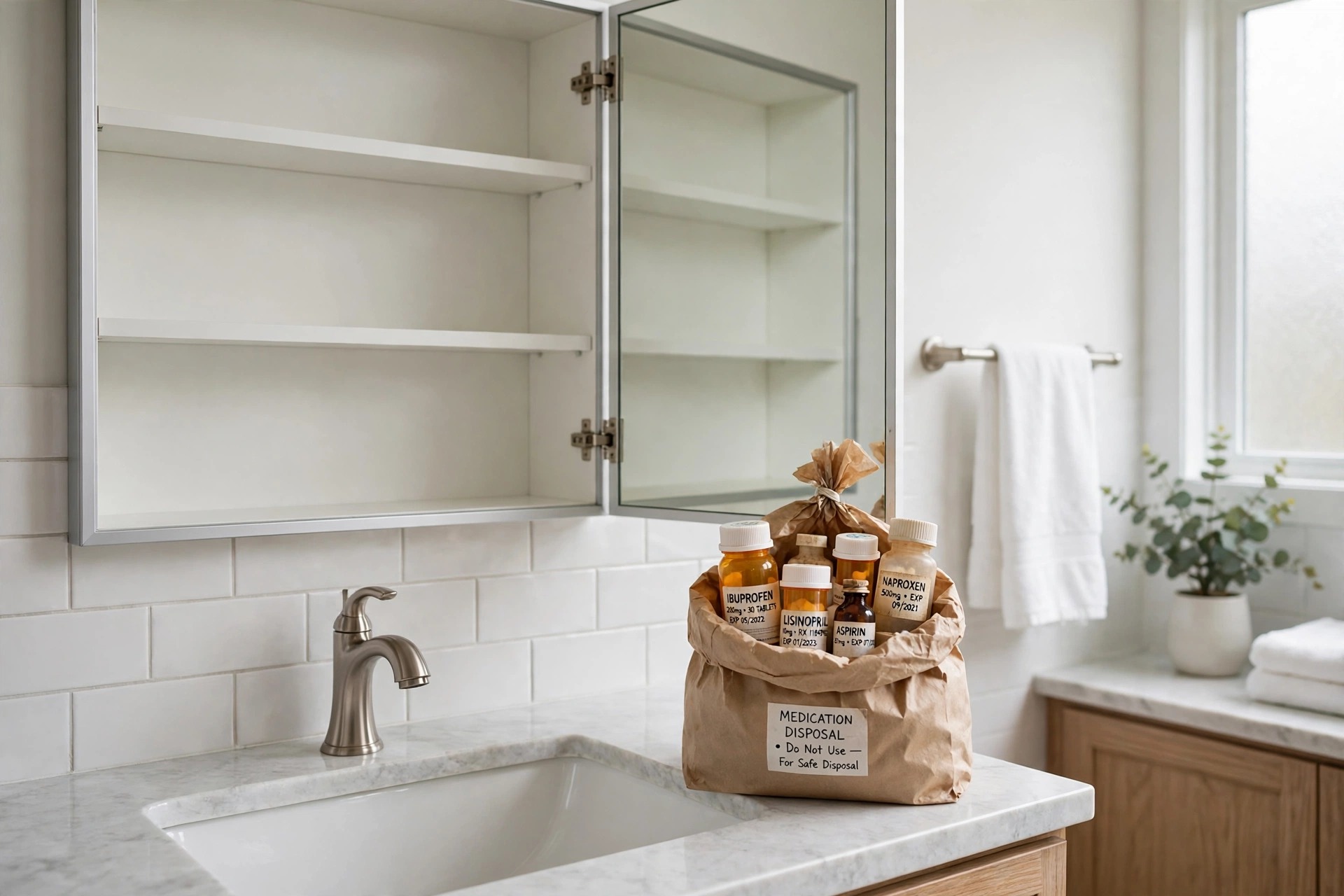
A cabinet you never empty is a cabinet full of things nobody uses, because the bottles that stay are the bottles nobody checks and the bottles nobody checks are the ones that expired two years ago. Take everything out, check every date, and throw away anything expired, anything with no label, and anything you have not touched in a year, because the cabinet that is emptied is the cabinet that can be organized. Put back only what you use every week, and keep the rest somewhere else, because the cabinet that holds only the weekly things is the cabinet that stays tidy. One clear-out, and the cabinet has room again.
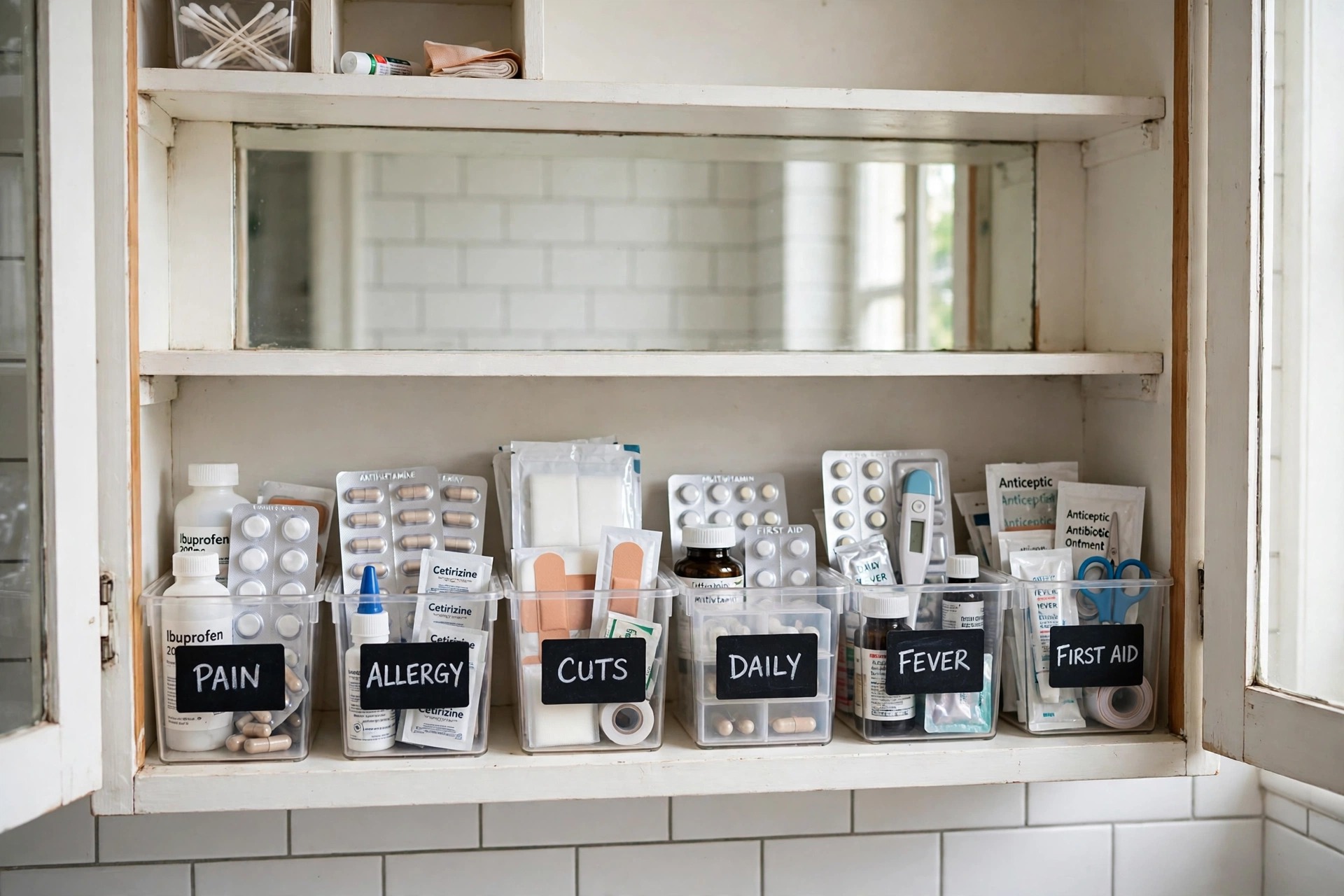
2. Small clear bins on each shelf — one bin per person or per category
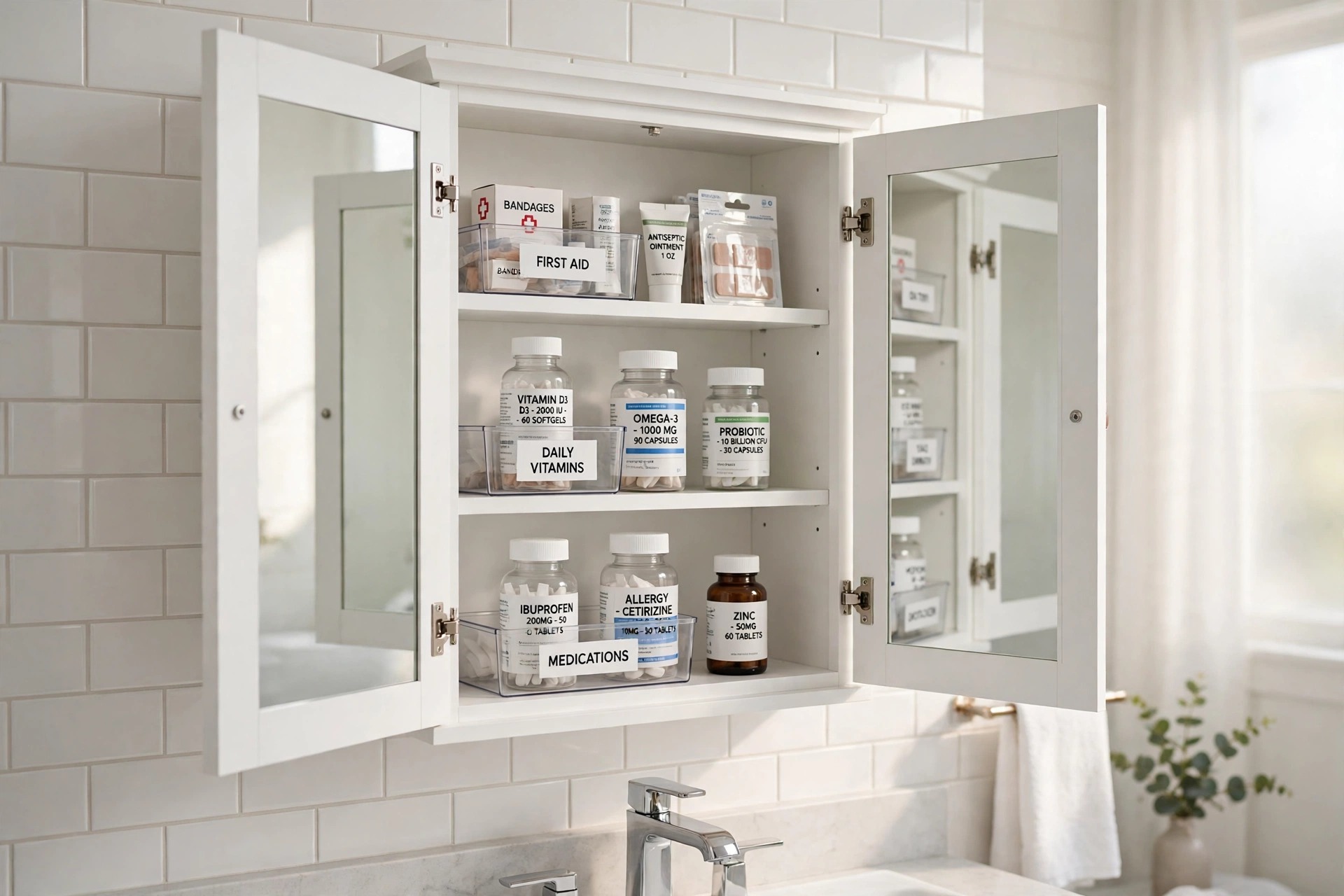
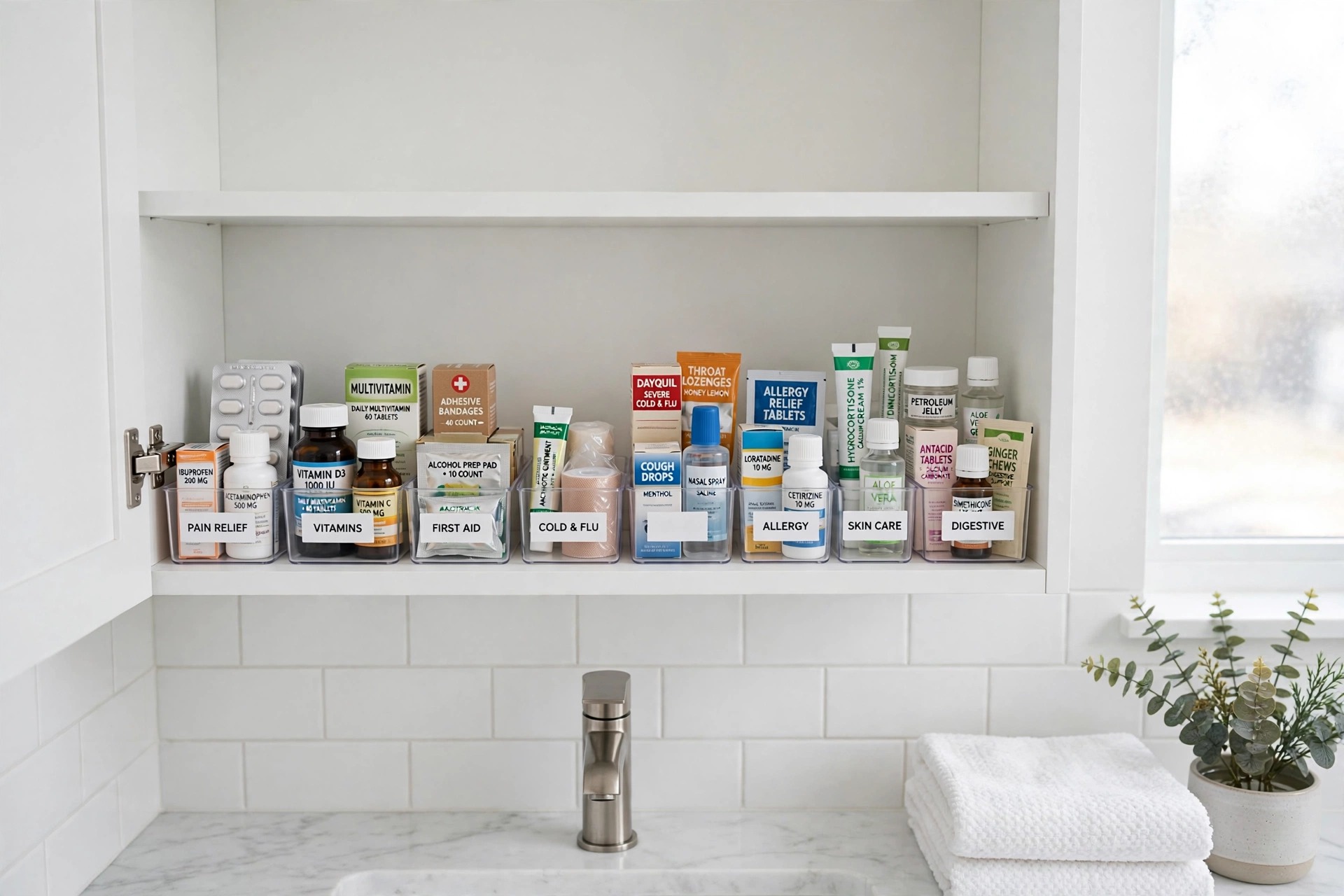
Loose bottles fall over and slide to the back, because the bottles that stand alone are the bottles with nothing to lean on. Put a small clear bin on each shelf — one bin per person or per category — so the bottles stand together and the bin keeps them upright. One bin for painkillers, one for plasters and first aid, one for daily tablets, because the bin that holds one kind of thing is the bin you can find in the dark. Use clear bins, not coloured ones, because the clear bin is the bin you can see into without lifting it out. Pull the bin out like a drawer, take what you need, slide it back, and the shelf stays tidy. A few small bins, and the bottles stop falling.
3. Stackable shelf risers — a second shelf inside the shelf
A medicine cabinet shelf wastes half its height, because the bottles are short and the shelf above them is a gap of empty air. Add a stackable shelf riser — a second shelf inside the shelf — so the short bottles sit on the riser and the tall bottles stand beside it, and one shelf becomes two. Measure the cabinet first, because the riser that fits is the riser that works, and choose a riser with a flat top so the bottles on it do not wobble. Put the things you use least on the riser, because the riser is the shelf you reach over, and keep the daily things at the front. One riser, and the cabinet holds twice as much. (Check on Amazon for stackable shelf risers in white, which fit most standard cabinets and wipe clean.)
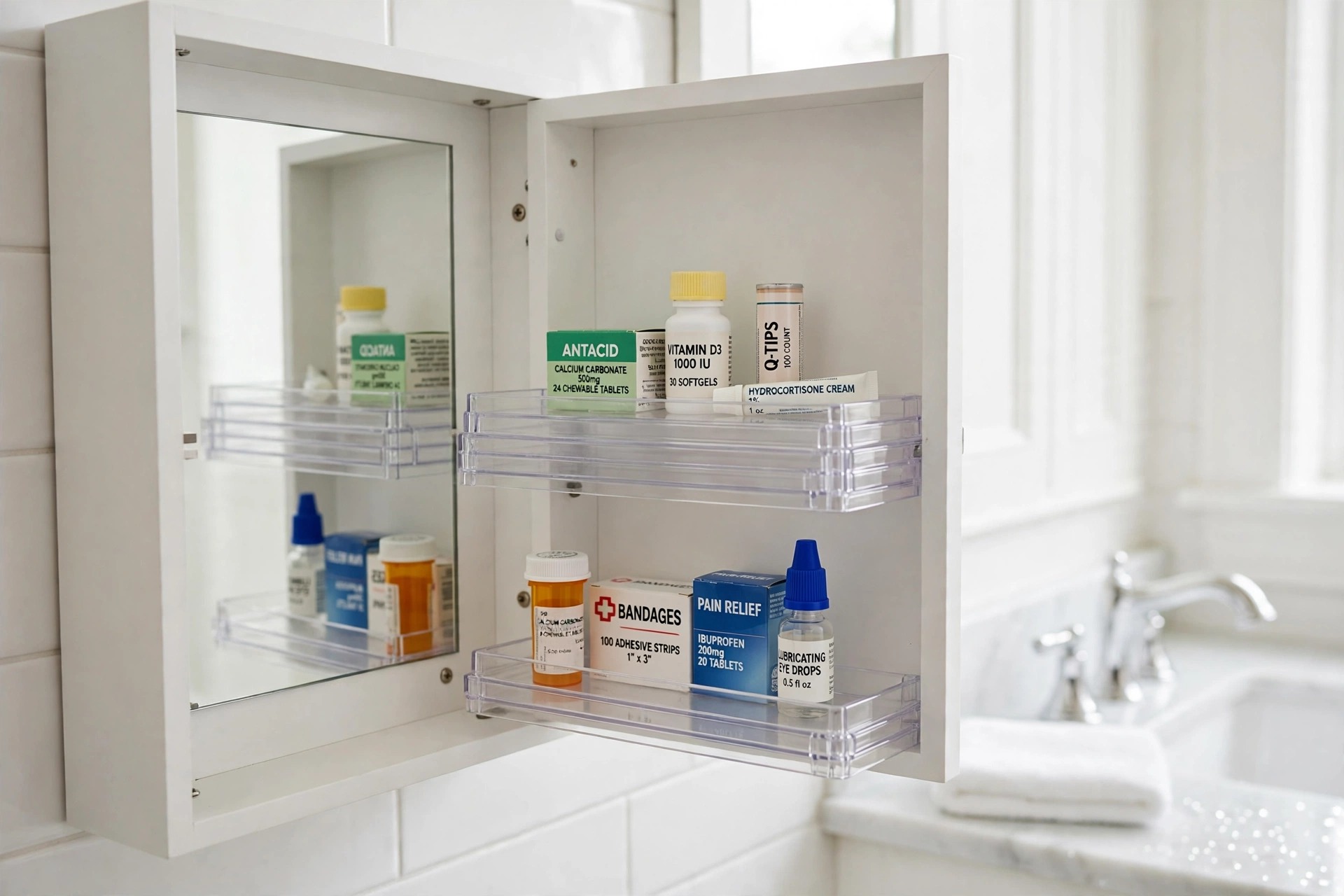
4. Label the bins — chalk labels so everyone finds their own things
A bin with no label is a bin everyone has to open, because the bin that is not labelled is the bin nobody trusts. Label every bin — chalk labels so everyone finds their own things — so the family knows which bin is theirs and which bin holds the plasters. Write the category on the front, not the top, because the front is the label you can read with the cabinet door open, and use chalk labels so you can change the word when the bin changes its job. Keep the words short, one or two words each, because the short label is the label you read at a glance. A label on every bin, and nobody opens the wrong one.
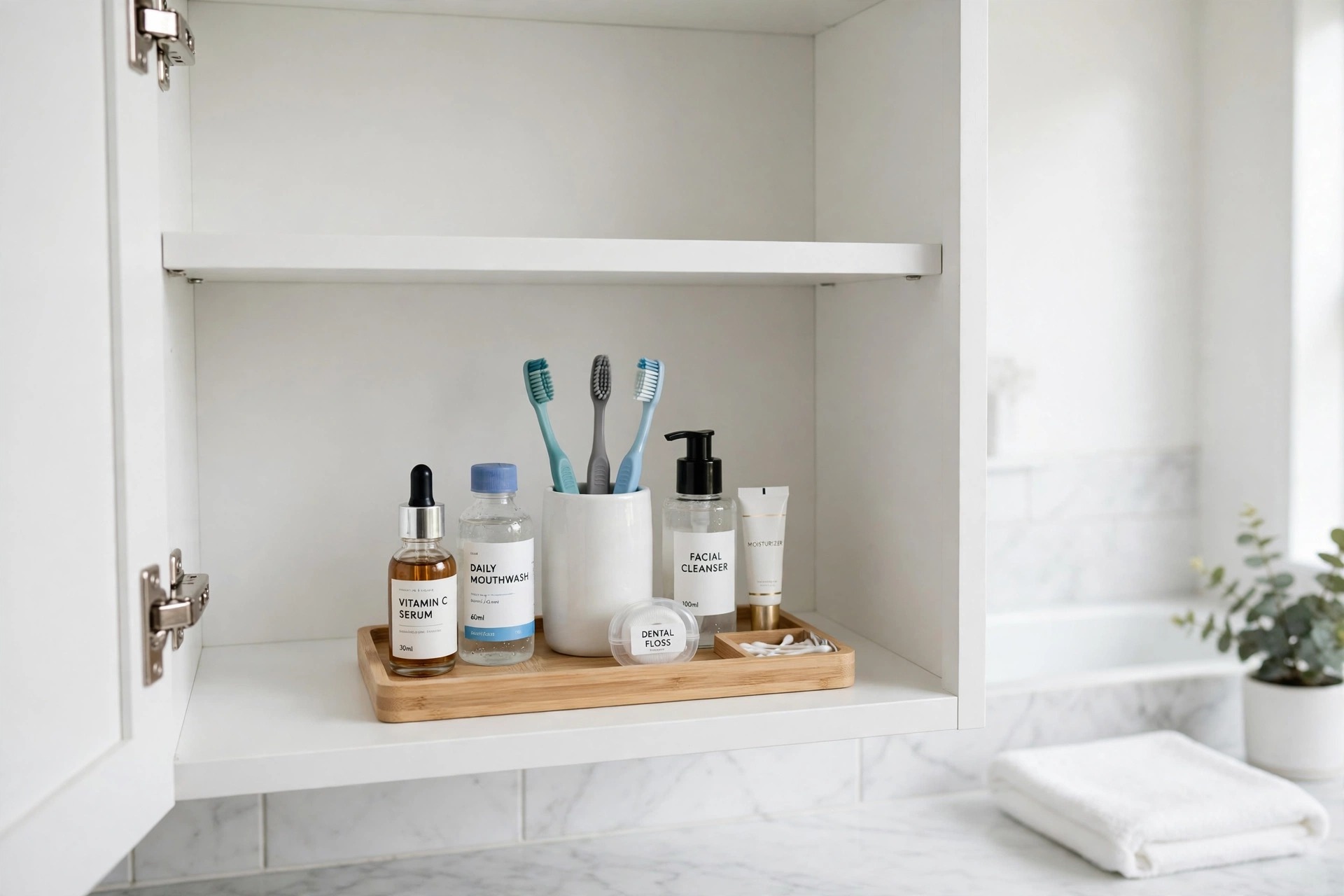
5. A small tray on the bottom shelf — the daily-use tray
The things you use every morning and every night get buried, because the daily things are the things that sink to the back of the shelf behind everything else. Put a small tray on the bottom shelf — the daily-use tray — so the morning tablets, the toothpaste and the cream you use every day live together in one place. Choose a tray with a low edge, so you can lift things out without lifting the tray, and keep it to the things you touch daily, no more, because the tray that holds only the daily things is the tray that stays tidy. Lift the whole tray out when you clean the shelf, because the tray that lifts out is the tray that makes cleaning easy. One small tray, and the daily things are always at the front.
Small bottles, tubes and daily medicines
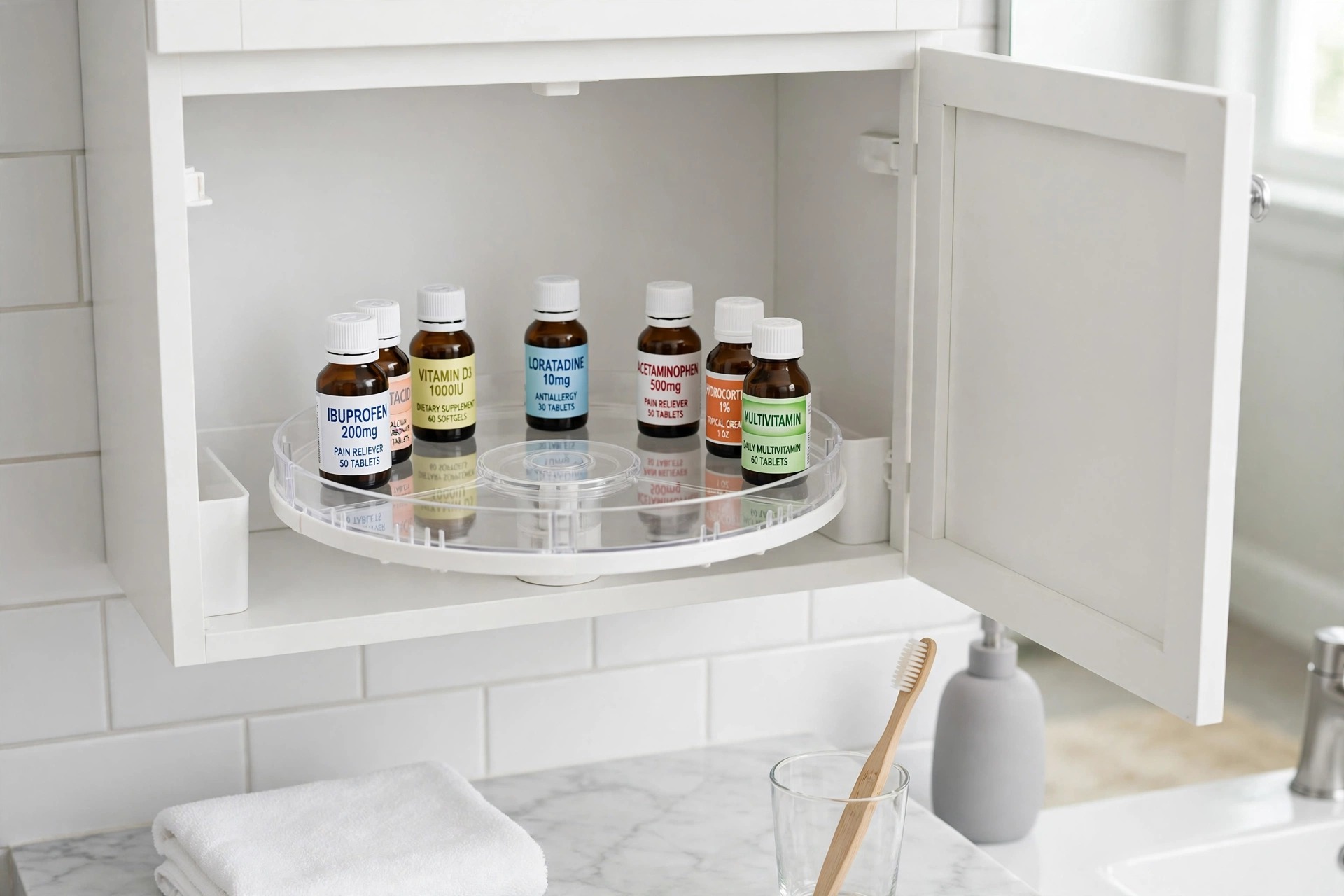
6. A rotating shelf for the back row — spin to reach the bottles at the back
The bottles at the back of the cabinet are the bottles you forget, because the back row is the row you cannot reach without moving everything in front of it. Put a rotating shelf inside the cabinet — spin to reach the bottles at the back — so a turn of the shelf brings the back row to the front and nothing hides. Choose a rotating shelf that fits the cabinet width with room to spin, because the shelf that spins freely is the shelf that works, and put the small bottles on it, not the tall ones, because the tall bottles tip when the shelf turns. Keep the heavy bottles off the rotating shelf, because the shelf that is overloaded is the shelf that sticks. One spin, and the back row is at your fingertips. (Check on Amazon for a small rotating shelf with a non-slip base, which stops the bottles sliding when it turns.)
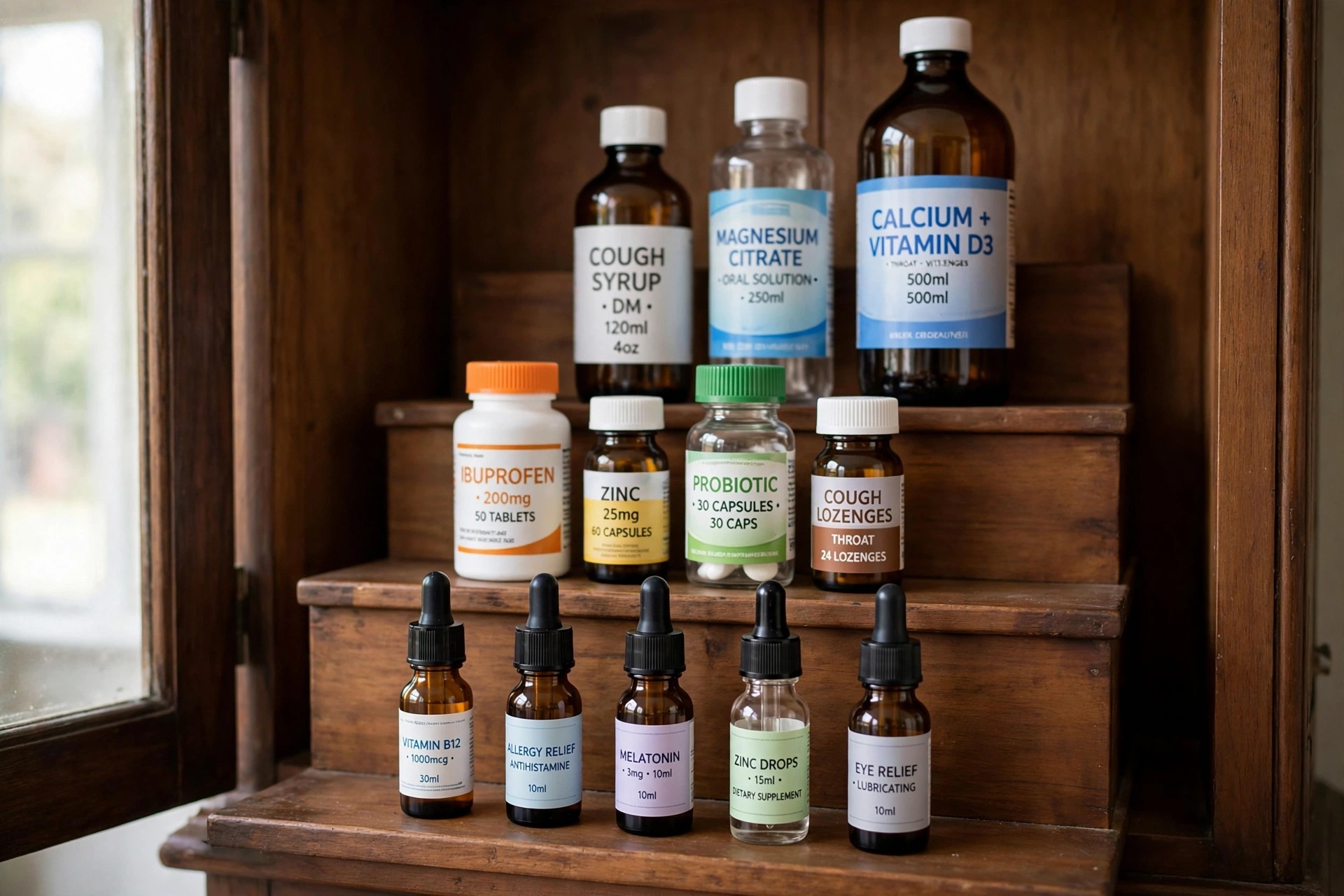
7. Slim bottles at the front, tall at the back — the stepped row
A cabinet where every bottle is the same height hides the short ones, because the short bottles are the ones that disappear behind the tall ones. Arrange them in a stepped row — slim bottles at the front, tall at the back — so every bottle is visible and every label can be read. Put the shortest bottles at the very front, the medium ones in the middle and the tallest at the back, because the stepped row is the row where nothing hides. Keep the bottles in a straight line, not a cluster, because the straight line is the line you can scan in one look. Group by use as well as height, so the painkillers stand together and the creams stand together, because the group that stands together is the group you find fast. A stepped row, and every bottle is in view.
8. A pill organizer with days of the week — the weekly box
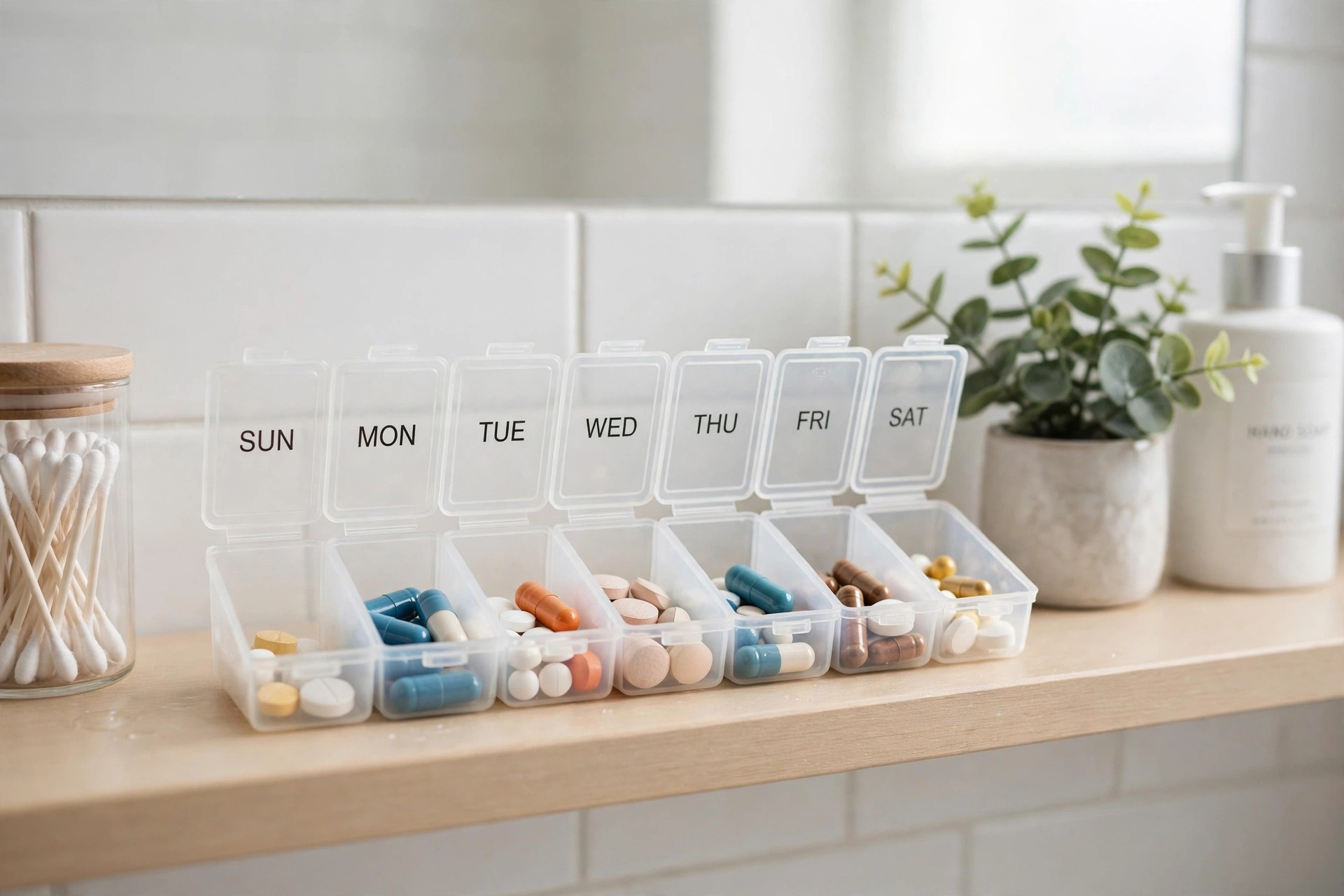
Daily tablets in their bottles are easy to forget, because the bottle does not tell you whether you took today's dose. Use a pill organizer with days of the week — the weekly box — so you fill it once on Sunday and every day has its own compartment. Open Monday, take the tablets, close it, and the empty compartment is the proof you took them, because the box that is empty is the box that did its job. Keep the organizer on the bottom shelf, at the front, because the front is the place your hand reaches first thing in the morning. Refill it at the same time every week, because the refill that happens on schedule is the refill that never gets missed. One weekly box, and the daily tablets take care of themselves.
9. A small first-aid basket — plasters, antiseptic and tweezers in one basket
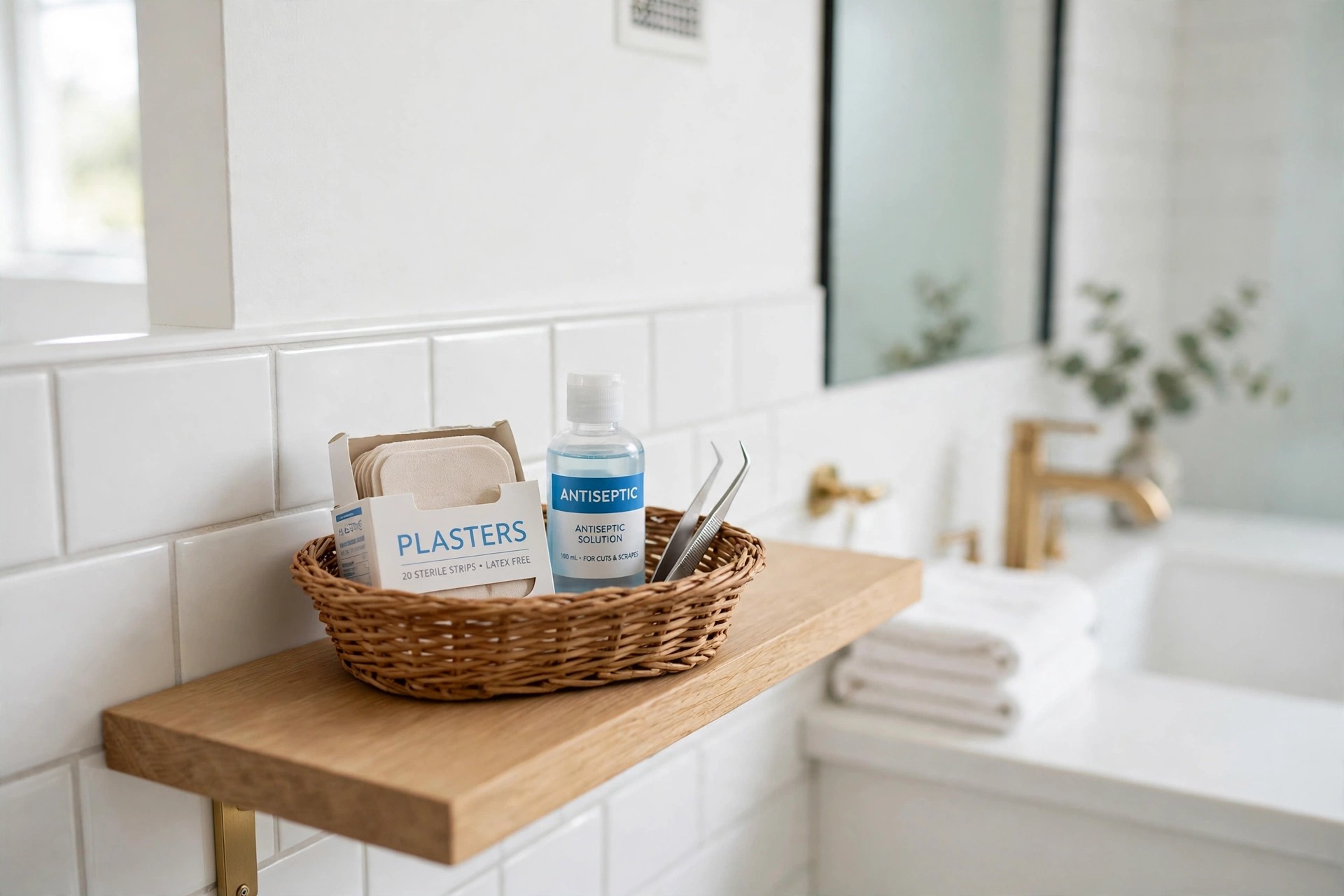
First aid scattered across three shelves is first aid you cannot find when someone is bleeding, because the plasters are on one shelf, the antiseptic on another, and the tweezers are somewhere else entirely. Put it all in a small first-aid basket — plasters, antiseptic and tweezers in one basket — so one grab brings everything to the sink. Keep the basket on the shelf you can reach without standing on tiptoe, because the basket that is easy to reach is the basket that gets used in a hurry. Check the basket once a month, because the basket that is checked is the basket that is never empty when you need it, and replace the plasters as you use them. One basket, and first aid is one grab away.
10. Keep heat-sensitive medicines out of the steamy bathroom — the cool, dry rule
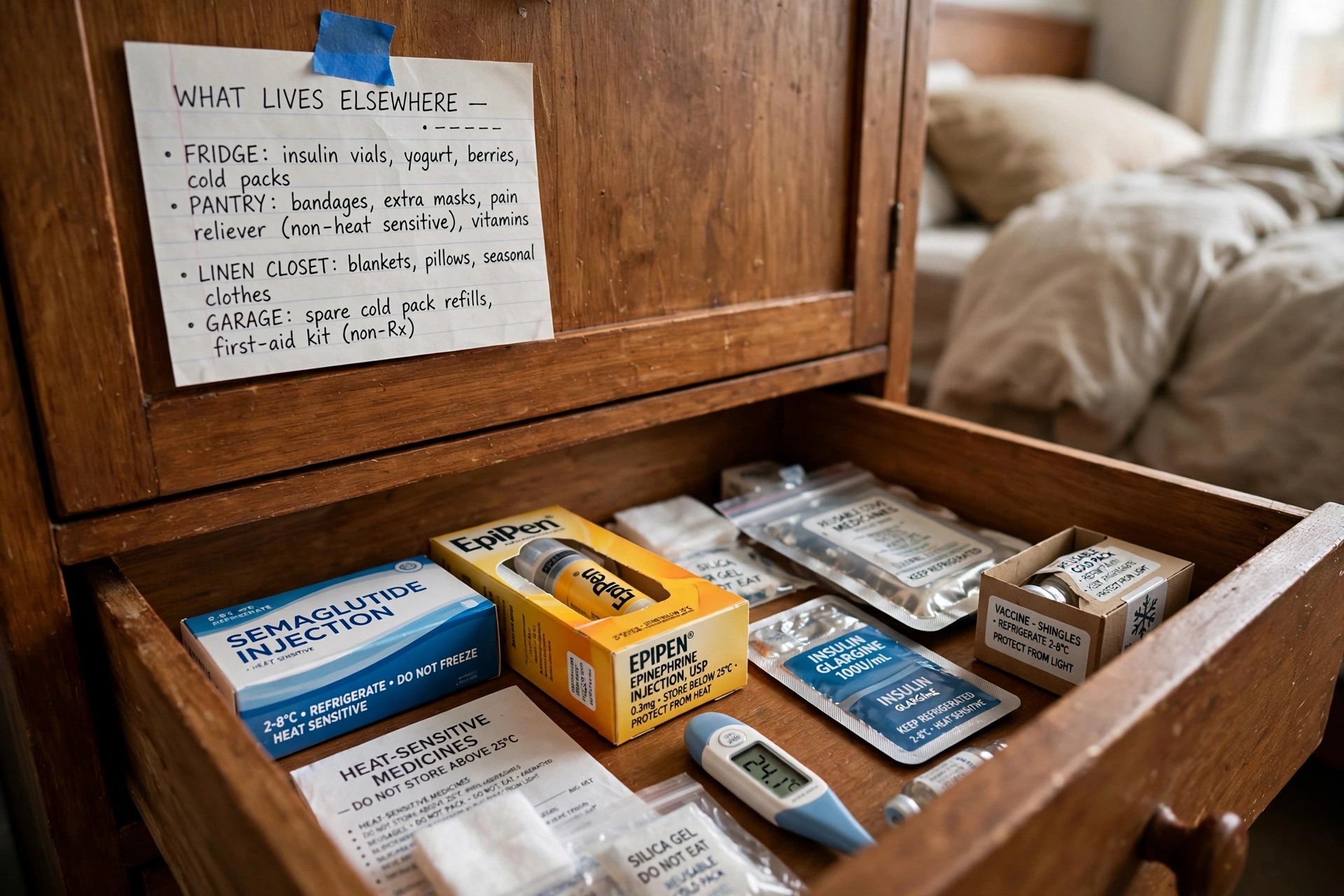
A bathroom is the worst place for some medicines, because the steam from the shower is the moisture that spoils tablets and the heat is the heat that weakens them. Check the label — the cool, dry rule — and move anything that says "store in a cool, dry place" out of the bathroom and into a bedroom drawer or a kitchen cupboard. Keep only the things that tolerate steam in the cabinet, because the cabinet that holds only the hardy things is the cabinet that keeps them safe. Put a small note on the cabinet door listing what lives elsewhere, because the note is the reminder that stops the wrong bottle coming back. The kitchen cabinet the medicines move to is in 20 Kitchen Cabinet Organization Ideas for 2026, where the cool cupboard gets its own system. A cool, dry home, and the medicines stay good until their date.
Doors, mirrors and the space around the cabinet
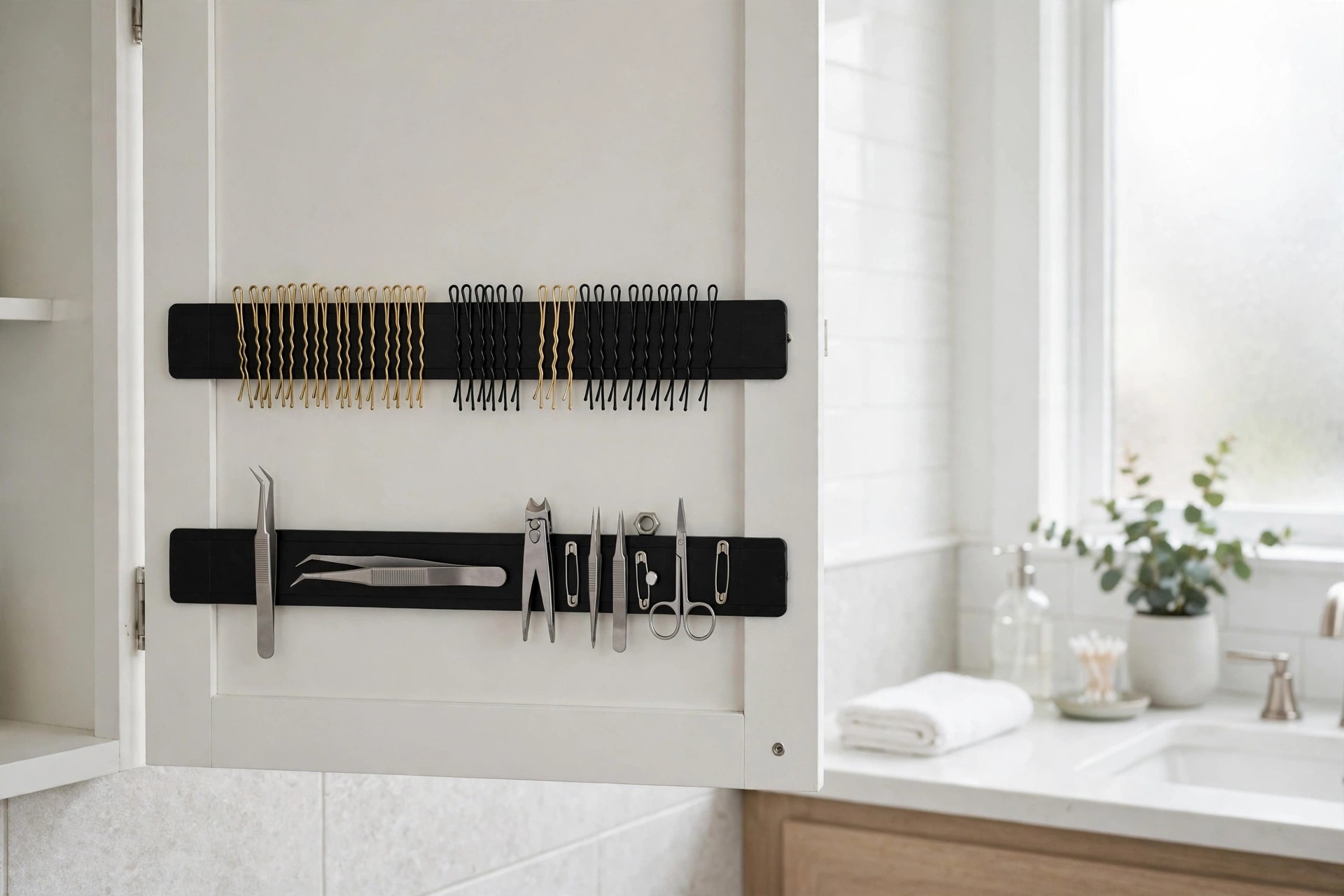
11. Magnetic strips on the inside of the door — bobby pins, tweezers and nail clippers
Small metal things vanish inside a cabinet, because the bobby pins are tiny, the tweezers are flat, and the nail clippers slide under everything. Stick a magnetic strip on the inside of the door — bobby pins, tweezers and nail clippers — so the small metal things hang where you can see them and never get lost in a drawer. Cut the strip to fit the door, stick it on with strong adhesive, and press the metal items onto it, because the strip that holds is the strip that works. Keep the strip away from the hinge, because the hinge is the place the strip gets knocked off, and keep the sharp things at the top, out of small hands' reach. One strip, and the small metal things have a home.
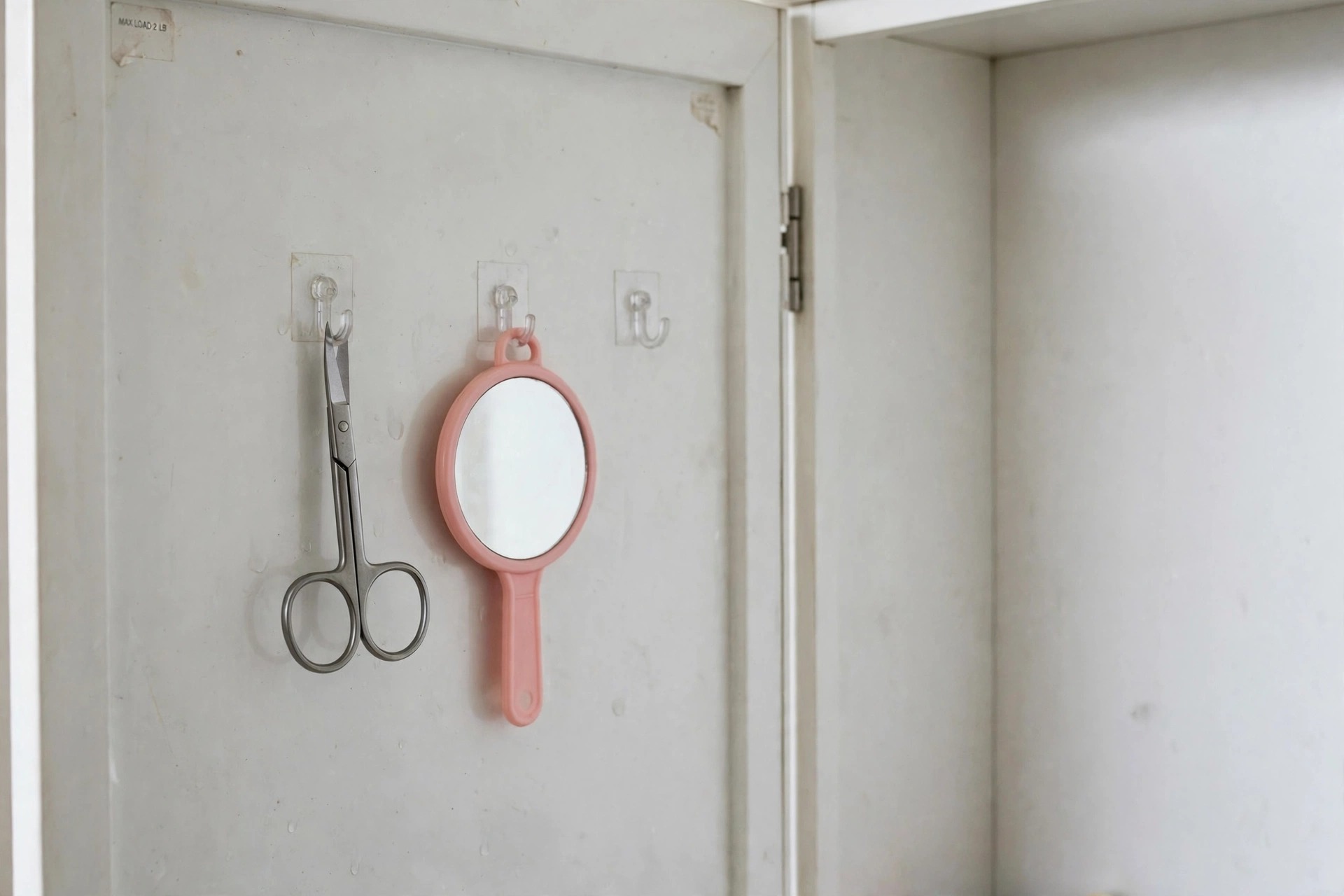
12. Small hooks or a slim rack on the door — the door becomes a shelf
The inside of the cabinet door is storage nobody uses, because the door is the thing you open and the door is the thing you forget. Hang small hooks or a slim rack on it — the door becomes a shelf — so the nail scissors, the small mirror and the spare toothbrush live on the door and the shelves stay free. Use adhesive hooks that hold the weight, because the hook that falls off is the hook that drops things into the sink, and keep the rack slim, because the rack that is slim is the rack that lets the door close. Hang only the light things, because the door that carries too much is the door that sags. Hooks on the door, and the cabinet gains a shelf for free.
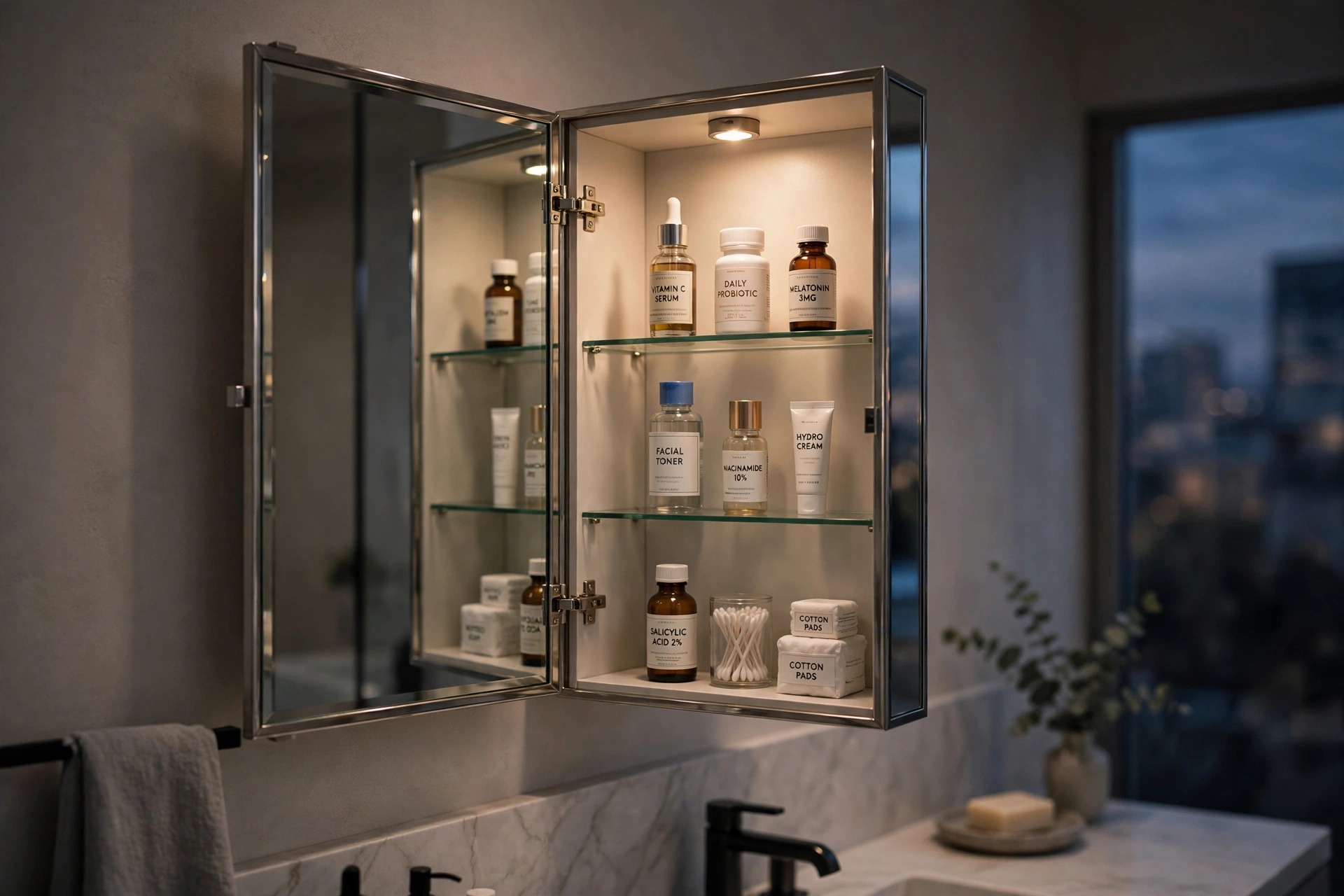
13. A mirrored cabinet with lights — light inside the cabinet
A cabinet with no light hides its own contents, because the bathroom light is behind you and your shadow is the thing that falls across the shelves. Choose a mirrored cabinet with lights — light inside the cabinet — so the shelves glow when the door opens and every bottle is easy to read. Battery lights work if there is no wiring, because the light that sticks on is the light that needs no electrician, and a motion sensor means the light comes on when the door opens and goes off when it closes. Keep the light warm, not cold, because the warm light is the light that shows true colours on labels. Light inside, and the cabinet stops hiding things.
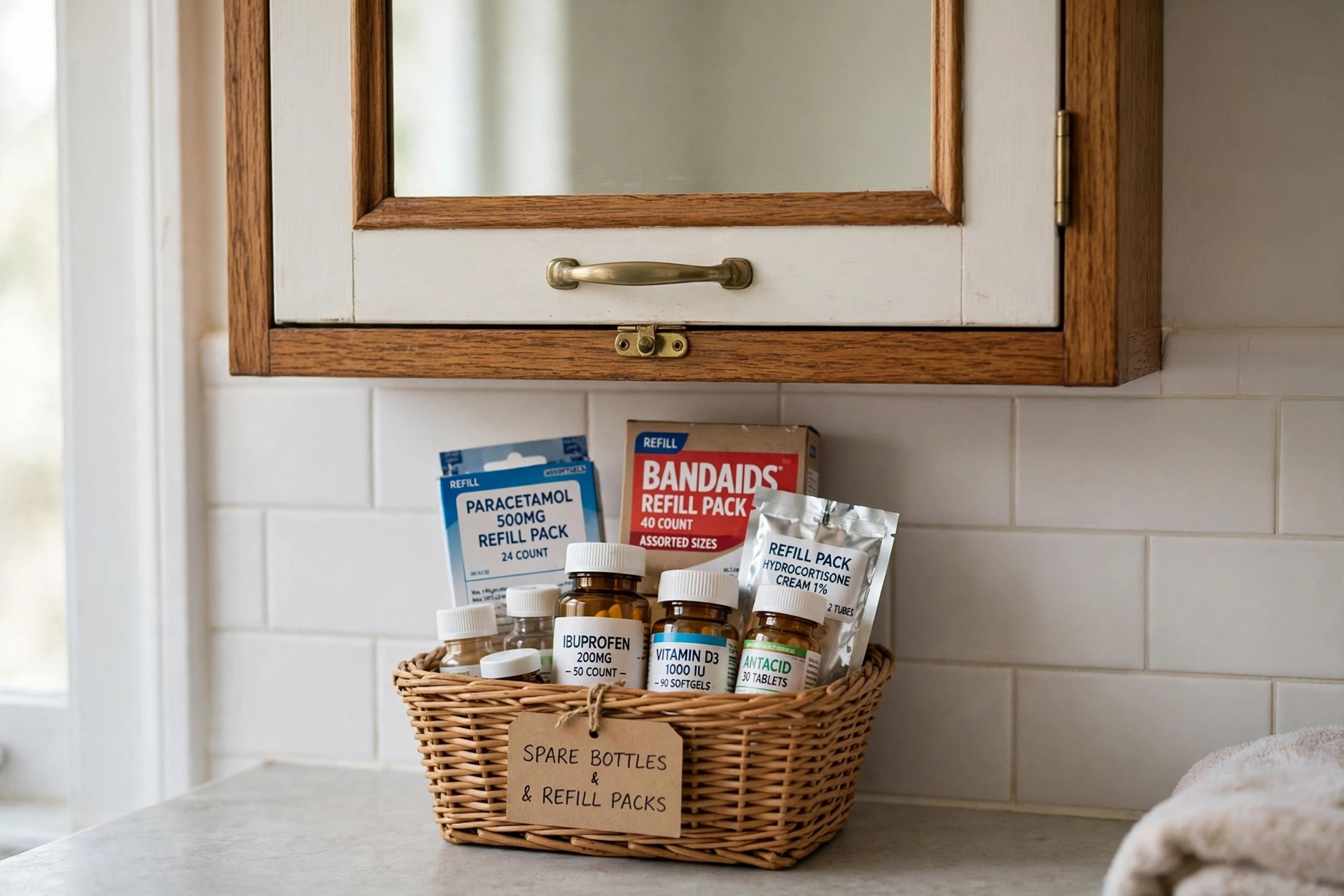
14. A small basket or caddy under the cabinet — the overflow caddy
Some things do not fit in the cabinet, because the cabinet is small and the spare bottles, the extra toothpaste and the refill packs have nowhere to go. Put a small basket or caddy under the cabinet — the overflow caddy — so the spares live just below, easy to reach when the cabinet runs out. Choose a basket that fits the space under the cabinet, and label it "spares", because the basket that is labelled is the basket nobody mistakes for rubbish. Refill the cabinet from the caddy, not from the shop, because the caddy that is stocked is the caddy that saves a trip. The laundry room where the bigger spares live is in 22 Laundry Room Storage Ideas for 2026, where the cleaning and first-aid spares have their own shelf. One caddy below, and the cabinet never runs dry.
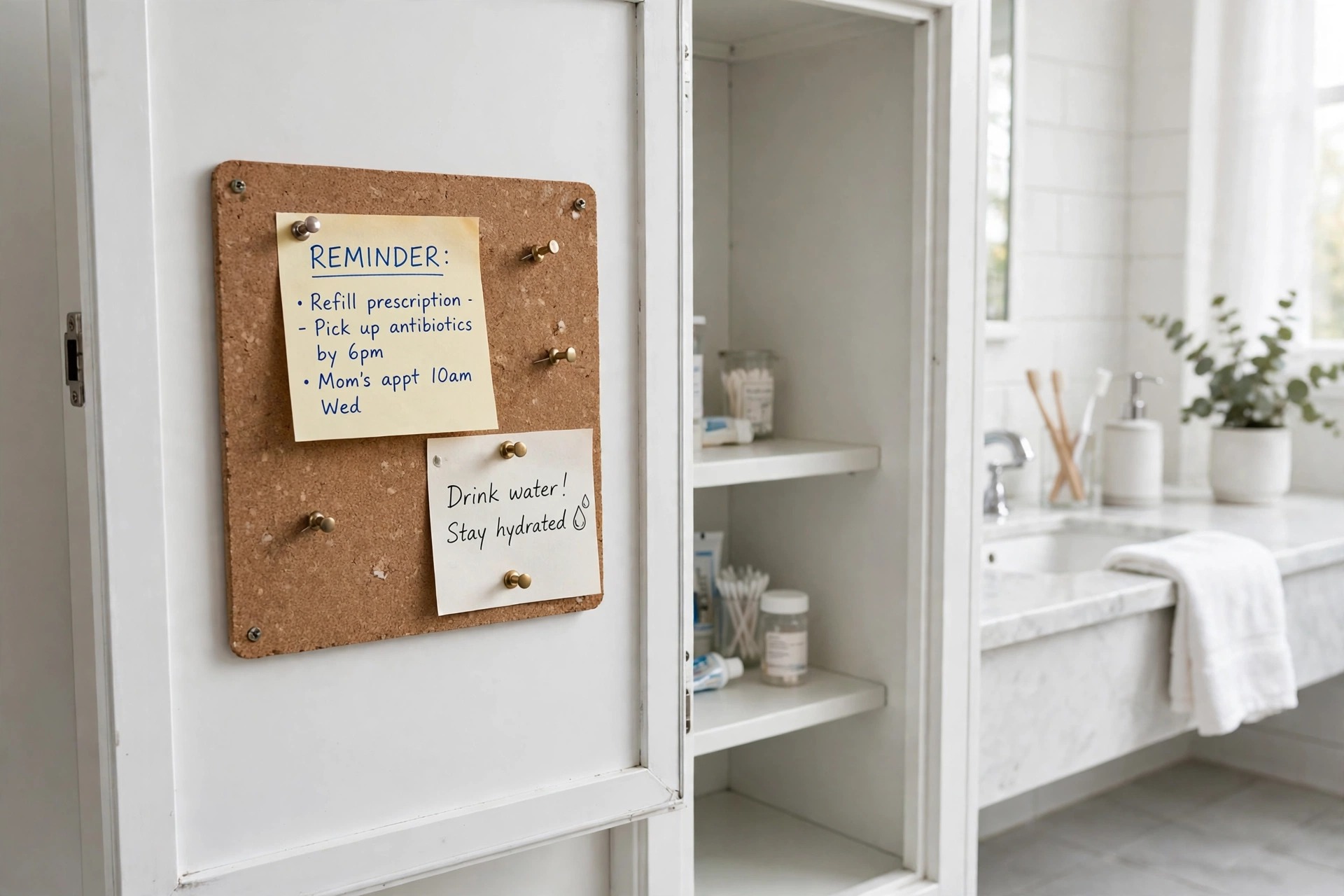
15. A cork board or small memo inside the door — the reminder board
The things you must remember — the prescription refill date, the dentist appointment, the vitamin schedule — live in your head, because there is nowhere in the bathroom to write them down. Fix a cork board or a small memo inside the door — the reminder board — so the notes live where you see them every morning. Pin the refill date, the appointment card and the vitamin list, because the board that holds the dates is the board that stops the missed refill. Keep the board small, so it fits inside the door and the door still closes, and use short pins, because the short pin is the pin that does not scratch the shelf behind it. The cork board the reminder borrows its idea from is in 18 DIY Cork Board Ideas for 2026, where a plain board becomes a display worth keeping. A board on the door, and the dates stop slipping away.
Keeping it tidy for good
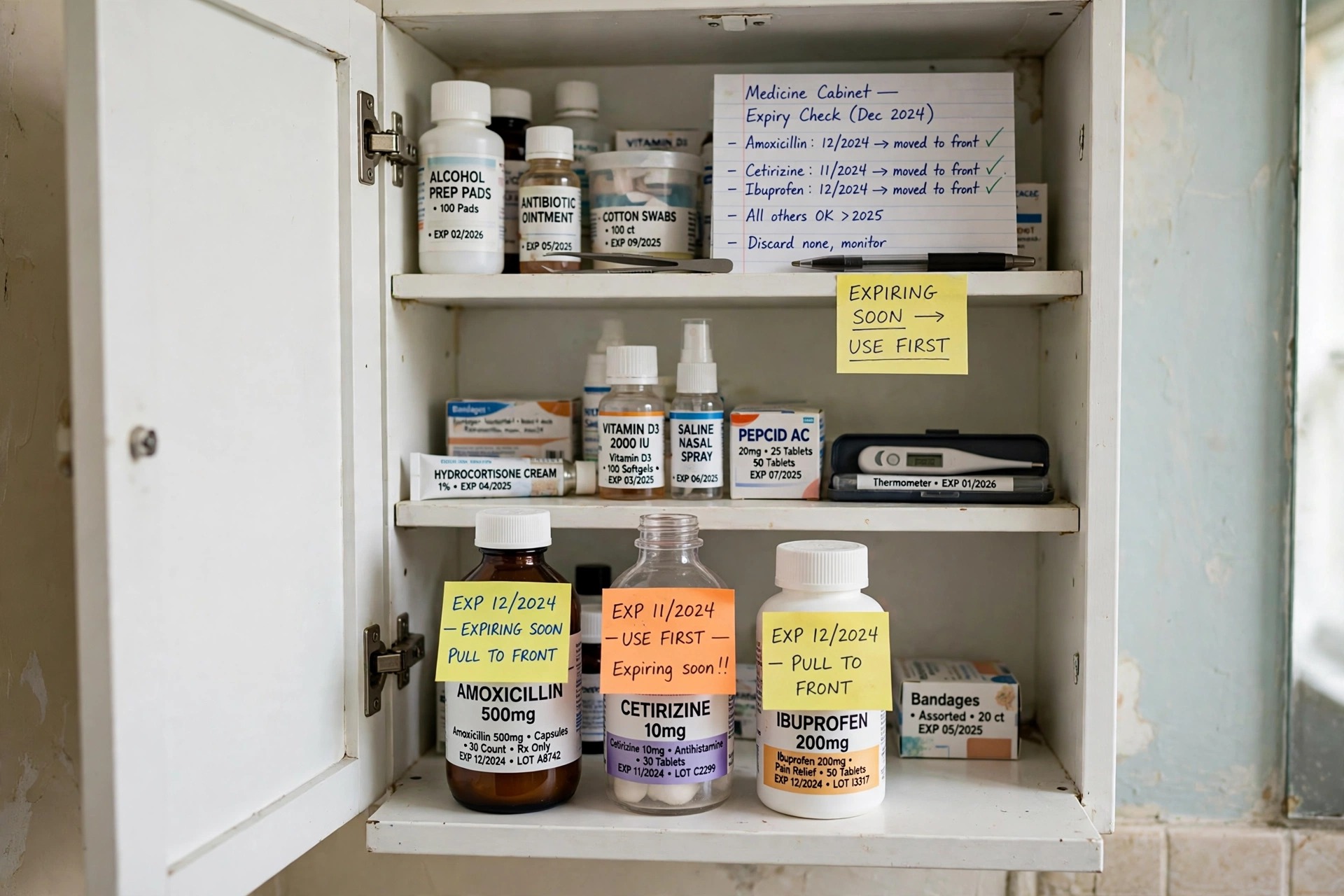
16. A monthly expiry check — the five-minute expiry sweep
Expired medicines are the ones that do not work when you need them, because the date passed and nobody noticed. Do a monthly expiry check — the five-minute expiry sweep — so nothing expired stays in the cabinet. Pick one day a month, the first Sunday or the first of the month, and check every bottle, because the check that happens on schedule is the check that catches the expired ones. Put the ones expiring soon at the front, because the front is the place they get used first, and take the expired ones to the pharmacy for safe disposal, because the pharmacy is the place that takes them back. Five minutes a month, and the cabinet never holds a dead bottle.
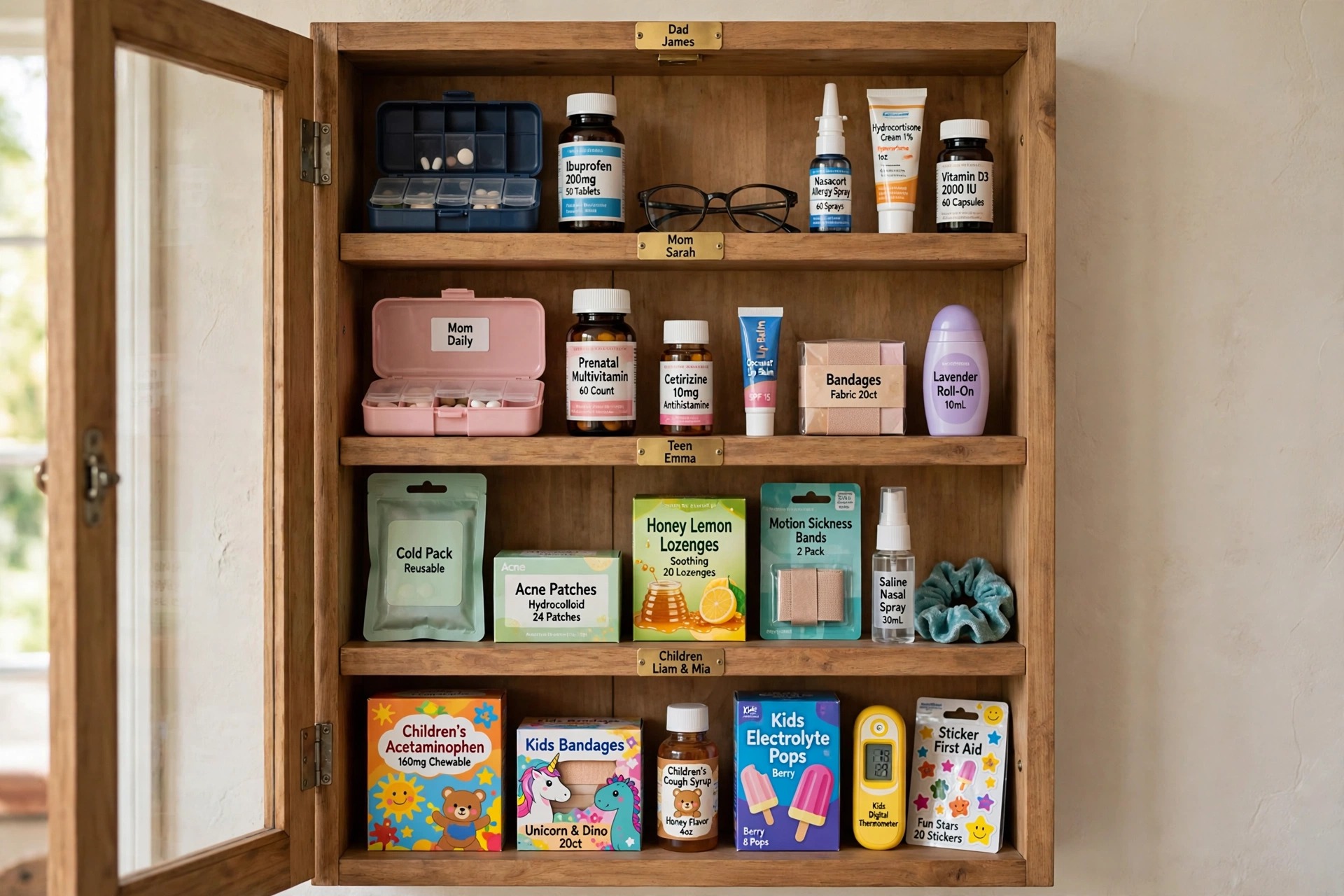
17. One shelf per person — the family shelf system
A family cabinet where everyone shares every shelf is a cabinet where nobody can find their own things, because your tablets are next to their creams and the children's vitamins are next to the plasters. Give each person a shelf — the family shelf system — so every shelf belongs to one person and every person knows where their things live. Put the children's shelf at the bottom, where small hands can reach it, and the adults' shelves above, because the shelf that fits the person is the shelf that works. Label each shelf with the person's name, because the name on the shelf is the rule that keeps the shelves separate. One shelf each, and the family stops mixing up the bottles.
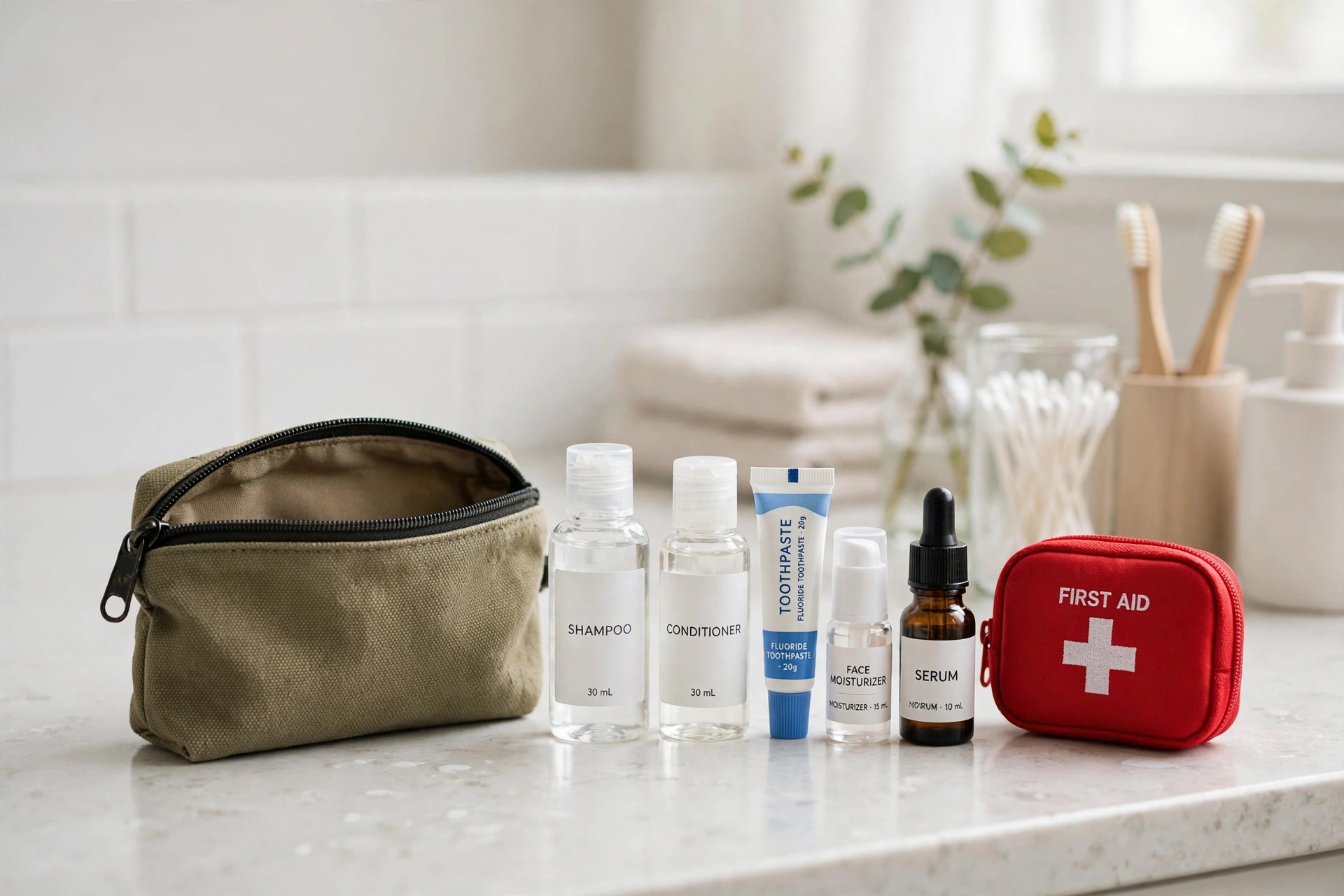
18. Travel minis in a zip pouch — the go-bag for trips
Packing toiletries the night before a trip is the packing that forgets something, because the travel bottles are the ones you have to hunt for and the hunt is the thing that takes an hour. Keep travel minis in a zip pouch — the go-bag for trips — so the pouch is always packed and the trip starts with a grab. Fill it with the small bottles, the mini toothpaste and the plasters, because the pouch that is packed is the pouch that is ready, and refill it the day you come home, because the refill that happens at once is the refill that never gets forgotten. Keep the pouch in the cabinet, at the front, because the front is the place you grab it from. One packed pouch, and the trip packing takes five minutes. (Check on Amazon for a clear zip pouch with a hanging hook, which keeps the minis visible and off the hotel counter.)
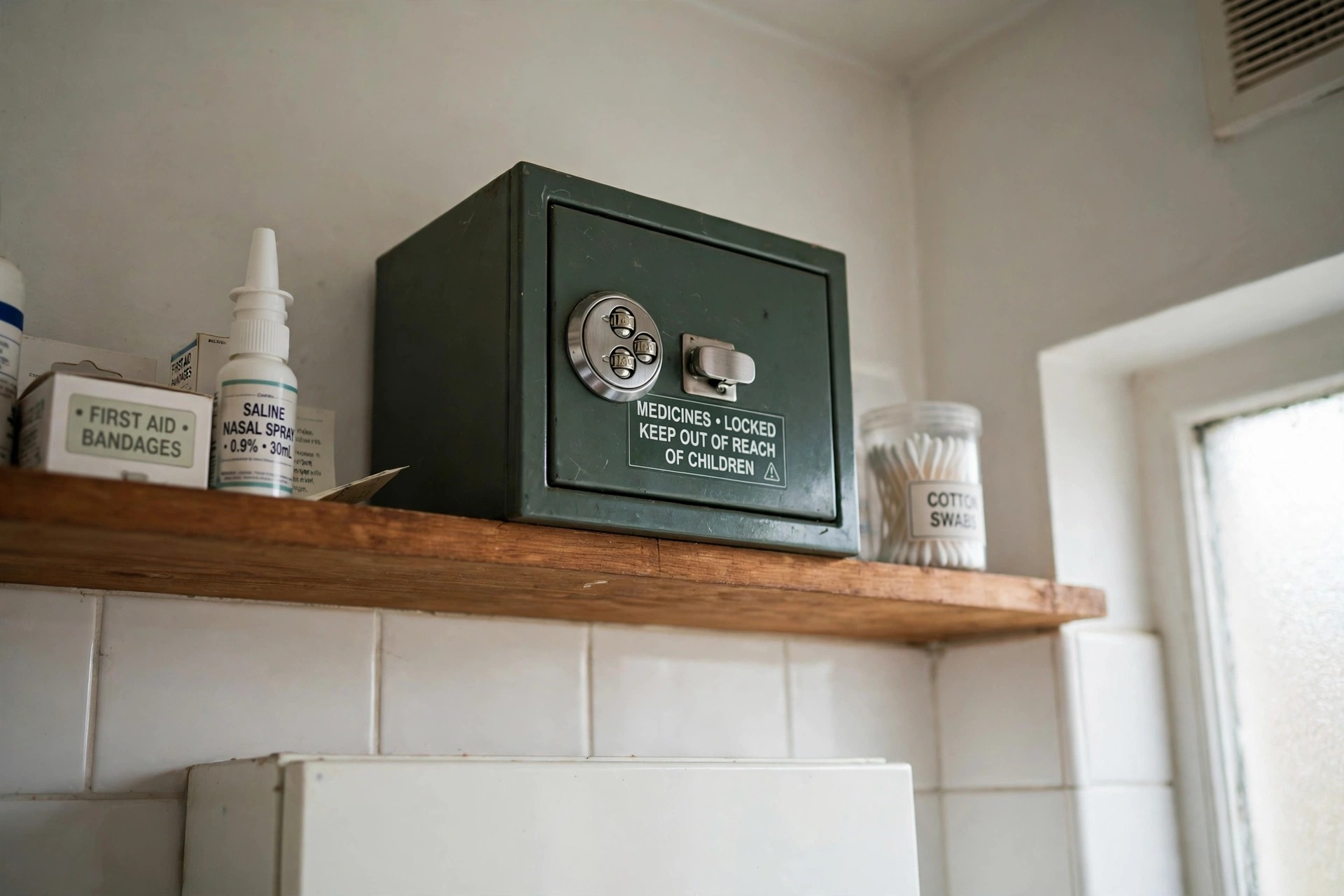
19. A small lockbox or a high shelf for medicines children should not reach — safety first
Some medicines are dangerous for small hands, because the child who can reach the cabinet is the child who can open the bottle. Keep those medicines in a small lockbox or on a high shelf — safety first — so the things children should not reach are the things children cannot reach. Choose a lockbox with a simple combination, because the lock that is easy for you is the lock that is hard for a child, and keep the key or the code away from the bathroom. Put the everyday, safe things low, where the children can reach their own vitamins, and the rest high or locked, because the shelf that is high is the shelf that is safe. A lockbox or a high shelf, and the cabinet is safe for the whole family.
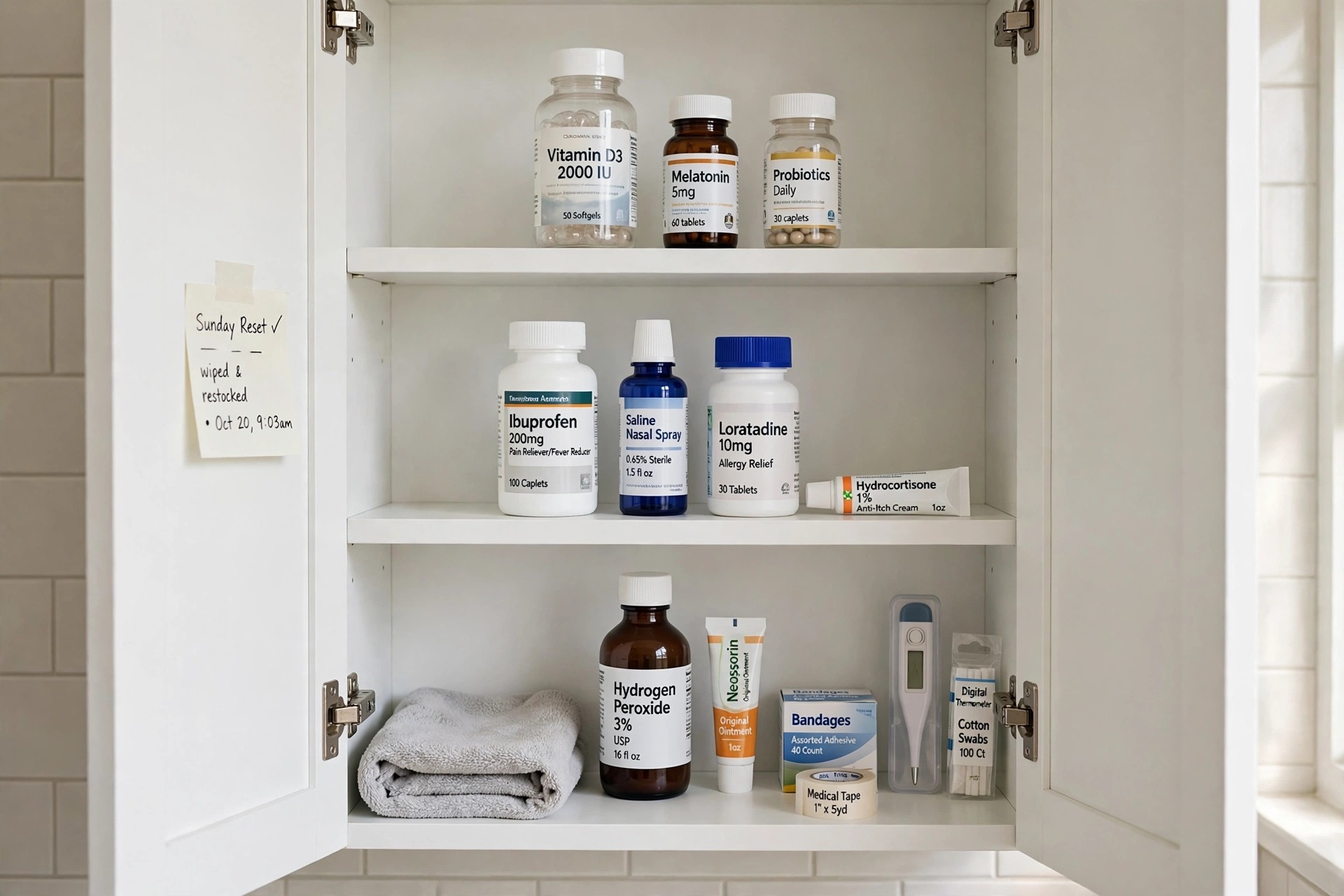
20. The Sunday reset — five minutes a week, and the cabinet stays sorted
A cabinet that is sorted once and never touched again is a cabinet that drifts back to chaos, because the bottles that come in are the bottles that land anywhere. Do a Sunday reset — five minutes a week, and the cabinet stays sorted — so the cabinet is checked every week and the drift never gets a chance. Put back anything that wandered, wipe the shelf, check the tray, because the reset that is short is the reset that actually happens. Keep a small cloth in the caddy under the cabinet, because the cloth that is there is the cloth that gets used. Five minutes every Sunday, and the cabinet stays as tidy as the day you sorted it.
Which medicine cabinet idea fits which situation?
| Situation | Best first move | Budget | Tools needed |
|---|---|---|---|
| Cabinet full of expired bottles | Clear it out first (idea 1) | Free | Bin bag |
| Bottles falling over | Small clear bins (idea 2) | Low | Clear bins |
| Shelf height wasted | Stackable shelf risers (idea 3) | Low | Shelf risers |
| Nobody can find their things | Label the bins (idea 4) | Low | Chalk labels |
| Back row unreachable | Rotating shelf (idea 6) | Low | Rotating shelf |
| Daily tablets forgotten | Weekly pill organizer (idea 8) | Low | Pill organizer |
| First aid scattered | Small first-aid basket (idea 9) | Low | Basket |
| Medicines spoiled by steam | Move them out, cool and dry (idea 10) | Free | None |
| Small metal things lost | Magnetic strips on the door (idea 11) | Low | Magnetic strips |
| Cabinet too dark inside | Mirrored cabinet with lights (idea 13) | Medium | Battery lights |
| Dates and refills forgotten | Reminder board in the door (idea 15) | Low | Cork board, pins |
| Family sharing one cabinet | One shelf per person (idea 17) | Free | Labels |
| Packing for trips is a hunt | Travel minis in a zip pouch (idea 18) | Low | Zip pouch |
| Children can reach medicines | Lockbox or high shelf (idea 19) | Low | Lockbox |
| Cabinet drifts back to chaos | Sunday reset, five minutes (idea 20) | Free | Cloth |
You do not need all 20 ideas. You need the three that solve your cabinet — usually the clear-out that makes room, the clear bins that keep the bottles upright, and the monthly expiry check that keeps the cabinet honest. Start with the clear-out, do it this weekend, and put back only what you use every week. Do that and the next time you reach for a bottle it will be there, upright, in date, and easy to find, for the price of a few bins and an afternoon.
Save this post for your next bathroom sort, and if the counter below the cabinet needs sorting first, read 25 Bathroom Counter Organization Ideas for 2026 next — it is Post 04, the counter the cabinet sits above — and 25 Pantry Organization Ideas for 2026, Post 08, for the labelling and bin system the cabinet borrows. This is the ninth post of the second Storage by room/object run — Posts 31 to 55, one room at a time — and the next posts carry the same small-cabinet system into the rooms that follow.
Publish date assigned at publishing time. Updated as new medicine cabinet finds are tested.
Frequently asked questions
What should I not keep in a medicine cabinet?
Do not keep medicines that say "store in a cool, dry place" in a steamy bathroom — heat and moisture spoil tablets and weaken them before their date. Move those to a bedroom drawer or a cool kitchen cupboard, and keep only the hardy things — plasters, creams and daily items that tolerate steam — in the cabinet. Check the label on every bottle, because the label is the rule, and put a small note on the cabinet door listing what lives elsewhere.
How do I organize a small medicine cabinet with no shelves?
Add the shelves yourself — stackable shelf risers turn one shelf into two, small clear bins keep the bottles upright and pull out like drawers, and hooks or a slim rack on the inside of the door add a whole extra shelf for free. Use the door for the small metal things with a magnetic strip, and keep the daily-use items in a small tray on the bottom shelf, because the tray that lifts out is the tray that makes cleaning easy. Risers, bins and door hooks, and a cabinet with no shelves gains three.
How often should I clean out a medicine cabinet?
Do a five-minute expiry check once a month — the first Sunday or the first of the month — and check every bottle's date, putting the ones expiring soon at the front and taking the expired ones to the pharmacy for safe disposal. Then do a quick Sunday reset every week: put back anything that wandered, wipe the shelf and check the tray, because the reset that is short is the reset that actually happens. A monthly check and a weekly reset, and the cabinet never drifts back to chaos.