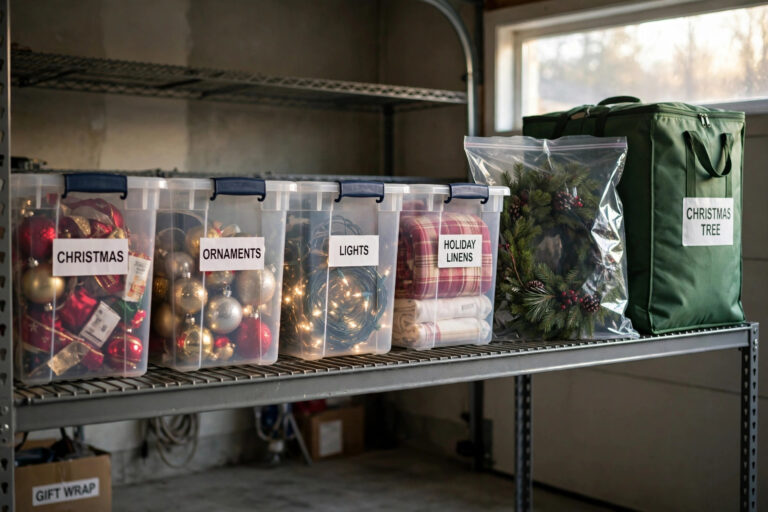
22 Camper Organization Ideas for 2026
A camper is a whole house in the space of a hallway, and everything in it has to earn its place twice — once for being useful, and once for staying put while the house moves. The mug that slides off the shelf on the first bend, the drawer that opens on a roundabout, the shoes that end up under the bed: a camper punishes every loose thing, and the fix is not more space, it is a system that holds.
These 22 camper organization ideas are compact storage systems for life on the road: start by measuring every nook, give every traveller one labelled bin, lock the kitchen down so nothing rattles, and finish with a five-minute reset at dusk — so the camper stays tidy while it moves and feels like home when it stops.
Every idea below works in a real camper, from a small two-berth van to a family motorhome with a garage bay. The small-space thinking is the same as in 28 Small Apartment Storage Ideas for 2026, where a tiny flat learns to hold a whole household — and the bed in the back borrows its under-bed tricks from 22 Under-Bed Storage Ideas for 2026, so the space under the mattress works as hard as the cupboards. Pick three ideas that fit your camper, start with the tape measure, and build from there.
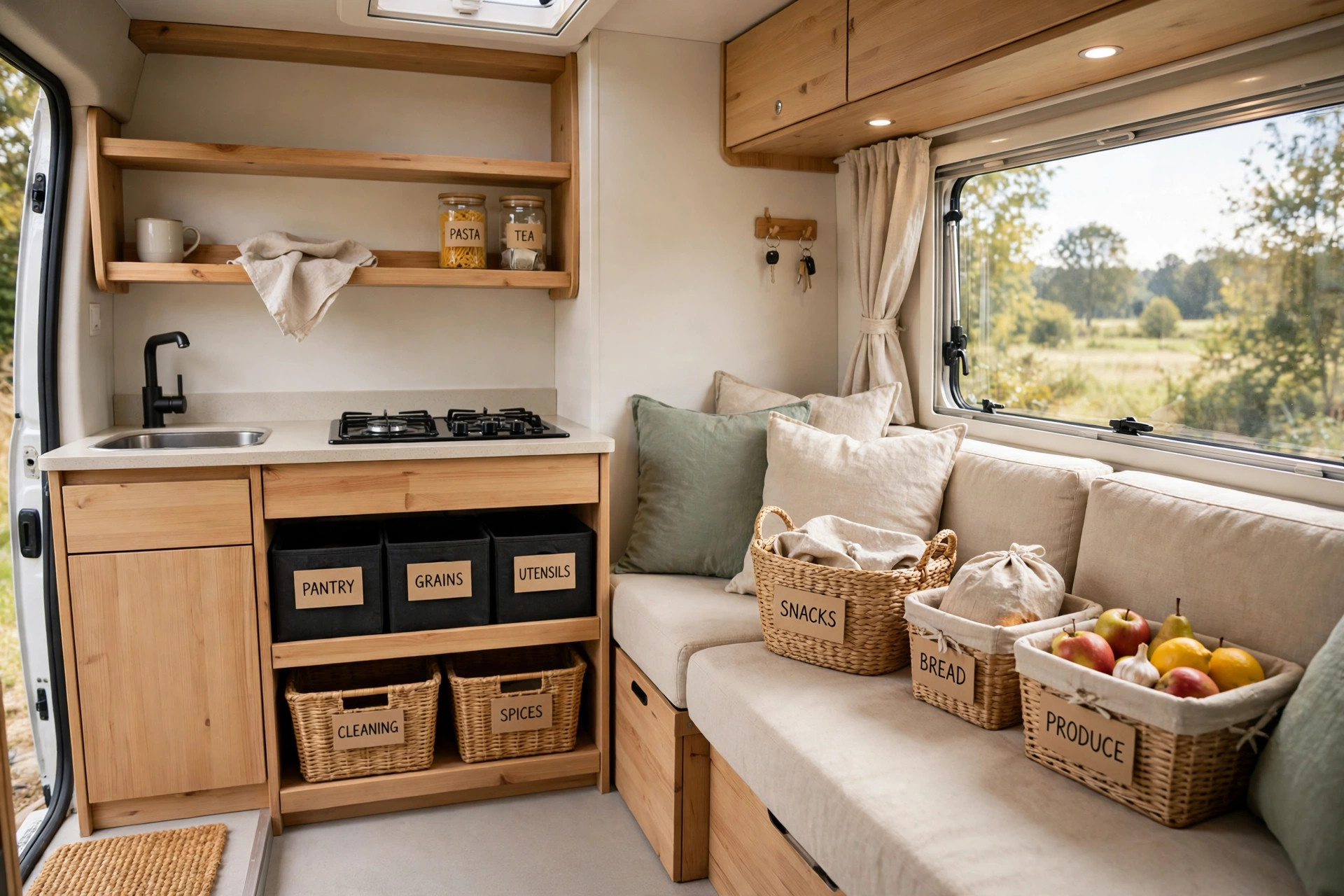
Start with the space: measure, sort, zone
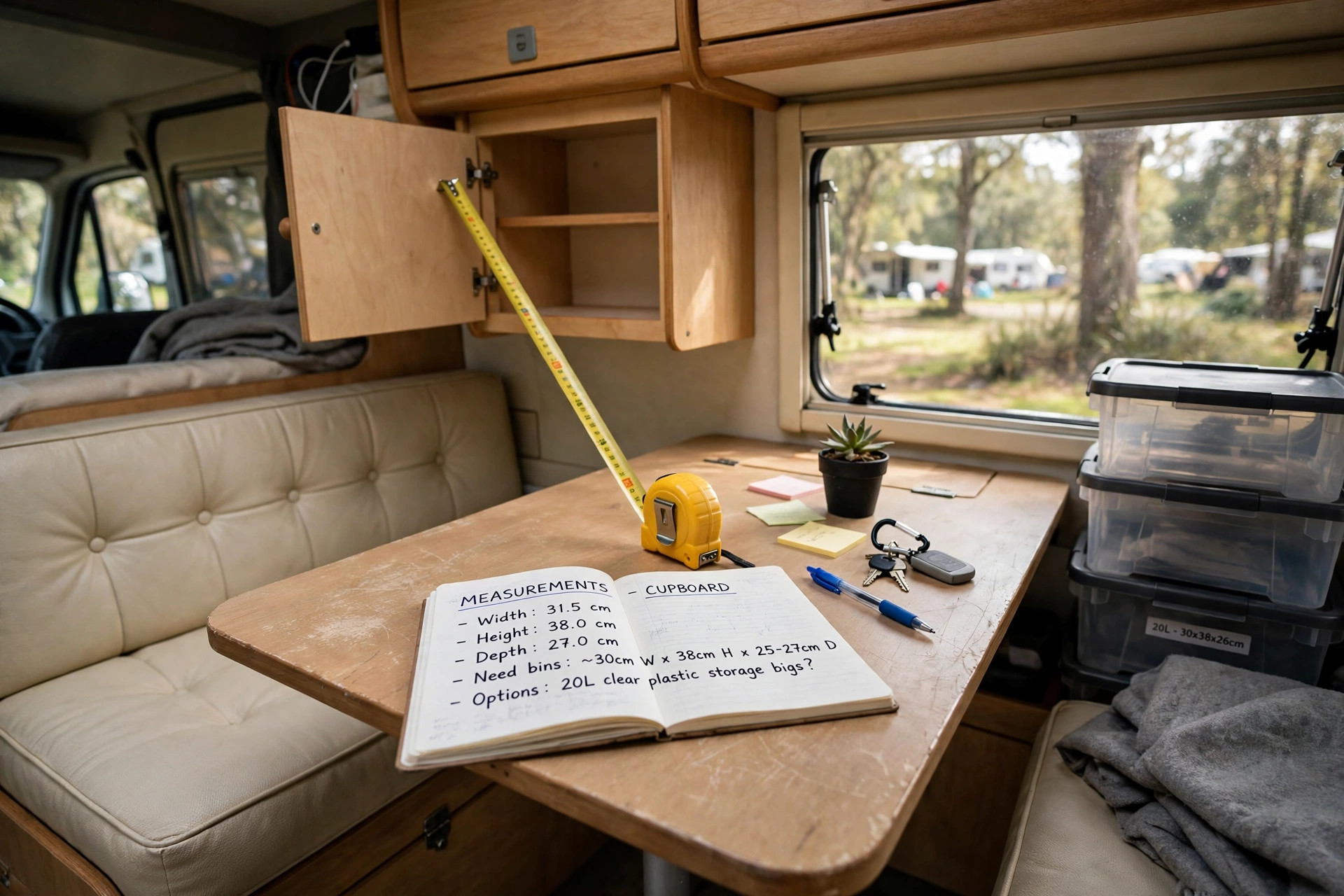
1. Measure every nook before you buy a single bin — the tape measure is the first organizer
A bin that does not fit is a bin in the way, because the cupboard in a camper is never the size you guessed and the bin you bought on a guess is the bin that lives on the floor. Measure every nook before you buy a single bin — the tape measure is the first organizer — so the bin you bring home slides in first time and stays there. Measure the width, the depth and the height of each cupboard, write the numbers in a notebook, and take the notebook to the shop, because the numbers in the notebook are the numbers that stop you buying the wrong size twice. Measure the awkward spots too, the gap beside the fridge and the shelf above the bed, because the awkward spot is often the spot with the most room. One afternoon with a tape measure, and every bin after it fits.
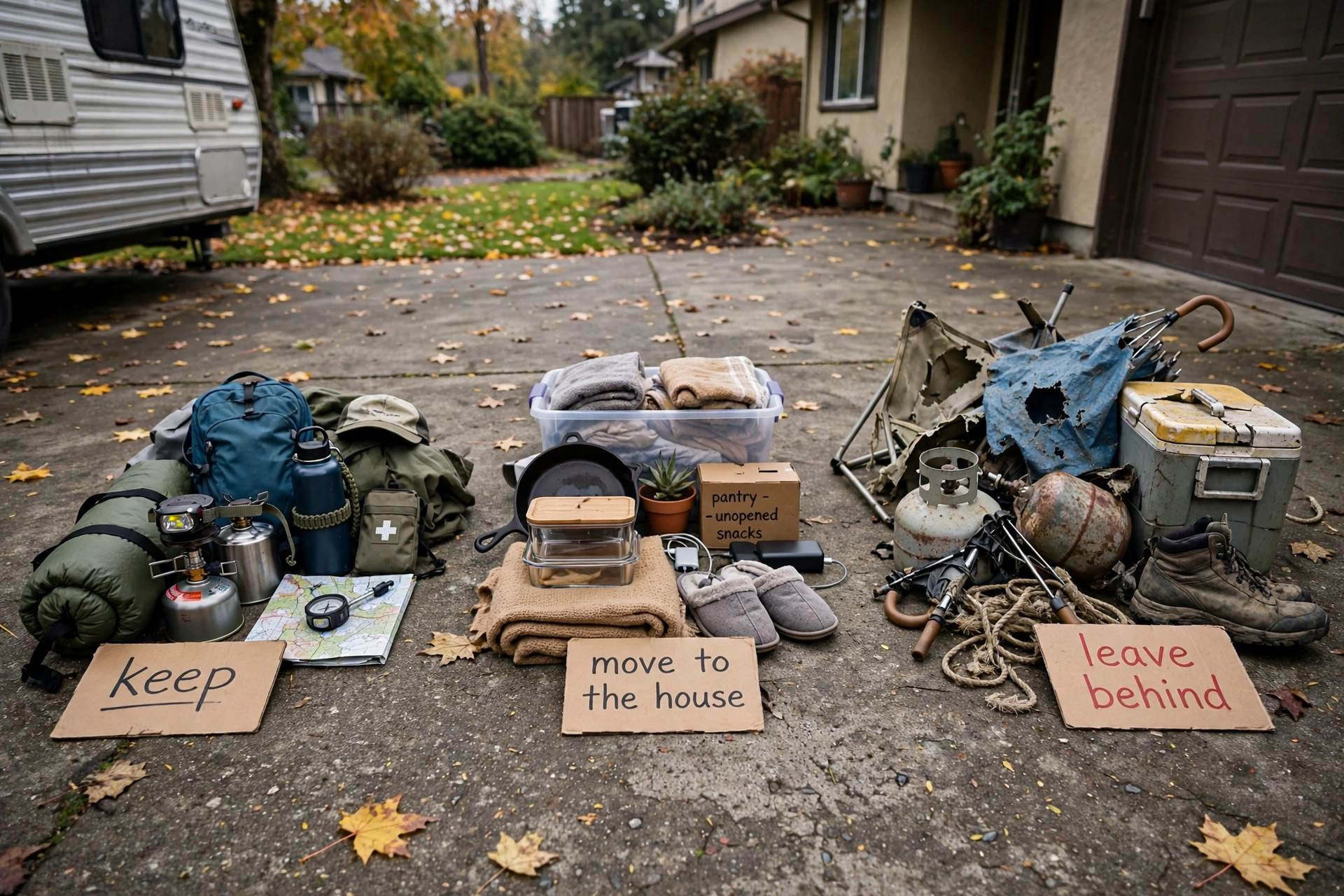
2. Sort everything into keep, move to the house, leave behind — the camper only carries what earns its place
A camper packed with "just in case" is a camper with no room for the things you actually use, because the spare kettle, the third torch and the board games nobody plays are the things that fill the cupboards first. Sort everything into keep, move to the house, leave behind — the camper only carries what earns its place — so the cupboards hold the trip, not the clutter. Lay it all out on the driveway, and be honest about what came out last trip and what never left its bag, because the thing that never left its bag is the thing that stays in the house. Keep what you used every day, move the spares to the house, and leave behind anything you can buy on the road for a few pounds. A ruthless sort, and the camper breathes again.
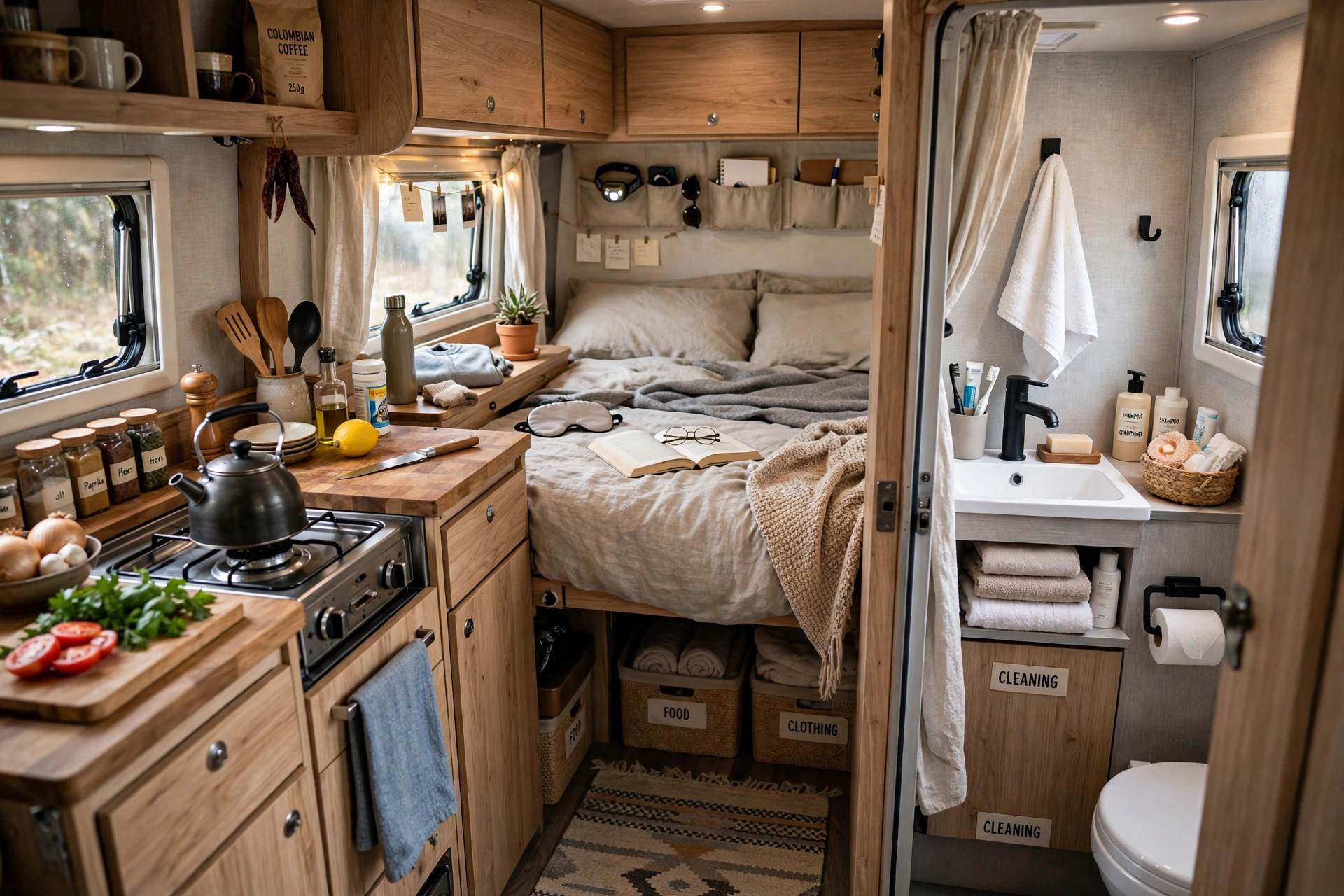
3. Zone the camper: sleep, cook, wash, drive — one zone, one job
A camper where everything lives everywhere is a camper where nothing is findable, because the torch is in the kitchen, the kettle is in the bedroom, and the dog lead is under the driver's seat. Zone the camper — sleep, cook, wash, drive — one zone, one job — so every thing lives where its job happens and your hand finds it without thinking. Cooking things live in the kitchen, sleeping things live by the bed, washing things live in the bathroom, and driving things live by the cab, because the zone that matches the job is the zone that stays tidy. Tell everyone the zones on the first morning, because the zones everyone knows are the zones everyone keeps. Four zones, and the camper stops being a search.
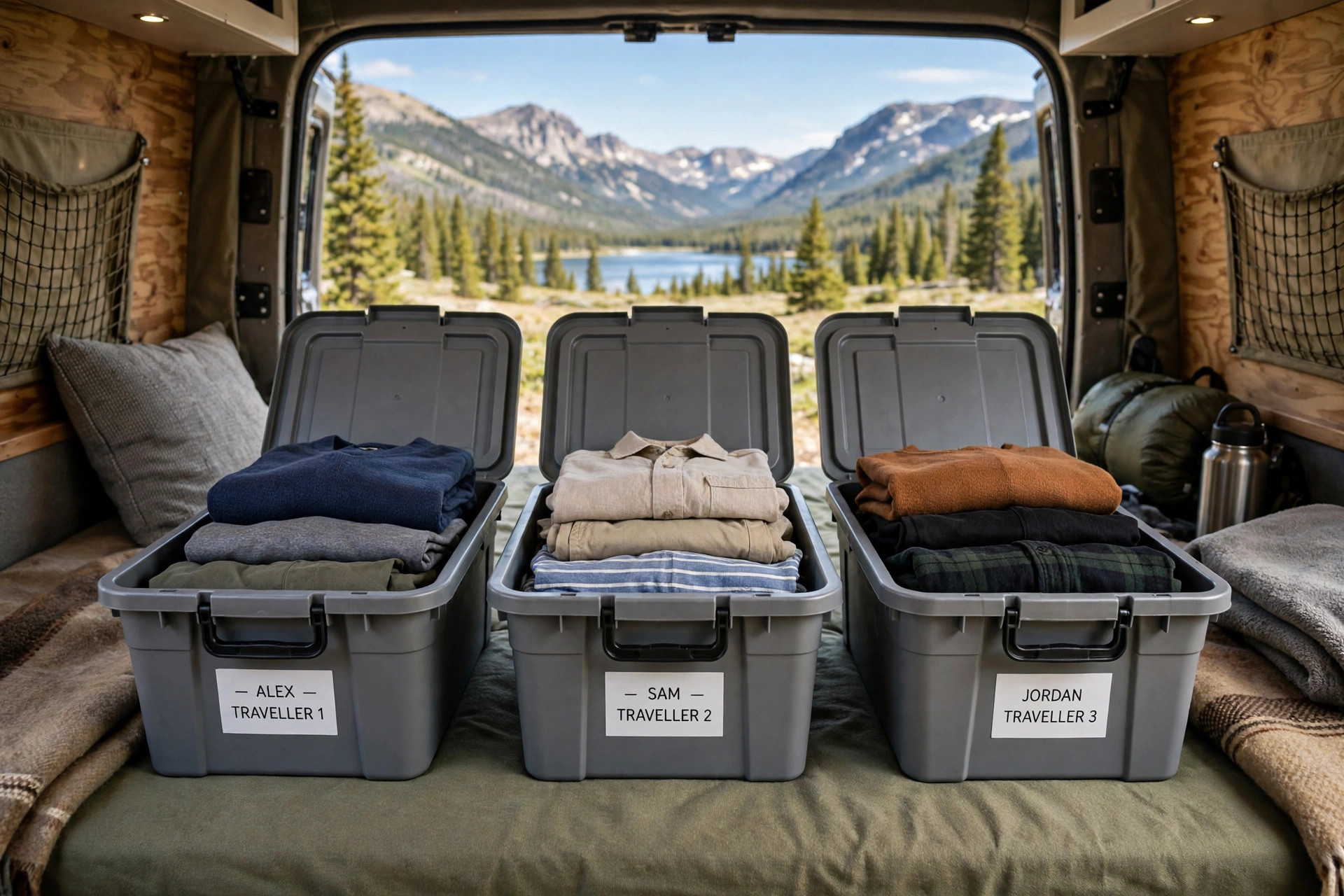
4. A labelled bin per person — one bin, one traveller, no mixing
One shared cupboard for everyone's clothes is a cupboard nobody owns, because the jumpers mix, the socks vanish, and the person looking for their own shirt is the person digging through everyone else's. Give every traveller one labelled bin — one bin, one traveller, no mixing — so each person owns one box and the box is their whole wardrobe for the trip. Label the bin with a name, not a category, because the name on the bin is the name that stops the mixing, and keep the bin where its owner sleeps, because the bin by the bed is the bin that gets used. One bin per person, and the morning hunt for clean clothes ends.
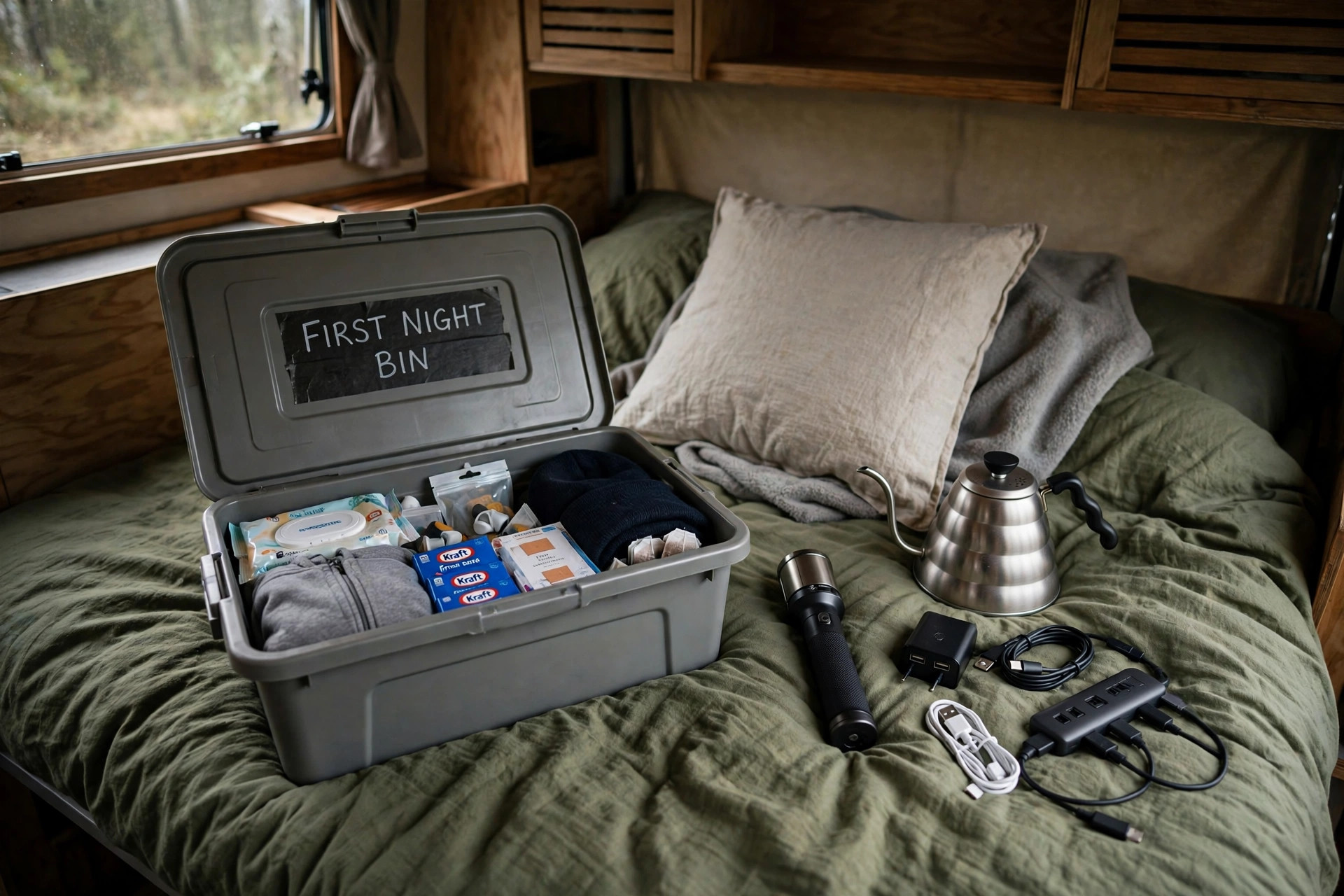
5. A "first night" bin — bedding, torch, kettle and chargers, ready before anything else is unpacked
The first night in a camper is the worst night to be unpacking, because it is dark, everyone is tired, and the bedding is at the bottom of the pile under the chairs. Pack a "first night" bin — bedding, torch, kettle and chargers, ready before anything else is unpacked — so the first hour on site is making tea, not digging. Put the bedding on top, the torch beside it, the kettle and two mugs next, and the phone chargers in the lid pocket, because the bin that opens first is the bin that settles the night. Keep the bin by the door, not buried in the garage bay, because the bin by the door is the bin you can reach in the dark. One bin, packed last and opened first, and the first night feels like home.
Kitchen and food on the road
6. A spice rack that locks — small jars in a rail so nothing rattles off
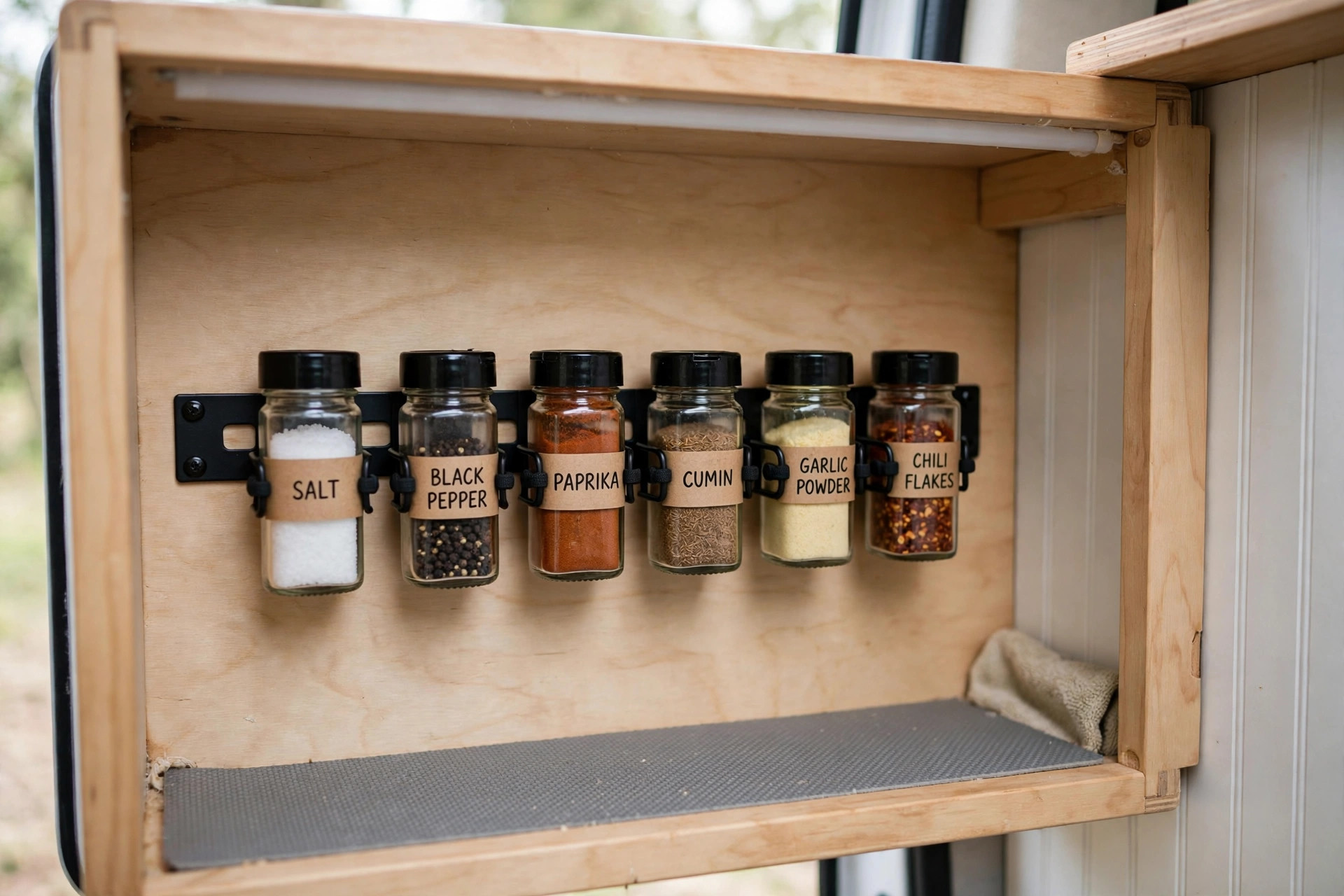
Spices loose in a cupboard are spices on the floor after the first bend, because the jars that stand free are the jars that fall when the camper leans. Fit a spice rack that locks — small jars in a rail so nothing rattles off — so the jars stay in their row no matter how rough the road gets. Use a rail with a lip, or small jars clipped into a strip, and keep the jars short and wide rather than tall and thin, because the short jar is the jar that does not tip. Label the lids, not the sides, because the lid is the label you see when you look down into the cupboard. A locking rail, and the paprika stays in its jar. (Check on Amazon for a small spice rack rail with a locking lip, sized for camper cupboards.)
7. A fridge bin system — one bin per shelf, labels facing out
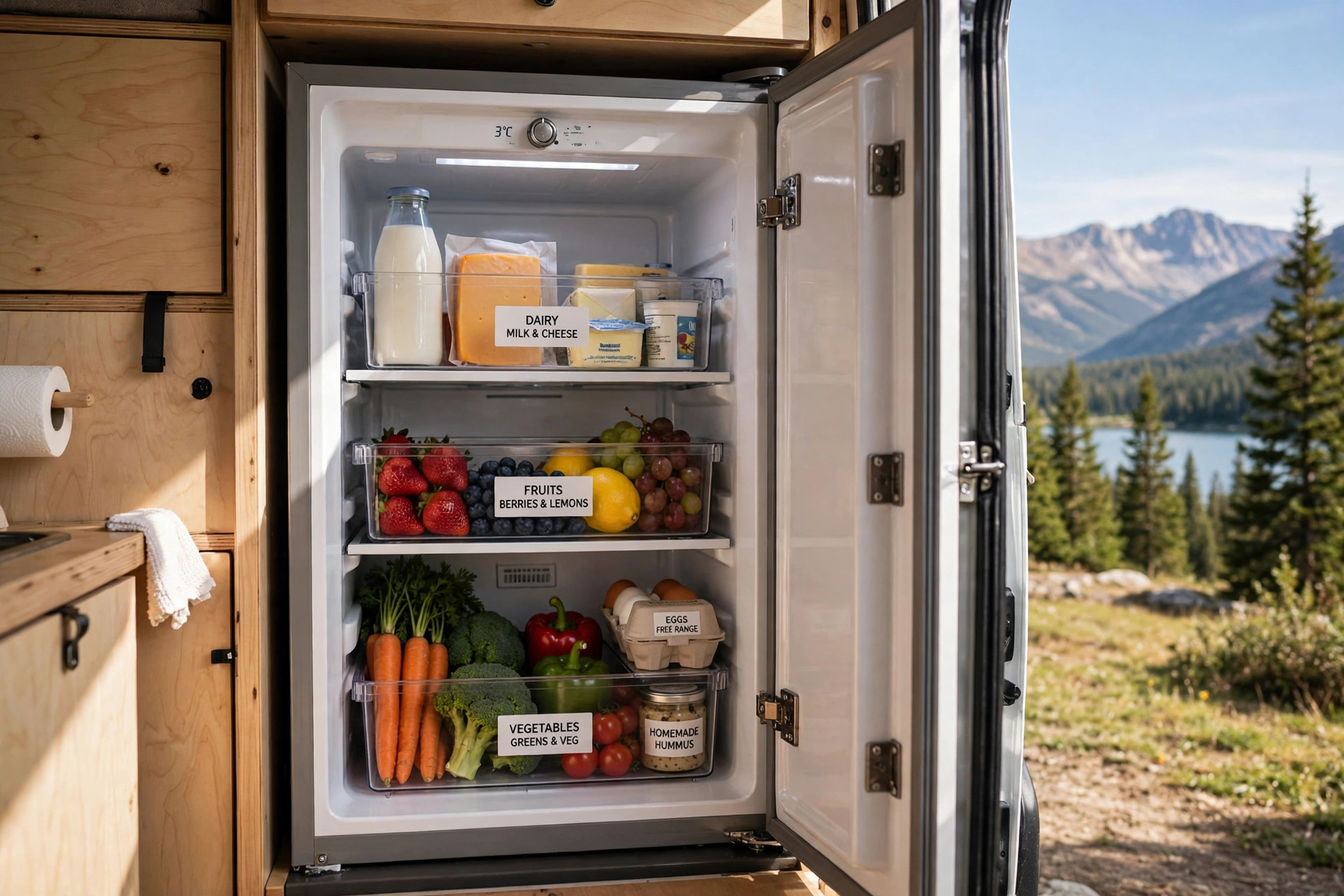
A camper fridge without bins is a fridge where everything slides, because the milk leans on the cheese, the cheese leans on the butter, and the first sharp brake is the brake that tips the lot. Use one bin per shelf — one bin per shelf, labels facing out — so every shelf holds one category and nothing travels. Put dairy in one bin, cold meat in another, and drinks in the door, because the bin that holds one thing is the bin that stays put. The fridge in the camper works the same way as the fridge at home, and the bin system is covered in 25 Fridge Organization Ideas for 2026, where the same one-bin-per-shelf rule keeps a full-size fridge tidy. Labels facing out, and the fridge opens on a tidy shelf every time.
8. A collapsible dish rack and a sink caddy — the washing-up station that fits in a cupboard
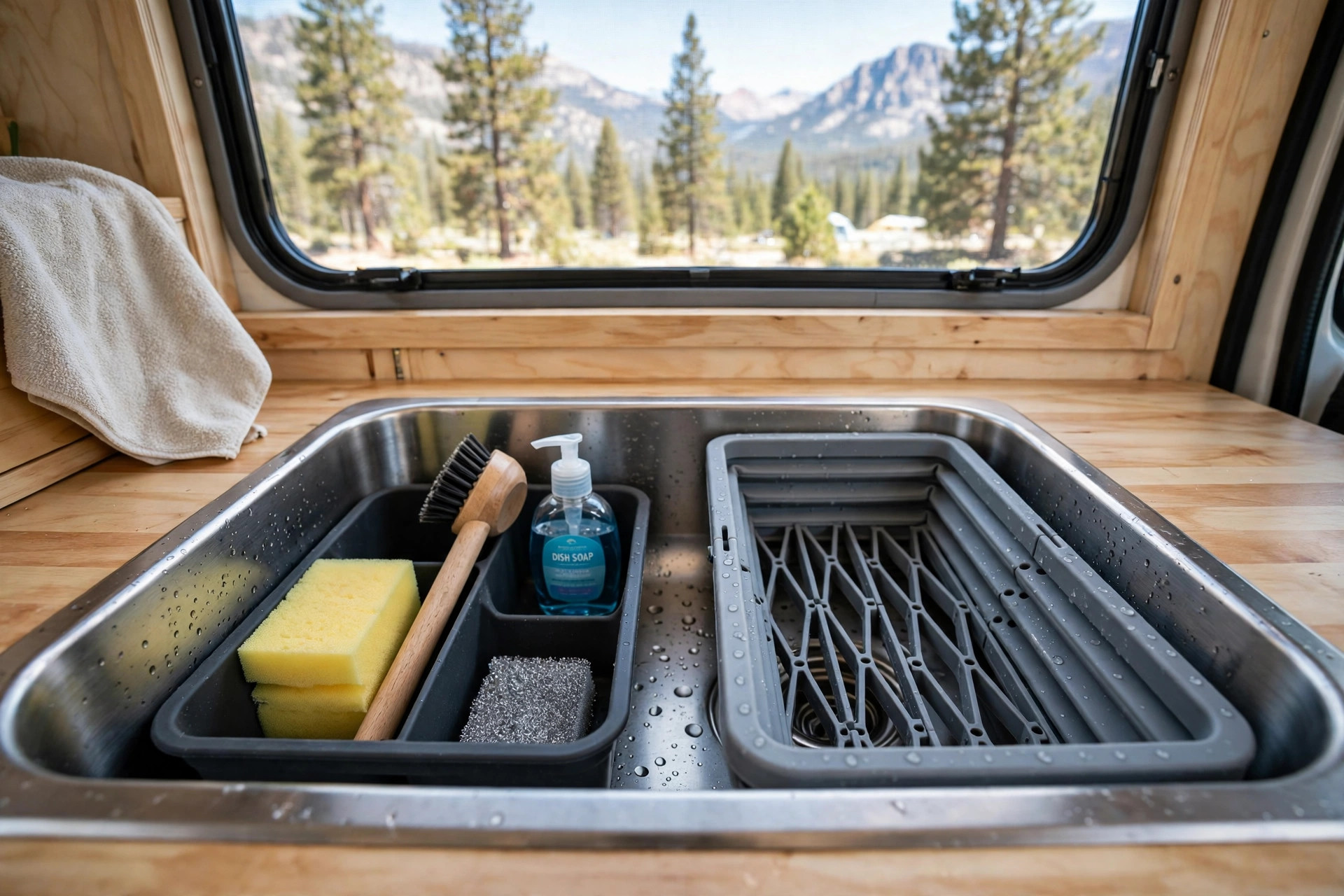
A full-size dish rack in a camper kitchen is a dish rack with nowhere to live, because the sink is small, the worktop is smaller, and the rack that does not fold is the rack that blocks the whole kitchen. Use a collapsible dish rack and a sink caddy — the washing-up station that fits in a cupboard — so the drying space appears when you need it and disappears when you do not. Fold the rack flat after the dishes dry, stand it behind the sink or slide it into the cupboard, and keep the sponge and soap in the caddy that hangs on the sink, because the caddy that hangs is the caddy that does not take worktop space. A rack that folds, and the kitchen stays usable.
9. A pantry door rack — tins and packets on the door, not in a deep cupboard
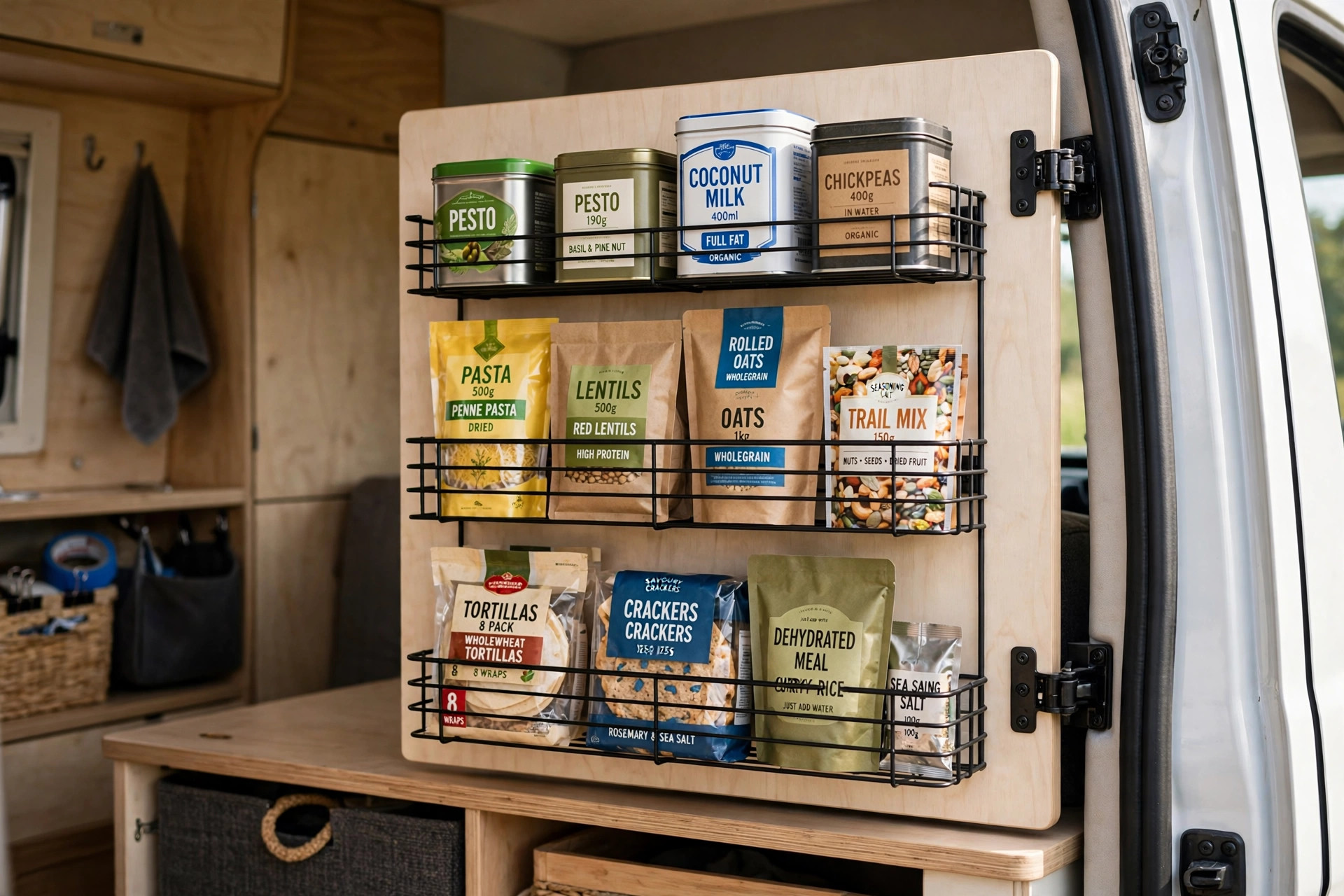
A deep cupboard in a camper is a cupboard where things disappear, because the tin at the back is the tin you cannot reach and the tin you cannot reach is the tin you buy twice. Hang a pantry door rack — tins and packets on the door, not in a deep cupboard — so everything you store is everything you can see. Screw a shallow rack to the inside of the cupboard door, keep the heaviest tins at the bottom and the lightest packets at the top, and leave a finger's width between the rack and the shelf, because the rack that clears the shelf is the rack that closes. One door rack, and the back of the cupboard stops eating tins.
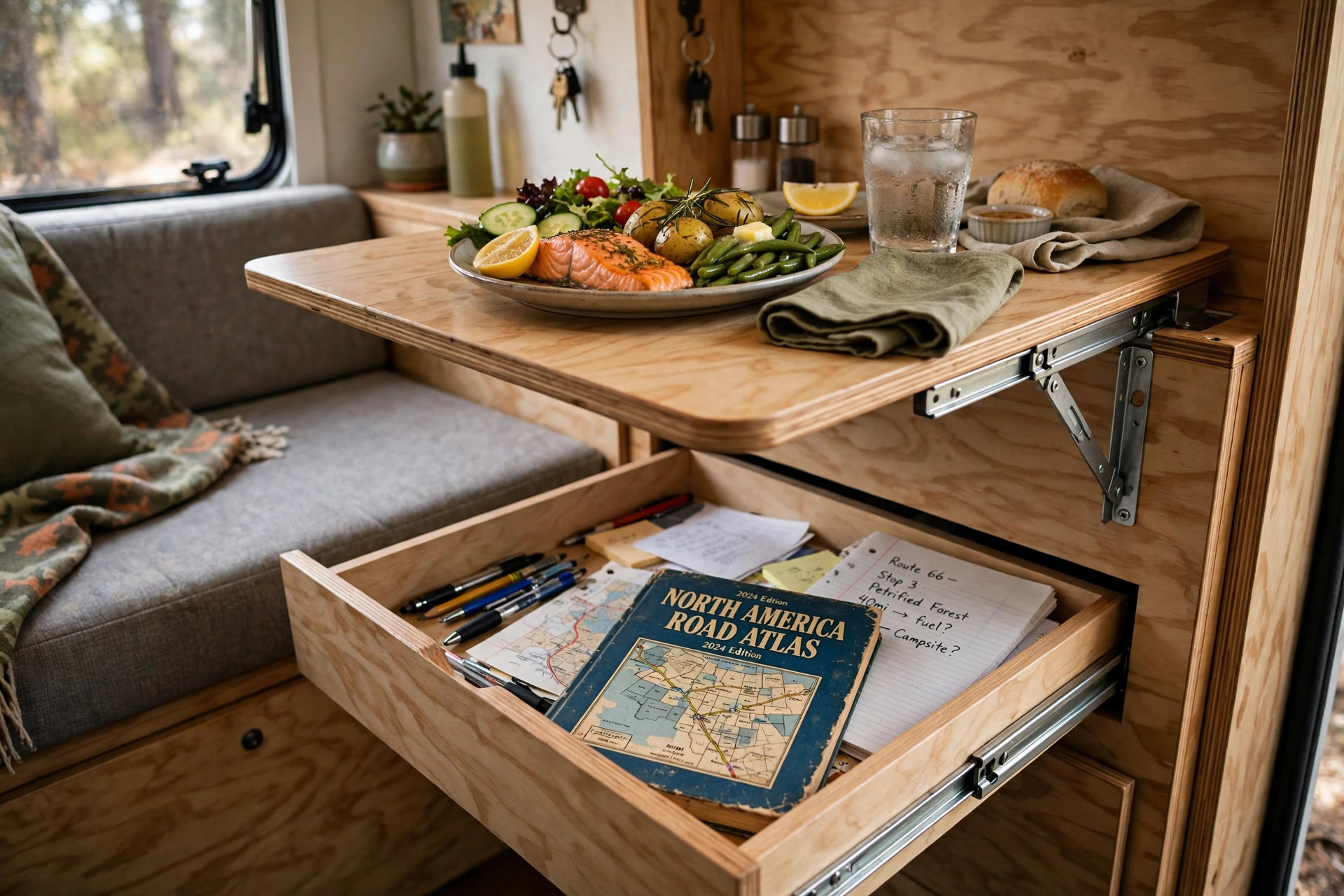
10. A fold-down table with a drawer underneath — dinner and homework in one spot
A camper table that only does dinner is a table that wastes half its day, because the table that folds away after breakfast is the table that could have held homework, maps and the laptop. Fit a fold-down table with a drawer underneath — dinner and homework in one spot — so the table works all day and the drawer holds what the table needs. Keep pens, paper and the road atlas in the drawer, fold the table down for meals, and fold it up when the beds come out, because the table that folds is the table that never blocks the walkway. A table with a drawer, and one piece of furniture does two jobs. A small rolling cart can do the same job as a side table if the fixed table is too small — the cart that rolls to the sofa is covered in 22 Rolling Cart Organization Ideas for 2026, and it parks by the door when the camper moves.
Clothes, shoes and gear in tiny closets
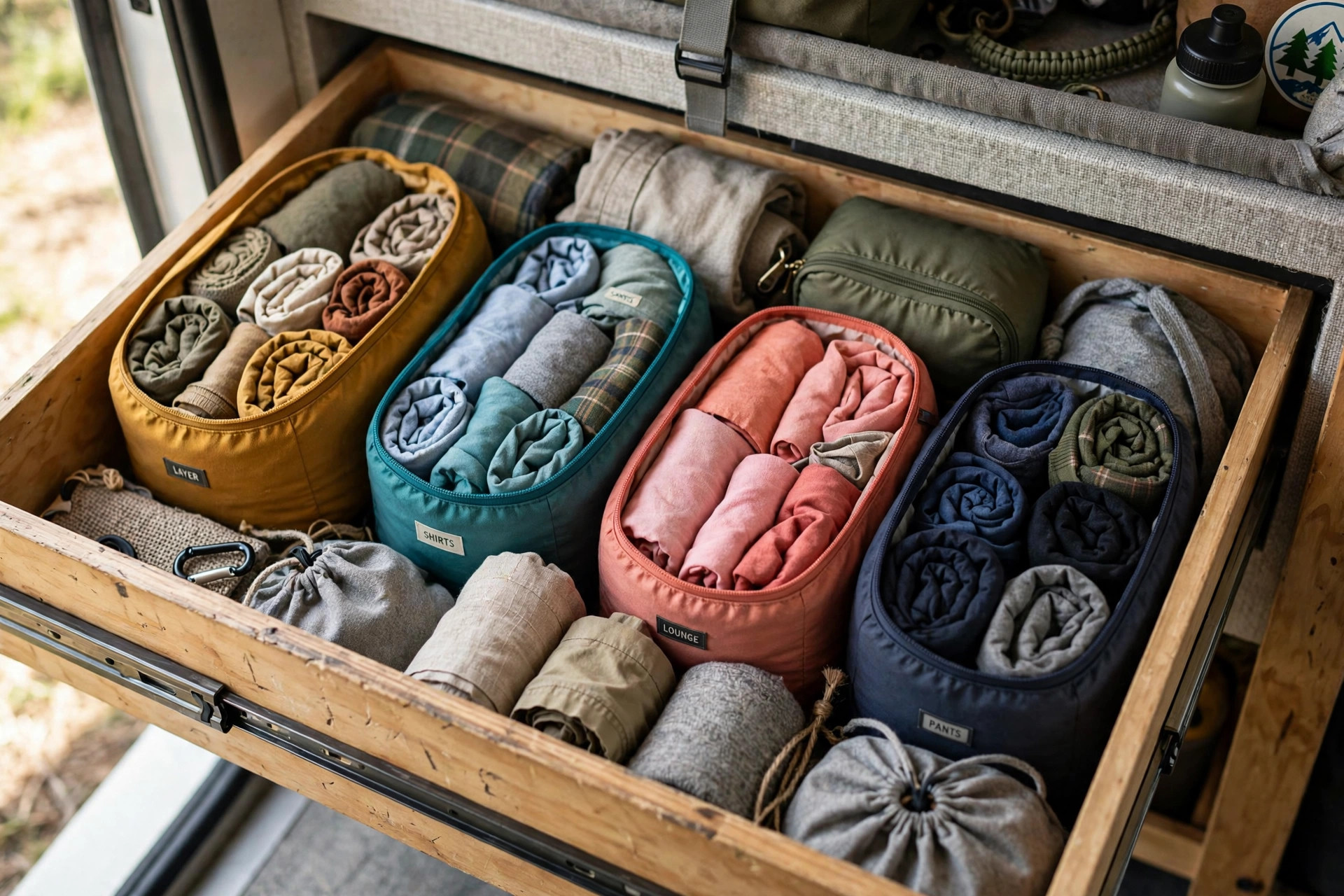
11. Rolling clothes instead of folding — the roll that doubles the drawer
Folded clothes in a shallow camper drawer are clothes that crease and slide, because the stack that looks neat in the house is the stack that falls over on the first corner. Roll your clothes instead of folding — the roll that doubles the drawer — so every item sits in its own tight roll and the drawer holds twice as much. Roll t-shirts, shorts and leggings, stand the rolls upright in the drawer like files in a box, and keep the bulkiest roll at the back, because the roll you can see is the roll you can grab without disturbing the rest. Rolling takes a minute to learn and saves a drawer a day. One drawer of rolls, and the clothes stop creasing.
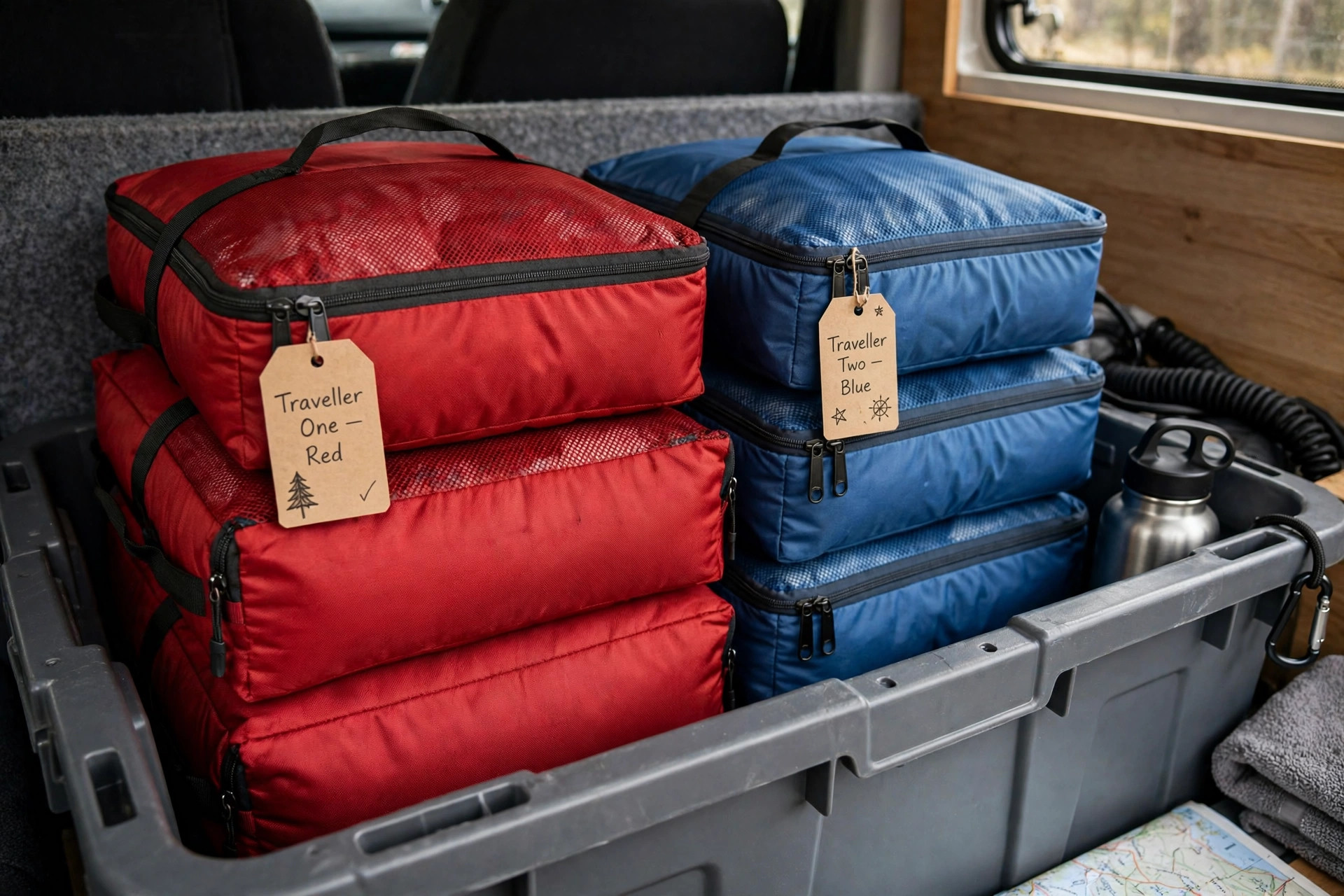
12. Packing cubes per person — one colour per traveller
Packing cubes in one colour for everyone are cubes nobody owns, because the cube that looks like every other cube is the cube that gets opened by the wrong person. Give each traveller their own colour — one colour per traveller — so the red cubes are one person's clothes, the blue cubes are another's, and the morning dress-up takes no digging. Put one cube per outfit day, or one cube per category, and stack them in the bin from idea 4, because the cube that matches the bin is the cube that belongs to its owner. Colours, not labels, and the whole family packs in minutes.
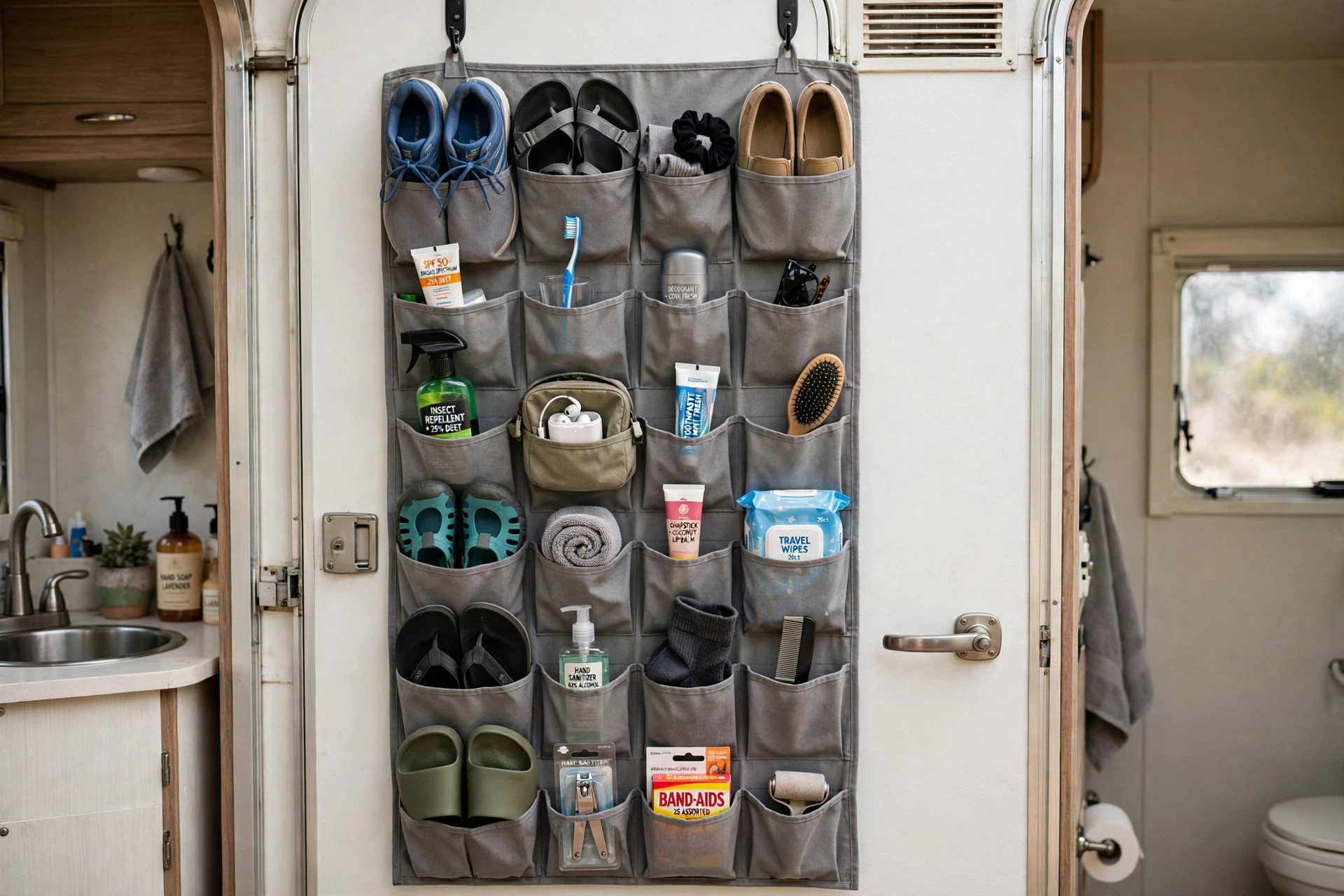
13. A hanging shoe organizer on the bathroom door — shoes, chargers and dog leads, all in pockets
Shoes loose in a camper are shoes under every seat, because the trainers are by the door, the sandals are under the bed, and the walking boots are somewhere in the garage bay. Hang a shoe organizer on the bathroom door — shoes, chargers and dog leads, all in pockets — so the small things that wander all live in one place. Use the clear pockets for shoes at the bottom and the small pockets at the top for chargers, the dog lead and the sun cream, because the pocket you can see into is the pocket you actually use. Hang it on the inside of the door so it does not swing when the camper moves, because the organizer that swings is the organizer that empties itself. One door, twelve pockets, and the floor is clear.
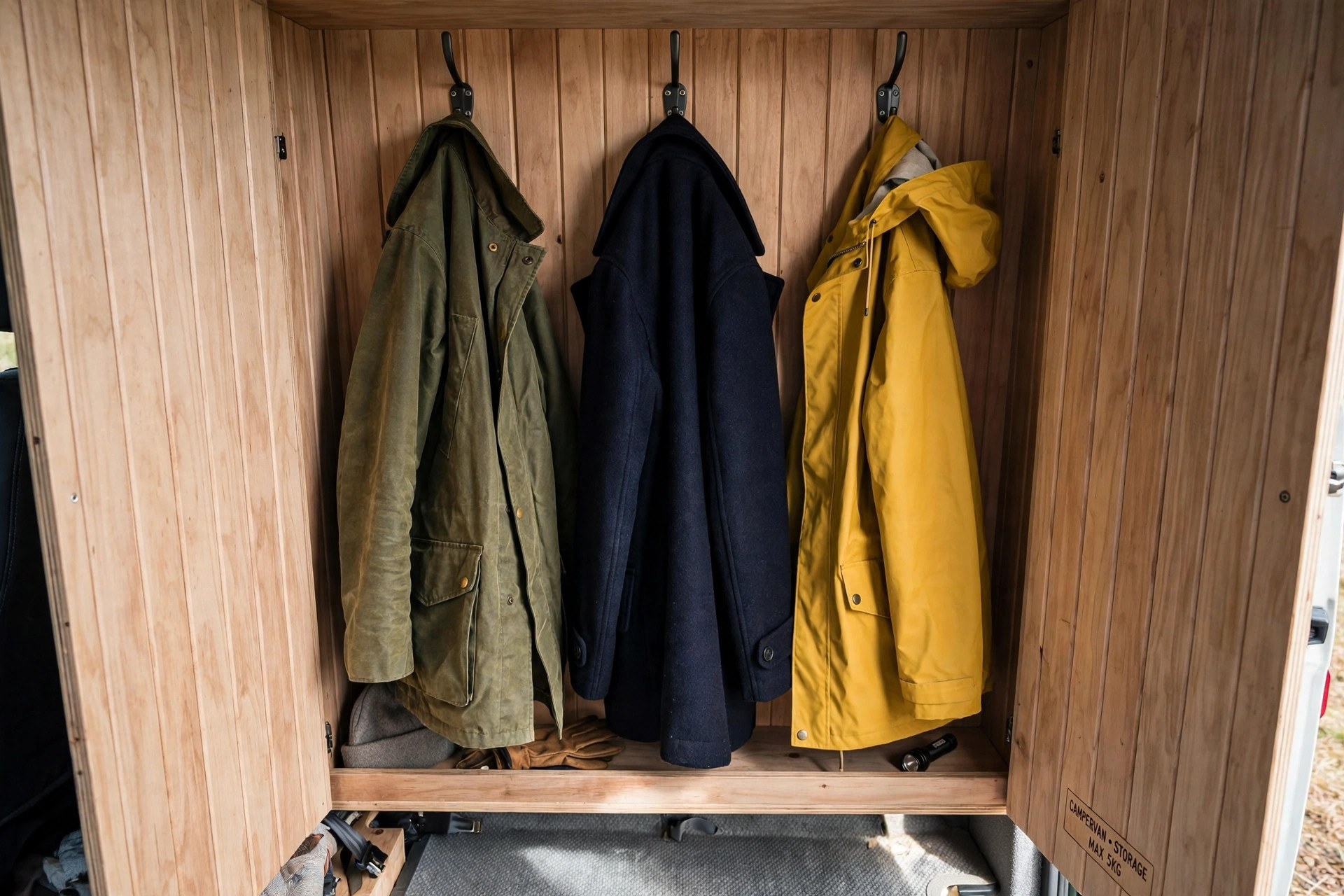
14. A slim wardrobe with hooks, not hangers — hangers swing, hooks hold
Hangers in a moving camper are hangers on the floor, because the hanger that swings on a bend is the hanger that slips off the rail and drops the coat with it. Use hooks instead — hangers swing, hooks hold — so the coats stay where you put them no matter how the road bends. Screw a row of sturdy hooks inside the wardrobe, hang one coat per hook, and keep the rail for the one or two things that truly need a hanger, because the hook that holds one coat is the hook that never drops it. Hooks take less space than hangers too, so the wardrobe holds more. A row of hooks, and the coats stop falling.
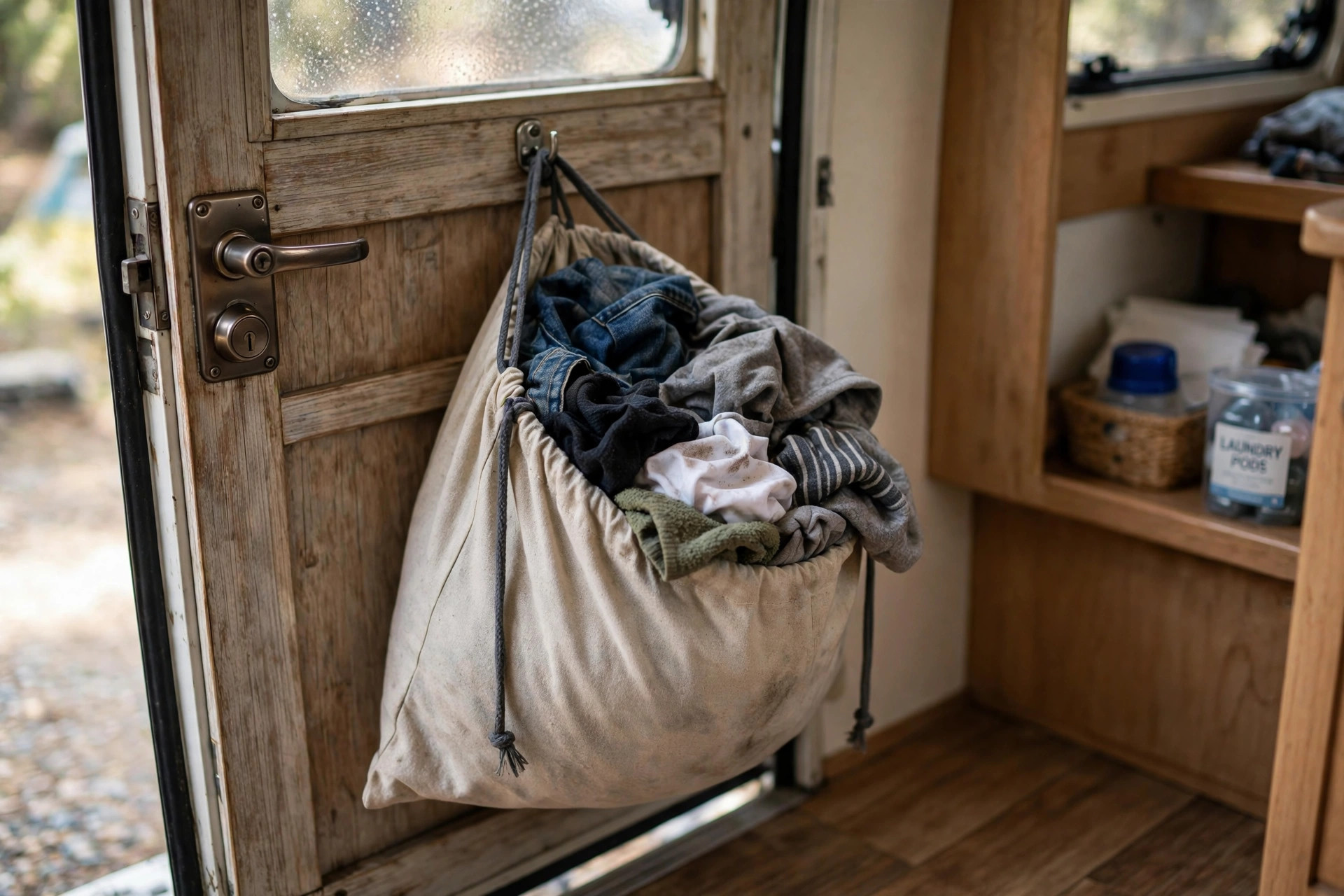
15. A laundry bag that hangs behind the door — dirty clothes off the floor
Dirty clothes on a camper floor are dirty clothes underfoot, because the floor is the only space left and the pile that starts small is the pile that grows by bedtime. Hang a laundry bag behind the door — dirty clothes off the floor — so the dirty washing has a home from the first sock. Use a bag with a drawstring top and a hook that fits over the door, and empty it at the campsite laundry or the next stop, because the bag that empties often is the bag that never overflows. Keep a second small bag for the really muddy things, because the muddy boots and the clean laundry do not belong in the same bag. One bag behind the door, and the floor stays clear.
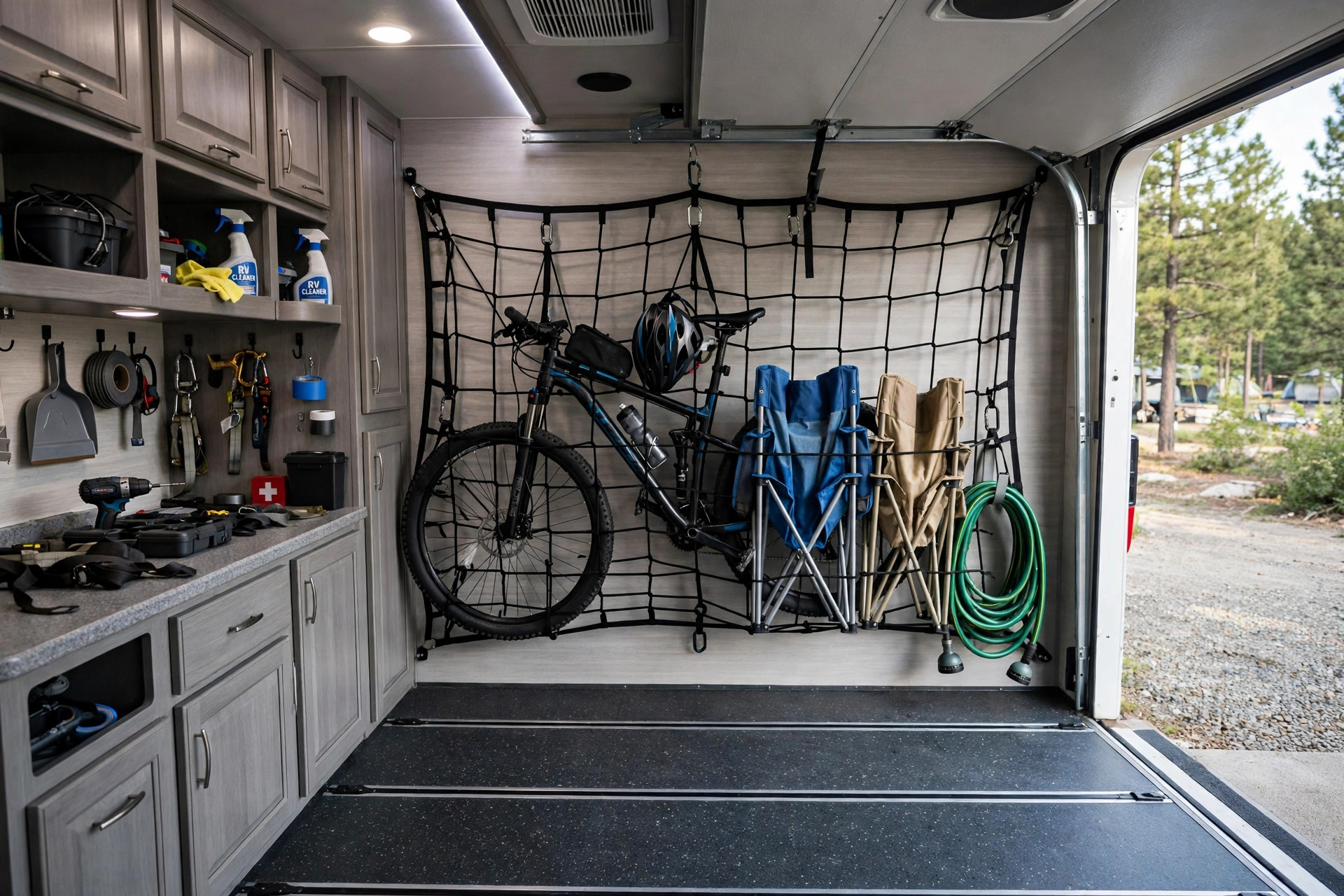
16. A gear net in the garage bay — bikes, chairs and hoses strapped, not stacked
A garage bay where everything is stacked is a garage bay where everything falls, because the chairs lean on the bikes, the bikes lean on the hose, and the first hard brake is the brake that brings the whole pile down. Fit a gear net — bikes, chairs and hoses strapped, not stacked — so every item is held against the wall and nothing can slide. Strap the bikes to one side, the folding chairs to the other, and coil the hose in a net pocket, because the net that holds is the net that stops the pile. The garage bay borrows its thinking from 25 Garage Storage Ideas for 2026, where the same wall-first rule keeps a full-size garage tidy. A net and a few straps, and the garage bay survives the journey.
Systems that hold on a moving home
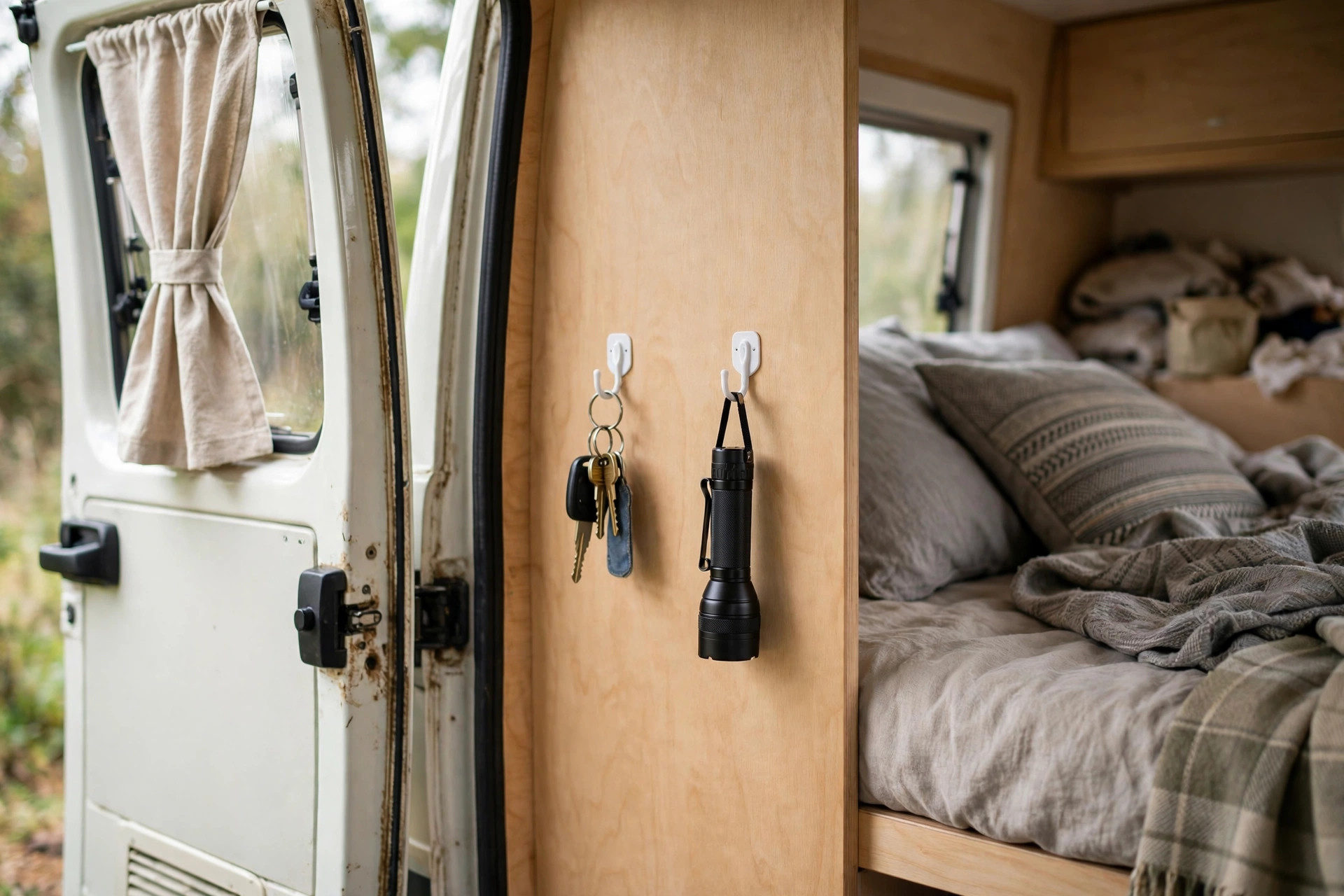
17. Command hooks everywhere — hooks that hold without holes
Drilling holes in a camper wall is a decision you cannot undo, because the wall is thin, the hole is permanent, and the hook you screwed in is the hook that stays in the wrong place forever. Use command hooks instead — hooks that hold without holes — so you can put a hook exactly where you need it and move it when you are wrong. Stick them by the door for keys, by the bed for the torch, and in the bathroom for the towel, because the hook that is there is the hook that gets used. Pull the tab to remove them cleanly at the end of the season, because the hook that leaves no mark is the hook that keeps the deposit. Hooks everywhere, no holes anywhere. (Check on Amazon for command hooks in small and medium, with the weight rating printed on the pack.)
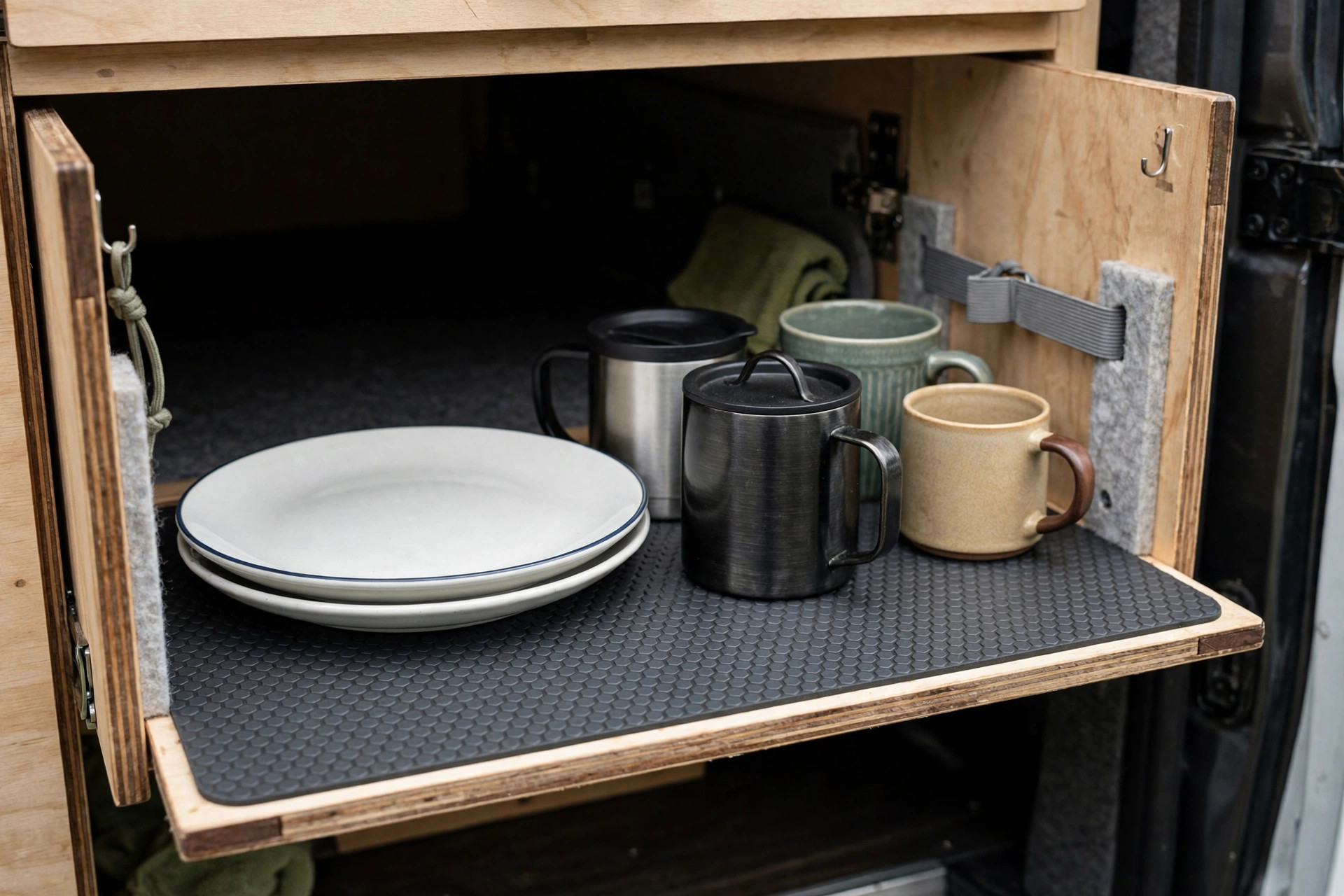
18. Non-slip shelf liner in every cupboard — the liner that stops the rattle
Cupboards without liner are cupboards that rattle, because the plates slide, the mugs slide, and the sliding is the sound that keeps everyone awake on a rough road. Line every shelf with non-slip liner — the liner that stops the rattle — so everything grips the shelf and stays where it was put. Cut the liner to fit, press it flat, and put the heaviest things at the back, because the liner that grips is the liner that holds the load. Wash it once a season, because the liner that is dusty is the liner that stops gripping. A roll of liner, and the camper goes quiet.
19. Bungee cords and tension rods — the cheap fix that holds everything in place on the move
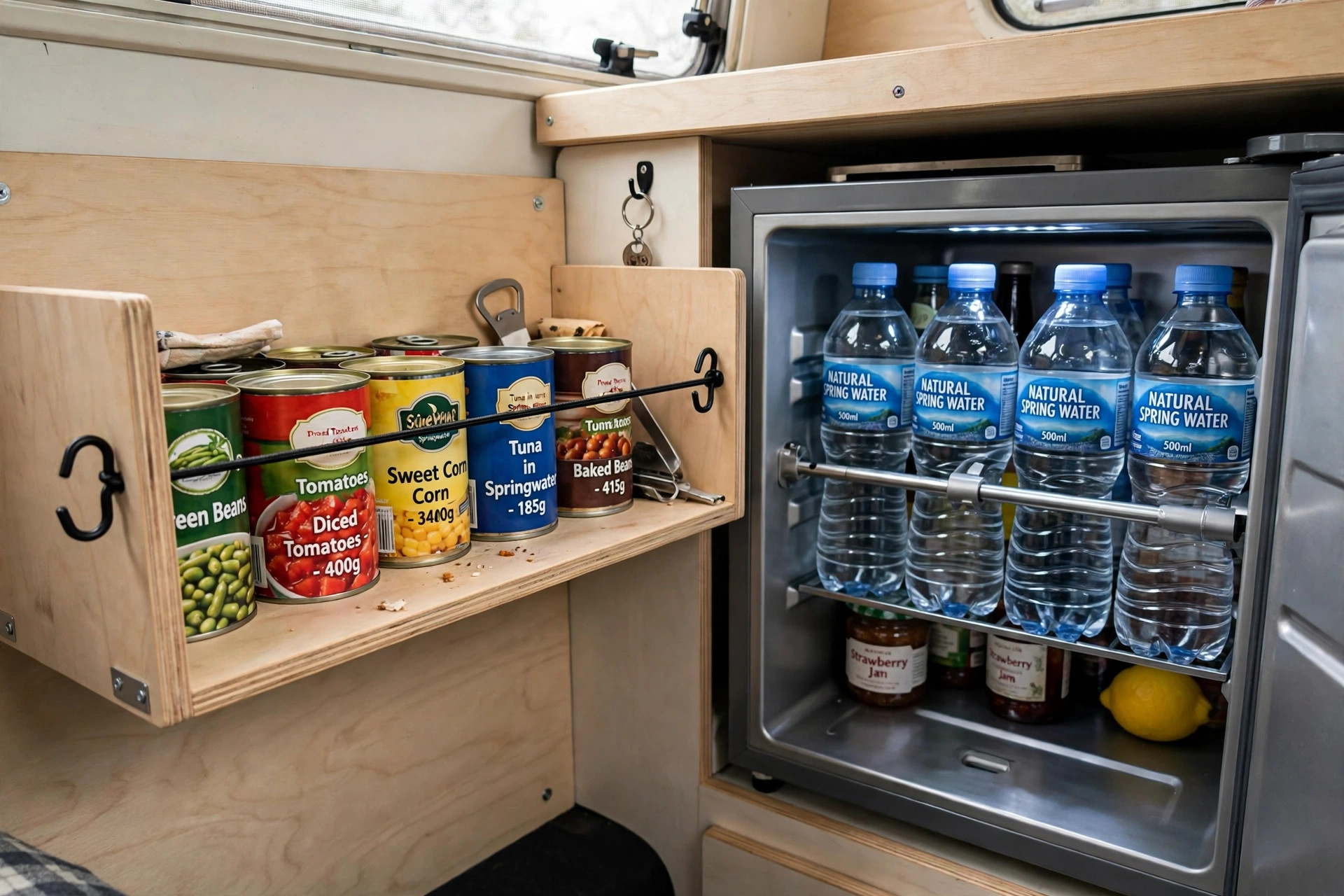
The cheapest fix in a camper is also the best, because a bungee cord costs almost nothing and holds almost anything. Use bungee cords and tension rods — the cheap fix that holds everything in place on the move — so the cupboard contents stay put without a single screw. Hook a bungee across the front of a shelf to keep the tins in, wedge a tension rod across the fridge to keep the bottles upright, and strap the bin lids down before you drive, because the cord that holds is the cord that stops the crash. Keep a spare bungee in the tool kit, because the cord that snaps is the cord you replace in a minute. Cords and rods, and the camper stops rattling. (Check on Amazon for a mixed pack of bungee cords with hooks, and adjustable tension rods in two sizes.)
20. A small tool kit in one labelled box — the fix-it box that lives by the door
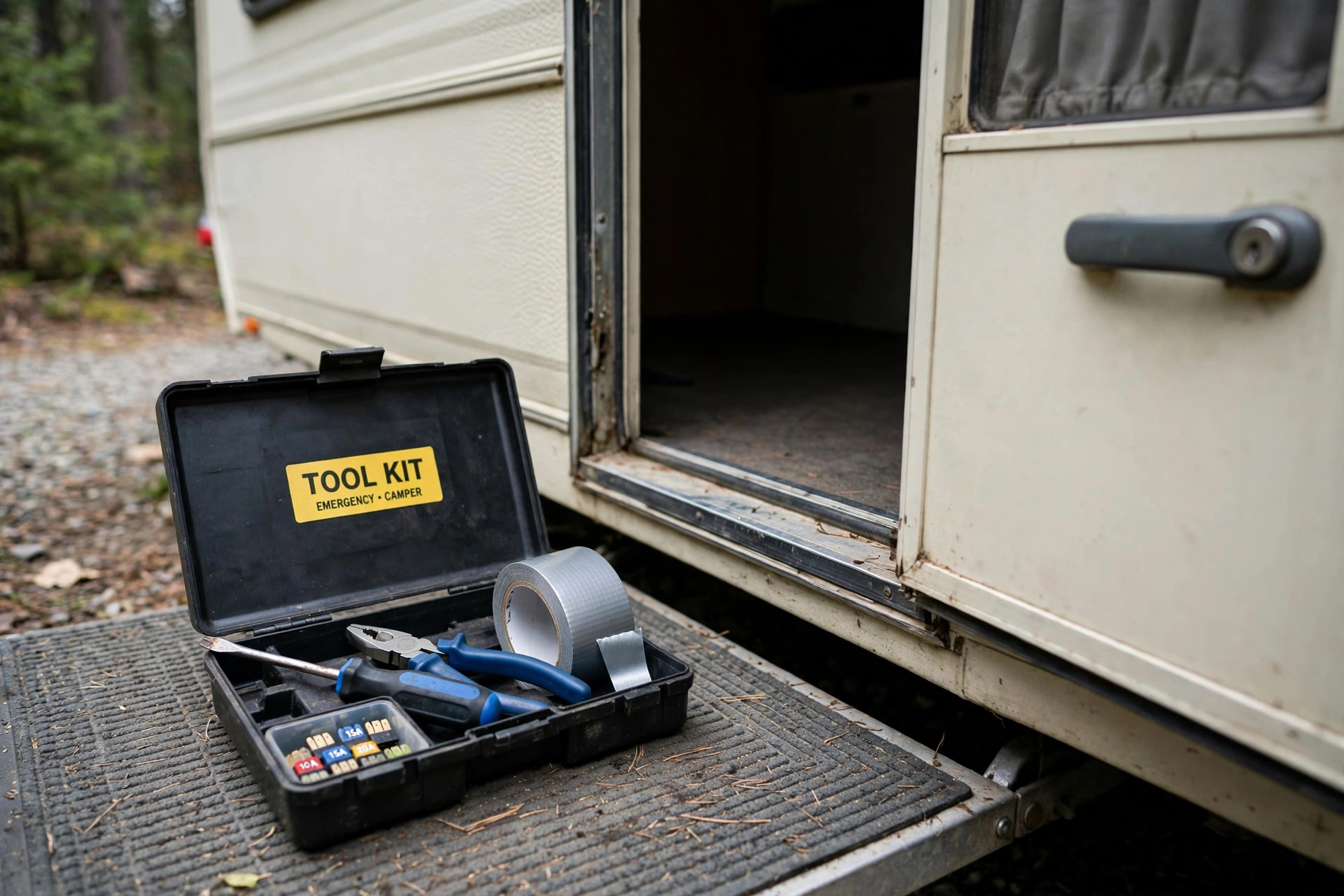
A camper with no tool kit is a camper with a loose screw and no screwdriver, because the screw that works loose on the road is the screw that needs fixing before the next stop. Keep a small tool kit in one labelled box — the fix-it box that lives by the door — so the screwdriver, the tape and the spare fuses are always in the same place. Put a screwdriver, pliers, duct tape, cable ties and a few spare screws in the box, label it clearly, and keep it by the door, because the box by the door is the box you can reach without unpacking. Check the box once a season, because the kit that is checked is the kit that is ready. One box by the door, and the small fixes take minutes.
21. A daily reset: five minutes at dusk — the habit that keeps the camper tidy
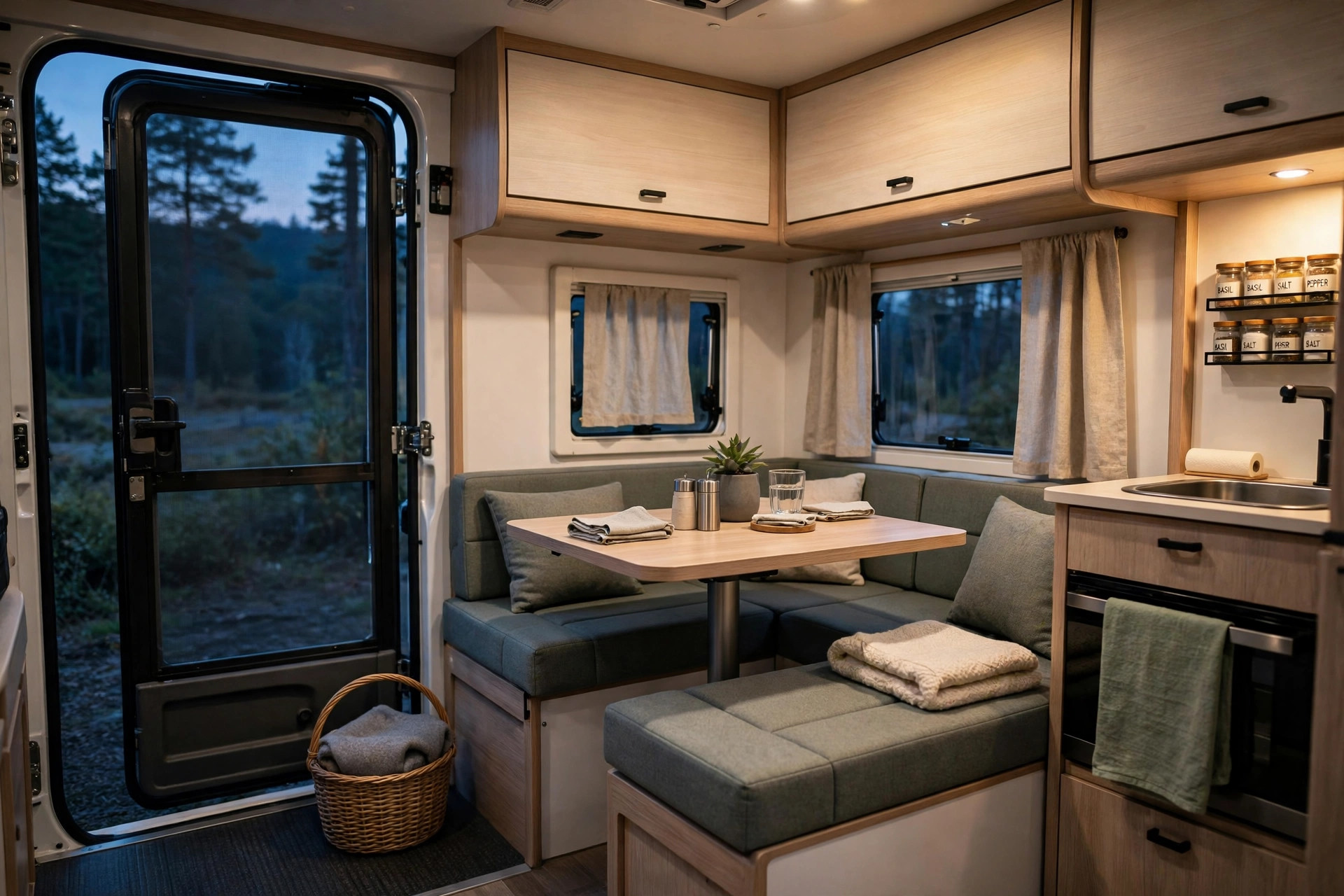
No system survives a camper without a habit, because the bins are only tidy on the day you pack them and the mess creeps back one sock at a time. Do a daily reset — five minutes at dusk — so the camper is tidy before bed and starts clean in the morning. Shoes in the organizer, dishes in the rack, clothes in the bins, and the table clear, because the reset that takes five minutes is the reset that actually happens. Do it together, because the reset everyone does is the reset that takes five minutes and not fifty. Five minutes at dusk, and the camper never needs a big clean. The door the reset starts at is the same drop zone the house uses — the entryway thinking is in 22 Entryway Storage Ideas for 2026, where the first thing you see when you come home is the first thing that gets put away.
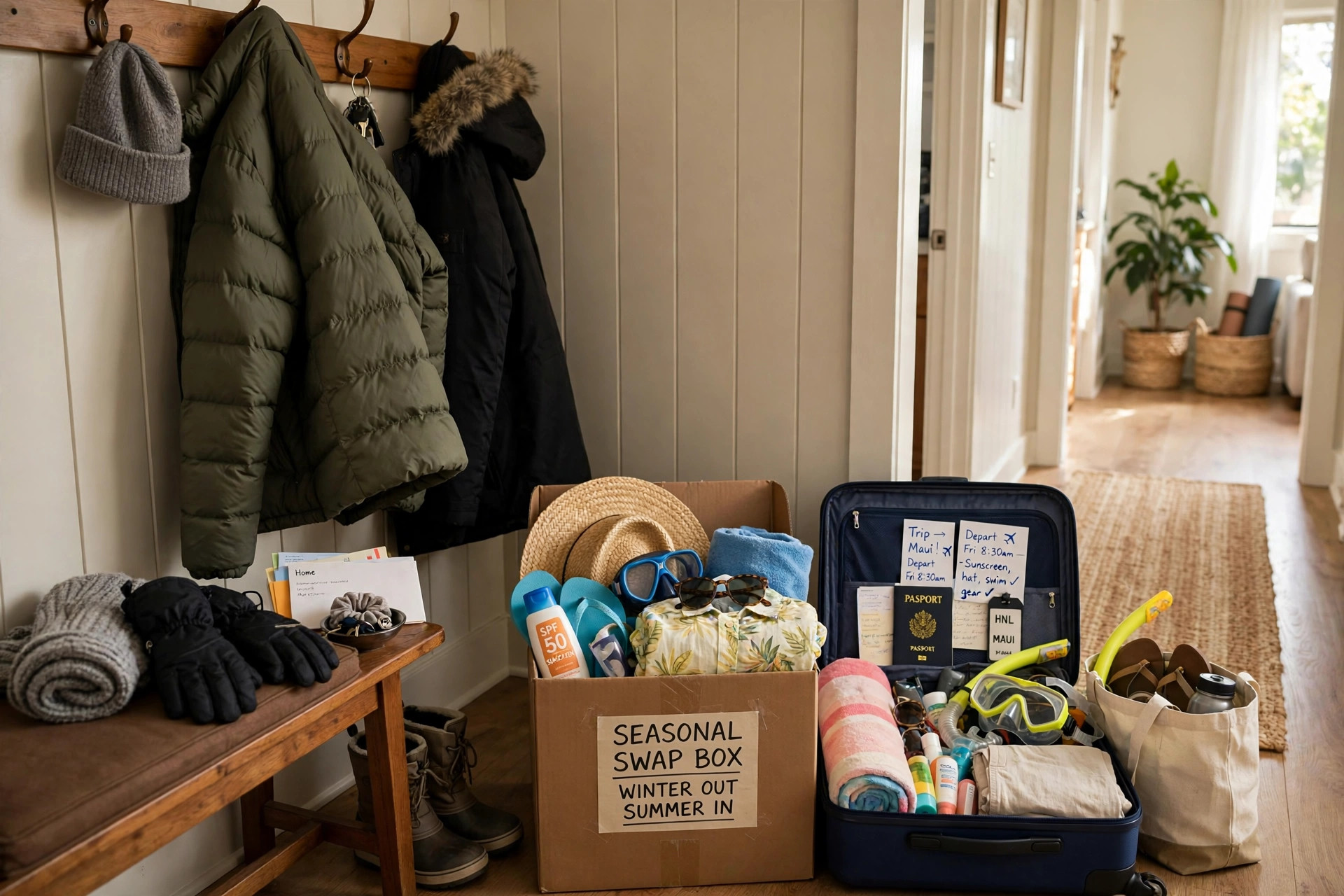
22. A seasonal swap box in the house — winter gear out, summer gear in, before every trip
A camper packed for every season is a camper packed for none of them, because the winter coats take the space the summer towels need, and the space that holds both is the space that holds neither properly. Keep a seasonal swap box in the house — winter gear out, summer gear in, before every trip — so the camper only carries the season you are driving into. Before each trip, pull the box out, swap the coats for the swimsuits or the swimsuits for the coats, and check the list inside the lid, because the list on the lid is the list that stops you forgetting the one thing you need. One box in the house, and the camper is packed for the right season every time.
Which camper organization idea fits which situation?
| Situation | Best first move | Budget | Tools needed |
|---|---|---|---|
| Bins that do not fit the cupboards | Measure every nook first (idea 1) | Free | Tape measure |
| Camper packed with "just in case" | Sort into keep, move, leave behind (idea 2) | Free | None |
| Nothing is findable | Zone the camper: sleep, cook, wash, drive (idea 3) | Free | Labels |
| Clothes mixed between travellers | A labelled bin per person (idea 4) | Low | Bins, labels |
| First night is a scramble | Pack a "first night" bin (idea 5) | Low | One bin |
| Spices on the floor after a bend | A spice rack that locks (idea 6) | Low | Rack rail |
| Fridge contents slide around | One bin per shelf, labels out (idea 7) | Low | Small bins |
| No room for a dish rack | Collapsible rack and sink caddy (idea 8) | Low | Rack, caddy |
| Tins vanish at the back of the cupboard | Pantry door rack (idea 9) | Low | Rack, screws |
| Table only does dinner | Fold-down table with a drawer (idea 10) | Medium | Table, drawer |
| Drawer too small for folded clothes | Roll clothes instead of folding (idea 11) | Free | None |
| Packing cubes all look the same | One colour per traveller (idea 12) | Low | Packing cubes |
You do not need all 22 ideas. You need the three that solve your camper — usually the tape measure before you buy a single bin, the labelled bin per person, and the five-minute reset at dusk that keeps it all tidy. Start with the measuring, do it this weekend before your next trip, and put the first-night bin by the door. Do that and the next time you pull into a site, the camper will be ready before the kettle boils.
Save this post for your next trip, and if the small-space thinking needs to go further, read 28 Small Apartment Storage Ideas for 2026 next — it is Post 50, the tiny-flat systems this camper borrows from — and 25 Garage Storage Ideas for 2026, Post 33, for the garage bay that holds the bikes and chairs. This is the last post of the Storage by room/object return run — Posts 31 to 55, one room and one object at a time — and the run ends with the smallest home of all. The next cluster opens with Drop Zone Organization, where the grab-and-go entryway gets the same treatment.
Publish date assigned at publishing time. Updated as new camper organization finds are tested.
Frequently asked questions
How do I keep things from moving around while driving?
Strap, wedge and line everything — non-slip shelf liner under every item, bungee cords across open shelves, and tension rods in the fridge and cupboards to hold bottles and tins in place. Pack the heaviest things low and at the back, and do a walk-through before you drive: open every cupboard, check nothing can slide, and shut every bin lid. The things that move are the things that were never held in the first place.
What is the best way to organize clothes in a camper?
Roll them, and give each traveller their own colour of packing cube inside one labelled bin per person. Rolling doubles the drawer, the cubes keep one person's clothes from mixing with another's, and the bin by the bed means the morning clothes are in reach without digging through a shared cupboard. One bin, one colour, one roll at a time, and the clothes stay tidy for the whole trip.
How do I stop a small camper from feeling cluttered?
Only carry what earns its place — sort ruthlessly before every trip and keep a seasonal swap box in the house so the camper only holds the season you are driving into. Then give everything a labelled home, keep the floor clear with a hanging shoe organizer and a laundry bag behind the door, and do the five-minute reset at dusk. A camper feels cluttered when things have no home; give them one, and the small space feels calm.