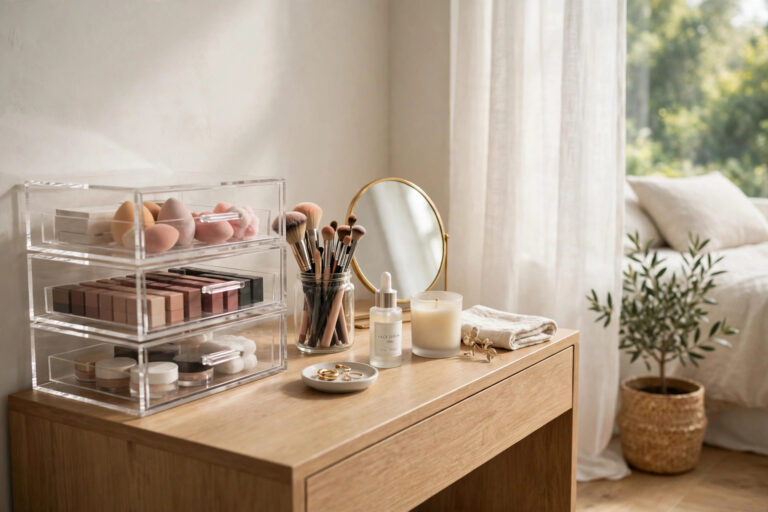
22 Jewelry Storage Ideas for 2026
Necklaces are the worst things to store, because a necklace left in a drawer is a necklace in a knot, and a knot is a necklace you stop wearing. The fix is not a bigger jewellery box, it is a home for each piece where the chain hangs straight, the earrings sit in pairs, and the bracelets slide on and off without a pile forming underneath.
These 22 jewelry storage ideas are tangle-free displays for vanities: start with a wall-mounted necklace bar, add a velvet-lined tray for the small pieces, build a tiered stand for the everyday set, and finish with a travel roll and a lockable box — so every piece is easy to find, easy to reach, and never knotted.
Every idea below works on a real vanity, from a small dressing table in a bedroom corner to a bathroom counter with one free inch. The rings that live beside the necklaces are covered in 16 DIY Ring Holder Ideas for 2026, where the rings get their own dish and cone — and the bedroom the vanity sits in is in 28 Bedroom Storage Ideas for 2026, so the dressing area matches the display. Pick three ideas that fit your collection, start with the necklace bar, and build from there.
Start simple: keep the necklaces untangled
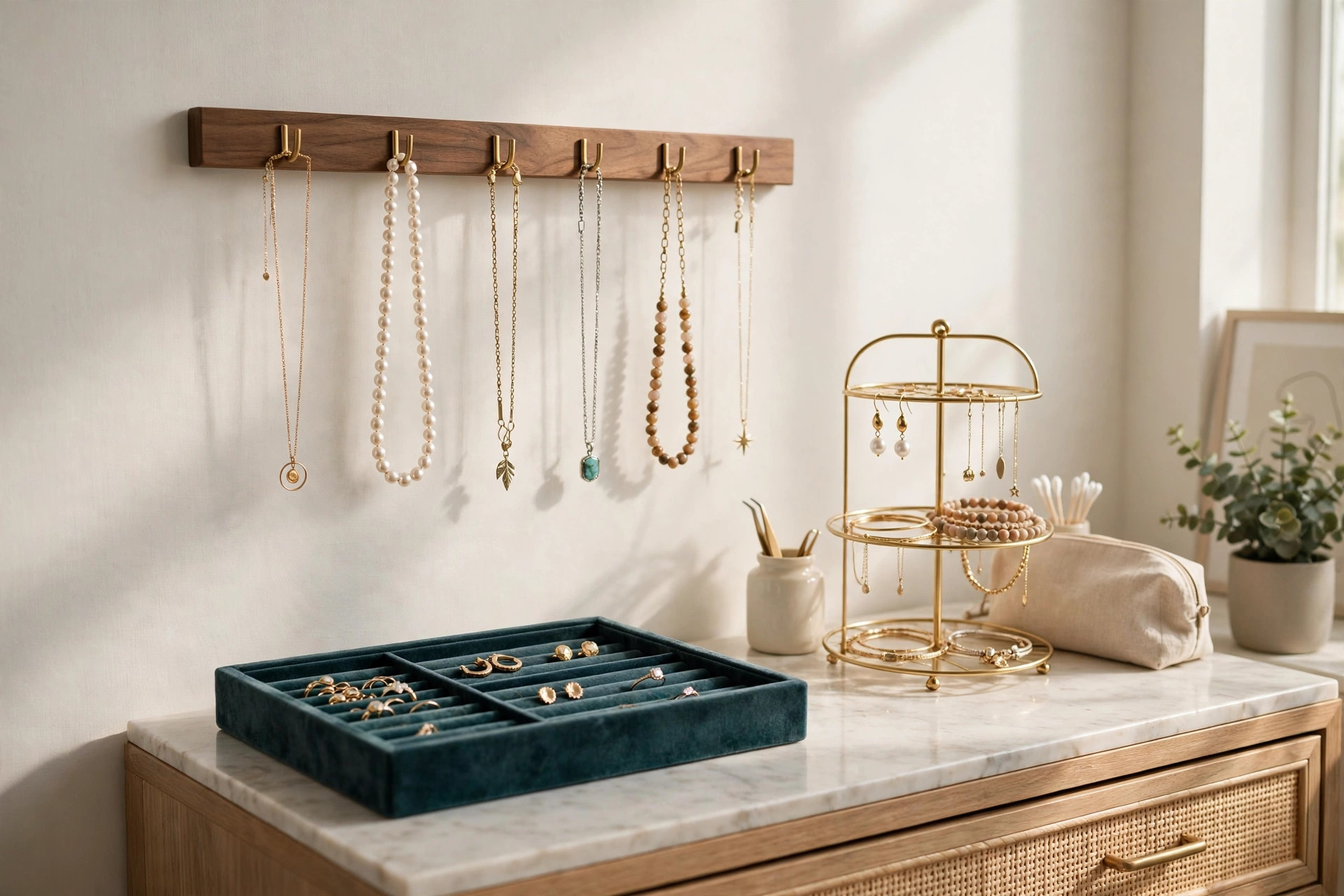
1. A wall-mounted necklace bar with hooks — necklaces hang straight, never tangled
A necklace in a drawer is a necklace in a knot, because the chain that lies loose is the chain that twists around the next one and the next one after that. Hang the necklaces on a wall-mounted bar with hooks — necklaces hang straight, never tangled — so each chain hangs on its own hook and gravity keeps it straight. Screw a slim bar to the wall above the vanity, space the hooks a few inches apart, and hang one necklace per hook, because the hook that holds one chain is the hook that never knots. Keep the longest necklaces at the ends and the shortest in the middle, so nothing overlaps, and put the bar at eye height, because the bar you can see is the bar you use. One bar, a row of hooks, and the necklaces stop knotting.
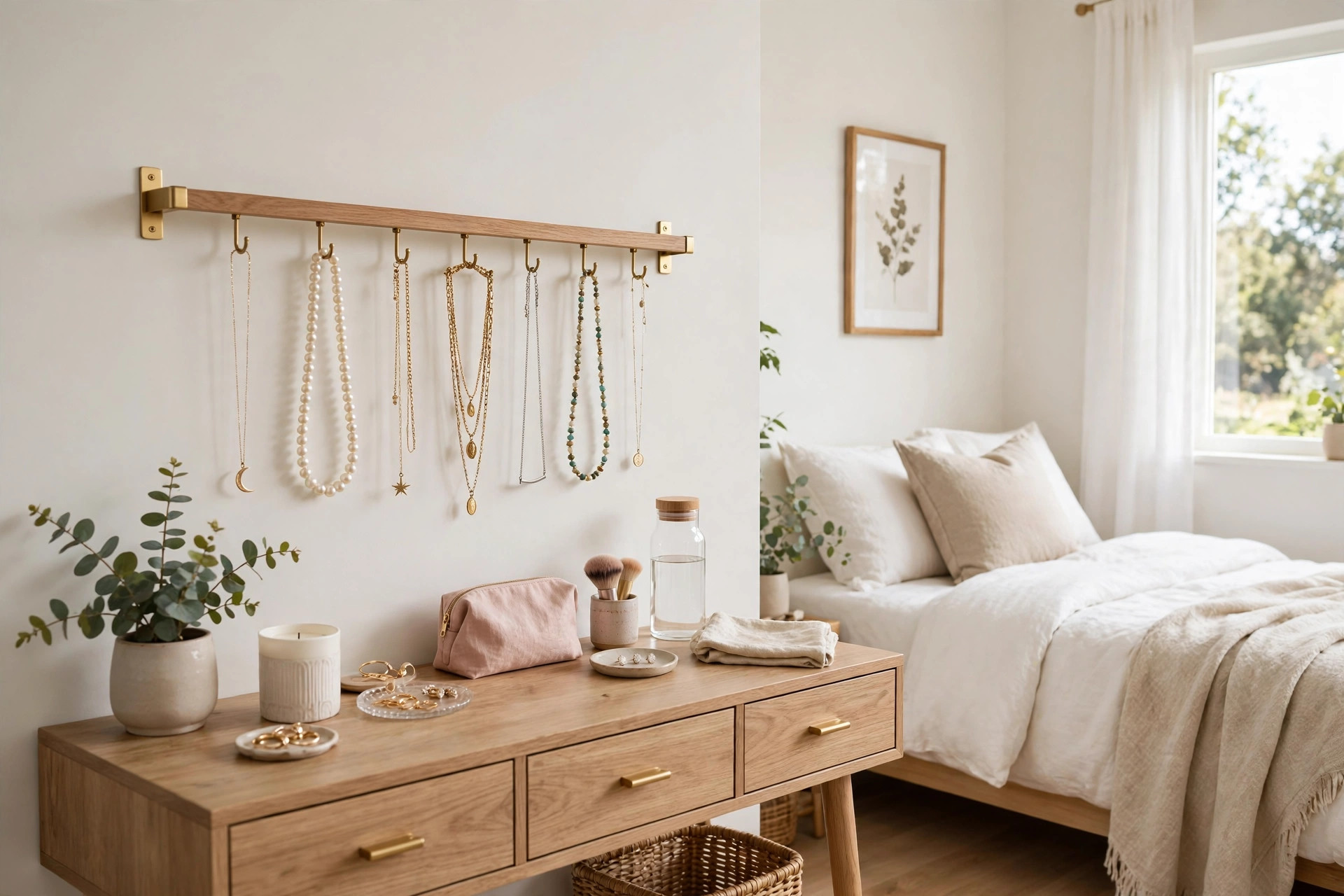
2. A tiered jewelry stand — necklaces on top, bracelets below, earrings at the base
A vanity with jewelry in three places is a vanity you have to search, because the necklaces are here, the bracelets are there, and the earrings are somewhere else entirely. Build a tiered stand — necklaces on top, bracelets below, earrings at the base — so the whole everyday set lives in one place and getting dressed takes half the time. Use a stand with a tall post and two or three tiers, hang the necklaces from the top hooks, slide the bracelets onto the middle tier, and keep the studs in a small dish at the base, because the tier that holds one kind of jewelry is the tier that finds it fast. Keep the stand small, so it fits on the vanity without crowding the mirror, and choose one in a finish that matches the room, because the stand that matches is the stand that looks bought. (Check on Amazon for a tiered jewelry stand in gold or wood, which holds necklaces, bracelets and earrings in one place.) One stand, three tiers, and the everyday set lives together.
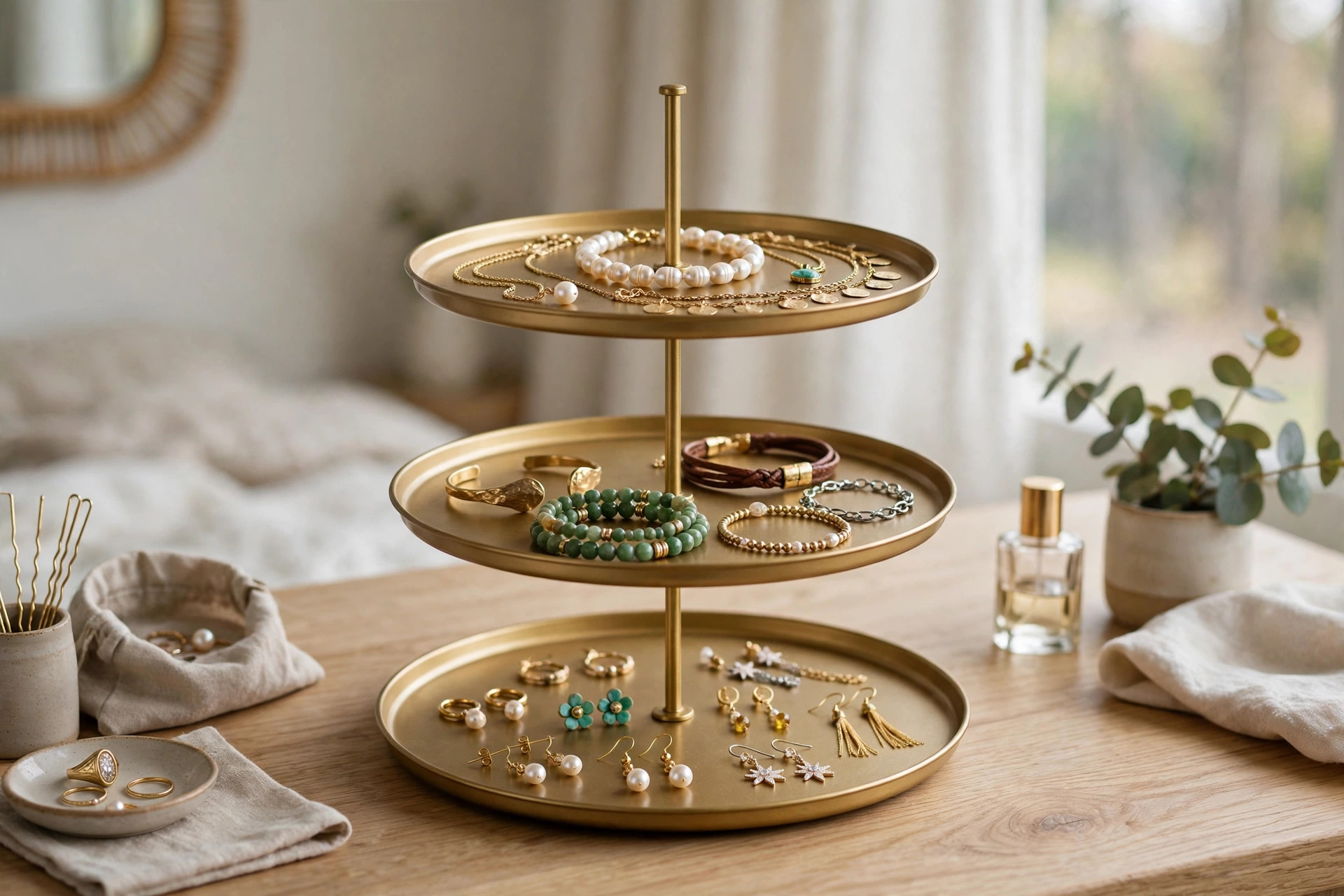
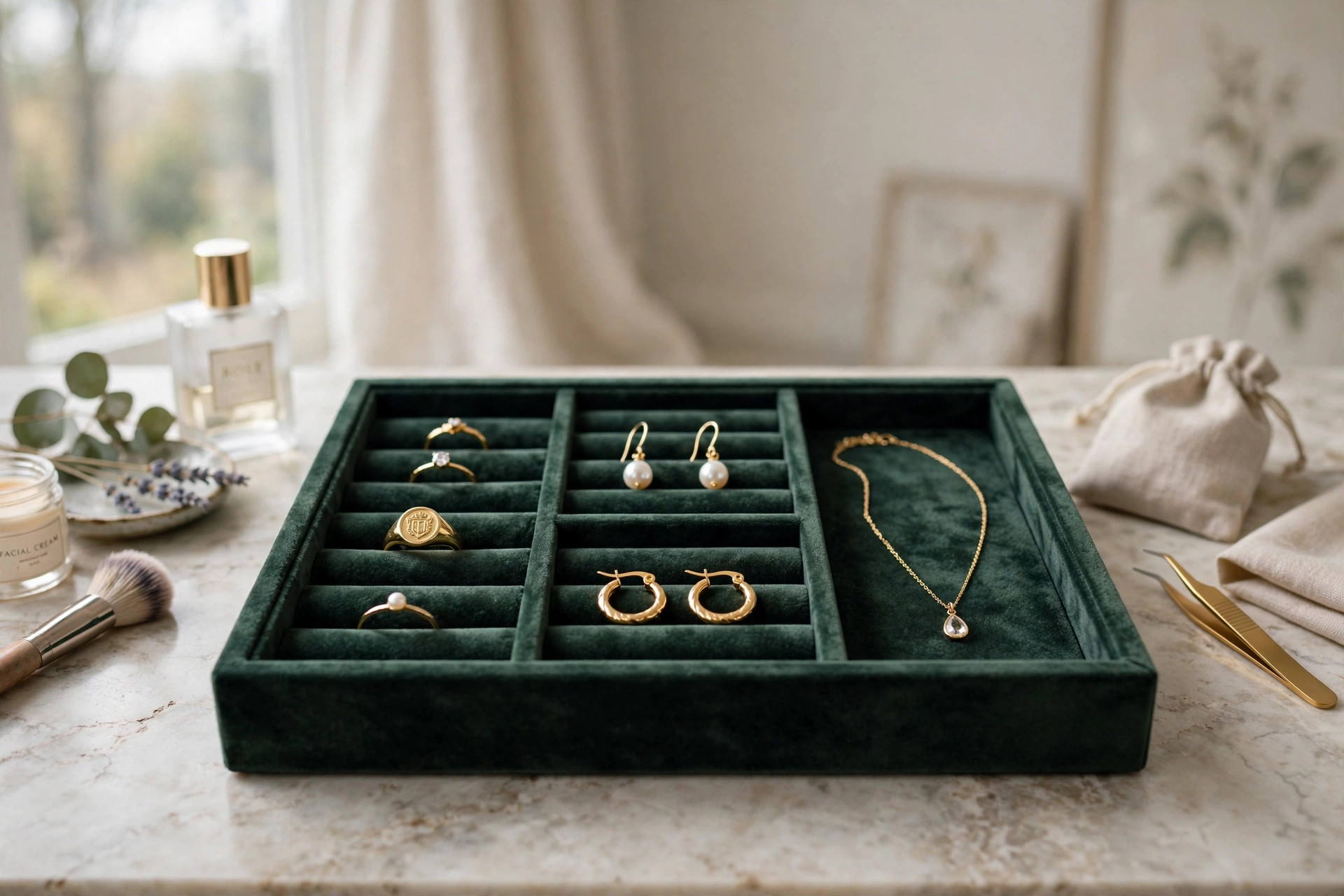
3. A velvet-lined tray with compartments — one tray, every piece in its own slot
Small pieces loose in a drawer get scratched, because the earrings that touch the rings are the earrings that mark them and the rings are the things that show it first. Line a tray with velvet and divide it into compartments — one tray, every piece in its own slot — so each piece lies on soft fabric and never touches another. Cut the velvet to fit, glue it down flat, and add small dividers, because the velvet is the protection and the compartments are the order. Put the rings in one row, the studs in another, and the brooches in a third, because the row that holds one kind is the row that finds it fast. Keep the tray on the vanity, not in the drawer, because the tray you can see is the tray you use, and the pieces you can see are the pieces you wear. Velvet in a tray, and the small pieces stay safe and sorted.
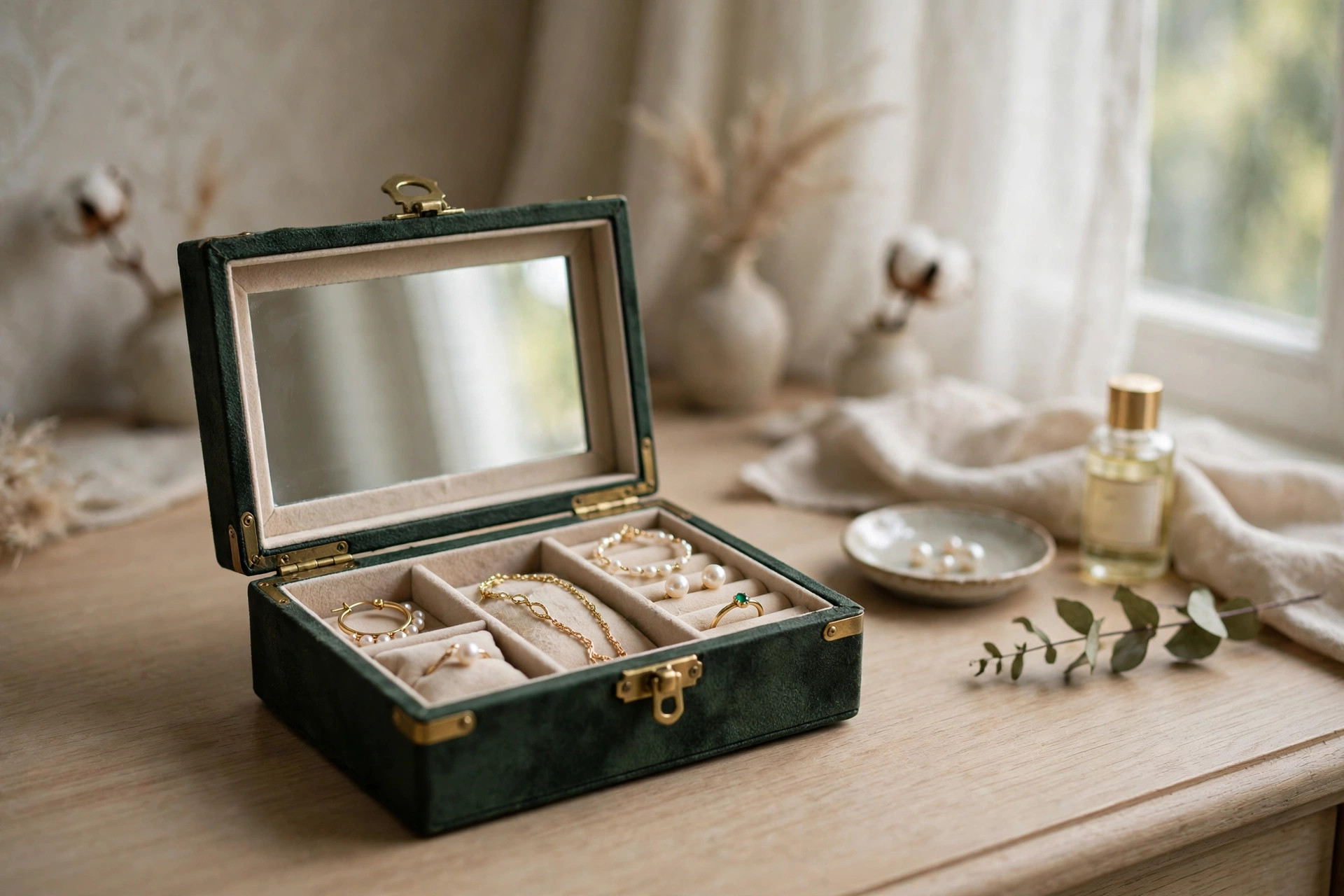
4. A small lidded jewelry box with a mirror — the box that lives on the vanity
A jewelry box with no lid gathers dust, because the dust is the thing that settles on everything left out and the jewelry is the thing that shows it first. Use a small lidded box with a mirror inside — the box that lives on the vanity — so the pieces are protected when you are not wearing them and the mirror is there when you put them on. Open the lid to choose, check the mirror, and close the lid when you leave, because the lid is the dust cover and the mirror is the dressing aid. Keep the box to the pieces you wear most, no more, because the box that holds ten pieces is a box you open and the box that holds fifty is a box you avoid. Choose a box with a velvet lining, so the pieces rest soft, and keep it where your hand reaches when you dress, because the box that is there is the box that gets used. A lidded box with a mirror, and the jewelry stays clean and close.
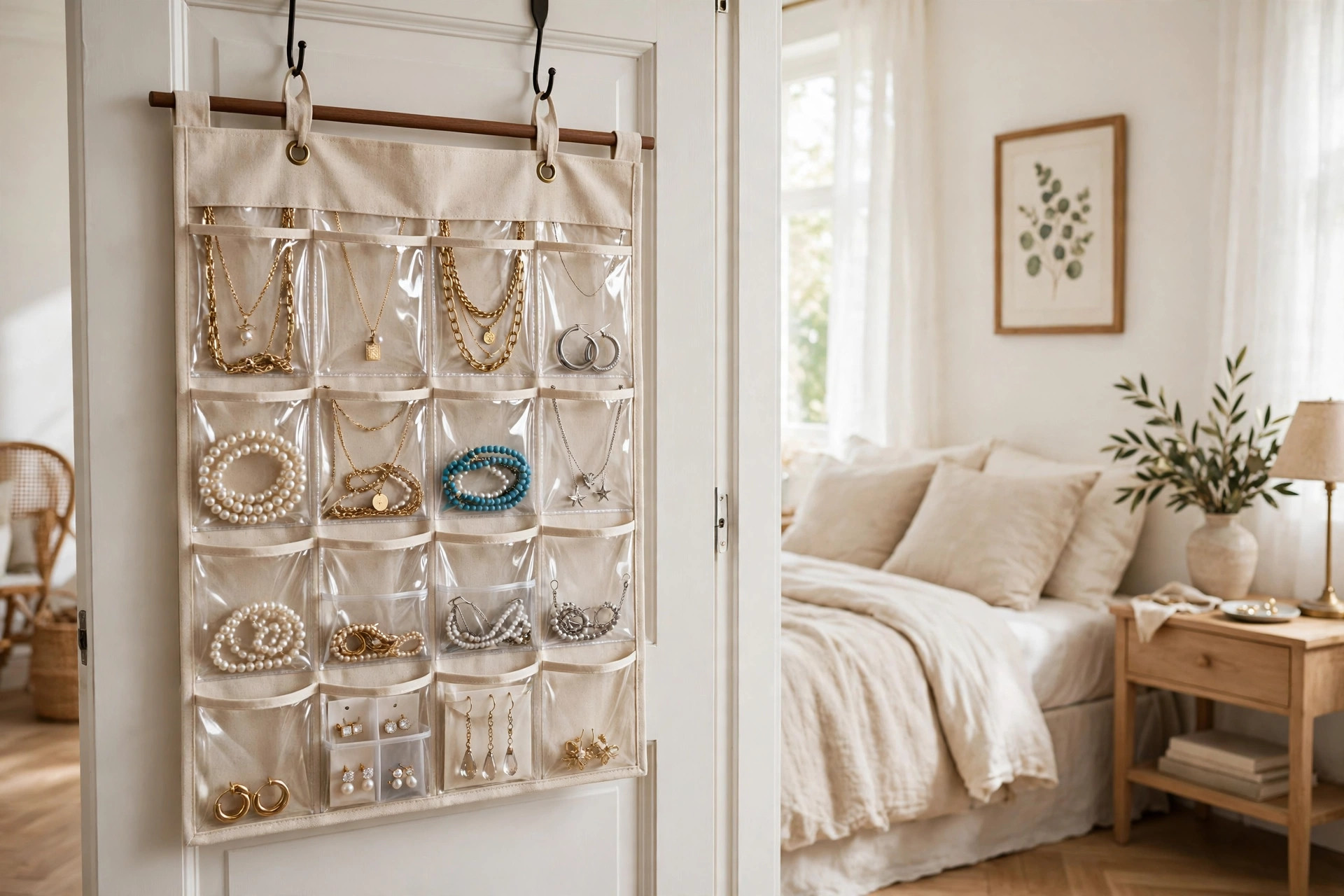
5. A hanging organizer on the closet door — clear pockets, every piece visible at a glance
Jewelry hidden in a box is jewelry forgotten, because the pieces you cannot see are the pieces you do not wear and the pieces you do not wear are the pieces that stay in the box for years. Hang a clear-pocket organizer on the inside of the closet door — clear pockets, every piece visible at a glance — so the whole collection shows itself when the door opens. Slip one necklace into each pocket, one pair of earrings per pocket, and the bracelets into the wider pockets at the bottom, because the pocket that holds one piece is the pocket that never tangles. Keep the organizer on the door you open to dress, because the door you open is the door that shows the jewelry, and the closet the organizer hangs in is in 26 Small Walk-In Closet Organization Ideas for 2026, so the dressing area matches the display. Clear pockets on a door, and nothing stays hidden.
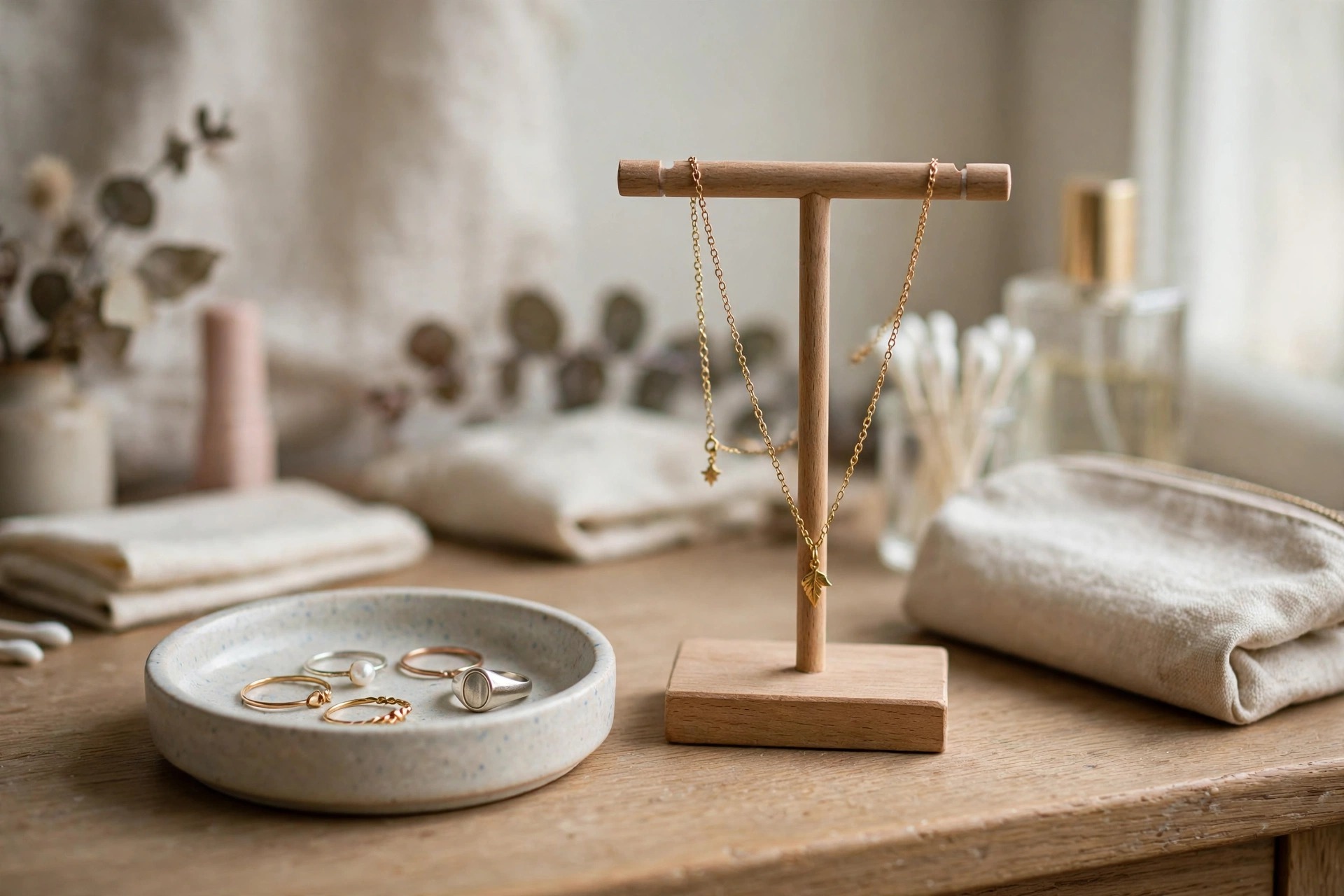
6. A ring dish beside the necklace stand — rings and necklaces in one spot
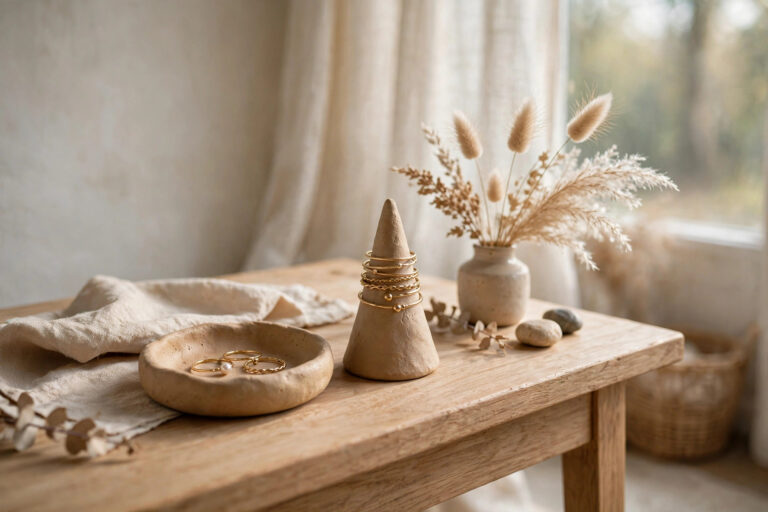
A ring with no dish is a ring on the counter, because the ring you take off has nowhere to go and the counter is the place it lands. Put a small ring dish beside the necklace stand — rings and necklaces in one spot — so the rings have a home next to the necklaces and the whole set lives in one place. Choose a dish that matches the stand, one colour and one finish, and put it where your hand reaches when the ring comes off, because the dish that is there is the dish that gets used. Keep the everyday rings in the dish and the rest in the box, because the dish that holds five rings is a dish you use and the dish that holds twenty is a dish you avoid. The rings themselves get their own holders in 16 DIY Ring Holder Ideas for 2026, where a clay dish and a wire tree give every ring a home. One dish beside the stand, and the rings stop wandering.
Necklaces, bracelets and earrings, each with a home
7. A bracelet bar — bracelets slide on, slide off, never in a pile
Bracelets in a pile get tangled and scratched, because the bracelets that touch each other are the bracelets that mark each other and the pile is the thing that hides the one you want. Use a bracelet bar — bracelets slide on, slide off, never in a pile — so each bracelet hangs on its own post and the one you want slides off in a second. Stand the bar on the vanity, slide the bracelets on in the order you wear them, and keep the everyday ones at the front, because the front of the bar is the place your hand reaches first. Choose a bar with a heavy base, so it does not tip when you pull a bracelet off, and keep it short, because the bar that is short is the bar that fits on a crowded vanity. A bar, a row of bracelets, and the pile is gone.
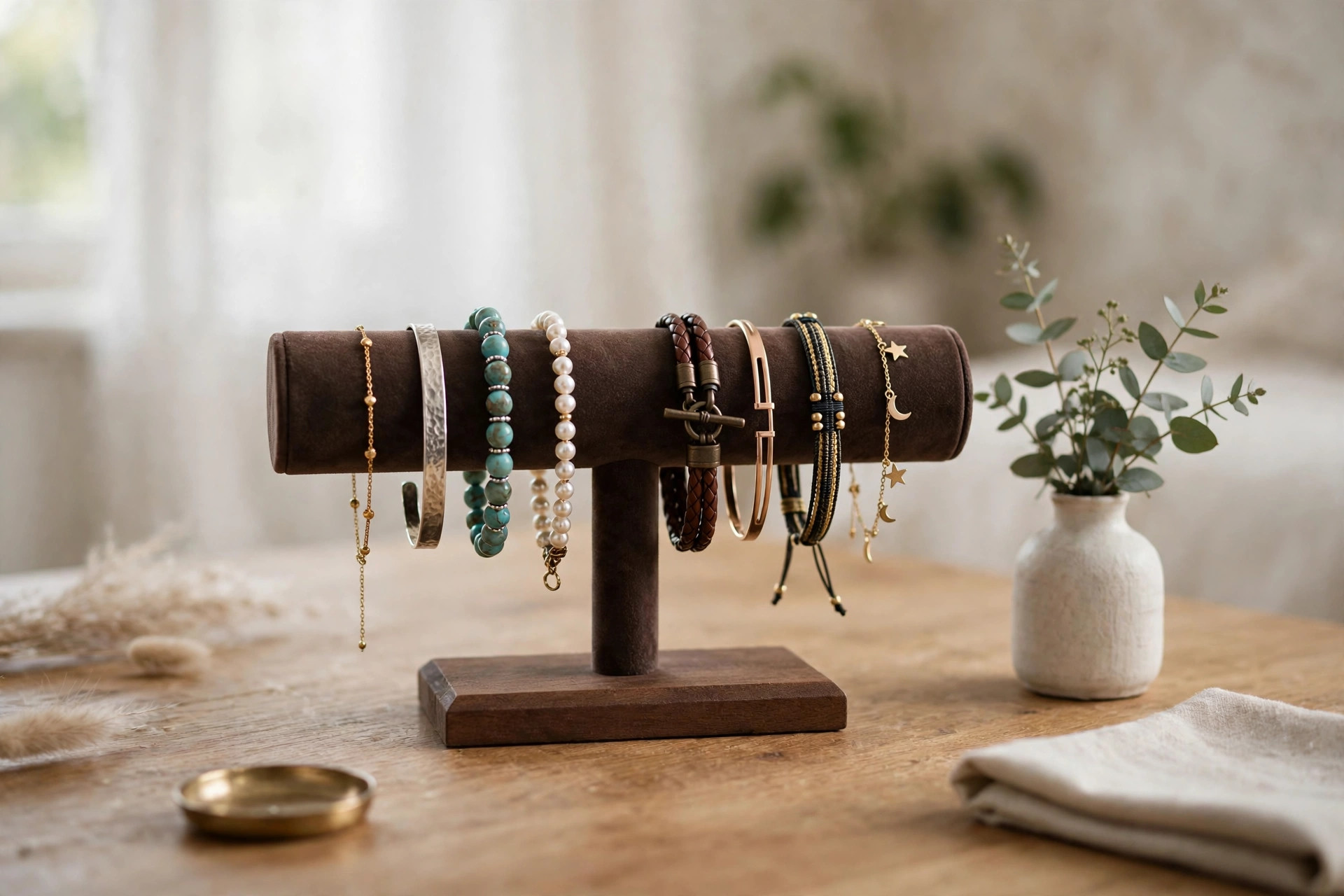
8. A necklace hanger with individual pegs — one peg per necklace, no knots
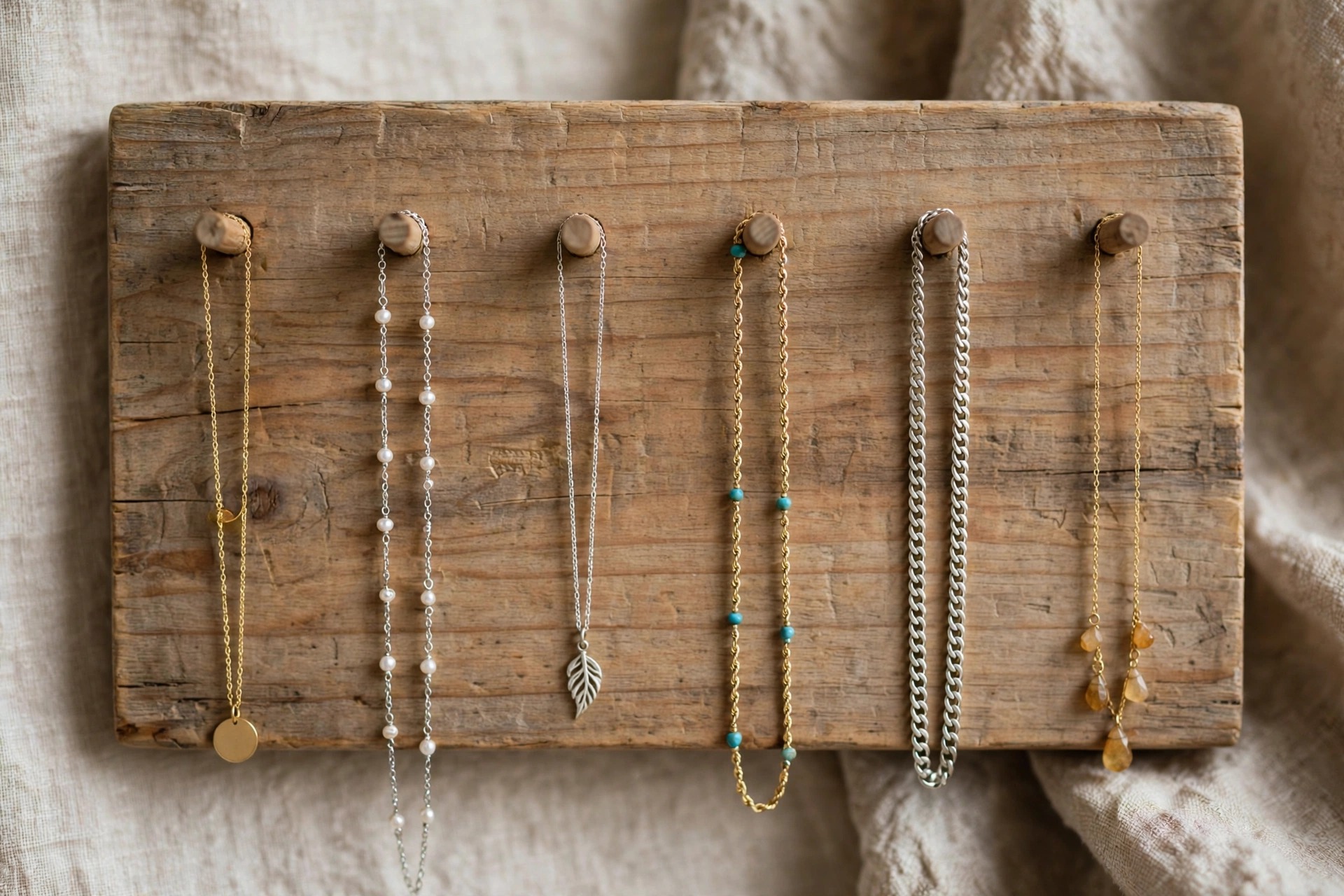
A necklace hung over another necklace is a necklace in a knot, because the chains that touch are the chains that twist together and the knot is the thing that takes ten minutes to undo. Hang each necklace on its own peg — one peg per necklace, no knots — so the chains never touch and the necklace you want lifts off clean. Fix a row of small pegs to a board or a rail, space them a few inches apart, and hang one chain per peg, because the peg that holds one chain is the peg that never knots. Keep the chunky necklaces on the end pegs and the fine chains in the middle, so nothing pulls on anything else, and put the board where you dress, because the board you can reach is the board you use. One peg per necklace, and the knots are gone for good.
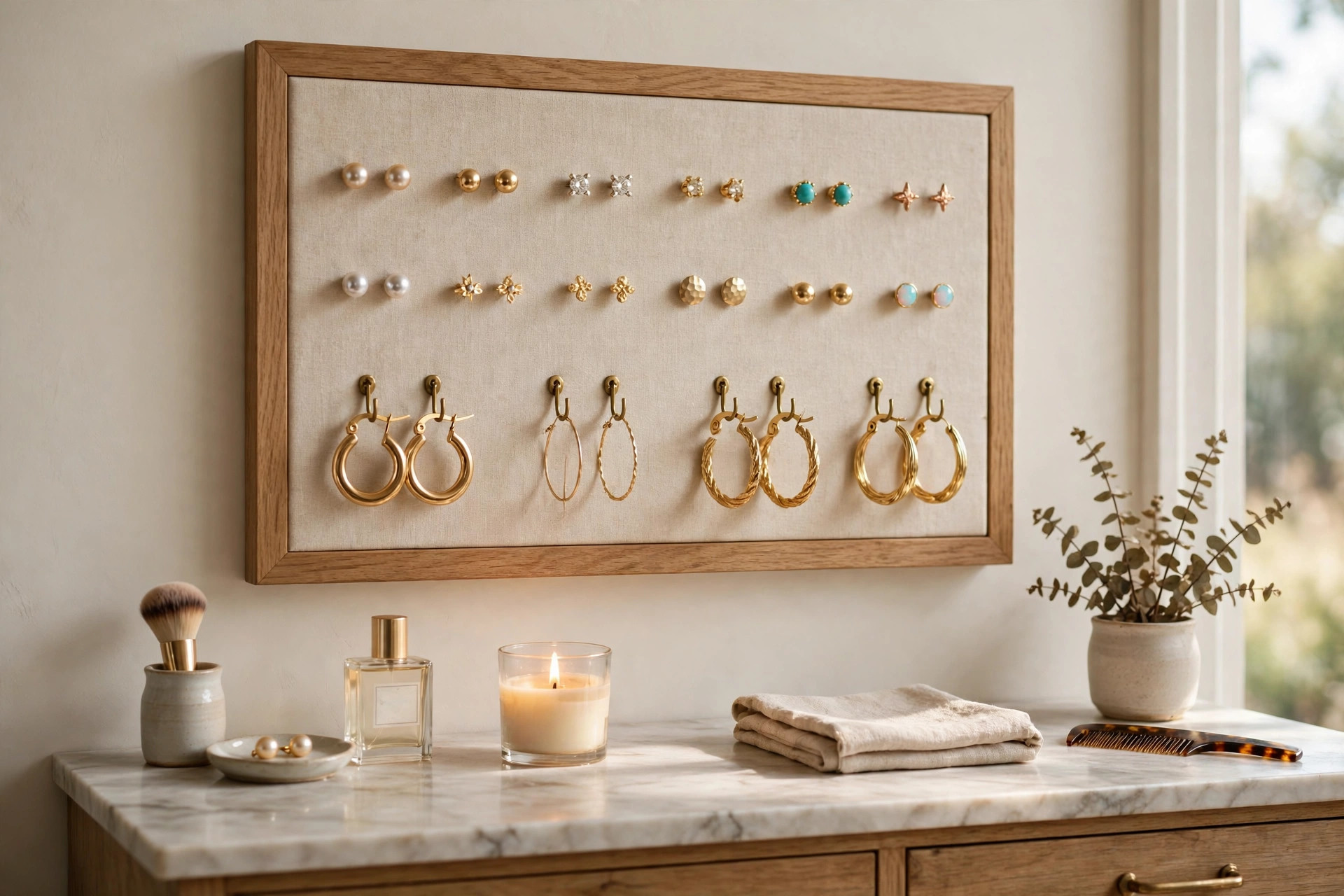
9. An earring board — studs in pairs, hoops on hooks, nothing loose
Earrings loose in a dish lose their partners, because the stud that rolls away is the stud that never comes back and the pair that splits is the pair that never gets worn. Put them on an earring board — studs in pairs, hoops on hooks, nothing loose — so every earring has a place and every pair stays a pair. Push the studs through the board in pairs, hang the hoops on small hooks underneath, and keep the dangly earrings on longer hooks at the edges, because the board that holds pairs is the board that keeps them together. Keep the board on the vanity wall, at eye height, so you can see the whole collection and choose in seconds, and paint it a colour that matches the room, because the board that matches is the board that looks like a display. A board for earrings, and no pair ever splits again.
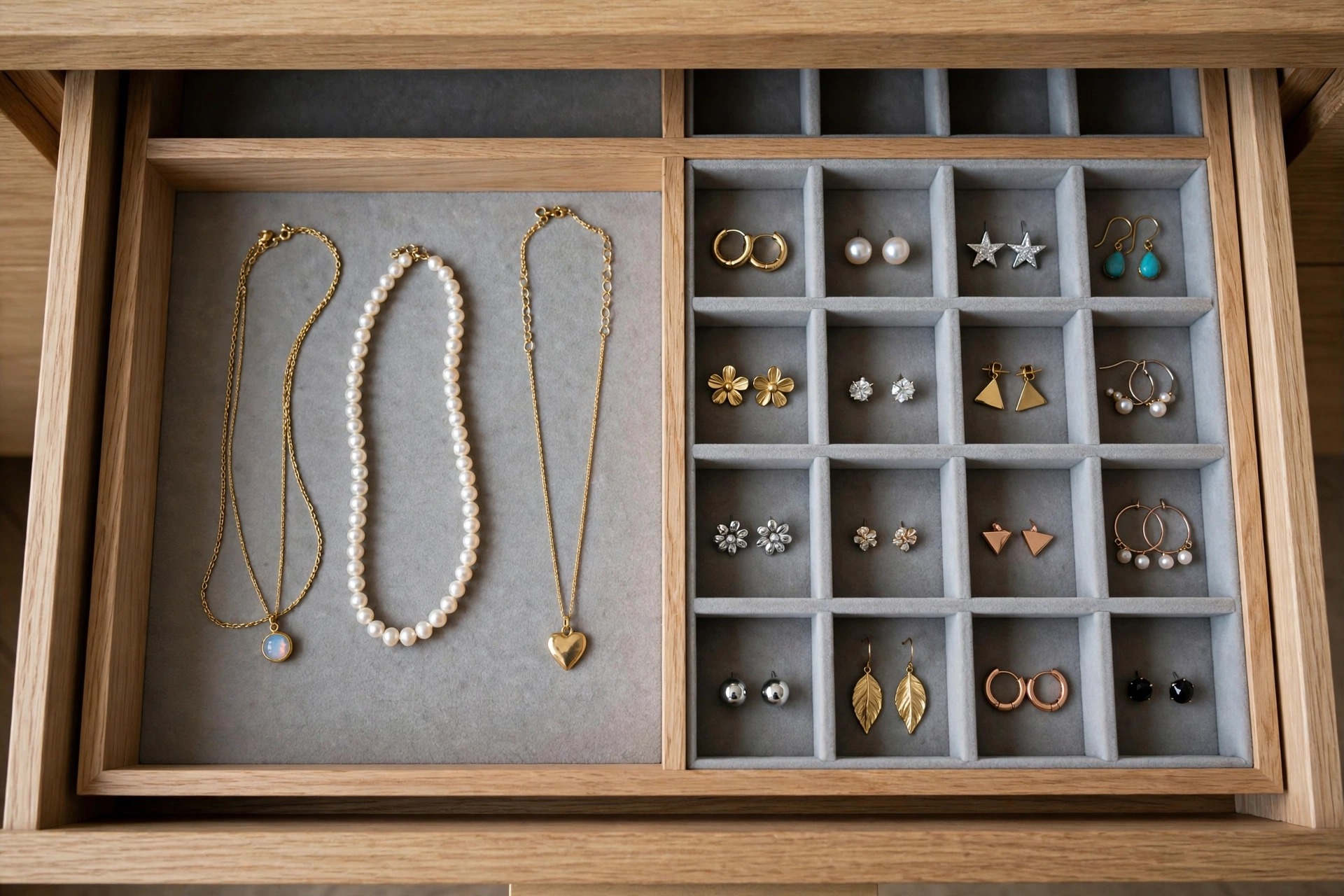
10. A small drawer with dividers — the drawer that holds the everyday set
A drawer with no dividers is a drawer where everything mixes, because the necklaces slide into the earrings, the earrings slide under the bracelets, and the whole drawer becomes one tangled pile. Add dividers — the drawer that holds the everyday set — so each kind of jewelry has its own section and the drawer opens to order. Measure the drawer, cut the dividers to fit, and give the necklaces the long section, the bracelets the wide one, and the earrings the small squares, because the section that fits one kind is the section that finds it fast. Keep the drawer to the pieces you wear every week, no more, because the drawer that holds the everyday set is the drawer you open and the drawer that holds everything is the drawer you avoid. Line the dividers with velvet, so the pieces rest soft, and the drawer stays a drawer you love to open.
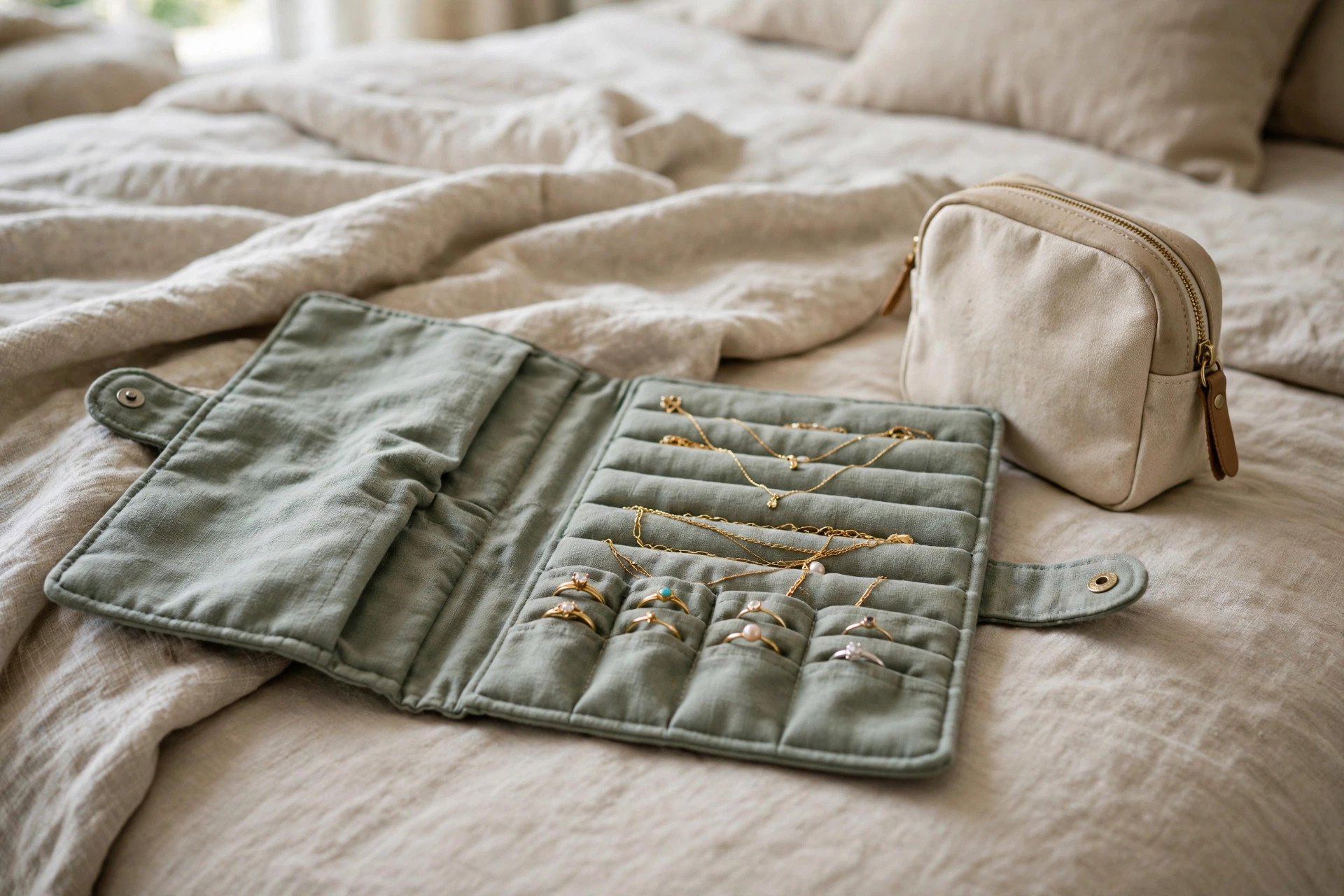
11. A travel jewelry roll — the roll that keeps chains from knotting in a bag
Necklaces loose in a bag come home in a knot, because the bag is the thing that throws them around and the chains are the things that have no protection. Roll them into a travel jewelry roll — the roll that keeps chains from knotting in a bag — so each chain lies in its own slot and arrives the way it left. Lay the necklaces flat in the roll, one per slot, tuck the rings into the pockets, and roll it up tight, because the roll is the shape that fits in a bag and the slots are the thing that keeps the chains apart. Keep the roll in the handbag or the overnight bag, and never let the jewelry travel loose again, because the necklace that travels loose is the necklace that comes home knotted. The bag the roll travels in is in 22 Purse Storage Ideas for 2026, where the handbag gets its own compartments first. (Check on Amazon for a travel jewelry roll in velvet with slots and pockets, if you would rather buy the roll than sew it.) A roll in the bag, and the jewelry travels safely.
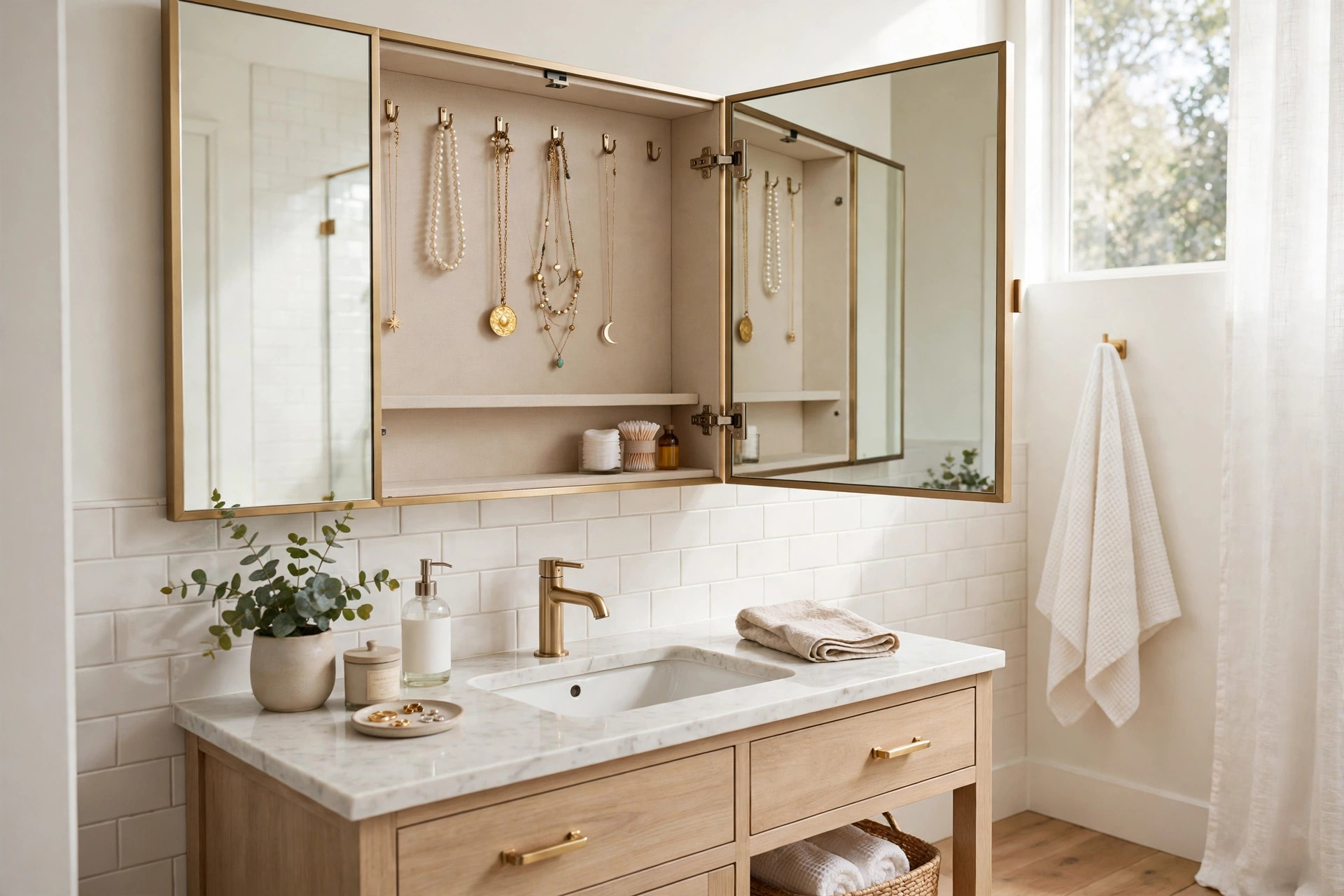
Pretty displays for the vanity
A vanity with no free surface is a vanity with no room for a stand, because the surface is the thing that is already full. Hide the jewelry behind the mirror — the mirror that opens to a cabinet — so the storage lives on the wall and the surface stays free. Hang a mirror cabinet above the vanity, with hooks inside for the necklaces and small shelves for the earrings, and open it to choose, because the mirror is the dressing aid and the cabinet is the storage. Keep the everyday pieces on the inside hooks, so they are the first thing you see when the mirror opens, and keep the mirror clean, because the mirror that is dusty is the mirror that dulls the jewelry. Mount it at eye height, so you can see the pieces and reach them without standing on tiptoe, and the vanity gains storage without losing a single inch of surface.
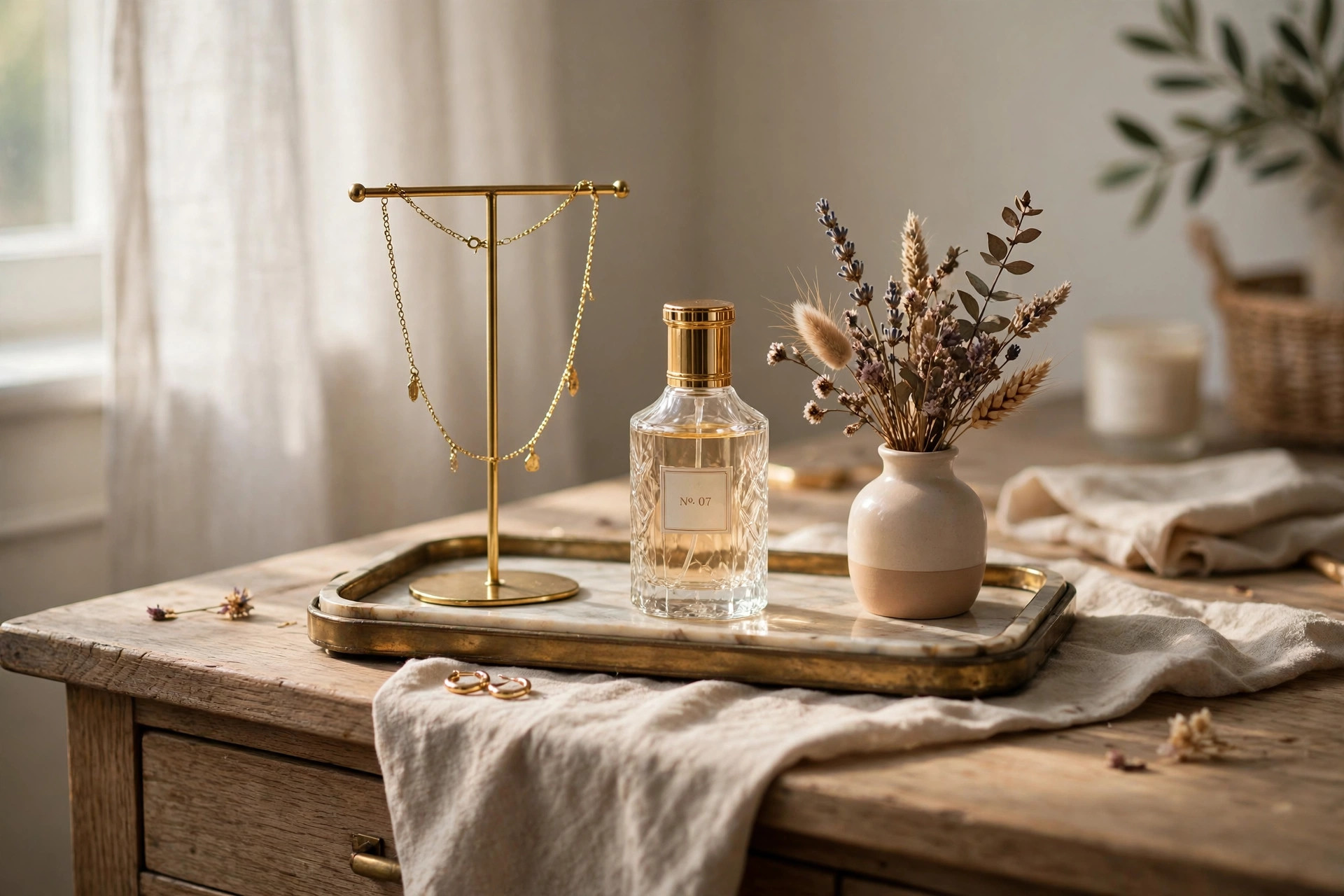
13. A vanity tray with necklace stand, perfume and vase — the whole vanity in one tray
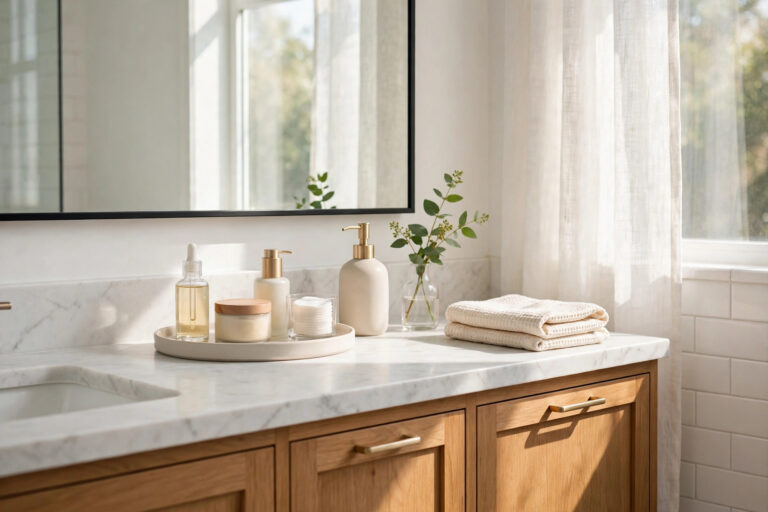
A vanity with things scattered across it looks messy, because the necklace stand is here, the perfume is there, and the vase is somewhere else entirely. Put the whole vanity in one tray — a necklace stand, a perfume bottle and a small vase — so everything lives in one place and the vanity looks styled instead of scattered. Choose a tray that fits the space, put the stand at the back, the perfume in the middle and the vase at the front, because the back is the tall thing and the front is the short thing. Keep the tray to three things, no more, because the tray that holds three things is a display and the tray that holds ten is a pile. The counter the tray sits on is in 25 Bathroom Counter Organization Ideas for 2026, where the counter gets a home for everything that lives by the sink. One tray, three things, and the vanity looks finished.
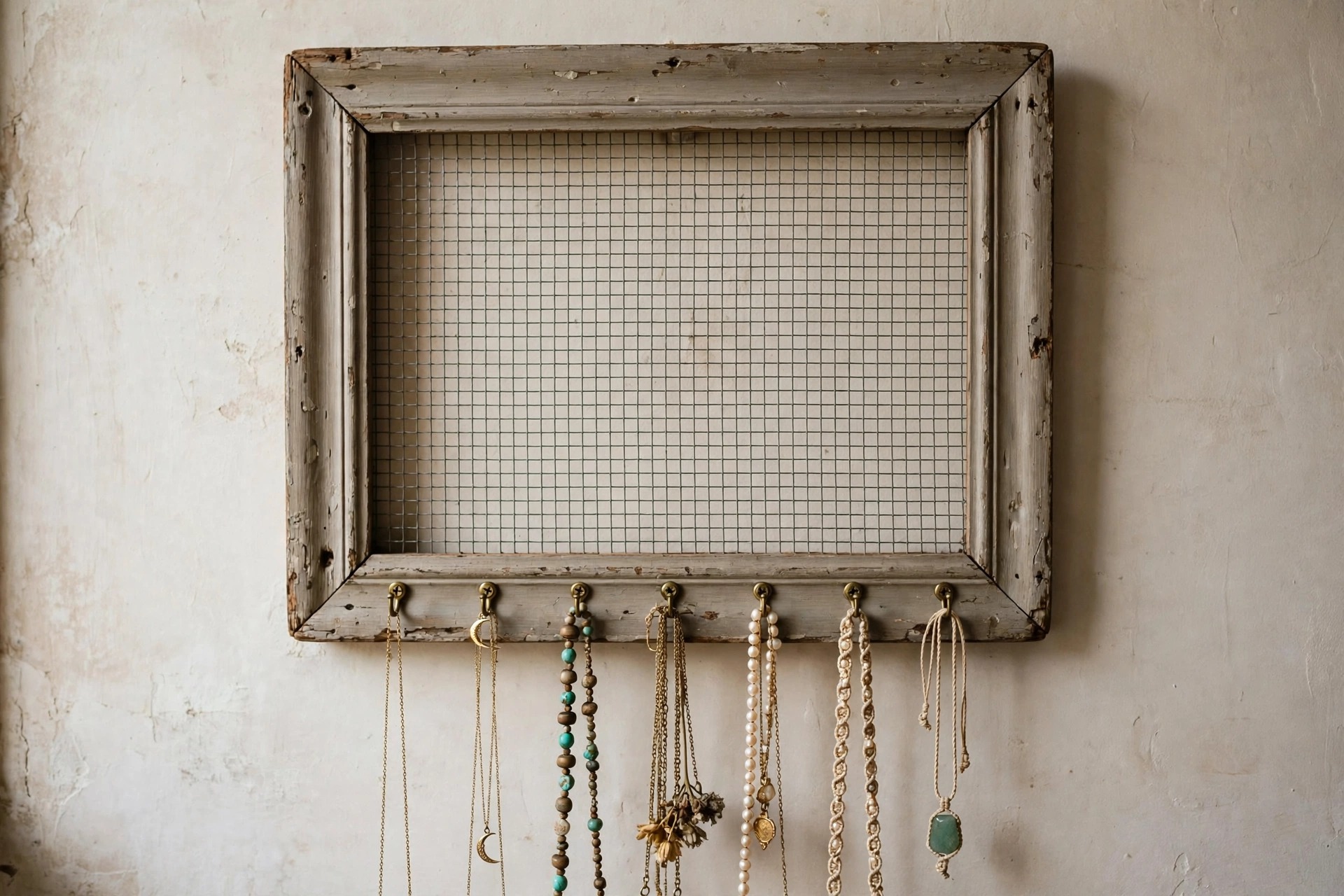
14. A framed jewelry display — necklaces on a pretty frame on the wall
A bare wall above the vanity is a wall doing nothing, because the wall you do not use is the wall that stays empty while the jewelry hides in a box. Turn it into a display — necklaces on a pretty frame on the wall — so the jewelry becomes the decoration and the wall earns its keep. Stretch mesh or fabric across an old picture frame, add small hooks, and hang the necklaces in a row, because the frame is the display and the hooks are the holders. Choose a frame with a colour you love, gold or white, because the frame you love is the frame you keep on display, and hang it at eye height, because the frame you can see is the frame you use. Keep the everyday necklaces on the frame and the rest in the box, because the frame that holds ten is a display and the frame that holds fifty is a clutter. A frame on the wall, and the jewelry is the art.
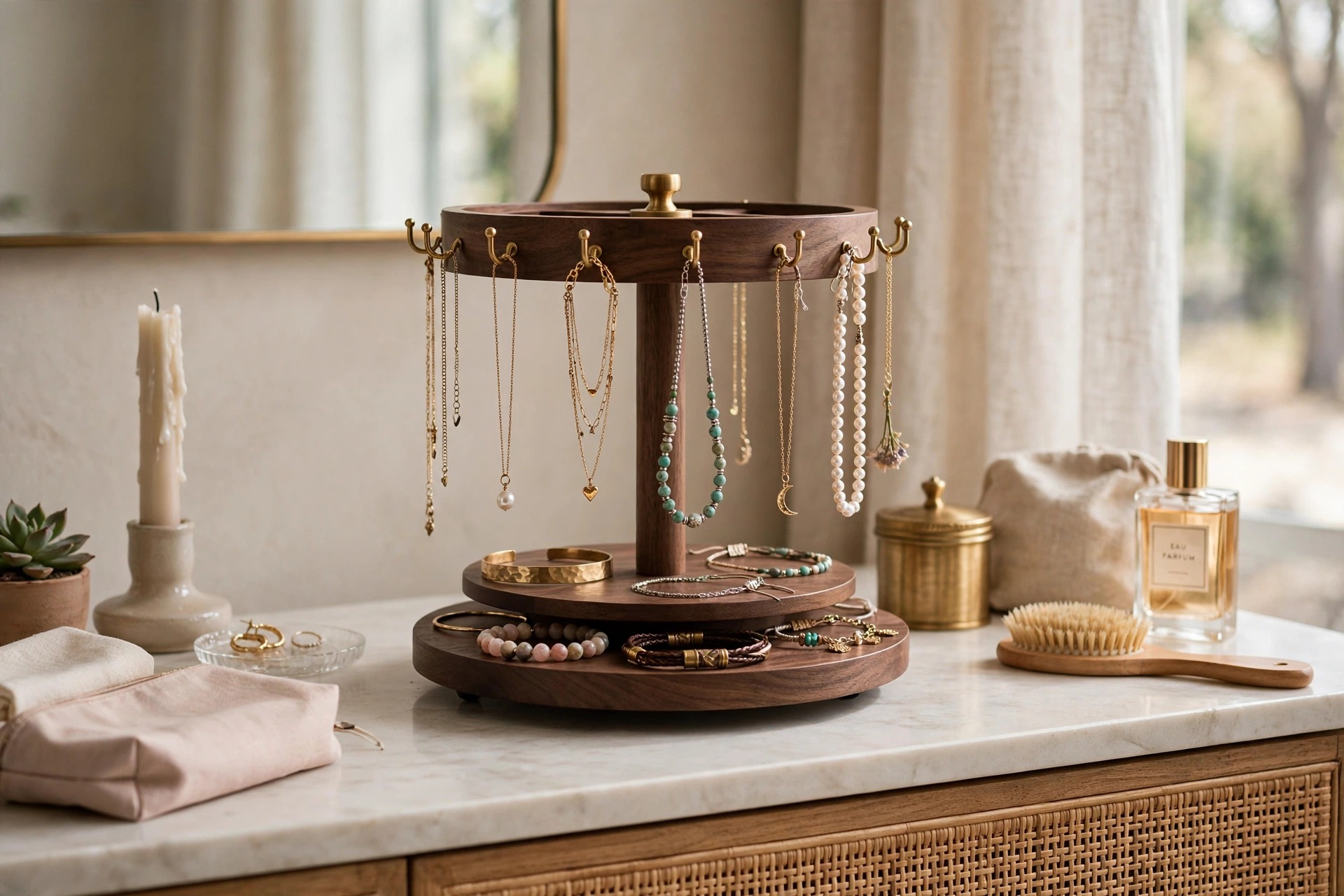
15. A rotating jewelry stand — spin to find the necklace you want
A jewelry stand with the piece you want at the back is a stand you have to reach around, because the necklaces at the front are the necklaces in the way and the one you want is always behind them. Use a rotating stand — spin to find the necklace you want — so the whole collection turns to you and the piece you want comes to the front. Put the necklaces on the hooks around the stand, the bracelets on the lower tier, and spin it gently, because the stand that turns is the stand that shows everything. Choose a stand with a smooth, steady spin and a heavy base, so it does not wobble when you turn it, and keep it small, because the stand that is small is the stand that fits on a crowded vanity. Spin the stand, and the necklace you want is always at the front.
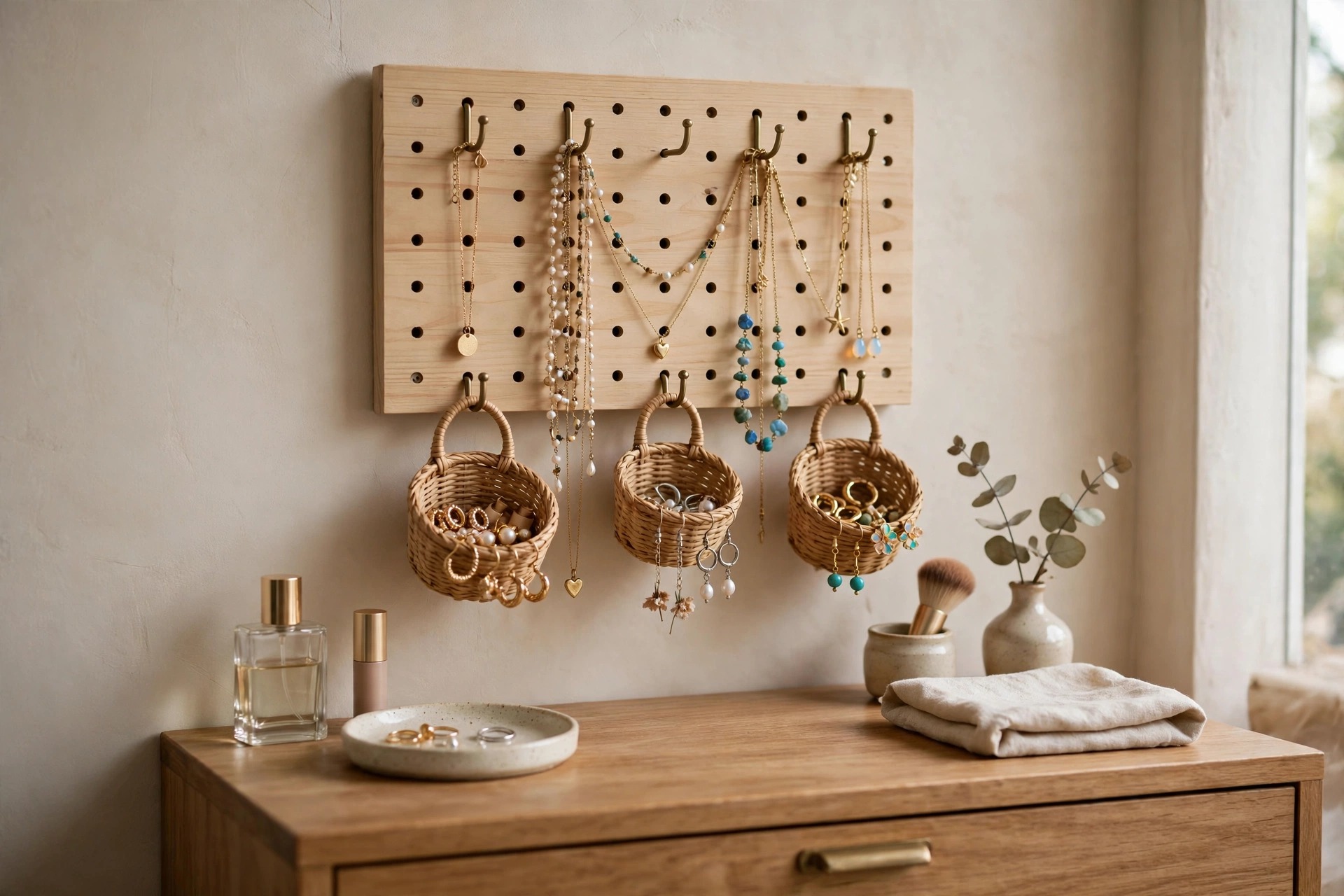
16. A pegboard for jewelry — pegs and hooks above the vanity
A vanity wall with nothing on it is a wall wasting space, because the wall you do not use is the wall that stays empty while the jewelry hides in drawers. Put a pegboard on it — pegs and hooks above the vanity — so the jewelry hangs where you can see it and the drawers stay free. Fix a small pegboard to the wall, add hooks for the necklaces and tiny baskets for the earrings, and arrange the pieces by colour, because the board that shows the collection is the board that gets used. Keep the everyday pieces at eye height, so you can see them and reach them without standing on tiptoe, and paint the pegboard the same colour as the wall, because the board that matches is the board that looks built in. A pegboard above the vanity, and the wall works as hard as the drawers.
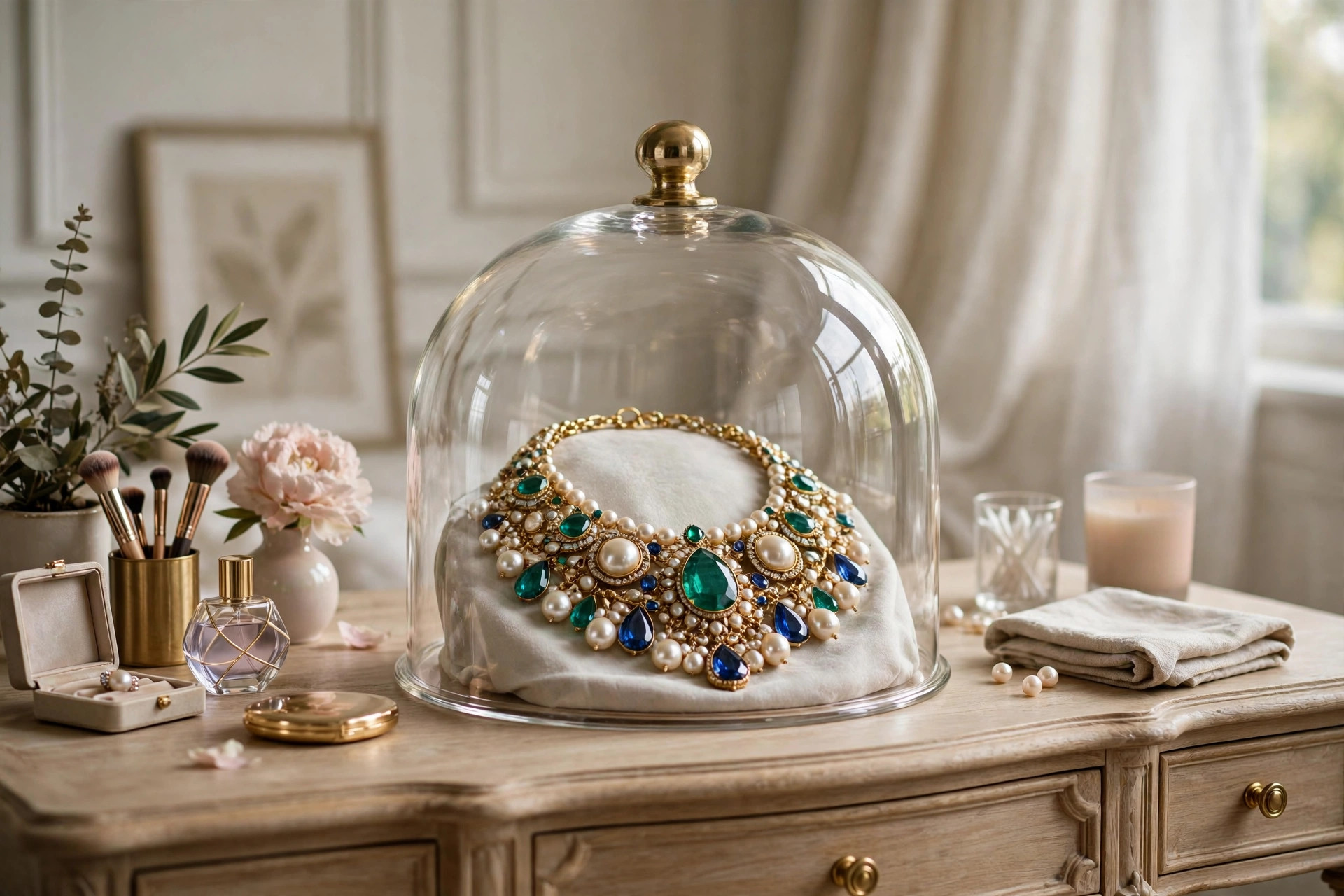
17. A glass cloche for the statement necklace — the necklace on display, dust-free
A statement necklace left out gathers dust, because the dust is the thing that settles on everything left out and the necklace is the thing that shows it first. Put it under a glass cloche — the necklace on display, dust-free — so the piece you love stays visible and clean at the same time. Stand the necklace on a small bust or a velvet pad, lower the cloche over it, and keep it on the vanity where the light catches it, because the cloche is the dust cover and the glass is the display. Lift the cloche to wear the necklace, and put it back when you take it off, because the cloche that goes back on is the cloche that keeps the dust out. Choose a cloche that fits the necklace with room to spare, so the glass never touches the chain, and the statement piece stays a statement. Glass over the necklace, and it shines every day.
Jewelry storage that works harder
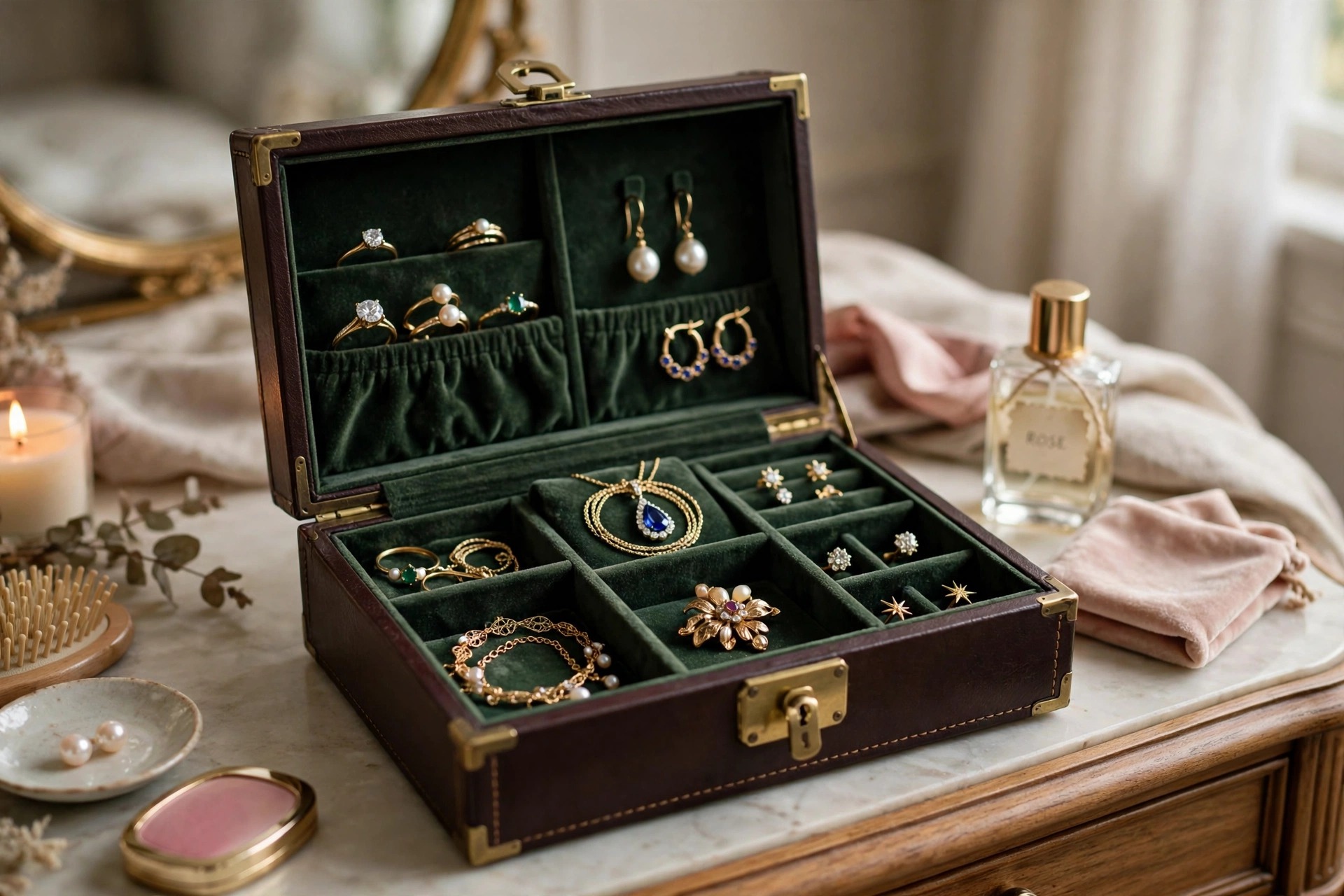
18. A lockable jewelry box — the box that keeps the good pieces safe
The good pieces need more than a tray, because the necklace that cost the most is the necklace that needs the most protection. Use a lockable jewelry box — the box that keeps the good pieces safe — so the pieces you value most are locked away when you are not wearing them. Choose a box with a lock that works smoothly, a velvet lining, and compartments for each kind of piece, because the lock is the security and the compartments are the order. Keep the key somewhere you will remember, not in the box, because the key in the box is the key that locks you out, and open the box only to choose, because the box that stays shut is the box that stays safe. (Check on Amazon for a lockable jewelry box with a velvet lining and a mirror, which holds the good pieces in one safe place.) A lock on the box, and the good pieces stay safe.
19. A jewelry armoire — the tall cabinet that holds the whole collection
A collection that has outgrown the vanity needs a home of its own, because the jewelry that no longer fits on the tray is the jewelry that ends up back in drawers and boxes. Give it an armoire — the tall cabinet that holds the whole collection — so every piece has a place and the vanity keeps only the everyday set. Choose an armoire with hooks for the necklaces, drawers for the earrings, and a mirror on the door, because the hooks are the storage and the mirror is the dressing aid. Keep the everyday pieces on the vanity and the rest in the armoire, because the armoire that holds the collection is the armoire that frees the vanity. Put the armoire in the bedroom, near the mirror, and open it to choose, because the armoire you can reach is the armoire you use. A tall cabinet, and the whole collection has a home.
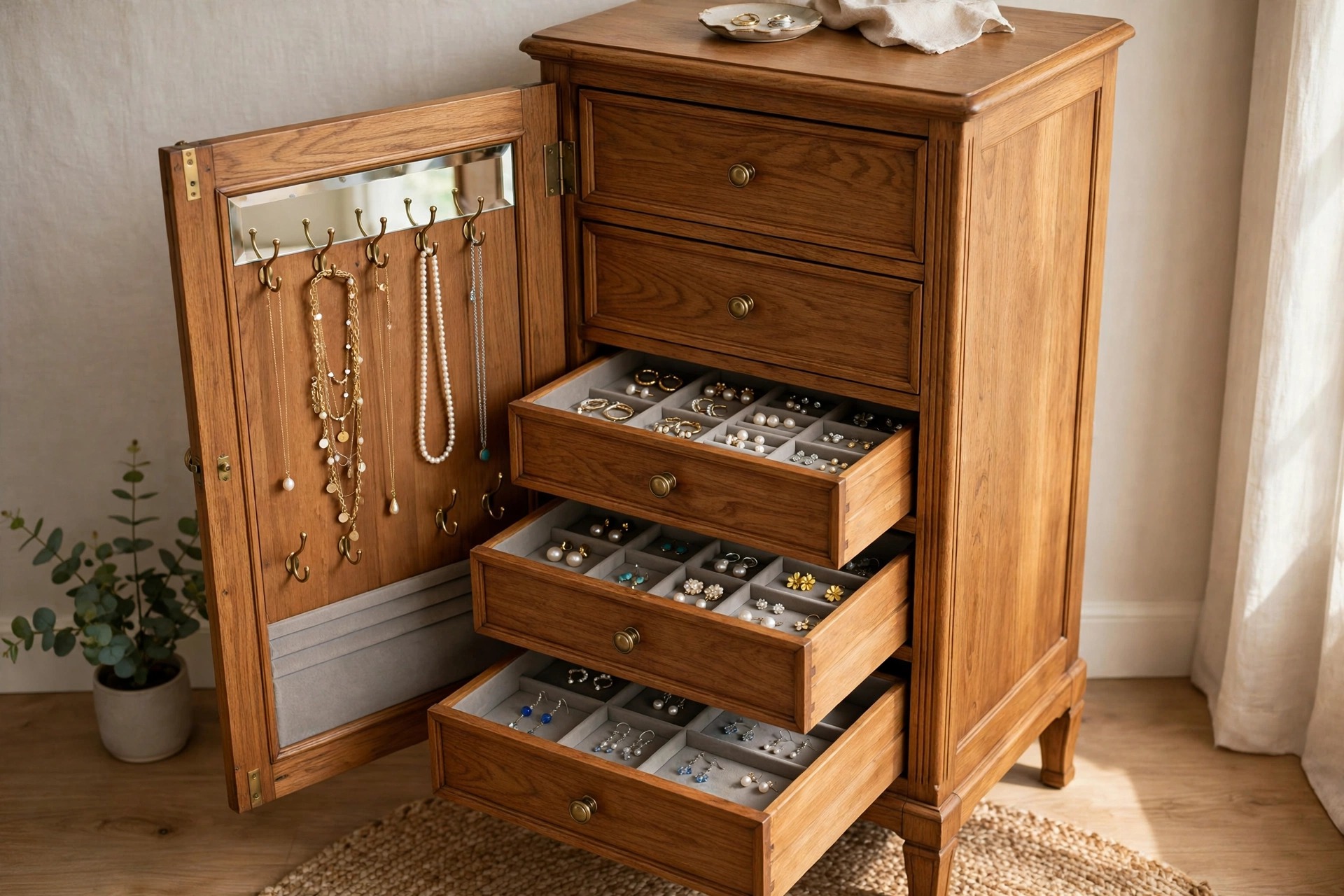
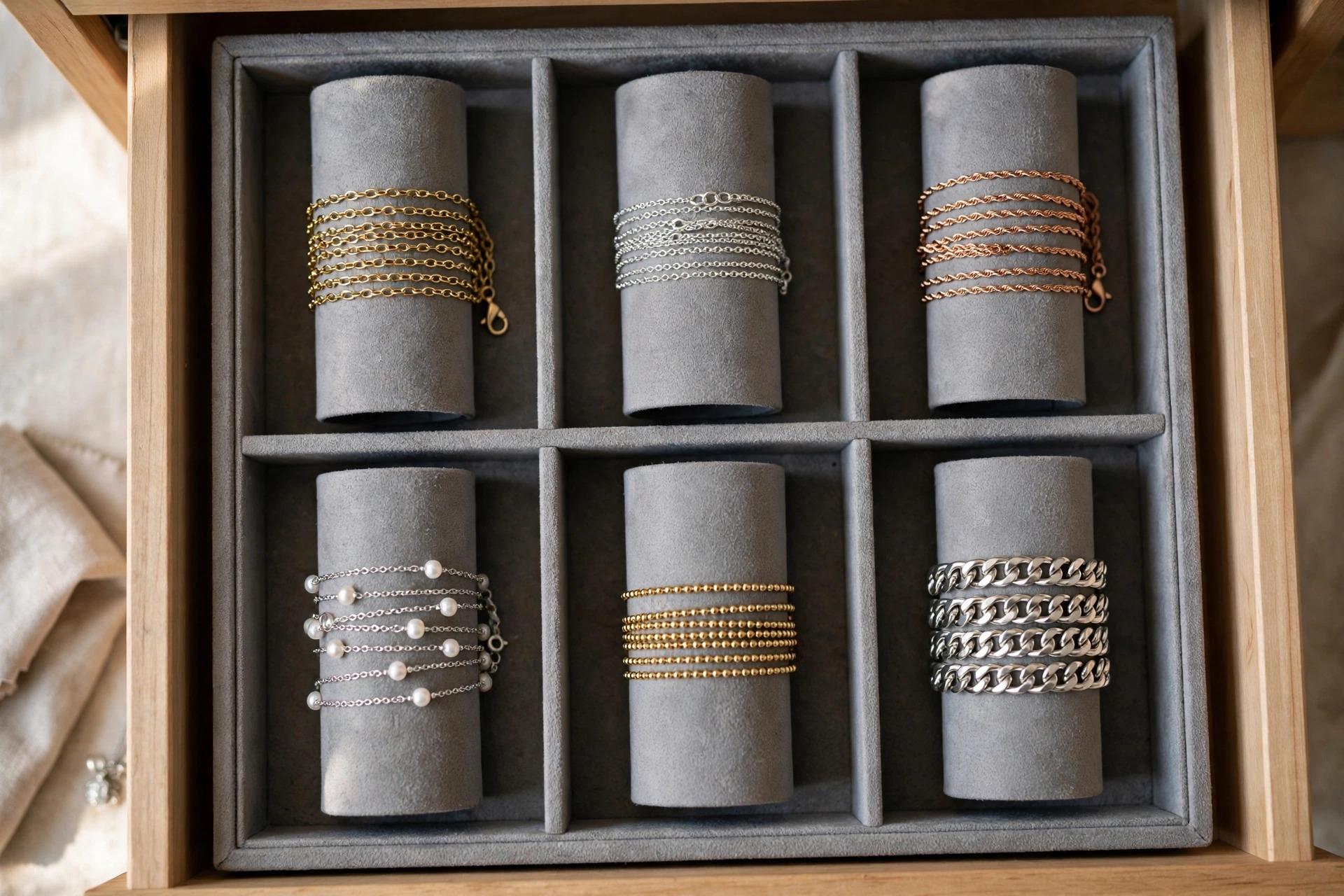
20. A drawer insert with necklace rolls — chains rolled, never tangled
Necklaces in a drawer without rolls are necklaces in a knot, because the chains that lie loose are the chains that twist around each other the moment the drawer closes. Add an insert with necklace rolls — chains rolled, never tangled — so each chain wraps around its own roll and stays straight. Lay the insert in the drawer, wrap one necklace around each roll, and tuck the clasp into the slot, because the roll is the shape that holds the chain and the slot is the thing that keeps the clasp from catching. Keep the insert to the necklaces you wear most, no more, because the insert that holds ten is an insert you use and the insert that holds fifty is an insert you avoid. Line the rolls with velvet, so the chains rest soft, and the drawer opens to order every time.
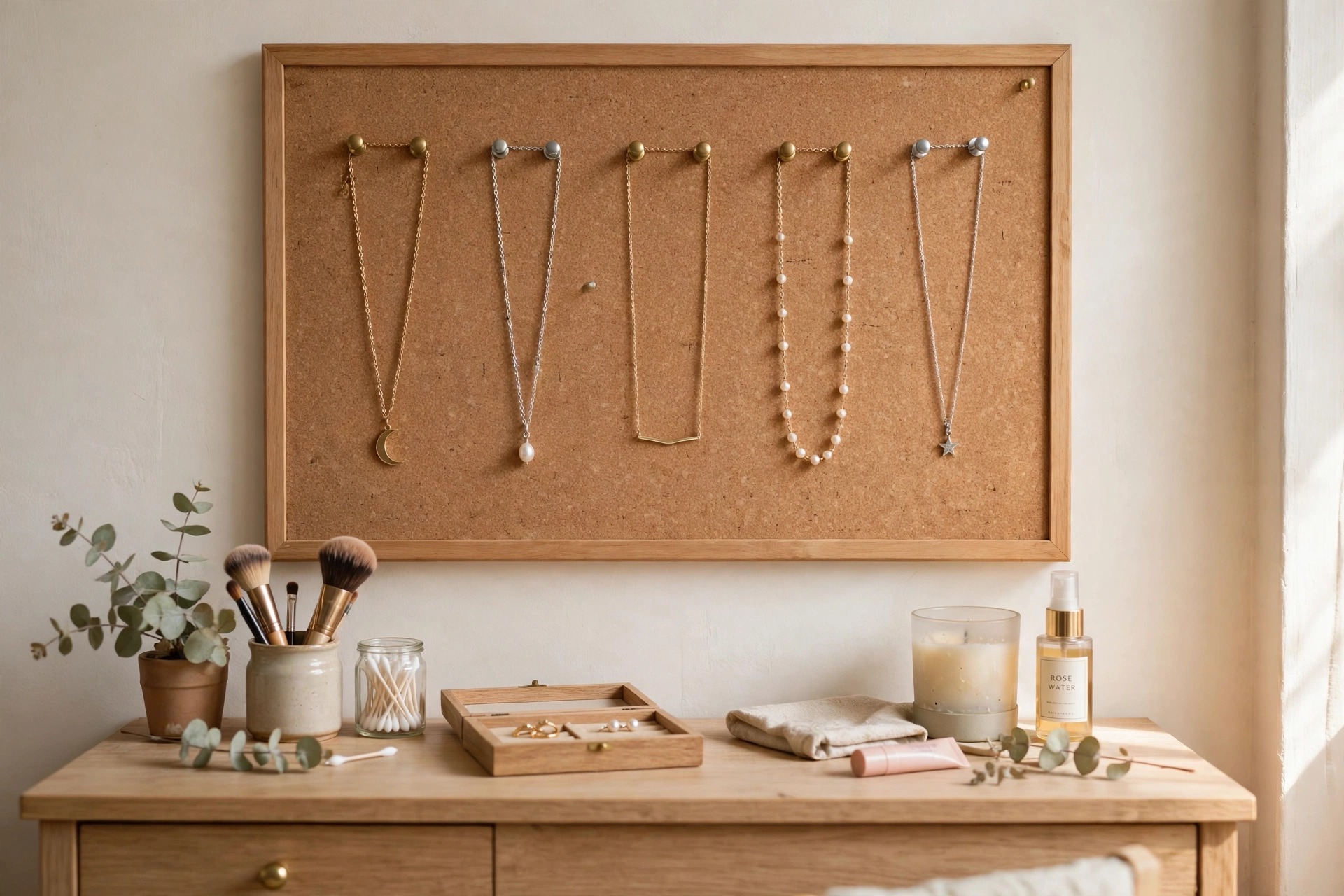
21. A cork board with pins for necklaces — pins hold the chains flat and visible
A necklace hung on a hook swings, because the hook is the thing that lets it move and the chain is the thing that tangles when it swings. Pin the chains flat on a cork board — pins hold the chains flat and visible — so each necklace lies straight against the board and never swings into the next one. Fix a cork board to the wall above the vanity, pin each chain along its length with two or three pins, and arrange the necklaces in a row, because the pin is the holder and the board is the display. Keep the everyday necklaces at eye height, so you can see them and unpin them in seconds, and choose pins with pretty heads, because the pins you like are the pins that look like part of the display. A cork board and pins, and the chains lie flat and still.
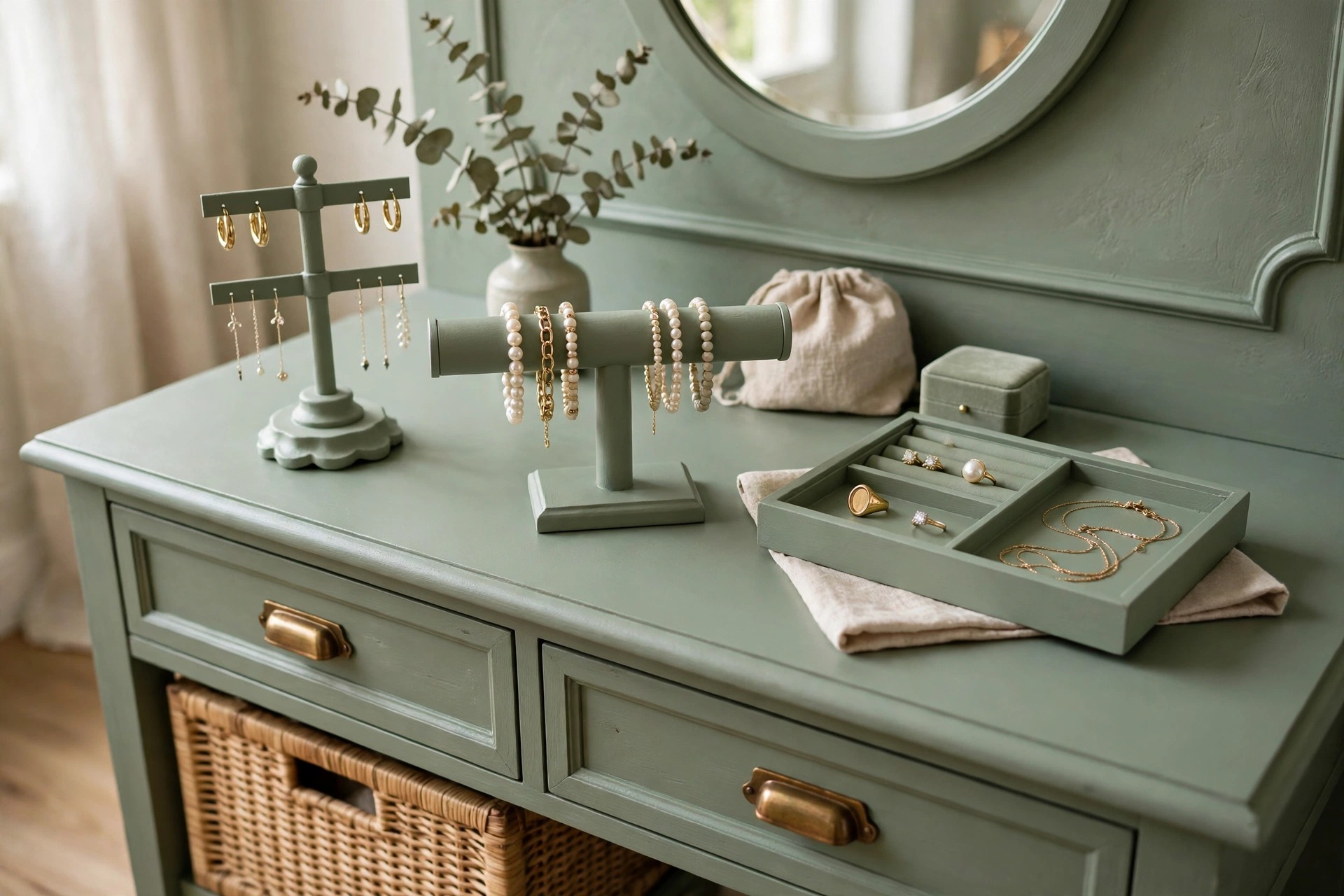
22. A jewelry display painted to match the vanity — one colour, one finish, and the display disappears into the room
A jewelry display in the wrong colour stands out, because the colour that does not match is the colour that shouts. Paint the display to match the vanity — one colour, one finish, and the display disappears into the room — so the stand, the bar and the tray look like they were always there and the vanity reads as one piece. Paint the stand, the bar and the tray the same sage, white or wood tone as the vanity, and use the same finish, matt or gloss, because the finish that matches is the finish that blends. Test the paint on the back of the stand first, because the paint that matches on the back is the paint that matches on the front. Keep the jewelry the only colour on the display, because the jewelry is the display and the stand is the frame. One colour, one finish, and the display belongs to the room.
Which jewelry storage idea fits which situation?
| Situation | Best first move | Budget | Tools needed |
|---|---|---|---|
| Necklaces knotting in a drawer | Wall-mounted necklace bar (idea 1) | Low | Bar, hooks, screws |
| Everyday set scattered | Tiered jewelry stand (idea 2) | Low | Stand |
| Small pieces getting scratched | Velvet-lined tray (idea 3) | Low | Tray, velvet |
| Jewelry forgotten in a box | Hanging organizer on the door (idea 5) | Low | Organizer, hook |
| Bracelets in a pile | Bracelet bar (idea 7) | Low | Bar |
| Earring pairs splitting | Earring board (idea 9) | Low | Board, hooks |
| Jewelry tangling in a bag | Travel jewelry roll (idea 11) | Low | Roll |
| Vanity surface is full | Mirror cabinet (idea 12) | Medium | Mirror cabinet |
| Vanity looks scattered | One tray, three things (idea 13) | Low | Tray |
| Statement necklace gathering dust | Glass cloche (idea 17) | Low | Cloche, bust |
| Good pieces need protection | Lockable jewelry box (idea 18) | Medium | Box |
| Collection outgrew the vanity | Jewelry armoire (idea 19) | Medium | Armoire |
You do not need all 22 ideas. You need the three that solve your collection — usually the wall-mounted necklace bar where the chains hang straight, the velvet-lined tray for the small pieces, and the travel roll that keeps the chains safe when you leave the house. Start with the bar, make it this weekend, and hang it where your hand reaches when you dress. Do that and the next time you take a necklace off it will have a home, for the price of a bar and an afternoon.
Save this post for your next vanity sort, and if the rings need sorting first, read 16 DIY Ring Holder Ideas for 2026 next — it is Post 25, the rings that live beside the necklaces — and 25 Bathroom Counter Organization Ideas for 2026, Post 04, for the counter the jewelry tray sits on. This is the seventh post of the second Storage by room/object run — Posts 31 to 55, one room at a time — and the next posts carry the same storage system into the rooms that follow.
Publish date assigned at publishing time. Updated as new jewelry storage finds are tested.
Frequently asked questions
How do I stop necklaces from tangling in storage?
Hang each necklace on its own hook or peg, so the chains never touch each other — a wall-mounted bar, a peg board or a mirror cabinet with hooks all work, because the hook that holds one chain is the hook that never knots. Never pile necklaces loose in a drawer or a box, and roll the ones you travel with into a jewelry roll with one chain per slot. One hook per necklace, and the tangles stop.
What is the best way to store jewelry in a small space?
Use the wall and the door, not the drawer — a necklace bar above the vanity, a clear-pocket organizer on the closet door, and a small velvet tray for the earrings and rings use space you already have. Keep only the everyday pieces on the vanity and the rest in a lidded box, because the vanity that holds ten pieces is a vanity you use and the vanity that holds fifty is a vanity you avoid. Wall, door and one tray, and a small space holds the whole collection.
How do I keep silver jewelry from tarnishing?
Keep silver dry, closed away from the air, and away from perfume and hairspray — a lidded box with a velvet lining is the best home, because the lid keeps the air out and the velvet keeps the pieces from scratching each other. Wipe each piece with a soft cloth before you put it away, and add an anti-tarnish strip to the box if you have one. Dry, closed and wiped clean, and the silver stays bright.